
A complete issue · 16 pages · 1906
Judge — August 4, 1906
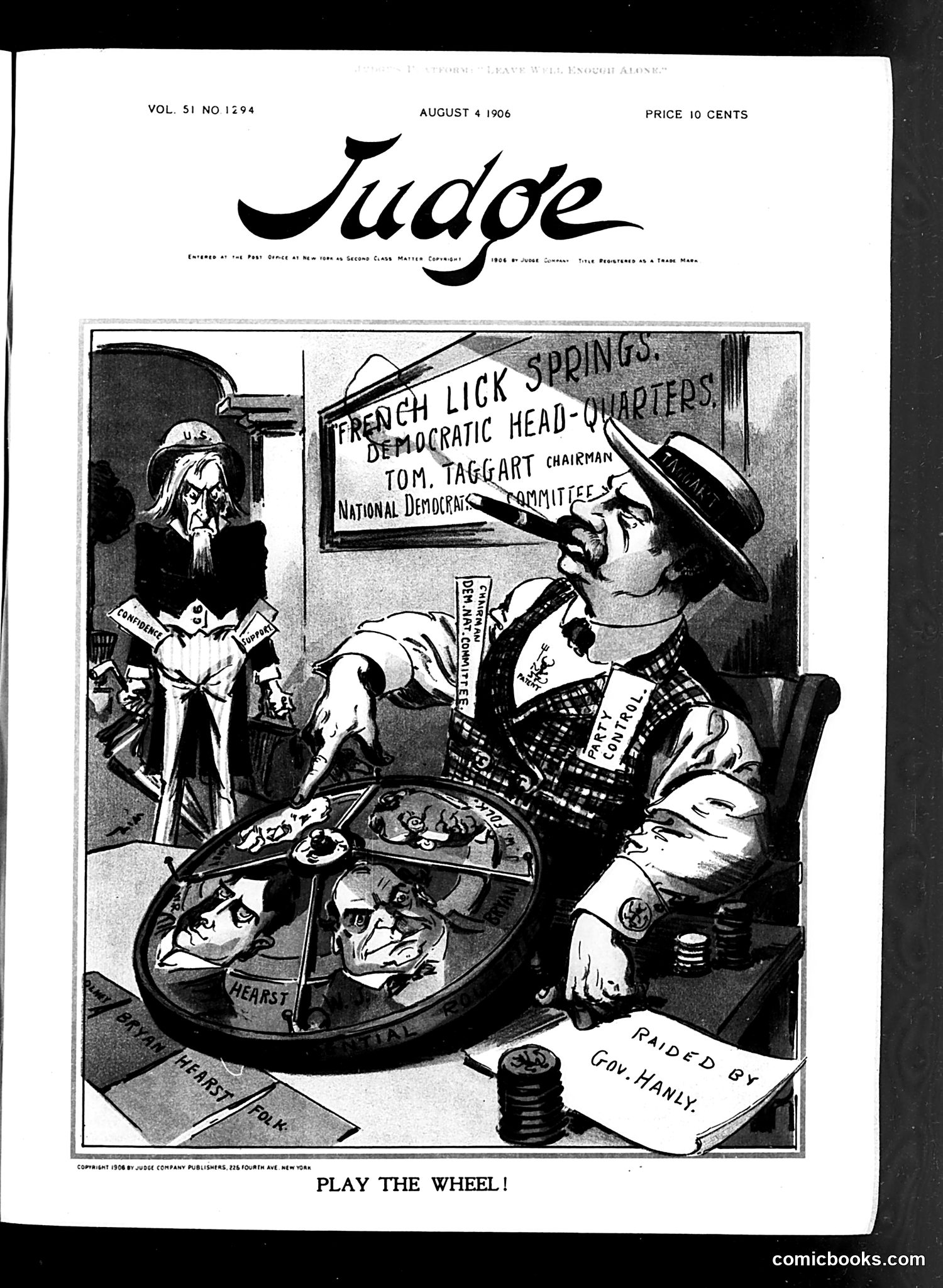
This political cartoon satirizes Democratic Party leadership as a gambling operation. A cowboy (labeled "Raided by Gov. Hanly") discovers the "French Lick Springs Democratic Head-Quarters" with Tom Taggart as "Chairman of National Democratic Committee." The cartoon depicts a fortune-telling wheel divided into sections labeled with political figures' names and traits like "Hearst" and "Tammany." A witch-like figure represents the Democratic establishment offering the wheel to the cowboy—essentially portraying Democratic politics as a rigged game of chance rather than legitimate governance. The joke suggests Democratic leadership under Taggart was corrupt and unprincipled, manipulating outcomes through deception rather than genuine political principle. Governor Hanly's raid adds contemporary law-enforcement legitimacy to the critique.
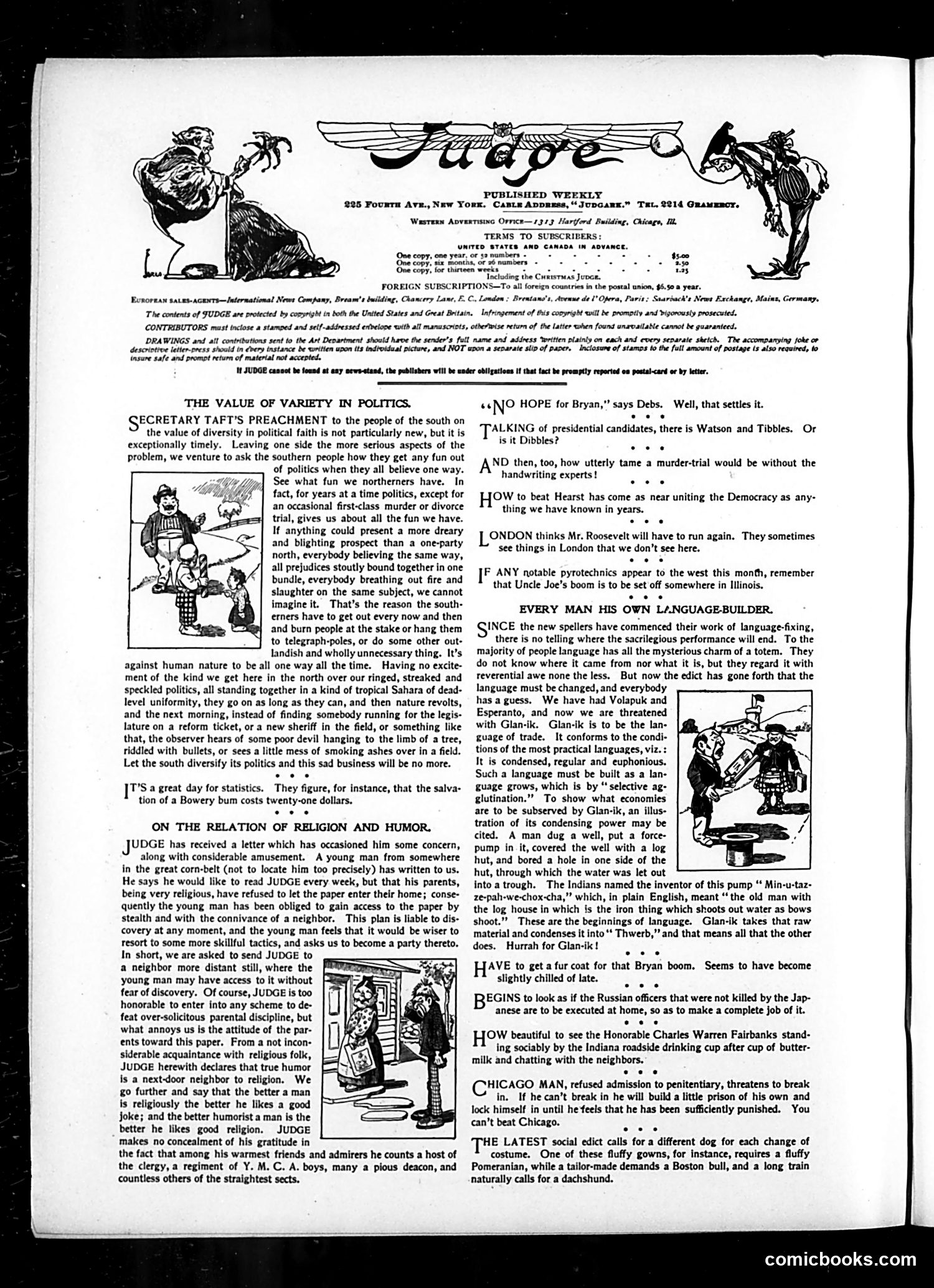
This page contains several satirical pieces commenting on early 20th-century American politics and social issues. **Main cartoon (top left):** Depicts Secretary Taft addressing the South about political diversity. The satire mocks how northern and southern politicians, despite fundamental disagreements, cooperate on most issues—suggesting their conflicts are performative rather than genuine. **"Every Man His Own Language" section:** Satirizes the proliferation of artificial languages (Volapük, Esperanto mentioned) as impractical solutions to communication barriers. The lengthy commentary ridicules these linguistic experiments as unnecessarily complex. **Remaining items:** Brief political quips about Bryan, Roosevelt, and various social observations—typical of Judge's miscellaneous satirical commentary format. The overall tone reflects Progressive-era skepticism toward both political hypocrisy and utopian technological/linguistic solutions.
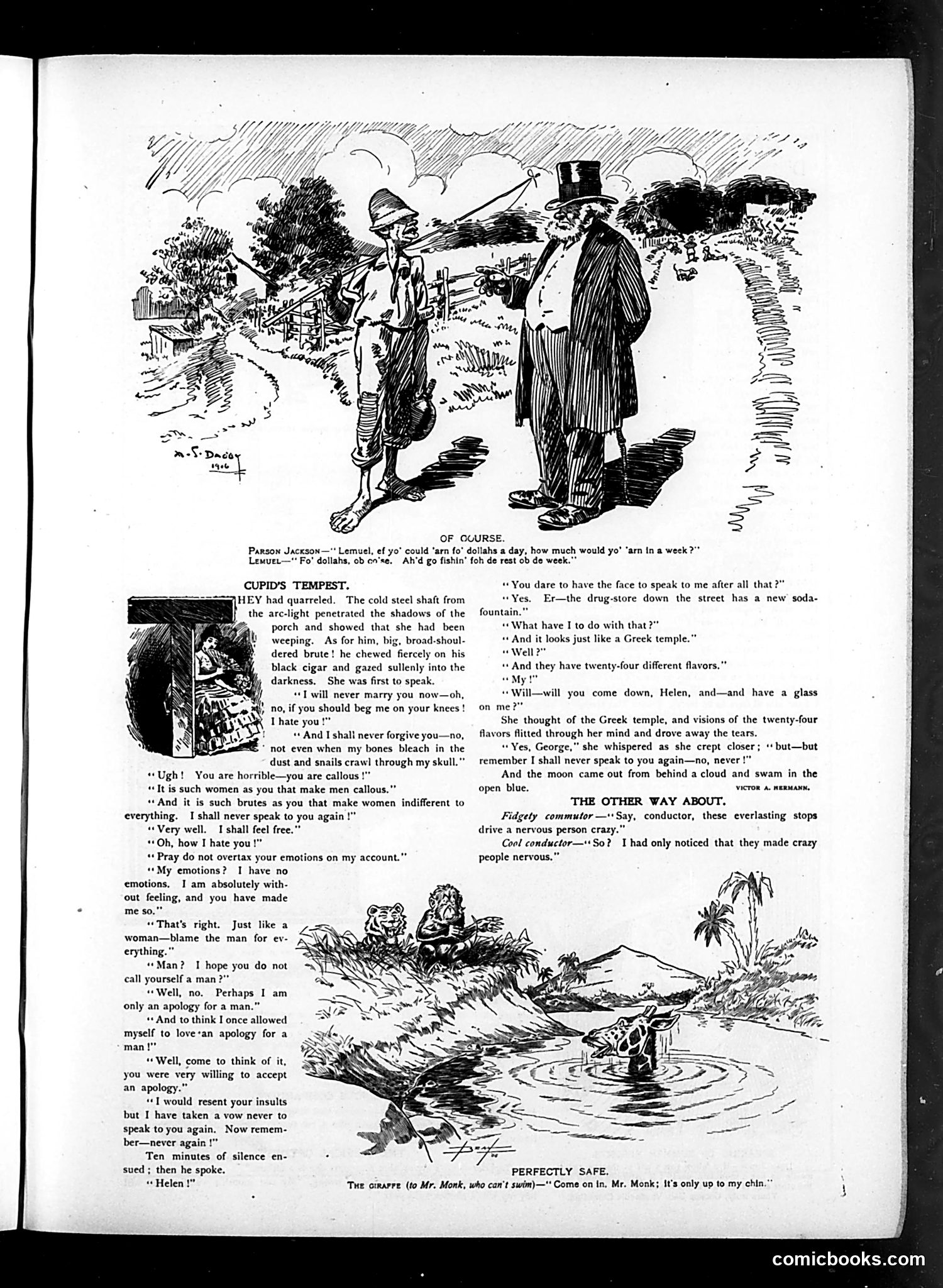
The top cartoon depicts two men in rural/farm setting with the caption "Of Course." It's a joke about earning potential: a farmer (Parson Jackson) asks a laborer (Lemuel) how much he'd earn in a week doing farm work. Lemuel responds he could make more money fishing—apparently a commentary on relative wages or labor preferences in agricultural America. The middle section contains a dramatic narrative dialogue between a man and woman, involving accusations of callousness and emotional hurt—appears to be satirizing romantic or marital conflict. The bottom cartoon, "Perfectly Safe," shows giraffes in water with the caption joke about safety being "only up to my chin"—a visual pun playing on the giraffe's notably long neck. These appear to be humor pieces typical of Judge's general satirical approach.
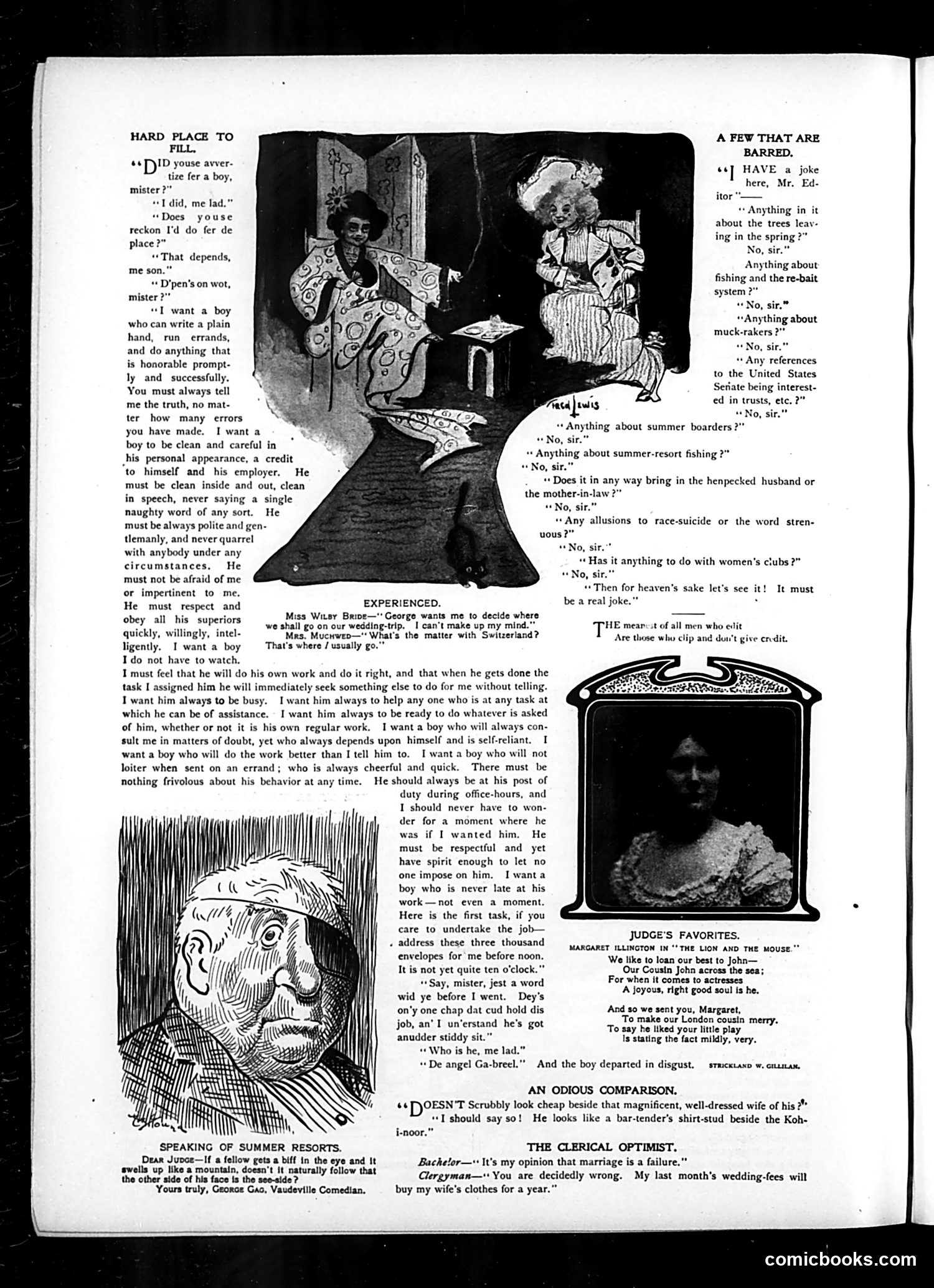
This page contains several distinct satirical pieces: **"Hard Place to Fill"** (left): A dialogue about hiring a boy for domestic service, satirizing the difficulty of finding reliable household help—a common employer complaint in the era when servants were standard. **"Experienced"** (center): A humorous exchange between a couple about an upcoming wedding trip to Switzerland, with the husband making excuses about work obligations. **"A Few That Are Barred"** (right): A joke list mocking what topics are apparently forbidden—trees leaving in spring, fishing systems, muck-rakers, summer boarders, trusts, race-suicide, women's clubs. The humor lies in these being absurdly mundane or slightly risqué subjects someone joked were censored. The remaining items are brief comic anecdotes about various social situations. Overall, the page reflects early 20th-century middle-class anxieties about servants, marriage, and social propriety.
I can see this is a Judge magazine page with two figures in formal attire positioned upside-down relative to each other, with text running vertically along the left margin that reads "Who says I print all the news?" However, I cannot reliably read the complete OCR text or definitively identify the specific figures depicted. The upside-down positioning suggests a visual joke about perspective or contradiction—perhaps commenting on selective news reporting or contradictory statements from public figures. The title phrase implies criticism of journalistic practices. Without being able to confirm the identities of the figures, the specific date, or read the full surrounding text clearly, I cannot accurately explain what political or social event this satirizes. To give you accurate historical context, I would need either clearer text or additional identifying information.
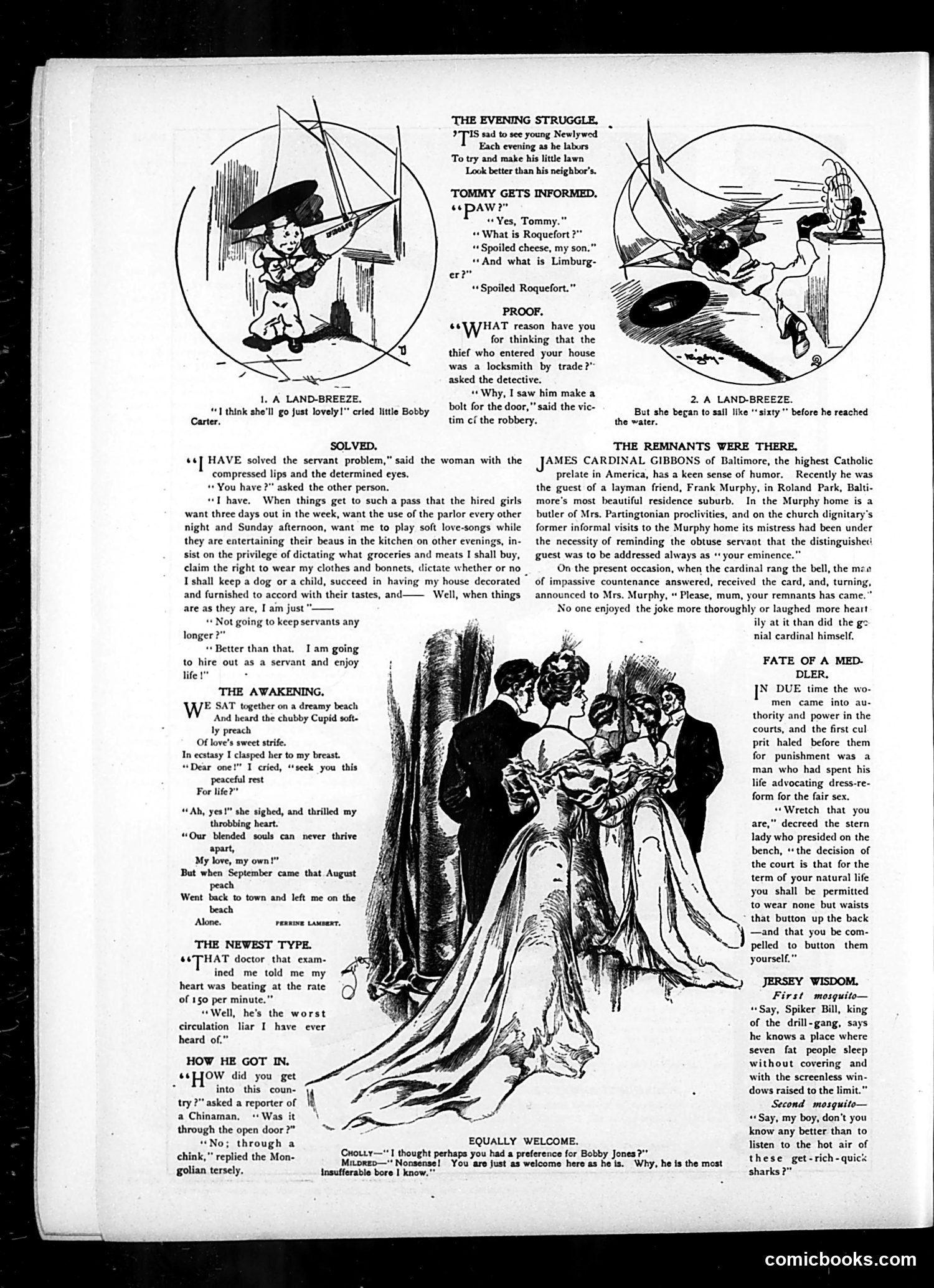
This page from *Judge* magazine (undated, but early 20th century based on style) contains several short humorous pieces typical of the publication: **"The Servant Problem"** satirizes the growing domestic labor crisis—servants demanding better conditions (days off, parlor access, control over groceries). The joke's twist: the exasperated employer decides to become a servant herself to "enjoy life," inverting the class hierarchy. **"The Evening Struggle"** mocks suburban competitive status-seeking among newlyweds obsessing over lawn appearance. **"Tommy Gets Informed"** makes a pun joke about cheese types (Roquefort and Limburg are both "spoiled"). **"The Remnants Were There"** recounts an anecdote about Cardinal Gibbons: a butler, told to address the cardinal as "your eminence," instead announces "your remnants has came"—a malapropism joke playing on the butler's comic incompetence. The other pieces are brief wordplay jokes. The cartoons illustrate domestic scenes and romantic mishaps. The satire targets class tensions, servant independence, domestic aspirations, and social pretension typical of *Judge's* middle-class readership.
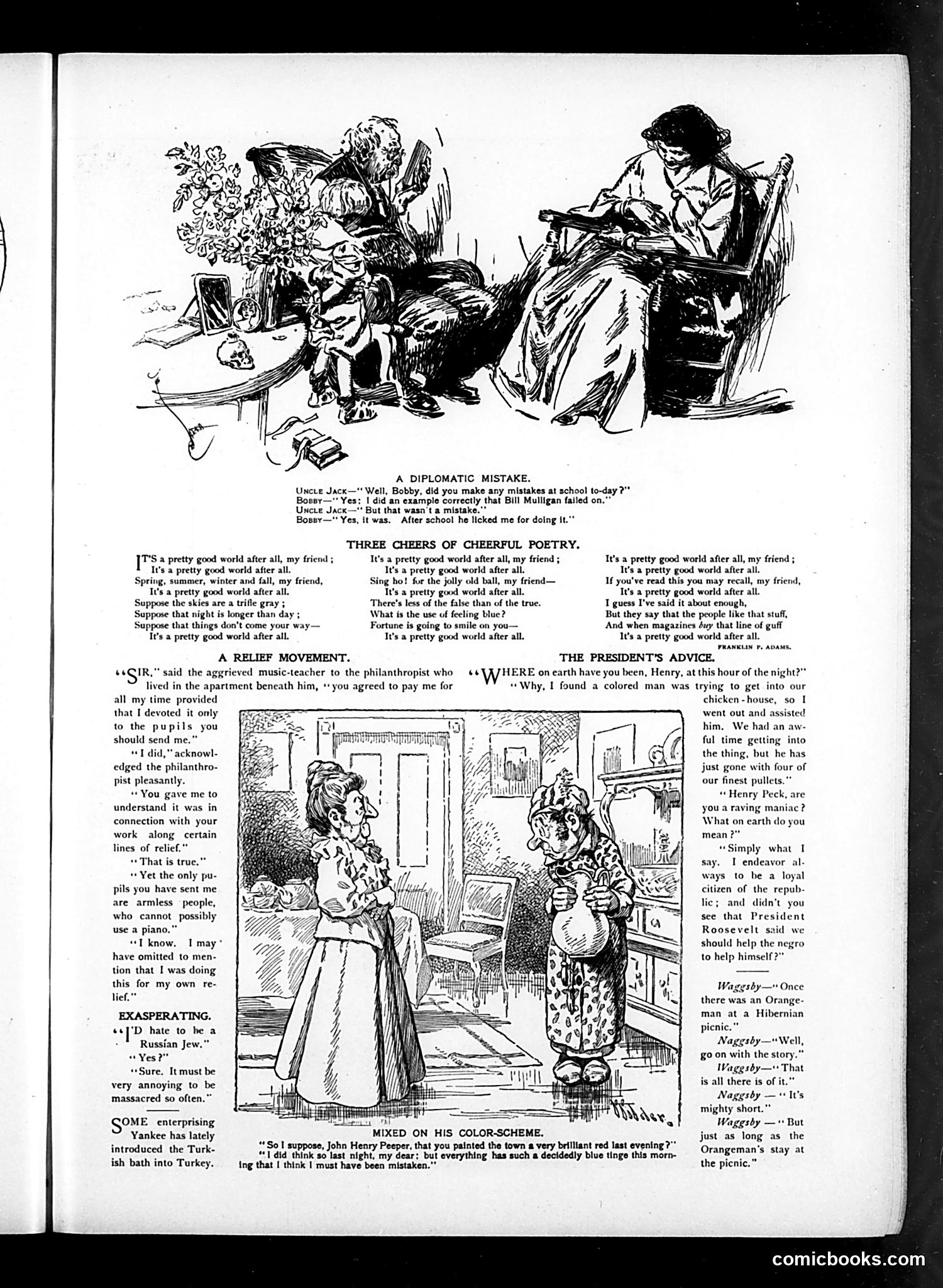
This page contains multiple satirical pieces targeting American social attitudes circa early 1900s: **"A Diplomatic Mistake"** mocks schoolyard violence—a boy gets beaten for outperforming a classmate, suggesting brutish anti-intellectualism was normalized. **"Three Cheers of Cheerful Poetry"** satirizes saccharine optimism, repeating "pretty good world after all" while acknowledging hardship, mocking shallow motivational platitudes. **"A Relief Movement"** jokes about philanthropic hypocrisy: a wealthy man claims to help disabled people while actually using charity as an excuse to escape his music teacher's complaints. **"The President's Advice"** references Theodore Roosevelt's advocacy for racial uplift and self-help. The humor turns dark: a man assists a Black burglar, misinterpreting Roosevelt's call for helping African Americans as justification for aiding actual theft. **Other brief pieces** mock Russian Jewish persecution and Ottoman backwardness, reflecting period prejudices. The page reflects Judge's satirical approach to contemporary social issues through humor often rooted in ethnic and class stereotypes.
This appears to be a single political cartoon, though the OCR text provides minimal context beyond the source attribution "comicbooks.com." The image shows a rotated black-and-white illustration depicting what seems to be a confrontation or dramatic scene between figures. One appears to be wearing official attire or uniform (visible text on clothing suggests "JUDGE" or similar authority marking). The artistic style and composition suggest social or political commentary typical of Judge magazine's satirical approach. However, **without legible text on the image itself or clearer OCR data**, I cannot definitively identify the specific figures, historical event, or satirical point being made. The dramatic positioning and caricature style indicate this critiques contemporary political or social figures, but asserting specifics would require guesswork rather than evidence from the source material.
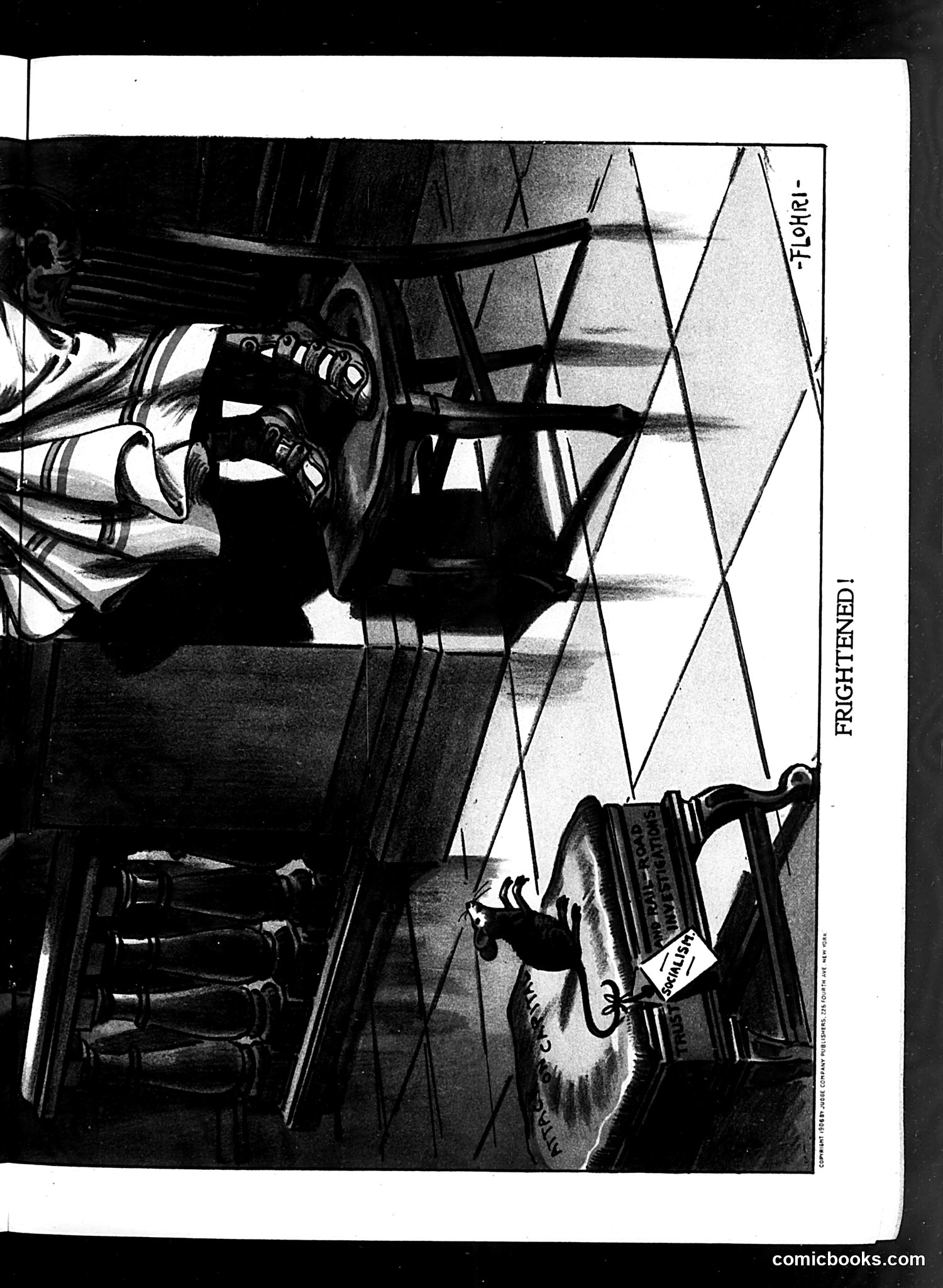
I can see this is a black and white photograph or illustration that appears to be rotated 90 degrees, showing what looks like industrial or mechanical equipment with angular structural elements. The text "FRIGHTENED!" appears on the right margin, and "comicbooks.com" is visible at the bottom. However, I cannot reliably identify specific political figures, caricatures, or satirical references from this image as presented. The OCR text is too minimal to provide context. Without clearer visibility of faces, labels, or captions that would identify the subjects and their satirical meaning, I cannot accurately explain what political or social commentary this Judge magazine page contains. I'd need additional legible text or clearer imagery to give you an accurate historical analysis.
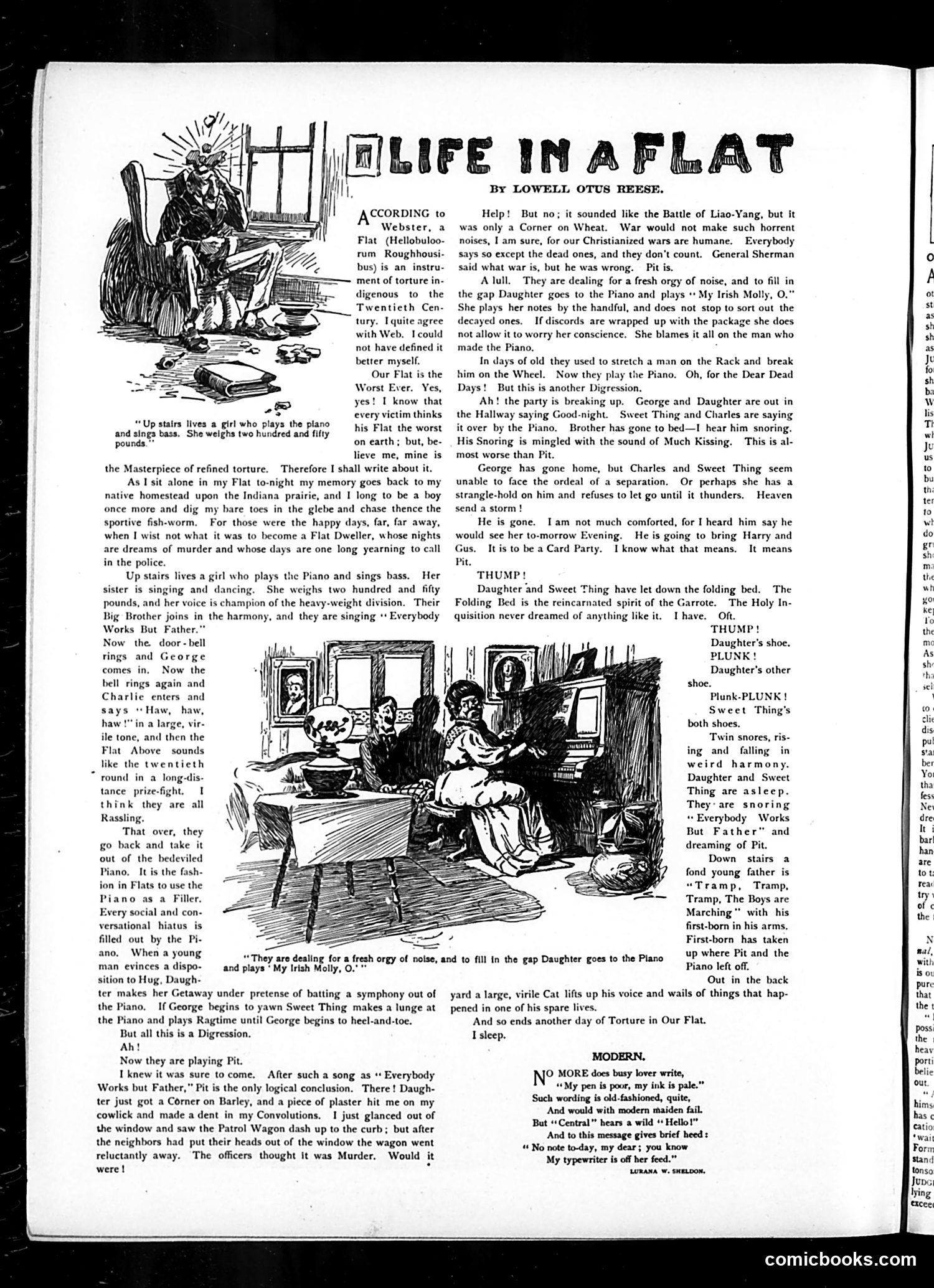
This is a satirical essay with illustrations mocking urban apartment living in early 20th-century America. The narrator laments living in a "Flat" (apartment), comparing it to medieval torture devices. The satire targets: - **Noisy neighbors**: Upstairs lives a heavy woman and her siblings who constantly play piano, sing loudly, and engage in boisterous games like "Pit" (a stock-trading card game that causes chaos) - **Modern urban inconveniences**: The author nostalgically contrasts cramped, noisy apartment life with peaceful Indiana prairie living - **The piano as social crutch**: Flats use pianos to fill conversational gaps—when guests arrive, neighbors yawn, or romantic moments threaten The humor derives from exaggeration: the neighbors' noise rivals the Battle of Liao-Yang (a 1904 Russo-Japanese War battle); plaster falls from ceiling vibrations; even police investigate thinking it's murder. This reflects genuine early-1900s complaints about apartment living—a relatively new, densely-packed urban phenomenon that many found intolerable compared to previous housing.
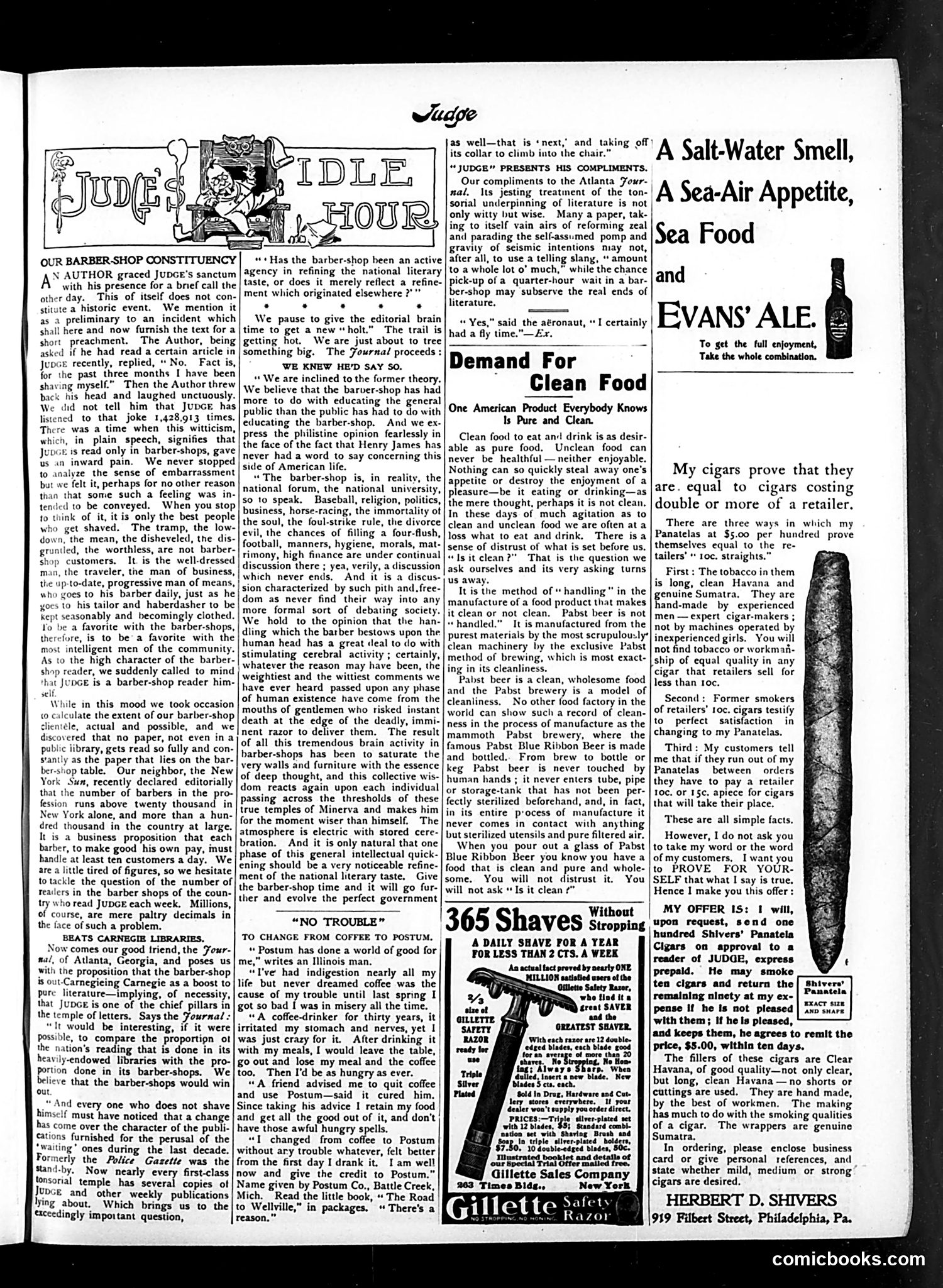
This editorial piece humorously addresses a running joke about Judge magazine—that it's primarily read in barber shops. Rather than dismissing this as an insult, the author reframes it as prestigious: barber-shop customers are well-dressed, educated men of business, making them an intelligent readership. The piece celebrates barber shops as superior to Carnegie libraries for spreading literature, citing over 100,000 barbers nationwide. It notes that barber-shop reading material has improved dramatically—replacing the *Police Gazette* with respectable publications like *Judge*. The satire is self-congratulatory: the magazine defends its "barber-shop constituency" not by denying the association, but by elevating barbers and their customers as society's refined gentlemen. The tongue-in-cheek tone suggests some irony about this defense of what was apparently a common jab at the magazine's readership demographics.
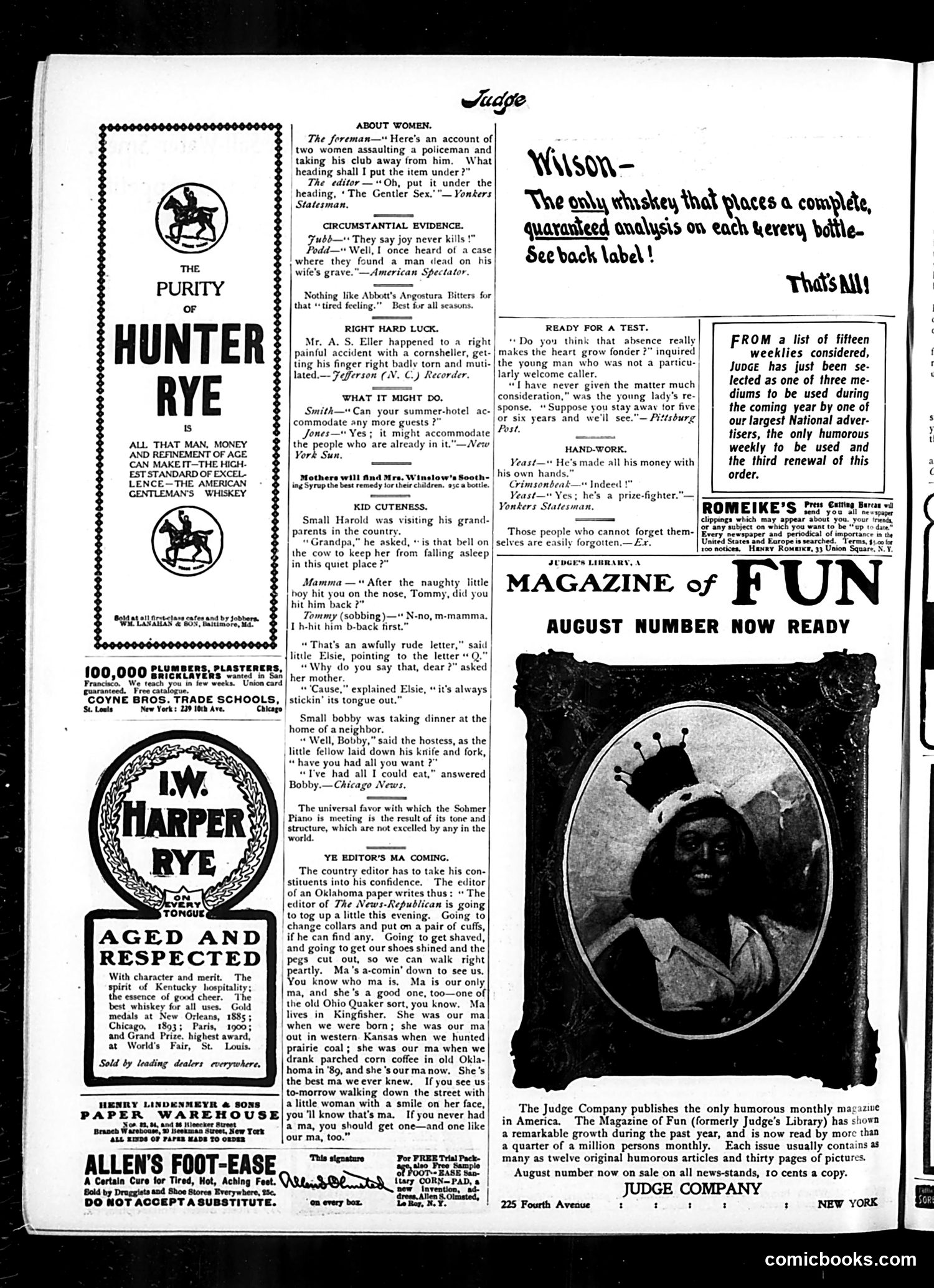
This page from **Judge** magazine consists primarily of **advertisements and humorous short jokes** rather than political cartoons. The main content includes: 1. **Whiskey advertisements** (Hunter Rye, Harper Rye, Wilson) - common in early 20th-century magazines 2. **Short satirical jokes** on domestic life, courtship, and rural scenes - typical Judge humor 3. **Trade school and product ads** (cornsheller accident, piano advertisement) The jokes reflect period concerns: workplace safety, gender relations (the opening joke about women assaulting a policeman appears mildly comedic rather than serious social commentary), and rural/urban contrasts. The page advertises **Judge's Library - Magazine of Fun**, emphasizing it as "the only humorous monthly magazine in America." **No clear political satire is evident** on this particular page - it's primarily light entertainment and advertising typical of American humor magazines from the early 1900s, rather than sharp political commentary.
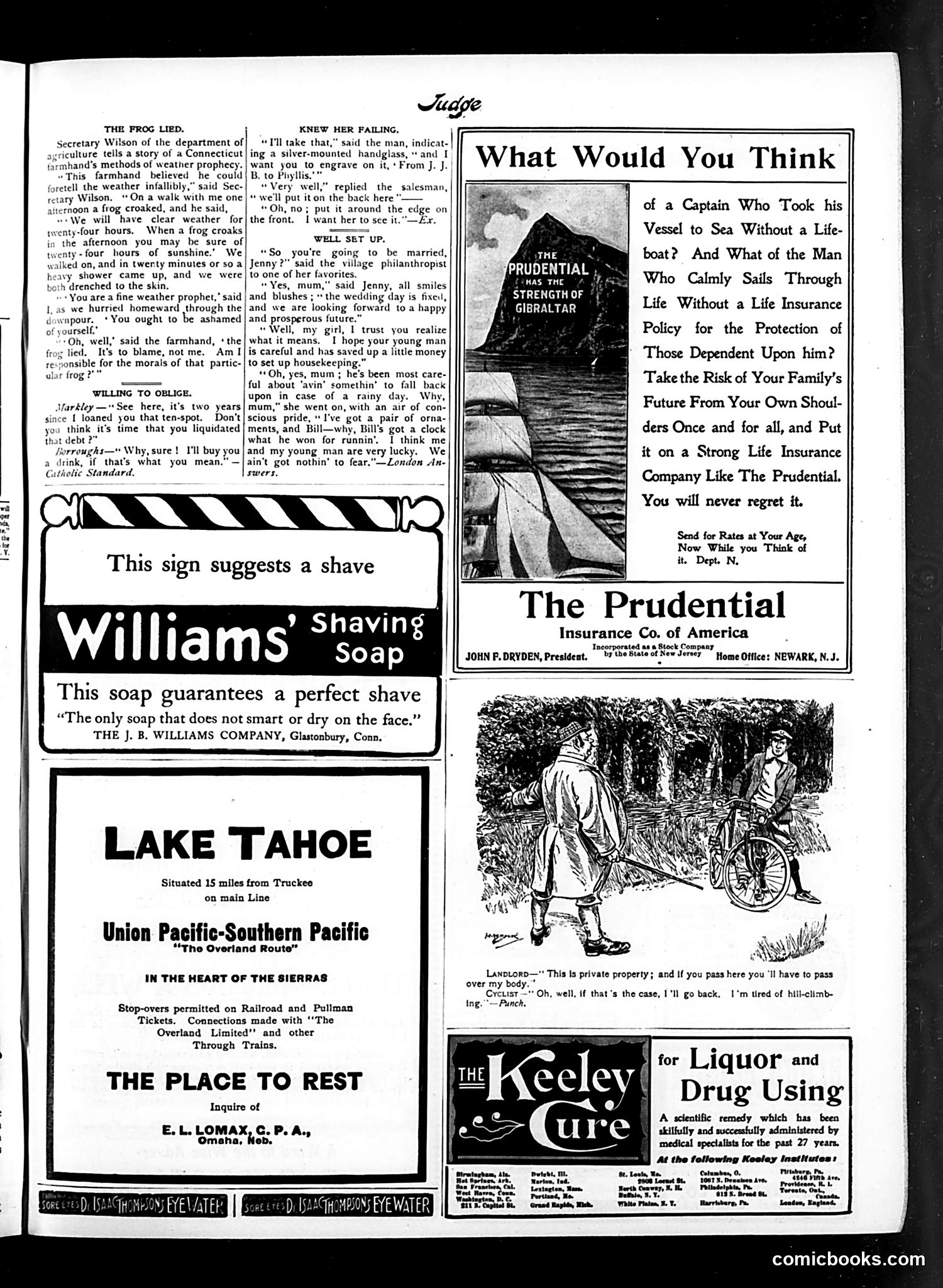
This page is primarily **advertising and humor filler** rather than political satire. It contains several brief anecdotes and jokes typical of early-20th-century magazines: **The main humorous pieces:** - "The Frog Lied" satirizes weather prediction superstitions—a farmhand blames a croaking frog for lying rather than admitting his forecasting method was false - "Willing to Oblige" is a simple joke about misunderstanding: a creditor asks someone to "liquidate" a debt; the debtor offers to buy him a drink instead - "Well Set Up" mocks working-class preparations for marriage—the couple's savings consist only of ornaments and a clock won in a race **The advertisements** dominate: Williams' Shaving Soap, Lake Tahoe tourism, The Prudential Insurance (using fear of leaving dependents unprotected), and The Keeley Cure (treatment for alcoholism/drug addiction). The **cartoon at bottom** shows a landlord confronting a trespasser; the cyclist agrees to leave rather than fight. The page reflects period concerns: superstition, financial carefulness, and substance abuse treatment—but contains no partisan political content.
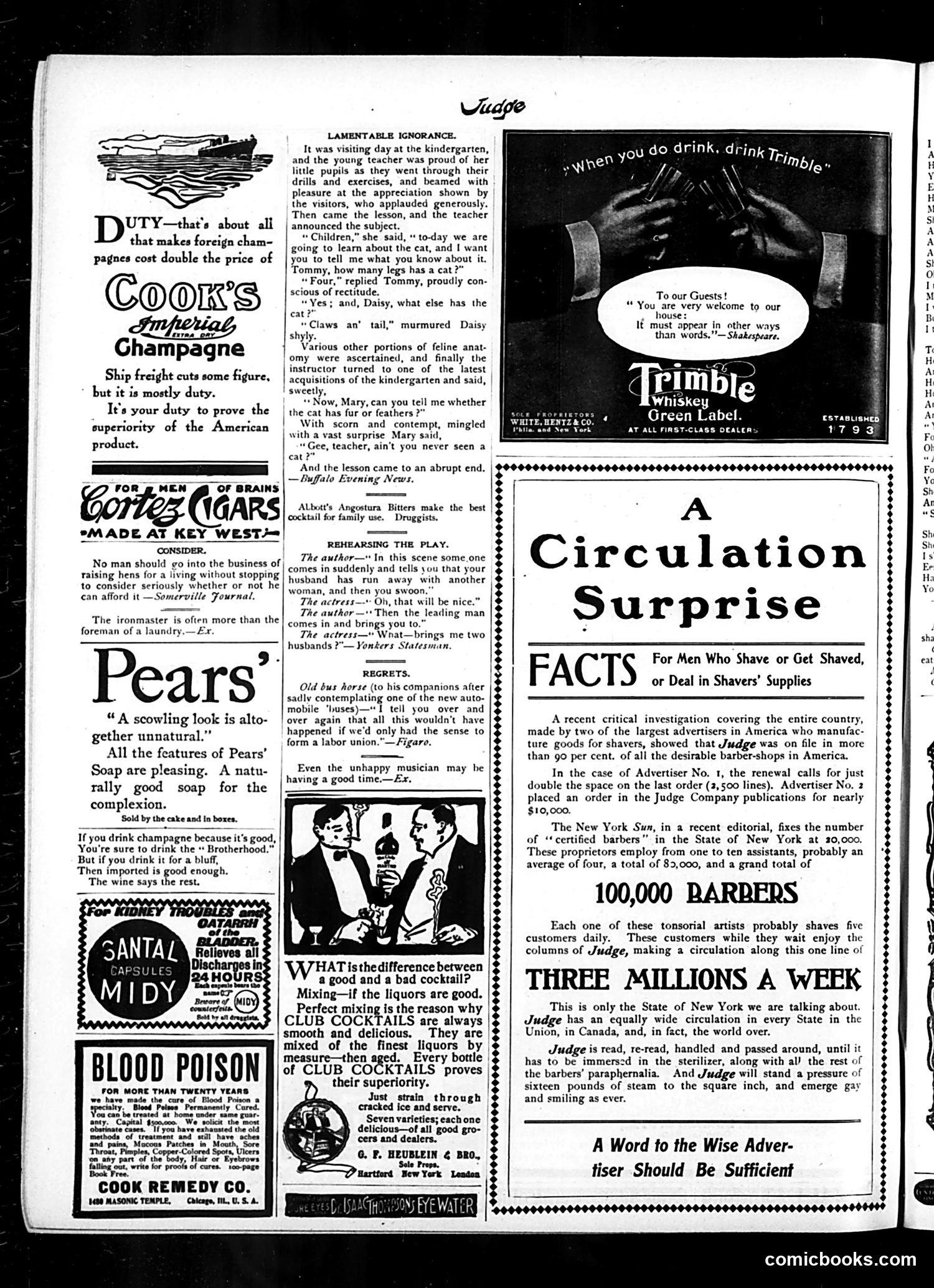
This page is primarily **advertising-driven** with several short humorous anecdotes interspersed. ## Main Content: **"Lamentable Ignorance"** — A kindergarten comedy where a teacher asks children about cats. When she asks if a cat has "fur or feathers," a girl named Mary responds with scorn: "Gee, teacher, ain't you never seen a cat?" The joke satirizes the teacher's absurd question and the child's practical common sense trumping formal instruction. **Brief jokes** mock various social conventions: an ironmaster compared to a laundry foreman, the absurdity of labor unions among horses, and theatrical melodrama. **"Circulation Surprise"** — A substantial advertisement claiming *Judge* magazine reaches 100,000 barbers weekly with a circulation of three million. This advertorial boasts of the magazine's reach among working-class readers. The page's satire is gentle and domestic—poking fun at education, class pretension, and modern anxieties rather than political targets. Most content serves as filler between advertisements for champagne, cigars, soap, and medical remedies (including blood poison "cures").
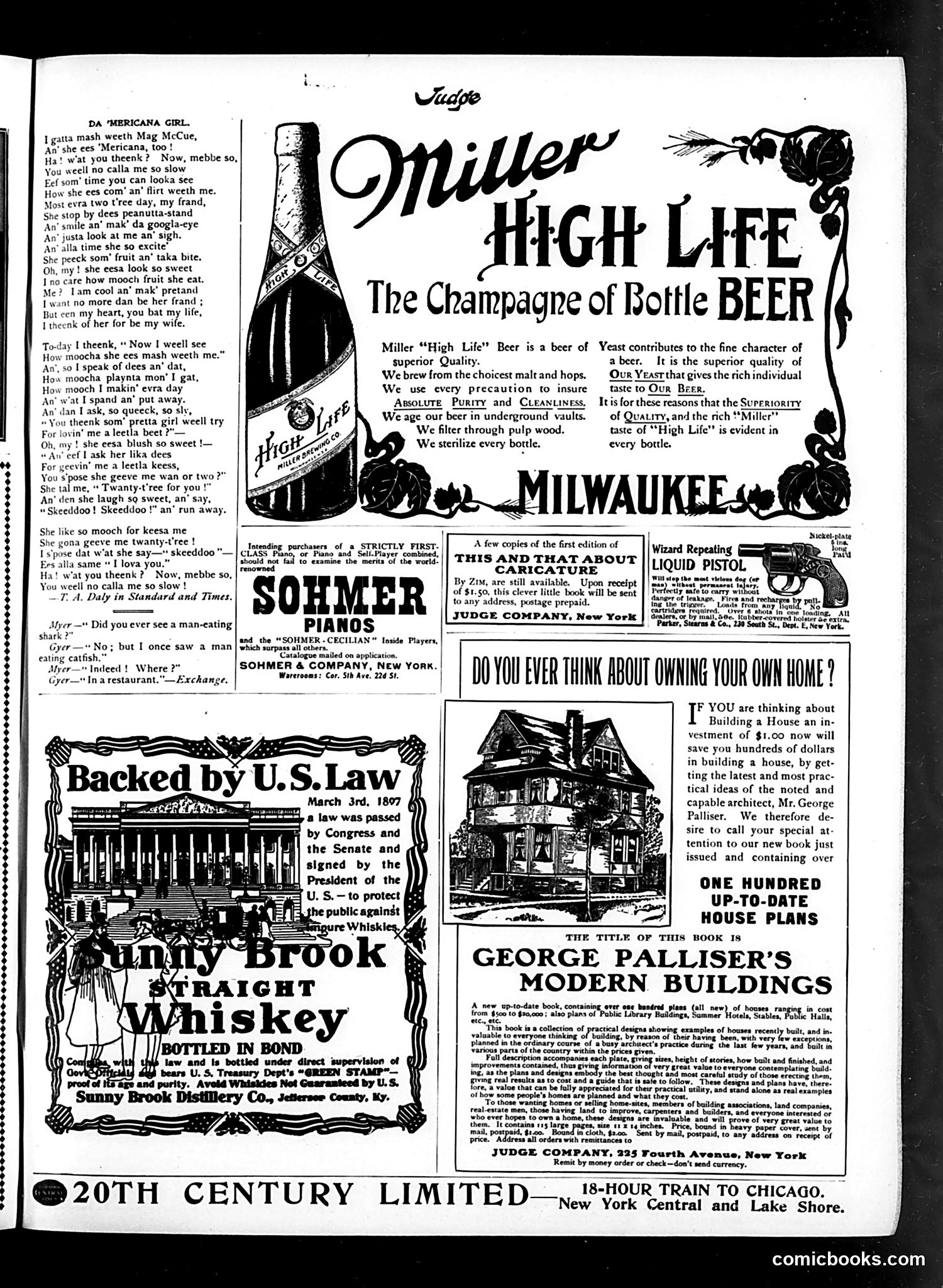
This is primarily an **advertising page** with minimal editorial content. The notable items are: **"DA 'MERICANA GIRL"** (top left): A poem in heavy Italian-immigrant dialect about a young man's romantic pursuit of an Italian-American girl at a fruit stand. The satire relies on ethnic stereotype humor common to the era—exaggerated accent and malapropisms were considered comedic. **Main advertisements include:** - Miller High Life Beer (large, center-left) - Sunny Brook Whiskey ("Backed by U.S. Law," referencing the 1897 law protecting whiskey from adulteration) - Sohmer Pianos - Wizard Repeating Liquid Pistol - George Palliser's Modern Buildings (architectural plans) The page reflects **early 1900s consumer culture** and period attitudes: ethnic humor, patent medicines/weapons marketed casually, and architectural aspirations. There is no significant political cartoon or satire beyond the dialect humor poem.
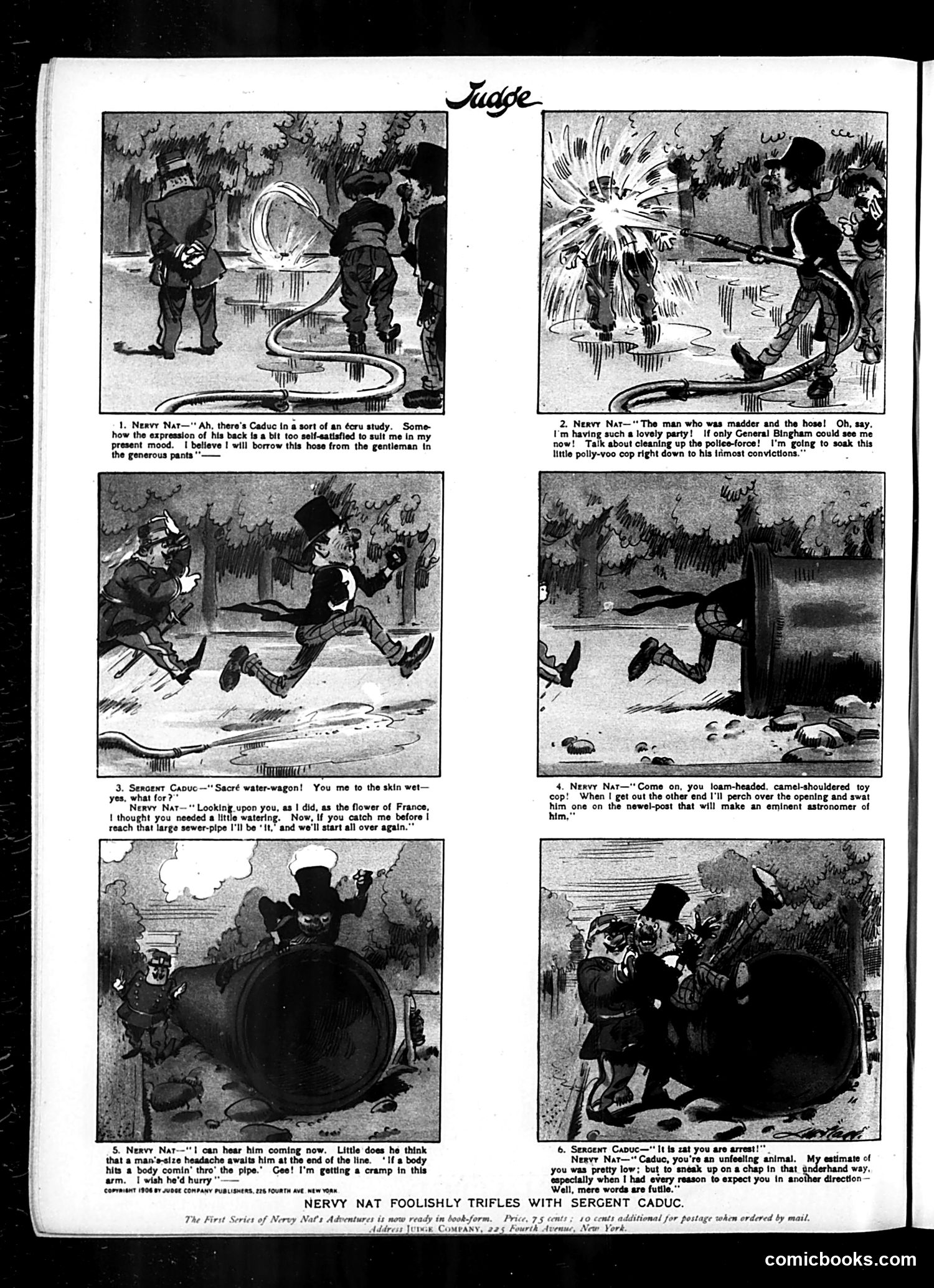
This 1908 comic strip from *Judge* depicts "Nervy Nat" playing pranks on "Sergeant Caduc," a French police officer. The humor centers on Nat stealing the sergeant's fire hose and spraying him, then leading him on a chase through sewers and water pipes while mocking him verbally. The satire appears to target French police ineffectuality and the stereotype of the bumbling foreign cop. References to "General Bingham" (likely Police Commissioner William O'Brien or similar reform-era figure) and "cleaning up the police-force" suggest contemporary American police reform debates. The repeated phrase "sacré" and exaggerated French mannerisms ("polly-voo") reflect period stereotypes of French characters in American comics. The underlying joke: an American protagonist outwits and humiliates a foreign authority figure through pranks and quick thinking—a common theme in early 20th-century American popular humor.