
Judge, 1906-08-04 · page 11 of 16
Judge — August 4, 1906 — page 11: what you’re looking at
What you’re looking at
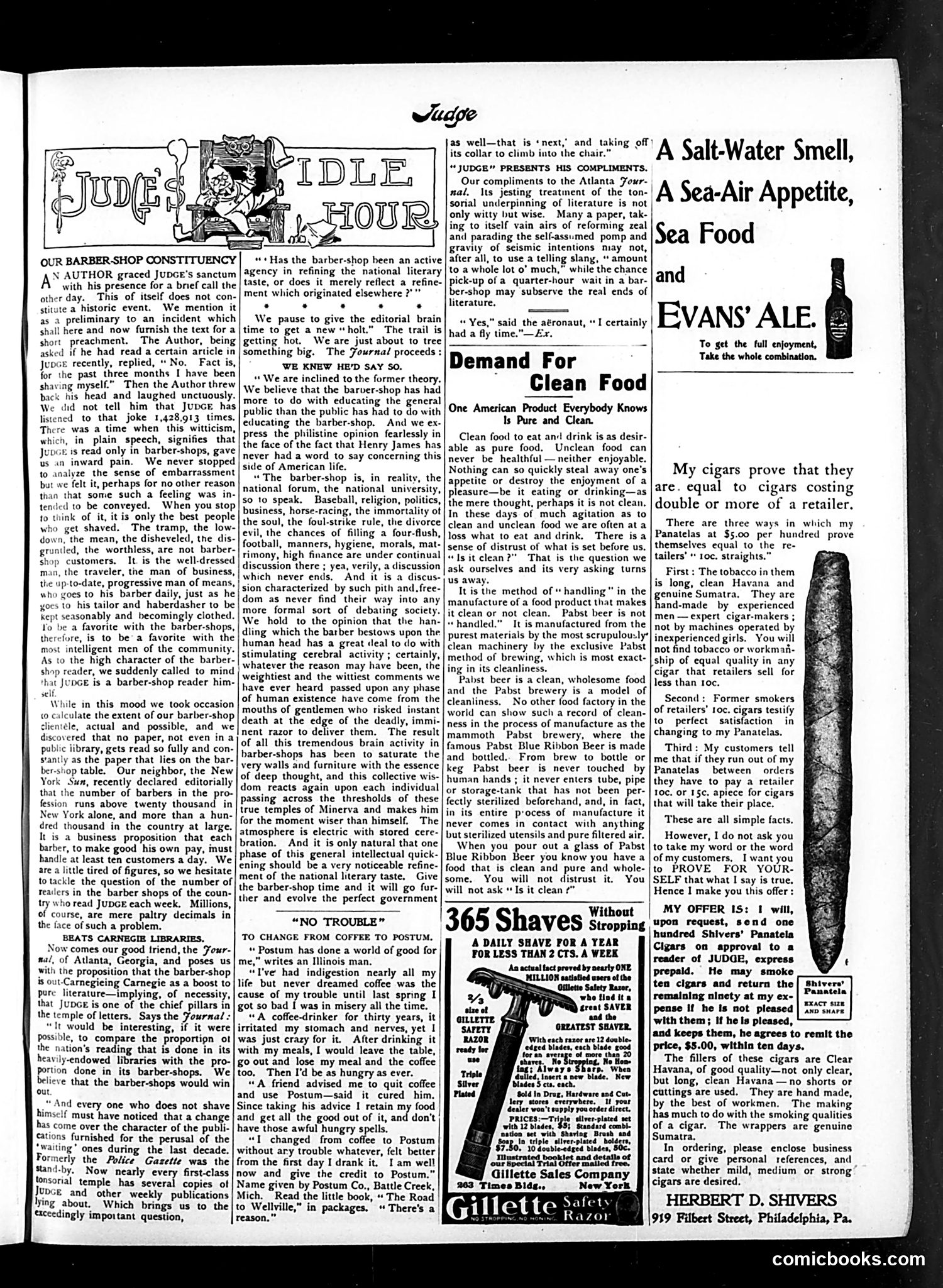
This editorial piece humorously addresses a running joke about Judge magazine—that it's primarily read in barber shops. Rather than dismissing this as an insult, the author reframes it as prestigious: barber-shop customers are well-dressed, educated men of business, making them an intelligent readership. The piece celebrates barber shops as superior to Carnegie libraries for spreading literature, citing over 100,000 barbers nationwide. It notes that barber-shop reading material has improved dramatically—replacing the *Police Gazette* with respectable publications like *Judge*. The satire is self-congratulatory: the magazine defends its "barber-shop constituency" not by denying the association, but by elevating barbers and their customers as society's refined gentlemen. The tongue-in-cheek tone suggests some irony about this defense of what was apparently a common jab at the magazine's readership demographics.
📄 Transcribed text from this page (OCR, searchable)
Machine-transcribed from the original scan — historical spelling and the odd misread are preserved.
wlidpe OUR BARBER-SHOP CONSTITUENCY N AUTHOR graced Jupce's sanctum AY with his presence for a brief call the other day. This of itself does not con- stitute a historic event. We mention it as a preliminary to an incident which Shall here and now furnish the text for a short preachment. The Author, being asked if he had read a certain article in Juoce recently, replied, “No. Fact is, for the past three months I have been shaving myself.” Then the Author threw back his head and laughed unctuously. We did not tell him that JupGE has listened to that joke 1,428,913 times. There was a time when this witticism, which, in plain speech, signifies that Juoce 1s read only in barber-shops, gave vs an inward pain. We never stopped to analyze the sense of embarrassment but we felt it, perhaps for no other reason than that some such a feeling was in- tended to be conveyed. When you stop to think of it, it is only the best people who get shaved. The tramp, the low- the mean, the disheveled, the dis- gruntled, the worthless, are not barber- h It. is the well-dressed man, the traveler, the man of business, the up-to-date, progressive man of means, who goes to his barber daily, just as he yoes to his tailor and haberdasher to be Kept seasonably and becomingly clothed. Yo be a favorite with the barber-shops, therefore, is to be a favorite with the most intelligent men of the community. As to the high character of the barber- shop reader, we suddenly called to mind that JUDGE is a barber-shop reader him- self While in this mood we took occasion o calculate the extent of our barber-shop clientéle, actual and possible, and we discovered that no paper, not even ina public library, gets read so fully and con- s‘antly as the paper that lies on the bar- ber-shop table. Our neighbor, the New York Sum, recently declared editorially that the number of barbers in the pro- fession runs above twenty thousand in New York alone, and more than a hun- dred thousand in the country at large. It is a business proposition that each barber, to make good his own pay, must handle at least ten customers a day. We are a little tired of figures, so we hesitate totackle the question of the number of ry who read JUDGE each week. Millions, of course, are mere paltry decimals in the face of such a problem. BEATS CARNEGIE LIBRARIES. Now comes our good friend, the Four- nai, of Atlanta, Georgia, and poses us with the proposition that the barber-shop is out-Carnegieing Carnegie as a boost to pure literature—implying, of necessity, that JUDGE is one of the chief pillars in the temple of letters. Says the Fournal : “It would be interesting, if it were Possible, to compare the proportion ot the nation’s reading that is done in its heavily-endowed libraries with the pro- portion done in its barber-shops. We believe that the barber-shops would win out And every one who does not shave himself must have noticed that a change has come over the character of the publi- cations furnished for the perusal of the ‘waiting’ ones during the last decade. Formerly the Police Gazette was the Stand-by, Now nearly every first-class tonsorial temple has several copies of Juvce and other weekly publications lying about. Which brings us to the exceedingly important question, “+ Has the barber-shop been an active agency in refining the national literary taste, or does it merely reflect a refine- ment which originated elsewhere 2°” . . * . We pause to give the editorial b time to get a new “holt.” The trail is getting hot. We are just about to tree something big. The Yournat proceeds : WE KNEW HE'D SAY SO. “ We are inclined to the former theory. We believe that the barver-shop has had more to do with educating the general public than the public has had to do with educating the barber-shop. And we ex- press the philistine opinion fearlessly in the face of the fact that Henry James has never had a word to say concerning this side of American life. “The barber-shop is, in reality, the national forum, the national university, so to speak. Baseball, religion, politics, business, horse-racing, the immortality of the soul, the foul-strike rule, the divorce evil, the chances of filling a four-flush, football, manners, hygiene, morals, mat- rimony, high finance are under continual discussion there ; yea, verily, a discussion which never ends. And it is a discus- sion characterized by such pith and. free- dom as never find their way into any more formal sort of debating society. We hold to the opinion that the han- dling which the barber bestows upon the human head has a great «eal to do with stimulating cerebral’ activity ; certainly, | whatever the reason may have been, the weightiest and the wittiest comments we have ever heard passed upon any phase of human existence have come from the mouths of gentlemen who risked instant death at the edge of the deadly, immi- nent razor to deliver them. The result of all this tremendous brain activity in barber-shops has been to saturate the very walls and furniture with the essence of deep thought, and this collective wis- dom reacts again upon each individual passing across the thresholds of these true temples of Minerva and makes him for the moment wiser than himself. The atmosphere is electric with stored cere- bration. And it is only natural that one phase of this general intellectual quick- ening should be a very noticeable refine- ment of the national literary taste. Give the barber-shop time and it will go fur- ther and evolve the perfect government “NO TROUBLE” TO CHANGE FROM COFFEE TO POSTUM. ostum has done a world of good for me,” writes an Illinois man. ve had indigestion nearly all my life but never dreamed coffee was the cause of my trouble until last spring I got so bad I was in misery all the time. A coffee-drinker for thirty years, it irritated my stomach and nerves, yet I was just crazy for it. After drinking it with my meals, I would leave the table, | go out and lose my meal and the coffee | too. Then I'd be as hungry as ever. | “A friend advised me to quit coffee and use Postum—said it cured him. Since taking his advice I retain my food and get all the good out of it, and don't | have those awful hungry spells. I changed from coffee to Postum without ary trouble whatever, felt better from the first day I drank it, I am well now and give the credit to Postum.” Name given by Postum Co., Battle Creek, Mich. “Read the little book, « The Road to Wellville,” in packages.’ «There's a reason.” as well—that is ‘next,’ and taking off its collar to climb into the chair.” “JUDGE” PRESENTS HIS COMPLIMENTS. Our compliments to the Atlanta Your- nal, Its jesting treatment of the ton- sorial underpinning of literature is not only witty but wise. Many a paper, tak- ing to itself vain airs of reforming zeal and parading the self-assumed pomp and gravity of seismic intentions may not, after all, to use a telling slang, “ amount to a whole lot o much,” while the chance pick-up of a quarter-hour wait in a bar- ber-shop may subserve the real ends of literature. * Yes," said the aéronaut, I certainly had a fly time."— Demand For Clean Food One American Product Everybody Knows Is Pure and Clean. Clean food to eat ani drink is as desir- able as pure food. Unclean food can never be healthful —neither enjoyable. Nothing can so quickly steal away one’s appetite or destroy the enjoyment of a pleasure—be it eating or drinking—as the mere thought, perhaps it is not clean. In these days of much agitation as to clean and unclean food we are often at a loss what to eat and drink, There isa sense of distrust of what is set before us. “Is itclean?" That is the question we ask ourselves and its very asking turns us away. It is the method of * handling” in the manufacture of a food product that makes it clean or not clean. Pabst beer is not “handled.” It is manufactured from the purest materials by the most scrupulously clean machinery by the exclusive Pabst method of brewing, which is most exact- ing in its cleanliness. Pabst beer is a clean, wholesome food and the Pabst brewery is a model of cleanliness. No other food factory in the world can show such a record of clean- ness in the process of manufacture as the mammoth Pabst brewery, where the famous Pabst Blue Ribbon Beer is made and bottled. From brew to bottle or keg Pabst beer is never touched by human hands ; it never enters tube, pipe or storage-tank that has not been per- fectly sterilized beforehand, and, in fact, in its entire process of manufacture it never comes in contact with anything but sterilized utensils and pure filtered air. When you pour out a glass of Pabst Blue Ribbon Beer you know you have a food that is clean and pure and whole- some. You will not distrust it. You will not ask “Is it clean ¢” Without 365 Shaves Strovping A DAILY SHAVE FOR A YEAR FOR LESS THAN 2 CTS. A WEEK ‘Aa actual fact proved by nearly ONE. MILLIO! Gillette Sales Company 263 Times Bids., New York ’A Salt-Water Smell, A Sea-Air Appetite, Sea Food and |EVANS’ ALE. To get the full enjoyment, Take the whole combination. My cigars prove that they are. equal to cigars costing double or more of a retailer. There are three ways in which my Panatelas at $5.00 per hundred prove themselves equal to the re- tailers’ * toc. straights.” First : The tobacco in them is long, clean Havana and enuine Sumatra, They are and-made by experienced men —expert cigar-makers ; not by machines operated by inexperienced girls. You will not find tobacco or workman- ship of equal quality in any cigar that retailers sell for less than toc. Second: Former smokers of retailers’ toc. cigars testify to perfect satisfaction in changing to my Panatelas. Third: My customers tell me that if they run out of my Panatelas between orders they have to pay a retailer loc. or 15¢. apiece for cigars that will take their place. These are all simple facts. However, I do not ask you to take my word or the word of my customers. I want you to PROVE FOR YOUR- SELF that what I say is true. Hence I make you this offer : MY OFFER IS: | will, upon request, send one hundred Shivers’ Panatela Cigars on approval to a reader of JUDGE, express prepaid, He may smoke ten cigars and return the remaining ninety at my ex- pense if he Is not pleased with them; If he Is pleased, and keeps them, he agrees to remit the price, $5.00, within ten days. The fillers of these cigars are Clear Havana, of good quality—not only clear, but long, clean Havana —no shorts of cuttings are used. They are hand made, by the best of workmen. The making has much to do with the smoking qualities of a cigar. The wrappers are genuine Sumatra, In ordering, please enclose business card or gi rsonal references, and state whether mild, medium or strong cigars are desired. HERBERT D. SHIVERS 919 Filbert Street, Philadelphia, Pa. Exact sue comicbooks.com