
A complete issue · 18 pages · 1906
Judge — July 14, 1906
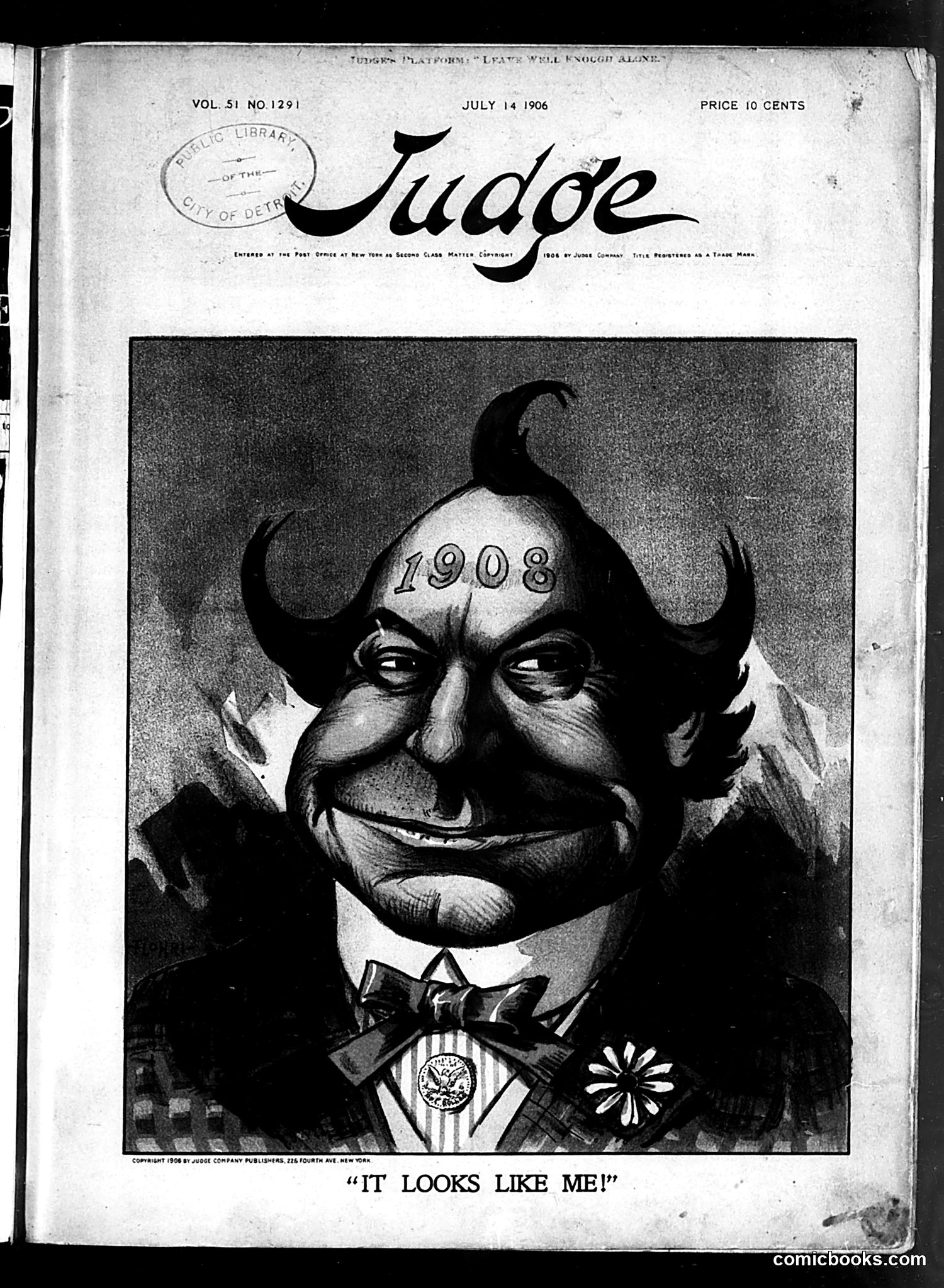
This cover depicts a grotesque demon or devil figure marked with "1908"—referring to the upcoming 1908 U.S. presidential election. The creature's caption reads "It Looks Like Me," suggesting the image represents a political threat or undesirable outcome voters feared for that election cycle. The devil's formal attire (bow tie, medals, formal dress) creates ironic contrast with its monstrous appearance, a common satirical device mocking political figures or movements as hypocritical or deceptive despite outward respectability. Without additional context from the magazine's articles, the specific target remains unclear—whether this references a particular candidate, political party, or broader social concern dominating 1906 discourse. The image functions as political warning or mockery of something contemporary readers would have immediately recognized.
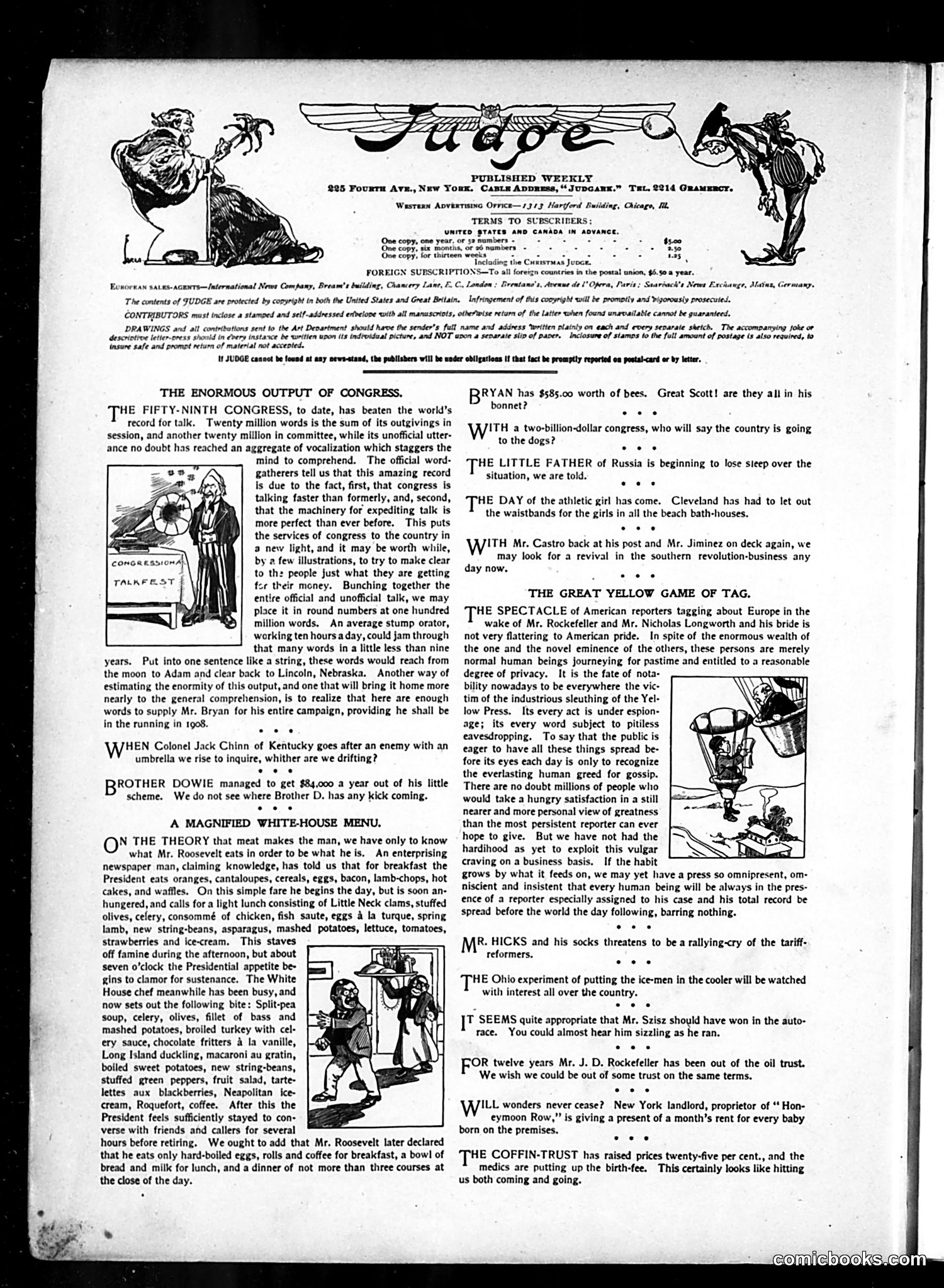
This page contains satirical commentary on early 20th-century American politics and society. The main article "The Enormous Output of Congress" mocks Congress for producing excessive wordiness—twenty million words in session—while accomplishing little. The accompanying cartoon depicts a congressman literally vomiting words, satirizing legislative verbosity. Other brief items target specific figures: "Bryan" (likely William Jennings Bryan) is mocked for his bee-keeping; Colonel Jack Chinn is questioned about wartime actions; and various items criticize trusts and monopolies (Rockefeller's oil trust, the "coffin trust"). The page exemplifies Judge's role as satirical watchdog, using humor to critique political inefficiency, wealthy industrialists, and what it viewed as excessive corporate consolidation during the Progressive Era.
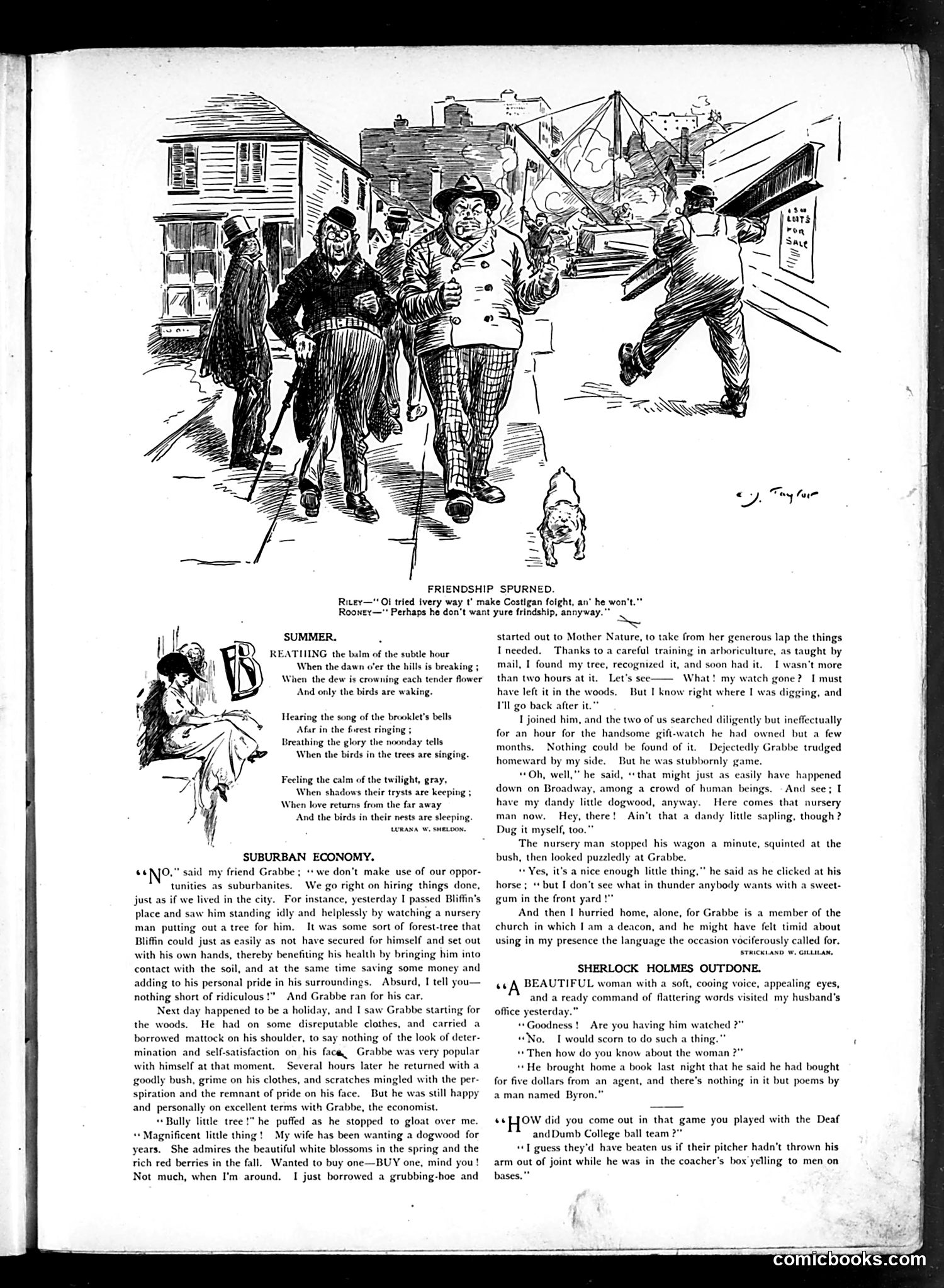
This page contains three separate short stories with accompanying illustrations, rather than political cartoons. **"Friendship Spurned"** depicts a confrontation about a lost watch, satirizing social pretension among working-class characters. **"Summer"** is a sentimental poem about nature, with illustration of a woman in a pastoral setting—standard magazine filler content. **"Suburban Economy"** mocks middle-class frugality, showing a man (Grabbie) who borrows a nursery man's labor to plant a tree himself, then brags about the savings while his wife admires flowers she won't buy. This satirizes penny-pinching hypocrisy among suburbanites. **"Sherlock Holmes Outshone"** references the fictional detective, apparently comparing amateur deduction to literary mysteries. The page is primarily literary/narrative humor rather than political satire.
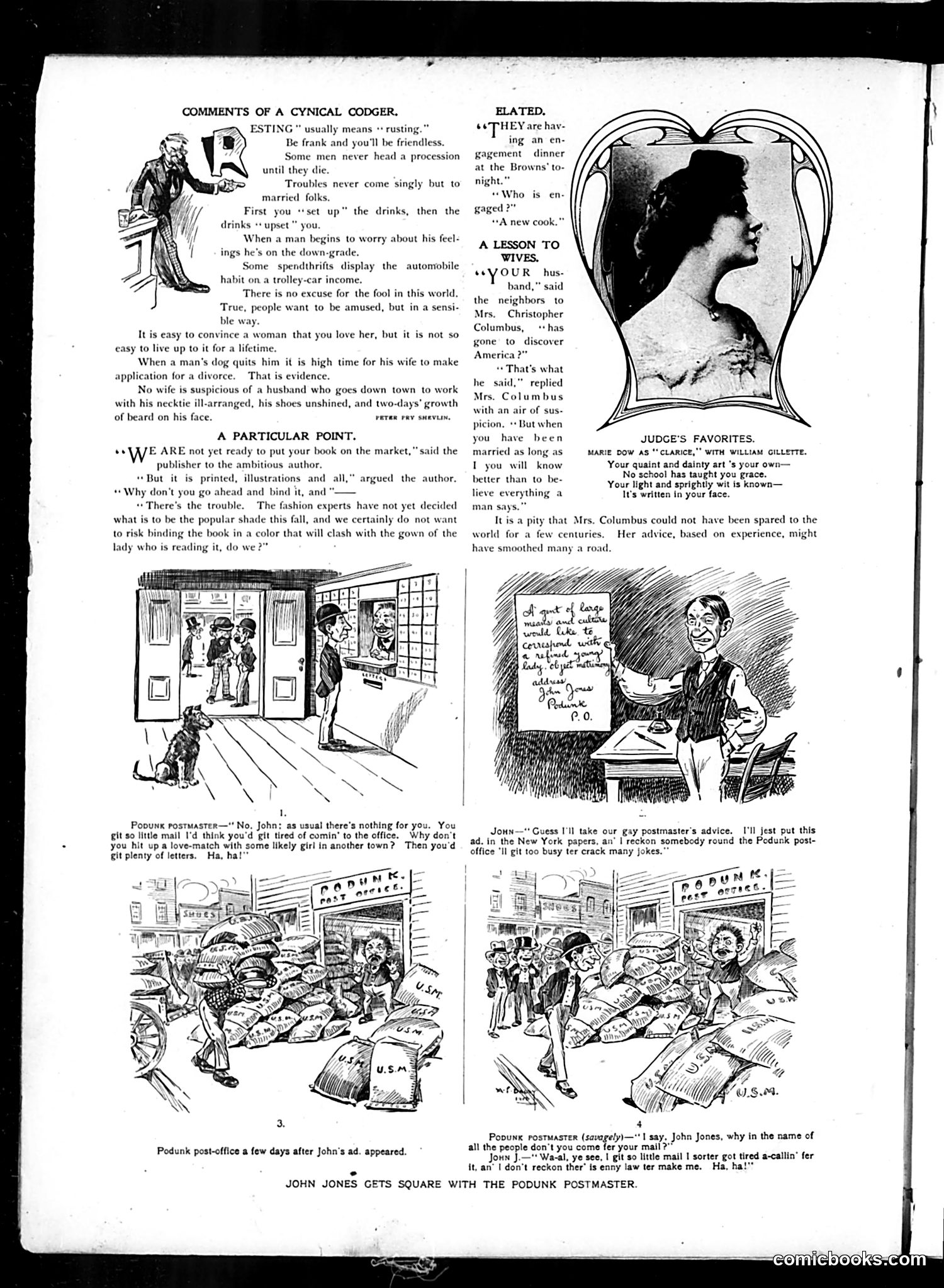
This page contains humor pieces and cartoons satirizing early 20th-century American life. The main story, "John Jones Gets Square with the Fodunk Postmaster," depicts a dispute between a citizen and a small-town postmaster (labeled "Fodunk"). Jones apparently placed a newspaper advertisement seeking romantic companionship, which the postmaster found objectionable or used inappropriately. The cartoons show the postmaster's office before and after Jones's complaint, with mail scattered about. The satire targets small-town bureaucratic hypocrisy and the postmaster's presumed misuse of his position. Other sections include "A Lesson to Wives" and cynical observations about marriage and social behavior. The humor reflects period attitudes toward gender roles, matrimony, and rural American institutions.
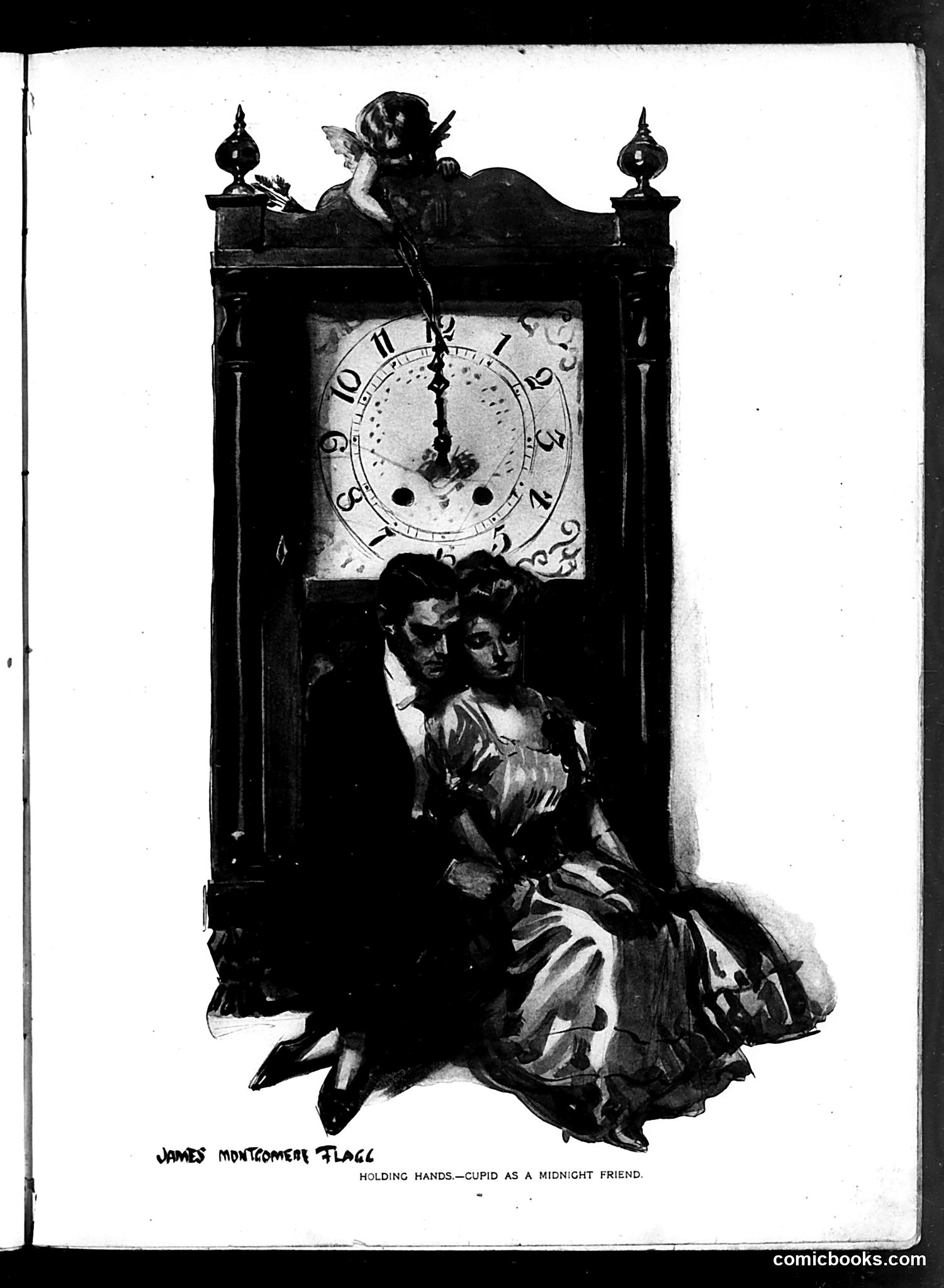
This illustration by James Montgomery Flagg depicts two figures in elaborate dress holding hands beneath an ornate grandfather clock showing midnight. A cherub (Cupid) perches atop the clock, seemingly orchestrating their romantic moment. The "midnight friend" reference suggests this is satirizing late-night romantic encounters or clandestine meetings—likely commentary on contemporary courtship customs or illicit affairs among the wealthy elite. The clock's prominent display emphasizes the secretive, time-bound nature of the rendezvous. Flagg's romanticized yet slightly mocking artistic treatment suggests Judge magazine is gently ridiculing either the pretentiousness of such encounters or broader anxieties about modern dating practices. Without additional context, the specific identities of the figures remain unclear.
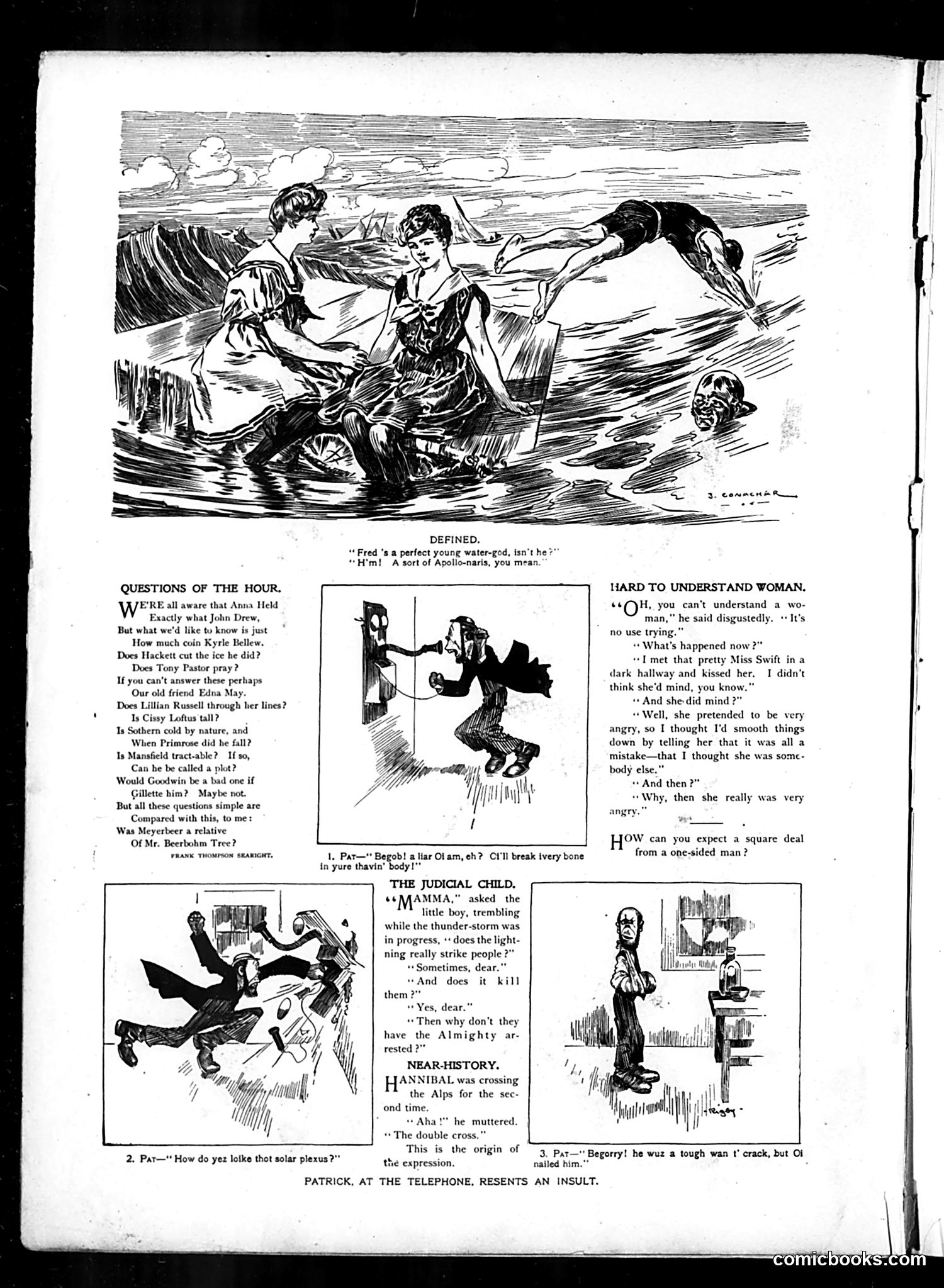
This page from **Judge** (likely early 1900s) contains several distinct humor pieces: **"Questions of the Hour"** lists contemporary theatrical celebrities—Anna Held, John Drew, Kyrle Bellew, Tony Pastor, Edna May, Lillian Russell—whose personal lives and professional reputations were fodder for gossip columns. The joke is that these questions pale beside asking whether composer Meyerbeer was related to actor Beerbohm Tree, a absurdist non-sequitur. **"The Judicial Child"** satirizes childish logic: a boy reasons that if God's lightning kills people, God should be arrested—mocking naive moral absolutism. **"Near-History"** plays on the phrase "double cross," suggesting Hannibal crossed the Alps twice and thus "double-crossed." **"Hard to Understand Woman"** presents a man's bafflement at female psychology—the woman pretended anger when kissed by a stranger, then became genuinely angry when he claimed it was a mistake. The satire targets male obliviousness about women's autonomy. The cartoons show figures in physical altercations (references to "solar plexus" boxing terminology), likely humorous vignettes of working-class violence or slapstick comedy.
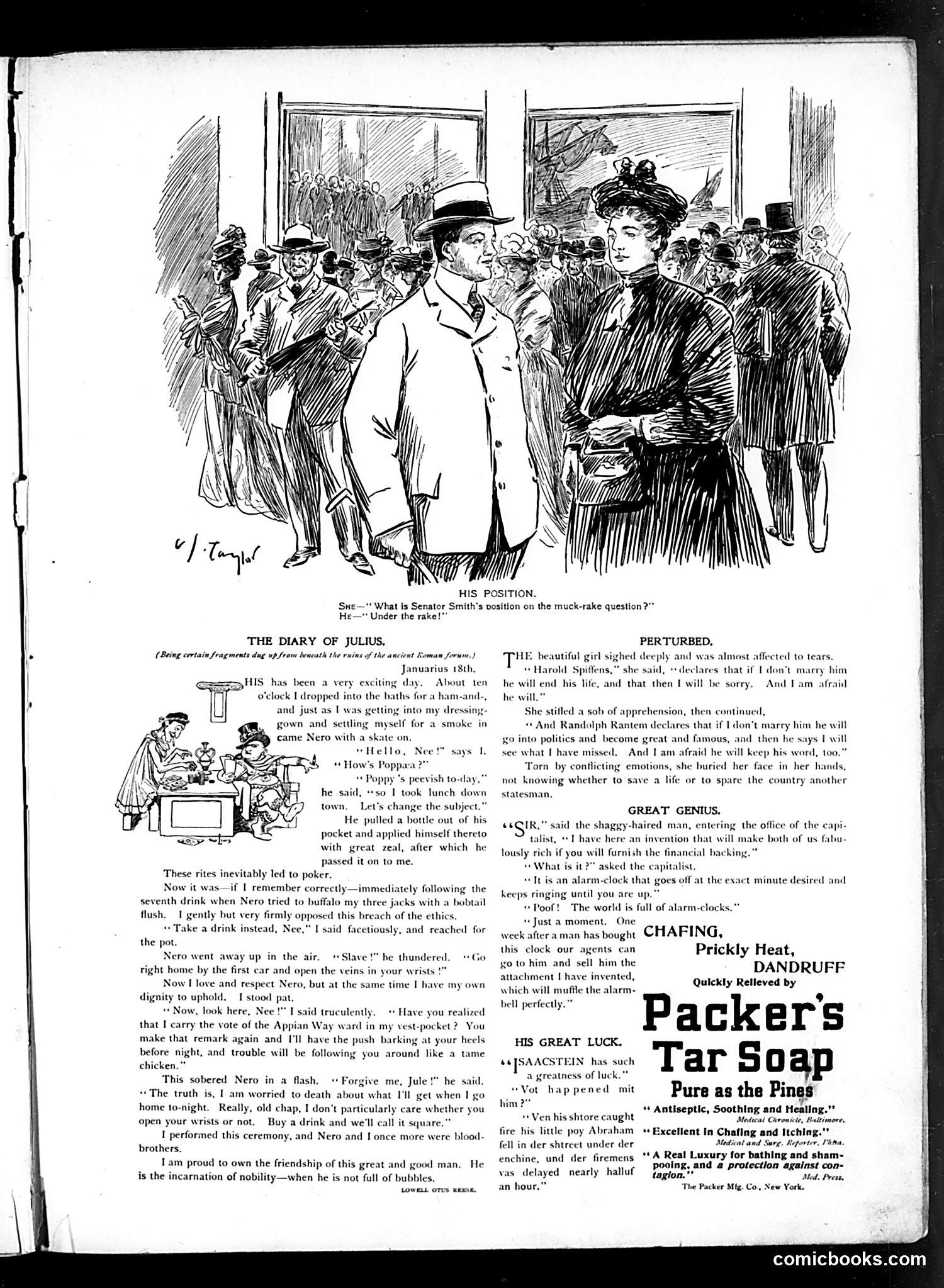
**Top Cartoon: "His Position"** This satirizes Senator Smith's stance on the "muck-rake question"—referring to investigative journalism exposing corruption (a major Progressive Era concern). The joke: when asked Smith's position on muckraking, the answer is "Under the rake!"—meaning he's being crushed by exposés, likely implying he's corrupt and wants the practice stopped. **"The Diary of Julius"** A humorous parallel between ancient Rome (Nero) and contemporary politics. When Julius refuses Nero in poker and mentions controlling "the Appian Way ward," Nero backs down—satirizing how political machine power influences even emperors. The implication: political leverage matters more than imperial authority. **Other Sketches** "Perturbed" jokes about suitors' threats (suicide or entering politics—presented as equally catastrophic). "Great Genius" mocks an alarm-clock scheme's dubious business model. The page largely consists of advertisements (Packer's Tar Soap), indicating Judge's revenue model.
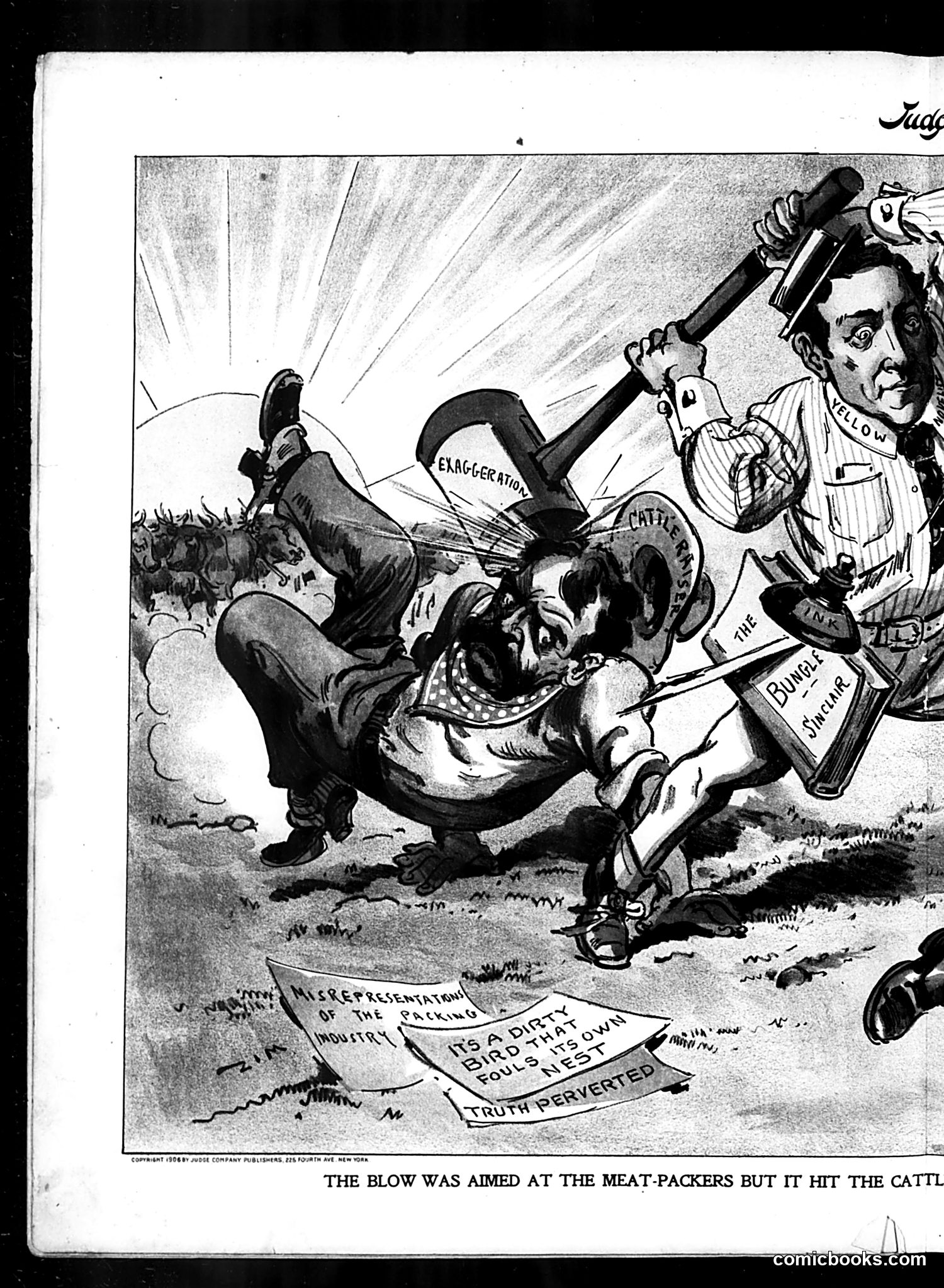
This 1908 **Judge** magazine cartoon satirizes the aftermath of exposés about the meatpacking industry. The figure on the right (likely representing a meat-packer or industry representative) wields a large club labeled "EXAGGERATION" while swinging at what appears to be cattle. Documents on the ground reference "MISREPRESENTATION OF THE PACKING INDUSTRY" and "TRUTH PERVERTED." The cartoon's point: reforms intended to clean up corrupt meatpacking practices backfired, harming cattle ranchers and farmers instead. The industry's counter-attack against critical reporting (labeled "exaggeration") inadvertently damaged the cattle market itself. This likely responds to Upton Sinclair's 1906 *The Jungle* and subsequent regulatory efforts, suggesting the industry's defensive campaign hurt innocent parties rather than addressing legitimate problems.
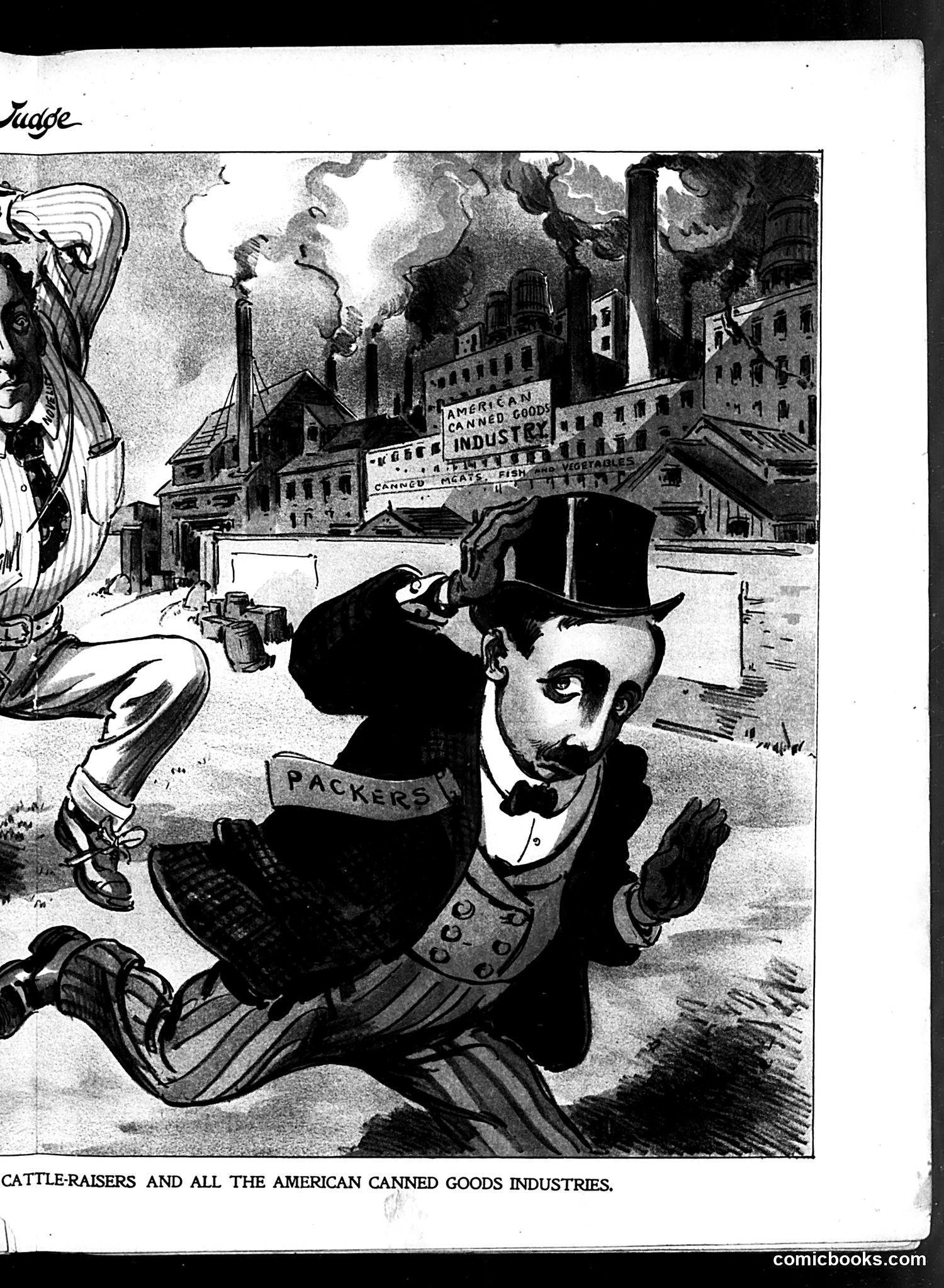
This Judge magazine cartoon satirizes the American meat-packing and canned goods industries. A well-dressed man in a top hat—labeled "PACKERS"—is depicted running frantically away from an industrial complex with smokestacks labeled "American Canned Goods Industry." The cartoon criticizes the meat-packing industry's practices, likely referencing Upton Sinclair's *The Jungle* (1906) or similar exposés of unsanitary conditions and fraudulent food production. The panicked figure suggests the industry's fear of public exposure or regulatory consequences. The caption states the cartoon addresses "cattle-raisers and all the American canned goods industries," indicating it's commentary on food industry accountability and the consequences of their practices being revealed to consumers.
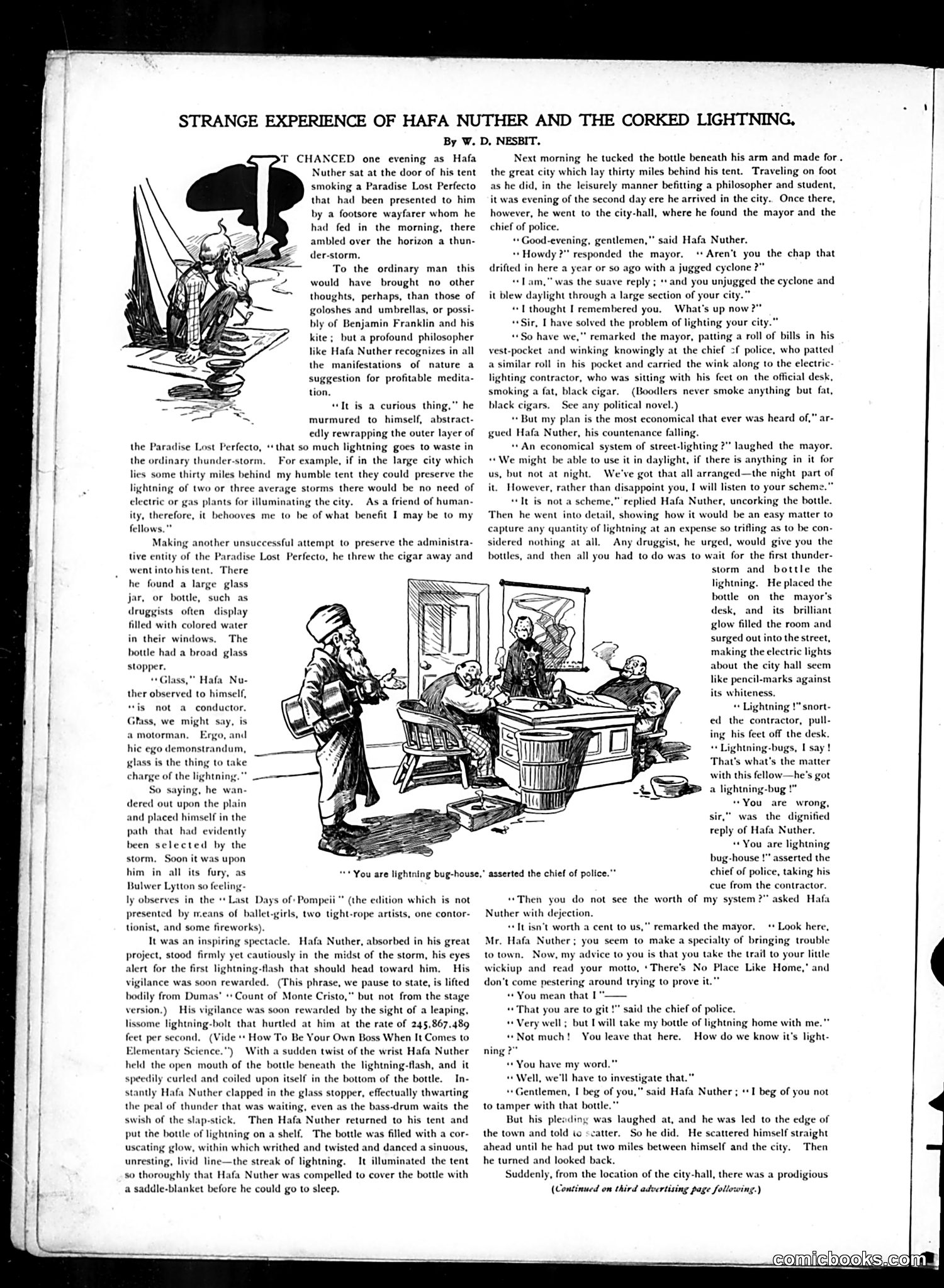
This humorous story satirizes pseudointellectual con artists and municipal inefficiency. Hafa Nuther is a fake philosopher-vagrant who catches lightning in a bottle, claiming to solve the city's electricity shortage. The satire targets two things: **First**, gullible acceptance of pseudo-scientific nonsense by authority figures—the mayor initially buys Nuther's absurd claims about capturing lightning for urban illumination. **Second**, municipal corruption and waste. The mayor reveals he already has "a similar roll in his pocket"—suggesting bureaucrats are already pocketing taxpayer money through bogus lighting contracts with fraudulent "contractors." The chief of police's dismissal ("lightning bug-house") represents common sense finally prevailing. The joke: officials are more interested in economical schemes than actually serving citizens, making them vulnerable to charlatans.
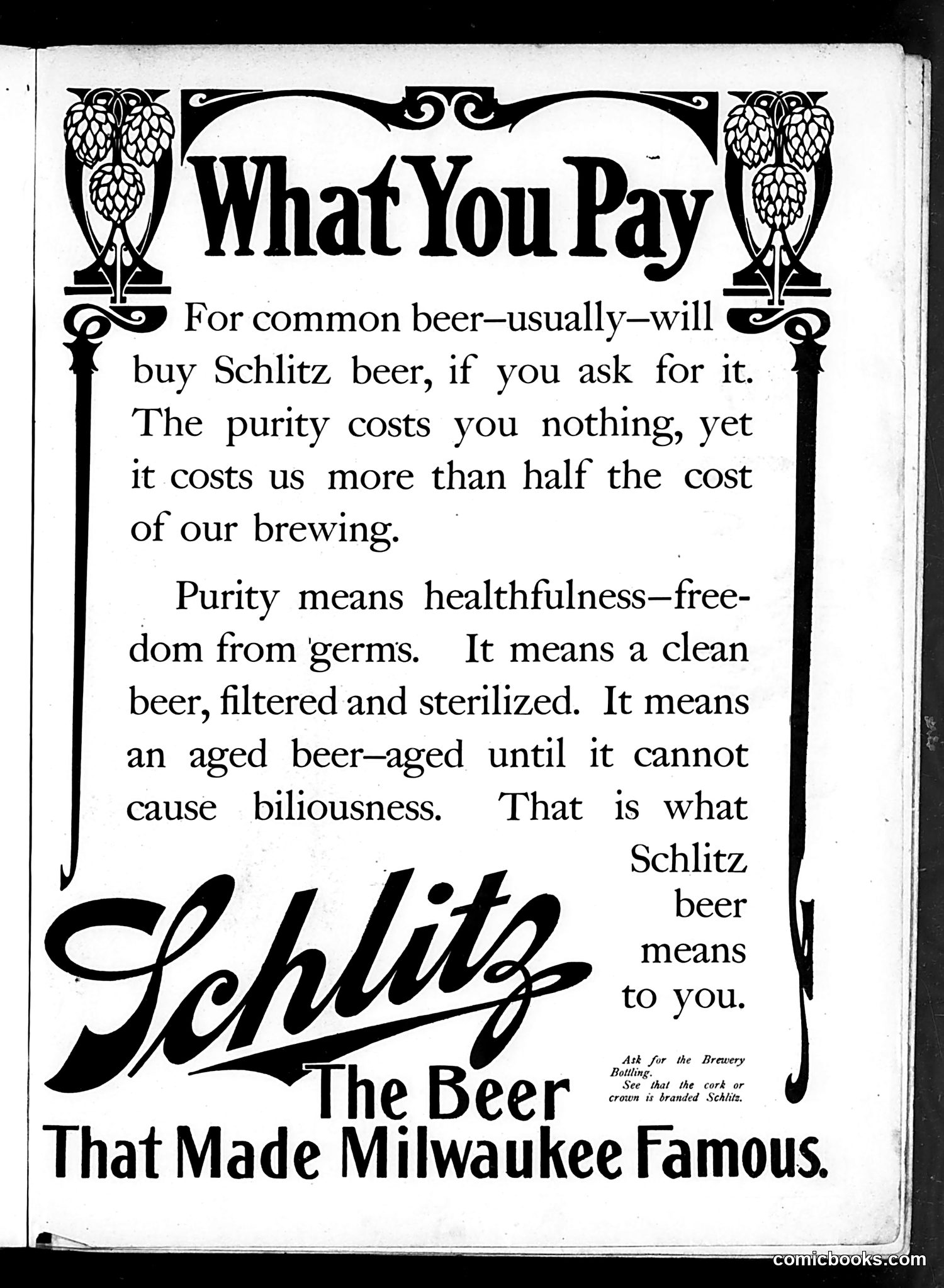
This is a **Schlitz beer advertisement**, not political satire. The page argues that Schlitz beer offers superior "purity"—filtering, sterilization, and aging to prevent digestive upset—despite costing consumers the same as cheaper competitors. The ad's pitch to modern readers seems counterintuitive: Schlitz claims their expensive purification process costs them "more than half the cost of our brewing," yet they don't charge extra. This suggests early 20th-century beer quality was inconsistent and frequently caused illness ("biliousness"). Schlitz positions themselves as the health-conscious choice, emphasizing scientific processing (filtering, sterilization) as a premium feature—a marketing strategy emphasizing safety and hygiene that would resonate in an era before food regulation standards. The ornamental hop designs frame the message as upscale product positioning.
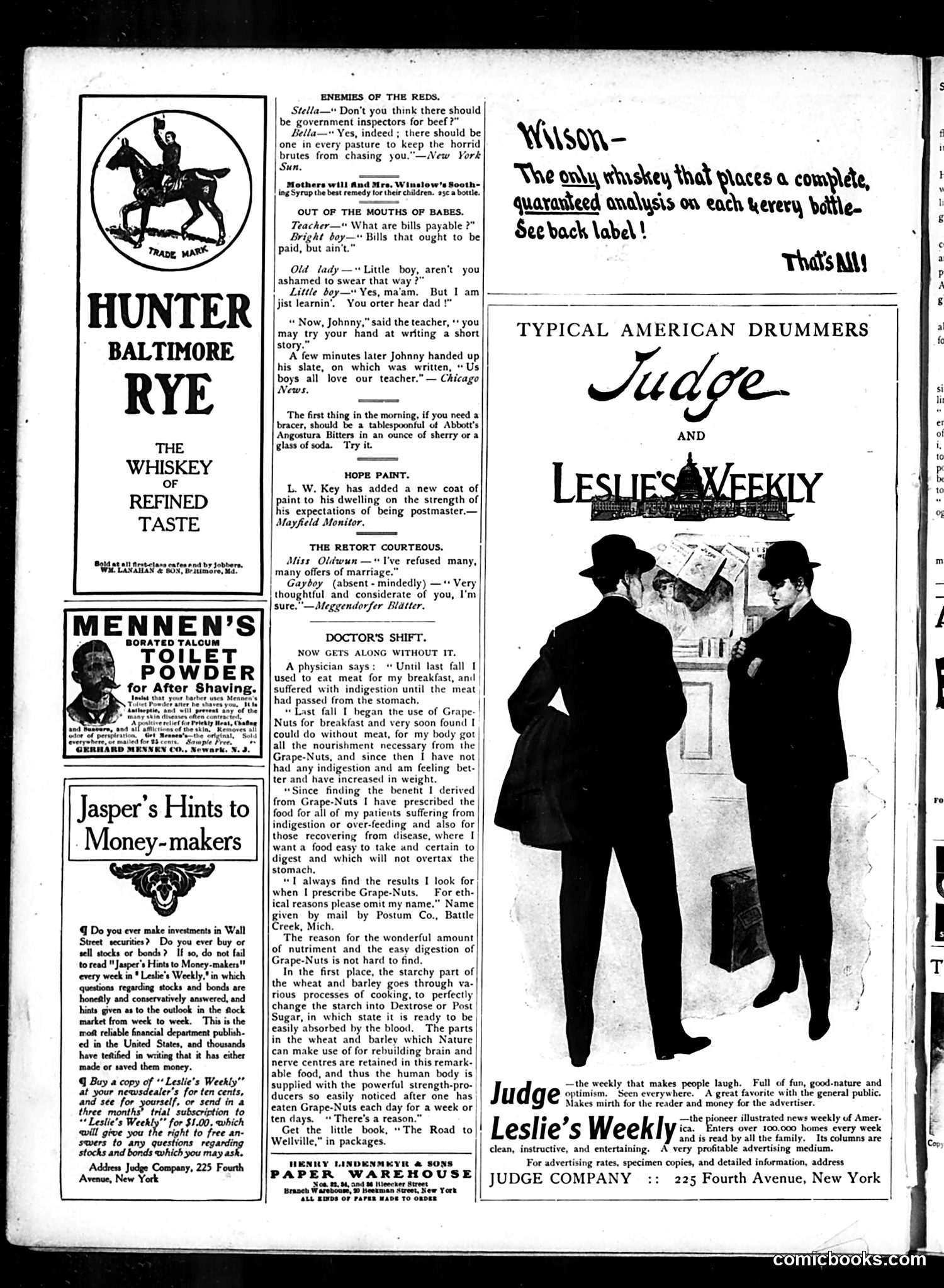
This is primarily an **advertising page** with several short humorous anecdotes rather than political cartoons. The page features ads for Hunter Baltimore Rye whiskey, Mennen's talcum powder, and Grape-Nuts cereal, interspersed with brief jokes typical of early 20th-century humor magazines. The anecdotes are gentle domestic comedy: a woman worried about cattle attacks, a child's definition of "bills payable" as unpaid debts, a boy defending his swearing by blaming his father, and a student's one-sentence story. A doctor's testimonial credits Grape-Nuts cereal with curing his indigestion. The only political reference appears oblique: "Hope Paint" mentions someone painting their house expecting a postmaster appointment—likely satirizing patronage politics where government jobs rewarded supporters. The page reflects **early 1900s middle-class consumer culture** more than political satire, showcasing products marketed to prosperous readers while offering light entertainment between advertisements.
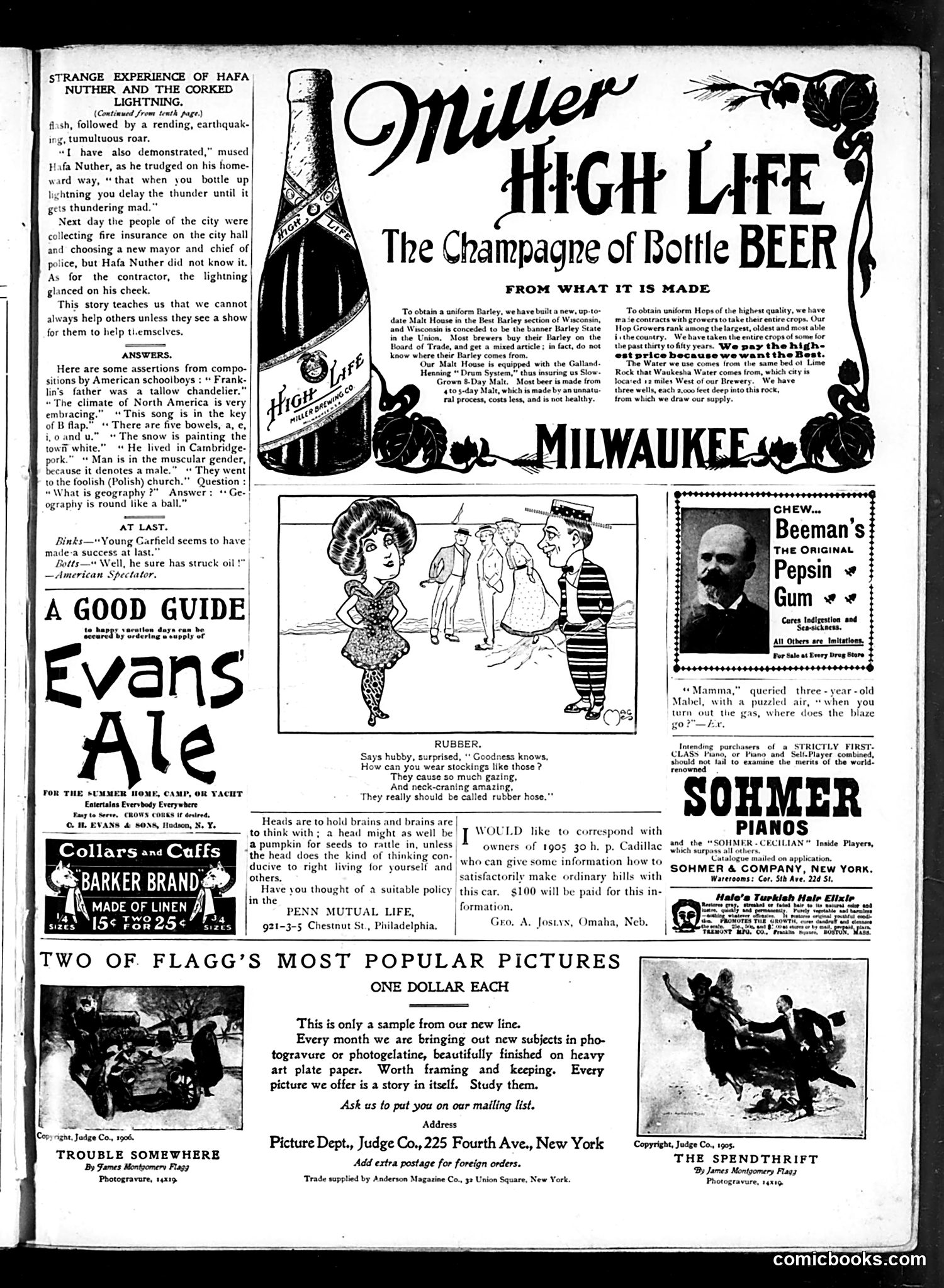
This page is primarily **advertising and miscellaneous content** rather than coherent political satire. The main feature is a lengthy advertisement for **Miller High Life beer** from Milwaukee, emphasizing its superior ingredients—specifically Wisconsin barley grown in a custom malt house and high-quality hops from contracted growers. The ad highlights brewing standards and water sourcing, targeting consumers concerned about product quality. The page also contains: - A serialized story fragment ("Hafa Nuther and the Corked Lightning") with an apparent moral about helping others - Random schoolboy composition errors (presented as humor) - Several period advertisements (Evans Ale, Beeman's Pepsin Gum, Sohmer Pianos, etc.) - A small cartoon labeled "Rubber" making a mild joke about women's stockings - Two photographs offered for sale There are **no identifiable political figures or significant satirical commentary** visible. The page exemplifies early 1900s magazine content mixing editorial material with advertising.
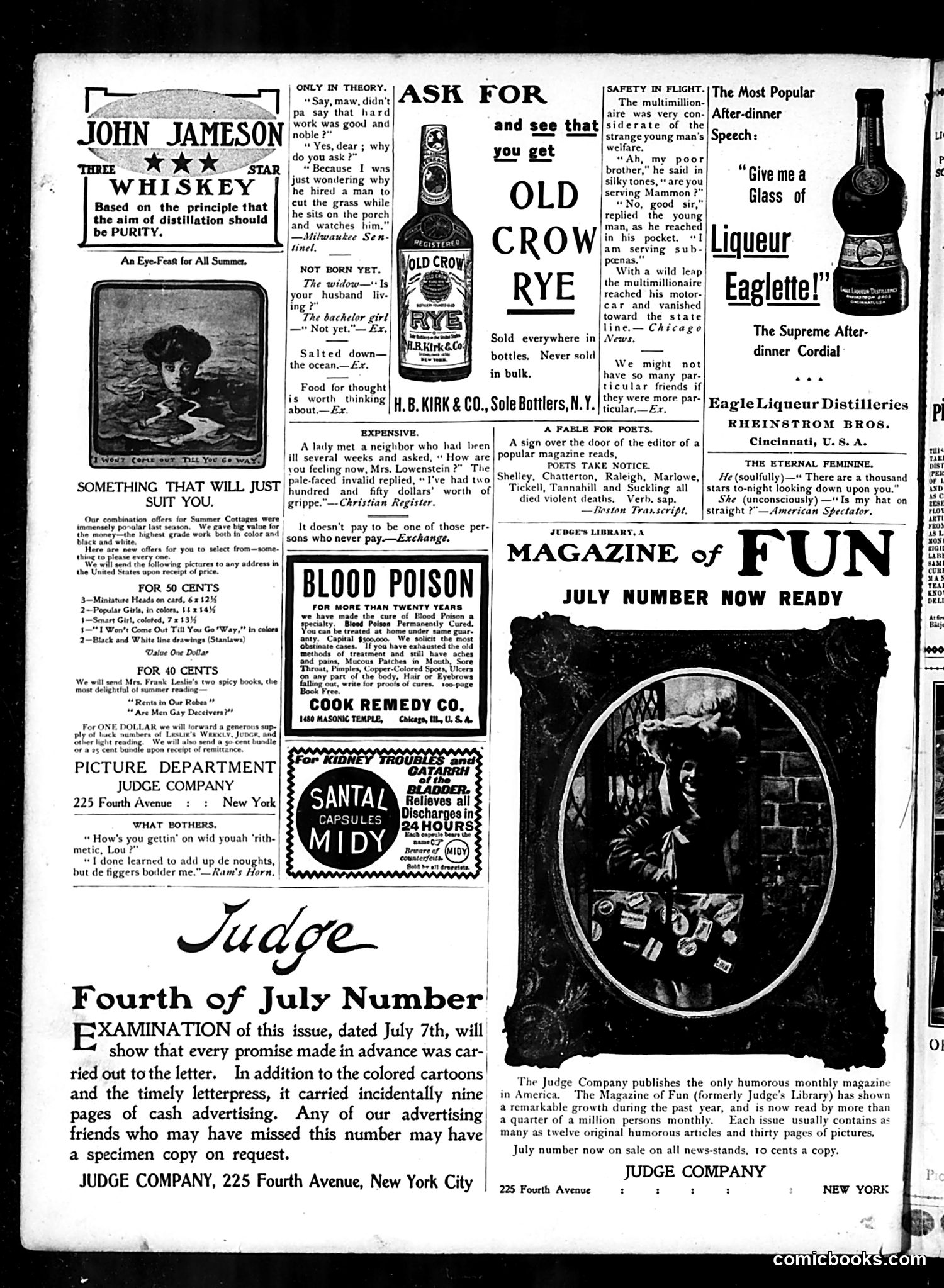
This page is primarily **advertising and promotional material** rather than political cartoons. The main elements include: **Key Content:** 1. **John Jameson Whiskey ad** (top left): A standard product advertisement emphasizing purity in distillation, with an unrelated illustration labeled "Forget 'Tis The Way of War." 2. **Old Crow Rye whiskey ad** (center): Simple product promotion with text snippets about hard work and welfare—the "cartoon" is minimal, just conversational dialogue about work ethic. 3. **Eagle Liqueur ad** (right): Another beverage advertisement. 4. **Various joke sections**: Short humor pieces about marriageexpense, poetry deaths, and arithmetic—typical Judge magazine filler content with no specific political satire. 5. **Promotional material** (bottom): Judge Company advertising its July Fourth issue and other products. **Bottom line**: This appears to be primarily a **promotional/advertising page** with light humor rather than substantive political or social satire. The ads reflect early 20th-century consumer culture.
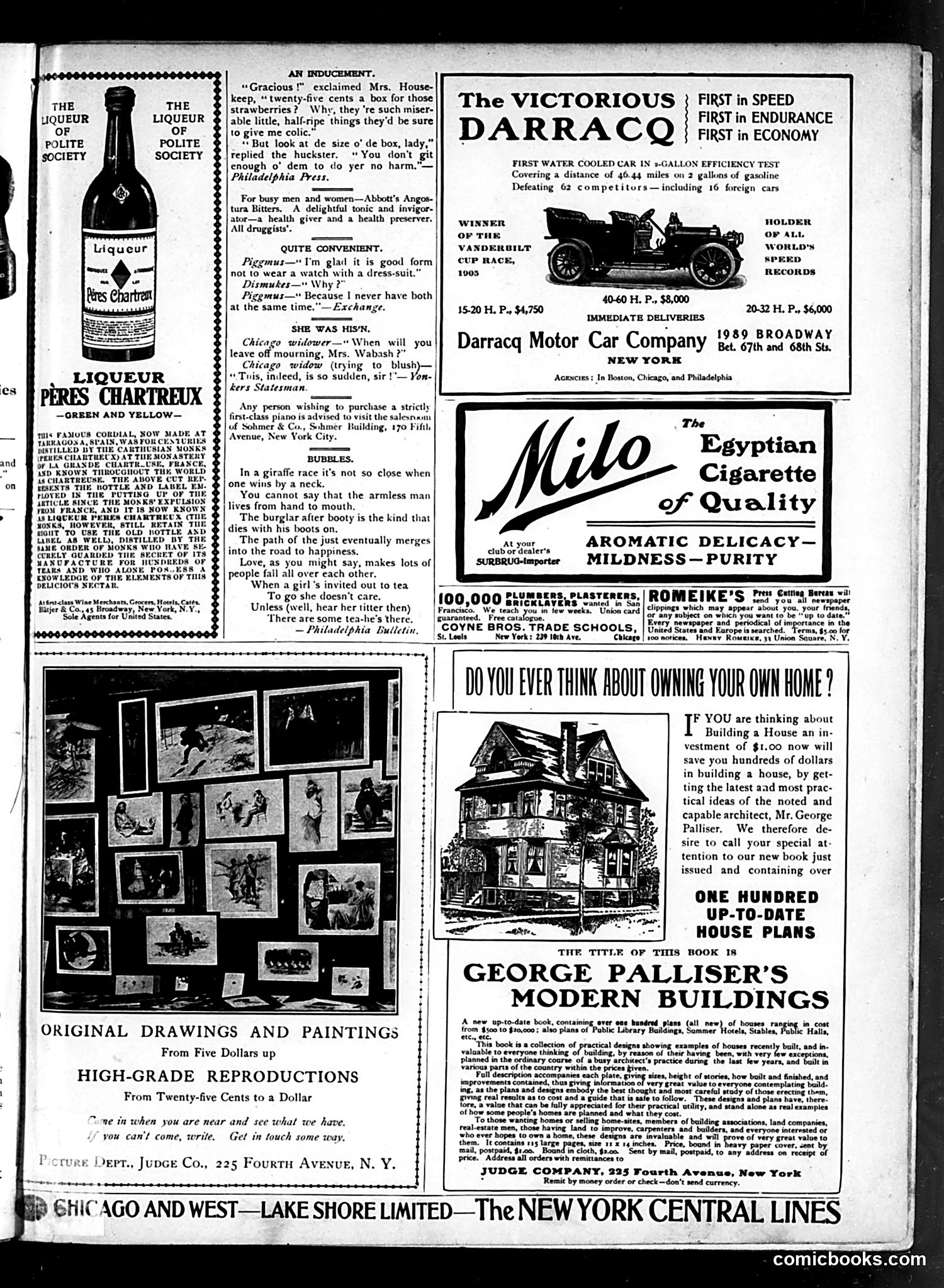
This page is **primarily advertising**, not political satire. The dominant content consists of product advertisements from the early 1900s, including: - **Liqueur Pères Chartreux** (French cordial) - **Darraco Motor Cars** (highlighting efficiency and speed records) - **Milo Egyptian Cigarettes** - **George Palliser's Modern Buildings** (architectural plans book) - **Coyne Bros. Trade Schools** - **Romeike's** (newspaper clipping service) The page includes several short humorous anecdotes labeled "An Inducement," "Quite Convenient," and "Bubbles"—light jokes about overpriced strawberries, mourning widows, and wordplay rather than political commentary. There is one cartoon showing "Original Drawings and Paintings" available for purchase from Judge Co., but no identifiable political figures or satire are visible. This appears to be a typical Judge magazine filler page combining advertisements with light humor.
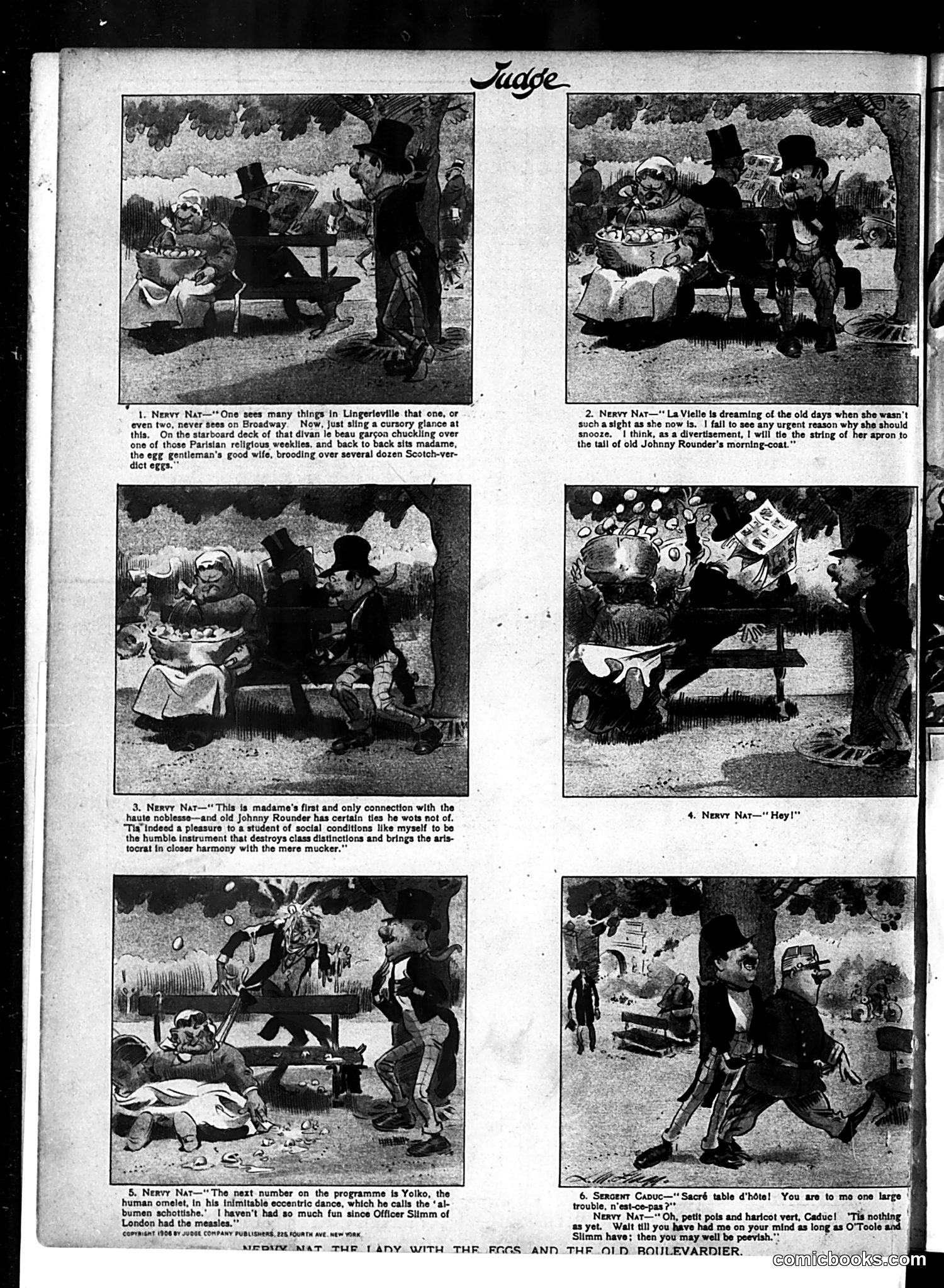
This is a comic strip titled "Nervy Nat—The Lady with the Eggs and the Old Boulevardier," featuring the character Nervy Nat making observations about Parisian street life, likely in a working-class neighborhood called "Lingerleville." Nat commentates on scenes involving a woman selling eggs and various characters—a man reading a religious weekly, a performing acrobat named Yolko doing an "albumen schottishe" dance, and a sergeant-major. The humor relies on Nat's sardonic observations about social mixing, class distinctions, and bohemian Parisian life. References to "Johnny Rounder," "Officer Slimm," and absurdist performance suggest this satirizes both pretentious social attitudes and eccentric street entertainment common in early-1900s Paris. The strip's appeal depends on familiarity with Parisian street culture and bohemian society that modern readers would largely miss.
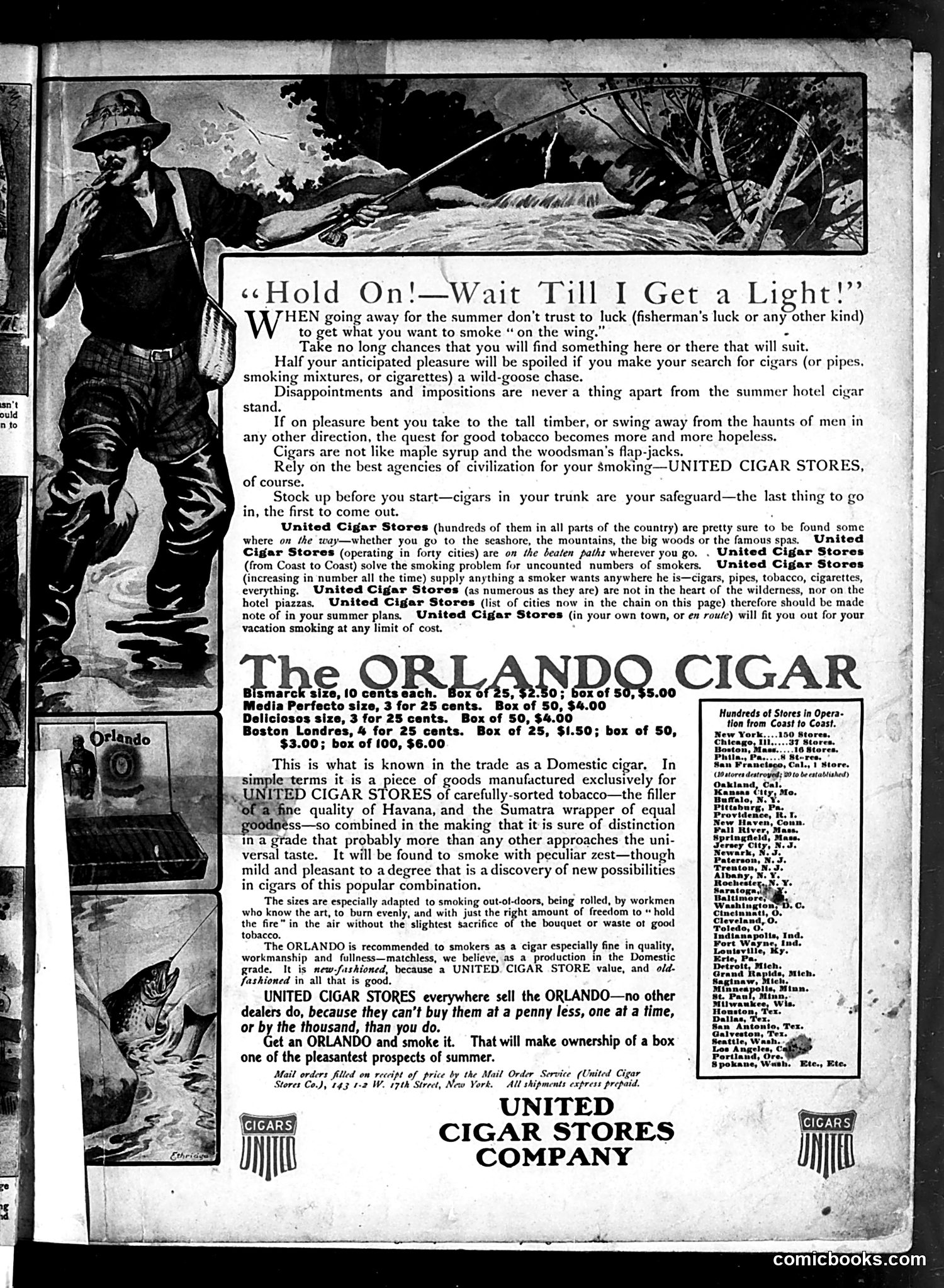
This is primarily a **full-page advertisement** for United Cigar Stores promoting their "Orlando" cigar brand, not a political cartoon. The page opens with a humorous illustrated vignette (top left): a fisherman in outdoor gear says "Hold On!—Wait Till I Get a Light!" The cartoon illustrates the advertiser's pitch: when vacationing in remote areas—fishing, mountains, spas—smokers can't rely on finding quality cigars locally. The joke plays on "fisherman's luck" (unreliable) to suggest smokers need to stock up beforehand at United Cigar Stores before traveling. The lengthy text emphasizes United's ubiquity: operating in forty cities across America "from Coast to Coast," they solve the smoking problem for travelers who might otherwise be disappointed by poor-quality resort cigars. The Orlando cigar itself is described as a "Domestic cigar"—using Havana filler and Sumatran wrapper, designed for outdoor smoking. **Bottom line**: This is commercial advertising using mild outdoor humor to encourage pre-vacation cigar purchases, not satirical commentary on political or social issues.
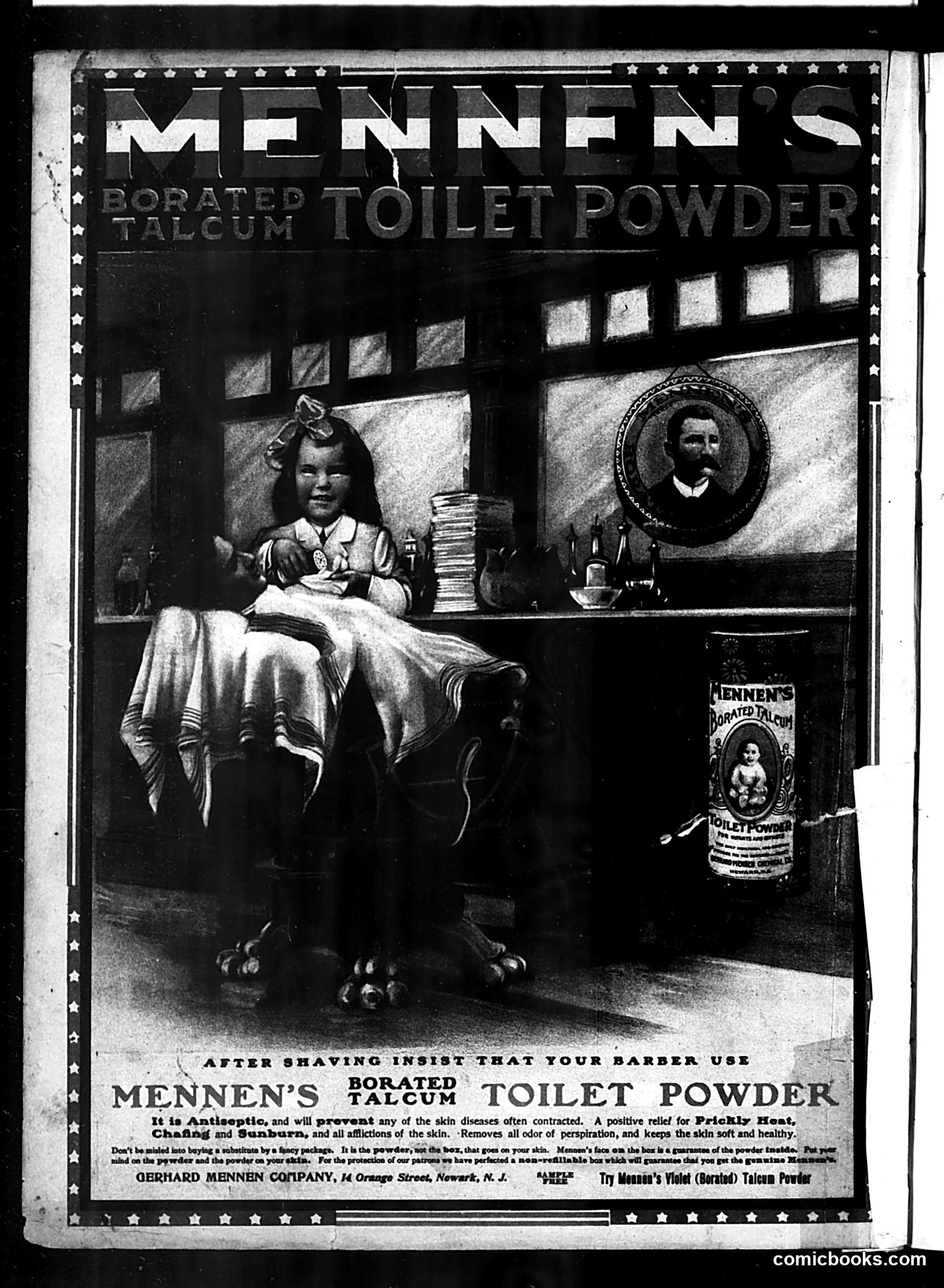
This is a **commercial advertisement**, not political satire. It promotes Mennen's talcum powder for men's grooming, specifically for use after shaving. The image depicts a young girl sitting at a vanity table with a man's portrait on the wall behind her—likely representing a father or male authority figure. The advertisement's message warns barbers to use Mennen's powder on customers' faces after shaving to prevent skin infections and irritation ("Prickly Heat, Chafing and Sunburn"). The copy addresses men directly, cautioning against cheap imitations and emphasizing that Mennen's "tamper-proof" packaging guarantees authenticity. This reflects early 20th-century consumer concerns about counterfeit products. The girl's presence appears designed to suggest cleanliness and health—associating the powder with family wellness rather than masculine grooming per se.