
A complete issue · 16 pages · 1906
Judge — July 7, 1906
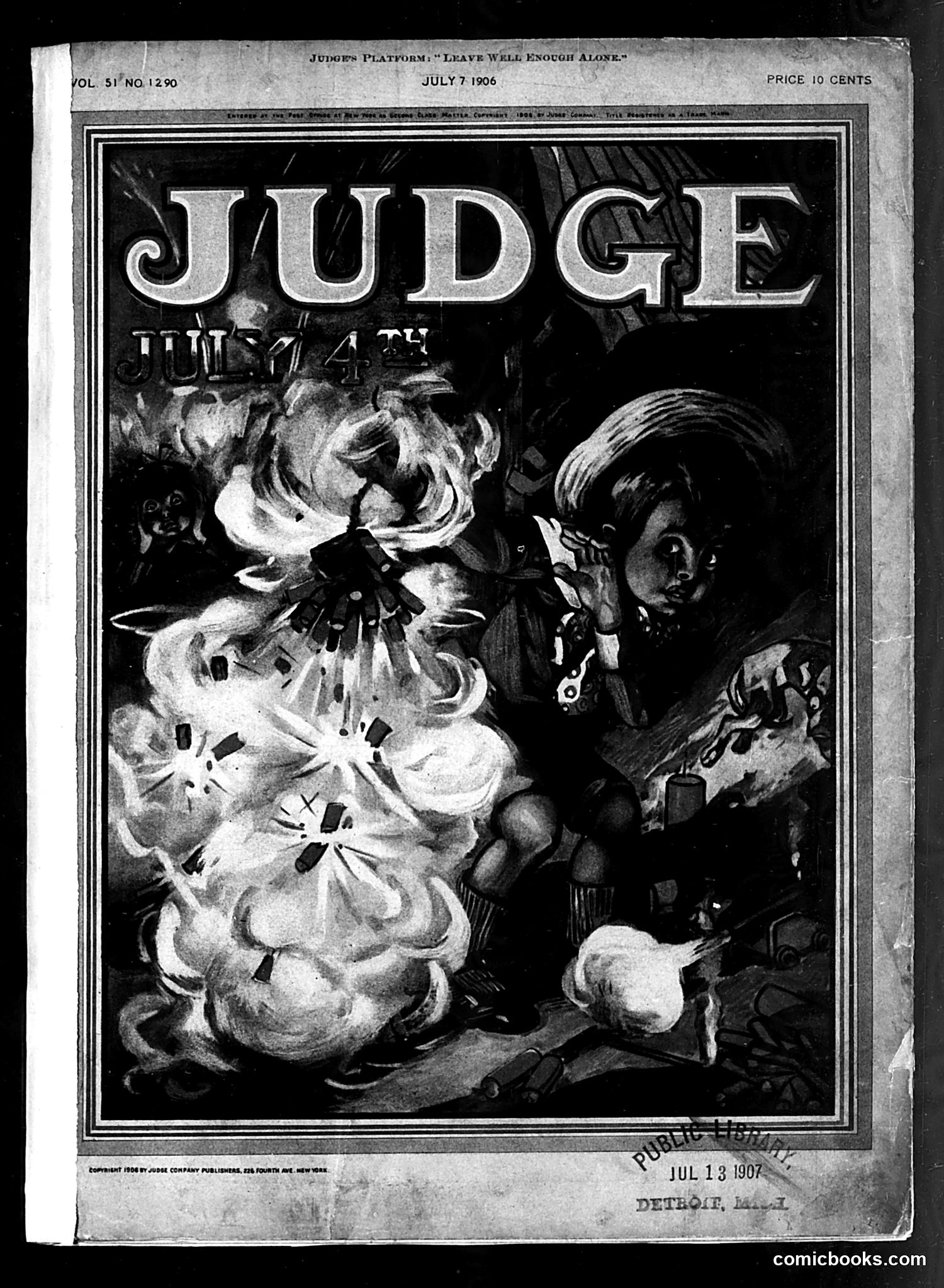
This cover depicts a grotesque figure with exaggerated features—bulbous nose, wild hair, and ornate clothing—appearing to emerge from or be surrounded by explosive bursts. A darker figure stands to the right observing the scene. The imagery suggests political satire, likely referencing anarchism or radical violence given the explosive visual metaphors and the grotesque caricature style typical of early-20th-century American political commentary. The platform headline "Leave Well Enough Alone" implies criticism of disruptive forces or radical movements. Without clearer identifying text visible, I cannot definitively name the specific figure or event referenced. However, the theatrical violence imagery and Judge's conservative editorial stance suggest commentary on contemporary anarchist or labor radical concerns prominent in 1906 America.
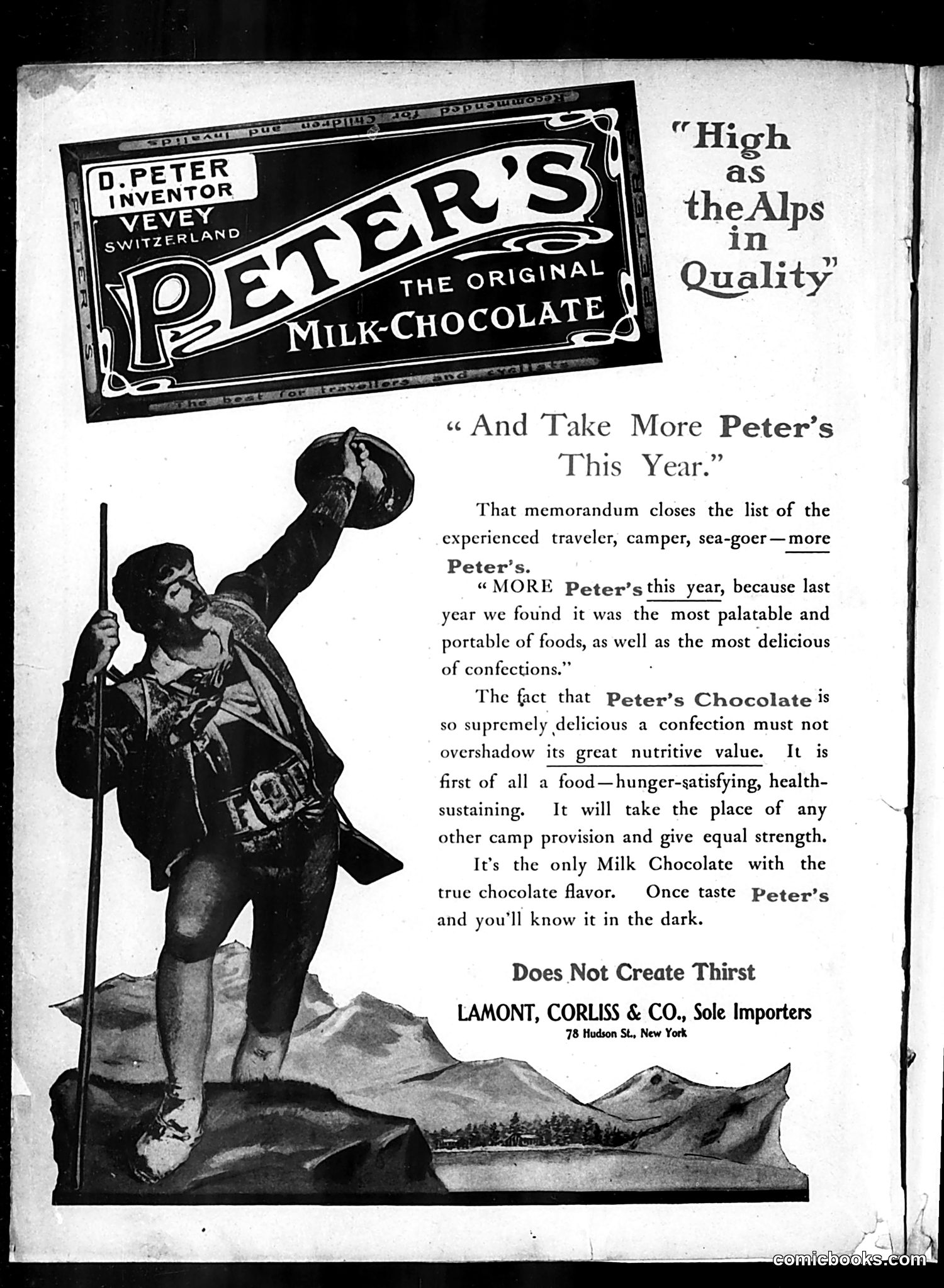
This page is primarily a **product advertisement**, not political satire. It promotes Peter's milk chocolate from Switzerland, marketed by Lamont, Corliss & Co. in New York. The ad depicts a mountaineer triumphantly climbing an Alpine peak, reinforcing the tagline "High as the Alps in Quality." The imagery associates the Swiss chocolate with Alpine excellence and durability—qualities valued in early 20th-century consumer marketing. The text emphasizes Peter's as ideal for travelers, campers, and outdoor enthusiasts, claiming it's nutritious, doesn't create thirst, and tastes good "in the dark." This positioning suggests the product as practical sustenance for adventurers, not mere confection. The "memorandum" framing device adds a testimonial-style appeal typical of period advertising.
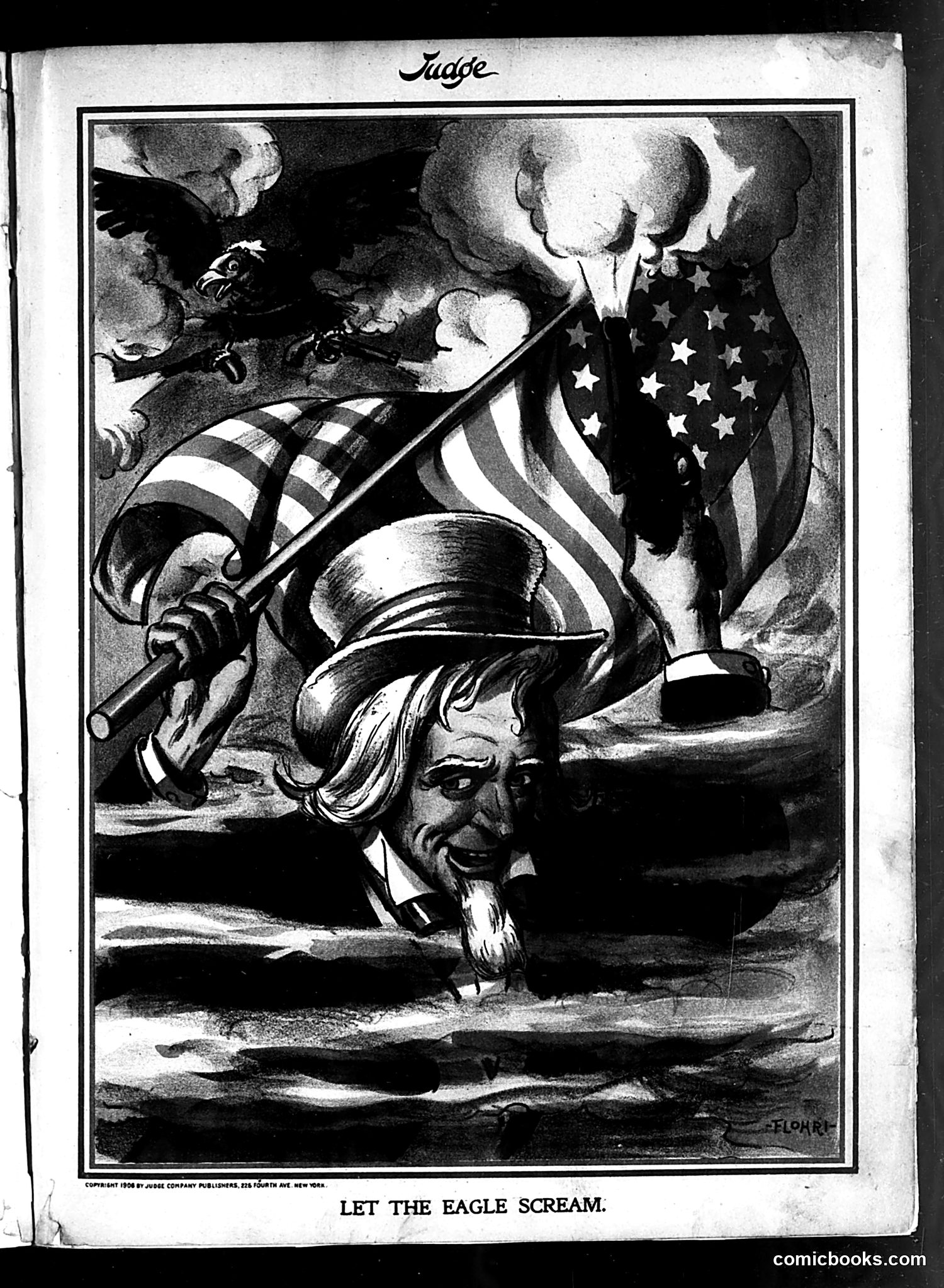
This Judge magazine cartoon satirizes American imperialism and aggressive foreign policy. The central figure—a caricatured man with exaggerated features wearing a large hat—appears to represent a foreign leader or national personification being dominated or trampled. Above him stand American figures wielding an American flag and eagle, suggesting American military or political power crushing an opponent. The title "Let the Eagle Scream" ironically invokes American patriotic symbols (the eagle, the flag) while depicting their aggressive use. The cartoon critiques U.S. intervention abroad, suggesting American power is being wielded domineering rather than diplomatically. The caricatured victim's degraded position emphasizes the satire's anti-imperialist perspective, typical of Judge magazine's occasionally critical stance toward American foreign policy expansion.
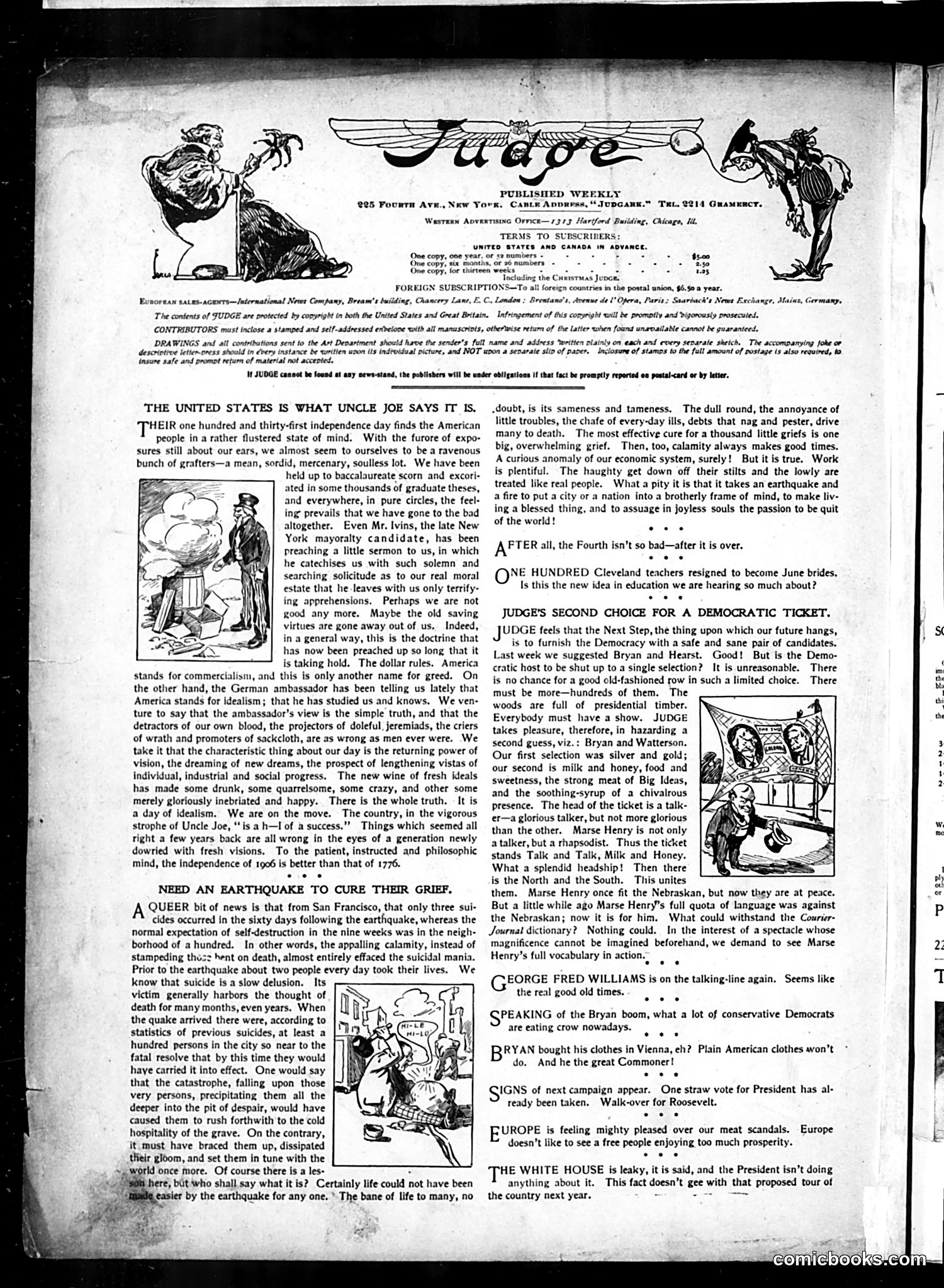
This page contains political commentary from Judge magazine (an American satirical publication). The main article, "The United States is What Uncle Joe Says It Is," critiques American society using the metaphor of the Fourth of July. It attacks what the author calls American character flaws—greed, commercialism, and loss of ideals—while defending against external criticism (likely from "Uncle Joe," possibly referencing Joseph Stalin or similar foreign critics). The scattered brief items below satirize contemporary political figures and events, including references to Cleveland teachers, Bryan (likely William Jennings Bryan), and Democratic presidential politics. The cartoons appear to illustrate these satirical points with period-typical caricature drawings. Without clearer dates or labels visible, precise identification of some references remains uncertain.
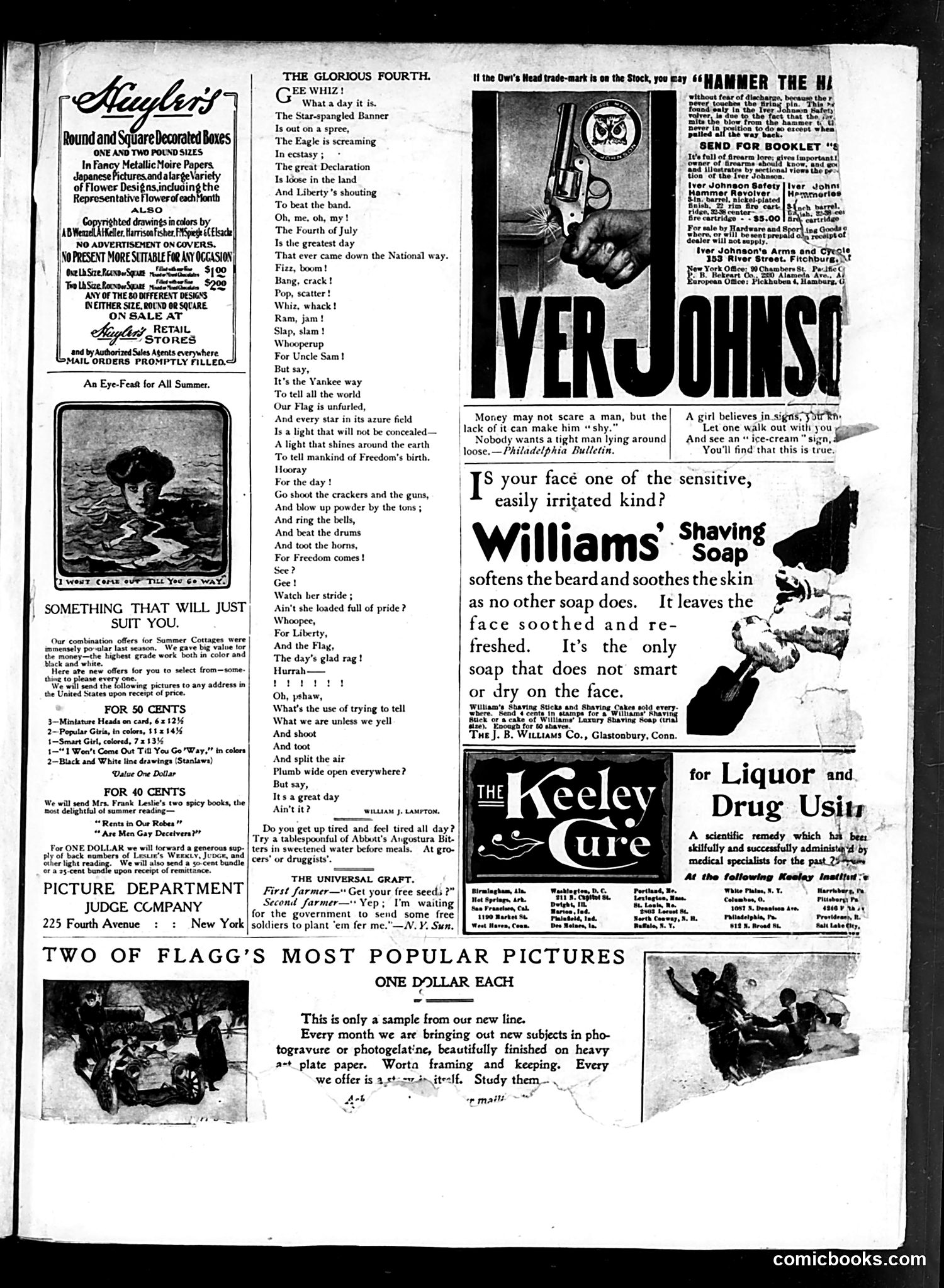
This Judge magazine page is primarily **advertising and commercial content** rather than political satire. The main elements include: - **"The Glorious Fourth"** poem celebrating Independence Day with patriotic imagery (the Eagle, the Flag, freedom) - **Sackley's decorative boxes** advertisement featuring Japanese-inspired designs - **Williams Shaving Soap** ad emphasizing gentleness for sensitive skin - **Keeley Cure** advertisement (a period medical treatment facility) - **Picture Department Judge Company** offering popular photogravure prints - **Flagg's popular pictures** (one dollar each) The only substantive content is the patriotic Fourth of July poem, which is straightforward celebration rather than satire. The page reflects Judge's dual nature as both satirical publication and **vehicles for commercial advertising**, which subsidized such magazines in this era.
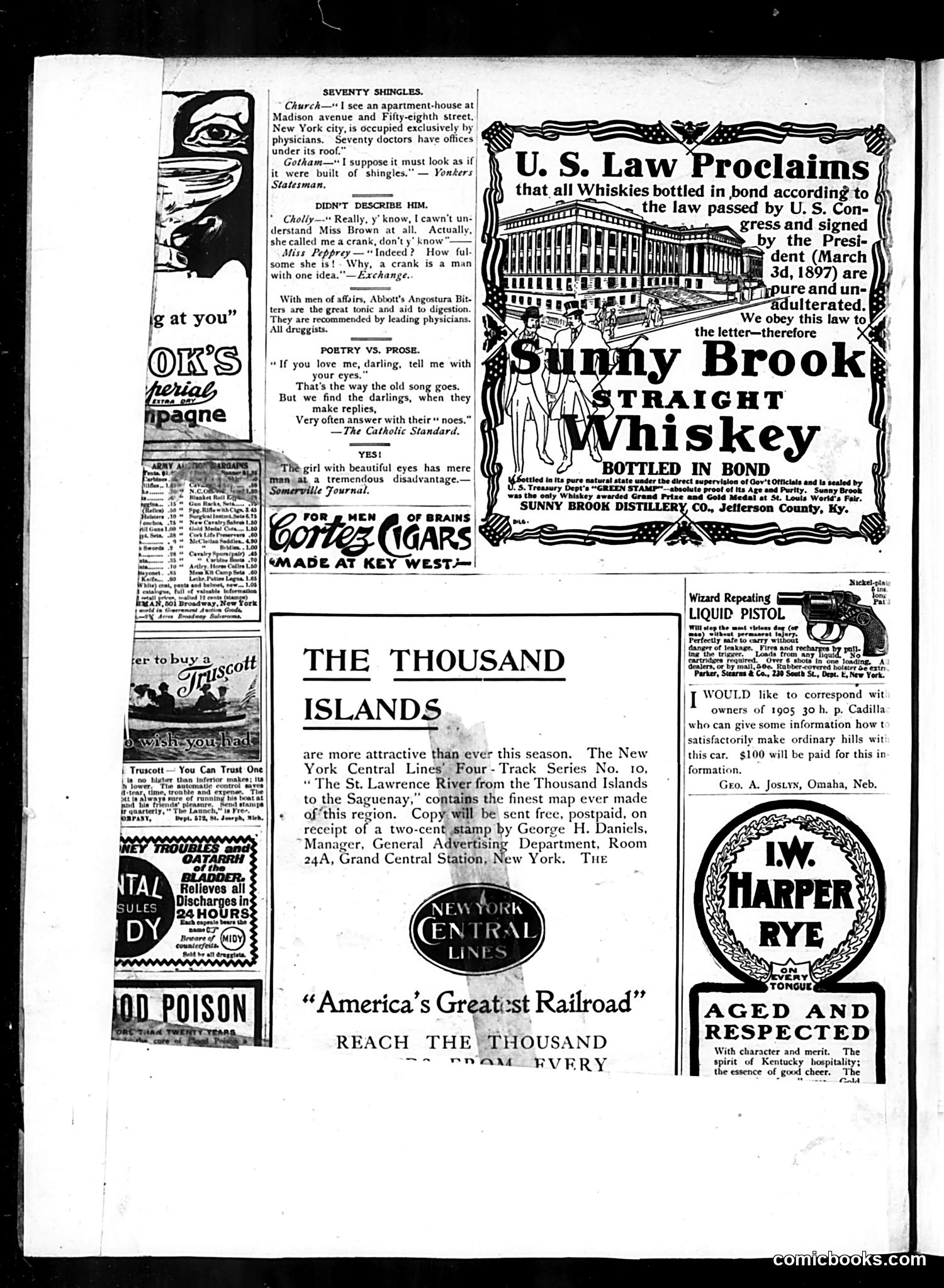
This page is primarily **advertising**, with brief humorous filler content typical of early 1900s magazines. The three short jokes ("Seventy Shingles," "Didn't Describe Him," "Poetry vs. Prose") are mild social commentary: the first puns on doctors' office building resembling shingled roofs; the second jokes about a woman calling a man "a crank"; the third contrasts romantic poetry with women's practical "noes." The page's real content is **liquor and commercial advertising**: Sunny Brook Whiskey prominently advertises compliance with the 1897 U.S. law requiring bonded whiskey purity; I.W. Harper Rye touts its aged quality and "Kentucky hospitality"; Abbott's Angostura Bitters advertises to businessmen; and the New York Central Lines promotes Thousand Islands tourism. The "Liquid Pistol" (apparently a spray device) and Cadillac inquiry also appear. This reflects the page's primary purpose: carrying paid advertisements interspersed with light entertainment for readers.
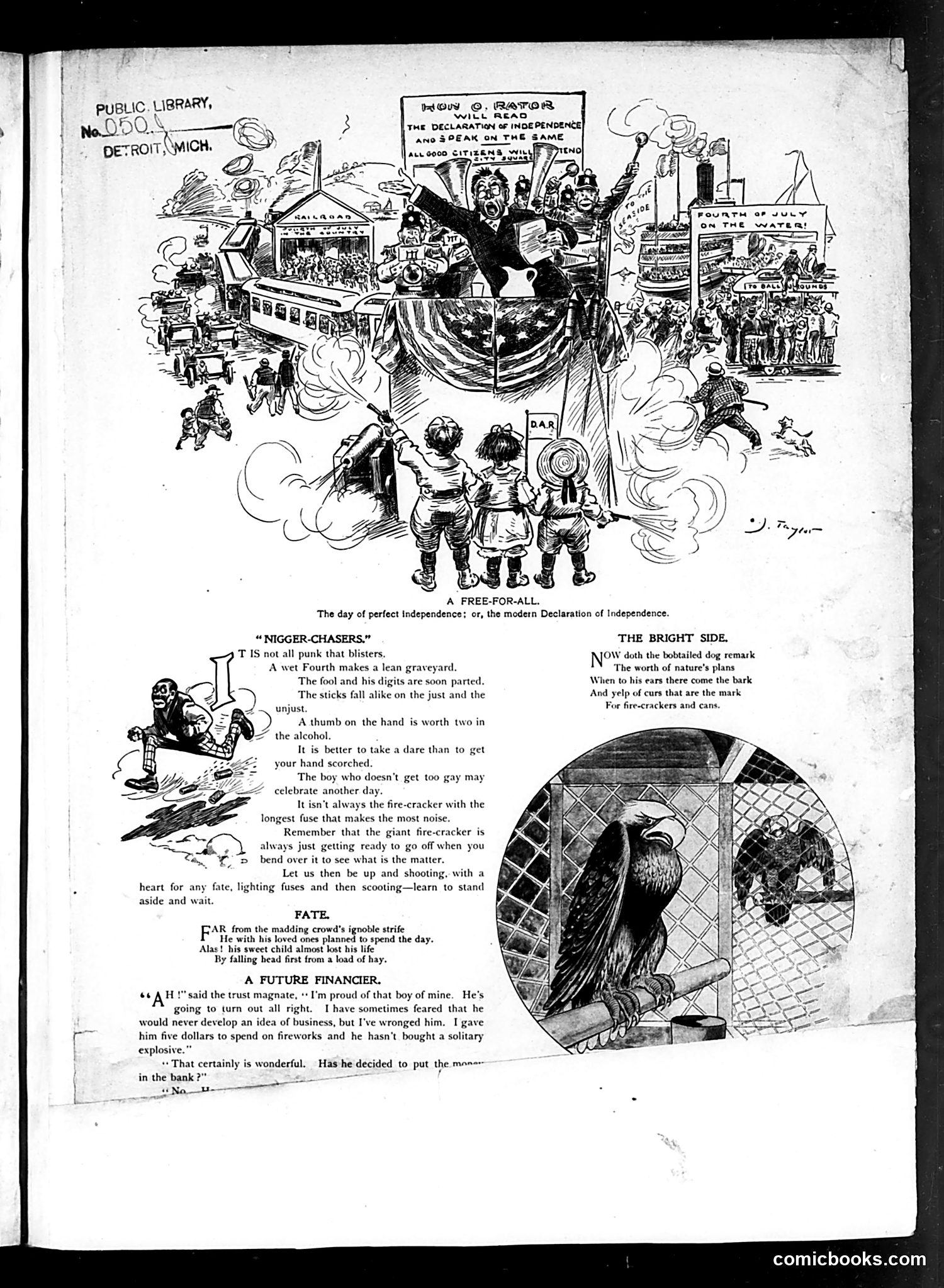
This is a satirical commentary on American Independence Day celebrations, likely from the early 1900s. The top cartoon depicts a chaotic Fourth of July celebration where a politician reads the Declaration of Independence to crowds, but the scene devolves into anarchic violence and mayhem—suggesting the gap between American ideals and reality. The surrounding verse and anecdotes mock the holiday's dangers: firecracker injuries ("A thumb on the hand is worth two in the alcohol"), drunk behavior, and child accidents. The term "Nigger-Chasers" refers to a type of small explosive firecracker popular at the time. The final section satirizes American capitalism: a wealthy "trust magnate" boasts that his son, given five dollars for fireworks, hasn't spent it—showing nascent business sense. The joke critiques both wealthy financiers and the corruption of childhood innocence through capitalist values, while the overall page suggests Independence Day celebrations embodied America's chaotic contradictions between noble rhetoric and violent, drunken reality.
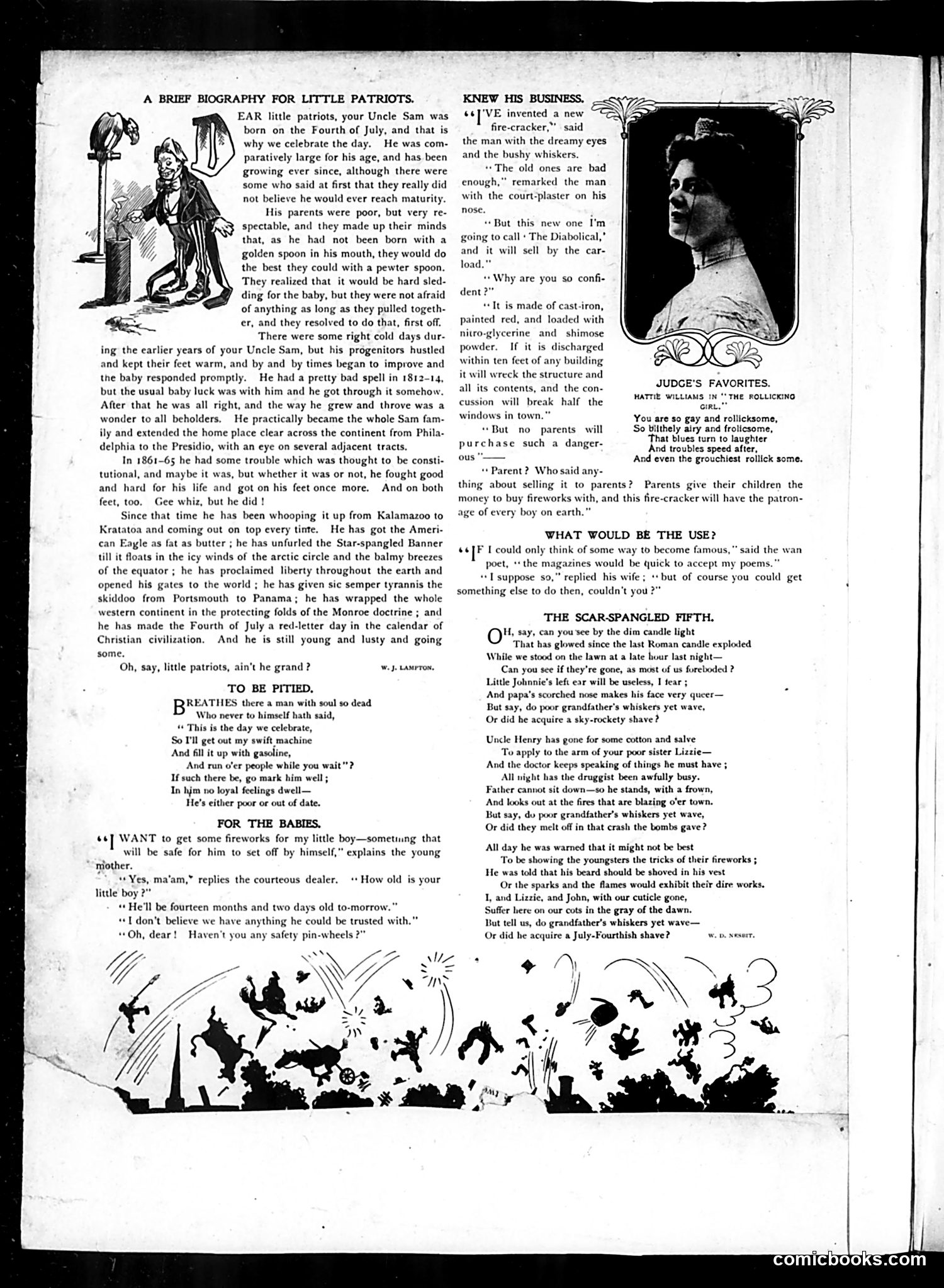
This page contains Fourth of July-themed satirical content for an American audience circa early 1900s. **"A Brief Biography for Little Patriots"** mock-heroically traces Uncle Sam's development from birth (July 4th) through adulthood, using baby metaphors. References include the War of 1812, the Civil War (1861-65), and American imperial expansion. The satire gently mocks nationalist pride while celebrating American achievement. **"To Be Pitied"** sarcastically criticizes those who don't celebrate Independence Day by recklessly driving automobiles—a contemporary reference to the new danger of motor vehicles on public roads. **"For the Babies"** jokes darkly about fireworks safety, with a mother requesting "safe" explosives for a 14-month-old child. The humor derives from the obvious absurdity and the era's casual attitude toward dangerous fireworks. **"Knew His Business"** depicts a firecracker salesman hawking an extremely dangerous explosive device, confident it will sell because of its destructive power. The satire criticizes both reckless salesmanship and consumer demand for ever-more-dangerous fireworks. All pieces critique Fourth of July excess and safety negligence.
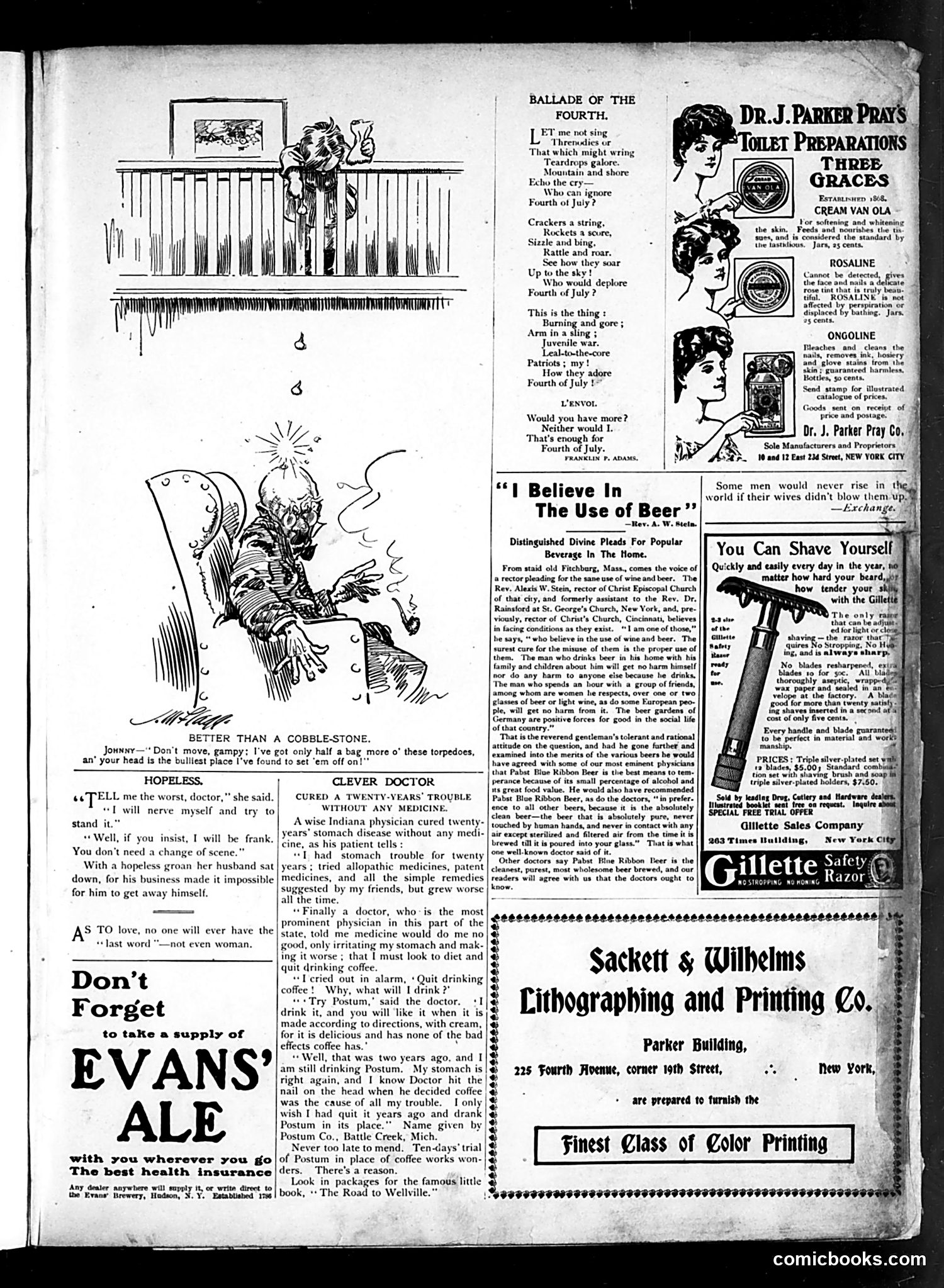
The page features two political cartoons mocking everyday frustrations: **"Better Than a Cobble-Stone"**: A boy (Johnny) threatens an elderly woman (Gampy) with firecrackers, using her head as a test site—satirizing both the recklessness of Independence Day celebrations and generational disrespect. **"Hopeless"**: A wife tells her doctor she needs a change of scene; he responds she doesn't need one—her real problem is her husband's inability to leave his business. The joke critiques American workaholism and suggests the wife's emotional needs are secondary to business demands. The page is primarily **advertising**, featuring endorsements for Evans' Ale, Postum (coffee substitute), Dr. Parker Pray's toiletries, and commercial printing services. A poem "Ballade of the Fourth" satirizes the chaos and injuries of Fourth of July celebrations ("Burning and gore; Arm in a sling"). The Rev. A.W. Stein's testimonial defending beer consumption reflects early-1900s debates over temperance.
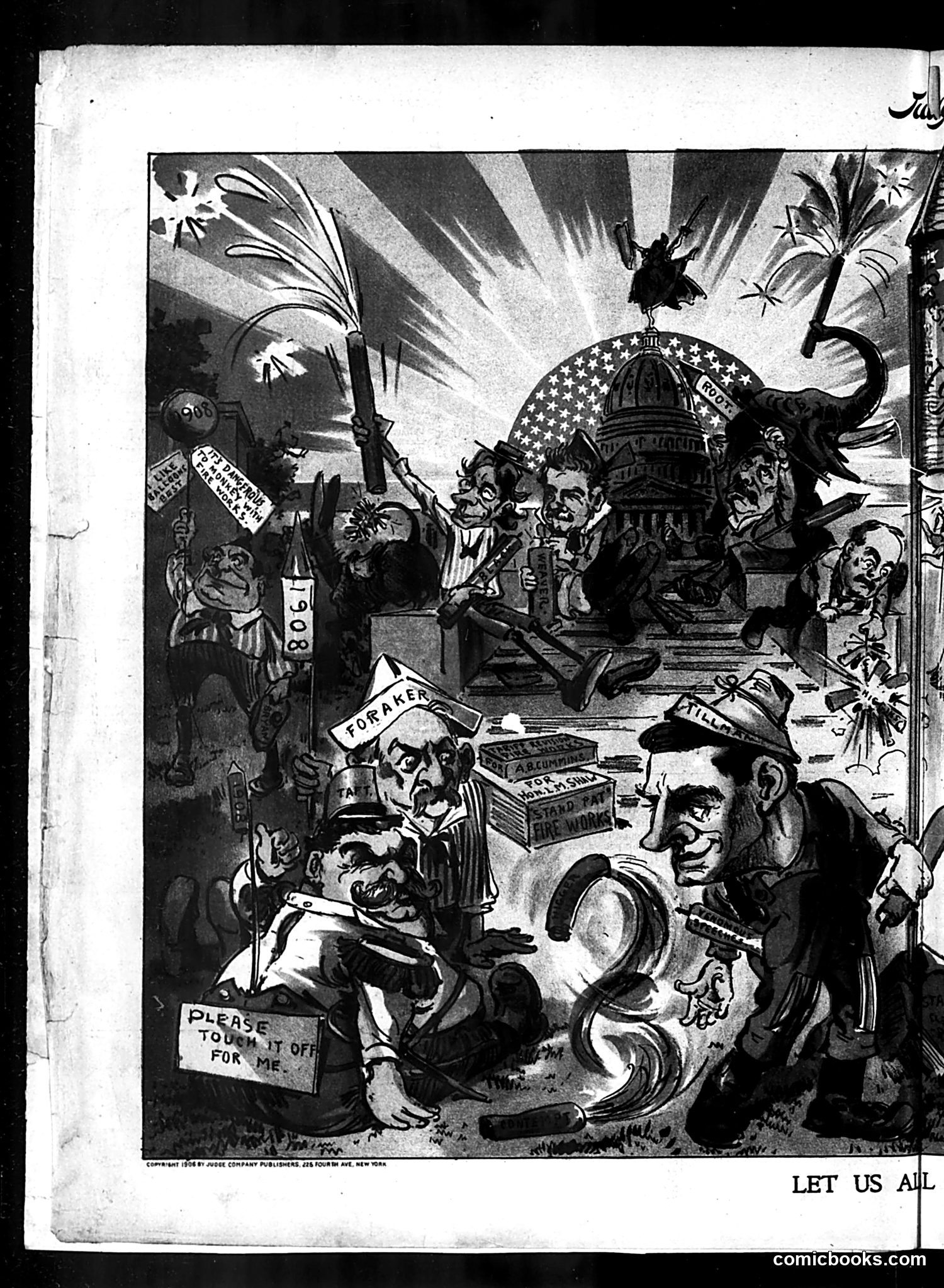
This appears to be a satirical cartoon from *Judge* magazine depicting a chaotic scene at the U.S. Capitol building. The cartoon shows numerous caricatured figures engaged in destructive activity—burning documents, wielding weapons, and creating mayhem around the Capitol dome. A figure labeled "FORAKER" appears prominently, likely Senator Joseph B. Foraker. Various boxes labeled with political terms are visible, suggesting this critiques political corruption or malfeasance. The banner "PLEASE TOUCH IT OFF FOR ME" implies accusations of incitement. Without the publication date visible, the precise political scandal or event being satirized remains unclear. However, the cartoon clearly attacks specific politicians for alleged corruption, document destruction, or undermining governmental institutions. The exaggerated caricatures and violent imagery are typical of *Judge*'s harsh political commentary style.
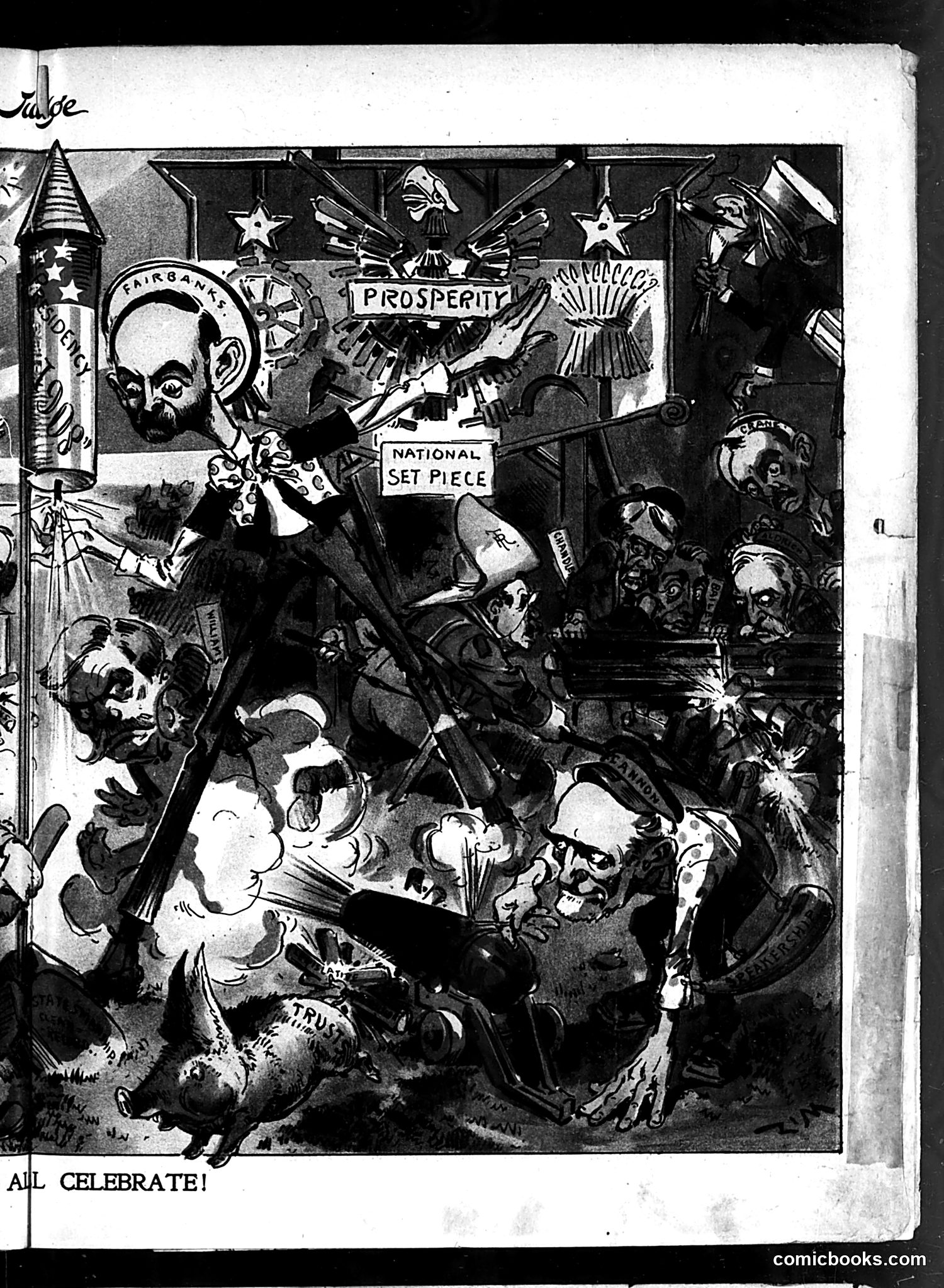
This political cartoon satirizes American prosperity and celebration during the early 20th century. The central figure appears to be a caricatured politician or public figure (possibly labeled "FAIRBANKS," visible on the left) presiding over a chaotic scene labeled "PROSPERITY" and marked as a "NATIONAL SET PIECE." The composition depicts numerous grotesque figures—some appearing to represent different social classes or ethnic groups—engaged in festivities around what seems to be theatrical pyrotechnics or explosives. The "ALL CELEBRATE!" caption at bottom suggests ironic commentary on forced or hollow prosperity celebrations. The satire likely critiques either the artificiality of claimed economic success, the unequal distribution of prosperity, or political theater masking underlying social tensions. The exaggerated, monstrous characterizations emphasize the cartoon's skeptical tone toward optimistic national proclamations.
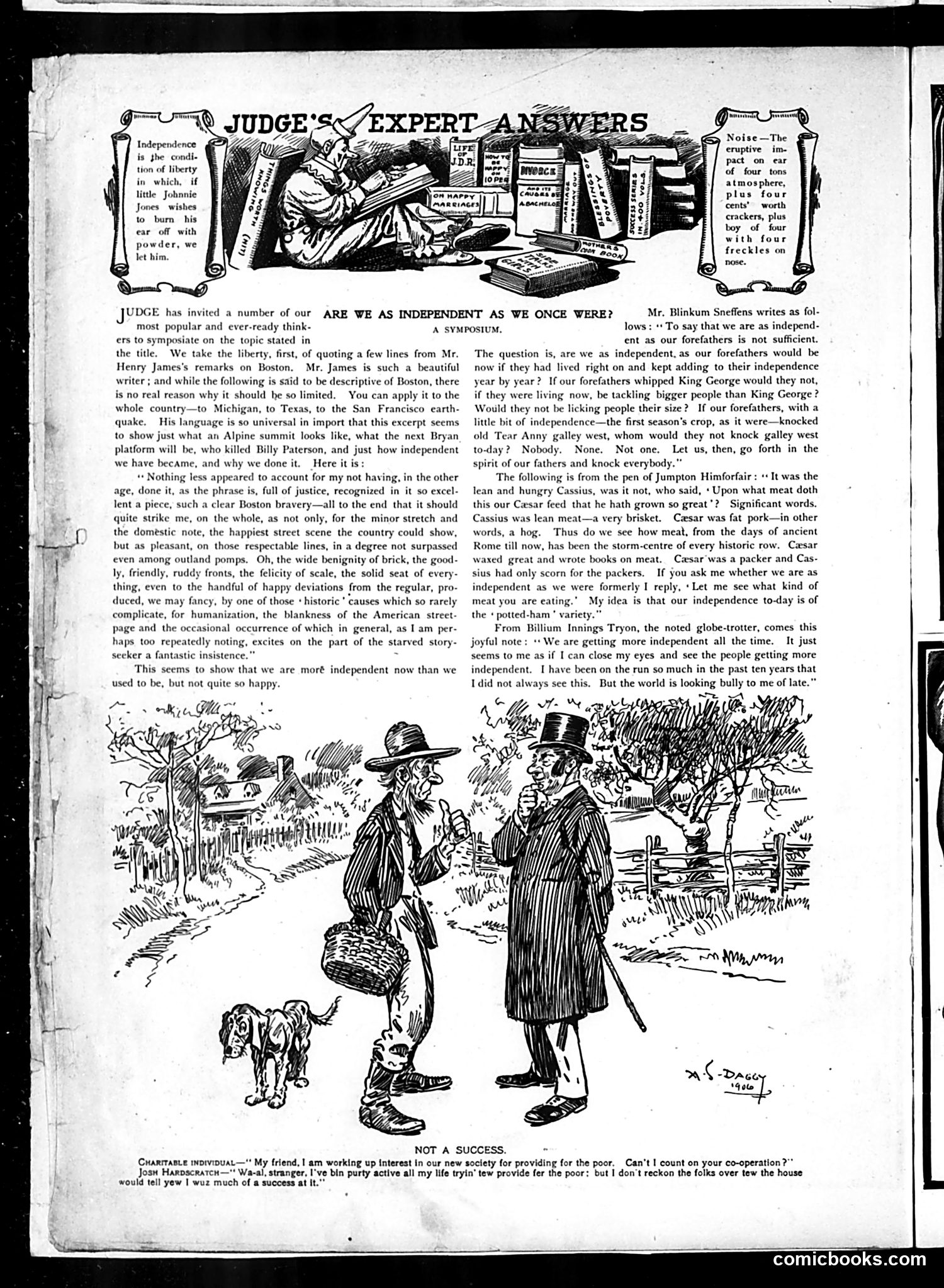
This page presents a symposium on American independence, asking whether modern citizens are as independent as their forefathers. The magazine invited notable thinkers to respond. Henry James's lengthy excerpt about Boston appears to argue that American civic architecture and society reflect a kind of inherited independence and stability—though the piece's ornate, almost impenetrable prose becomes part of the satire itself. The responses that follow are comically absurd. One contributor argues forefathers would tackle "bigger people" if alive today. Another (Jumpton Himforfair) launches into a ridiculous analogy about independence and meat-eating, conflating Caesar and pork packers. **The cartoon's point**: American independence has become hollow or confused. Rather than genuine civic virtue or self-governance, "independence" now means either aggressive nationalism or nonsensical philosophizing. The contributors' overwrought, disconnected arguments satirize how intellectuals and politicians invoke the founding fathers' legacy without substance.
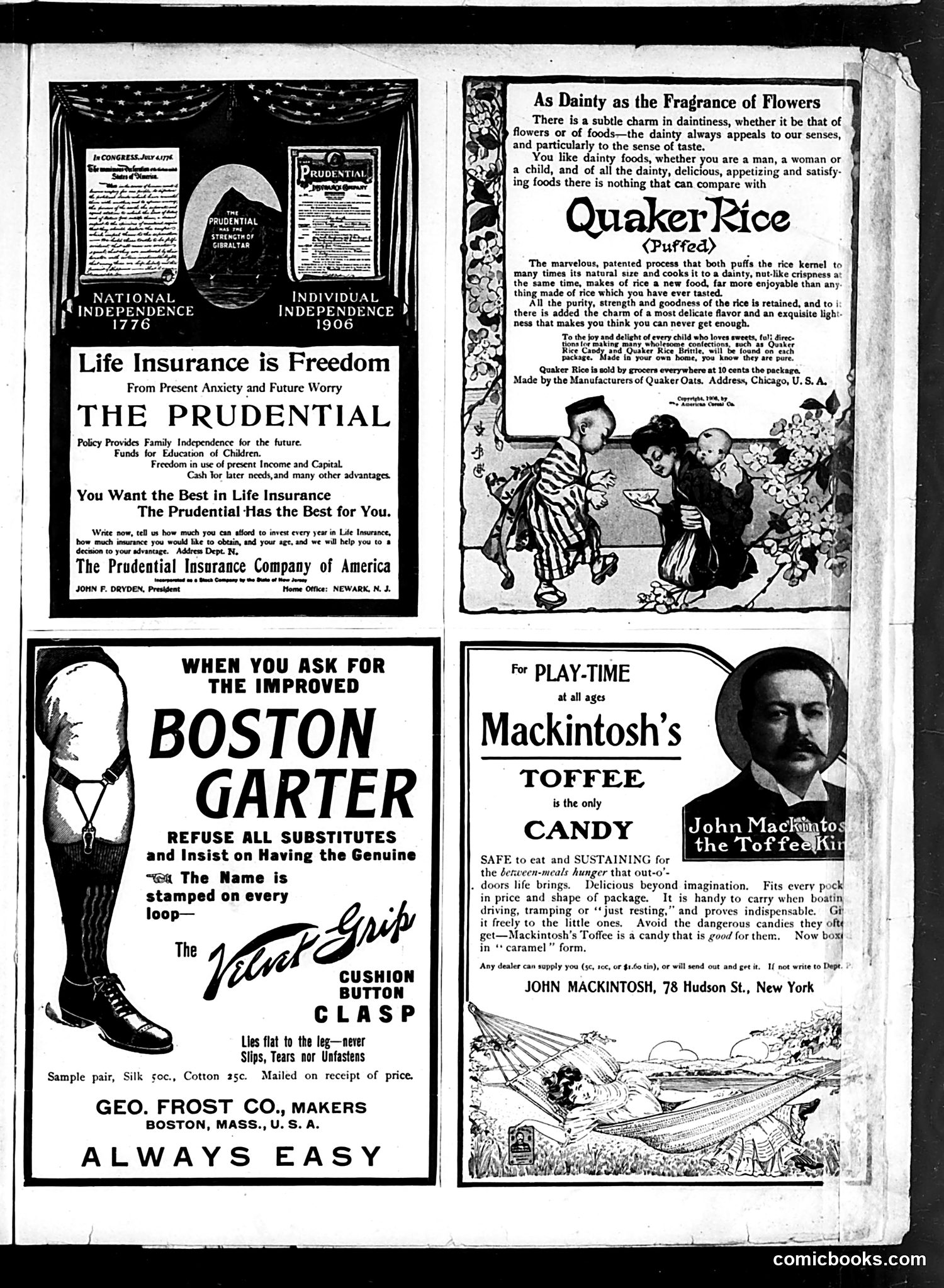
This page is primarily **advertising**, not political satire. It contains four product advertisements typical of early 1900s publications: 1. **Prudential Life Insurance**: Uses patriotic imagery (1776/1906 comparison) to market life insurance as "freedom" from financial worry—a common advertising strategy appealing to American values. 2. **Quaker Rice (Puffed)**: Markets a processed rice product emphasizing daintiness and purity, with illustrated children enjoying the food. 3. **Boston Garter**: Advertises men's garters with emphasis on durability ("never slips, tears nor unfastens"). 4. **Mackintosh's Toffee**: Promotes candy as suitable for children's play-time snacks. The page reflects early 20th-century advertising conventions: appeals to family values, claims of safety/purity, and direct product endorsements. There is no visible political cartoon or satirical commentary—Judge's editorial content appears on other pages of this issue.
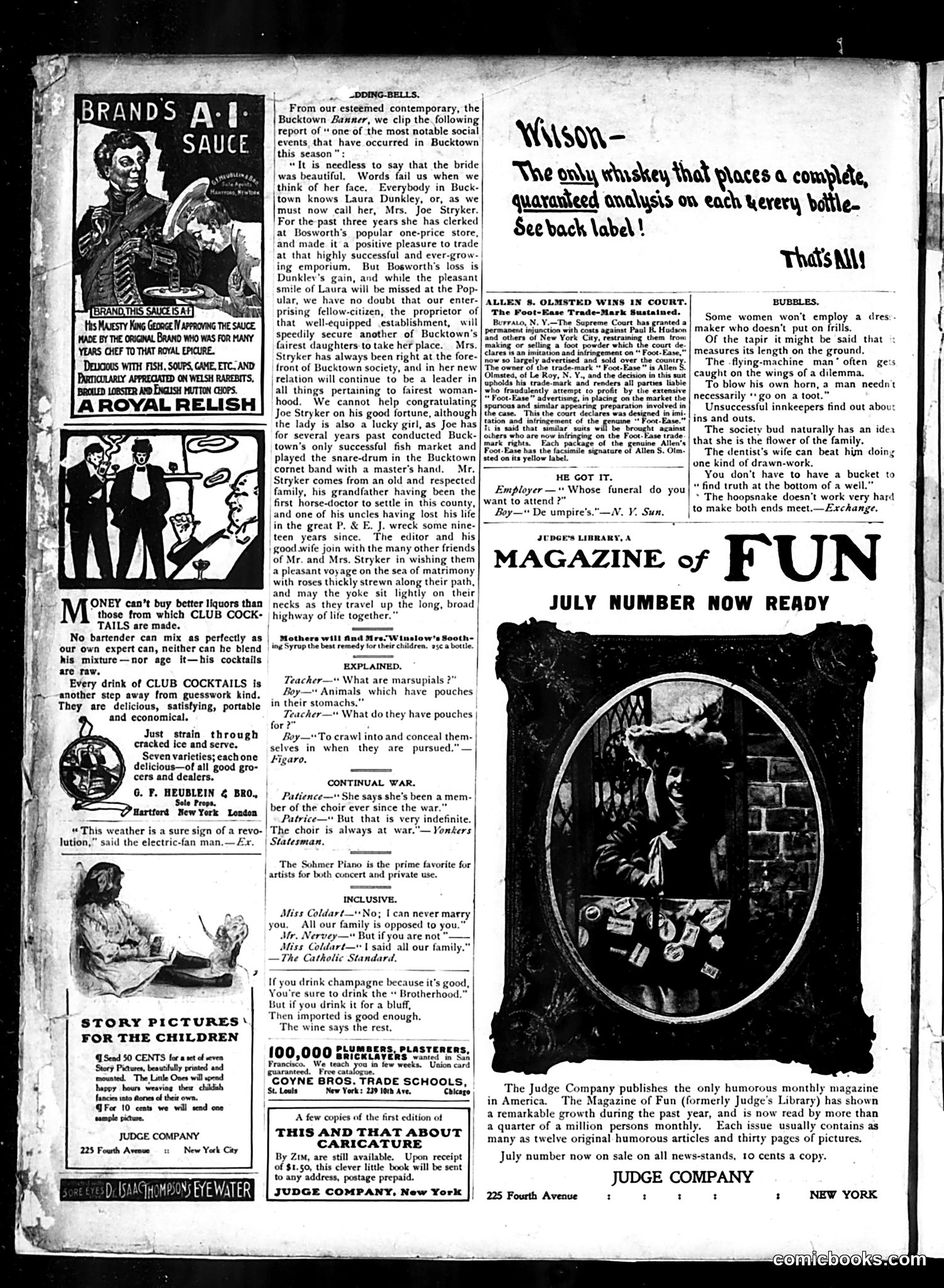
This page satirizes small-town newspaper writing and social pretension through a mock wedding announcement. The text parodies the overwrought, self-important tone of local journalism—specifically the fictional "Bucktown Banner." The satire targets how provincial papers gush about minor figures and inflate their importance. Laura Dunkley, a store clerk, becomes momentous simply by marrying Joe Stryker, a fish-market owner and amateur drummer. The announcement absurdly praises both parties' families (Joe's grandfather was a horse-doctor; an uncle died in a train wreck) and uses flowery language ("sea of matrimony," "roses thickly strewn") for an ordinary event. The humor lies in the gap between the grandiose language and the mundane reality—this is not a notable event, yet the "Banner" treats it as one. Judge mocks how local editors inflate small-town gossip into pseudo-literary pronouncements, satirizing the pretensions of rural journalism and small-town social hierarchies.
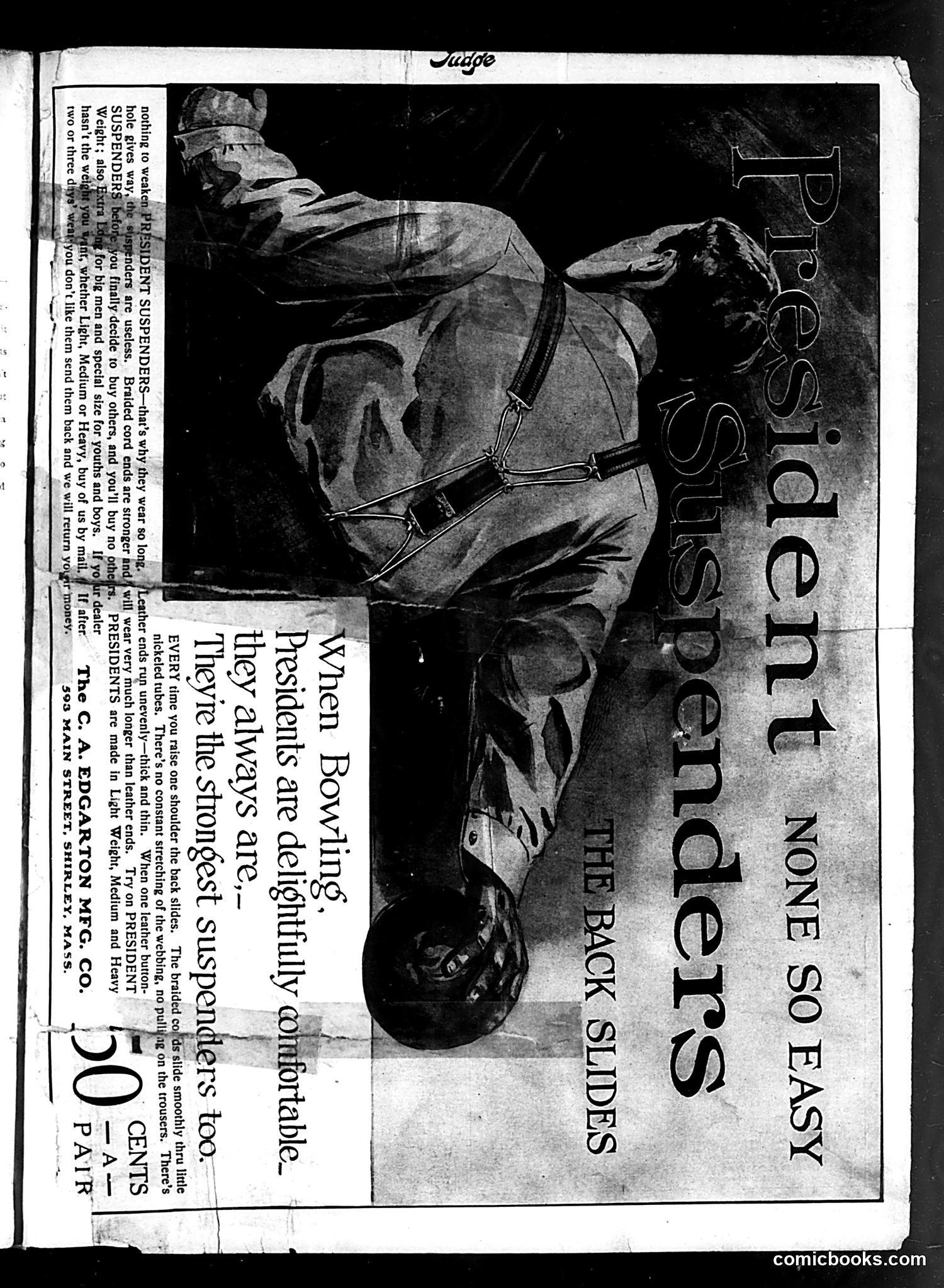
This page is primarily **advertising**, not political satire. The main content is a product advertisement for "President Suspenders" by the C. A. Edgarton Manufacturing Company. The ad features a photograph of a man bowling, demonstrating the suspenders in action. The copy emphasizes practical features: braided cord ends that slide smoothly through nickeled tubes, preventing constant stretching and sagging of trousers during movement. The humor is gentle and product-focused rather than satirical. The title "When Bowling, Presidents are Delightfully Unbearable—they always are" plays on the word "President" (the brand name) as a pun, suggesting these suspenders stay reliable even during active athletic movement. The ad includes typical early-20th-century marketing language about durability, availability in multiple sizes, and a money-back guarantee. This is standard commercial advertising masquerading as entertainment content within Judge magazine.
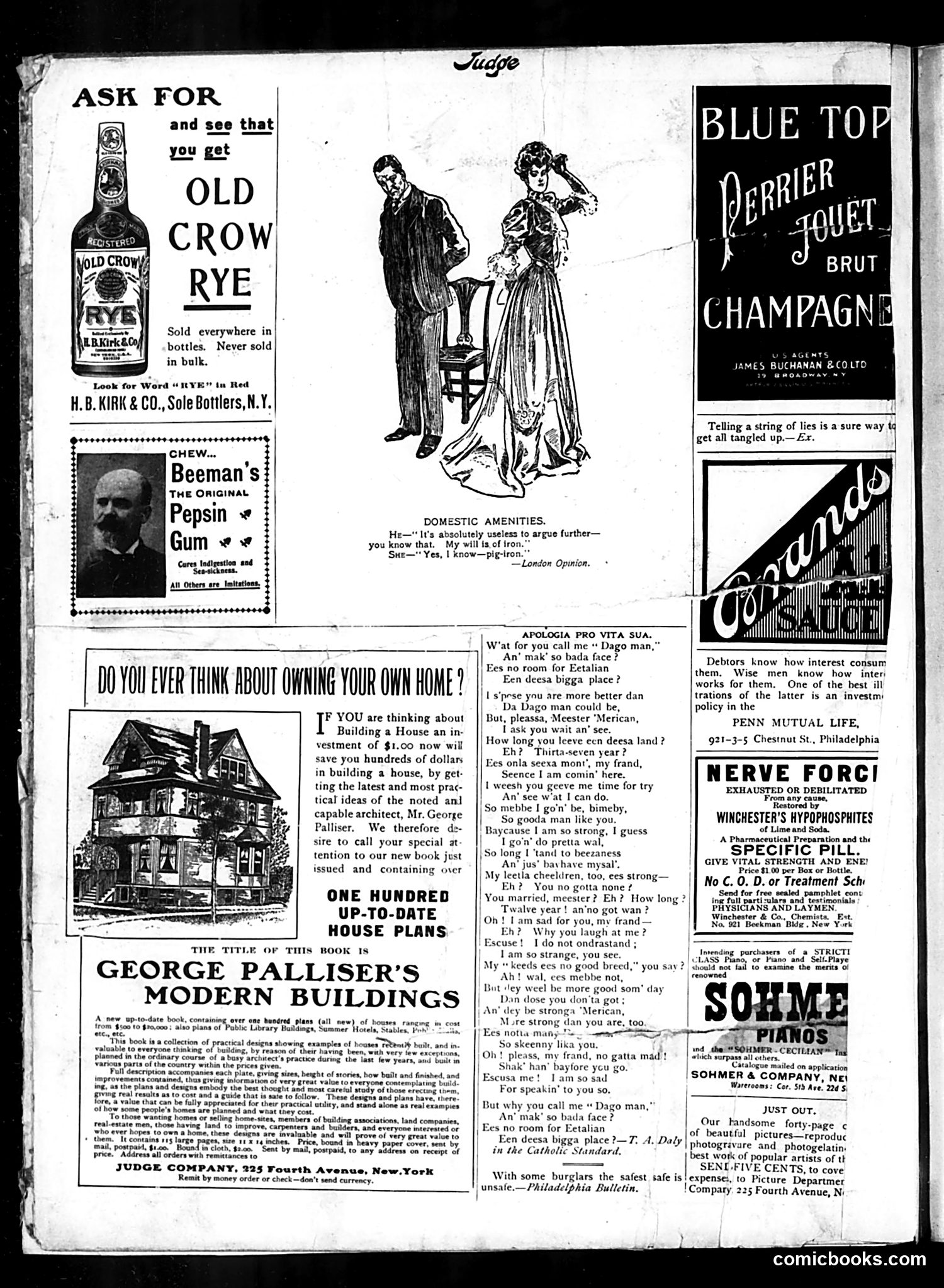
This page contains two distinct satirical pieces: **"Domestic Amenities"** (center): A brief joke about marital discord. A husband claims his will is absolute; his wife retorts he has a "pig-iron" will—immovable and crude. It's a commonplace jab at domestic power struggles, with the wife getting the sharper riposte. **"Apologia Pro Vita Sua"** (right): A monologue by an Italian immigrant defending himself against discrimination. He asks why he's called a "Dago" (ethnic slur) and notes he's been in America only six months, requesting time to prove himself. He boasts of his strength and his children's potential to become "strong Americans." The satire here cuts both ways: it mocks nativist prejudice through the immigrant's reasonable appeals, while also presenting him in stereotypical dialect. The piece appears to critique American xenophobia, though its execution relies on ethnic caricature—common for Judge magazine's era. The title's Latin phrase ("defense of one's life") elevates the immigrant's plea with classical dignity, adding ironic weight to his plea for acceptance.