
Judge, 1906-07-07 · page 12 of 16
Judge — July 7, 1906 — page 12: what you’re looking at
What you’re looking at
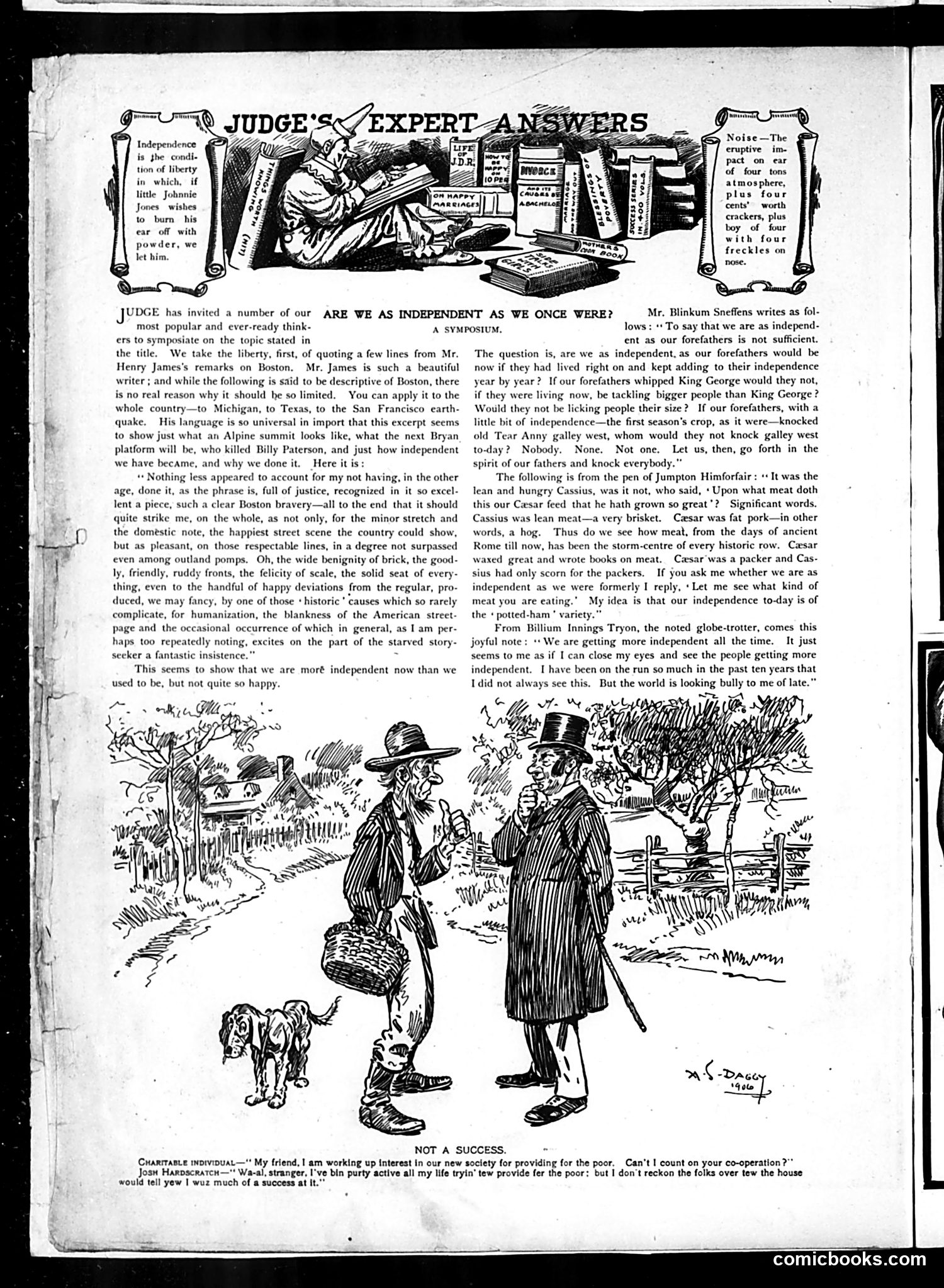
This page presents a symposium on American independence, asking whether modern citizens are as independent as their forefathers. The magazine invited notable thinkers to respond. Henry James's lengthy excerpt about Boston appears to argue that American civic architecture and society reflect a kind of inherited independence and stability—though the piece's ornate, almost impenetrable prose becomes part of the satire itself. The responses that follow are comically absurd. One contributor argues forefathers would tackle "bigger people" if alive today. Another (Jumpton Himforfair) launches into a ridiculous analogy about independence and meat-eating, conflating Caesar and pork packers. **The cartoon's point**: American independence has become hollow or confused. Rather than genuine civic virtue or self-governance, "independence" now means either aggressive nationalism or nonsensical philosophizing. The contributors' overwrought, disconnected arguments satirize how intellectuals and politicians invoke the founding fathers' legacy without substance.
📄 Transcribed text from this page (OCR, searchable)
Machine-transcribed from the original scan — historical spelling and the odd misread are preserved.
Independence is the condi- tion of liberty which, if little Johnnie Jones” wishes to burn his car off with powder, we let him. UDGE has invited a number of our ARE WE AS INDEPENDENT AS WE ONCE WERE? A SYMPOSIUM. low: most popular and ever-ready think- ers to symposiate on the topic stated in the title. We take the liberty, first, of quoting a few lines from Mr. Henry James's remarks on Boston. Mr. James is such a beautiful writer ; and while the following is said to be descriptive of Boston, there is no real reason why it should be so limited, You can apply it to the whole country—to Michigan, to Texas, to the San Francisco earth- His language is so universal in import that this excerpt seems to show just what an Alpine summit looks like, what the next Bryan platform will be, who killed Billy Paterson, and just how independent we have became, and why we done it. Here it is: “ Nothing less appeared to account for my not having, i age, done it, as the phrase is, full of justice, recognized in it so excel- lent a piece, such a clear Boston bravery—all to the end that it should quite strike me, on the whole, as not only, for the minor stretch and the domestic note, the happiest street scene the country could show, but as pleasant, on those respectable lines, in a degree not surpassed even among outland pomps. Oh, the wide benignity of brick, the good- ly, friendly, ruddy fronts, the felicity of scale, the solid seat of every- thing, even to the handful of happy deviations from the regular, pro- duced, we may fancy, by one of those ‘historic’ causes which so rarely complicate, for humanization, the blankness of the American street- page and the occasional occurrence of which in general, as am per- haps too repeatedly noting, excites on the part of the starved story- quake. seeker a fantastic insistence.” This seems to show that we are mort independent now than we used to be, but not quite so happy. Cuarrrapce inpivipuat—" Josn Harpscratcr—" Wa-al, stranger, would tell yew I wuz much of a success at It. Noise —The eruptive im- pact on ear of four tons atmosphere, plus four cents’ worth crackers, plus boy of four with four freckles on Mr. Blinkum Sneffens writes as fol- To say that we are as independ- ent as our forefathers is not sufficient. ‘The question is, are we as independent, as our forefathers would be now if they had lived right on and kept adding to their independence year by year? If our forefathers whipped King George would they not, if they were living now, be tackling bigger people than King George ? Would they not be licking people their size? If our forefathers, with a little bit of independence—the first season's crop, as it were—knocked old Tear Anny galley west, whom would they not knock galley west to-day? Nobody. None. Not one, Let us, then, go forth in the spirit of our fathers and knock everybody.” The following is from the pen of Jumpton Himforfair : ++ It was the lean and hungry Cassius, was it not, who said, * Upon what meat doth this our Casar feed that he hath grown so great’? Significant words. Cassius was lean meat—a very brisket. Cassar was fat pork—in other words, a hog. Thus do we see how meat, from the days of ancient Rome till now, has been the storm-centre of every historic row. Caesar waxed great and wrote books on meat. Czsar'was a packer and Cas- sius had only scorn for the packers. If you ask me whether we are as independent as we were formerly I reply, ‘Let me see what kind of meat you are eating.’ My idea is that our independence to-day is of the + potted-ham" variety.” From Billium Innings Tryon, the noted globe-trotter, comes this joyful note; + We are getting more independent all the time. It just seems to me as if I can close my eyes and see the people getting more independent. [ have been on the run so much in the past ten years that Idid not always see this, But the world is looking bully to me of late." PSs {t' 7 | | it [ | \ " \\ a» a, NOT A SUCCESS. ad * My friend, | am working up interest in our new society for providing for the poor. Can't | count on your co-operation ?"* re bin purty active all my life tryin’ tew provide fer the poor: but I don't reckon the folks over tew the house comicbooks.com