
A complete issue · 16 pages · 1906
Judge — April 21, 1906
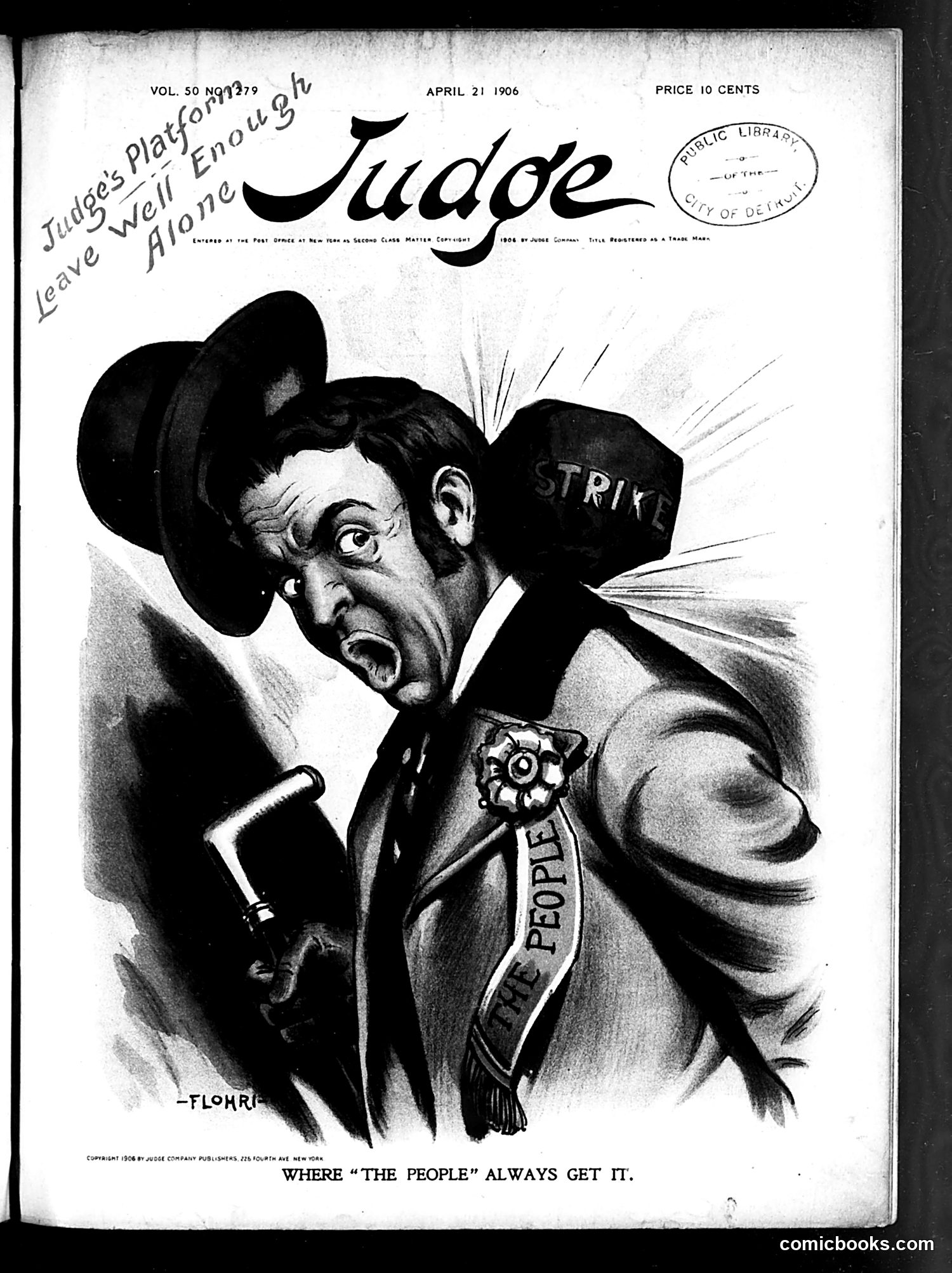
This political cartoon satirizes labor strikes and their impact on ordinary citizens. The central caricatured figure—labeled with "STRIKE" on his glove—represents either a strike leader or the strike movement itself, depicted as violent and aggressive (fist raised, wild expression). The ribbon across his chest reads "THE PEOPLE," though the figure is portrayed as harmful rather than heroic. The caption "WHERE 'THE PEOPLE' ALWAYS GET IT" employs bitter irony: the cartoon suggests that workers claiming to fight for "the people" actually harm common citizens through strike disruption. This reflects anti-labor sentiment common among Judge's middle-class readership during the early 1900s, when strikes were frequent and controversial.
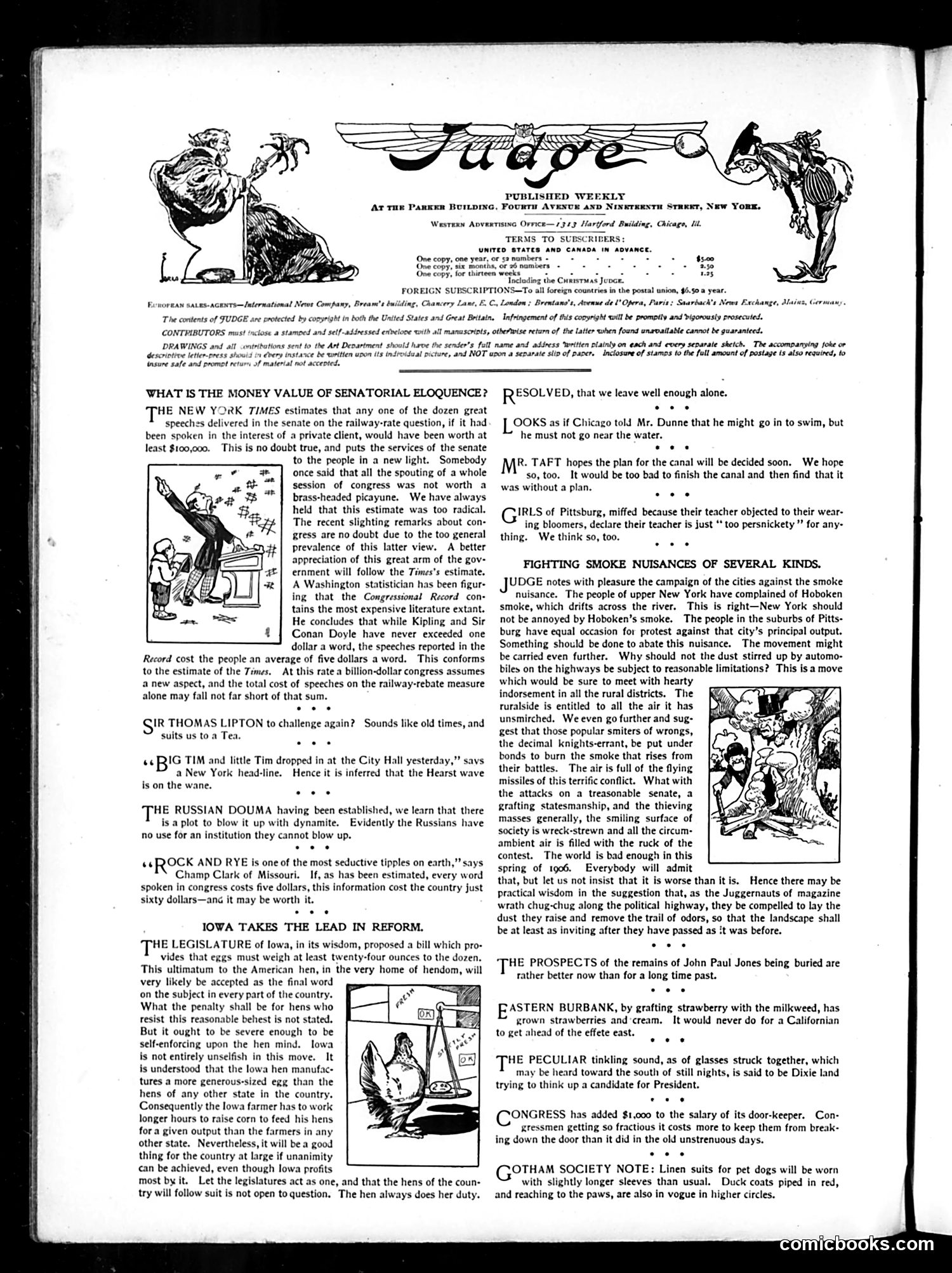
This page contains several short political commentaries and satirical notes rather than a single large cartoon. The visible illustrations are small sketches accompanying brief editorial quips about contemporary issues. The content mocks political figures and social trends of the era. One section criticizes senatorial "eloquence" on railroad rates, suggesting senators' speeches weren't worth the time spent. Another attacks Chicago's handling of smoke nuisance from industrial sources. There's commentary on Iowa's proposed egg-weighing legislation, satirizing what Judge considers excessive regulatory intervention. A final note jokes about congressional salary increases for doorkeepers. The cartoons use exaggerated character drawings typical of satirical magazines to amplify ridicule. Without clearer image resolution, specific figure identification is difficult, but the overall tone targets government inefficiency and over-regulation.
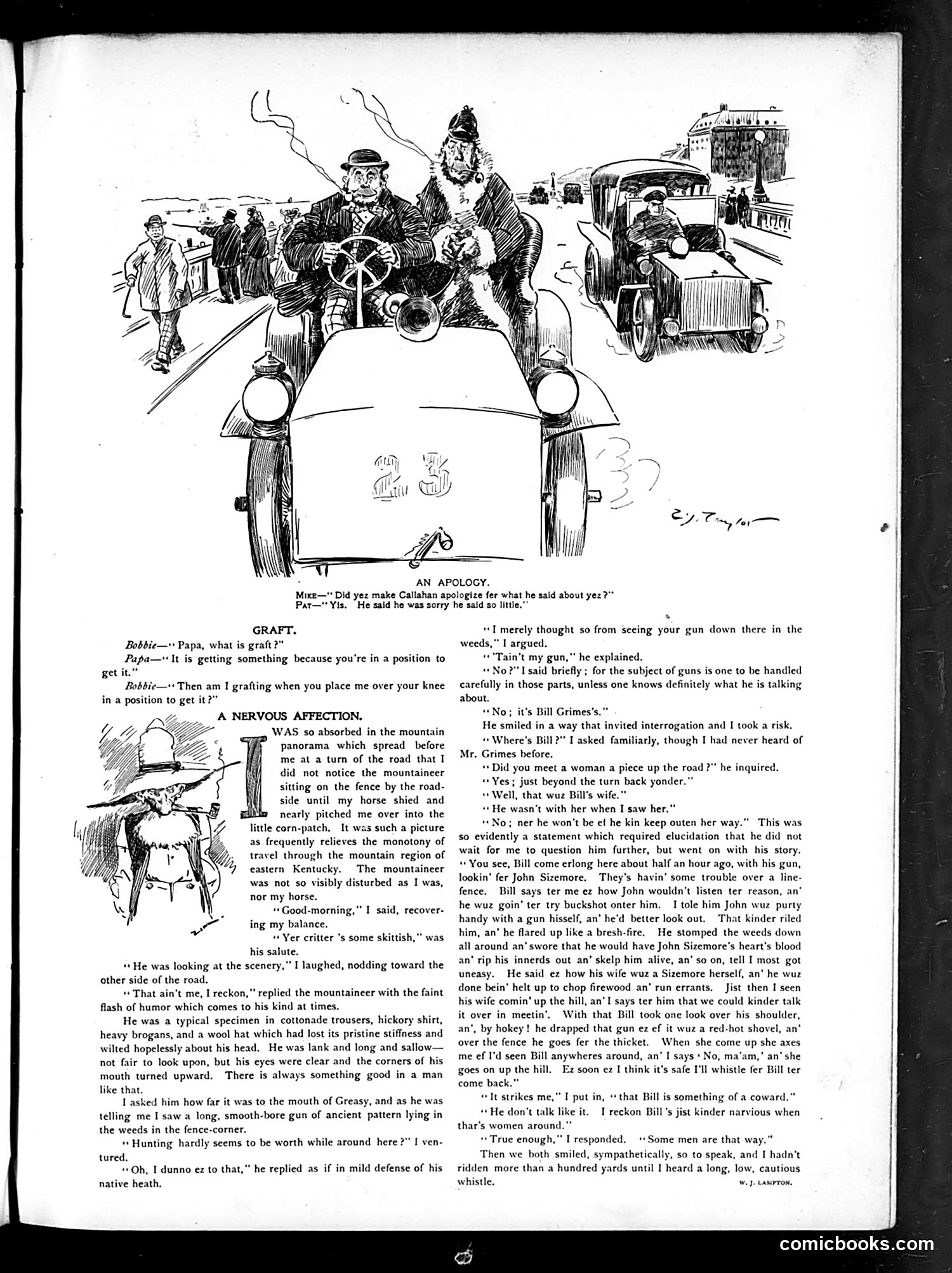
The top cartoon titled "An Apology" depicts an early automobile with two men, satirizing a traffic incident. The dialogue references "Callahan" apologizing for something he said, suggesting a specific contemporary dispute, though the exact context is unclear. Below, "Graft" presents a conversation defining graft as "getting something because you're in a position to get it"—mocking corrupt officeholders who exploit their positions. The larger illustration "A Nervous Affection" depicts a mountaineer recounting an encounter with someone named Bill involving a gun. The lengthy accompanying story appears to be frontier humor, possibly satirizing rural gun culture or a specific contemporary figure, though the specific reference is unclear. The overall page combines political corruption commentary with rural/frontier social satire typical of Judge's approach.
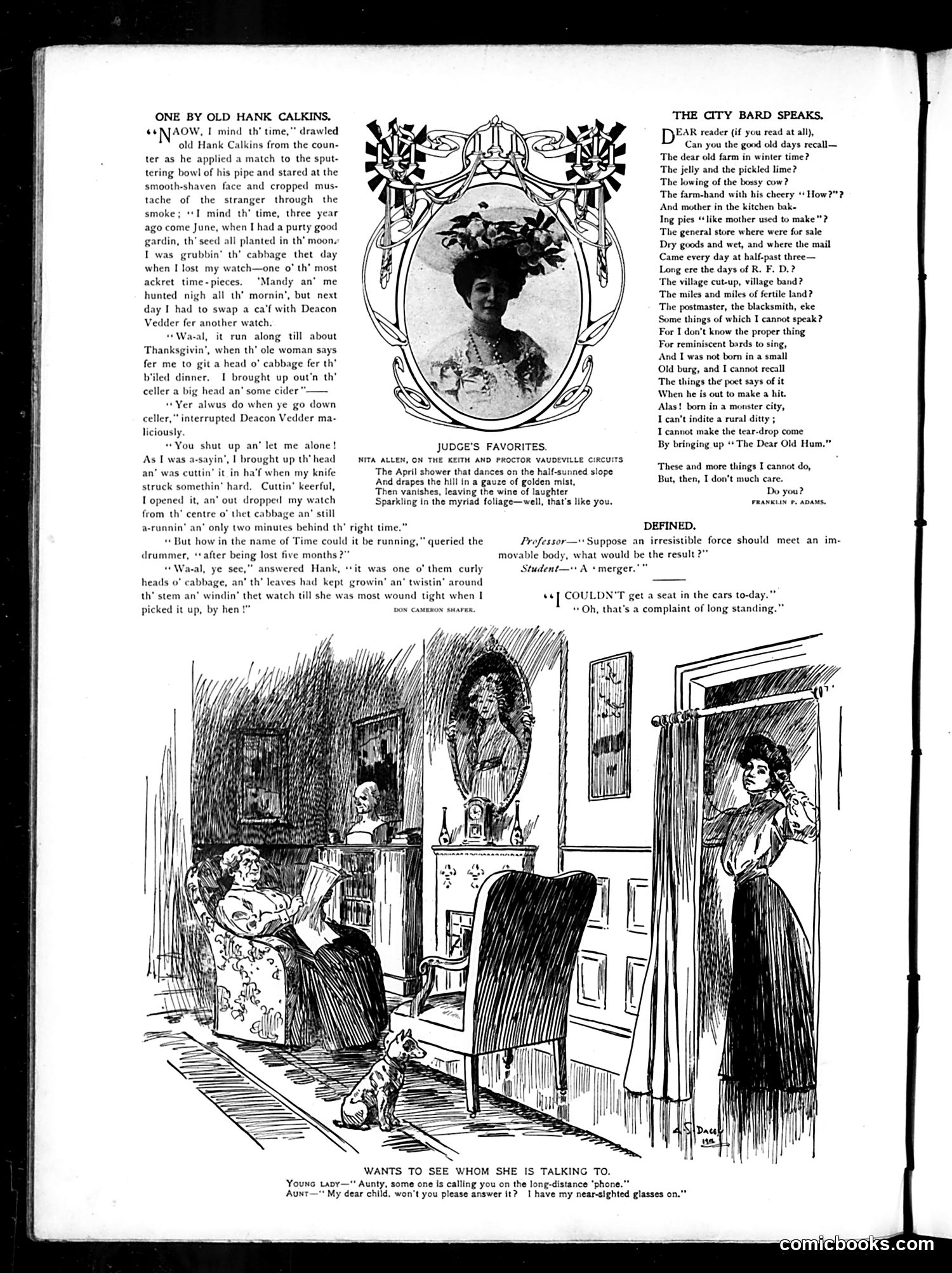
This Judge magazine page combines nostalgic rural humor with contemporary social commentary. "One by Old Hank Calkins" features a farmer reminiscing about losing his watch while gambling on cabbage, using folksy dialect. The piece celebrates pre-modern rural life as superior to present times. "The City Bard Speaks" is a poem lamenting loss of rural traditions—farm life, village stores, general goods—replaced by modern urban existence. The writer expresses alienation from city living and cannot adequately describe nostalgic memories. The bottom cartoon shows a woman on a long-distance telephone call, with her elderly aunt unable to hear properly without glasses. It satirizes emerging telephone technology as confusing and impersonal compared to face-to-face conversation. Overall, the page expresses anxiety about modernization and urbanization displacing traditional American rural culture.
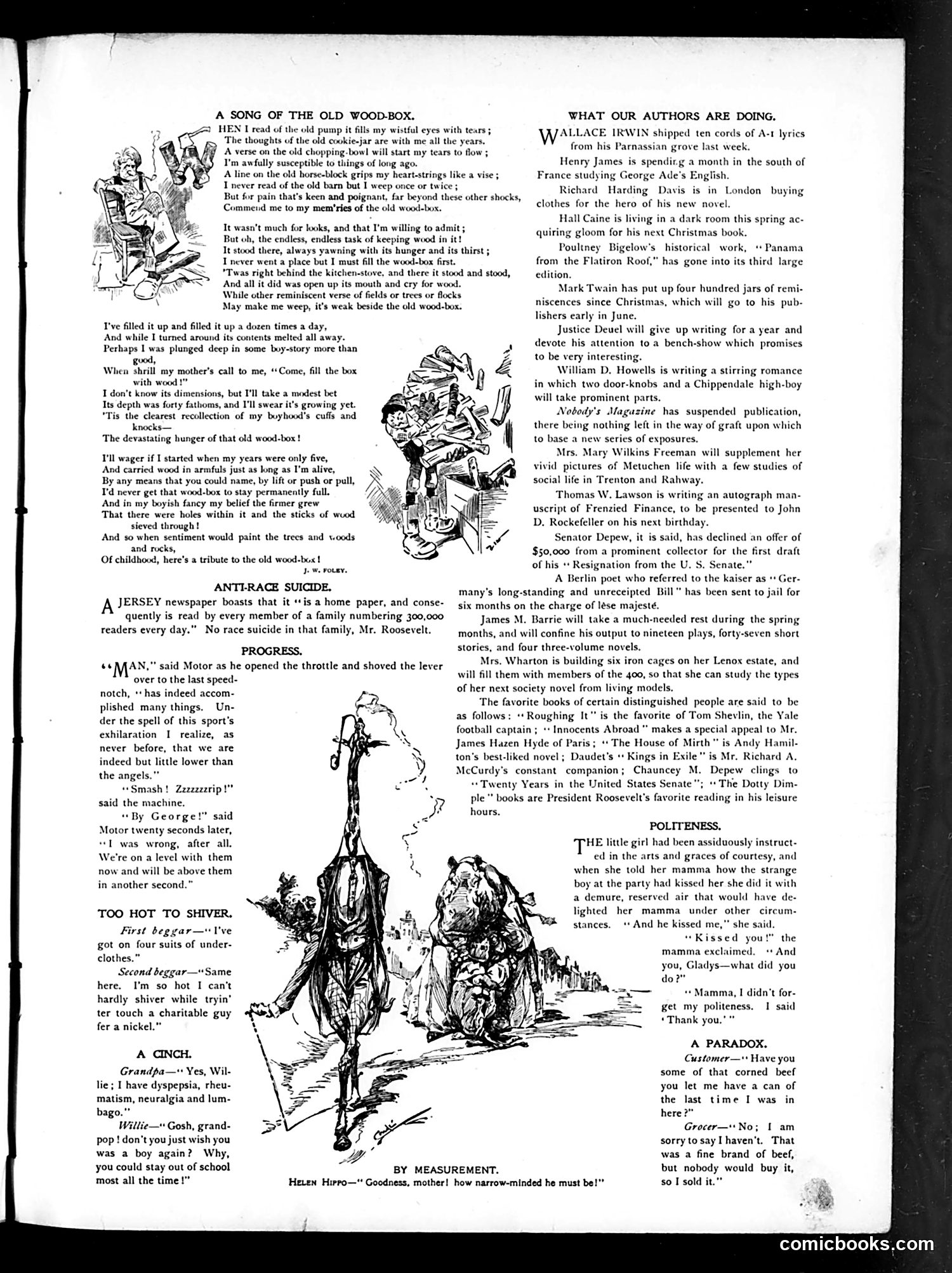
This page contains several short humorous pieces and sketches rather than a unified political cartoon. The content includes: **"A Song of the Old Wood-Box"** — A nostalgic poem with accompanying illustration about a wooden storage box, likely satirizing sentimental Victorian attitudes toward humble domestic objects. **"What Our Authors Are Doing"** — Brief notes on contemporary writers' activities, presented as society gossip. **"Anti-Race Suicide"** and **"Progress"** — Short satirical pieces with motor-car illustrations, appearing to mock early automobile culture and related social concerns. **"Too Hot for Shiver," "A Cinch," "A Paradox," and "By Measurement"** — Joke exchanges between characters, using wordplay and ironic situations typical of period humor magazines. The overall tone is light domestic satire rather than serious political commentary. The exact publication date is unclear from the visible content.
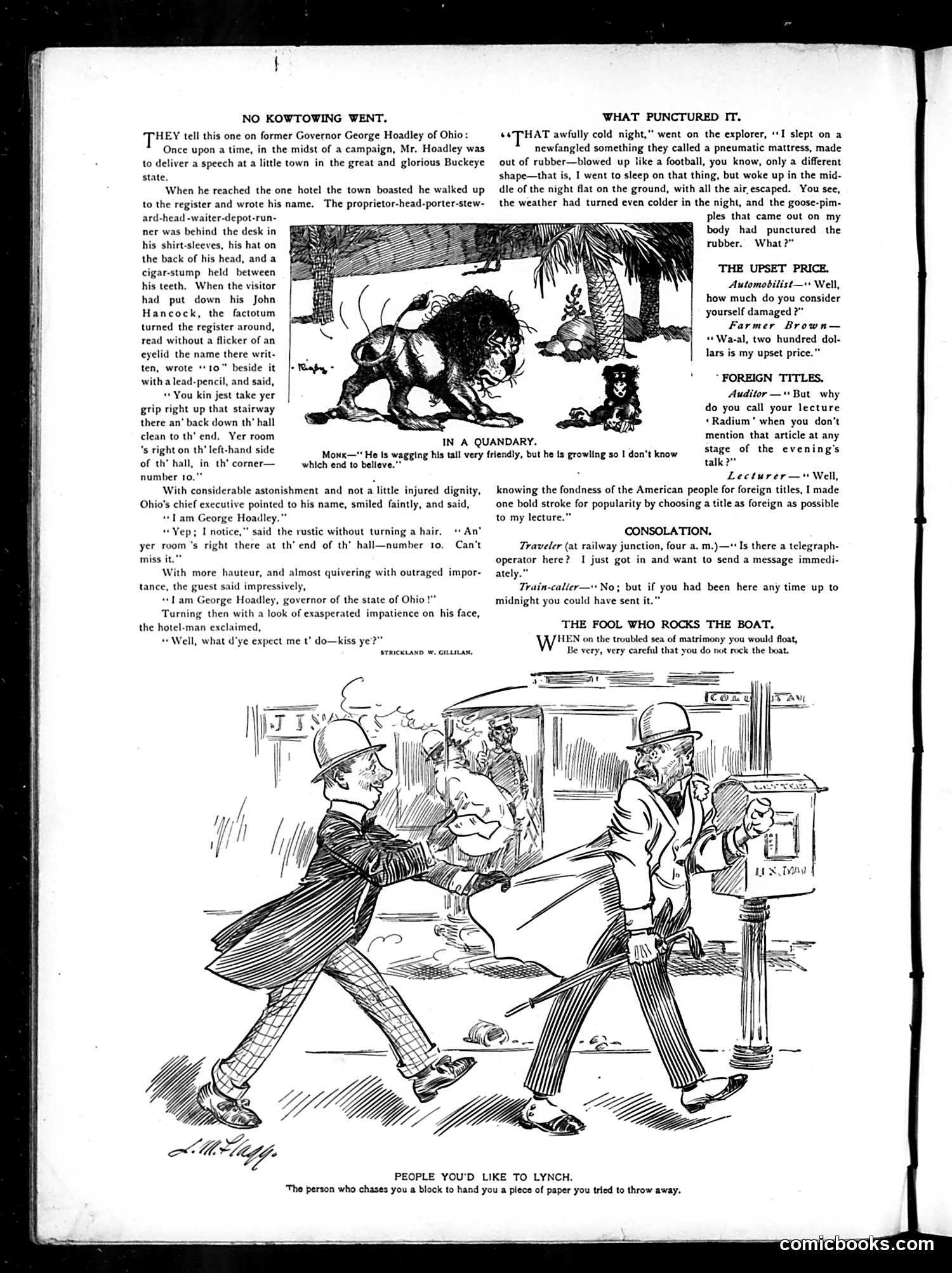
This page contains multiple satirical pieces typical of late 19th-century American humor: **"No Kowtowing Went"** mocks former Ohio Governor George Hoadley through a anecdote about his visit to a small-town hotel. The proprietor, an uncouth rustic, treats the distinguished governor with complete indifference—assigning him a room number without deference and refusing to acknowledge his official status. The satire criticizes either Hoadley's pretension or, conversely, celebrates American egalitarianism where even governors receive no special treatment. **Other brief pieces** include absurdist humor: a dog's mixed signals ("In a Quandary"), an explorer's goose-pimples puncturing an air mattress ("What Punctured It"), and various puns about pneumatic tires, lecture titles, and telegraph operators. **The bottom cartoon** depicts two men fighting over a block—illustrating annoyances of daily life, typical of Judge's "People You'd Like to Lynch" recurring feature satirizing minor social irritations. The overall tone reflects Judge's blend of political commentary, class humor, and absurdist everyday observations.
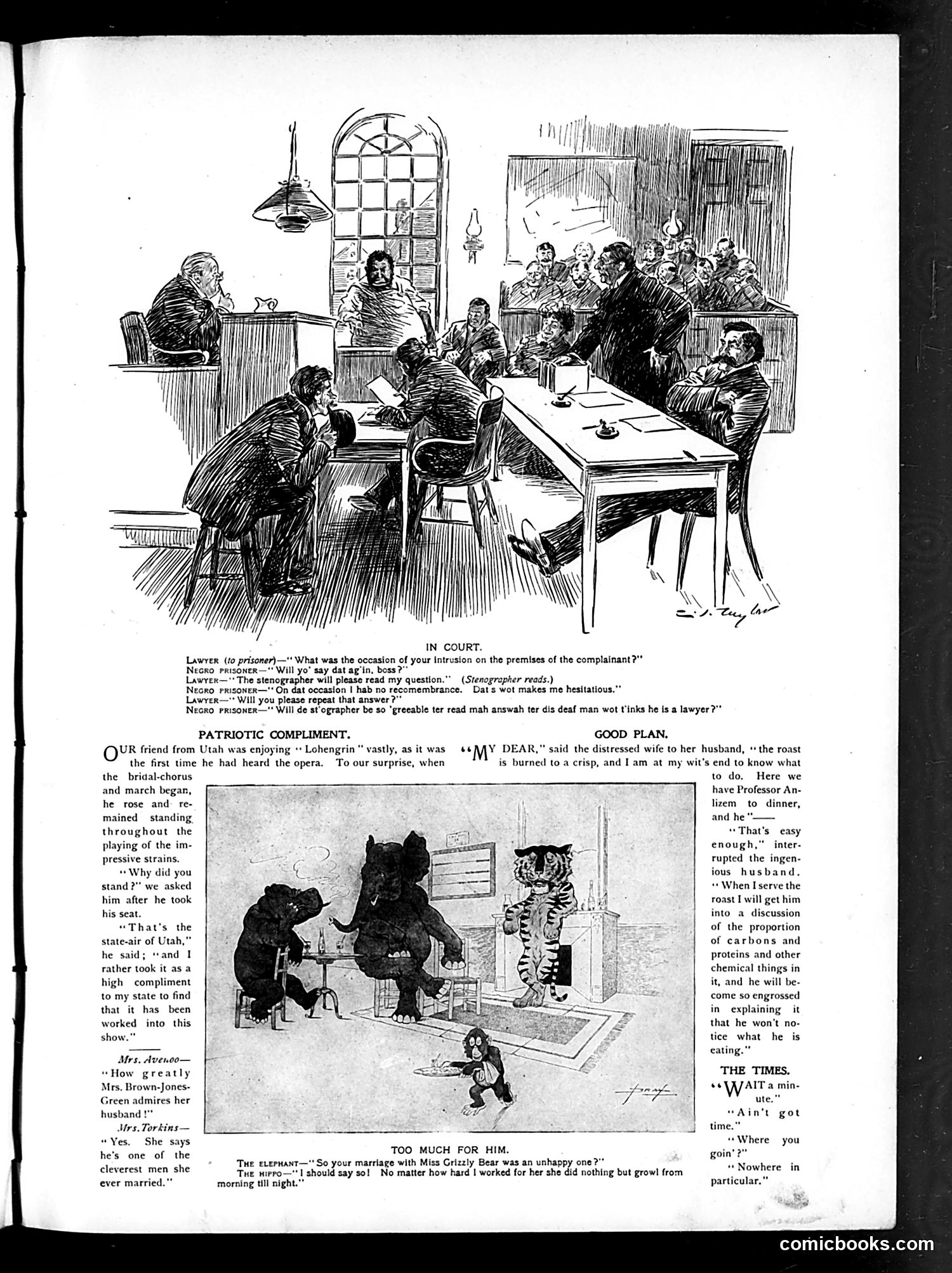
This page contains three distinct satirical pieces: **"In Court"**: A racist minstrel-show stereotype mockery depicting a Black defendant whose dialect and malapropisms frustrate a lawyer. The "joke" relies on racist caricature—the defendant deliberately misunderstands legal language and demands the stenographer re-read questions, suggesting intellectual incompetence. This reflects the deeply offensive racial humor common in Gilded Age publications. **"Patriotic Compliment"**: A Utah man stands during Wagner's "Lohengrin" bridal chorus, believing it's the state anthem. Mild satire on provincial pride and cultural unfamiliarity. **"Good Plan" and related anecdotes**: Humorous domestic sketches about wives managing husbands—one wife distracts a visiting professor from noticing burnt roast by engaging him in chemistry discussion; another wife notes her clever husband is "one of the cleverest men she ever married" (implying serial marriages). The page represents typical Judge content: light domestic humor mixed with cruder racial caricature. Modern readers should recognize the explicitly racist material as historically significant evidence of accepted bigotry in mainstream American periodicals.
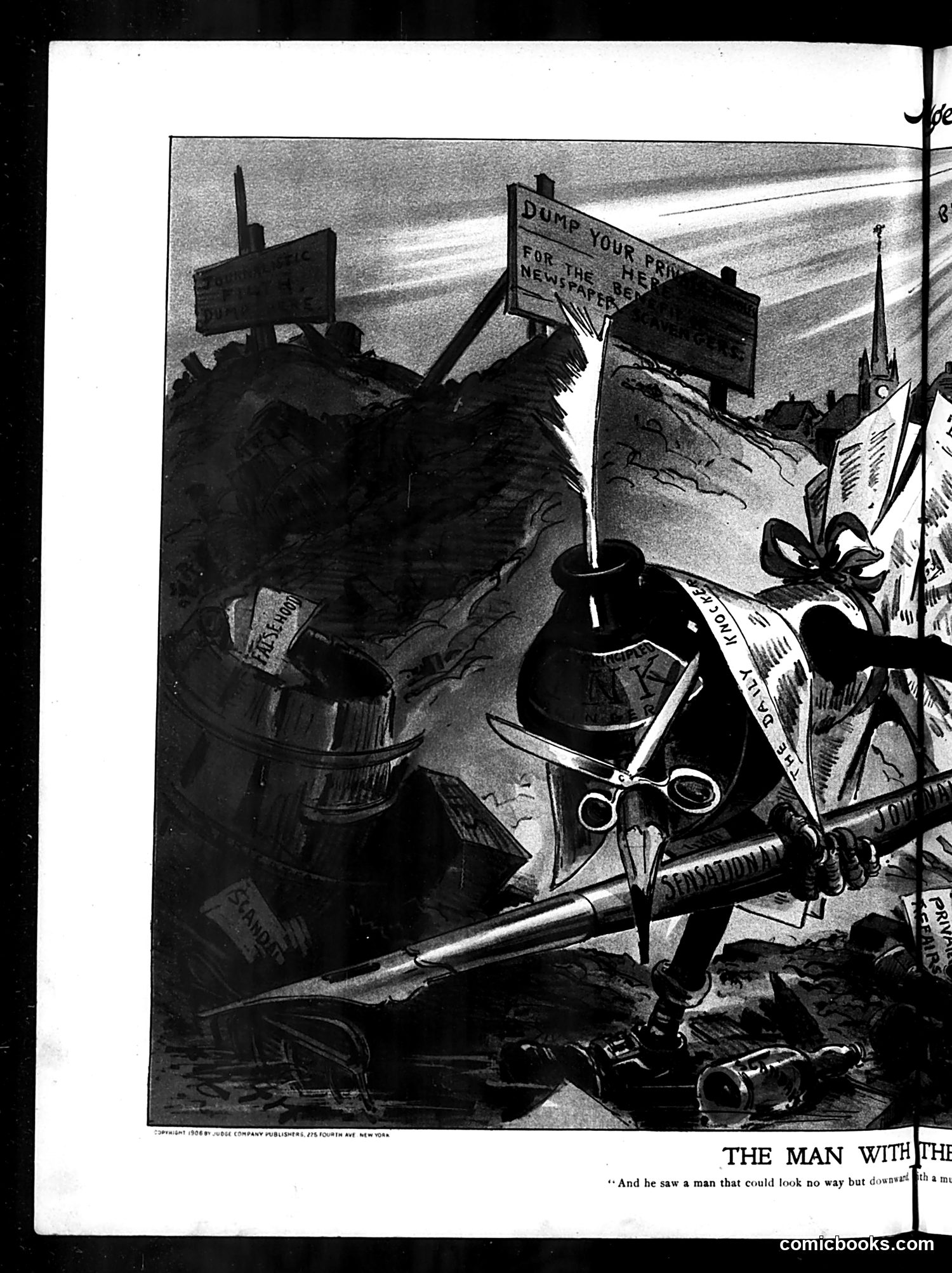
This appears to be a political or social satire cartoon from Judge magazine (1906). The illustration shows a figure surrounded by newspapers and signs reading "DUMP YOUR PAPERS FOR THE NEWSPAPERS" and similar messages about discarding or replacing newspapers. Various documents and what appear to be satirical props litter the scene. The cartoon likely satirizes early-1900s concerns about media manipulation, yellow journalism, or the proliferation of newspapers. The figure's downward gaze (referenced in the partial quote below) suggests resignation or despair at being overwhelmed by media or public opinion. Without the complete title and caption, the specific political target remains unclear, though it appears critical of newspaper culture or media influence during the Progressive Era.
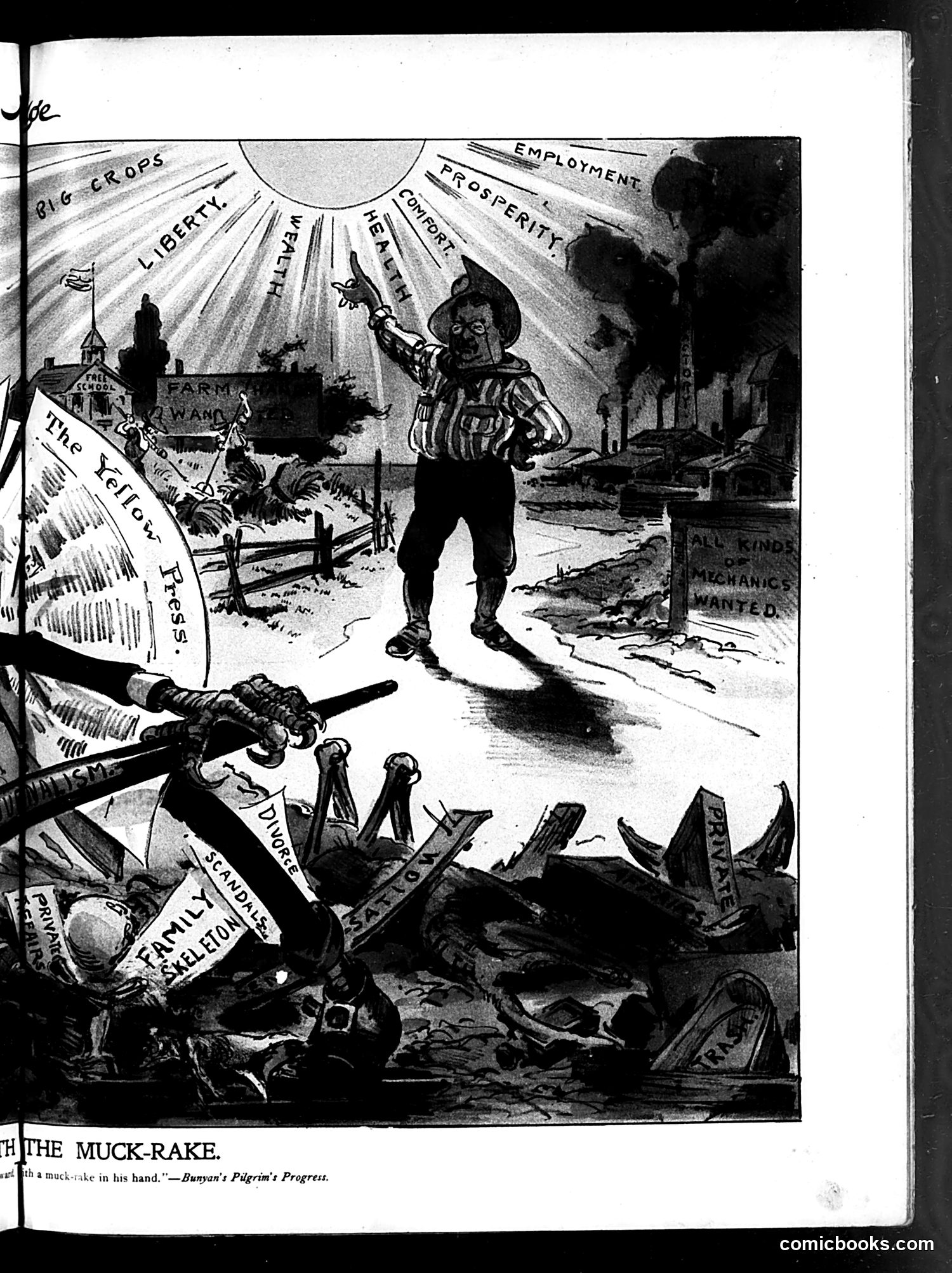
This political cartoon satirizes a figure wielding a rake amid societal debris, referencing Bunyan's *Pilgrim's Progress*. The radiant labels—"Big Crops," "Liberty," "Harmony," "Prosperity," "Employment," "Comfort"—represent ideals the figure ignores while focusing downward on filth. The cartoon likely critiques "muckraking" journalists or activists of the Progressive era (early 1900s) who exposed corruption but, in the cartoonist's view, obsessed over scandals rather than appreciating actual American achievements and progress. The caricatured figure's grotesque features suggest contempt for this approach. The rubble below includes signs reading "All Kinds Mechanics Wanted," indicating economic opportunity being overlooked. The satire argues muckrakers undermine public morale by dwelling on problems rather than recognizing national prosperity.
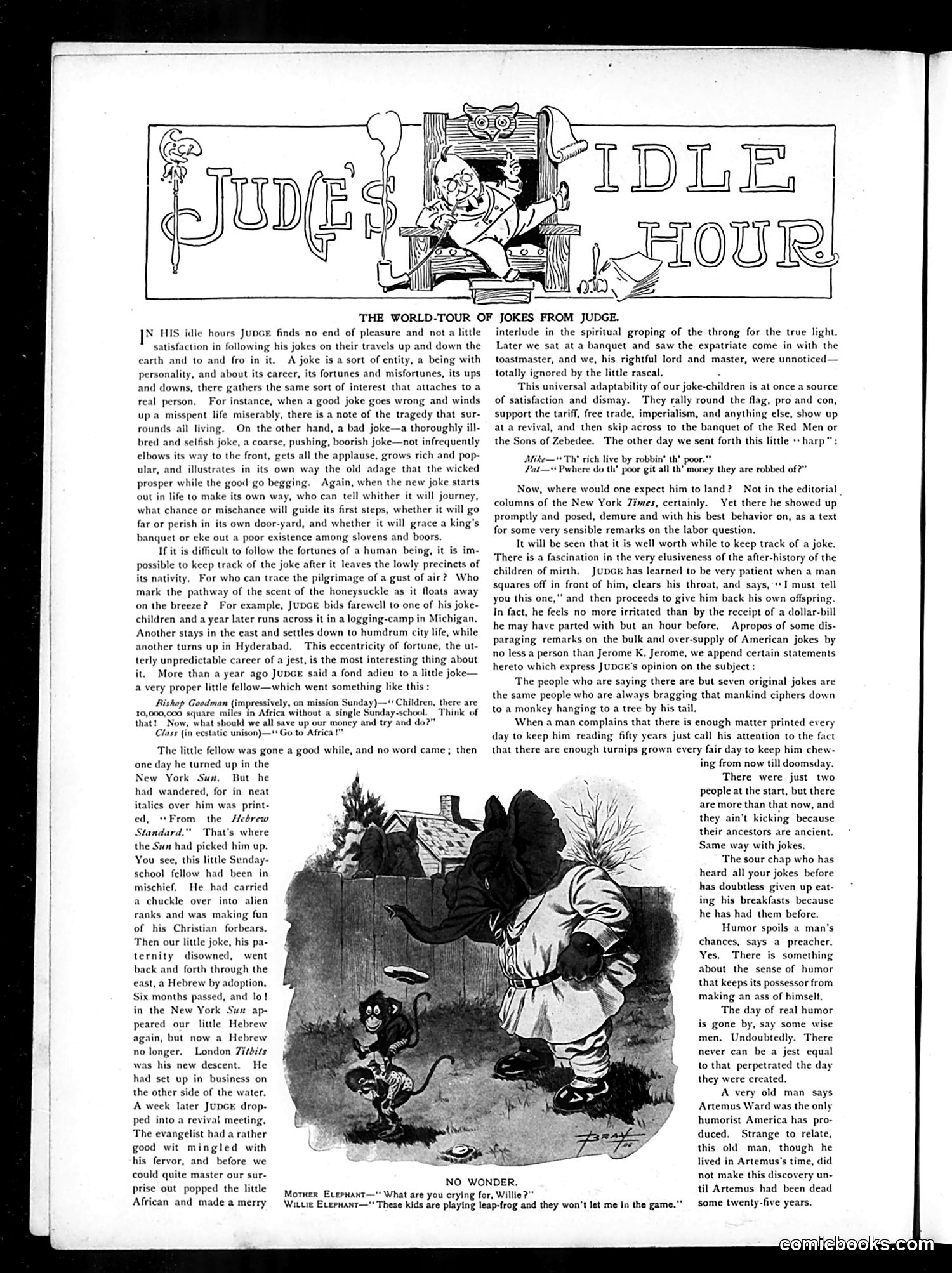
This page presents **Judge magazine's philosophical reflection on jokes themselves** — treating them as living entities with independent lives and careers. The main essay traces the journey of a single joke that originated in Judge, following it as it travels through publications (the *New York Sun*, the *Hebrew Standard*, London's *Titbits*) and contexts, gaining and losing identity with each retelling. The joke about a missionary child saying "Go to Africa!" becomes a vehicle to explore how humor circulates unpredictably through culture. **The satire's point**: Judge uses tongue-in-cheek personification to comment on intellectual property, plagiarism, and how humor spreads without attribution—a recurring frustration for satirical publications of the era. Jokes are "kidnapped" by other publications, transformed, and repurposed. The **cartoon at bottom** ("No Wonder") shows a simple domestic joke about children excluding another from their game—an example of the "little joke-children" discussed above. The piece is fundamentally **self-promotional**, celebrating Judge's role as humor originator while lamenting how its creations escape into the cultural commons.
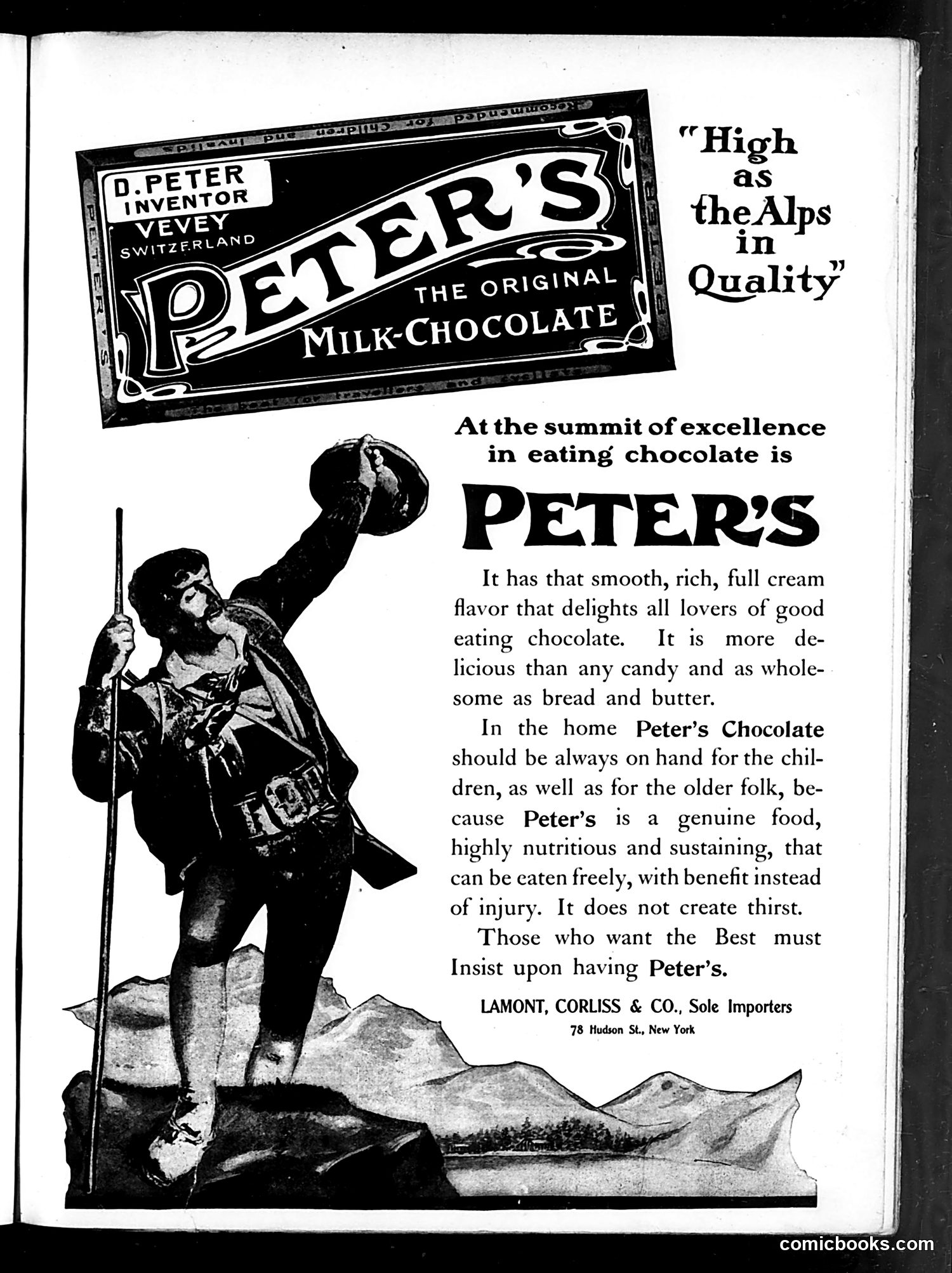
This is **not a cartoon or satire** — it's a straightforward **advertisement** for Peter's milk chocolate, a Swiss import distributed by Lamont, Corliss & Co. in New York. The page features an Alpine mountaineer triumphantly holding a chocolate bar atop a mountain peak, illustrating the advertising slogan "High as the Alps in Quality." The imagery connects the product's Swiss origin to Alpine excellence and purity. The ad's claims reflect early 20th-century marketing language: chocolate is pitched as nutritious "genuine food" suitable for children and adults alike, claimed to be wholesome as "bread and butter" and notably "does not create thirst" — a selling point suggesting it won't make consumers thirsty in an era before modern beverages were widely available. This represents typical **luxury food advertising** from Judge magazine's era, targeting middle-class readers who could afford imported Swiss chocolates.
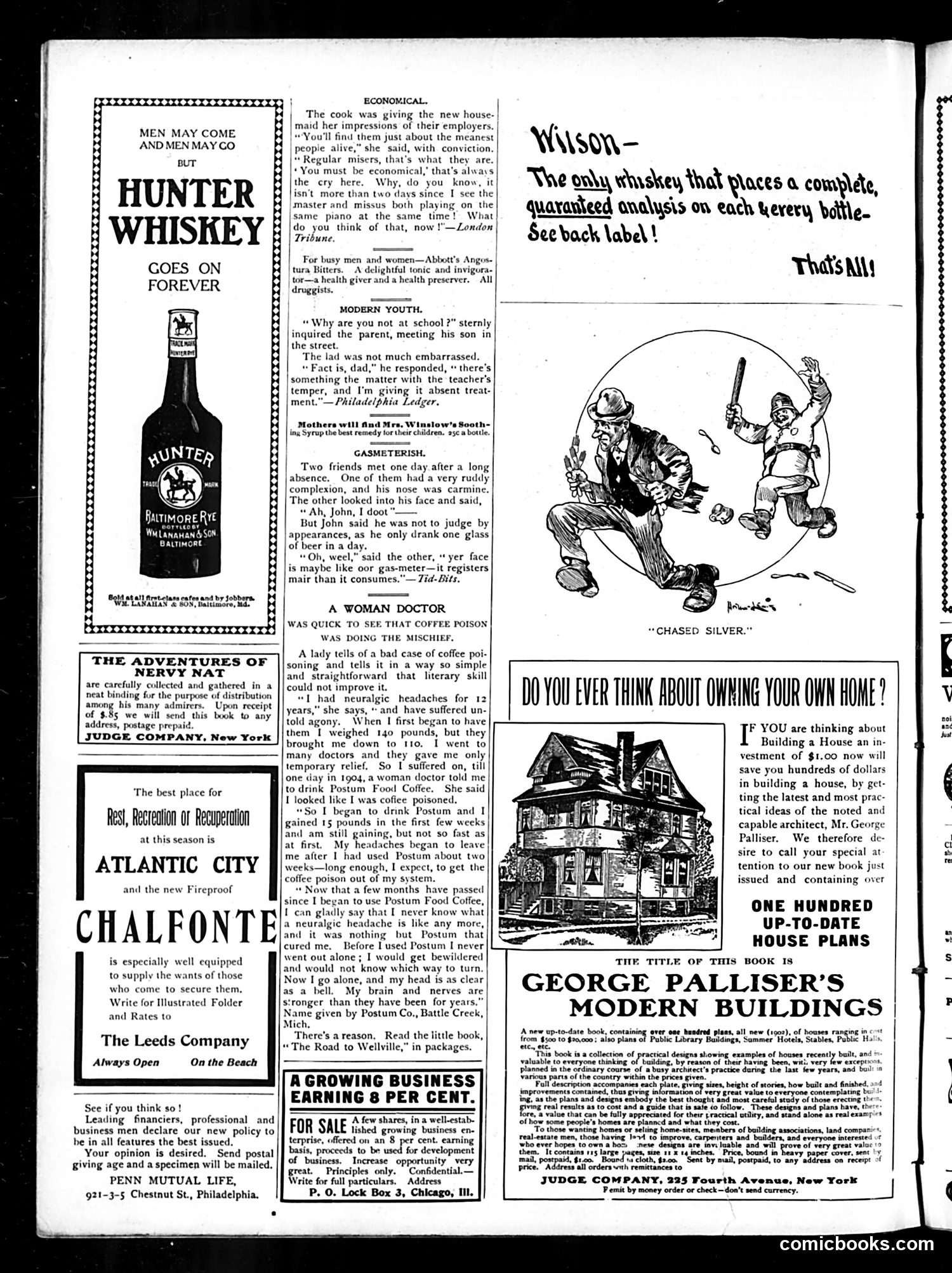
This page from the satirical magazine *Judge* contains several short humorous anecdotes targeting common social behaviors of the era. The main cartoons mock **economical miserliness**: one depicts a cook describing her employers as misers obsessed with saving money; another shows a schoolboy claiming he's giving his teacher an "absent treatment" due to the teacher's bad temper—a cheeky inversion of discipline. A third jokes about a man's ruddy complexion, suggesting his face "registers more than it consumes" like a gas meter—implying heavy drinking despite claims of moderation. The page also features a serious testimonial about **coffee poisoning**, where a woman describes how switching from regular coffee to Postum (a caffeine-free grain beverage) cured her chronic neuralgic headaches. **Context for modern readers**: These satirize 1910s-era anxieties about excessive frugality, youth disrespect for authority, hidden drinking, and emerging health concerns about caffeine consumption—all common Judge targets reflecting middle-class preoccupations.
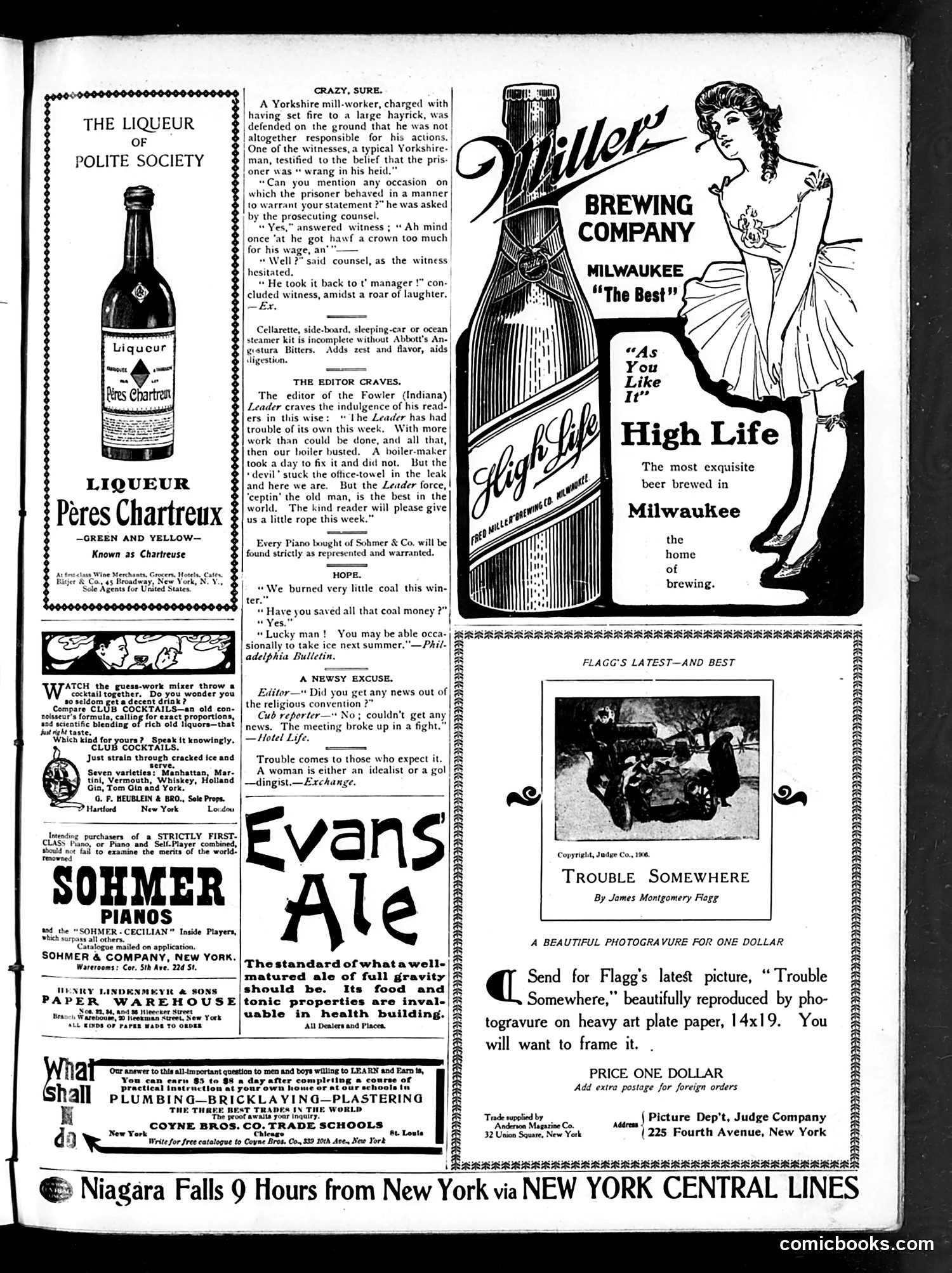
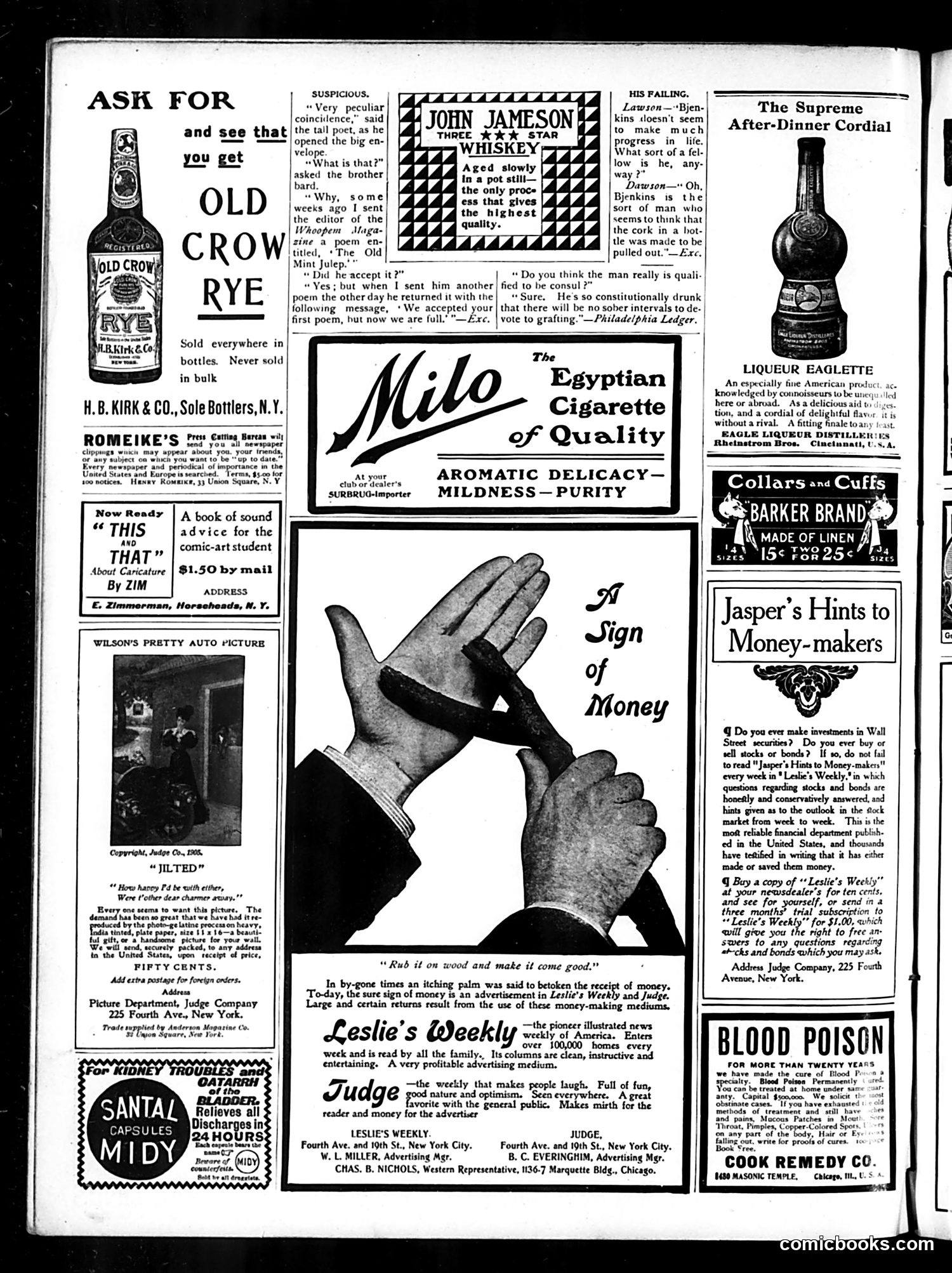
This page is primarily an **advertising compilation** with minimal cartoon content. The notable editorial content includes: **"His Failing" anecdote**: A joke about a man named Bjenkins who pulls corks from bottles—satirizing inebriation as a personal vice preventing success. **"Suspicious" and "Do you think the man...?" jokes**: Brief satirical quips about poets struggling with magazine editors and commentary on diplomatic corruption (a consul being so drunk he won't engage in graft). The page is dominated by **product advertisements** for liquor (Old Crow Rye, John Jameson Whiskey), cigarettes (Milo Egyptian), and patent medicines (Santa Midy Capsules), typical of Judge magazine's revenue model. There's also advertising copy for Leslie's Weekly magazine itself and Jasper's investment advice column. The page lacks substantive political satire—it's a snapshot of early 1900s advertising and light social humor.
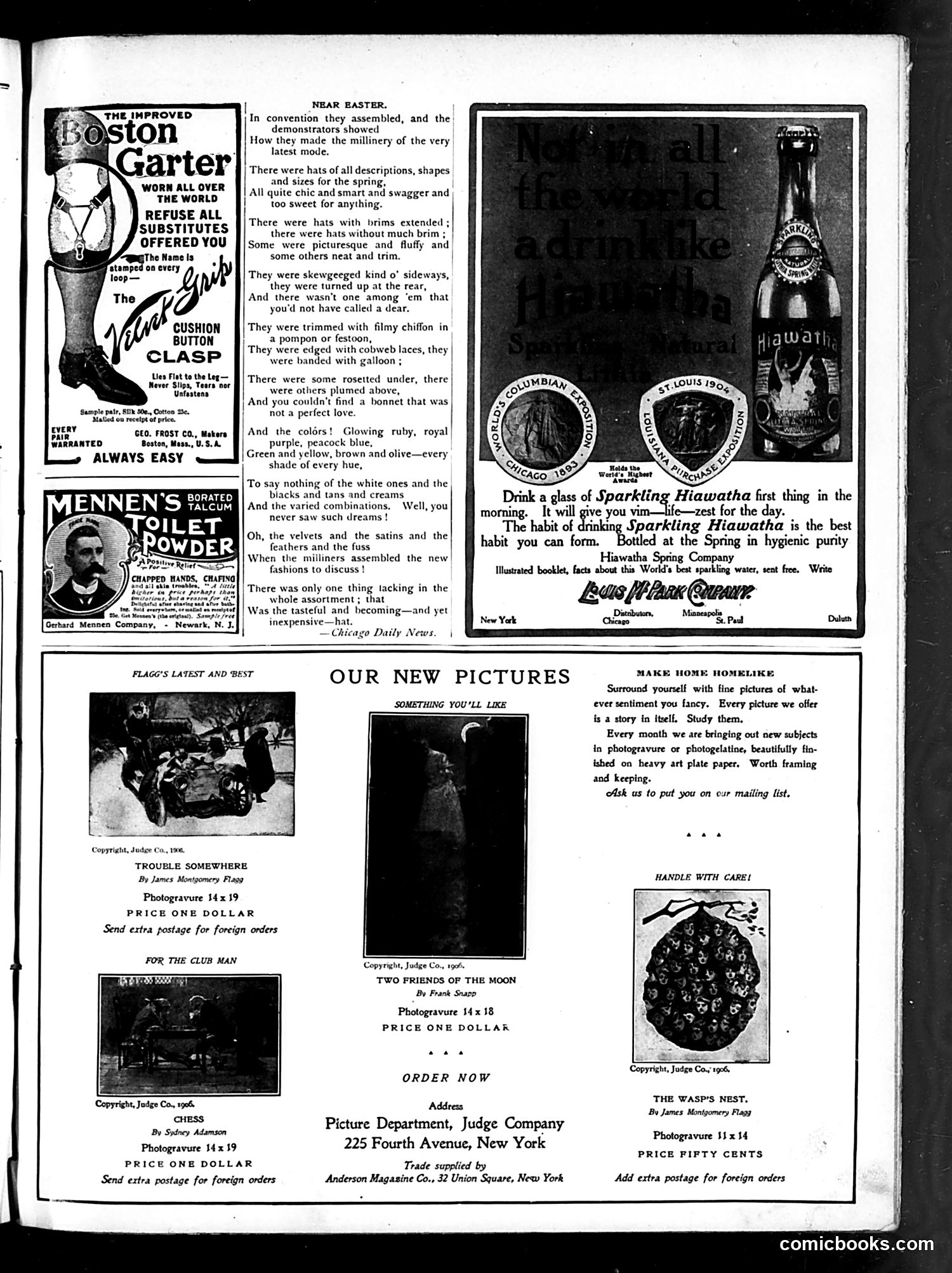
This page is primarily **advertising and product promotion** rather than political satire. The main content includes: **"Near Easter"** - A lighthearted poem about spring millinery fashions, celebrating elaborate Easter bonnets with detailed descriptions of trims, colors, and decorative elements. This reflects the early 1900s social importance of fashionable hats, particularly for women's Easter wear. **Product Advertisements:** - Boston Garter corset stays - Mennen's Borated Talcum Powder - **Hiawatha Sparkling Water** - positioned as a health beverage for daily consumption **Picture Department Section** - Judge Company selling photogravure prints of artworks by James Montgomery Flagg and others, marketed as decorative home items worth framing. The page shows the magazine's dual function as both satirical publication and commercial advertising vehicle. The fashion poem's cheerful tone reflects period gender norms where women's appearance and fashionable dress were central social concerns. The water advertisement emphasizes "hygienic purity," reflecting contemporary health anxieties.
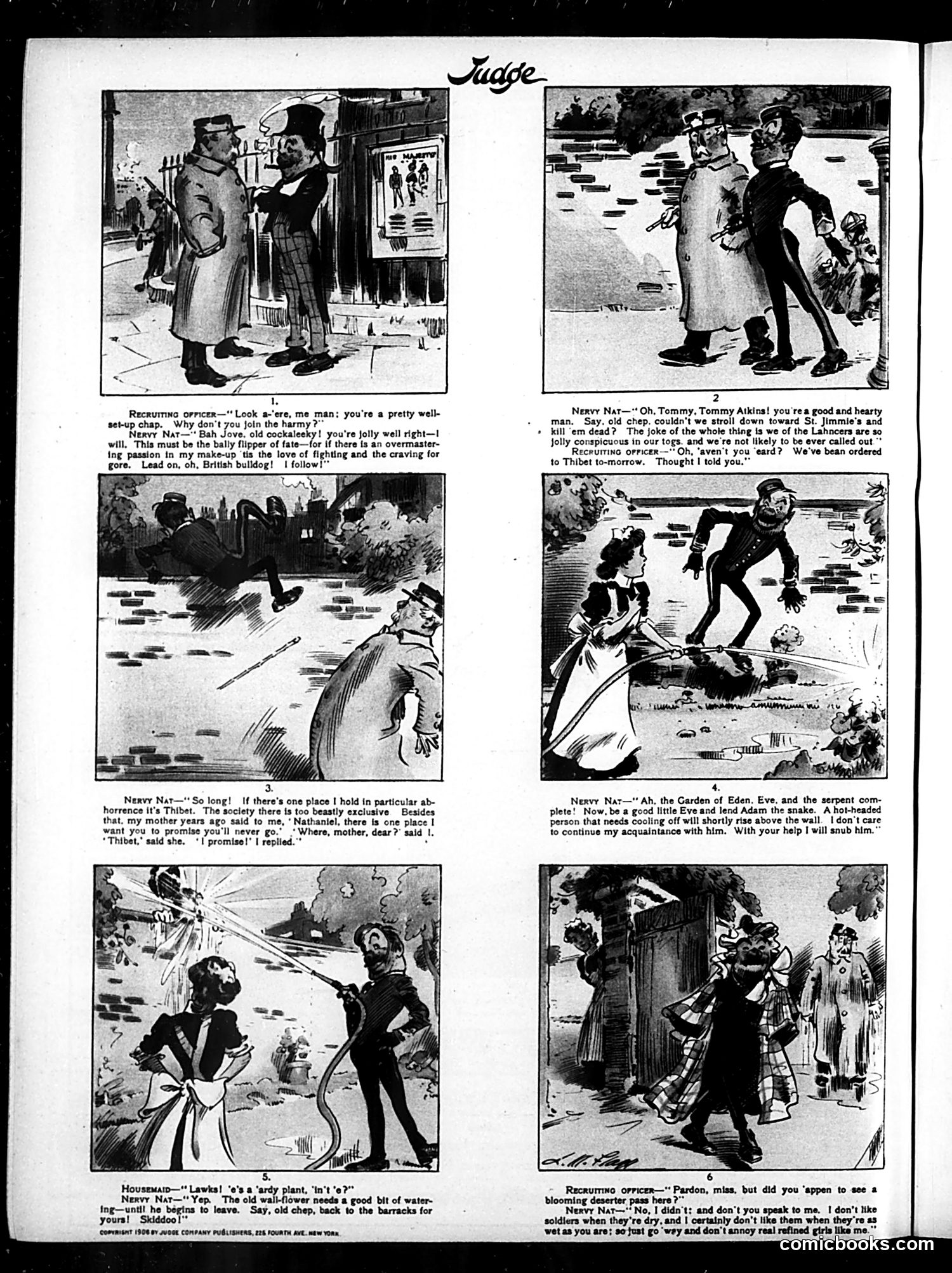
This is a satirical comic strip featuring "Nervy Nat," a cocky character who speaks in exaggerated British military slang ("old cockaleeky," "bally," "Lawks"). The narrative follows him encountering a recruiting officer and various characters while avoiding military service to Tibet. The satire targets British military recruitment and colonial imperialism—Nat claims he loves fighting for Britain but repeatedly dodges actual deployment. His contradictions (professing patriotic passion while making excuses) mock both recruitment propaganda and the inconsistency of public war enthusiasm versus personal reluctance. References to "Tommy Atkins" (generic term for British soldiers), "Lancers" (cavalry regiment), and the Thibet campaign appear to reference actual British imperial military activities. The garden/serpent dialogue likely alludes to romantic entanglement as another excuse. The humor derives from Nat's transparent self-interest clashing with militaristic rhetoric—satire on how ordinary men evaded actual combat duty despite patriotic posturing.