
Judge, 1906-04-21 · page 5 of 16
Judge — April 21, 1906 — page 5: what you’re looking at
What you’re looking at
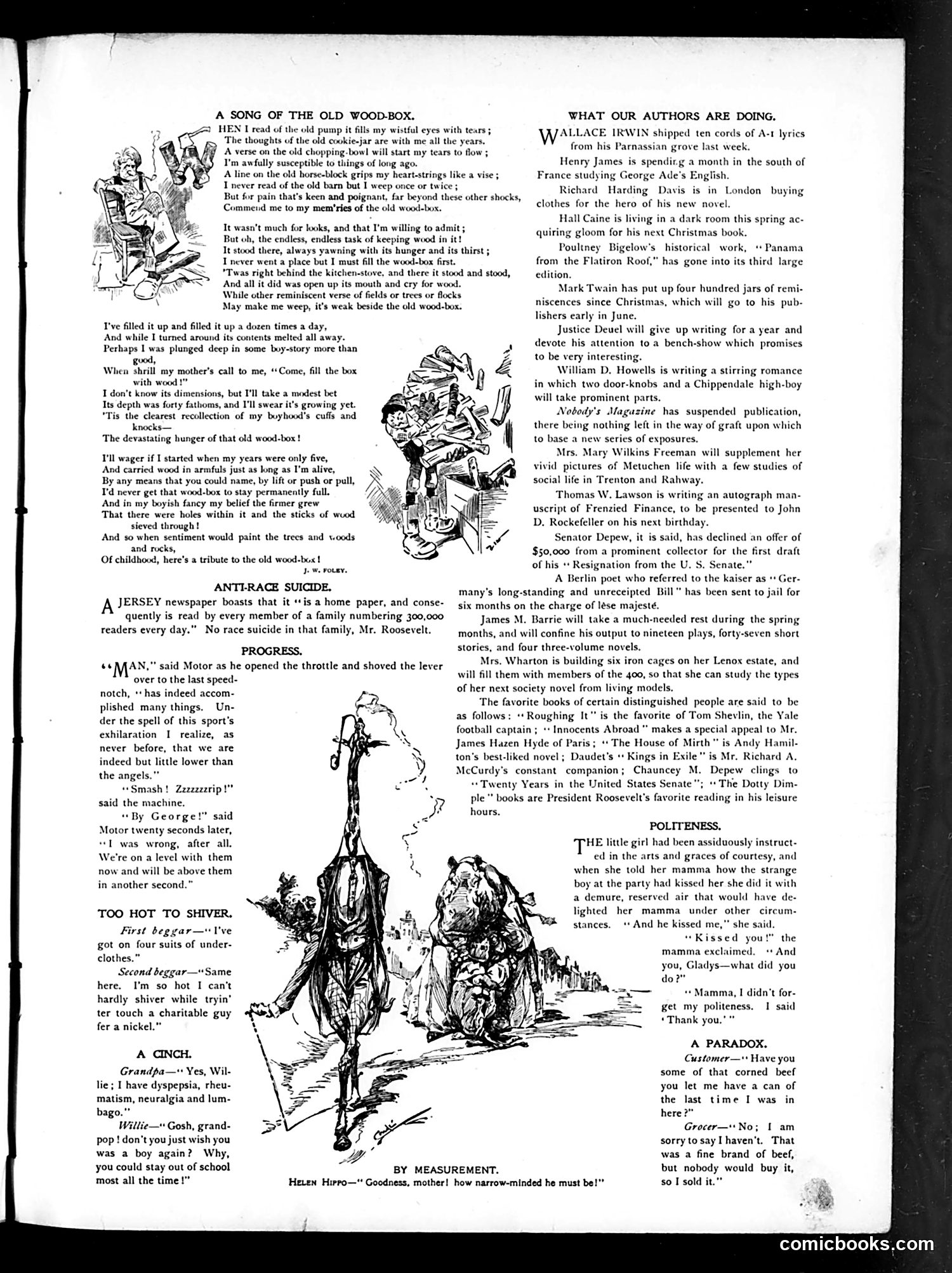
This page contains several short humorous pieces and sketches rather than a unified political cartoon. The content includes: **"A Song of the Old Wood-Box"** — A nostalgic poem with accompanying illustration about a wooden storage box, likely satirizing sentimental Victorian attitudes toward humble domestic objects. **"What Our Authors Are Doing"** — Brief notes on contemporary writers' activities, presented as society gossip. **"Anti-Race Suicide"** and **"Progress"** — Short satirical pieces with motor-car illustrations, appearing to mock early automobile culture and related social concerns. **"Too Hot for Shiver," "A Cinch," "A Paradox," and "By Measurement"** — Joke exchanges between characters, using wordplay and ironic situations typical of period humor magazines. The overall tone is light domestic satire rather than serious political commentary. The exact publication date is unclear from the visible content.
📄 Transcribed text from this page (OCR, searchable)
Machine-transcribed from the original scan — historical spelling and the odd misread are preserved.
A SONG OF THE OLD WOOD-BOX. 2 HEN I read of the old pump it fills my wistful eyes with tears ; The thoughts of the old cookie-jar are with me all the y -bow! will start my tears to flow ; A verse on the old choppin ars. I'm awfully susceptible to things of long ago. A line on the old horse-block grips my heart-strings like a vise ; I never read of the old barn but I weep once of twi But for pain that's keen and poignant, far beyond these other shocks, Commend me to my mem'ries of the old wood-box, Tt wasn't much for looks, and that I'm willing to admit But oh, the endless, endless task of keeping wood in i It stood there, always yawning with its hunger and its thirst ; I never went a place but I must fill the wood-box first. "Twas right behind the kitchen-stove, and there it stood and stood, And all it did was open up its mouth and cry for wood. While other reminiscent verse of fields or trees or flocks May make me weep, it's weak beside the old wood-box. I’ve filled it up and filled it up a dozen times a day, And while I turned around its contents melted all away. Perhaps I was plunged deep in some buy-story more than gvod, When shrill my mother’s call to me, “Come, fill the box with wood !” I don't know its dimensions, but I'll take a modest bet Its depth was forty fathoms, and I'll swear it’s growing yet. "Tis the clearest recollection of my buyhood's cuffs and knocks— The devastating hunger of that old wood-box ! I'll wager if I started when my years were only five, And carried wood in armfuls just as long as I'm alive, By any means that you could name, by lift or push or pull, T’d never get that wood-box to stay permanently full. And in my boyish fancy my belief the firmer grew ‘That there were holes within it and the sticks of wood sieved through! And so when sentiment would paint the trees and woods and rocks, Of childhood, here's a tribute to the old wood-box ! Je, vouRy. ANTI-RACE SUICIDE. JERSEY newspaper boasts that it “is a home paper, and conse- quently is read by every member of a family numbering 300,000 readers every day.” No race suicide in that family, Mr. Roosevelt. PROGRESS. ‘ *‘MA®.” said Motor as he opened the throttle and shoved the lever over to the last speed- notch, **has indeed accom- plished many things. Un- der the spell of this sport's exhilaration I realize, as never before, that we are indeed but little lower than the angels.”” “Smash ! Zzzzzzzrip said the machine, “By George!” said Motor twenty seconds later, +1 was wrong, after all. We're on a level with them now and will be above them in another second. TOO HOT TO SHIVER. First beggar—"V've got on four suits of under- clothes.” Second beggar—“Same here. I'm so hot I can’t hardly shiver while tryin’ ter touch a charitable guy fer a nickel.” A CINCH. Grandpa—* Yes, Wil- lie ; I have dyspepsia, rheu- matism, neuralgia and lum- bago.”” Willie—« Gosh, grand- pop ! don’t you just wish you was a boy again? Why, you could stay out of school most all the time!" flo, i WHAT OUR AUTHORS ARE DOING. LLACE IRWIN shipped ten cords of A-t lyrics from his Parnassian grove last week. Henry James is spendirg a month in the south of France studying George Ade’s English. Richard Harding Davis is in London clothes for the hero of his new novel. buying Hall Caine is living in a dark room this spring ac- quiring gloom for his next Christmas book. Bigelow’s historical work, + Panama iron Roof,” has gone into its third large Poultne) from the F edition. Mark Twain has put up four hundred jars of remi- niscences since Christmas, which will go to his pub- lishers early in June. Justice Deuel will give up writing fora year and devote his attention toa bench-show which promises to be very interesting. William D, Howells is writing a stirring romance in which two door-knobs and a Chippendale high-boy will take prominent parts. Nobody's Magazine has suspended publication, there being nothing left in the way of graft upon which to base a new series of exposures. Mrs. Mary Wilkins Freeman will supplement her vivid pictures of Metuchen life with a few studies of social life in Trenton and Rahway. Thomas W. Lawson is writing an autograph man- uscript of Frenzied Finance, to be presented to John D. Rockefeller on his next birthday. J, has declined an offer of st draft Senator Depew, it is $50,000 from a prominent collector for the fi of his + Resignation from the U. S. Senate. A Berlin poet who referred to the kaiser as +* Ger- many's long-standing and unreceipted Bill" has been sent to jail for six months on the charge of lése majesté. James M. Barrie will take a much-needed rest during the spring months, and will confine his output to nineteen plays, forty-seven short stories, and four three-volume novels, Mrs, Wharton is building six iron cages on her Lenox estate, and will fill them with members of the 400, so that she can study the types of her next society novel from living models. The favorite books of certain distinguished people are said to be as follows: +Roughing It" is the favorite of Tom Shevlin, the Yale football capta James Hazen Hyde of Paris ; in ; ++ Innocents Abroad" makes a speci appeal to Mr. ‘The House of Mirth“ is Andy Hamil- ton’s best-liked novel ; Daudet’s +" Kings in Exile" is Mr. Richard A. McCurdy’s constant companion; Chauncey M. Depew clings to “Twenty Years in the United States Senate”; “The Dotty Dim- ple” books are President Roosevelt's favorite reading in his leisure BY MEASUREMENT. HeLen Hirro—" Goodness, mother! how narrow-minded he must be!"* POLITENESS. HE little girl had been assiduously instruct- ed in the arts and graces of courtesy, and when she told her mamma how the strange boy at the party had kissed her she did it with a demure, reserved air that would have de- lighted her mamma under other circum- “And he kissed me," she said “Kissed you!" the mamma exclaimed. And Gladys—what did you stances. do “Mamma, I didn’t for- get my politeness. I said ‘Thank you." ” A PARADOX. Customer —* Have you some of that corned beef you let me have a can of the last time I was in here?” Grocer—*No; [| am sorry to say I haven't. That was a fine brand of beef, but nobody would buy it, so I sold it.” comicbooks.com