
Judge, 1906-04-21 · page 10 of 16
Judge — April 21, 1906 — page 10: what you’re looking at
What you’re looking at
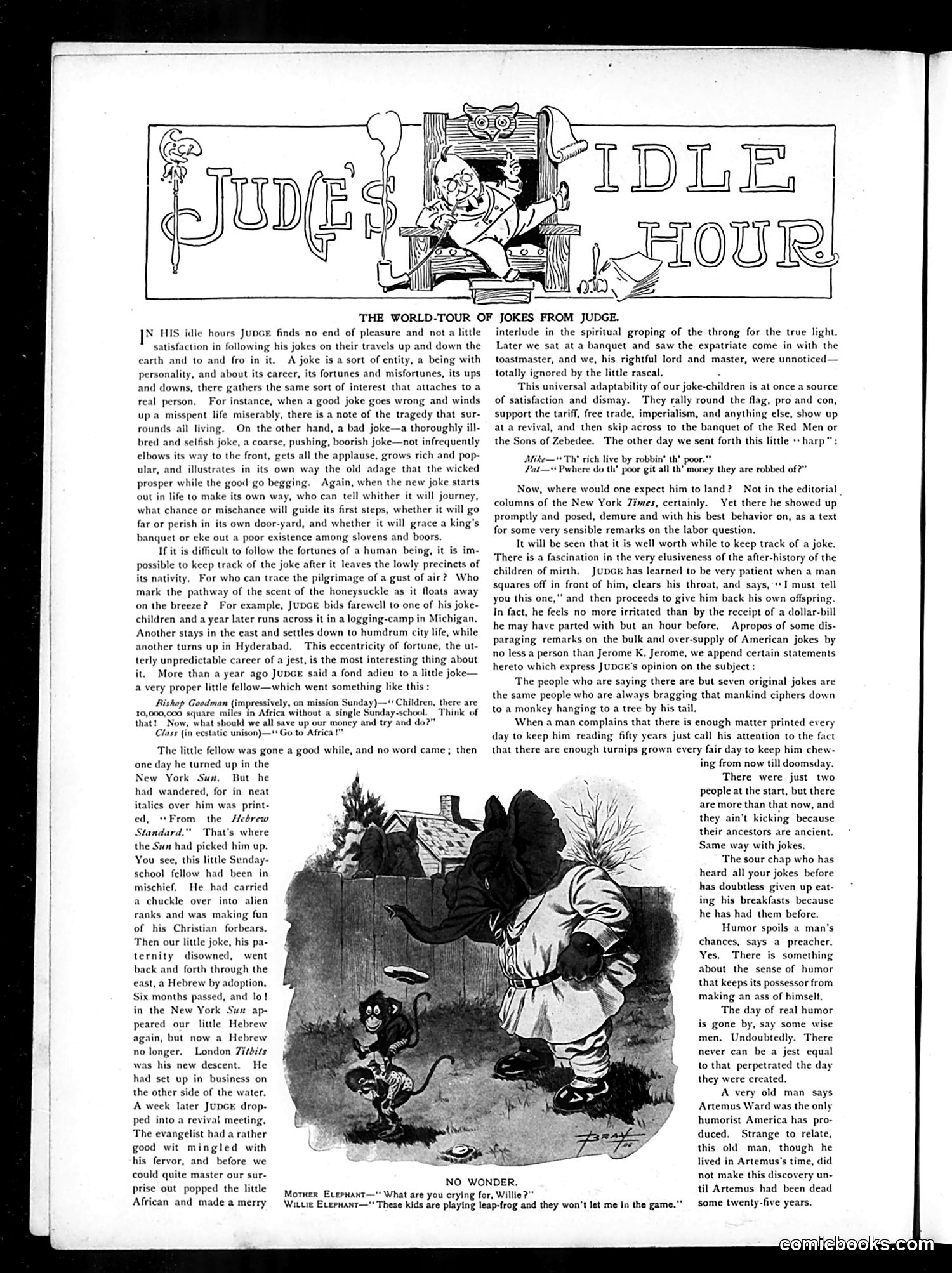
This page presents **Judge magazine's philosophical reflection on jokes themselves** — treating them as living entities with independent lives and careers. The main essay traces the journey of a single joke that originated in Judge, following it as it travels through publications (the *New York Sun*, the *Hebrew Standard*, London's *Titbits*) and contexts, gaining and losing identity with each retelling. The joke about a missionary child saying "Go to Africa!" becomes a vehicle to explore how humor circulates unpredictably through culture. **The satire's point**: Judge uses tongue-in-cheek personification to comment on intellectual property, plagiarism, and how humor spreads without attribution—a recurring frustration for satirical publications of the era. Jokes are "kidnapped" by other publications, transformed, and repurposed. The **cartoon at bottom** ("No Wonder") shows a simple domestic joke about children excluding another from their game—an example of the "little joke-children" discussed above. The piece is fundamentally **self-promotional**, celebrating Judge's role as humor originator while lamenting how its creations escape into the cultural commons.
📄 Transcribed text from this page (OCR, searchable)
Machine-transcribed from the original scan — historical spelling and the odd misread are preserved.
THE WORLD-TOUR OF JOKES FROM JUDGE. X HIS idle hours JuGE finds no end of pleasure and not a little atisfaction in following his jokes on their travels up and down the earth and to and fro in it, A joke is a sort of entity, a being with personality, and about its career, its fortunes and misfortunes, its ups and downs, there gathers the same sort of interest that attaches to a real person. For instance, when a good joke goes wrong and winds up a misspent life miserably, there is a note of the tragedy that sur- rounds all living. On the other hand, a bad joke—a thoroughly ill- bred and selfish joke, a coarse, pushing, boorish joke—not infrequently elbows its way to the front, gets all the applause, grows rich and pop- ular, and illustrates in its own way the old adage that the wicked prosper while the good go begging. Again, when the new joke starts out in life to make its own way, who can tell whither it will journey, what chance or mischance will guide its first steps, whether it will go far or perish in its own door-yard, and whether it will grace a king's banquet or eke out a poor existence among slovens and boors. If it is difficult to follow the fortunes of a human being, it is im- possible to keep track of the joke after it leaves the lowly precinets of its nativity. For who can trace the pilgrimage of a gust of air? Who mark the pathway of the scent of the honeysuckle as it floats away on the breeze? For example, JUDGE. bids farewell to one of his joke- children and a year later runs across it in a logging-camp in Michigan. Another stays in the east and settles down to humdrum city life, while This eccentricity of fortune, the ut- terly unpredictable career of a jest, is the most interesting thing about it. More than a year ago JUDGE said a fond adieu to a little joke— a very proper little fellow—which went something like this : another turns up in Hyderabad. Bishop Goodman (impressively, on mission there are les in Africa without a single Sunday-school. TI ve up our money and try and do?” Yass (in ecstatic unison)—* Go to Africa!" The little fellow was gone a good while, and no word came; then one day he turned up in the New York Sum. But he had wandered, for in neat italics over him was print- ed, “From the Hebrew Standard.” That's where the Sun had picked him up. You see, this little Sunday- school fellow had been in mischief. He had carried a chuckle over into alien ranks and was making fun of his Christian forbears. Then our little joke, his pa- ternity went back and forth through the st, a Hebrew by adoption, Six months passed, and lo! in the New York Sus ap- peared our little Hebrew again, but now a Hebrew no longer. London 7itbits was his new descent. He had set up in business on the other side of the water. A week later JupcE drop- ped into a revival meeting. The evangelist had a rather good wit mingled with his fervor, and before we could quite master our sur- prise out popped the little African and made a merry disowned, Motner Evernanr: NO WONDER, What are you crying for, Willie? Wittie Evernant—' These kids are playing leap-frog and they won't let me in the game.” interlude in the spiritual groping of the throng for the true light. Later we sat at a banquet and saw the expatriate come in with the toastmaster, and we, his rightful lord and master, were unnoticed— totally ignored by the little rascal. This universal adaptability of our joke-children is at once a source of satisfaction and dismay. They rally round the flag, pro and con, support the tariff, free trade, imperialism, and anything else, show up at a revival, and then skip across to the banquet of the Red Men or the Sons of Zebedee. The other day we sent forth this little harp": rich live by robbin’ th’ poor. Pwhere do th’ poor git all th’ money they are robbed of?” Now, where would one expect him to land? Not in the editorial columns of the New York 7imes, certainly. Yet there he showed up promptly and posed, demure and with his best behavior on, as a text for some very sensible remarks on the labor question. It will be seen that it is well worth while to keep track of a joke. There is a fascination in the very elusiveness of the after-history of the children of mirth. JUDGE has learned to be very patient when a man squares off in front of him, clears his throat, and says, ‘+I must tell you this one,” and then proceeds to give him back his own offspring. In fact, he feels no more irritated than by the receipt of a dollar-bill he may have parted with but an hour before. Apropos of some dis- paraging remarks on the bulk and over-supply of American jokes by no less a person than Jerome K. Jerome, we append certain statements hereto which express JUDGE'S opinion on the subject : The people who are saying there are but seven original jokes are the same people who are always bragging that mankind ciphers down to a monkey hanging to a tree by his tail. When a man complains that there is enough matter printed every day to keep him reading fifty years just call his attention to the fact that there are enough turnips grown every fair day to keep him chew- ing from now till doomsday. There were just two people at the start, but there are more than that now, and they ain't kicking because their ancestors are ancient. Same way with jokes. The sour chap who has heard all your jokes before has doubtless given up eat- ing his breakfasts because he has had them before. Humor spoils a man’s chances, says a preacher. Yes. There is something about the sense of humor that keeps its possessor from making an ass of himself. The day of real humor is gone by, say some wise men. Undoubtedly. There never can be a jest equal to that perpetrated the day they were created. A very old man says Artemus Ward was the only humorist America has pro- duced. Strange to relate, this old man, though he lived in Artemus's time, did not make this discovery un- til Artemus had been dead some twenty-five years,