
Judge, 1906-04-21 · page 3 of 16
Judge — April 21, 1906 — page 3: what you’re looking at
What you’re looking at
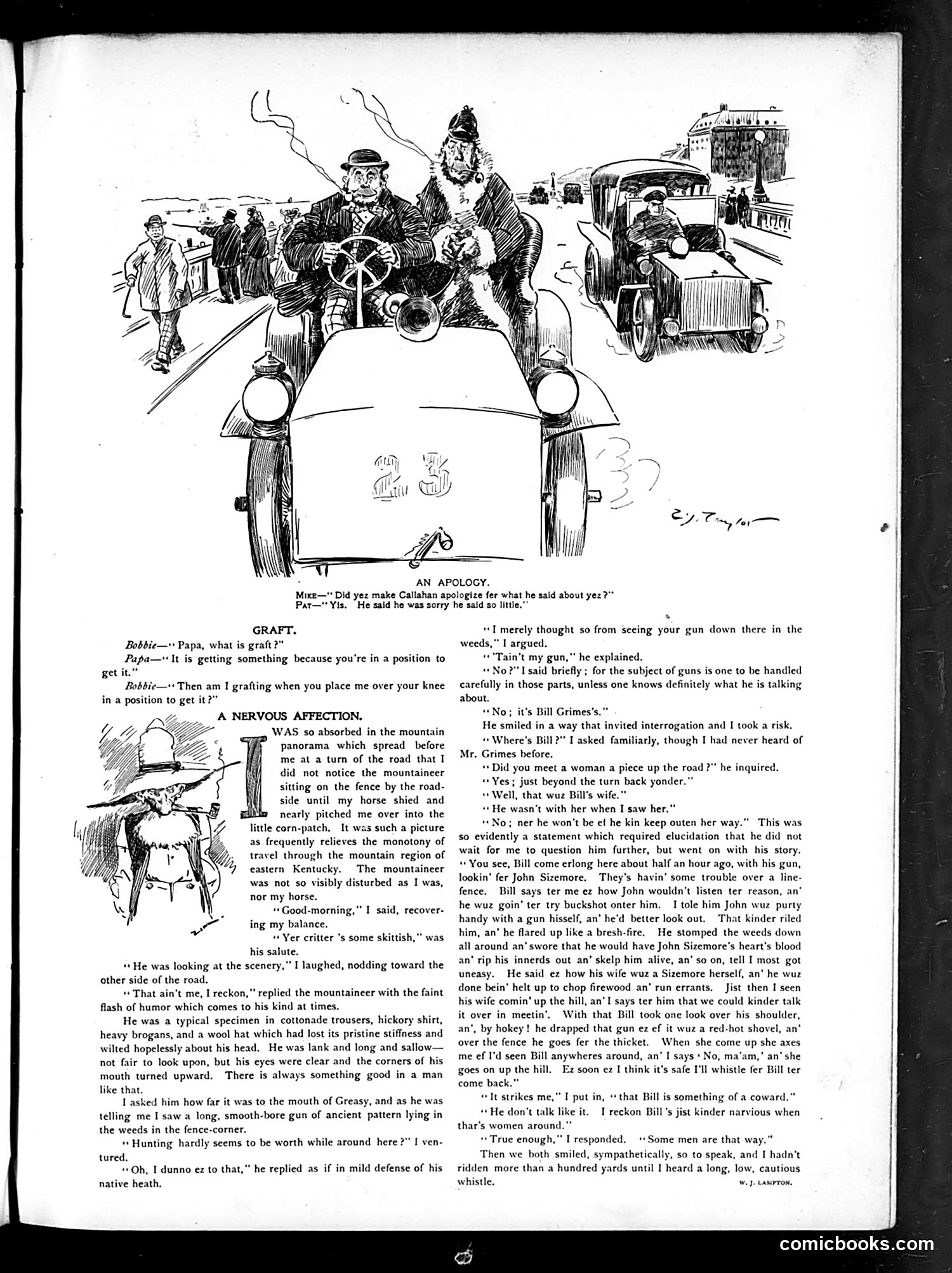
The top cartoon titled "An Apology" depicts an early automobile with two men, satirizing a traffic incident. The dialogue references "Callahan" apologizing for something he said, suggesting a specific contemporary dispute, though the exact context is unclear. Below, "Graft" presents a conversation defining graft as "getting something because you're in a position to get it"—mocking corrupt officeholders who exploit their positions. The larger illustration "A Nervous Affection" depicts a mountaineer recounting an encounter with someone named Bill involving a gun. The lengthy accompanying story appears to be frontier humor, possibly satirizing rural gun culture or a specific contemporary figure, though the specific reference is unclear. The overall page combines political corruption commentary with rural/frontier social satire typical of Judge's approach.
📄 Transcribed text from this page (OCR, searchable)
Machine-transcribed from the original scan — historical spelling and the odd misread are preserved.
AN APOLOGY. Mixe—"* Did yez make Callahan apologize fer what he said about yez?" Pat—"' Yis. GRAFT. Bobbie— Papa, what is graft?” Papa—‘It is getting something because you'r get it.” Bobbie— Then am I grafting when you place me over your knee in a position to get it?” A NERVOUS AFFECTION. WAS so absorbed in the mountain panorama which spread before me at a turn of the road that I did not notice the mountaineer sitting on the fence by the road- side until my horse shied and nearly pitched me over into the little corn-patch. It was such a picture as frequently relieves the monotony of travel through the mountain region of eastern Kentucky. The mountaineer was not so visibly disturbed as I was, nor my horse. ««Good-morning,” I said, recover- ing my balance. «Yer critter 's some skittish,” was his salute. “+ He was looking at the scenery,” I laughed, nodding toward the other side of the road. “That ain't me, I reckon," replied the mountaineer with the faint flash of humor which comes to his kind at times. He was a typical specimen in cottonade trousers, hickory shirt, heavy brogans, and a wool hat which had lost its pristine stiffness and wilted hopelessly about his head. He was lank and long and sallow— not fair to look upon, but his eyes were clear and the corners of his mouth turned upward. There is always something good in a man like that. I asked him how far it was to the mouth of Greasy, and as he was telling me I saw a long, smooth-bore gun of ancient pattern lying in the weeds in the fence-corner. «Hunting hardly seems to be worth while around here ?” I ven- in a position to tured, «Oh, I dunno ez to that,” he replied as if in mild defense of his native heath. He said he was sorry he said so little.” «T merely thought so from Seeing your gun down there in the weeds,” I argued. “'Tain’t my gun,” he explained. 2" said briefly ; for the subject of guns is one to be handled carefully in those parts, unless one knows definitely what he is talking about. “No; it’s Bill Grimes's.” He smiled in a way that invited interrogation and I took a risk. “Where's Bill?” I asked familiarly, though I had never heard of Mr. Grimes before. “Did you meet a woman a piece up the road ?” he inquired. “Yes; just beyond the turn back yonder.” “Well, that wuz Bill’s wife.” «He wasn’t with her when I saw her.” ‘No; ner he won't be ef he kin keep outen her way.” This was so evidently a statement which required elucidation that he did not wait for me to question him further, but went on with his story. You see, Bill come erlong here about half an hour ago, with his gun, lookin’ fer John Sizemore. They’s havin’ some trouble over a line- fence. Bill says ter me ez how John wouldn't listen ter reason, an’ he wuz goin’ ter try buckshot onter him. I tole him John wuz purty handy with a gun hisself, an‘ he'd better look out. That kinder riled him, an’ he flared up like a bresh-fire. He stomped the weeds down all around an’ swore that he would have John Sizemore’s heart's blood an‘ rip his innerds out an’ skelp him alive, an’ so on, tell I most got uneasy. He said ez how his wife wuz a Sizemore herself, an’ he wuz done bein’ helt up to chop firewood an’ run errants, Jist then I seen his wife comin’ up the hill, an’I says ter him that we could kinder talk it over in meetin’, With that Bill took one look over his shoulder, an‘, by hokey! he drapped that gun ez ef it wuz a red-hot shovel, an’ over the fence he goes fer the thicket. When she come up she axes me ef I'd seen Bill anywheres around, an’ I says + No, ma'am," an’ she goes on up the hill. Ez soon ez I think it's safe I'll whistle fer Bill ter come back.” “It strikes me,” I put in, + that Bill is something of a coward.” “He don’t talk like it. T reckon Bill's jist kinder narvious when thar’s women around «True enough,” “Some men are that way.” Then we both smiled, sympathetically, so to speak, and I hadn't ridden more than a hundred yards until I heard a long, low, cautious whistle. T responded. Ww. J LAMFTON, comicbooks.com