
A complete issue · 20 pages · 1906
Judge — April 14, 1906
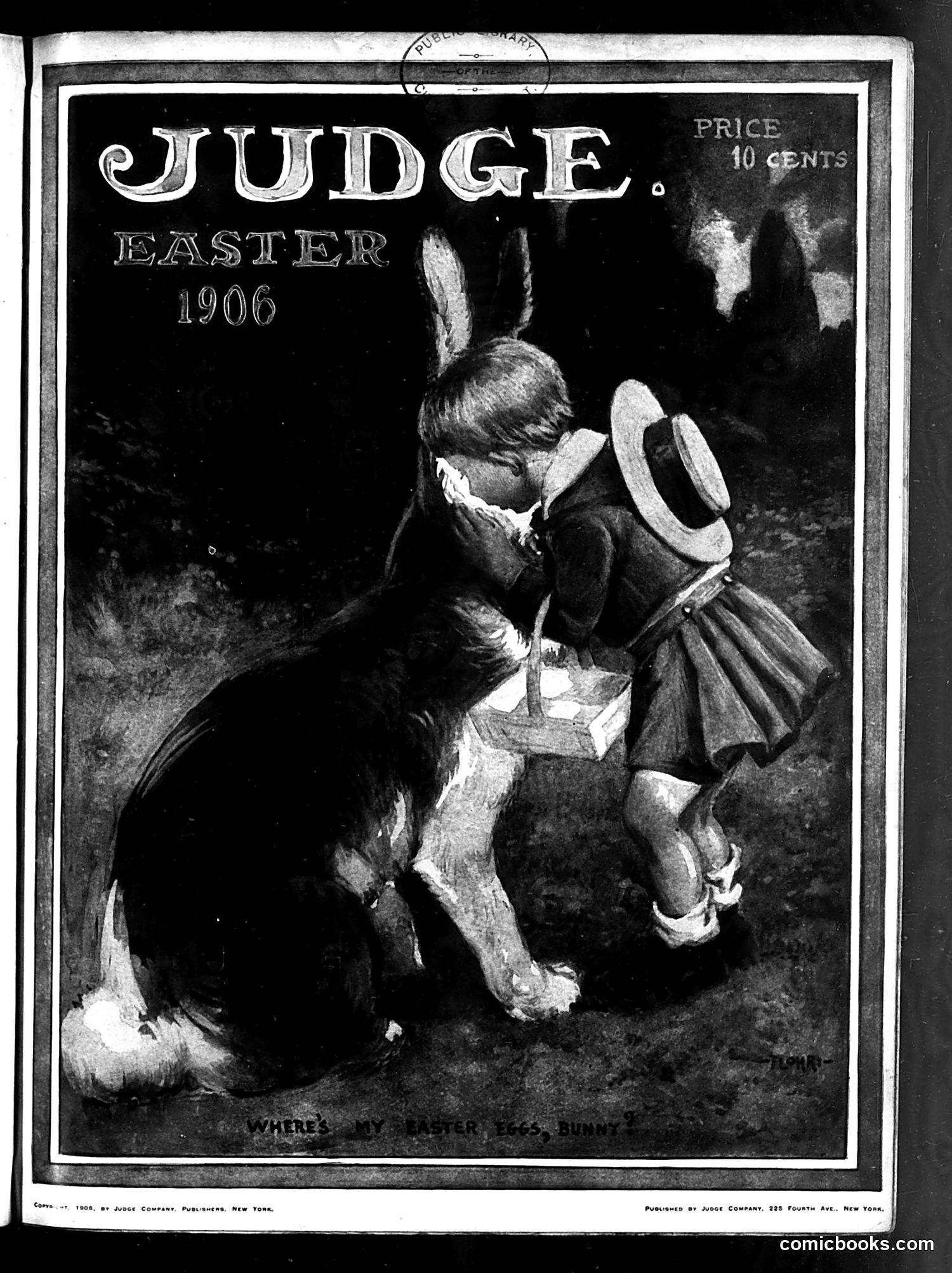
This is the Easter 1906 cover of *Judge* magazine (price 10 cents). The illustration shows a child dressed as an Easter bunny character speaking with an actual rabbit, with the caption "WHERE'S MY EASTER EGGS, BUNNY?" The satire is straightforward holiday humor rather than political commentary. It plays on the Easter tradition of the Easter Bunny delivering colored eggs to children. The joke depicts a child taking the Easter Bunny legend literally—confronting a real rabbit and demanding the eggs it supposedly hid. The humor relies on the disconnect between childhood imagination (believing in the Easter Bunny) and reality (encountering an actual animal). This is gentle, family-friendly satire typical of holiday-themed *Judge* covers, aimed at amusing adults while appealing to children's sensibilities.
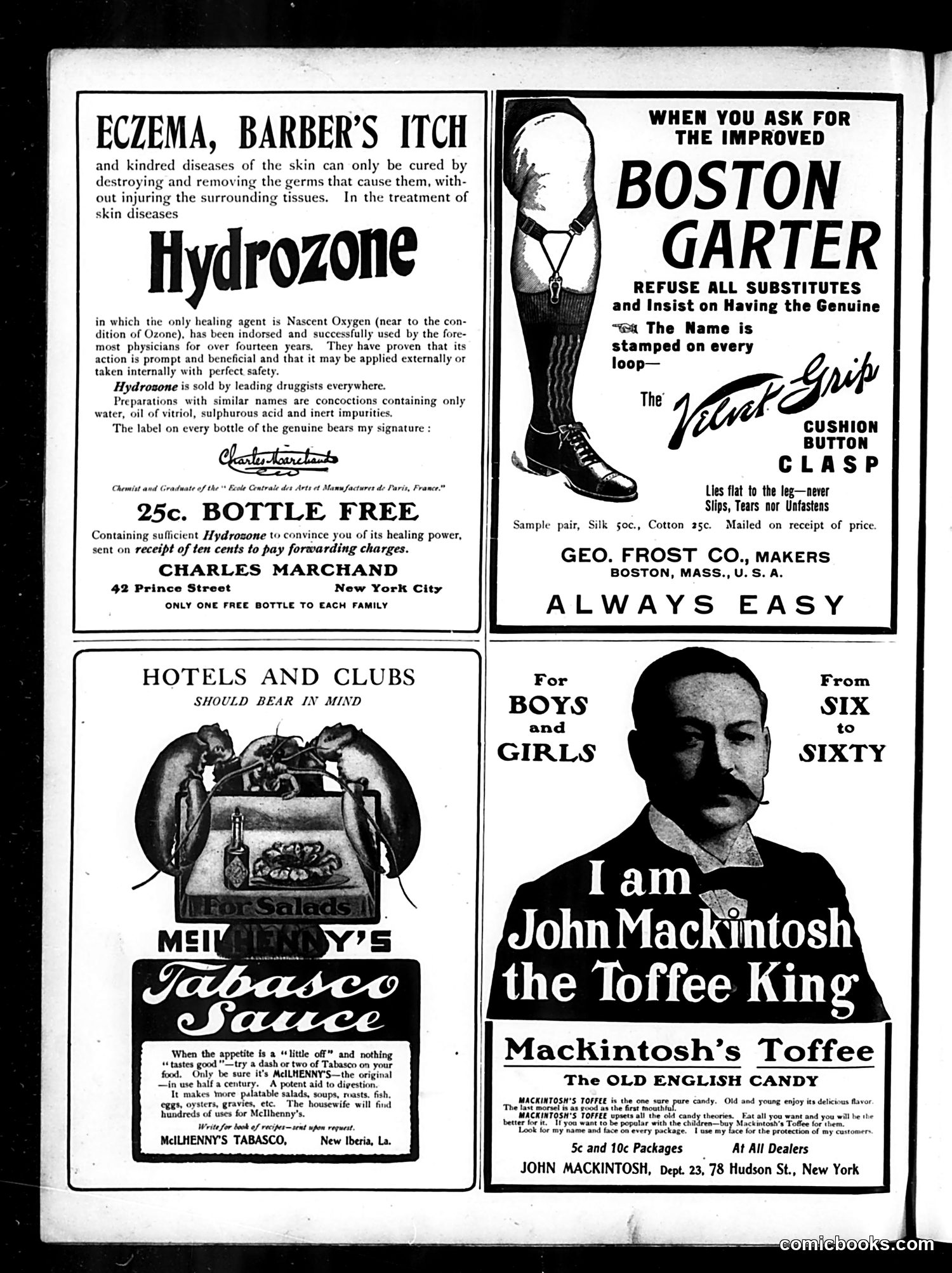
This page consists entirely of **advertisements**, not satirical cartoons. There is no political content or satire to analyze. The four ads promote period products: Hydrozone (a skin treatment), Boston Garter (hosiery with cushioned clasps), McIlhenny's Tabasco Sauce, and Mackintosh's Toffee candy. The Mackintosh ad features a man identified as "John Mackintosh the Toffee King," presented as the product's endorser. The other ads use typical early 20th-century marketing strategies: medical claims (Hydrozone), product endorsements, and appeals to convenience and quality. While *Judge* was known for satire, this particular page serves as a revenue source through straightforward commercial advertising rather than editorial commentary.
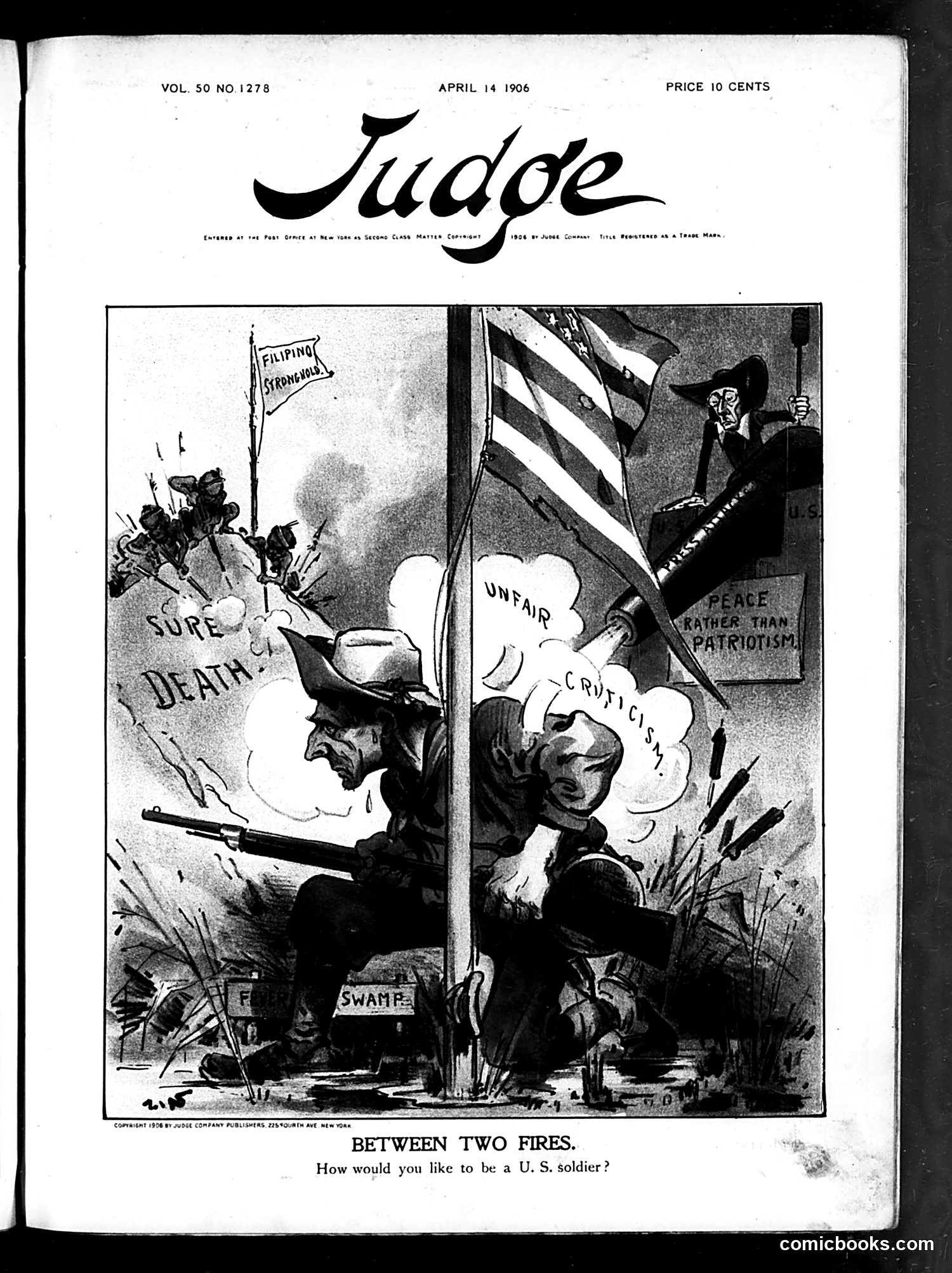
This 1906 Judge cartoon satirizes the position of a potential U.S. soldier caught between competing pressures. On the left, a skeletal Death figure labeled "Sure Death" looms over Filipino insurgents with a "Filipino Stronghold" flag—referencing the ongoing Philippine-American War (1899-1902, with lingering conflict). On the right, a uniformed officer holds a sign reading "Peace Rather Than Patriotism," representing anti-war or pacifist critics. The central figure—a prospective soldier—is literally trapped between these two extremes: the deadly reality of combat versus public criticism of military service itself. The cartoon's question—"How would you like to be a U.S. soldier?"—presents enlistment as an impossible choice between death abroad or social condemnation at home. The satire critiques both the war's dangers and domestic opposition to American military expansion.
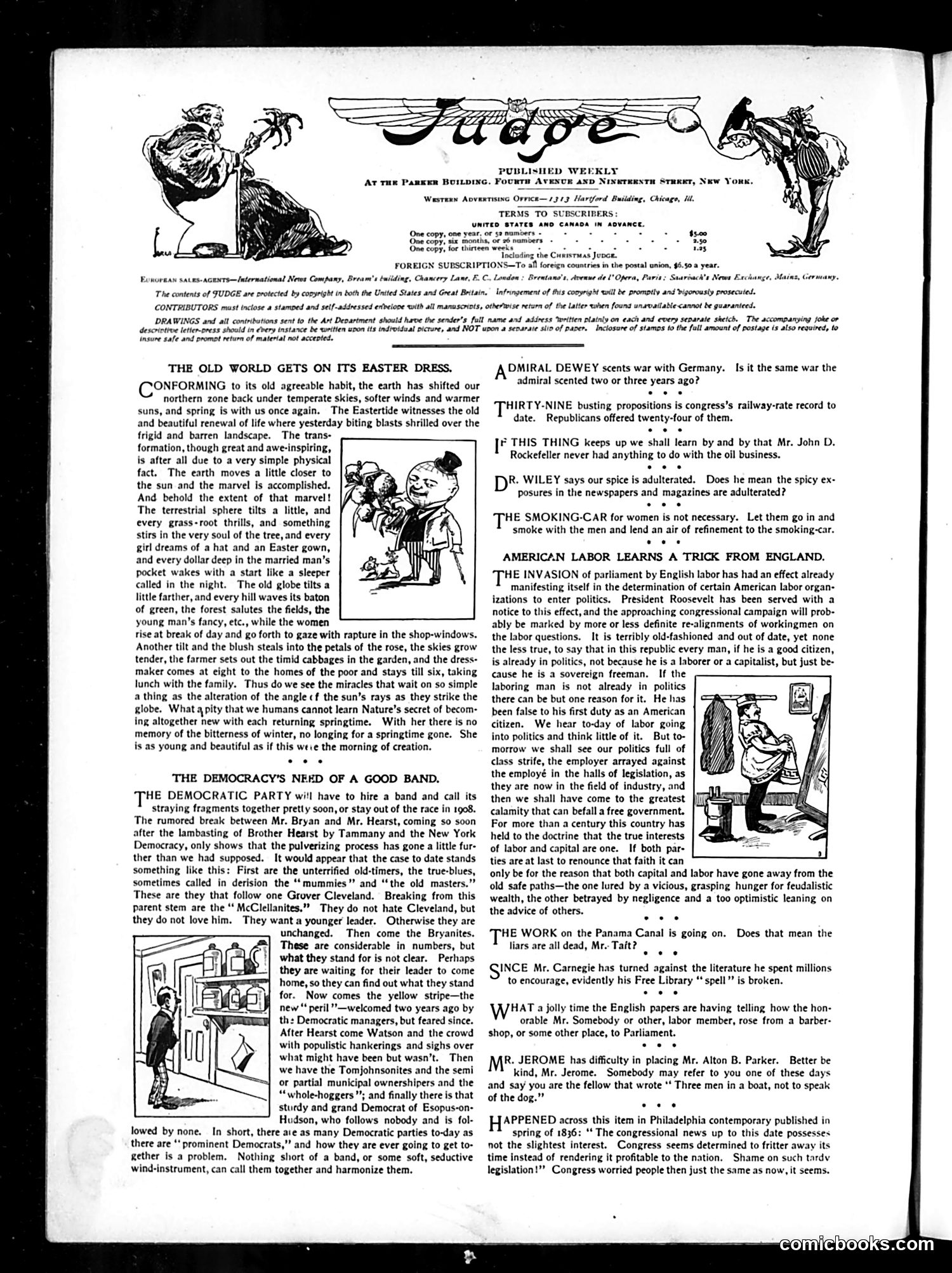
This page from *Judge* contains political commentary and brief satirical items rather than a single cartoon. The visible articles reference: **"The Democratic's Need of a Good Band"** — mocking the Democratic Party's internal divisions, comparing their fractured leadership to an out-of-tune orchestra. The text mentions Bryan and Hearst's "numberless breaks," suggesting disagreement between party factions. **Other brief items** critique various public figures and policies: Admiral Dewey's military involvement, Congress's railway record, John D. Rockefeller's business practices, and labor disputes. **The illustrations** appear to show domestic/everyday scenes rather than specific political caricatures—though the quality makes precise identification difficult. Without clearer dates or context, the specific events remain unclear, but the overall tone is typical *Judge*-style mockery of Democratic Party dysfunction and criticism of wealthy industrialists and political mismanagement.
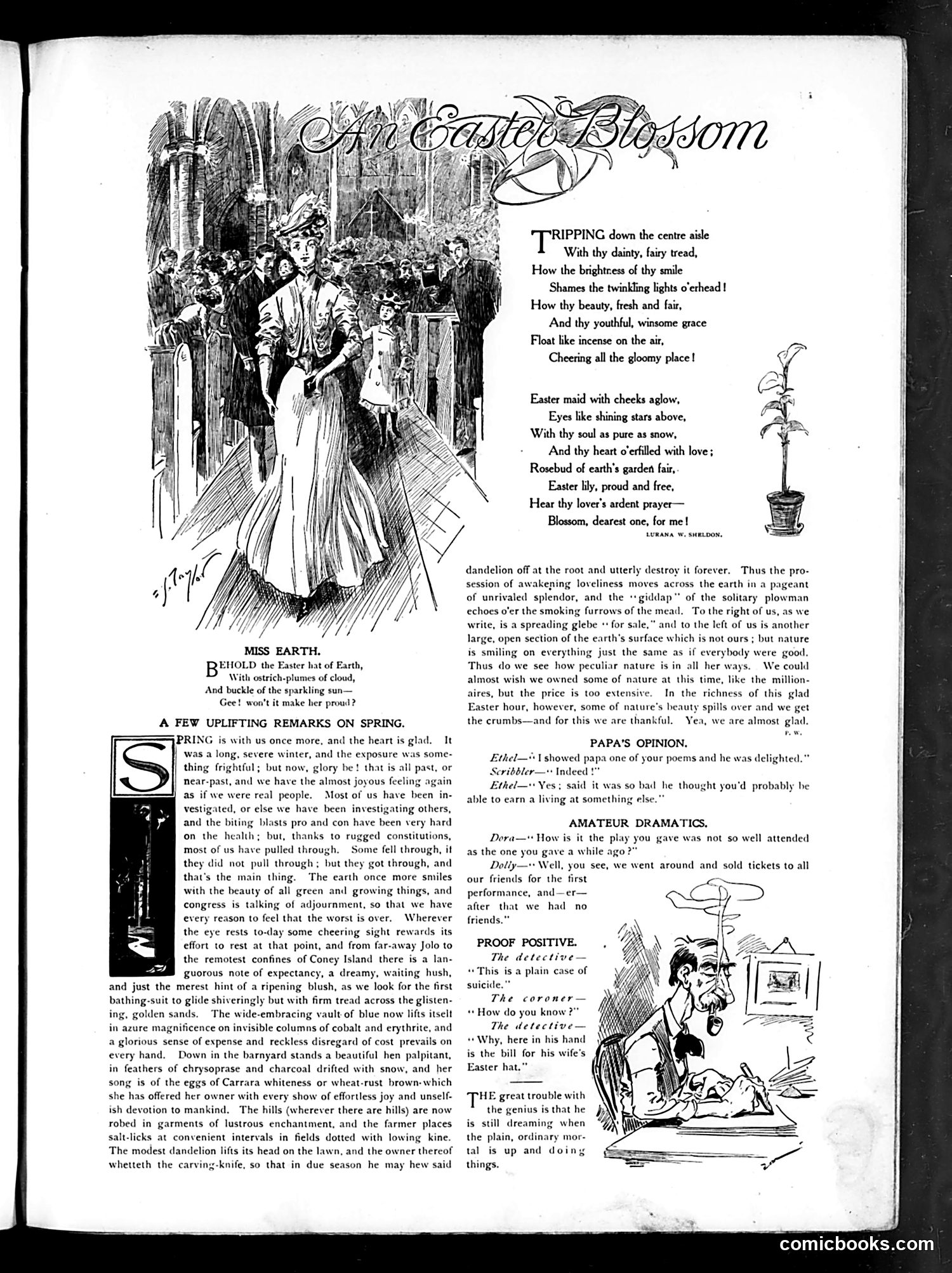
This page contains Easter-themed poetry and literary content rather than political satire. The main illustration shows elegantly dressed figures in a church aisle during Easter services, celebrating the holiday's themes of renewal and joy. The poems and short pieces focus on Easter's spiritual and secular meanings—themes of rebirth, hope, and spring. One section titled "Miss Earth" personifies the planet awakening. "A Few Uplifting Remarks on Spring" discusses nature's renewal and seasonal optimism. The smaller cartoons at bottom ("Papa's Opinion," "Amateur Dramatics," "Proof Positive") appear to be humorous domestic vignettes unrelated to politics, featuring typical late-19th/early-20th-century family situations and social observations. This is primarily **literary content with light humor** rather than political commentary.
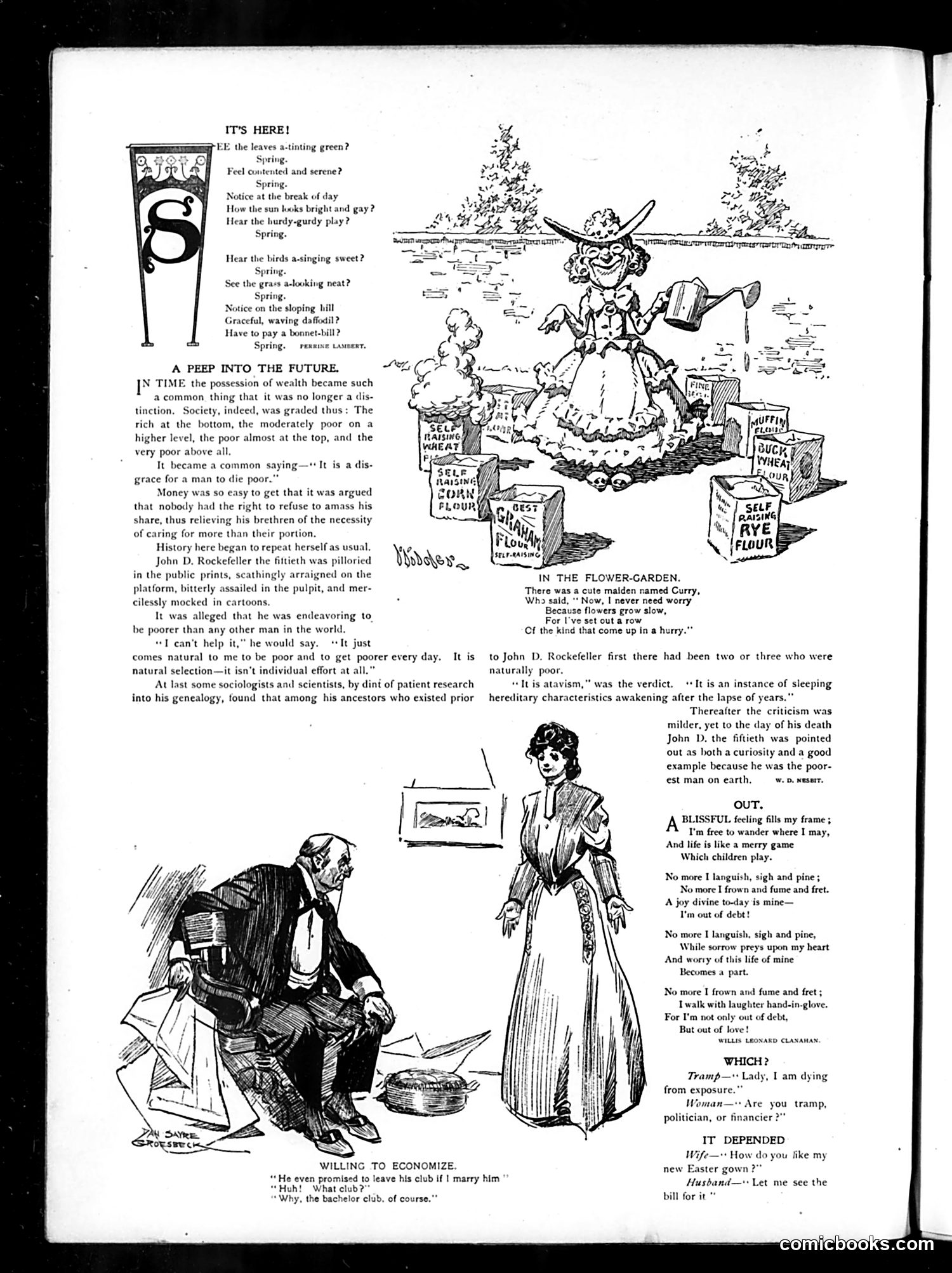
This page satirizes wealth inequality and social mobility through an inverted-future scenario. The main cartoon imagines a time when wealth becomes so common that society's hierarchy reverses: the rich are at the "bottom," the moderately poor higher up, and the very poor "above all." The satire targets **John D. Rockefeller the fiftieth**, a descendant of the famous industrialist. In this future world, being poor becomes a mark of distinction rather than shame. Rockefeller the fiftieth is pilloried for being "the poorest man on earth"—a deliberate inversion of how his ancestor was attacked for being excessively wealthy. Sociologists discover his poverty stems from ancestral "atavism" (inherited traits), treating it like a curiosity. The joke critiques both extreme wealth concentration and society's obsession with attacking the ultra-rich, suggesting that if everyone became wealthy, poverty itself would become enviable—a cutting commentary on American class anxieties and the arbitrariness of social status.
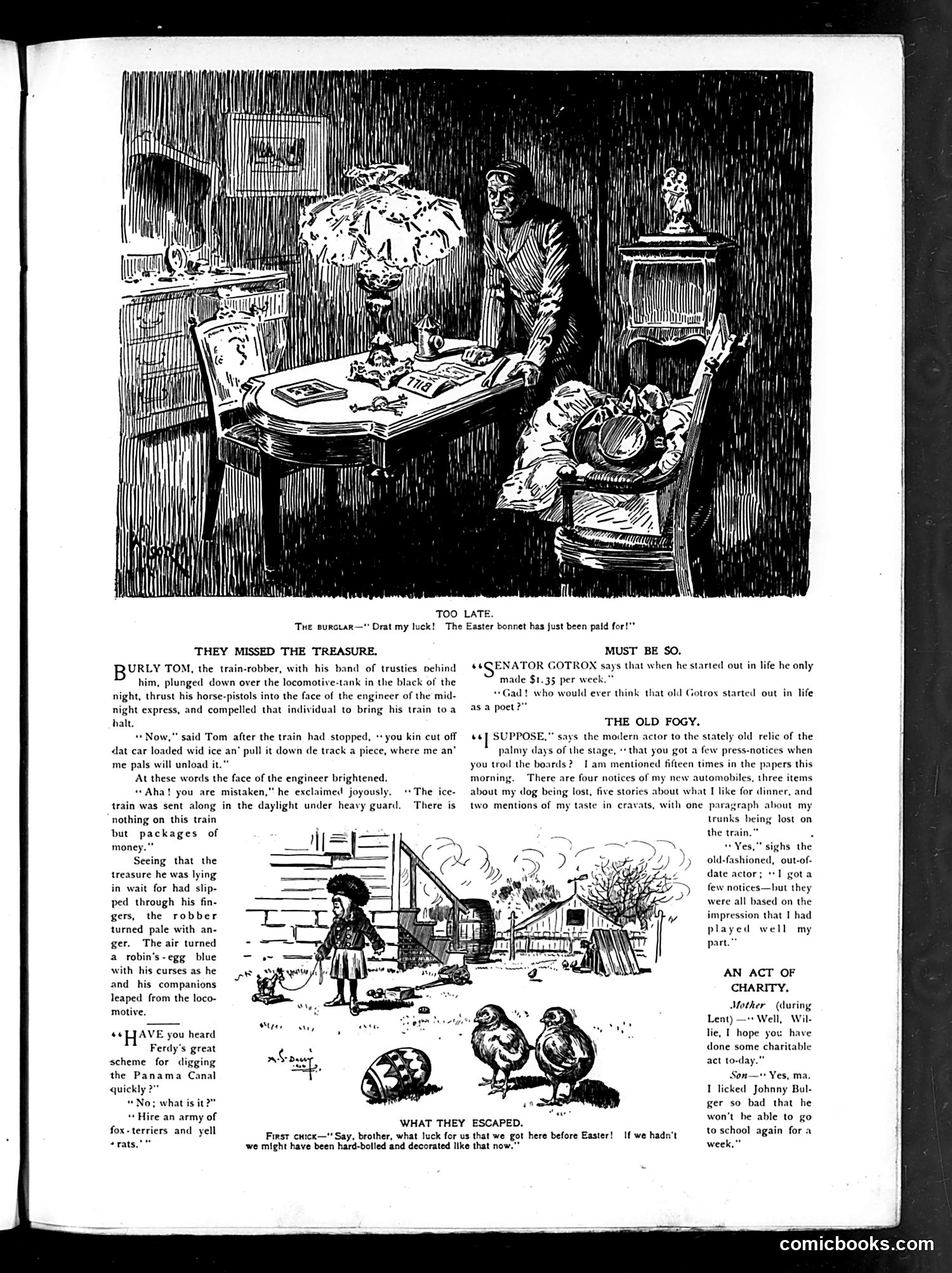
This Judge magazine page contains multiple satirical pieces: **"They Missed the Treasure"** mocks train robbers who plan to steal an ice car, only to learn the valuable cargo travels separately under guard. The joke relies on period-specific knowledge of railroad security and theft. **The Panama Canal reference** appears to joke about dubious engineering schemes, likely contemporary to the canal's actual construction (early 1900s). **"The Old Fogy"** contrasts modern actors' obsession with newspaper coverage of trivial personal details (cars, dogs, clothes) versus older actors judged solely on theatrical performance. This satirizes emerging celebrity culture and the press's shift toward lifestyle coverage. **"An Act of Charity"** presents dark humor: a boy claims beating a peer so badly he can't attend school constitutes charitable behavior. The satire targets either the boy's moral confusion or—less likely—parental hypocrisy about "charity." The top cartoon's specific political reference remains unclear without additional context about "the burglar" and the Easter bonnet reference.
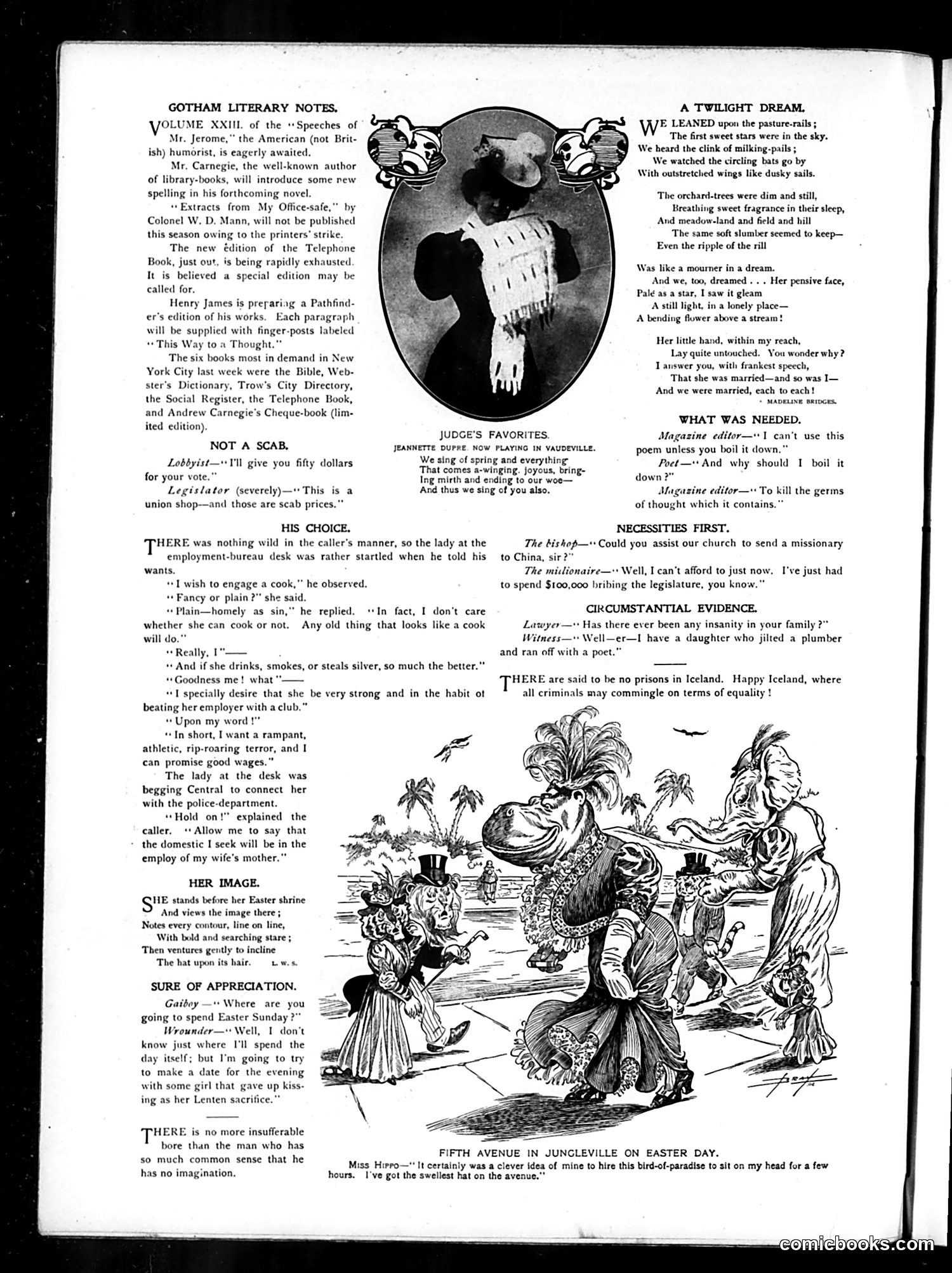
This is a humor/satire page from Judge magazine mixing literary commentary, jokes, and an illustration. **The Literary Notes** mock prominent figures: William Jerome (humorist), Andrew Carnegie (industrialist famous for funding libraries), and Colonel W.D. Mann (publisher). The jokes reference topical concerns—Carnegie's eccentric spelling reforms, Mann's alleged "office-safe" containing blackmail material, and the demand for practical books (Bible, directory, telephone book, even Carnegie's "Cheque-book"). **The cartoon "Fifth Avenue in Jungleville on Easter Day"** appears to satirize wealthy New Yorkers' Easter displays and fashion obsession, depicting a surreal, chaotic scene—possibly mocking the artificiality or pretension of upper-class Easter celebrations. **The short humorous pieces** include a lobbyist offering bribes, a man seeking a brutish cook (who'll work for his mother-in-law), and romantic poetry about forbidden love between two married people. The overall tone is witty mockery of contemporary American society, literature, and politics.
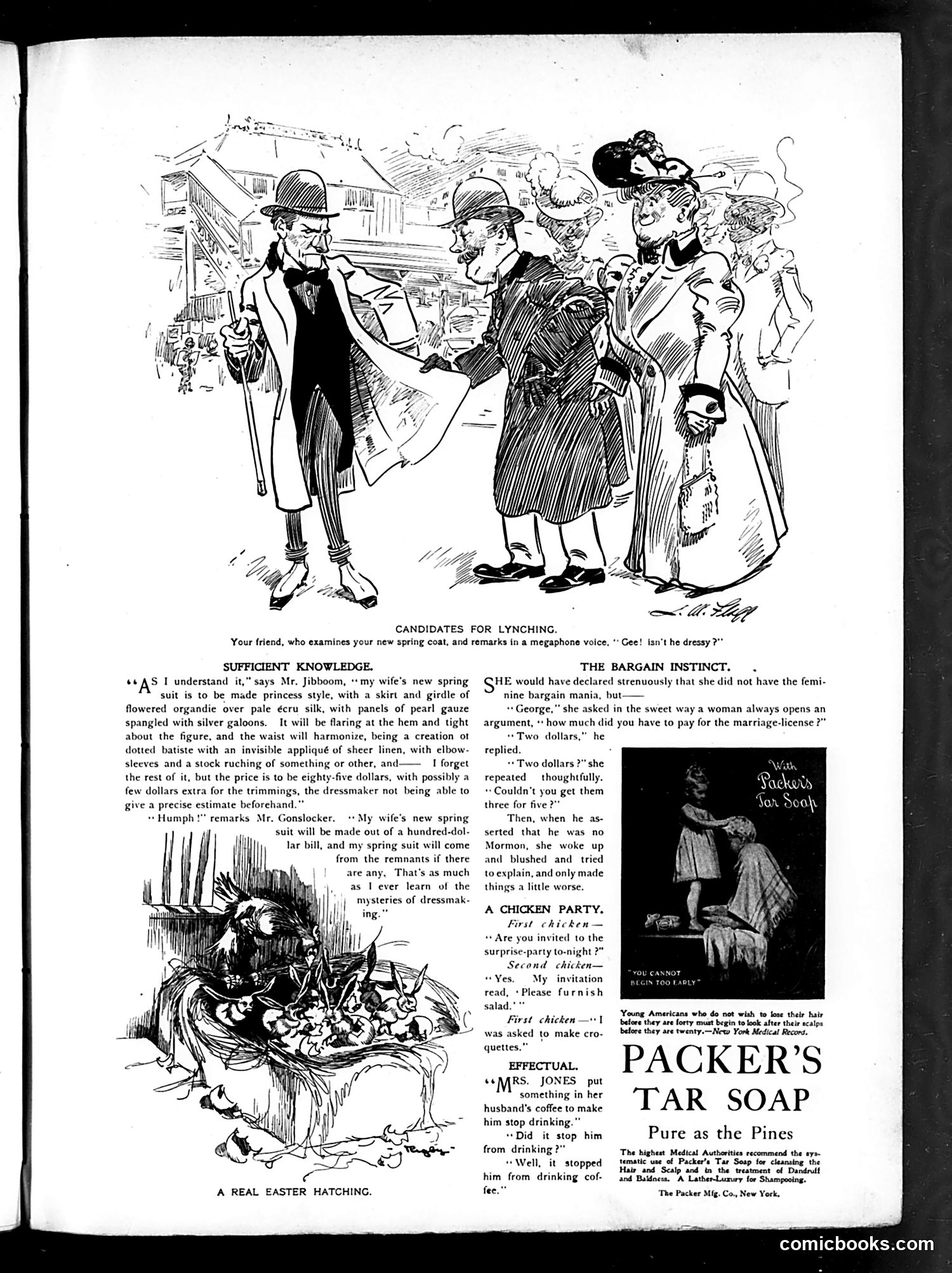
This page contains three separate satirical cartoons mocking social behavior of the era: **"Candidates for Lynching"** (top): Ridicules people who loudly comment on others' clothing in public—specifically someone who examines a friend's new spring coat and announces it's stylish in an obnoxiously loud voice ("megaphone voice"). The phrase "candidates for lynching" means such people deserve public disapproval. **"Sufficient Knowledge"** (left): Two men discuss their wives' spring fashions. Mr. Jibboom recites elaborate, incomprehensible dress details (organdie, gauze, galoons, batiste), while Mr. Gonslocker pragmatically notes his wife's suit costs $100 and his comes from leftovers—he needs no fashion knowledge, only price awareness. It satirizes how men pretend to understand women's clothing complexity. **"The Bargain Instinct"** (center): A wife, hearing her marriage license cost two dollars, immediately asks "Couldn't you get them three for five?"—revealing the stereotype that women compulsively hunt bargains. The humor mocks female shopping obsession. The page also includes advertisements and minor humorous items.
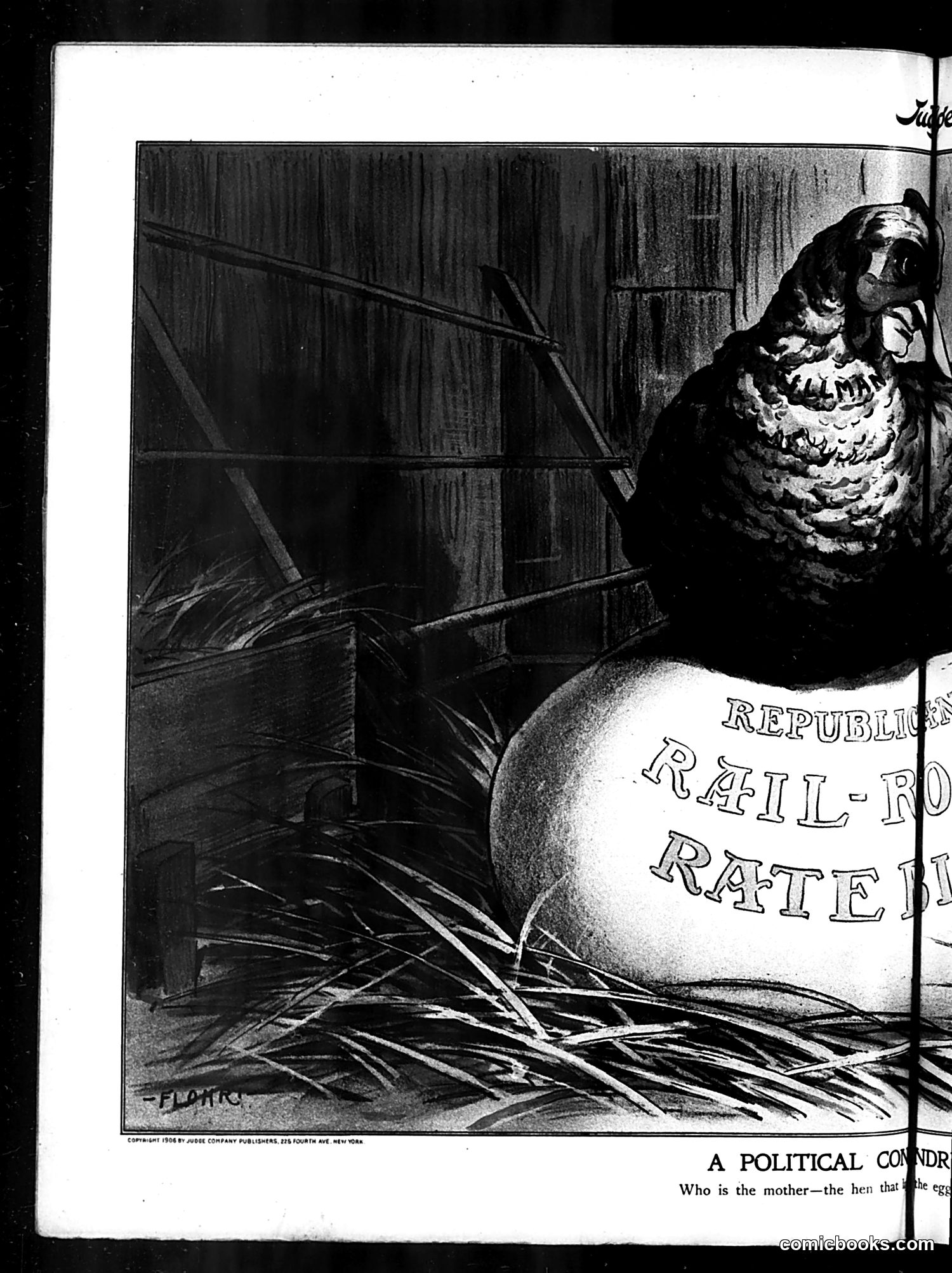
This political cartoon depicts a hen sitting on an enormous egg labeled "REPUBLICAN RAIL-ROAD RATE" (text partially visible). The incomplete caption asks "Who is the mother—the hen that..." suggesting a riddle about parentage or responsibility. The satire likely critiques Republican Party policies regarding railroad regulation and rates, which were contentious political issues in the late 19th/early 20th century. The cartoon suggests confusion or dispute over who bears responsibility for these policies—treating the legislative outcome as something controversial being "birthed" by the political system. The artist signature reads "FLOTKIN" (or similar). Without the complete caption, the full joke's target remains somewhat unclear, but it clearly mocks Republican railroad policy as absurd or problematic.
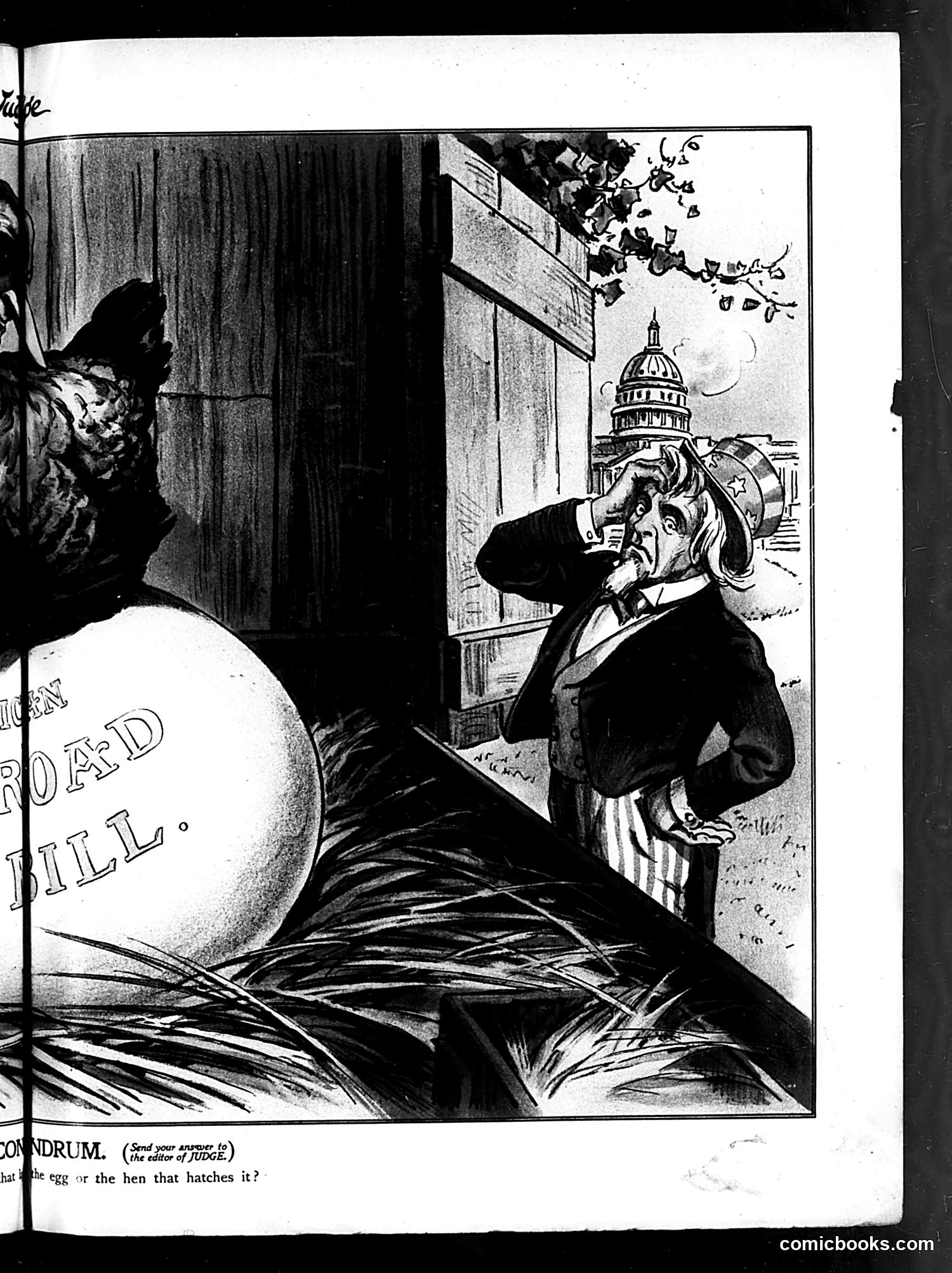
This political cartoon from *Judge* magazine depicts a caricatured figure (appearing to be a politician or public figure) holding his head in confusion or distress before the U.S. Capitol building. A large spherical object labeled "FORD BILL" is visible on the left side. The caption references an old philosophical riddle: "which came first—the egg or the hen that hatches it?" This suggests the cartoon satirizes confusion or circular logic surrounding some legislative proposal called the "Ford Bill." The figure's exaggerated facial features and distressed pose suggest bewilderment or the absurdity of the bill's debate. Without knowing the specific date and Ford Bill referenced, the exact political target remains unclear, but the satire mocks legislative confusion or contradictory reasoning.
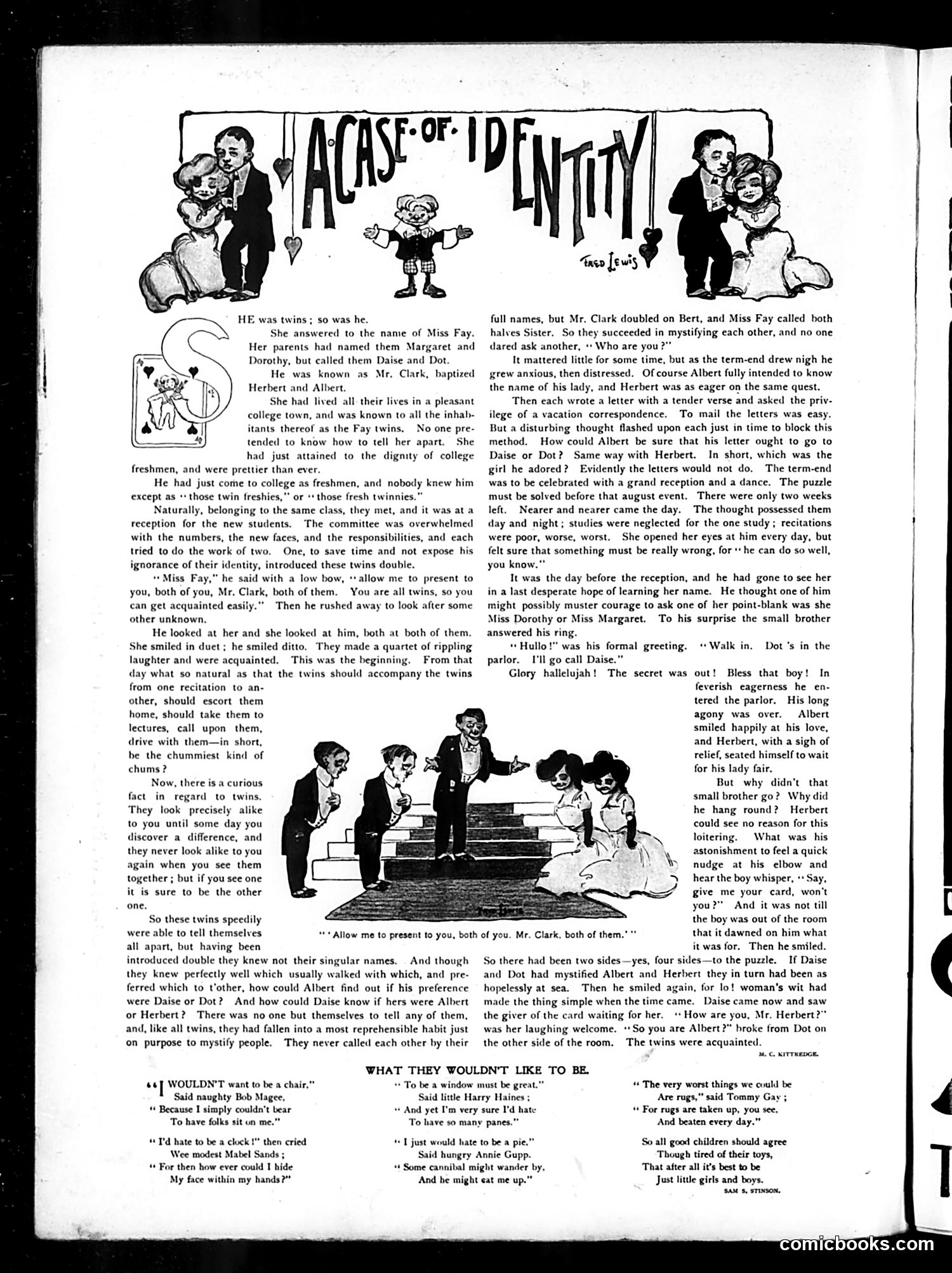
This is a romantic comedy story, not political satire. It concerns twin siblings—the Fay sisters (Margaret/Dorothy, called Daise/Dot) and the Clark brothers (Herbert/Albert)—who meet at college. A registrar, overwhelmed at a reception, introduces the two sets of twins collectively without distinguishing individuals. The four become inseparable companions. However, because they were introduced as indistinguishable pairs and the twins deliberately maintain confusion for amusement, neither brother can determine which sister he's actually courting—a problem that becomes urgent as the term ends and a formal reception/dance approaches. The story explores the Victorian-era romantic anxiety of young men uncertain of their romantic prospects. The satire targets the bureaucratic incompetence of administrators and the playful deception of twins who enjoy mystifying people.
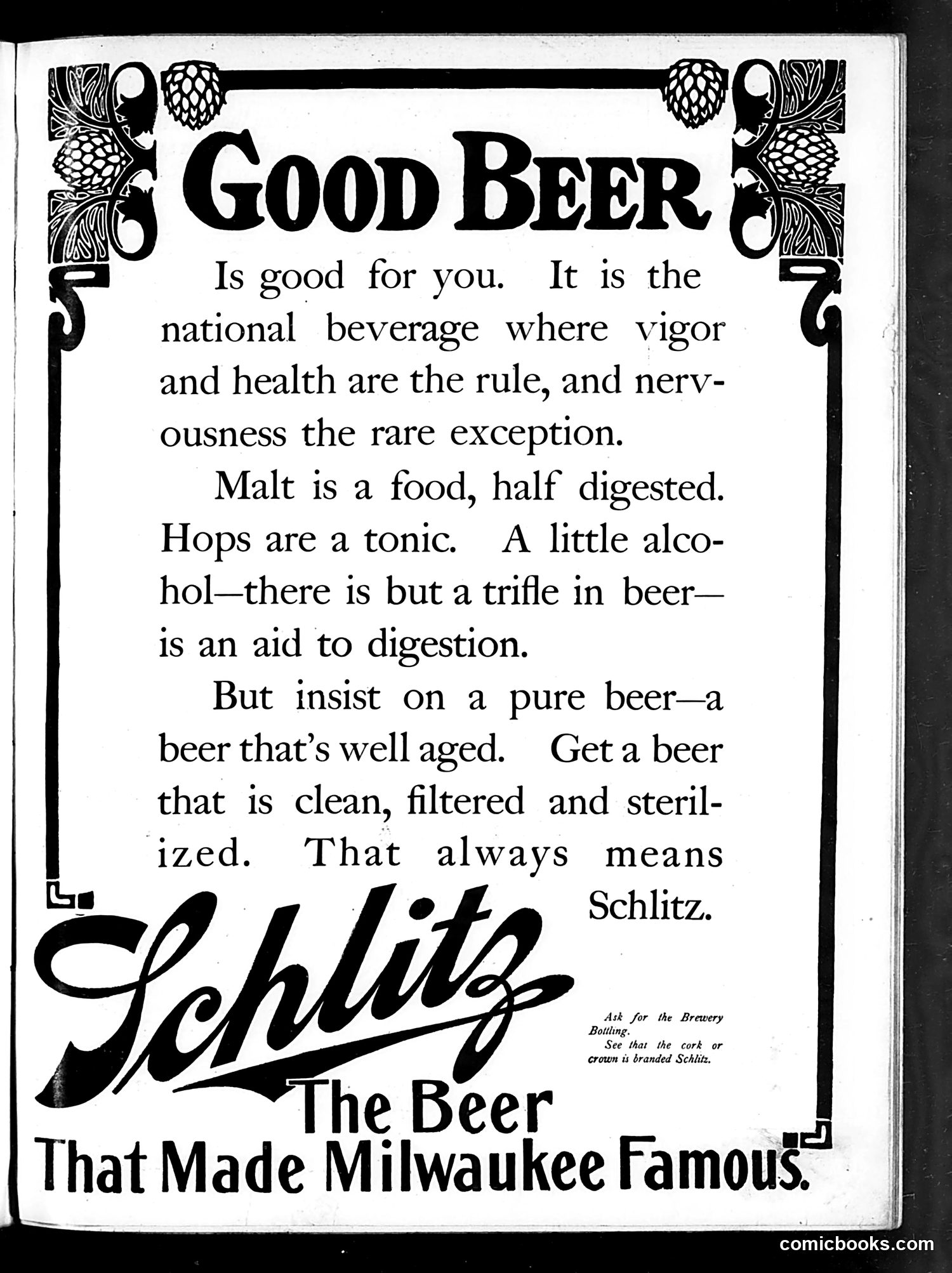
This is a **beer advertisement**, not satire or political commentary. It's a vintage Schlitz brewery ad making health claims common to early-20th-century advertising. The ad argues beer is beneficial, claiming malt is "a food," hops are "a tonic," and alcohol aids digestion—pseudo-scientific marketing typical of the era before modern food regulation. It positions beer as a "national beverage" promoting "vigor and health." The sales pitch emphasizes purity: the beer must be "well aged," "clean, filtered and sterilized"—reassuring consumers about safety and quality. The ornamental hop designs frame the text decoratively. The tagline "The Beer That Made Milwaukee Famous" references Milwaukee's prominence as a beer-brewing center, likely home to Schlitz's operations. This reflects pre-Prohibition attitudes toward alcohol as wholesome.
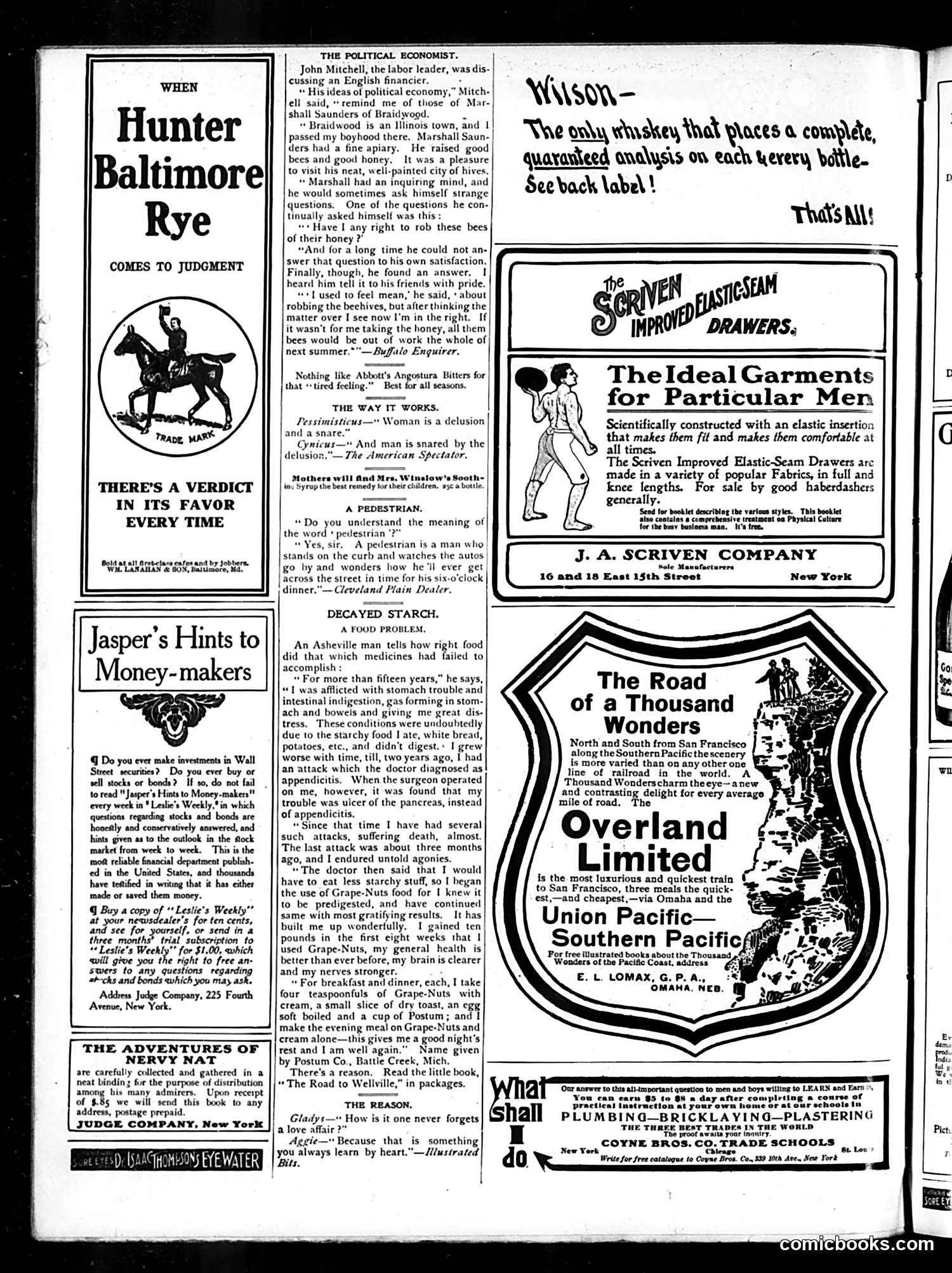
This page is primarily **advertisements and humorous short pieces** rather than political cartoons. The main content includes: **"The Political Economist"** — A anecdote by labor leader John Mitchell about a beekeeper named Marshall Saunders who justified taking honey from his bees by claiming they'd "be out of work" otherwise. The joke satirizes **flawed economic logic** — using absurd reasoning to justify exploitation, likely mocking justifications for low wages or poor labor conditions. **Other brief humor pieces** mock pedestrians waiting to cross streets (car-era satire) and conflicting views on relationships. **The advertising** dominates, promoting whiskey, elastic-seam drawers, train travel to San Francisco, plumbing schools, and patent medicines — typical Judge content mixing commerce with satire. The Hunter Baltimore Rye advertisement features a horse and rider trademark (no clear political figure). This appears to be an early 20th-century Judge issue blending commercial content with gentle social commentary rather than hard-hitting political satire.
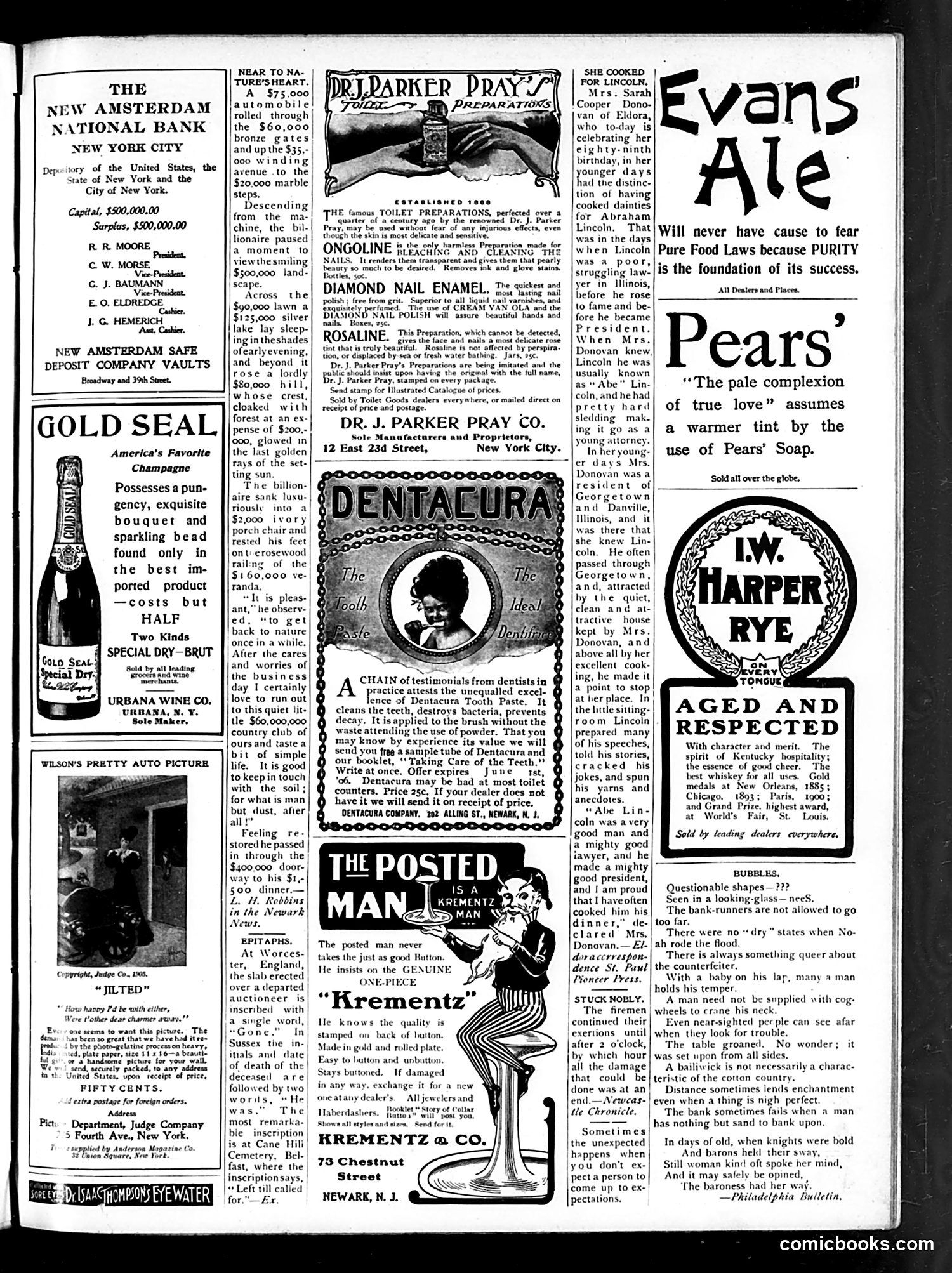
This page consists primarily of **advertisements and paid promotional content** rather than political satire. The notable exception is one cartoon titled **"Near to Nature's Heart,"** attributed to L. H. Robbins of the Newark News. ## The Main Cartoon's Satire The cartoon mocks the wealthy's performative relationship with nature. A billionaire arrives at his palatial $60-million country estate in a $75,000 automobile, passes through $35,000 gates and $400,000 doorways, then claims he needs to "get back to nature" and "keep in touch with the soil." The joke: his entire "natural" experience—the lake, forest, hill, chair, veranda—has been expensively constructed and commodified. His "$1,500 dinner" awaits. **The satire targets** Gilded Age hypocrisy: the ultra-wealthy's pretense of simple living despite surrounding themselves with ostentatious artificial luxury. It's social commentary on how money isolates the rich from genuine nature even as they romanticize it. The remainder of the page advertises patent medicines, champagne, banking services, and other consumer goods typical of 1908 publications.
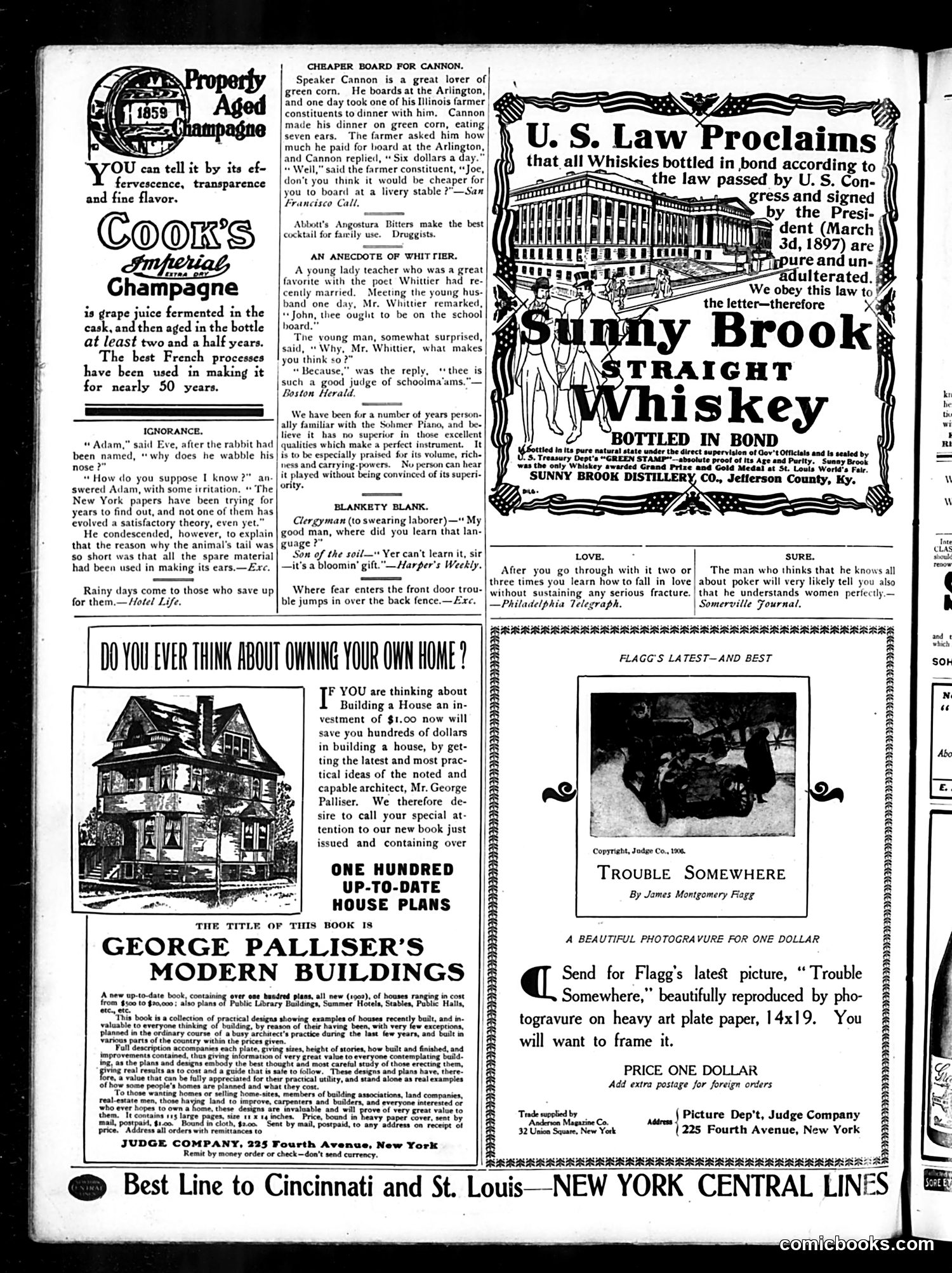
This page from Judge magazine (circa 1897-1902, based on internal dates) mixes political humor with advertising. **Political Content:** The "Cheaper Board for Cannon" anecdote mocks Speaker Joseph Cannon, a powerful Illinois Republican congressman. The joke portrays him as gluttonous and cheap—eating seven ears of corn at an expensive hotel, then complaining about the cost. The humor derives from depicting a prominent politician as simultaneously indulgent and stingy. **Other Humor:** Minor anecdotes about the poet Whittier and various observations on human nature fill the page. **Advertising:** The dominant content is actually commercial: Cook's Imperial Champagne, Sohmer Piano, George Palliser's house-plan book, and a Flagg photogravure reproduction. The Sunny Brook Whiskey ad emphasizes federal regulation ("bottled in bond"), suggesting whiskey quality was a consumer concern. The page exemplifies how Judge blended political satire with commercial content to reach middle-class readers interested in home ownership and consumer goods.
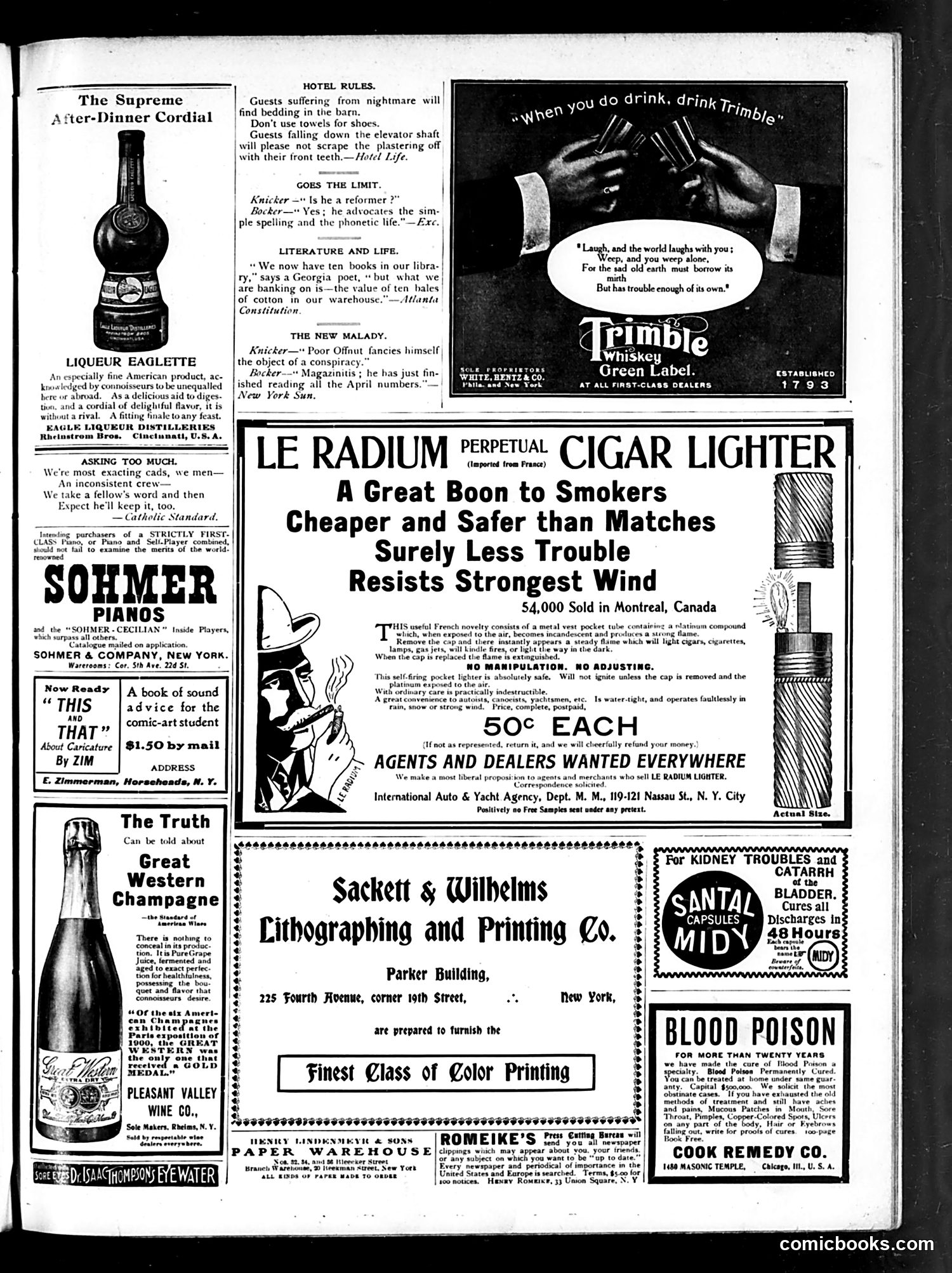
This page consists primarily of **period advertisements** rather than political satire. The small humorous items are brief jokes typical of Judge magazine: **"GOES THE LIMIT"** mocks reformers advocating "simple spelling and phonetic life"—a reference to early 1900s spelling reform movements that proposed simplifying English (e.g., "nite" for "night"). The joke trivializes these efforts as extreme. **"THE NEW MALADY"** jokes about "Magazinitis"—a made-up illness supposedly caused by reading too many April magazine issues, likely poking fun at magazine addiction or oversaturation. The remaining humor pieces are mild social observations about inconsistent men and library priorities. The dominant content is vintage advertising for liqueurs, pianos, champagne, and notably a **"Le Radium" perpetual cigar lighter**—a radioactive novelty product, reflecting the early 1900s craze for radium consumer goods (before its dangers were understood). This would seem alarming to modern readers but was marketed as a miracle product at the time. No significant political cartoon or caricature appears on this page.
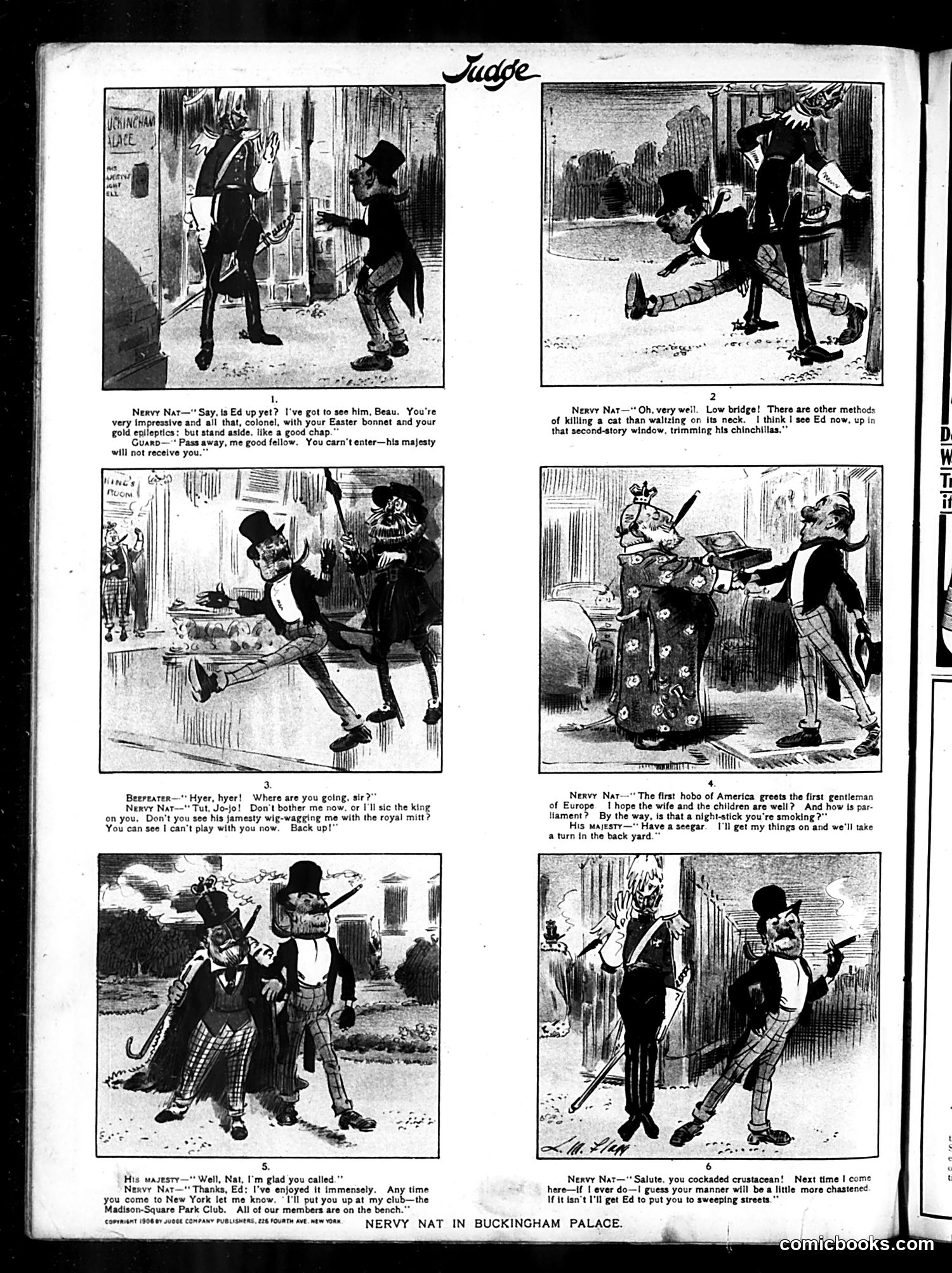
This is a satirical comic strip mocking an American character's irreverent behavior at the British royal court. "Nervy Nat" is an American stereotype—brash, informal, and disrespectful of aristocratic protocol—who barges into Buckingham Palace and treats the King with comic impertinence. The humor derives from the clash between American democratic casualness and British royal formality. Nat ignores guards, addresses the King as a peer ("Ed"), threatens to "sic" him, and generally treats the palace like his own territory, even inviting the King to visit his New York club where "all of our members are on the bench" (likely a working-class reference). The satire targets American arrogance and perceived lack of refinement when encountering Old World hierarchy. It reflects early 20th-century anxieties about American upstarts challenging established European social order, presented here as comedic rather than genuinely threatening.
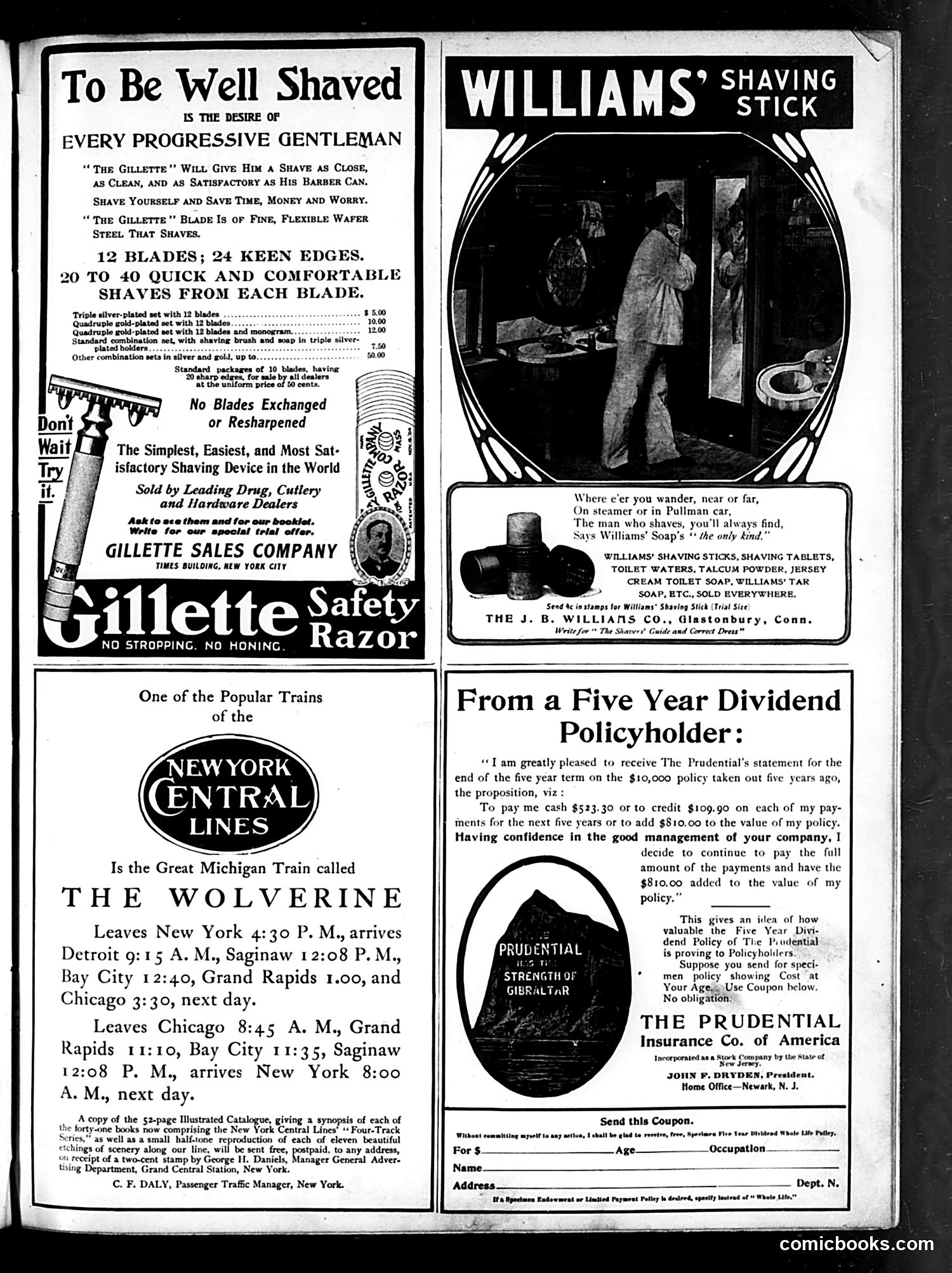
This page contains **no political cartoons or satire**—it is primarily advertising from the early 1900s. The content includes: **Gillette Safety Razor** (top left): Markets the new safety razor as modern and convenient, targeting "progressive gentlemen" who can shave themselves rather than visit a barber, saving time and money. This reflects the era's embrace of new consumer technology. **Williams' Shaving Stick** (top right): Competing grooming product advertisement emphasizing portability for travelers on trains and steamships. **New York Central Lines train ad** (bottom left): Promotes "The Wolverine," a luxury passenger train connecting major Midwest cities with New York. **Prudential Insurance** (bottom right): Features a testimonial from a satisfied policyholder describing five-year dividend benefits, demonstrating how insurance provided financial returns—a novel concept at the time. These ads collectively illustrate early-20th-century consumer culture: convenience products, modern transportation, and financial security products marketed to middle and upper-class men.
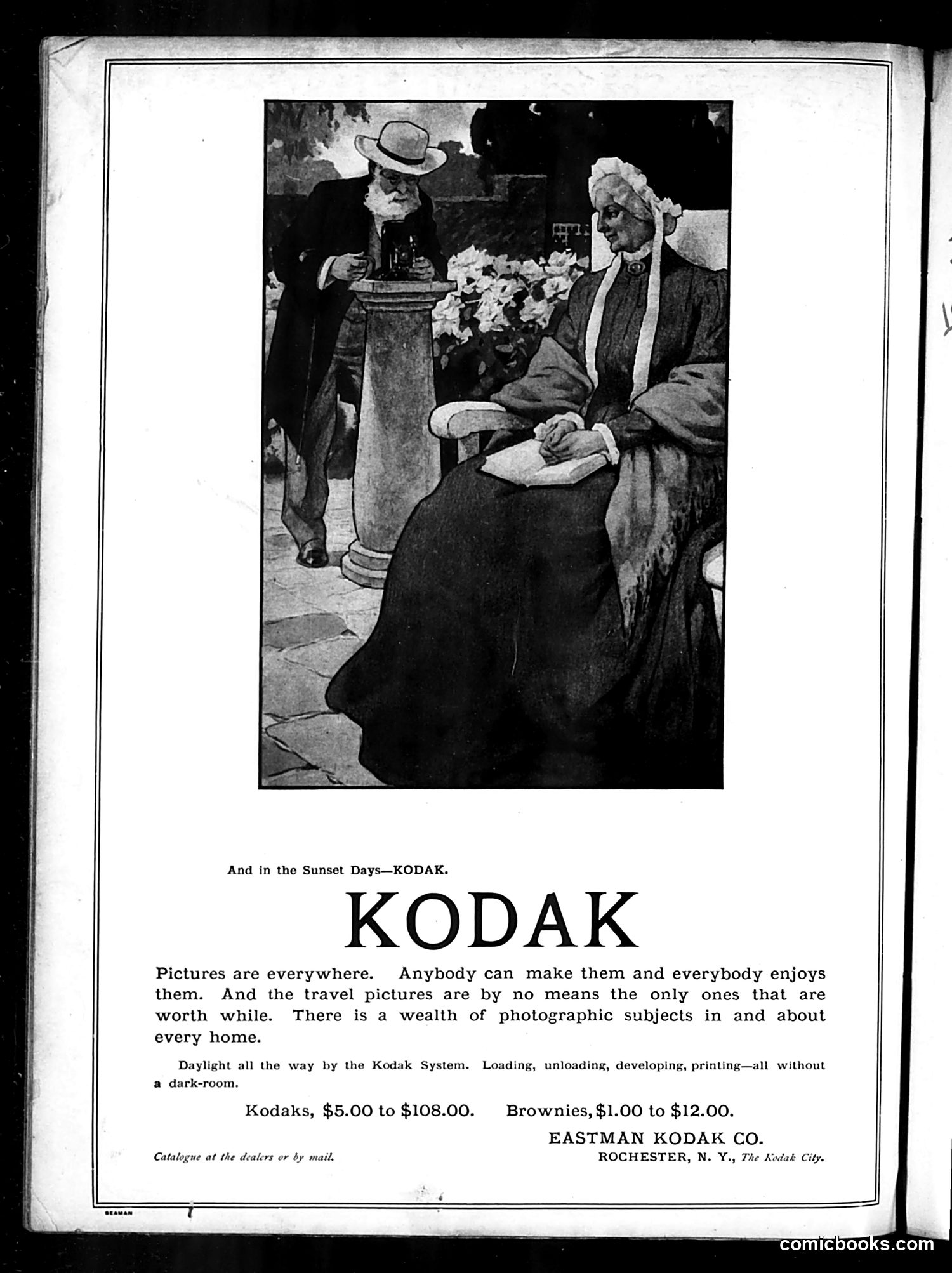
This is primarily a **Kodak camera advertisement**, not a political cartoon. The page shows an elderly couple in period clothing examining photographs together, with the tagline "And in the Sunset Days—KODAK." The advertisement's point is nostalgic and emotional: photography allows people to preserve memories of everyday home life, not just travel. The "Sunset Days" reference suggests capturing moments for posterity as one ages. The ad emphasizes accessibility—anyone can use Kodak's simple system without darkroom expertise. The pricing ($5–$108 for cameras; $1–$12 for Brownies, their budget model) and Rochester, NY location confirm this as genuine period advertising, likely from the early 1900s when Kodak dominated amateur photography and actively marketed to ordinary households.