
Judge, 1906-04-14 · page 12 of 20
Judge — April 14, 1906 — page 12: what you’re looking at
What you’re looking at
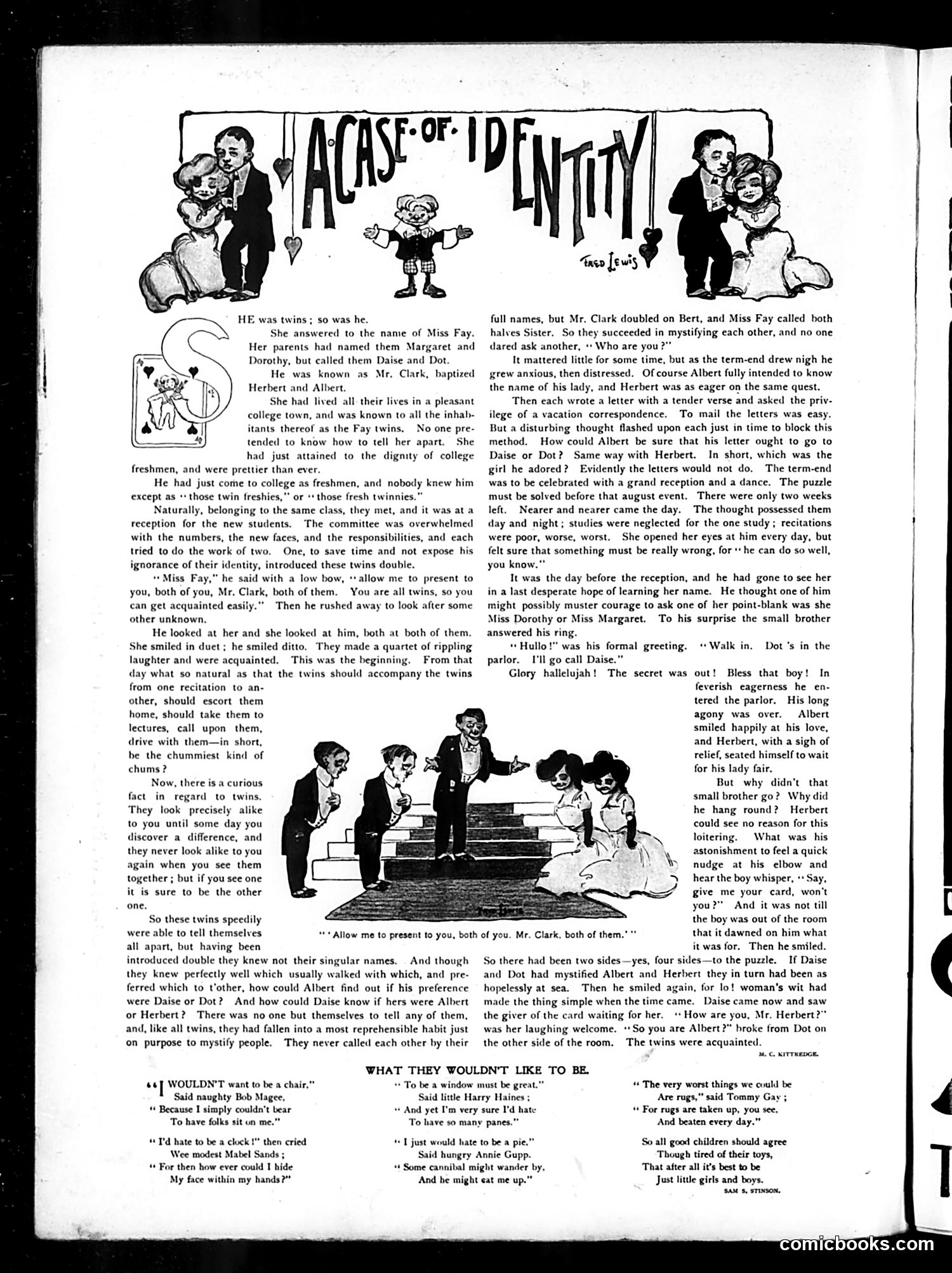
This is a romantic comedy story, not political satire. It concerns twin siblings—the Fay sisters (Margaret/Dorothy, called Daise/Dot) and the Clark brothers (Herbert/Albert)—who meet at college. A registrar, overwhelmed at a reception, introduces the two sets of twins collectively without distinguishing individuals. The four become inseparable companions. However, because they were introduced as indistinguishable pairs and the twins deliberately maintain confusion for amusement, neither brother can determine which sister he's actually courting—a problem that becomes urgent as the term ends and a formal reception/dance approaches. The story explores the Victorian-era romantic anxiety of young men uncertain of their romantic prospects. The satire targets the bureaucratic incompetence of administrators and the playful deception of twins who enjoy mystifying people.
📄 Transcribed text from this page (OCR, searchable)
Machine-transcribed from the original scan — historical spelling and the odd misread are preserved.
HE was twins ; so was he. She answered to the name of Miss Fay. Her parents had named them Margaret and Dorothy, but called them Daise and Dot. He was known as Mr, Clark, baptized Herbert and Albert. She had lived all their lives in a pleasant college town, and was known to all the inhab- itants thereof as the Fay twins, No one pre- tended to know how to tell her apart. She had just attained to the dignity of college freshmen, and were prettier than ever. He had just come to college as freshmen, and nobody knew him except as ** those twin freshies," or ‘+ those fresh twinnies.” Naturally, belonging to the same class, they met, and it was ata reception for the new students. The committee was overwhelmed with the numbers, the new faces, and the responsibilities, and each tried to do the work of two. One, to save time and not expose his ignorance of their identity, introduced these twins double. «Miss Fay,” he said with a low bow, ‘allow me to present to you, both of you, Mr. Clark, both of them. You are all twins, so you can get acquainted easily.” Then he rushed away to look after some other unknown, He looked at her and she looked at him, both at both of them, She smiled in duet; he smiled ditto. They made a quartet of rippling laughter and were acquainted, This was the beginning. From that day what so natural as that the twins should accompany the twins from one recitation to an- other, should escort them home, should take them to lectures, call upon them, drive with them—in short, be the chummiest kind of chums? Now, there is a curious fact in regard to. twins, They look precisely alike to you until some day you discover a difference, and they never look alike to you again when you see them together ; but if you see one it is sure to be the other one. So these twins speedily were able to tell themselves all apart, but having been introduced double they knew not their singular names. And though they knew perfectly well which usually walked with which, and pre- ferred which to t'other, how could Albert find out if his preference were Daise or Dot? And how could Daise know if hers were Albert or Herbert? There was no one but themselves to tell any of them, and, like all twins, they had fallen into a most reprehensible habit just ‘on purpose to mystify people. They never called each other by their “+ Allow me to present to you, both of you. Mr. Clark, both of them." full names, but Mr. Clark doubled on Bert, and Miss Fay called both halves Sister. So they succeeded in mystifying each other, and no one dared ask another, ‘* Who are you 2” It mattered little for some time, but as the term-end drew nigh he grew anxious, then distressed. Of course Albert fully intended to know the name of his lady, and Herbert was as eager on the same quest. Then each wrote a letter with a tender verse and asked the priv- ilege of a vacation correspondence. To mail the letters was easy. But a disturbing thought flashed upon each just in time to block this method. How could Albert be sure that his letter ought to go to Daise or Dot? Same way with Herbert. In short, which was the girl he adored? Evidently the letters would not do. The term-end was to be celebrated with a grand reception and a dance. The puzzle must be solved before that august event, There were only two weeks left. Nearer and nearer came the day. The thought possessed them day and night ; studies were neglected for the one study ; recitations were poor, worse, worst. She opened her eyes at him every day, but felt sure that something must be really wrong, for ** he can do so well, you know.” It was the day before the reception, and he had gone to see her in a last desperate hope of learning her name. He thought one of him might possibly muster courage to ask one of her point-blank was she Miss Dorothy or Miss Margaret. To his surprise the small brother answered his ring. * Hullo!" was his formal greeting. parlor. I'll go call Daise.” Glory hallelujah! The secret was out! Bless that boy! In feverish eagerness he en- tered the parlor. His long agony was over. Albert smiled happily at his love, and Herbert, with a sigh of relief, seated himself to wait for his lady fair. But why didn't that small brother go? Why did he hang round? Herbert could see no reason for this loitering. What was his astonishment to feel a quick nudge at his elbow and hear the boy whisper, “+ Say, give me your card, won't you?" And it was not till the boy was out of the room that it dawned on him what it was for. Then he smiled. So there had been two sides—yes, four sides—to the puzzle. If Daise and Dot had mystified Albert and Herbert they in turn had been as hopelessly at sea. Then he smiled again, for lo! woman's wit had made the thing simple when the time came. Daise came now and saw the giver of the card waiting for her. ** How are you, Mr. Herbert?” was her laughing welcome. **So you are Albert?” broke from Dot on the other side of the room. The twins were acquainted. ec XI TREC. «Walk in. Dot 's in the WHAT THEY WOULDN'T LIKE TO BE, 66] WOULDN'T want to be a chair,” Said naughty Bob Magee, « Because I simply couldn't bear To have folks sit un me.” “T’d hate to be a clock!" then cried Wee modest Mabel nds « For then how ever could I hide My face within my hands?” “+ To be a window must be great.”” Said little Harry Haines ; “And yet I'm very sure I'd hate To have so many panes.” ++ [just would hate to be a pie.” Said hungry Annie Gupp. Some cannibal might wander by, And he might eat me up.”” “The very worst things we could be Are rugs,” said Tommy Gay ; « For rugs are taken up, you see, ‘And beaten every day.” So all good children should agree ‘Though tired of their toys, That after all it’s best to be Just little girls and boys. SAM 8, STINSON, comicbooks.com