
Judge, 1906-04-14 · page 4 of 20
Judge — April 14, 1906 — page 4: what you’re looking at
What you’re looking at
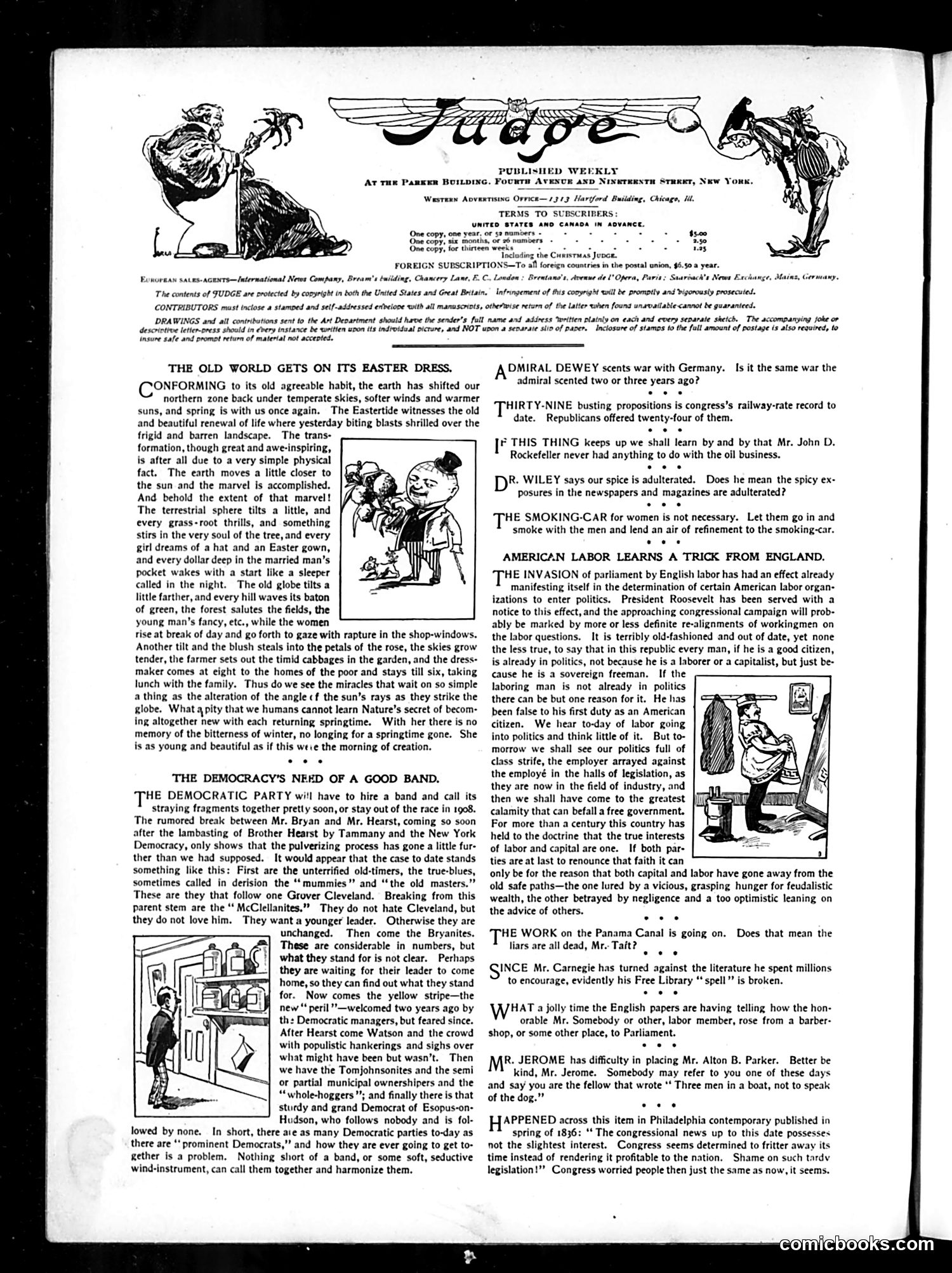
This page from *Judge* contains political commentary and brief satirical items rather than a single cartoon. The visible articles reference: **"The Democratic's Need of a Good Band"** — mocking the Democratic Party's internal divisions, comparing their fractured leadership to an out-of-tune orchestra. The text mentions Bryan and Hearst's "numberless breaks," suggesting disagreement between party factions. **Other brief items** critique various public figures and policies: Admiral Dewey's military involvement, Congress's railway record, John D. Rockefeller's business practices, and labor disputes. **The illustrations** appear to show domestic/everyday scenes rather than specific political caricatures—though the quality makes precise identification difficult. Without clearer dates or context, the specific events remain unclear, but the overall tone is typical *Judge*-style mockery of Democratic Party dysfunction and criticism of wealthy industrialists and political mismanagement.
📄 Transcribed text from this page (OCR, searchable)
Machine-transcribed from the original scan — historical spelling and the odd misread are preserved.
——— oa —=f FA Ca Av rue Pargen Boitpinc. Founrm Avexce axp Wasrexx Apvexrisinc PUBLISH NETHENTH STuKKT, New Yours. 313 Hartford Building, Chicage, lt, TERMS TO RI ‘AND CANADA One copy, six months, or #6 numbers ‘One copy, for thirteen weeks Toclading the Cunistatas Junce. FOREIGN SUPSCRIPTIONS—To al foreign countries in the postal union, $5.50 a year. Eonorean satns-acenrs—/atermational News Company, Bream's building, Chancery Lane, F.C. The contents of JUDGE are protected by copyright in both the United States and Great Britain. don : Brentana’s, Avenue de l' Opera, Paris: Suariach's News Exch Infringement of this conyright will be promptly and Pigorously prosecuted. CONTRIBUTORS mast inctose a stamped and self-addressed erfoelone with all manascriots, otherwise return of the Latter when found unavailabecannot be guaranteed. DRAWINGS and ail contribotions sent to the Art Department should have the sender's fall name and adress Written plainly on each and every separate sketch. The accompanying joke or descrintrve letter-bress should in ébery instance be written upon its indrosdual picture, and NOT upon a seoarate sii0 of pacer. Inclosare of stamos to the fall amount of postage (s also required, to insure safe and prompt return of material not accepted, THE OLD WORLD GETS ON ITS EASTER DRESS. (CONFORMING to its old agreeable habit, the earth has shifted our northern zone back under temperate skies, softer winds and warmer suns, and spring is with us once again. The Eastertide witnesses the old and beautiful renewal of life where yesterday biting blasts shrilled over the frigid and barren landscape. The trans- formation, though great and awe-inspiring, is after all due to a very simple physical fact. The earth moves a little closer to the sun and the marvel is accomplished. And behold the extent of that marvel! The terrestrial sphere tilts a little, and every grass-root thrills, and something stirs in the very soul of the tree, and every girl dreams of a hat and an Easter gown, and every dollar deep in the married man’s pocket wakes with a start like a sleeper called in the night. The old globe tilts a little farther, and every hill waves its baton of green, the forest salutes the fields, the young man’s fancy, etc., while the women rise at break of day and go forth to gaze with rapture in the shop-windows. Another tilt and the blush steals into the petals of the rose, the skies grow tender, the farmer sets out the timid cabbages in the garden, and the dress- maker comes at eight to the homes of the poor and stays till six, taking lunch with the family. Thus do we see the miracles that wait on so simple a thing as the alteration of the angle cf the sun’s rays as they strike the globe. What q pity that we humans cannot learn Nature’s secret of becom- ing altogether new with each returning springtime. With her there is no memory of the bitterness of winter, no longing for a springtime gone. She is as young and beautiful as if this weve the morning of creation. THE DEMOCRACY’S NEED OF A GOOD BAND. 'HE DEMOCRATIC PARTY witl have to hire a band and call its straying fragments together pretty soon, or stay out of the race in 1908. The rumored break between Mr. Bryan and Mr. Hearst, coming so soon after the lambasting of Brother Hearst by Tammany and the New York Democracy, only shows that the pulverizing process has gone a little fur- ther than we had supposed. It would appear that the case to date stands something like this: First are the unterrified old-timers, the true-blues, sometimes called in derision the ‘mummies’? and ‘the old masters.” These are they that follow one Grover Cleveland. Breaking from this parent stem are the ‘‘ McClellanites.” They do not hate Cleveland, but they do not love him. They want a younger leader. Otherwise they are unchanged. Then come the Bryanites. These are considerable in numbers, but what they stand for is not clear. Perhaps they are waiting for their leader to come home, so they can find out what they stand for. Now comes the yellow stripe—the new“ peril ’—welcomed two years ago by th: Democratic managers, but feared since. After Hearst come Watson and the crowd with populistic hankerings and sighs over what might have been but wasn’t. Then we have the Tomjohnsonites and the semi or partial municipal ownershipers and the “‘whole-hoggers ”; and finally there is that sturdy and grand Democrat of Esopus-on- Hudson, who follows nobody and is fol- lowed by none. In short, there aie as many Democratic parties to-day as there are “ prominent Democrats,” and how they are ever going to get to- gether is a problem. Nothing short of a band, or some soft, seductive wind-instrument, can call them together and harmonize them. DMIRAL DEWEY scents war with Germany. Is it the same war the admiral scented two or three years ago? THIRTY-NINE busting propositions is congress’s railway-rate record to date. Republicans offered twenty-four of them. THIS THING keeps up we shall learn by and by that Mr. John D. Rockefeller never had anything to do with the oil business. R. WILEY says our spice is adulterated. Does he mean the spicy ex- posures in the newspapers and magazines are adulterated? THE SMOKING-CAR for women is not necessary. Let them go in and smoke with the men and lend an air of refinement to the smoking-car. AMERICAN LABOR LEARNS A TRICK FROM ENGLAND. THE INVASION of parliament by English labor has had an effect already manifesting itself in the determination of certain American labor organ- izations to enter politics. President Roosevelt has been served with a notice to this effect, and the approaching congressional campaign will prob- ably be marked by more or less definite re-alignments of workingmen on the labor questions. It is terribly old-fashioned and out of date, yet none the less true, to say that in this republic every man, if he is a good citizen, is already in politics, not because he is a laborer or a capitalist, but just be- cause he is a sovereign freeman. If the laboring man is not already in politics there can be but one reason for it. He has been false to his first duty as an American citizen. We hear to-day of labor going into politics and think little of it. But to- morrow we shall see our politics full of class strife, the employer arrayed against the employé in the halls of legislation, as they are now in the field of industry, and then we shall have come to the greatest calamity that can befall a free government. For more than a century this country has held to the doctrine that the true interests of labor and capital are one. If both par- ties are at last to renounce that faith it can only be for the reason that both capital and labor have gone away from the old safe paths—the one lured by a vicious, grasping hunger for feudalistic wealth, the other betrayed by negligence and a too optimistic leaning on the advice of others. Ir ‘THE WORK on the Panama Canal is going on. liars are all dead, Mr Tait? Does that mean the INCE Mr. Carnegie has turned against the literature he spent millions to encourage, evidently his Free Library ‘* spell’ is broken. WHAT a jolly time the English papers are having telling how the hon- orable Mr. Somebody or other, labor member, rose from a barber- shop, or some other place, to Parliament. Better be MB. JEROME has difficulty in placing Mr. Alton B. Parker. kind, Mr. Jerome. Somebody may refer to you one of these days and say you are the fellow that wrote “‘ Three men in a boat, not to speak of the dog.” APPENED across this item in Philadelphia contemporary published in spring of 1836: ‘* The congressional news up to this date possesses not the slightest interest. Congress seems determined to fritter away its time instead of rendering it profitable to the nation. Shame on such tardv legislation !’” Congress worried people then just the same as now, it seems.