
Judge, 1906-04-14 · page 6 of 20
Judge — April 14, 1906 — page 6: what you’re looking at
What you’re looking at
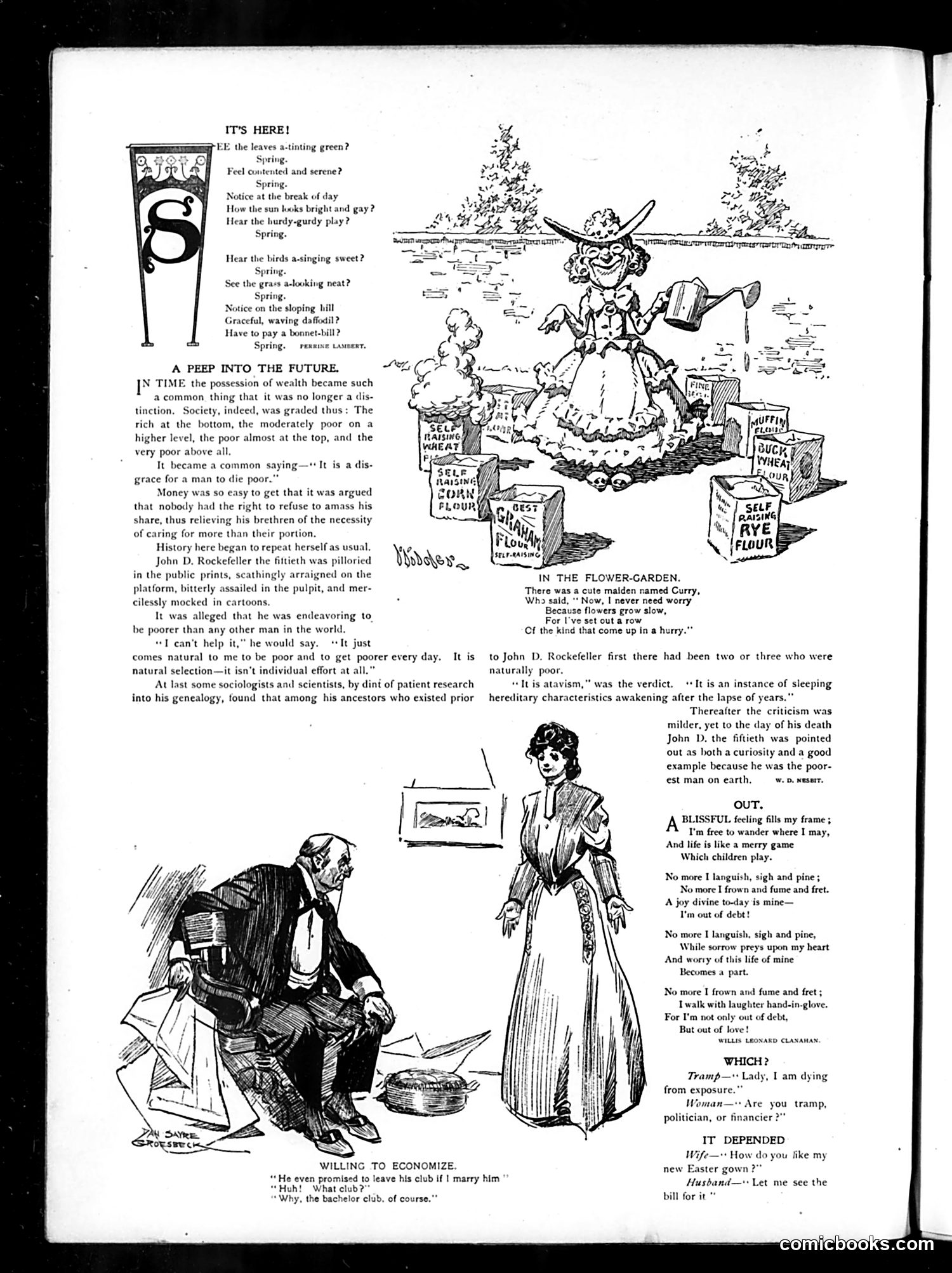
This page satirizes wealth inequality and social mobility through an inverted-future scenario. The main cartoon imagines a time when wealth becomes so common that society's hierarchy reverses: the rich are at the "bottom," the moderately poor higher up, and the very poor "above all." The satire targets **John D. Rockefeller the fiftieth**, a descendant of the famous industrialist. In this future world, being poor becomes a mark of distinction rather than shame. Rockefeller the fiftieth is pilloried for being "the poorest man on earth"—a deliberate inversion of how his ancestor was attacked for being excessively wealthy. Sociologists discover his poverty stems from ancestral "atavism" (inherited traits), treating it like a curiosity. The joke critiques both extreme wealth concentration and society's obsession with attacking the ultra-rich, suggesting that if everyone became wealthy, poverty itself would become enviable—a cutting commentary on American class anxieties and the arbitrariness of social status.
📄 Transcribed text from this page (OCR, searchable)
Machine-transcribed from the original scan — historical spelling and the odd misread are preserved.
IT’S HERE! EE the leaves a-tinting green? Spring. ented Spring. Notice at the break of day How the sun looks bright and gay ? Hear the hurdy-gurdy play? Spring. Feel cu d serene? Hear th Spring. See the grass alooking neat? Spring. birds a-singing sweet? Notice on the sloping hill Graceful, waving daffodil? Have to pay a bonnet-bill? Spring. PERRIN LAMENT, A PEEP INTO THE FUTURE. N TIME the possession of wealth became such a common thing that it was no longer a dis- tinction, Society, indeed, was graded thus: The rich at the bottom, the moderately poor on a higher level, the poor almost at the top, and the very poor above all. It became a common saying grace for a man to die poor.” Money was so easy to get that it was argued that nobody had the right to refuse to amass his share, thus relieving his brethren of the necessity It is a dis- CORN FLOUR’ of caring for more than their portion, History here began to repeat herself as usual. John D. Rockefeller the fittieth was pilloried in the public prints, scathingly arraigned on the platform, bitterly assailed in the pulpit, and mer- cilessly mocked in cartoons. It was alleged that he was endeavoring to be poorer than any other man in the world. “1 can’t help it," he would say, “It just comes natural to me to be poor and to get poorer every day. natural selection—it isn’t individual effort at all.” At last some sociologists and scientists, by dini of patient research into his genealogy, found that among his ancestors who existed prior Virdee, It is WILLING TO ECONOMIZE. “He even promised to leave his club if | marry him Huh! What club?" “Why, the bachelor club, of course.” There was a cute maiden named Curry, Who said, “* Now, I never need worry Because flowers grow slow, For I've set out a row Cf the kind that come up in a hurry." to John D. Rockefeller first there had been two or three who were naturally poor. “tis as the verdict. “It is an instance of sleeping hereditary characteristics awakening after the lapse of years.” Thereatter the criticism was milder, yet to the day of his death John D, the fiftieth was pointed out as both a curiosity and a good example because he was the poor- est man on earth. tavism," W. D. weserr, OUT. BLISSFUL feeling fills my frame ; I'm free to wander where I may, And life is like a merry game Which children play. No more I languish, sigh and pine ; ‘No more I frown and fume and fret. A joy divine to-day is mine— I'm out of debt! No more I languish, sigh and pine, While sorrow preys upon my heart And worry of this life of mine Becomes a part. No more I frown and fume and fret ; Twalk with laughter hand-in.glove. For I'm not only out of debt, But out of love! WILLIS LEONARD CLANAMAN. WHICH? Tramp—« Lady, I am dying from exposur Woman you tramp, politician, or financier + Are IT DEPENDED Wife—» How do you like my new Easter gown ?” Husband—* Let me see the bill for it