
A complete issue · 16 pages · 1906
Judge — April 7, 1906
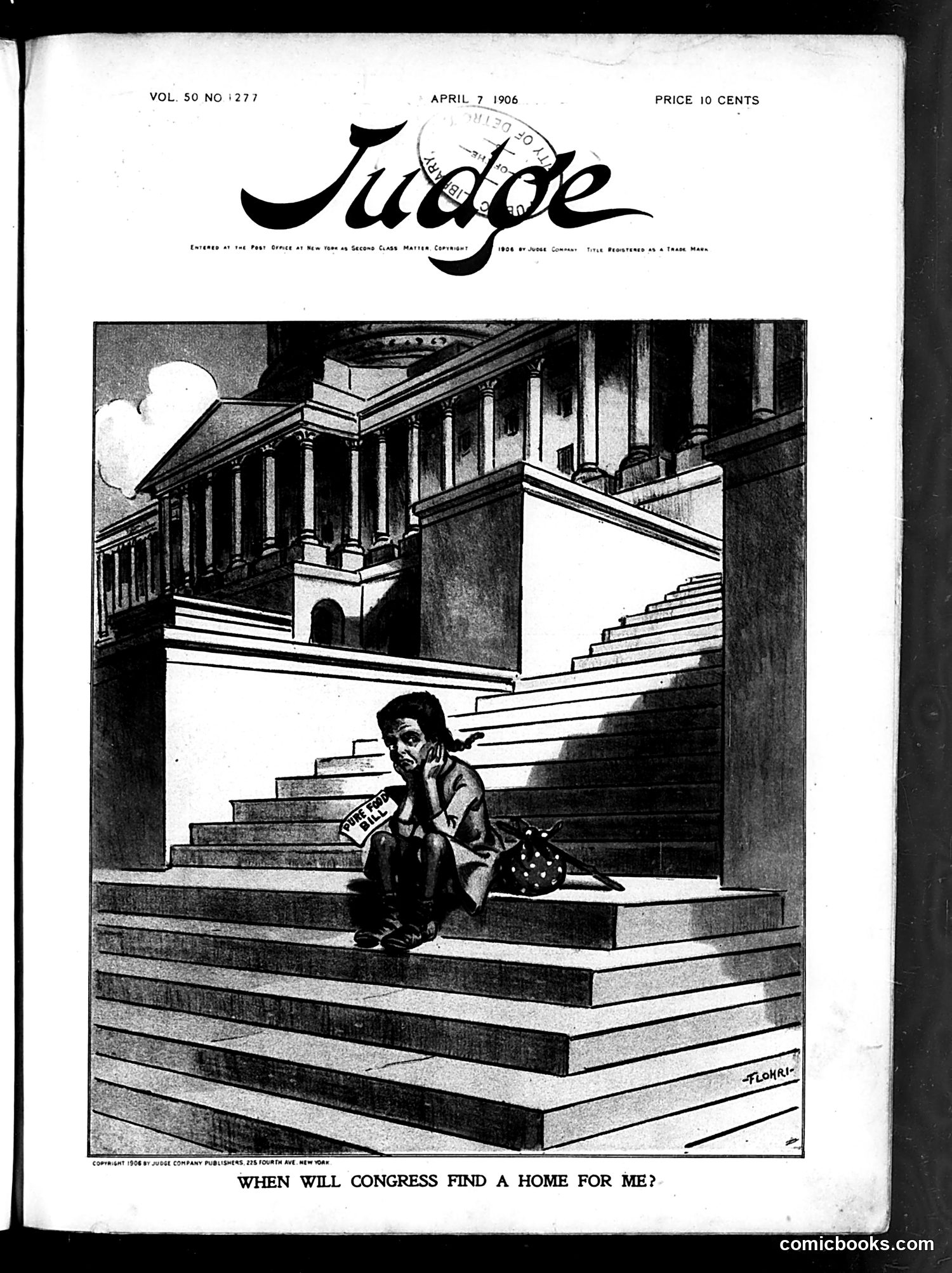
This political cartoon depicts a ragged, disheveled figure sitting on the steps of a grand neoclassical building (likely the U.S. Capitol). The figure holds a newspaper and asks: "WHEN WILL CONGRESS FIND A HOME FOR ME?" The satire targets Congressional homelessness or lack of permanent housing for the legislative body. This likely references the actual disruption caused by the San Francisco earthquake of April 18, 1906 (which occurred shortly after this issue's April 7 date), or ongoing debates about relocating Congress. The contrast between the figure's poverty and the imposing Capitol architecture emphasizes Congressional inaction or neglect regarding housing needs or disaster relief. The cartoon critiques legislative failure to address a pressing national problem.
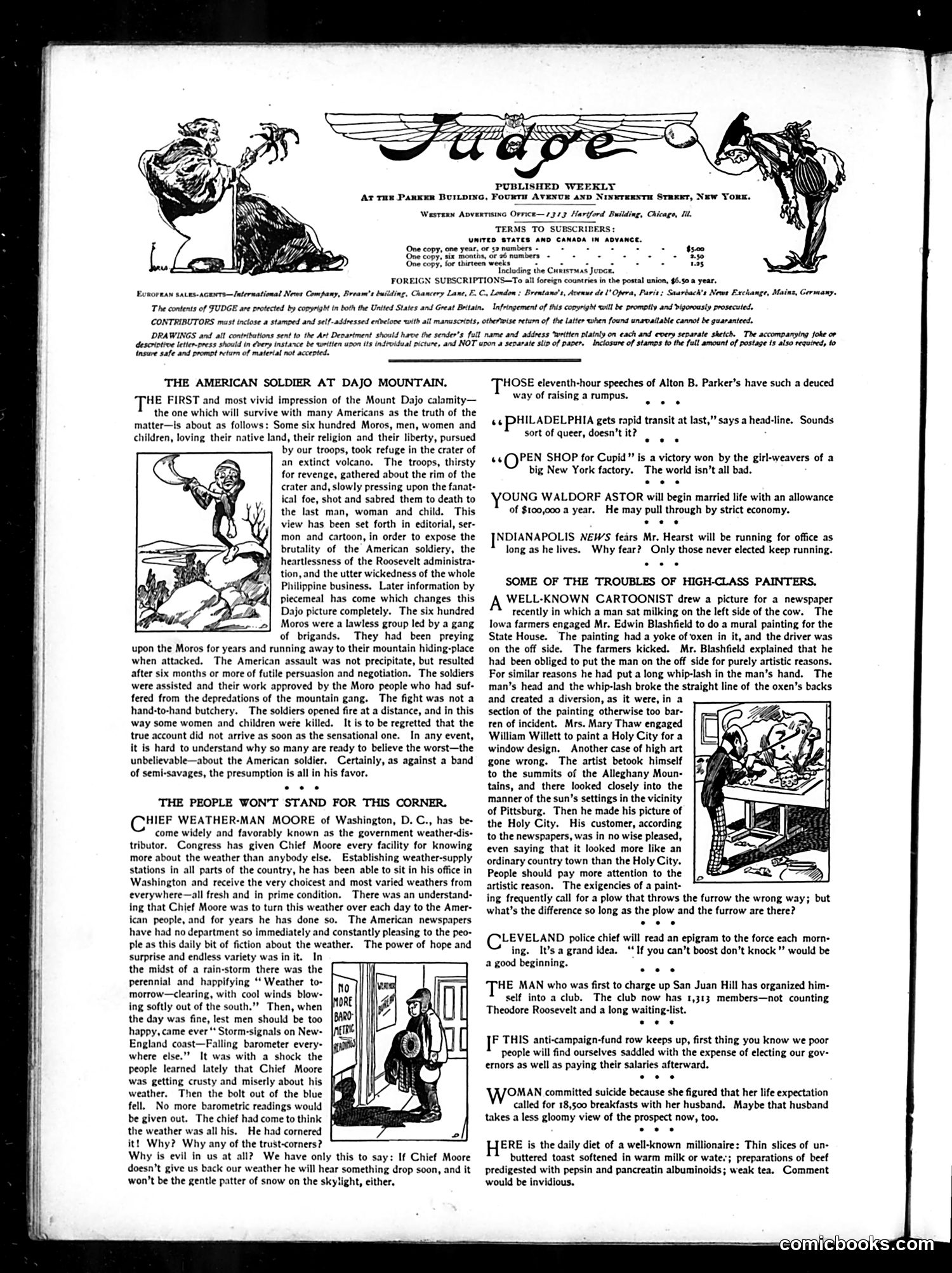
This page contains multiple satirical news items and illustrations typical of Judge's format. The main article, "The American Soldier at Dajo Mountain," describes a military conflict involving American troops and Moro fighters in what appears to be the Philippines, criticizing the Roosevelt administration's handling of the situation. Other brief items mock contemporary figures and events: a head-line about Philadelphia transit, a quip about a wealthy young Waldorf Astor's finances, and commentary on high-class painters' troubles with commissions. The most developed satire concerns Chief Weather-Man Moore of Washington, D.C., mocking the government's weather service and suggesting Moore's incompetence makes weather predictions unreliable. The accompanying illustration emphasizes this through visual humor about meteorological failures.
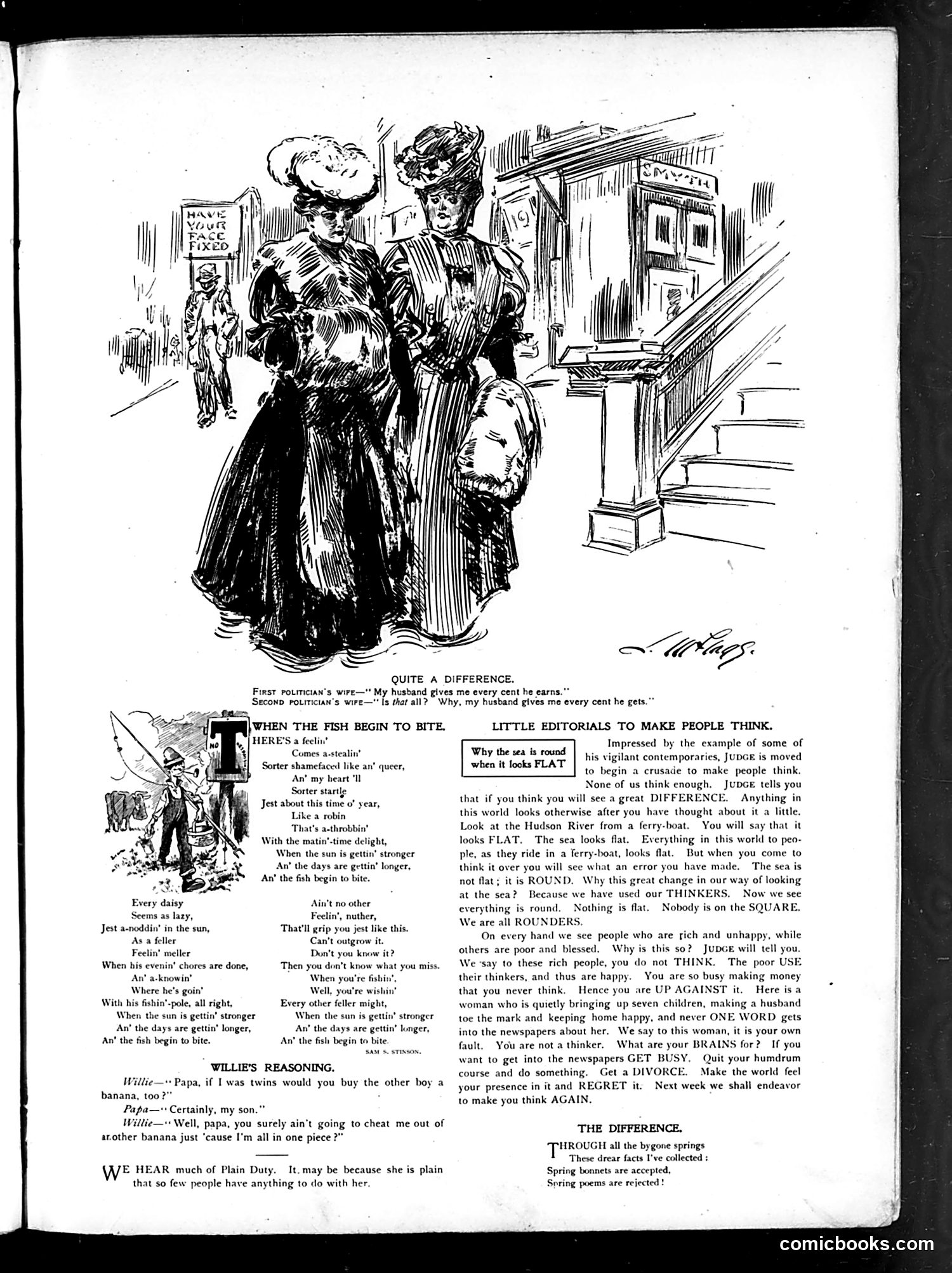
**Main Cartoon - "Quite a Difference":** Two well-dressed women discuss their husbands' financial practices. The first says her husband gives her every cent he earns; the second replies "Is that all?" and notes her husband gives her every cent he *gets*—implying he spends/wastes money before bringing home the rest. The satire targets marital economics and male financial irresponsibility in the early 20th century. **Supporting Content:** Additional humorous pieces include "Willie's Reasoning" (a child's logic about buying bananas) and editorial commentary titled "Little Editorials to Make People Think," criticizing wealthy people for not engaging in serious thought, using extended metaphors about flat surfaces and roundness. The page reflects period concerns about wealth, marriage dynamics, and social class attitudes.
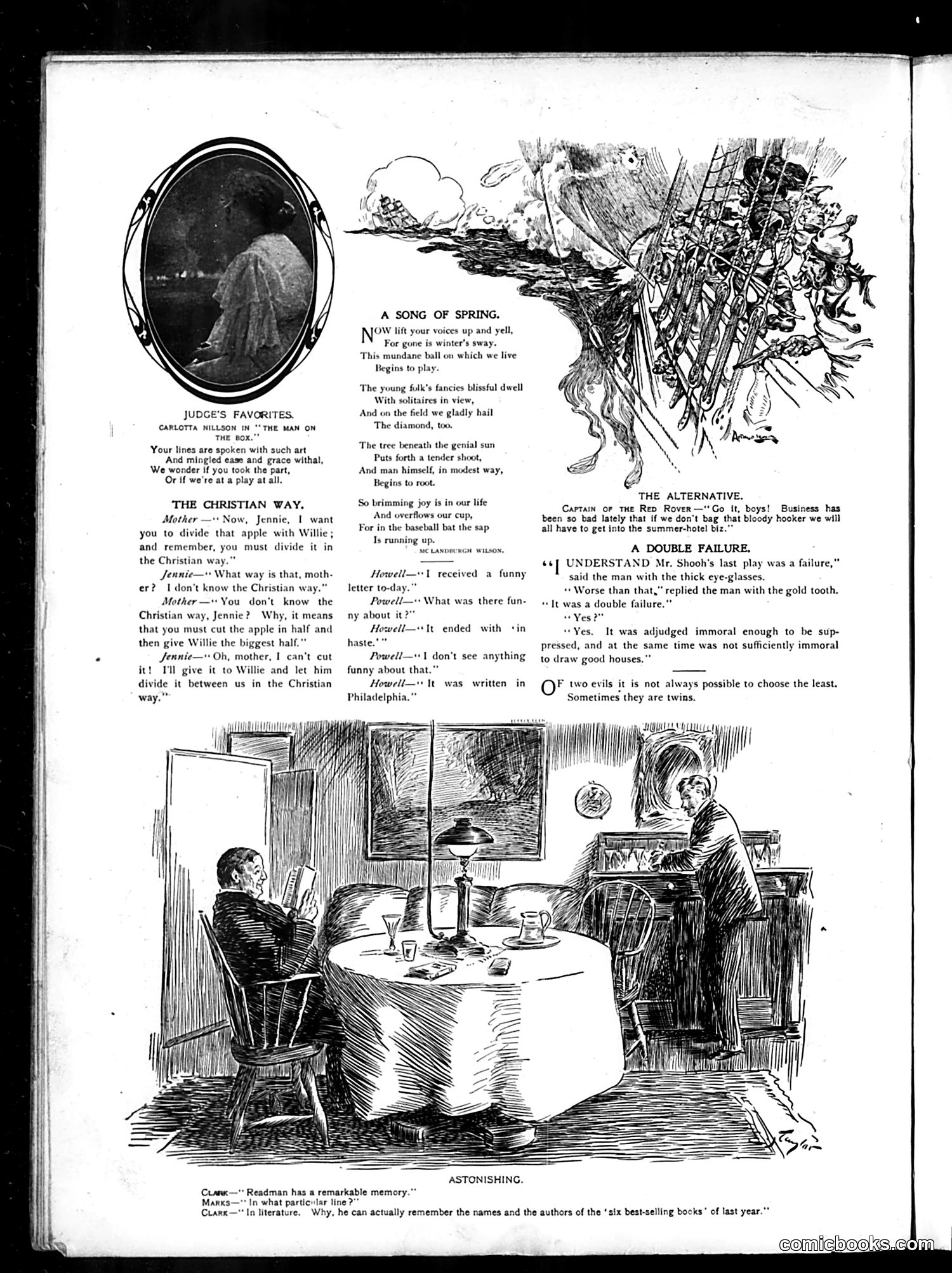
This page contains literary and social humor rather than political satire. The main cartoon, titled "Astonishing," depicts two men dining—one remarking that "Roadman has a remarkable memory," specifically that he can remember "the names and the authors of the 'six best-selling books' of last year." The joke satirizes either the absurdity of best-seller lists or the ephemeral nature of popular literature—suggesting it's remarkable (and perhaps absurd) that anyone would remember commercially successful but forgettable books once they've faded from public attention. The page also includes a portrait labeled "Judge's Favorites" showing Carlotta Millson from "The Man on the Box," plus various brief humorous anecdotes and literary pieces typical of Judge's content.
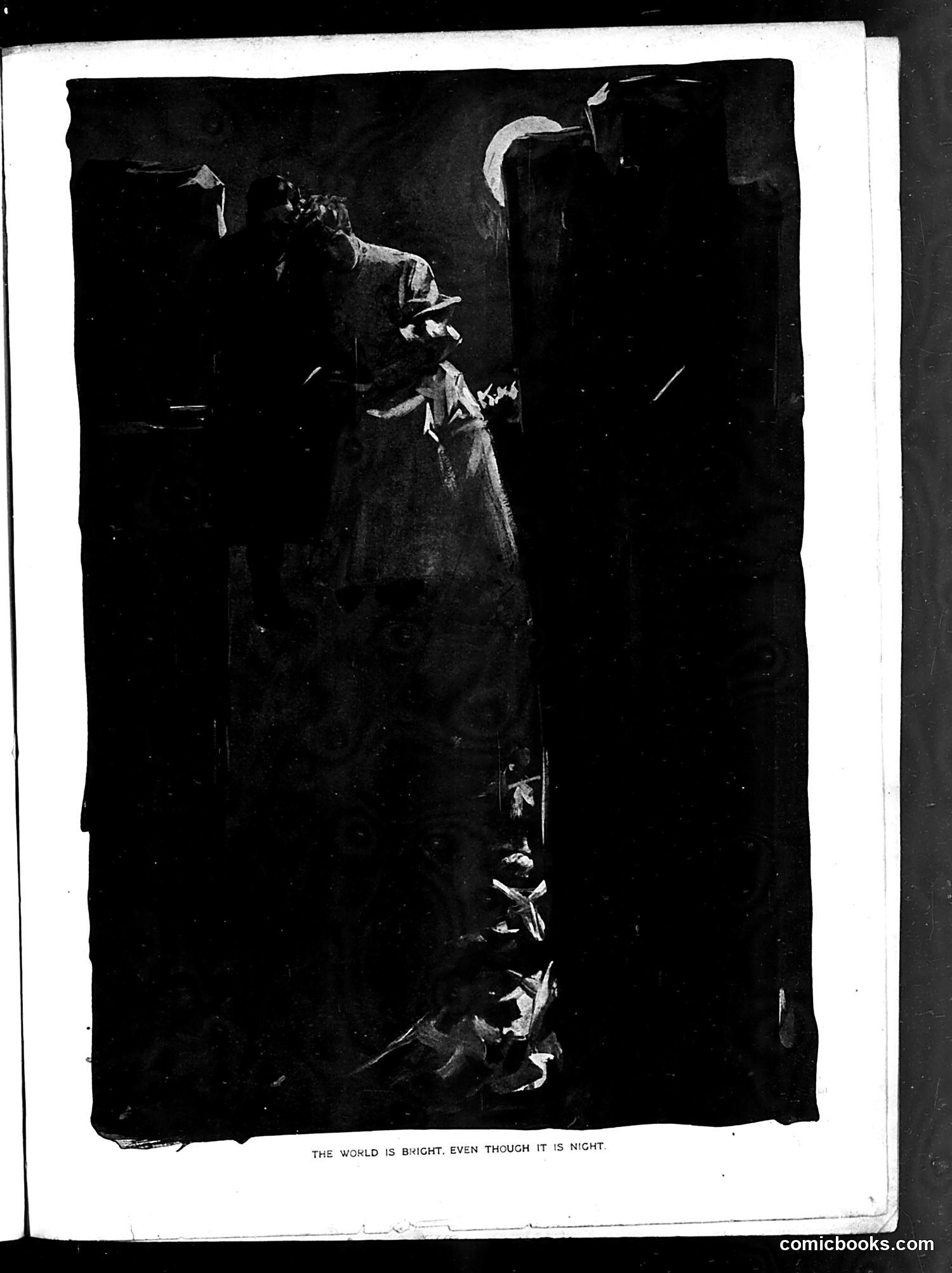
This appears to be a satirical illustration from *Judge* magazine showing a nighttime scene with dramatic chiaroscuro lighting. A figure stands elevated in what looks like an interior space, with strong contrast between light and shadow. The caption reads: "THE WORLD IS BRIGHT, EVEN THOUGH IT IS NIGHT." Without additional context, the specific political or social reference is unclear. The image's mood is somewhat ominous despite the optimistic caption, suggesting ironic commentary. The elevated figure and dramatic lighting could reference a public speaker, politician, or spiritual leader addressing followers, but I cannot definitively identify who is caricatured or what specific event this references. The composition suggests early-to-mid 20th century sensibilities, but the precise satirical point remains ambiguous from the image alone.
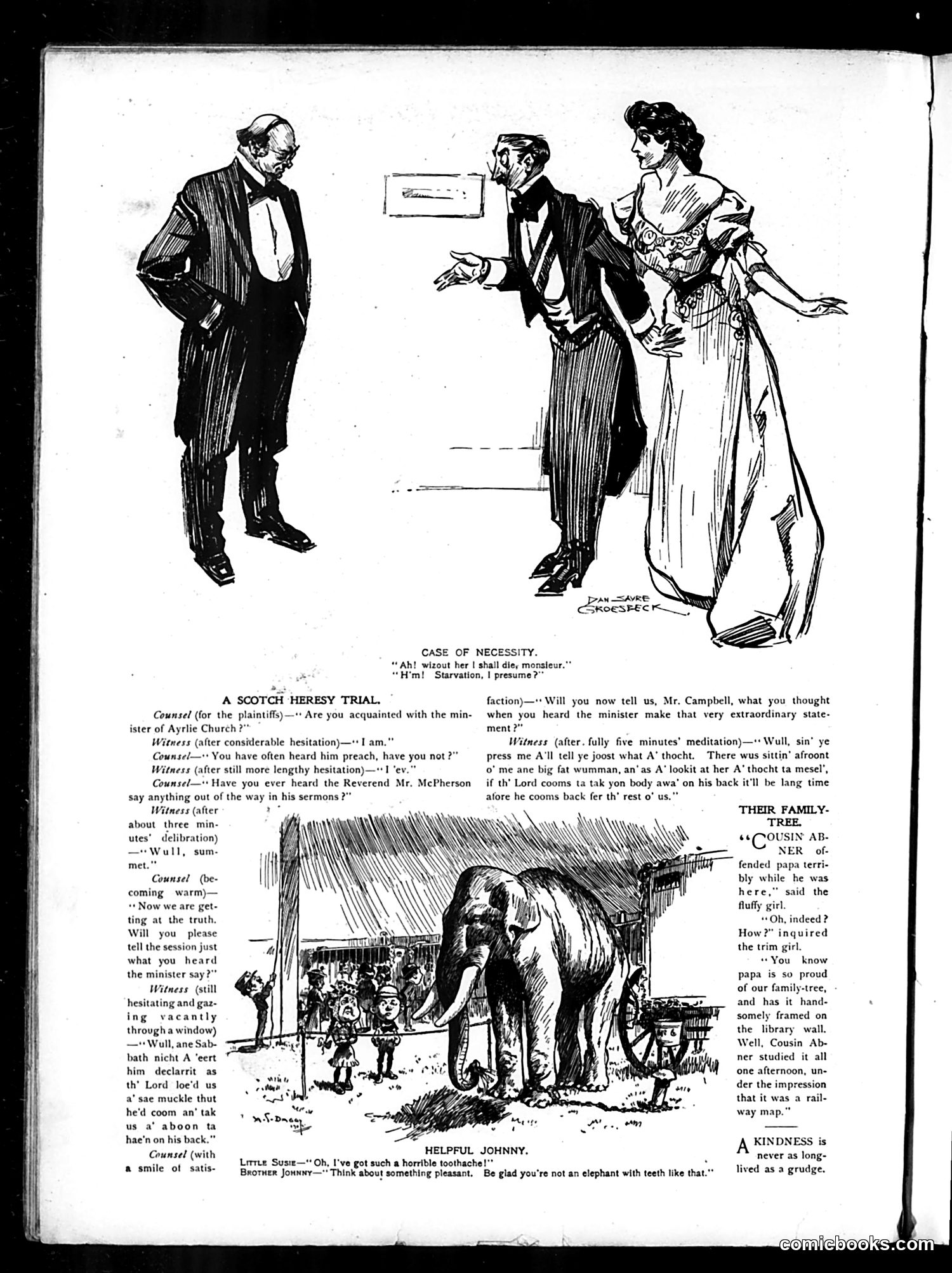
This page contains three satirical pieces: **"A Scotch Heresy Trial"** (main cartoon): Mocks Scottish court proceedings through exaggerated dialect testimony. A witness struggles to recall whether a minister said anything improper, eventually admitting he was distracted by a fat woman, leading to an absurd theological observation about the Resurrection. The satire targets both Scottish legal formality and religious pedantry—the trial seems concerned with doctrinal heresy while the witness couldn't focus on spiritual matters. **"Case of Necessity"** (top): A Frenchman claims he'll die without a woman's company; the response sardonically suggests starvation as the real issue—satirizing Continental romantic dramatics. **"Their Family Tree"** and **"Helpful Johnny"** (shorter pieces): Light domestic humor about mistaking a family tree diagram for a railway map, and a boy's "helpful" suggestion to a toothached girl. The page exemplifies *Judge*'s blend of political/social satire with genteel humor aimed at upper-class readers.
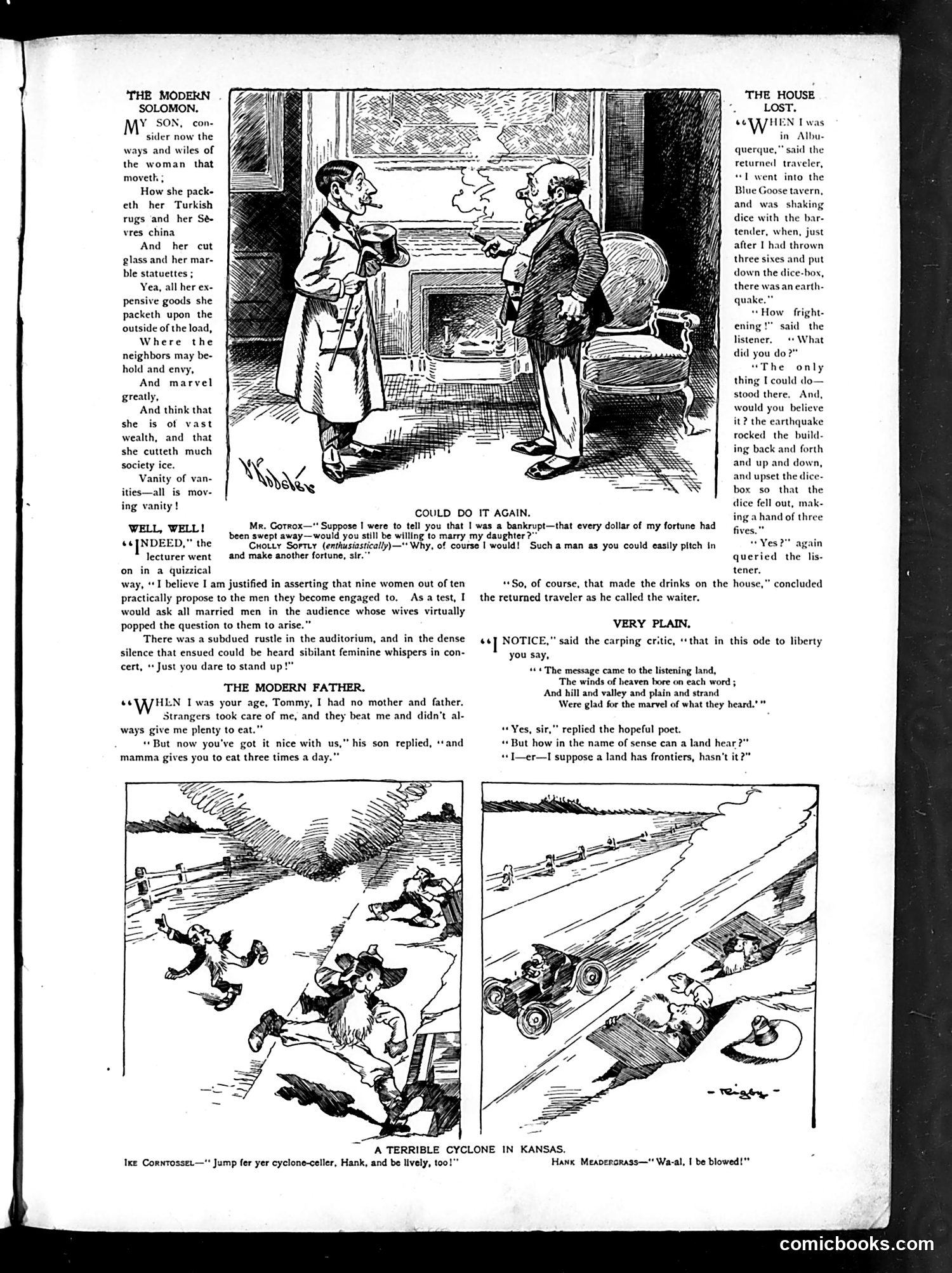
This page contains several satirical pieces mocking social pretension and gender dynamics: **"Moving Vanity"** ridicules wealthy women who ostentatiously display expensive goods (Turkish rugs, Sèvres china, marble statues) during moves to impress neighbors—critiquing materialism and status-seeking. **"The Modern Father"** inverts traditional hardship narratives: a father who claims to have suffered as a child now enjoys comfort provided by his wife, suggesting role reversals or economic dependence that undermine masculine authority. **"Could Do It Again"** satirizes a suitor's enthusiasm about marrying a suddenly-bankrupt man's daughter, implying fortune-hunters care only about wealth, not character. **"The House Lost"** presents a tall tale: an earthquake during dice-rolling accidentally creates winning hands and free drinks—poking fun at travelers' exaggerated stories. **"Very Plain"** mocks pretentious poetry by having a critic point out literal absurdities (how can land hear?), with the poet's nonsensical answer about "frontiers" highlighting affected artistic pretension. **"Terrible Cyclone"** shows comic Kansas frontier dialect about storm cellars.
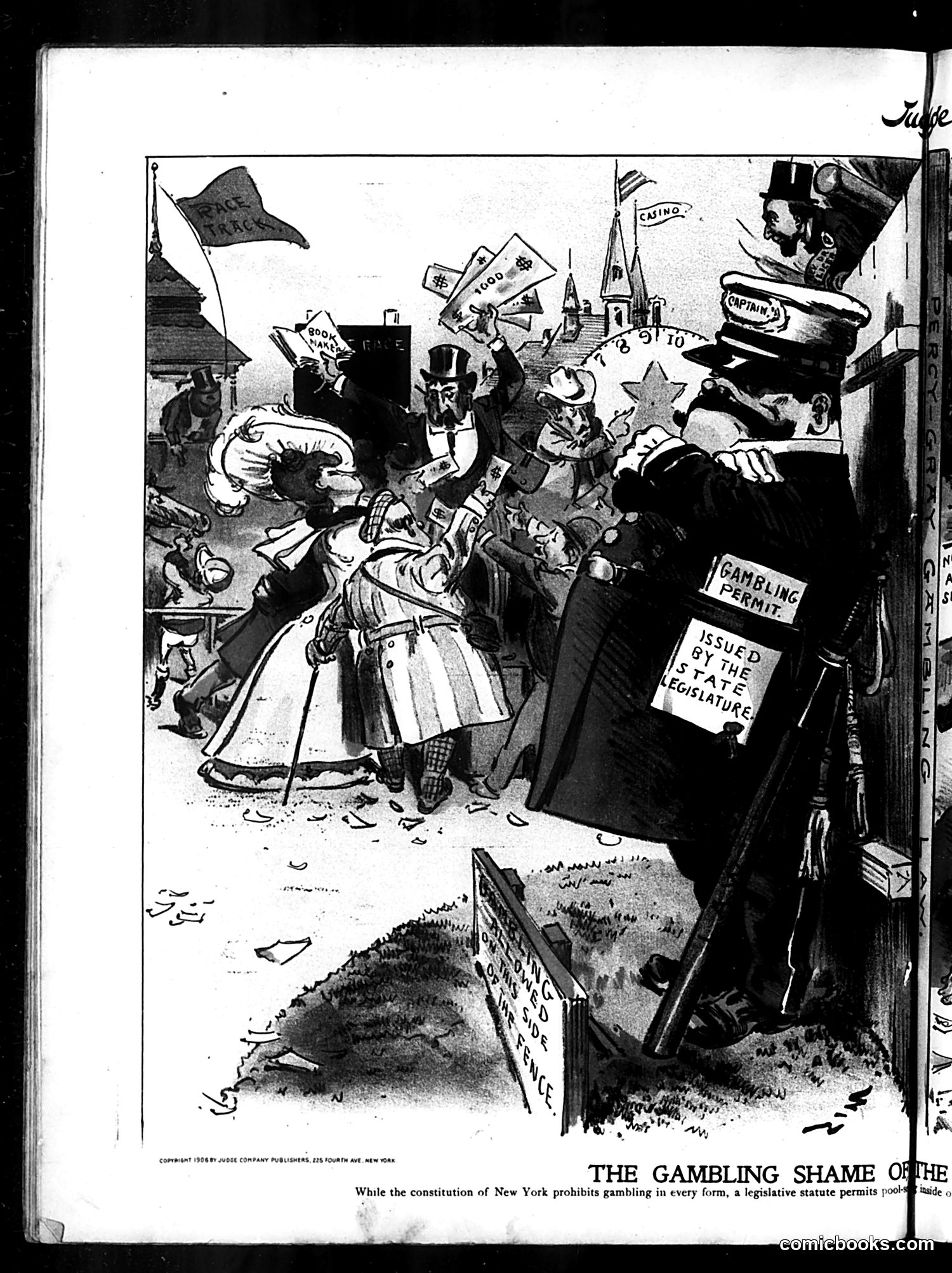
This political cartoon satirizes hypocrisy in New York State law. The caption explains the contradiction: the state constitution prohibits gambling entirely, yet a legislative statute permits pool-selling (a form of gambling on horse races). The cartoon depicts well-dressed gentlemen and a woman in Victorian-era clothing gathered around what appears to be a gambling operation or casino. Labels visible include "GAMBLING PERMIT" and "ISSUED BY THE STATE LEGISLATURE," emphasizing the official sanction of illegal activity. The satire targets lawmakers who created this legal loophole, allowing pool-selling to continue despite constitutional prohibition. The elegant figures suggest corruption among the state's respectable political class. The cartoon critiques the absurdity and moral failure of permitting through statute what the constitution explicitly forbids—a commentary on legislative hypocrisy regarding gambling regulation.
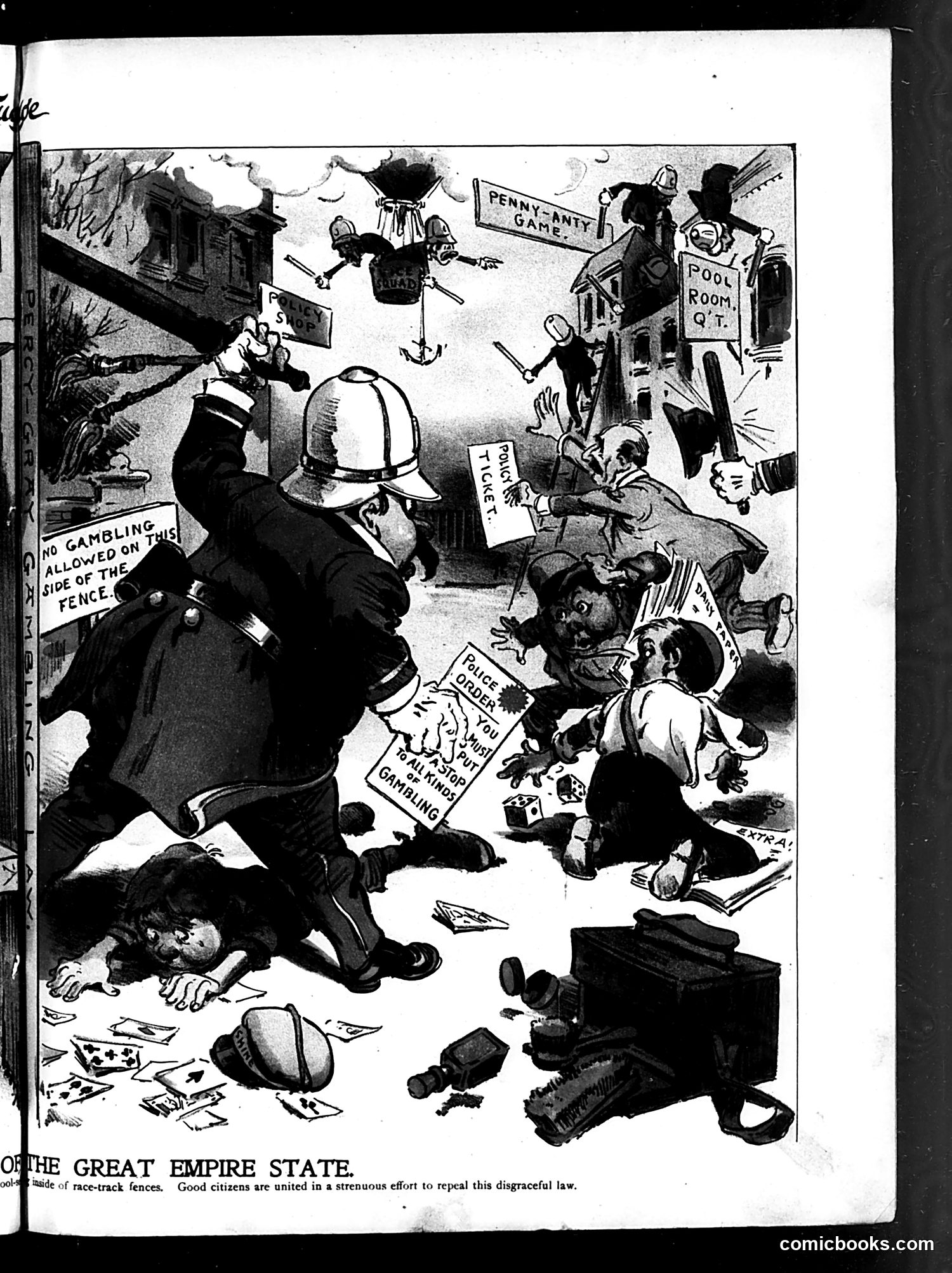
This satirical cartoon depicts law enforcement (the police officer in helmet) struggling to maintain order against chaos representing illegal gambling and vice in New York State. The signs visible reference "Penny-Ante Games," "Pool Room," and gambling-related activities, while scattered playing cards, dice, and money litter the ground. The cartoon criticizes New York's perceived failure to enforce laws against gambling and related vices. The "disgraceful law" mentioned in the caption appears to reference race-track gambling legislation—likely permissive statutes the cartoonist viewed as enabling corruption. The chaotic scene, with figures representing various vice operations, suggests that gambling has run rampant despite law enforcement efforts. The satire advocates for repeal of pro-gambling legislation, positioning "good citizens" against this perceived moral failing of the state government.
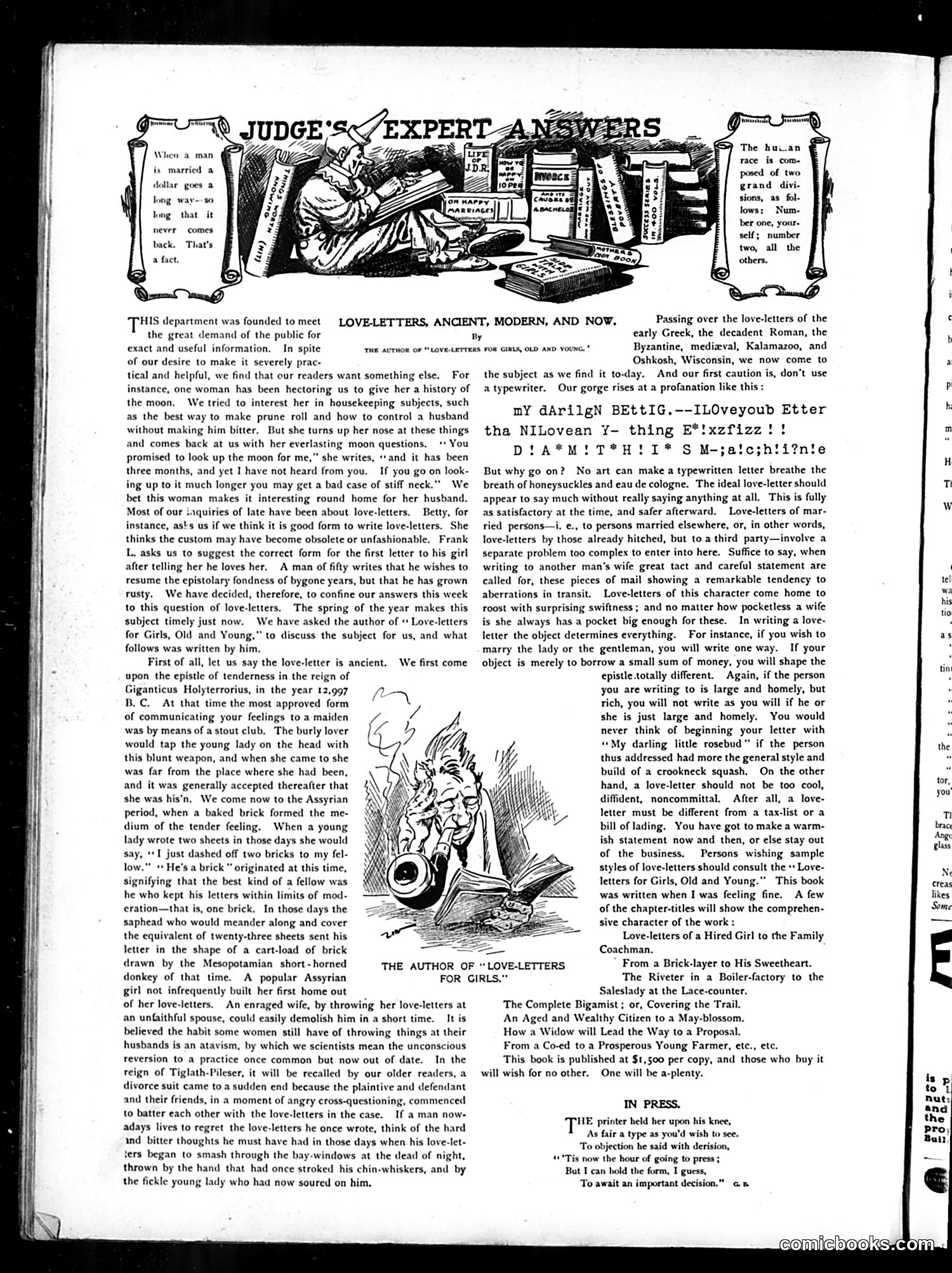
This page presents a humorous article about love-letter writing conventions, framed as advice from "Judge's Expert Answers" department. The author satirizes the history of romantic correspondence by tracing it absurdly backward through time—beginning with ancient Giganticus Holyterrorius (a fictional prehistoric figure) communicating via club-strikes, then Assyrian brick-tablets, progressing to actual written letters. The satire works through exaggeration: young Assyrian women building homes from love-brick, jealous wives using love-letters as weapons against unfaithful husbands, and a divorce case ending in a letter-throwing brawl. This mock-historical approach pokes fun at contemporary courtship customs and gender dynamics of the era—particularly the notion that women are emotionally volatile and men careless in romance. The small epigraph at page-bottom ("IN PRESS") offers additional gentle mockery about impatience in love. Overall, the piece uses absurdist humor to satirize both romantic sentimentality and marital discord among Judge's readers.
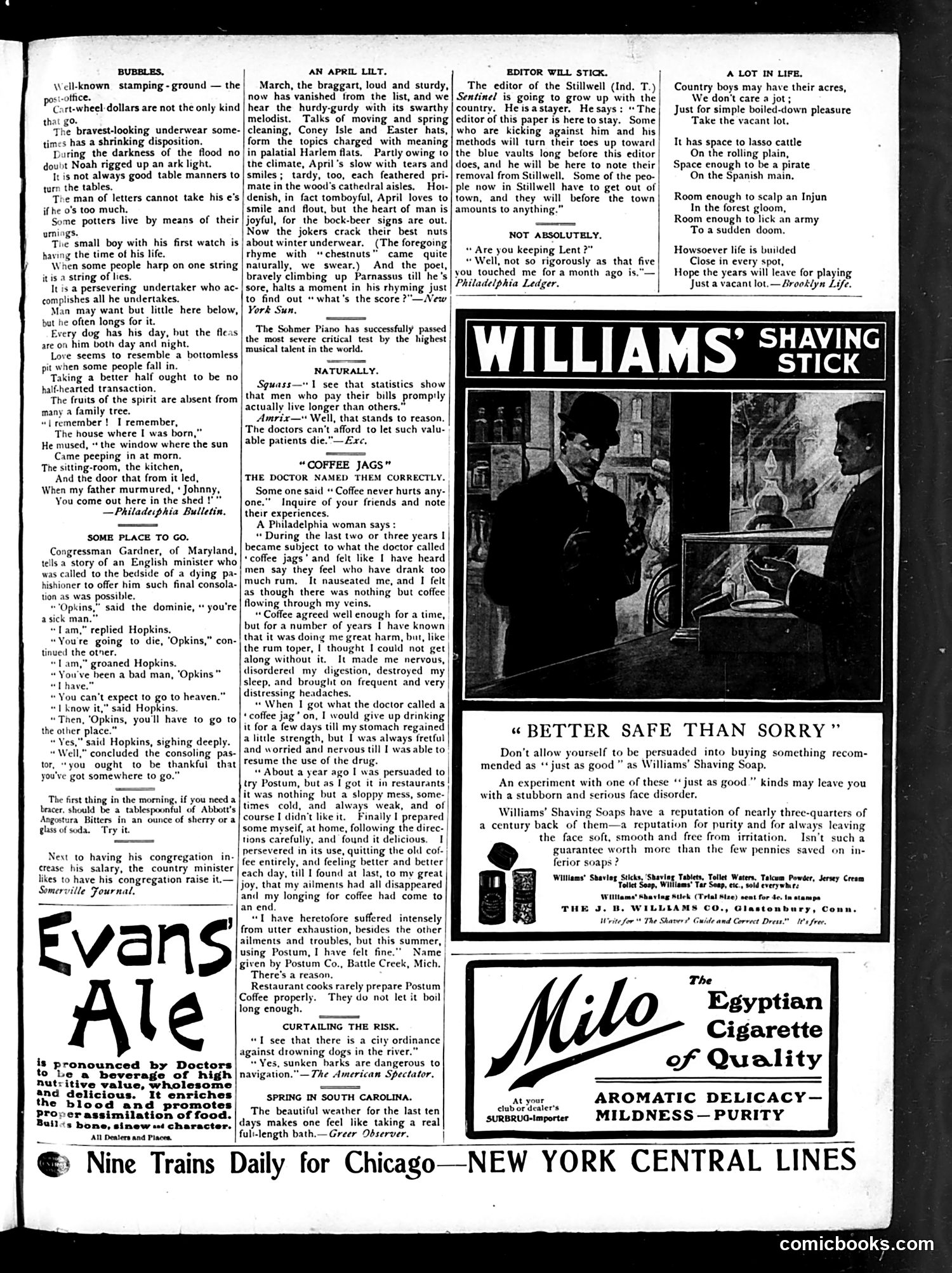
This is primarily a **collection of miscellaneous humor and advertisements** rather than a focused political cartoon. The text content consists of brief satirical observations (called "Bubbles") poking fun at everyday American life—absent-minded postal workers, shrinking underwear, puns about various professions. These are gentle social humor typical of the era. A notable piece is "Some Place to Go," a story about an English minister consoling a dying parishioner named Hopkins. The joke's dark humor: when told he's too wicked for heaven, Hopkins resignedly accepts being damned—at least he has "somewhere to go." The advertisements dominate the page: **Evans Ale** (nutritious beverage), **Williams' Shaving Stick** (promising reliability), the **Milo Egyptian Cigarette** (emphasizing "aromatic delicacy"), and **New York Central Lines** (railroad). No specific political figures or events are referenced. This page reflects early 1900s commercial magazine culture—mixing mild social satire with product promotion.
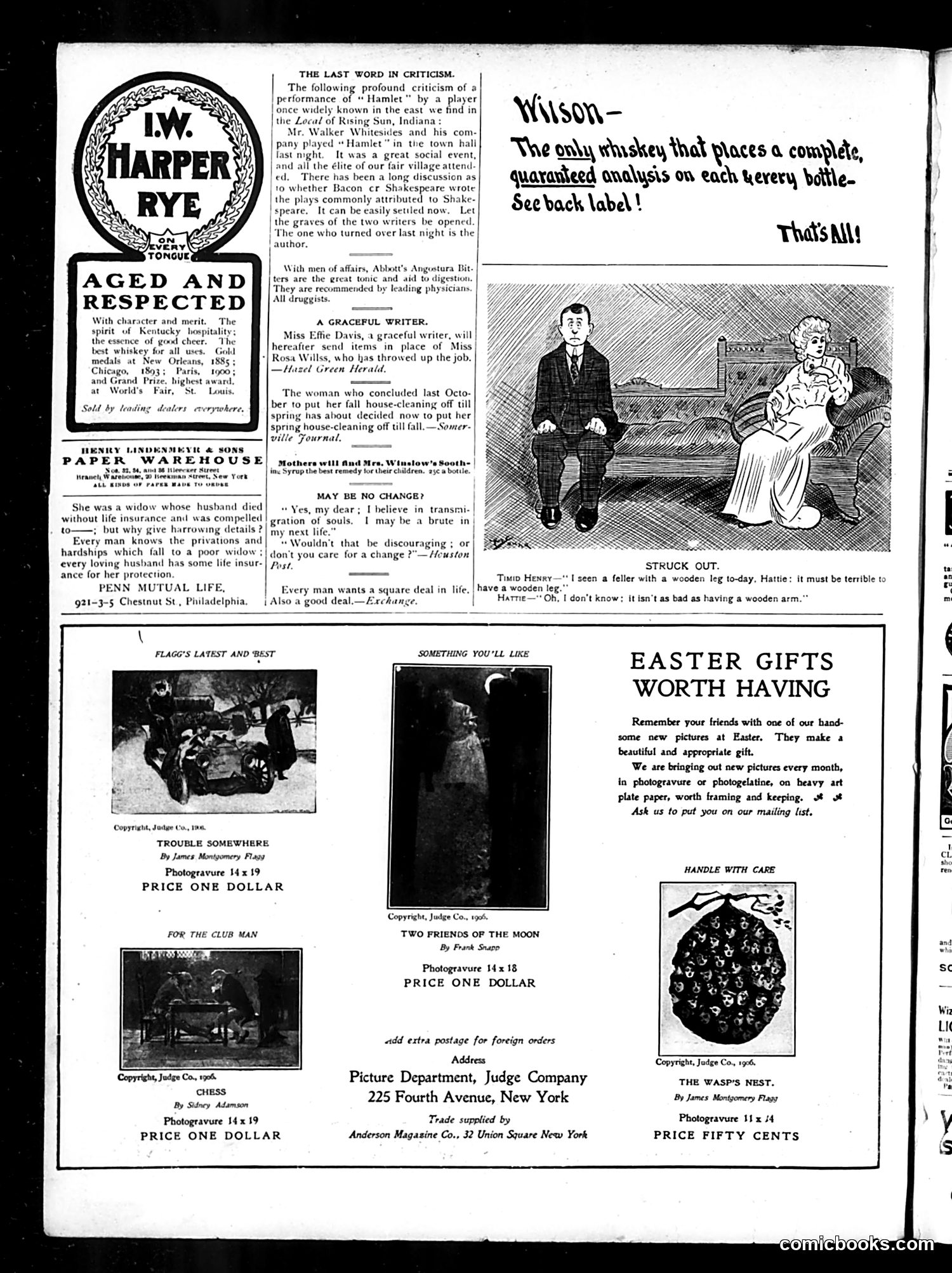
This page from the satirical magazine **Judge** contains mostly advertisements and light humor rather than political cartoons. **"The Last Word in Criticism"** mocks small-town dramatic criticism. A reviewer of an actor named Walker Whitesides performing *Hamlet* suggests settling the Shakespeare-vs.-Bacon authorship debate by exhuming both writers' graves—the one who "turned over last night" (implying Whitesides' terrible performance disturbed the corpse underground) wrote the play. It's humor at the expense of both the actor's abilities and the absurdity of provincial theater reviewing. **Minor comic items** include jokes about a woman postponing spring cleaning to fall, and a dialogue about reincarnation. There's also a crude joke about wooden legs versus wooden arms. The bulk of the page comprises **Easter gift advertisements**—photogravure pictures by artist James Montgomery Flagg priced at one dollar, sold through Judge Company in New York. The **Wilson whiskey ad** at top-right is straightforward product marketing, not satire. The page is primarily **commercial advertising** disguised within a humor magazine's content.
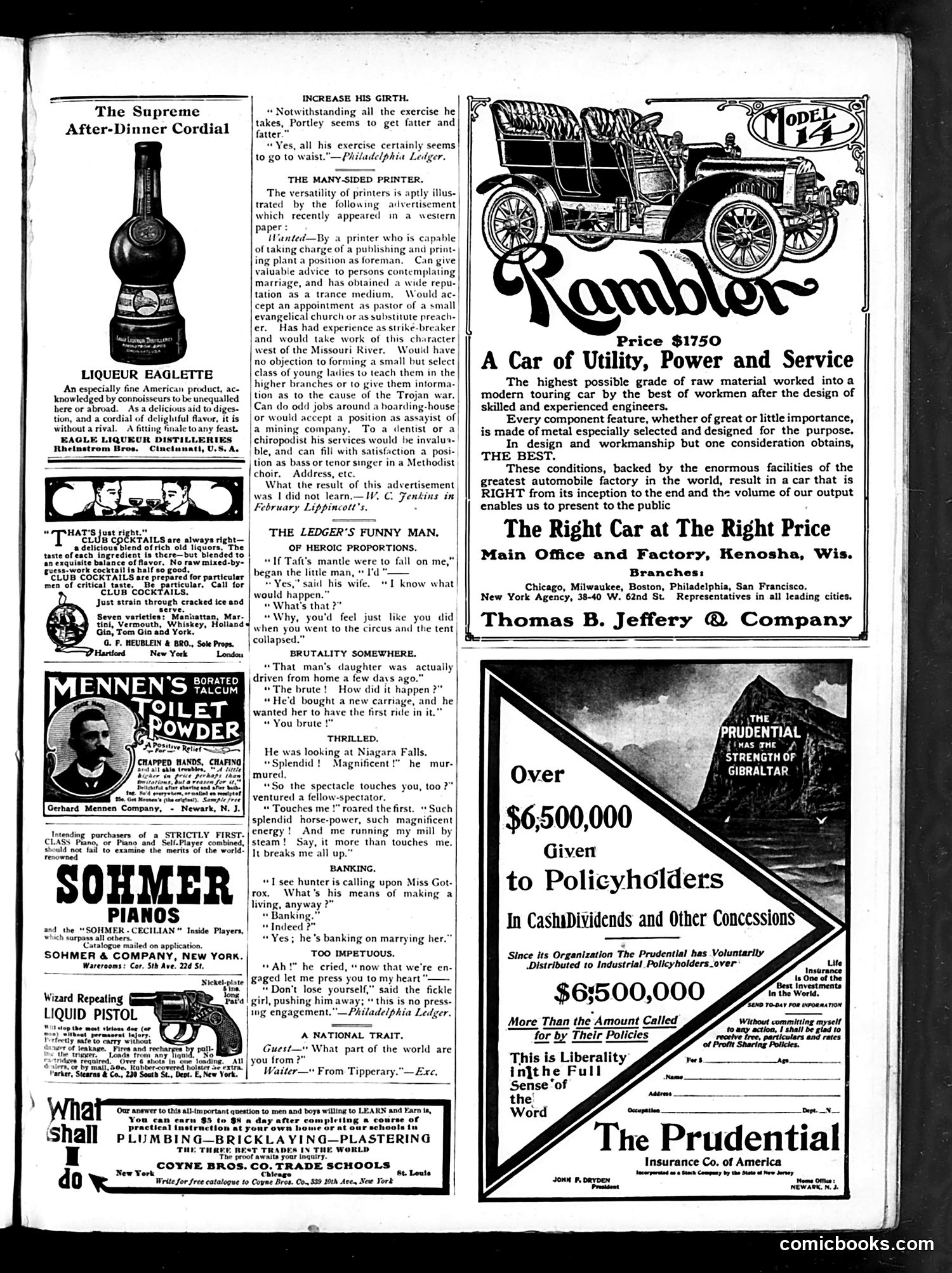
This page is primarily **advertising with interspersed humor content**, typical of early 1900s magazines. The advertisements promote luxury goods (Liqueur Eaglette cordial, Sohmer pianos, Mennen's toilet powder) to affluent readers. The Rambler automobile ad emphasizes "utility, power and service"—marketing language positioning cars as practical investments. The humor pieces are brief anecdotes mocking contemporary social types: - **"Increase His Girth"**: A pun about someone named Portley growing fatter despite exercise - **"The Many-Sided Printer"**: Satirizes an absurdly overqualified job applicant claiming expertise in printing, marriage counseling, spiritualism, preaching, and teaching young women - **"Brutality Somewhere"**: Dark humor about a father driving his daughter from home (she gets the first ride in his new carriage) - **"Banking"**: Wordplay about a suitor "banking on" marriage These sketches reflect Judge's satirical approach: poking fun at pretension, overambition, and social absurdities through short, punchy jokes. The "Taft" reference likely alludes to President William Howard Taft.
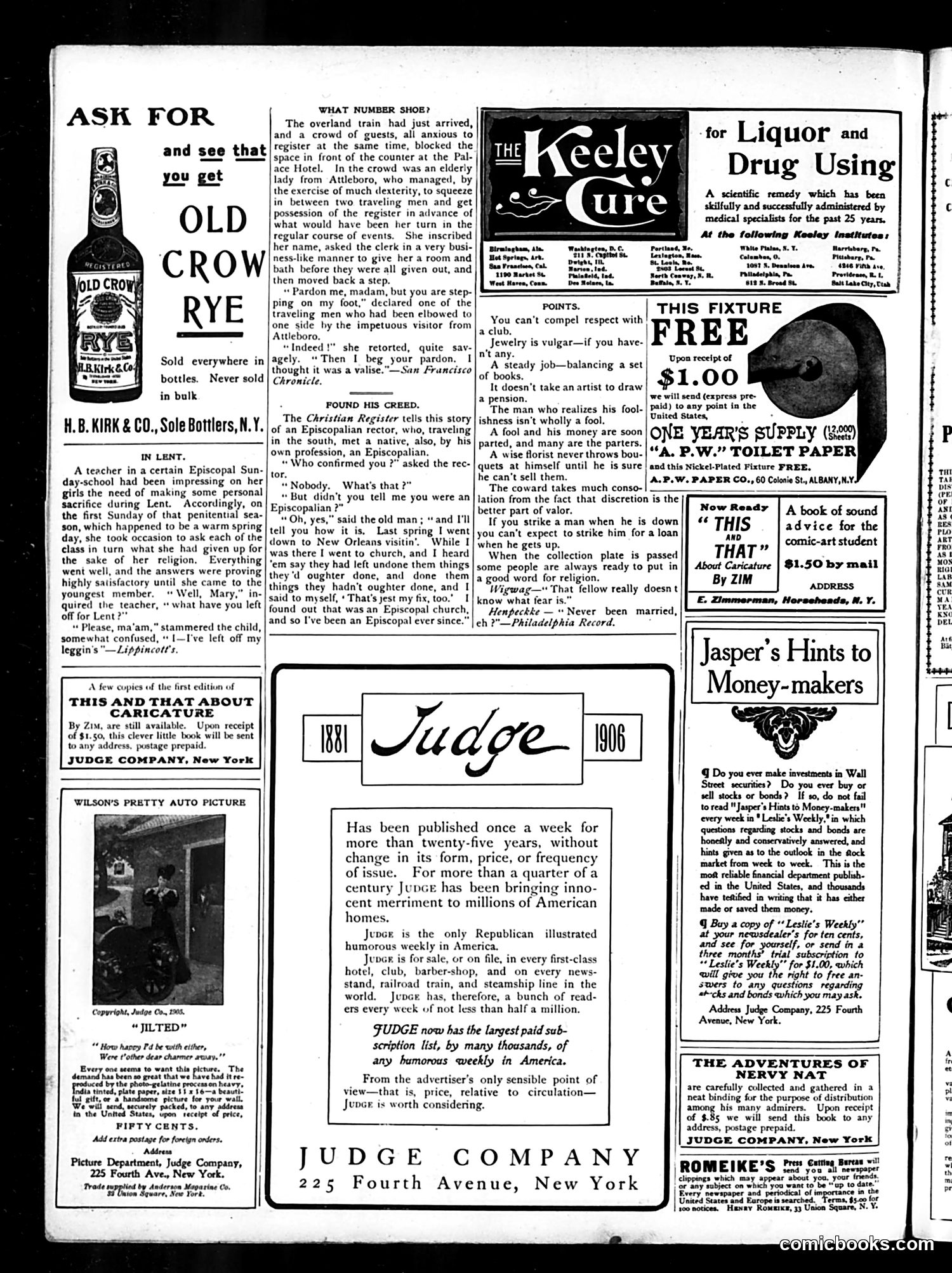
This page is primarily **advertising and filler content** rather than political satire. The main elements include: **"What Number Shoe?"** — A mild humor anecdote about an elderly woman from Attleboro pushing ahead in a hotel line, stepping on a traveling man's foot. When he complains, she apologizes, having mistaken his foot for luggage. The joke relies on simple physical comedy rather than political reference. **"Found His Creed"** — A brief anecdote about an uneducated Southern man who became Episcopalian after hearing a church service's confession of sins, believing it perfectly described his own life. The humor plays on rural/class stereotypes and religious misunderstanding. The remainder consists of **advertisements**: Old Crow Rye whiskey, "The Keeley Cure" (a treatment for alcohol/drug addiction), Judge magazine subscriptions, and various book/product offers. There is no significant political cartoon or satire on this particular page—it's typical of Judge's mixed content approach combining light humor with commercial advertising.
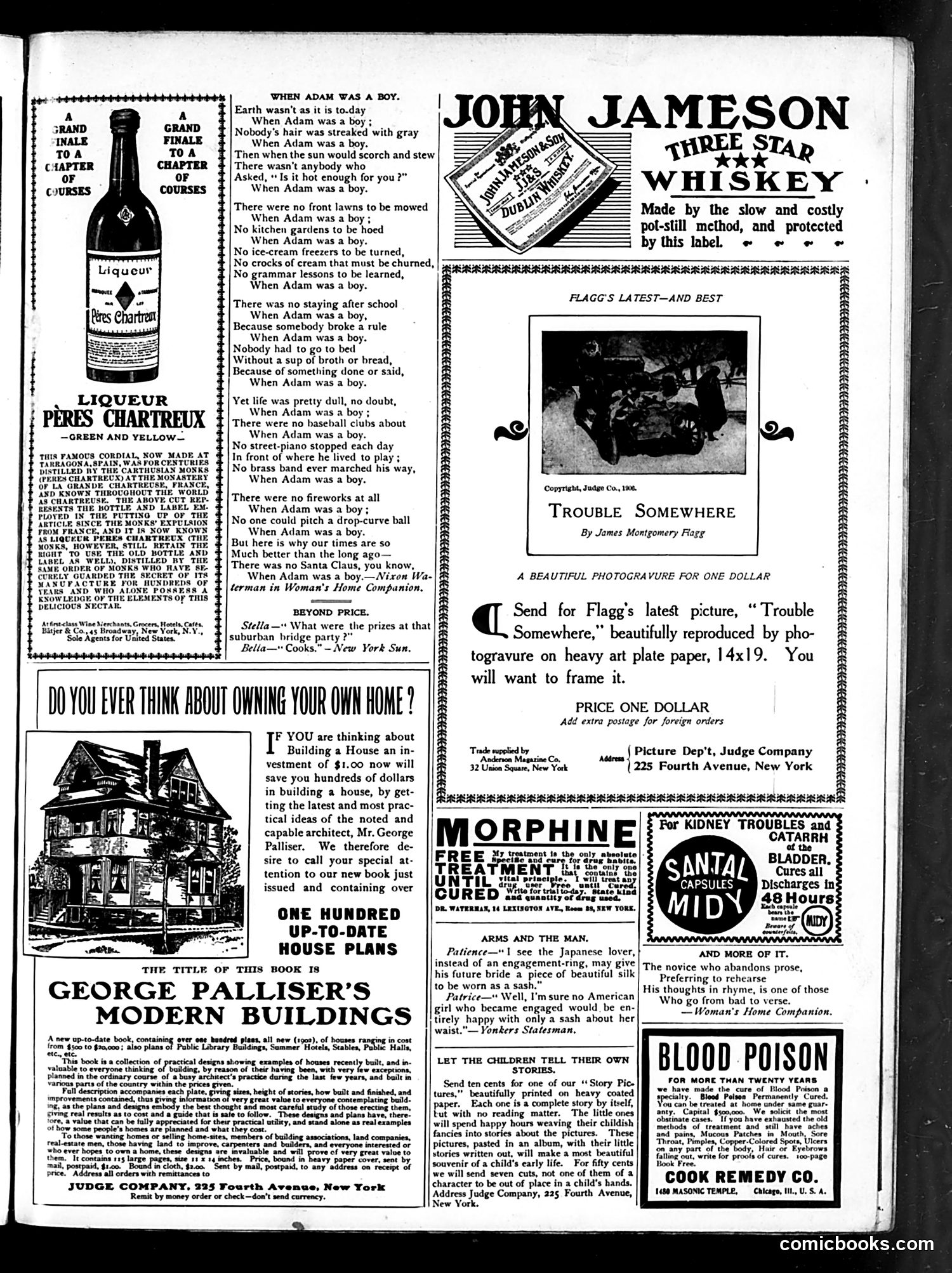
This page is primarily **advertising and light humor**, not political satire. The main content is a nostalgic poem "When Adam Was a Boy" by Nixon Waterman, contrasting simple biblical times with modern complications (lawn-mowing, ice-cream making, baseball, fireworks, Santa Claus). The joke: despite progress, life was actually better in Adam's day—a common early-1900s lament about modernity. The page features ads for **Pères Chartreux liqueur, John Jameson whiskey, Morphine treatments, and house-building plans**—typical Judge advertising. A small cartoon shows a bride receiving silk fabric instead of an engagement ring from a Japanese suitor, joking about cultural differences in courtship customs. The "Santal Capsules" and "Blood Poison" remedy ads reflect the era's patent-medicine marketing, before FDA regulation. Overall, this reflects **early-20th-century consumer culture and nostalgic humor**, rather than political commentary. The tone is whimsical rather than satirical.
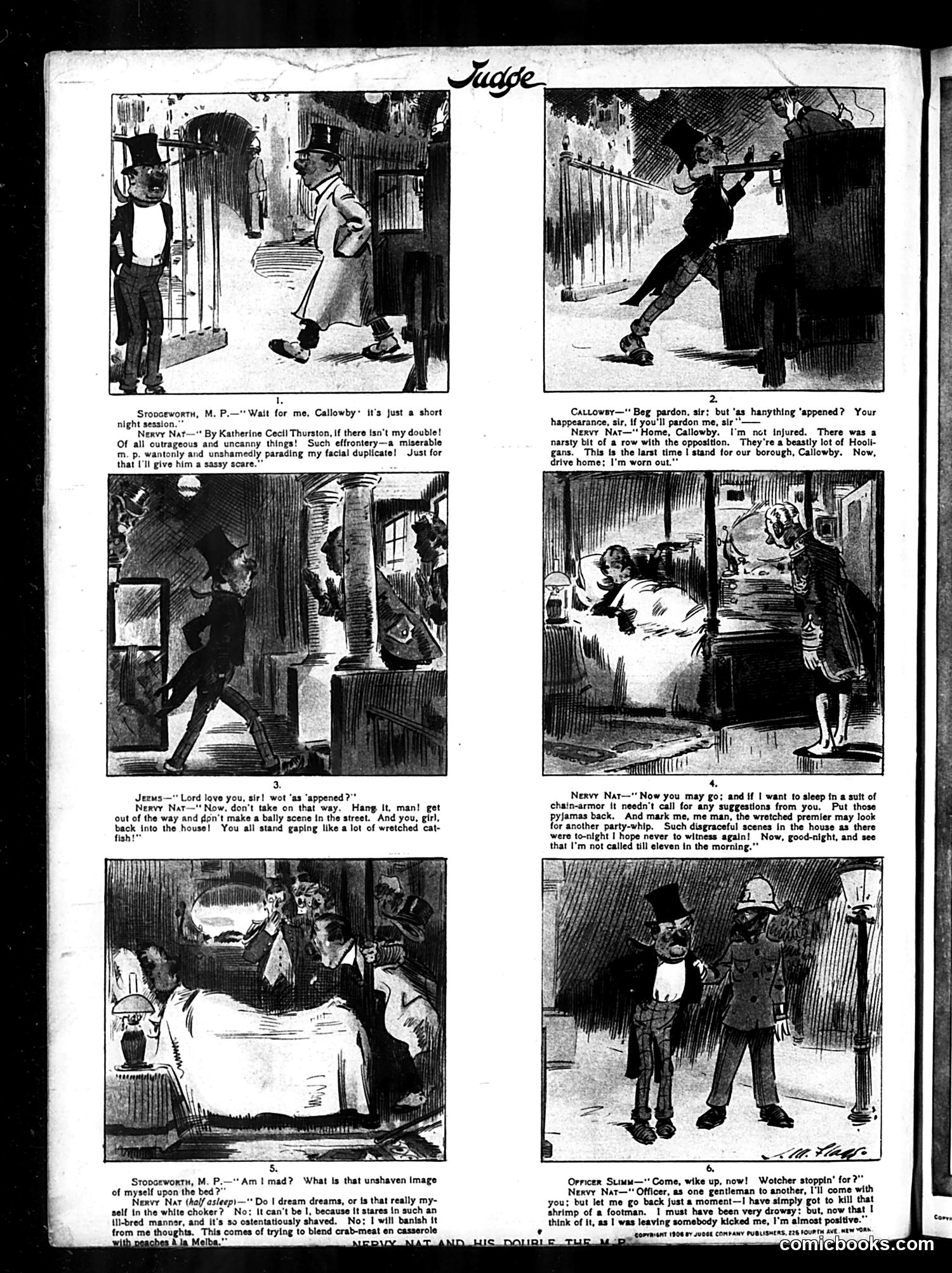
This is a multi-panel comic featuring "Nervy Nat" (a character name) encountering his facial double—an MP (Member of Parliament) named Stodgeworth. The satire plays on the common Victorian literary trope of doppelgängers (made famous in Katherine Cecil Thurston's contemporary novels, referenced in the text). The joke mocks British political life: an exhausted politician, returning from late parliamentary sessions, repeatedly encounters what he believes is his own ghostly double or drunken impostor. The comedy escalates through misunderstandings with servants and police, culminating in physical altercations the protagonist can't quite remember. The satire appears to target MPs' dissipated lifestyles and the chaos of parliamentary politics—suggesting politicians are so worn out and inebriated they can barely distinguish reality. The "beastly" opposition members and disorderly parliamentary conduct referenced reinforce the critique of institutional disorder.