
Judge, 1906-04-07 · page 10 of 16
Judge — April 7, 1906 — page 10: what you’re looking at
What you’re looking at
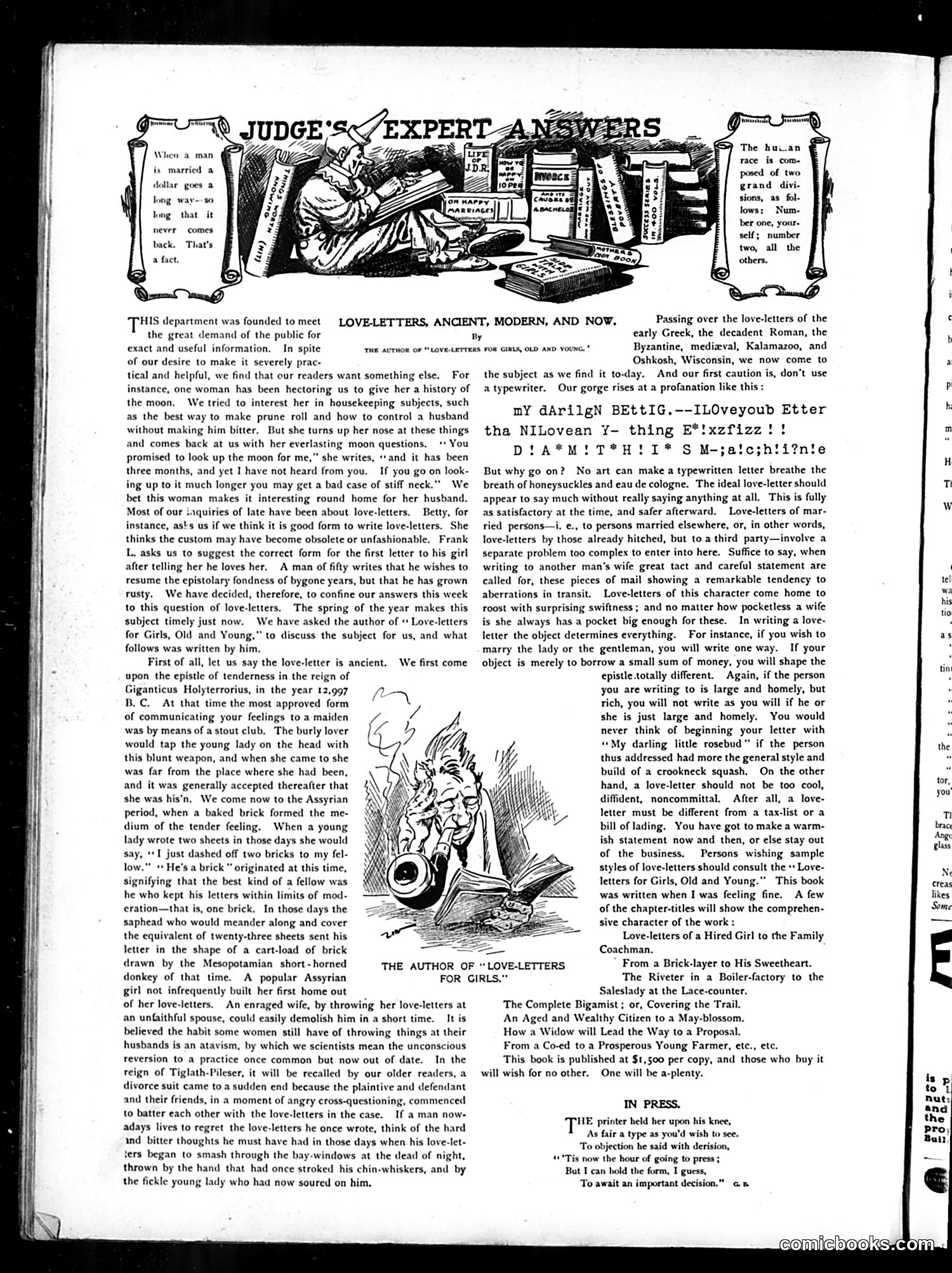
This page presents a humorous article about love-letter writing conventions, framed as advice from "Judge's Expert Answers" department. The author satirizes the history of romantic correspondence by tracing it absurdly backward through time—beginning with ancient Giganticus Holyterrorius (a fictional prehistoric figure) communicating via club-strikes, then Assyrian brick-tablets, progressing to actual written letters. The satire works through exaggeration: young Assyrian women building homes from love-brick, jealous wives using love-letters as weapons against unfaithful husbands, and a divorce case ending in a letter-throwing brawl. This mock-historical approach pokes fun at contemporary courtship customs and gender dynamics of the era—particularly the notion that women are emotionally volatile and men careless in romance. The small epigraph at page-bottom ("IN PRESS") offers additional gentle mockery about impatience in love. Overall, the piece uses absurdist humor to satirize both romantic sentimentality and marital discord among Judge's readers.
📄 Transcribed text from this page (OCR, searchable)
Machine-transcribed from the original scan — historical spelling and the odd misread are preserved.
When a man is married a dollar goes a lang way--so lung that it never comes back. That's THis department was founded tomeet_ LOVE-LETTERS, ANCIENT, MODERN, AND NOW, the great demand of the public for By exact and useful information. In spite THE AUTHOR OF “LOVE-LITTERS YOR GIRLS, OLD AND YOUNG." of our desire to make it severely prac- tical and helpful, we find that our readers want something else. For instance, one woman has been hectoring us to give her a history of the moon. We tried to interest her in housekeeping subjects, such as the best way to make prune roll and how to control a husband without making him bitter, But she turns up her nose at these things and comes back at us with her everlasting moon questions. + You promised to look up the moon for me,” she writes, ‘and it has been three months, and yet I have not heard from you. If you go on look- ing up to it much longer you may get a bad case of stiff neck." We bet this woman makes it interesting round home for her husband. Most of our inquiries of late have been about love-letters. Betty, for instance, asts us if we think it is good form to write love-letters. She thinks the custom may have become obsolete or unfashionable. Frank L, asks us to suggest the correct form for the first letter to his girl after telling her he loves her. A man of fifty writes that he wishes to resume the epistolary fondness of bygone years, but that he has grown rusty. We have decided, therefore, to confine our answers this week to this question of love-letters. The spring of the year makes this subject timely just now. We have asked the author of ++ Love-letters for Girls, Old and Young," to discuss the subject for us, and what follows was written by him. First of all, let us say the love-letter is ancient. We first come upon the epistle of tenderness in the reign of Giganticus Holyterrorius, in the year 12,997 B.C. At that time the most approved form of communicating your feelings to a maiden was by means of astout club. The burly lover would tap the young lady on the head with this blunt weapon, and when she came to she was far from the place where she had been, and it was generally accepted thereafter that she was his'n. We come now to the Assyrian period, when a baked brick formed the me- dium of the tender feeling. When a young lady wrote two sheets in those days she would say, I just dashed off two bricks to my fel- Joy * He's a brick" ated at this time, signifying that the best kind of a fellow was he who kept his letters within limits of mod- eration—that is, one brick. In those days the saphead who would meander along and cover the equivalent of twenty-three sheets sent his letter in the shape of a cart-load of brick drawn by the Mesopotamian short - horned donkey of that time. A popular Assyrian girl not infrequently built her first home out of her love-letters. An enraged wife, by throwing her love-letters at an unfaithful spouse, could easily demolish him in a short time. It is believed the habit some women still have of throwing things at their husbands is an atavism, by which we scientists mean the unconscious reversion to a practice once common but now out of date. In the reign of Tiglath-Pileser, it will be recalled by our older readers, a divorce suit came to a sudden end because the plaintive and defendant and their friends, in a moment of angry cross-questioning, commenced to batter each other with the love-letters in the case. If a man now- adays lives to regret the love-letters he once wrote, think of the hard ind bitter thoughts he must have had in those days when his love-let- ters began to smash through the bay-windows at the dead of night, thrown by the hand that had once stroked his chin-whiskers, and by the fickle young lady who had now soured on him. THE AUTHOR OF “LOVE-LETTERS FOR GIRLS.” The huvan race is com- posed of two grand divi- sions, as fol- lows: Num- ber one, your self; number two, all the others. Passing over the love-letters of the early Greek, the decadent Roman, the Byzantine, mediaval, Kalamazoo, and Oshkosh, Wisconsin, we now come to the subject as we find it to-day. And our first caution is, don’t use a typewriter, Our gorge rises at a profanation like this : mY dArilgN BEttIG.--ILOveyoub Etter tha NILovean Y- thing E*!xzfizz!! D!IA*M!IT*H!I* S M-jatcshti?nte But why go on? No art can make a typewritten letter breathe the breath of honeysuckles and eau de cologne. The ideal love-letter should appear to say much without really saying anything at all. This is fully as satisfactory at the time, and safer afterward, Love-letters of mar- ried persons—i. e., to persons married elsewhere, or, in other words, love-letters by those already hitched, but to a third party—involve a separate problem too complex to enter into here. Suffice to say, when writing to another man’s wife great tact and careful statement are called for, these pieces of mail showing a remarkable tendency to aberrations in transit. Love-letters of this character come home to roost with surprising swiftness ; and no matter how pocketless a wife is she always has a pocket big enough for these. In writing a love- letter the object determines everything. For instance, if you wish to marry the lady or the gentleman, you will write one way. If your object is merely to borrow a small sum of money, you will shape the epistle.totally different. Again, if the person you are writing to is large and homely, but rich, you will not write as you will if he or she is just large and homely. You would never think of beginning your letter with “My darling little rosebud” if the person thus addressed had more the general style and build of a crookneck squash. On the other hand, a love-letter should not be too cool, diffident, noncommittal. After all, a love- letter must be different from a tax-list or a bill of lading. You have got to make a warm- ish statement now and then, or else stay out of the business. Persons wishing sample styles of love-letters should consult the ** Love- letters for Girls, Old and Young.” This book was written when I was feeling fine. A few of the chapter-titles will show the comprehen- sive character of the work : Love-letters of a Hired Girl to the Family Coachman. From a Brick-layer to His Sweetheart. The Riveter in a Boiler-factory to the Saleslady at the Lace-counter. The Complete Bigamist ; or, Covering the Trail. An Aged and Wealthy Citizen to a May-blossom. How a Widow will Lead the Way to a Proposal. From a Co-ed to a Prosperous Young Farmer, etc., etc. This book is published at $1,500 per copy, and those who buy it will wish for no other. One will be a-plenty. IN PRESS. THE printer held her upon his knee, As fair a type as you'd wish to see. To objection he said with derision, “Tis now the hour of going to press ; But I can hold the form, I guess, ‘To await an important decision.” <=