A complete issue · 16 pages · 1906
Judge — March 24, 1906
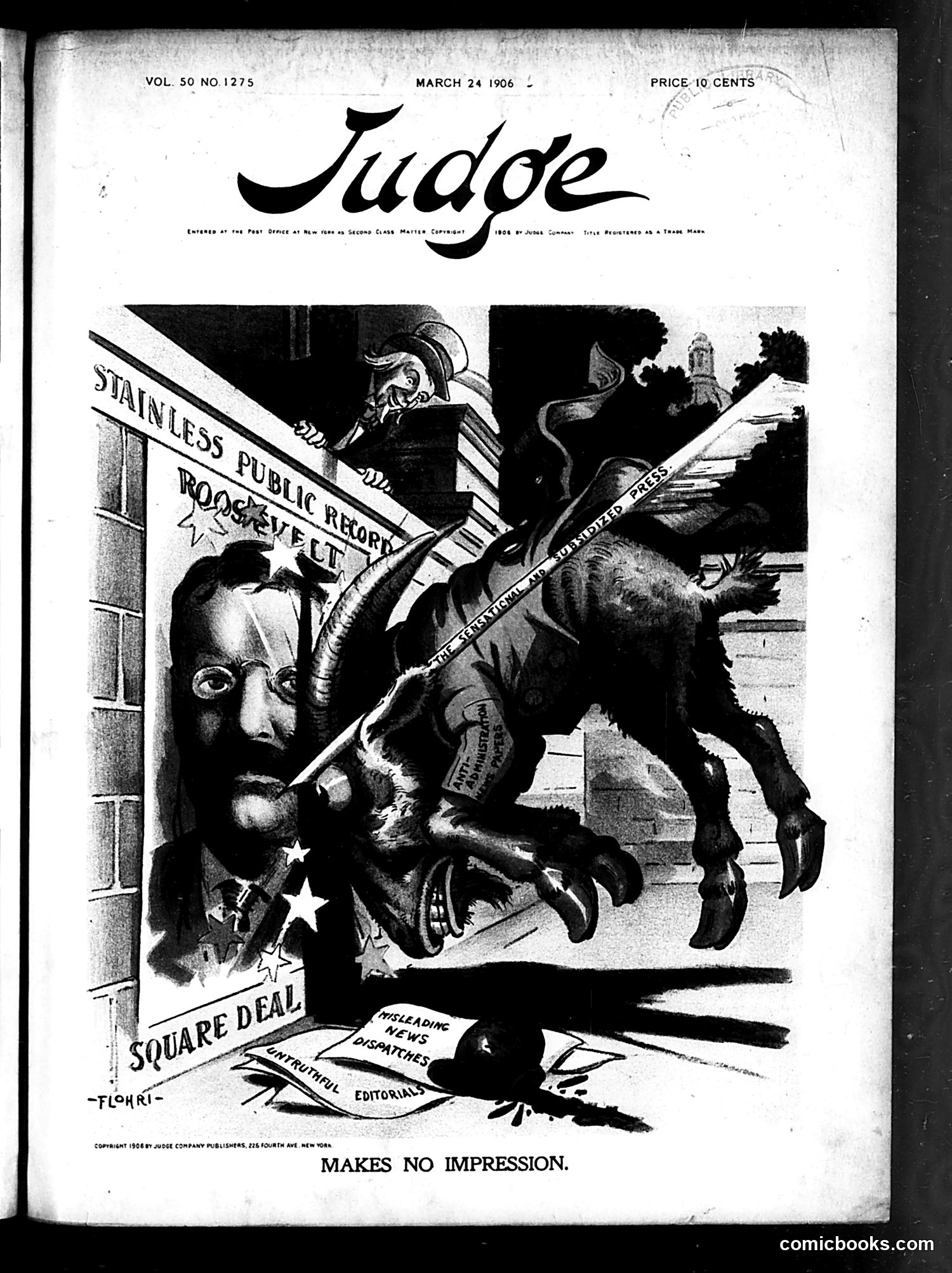
This cartoon satirizes President Theodore Roosevelt's "Square Deal" domestic policy program. The image depicts Roosevelt as a figure whose initiatives are failing to convince or impress the public. Various demonic or monstrous creatures labeled with terms like "Misleading News," "Dispatches," and "Untruthful Editorials" attack or undermine the Square Deal concept, shown as a vulnerable figure or structure on the left. The caption "MAKES NO IMPRESSION" suggests that despite Roosevelt's efforts to reform business practices and regulate corporate corruption, hostile media forces and misinformation campaigns were preventing his message from reaching or persuading Americans. This reflects contemporary debates about press responsibility and Roosevelt's contentious relationship with newspaper publishers who opposed his regulatory agenda.
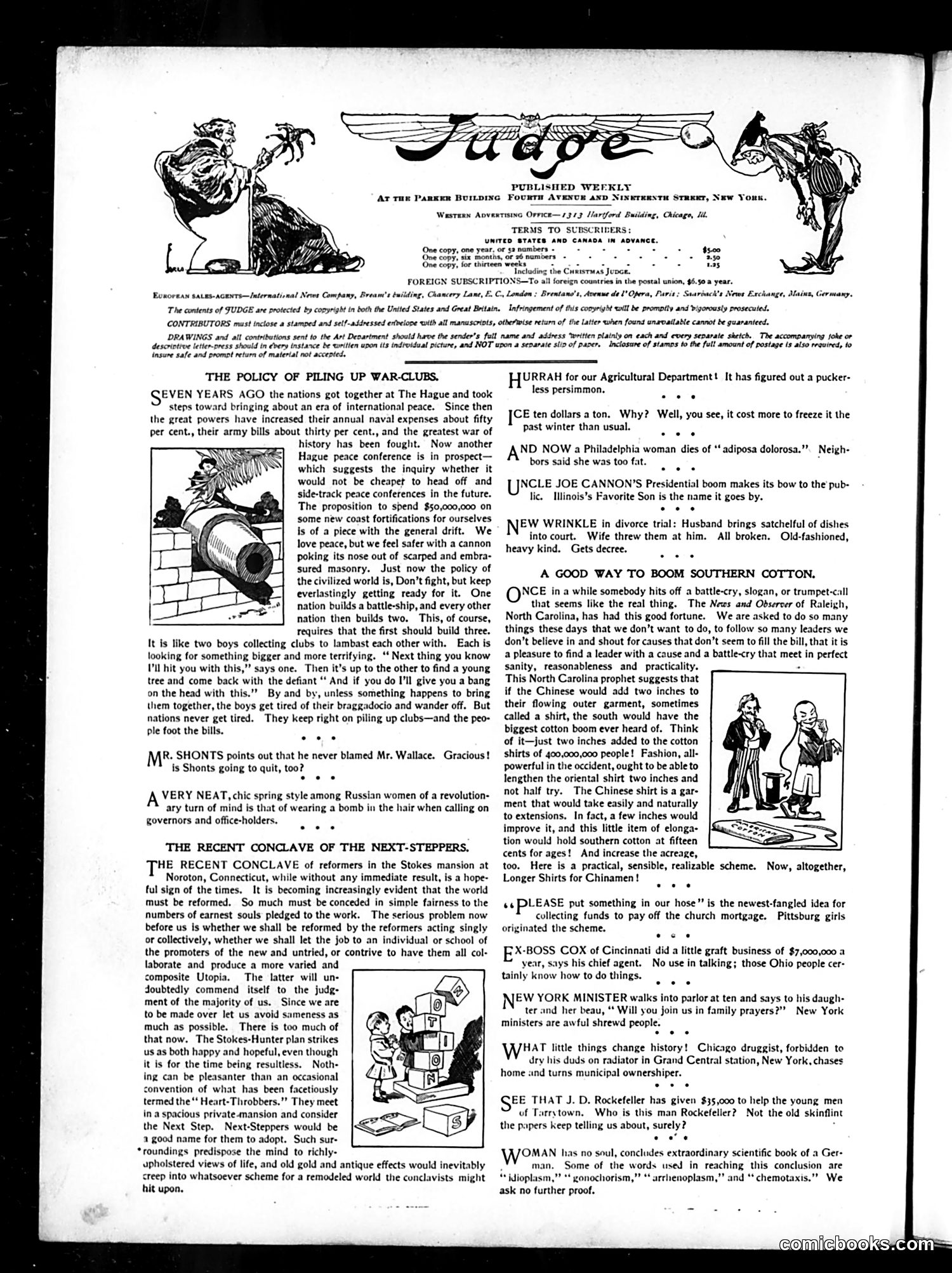
The page contains several brief satirical items typical of Judge magazine's format. The main cartoon depicts a large artillery cannon labeled as representing war-clause policy, illustrating the article "THE POLICY OF FILING UP WAR-CLUBS." The text criticizes international peace efforts, sarcastically suggesting nations should build up military arsenals rather than pursue disarmament conferences. The Hague peace conference is referenced—likely the 1907 Second Hague Peace Conference. Other brief items mock contemporary figures and events: Uncle Joe Cannon's political influence, a divorce case involving broken dishes, and various social absurdities. The tone is consistent with Judge's conservative, satirical approach to mocking progressive reforms, peace movements, and political figures of the early 1900s. The cartoons use exaggeration and irony to critique both foreign policy and domestic social trends.
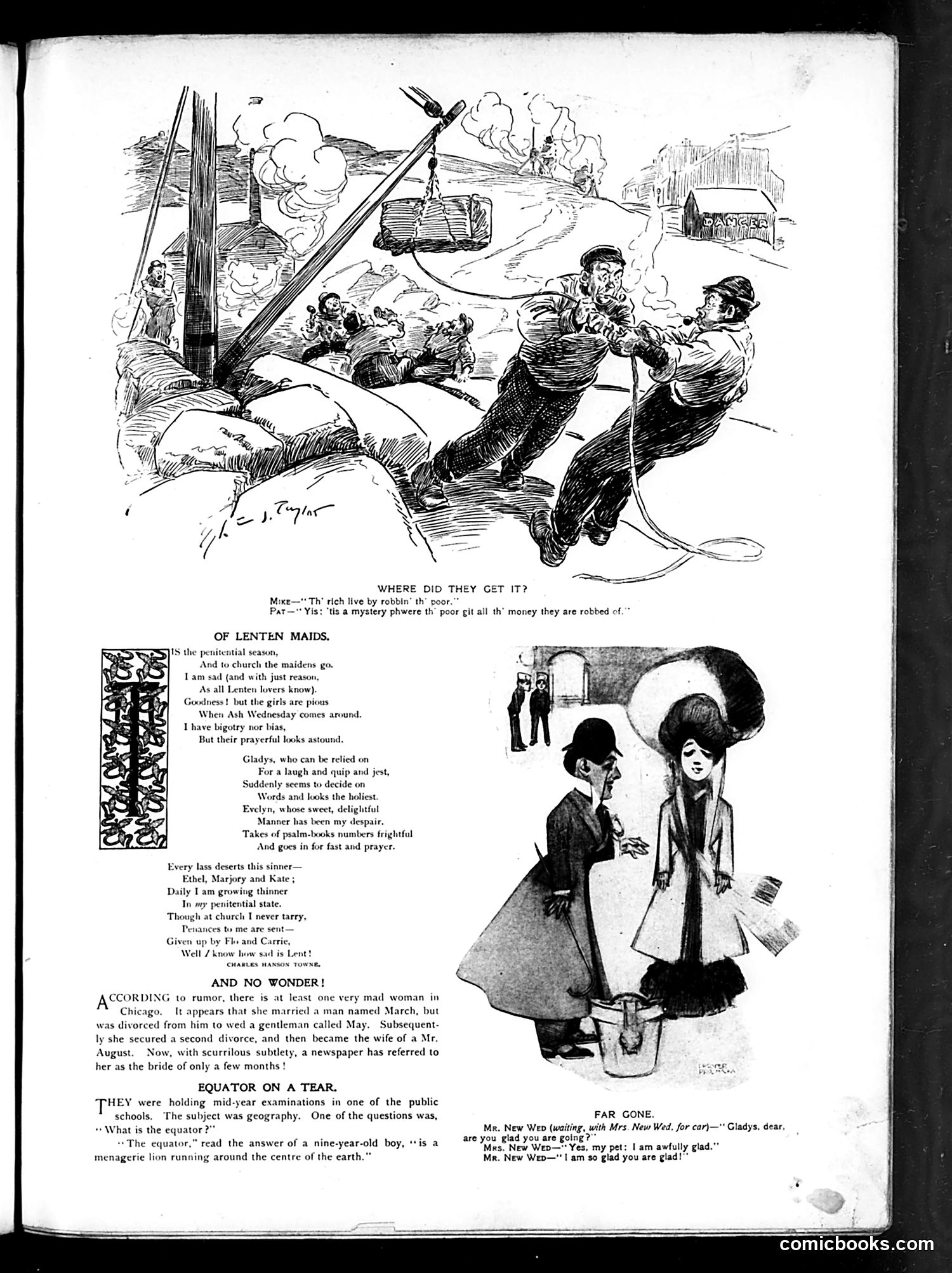
This page contains four separate satirical pieces from an early 20th-century Judge magazine: 1. **"Where Did They Get It?"** - A cartoon showing men being robbed, with dialogue suggesting mystery about poverty despite claims of wealth redistribution. 2. **"Of Lenten Maids"** - A poem satirizing young women's behavior during Lenten season, mocking their supposed piety while gossiping and socializing. 3. **"And No Wonder!"** - Brief text satirizing a Chicago woman's multiple marriages in quick succession (to men named March, May, and August). 4. **"Equator on a Tear"** and **"Far Gone"** - Humorous anecdotes about schoolchildren and acquaintances. The page exemplifies Judge's mix of social commentary, religious satire (targeting hypocrisy), and domestic humor typical of early 1900s American satirical journalism. The targets are primarily middle-class social pretenses and gender behavior.
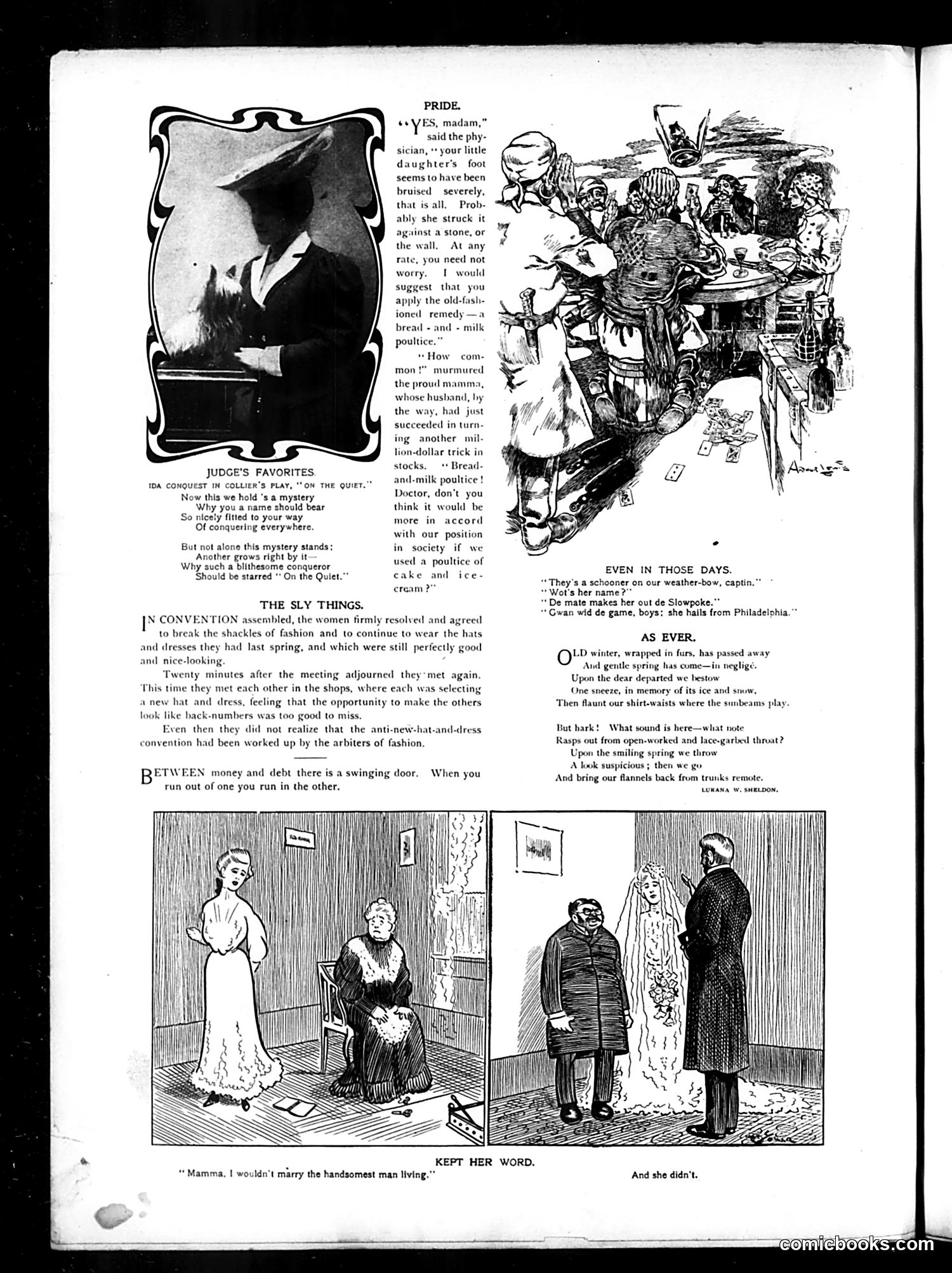
This page contains several distinct satirical pieces: **"Pride"** (top left): Features Ida Conquest, an actress from Collier's play "On the Quiet." The text's wordplay on her name suggests satirical commentary on theatrical vanity. **"The Sly Things"** (middle): Mocks a women's convention that resolved to wear old fashions and hats. The satire suggests women's resistance to fashion change while ironically pursuing new hat-and-dress trends—poking fun at contradictory female consumer behavior. **Bottom section**: Two comic panels illustrating the aphorism "Between money and debt there is a swinging door," depicting financial precarity. **"Kept Her Word"** (bottom): A brief joke where a woman promised not to marry the handsomest man—and she didn't, suggesting the man she married was less attractive. The overall tone is characteristic of early 20th-century Judge: lighthearted social satire targeting women's fashion, theatrical culture, and financial anxiety.
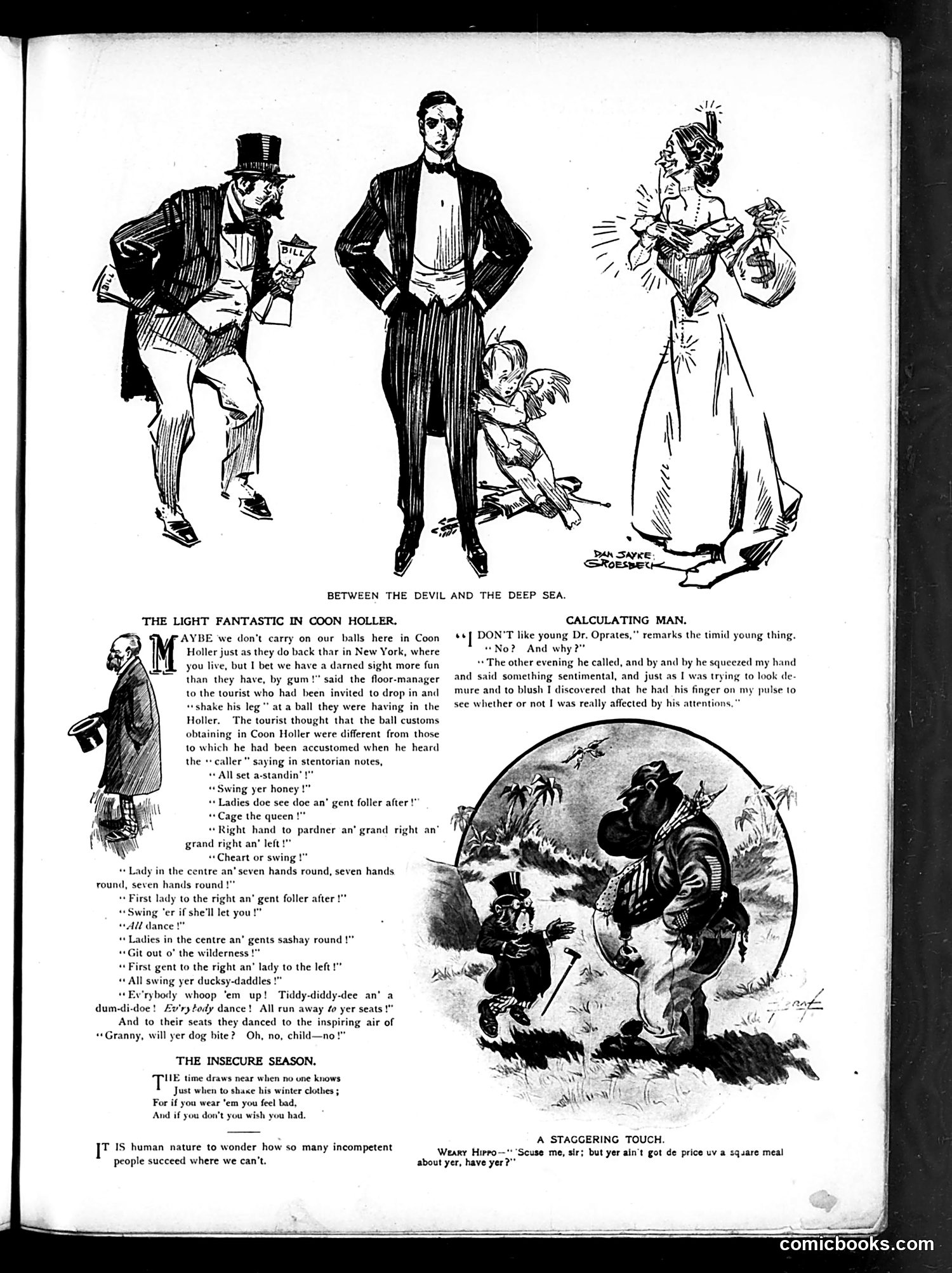
This page contains several satirical illustrations and humorous sketches typical of early 20th-century American humor magazines. **"The Light Fantastic in Coon Holler"** mocks rural dance culture, specifically targeting African American communities ("Coon" being a derogatory term of that era). The text describes crude dance calls, reflecting period stereotypes. **"Between the Devil and the Deep Sea"** and other illustrations appear to satirize social situations—one depicts a well-dressed man caught between conflicting demands. **"Calculating Man"** presents a domestic comedy about a man concerned with romantic propriety. **"The Insecure Season"** and **"A Staggering Touch"** offer general social commentary on human behavior and class interactions. The page exemplifies Judge's satirical approach: mixing crude ethnic stereotyping (common to the era) with observational humor about middle and upper-class social pretensions and domestic life.
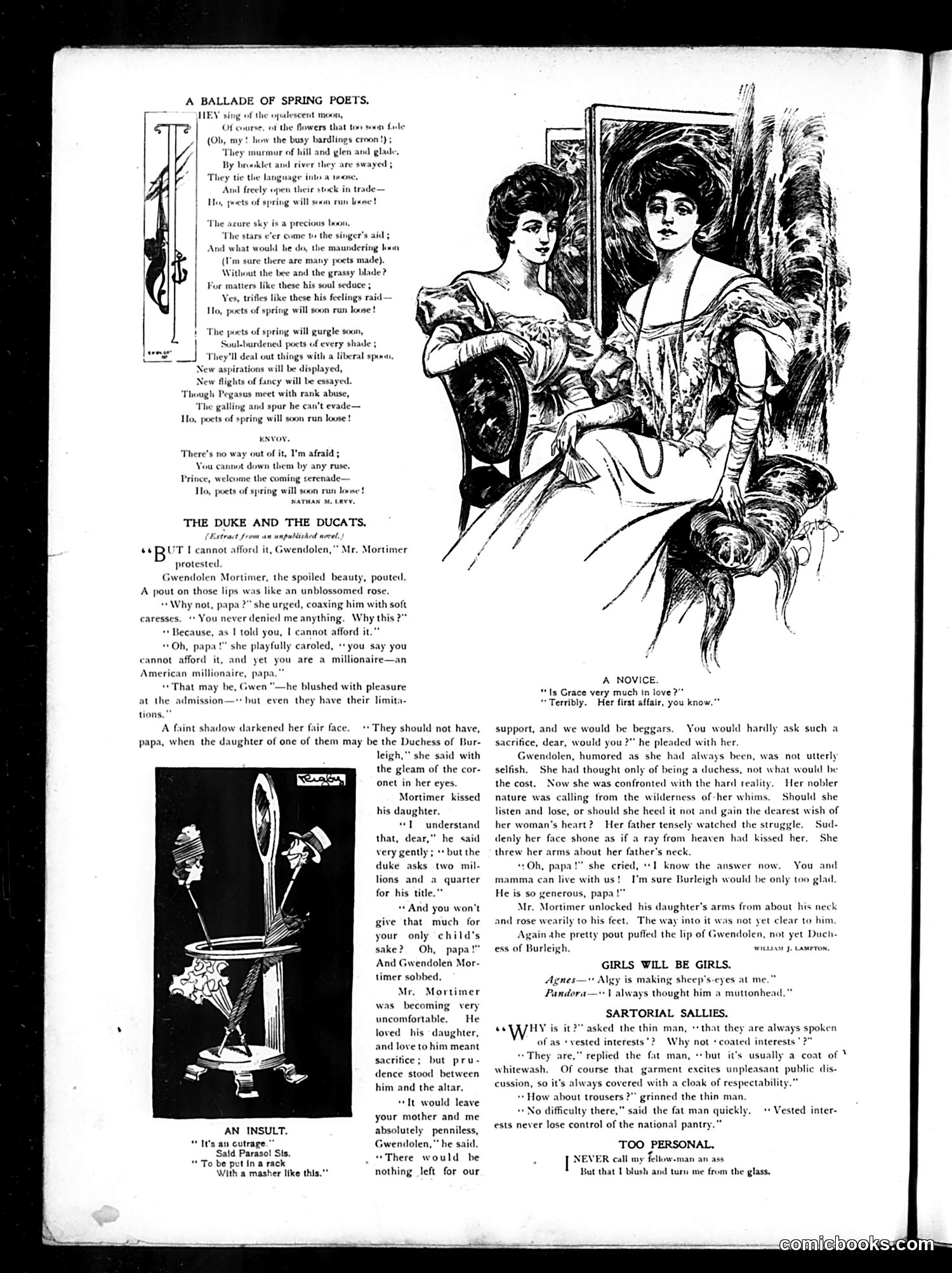
This page satirizes the pretentious excesses of Gilded Age American society, particularly the obsession with European titles and marriages of convenience. **"The Duke and the Ducats"** is the main satire: An American millionaire's spoiled daughter, Gwendolen, demands her father buy her a dukedom by paying a British duke 2.25 million dollars to marry her. The satire targets wealthy Americans' desperation to acquire European aristocratic status through financial transactions, essentially purchasing nobility. The daughter's initial selfishness—willing to bankrupt her family for a coronet—contrasts with her sudden "noble" suggestion that the duke live off her parents' support instead, revealing her shallow reasoning persists beneath momentary sentiment. **"A Ballade of Spring Poets"** mocks the predictable, overwrought nature poetry that floods publications each spring—"soul-burdened poets" churning out clichéd verse about moonlight, flowers, and nightingales. The smaller jokes ("An Insult," "Girls Will Be Girls," "Sartorial Sallies") are brief social observations about contemporary manners. Overall: satire of American wealth-worship and European social climbing.
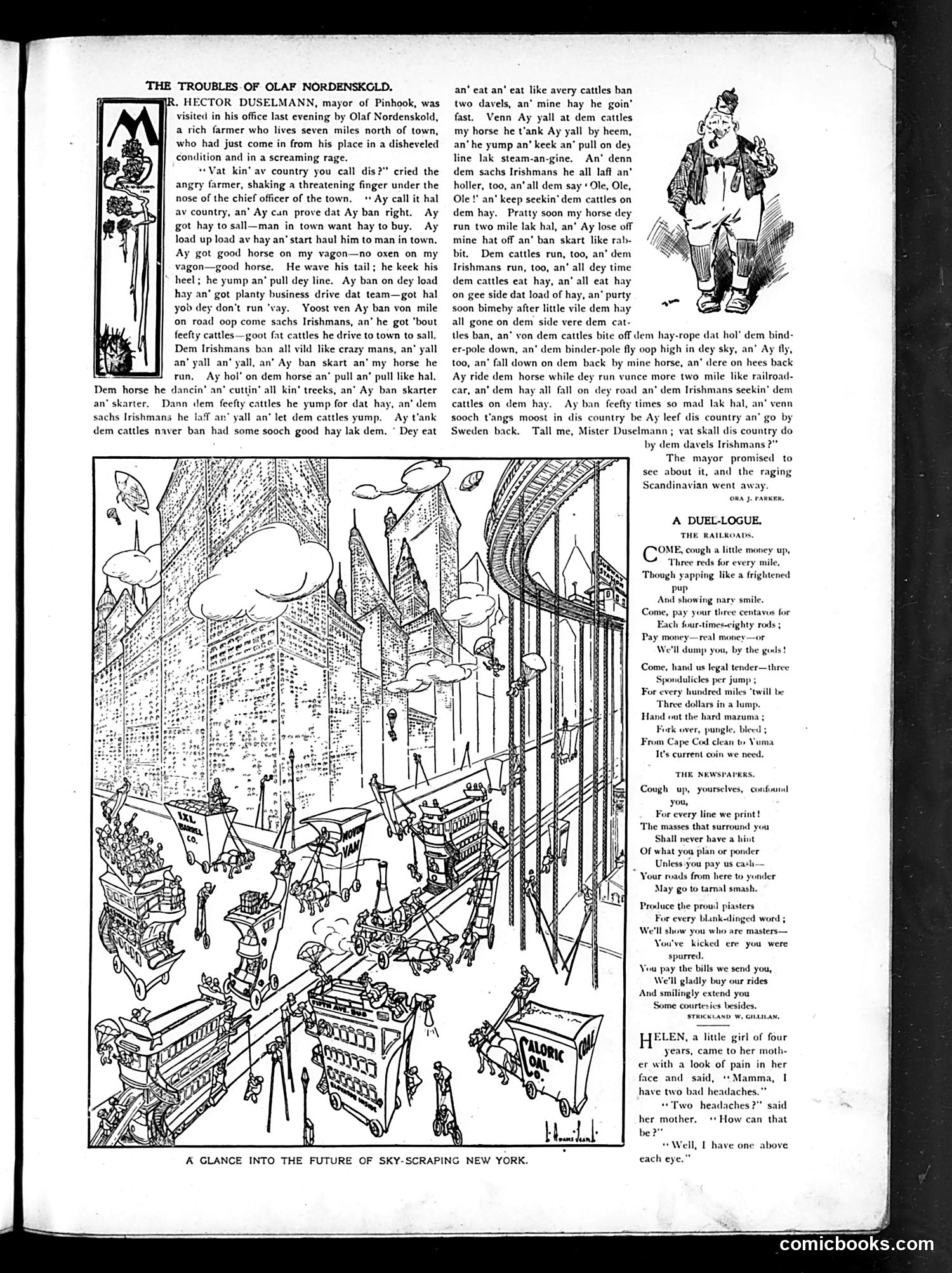
**Main Story: "The Troubles of Olaf Nordenskgold"** This satirical tale mocks both Scandinavian immigrant dialect humor and rural-urban tensions in late 19th-century America. Olaf, a Swedish farmer, complains to the mayor about Irish drovers whose cattle stampeded his hay wagon during transport to town. The humor relies heavily on exaggerated ethnic stereotypes—Olaf's mangled English ("vat kin' av country") and the portrayal of Irish cattlemen as rowdy and irresponsible. The story suggests conflict between immigrant groups competing in the local economy. **Secondary Content: "A Duel-Logue"** This satirical poem criticizes railroads and newspapers as corrupt institutions extorting money from the public. Railroads demand payment while threatening service disruption; newspapers similarly blackmail advertisers, threatening negative coverage unless paid. Both are depicted as predatory monopolies indifferent to public welfare. The page employs ethnic caricature and anti-establishment satire typical of Judge's era, reflecting period anxieties about immigration, corporate power, and press corruption.
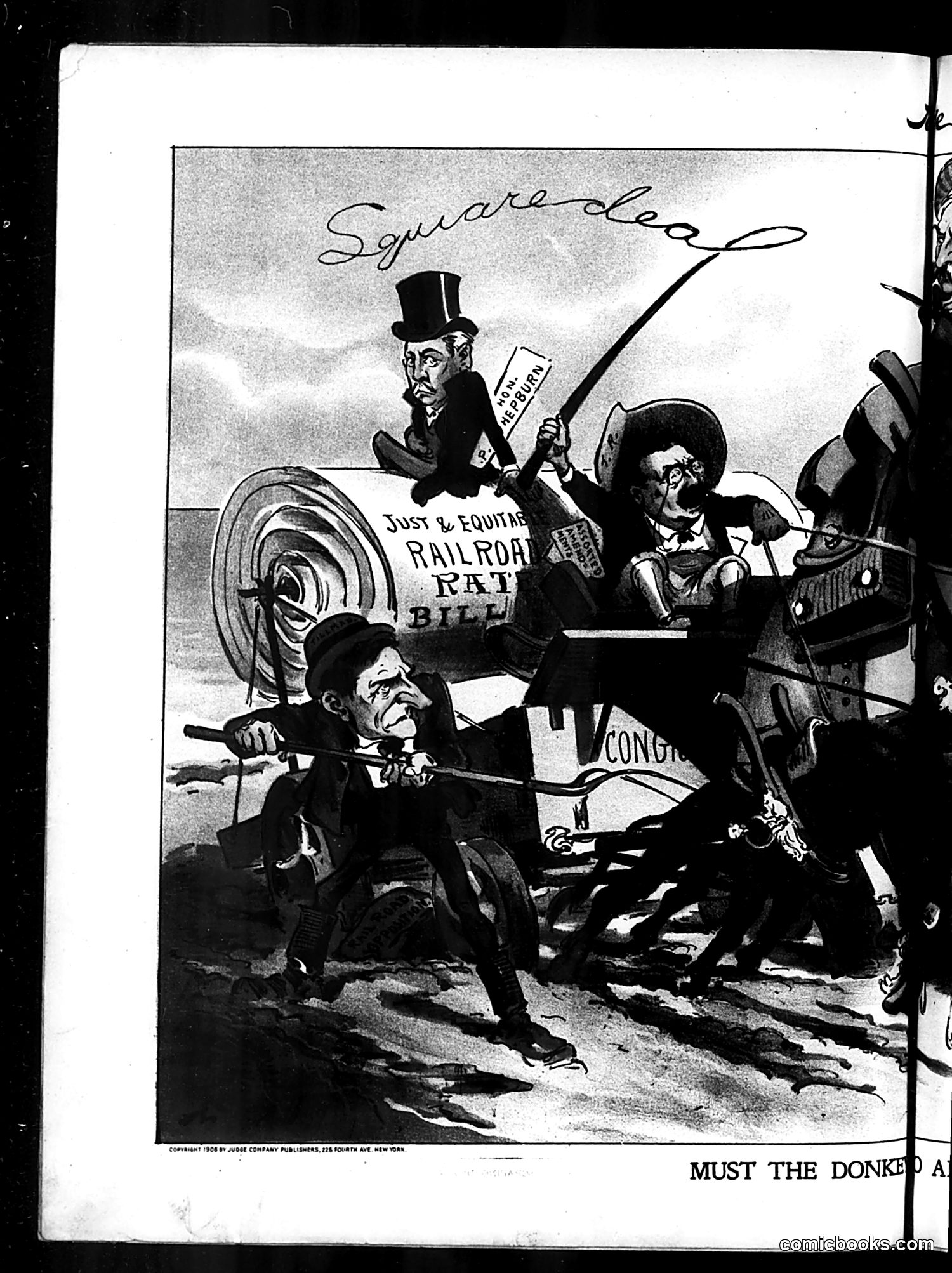
This Judge magazine cartoon titled "Square Deal" depicts a conflict over railroad regulation. A figure in a top hat (likely representing a railroad magnate or monopolist) operates a large wheel labeled "JUST & EQUITABLE RAILROAD RATE," while other figures—possibly representing Congress or the public interest—attempt to control or redirect it with tools and implements. The "Square Deal" reference suggests this relates to Theodore Roosevelt's progressive policies on railroad regulation and corporate accountability. The cartoon satirizes the struggle between wealthy railroad interests and government reformers seeking fair rates and honest competition. The exaggerated caricatures and violent imagery suggest the cartoonist viewed this as a pitched battle for economic justice, with corporate power resisting regulatory oversight.
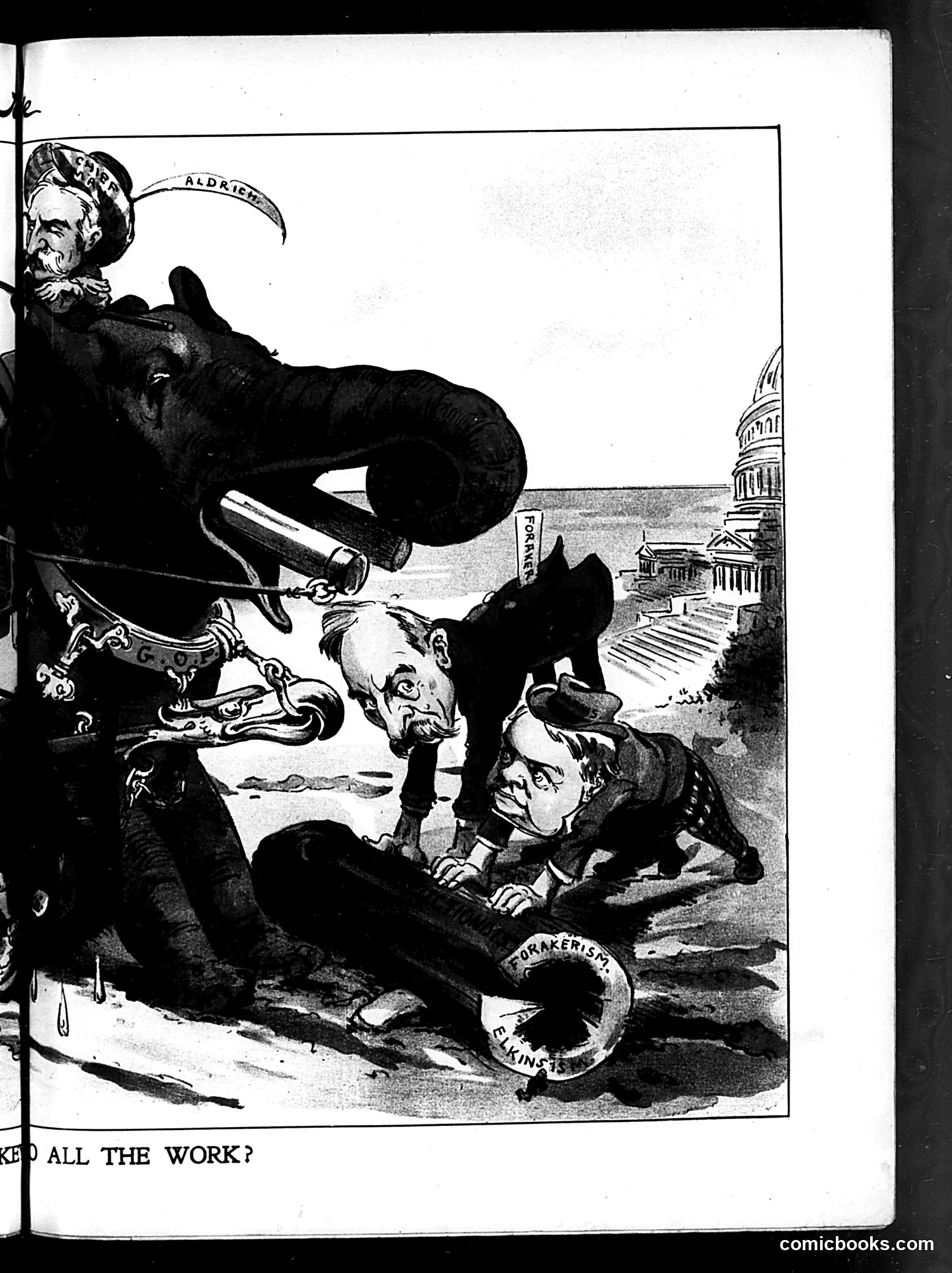
This political cartoon depicts **Aldrich** (labeled on the scythe) as Death, wielding a large scythe over three smaller figures labeled **"Populism," "Crankism," and "Slings"** (or similar terms—the exact third label is unclear). The Capitol building appears in the background, establishing a Washington, D.C. political context. The cartoon satirizes **Nelson Aldrich**, a prominent Republican senator, suggesting his political power is destroying or "reaping" various reform movements and populist causes of the era. The three figures crawling or cowering beneath him represent different political movements or ideologies that Aldrich's influence allegedly threatens. The caption reads "WHO DID ALL THE WORK?"—likely questioning who bears responsibility for dismantling these reform movements.
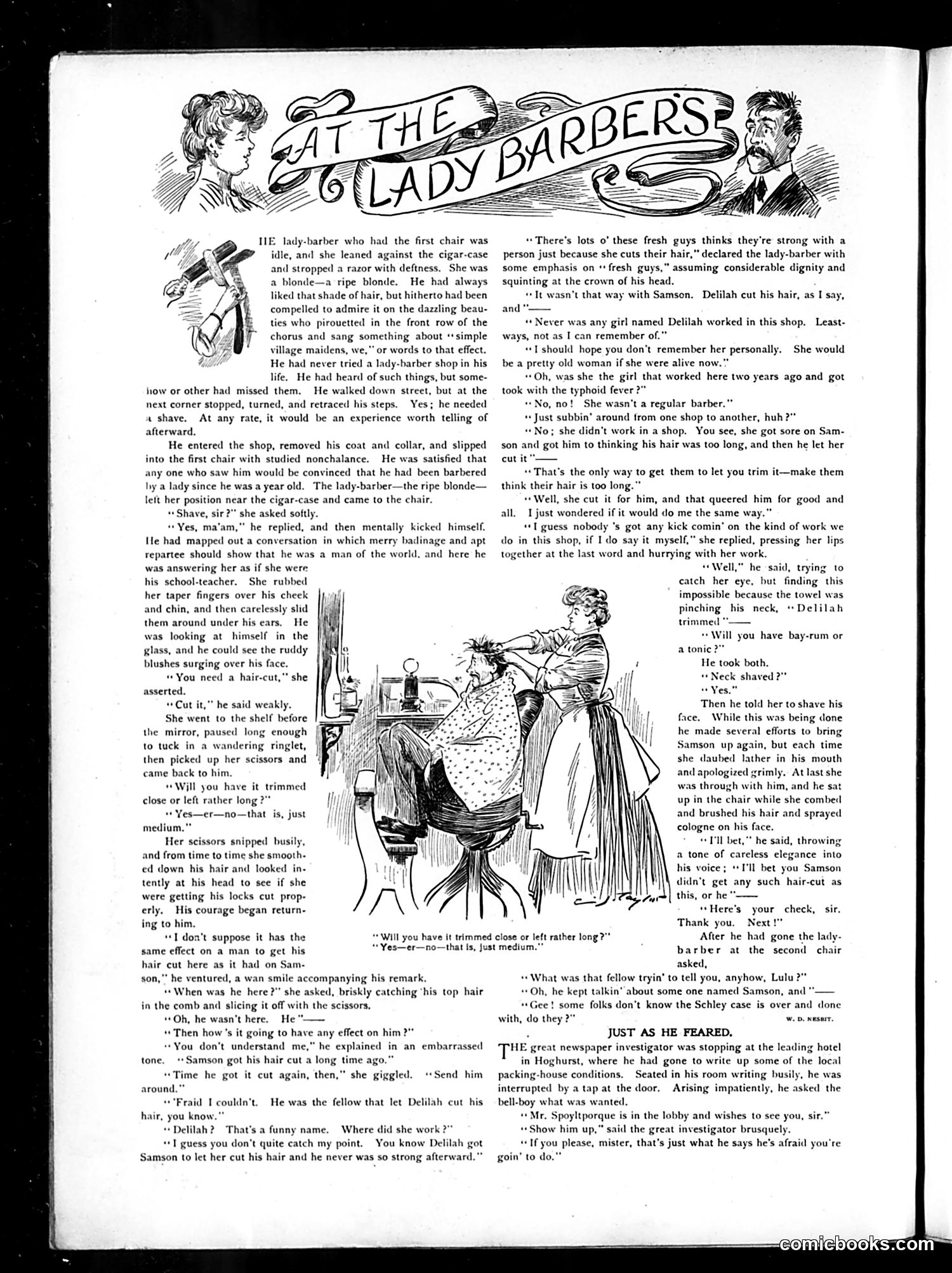
This humorous story depicts a man visiting a lady-barber shop for the first time, attempting to impress the attractive blonde barber with sophisticated wit. He tries making a classical reference to Samson and Delilah, suggesting that just as Delilah weakened Samson by cutting his hair, this barber might have similar power over him. The barber, however, completely misses his flirtation, taking his comment literally and dismissively. She responds with practical, no-nonsense working-class attitude: "There's lots o' these fresh guys thinks they're strong with a person just because she cuts their hair." She further deflates his mythology by claiming no girl named Delilah ever worked there. The satire targets both the man's awkward attempt at seduction through classical allusion and the barber's oblivious, matter-of-fact rejection of his advances. The joke reflects early-20th-century attitudes about gender roles, working-class women, and men's perceived superiority being punctured by female workers' indifference to their charms.

This is **not a cartoon or satire** — it's a **straightforward advertisement** for Schlitz beer. The page promotes the brand's purity claims through detailed manufacturing descriptions: sterile brewing, filtered air cooling, aging to prevent digestive upset, wood pulp filtration, and bottle sterilization. The ad acknowledges the marketing paradox: calling beer "pure" is easy, but achieving actual purity doubles production costs. It positions Schlitz as premium through expensive processes. The ornamental border and prominent branding reinforce luxury positioning. For modern readers: this reflects early-20th-century advertising emphasizing sanitation and scientific processes as selling points — purity claims were competitive differentiators before regulations standardized beer safety. "The Beer That Made Milwaukee Famous" was Schlitz's actual slogan, reflecting Milwaukee's dominance in American brewing.
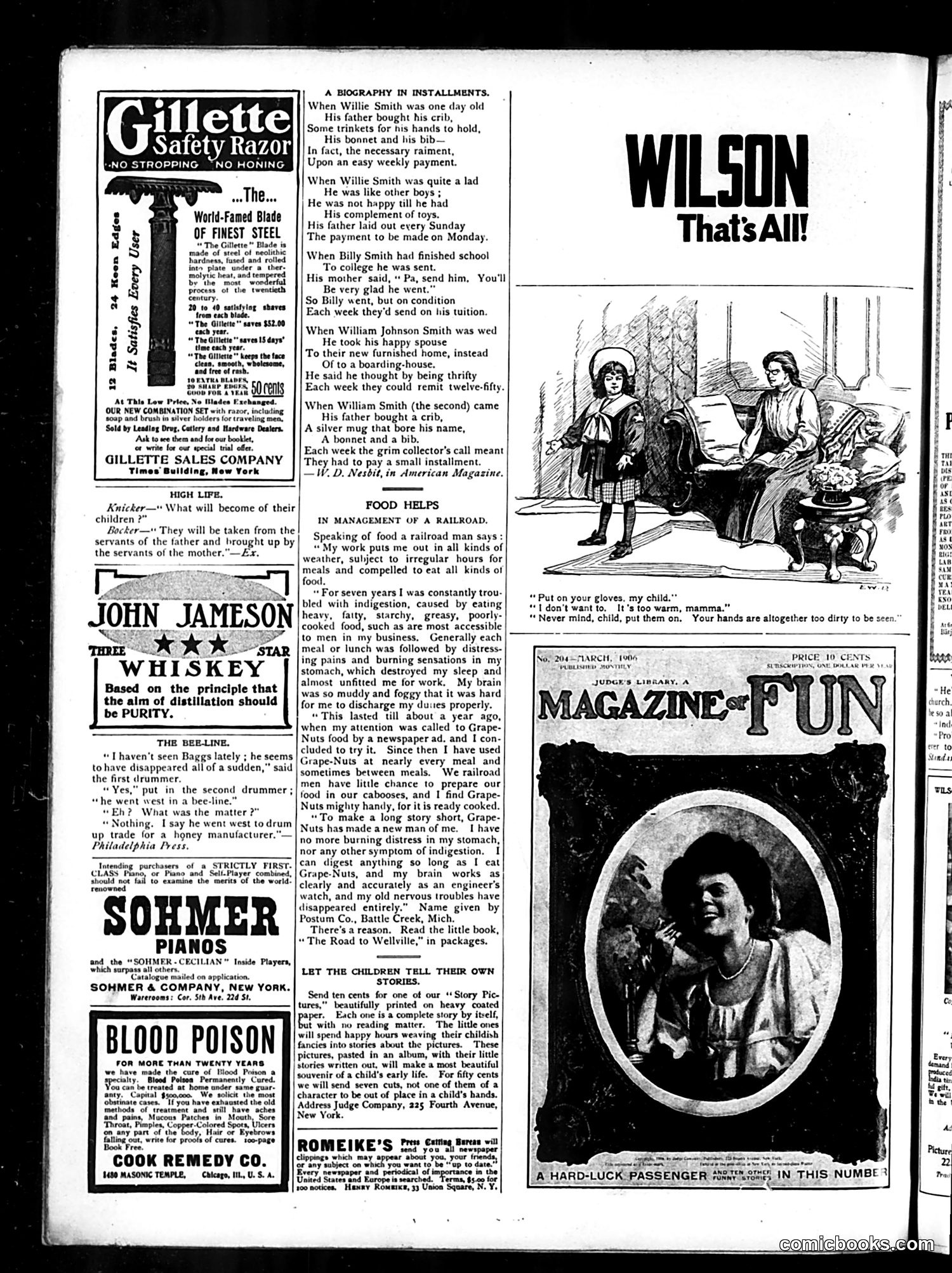
This poem satirizes the American installment-purchase system popular in the early 1900s. It follows Willie Smith from birth through fatherhood, showing how each life milestone—crib, toys, college, marriage, home furnishings—is purchased "on easy weekly payment." The satire's point: installment buying had become so normalized that it trapped working-class families in perpetual debt cycles. Rather than owning items outright, they faced endless "grim collector's calls" demanding weekly payments. The repetitive structure emphasizes the inescapability—even the next generation inherits the same financial burden when Willie Smith's own son is born and the cycle repeats with "a small installment." The poem critiques how consumer culture, enabled by credit systems, had become a permanent feature of American life, leaving no escape from weekly financial obligations. It's commentary on economic vulnerability disguised as humorous verse.
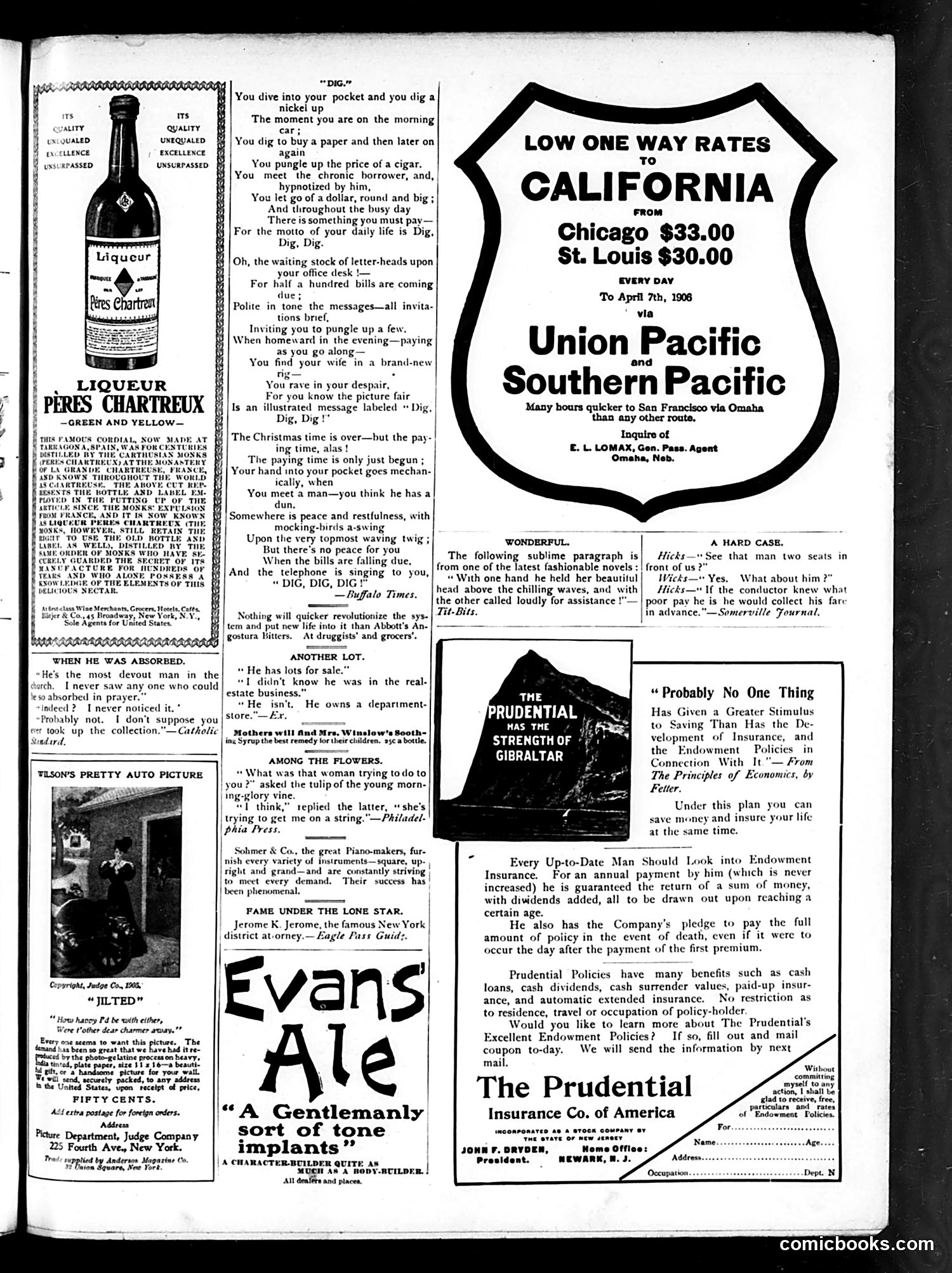
This page from Judge magazine (circa 1905) is primarily advertising with some satirical content. The main visual feature is a bottle of Liqueur Péres Chartreux (a French liqueur), advertised with claims of "unequaled excellence." The satirical content includes short humor pieces mocking everyday American life. A prominent poem titled "DIG, DIG, DIG" lambastes the constant financial obligations of urban life—nickels for streetcars, newspaper purchases, chronic borrowers, bills, and holiday expenses. It's a working-class complaint about incessant spending demands. Other brief jokes mock church donation practices, department stores selling property lots, and a woman trying to entrap a young man. Railroad advertisements promote low fares to California ($33-$30) via Union Pacific and Southern Pacific. The Prudential Insurance ad emphasizes endowment policies and life insurance benefits. Overall, this represents Judge's blend of consumer advertising with satirical commentary on urban commercial culture and financial pressures facing early 1900s Americans.
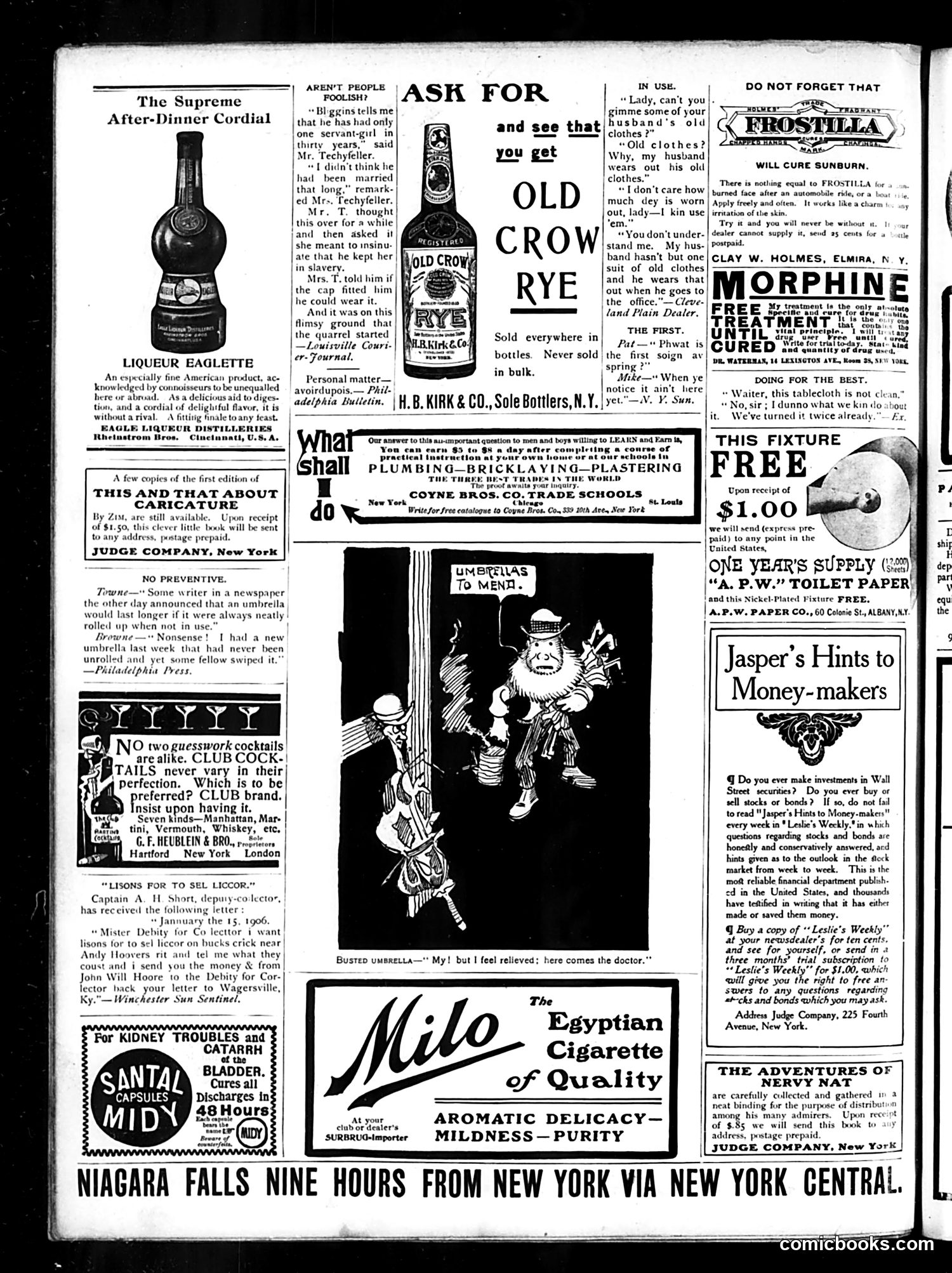
This page is primarily **advertisements and miscellaneous content** rather than political satire. However, the central cartoon depicts a humorous domestic scene labeled "BUSTED UMBRELLA — 'My! but I feel relieved; here comes the doctor.'" The cartoon shows a woman who has apparently been injured or struck by an umbrella (likely her husband's during a quarrel), now relieved to see the doctor arriving. This illustrates the page's running theme about marital discord over domestic matters—specifically, the preceding text about disputes over worn-out clothing and household items. The joke reflects early 20th-century assumptions about marriage tensions and slapstick domestic conflict. The "busted umbrella" becomes a metaphor for marital discord and the petty arguments that characterized middle-class households of the era. It's both humorous and casually normalizes domestic conflict as inevitable comedy.
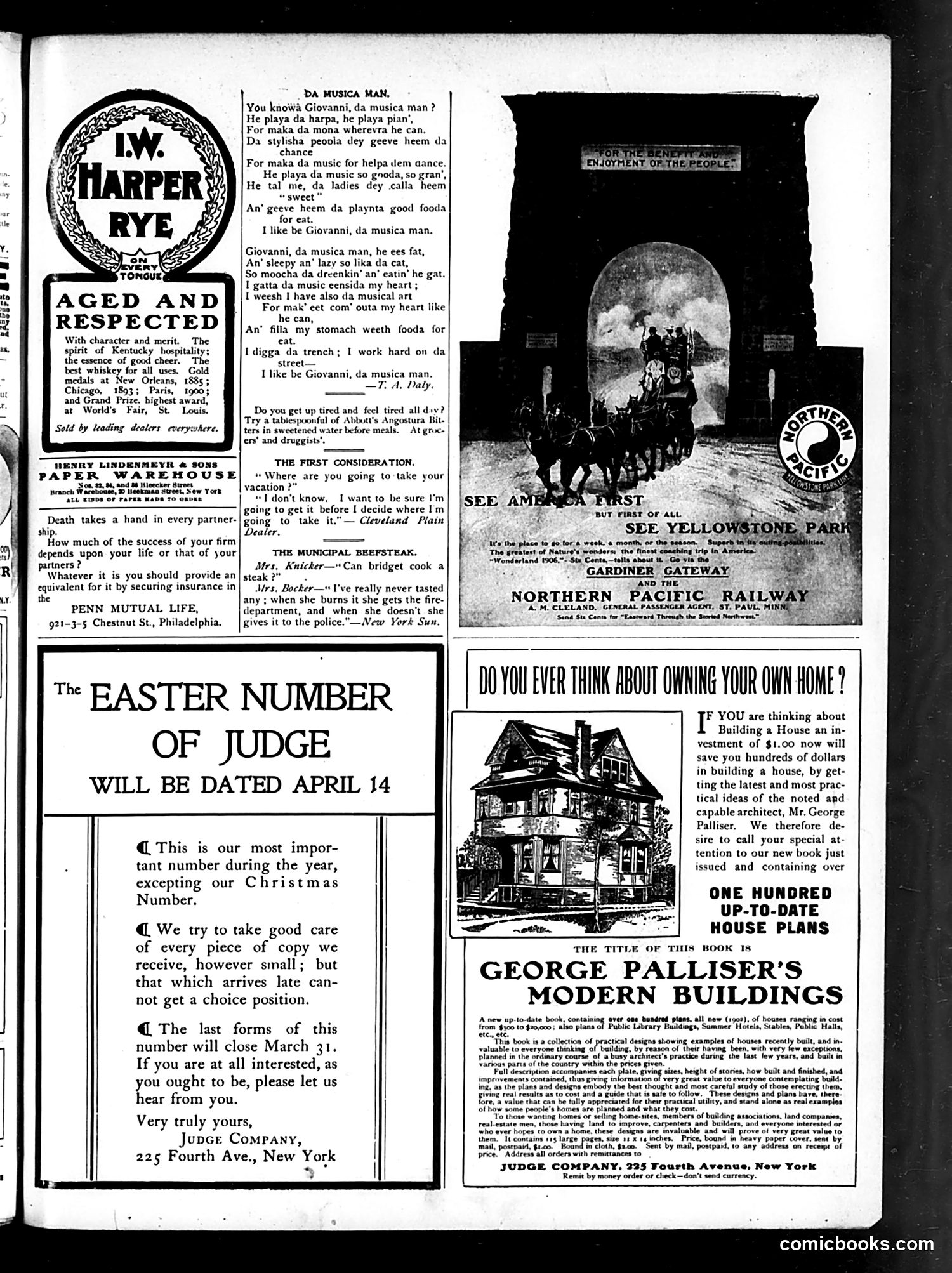
This Judge magazine page (circa 1902) contains mostly **advertisements and filler content** rather than political satire. The main text piece is **"Da Musica Man"** by T.A. Daly—a sentimental poem in Italian-American dialect about Giovanni, a struggling street musician who plays harp and piano. The poem idealizes his musical talent and modest success with wealthy patrons, contrasting with the speaker's own hard labor digging trenches. This reflects the era's **romanticization of immigrant musicians** as cultural figures, while the dialect itself reflects period conventions of ethnic representation (which modern readers would recognize as stereotypical). The remaining content comprises **period advertisements**: whiskey, life insurance, paper goods, and notably, architect George Palliser's house-plan book and Northern Pacific Railway travel promotions. A small joke section includes mundane observations about municipal bureaucracy and household servants—typical light humor of the era. The page primarily served **commercial purposes** through advertising revenue rather than delivering pointed social commentary.