
A complete issue · 14 pages · 1906
Judge — February 24, 1906
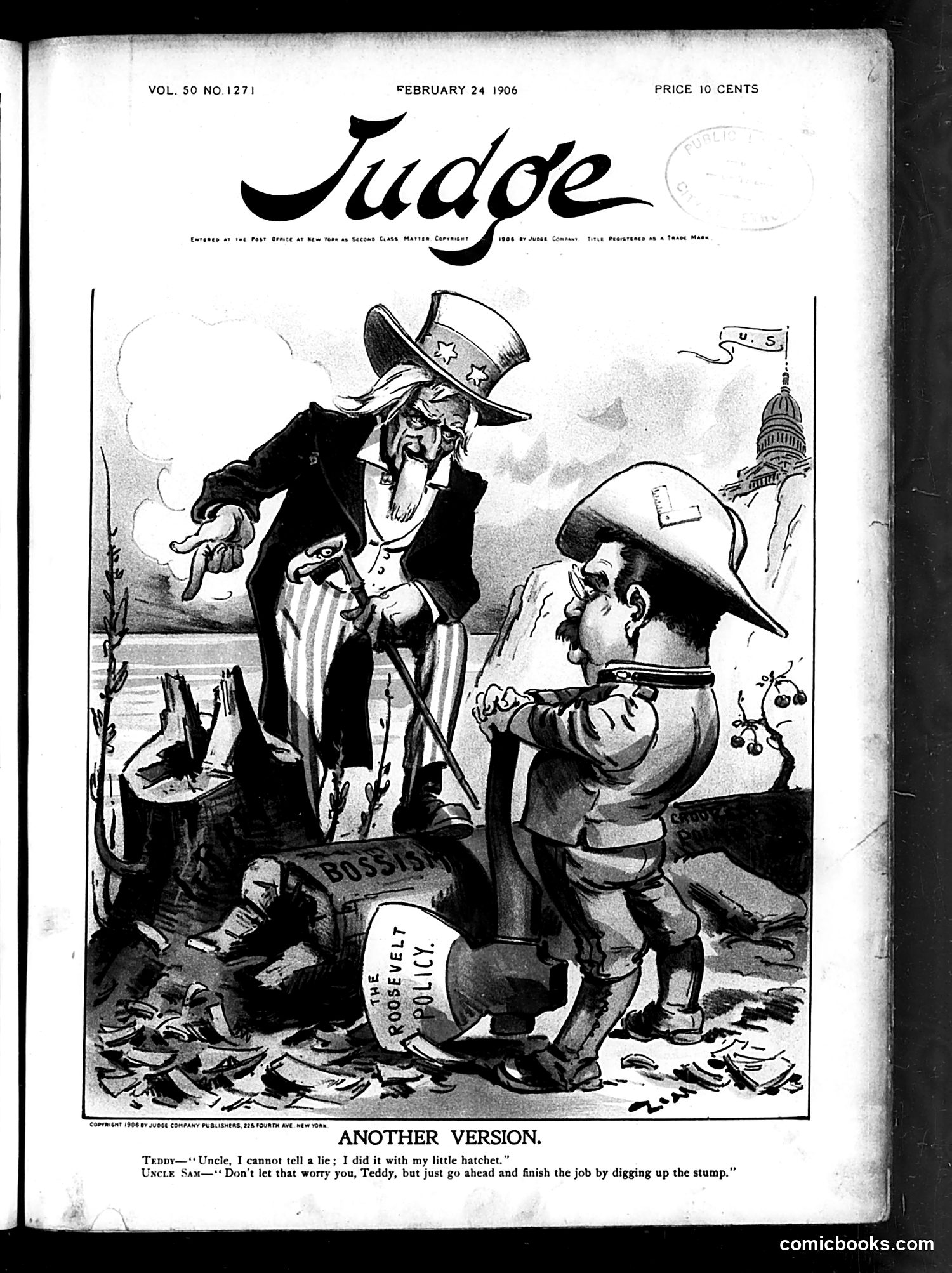
This February 1906 *Judge* cartoon satirizes President Theodore Roosevelt's handling of the Panama Canal construction. The figure labeled "U.S." represents America, while Uncle Sam directs a young "Teddy" (Roosevelt) to complete difficult excavation work—"finish the job by digging up the stump." The scattered debris labeled "ROOSEVELT POLICY" suggests previous failed or messy attempts. The cartoon critiques Roosevelt's approach to the canal project, which faced engineering and political obstacles. The joke plays on Roosevelt's famous determination: Uncle Sam essentially tells the young president to persist despite complications and incomplete prior work. The caption emphasizes Roosevelt cannot "tell a lie," referencing his reputation for blunt honesty, while sardonically suggesting he should simply soldier forward regardless of obstacles.
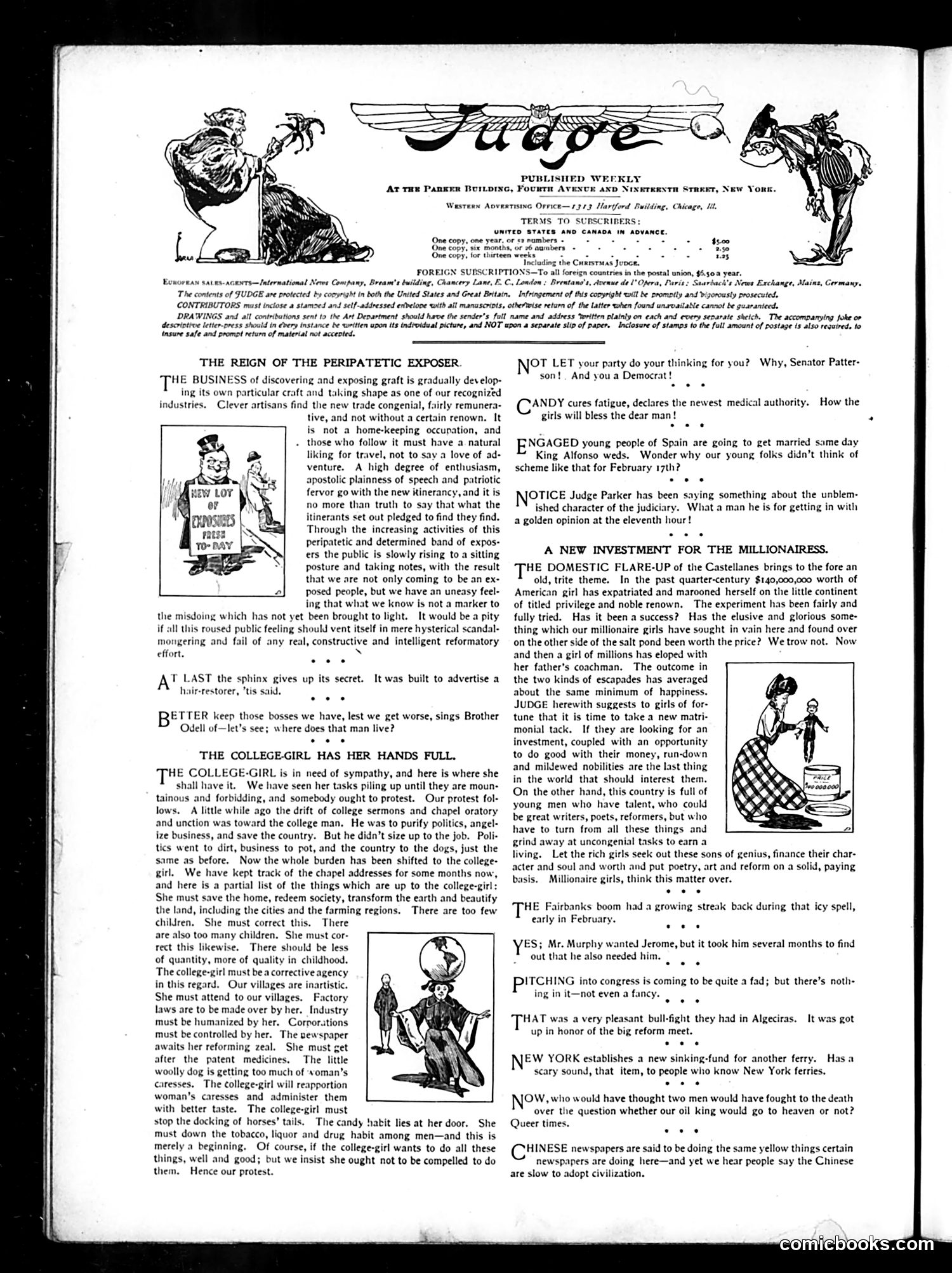
This page contains editorial commentary rather than political cartoons. The main pieces critique American social issues: **"The Reign of the Peripatetic Exposer"** mocks investigative journalists ("exposers") who travel around publicizing scandals. The accompanying illustration shows someone promoting "exposure," satirizing sensationalist journalism. **"The College-Girl Has Her Hands Full"** advocates for expanded women's education and responsibilities, arguing college-educated women should pursue meaningful work beyond domestic duties—a progressive position for the era. The remaining items are brief satirical notes on contemporary topics: Senator Patterson's political character, candy manufacturers' health claims, Spanish royalty, and other minor social observations. The page reflects Judge's role as a venue for social commentary on education, journalism, and women's roles, rather than serving primarily as political-cartoon publication.
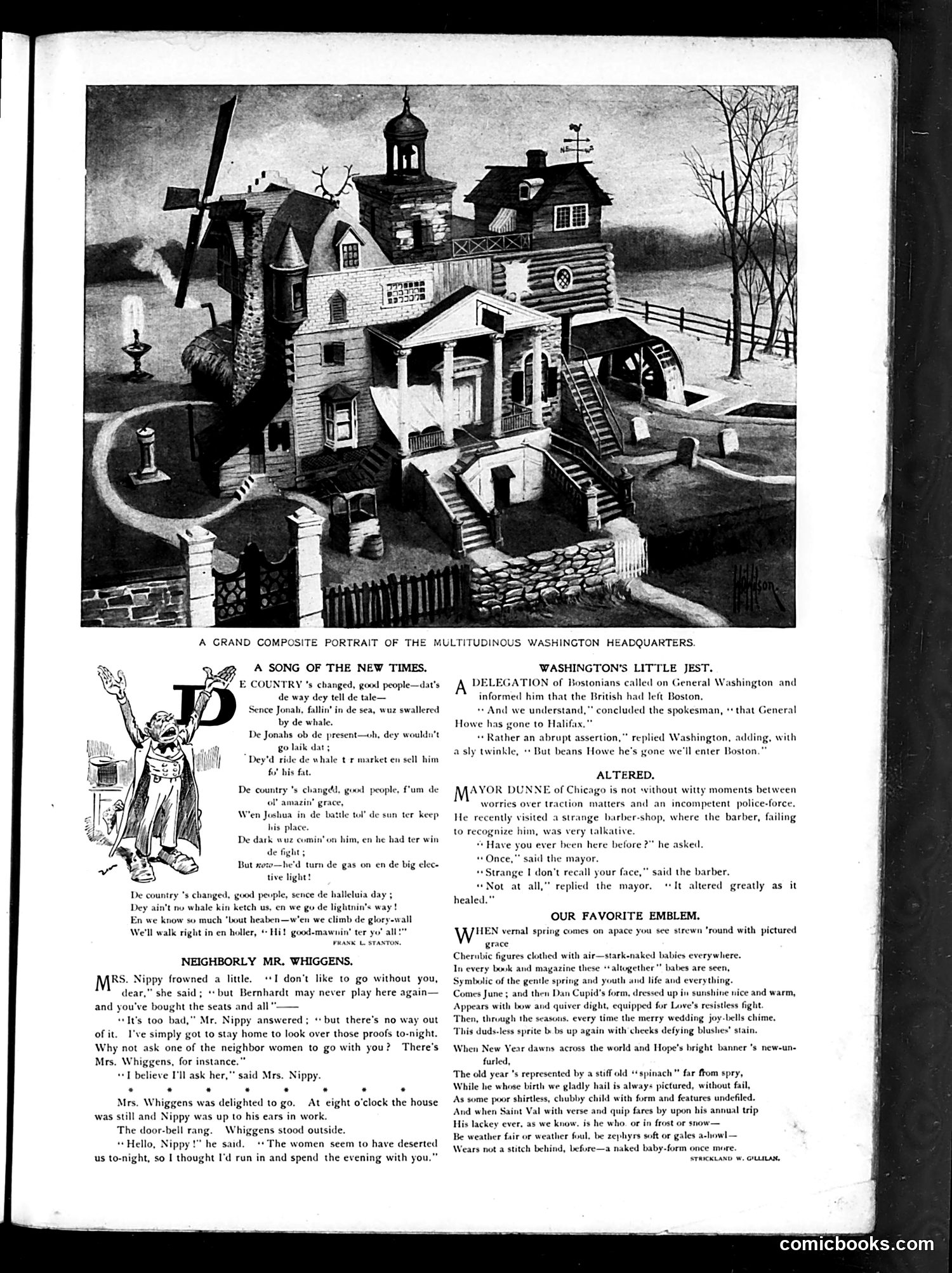
The top illustration depicts a fanciful, composite portrait of George Washington's headquarters—a whimsical architectural mashup combining a windmill, church steeple, log cabin, water wheel, and various colonial structures. This appears to be satirical commentary on the Revolutionary War period rather than serious political satire. Below are three separate humorous domestic sketches: "Song of the New Times," "Neighborly Mr. Whiggens," and "Altered," featuring ordinary people in everyday situations. The "Whiggens" story involves a husband avoiding his wife by staying out late. The bottom section, "Our Favorite Emblem," is a sentimental poem about spring imagery and renewal—typical light, moralistic content common to Judge magazine. This page mixes historical whimsy with genteel domestic humor rather than sharp political commentary.
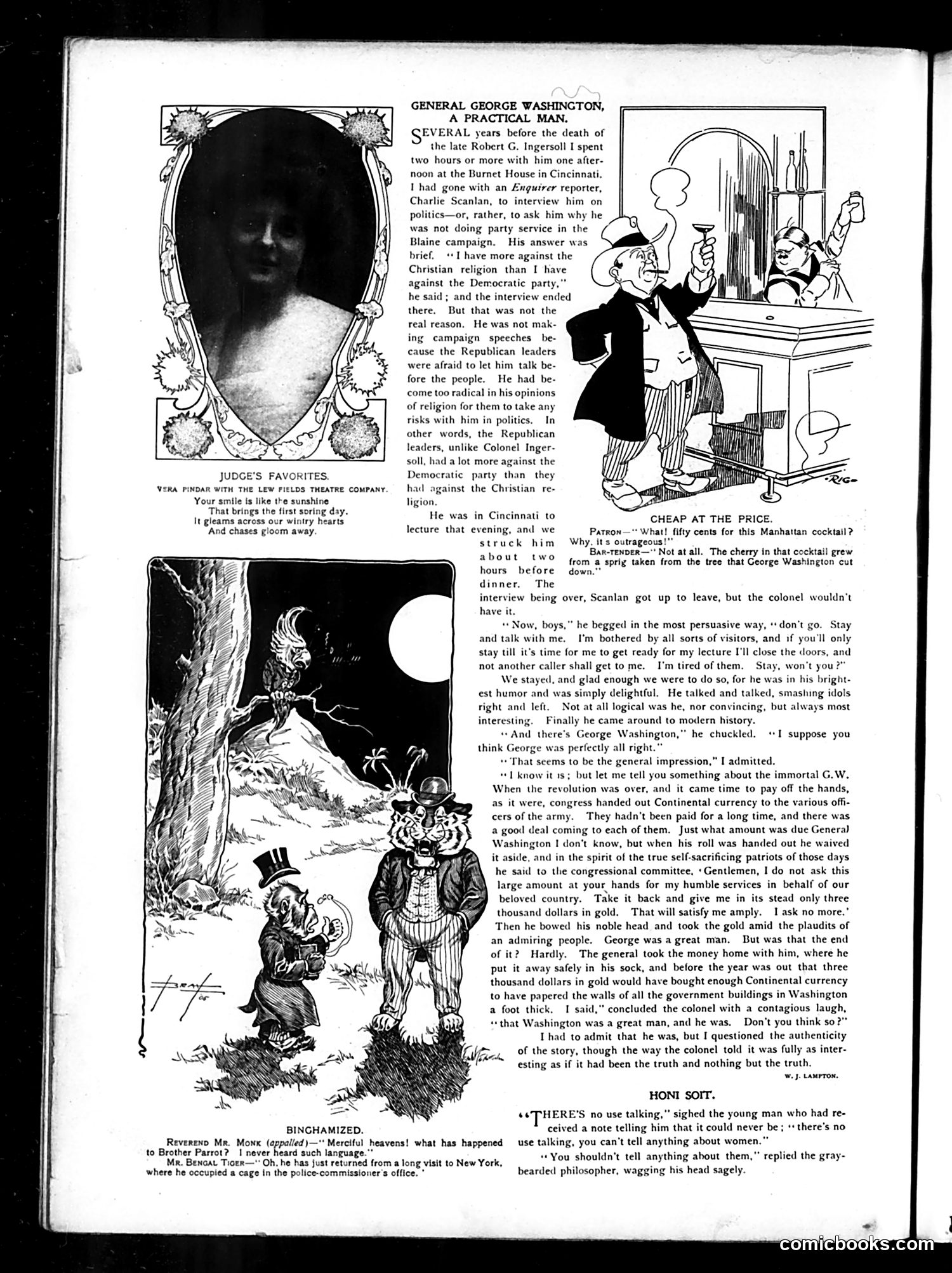
This page contains three distinct pieces: 1. **"Judge's Favorites"** - A portrait of Vera Findah with the Lew Fields Theater Company, praising her opening-day performance. 2. **"General George Washington, A Practical Man"** - The main article recounts an anecdote where Robert G. Ingersoll (a famous 19th-century agnostic) visited Cincinnati and told Colonel about Washington refusing Continental Army payment, instead asking Congress for three thousand dollars in gold. The story illustrates Washington as pragmatic yet principled. The satire mocks Republican politicians' reluctance to associate with Ingersoll's radical religious views during campaigns, despite their political alignment. 3. **"Cheap at the Price"** - A cartoon mocking a bartender's claim that a Manhattan cocktail contains cherry from "the tree that George Washington cut down," playing on the apocryphal young Washington/cherry tree legend.
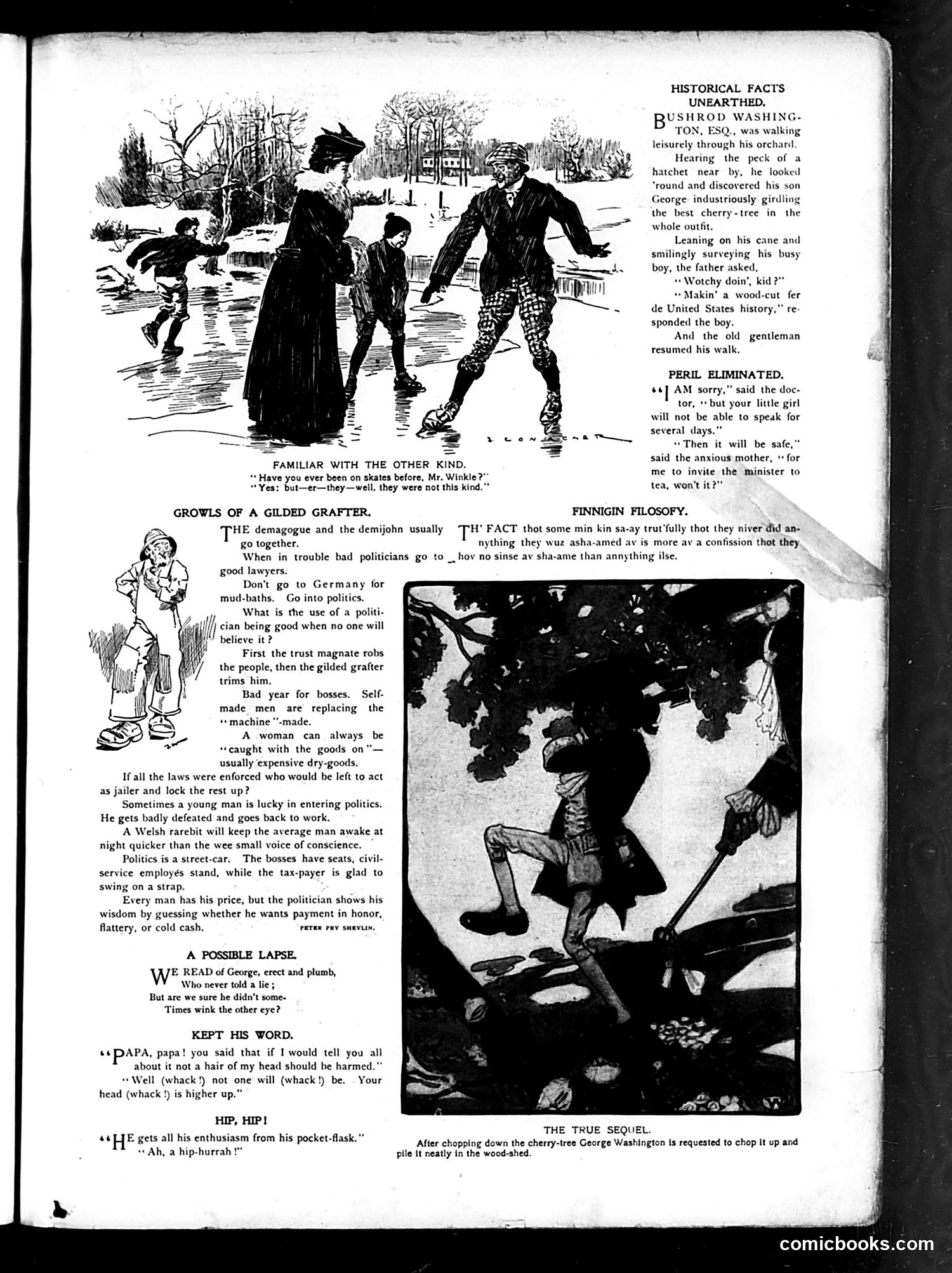
The top illustration, "Familiar with the Other Kind," depicts Bushrod Washington, Esq. observing his son George cutting figures on ice while skating. The humor derives from a play on words: when asked if he's skated before, the boy responds he has—"but—er—they were not this kind," implying he's familiar with *other* skating (dishonest dealings or evasion). This satirizes corruption among wealthy elites who engage in questionable practices while maintaining respectability. The "Growls of a Gilded Grafter" section mocks politicians and wealthy businessmen, suggesting they corrupt the system through bribery, manipulation, and self-interest. It portrays politics as inherently dishonest, where bosses, graft, and cash payment dominate over principle—a criticism common in Gilded Age satire targeting political corruption and corporate malfeasance.
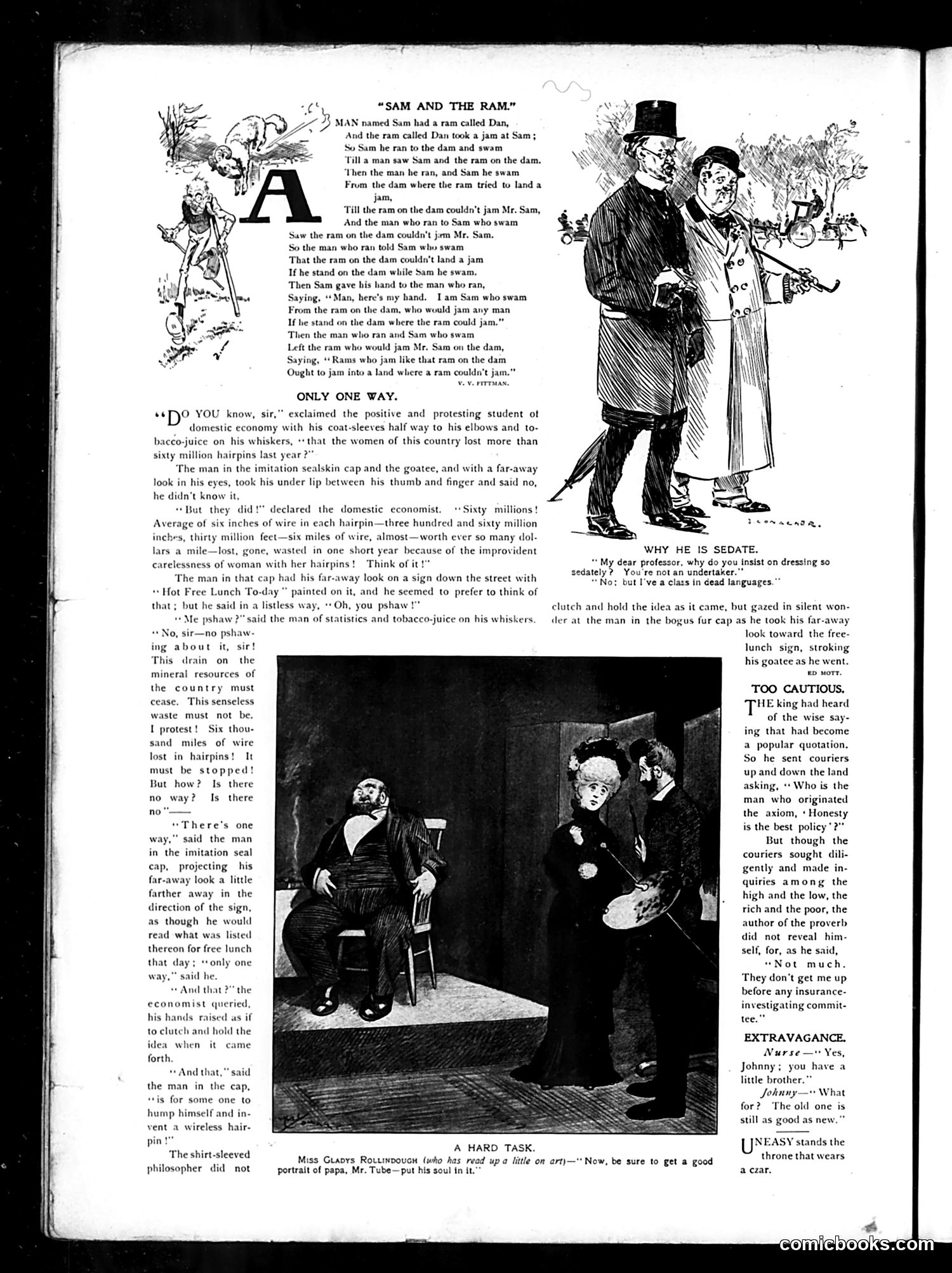
This page contains three satirical pieces targeting American social and economic attitudes of the early 20th century. **"Sam and the Ram"** is a tongue-twister poem mocking verbose, repetitive speech—likely satirizing political rhetoric or bureaucratic jargon of the era. **"Only One Way"** ridicules a pedantic "domestic economist" who obsesses over lost hairpins as a national crisis, wasting six miles of wire annually. The joke targets both his humorless moralizing about women's "improvidence" and his absurd extrapolation of minor losses into catastrophic statistics. The unnamed figure with the "far-away look" represents the indifferent everyman, unimpressed by statistical doomsaying. **"Why He Is Sedate"** and subsequent vignettes feature this same far-away-looking character in a sealskin cap, used as a recurring comedic device to contrast earnest questioners with his detached, pragmatic indifference. The overall thrust mocks reform-minded intellectuals, statistics-obsessed moralists, and sanctimonious hand-wringing about trivial matters—common Judge targets throughout its satirical tradition.
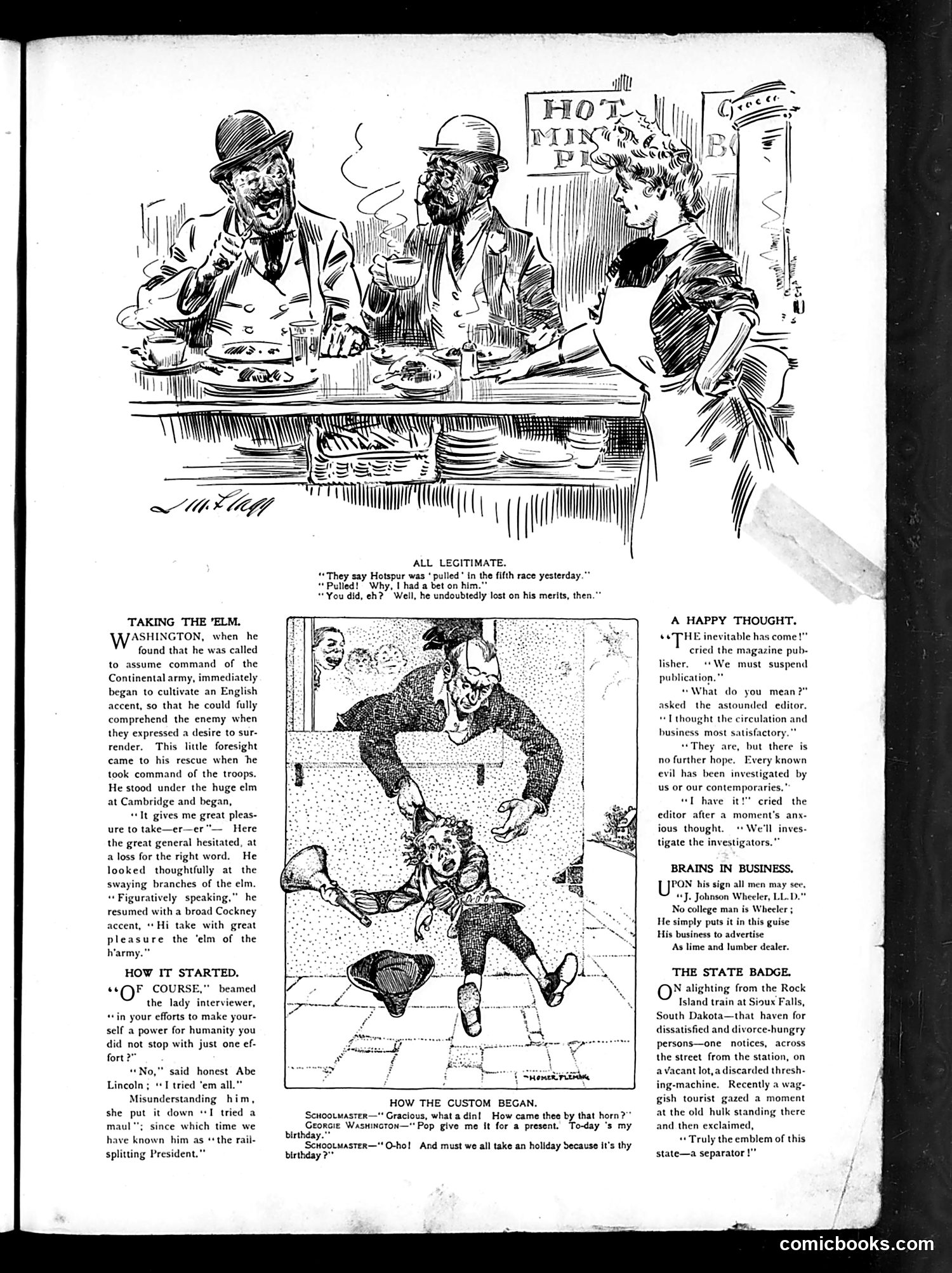
This page contains multiple satirical items typical of Judge's humor: **"Taking the 'Elm"** mocks George Washington's supposed adoption of a Cockney English accent to understand British enemies, playing on the phrase "helm of the army" rendered as "'elm" in working-class London dialect—the joke being Washington's absurd linguistic affectation. **"How It Started"** attributes Lincoln's "rail-splitting President" nickname to a mishearing: when asked if he tried multiple approaches, his response was misheard as "I tried a maul" rather than "I tried 'em all." **"All Legitimate"** is a brief joke about horse racing, where a "pulled" horse (deliberately underperforming) still loses on actual merit. **"How the Custom Began"** depicts a child presenting a horn as a birthday gift, establishing why birthday holidays became custom. **"A Happy Thought"** satirizes magazines: when a publisher fears cancellation despite good circulation, the editor proposes investigating "the investigators"—mocking endless exposé journalism. Minor items mock diploma fraud in business and South Dakota's divorce industry. The tone is light social commentary rather than sharp political critique.
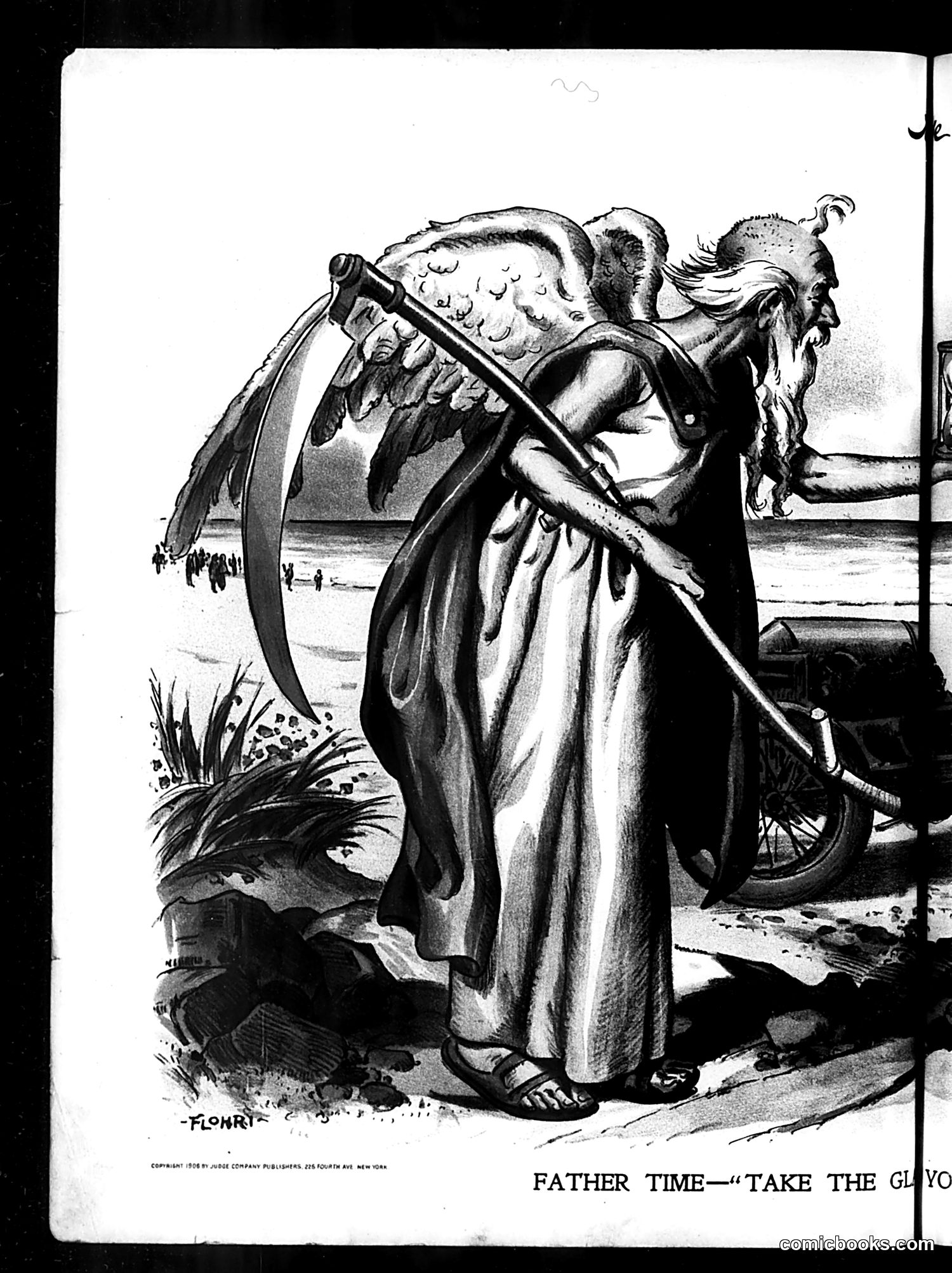
This Judge magazine cartoon depicts **Father Time** (the winged, bearded figure) wielding a scythe—his traditional symbol of mortality and the passage of time. The caption reads "Father Time—'Take the Gl...'" (text cut off, likely "Take the Gloves Off"). The cartoon appears to be commentary on conflict or confrontation, with Father Time instructing someone to remove restraints ("gloves") and engage more directly. The scene shows what appear to be modern figures in the background, suggesting contemporary political or social conflict. Without the complete caption and publication date visible, the specific historical context remains **unclear**—this could reference labor disputes, war preparation, or domestic political conflict from the early-to-mid 20th century.
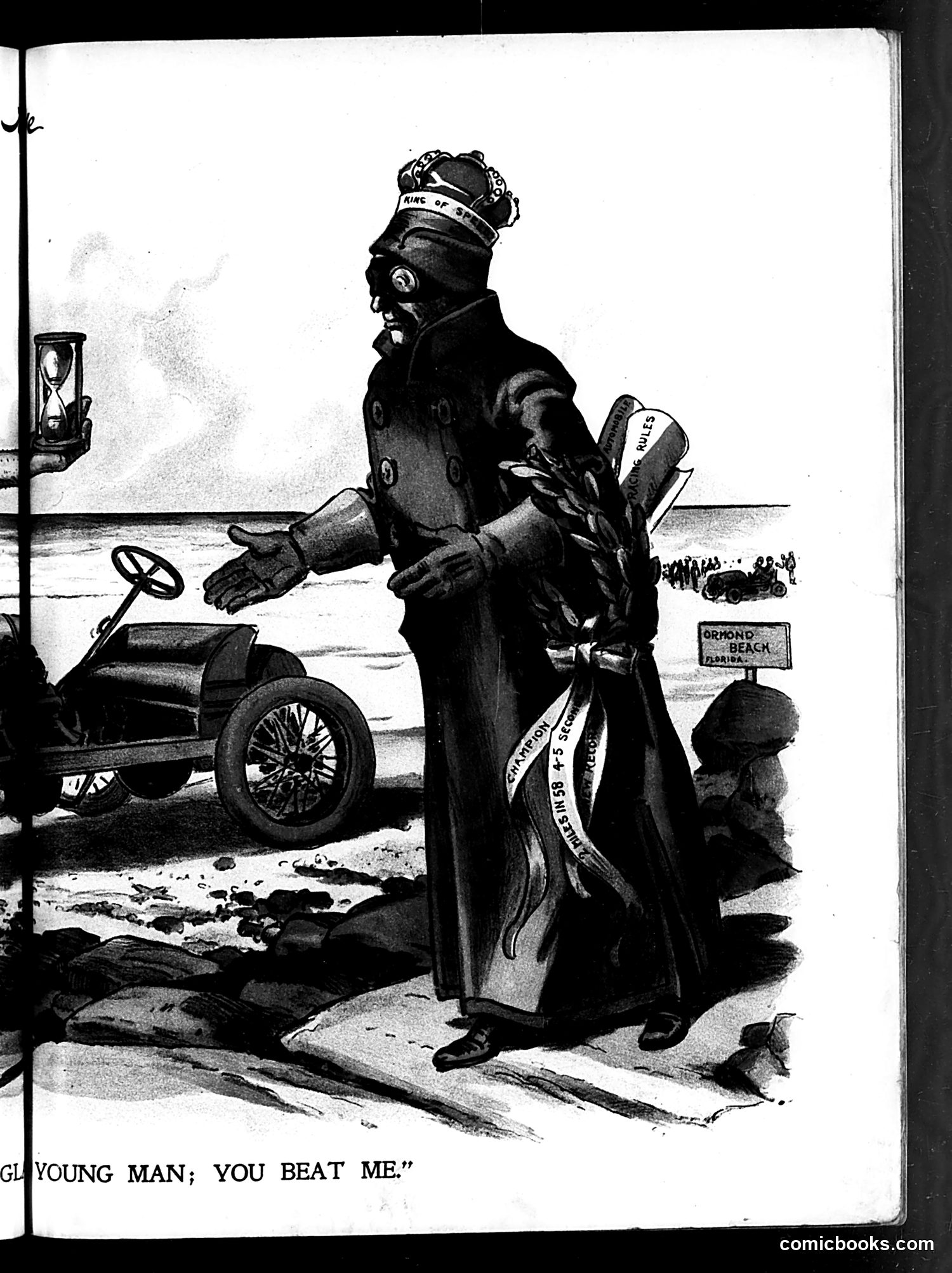
This political cartoon depicts a caricatured figure in military dress at Ormond Beach, standing beside an early racing automobile. The figure wears a crown labeled "KING OF" and appears to be a personification of some authority or leader being mocked. The caption reads: "YOUNG MAN; YOU BEAT ME." The satire appears to target automotive speed records or racing competitions at Ormond Beach, a famous early venue for land-speed trials. The "king" figure—likely representing an established record holder or racing authority—is being humbled by a younger competitor who has surpassed previous achievements. Without additional context about the magazine's date or specific racing events referenced, I cannot identify the exact historical figures or records being satirized, though the cartoon clearly mocks the displacement of established dominance by new technological achievement.
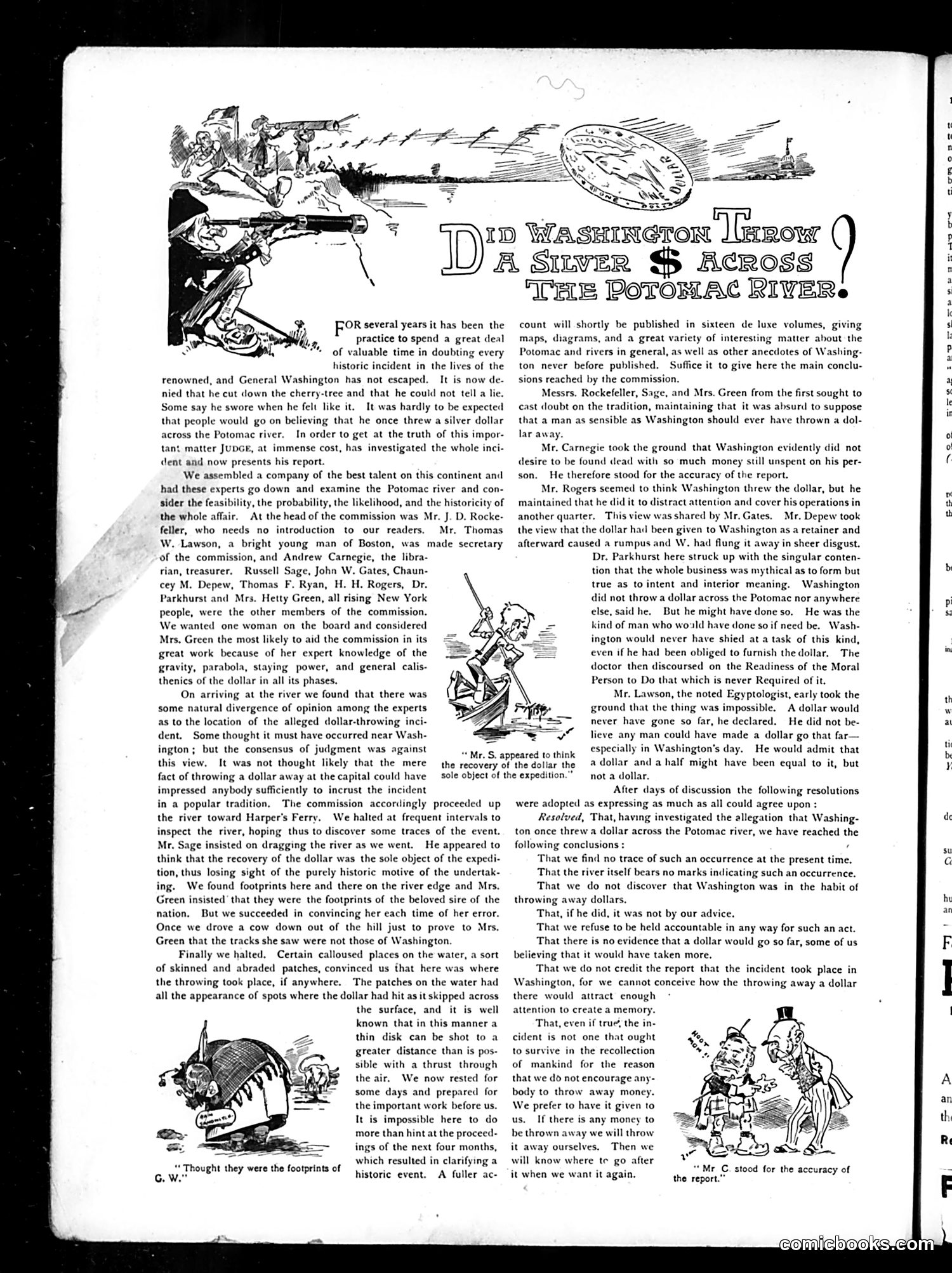
This satirical piece mocks the era's obsession with debunking historical legends about George Washington (like the cherry-tree story). Judge magazine assembles a "commission" of famously wealthy, penny-pinching Gilded Age tycoons—Rockefeller, Carnegie, Russell Sage, Hetty Green, and others—to scientifically investigate whether Washington actually threw a silver dollar across the Potomac. The joke ridicules both the historical skepticism trend and these robber barons' legendary stinginess. Having men like Russell Sage (who notoriously hoarded money) investigate Washington's alleged dollar-throwing is absurd: it's unimaginable such misers would believe anyone—even a revered president—would casually waste money. The accompanying cartoons show Sage eagerly wanting to *recover* the dollar rather than verify history, and Mrs. Green mistaking cow tracks for Washington's footprints, emphasizing their obsession with money over truth.
This page is primarily **advertisements and humorous short pieces**, not political satire. The main content consists of: **Humorous Anecdotes:** - Brief comedic stories about everyday life (roller-skating rink crowds, clergy mishaps, marketplace haggling) - Jokes playing on misunderstandings and wordplay - Short quips about human nature and social behavior **Notable piece:** "Maud Consented" depicts a clergyman mishearing a couple's request for "a ramble" as a proposal for marriage—the joke relies on the period's social convention that courtship proposals were serious formal matters. **Advertisements:** - Piano manufacturers (Sohmer) - Tar soap for hair care - Life insurance - Hat company (Dunlap & Co.) - Cigar sales advice **Context for modern readers:** This reflects early 20th-century *Judge* magazine's typical mix—light domestic humor without sharp political bite, interspersed with period-appropriate product advertisements. The comedy assumes readers understand social hierarchies, courtship rituals, and small-town American life.
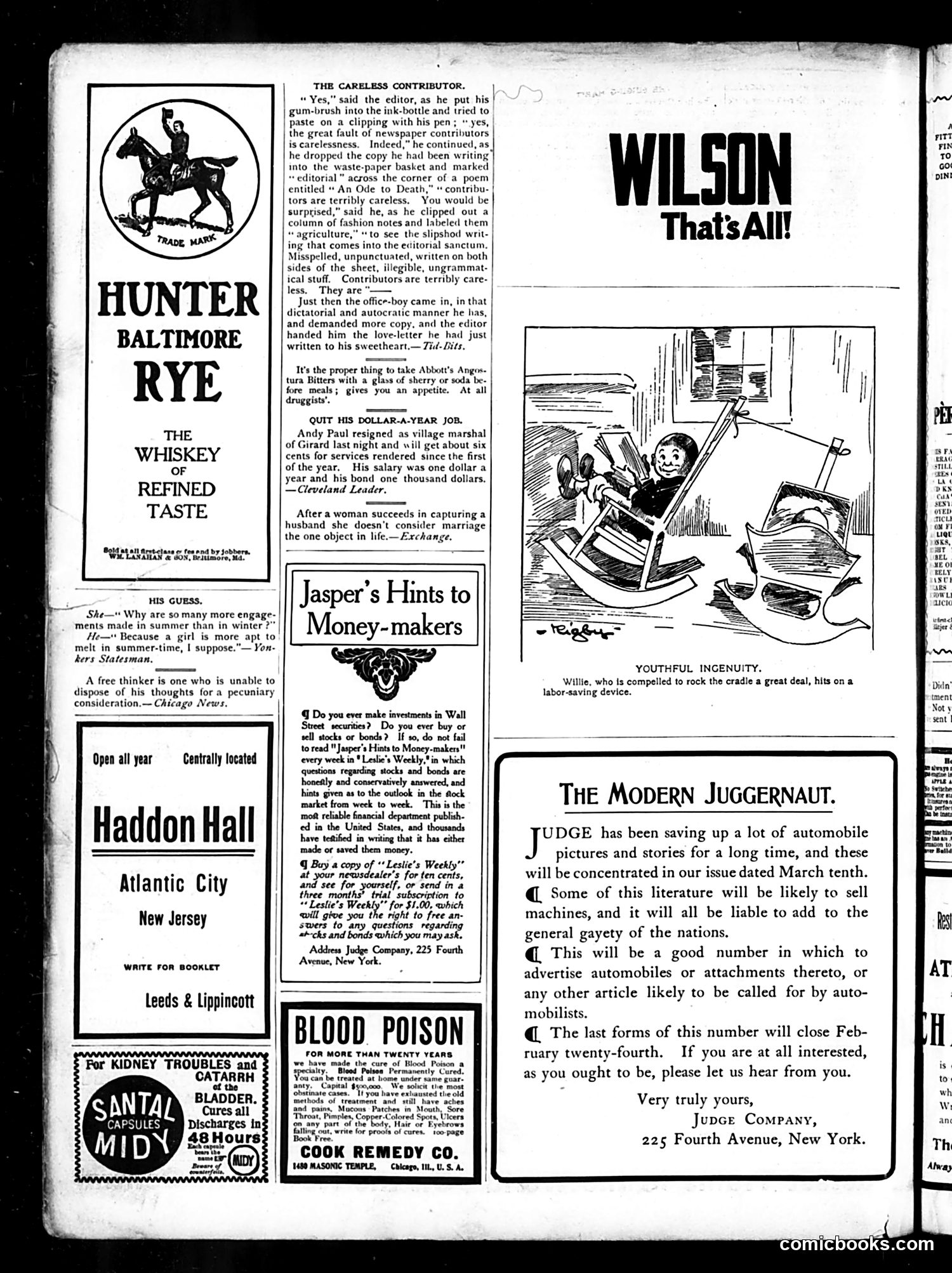
This page contains several short satirical pieces typical of Judge magazine's humor. **"The Careless Contributor"** is the main cartoon/article: it's ironic social commentary. An editor lectures a contributor about carelessness—misspelled words, poor punctuation, illegible writing—while the editor himself is hilariously careless: putting a gum-brush in an ink bottle, mislabeling submissions (fashion notes as "agriculture"), and ultimately handing the office boy a love letter instead of editorial copy. The satire targets editorial hypocrisy: editors criticize contributors while being equally sloppy themselves. The remaining items are brief humor snippets (quoted observations about human nature, a joke about summer engagements, etc.) and advertisements for whiskey, Haddon Hall resort, financial advice, and patent medicines—typical of the era. **"Youthful Ingenuity"** shows a boy in a rocking chair, humorously depicted as an labor-saving device innovation, mocking how children adapt to tedious tasks. The satire assumes readers recognize that carelessness was genuinely a publishing problem, making the editor's hypocrisy absurd and funny.
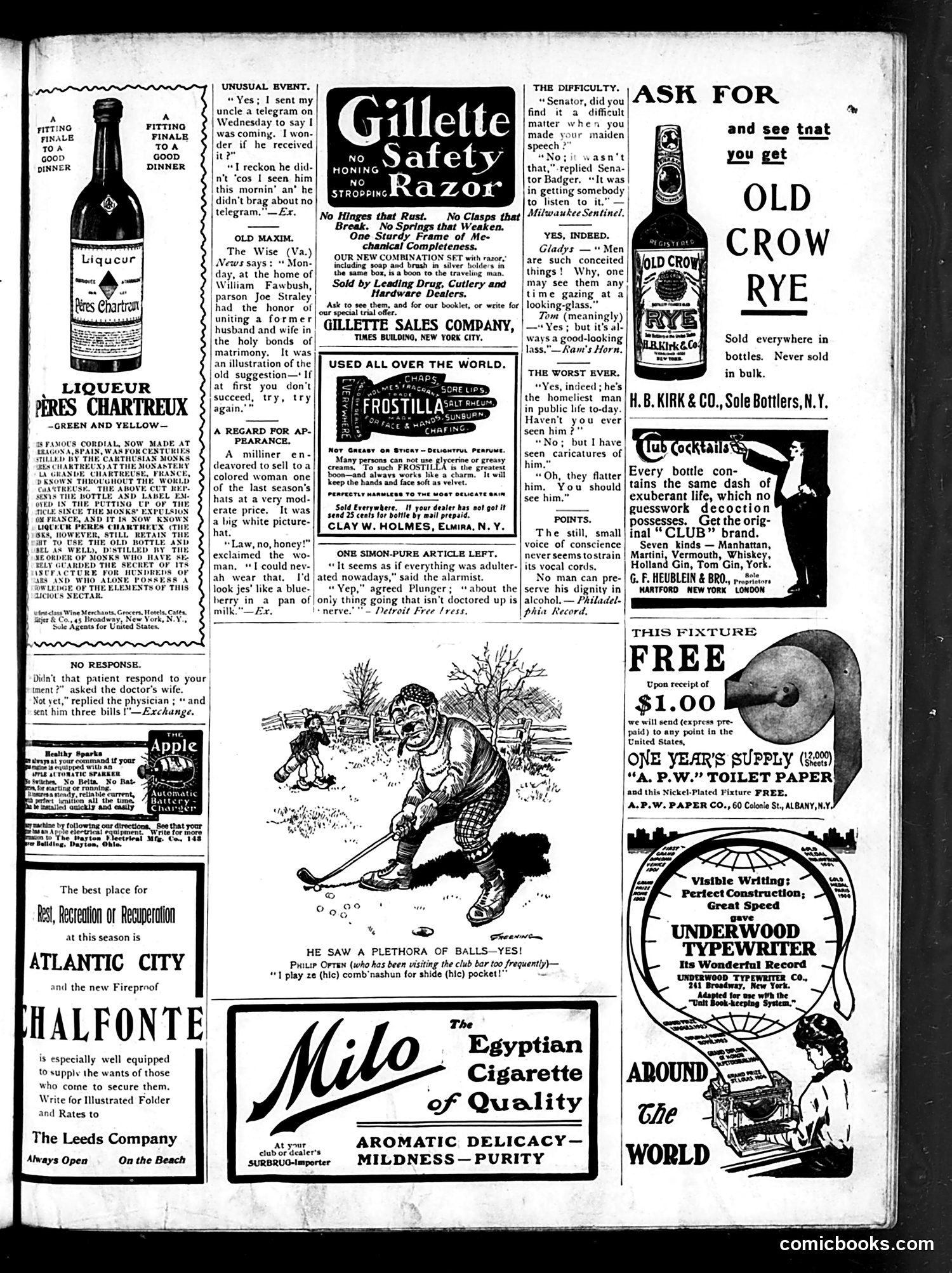
This is primarily an **advertising page** from Judge magazine, with minimal editorial cartooning. The main cartoon depicts a hockey player mid-action with the caption "HE SAW A PLETHORA OF BALLS—YES!" This appears to be a pun—the player is surrounded by hockey pucks, but "balls" creates double meaning for a joke (unclear without fuller context). The page is dominated by product advertisements typical of early 20th-century magazines: Gillette Safety Razors, Old Crow Rye whiskey, liqueurs, cigarettes, typewriters, and toilet paper fixtures. These ads reflect contemporary consumer goods and leisure culture. Two brief text humor pieces appear: one about a senator's maiden speech, and another about a patient who responds to doctor's bills. Both are mild observational humor rather than political satire. The overall page represents Judge's revenue model—mixing light humor with commercial advertising rather than substantive political commentary.
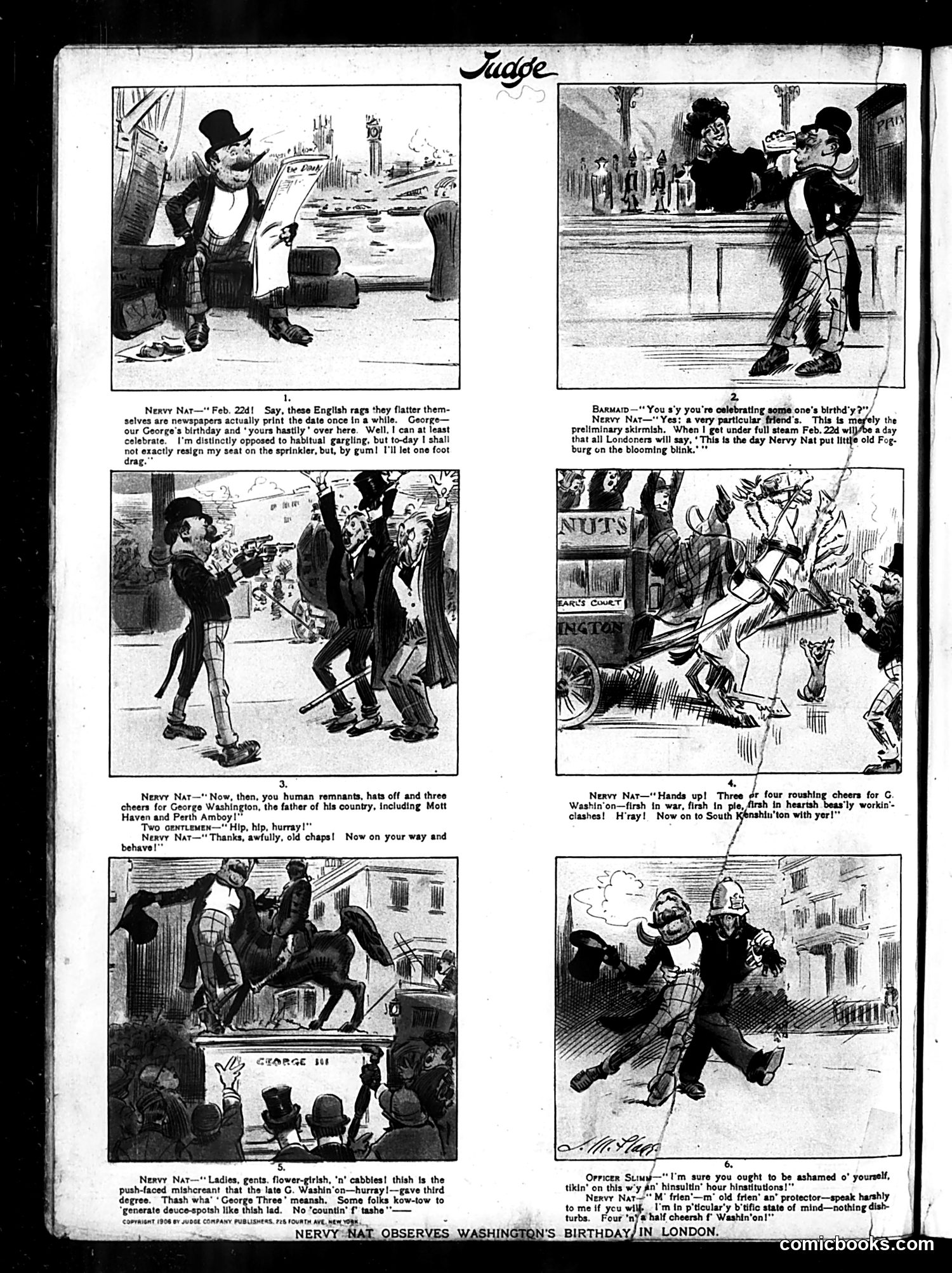
This is a satirical comic strip about an American character ("Nervy Nat") celebrating George Washington's birthday while in London, apparently to needle the British. The humor operates on several levels: **The premise**: Nat attempts to stir up patriotic American sentiment in London by loudly celebrating Washington and American independence—deliberately provocative to British audiences. **The satire**: The comic mocks both Nat's brash, disruptive behavior and British social pretense. British characters react with scandalized indignation to his loud celebrations near monuments (including one to King George III), while Nat continues undeterred. **The speech patterns**: Characters speak in exaggerated drunk or working-class dialects ("Washin'on," "H'ray"), which Judge uses to demean both the rowdy American and his British observers. **The point**: Judge satirizes American jingoism abroad and British stuffiness, presenting the clash as absurdly comic. The 1908 date suggests this reflects Anglo-American tensions of the era.