
Judge, 1906-02-24 · page 10 of 14
Judge — February 24, 1906 — page 10: what you’re looking at
What you’re looking at
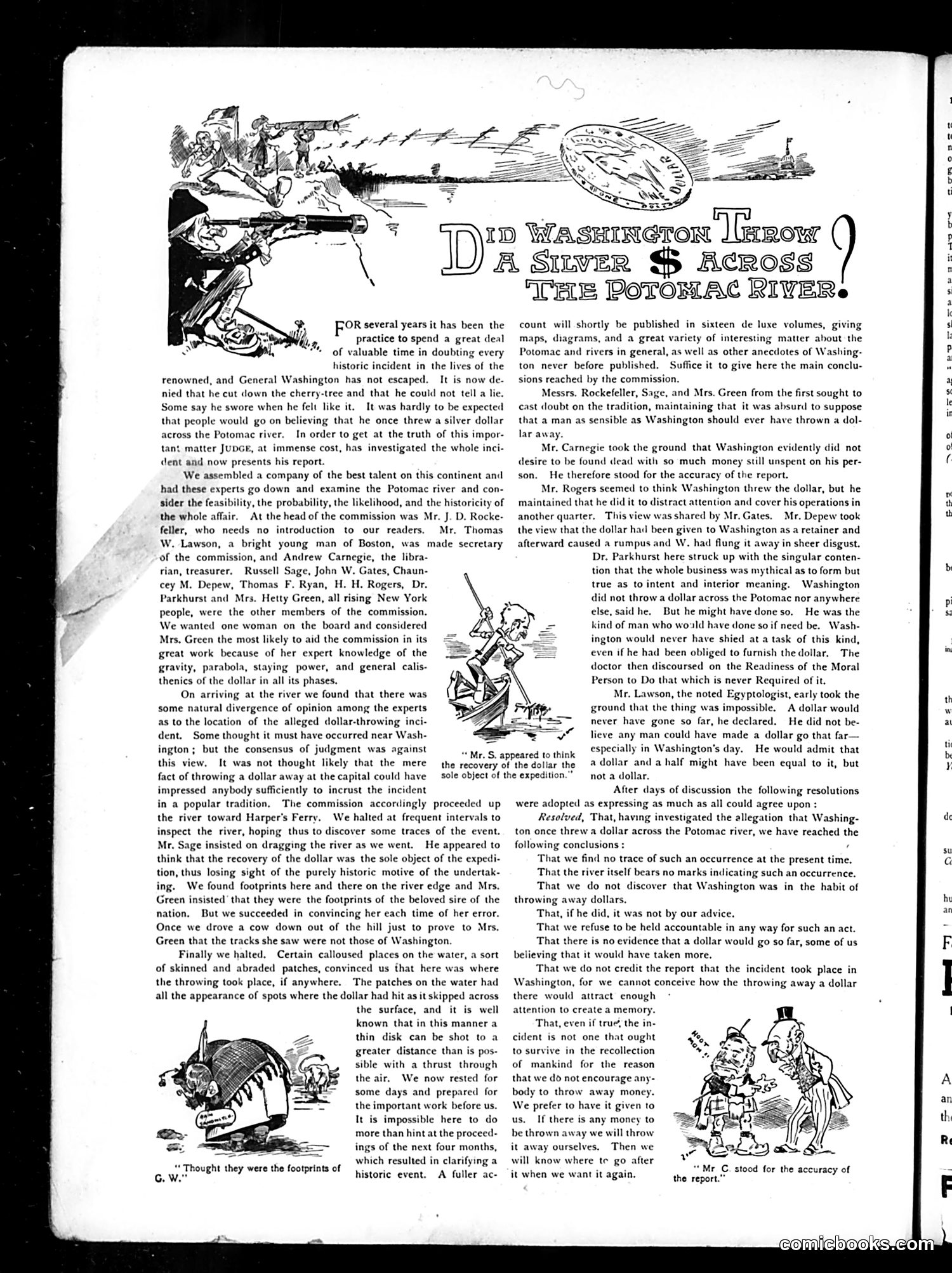
This satirical piece mocks the era's obsession with debunking historical legends about George Washington (like the cherry-tree story). Judge magazine assembles a "commission" of famously wealthy, penny-pinching Gilded Age tycoons—Rockefeller, Carnegie, Russell Sage, Hetty Green, and others—to scientifically investigate whether Washington actually threw a silver dollar across the Potomac. The joke ridicules both the historical skepticism trend and these robber barons' legendary stinginess. Having men like Russell Sage (who notoriously hoarded money) investigate Washington's alleged dollar-throwing is absurd: it's unimaginable such misers would believe anyone—even a revered president—would casually waste money. The accompanying cartoons show Sage eagerly wanting to *recover* the dollar rather than verify history, and Mrs. Green mistaking cow tracks for Washington's footprints, emphasizing their obsession with money over truth.
📄 Transcribed text from this page (OCR, searchable)
Machine-transcribed from the original scan — historical spelling and the odd misread are preserved.
A SILVER ‘OR several years it has been the practice to spend a great deal of valuable time in doubting every historic incident in the lives of the renowned, and General Washington has not escaped. It is now de- nied that he cut down the cherry-tree and that he could not tell a lie. Some say he swore when he felt like it. It was hardly to be expected that people would go on believing that he once threw a silver dollar across the Potomac river. In order to get at the truth of this impor- tant matter JUDGE, at immense cost, has investigated the whole inci- dent and now presents his report. We assembled a company of the best talent on this continent and had these experts go down and examine the Potomac river and con- sider the feasibility, the probability, the likelihood, and the historicity of the whole affair. At the head of the commission was Mr. J. D. Rocke- feller, who needs no introduction to our readers. Mr. Thomas W. Lawson, a bright young man of Boston, was made secretary of the commission, and Andrew Carnegic, the libra- rian, treasurer. Russell Sage, John W. Gates, Chaun- cey M. Depew, Thomas F. Ryan, H. H. Rogers, Dr. Parkhurst and Mrs. Hetty Green, all rising New York people, were the other members of the commission. We wanted one woman on the board and considered Mrs. Green the most likely to aid the commission in its great work because of her expert knowledge of the gravity, parabola, staying power, and general calis- thenics of the dollar in all its phases. On arriving at the river we found that there was some natural divergence of opinion among the experts as to the location of the alleged dollar-throwing inci- dent. Some thought it must have occurred near Wash- ington ; but the consensus of judgment was against this view, It was not thought likely that the mere fact of throwing a dollar away at the capital could have impressed anybody sufficiently to incrust the incident in a popular tradition, The commission accordingly proceeded up the river toward Harper's Ferry. We halted at frequent intervals to inspect the river, hoping thus to discover some traces of the event. Mr. Sage insisted on dragging the river as we went. He appeared to think that the recovery of the dollar was the sole object of the expe tion, thus losing sight of the purely historic motive of the undertak- ing. We found footprints here and there on the river edge and Mrs. Green insisted’ that they were the footprints of the beloved sire of the nation. But we succeeded in convincing her each time of her error. Once we drove a cow down out of the hill just to prove to Mrs. Green that the tracks she saw were not those of Washington. Finally we halted, Certain calloused places on the water, a sort of skinned and abraded patches, convinced us that here was where the throwing took place, if anywhere. The patches on the water had all the appearance of spots where the dollar had hit as it skipped across the surface, and it is well known that in this manner a thin disk can be shot to a greater distance than is pos- sible with a thrust through the air, We now rested for some days and prepared for the important work before us. It is impossible here to do more than hint at the proceed- ings of the next four months, which resulted in clarifying a historic event. A fuller ac- “Thought they were the footprints of G. WwW." “ Mr. S. appeared to think the recovery of the dollar the sole object of the expedition.” ACROSS "TEE POTOMAC RIVER. count will shortly be published in sixteen de luxe volumes, giving maps, diagrams, and a great variety of interesting matter about the Potomac and rivers in general, as well as other anecdotes of Washing- ton never before published. Suffice it to give here the main conclu- sions reached by the commission. Messrs. Rockefeller, Sage, and Mrs. Green from the first sought to cast doubt on the tradition, maintaining that it was absurd to suppose that a man as sensible as Washington should ever have thrown a dol- lar away. Mr. Carnegie took the ground that Washington evidently did not desire to be found dead with so much money still unspent on his per- He therefore stood for the accuracy of the report. Mr. Rogers seemed to think Washington threw the dollar, but he maintained that he did it to distract attention and cover his operations in another quarter. This view was shared by Mr. Gates. Mr. Depew took the view that the dollar had been given to Washington as a retainer and afterward caused a rumpus and W. had flung it away in sheer disgust. Dr. Parkhurst here struck up with the singular conten- tion that the whole business was mythical as to form but true as to intent and interior meaning. Washington did not throw a dollar across the Potomac nor anywhere else, said he, But he might have done so. He was the kind of man who would have done so if need be. Wash- ington would never have shied at a task of this kind, even if he had been obliged to furnish the dollar. The doctor then discoursed on the Readiness of the Moral Person to Do that which is never Required of it. Mr. Lawson, the noted Egyptologist, early took the ground that the thing was impossible. A dollar would never have gone so far, he declared. He did not be- lieve any man could have made a dollar go that far— especially in Washington's day. He would admit that adollar and a half might have been equal to it, but not a dollar. After days of discussion the following resolutions were adopted as expressing as much as all could agree upon : Resolved, That, having investigated the allegation that Washing- ton once threw a dollar across the Potomac river, we have reached the following conclusions : ‘ That we find no trace of such an occurrence at the present time. That the river itself bears no marks indicating such an occurrence. That we do not discover that Washington was in the habit of throwing away dollar: That, if he did, it was not by our advice. That we refuse to be held accountable in any way for such an act. That there is no evidence that a dollar would go so far, some of us believing that it would have taken more. That we do not credit the report that the incident took place in Washington, for we cannot conceive how the throwing away a dollar there would attract enough attention to create a memory. That, even if true, the in- cident is not one that ought to survive in the recollection of mankind for the reason that we do not encourage any- body to throw away money. We prefer to have it given to us, If there is any money to be thrown away we will throw it away ourselves, Then we will know where te go after it when we want it again. son. “Mr C. stood for the accuracy of the report.”