
Judge, 1906-02-24 · page 6 of 14
Judge — February 24, 1906 — page 6: what you’re looking at
What you’re looking at
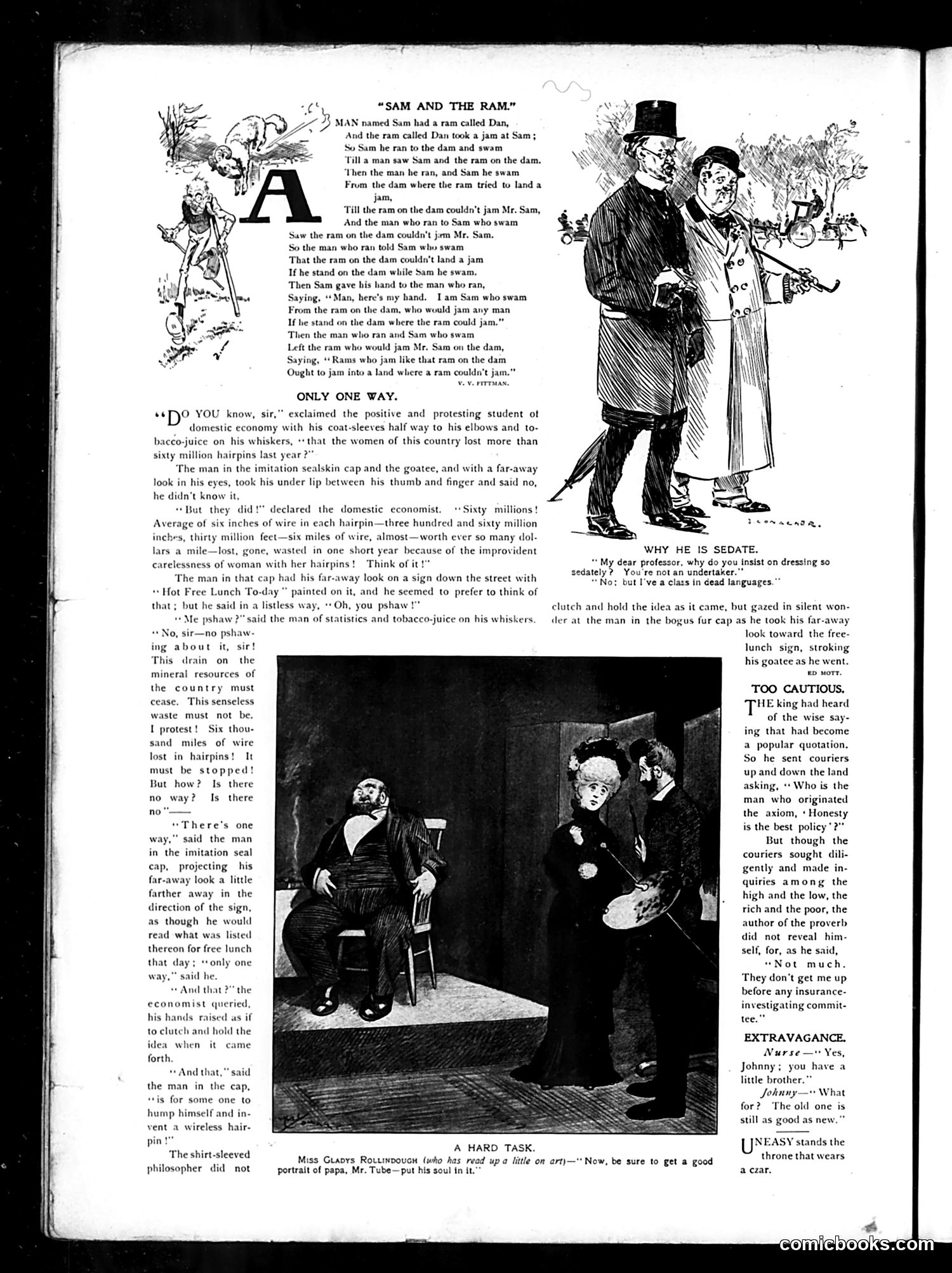
This page contains three satirical pieces targeting American social and economic attitudes of the early 20th century. **"Sam and the Ram"** is a tongue-twister poem mocking verbose, repetitive speech—likely satirizing political rhetoric or bureaucratic jargon of the era. **"Only One Way"** ridicules a pedantic "domestic economist" who obsesses over lost hairpins as a national crisis, wasting six miles of wire annually. The joke targets both his humorless moralizing about women's "improvidence" and his absurd extrapolation of minor losses into catastrophic statistics. The unnamed figure with the "far-away look" represents the indifferent everyman, unimpressed by statistical doomsaying. **"Why He Is Sedate"** and subsequent vignettes feature this same far-away-looking character in a sealskin cap, used as a recurring comedic device to contrast earnest questioners with his detached, pragmatic indifference. The overall thrust mocks reform-minded intellectuals, statistics-obsessed moralists, and sanctimonious hand-wringing about trivial matters—common Judge targets throughout its satirical tradition.
📄 Transcribed text from this page (OCR, searchable)
Machine-transcribed from the original scan — historical spelling and the odd misread are preserved.
ay “SAM AND THE RAM.” ZZ, D MAS named Sam had a ram called Dan, And the ram called Dan took a jam at Sam; So Sam he ran to the dam and swam Till a man saw Sam and the ram on the dam. ‘Then the man he ran, and Sam he swam From the dam where the ram tried to land a jam, Till the ram on the dam couldn't jam Mr. S id the man who ran to Sam who swam Saw the ram on the dam couldn't jem Mr. Sam. So the man who ran told Sam whe swam That the ram on the dam couldn't land a jam If he stand on the dam while Sam he swam. Then Sam gave his hand to the man who ran, Saying, “Man, here's my hand. Iam Sam who swam From the ram on the dam, who would jam any man If re stand on the dam where the ram could jam." Then the man who ran and Sam who swam Left the ram who would jam Mr, Sam on the dam, Saying, “Rams who jam like that ram on the dam Ought to jam into a land where a ram couldn't jam.” ONLY ONE WAY. s6P)O YOU know, sir,” exclaimed the positive and protesting student ot domestic economy with his coat-sleeves half way to his elbows and to- bacco-juice on his whiskers, «that the women of this country lost more than sixty million hairpins last year 2” ‘The man in the imitation sealskin cap and the goatee, and with a far-away look in his eyes, took his under lip between his thumb and finger and said no, he didn’t know it, “But they did!” declared the domestic economist. “Sixty millions! Ay of six inches of wire in each hairpin—three hundred and sixty million inches, thirty million feet—six miles of wire, almost—worth ever so many dol- lars a mile—lost, gone, wasted in one short year because of the improvident WHY HE IS SEDATE. “: My dear professor, why do you insist on dressing so . sedately? You're not an undertaker.”* The man in that cap had his far-away look on a sign down the street with "No: but I've a class in dead languages.”” “Hot Free Lunch To-day” painted on it, and he seemed to prefer to think of that; but he said in a listless way, *Oh, you pshaw !"° clutch and hold the idea as it came, but gazed in silent won- + Me pshaw ?"'said the man of statistics and tobacco-juice on his whiskers. der at the man in the bogus fur cap as he took his far-away look toward the free- lunch sign, stroking his goatee as he went. eo wort. carelessness of woman with her hairpins! Think of it!" “« No, sir—no pshaw- ing about it, sir! This drain on the mineral resources of the country must TOO CAUTIOUS. cease. This senseless THE king had heard waste must not be. P of the wise say- I protest! Six thou. f ing that had become sand miles of wire , a popular quotation. lost in hairpins! It So he sent couriers must be stopped! up and down the land But how? Is there , asking, ** Who is the no way? Is. there man who originated no "— the axiom, + Honesty here’s one is the best policy?” way,” said the man But though the in the imitation seal } couriers sought dili- gently and made in- cap, projecting his ; far-away look a little = , quiries among the if high and the low, the rich and the poor, the author of the proverb did not reveal him- self, for, as he said, “Not much. way,” said he. They don’t get me up And that?” the before any insurance- investigating commit- tee.” farther away in the direction of the sign, as though he would read what was listed thereon for free lunch that day; “only one economist queried, his hands raised as if toclutchandholdthe P EXTRAVAGANCE. idea when it’ came ; Nurse—« Yes, forth : h h + And that,” said - Jobeny i you havea the man in the cap, z s a . b 7 H little brother. ‘ aps ‘ > Johnny—« What s+is for some one to : : q : for? The old one is hump himself and in- % . i 3 ~ still as good as new. vent a wireless hair- = pin!” A HARD TASK. The shirt-sleeved Miss Gaps Rottinpoucn (who has read upa little on art)—"* Now, be sure to get a good philosopher did not portrait of papa, Mr. Tube—put his soul in it." a czar. NEASY stands the throne that wears