
A complete issue · 16 pages · 1906
Judge — February 17, 1906
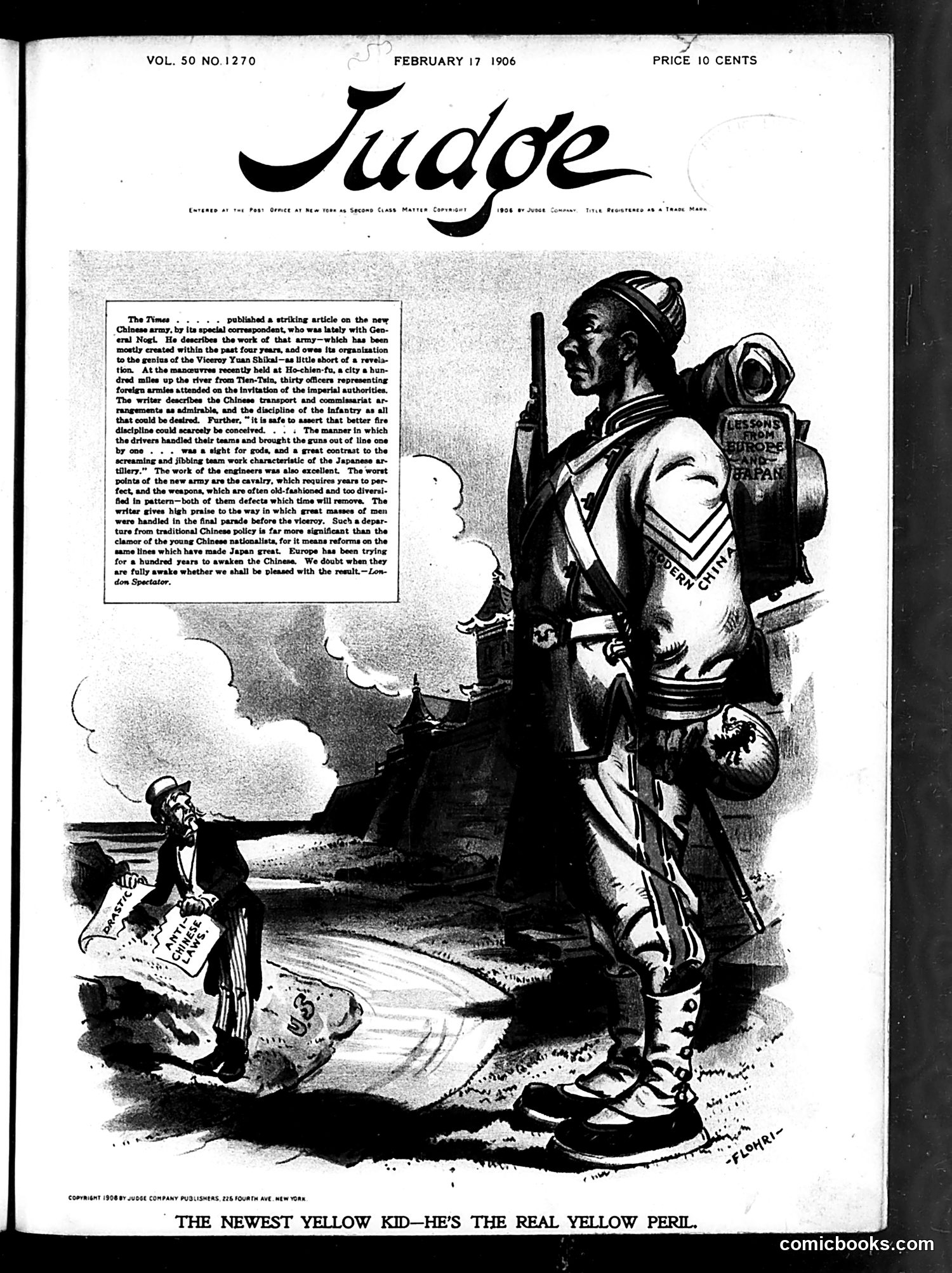
This 1906 *Judge* cartoon satirizes American anxieties about Chinese immigration and military power. The large figure appears to represent China or a Chinese soldier, depicted as a threatening, towering presence. The smaller figure at left—labeled with what seems to be American or Western insignia—looks diminished by comparison. The title plays on "The Yellow Kid," a famous newspaper comic character, while invoking "Yellow Peril"—a contemporary racist phrase describing fears of Asian dominance. The accompanying article discusses Chinese military organization and General Hoel, suggesting contemporary concerns about China's modernization and military strength. The cartoon expresses early-20th-century American xenophobia, presenting Chinese military development as an existential threat to Western interests.
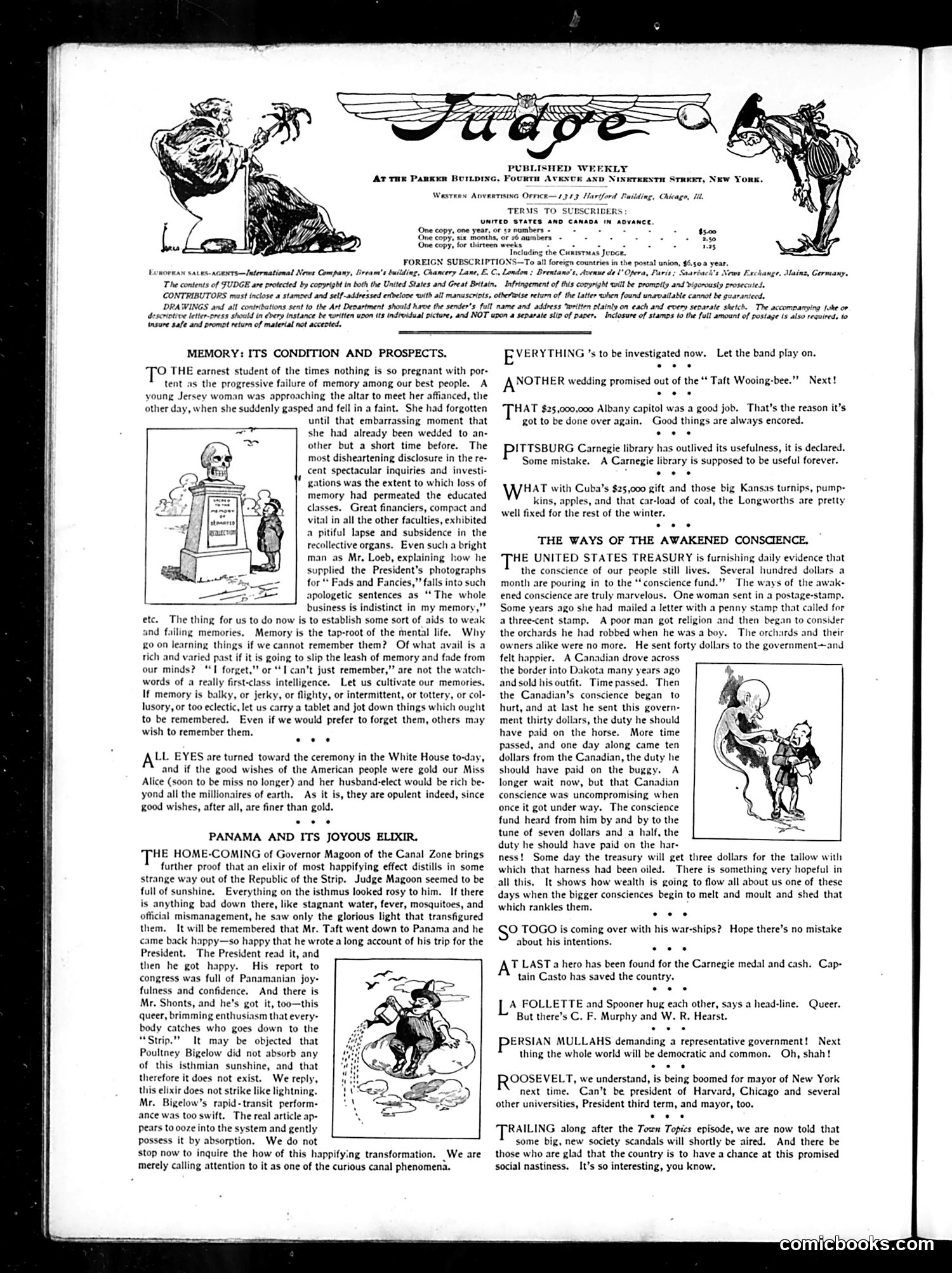
This page contains multiple satirical commentary pieces rather than single cartoons. The content critiques early 1900s American politics and society: **"Memory: Its Condition and Prospects"** mocks the public's forgetfulness about scandals, using a monument inscription joke about remembering nothing. **"Panama and Its Joyous Elixir"** satirizes Governor Magoon's return from the Canal Zone, suggesting colonial administration brought only disease and misery despite official optimism. **"The Ways of the Awakened Conscience"** ridicules wealthy Americans' selective moral awakenings—donating to causes after profiting from questionable practices—through anecdotes about guilt-driven charity. The cartoons feature sketched illustrations supporting these written commentaries. The overall tone suggests skepticism toward political claims, corporate ethics, and American imperialism during the Progressive Era.
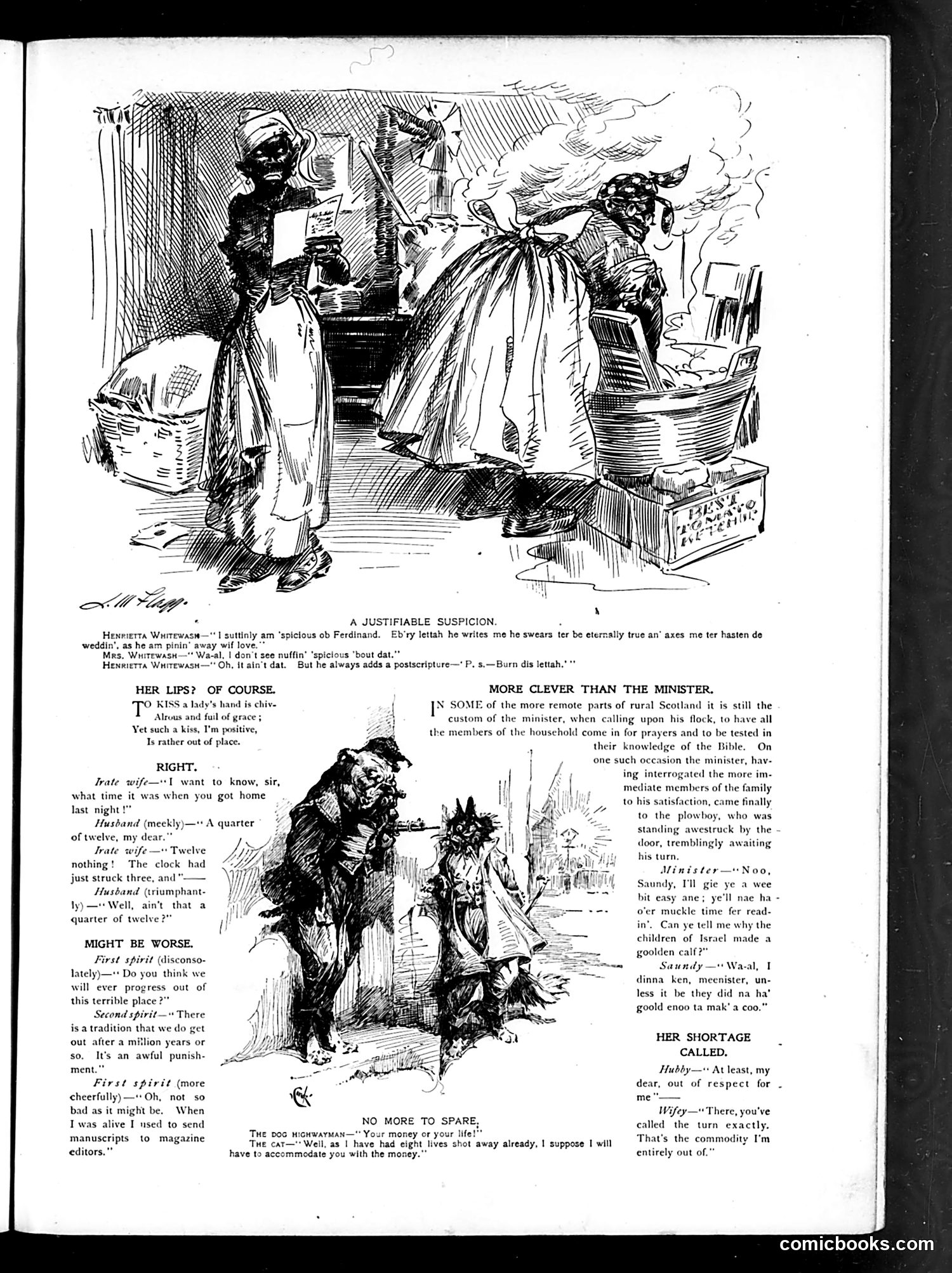
This page contains three separate humor pieces: 1. **"A Justifiable Suspicion"** (top): Shows domestic servants examining a woman's correspondence. The joke involves suspicion about infidelity—a husband demands written proof of fidelity, which the wife finds absurd and insulting. 2. **"Her Lips? Of Course"** (left): A brief marital dialogue where a husband questions a kiss's authenticity, escalating into comic absurdity about time measurements and marital discord. 3. **"More Clever Than the Minister"** (right): A Scottish rural scene where a minister tests household members on biblical knowledge. A plowboy outsmarts him by explaining a theological point better than expected—satirizing assumptions about rural ignorance versus urban education. These are gentle domestic and class-based humor pieces typical of early-20th-century American satire.
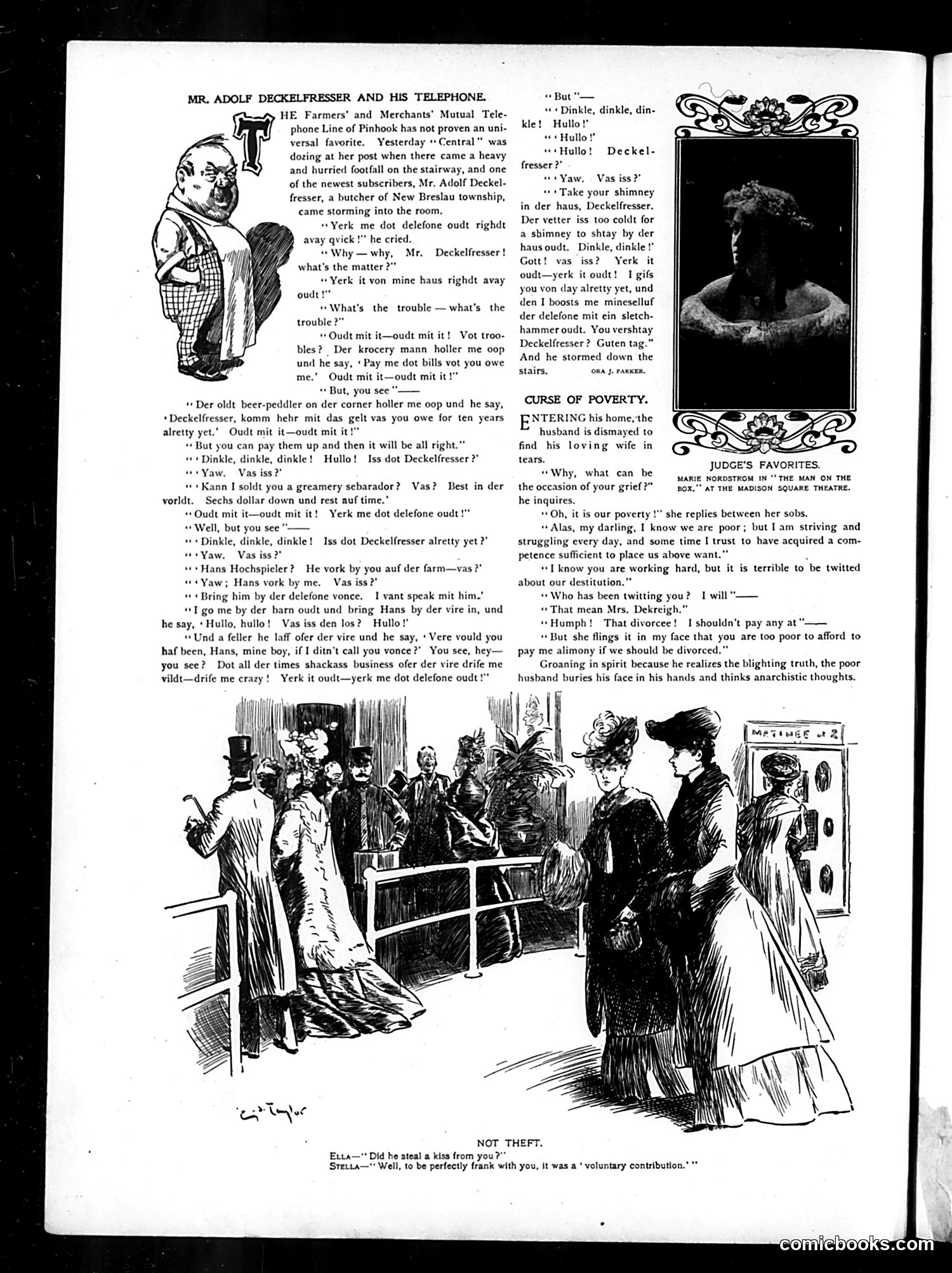
**Top Section - "Mr. Adolf Deckelfresser and His Telephone":** This satirical piece depicts a German butcher (identifiable by the German dialect used throughout) conducting an absurd phone conversation with his grocer about unpaid bills. The humor relies on ethnic stereotype—exaggerated German accent and mannerisms—and the character's circular logic attempting to avoid payment obligations. The joke plays on the incompetent small businessman. **Middle Section - "Curse of Poverty":** A brief domestic drama showing a poor couple's marital strain caused by financial hardship. The husband refuses to pay alimony in divorce proceedings because they're too poor. **Bottom Section - "Not Theft":** A society gathering where two women debate whether a kiss constitutes "theft" or a "voluntary contribution." This reflects contemporary debates about consent and propriety in courtship. The page exemplifies Judge's focus on class commentary and social satire through comedic scenarios.
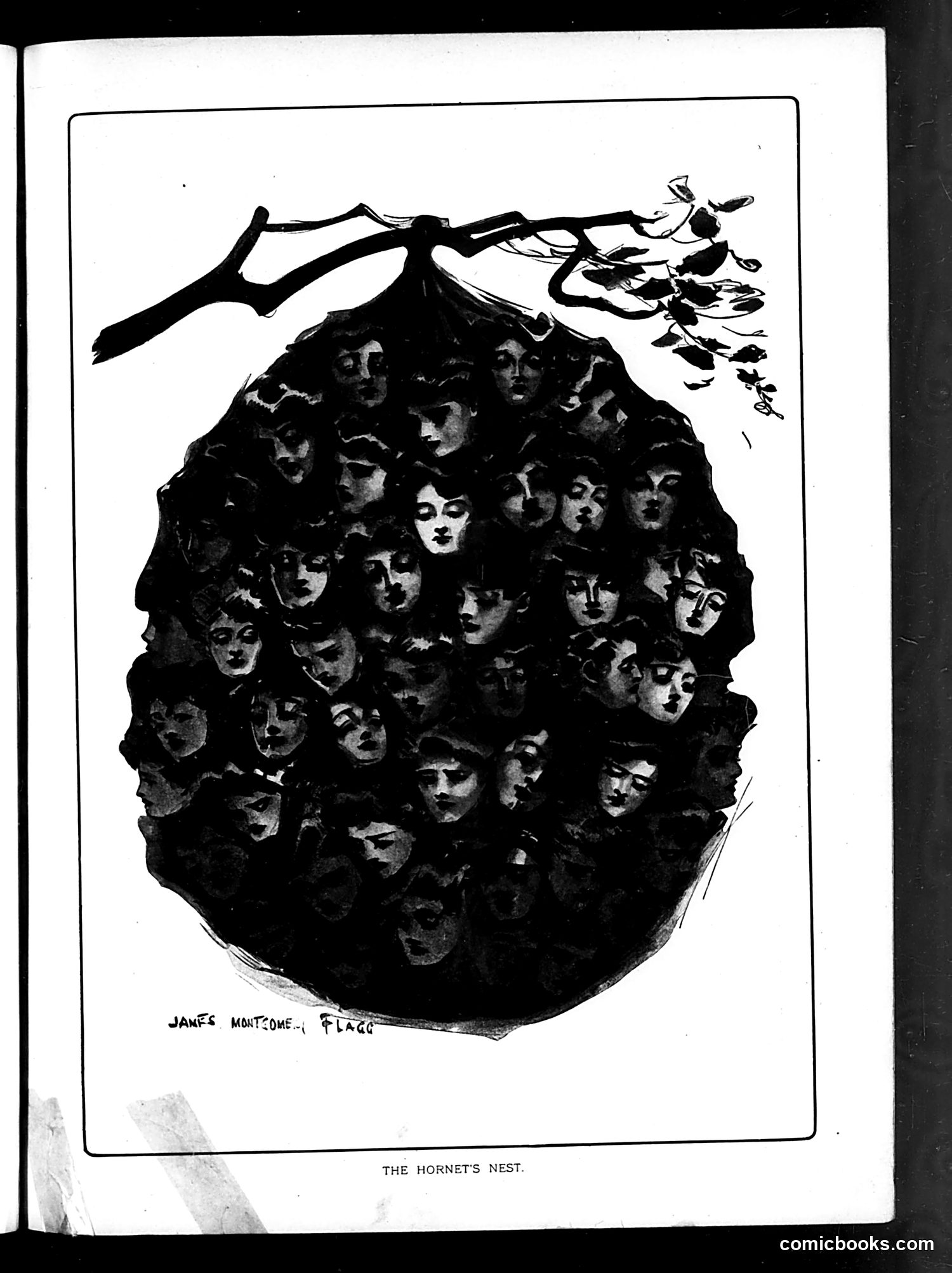
This political cartoon by James Montgomery Flagg depicts a large hornets' nest filled with numerous female faces, with a bare branch above from which hornets emerge and scatter. The title "The Hornet's Nest" is a metaphorical warning. The cartoon appears to satirize women's activism or political organizing—likely referencing the suffrage movement or broader women's rights agitation of the early 20th century. The densely packed female faces represent organized female political power as a "nest" of aggravating forces, while the escaping hornets suggest this movement creating widespread social disruption or controversy. The satire mocks women's collective political action as inherently chaotic and troublesome to society.
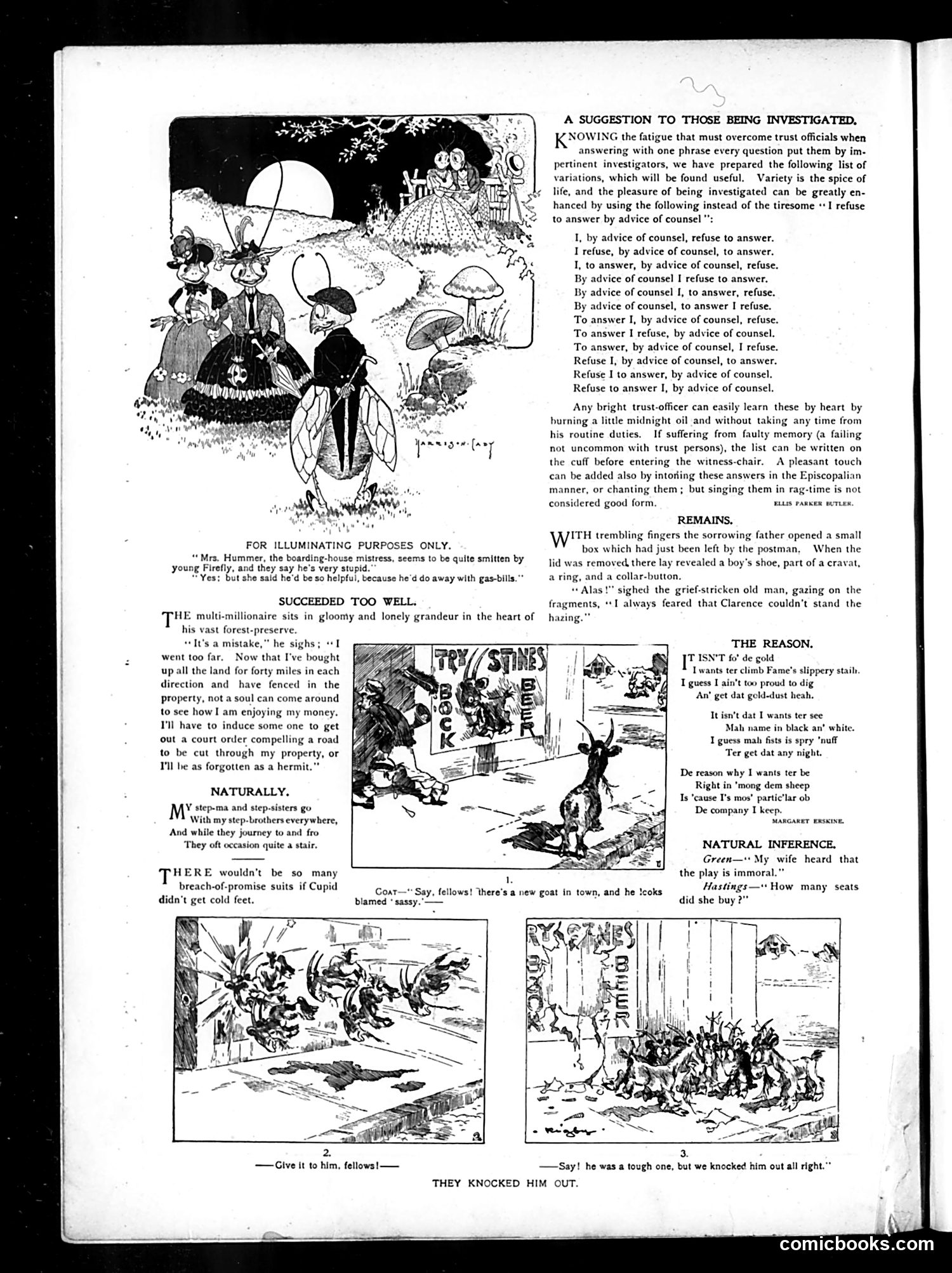
This Judge magazine page contains several satirical pieces: **"A Suggestion to Those Being Investigated"** mocks officials undergoing trust/corruption investigations (likely corporate trustees or government figures) who repeatedly invoke "advice of counsel" to avoid answering questions. The satire presents absurd grammatical rearrangements of the same evasion, suggesting officials are using legalistic language as a transparent dodge. **"Succeeded Too Well"** satirizes a wealthy industrialist who bought vast land holdings to create a private forest preserve, only to realize his exclusivity means nobody visits—defeating his goal of displaying his wealth and status. The shorter humorous pieces address everyday topics: a landlady attracted to a "firefly" for utility rather than romance, step-relations causing social disruption, broken engagements, and hazing (a college practice where initiation caused a student's death). These satirize wealth, legal evasion, and social pretension typical of Gilded Age Judge humor, targeting the privileged and powerful.
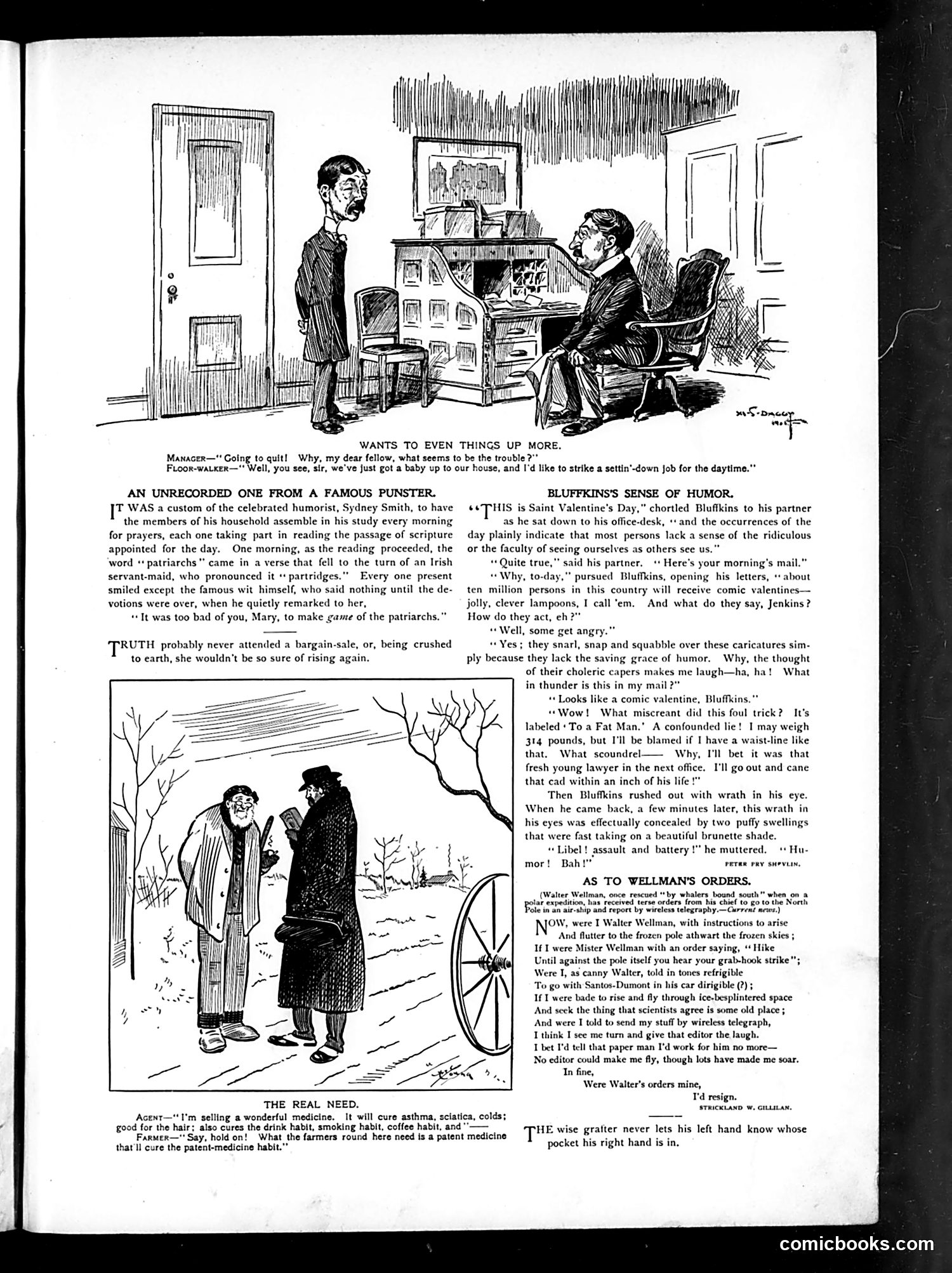
This Judge magazine page contains three satirical pieces: **"Wants to Even Things Up More"** (top cartoon): A floor-walker (store employee) asks his manager to quit for a daytime job because he's just become a father and wants "a settin'-down job"—wordplay on childcare duties. The joke relies on Victorian class humor about working-men balancing employment with domestic responsibilities. **"Bluffkins's Sense of Humor"** (middle): A hypocritical businessman ridicules others for getting angry at insulting valentine cards, then receives one calling him fat. He immediately assaults the sender, then returns bruised—the satire mocking his lack of self-awareness and the irony that he himself can't take the humor he preaches. **"As to Wellman's Orders"** (bottom poem): References explorer Walter Wellman's Arctic expedition via airship with wireless communication. The poem humorously imagines Wellman receiving absurd orders to fly to the North Pole and file reports remotely, then resigning—satirizing both the expedition's ambition and editorial demands on journalists.
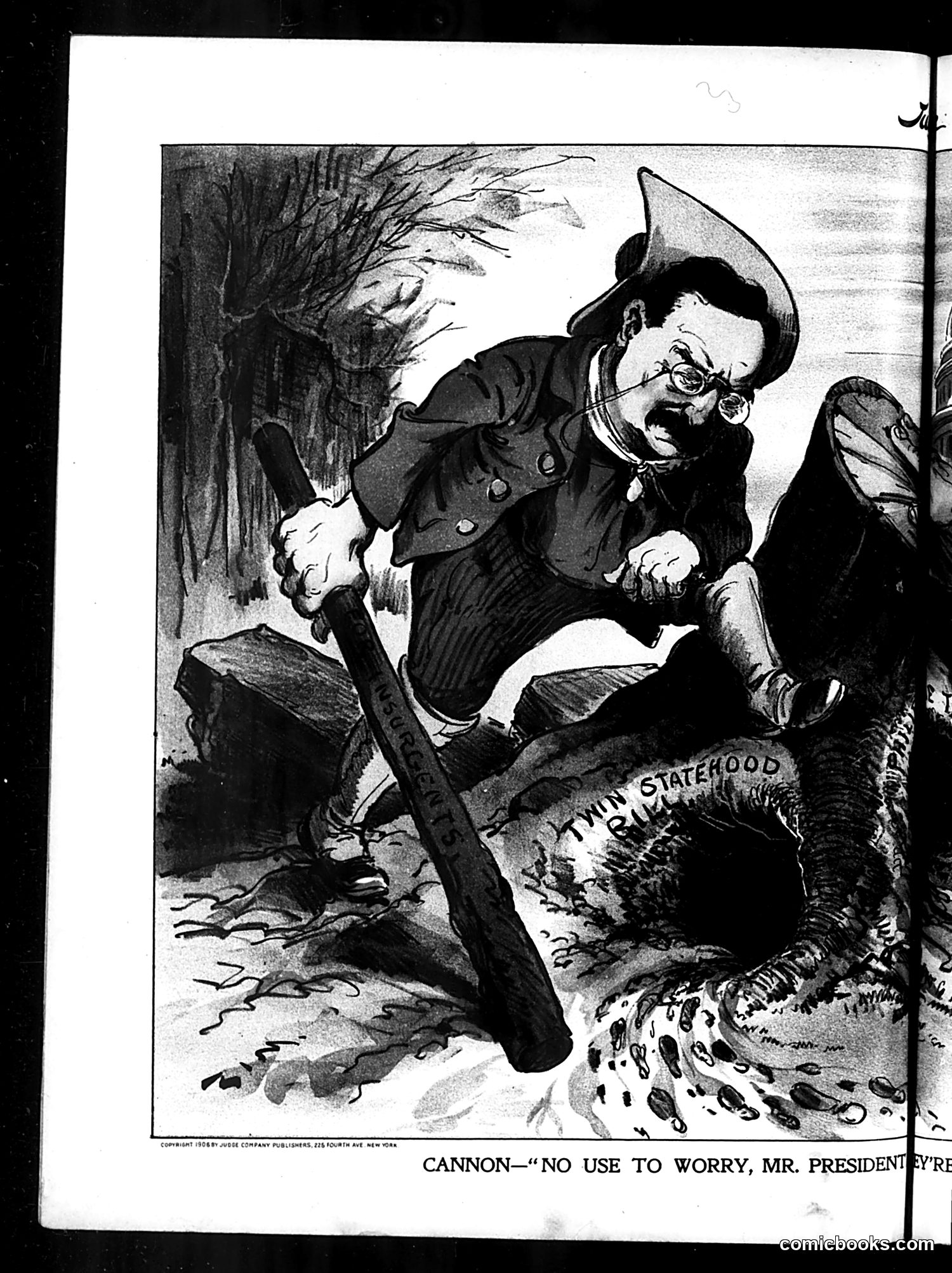
This Judge magazine cartoon titled "No Use to Worry, Mr. President" depicts a caricatured figure in formal dress (appearing to be a president based on the caption) sitting atop what's labeled "Twin Statehood Right" — likely referring to the admission of Arizona and New Mexico as states. The figure appears anxious or distressed, while another character (possibly representing a political opponent or satirist) reassures him not to worry. The bare tree and desolate setting suggest hardship or difficult times. Without the specific date visible, the exact political context remains unclear, though this likely satirizes either the statehood process itself or concerns a president had regarding these admissions. The cartoon's point appears to mock the president's anxieties as unfounded.
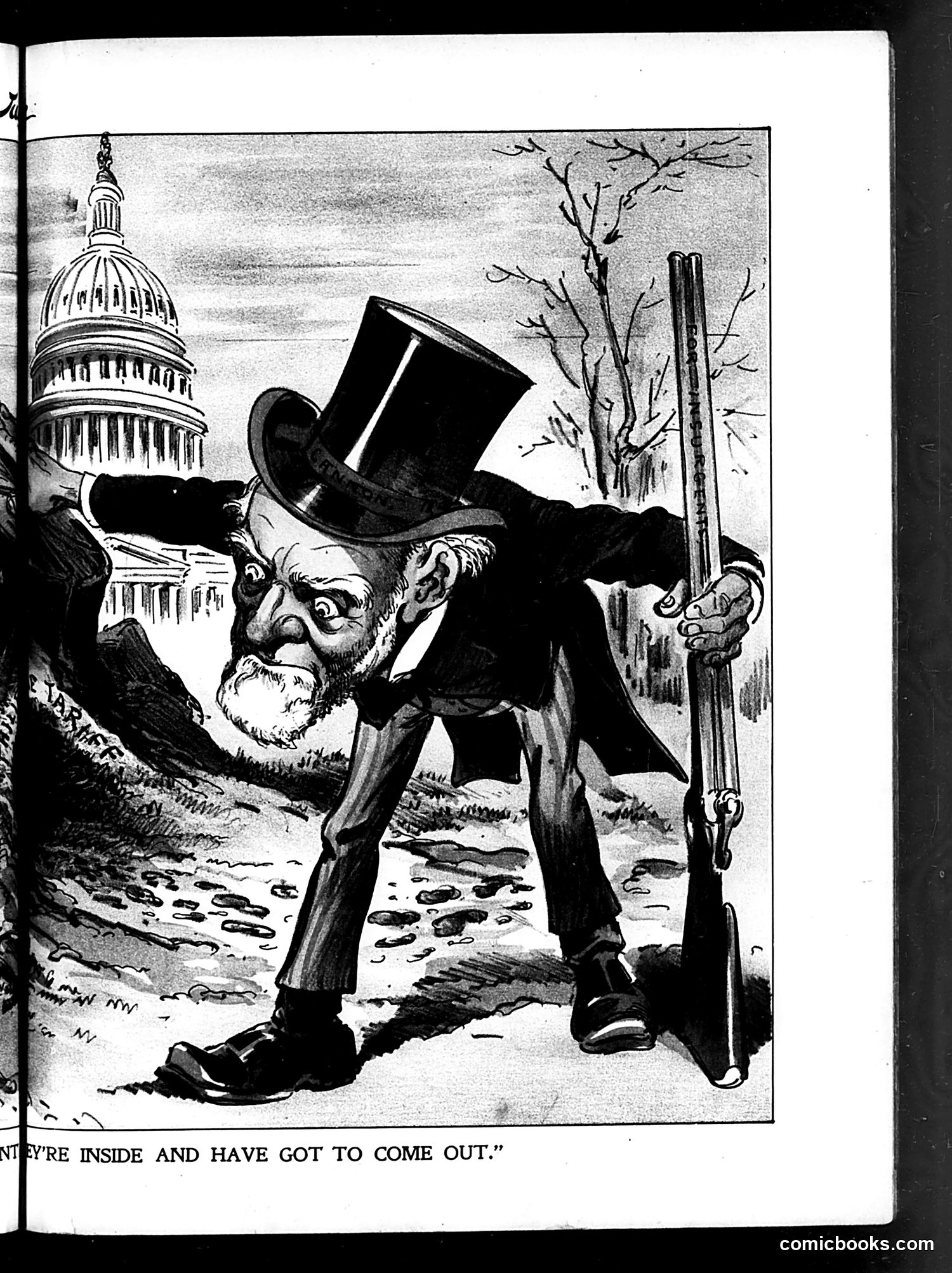
This is a satirical cartoon depicting a bearded man in formal attire and top hat, wielding a rifle or similar weapon outside the U.S. Capitol building. The partial caption reads: "...YOU'RE INSIDE AND HAVE GOT TO COME OUT." The cartoon appears to criticize a political figure or movement attempting to force someone out of the Capitol—likely depicting a confrontation over political control or removal from office. The caricatured features and aggressive posture suggest this is commentary on political violence or coercion in American governance. Without the full caption and publication date, I cannot definitively identify the specific figure or historical event referenced. However, the imagery clearly satirizes the use of force or threats in political disputes, a common Judge magazine theme addressing governance conflicts and political corruption.
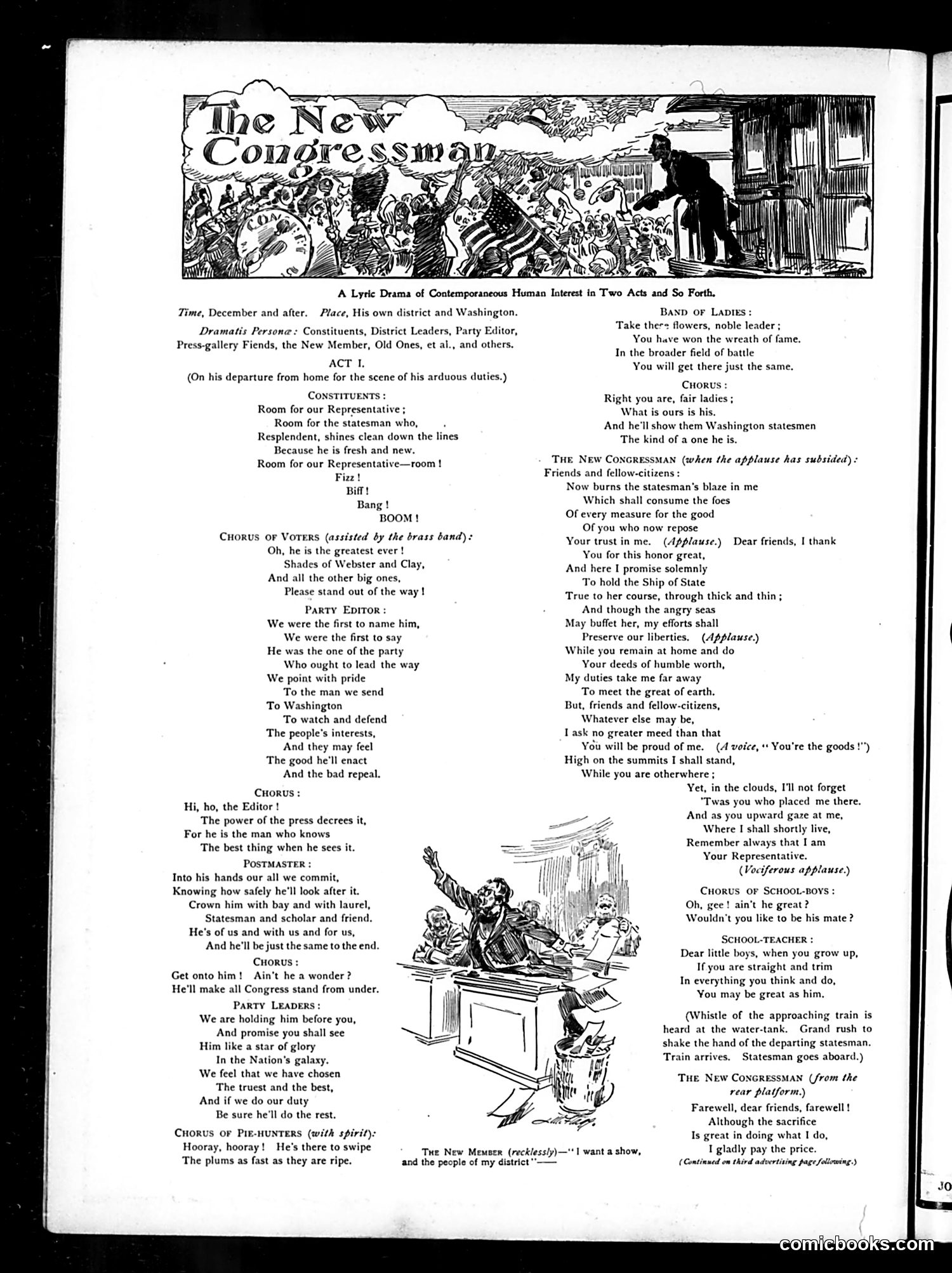
This is a theatrical satire mocking the inflated rhetoric and empty promises surrounding a newly elected congressman's departure for Washington. The "lyric drama" format parodies the grandiose send-off the newcomer receives from his constituents, party leaders, and press. The satire targets several absurdities: constituents treating him as a savior ("greatest ever," compared to Webster and Clay); the editor's self-congratulation for "naming" him; the congressman's melodramatic vows to "hold the Ship of State" while standing "high on the summits"; and the obsequious chorus of pie-hunters, school-teachers, and party leaders pledging blind loyalty. The central joke is the disconnect between humble reality and grandiose expectation—the young politician promises the world while his constituents remain home doing "deeds of humble worth." Judge suggests politicians routinely exploit constituent worship and patriotic rhetoric to advance themselves, knowing their lofty promises are theater.
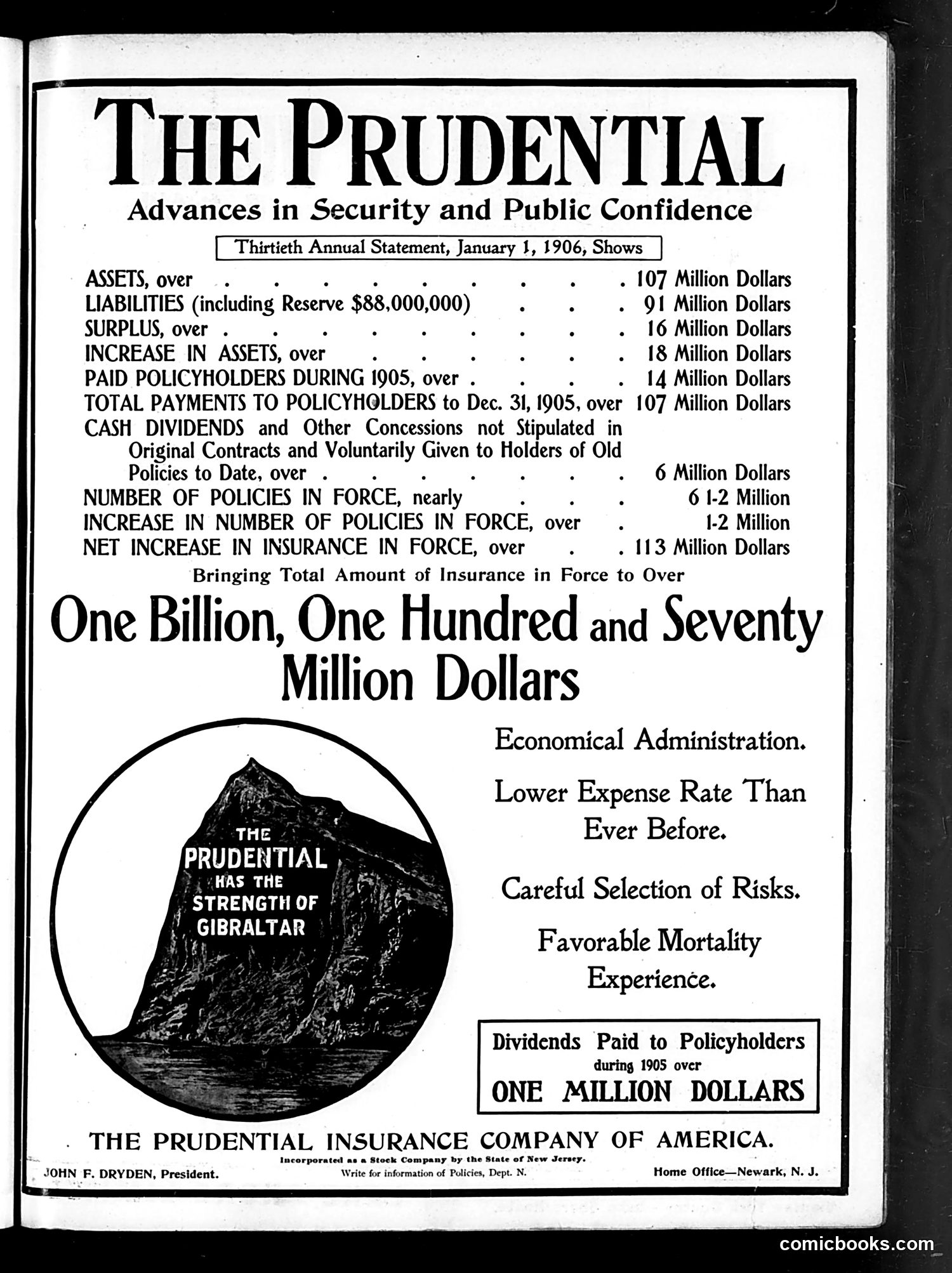
This is a **full-page advertisement**, not satire or political commentary. It's The Prudential Insurance Company's announcement of their 1906 financial results, placed in *Judge* magazine. The page showcases impressive figures: over $1.17 billion in insurance force, $107 million in assets, and $1 million in dividends paid to policyholders. The Rock of Gibraltar image reinforces the company's stability and trustworthiness—a common insurance industry metaphor suggesting strength and permanence. The tagline "Advances in Security and Public Confidence" emphasizes how well the company performed financially. This was a form of corporate boasting: displaying growth and dividends to attract new customers and reassure existing policyholders of the company's soundness. The ad reflects early-20th-century insurance industry confidence, before major regulatory reforms.
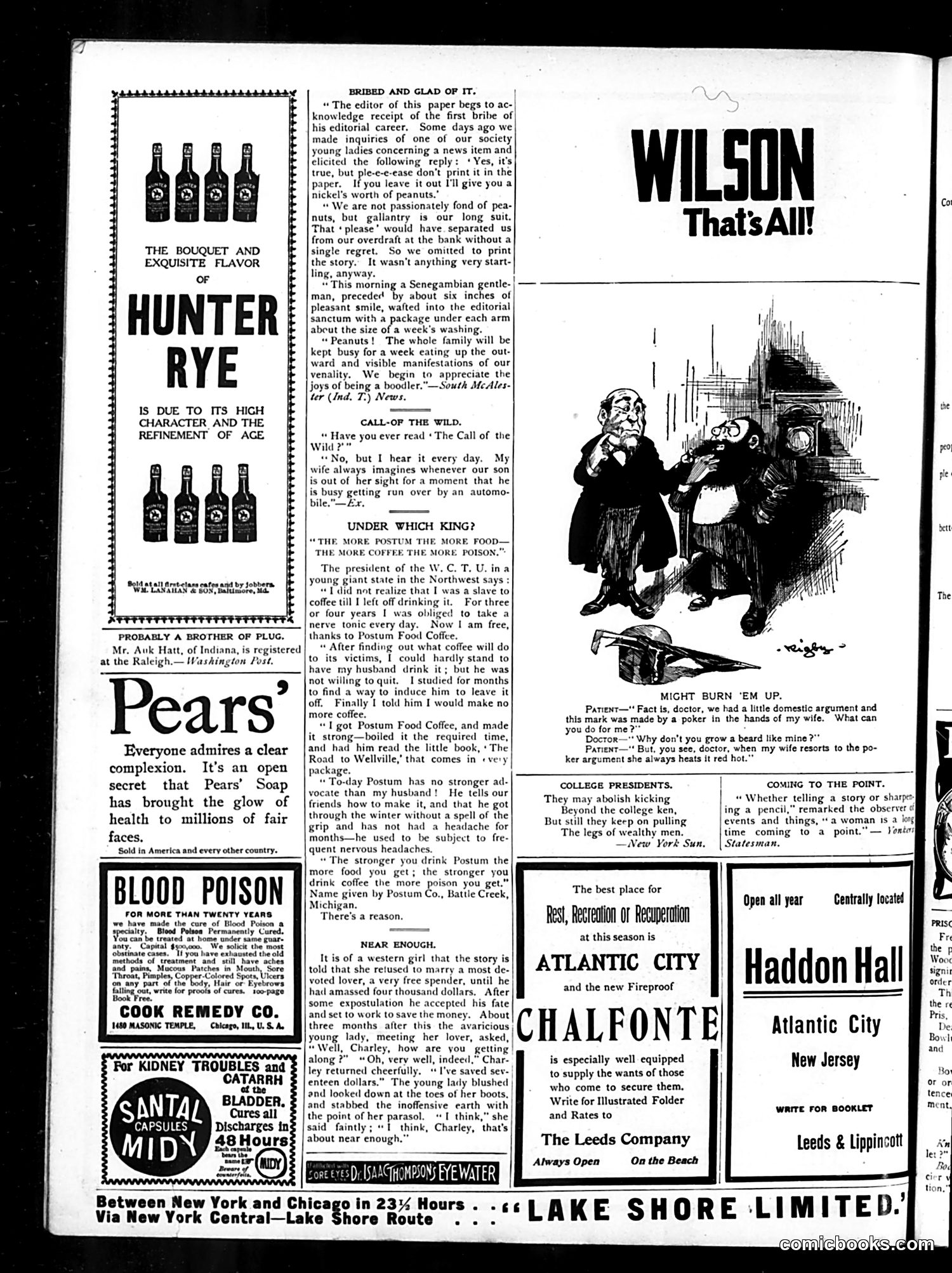
This page is primarily **advertisements and humor pieces**, not political satire. The main cartoon, titled "MIGHT BURN 'EM UP," depicts a domestic argument where a husband and wife quarrel—he asks why she doesn't grow a beard, and she retorts that she'd rather beat him with a red-hot poker. It's a lighthearted, anti-feminist joke typical of the era, mocking women's tempers. The longer text piece "BRIBED AND GLAD OF IT" is satirical commentary on journalistic ethics. An editor jokes about accepting bribes (peanuts) from a society girl to suppress gossip, then receives gifts from a "Senegambian gentleman." The satire targets editorial corruption and the compromising of journalistic integrity. The remaining content consists entirely of **patent medicines and consumer advertisements** (Pears' Soap, Blood Poison cure, Postum coffee, etc.)—standard magazine filler of that era. The page reflects early 20th-century attitudes: casual racism, dismissive treatment of women, and aggressive advertising for dubious medical remedies.
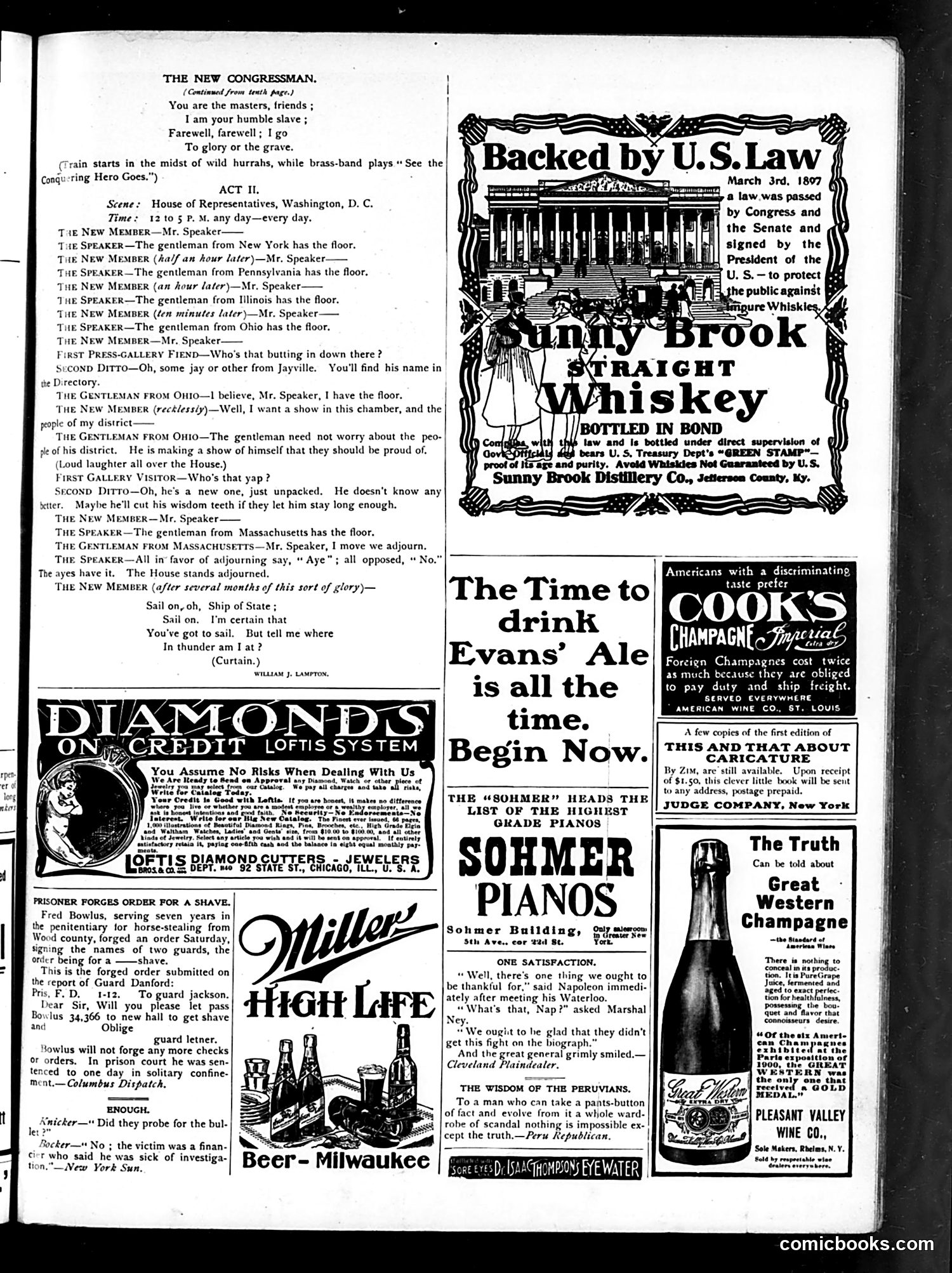
This theatrical sketch mocks the futility and irrelevance of newly-elected congressmen in the House of Representatives. The unnamed "New Member" from New York arrives full of idealistic speeches about serving his constituents ("You are the masters, friends; I am your humble slave"), but immediately becomes invisible once legislative business begins. Over several months, the Speaker repeatedly denies him the floor, always yielding to other representatives instead. When he finally attempts to speak, an experienced congressman from Ohio publicly humiliates him, getting laughter from the entire chamber. Gallery observers dismiss him as ignorant and inexperienced ("just unpacked"). The satire's point: new congressmen, despite grand campaign promises, are powerless and irrelevant in the actual functioning of Congress. The New Member's final soliloquy—confused about his own position ("In thunder am I at?")—captures the disorientation of discovering one's political idealism means nothing in institutional reality. The sketch, by William J. Lampton, reflects Progressive Era skepticism toward American political institutions and their resistance to reform-minded newcomers.
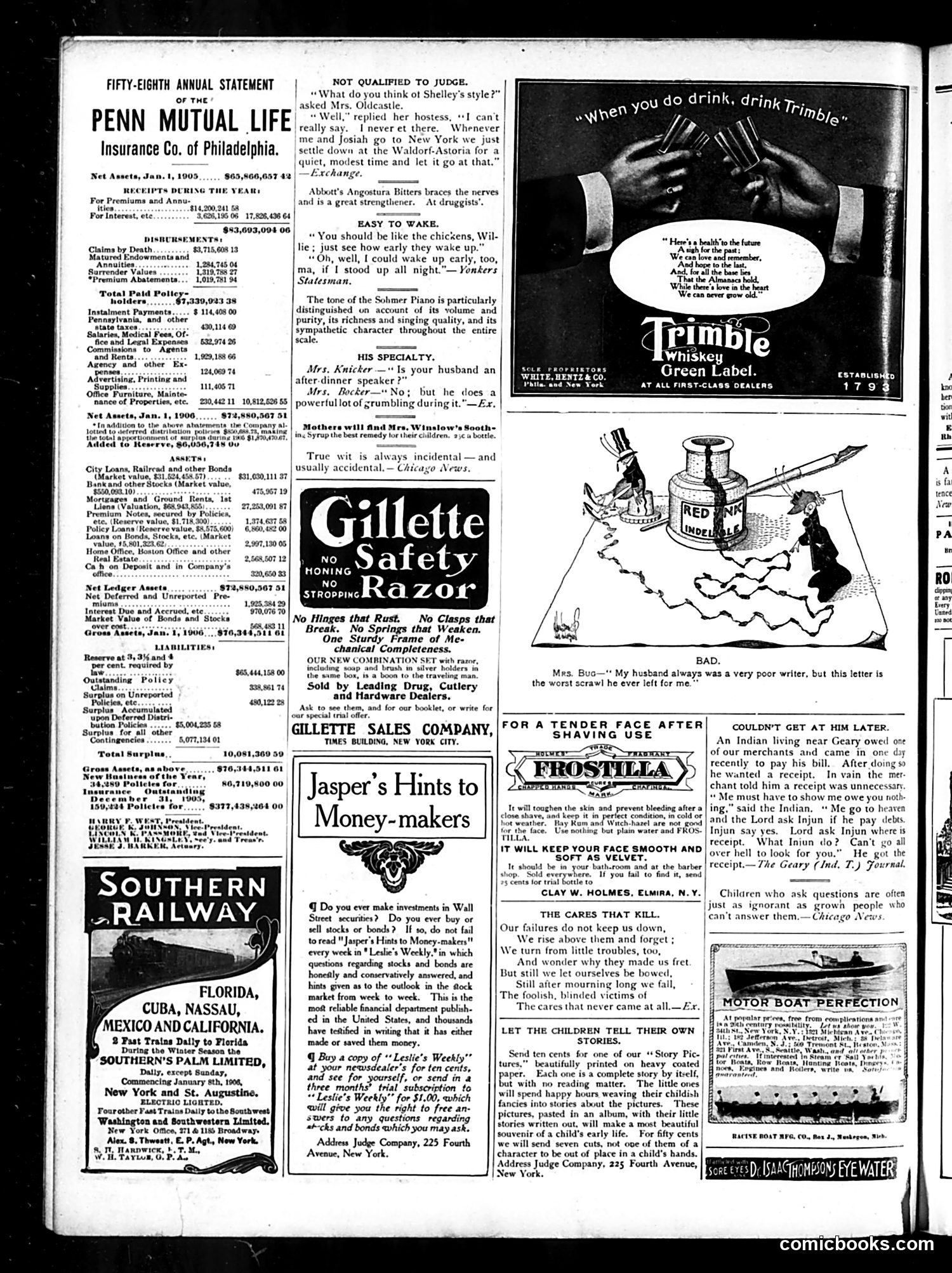
This page is primarily a **financial statement and advertisements** from *Judge* magazine (circa 1906). The Penn Mutual Life Insurance Company's annual report dominates the left side, while the right features period advertisements and brief humorous snippets. The cartoons/humor are minimal and incidental: - **"Not Qualified to Judge"**: A wealthy woman admits she can't critique Shelley's literary style because she's never actually read him—only stayed at the Waldorf-Astoria hotel. The satire targets pretentious society figures who posture about culture without genuine knowledge. - **"Easy to Wake"**: A child's literal logic joke—if chickens wake early because they stand all night, he could do the same. - **"His Specialty"**: A husband's specialty is complaining during dinner, not speaking eloquently. The advertisements (Trimble Whiskey, Gillette Safety Razors, Southern Railway, Frostilla shaving cream) are straightforward period marketing with minimal satirical content. The page reflects *Judge*'s mixed editorial-commercial format typical of early 1900s magazines.
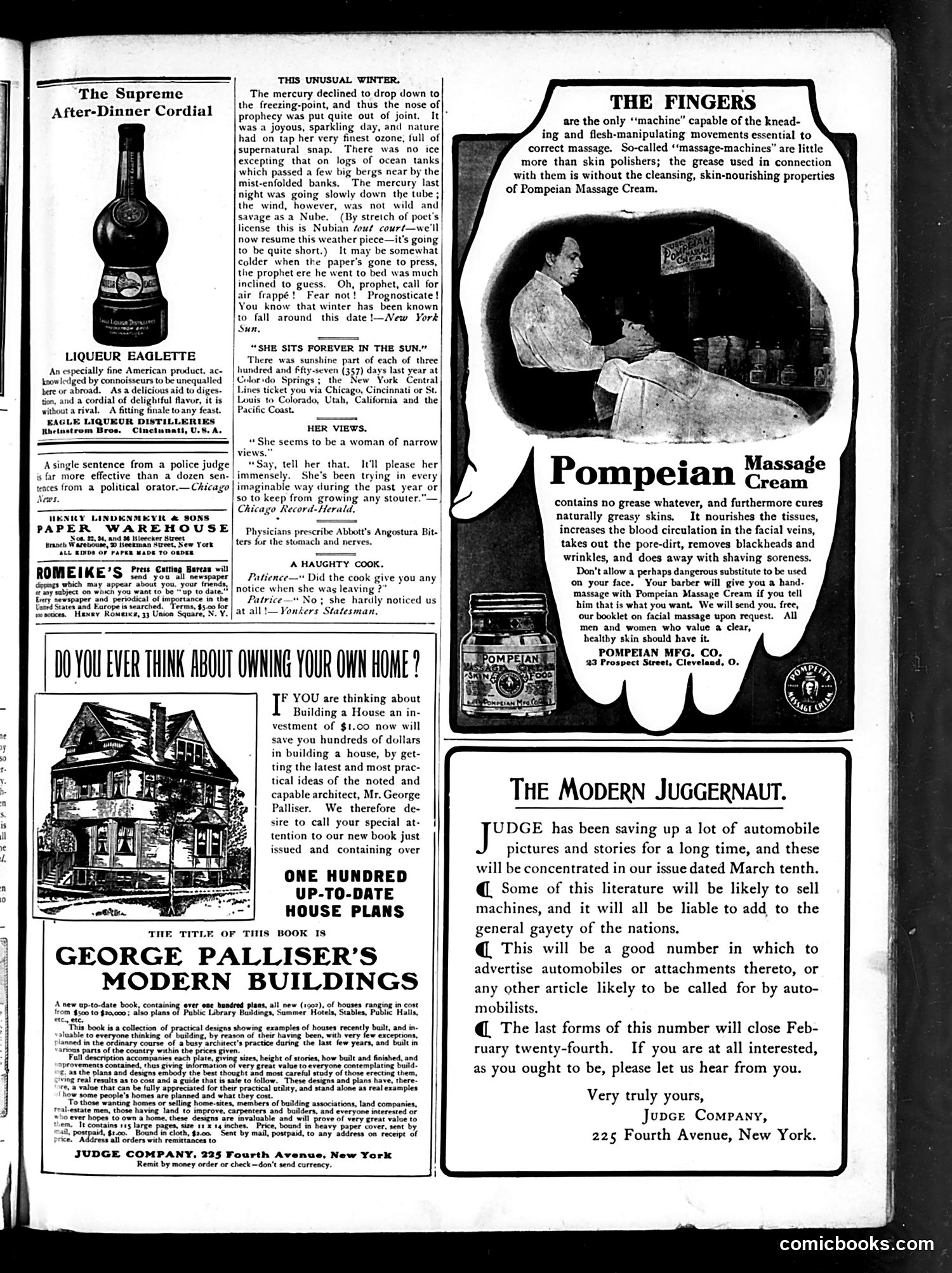
This page is primarily **advertising and filler content** rather than political satire. The main elements include: **"The Supreme After-Dinner Cordial"** — A liqueur advertisement for Eagle Liqueur, positioned as a digestive aid. **Weather commentary** — A brief, whimsical piece about an unusually warm winter in New York, with poetic language about temperature and nature. **Pompeian Massage Cream advertisement** — The largest visual element, featuring a woman receiving a facial massage, emphasizing that human fingers (not machines) provide proper massage benefits. **Miscellaneous short jokes and notices** — Including quips about police judges, a cook's vanity, and Abbott's Angostura Bitters. **"Do You Ever Think About Owning Your Own Home?"** — An advertisement for George Palliser's architecture book offering house plans. The page lacks coherent satirical commentary on contemporary politics or events. It appears to be a typical early 20th-century magazine mix of advertising, light humor, and promotional content—representative of Judge's business model rather than its editorial voice.
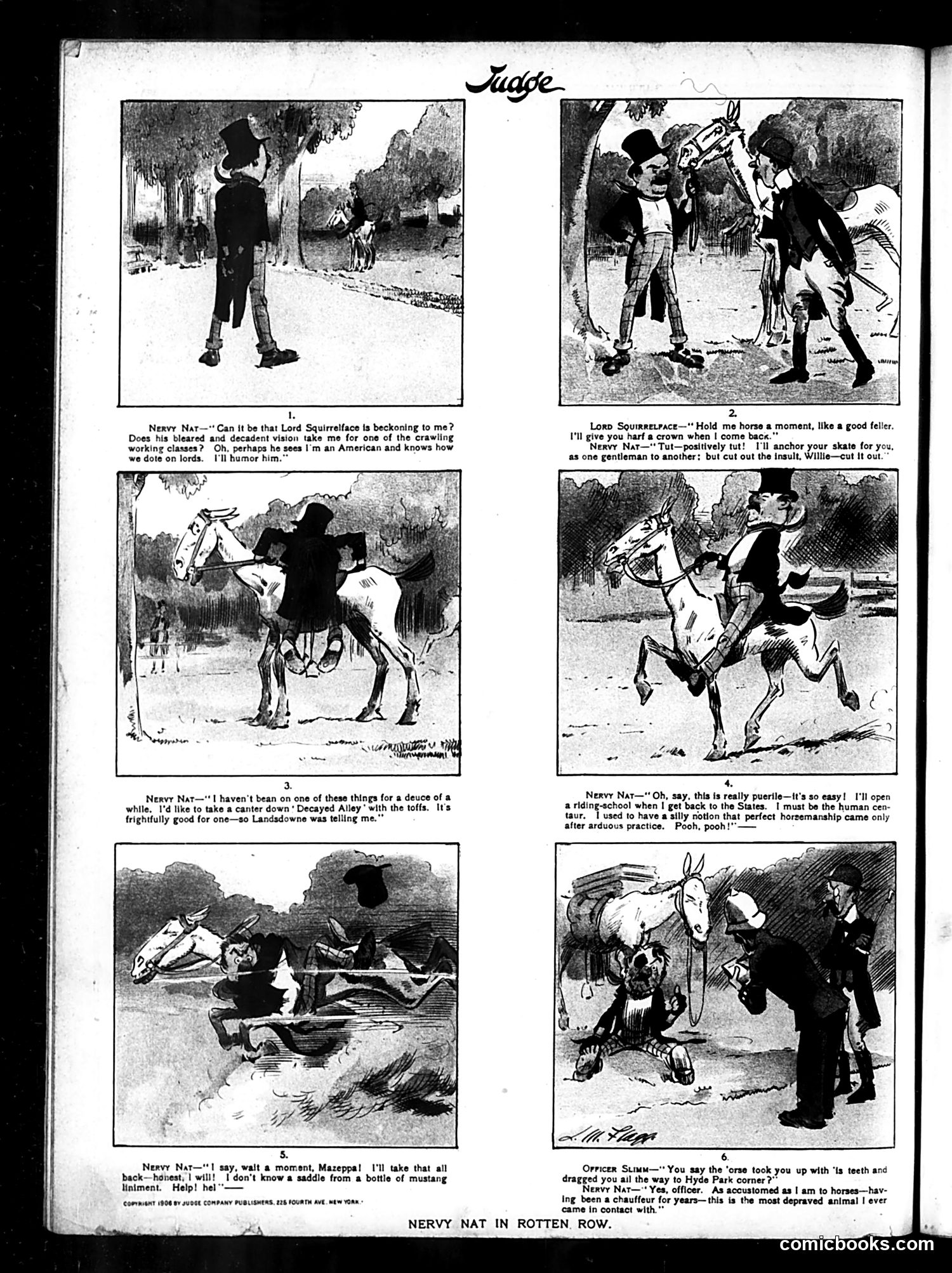
This six-panel comic satirizes an American ("Nervy Nat") attempting to blend into London's upper-class society at Rotten Row, an exclusive equestrian area in Hyde Park. The humor stems from his incompetence and affected pretension. The satire targets: - **American social climbing**: Nat assumes wealth equals sophistication and tries mimicking British aristocracy ("Lord Squirrelface," references to "the toffs") - **Actual incompetence masked by bluster**: Despite claiming riding mastery, he immediately loses control of the horse and ends up unseated - **Class pretense**: He speaks in exaggerated British affectations while admitting ignorance (can't distinguish saddles from bottles) - **Self-deception**: Each failure is met with dismissal rather than humility The title "Rotten Row" puns on the area's name, suggesting the American's visit there is morally questionable or simply absurd. The joke assumes readers understand that wealthy Americans often attempted—and failed at—adopting British mannerisms during this era.