
A complete issue · 16 pages · 1905
Judge — November 25, 1905
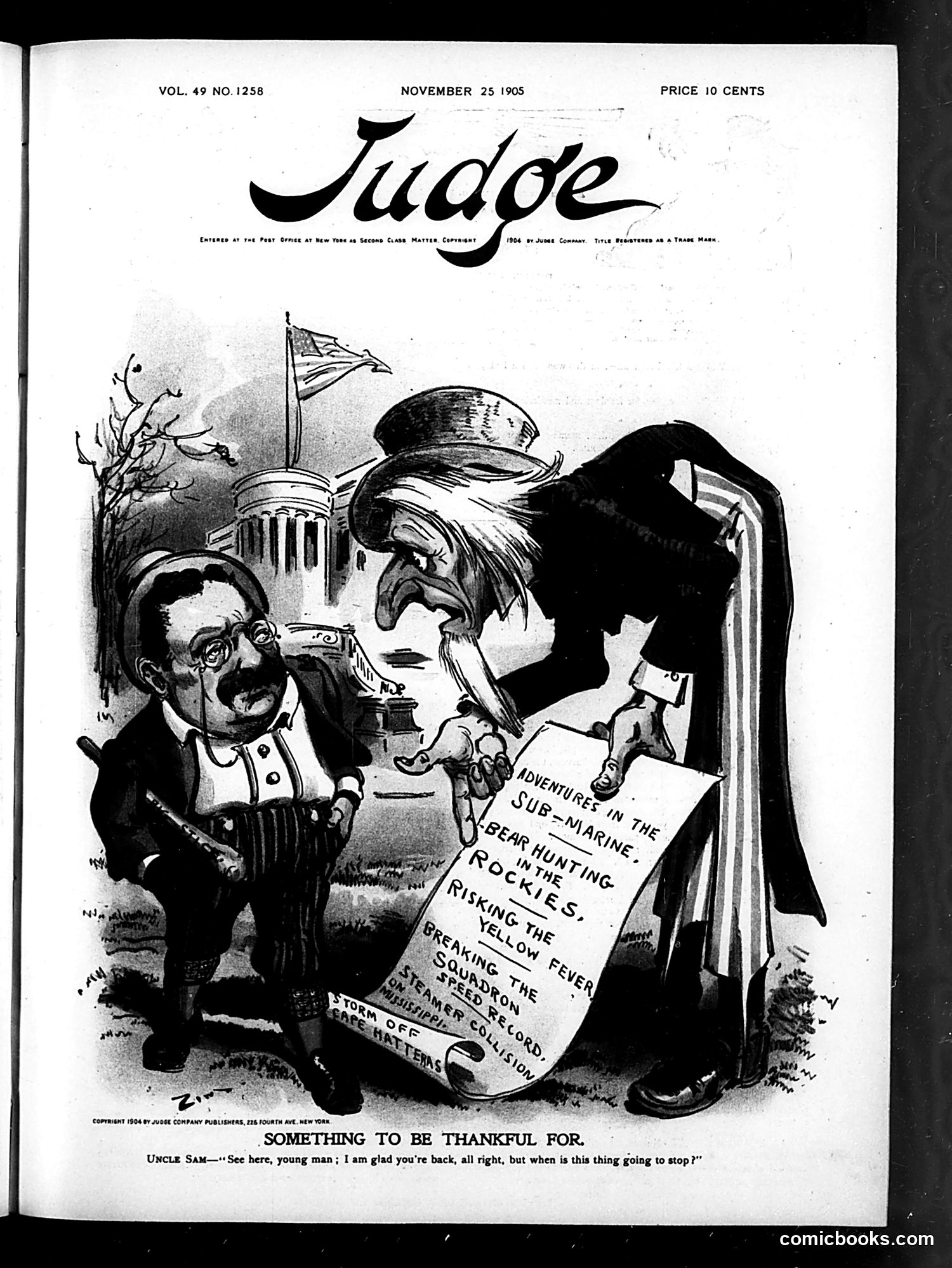
This political cartoon depicts Uncle Sam confronting a tall, thin figure (likely representing a politician or military leader) holding a scroll listing American military/naval achievements: "Adventures in the Sub-Marine," "Bear Hunting in the Rockies," "Risking Yellow Fever," "Breaking the Steam Record," and others. Uncle Sam says: "See here, young man; I am glad you're back, all right, but when is this thing going to stop?" The cartoon appears to satirize excessive military adventurism or expansionism under the Roosevelt administration (1901-1909). The "achievements" listed seem boastful rather than genuinely impressive, and Uncle Sam questions whether these costly ventures will ever cease—suggesting public concern about ongoing foreign interventions and military overreach draining American resources.
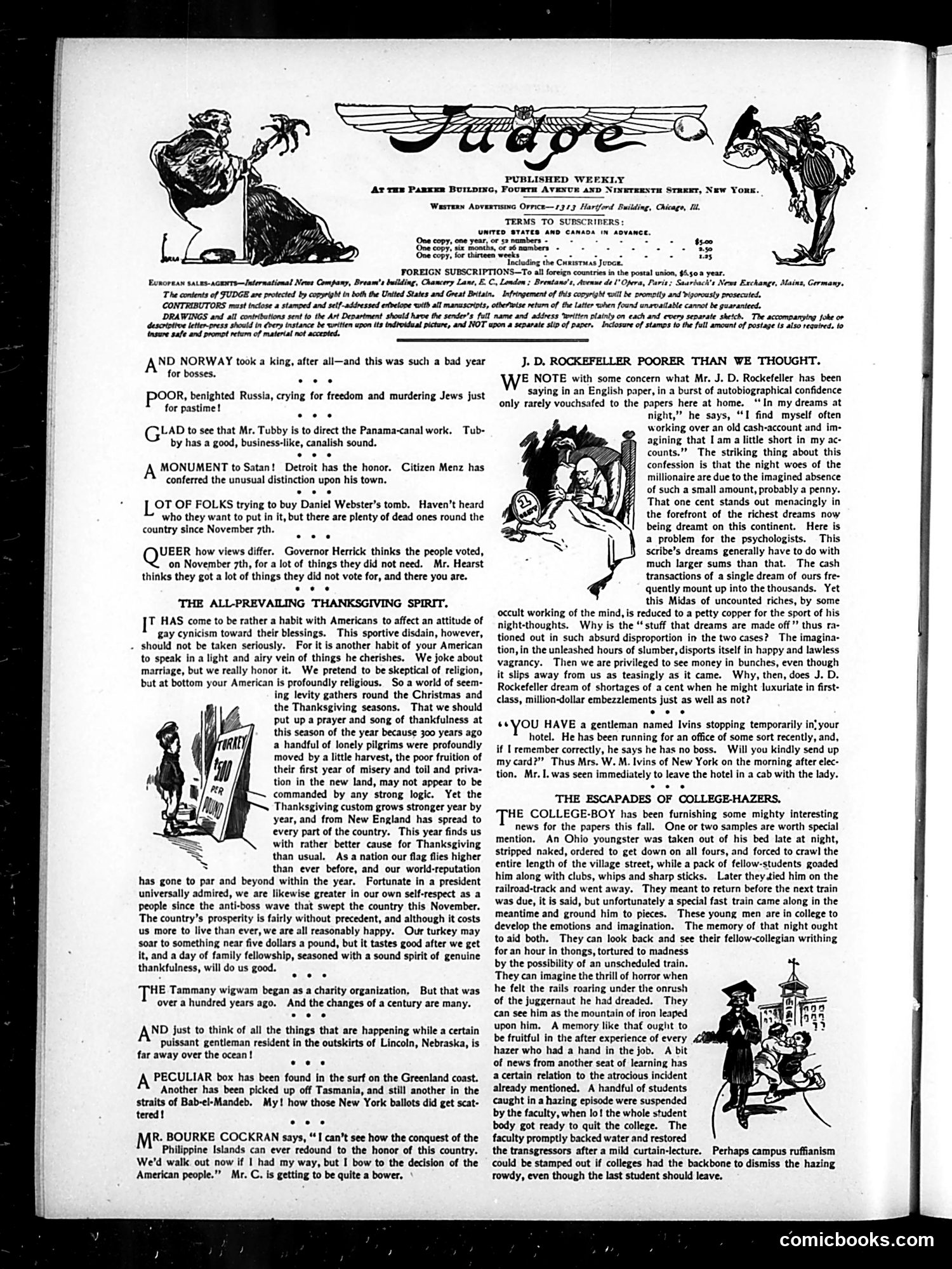
This page contains editorial commentary rather than political cartoons. The lead item "AND NOBODY took a king" criticizes Russia's treatment of Jews and freedom, likely referencing Tsarist pogroms. Subsequent brief items mock: Mr. Tubby directing Panama Canal work (appears to be President Taft), Detroit's monument to Satan (unclear reference), and Governor Herrick's election performance in Ohio. "The All-Prevailing Thanksgiving Spirit" argues Americans should genuinely practice thankfulness rather than merely observe the holiday formally—a social critique typical of Judge's reformist stance. The right column discusses J.D. Rockefeller's alleged dreams of money shortages, satirizing wealthy industrialists' anxieties. The "College-Boy Escapades" section describes student pranks involving hazing—contemporary social commentary on collegiate behavior. Overall, this represents Judge's mix of political criticism and social satire circa early 1900s.
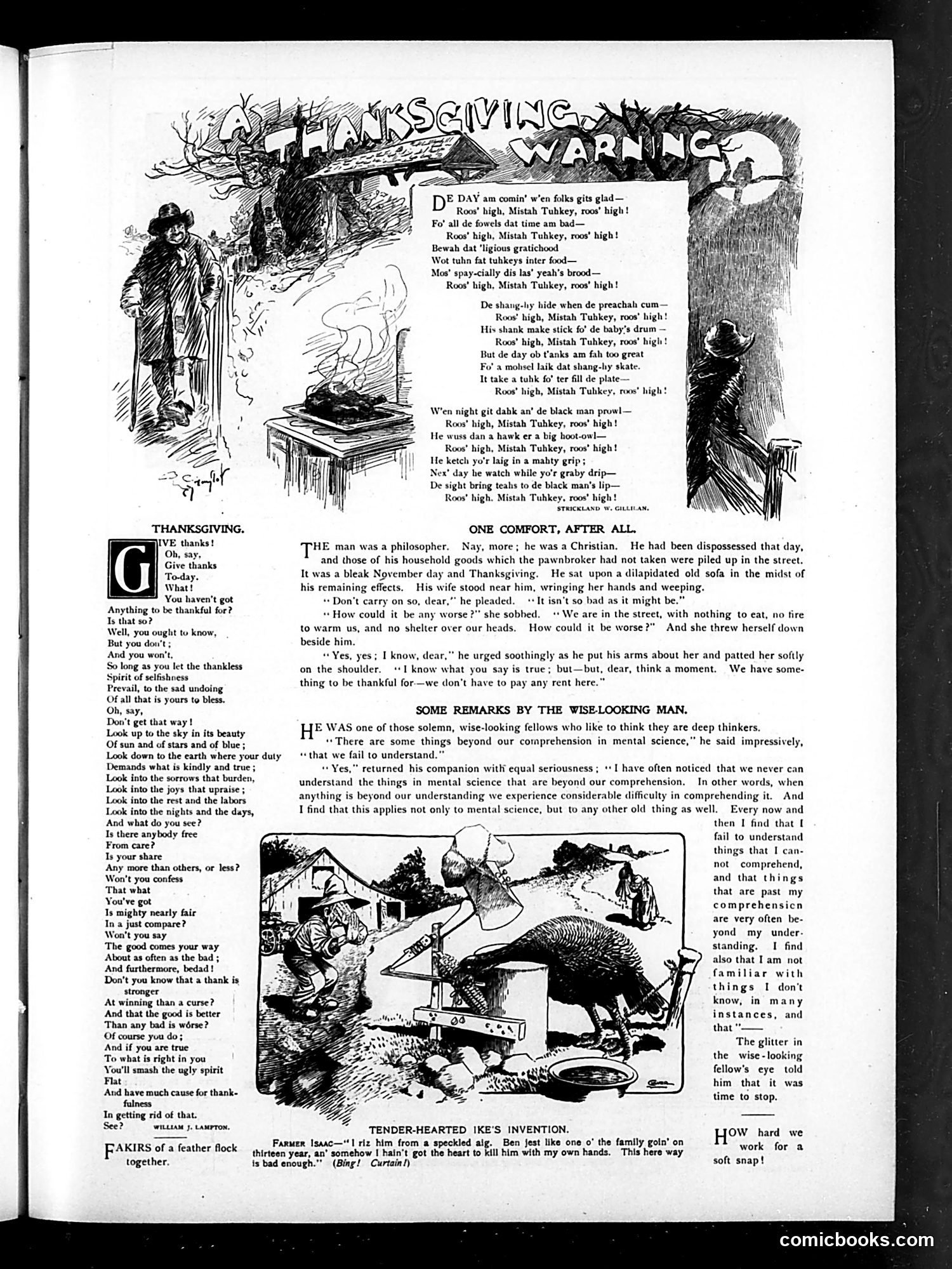
This Thanksgiving-themed page contains several distinct pieces: **"Thanksgiving Warning"** (top): A cautionary poem about overeating at Thanksgiving, warning against excessive consumption of turkey and rich foods—a common satirical theme about holiday excess. **"Thanksgiving"** (left column): A traditional gratitude poem listing things to be thankful for, presented as earnest verse. **"One Comfort, After All"** (center): A story about a poor philosopher and his wife facing homelessness on Thanksgiving, finding solace in Christian faith and acceptance of hardship despite material deprivation. **"Some Remarks by the Wise-Looking Man"** (right): A humorous piece where a self-proclaimed intellectual discusses the limits of human comprehension—satirizing pretentious philosophizing. **Bottom sections** contain brief anecdotes including a farmer's story about killing livestock. The page balances gentle satire about human nature and philosophy with earnest moralizing typical of early 20th-century American magazines.
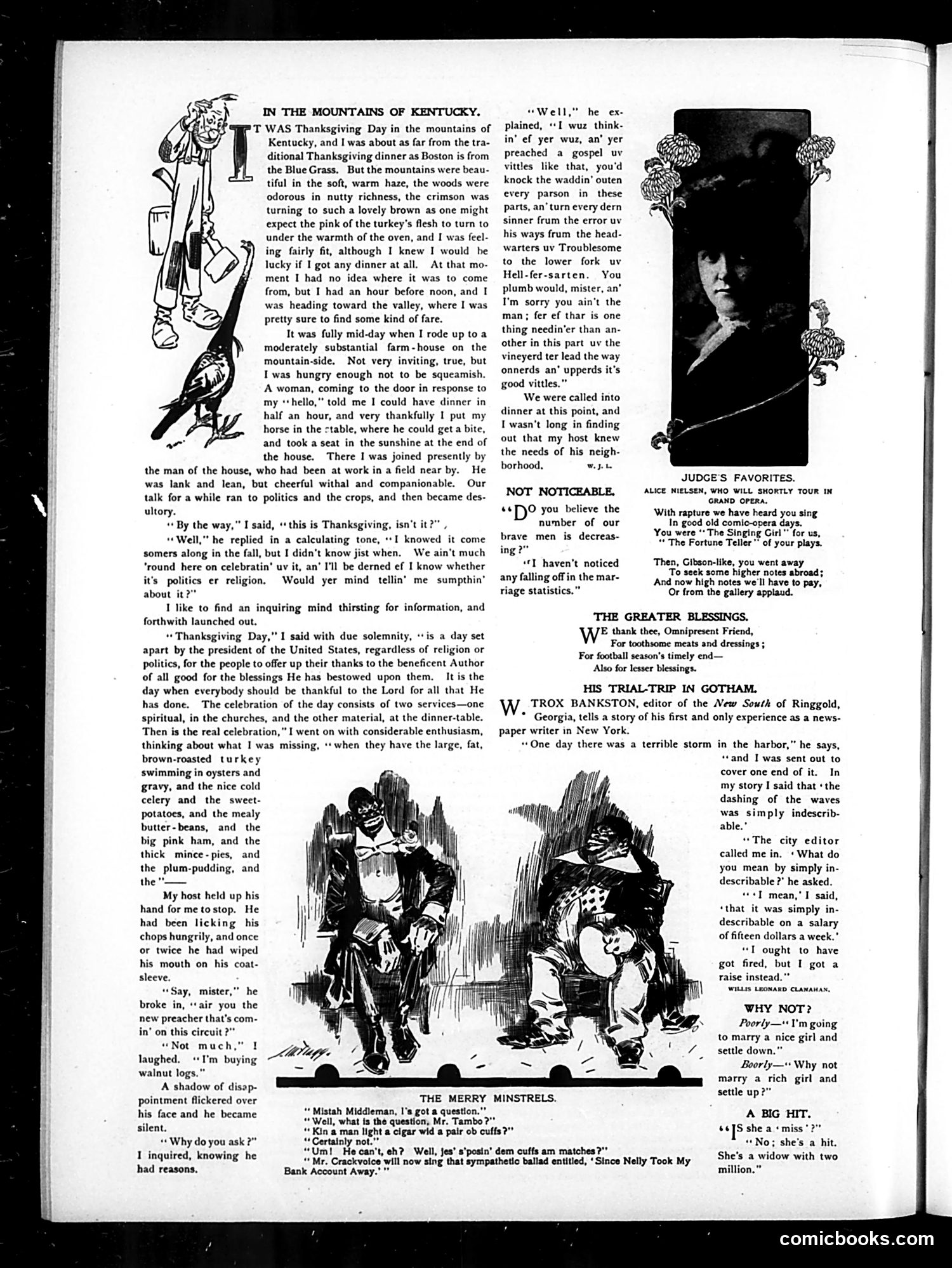
This page contains a story titled "In the Mountains of Kentucky" about a Thanksgiving Day visit, accompanied by illustrations and several short humor sections. The main political/satirical content appears in sections like "Not Noticeable" (questioning whether brave men are decreasing), "The Greater Blessings" (a Thanksgiving reflection), and "His Trial-Trip in Gotham" (about a newspaper editor's experience covering a storm). "The Merry Minstrels" section at bottom features dialogue about cufflinks and includes what appears to be a racist reference typical of early 20th-century Judge magazine humor—specifically minstrel-show stereotypes. The cartoons use stock characters and period humor styles; without clearer identification of specific figures, I cannot definitively name particular political targets, though the content reflects turn-of-the-century American satire conventions.
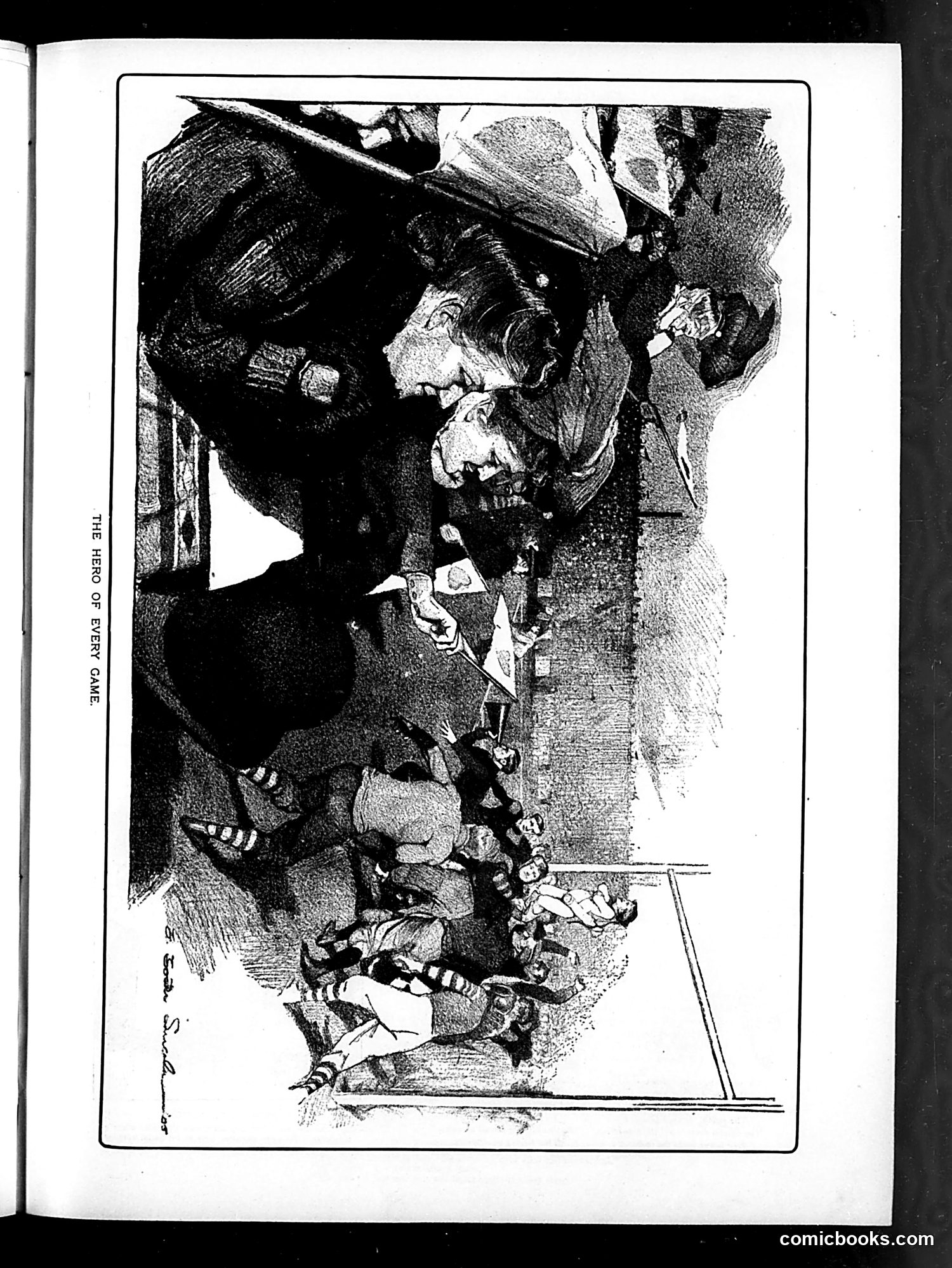
This cartoon appears to depict a exaggerated caricatured figure in the center, surrounded by smaller figures in what seems to be a theatrical or performance setting. The title "The Hero of Every Game" suggests satirical commentary on someone who claims credit or prominence in multiple situations. The style and presentation are characteristic of late 19th or early 20th-century Judge magazine satire. However, without clearer text identification of specific individuals or dates visible on this page, I cannot definitively identify which political or social figure is being mocked or what particular events are referenced. The overall tone appears mockingly celebratory—likely critiquing someone's self-aggrandizement or false claims to heroic status across various contexts.
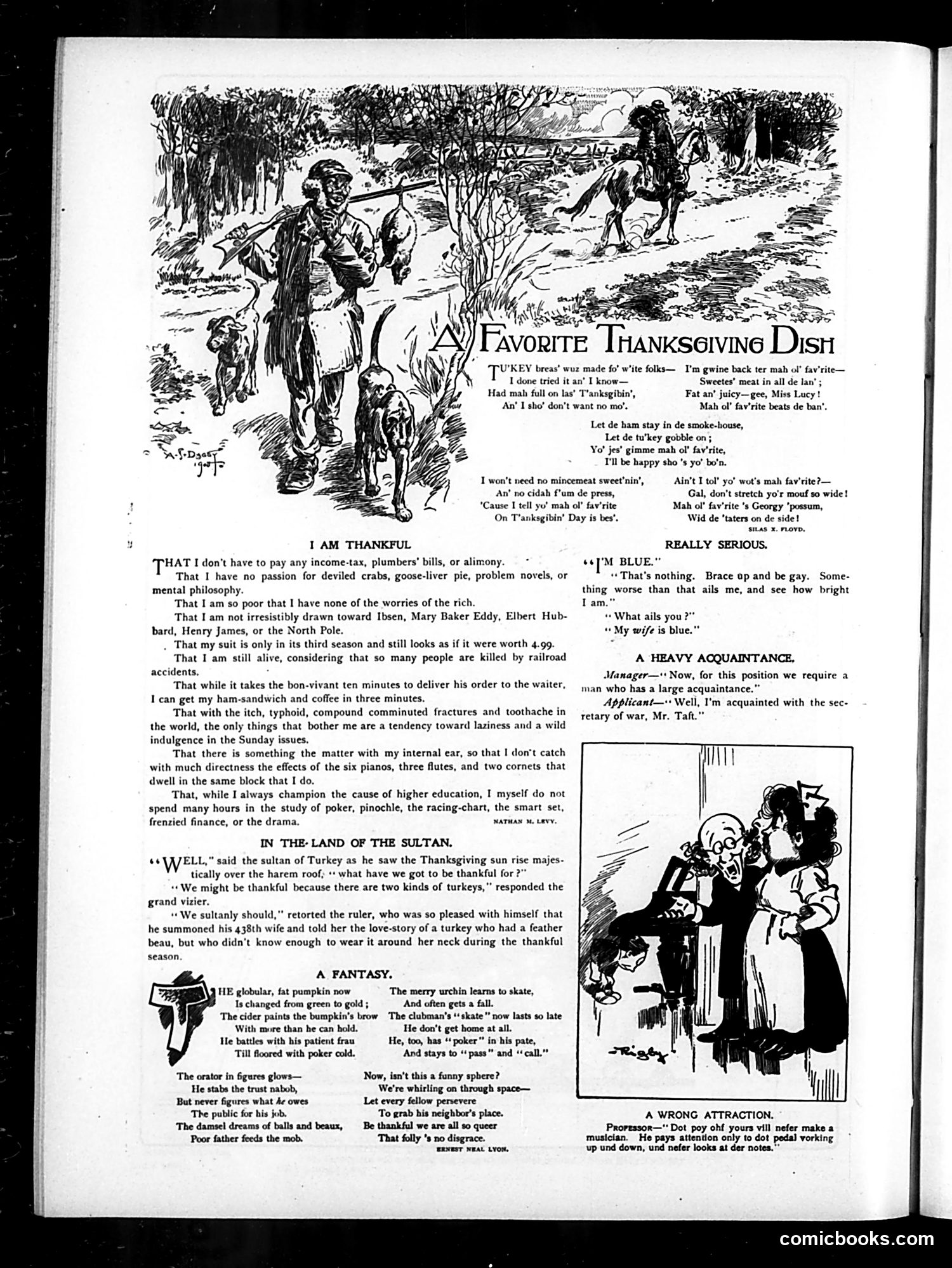
This Thanksgiving-themed page from Judge magazine contains several satirical pieces typical of early 20th-century humor: **"Favorite Thanksgiving Dish"**: A dialect poem (in offensive African-American vernacular stereotypical of the era) where a speaker rejects turkey for possum—a cheaper meat associated with rural poverty. The satire targets class differences and changing food tastes. **"I Am Thankful"**: A list of humorous gratitudes by Nathan M. Levy about avoiding modern anxieties (income tax, Ibsen, the North Pole) while celebrating simple pleasures. Social satire on contemporary intellectual pretensions. **"In the Land of the Sultan"**: A joke about the Turkish sultan's 438 wives, playing on Western stereotypes about Ottoman harems and polygamy. **"A Heavy Acquaintance"**: A brief joke where a job applicant claims to know Secretary of War Taft—contemporary political humor. The remaining pieces are generic comic verses and a cartoon about failed romance. The page reflects Judge's typical approach: satirizing wealth, immigration, modernity, and contemporary politics through dialect humor and caricature.
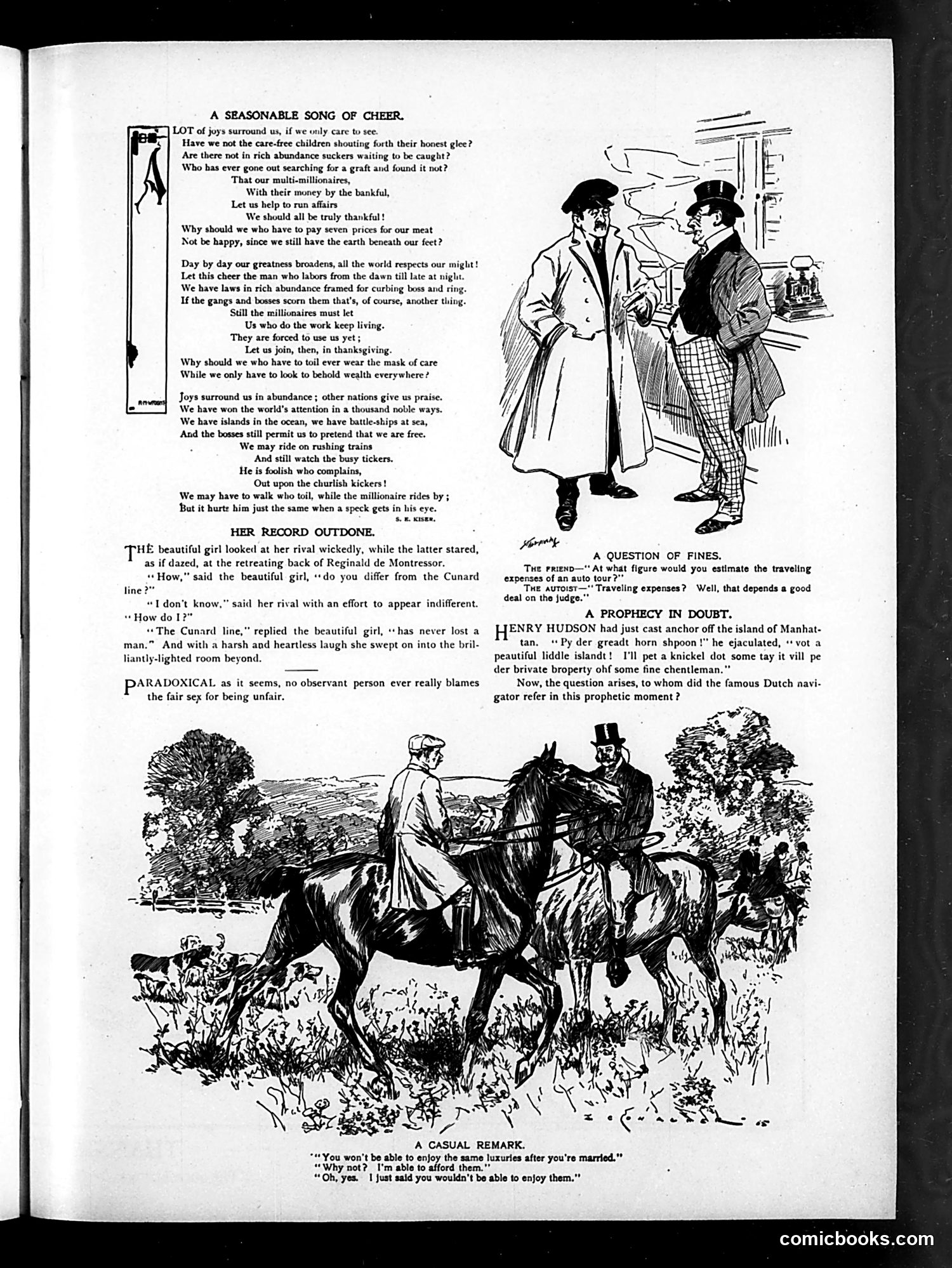
This page contains **satirical commentary on American economic inequality and political corruption**, presented through multiple pieces: ## "A Seasonable Song of Cheer" A heavily ironic poem mocking workers who accept their exploitation. The satire targets: - **Grafts and corruption** ("Who has ever gone out searching for a graft and found it not?") - **Millionaire dominance** of public affairs - **Wage suppression** ("pay seven prices for our meat") - **Labor oppression** while pretending workers are "free" The poem's forced optimism undercuts itself—every "joy" listed is actually a complaint. ## Other Cartoons - **"Her Record Outdone"**: Jokes about maritime disasters (Cunard Line references) - **"A Question of Fines"**: Suggests judicial corruption—auto tour fines depend on which judge hears the case - **"A Prophecy in Doubt"**: A Dutch-accented Henry Hudson character predicts Manhattan will become private property, satirizing real estate monopolization The page overall mocks **early 20th-century American capitalism**, labor conditions, and institutional corruption through dark humor.
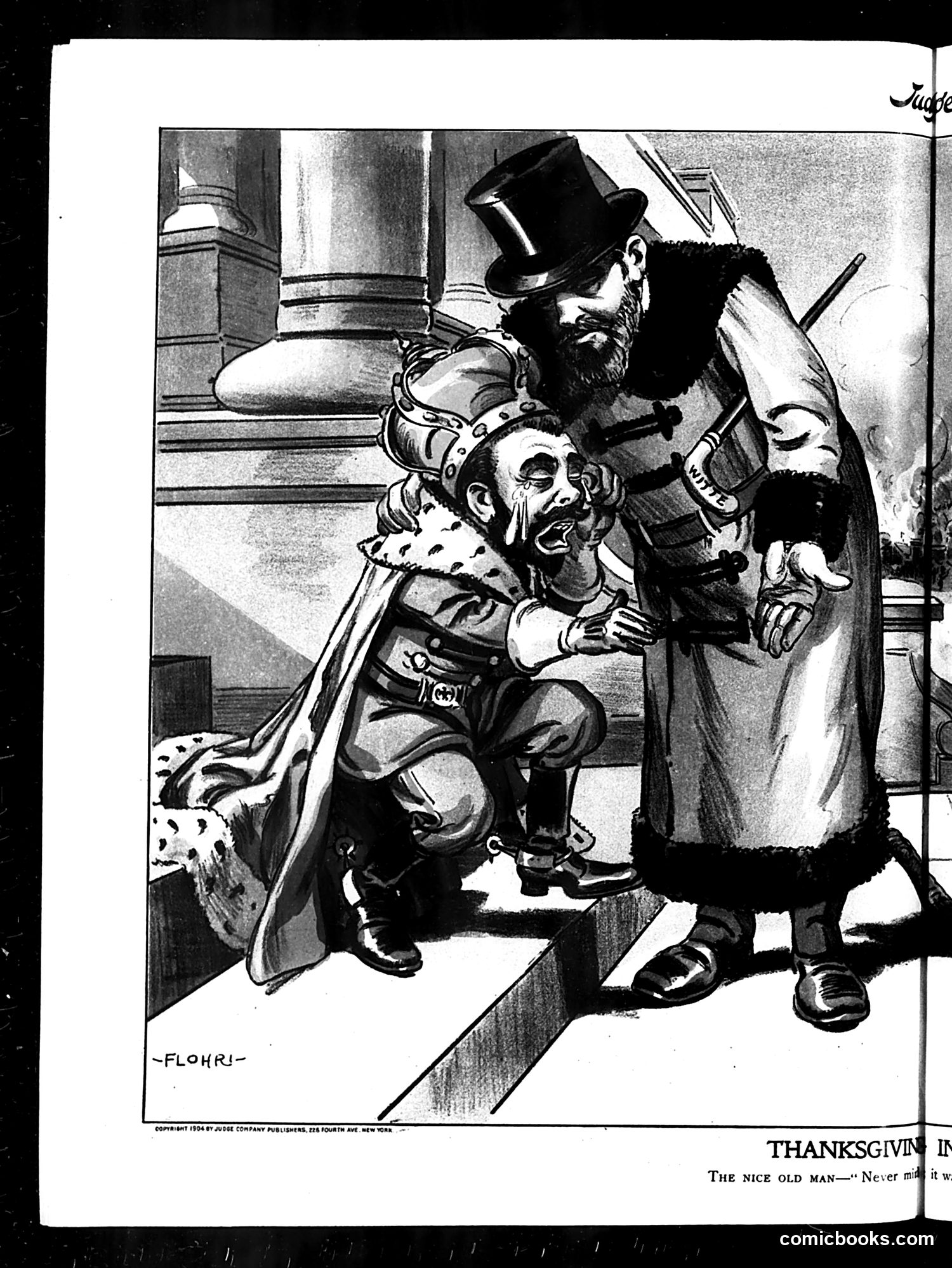
This 1904 Judge magazine cartoon by Flohr depicts a scene with two figures in formal 19th-century dress. A bearded man in a top hat appears to be confronting or restraining a smaller, distressed military or official figure wearing ornate regalia and a fur-trimmed coat. The visible caption fragment "The Nice Old Man—'Never mit...'" suggests commentary on an older political figure's interaction with a younger or subordinate one. Without the complete text, the specific political reference remains unclear, but the composition implies criticism of power dynamics or manipulation—a common Judge satirical theme from the Theodore Roosevelt era. The military dress and formal setting suggest this may reference diplomatic or military affairs, but the exact historical context and figures cannot be definitively identified from the visible portions alone.
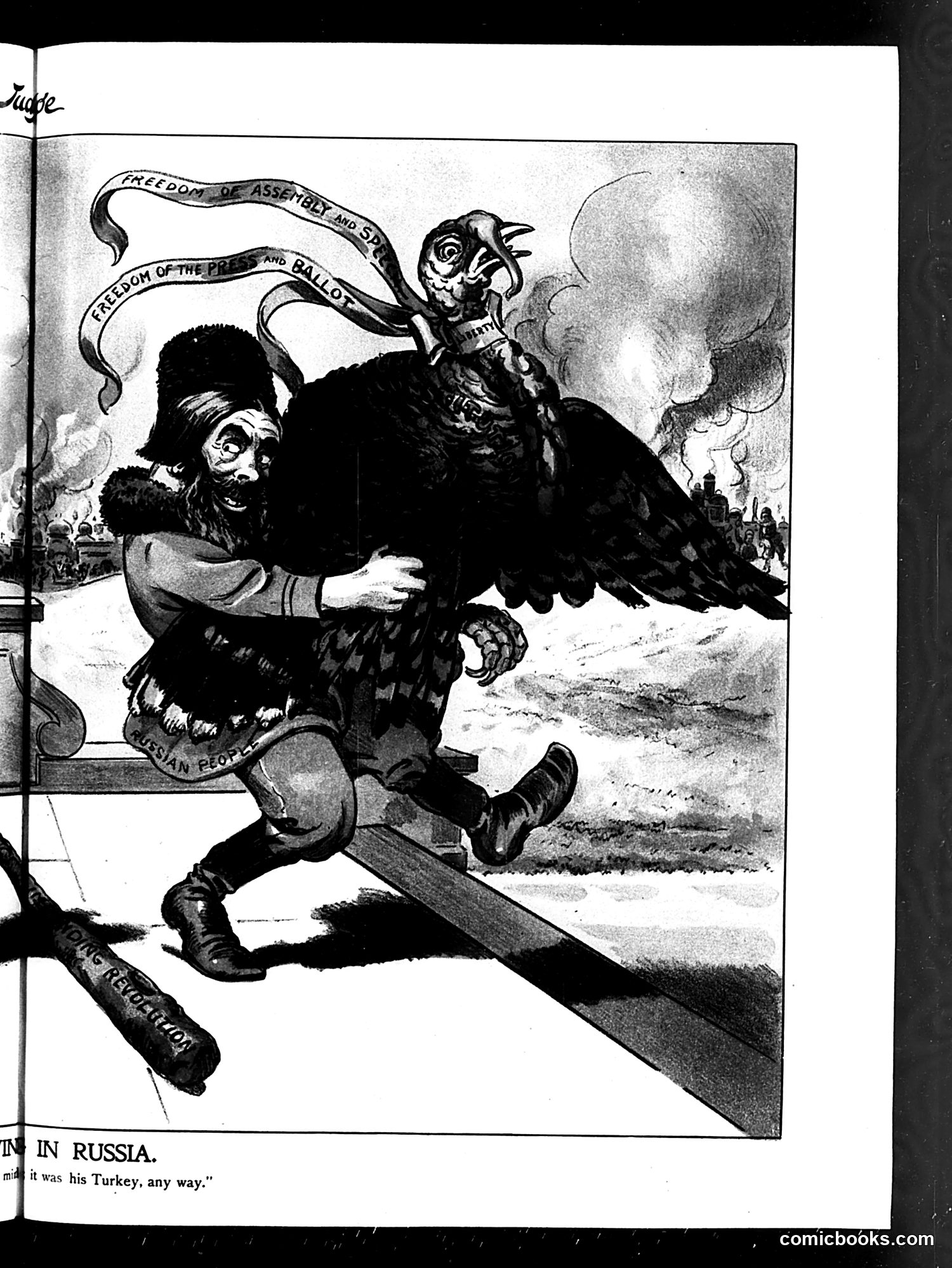
This Judge magazine cartoon depicts a grotesque bird-creature (likely representing Bolshevik Russia or Soviet leadership) carrying off a smaller figure labeled "Russian People." The creature wears ribbons reading "Freedom of the Press," "Freedom of Assembly and Speech"—ironies, since the cartoon sarcastically suggests these freedoms were being destroyed rather than protected. The caption "it was his Turkey, any way" implies the Soviet government claimed ownership of the people as property. The burning buildings in the background suggest destruction and chaos accompanying the Russian Revolution. This appears to be American Cold War-era political satire criticizing Soviet oppression and the gap between communist revolutionary ideals and actual authoritarian practice.
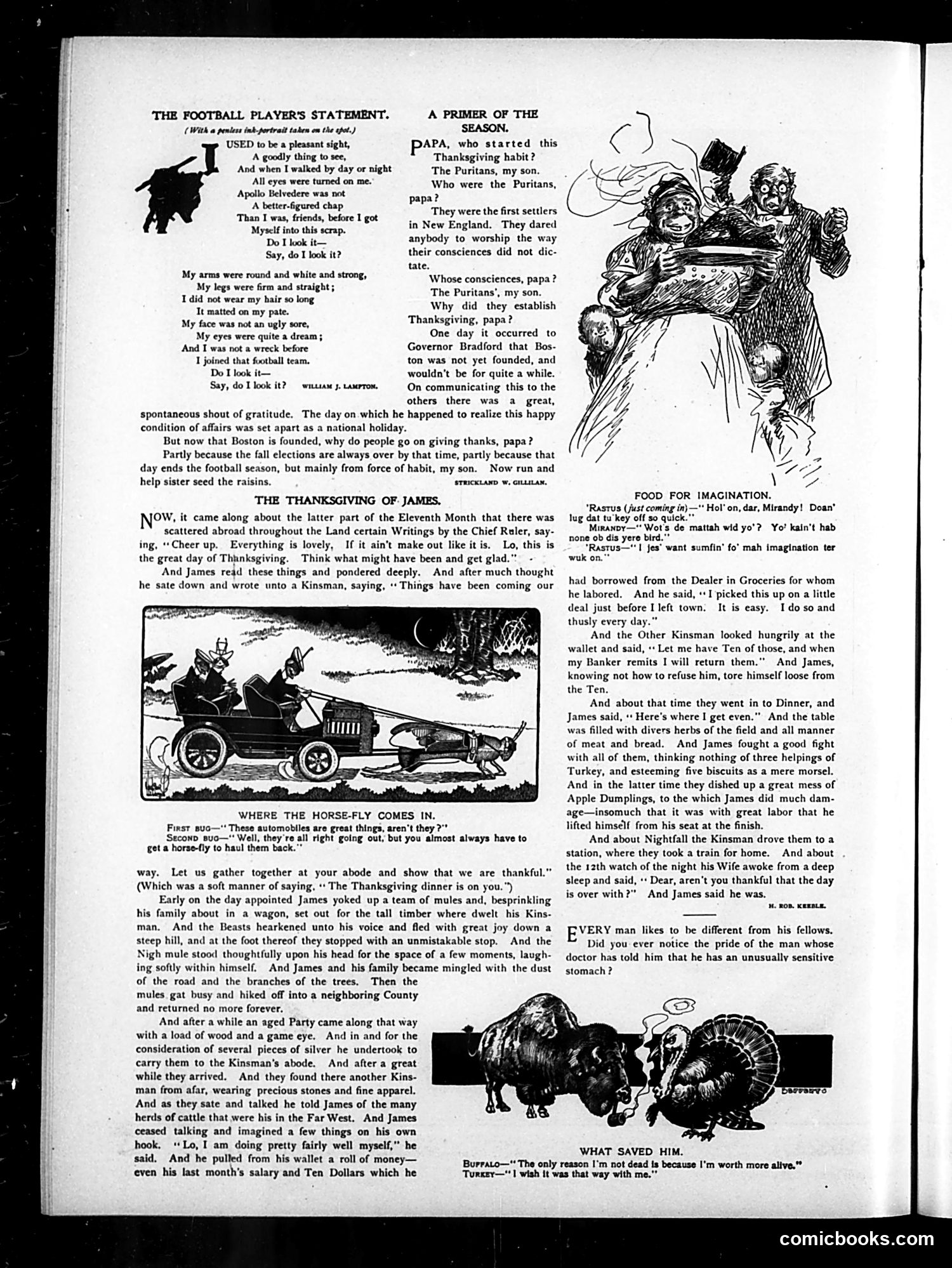
This Judge magazine page contains three satirical pieces: 1. **"A Primer of the Season"** (top): A dialogue mocking Puritan hypocrisy. The child asks why Thanksgiving exists; the parent explains Puritans established it out of gratitude that Boston hadn't been founded yet—implying they were glad to delay settling there. The joke: Puritans claimed moral superiority while being hypocritical, and people now observe Thanksgiving from "force of habit" rather than genuine piety. 2. **"The Football Player's Statement"**: A first-person lament by a disfigured athlete, contrasting his former Apollo-like appearance with his current wrecked state from playing football. It's satirical commentary on football's brutality and the physical toll on players. 3. **"Where the Horse-Fly Comes In"**: A visual gag about automobiles needing horses to tow them back—mocking early automobiles' unreliability compared to horse-drawn vehicles. The illustrations support these satirical critiques of contemporary American society, institutions, and technology.
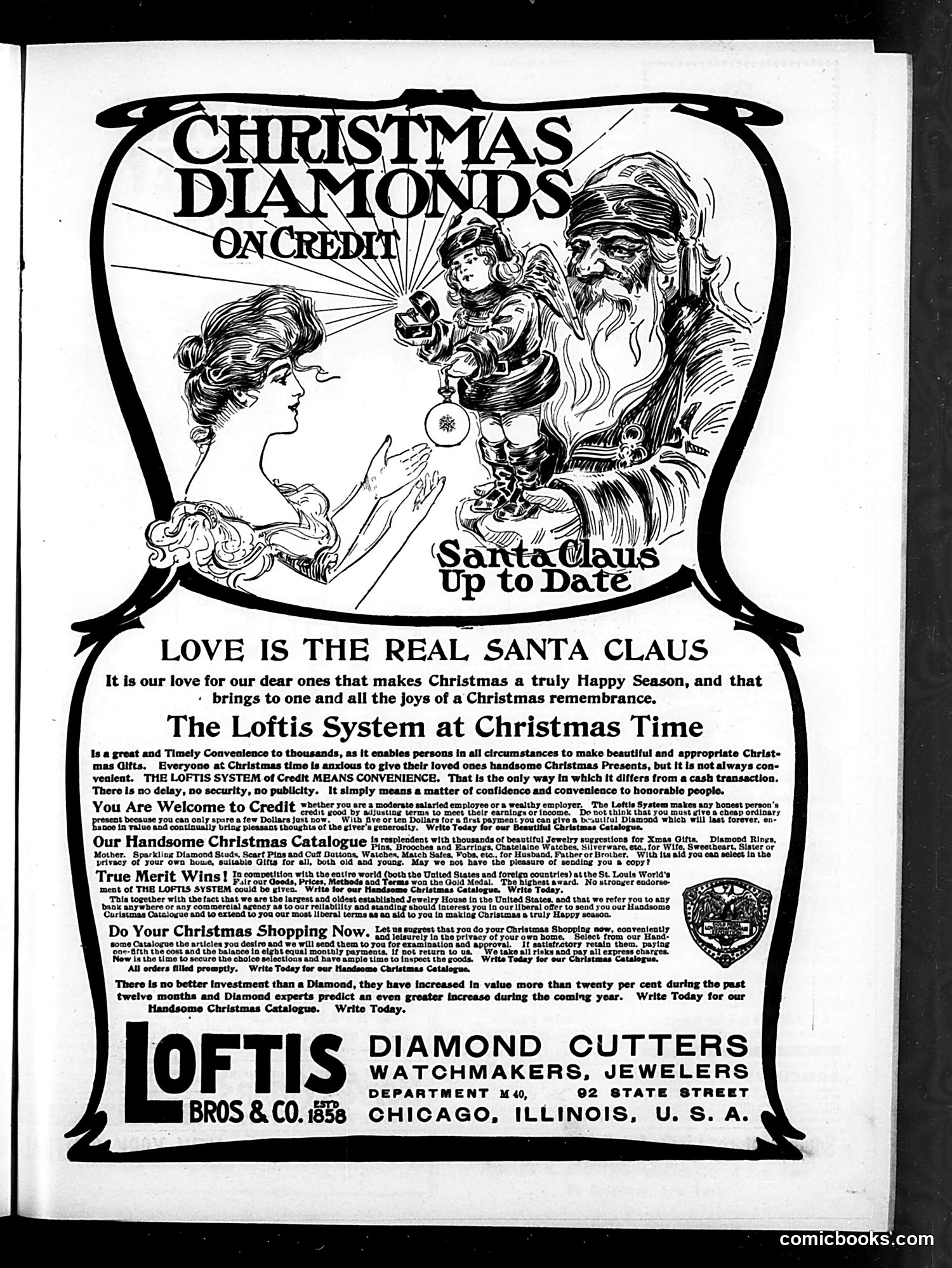
This is primarily a **jewelry advertisement**, not political satire. The illustration depicts a woman showing Santa Claus and a child a diamond, promoting Loftis Bros' installment credit system for Christmas gifts. The "satire" is gentle marketing messaging: the headline "Love is the Real Santa Claus" frames diamond purchases as expressions of affection rather than material excess. The ad addresses a practical concern for early-1900s consumers—most people couldn't afford luxury gifts outright. The "Loftis System" allowed customers to buy diamonds with small down payments (five or ten dollars) and monthly installments, making expensive presents accessible to middle-class families. The copy emphasizes trustworthiness and established reputation (claiming to be "the largest and oldest established Jewelry House"), notes the company won gold medals at the St. Louis World's Fair, and promises no publicity or security requirements—just "confidence and convenience." This reflects pre-modern consumer credit marketing: positioning installment buying as respectable and honorable rather than risky debt.
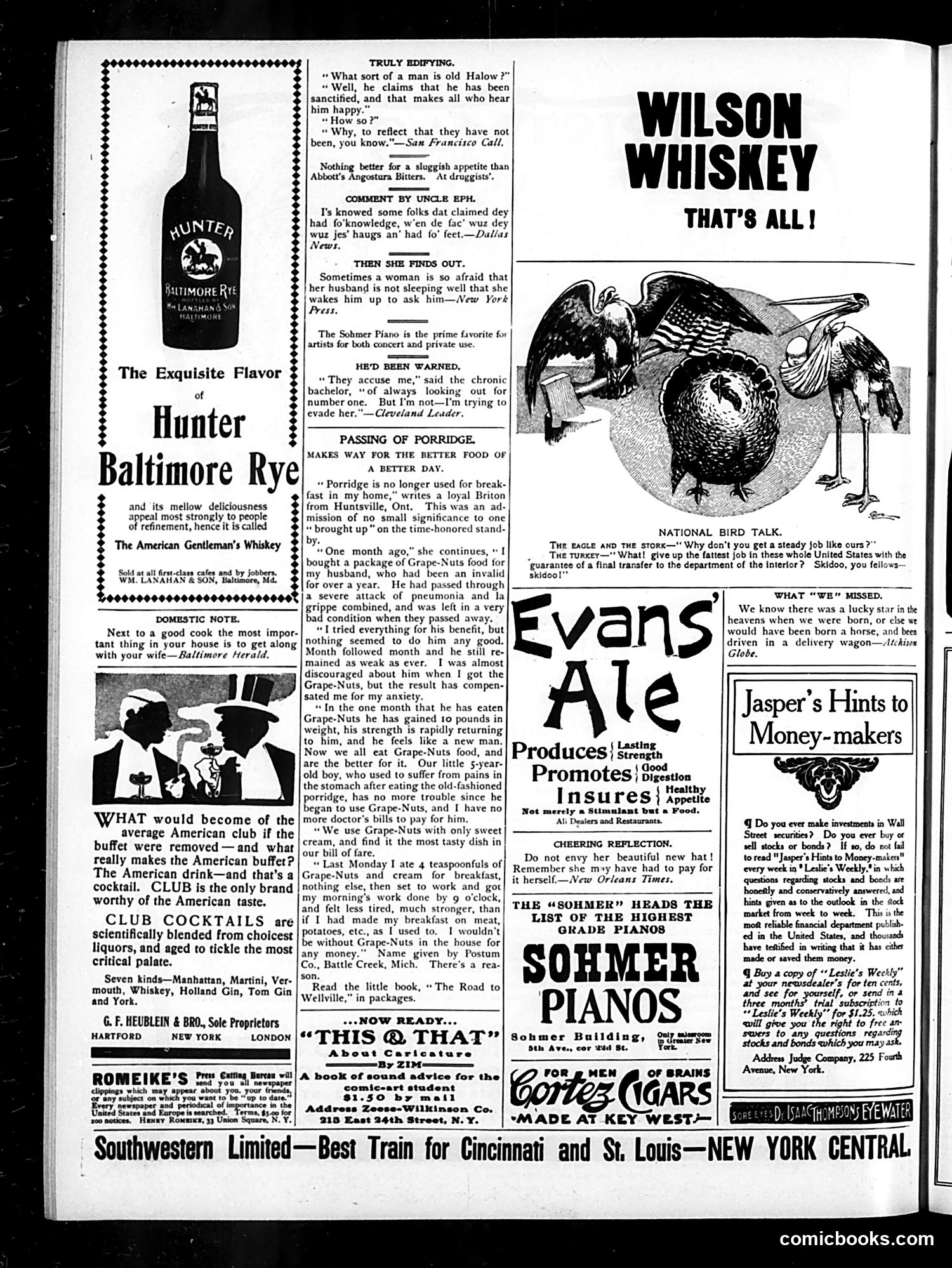
This page is primarily **advertising**, with minimal editorial content. The main elements are: **Advertisements:** - Hunter Baltimore Rye whiskey ("The American Gentleman's Whiskey") - Club Cocktails - Grape-Nuts cereal (featuring a testimonial about health benefits) - Sohmer Pianos - Evans Ale - Cortez Cigars - Sommer Pianos - Various smaller ads **Brief Humorous Items:** The page includes several short jokes/quips (labeled "Truly Edifying," "Comment by Uncle Eph," etc.) typical of Judge's satirical format—observations about marriage, sanctimony, and domestic life. **The Eagle Cartoon:** One illustrated piece shows an eagle with a globe, titled "National Bird Talk," making a joke about the Stork. The page reflects early-20th-century advertising priorities and consumer products, with whiskey and tonics prominently featured alongside health-food claims (Grape-Nuts) that seem dubious by modern standards.
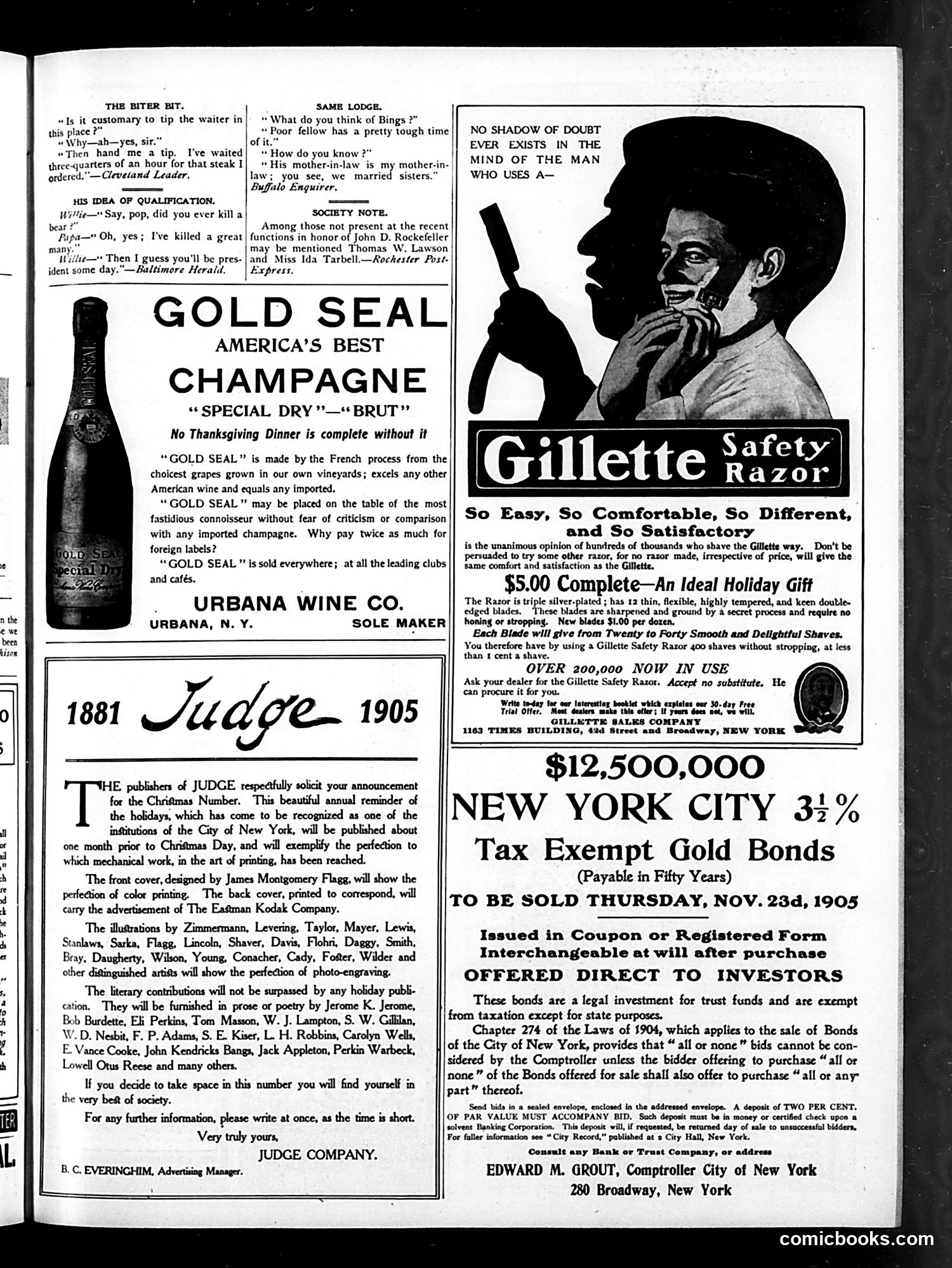
This page contains mostly **advertisements and filler content** rather than significant political cartoons. The main visual is a **Gillette Safety Razor ad** featuring a silhouetted man shaving—typical product advertising of the era. The brief text jokes scattered throughout are mild workplace humor: - "The Biter Bit" mocks a diner who demands a tip from the waiter after waiting long for food - "His Idea of Qualification" is a weak pun about killing bears and becoming president - "Same Lodge" jokes about marrying sisters The **"Society Note"** is the only potentially satirical item, sarcastically noting that **Thomas W. Lawson and Ida Tarbell were absent** from Rockefeller honor functions. Both were prominent **muckrakers/critics of Rockefeller's Standard Oil monopoly**, so their absence is presented as unsurprising. Otherwise, this is primarily a **Christmas issue solicitation page** (Judge Company advertisement) and champagne/bonds advertisements—not a satirical content page.
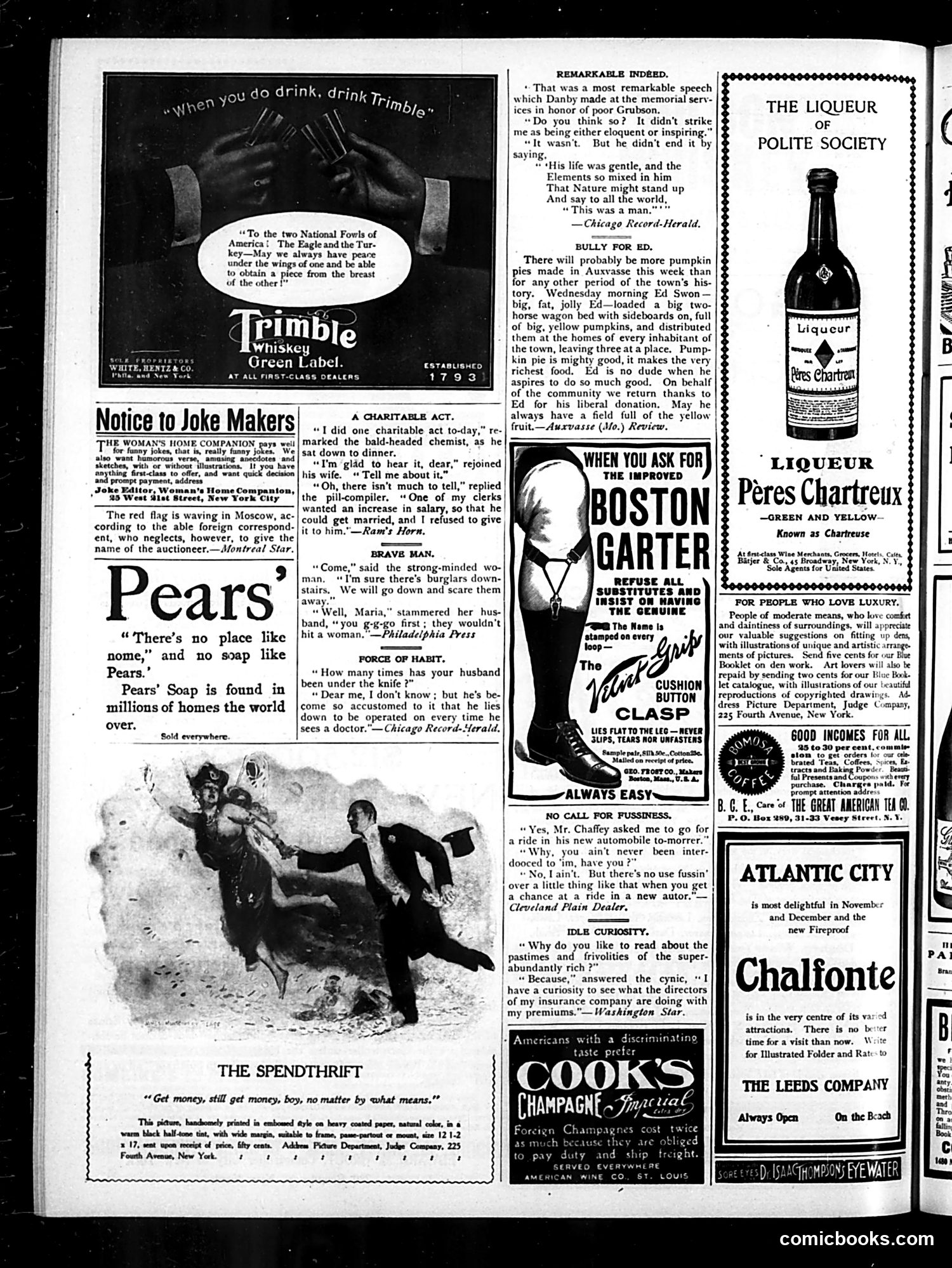
This page from *Judge* magazine (a satirical publication) is primarily **advertising with brief humor pieces**. The main cartoon/satire is "The Spendthrift" (bottom), illustrating the Shakespearean quote about obtaining money "by any means"—a commentary on materialism and moral compromise. The humor pieces mock contemporary social pretension: - **"Remarkable Indeed"**: A joke about a long-winded memorial speech that fails to quote Shakespeare properly—satirizing verbose, unimpressive oratory - **"Bully for Ed"**: A straightforward story praising a generous farmer who distributed pumpkins (no satire intended) - **"Force of Habit"**: A joke about a man so accustomed to surgery he lies down whenever seeing a doctor—absurdist humor - **"No Call for Fussiness"**: Mocking a woman cavalier about meeting a man via automobile—poking fun at emerging car culture's social disruption The **Trimble Whiskey advertisement** (top) features nationalistic rhetoric about American eagles and turkeys, typical of early 20th-century marketing. The page is mostly **commercial/advertising content** rather than political cartoons.
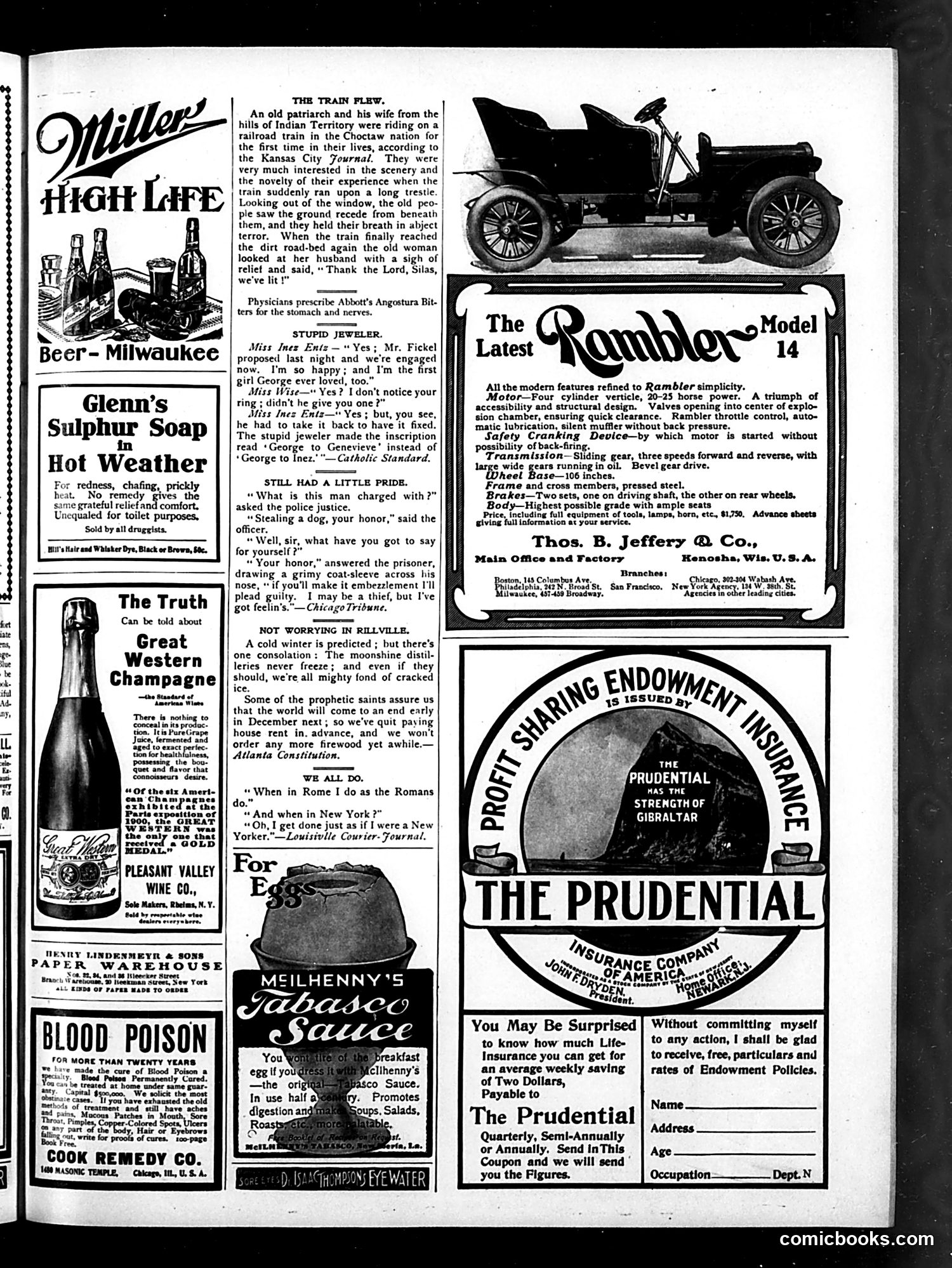
This is primarily an **advertising page** from Judge magazine, containing multiple commercial advertisements rather than satirical cartoons. The visible text content includes humorous **anecdotes** rather than political satire: - **"The Train Flew"**: A joke about rural Indian Territory residents experiencing a train crossing a trestle for the first time, panicking at the sight of ground beneath them. - **"Stupid Jeweler"**: A woman's engagement ring inscription was misspelled, causing embarrassment. - **"Still Had a Little Pride"**: A thief arrested for dog-stealing insists the charge be called "embezzlement" instead, claiming he has standards. - **"Not Worrying in Rillville"**: Southern rural humor about moonshine distilleries and avoiding rent payments due to apocalypse predictions. The jokes rely on period stereotypes about rural/southern ignorance and criminality. The advertisements (soap, champagne, insurance, automobiles) are typical early 1900s magazine content. **No significant political satire is evident on this page.**
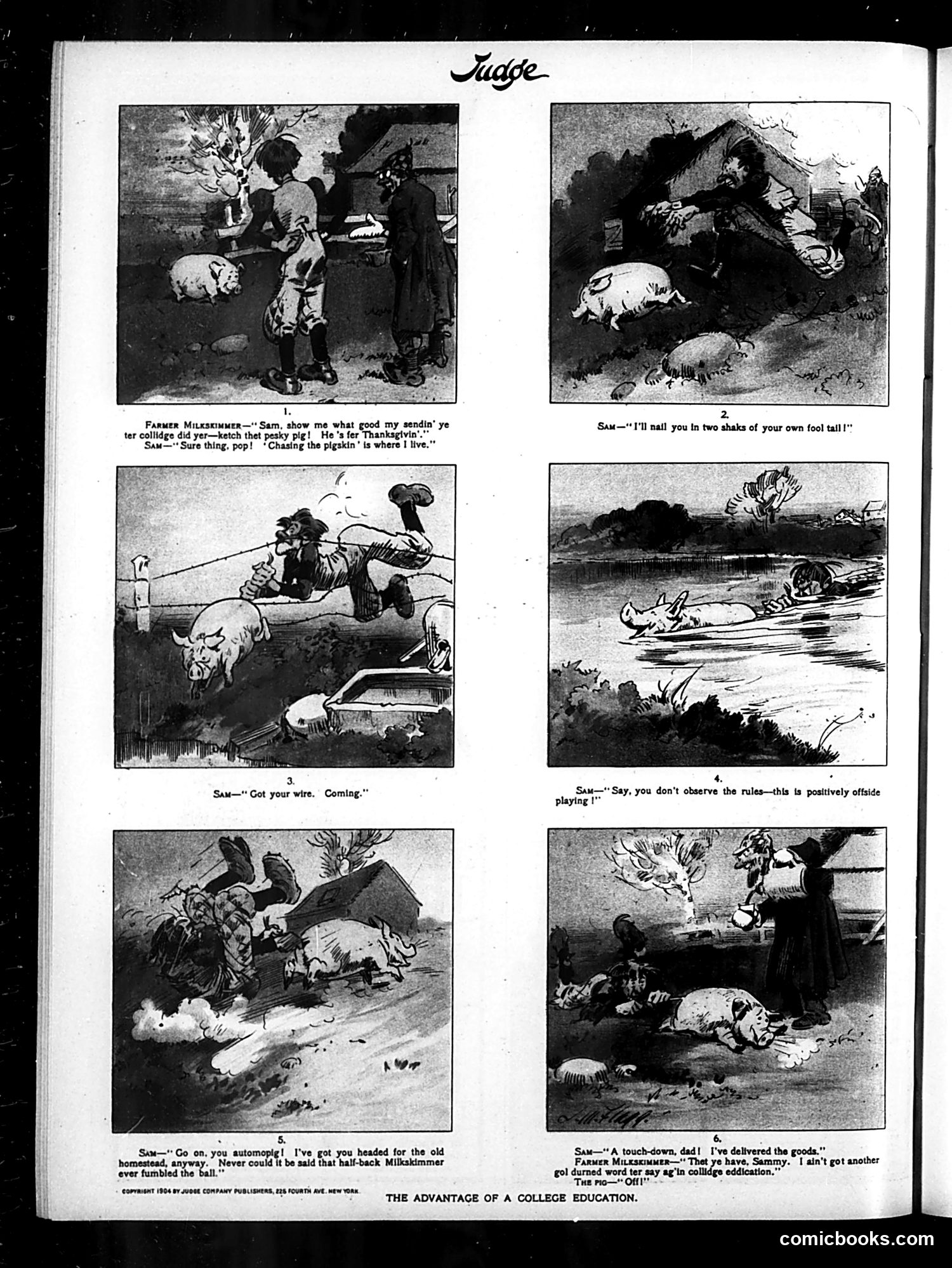
This six-panel comic satirizes how college education corrupts practical farm values. Farmer Milkskimmer sends his son Sam to college, expecting useful knowledge. Instead, Sam returns speaking in sports jargon—calling pig-chasing "chasing the pigskin" (football terminology), treating farm tasks like football plays ("touch-down," "offside"), and referring to himself as "half-back Milkskimmer." The joke mocks early 1900s anxiety that college made rural youth impractical and pretentious. Sam uses elaborate sports language for simple farm work, suggesting he's learned useless sophistication rather than real skills. The father's grudging admission—"I ain't got another gol dummed word ter say ag'in collidge eddication"—delivers the ironic punchline: despite the absurdity, the boy *did* accomplish the task, so perhaps college education has some value after all, however indirect.