
A complete issue · 16 pages · 1905
Judge — September 23, 1905
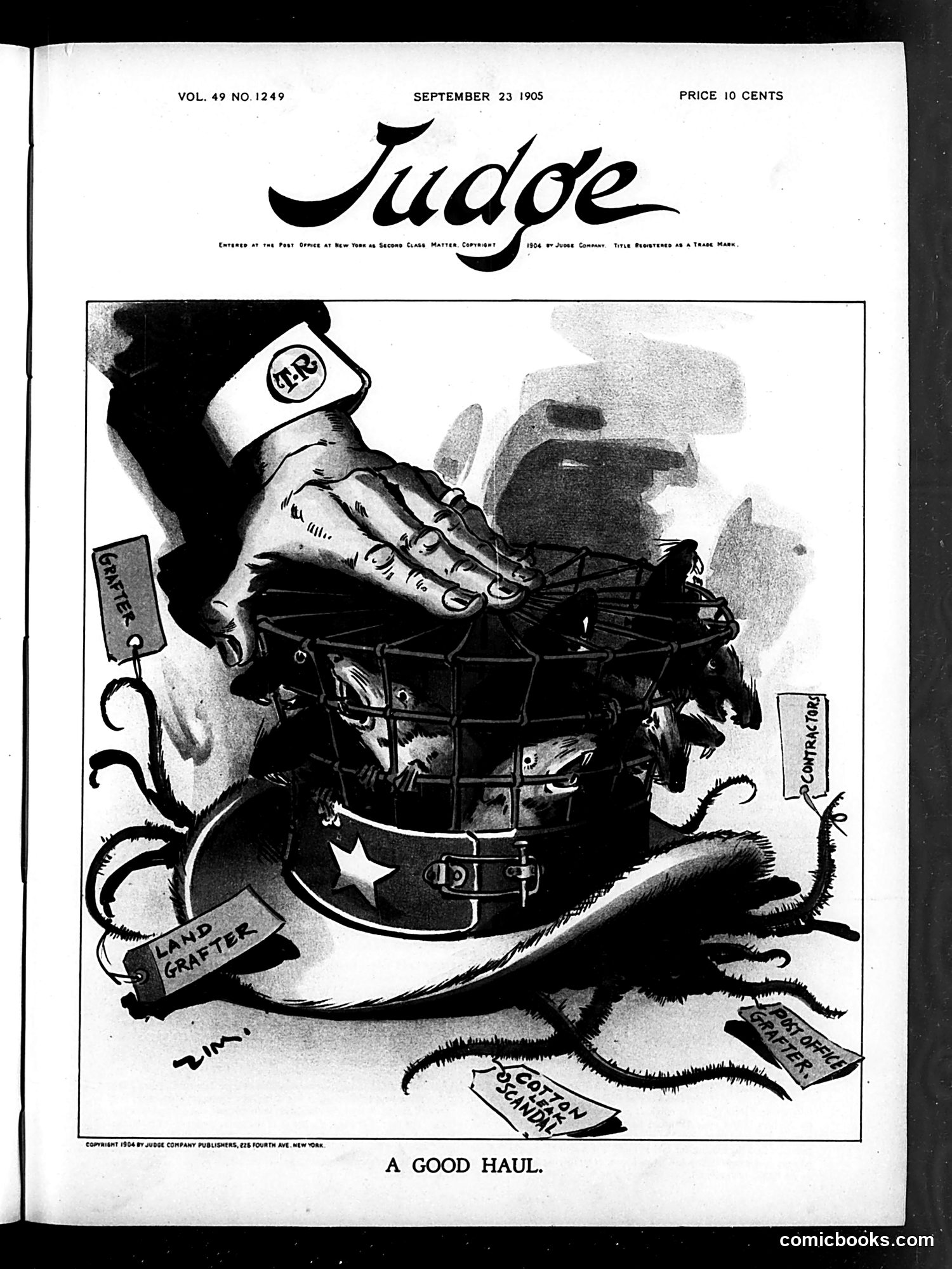
This political cartoon depicts a hand labeled "U.S." holding a basket of squirming creatures representing various political corruptions and scandals. The labels visible include "Land Grafter," "Corrupt Senator," and "Graft" among the writhing figures. The cartoon satirizes the Roosevelt administration's anti-corruption efforts during the Progressive Era. The "good haul" refers to successful prosecutions or exposures of political corruption—portrayed as captured vermin being hauled in. The caricatured creatures and explicit "graft" labels reflect contemporary concerns about systematic corruption in government and business. This reflects Judge magazine's support for Progressive reform and anti-corruption initiatives that characterized early 1900s American politics.
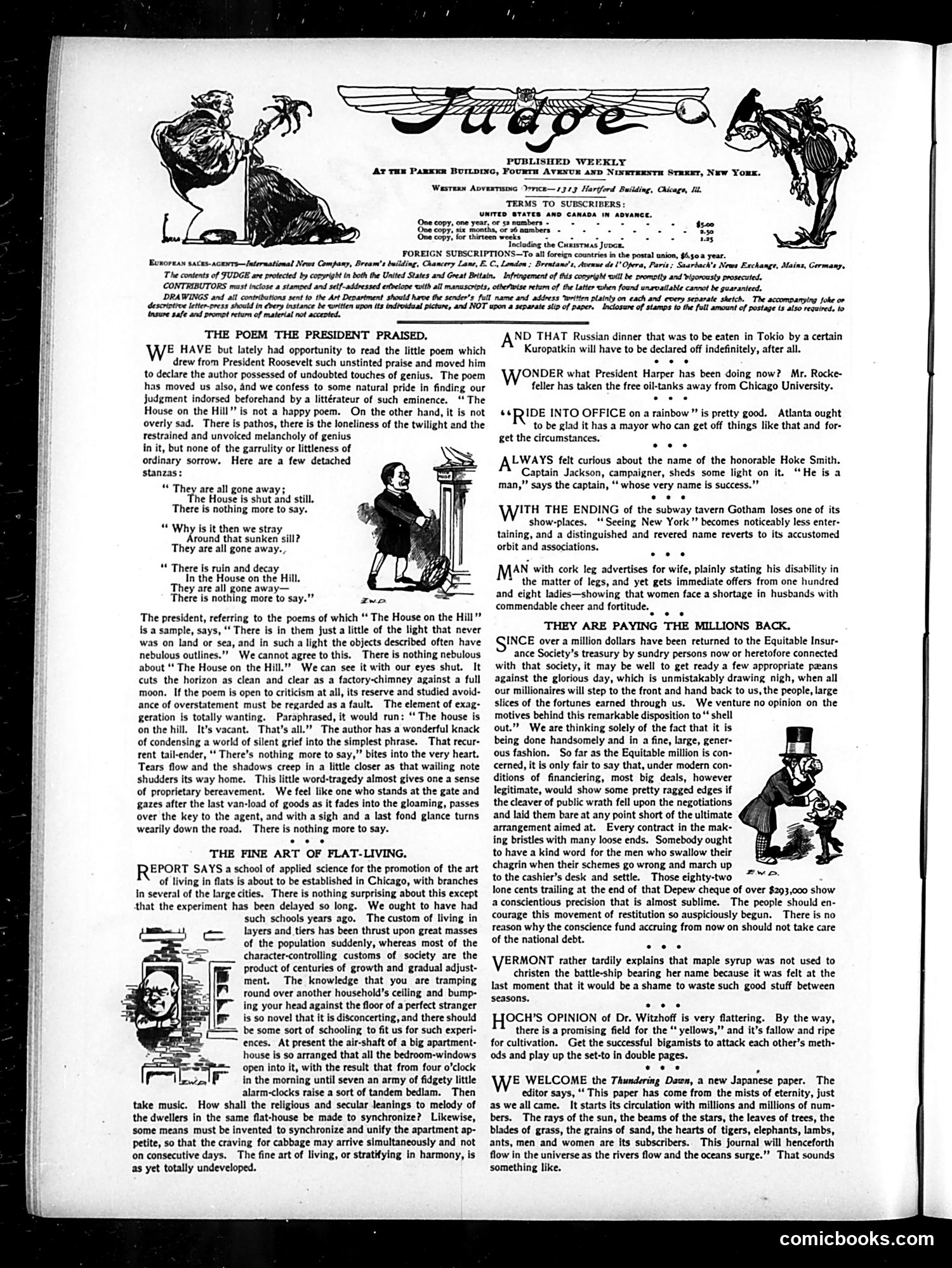
This page contains satirical commentary rather than political cartoons. The main articles mock contemporary issues: **"The Poem the President Praised"** critiques a poem about "The House on the Hill," defending it against accusations of being "nebulous." The piece defends the poem's artistic merit while subtly questioning the president's judgment in praising it. **"The Fine Art of Flat-Living"** satirizes Chicago's new school of "applied science" promoting efficient apartment living. Judge mocks this as impractical social engineering—cramming families into tiny spaces with synchronized meal times and shared resources. The satire suggests this experiment in "character-controlling customs" reflects misguided Progressive-era efficiency movements. The illustrations show figures in cramped, absurd living situations, emphasizing Judge's skepticism toward urban reform initiatives.
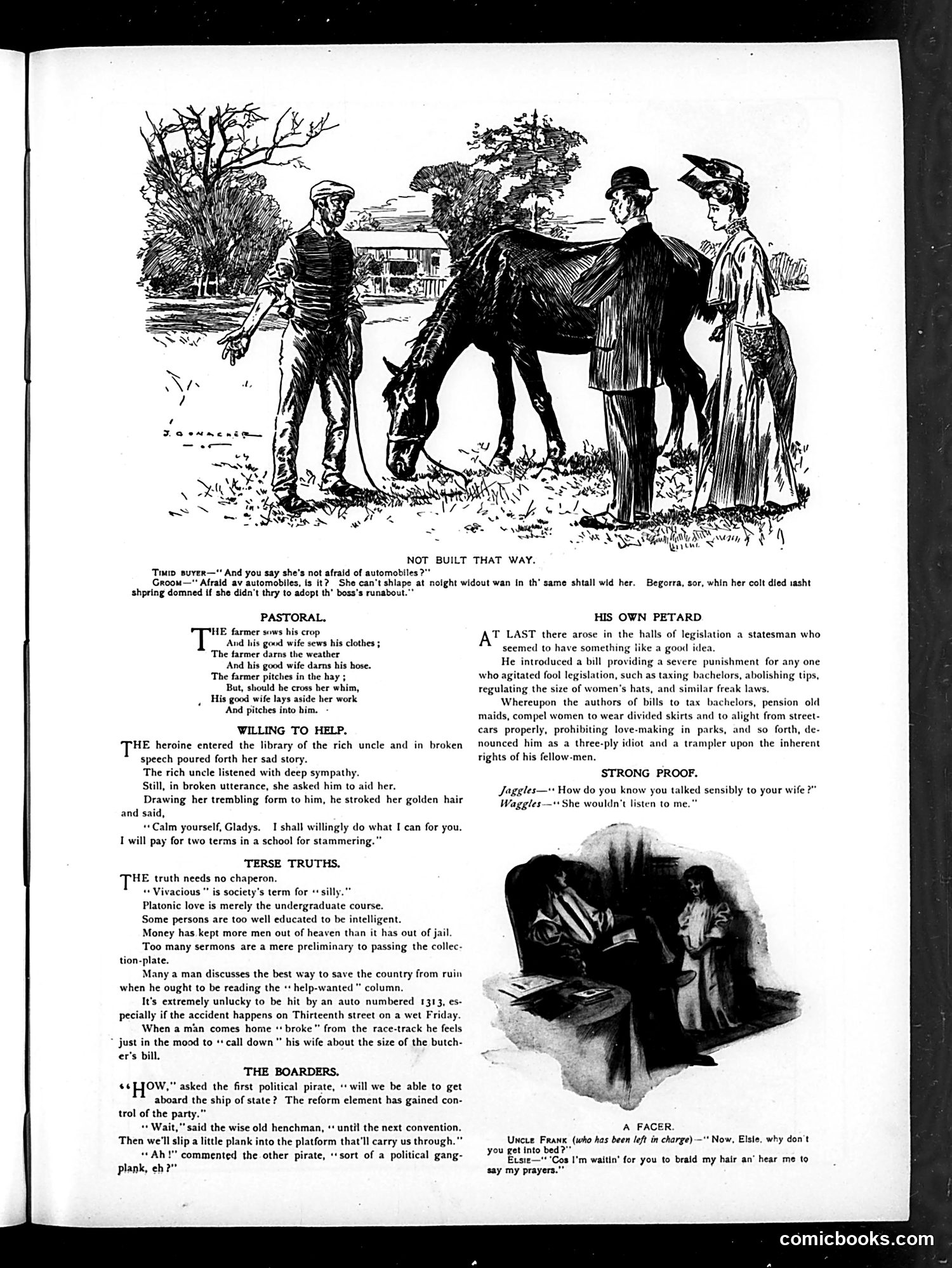
The top illustration titled "Just Built That Way" depicts a social scene where a woman on horseback is being discussed by three men. The dialogue references her fearlessness regarding automobiles and her wild behavior, suggesting satirical commentary on "New Woman" attitudes of the early 1900s—women challenging traditional gender roles and embracing modern conveniences and independence. The text sections below are humorous observations on various social topics: farming, helping others, truth-telling, political corruption, and boarders. "His Own Petard" appears to critique legislators proposing restrictive bills, while "Strong Proof" presents a marital dialogue joke about persuasion. The lower illustration "A Facer" shows a domestic confrontation scene with accompanying joke dialogue, though specific context is unclear from the visible text.
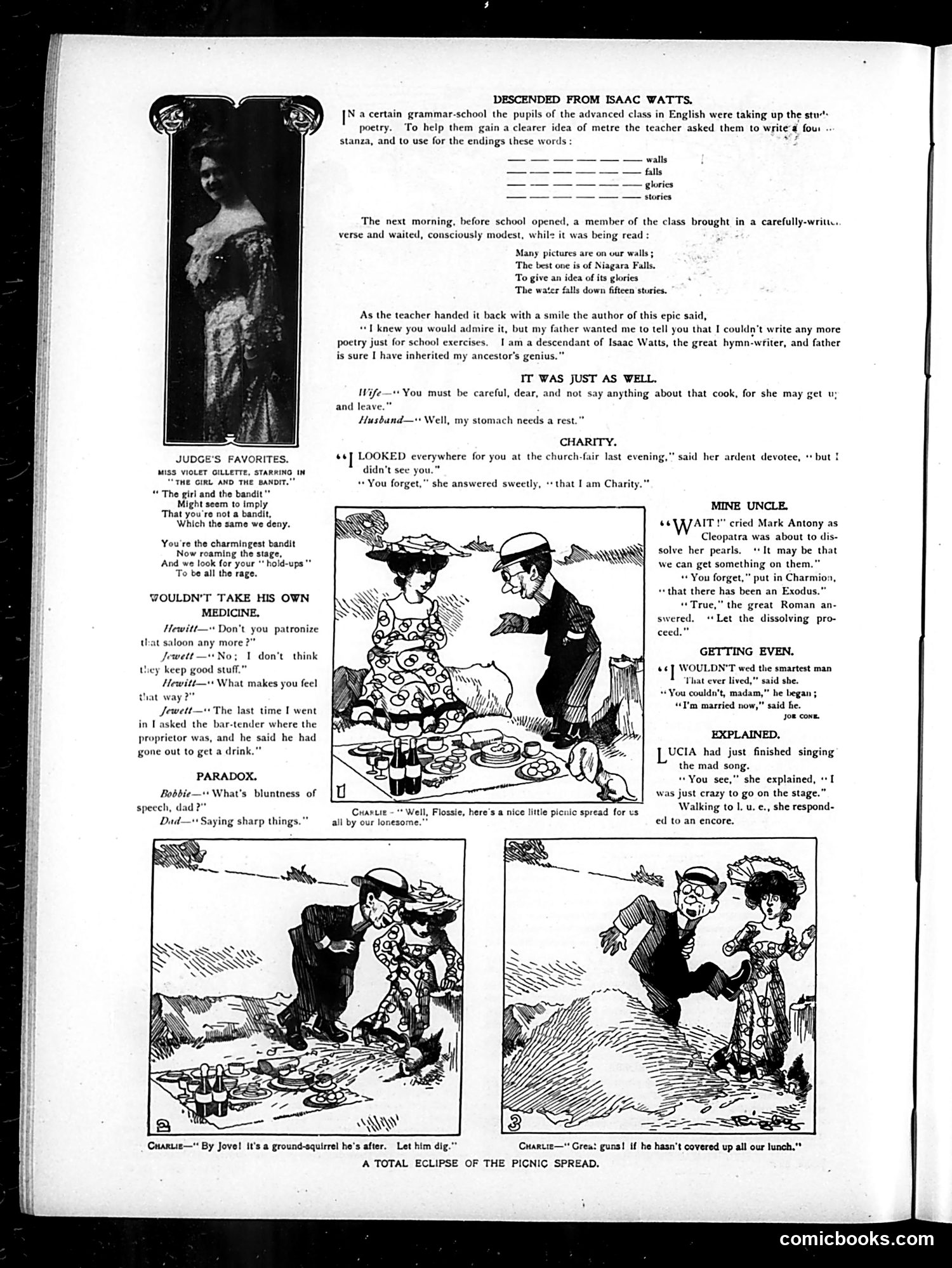
This page contains humor pieces and comic strips, not political cartoons. The content includes: **"Descended from Isaac Watts"** — A anecdote about a schoolgirl whose poem about Niagara Falls mimics the hymn writer's style. Her father discourages her poetry, claiming she inherited the ancestor's genius rather than actual talent. **"A Total Eclipse of the Picnic Spread"** — A three-panel comic strip showing a couple's picnic repeatedly disrupted by a ground squirrel stealing their food. The humor relies on slapstick physical comedy and the animal's persistent thievery. **Additional humor pieces** include brief jokes about etiquette, marriage, and social situations. The page is primarily **light social satire and domestic humor** rather than political commentary, typical of Judge's family-friendly content of this era.
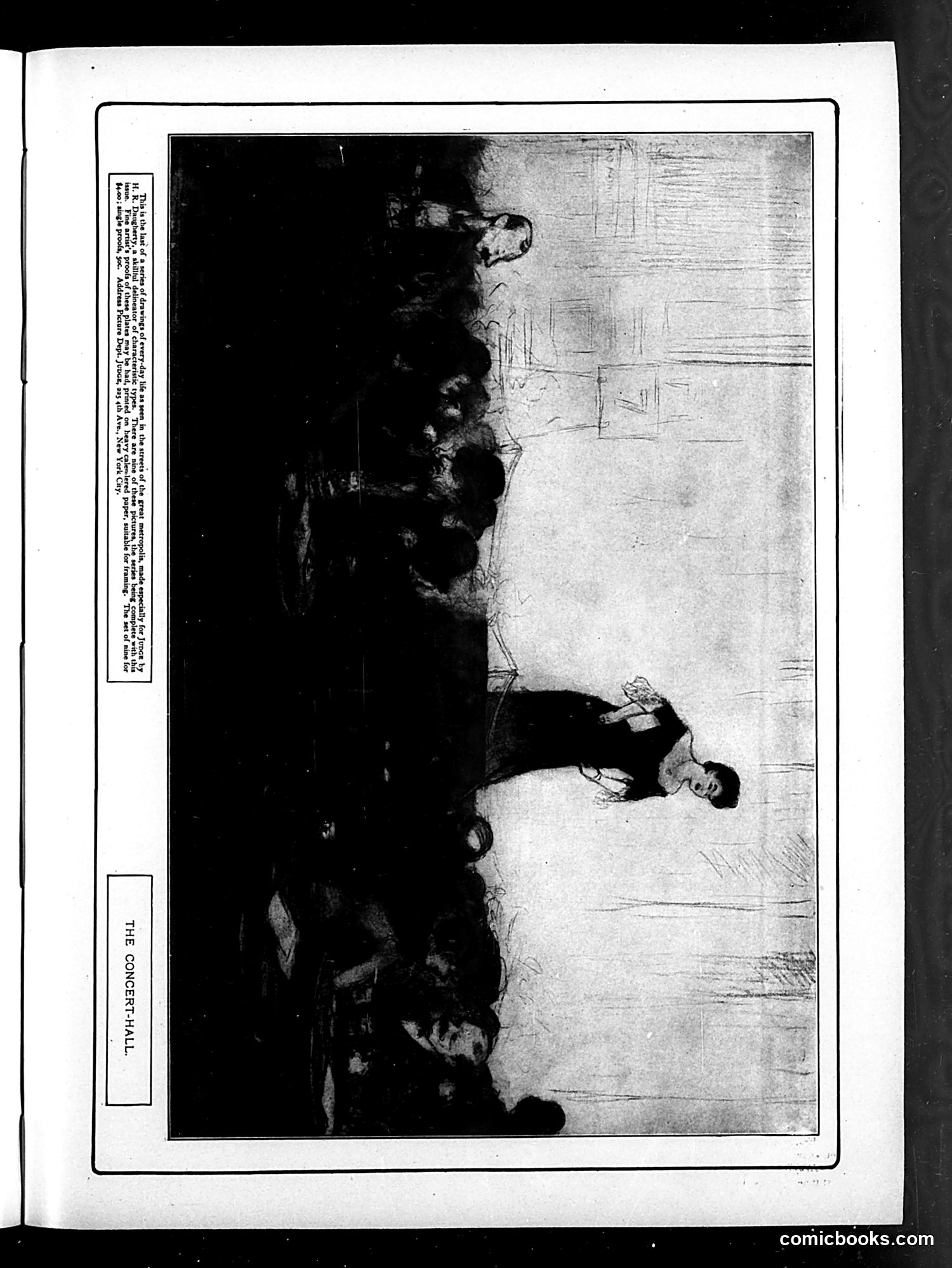
This page appears to be from *Judge* magazine and depicts a scene titled "The Concert-Hall." The image shows what appears to be a formal concert or musical performance setting, with figures in period dress (likely late 19th or early 20th century). The OCR text is severely degraded and largely illegible, making it difficult to determine the specific satirical point. The caption mentions "the streets of the great metropolis" and suggests the content is "suitable for framing," indicating this was likely a humorous social commentary on urban concert-going culture or behavior. Without clearer text, the exact target of the satire—whether it concerned audience etiquette, class pretension, musical tastes, or another social issue—cannot be reliably determined from this reproduction.
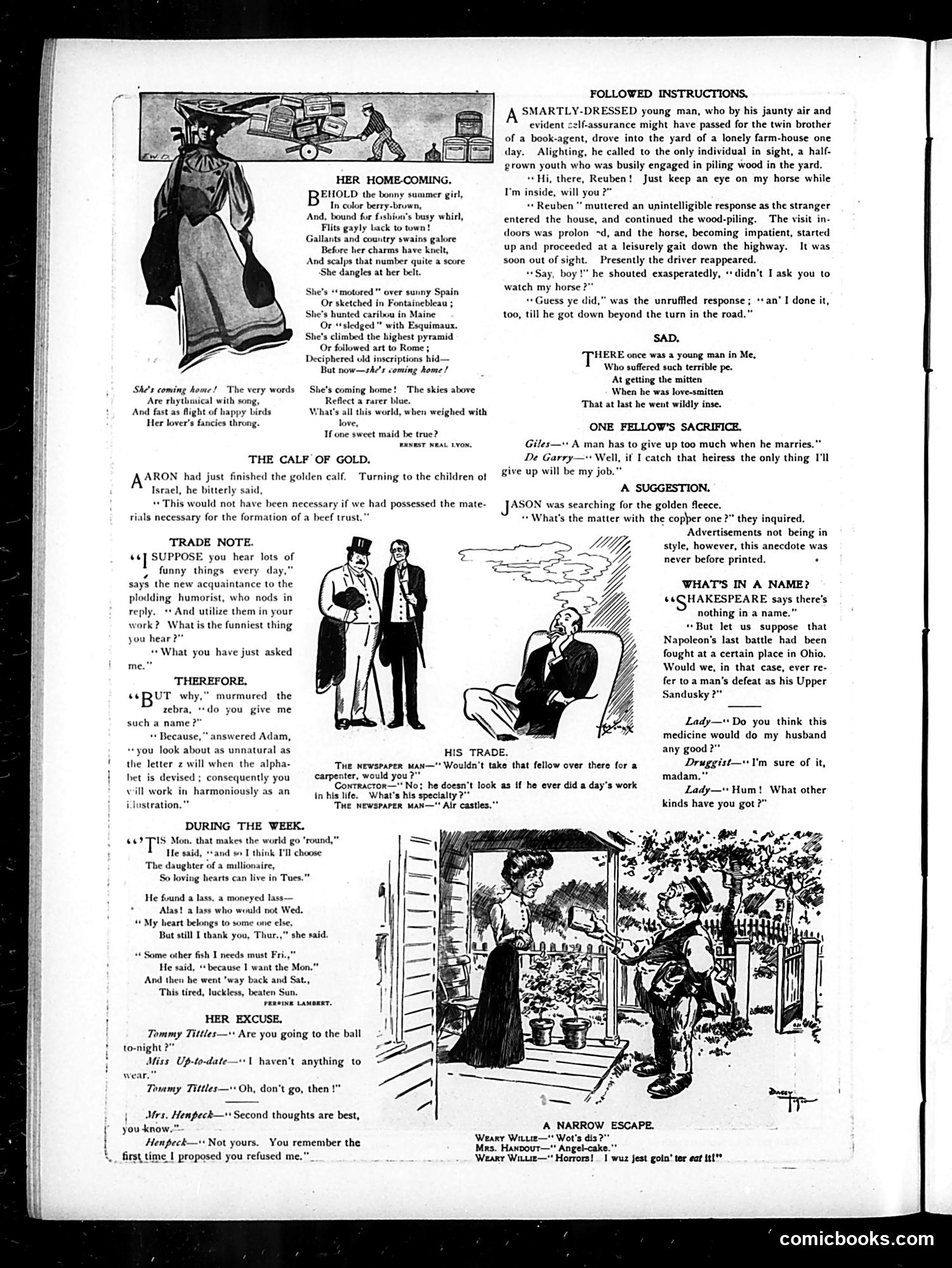
This page from the satirical magazine **Judge** contains multiple short humor pieces typical of early 20th-century American comedy: **"Her Home-Coming"** mocks the wealthy "summer girl"—a social type who travels extensively (Spain, Maine, Egypt) and collects romantic conquests ("scalps...she dangles at her belt"), yet whose lover romanticizes her return home, oblivious to her frivolous nature. **"The Calf of Gold"** references the biblical golden calf but pivots to contemporary economics, with Aaron lamenting he lacks materials for a "beef trust"—satirizing the actual monopolistic meat-packing trusts dominating American business at the time. **"His Trade"** depicts a con artist leaving a farm boy to watch his horse, which the boy literally does—watching it depart down the road—exploiting the ambiguity between "watching" and "preventing escape." Other brief pieces satirize marriage, classical mythology, and wordplay. The cartoons emphasize visual comedy and social observation rather than explicit political critique, focusing on character types and human folly that remain recognizable today.
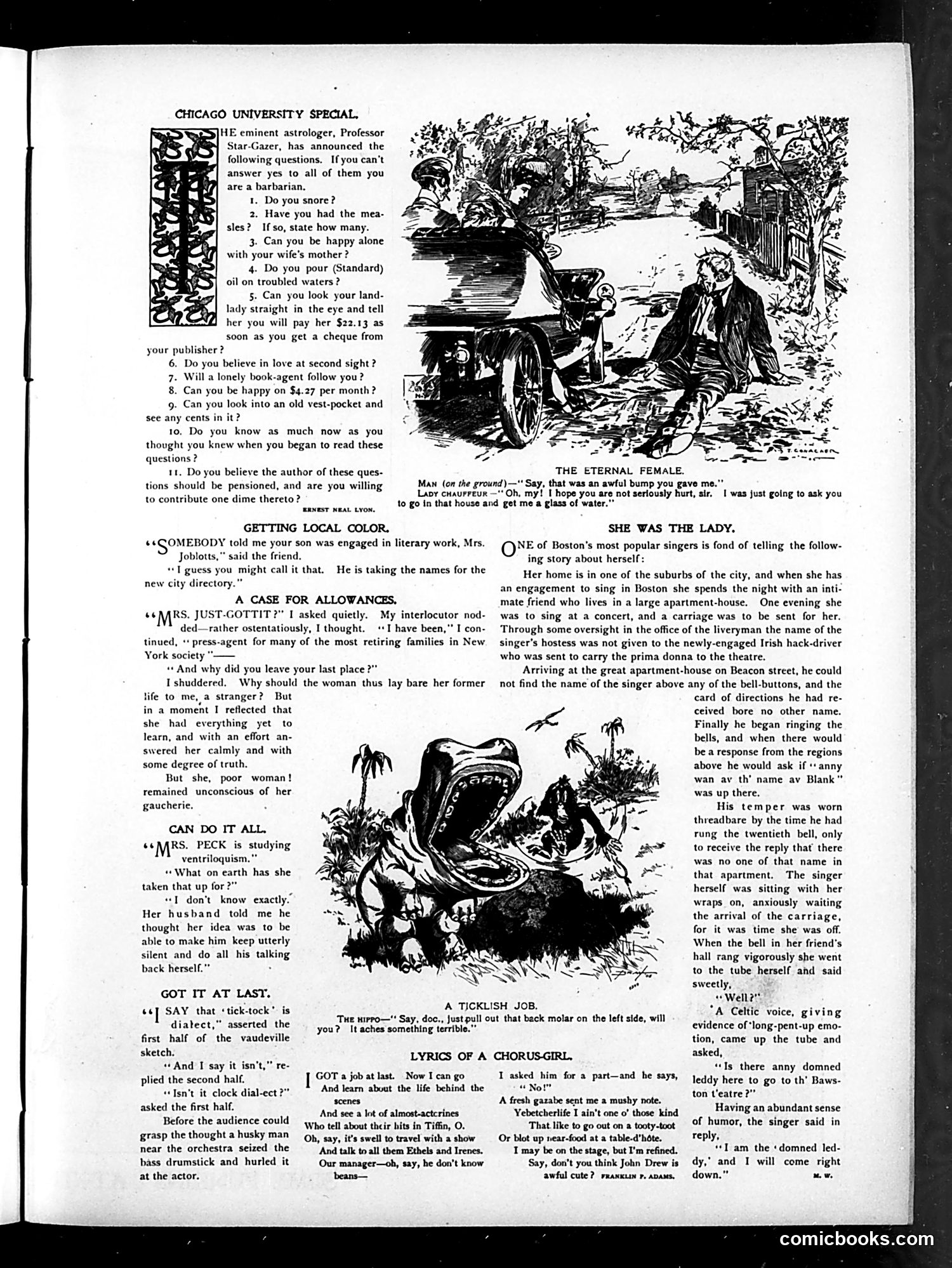
This page contains several satirical sketches and humorous stories typical of early 20th-century American humor magazines. **"Chicago University Special"** mocks pretentious self-improvement through absurdist questions—mixing genuine hardship (poverty, landlady debts) with silly ones (snoring, measles count)—suggesting that claimed "barbarian" status is actually just normal human experience. **The cartoons** illustrate domestic comedies: a woman learning ventriloquism to silence her talkative husband; a dentist struggling with a difficult extraction; a carriage driver unable to locate a Boston singer at her friend's apartment building because no name was provided. **"She Was the Lady"** appears to be a humorous story about class confusion—an Irish hack-driver cannot find which apartment contains the "prima donna" because he lacks proper identification, highlighting the anonymity of urban apartment living and servants' difficulties navigating wealthy clients' social arrangements. The overall tone is lighthearted mockery of middle-class anxieties, marriage dynamics, urban confusion, and social pretension—standard Judge magazine fare.
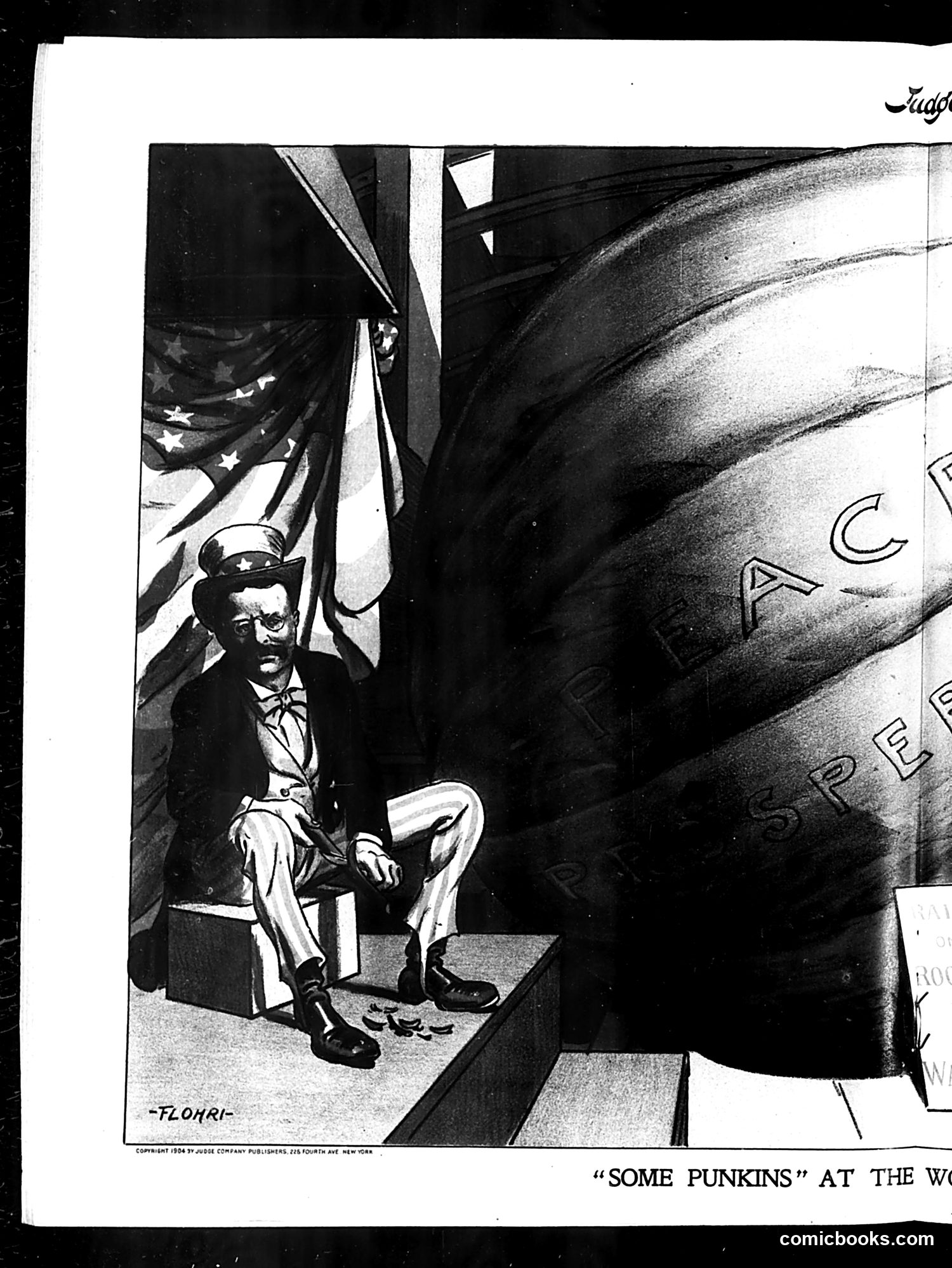
This appears to be a satirical cartoon from *Judge* magazine (copyright 1934, Puck Company Publishers). The image shows a figure in formal attire with a star-emblazoned hat, sitting beneath an enormous fist—likely representing governmental or authoritarian power. The caption reads "SOME PUNKINS" AT THE W[orld]—a colloquial phrase meaning "something impressive" or "quite important." The artist's signature appears to be "FLOHR." The cartoon likely comments on American political figures or movements of the 1930s—an era marked by economic crisis and rising international authoritarianism. The juxtaposition of the formally-dressed figure beneath the looming fist suggests satire about power dynamics, governmental strength, or possibly commentary on the New Deal or other contemporary political movements, though the specific reference remains unclear without additional context.
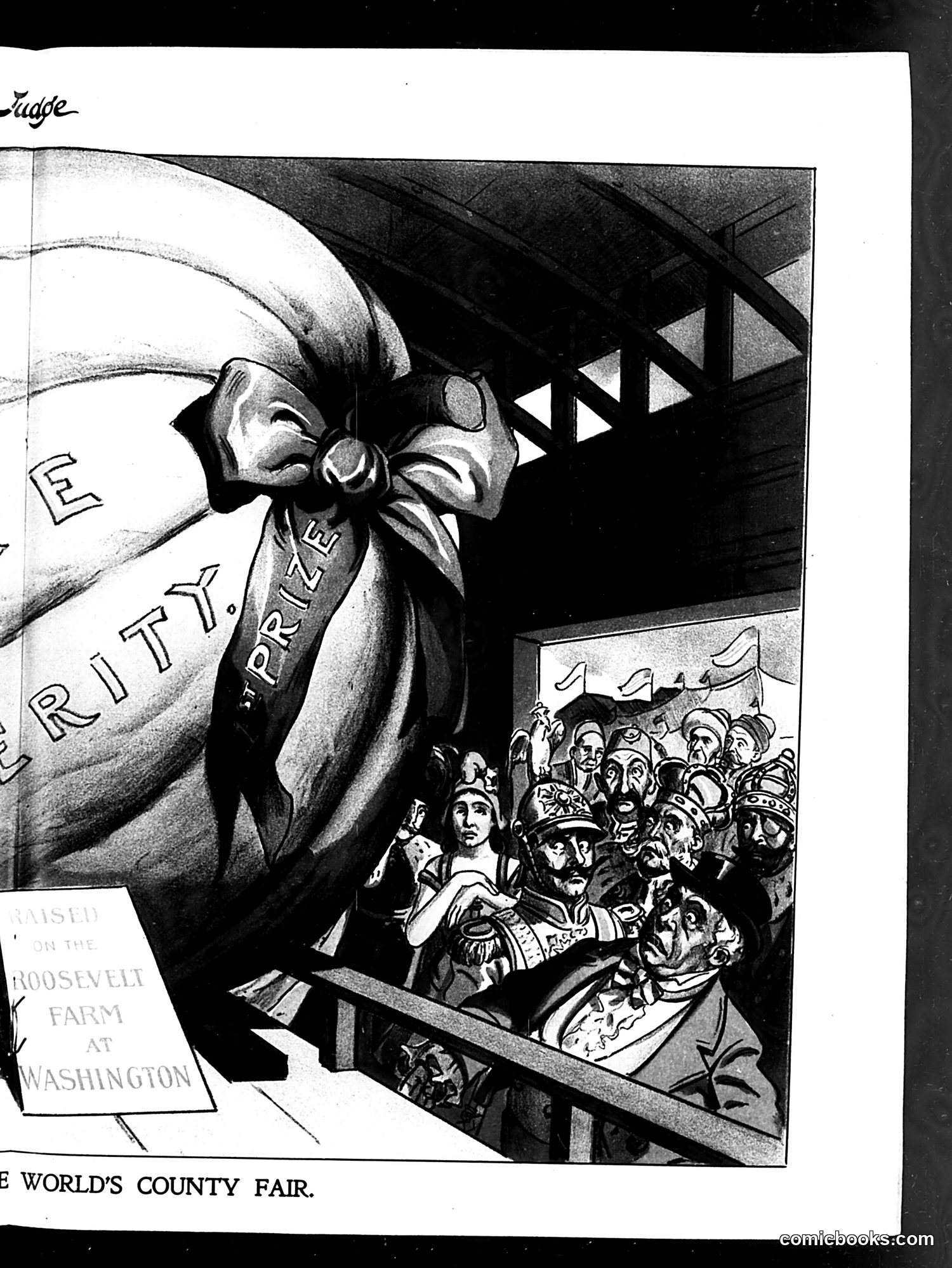
This Clifford Berryman-signed cartoon depicts "The World's Country Fair," showing a large figure labeled "PRIVILEGE" with a ribbon marked "PRIZE" presenting to a crowd of European royalty and dignitaries. A sign references "Roosevelt Farm at Washington," suggesting criticism of President Theodore Roosevelt's administration. The satire appears to argue that Roosevelt's policies favored wealthy privilege and special interests over ordinary citizens. The "prize ribbon" suggests preferential treatment, while the assembled European rulers symbolize corrupt aristocratic power. The cartoon critiques what the cartoonist saw as Roosevelt government favoring the privileged classes—a common progressive-era complaint about perceived failures to adequately challenge established wealth and power.
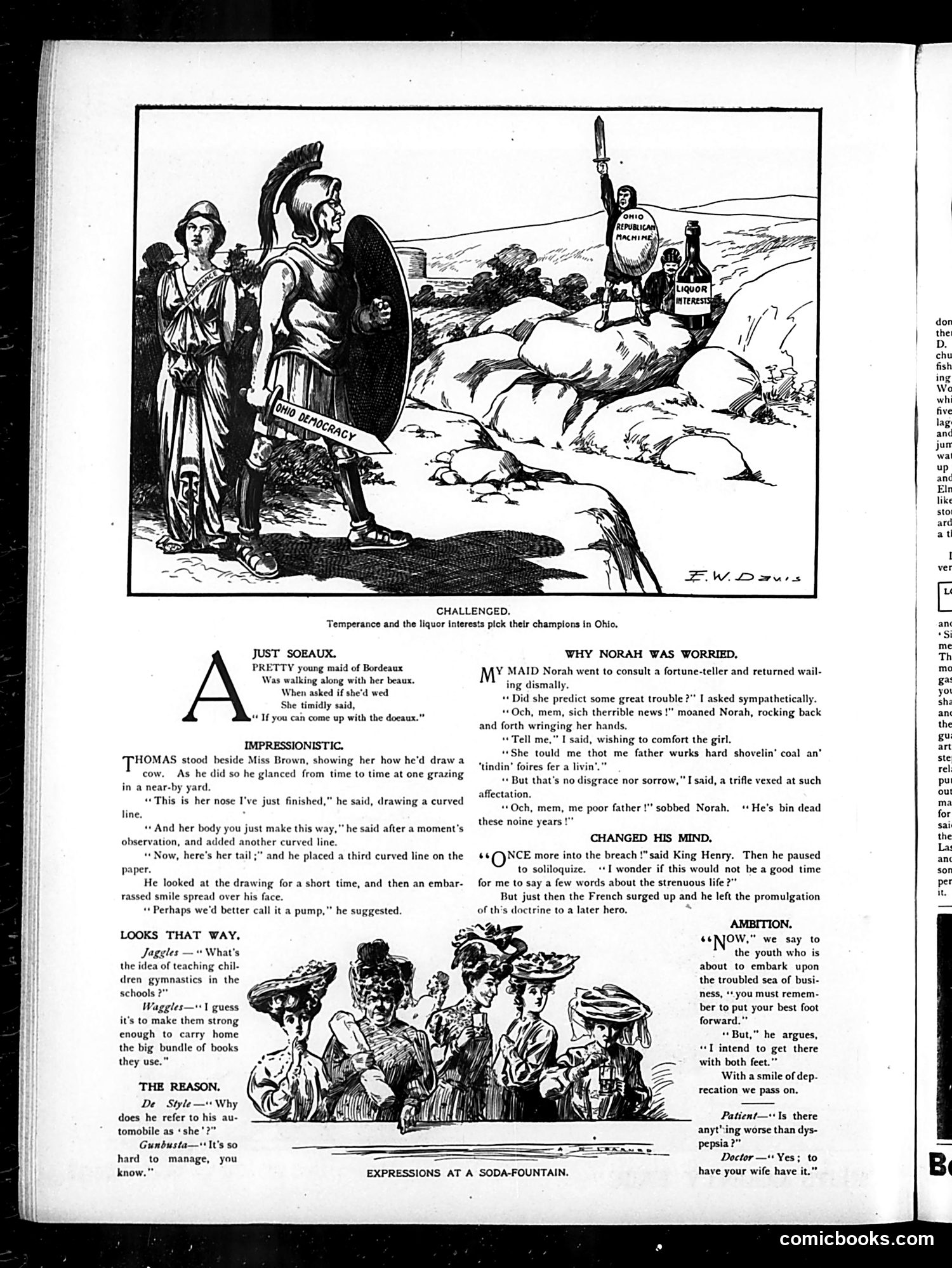
The top cartoon depicts a conflict between **Temperance** (the woman on left, labeled "DEMOCRACY") and **Liquor Interests** (represented by armed figures on right, labeled "OHIO REPUBLICAN MACHINE" and "LIQUOR INTERESTS"). They're positioned as opposing armies, suggesting a literal political battle over alcohol regulation in Ohio. This satirizes the early 20th-century Prohibition movement—a heated national debate where temperance reformers clashed with alcohol industry lobbyists for political influence. The "challenge" caption indicates they're competing to determine Ohio's policy through electoral politics. The cartoonist positions temperance as democratic principle versus entrenched commercial/political power, presenting their Ohio struggle as a consequential showdown. The militaristic imagery emphasizes the intensity and stakes of this social reform battle, which would culminate nationally in Prohibition (1920-1933). The lower half contains unrelated humor pieces typical of Judge magazine's mixed-content format.
This page is primarily **advertising and miscellaneous content** rather than political satire. It contains three humorous anecdotes: 1. **"A Pastor's Story"** — A reverend's improbable fishing tale (a pickerel jumps a stone wall to grab bait), satirizing fishermen's tall tales by framing it as credible because a pastor told it. 2. **British humor from "Mr. Punch"** — Two jokes mocking British understatement: one about a burglar using a written note instead of speaking (playing on politeness), another about Yorkshire motorists taking hospital patients on drives, with deadpan commentary suggesting dangerous driving benefits public health by killing deaf people. The satire is **mild and observational** — poking fun at cultural quirks (British reserve, clerical credibility) rather than political figures or movements. The page includes advertisements for Cook's Champagne, Pabst Blue Ribbon beer, Evans' Ale, and Judge's own hotel advertising service. This appears to be a **light entertainment issue** focused on humor and commerce rather than political commentary.
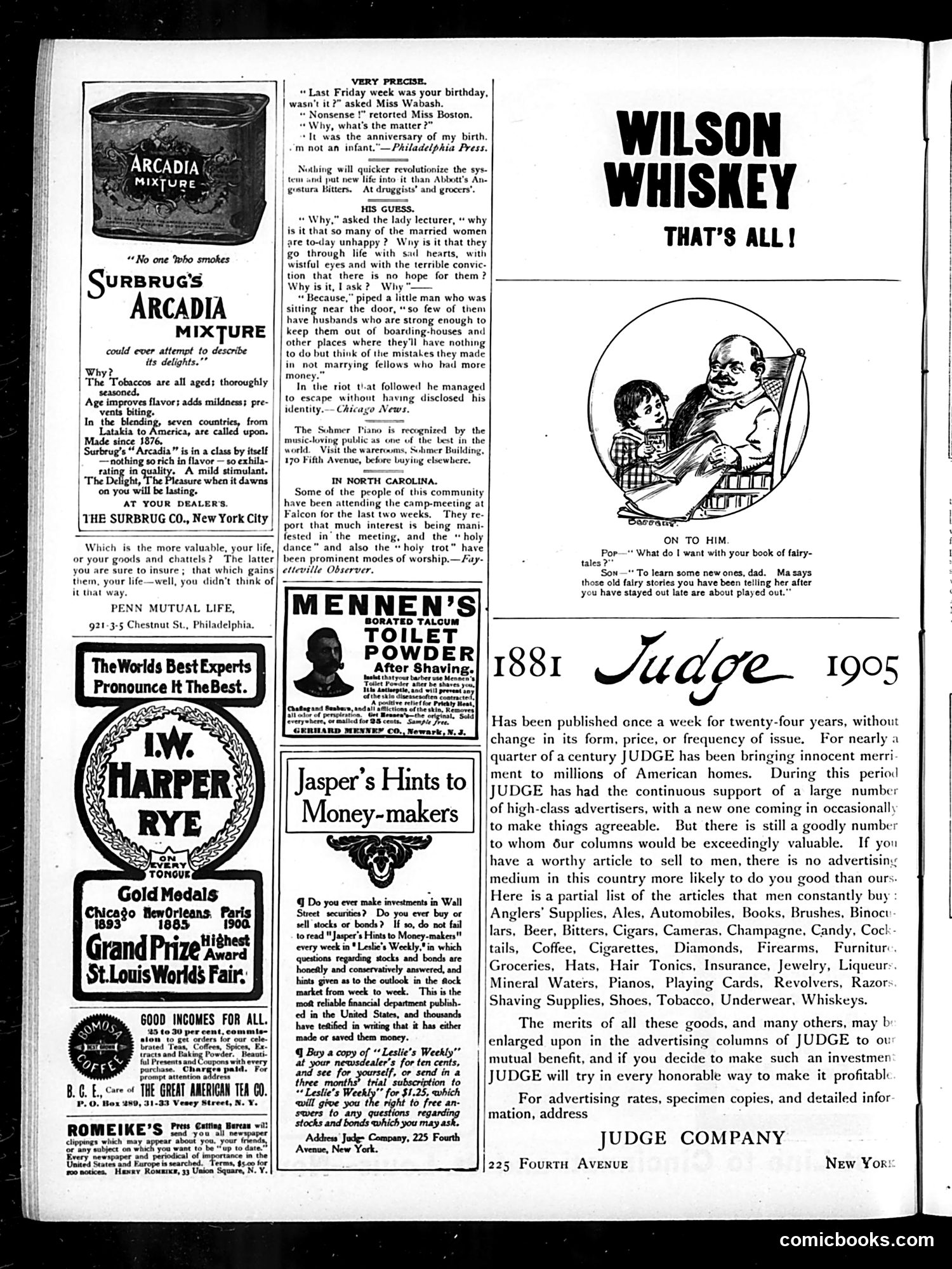
This page is primarily **advertising**, with minimal editorial content. The notable cartoon appears in the upper right: "**On to Him**" shows a man reading fairy tales to a child, with the caption suggesting the child has been staying out late playing—a gentle domestic humor piece about parenting. The left column contains brief satirical anecdotes (unmarked as cartoons): - **"Very Precise"**: A woman corrects another's terminology about her birthday, claiming "anniversary of my birth" rather than "birthday"—poking fun at pretentious linguistic correction. - **"His Guess"**: A lecture scenario where a man quips that unhappy married women lack husbands "strong enough" to keep them from boarding houses—a crude joke about masculine authority and women's discontent, typical of early 1900s attitudes. - **"In North Carolina"**: A brief report on religious camp meetings featuring "holy dances" and "holy trots," likely mocking rural religiosity. The remainder is commercial advertising for tobacco, whiskey, life insurance, pianos, talcum powder, and financial publications—characteristic Judge content for monetization.
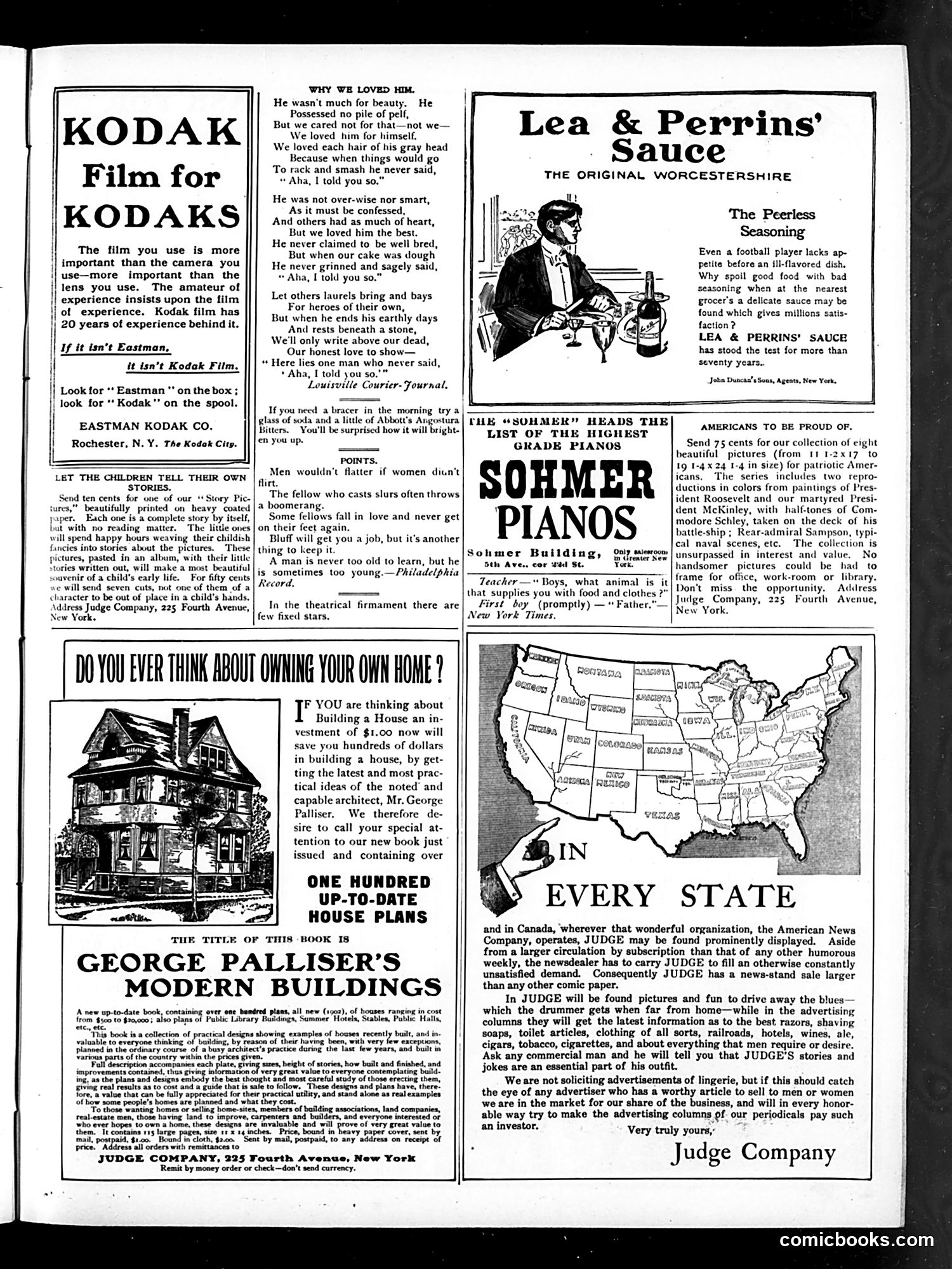
This page is primarily **commercial advertising** rather than satire or editorial cartooning. It contains advertisements for Kodak film, Lea & Perrins' Sauce, Sohmer pianos, George Palliser's house-building book, and the Judge Company's own products. The only substantial editorial content is a poem titled "Why We Loved Him" (from the Louisville Courier-Journal), which appears to praise an unnamed man for his humility and absence of smugness—he never said "I told you so" when things went wrong. This is sentimental rather than satirical. Below the poem is a section of generic witticisms labeled "POINTS," offering observations about human nature and behavior in the style typical of Judge magazine's era. The page reflects early-20th-century mass-market advertising and lifestyle content rather than political commentary or visual satire.
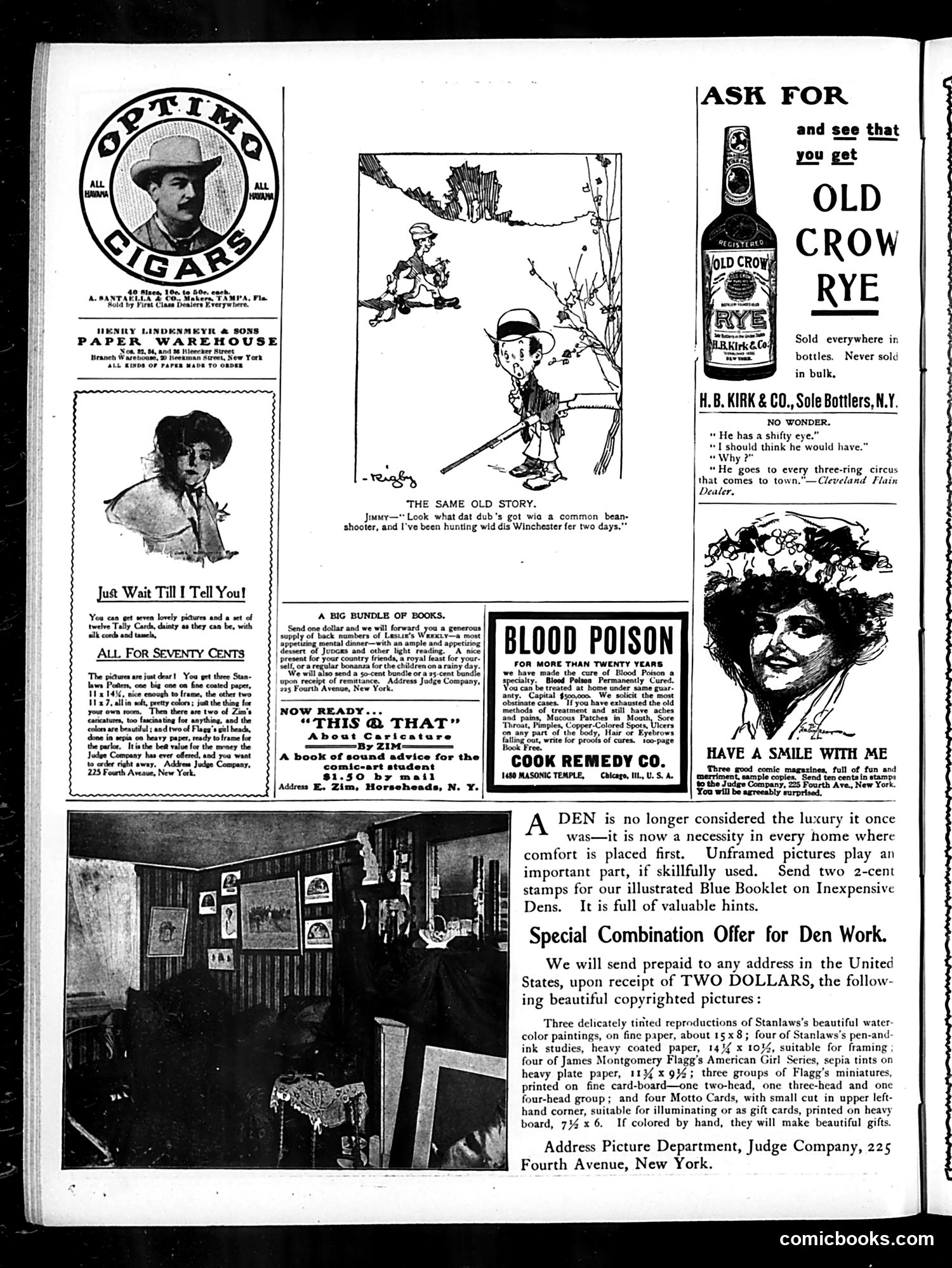
This page is primarily **advertising**, mixing product promotions with light humor content typical of early 20th-century magazines. The central cartoon, titled "The Same Old Story," depicts two figures with rifles—one boasting about bagging game with a common "bean shooter" (slingshot) while the other has hunted unsuccessfully for two days with a Winchester rifle. The humor relies on the irony of superior equipment failing against crude tools. The page features numerous patent medicine and product ads, including "Blood Poison" treatment and "Cook Remedy Co."—typical of this era when such publications carried unregulated medical claims. The "Old Crow Rye" whiskey ad and Optimo Cigars advertisement represent mainstream products. Other content includes offers for pictures/prints and books—common direct-mail promotions of the period. The "Den Work" section advertises reproductions by artist James Montgomery Flagg, reflecting the era's interest in home decoration. The humor is mild, apolitical domestic satire rather than sharp social commentary, characteristic of Judge's lighter pages between weightier editorial cartoons.
This is a **title page advertisement**, not a cartoon. It announces Leslie's Weekly's fiftieth anniversary celebration, marking fifty years since founder Frank Leslie established the publication on December 14th, 1855. The page promotes a special **double issue** combining Christmas and Semi-Centennial numbers (December 14th, 1905). The publishers boast that Leslie's Weekly remains "the pioneer of illustrated journalism" and "the most progressive and best illustrated newspaper published"—claims meant to attract advertisers. The appeal to advertisers is direct: copy deadline is November 15th, and they're encouraged to be represented in this commemorative issue, which "will be kept for many years." Contact information lists William L. Miller (Advertising Manager) with regional representatives in Chicago and Boston, emphasizing this is the only Leslie's Weekly publication.
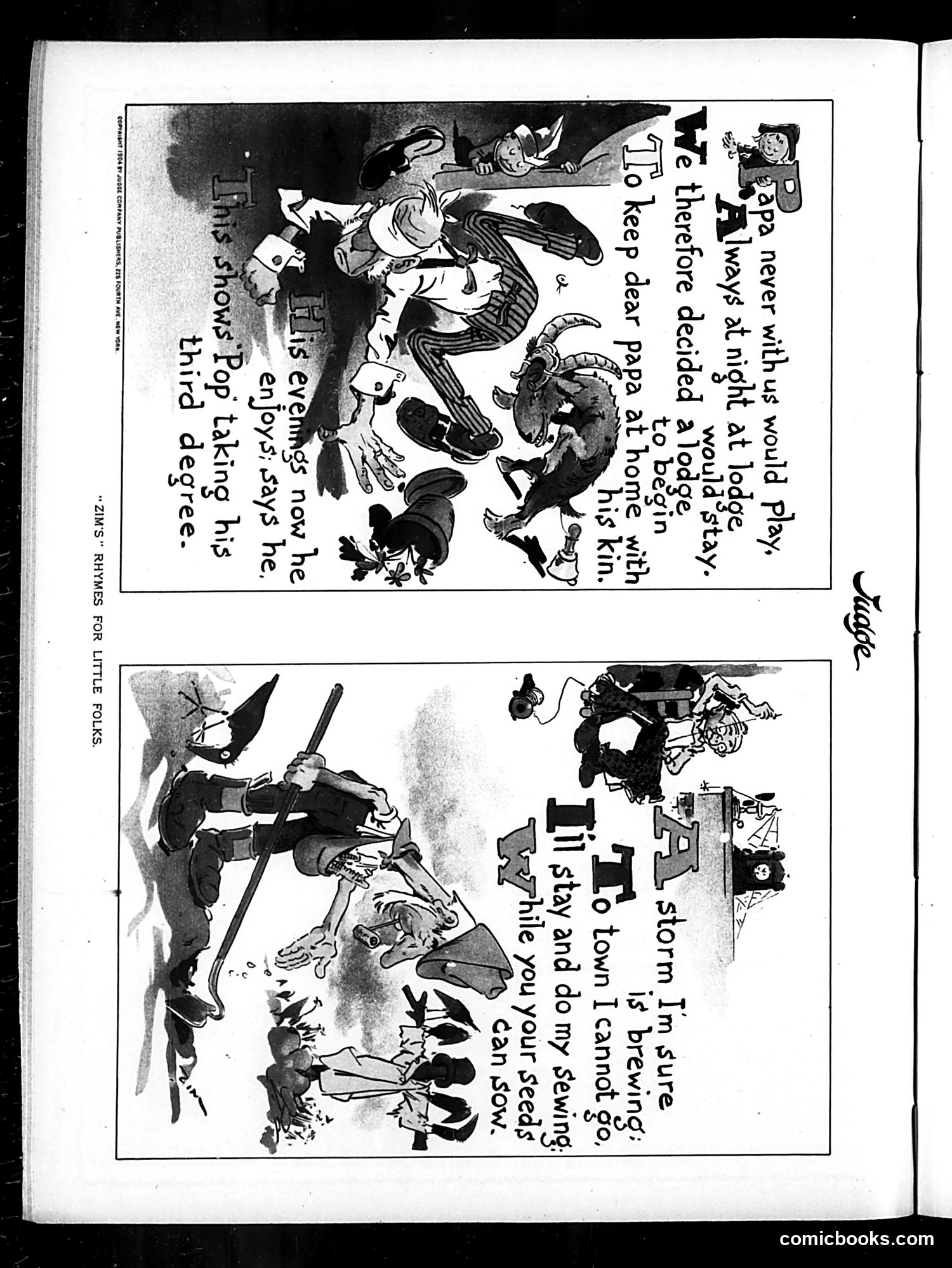
This page contains two cartoon panels satirizing parental discipline and family dynamics, circa 1906. **Top panel**: Shows a father interrogating a mischievous child with exaggerated intensity—a "third degree" (intense questioning). The text explains the father never plays with the child during the day, so he's decided to conduct aggressive questioning at home instead, treating the child like a criminal suspect. **Bottom panel**: Titled "Zim's Rhymes for Little Folks," presents a domestic scene where a mother declares she cannot leave home to go to town—she must stay and sew while the father goes out to "sow his seeds" (a euphemistic reference to infidelity or general carousing). Both panels mock Victorian-era parenting and gender dynamics: the emotionally distant, authoritarian father and the confined, dutiful mother. The satire criticizes rigid family structures where fathers neglect children except to discipline them harshly, and wives remain domestically imprisoned.