
Judge, 1905-09-23 · page 2 of 16
Judge — September 23, 1905 — page 2: what you’re looking at
What you’re looking at
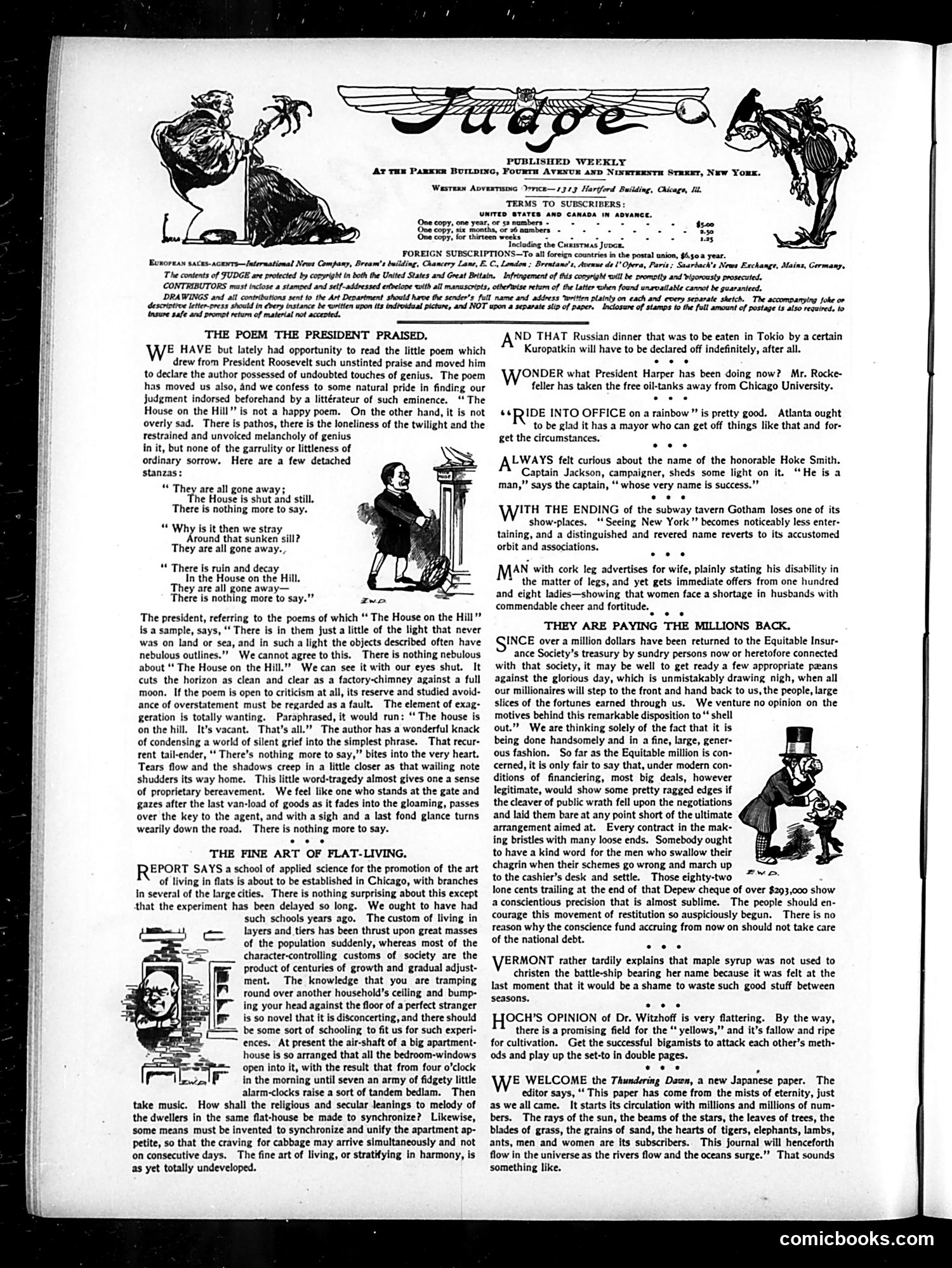
This page contains satirical commentary rather than political cartoons. The main articles mock contemporary issues: **"The Poem the President Praised"** critiques a poem about "The House on the Hill," defending it against accusations of being "nebulous." The piece defends the poem's artistic merit while subtly questioning the president's judgment in praising it. **"The Fine Art of Flat-Living"** satirizes Chicago's new school of "applied science" promoting efficient apartment living. Judge mocks this as impractical social engineering—cramming families into tiny spaces with synchronized meal times and shared resources. The satire suggests this experiment in "character-controlling customs" reflects misguided Progressive-era efficiency movements. The illustrations show figures in cramped, absurd living situations, emphasizing Judge's skepticism toward urban reform initiatives.
📄 Transcribed text from this page (OCR, searchable)
Machine-transcribed from the original scan — historical spelling and the odd misread are preserved.
PUBLISHED WEEKLY Av Tue Pamxen Burtpixc, Fourrm AVEXUE axD Nixereesrn Staxxr, New Yor. Wasraxx Apvextisina Yrrice—1313 Hartford Building, Chicago, Mit. TERMS TO SUBSCRIBERS: UNITED STATES AND CANADA IN ADVANCE. copy, six copy, for thirteen weeks 320 230 é 13s Including the Cusistwas Juoce. FOREIGN SUBSCRIPTIONS—To all foreign countries in the postal union, $4.30. year. Bunornan sacus-actts—/uternational News Company, Bream's building, Chancery Lane, F.C, London : Brentano's, Avene de Opera, Paris: Saarbach's News Exchange, Mains, Germany. The contents of FUDGE ave protected by copyright in both the United States and Great Britain, Infringement of this conyright wll be promptty and rigorously prosecuted. CONTRIBUTORS mast inciose a stamced and self-addressed extretope with all manuscripts, othefvise retam of the Latter when found unavailaNe cannot be guaranteed. DRAWINGS and all contributions sent to the Art Department should have the sender's full name and actiness “written plainty on each and every separate sketch. The accompanying joke or descriptive letter-press should in ébery instance be waritten upon tts indtotdual pictare, and NOT upon a separate slip of paper. Inclosare of stamps to the fall amount of postage 1s also required. to Insure safe and promot return of material not THE POEM THE PRESIDENT PRAISED. WE HAVE but lately had opportunity to read the little poem which drew from President Roosevelt such unstinted praise and moved him to declare the author possessed of undoubted touches of genius. The poem has moved us also, and we confess to some natural pride in finding our Judgment indorsed beforehand by a littérateur of such eminence. ‘‘ The House on the Hill’ is not a happy poem. On the other hand, it is not overly sad. There is pathos, there is the loneliness of the twilight and the restrained and unvoiced melancholy of genius in it, but none of the garrulity or littleness of ordinary sorrow. Here are a few detached stanzas: “ They are all gone away; he House is shut and still. There is nothing more to say. bs Why is it then we stray round that sunken sill? They are all gone away., “ There Is ruin and decay In the House on the Hill. They are all gone away— There is nothing more to say.” The president, referring to the poems of which ‘ The House on the Hill” is a sample, says, “‘ There is in them just a little of the light that never was on land or sea, and in such a light the objects described often have nebulous outlines.” We cannot agree to this. There is nothing nebulous about ‘‘ The House on the Hill.”” We can see it with our eyes shut. It cuts the horizon as clean and clear as a factory-chimney against a full moon. If the poem is open to criticism at all, its reserve and studied avoid- ance of overstatement must be regarded as a fault. The element of exag- geration is totally wanting. Paraphrased, it would run: ‘ The house is on the hill. It’s vacant. That's all.” The author has a wonderful knack of condensing a world of silent grief into the simplest phrase. That recur- rent tail-ender, *‘ There’s nothing more to say,”’ bites into the very heart. Tears flow and the shadows creep in a little closer as that wailing note shudders its way home. This little word-tragedy almost gives one a sense of proprietary bereavement. We feel like one who stands at the gate and gazes after the last van-load of goods as it fades into the gloaming, passes over the key to the agent, and with a sigh and a last fond glance turns wearily down the road. There is nothing more to say. ‘THE FINE ART OF FLAT-LIVING. REPORT SAYS a school of applied science for the promotion of the art of living in flats is about to be established in Chicago, with branches in several of the large cities. There is nothing surprising about this except that the experiment has been delayed so long. We ought to have had such schools years ago, The custom of living in layers and tiers has been thrust upon great masses of the population suddenly, whereas most of the character-controlling customs of society are the product of centuries of growth and gradual adjust- ment. The knowledge that you are tramping round over another household’s ceiling and bump- ing your head against the floor of a perfect stranger is so novel that it is disconcerting, and there should be some sort of schooling to fit us for such experi- ences. At present the air-shaft of a big apartment- house is so arranged that all the bedroom-windows open into it, with the result that from four o’clock in the morning until seven an army of fidgety little alarm-clocks raise a sort of tandem bedlam. Then take music. How shall the religious and secular leanings to melody of the dwellers in the same flat-house be made to synchronize? Likewise, some means must be invented to synchronize and unify the apartment ap- petite, so that the craving for cabbage may arrive simultaneously and not ‘on consecutive days. The fine art of living, or stratifying in harmony, is as yet totally undeveloped. mo ANDO THAT Russian dinner that was to be eaten in Tokio by a certain Kuropatkin will have to be declared off indefinitely, after all. WONDER what President Harper has been doing now? Mr. Rocke- feller has taken the free oil-tanks away from Chicago University. 6¢PIDE INTO OFFICE on a rainbow” is pretty good. Atlanta ought to be glad it has a mayor who can get off things like that and for- get the circumstances. ee ALWAYS felt curious about the name of the honorable Hoke Smith. Captain Jackson, campaigner, sheds some light on it. “He is a man,” says the captain, ‘ whose very name is success.” W'TH THE ENDING of the subway tavern Gotham loses one of its show-places. “Seeing New York” becomes noticeably less enter- taining, and a distinguished and revered name reverts to its accustomed orbit and associations. gue MAN with cork leg advertises for wife, plainly stating his disability in the matter of legs, and yet gets immediate offers from one hundred and eight ladies—showing that women face a shortage in husbands with commendable cheer and fortitude. | . THEY ARE PAYING THE MILLIONS BACK. INCE over a million dollars have been returned to the Equitable Insur- ance Society’s treasury by sundry persons now or heretofore connected with that society, it may be well to get ready a few appropriate pwans against the glorious day, which is unmistakably drawing nigh, when all our millionaires will step to the front and hand back to us, the people, large slices of the fortunes earned through us. We venture no opinion on the motives behind this remarkable disposition to shell out.” We are thinking solely of the fact that it is being done handsomely and in a fine, large, gener ous fashion. So far as the Equitable million is con- cerned, it is only fair to say that, under modern con ditions of financiering, most big deals, however legitimate, would show some pretty ragged edges if the cleaver of public wrath fell upon the negotiations and laid them bare at any point short of the ultimate arrangement aimed at. Every contract in the mak- ing bristles with many loose ends. Somebody ought to have a kind word for the men who swallow their chagrin when their schemes go wrong and march up to the cashier’s desk and settle. Those eighty-two lone cents trailing at the end of that Depew cheque of over $293,000 show a conscientious precision that is almost sublime. The people should en- courage this movement of restitution so auspiciously begun. There is no reason why the conscience fund accruing from now on should not take care of the national debt. ERMONT rather tardily explains that maple syrup was not used to christen the battle-ship bearing her name because it was felt at the last moment that it would be a shame to waste such good stuff between seasons. reuse HOCH’S OPINION of Dr. Witzhoff is very fattering. By the way, there is a promising field for the ‘* yellows,” and it’s fallow and ripe for cultivation. Get the successful bigamists to attack each other’s meth- ods and play up the set-to in double pages. eee x WE WELCOME the Thundering Dawn, a new Japanese paper. The editor says, ‘ This paper has come from the mists of eternity, just as we all came. It starts its circulation with millions and millions of num- bers. The rays of the sun, the beams of the stars, the leaves of trees, the blades of grass, the grains of sand, the hearts of tigers, elephants, lambs, ants, men and women are its subscribers. This journal will henceforth flow in the universe as the rivers flow and the oceans surge.” That sounds something like. Ewe. comicbooks.com