
A complete issue · 16 pages · 1905
Judge — September 9, 1905
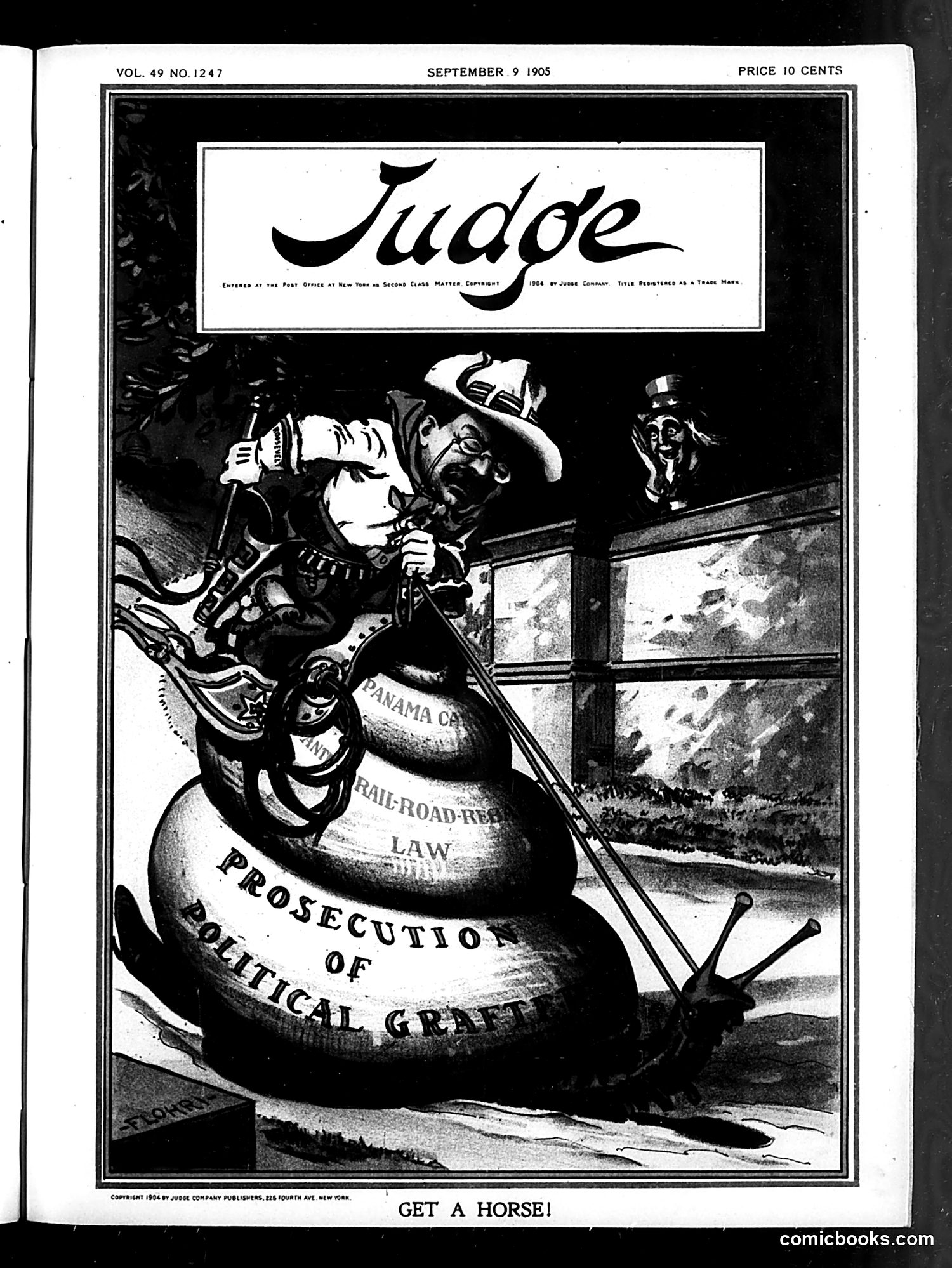
This satirical cartoon depicts a cowboy figure riding a large bomb labeled "PROSECUTION OF POLITICAL GRAFT." The text references "PANAMA QUESTION," "RAILROAD REBATE LAW," and other regulatory issues. A small figure labeled "UNCLE SAM" appears in the window, observing. The cartoon criticizes the Theodore Roosevelt administration's anti-corruption efforts during the Progressive Era. The cowboy imagery suggests aggressive, reckless action—satirizing the administration's approach to prosecuting political corruption and railroad abuses as overly wild or out of control. The caption "GET A HORSE!" implies these prosecutions are as outdated or ineffective as riding a horse instead of using modern methods.
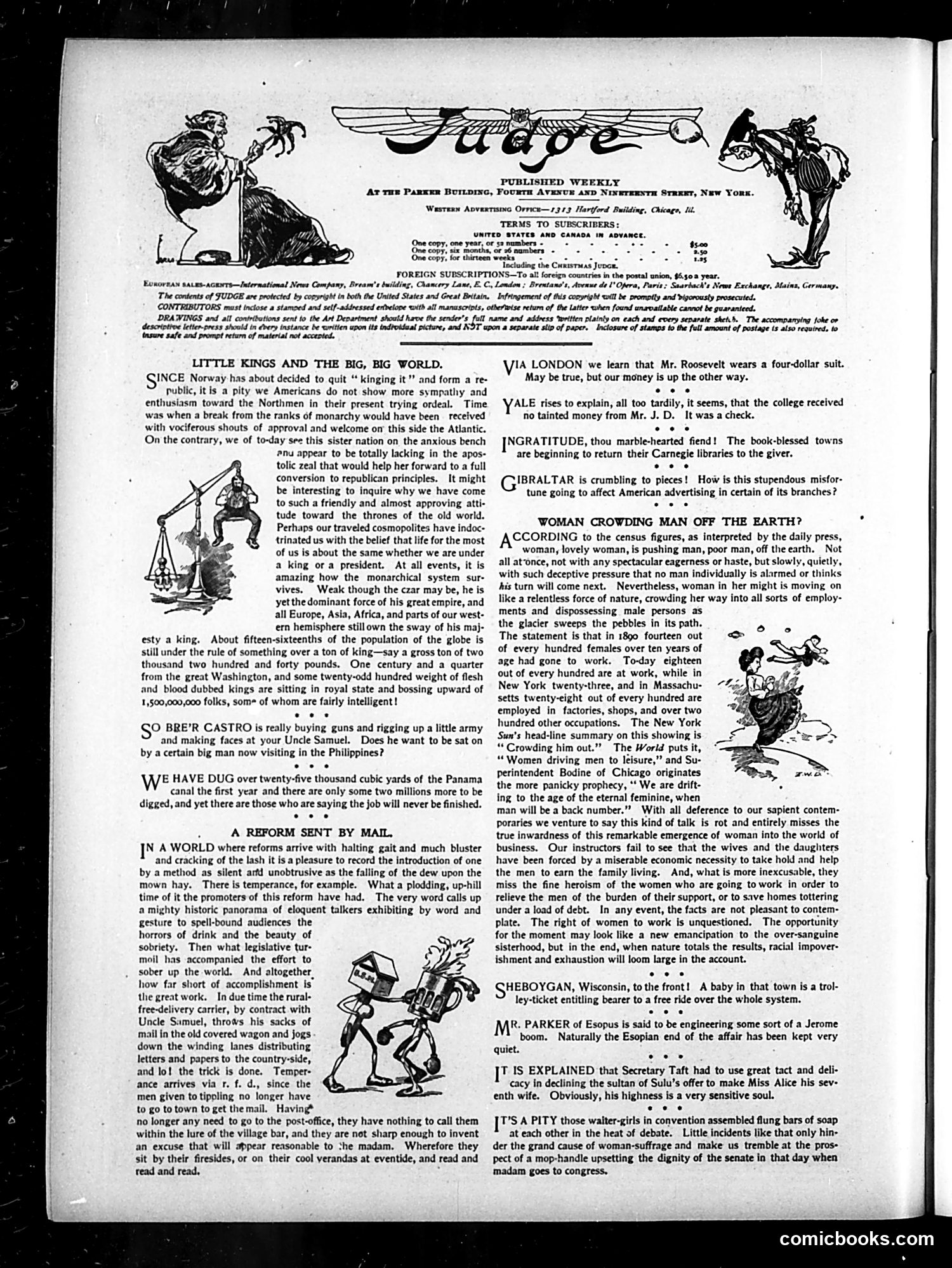
This page contains multiple brief satirical commentary pieces rather than traditional political cartoons. **Key sections:** - **"Little Kings and the Big, Big World"**: Mocks Republican conversion efforts, suggesting the GOP is weak and unconvincing in its appeals. - **"Woman Crowding Man Off Earth"**: Critiques census data showing women outnumber men, sarcastically framing female workforce participation as unnatural competition displacing masculine authority—a common anti-suffrage/anti-women's-labor argument of the era. - **"A Reform Sent by Mail"**: Satirizes postal reform efforts, mocking their ineffectiveness and the bureaucratic contradictions involved. The cartoons feature exaggerated character illustrations typical of Judge's style. Overall, the page reflects early-20th-century anxieties about gender roles, labor, and progressive reform—treating social change as absurd rather than legitimate.
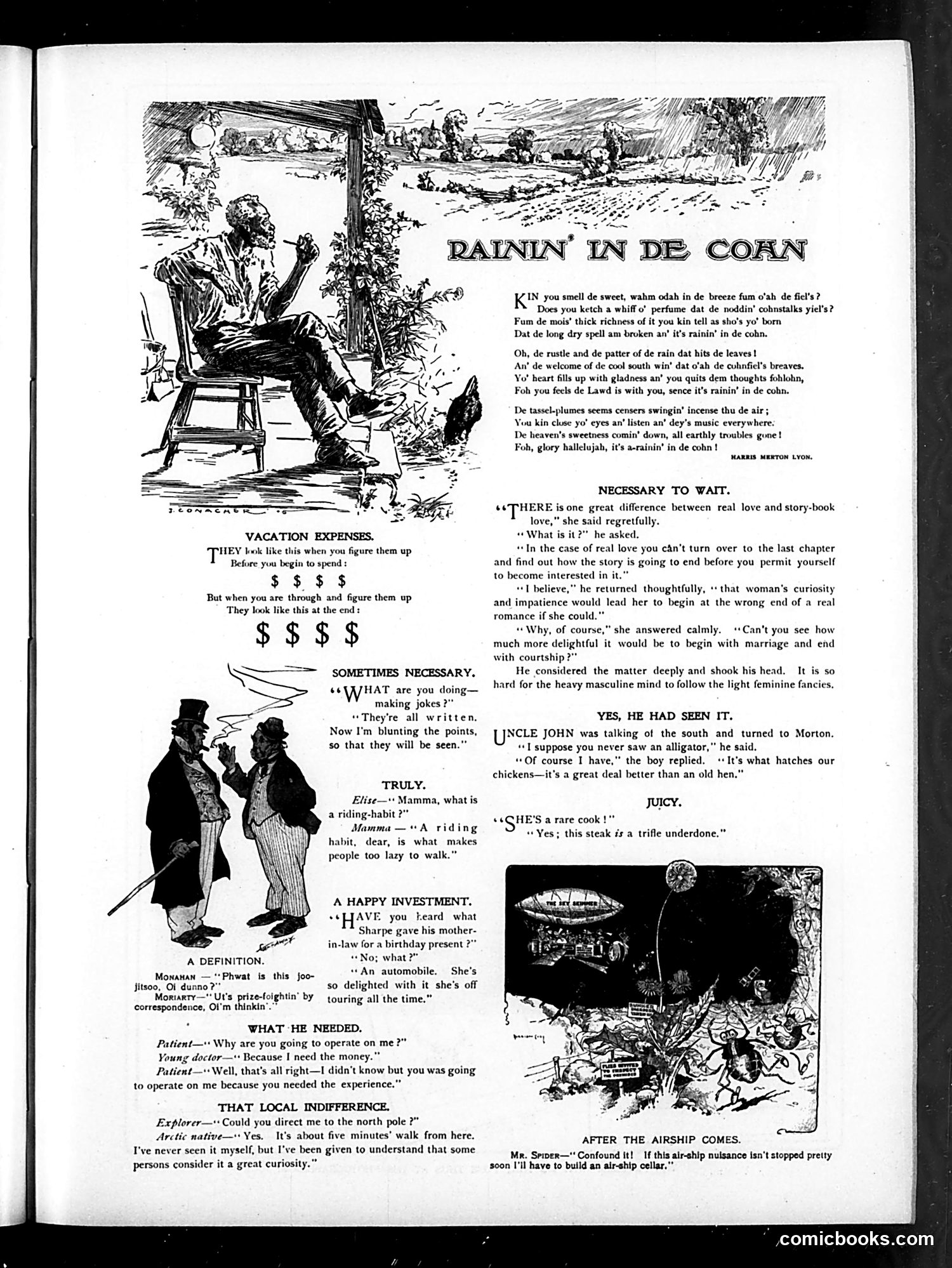
This page contains primarily humorous short jokes and anecdotes rather than political cartoons. The main illustrated piece, "Rainin' in de Coan," depicts a man sitting outdoors during rainfall, rendered in dialect verse about enjoying rain in the corn. The other sections are comedic vignettes: "Vacation Expenses" contrasts modest planning with actual overspending; "Sometimes Necessary" shows two figures discussing joke-writing; "Truly" defines a "riding-habit"; and several others cover mundane domestic situations and wordplay ("A Happy Investment," "What He Needed"). The bottom illustration labeled "After the Airship Comes" shows an airship/early aircraft scene with a caption about "Mr. Spider" needing to build "an air-ship collar," suggesting satire about emerging aviation technology. This appears to be lighthearted social humor rather than serious political commentary.
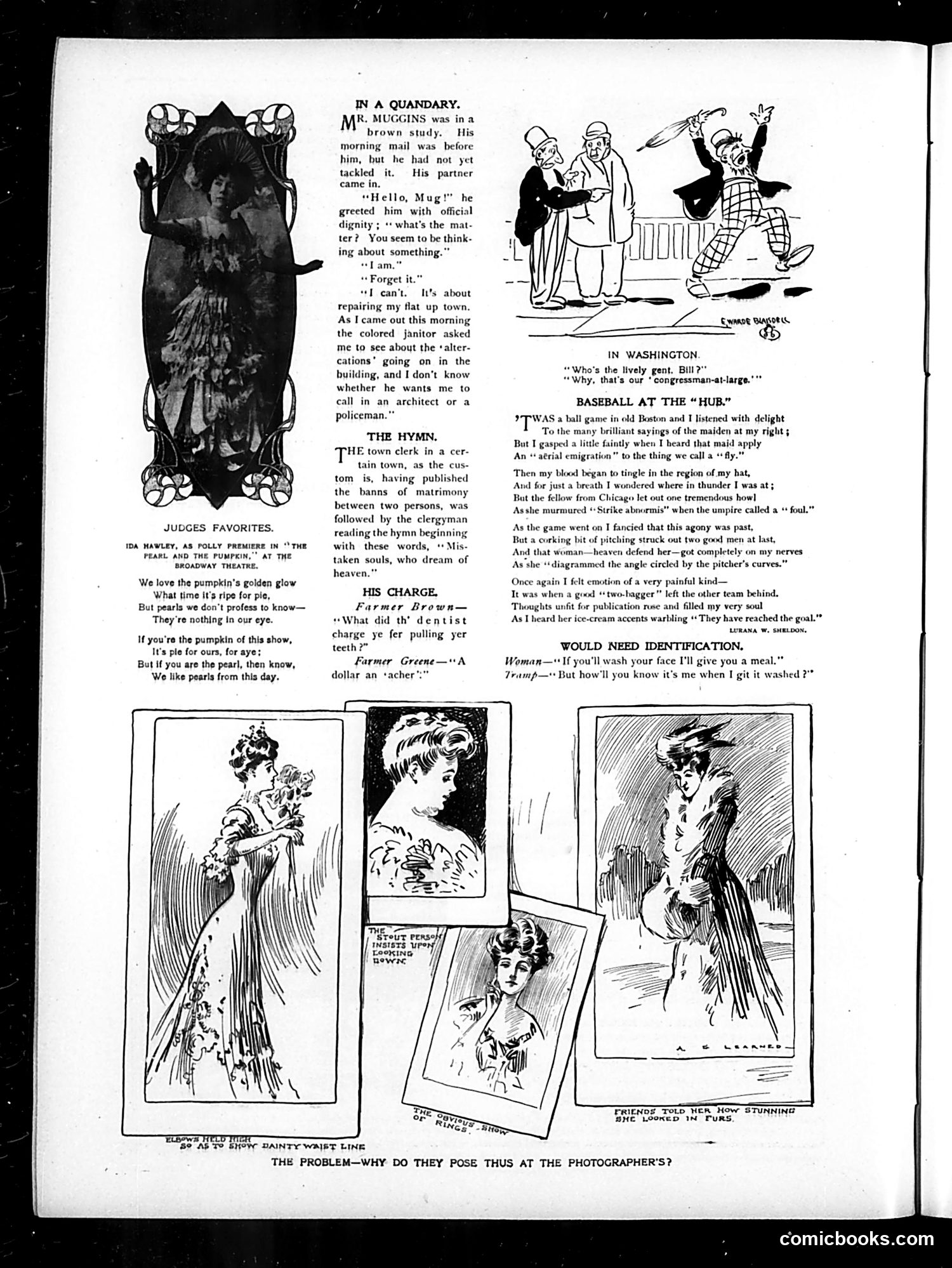
This page contains several unrelated humorous pieces typical of early 20th-century Judge magazine: 1. **"In a Quandary"**: A comedy sketch about Mr. Muggins dealing with a repair contractor's vague architectural terminology. 2. **"The Hymn"**: A joke about a town clerk reading marriage announcements aloud during a hymn. 3. **"His Charge"** and **"Would Need Identification"**: Brief comedic exchanges between dentists/tramps and their clients, playing on working-class dialect humor. 4. **Lower section**: Fashion illustrations captioned "The Problem—Why Do They Pose Thus at the Photographer's?"—satirizing women's exaggerated posing and impractical corsetry that created awkward body positions for portrait photography. The page reflects period preoccupations with class distinction, gender fashion absurdities, and working-class dialect comedy.
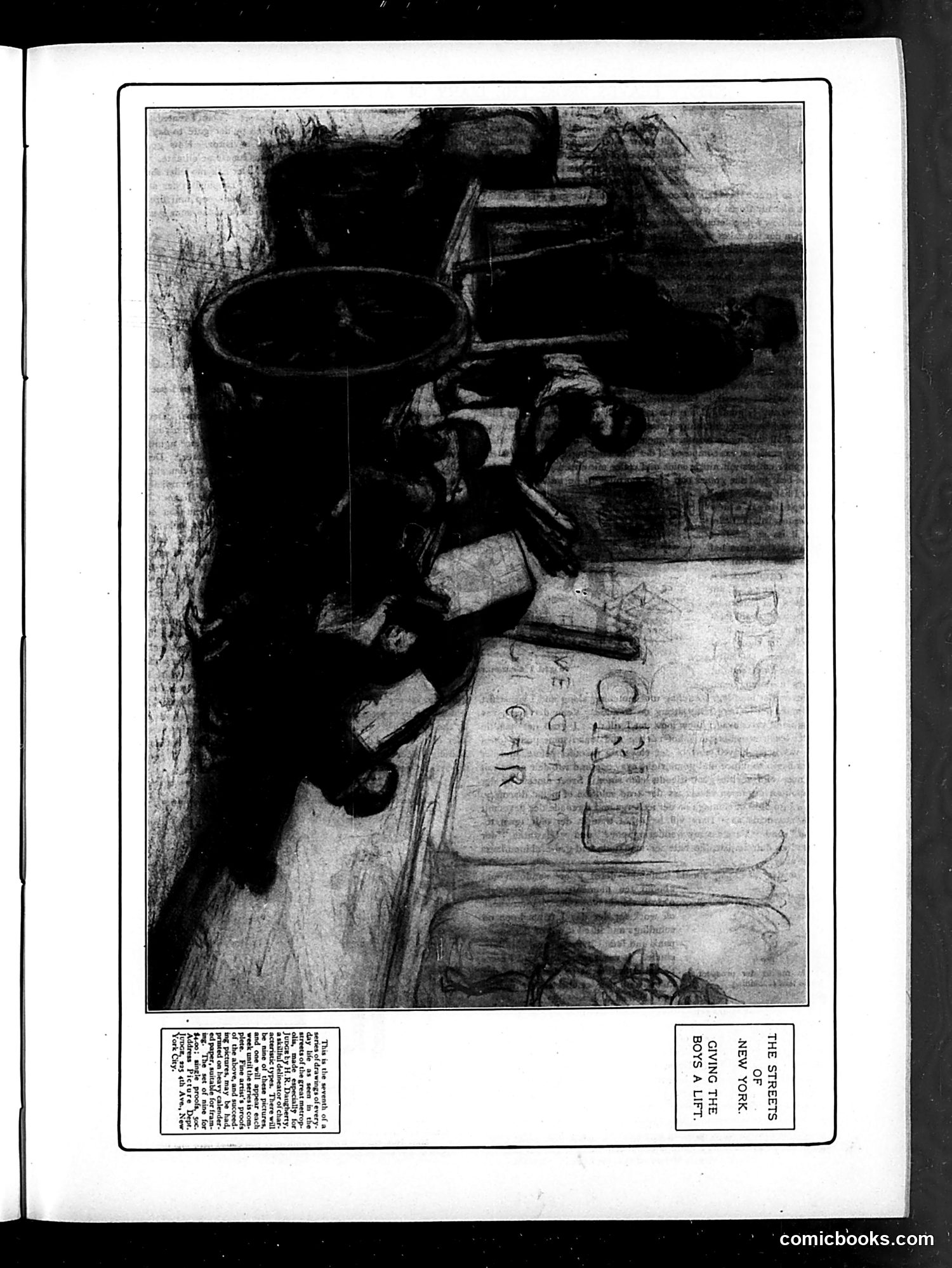
This appears to be a Judge magazine page depicting street life in New York, titled "The Streets of New York: Giving the Boys a Lift." The image shows what appears to be a delivery wagon or cart with large containers/barrels and figures around it—likely street children or working-class boys. The phrase "Giving the Boys a Lift" suggests satirical commentary on urban poverty and child labor conditions in late 19th or early 20th-century New York. The cartoon likely critiques either inadequate charity efforts toward poor children or exploitative labor practices. The OCR text is largely illegible, making precise interpretation difficult, but the visual composition emphasizes the contrast between industrial/commercial activity and vulnerable street youth. Without clearer text, the specific satirical target remains unclear, though the scene appears to comment on working-class conditions in urban America.
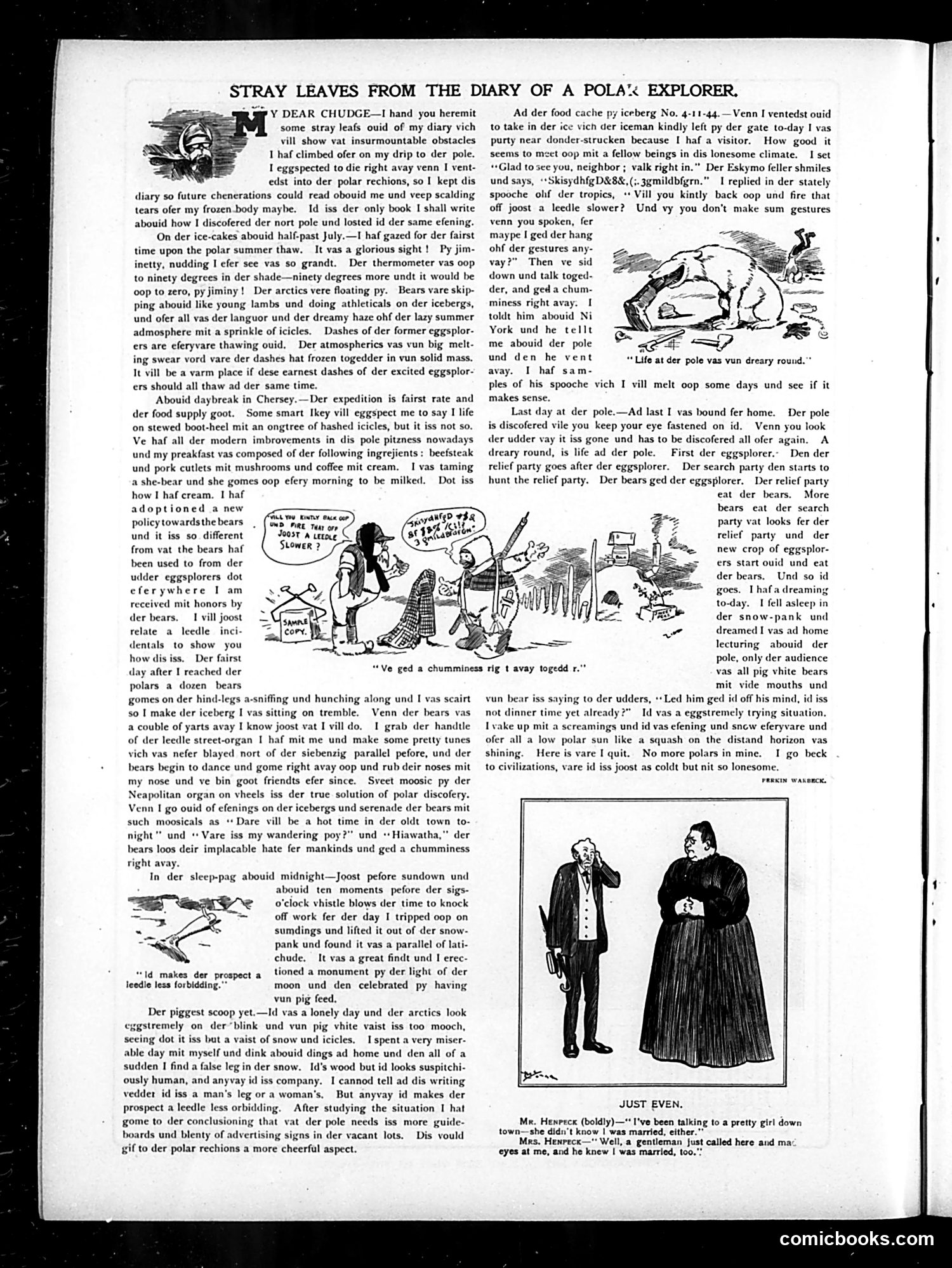
This is a humorous fictional diary from a comic character with a thick, exaggerated German-Yiddish accent (rendered phonetically: "vat," "py jiminy," "eggspected"). The narrator claims to be a polar explorer who discovered the North Pole but immediately lost it the same evening—a joke on the era's famous polar exploration races and competing claims. The satire mocks both explorers' grandiose self-promotion and contemporary immigrant stereotypes. The accent-heavy narrative ridicules German-American immigrants while poking fun at the melodramatic tone of real polar expedition accounts. Details like befriending bears with street-organ music and milking a she-bear for cream are absurdist humor. The tiny cartoon captioned "Just Even" (bottom right) appears unrelated to the main story. Overall, this is light satirical commentary on exploration mythology and ethnic humor typical of early-20th-century American magazines.
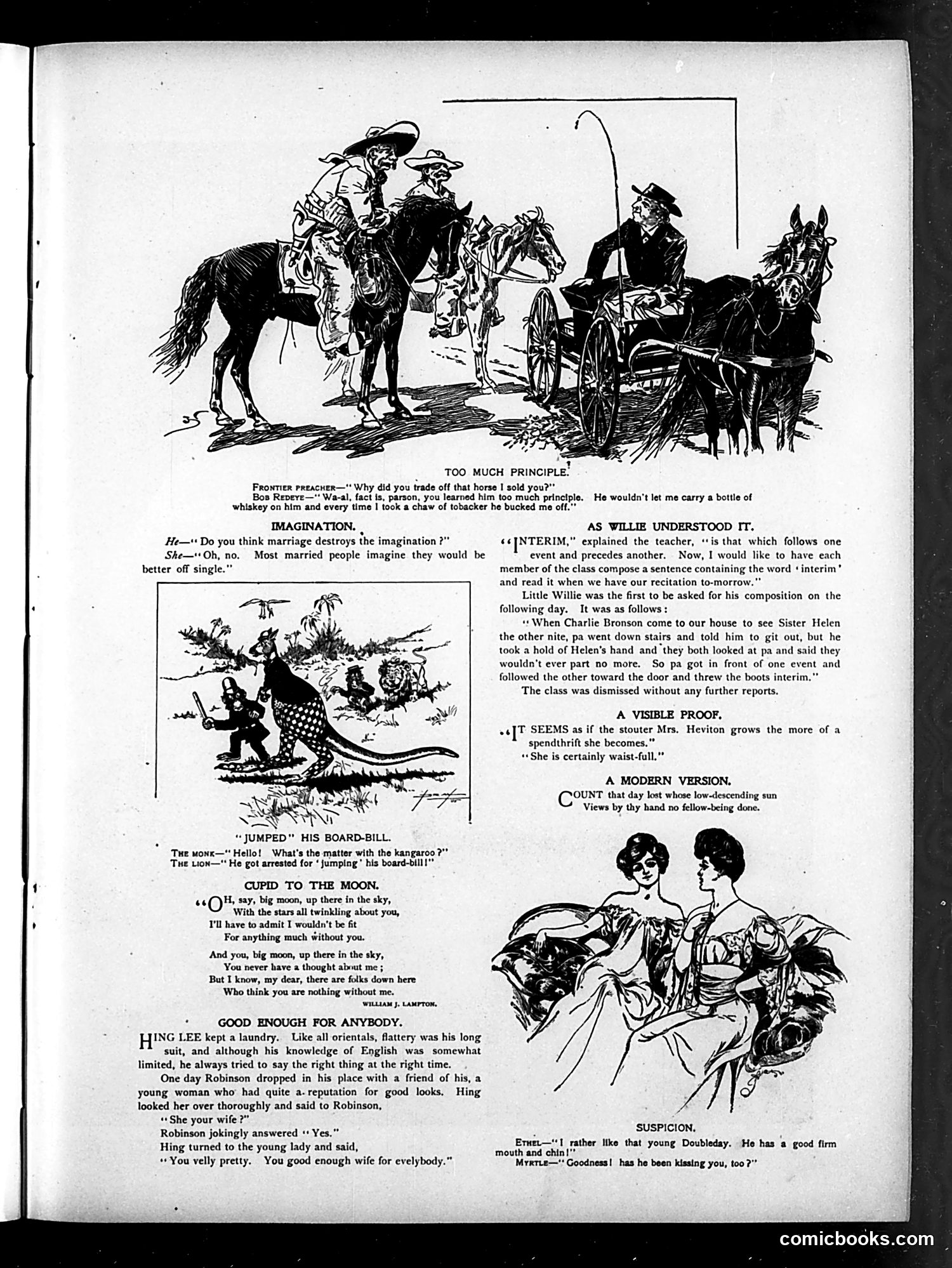
This page contains several unrelated short humorous pieces typical of early 20th-century satirical magazines: **"Too Much Principle"**: A frontier preacher sold a horse to a man (Bob Revere) who complains the horse won't cooperate—it refuses to let him carry whiskey or chew tobacco. The joke satirizes the preacher's moral instruction as impractical frontier behavior. **"As Willie Understood It"**: A schoolboy misunderstands the word "interim," creating an absurd sentence about his sister's boyfriend that literally describes throwing boots "between" two events—wordplay humor. **"A Visible Proof"**: A pun on "waist-full" (wasteful) about a heavy woman. **"Hing Lee's Laundry"**: Plays on stereotypical broken English and flattery from an Asian immigrant laundry owner who compliments *everyone* equally. The page mixes domestic humor, schoolroom jokes, puns, and ethnic stereotypes—standard Judge fare emphasizing clever wordplay over refined satire. None appears to reference specific political events.
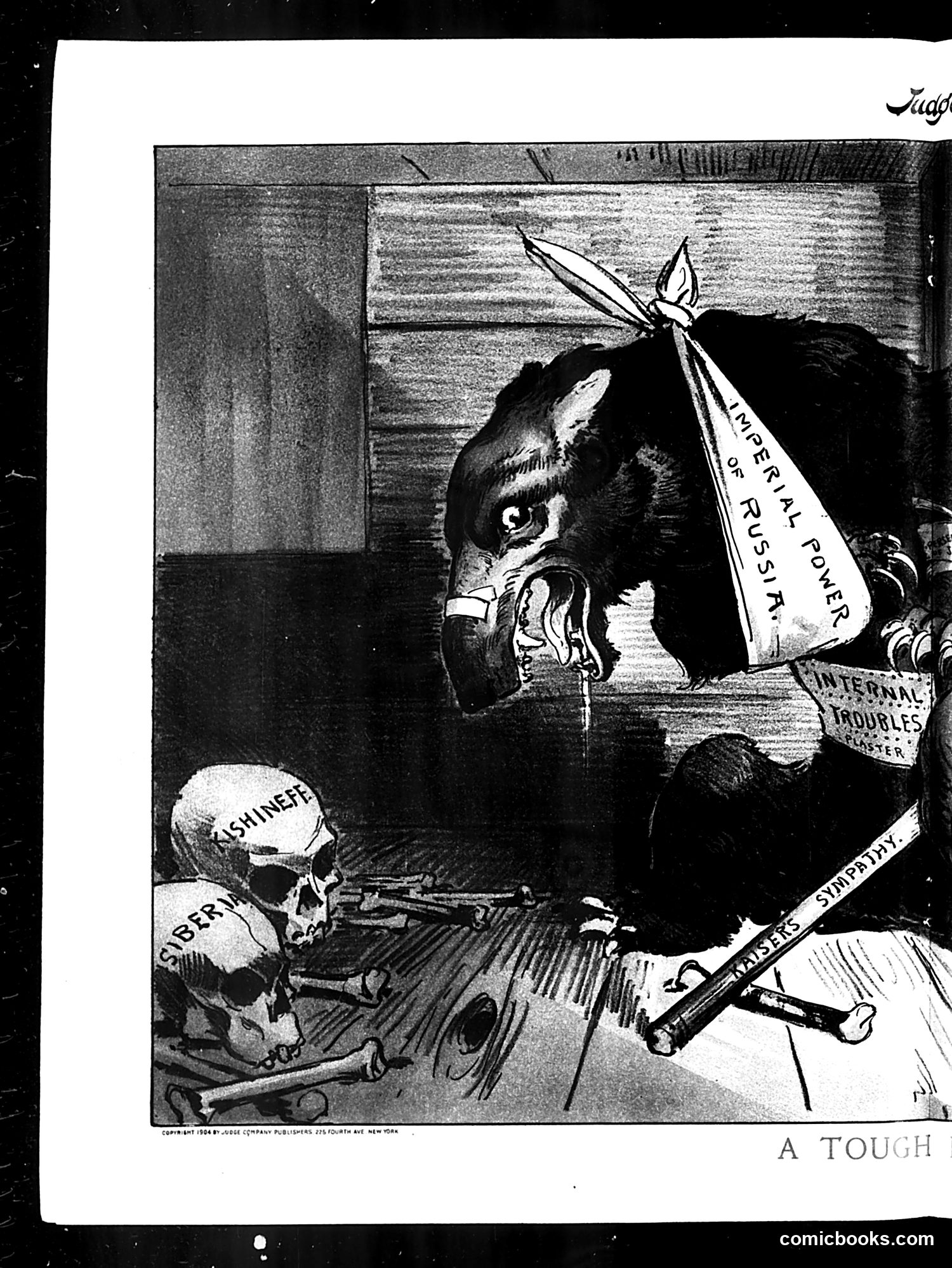
This political cartoon depicts a menacing figure (appears to be a personified threat or adversary) labeled with references to "Imperial Power," "Internal Troubles," and "Masters' Supply." A skull labeled "Dishonest" sits nearby with weapons, suggesting corruption and violence undermine the figure's position. The ribbon banner reading "Imperial Power" and the overall composition suggest this critiques imperial ambitions—likely commenting on international conflicts or colonial expansion. The skull, weapons, and labels pointing to dishonesty and internal strife imply the satirist's argument that such power bases are inherently unstable, built on corruption rather than legitimate authority. The exact historical moment remains unclear without additional context or date information visible on this page.
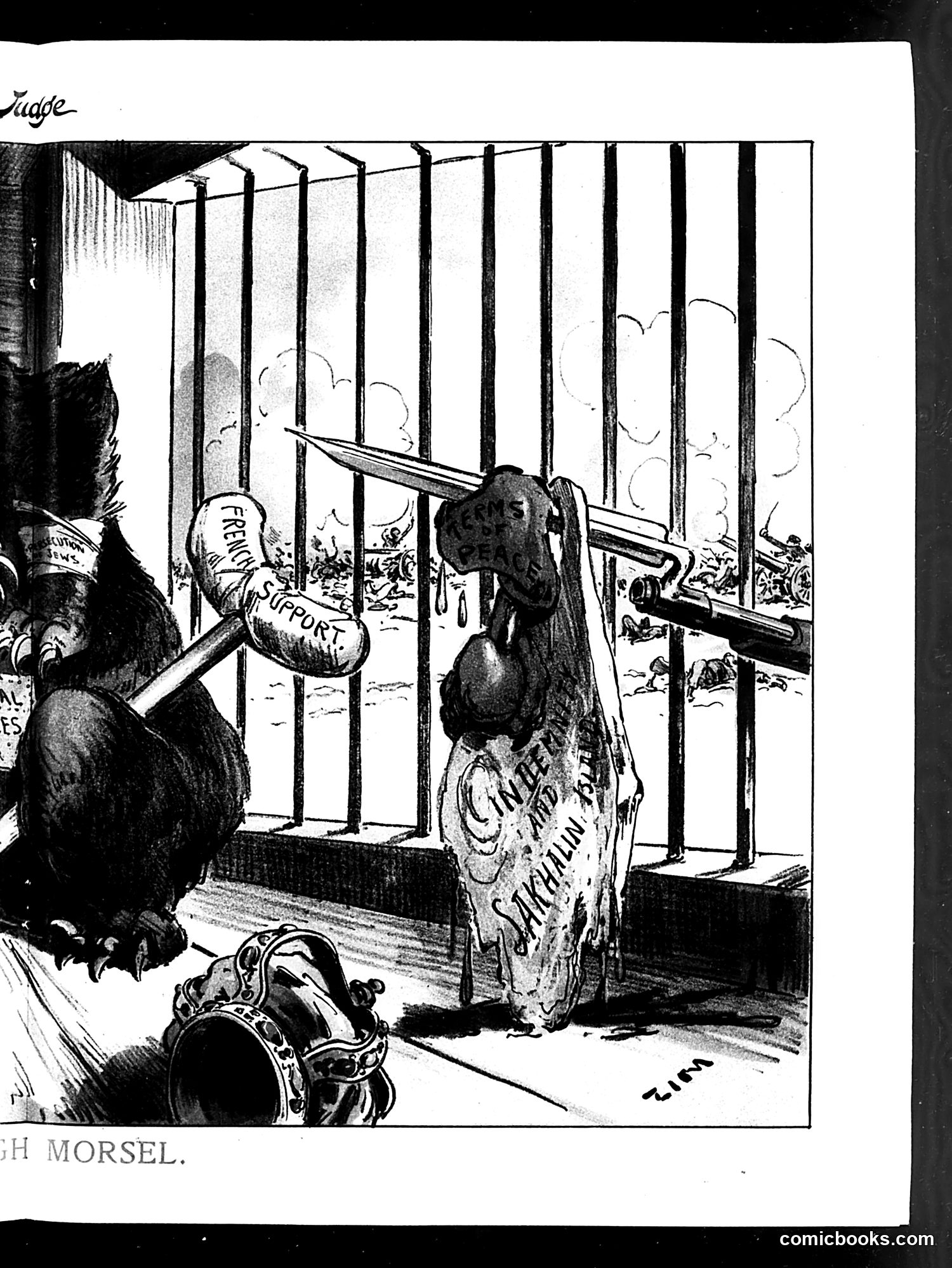
This political cartoon from *Judge* magazine depicts a caged animal labeled "Stability" being fed by a figure on the left (partially visible, labeled "French Support"). The figure inside the cage, labeled "Strife," appears to be a caricatured human or beast receiving sustenance through the bars. The satire critiques how external support—specifically French backing—paradoxically strengthens internal conflict rather than promoting genuine stability. The cartoon suggests that foreign intervention, despite claims of supporting order, actually perpetuates turmoil and discord. The caption references "Morsel," though the complete title is cut off. Without more context about the specific date and political situation, the exact historical reference remains unclear, but this appears to address early 20th-century international relations and unintended consequences of foreign aid.
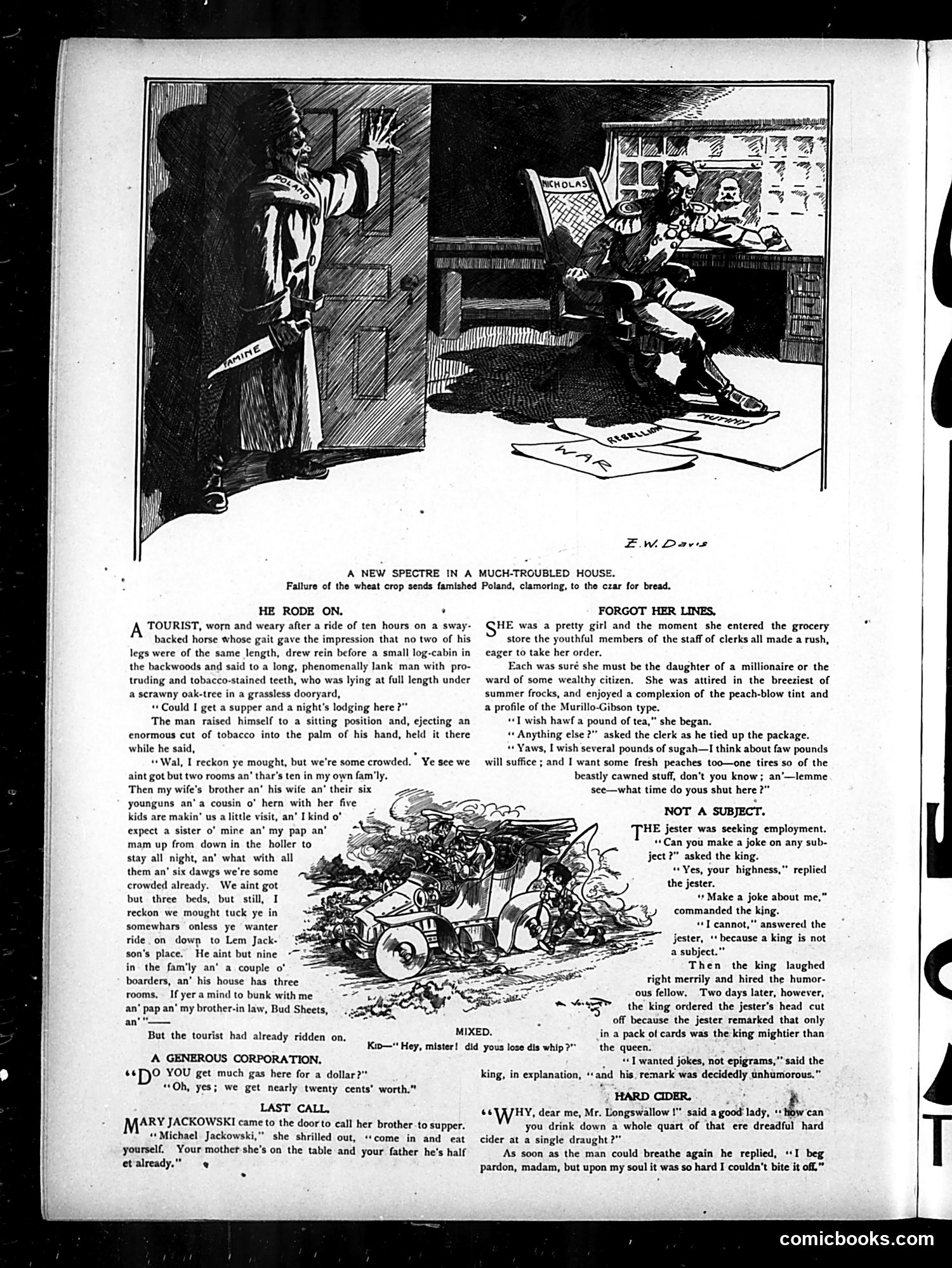
This page contains multiple satirical pieces typical of Judge magazine's humor: **"He Rode On"** (top): A backwoods humor story mocking rural poverty and overcrowded frontier living conditions. The punchline relies on exaggerating the squalor—a man with so many family members and animals that he can barely offer lodging, yet suggests his neighbor might have space. **"A New Spectre in a Much-Troubled House"** (top right cartoon): References Poland's 1891-92 famine, where crop failure forced Poles to appeal to the Russian Czar for bread aid. The "spectre" is starvation haunting Poland under Russian rule. **"A Generous Corporation"** (middle): Satirizes gas company pricing—customers receive only 20 cents' worth of gas despite paying a dollar, mocking corporate profiteering. **"The Jester" story**: A clever wordplay joke about monarchy and power—a jester cannot joke about the king because the king is not a "subject" (grammatically and politically). **"Hard Cider"** (bottom): Rural dialect humor where a man claims the cider was so hard he "couldn't bite it off"—absurdist humor based on exaggeration.
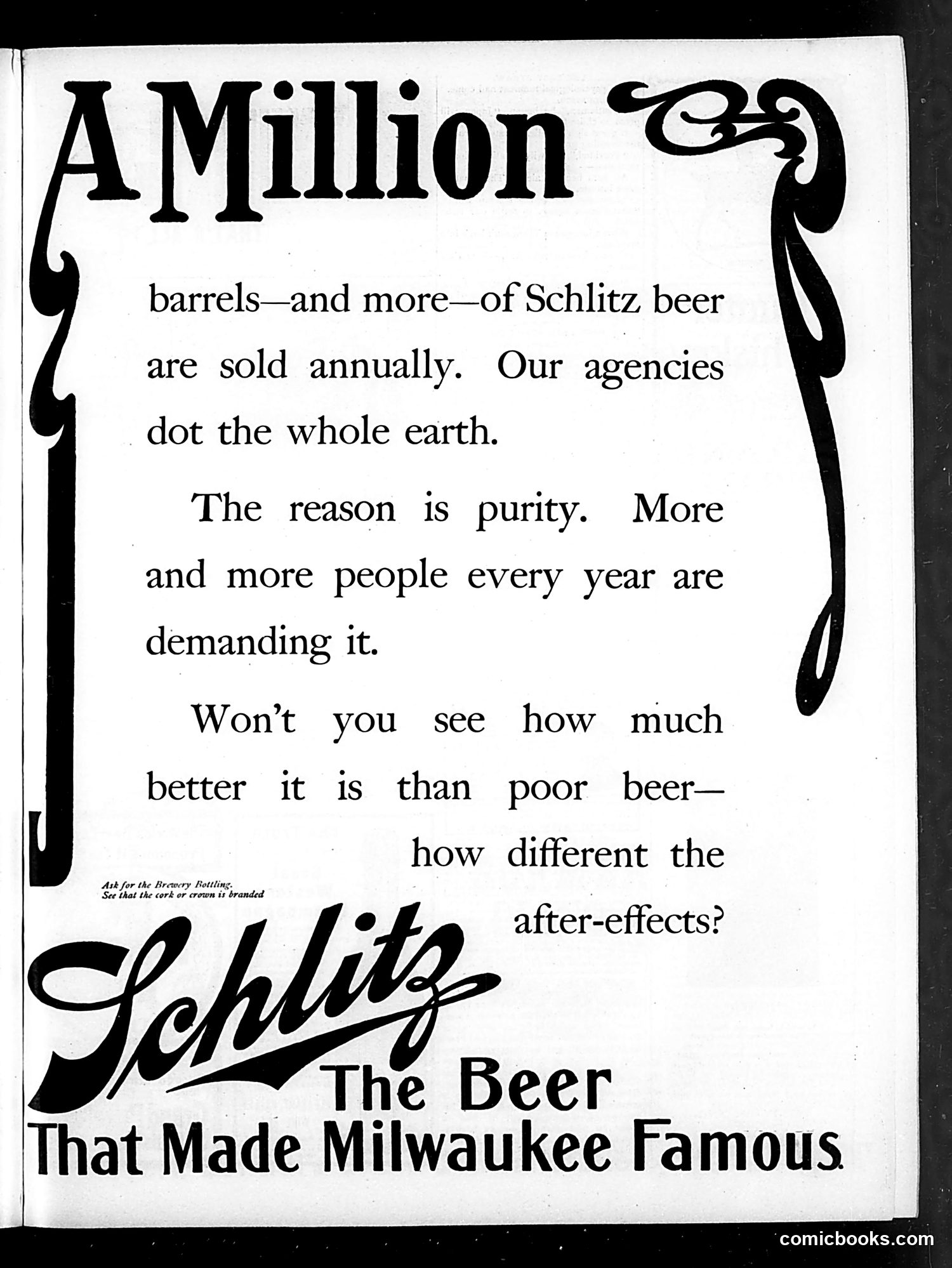
This is a **full-page advertisement**, not satire or political commentary. It promotes Schlitz beer, emphasizing the brand's massive global sales ("a million barrels") and widespread distribution. The ad's appeal centers on **purity** as the key selling point—a major marketing angle for breweries in this era, when quality control and sanitation were genuine competitive advantages. The copy invites readers to notice the superiority of Schlitz compared to "poor beer," specifically highlighting different "after-effects" (implying Schlitz causes fewer hangovers or digestive problems). The tagline "The Beer That Made Milwaukee Famous" references Milwaukee's historical dominance in American beer production. The ornamental borders and typography are typical of early 20th-century print advertising design.
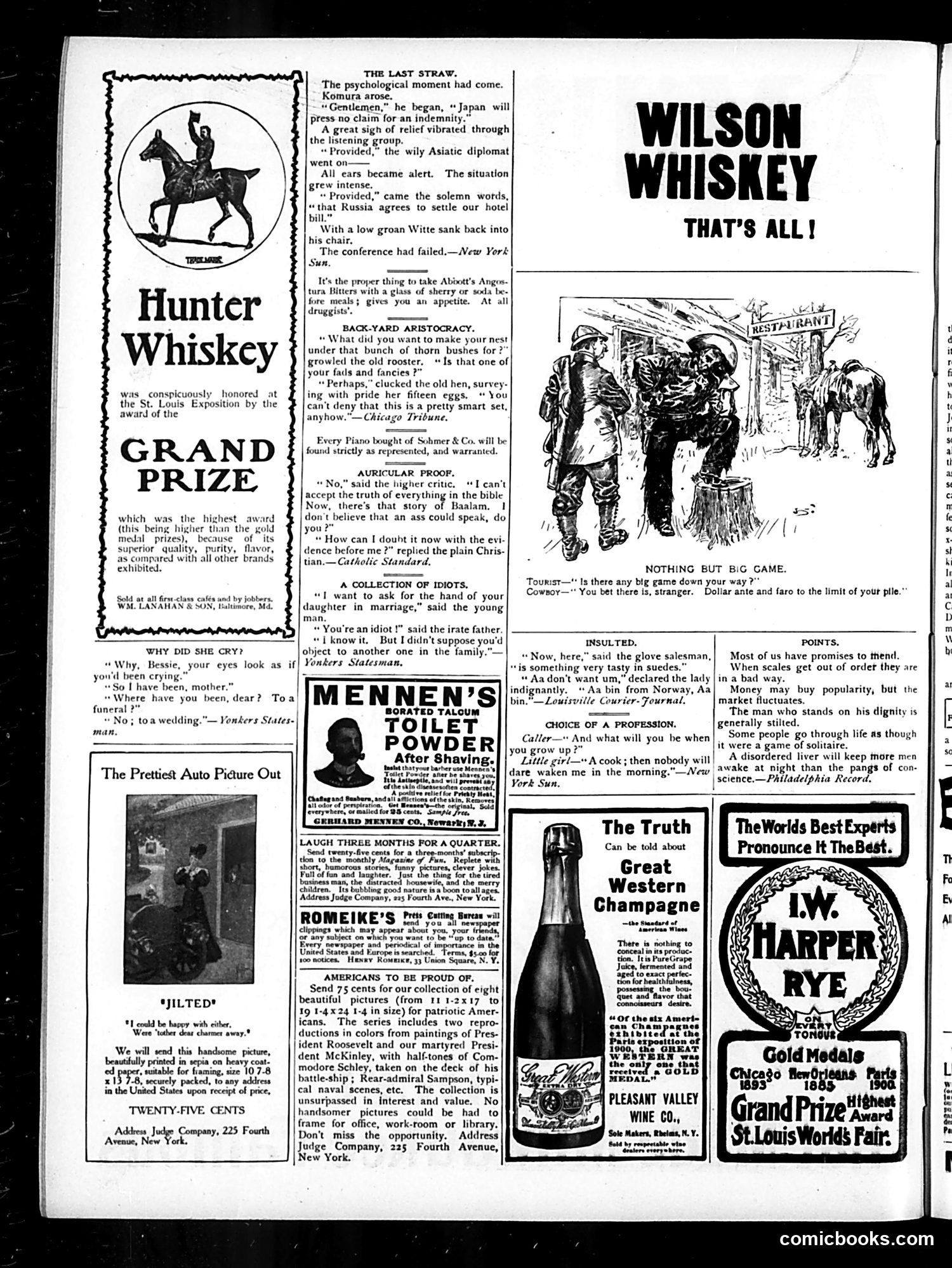
This page contains primarily **advertising and short humorous anecdotes** rather than editorial cartoons. The main satirical content is "The Last Straw," a joke about the 1905 Russo-Japanese peace negotiations. ## "The Last Straw" The cartoon references **Komura and Witte**, the Japanese and Russian diplomats negotiating the end of the Russo-Japanese War. The satire mocks the conference's failure by suggesting Japan's final demand—that Russia pay their hotel bill—was so absurd it collapsed negotiations. This plays on contemporary frustration that despite Japan's military victory, the actual peace treaty (Portsmouth Treaty) yielded limited territorial gains, making the war's costs seem disproportionate. The joke's "psychological moment" and dramatic tension parody diplomatic language while deflating serious peace talks into petty bickering over lodging expenses. ## Remaining Content The page features numerous brief humorous anecdotes ("Back-Yard Aristocracy," "Auricular Proof," etc.) and extensive period advertisements for whiskey, champagne, pianos, and patent medicines—typical Judge magazine filler content.
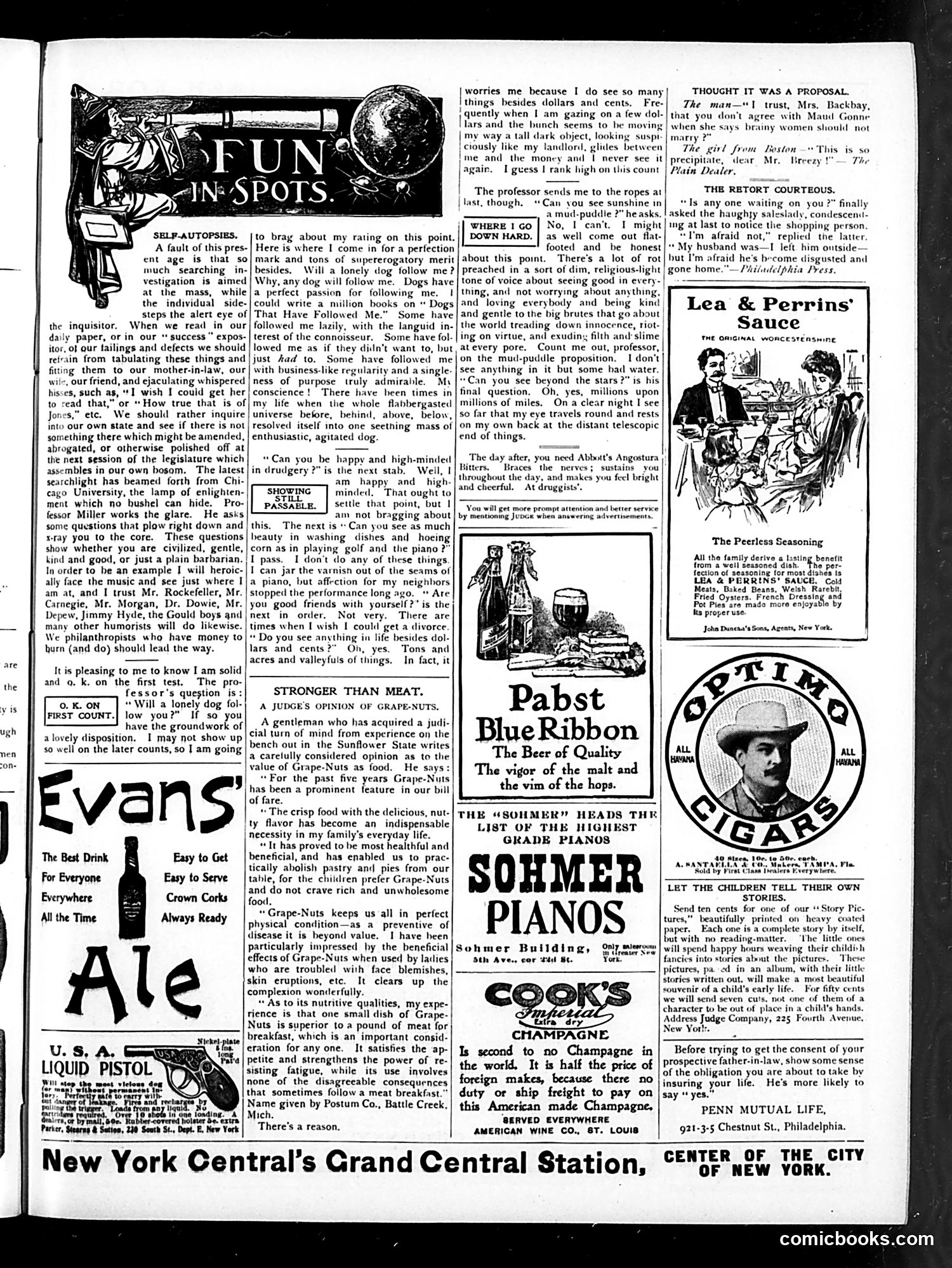
This page is primarily **advertising with satirical article sidebars**—typical of Judge magazine's format. The main visible cartoon/article is titled "SELF-AUTOPSIES," which satirizes early-1900s self-help culture and introspection trends. The author humorously describes a "Professor Miller" from Chicago University who posed questions designed to reveal one's character. The joke: the author admits he scores well on the first test (dogs follow him, proving kindness) but fears failing later ones. The satire targets wealthy philanthropists like Rockefeller and Carnegie who perform public virtue while the author mockingly suggests they should examine their own flaws rather than judging society. The other brief cartoons joke about class anxieties: "Thought It Was a Proposal" mocks wealthy women worried about money, and "The Retort Courteous" features a wife leaving her bored husband while shopping. The page is otherwise filled with period advertisements for Evans Ale, Pabst Blue Ribbon, Sohmer Pianos, and other products—standard Judge content reflecting consumer culture of the era.
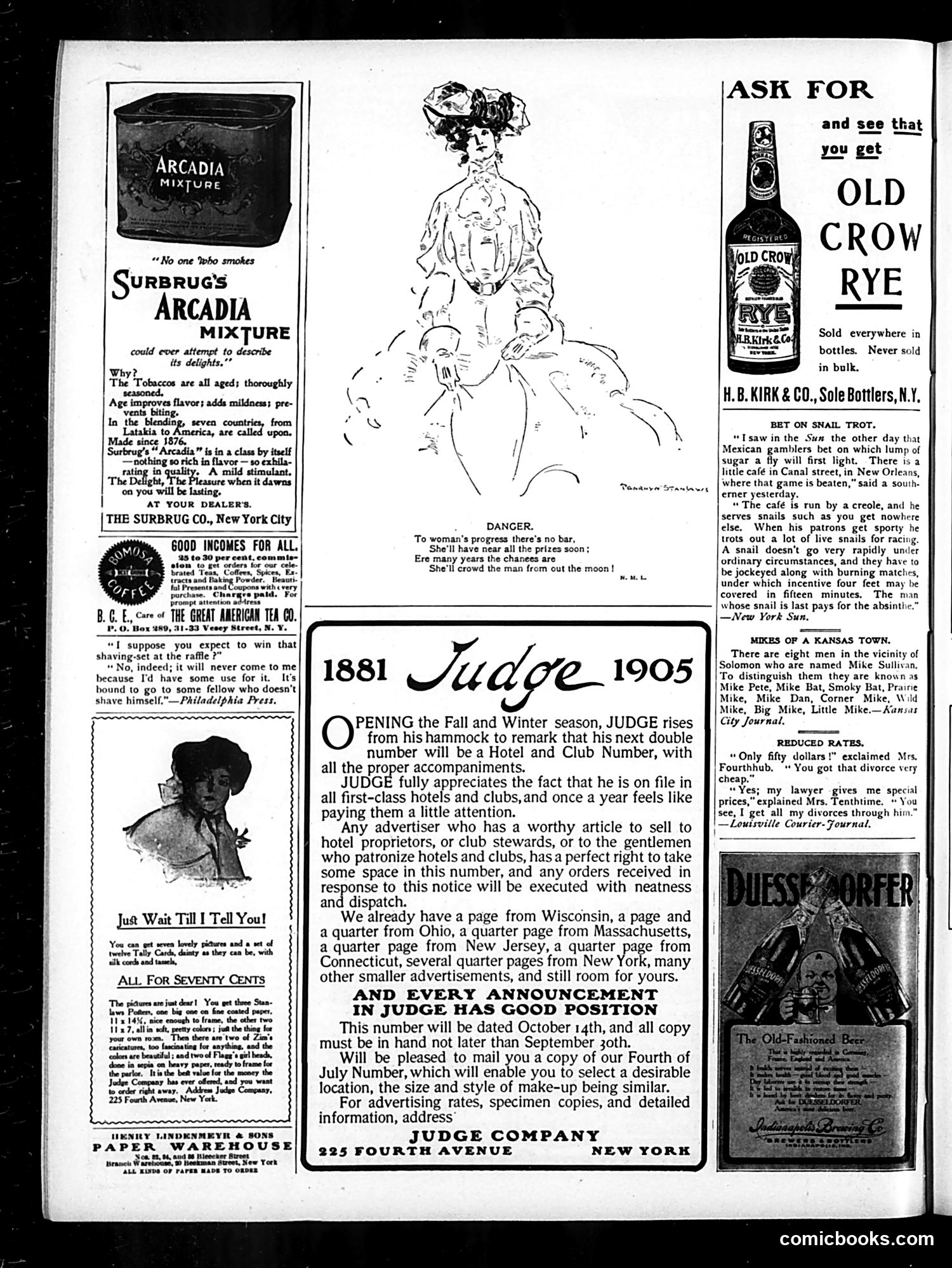
This page from Judge (circa 1905) is primarily **advertising and announcements**, with one small political cartoon. **The cartoon "Danger"** depicts a woman in early-1900s dress and shows anxiety about female progress. The caption warns that women will soon have "near all the prizes" and will "crowd the man from out the moon"—a satirical exaggeration expressing contemporary anxieties about women's expanding rights and opportunities. This reflects the suffrage movement era, when women's increasing social and economic power prompted (often humorous) male concerns about displacement. **The rest of the page** consists of advertisements for tobacco (Surbrug's Arcadia), tea/coffee, spirits (Old Crow Rye), and other products, plus announcements about Judge's upcoming Hotel and Club issue seeking advertisers. The "woman question" cartoon represents typical early-20th-century satire: mocking women's advancement while inadvertently documenting contemporary gender tensions.
This page is primarily **advertising and filler content** rather than political satire. The main elements are: **"September in the Adirondacks"** — a travel advertisement for the New York Central Lines promoting the Adirondack Mountains as a vacation destination. **"Do You Ever Think About Owning Your Own Home?"** — an advertisement for George Palliser's architectural pattern book offering 100+ house plans. **Iver Johnson Revolver ad** — promoting an "automatic revolver" with safety features ("won't go off unless you pull the trigger"). **Various small advertisements** for household items, books, and remedies (Blood Poison Cook Remedy). The page also includes **brief local news snippets** (train departures from what appears to be a small town) and **religious/family content** (a story about a minister's disobedient son). There is **no discernible political cartoon or satire** on this page. It represents typical early-20th-century magazine filler—a mix of commercial advertising and community notices between editorial content.
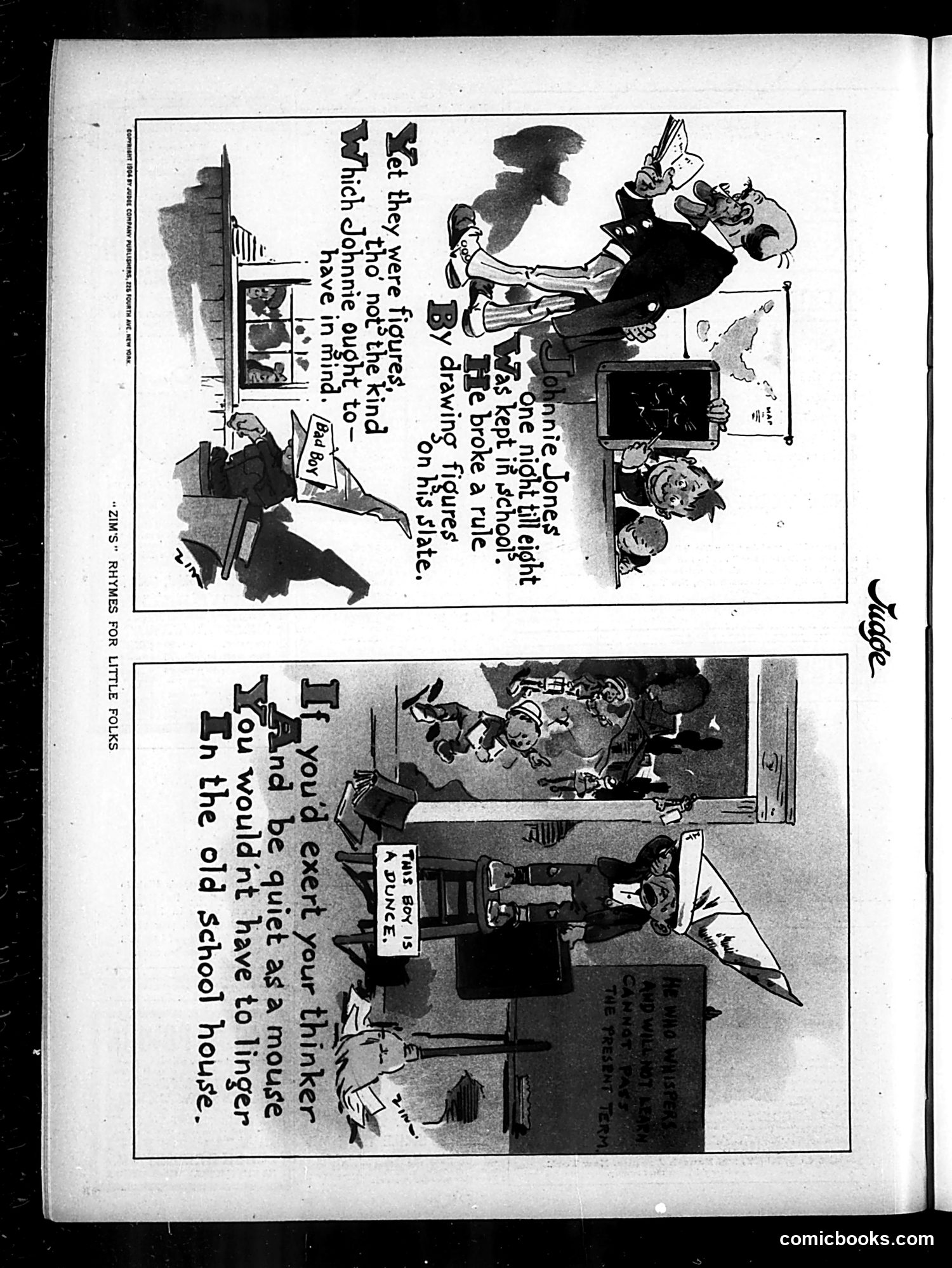
This page contains two cartoon panels with accompanying verse, appearing to be children's moral instruction content rather than political satire. The cartoons depict a boy named Johnnie who breaks school rules by drawing figures (apparently female nudes or suggestive images, based on the text's concern about "figures...which Johnnie ought...not have in mind"). The satirical point targets childhood misbehavior and the consequences: Johnnie must stay after school as punishment. The moral lesson, delivered in verse, suggests that if the boy would "exert your thinker / And be quiet as a mouse," he wouldn't be forced to "linger / In the old school house." This is gentle, domesticated satire aimed at juvenile readers—using humor to reinforce proper classroom conduct and appropriate thoughts for schoolchildren.