
A complete issue · 16 pages · 1905
Judge — July 22, 1905
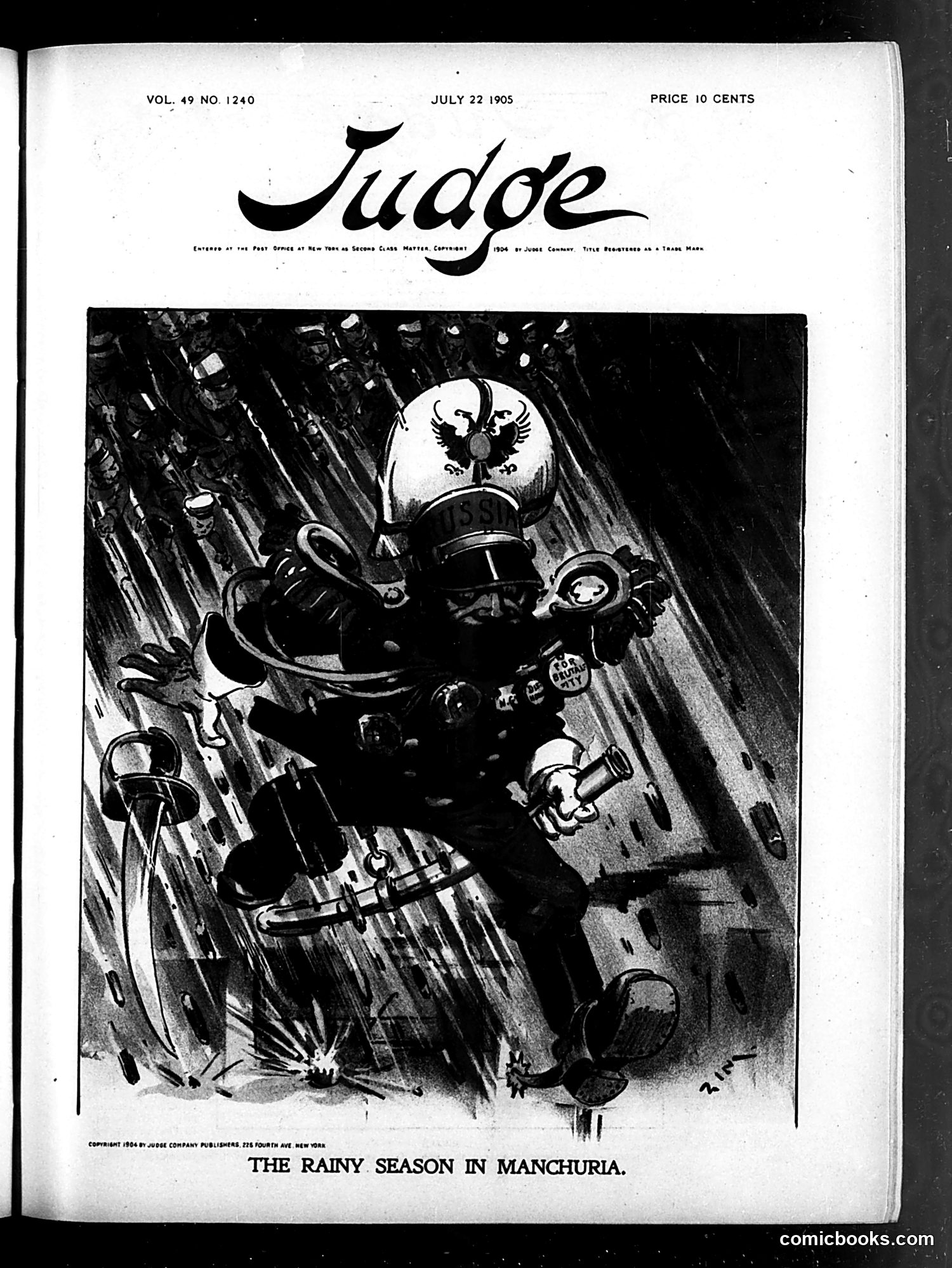
This 1905 Judge cartoon satirizes the Russo-Japanese War (1904-1905), specifically Russia's military struggles in Manchuria. The figure appears to be a caricatured Russian soldier or military personification, shown drowning or floundering in rain and mud—the "rainy season" serving as metaphor for Russia's deteriorating position. The American eagle shield above suggests U.S. perspective on the conflict. Russia, depicted as incompetent and helpless against natural conditions, reflects contemporary American mockery of Russian military failures during this war. Japan ultimately defeated Russia, shocking the world and marking the first major Asian victory over a European power. The cartoon uses environmental hardship as satirical commentary on Russian military incompetence.
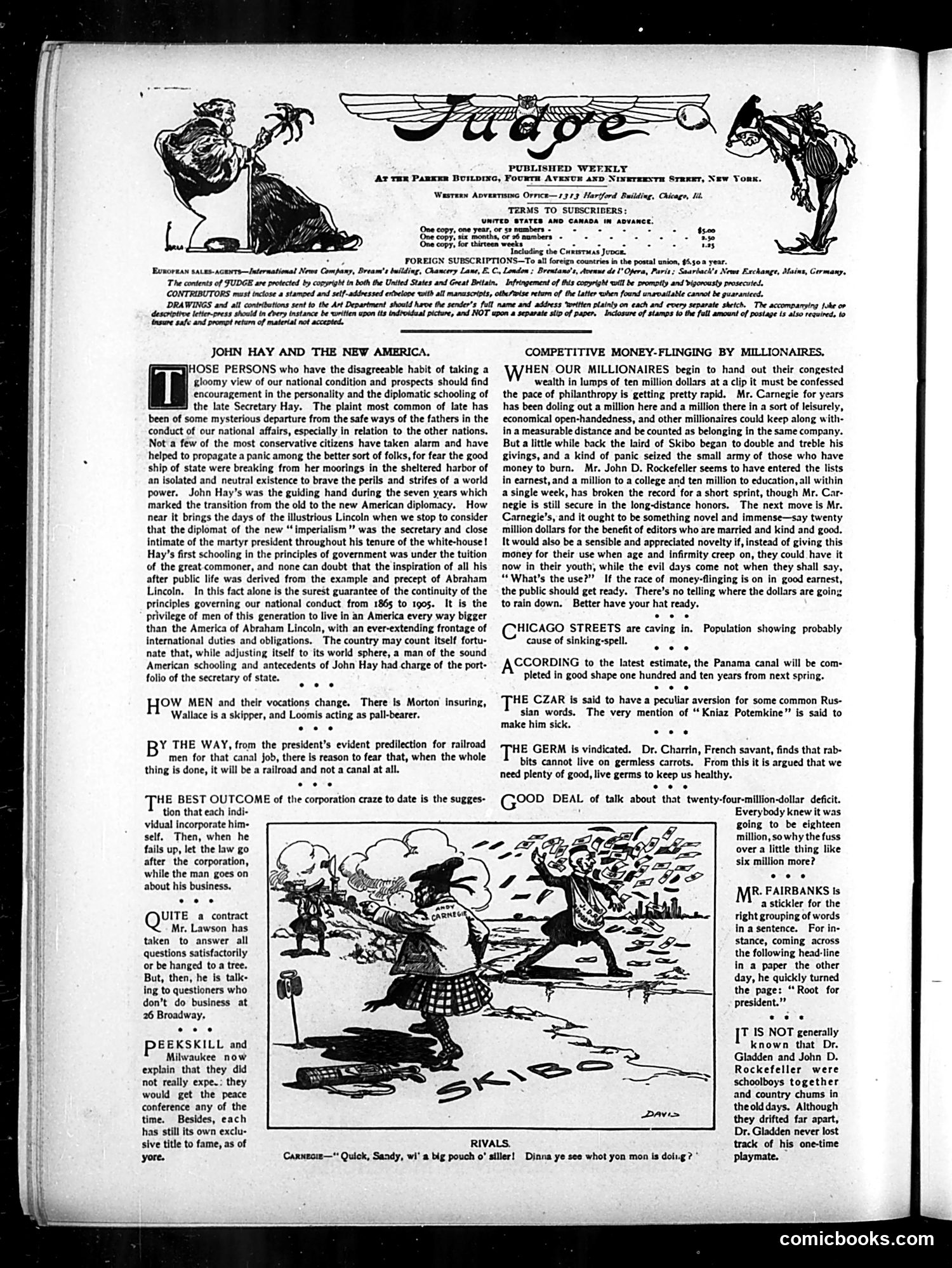
The main cartoon titled "SKIBOO" depicts a figure being chased or attacked by what appears to be a woman wielding a club or stick, with money scattered on the ground. The caption reads: "Carriage—'Quick, Sandy, wi' a big pouch o' siller! Dinna ye see what yon man is doin'?" The cartoon satirizes the frenzy of money-grabbing and wealth competition among the wealthy. The surrounding text discusses "COMPETITIVE MONEY-FLINGING BY MILLIONAIRES," criticizing philanthropists like Carnegie and Rockefeller for their public giving as mere competitive display rather than genuine charity. The scattered money and violent imagery suggest the chaotic, destructive nature of unchecked wealth accumulation and ostentatious competition among the ultra-rich.
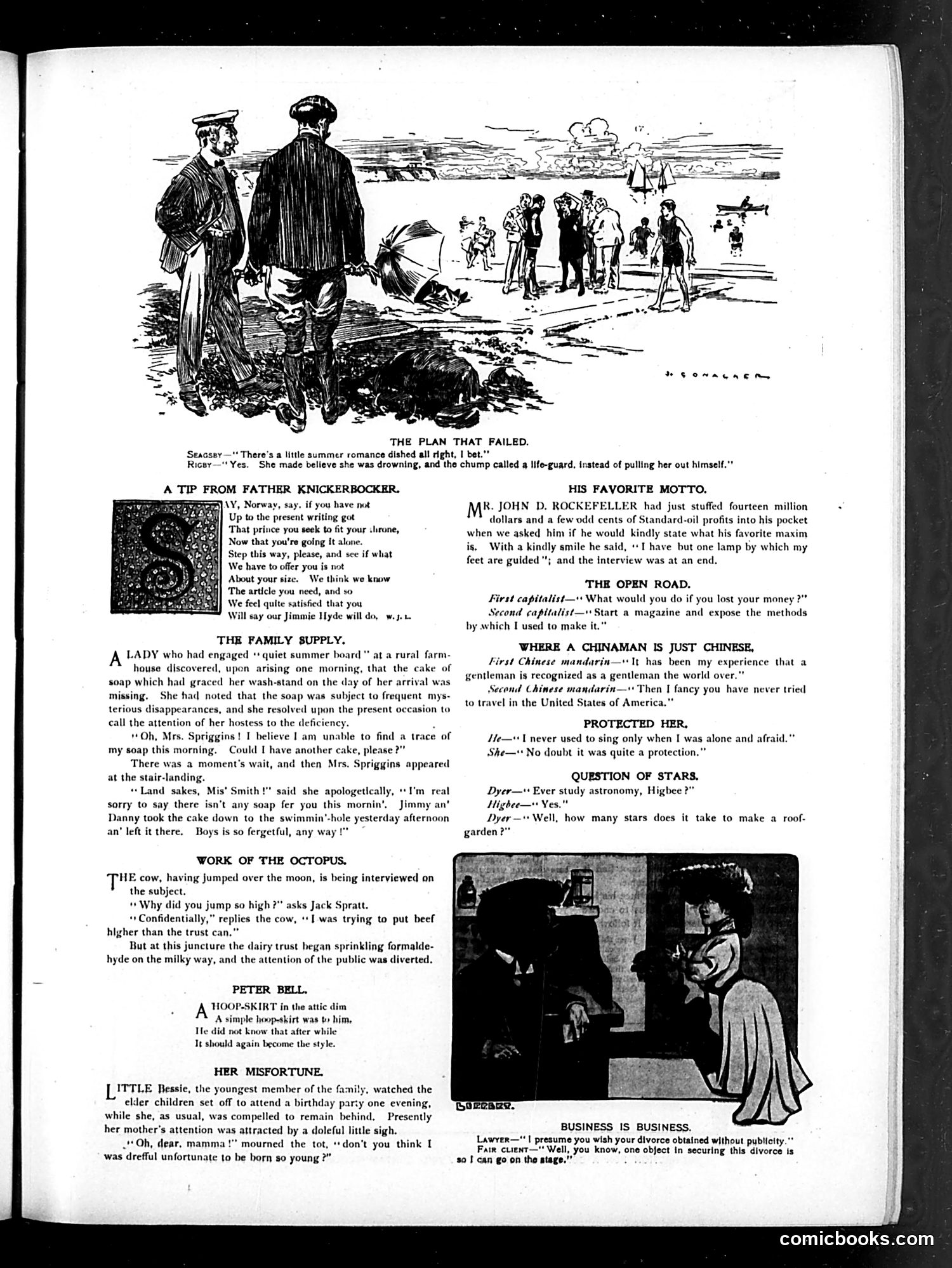
This page contains several unrelated comic sketches and humorous anecdotes typical of Judge magazine's format. The top cartoon "The Plan That Failed" depicts a beach scene where a man tells another he witnessed a woman pretending to drown so a lifeguard would rescue her—but the lifeguard called a life-guard instead, thwarting her romantic scheme. Below are disconnected humor pieces: "A Tip from Father Knickerbocker" offers advice to Norway; "The Family Secret" jokes about a woman's laundry soap; and brief dialogue exchanges about chinamen, astronomy, and an octopus jumping over the moon. The humor relies on wordplay, puns, and absurdist scenarios. Without specific historical context or clearer identification of figures, the precise satirical targets remain unclear, though the content reflects early 20th-century American popular humor conventions.
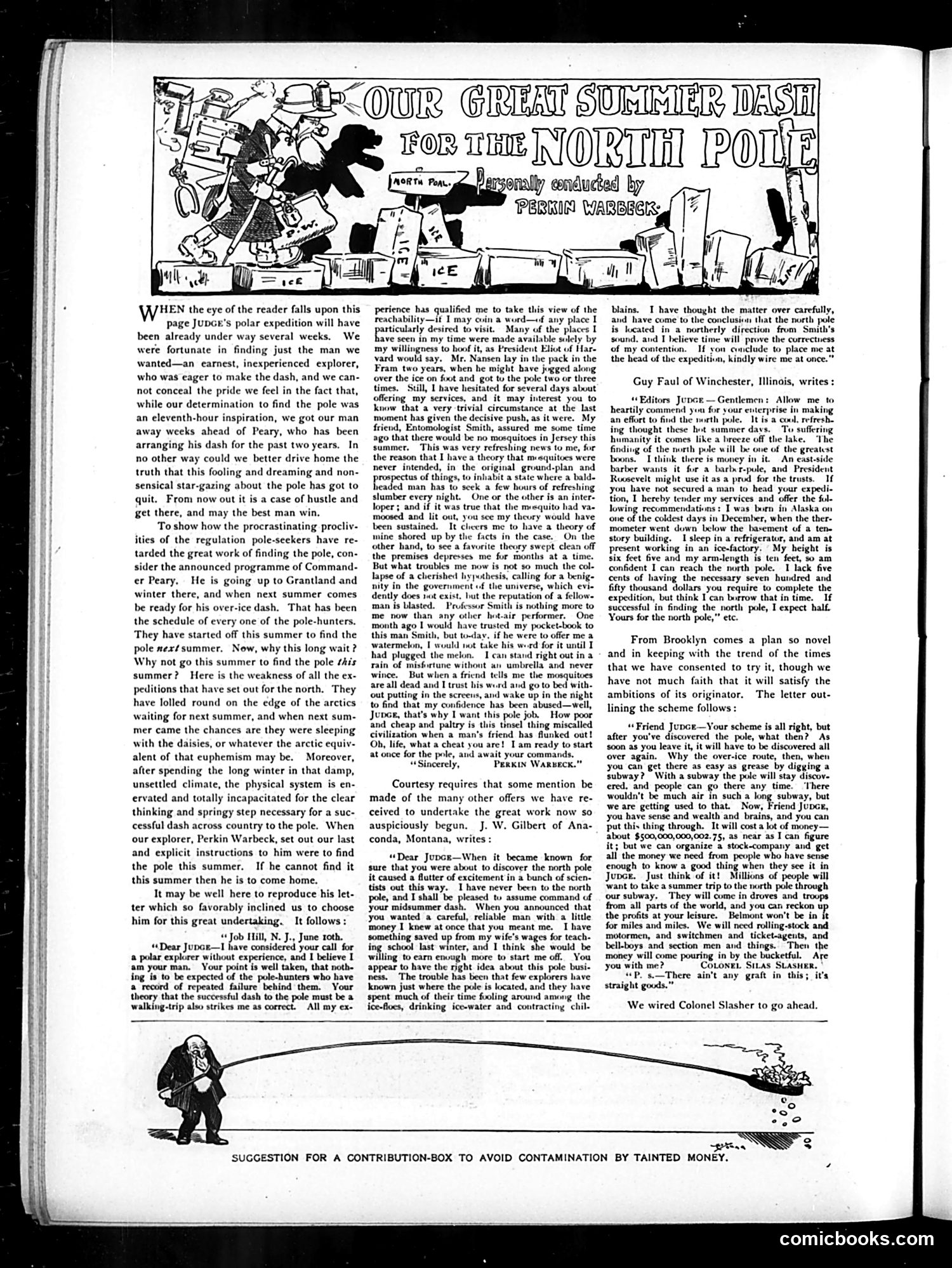
This satirical piece, apparently conducted by Perrin Warbeck, mocks various proposed expeditions to reach the North Pole. The cartoon depicts competing explorers (shown as silhouettes in a chaotic race) attempting what was then a genuinely prestigious geographical goal. The text consists of letters from readers offering humorous advice and theories about reaching the pole—including one writer's confident (but absurd) belief that mosquitoes were native to Jersey, not the Arctic. Another correspondent suggests organizing a "stock-company" expedition with financial backing. The satire targets the era's obsession with polar exploration as celebrity enterprise, while poking fun at amateur theorists and get-rich-quick schemes surrounding Arctic expeditions. The tone suggests skepticism about these ventures' practicality and serious purpose.
This appears to be a dramatic scene depicting romantic rejection or abandonment. The image shows a figure in ornate military dress (suggested by decorative shoulder insignia) in an interior setting, with what appears to be a lit window or opening in the background. The title "JILTED" indicates the cartoon is satirizing a romantic rejection or broken engagement. Without clearer visibility of specific details or additional context from the magazine issue, the exact political or social commentary remains unclear. It could reference a specific public figure's romantic scandal or comment on social attitudes toward military men in relationships, but the specific target and satirical point cannot be definitively determined from this image alone.
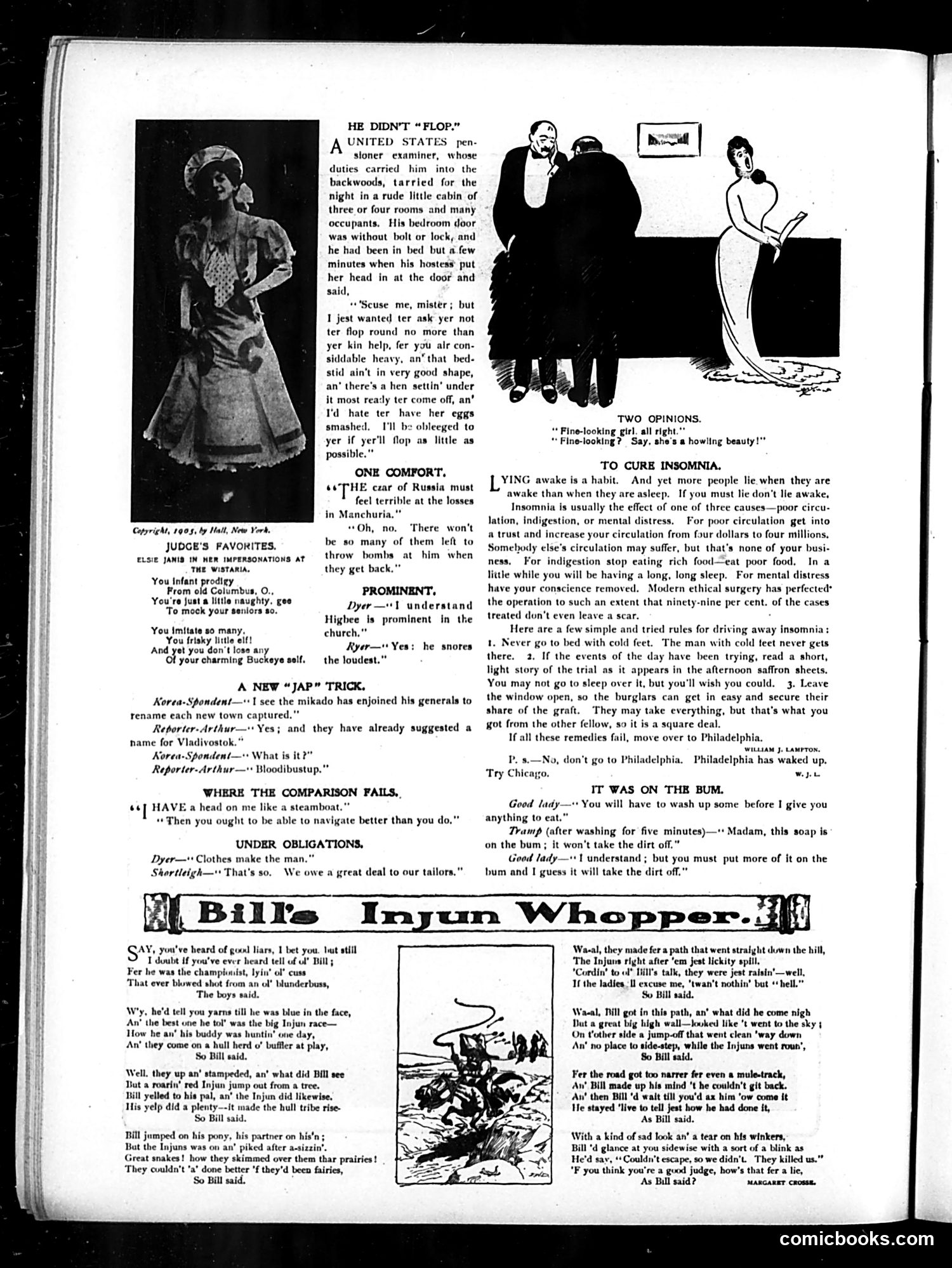
This page from Judge (circa 1905) contains several satirical pieces: **Main Stories:** - "He Didn't Flop": A humorous anecdote about a U.S. pension examiner staying in a backwoods cabin, where the hostess asks him not to move around in bed because a hen is nesting underneath it. - "Bill's Injun Whopper": A tall tale about a notorious liar named Bill recounting an exaggerated encounter with Native Americans and buffalo on the prairie—a mocking reference to frontier mythology. **Brief Jokes:** - References to the Russo-Japanese War (1904-05), with dark humor about Russian casualties - "A New 'Jap' Trick": Wordplay mocking Japanese renaming of captured Korean towns - Various one-liners on prominent citizens, clothing, and insomnia remedies **Context:** The page exemplifies Judge's satirical humor targeting rural Americans, frontier stereotypes, and contemporary world events. The casual ethnic mockery ("Jap," "Injun") reflects early-1900s attitudes. Much content is advertising-adjacent filler with light social commentary.
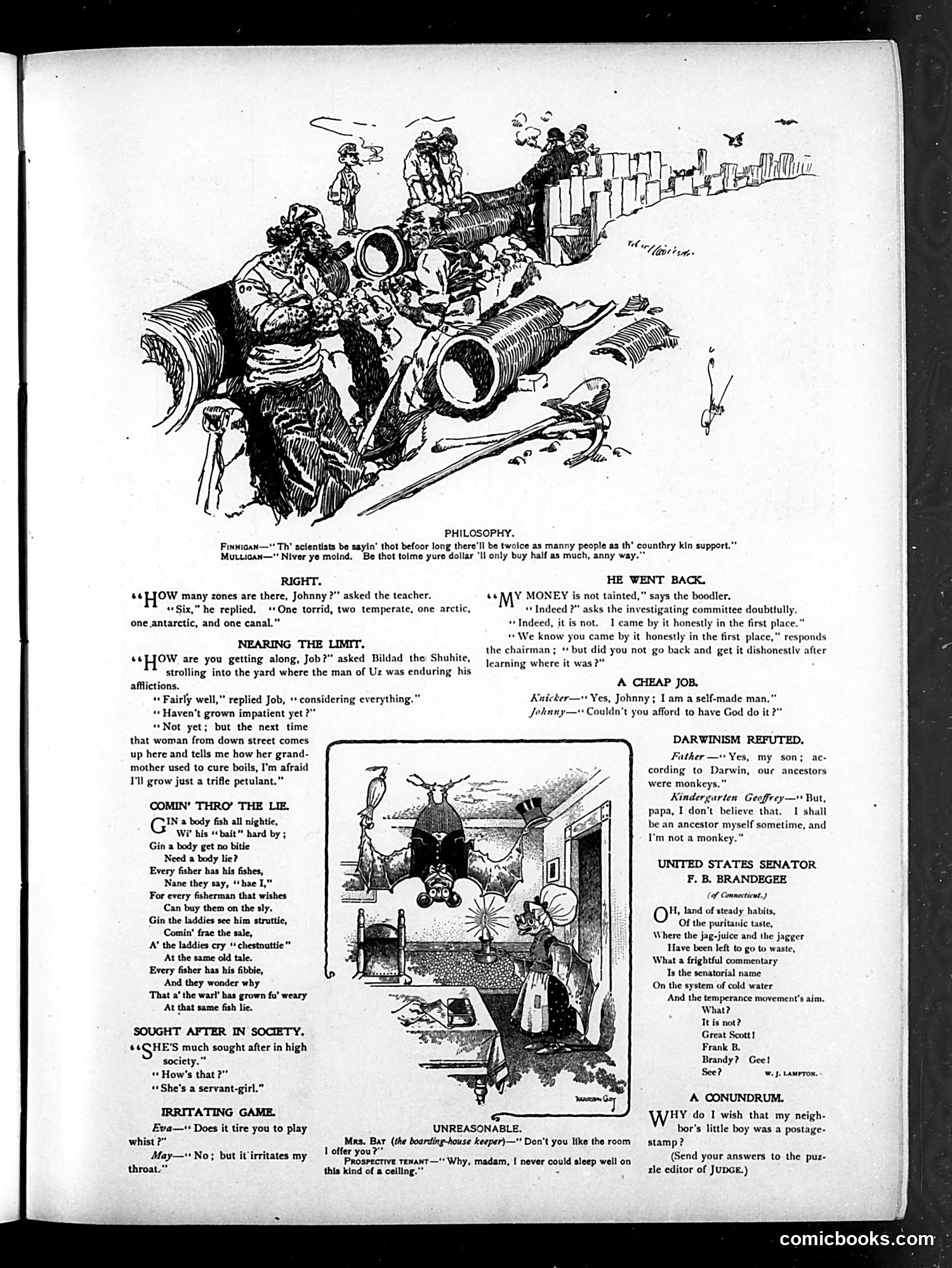
This page contains several satirical pieces targeting early 20th-century American life: **Top cartoon**: Shows a grotesque figure representing unchecked industrial/political corruption—likely symbolizing a corrupt politician or monopolist—sprouting cannons and machinery toward a cityscape. It mocks how power concentrates wealth while ordinary people struggle. **"He Went Back"**: Satirizes a corrupt politician ("boodler") claiming money earned honestly, then admitting he obtained it dishonestly afterward—a jab at political corruption and hypocrisy. **"Darwinism Refuted"**: A child cleverly dismisses Darwin's theory by noting he himself will become an ancestor, so humans cannot be descended from monkeys—gentle mockery of how people misunderstood or resisted evolutionary theory. **"United States Senator F.B. Brandegee"**: Appears to mock a specific Connecticut senator for hypocrisy regarding temperance—his name "Brandy-gee" suggests he drinks despite supporting prohibition or temperance ideals. Other pieces humorously address fishing lies, servant-girl social climbing, and domestic irritations typical of period humor.
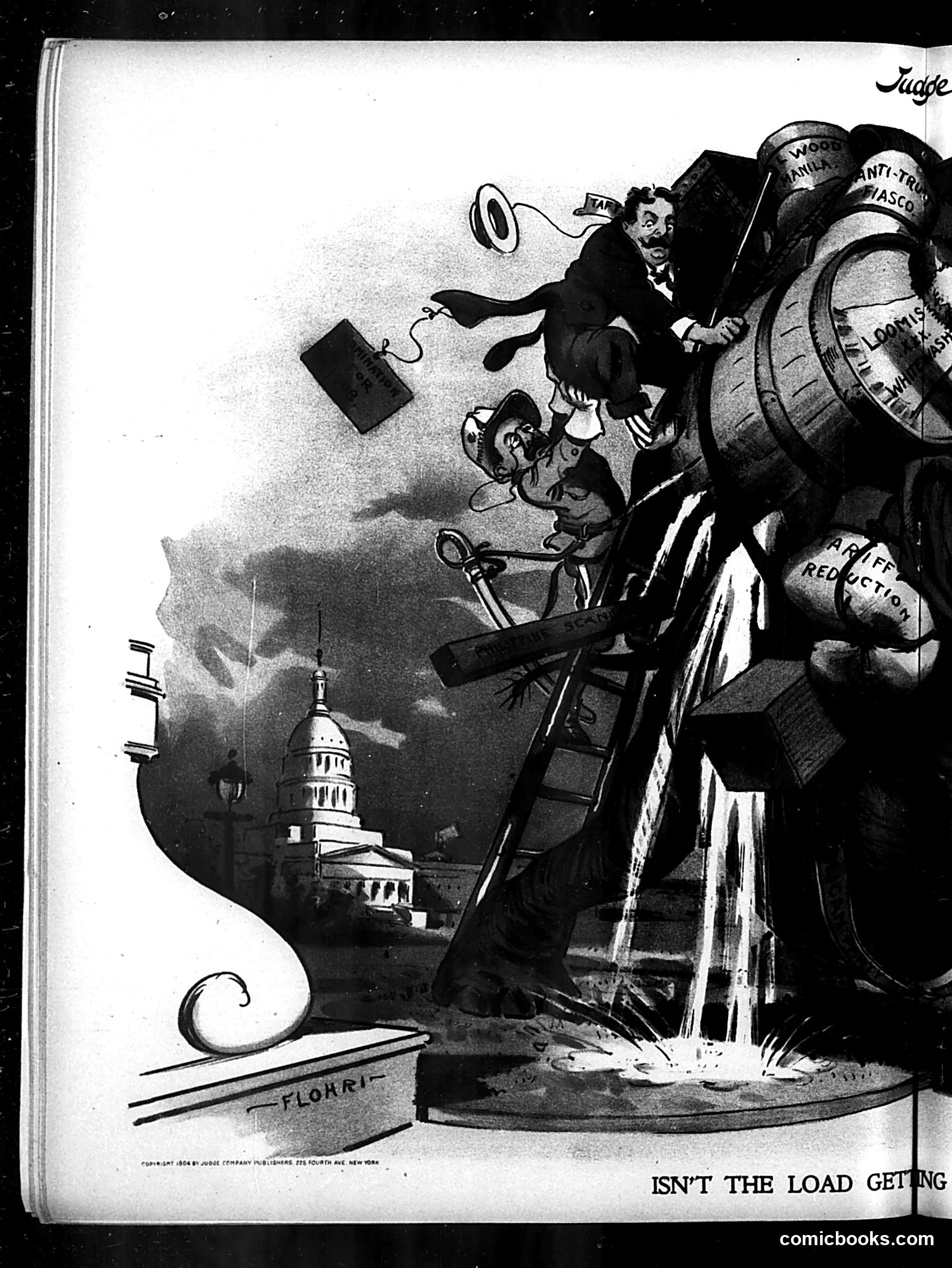
This is a satirical cartoon from *Judge* magazine titled "Isn't the Load Getting..." The image depicts a grotesque figure (likely representing a politician or corporate entity) struggling under an enormous burden of barrels and containers labeled with various anti-trust and regulatory measures. These barrels appear to reference trust-busting legislation and government regulations. The cartoon criticizes the accumulating weight of legal and regulatory restrictions being imposed on big business. The figure's distressed expression and strained posture suggest the satire argues these regulations are becoming excessive or unsustainable. The Capitol building visible in the background indicates Congress is the source of this regulatory burden. The cartoon reflects early 20th-century debates over the government's role in regulating monopolies and large corporations.
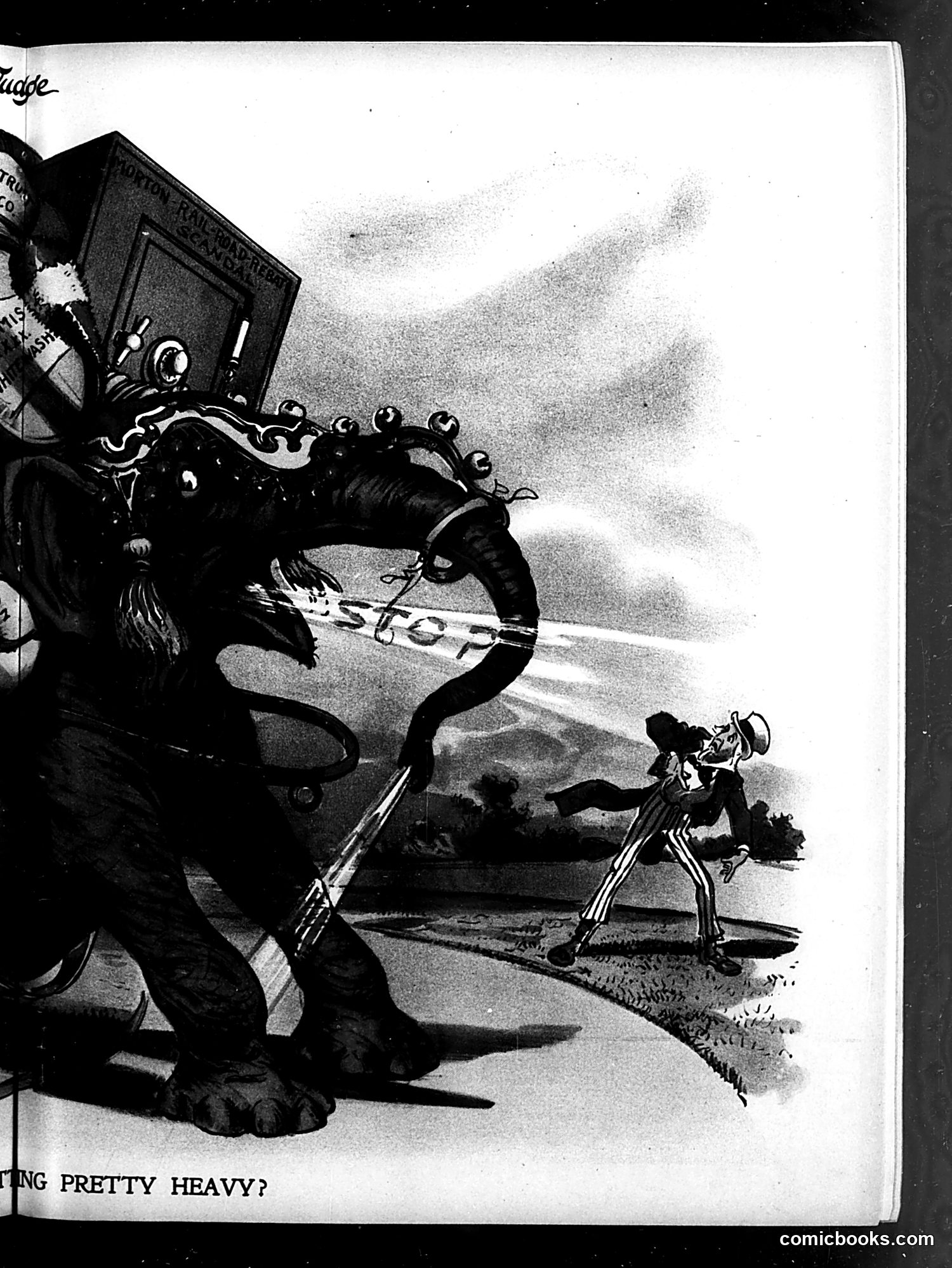
This appears to be a political cartoon from *Judge* magazine depicting a large, grotesque creature or monster labeled "507" confronting a small human figure in striped clothing. The monster sports elaborate decorative elements including what appear to be ornamental spheres or bells. The caption "ING PRETTY HEAVY?" (likely reading "ISN'T THAT PRETTY HEAVY?") suggests commentary on burden or weight—possibly economic or political pressure. Without the full page context and publication date, I cannot definitively identify the specific historical figure or event referenced. The "507" notation and the creature's appearance suggest it represents either a tariff, tax, regulation, or foreign power that the cartoonist views as oppressive to ordinary Americans (represented by the small figure). More context would be needed for precise interpretation.
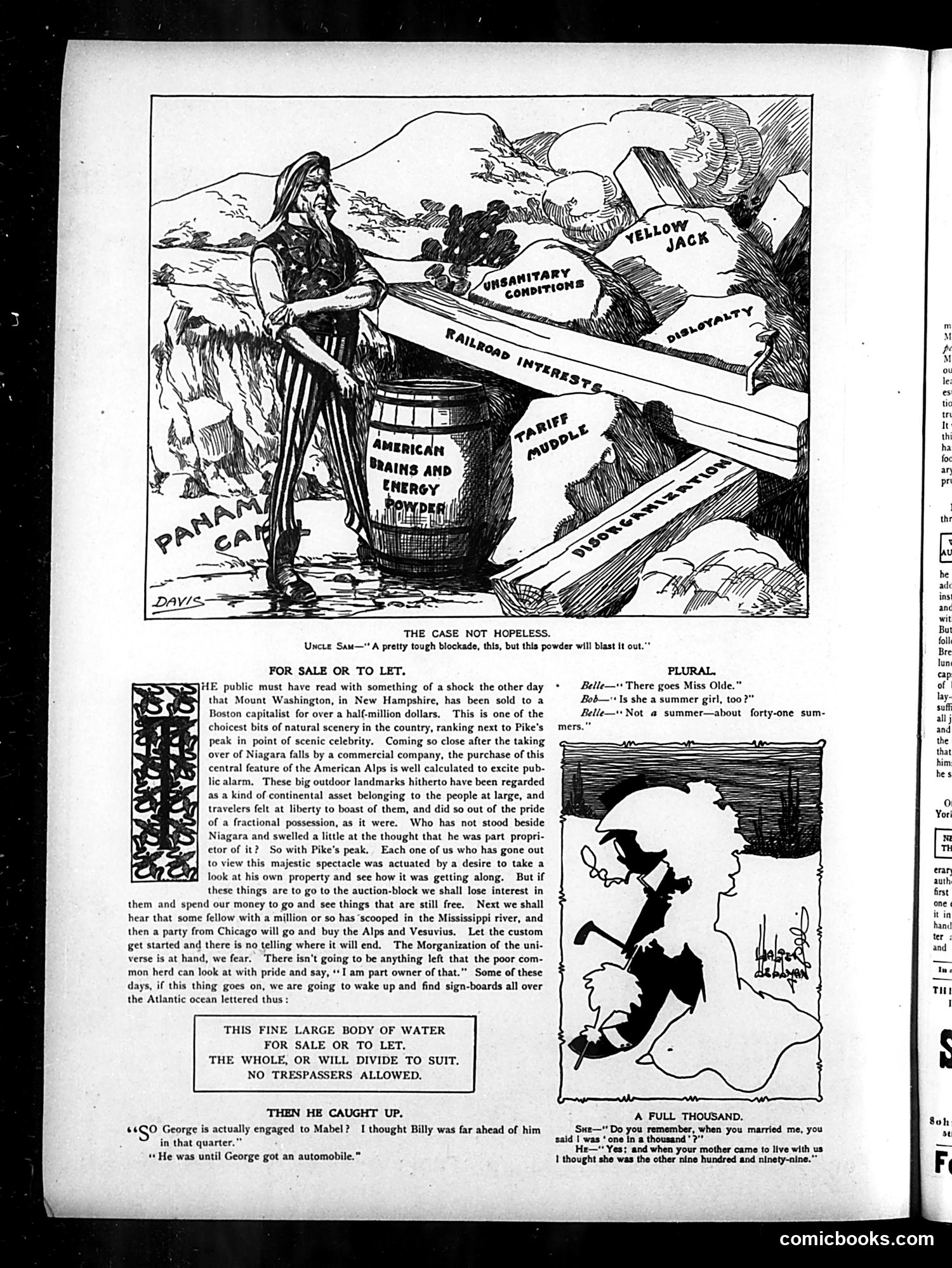
The top cartoon depicts **Uncle Sam** facing a barrel labeled "American Brains and Energy" while surrounded by obstacles labeled "Railroad Interests," "Tariff Muddle," "Disorganization," and "Yellow Jack" (likely yellow fever). Uncle Sam holds gunpowder, suggesting he must forcefully clear these blockades—a metaphor for **Progressive Era obstacles** to American progress. The accompanying article satirizes the privatization of natural landmarks. It references the actual **sale of Mount Washington** to Boston capitalists and the commercialization of **Niagara Falls**. The satire warns that if America's great natural resources become private property, ordinary citizens lose their sense of shared national patrimony. The author fears a "Morganization" (referencing J.P. Morgan's corporate consolidation) of everything, ending with a mock "For Sale" sign on the Atlantic Ocean. The page's humor stems from exaggerating corporate overreach—a core **Progressive Era concern** about unchecked capitalism.
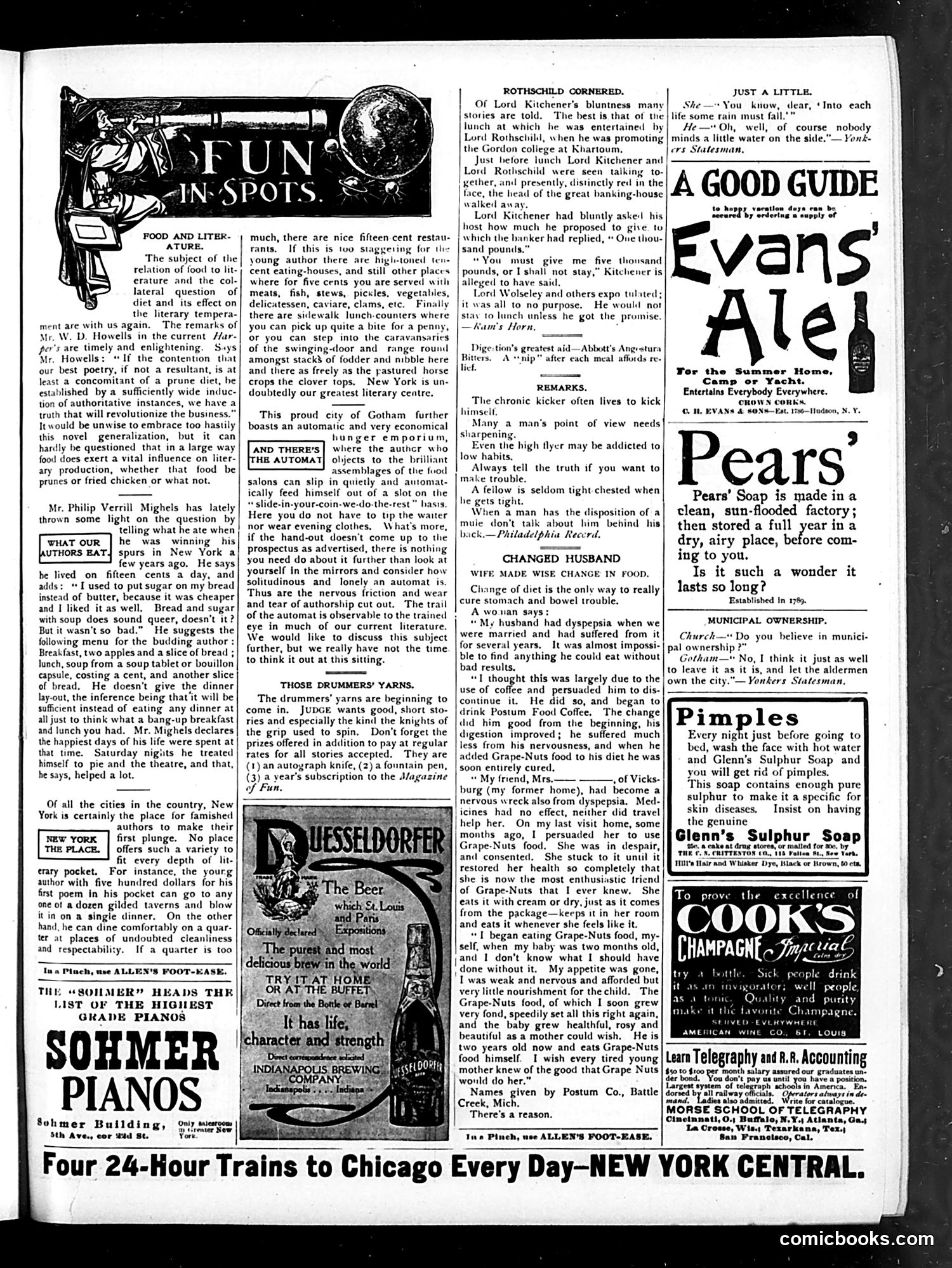
This page from Judge (an American satirical magazine) discusses the relationship between **food and literary productivity**, using humor to address a serious cultural debate. ## Main Content The essay references **W.D. Howells's** claim that diet—particularly prunes—correlates with poetry quality. It humorously explores how New York City offers dining options for authors at every economic level, from five-cent lunch counters to gilded taverns. ## The Satire The piece mocks both: - The pretentious literary establishment (via Howells's theory) - Struggling young authors forced into extreme poverty diets (sugar on bread, soup tablets, pie as a weekly luxury) ## Key Cultural References The essay highlights **the Automat**—an early automated vending restaurant popular in early-20th-century New York where customers inserted coins to retrieve prepared food from slots. This represented modern technological convenience and, crucially, *anonymity*—allowing struggling or eccentric authors to eat without social judgment or tipping requirements. The overall joke: New York enables literary ambition despite poverty, but success requires surviving on nearly nothing while hoping diet doesn't damage your creative output.
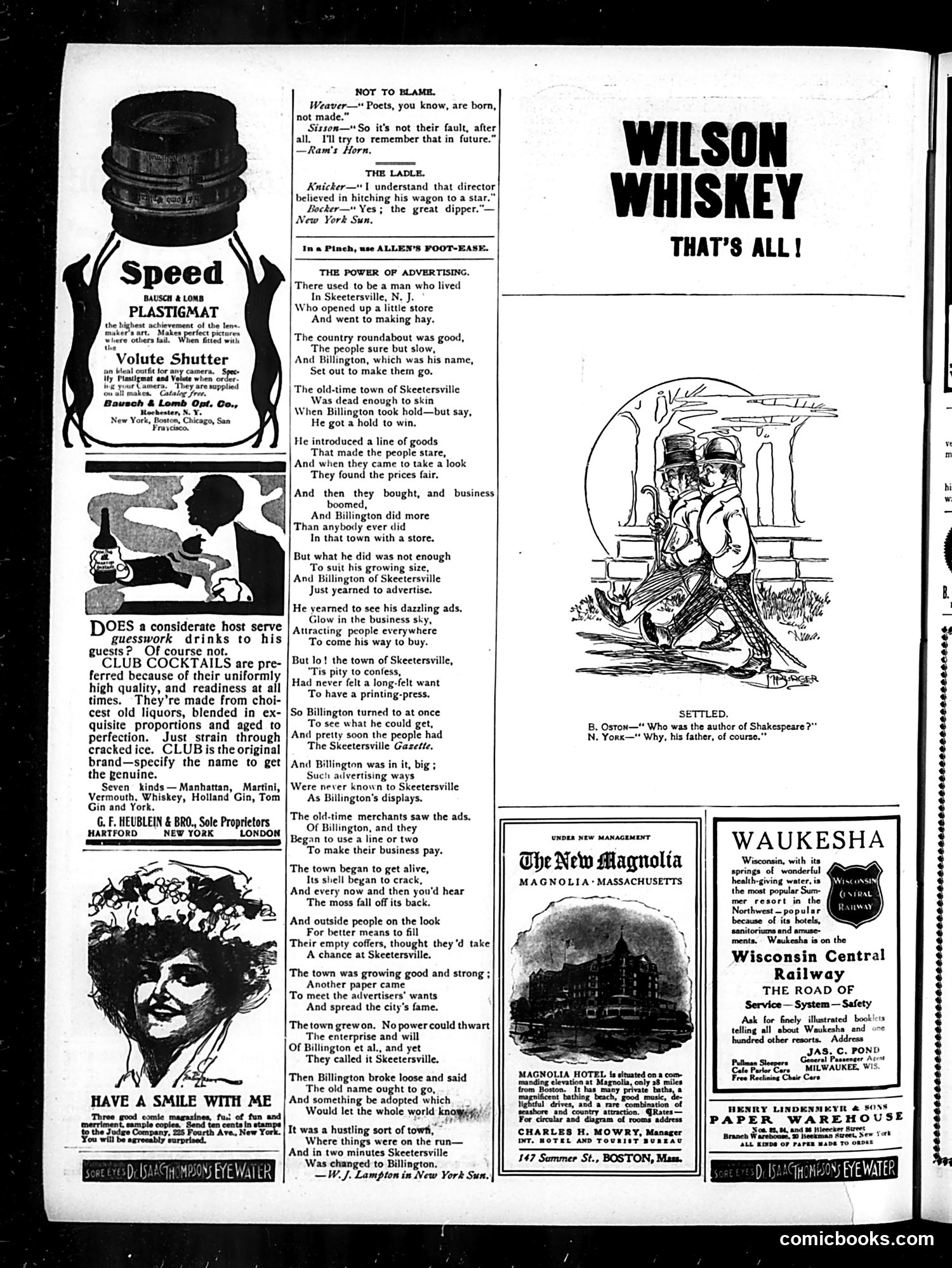
This page is primarily **advertising** with a humorous short story called "The Power of Advertising." **The Main Story** satirizes American capitalism and boosterism. It describes how a shrewd merchant named Billington transforms the sleepy town of Skeetersville, New Jersey, through aggressive advertising. By placing ads in a newly-established local newspaper, he stimulates business growth, attracts outside investment, and ultimately gets the town renamed after himself ("Billington"). **The Satire's Point**: The story gently mocks how advertising transforms communities and how ambitious entrepreneurs can reshape entire towns through promotional savvy. It presents this as both impressive and absurd—one man's marketing prowess literally rebrand an entire municipality. **The Cartoons**: Small humorous exchanges accompany the text. One features a poet's lack of culpability ("Not to Blame"), another shows figures in what appears to be a casual conversation ("Settled"). **The Advertisements** are typical of the era: camera equipment, cocktail mixers, footcare products, hotels, and whiskey—all using period marketing language and imagery.
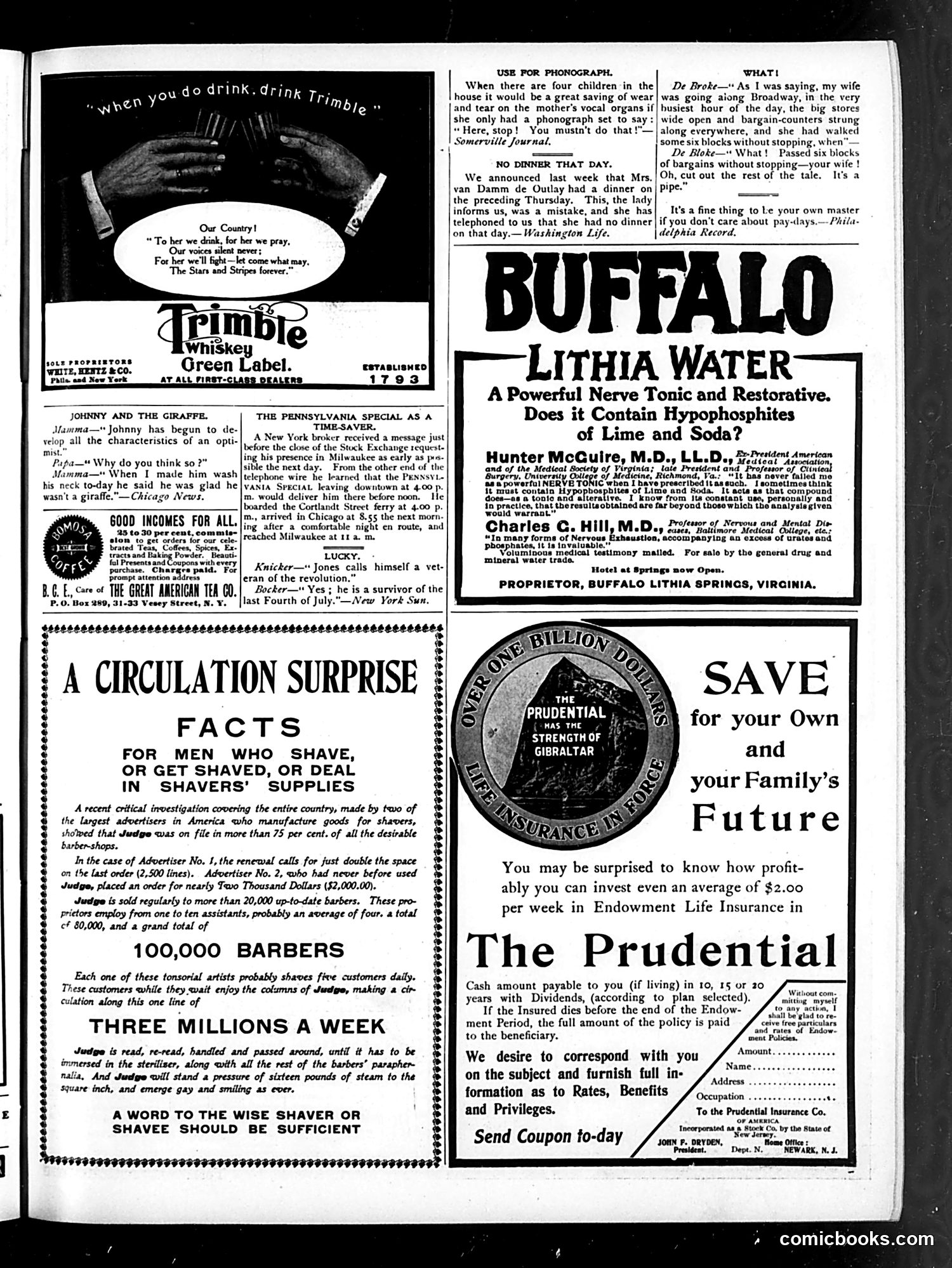
This page is primarily **advertising** with brief satirical content scattered throughout. The small cartoons and jokes at the top are typical Judge fare: light humor about domestic life (a child's optimistic observation about not being a giraffe) and social awkwardness (a wealthy man's wife who won't stop at bargain counters). The major content is the **"Circulation Surprise Facts"** section, which is actually a boast disguised as news. Judge is claiming that 75% of barbershops subscribe to the magazine—a circulation stat meant to attract advertisers. The "word to the wise shaver" concludes that advertising in Judge reaches barbers effectively. The remaining space is **paid advertisements**: Trimble whiskey (with patriotic imagery), Buffalo Lithia Water (a health tonic), and Prudential Insurance. Medical endorsements for the water appear fabricated or exaggerated, typical of early 20th-century patent medicine marketing. Nothing here requires specialized historical knowledge—it's straightforward advertising and self-promotion by a magazine selling ad space to manufacturers.
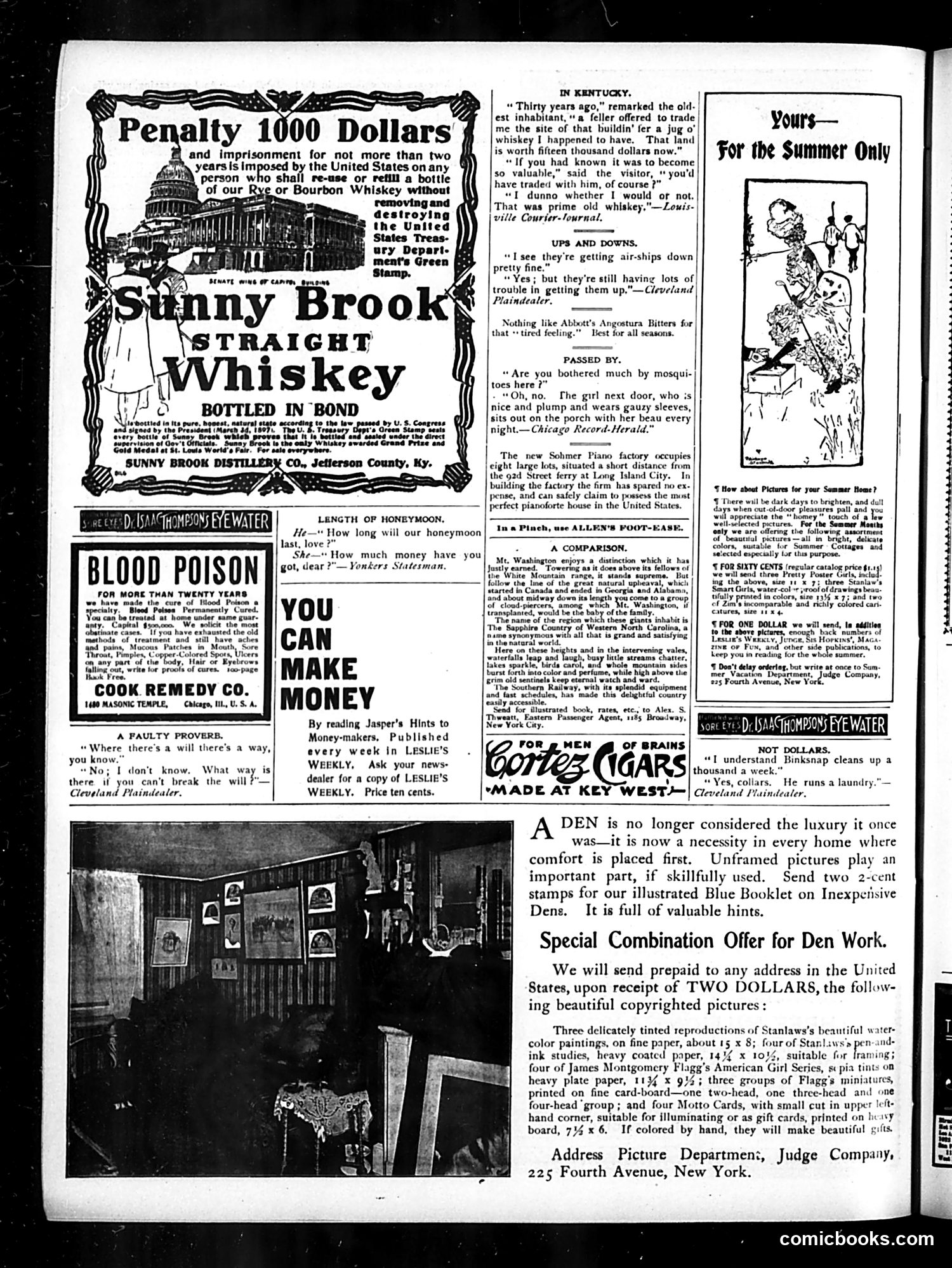
This page is primarily **advertising and fillers** rather than political satire. The main content includes: **Key Advertisements:** - **Sunny Brook Whiskey**: A federal penalty notice (satirical framing) advertises whiskey "bottled in bond," playing on Prohibition-era concerns about authenticity - **Blood Poison remedy** and other patent medicines: Typical of this era's unregulated medical advertising - **Cortes Cigars** and various picture/den decoration services **Comic Fillers** (short jokes): - A Kentucky anecdote about trading valuable land for whiskey - Honeymoon/love jokes - Mosquito/courting humor - Aviation jokes ("ups and downs") **Context for modern readers:** This reflects early 1900s America when Judge mixed serious political cartoons with advertisements for patent medicines, alcohol, and consumer goods—many now recognized as dubious or harmful. The whiskey ad's "penalty" framing likely references federal bonding requirements meant to ensure quality during an era of widespread adulteration.
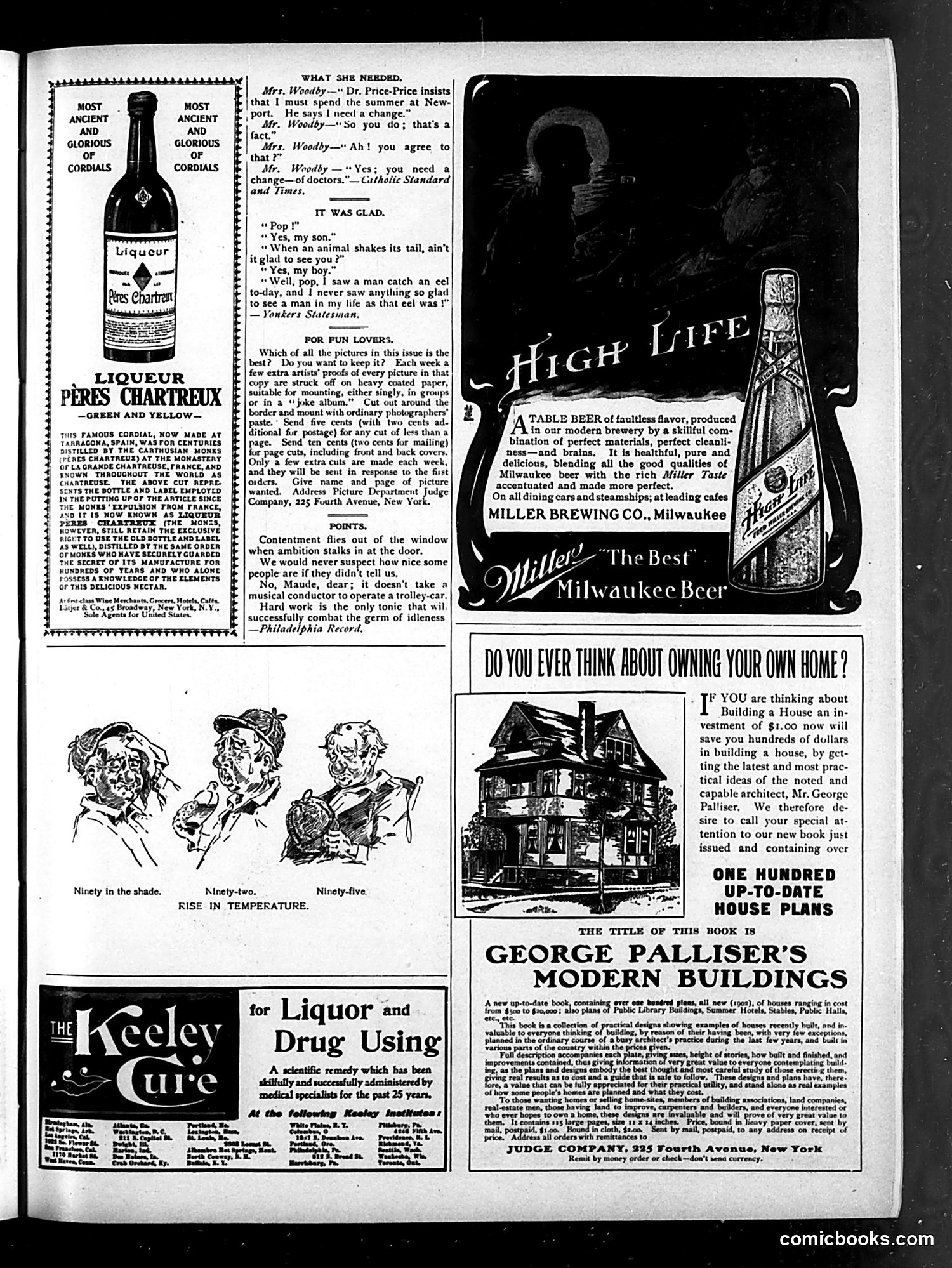
This page is primarily **advertising and filler content** rather than political satire. The main elements include: **Advertisements:** - Liqueur Pères Chartreux (cordial from French monastery) - Miller Brewing Co. Milwaukee beer - George Palliser's Modern Buildings (house plans book) - "The Keeley Cure" for alcohol/drug addiction **Humor sections** ("What She Needed," "It Was Glad," "Points"): These are brief, mild jokes typical of early 20th-century magazines—a doctor joke, a child's misunderstanding about eels, and general observations about human nature. None contain political references. **Temperature cartoon**: Three caricatured faces labeled "Ninety in the shade," "Ninety-two," and "Ninety-five" showing "rise in temperature"—presumably depicting increasing irritability in hot weather. The page reflects Judge's mix of satire, advertising, and gentle humor. There are no evident political figures or significant satirical targets visible in the image or text.
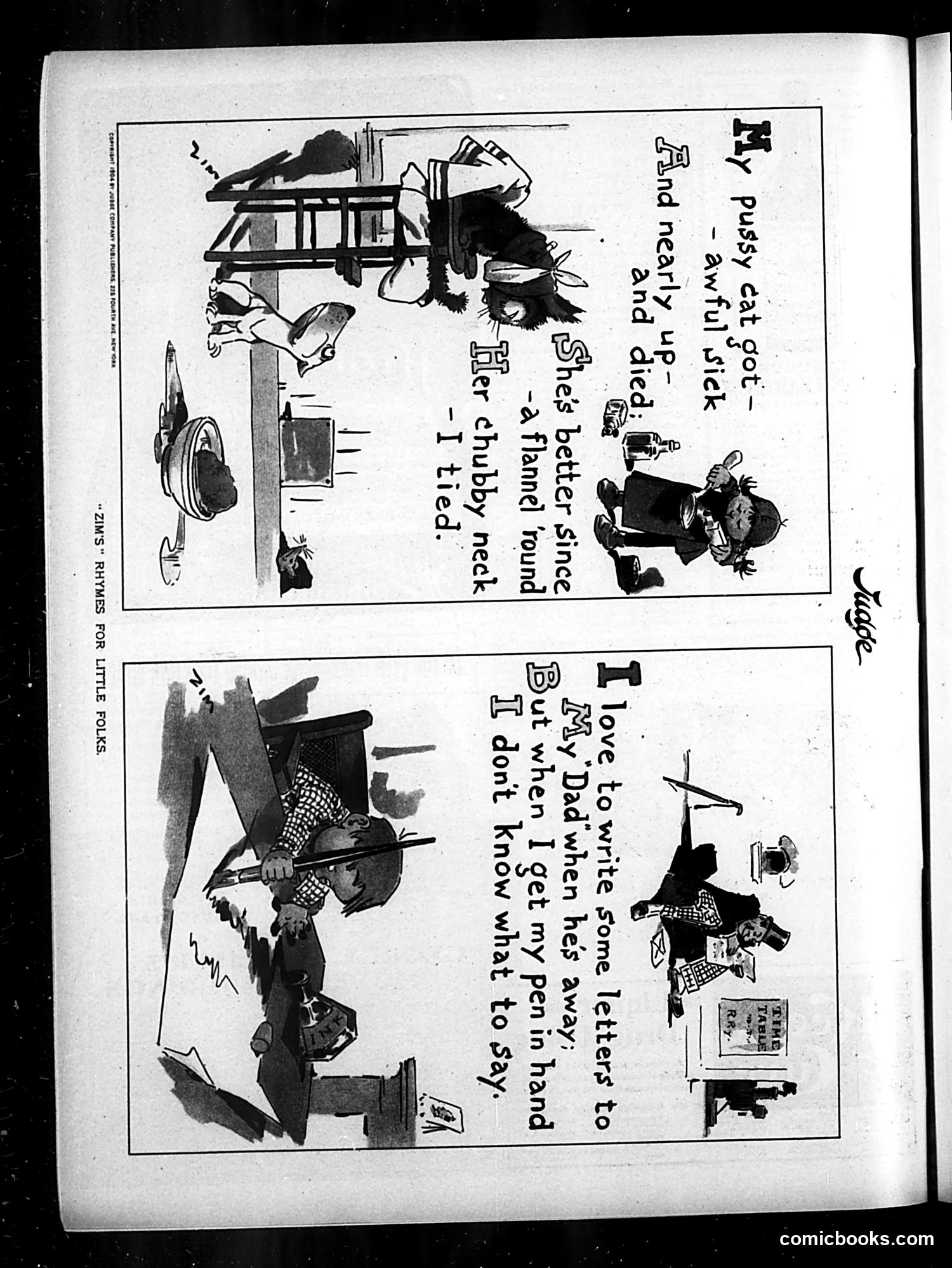
This page contains two comic strips from "Zim's Rhymes for Little Folks," a children's humor feature in Judge magazine (circa 1906). **Top panel:** Shows a child struggling with a cat and various household items, illustrating the humorous complaint that the family pet has fallen ill. **Bottom panel:** Depicts a child attempting to write letters to an absent father, expressing the child's difficulty finding words—a relatable moment of writer's block for young correspondents. These are **not political cartoons** but rather gentle domestic humor aimed at children, featuring everyday family situations and pet problems. The "Zim's Rhymes" series used illustrated verse to capture amusing moments from childhood life. The humor derives from the child's perspective on ordinary family activities rather than from social or political satire.