
Judge, 1905-07-22 · page 4 of 16
Judge — July 22, 1905 — page 4: what you’re looking at
What you’re looking at
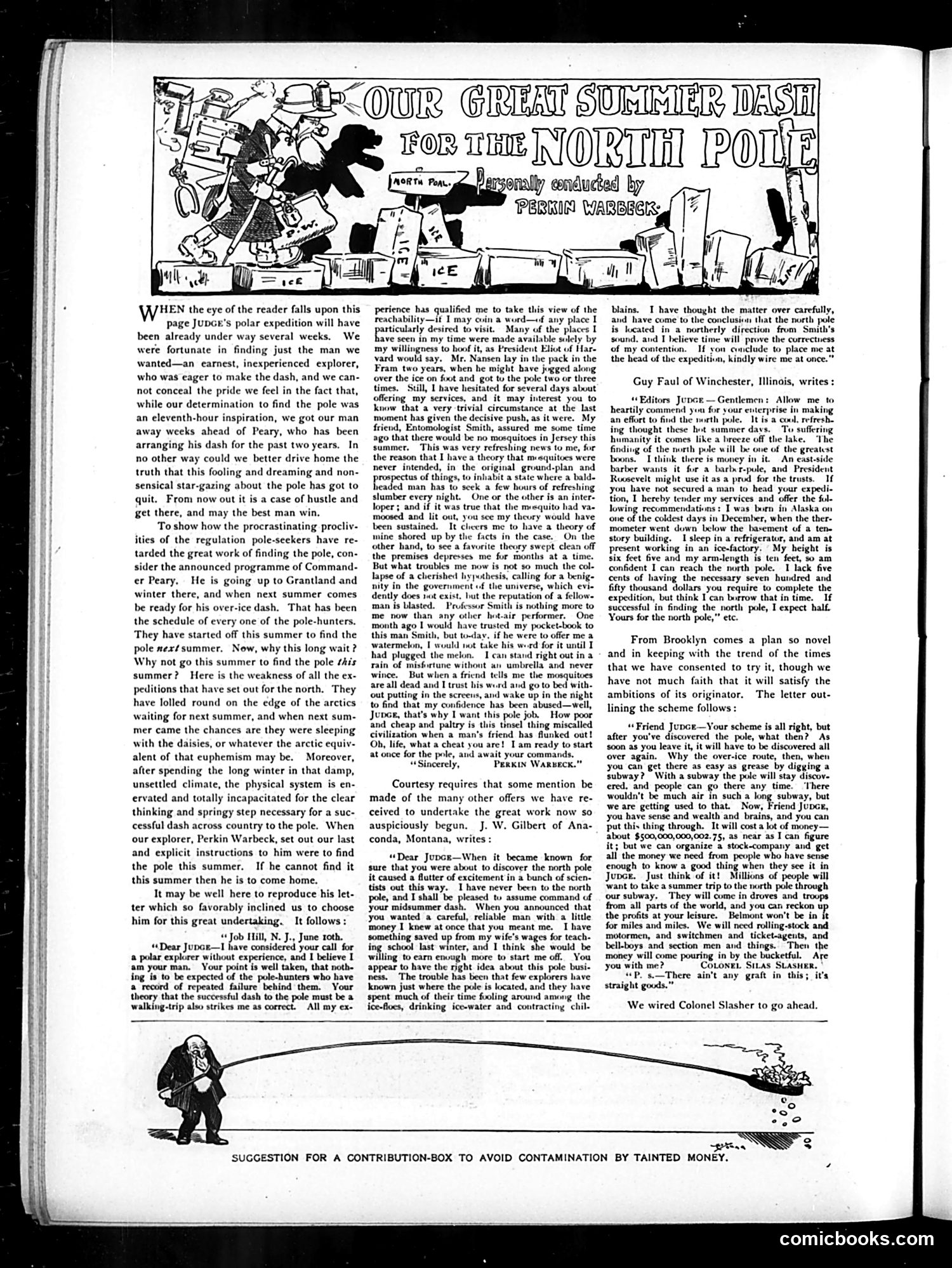
This satirical piece, apparently conducted by Perrin Warbeck, mocks various proposed expeditions to reach the North Pole. The cartoon depicts competing explorers (shown as silhouettes in a chaotic race) attempting what was then a genuinely prestigious geographical goal. The text consists of letters from readers offering humorous advice and theories about reaching the pole—including one writer's confident (but absurd) belief that mosquitoes were native to Jersey, not the Arctic. Another correspondent suggests organizing a "stock-company" expedition with financial backing. The satire targets the era's obsession with polar exploration as celebrity enterprise, while poking fun at amateur theorists and get-rich-quick schemes surrounding Arctic expeditions. The tone suggests skepticism about these ventures' practicality and serious purpose.
📄 Transcribed text from this page (OCR, searchable)
Machine-transcribed from the original scan — historical spelling and the odd misread are preserved.
~ WHEN the eye of the reader falls upon this page JupGe’s polar expedition will have been already under way several weeks. We were fortunate in finding just the man we wanted—an earnest, inexperienced explorer, who was eager to make the dash, and we can- not conceal the pride we feel in the fact that, while our deter n to find the pole was an eleventh-hour inspiration, we got our man away weeks ahead of Peary, who has been arranging his dash for the past two years. In no other way could we better drive home the truth that this fooling and dreaming and non- sensical star-gazing about the pole has got to quit. From now out it is a case of hustle and get there, and may the best man win, To show how the procrastinating procliv- ities of the regulation pole-seekers have re- tarded the great work of finding the pole, con- sider the announced programme of Command- er Peary. He is going up to Grantland and winter there, and when next summer comes be ready for his over-ice dash. That has been the schedule of every one of the pole-hunt They have started off this summer to find the pole nexfsummer. Now, why this long wait ? Why not go this summer to find the pole ¢is summer? Here is the weakness of all the ex- peditions that have set out for the north. They have lolled round on the edge of the arctics waiting for next summer, and when next sum- mer came the chances are they were sleeping with the daisies, or whatever the arctic equiv- alent of that euphemism may be. Moreover, after spending the long winter in that damp, unsettled climate, the physical system is en- ervated and totally incapacitated for the clear thinking and springy step necessary for a suc- cessful dash across country to the pole. When our explorer, Perkin Warbeck, set out our last and explicit instructions to him were to find the pole this summer. If he cannot find it this summer then he is to come home. It may be well here to reproduce his let- ter which so favorably inclined us to choose him for this great undertaking. It follows : «Job Hill, N. J., June roth. “Dear Jupcr—I have considered your call for polar explorer without experience, and I believe I am your man. Your point is well taken, that noth ing ‘is to be expected of the pole-hunters who have a record of repeated failure behind them. Your theory that the successful dash to the pole must be a walking-trip also strikes me as correct. All my ex- OUR Hoo NORTH Poa. perience has qualified me to take this view of the reachability—if T may cuin a word—of any place I Birticulatly desired to visit. Many uf the places I ave seen in my time were made available sulely by my willingness to hoof it, as President Eliot of Har- vard would say. Mr. Nansen lay in the pack in the Fram two years, when he might bave jogged along over the ice on foot and got tu the pole two or three times. Still, I have hesitated for several days about offering my services, and it may interest you to know that a very trivial circumstance at the last moment has given the decisive push, as it were. My friend, Entomologist Smith, assured me some time ago that there would be no mosquitoes in Jersey this summer. This was very refreshing news to me, for the reason that I have a theory that mesquitoes were never intended, in the original ground-plan and prospectus of things, to inhabit a state where a bald. headed man has to seek a few hours of refresh slumber every night. One or the other is an inter- loper ; and if it was true that the mosquito had va- moosed and lit out, you see my theury would have been sustained. It cheers me to have a theory of mine shored up by the facts in the case. On the other hand, to see a favorite theary swept clean off the premises depresses me fur months at a time. But what troubles me now is not so much the col- lapse of a cherished hypothesis, calling for a benig- nity in the government uf the universe, which evie dently does sot exist, but the reputation of a fellows man is blasted. Professor Smith is nothing more to me now than any other hot-air performer. One month ago I would have trusted my pocket-book to this man Smith, but to-day, if he were to offer me a watermelon, I would not take his werd for it until I had plugged the mel stand right out rain of misfortune without an umbrella and never wince. But when a friend tells me the mosquitoes are all dead and I trust hi and go to bed with- out putting in the screens, and wake up in the night to find that my confidence has been abused—well, Jvper, that’s why I want this pole job. How poor and cheap and paltry is this tinsel thing miscalled civilization when a man's friend has flunked out! Oh, life, what a cheat you are! Iam ready to start at once for the pole, and await your commands, “Sincerely, PERKIN WARBECK.” Courtesy requires that some mention be made of the many other offers we have re- ceived to undertake the great work now so auspiciously begun. J. W. Gilbert of Ana- conda, Montana, writes : “Dear Jupcr—When it became known for sure that you were about to discover the north pole it caused a flutter of excitement in a bunch of scien- tists out this way. I have never been to the north pole, and I shall be pleased tu assume command of your midsummer dash. When you announced that you wanted a careful, reliable man with a little money I knew at once that you meant me. I have something saved up from my wife's wages for teach- ing school last winter, and I think she would be willing to earn enuugh more to start me off. You appear to have the right idea about this pole busi- ness. The trouble has been that few explorers have known just where the pole is located, and they have spent much of their time fooling around among the ice-floes, drinking ice-water and contracting chil. GREAT SULIT DASE T have thought the matter over carefully, sme to the conclusiv that the north pole na northerly direction from Smith's I believe time will prove the correctness cunclude to place me at n, kindly wire me at once." blains. and have is located sound, av of my contention. If the head of the expedit Guy Faul of Winchester, Illinois, writes : “Editors Jupcr — Gentlemen: Allow me to heartily commend you for your enterprise in making an effort to find the north pole. It is a cool, refresh ing thought these het summer davs. To suffering humanity it comes like a breeze off the lake. ‘The of the north pole will be one of the greatest ink it. An east-side it for a barlt-pole, and President Roosevelt might use it as a prod for the trusts. If you have not secured a man to head your expedi- tion, I hereby tender my services and offer the fule lowing recommendations : T was born in Alaska on ‘one of the coldest days in December, when the ther- mometer went duwn below the basement of a ten story building. I sleep in a refrigerator, and am at present working in an ice-factory. My height is six feet five and my arm-length is ten feet, so am confident I can reach the north pole. I lack five cents of having the necessary seven hundred and fifty thousand dollars you require to complete the expedition, but think I'can borrow that in time. If successful in finding the north pole, I expect half. Yours for the north pole,” etc. From Brooklyn comes a plan so novel and in keeping with the trend of the times that we have consented to try it, though we have not much faith that it will satisfy the ambitions of its originator. The letter out- lining the scheme follows : “Friend Jupce—Your scheme is all right, but after you've discovered the pole, what then?” As soon as you leave it, it will have to be discovered all ‘over again. Why the over-ice route, then, when you can get there as easy as grease by digging a subway?” With a subway the pole will stay discov- ered, and people can go there any time. ‘There wouldn't be much air in such a long subway, but we are getting used to that. Now, Friend Jupce, you have sense and wealth and brains, and you can put this thing through. It will cost a lot of money— about $$00,000,000,002.75, as near as I can figure it; but we can organize a stock-company and get all the money we need from people who have sense enough to know a good thing when they see it in Jupce. Just think of it! Millions of people will Want to take a summer trip to the north pole through our subway. They will come in droves and troops from all parts of the world, and you can reckon uj the profits at your leisure. ' Belmont won't be in it for miles and miles. We will need rolling-stock and motormen, and switchmen and ticketagents, and bell-boys and section men and things. Then the money will come pouring in by the bucketful. Are you with me? COLONEL SILAS SLASH “P. s.—There ain't any graft in this straight goods.” We wired Colonel Slasher to go ahead. SUGGESTION FOR A CONTRIBUTION-BOX TO AVOID CONTAMINATION BY TAINTED MONEY. comicbooks.com