
A complete issue · 21 pages · 1904
Judge — December 31, 1904
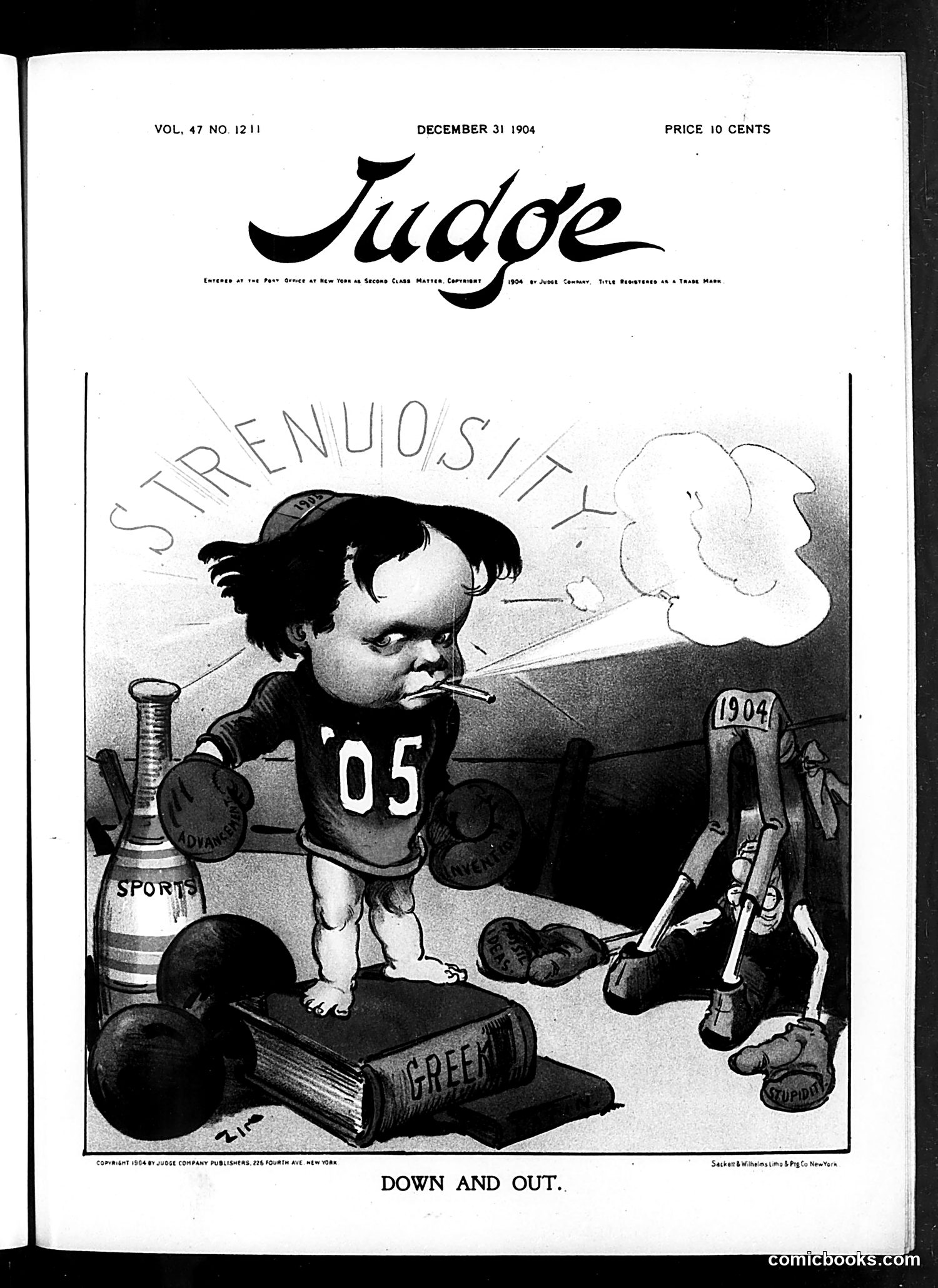
This cartoon satirizes the year 1904 as a stumbling, intoxicated infant labeled "1904." The child wears boxing gloves and smokes a cigar, surrounded by symbols of excess: a bottle labeled "SPORTS," dumbbells, and what appears to be a book labeled "CREEK" (possibly referencing scandal or controversy). The caption "STRENUOSITY" mocks President Theodore Roosevelt's famous philosophy of vigorous, active living—the "strenuous life." The joke plays on the idea that despite Roosevelt's promotion of strength and discipline, 1904 has instead been characterized by excess, drunkenness, and buffoonish behavior. It's a year-end critique suggesting the country embodied the opposite of the virtues Roosevelt championed, presenting 1904 as rowdy and out of control rather than disciplined and robust.
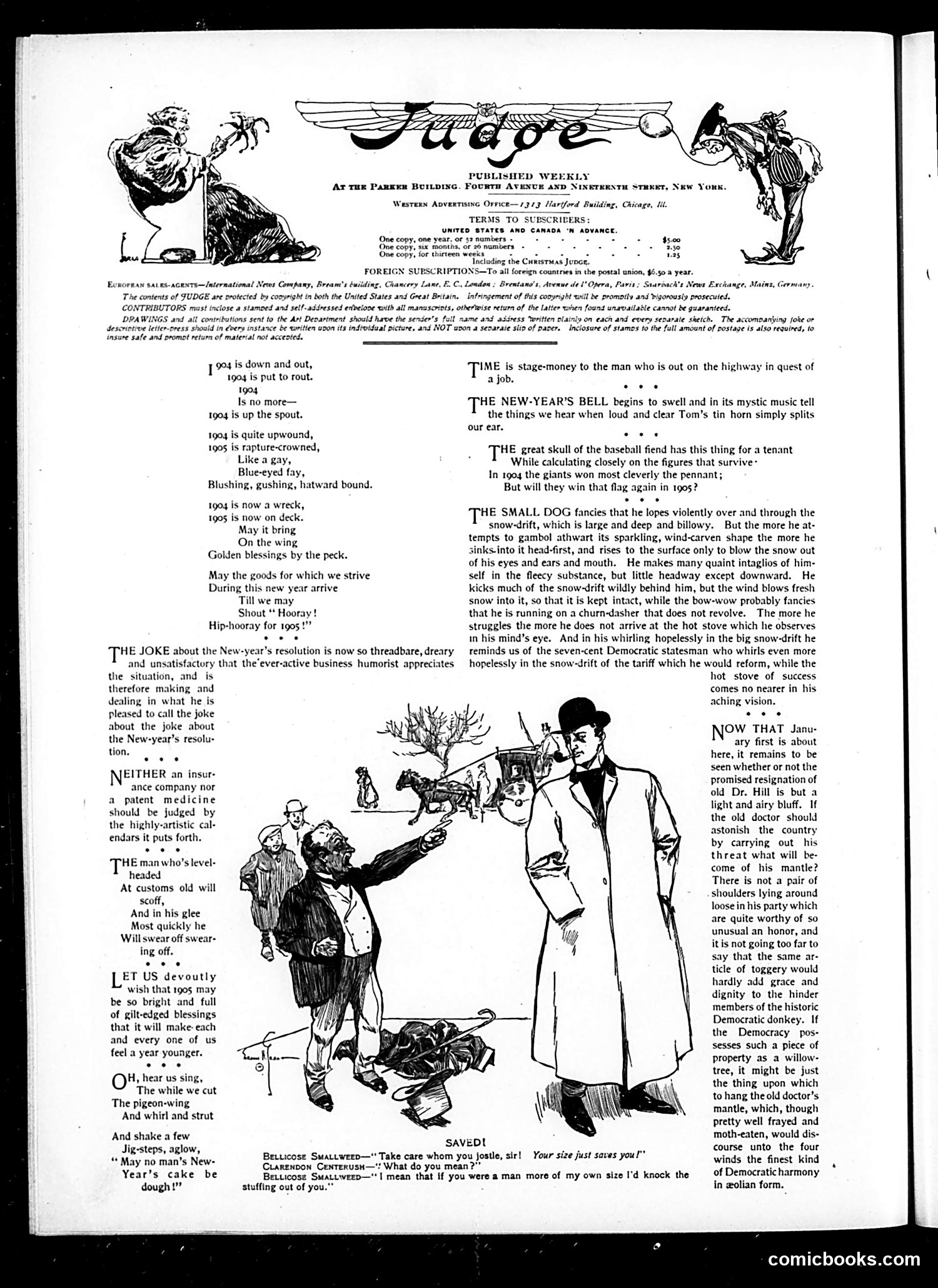
This page from Judge magazine contains satirical poetry and a central cartoon about New Year's resolutions and social commentary. The main illustration depicts what appears to be a well-dressed gentleman confronting two working-class figures in winter clothing, with a caption reading "SAVED!" The dialogue references size and physical altercation ("Your size just saves you!"). The surrounding verse includes commentary on 1904-1905 events (baseball pennants, the New Year), with particular focus on political and social themes. One section discusses Dr. Hill's "Democratic doomsday" and tariff issues, suggesting this addresses contemporary political debates of the early 1900s. The overall tone mocks upper-class pretensions while commenting on class tensions, political resolve, and the gap between wealthy and working-class Americans during this Progressive Era period.
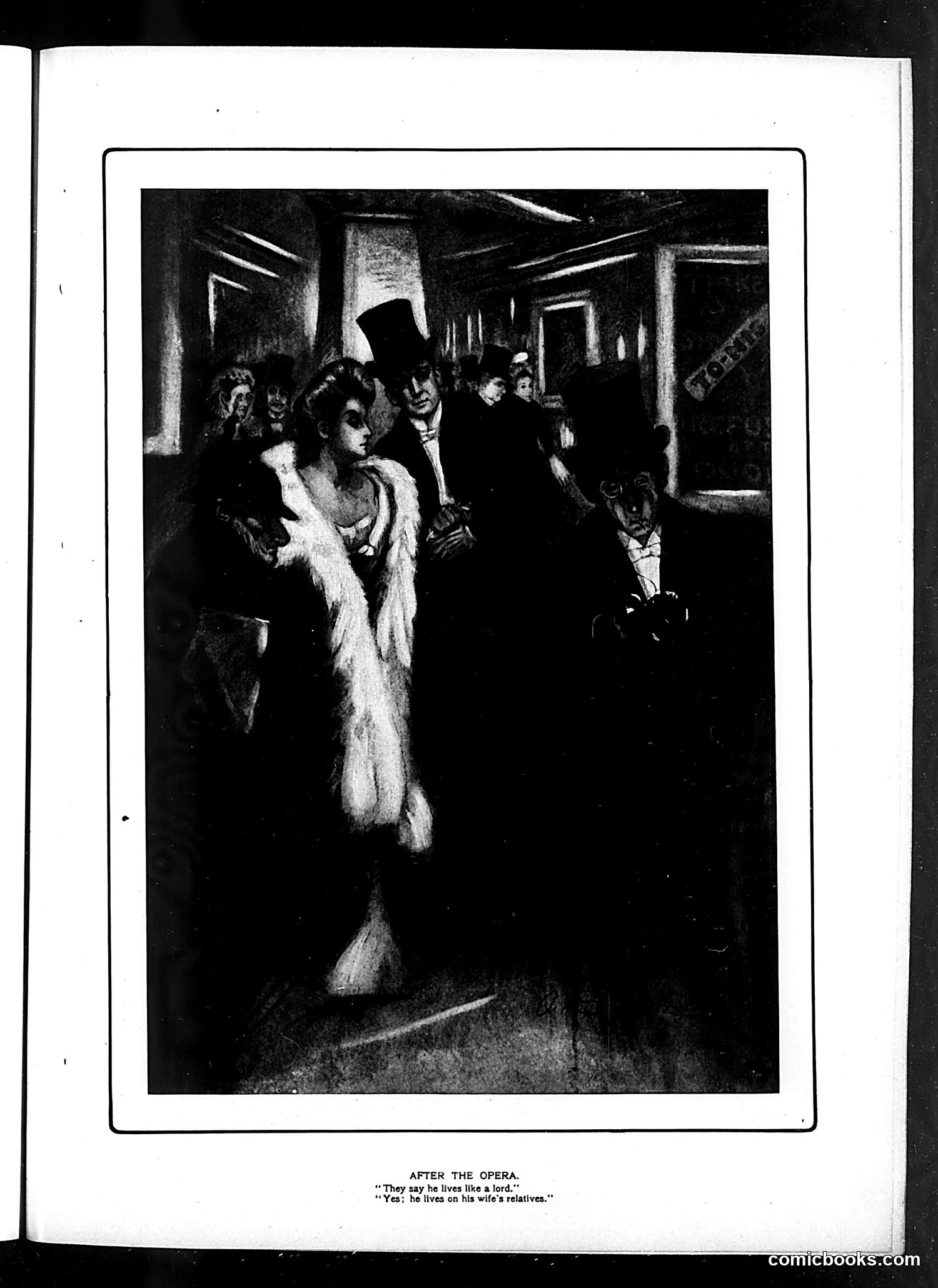
This satirical illustration depicts well-dressed opera-goers in what appears to be an elegant interior hallway. The caption reads: "They say he lives like a lord." / "Yes; he lives on his wife's relatives." The joke targets a common social stereotype of the era: a man who maintains an appearance of wealth and sophistication (attending the opera, wearing formal dress) while actually being financially dependent on his wife's family. The satire mocks both the pretense of such individuals and the economic reality beneath their polished facade—a man living as a "lord" while parasitically relying on in-laws for support. This reflects period anxieties about masculine economic independence and social status built on false appearances.
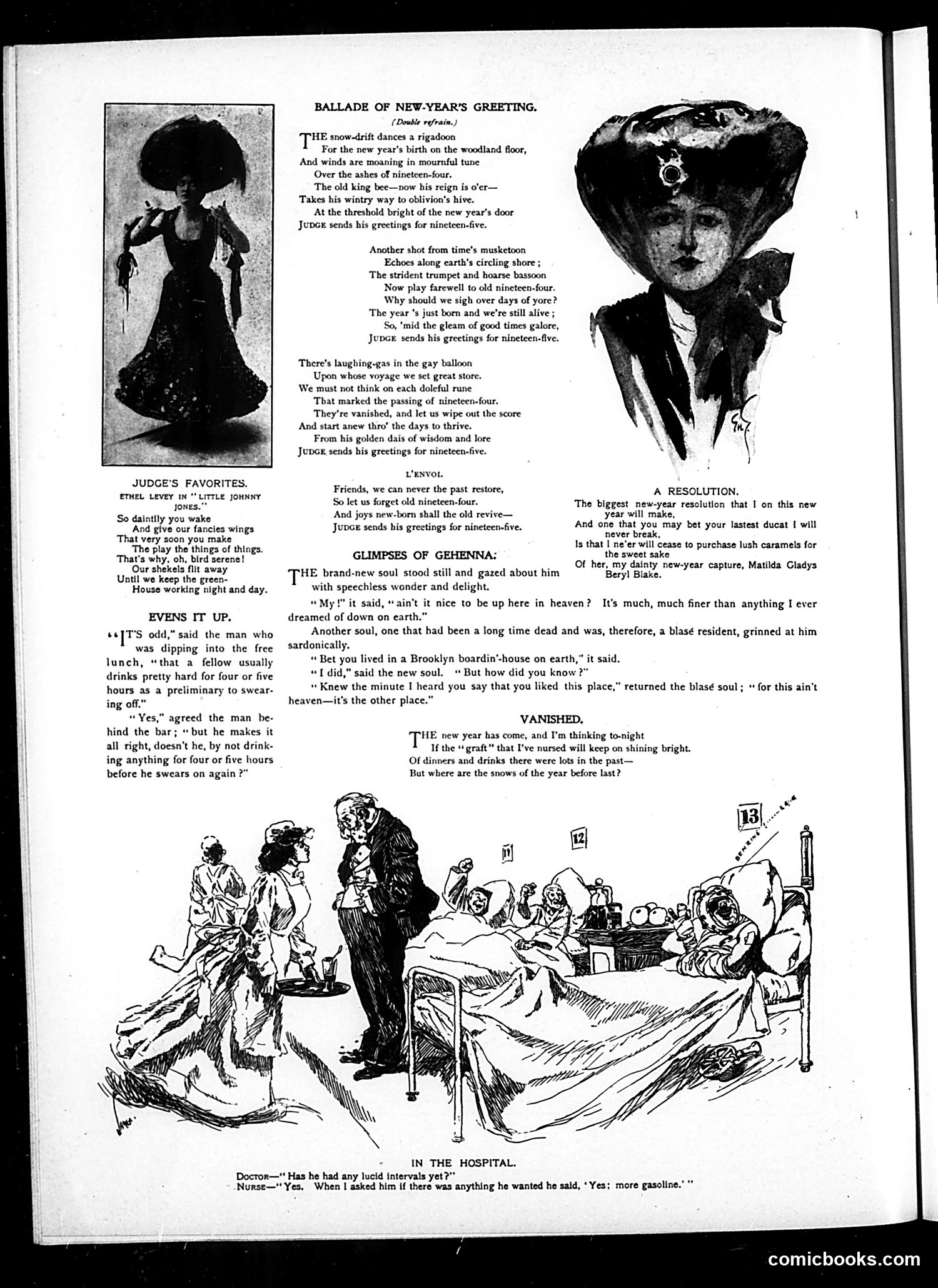
This page contains New Year's 1905 themed satirical content. The "Ballade of New-Year's Greeting" mocks the passing of 1904, using "Judge" (a personified figure) sending greetings to the new year. "Judge's Favorites" credits Ethel Levey in "The Parisian Burglars," while other items like "Evens It Up" contain light social humor about drinking and swearing as New Year's traditions. "Glimpses of Gehenna" presents a dialogue between a newly dead soul and a blasé resident about Brooklyn boardinghouses, using sardonic humor about the afterlife. The hospital cartoon at bottom features a doctor-nurse exchange: when asked if a patient wants anything, the nurse reports he requested "more gasoline"—likely referencing early automobile culture or fuel-related injury, playing on contemporary anxieties about new automotive technology.
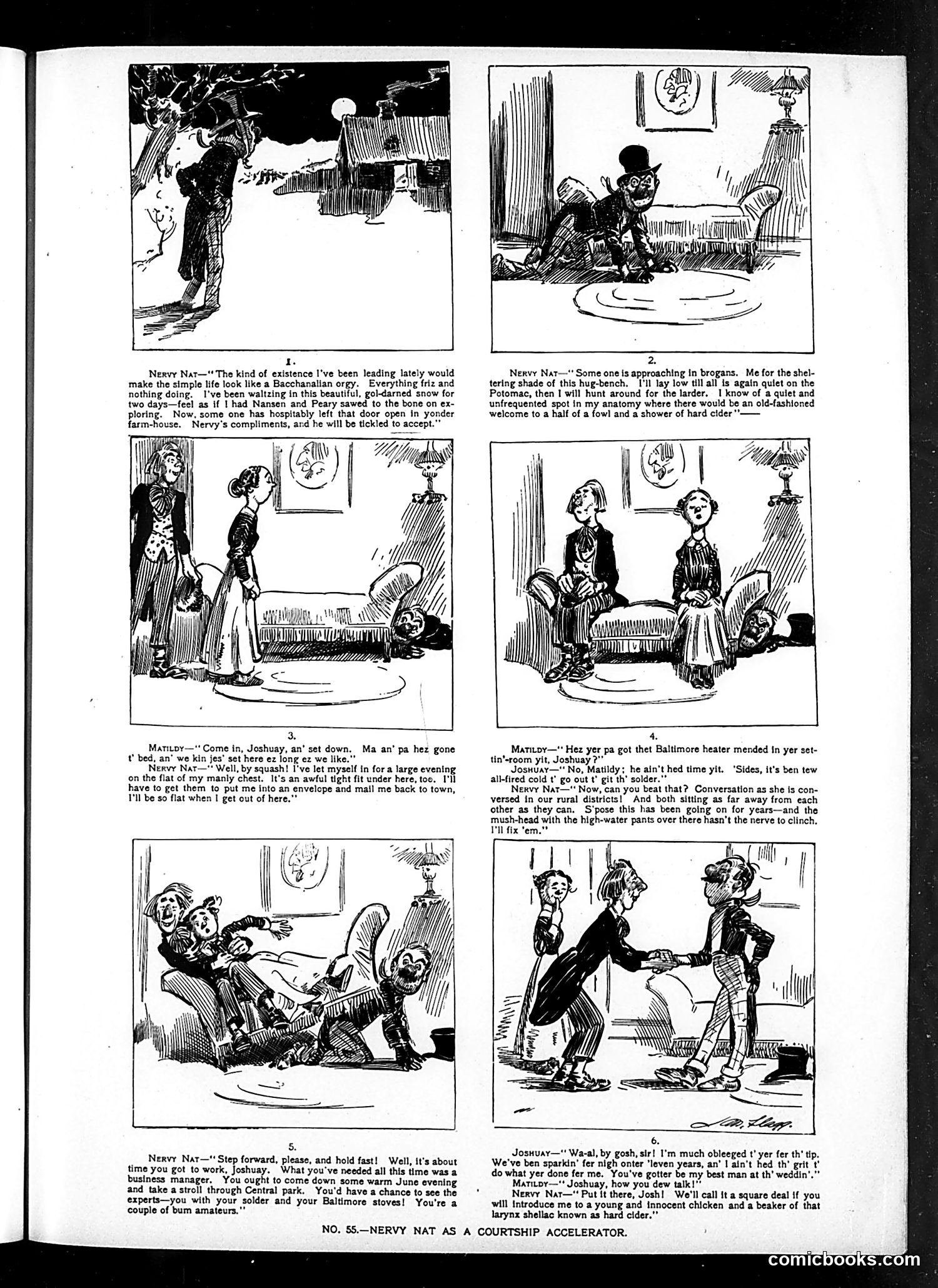
This comic strip satirizes rural courtship customs through "Nervy Nat," a scheming vagrant who stumbles upon a farmhouse and exploits its inhabitants' shyness. The humor targets the social awkwardness of rural American couples: Joshua and Matildy have been "sparking" (courting) for eleven years without progressing to engagement, despite living together and clearly interested in each other. Nat manipulates the situation—breaking in, offering unsolicited advice about romance, and shaming Joshua into action. The satire mocks both the couple's paralytic timidity and Nat's presumptuous meddling. The strip reflects urban attitudes toward rural life as backward and emotionally repressed. References to "Nansen and Peary" (Arctic explorers) and "Central Park" anchor the story in the early 1900s. The punchline rewards Nat's interference with promises of food and "hard cider."
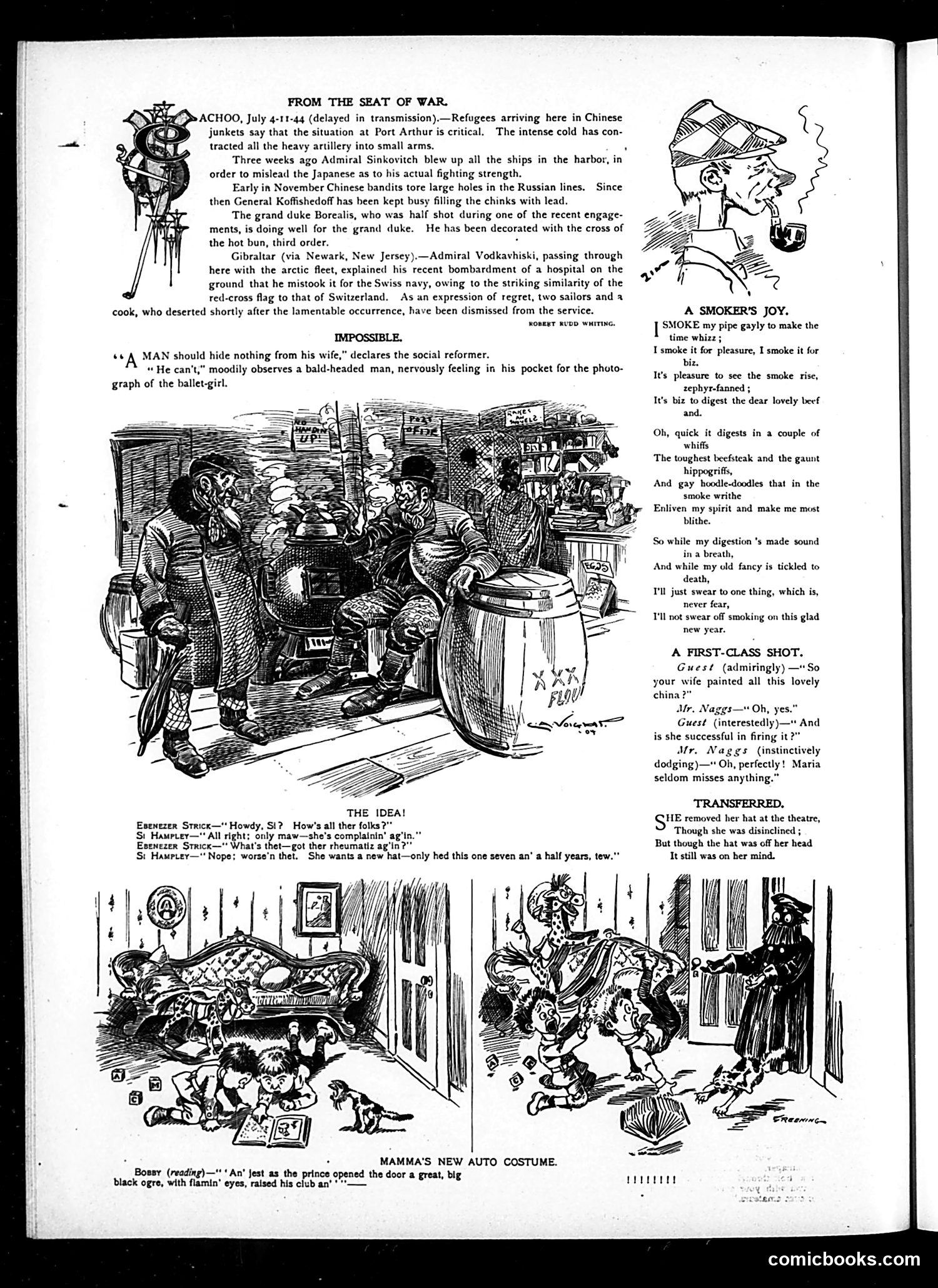
This page from Judge (dated July 4-11-44, likely **1904** based on the Russo-Japanese War reference) contains satirical war dispatches and humorous domestic sketches. **"FROM THE SEAT OF WAR"** mocks the Russo-Japanese War with absurdist fictional dispatches. References to "Port Arthur," "Admiral Sinkovitch," and "General Koffishedoff" are invented names satirizing Russian military incompetence. The joke is that official war reports are so ridiculous and contradictory that completely fabricated ones seem plausible—ships blown up to "mislead the Japanese," hospitals mistaken for the Swiss navy. **Domestic humor sketches** below include: - A bald man hiding a ballet-girl photograph from his wife (marital deception) - A smoker's romantic ode to pipe-smoking - A husband whose wife fires china (violent domestic discord played for laughs) - Rural dialect humor about a wife wanting a new hat after seven-and-a-half years The satire targets military bureaucratic absurdity and Victorian-era marital tensions, reflecting early 20th-century anxieties about war and gender relations.
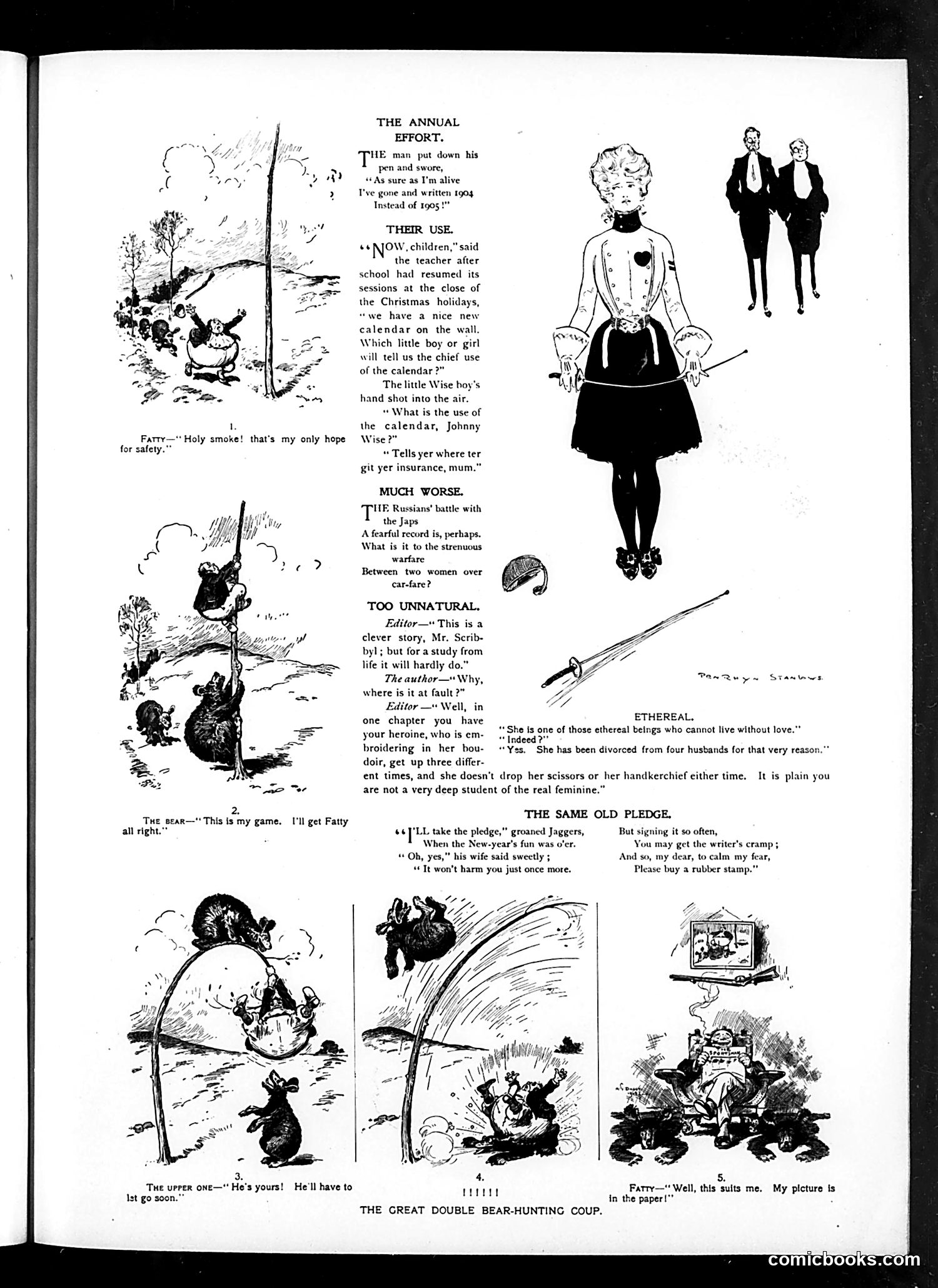
This page contains several satirical pieces from *Judge* magazine (early 1900s). Key content: **"The Annual Effort"**: Mocks the common New Year's mistake of writing the old year instead of new on documents—a relatable frustration. **"Their Use"**: A teacher asks about calendars; a cynical student (Fatty) answers it shows "where to get insurance"—satirizing how ordinary people view calendars pragmatically rather than educationally. **"Much Worse"**: Compares the Russo-Japanese War (1904-05) unfavorably to women quarreling over streetcar fare—dark humor suggesting domestic disputes are more consequential than international conflict. **"Too Unnatural"** and **"Ethereal"**: Critique female characters in fiction for implausible behavior (never dropping things) and melodramatic romantic obsession. **"The Same Old Pledge"** and **"Great Double Bear-Hunting Coup"**: Joke about New Year's resolutions (repeatedly taking temperance pledges) and someone's vanity at seeing their picture published. The cartoons employ visual gags typical of early-1900s humor magazines.
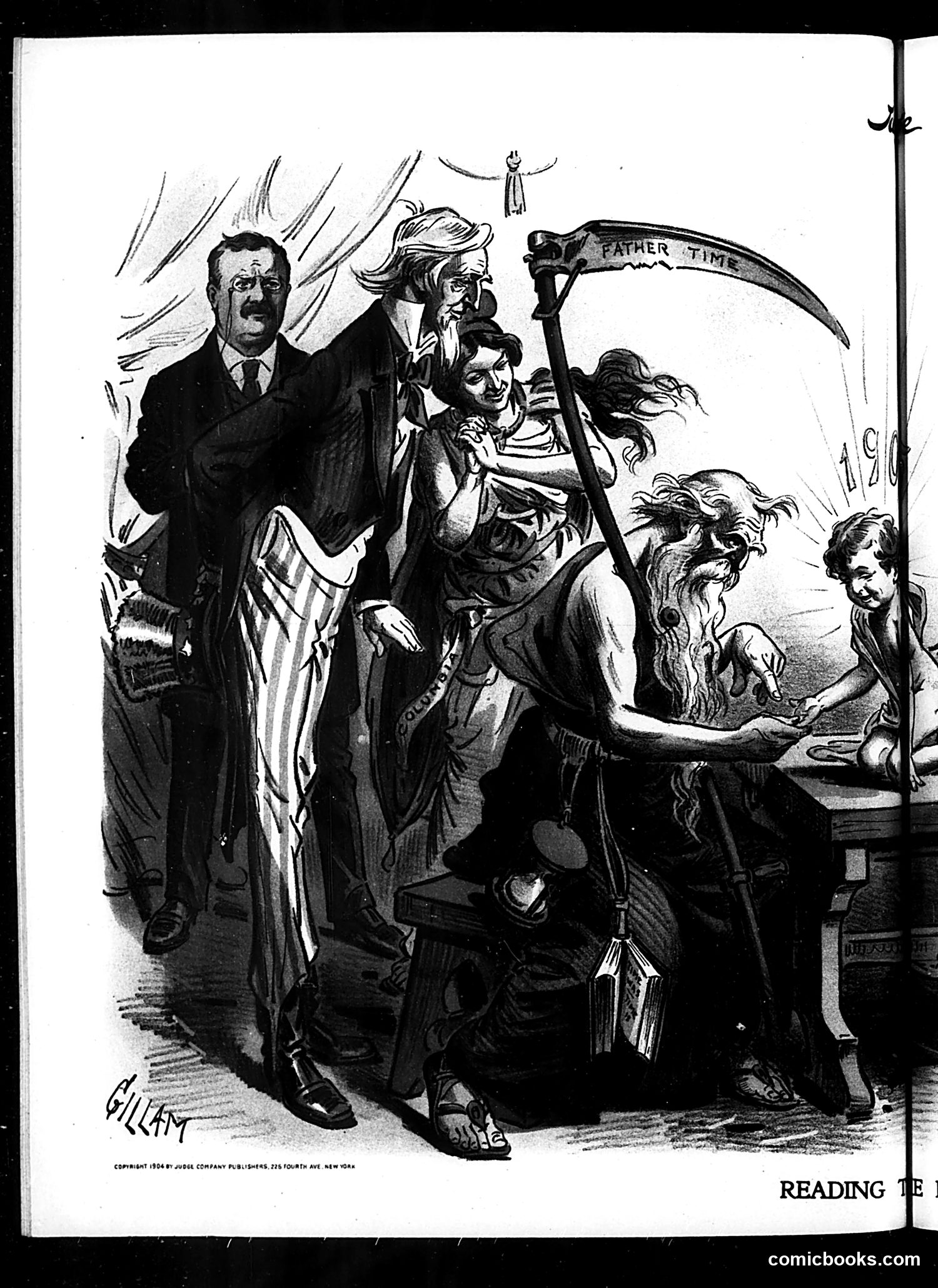
This is a satirical cartoon signed "Gillam" depicting "Father Time" (the bearded figure with a scythe labeled "FATHER TIME") seemingly ushering in or presiding over a group of figures in formal dress and classical/allegorical costumes. The cartoon appears to be commentary on the passage of time and changing political or social circumstances. The formally-dressed men on the left appear anxious or concerned, while Father Time and the allegorical figures (possibly representing virtues or concepts) interact with them. Without the specific publication date or clearer context from surrounding text, I cannot identify the particular historical event or political figures being satirized. The style suggests late 19th or early 20th century American politics, but the exact subject remains unclear from the image alone.
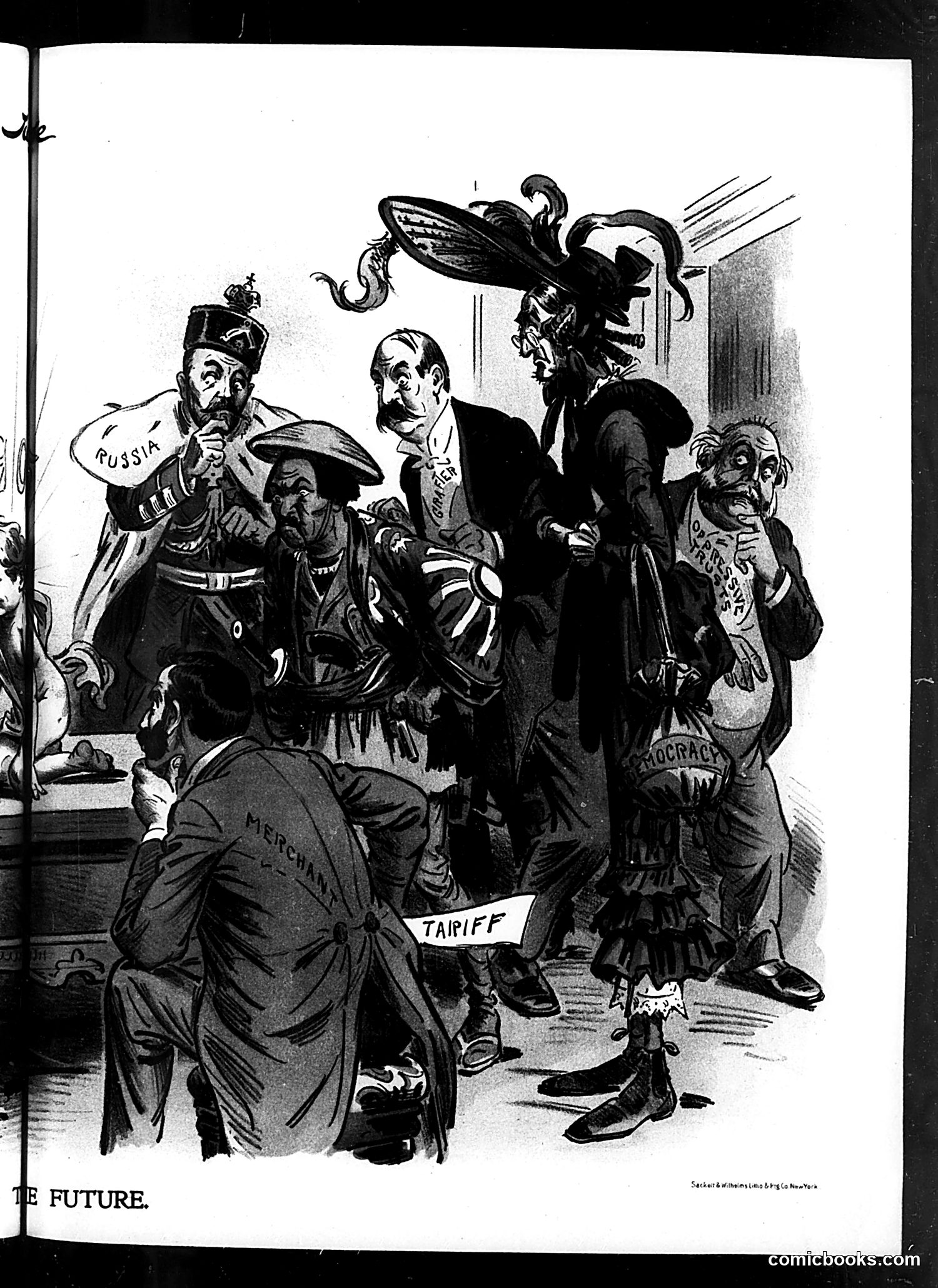
This Judge magazine cartoon satirizes international trade tensions, likely from the late 19th or early 20th century. The central figure labeled "RUSSIA" (left, in military dress) confronts a "MERCHANT" (center, in civilian clothes) over a document marked "TARIFF." The grotesque winged demon figure above represents the chaos or conflict these trade policies provoke. On the right stands a caricatured figure labeled "AUTOCRACY," depicted with exaggerated, menacing features. The cartoon critiques how tariff disputes between nations—particularly Russia's protectionist trade practices—threaten international commerce and stability. The "Future" referenced in the title suggests the artist warns of coming conflict if these trade hostilities continue unresolved. The demon embodies the destructive consequences feared from escalating economic nationalism.
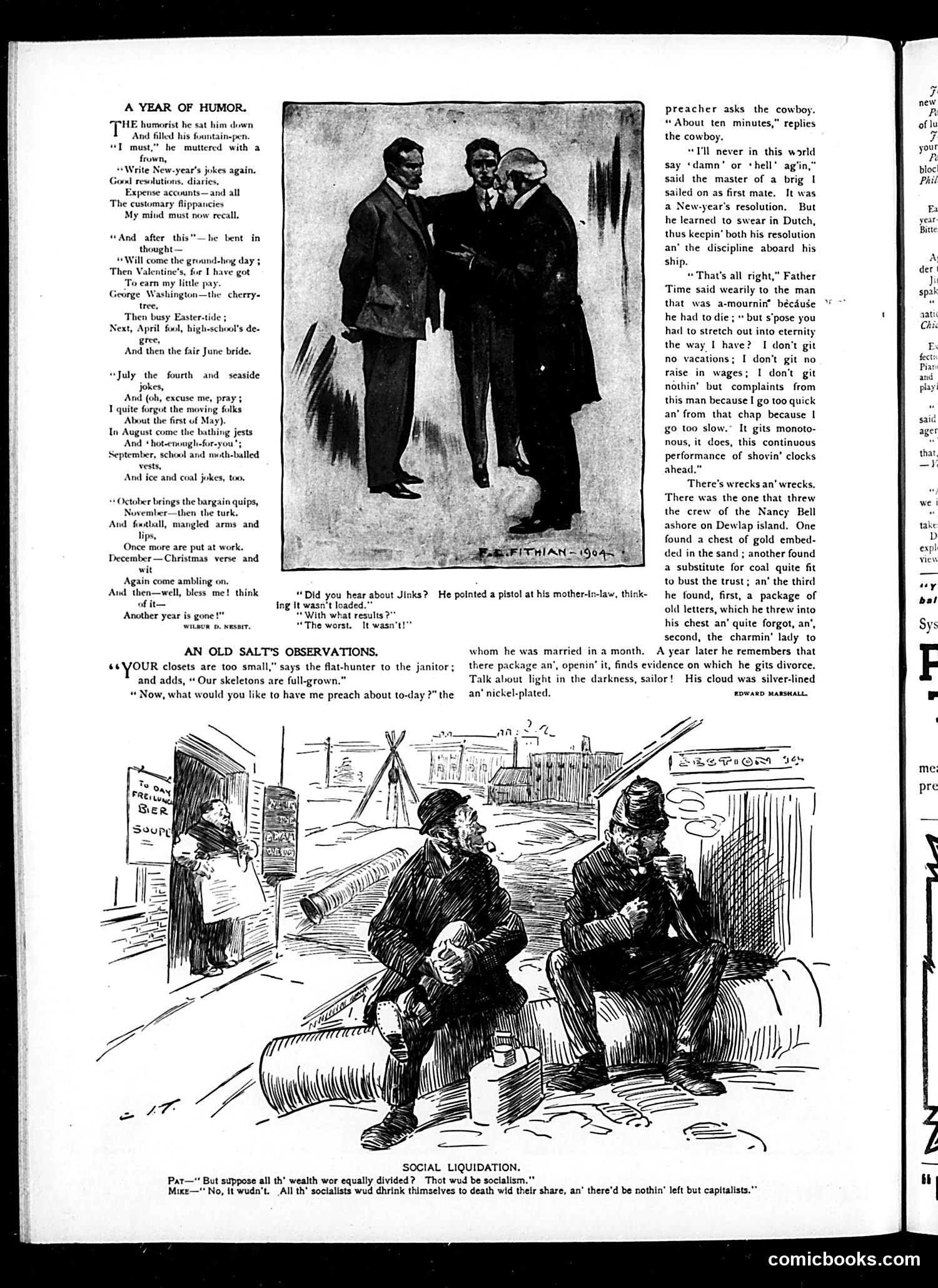
This page contains several satirical pieces from *Judge* magazine: **"A Year of Humor"** is a meta-joke about a humorist struggling to generate seasonal material—new year's resolutions, Valentine's Day jokes, Easter, Fourth of July, etc.—recognizing the formulaic exhaustion of annual comedy writing. **"An Old Salt's Observations"** features a sailor telling tall tales with moral angles: a man's failed suicide attempt (the gun wasn't loaded), a ship captain who swears in Dutch to maintain his New Year's resolution, and wreck survivors finding unexpected treasures. **"Social Liquidation"** is a political cartoon mocking socialist ideology. Two working-class characters (likely Irish, suggested by dialect) debate socialism: one argues equal wealth distribution would be socialism, the other retorts that socialists would drink themselves to death with their share, leaving only capitalists remaining. This reflects early-20th-century American fears of socialism and stereotypes about working-class immigrants' supposed drinking habits. The satire assumes reader familiarity with contemporary socialist political movements gaining traction in that era.
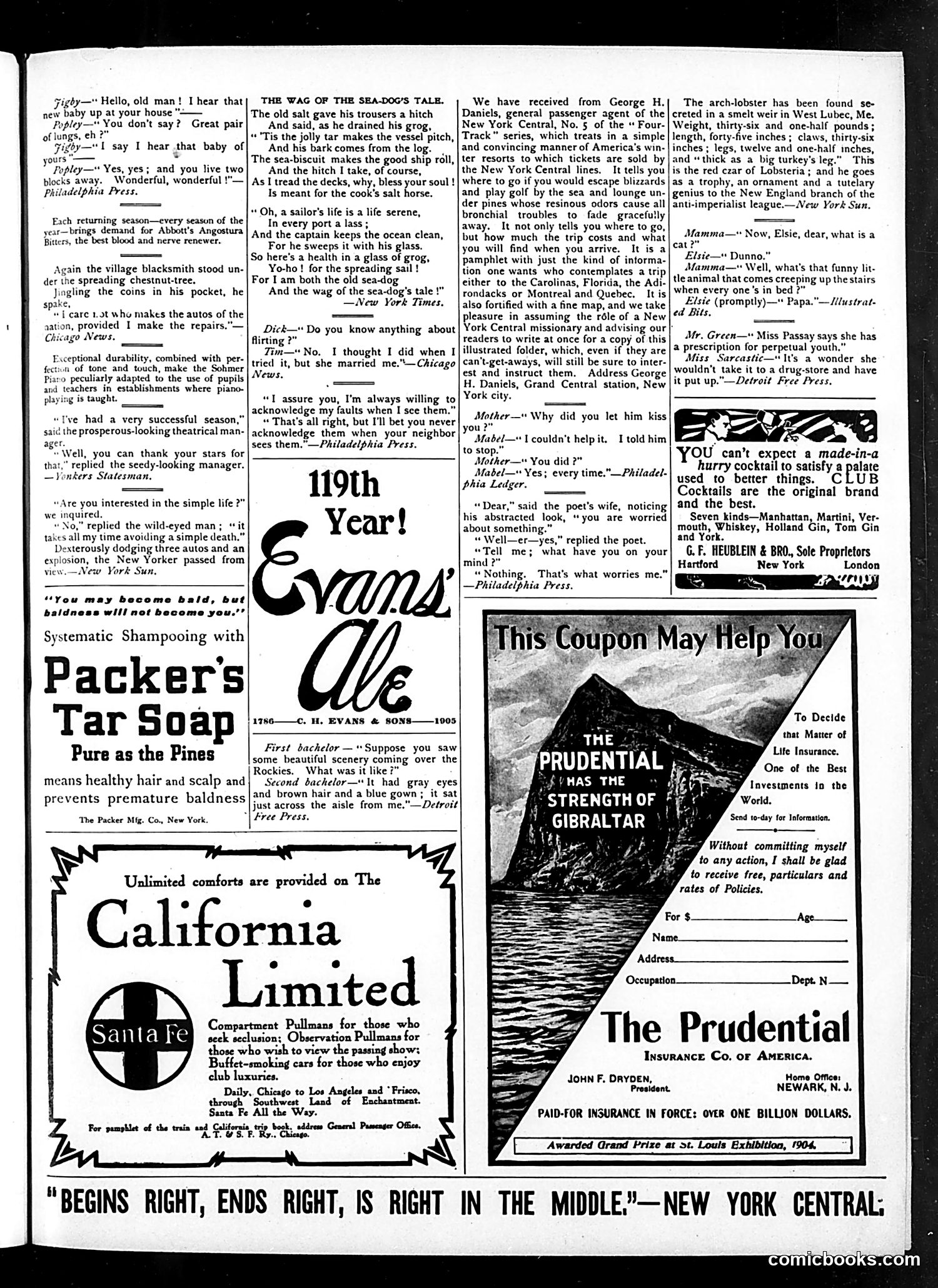
This page from Judge's 119th year (1905) is primarily a **collection of short humorous anecdotes** rather than political cartoons, interspersed with period advertisements. The jokes reflect early 1900s American concerns: a new father's loud baby disturbs neighbors two blocks away; an auto mechanic profits from car repair work (automobiles were still novelties); a bachelor mistakes a woman's appearance for scenery; a flirt discovers his target married him; a New Yorker narrowly avoids three automobiles and an explosion while living an "simple life." The humor is gentle social commentary on **modern urban life**—nascent automobile culture, theatrical success, and changing domestic situations. The advertisements (Packer's Tar Soap, Santa Fe railway, Prudential Insurance) underscore the page's target audience: middle-class readers concerned with health, travel, and financial security. There are **no identifiable political figures or sharp satire**—just relatable domestic and urban humor typical of Judge's lighter content.
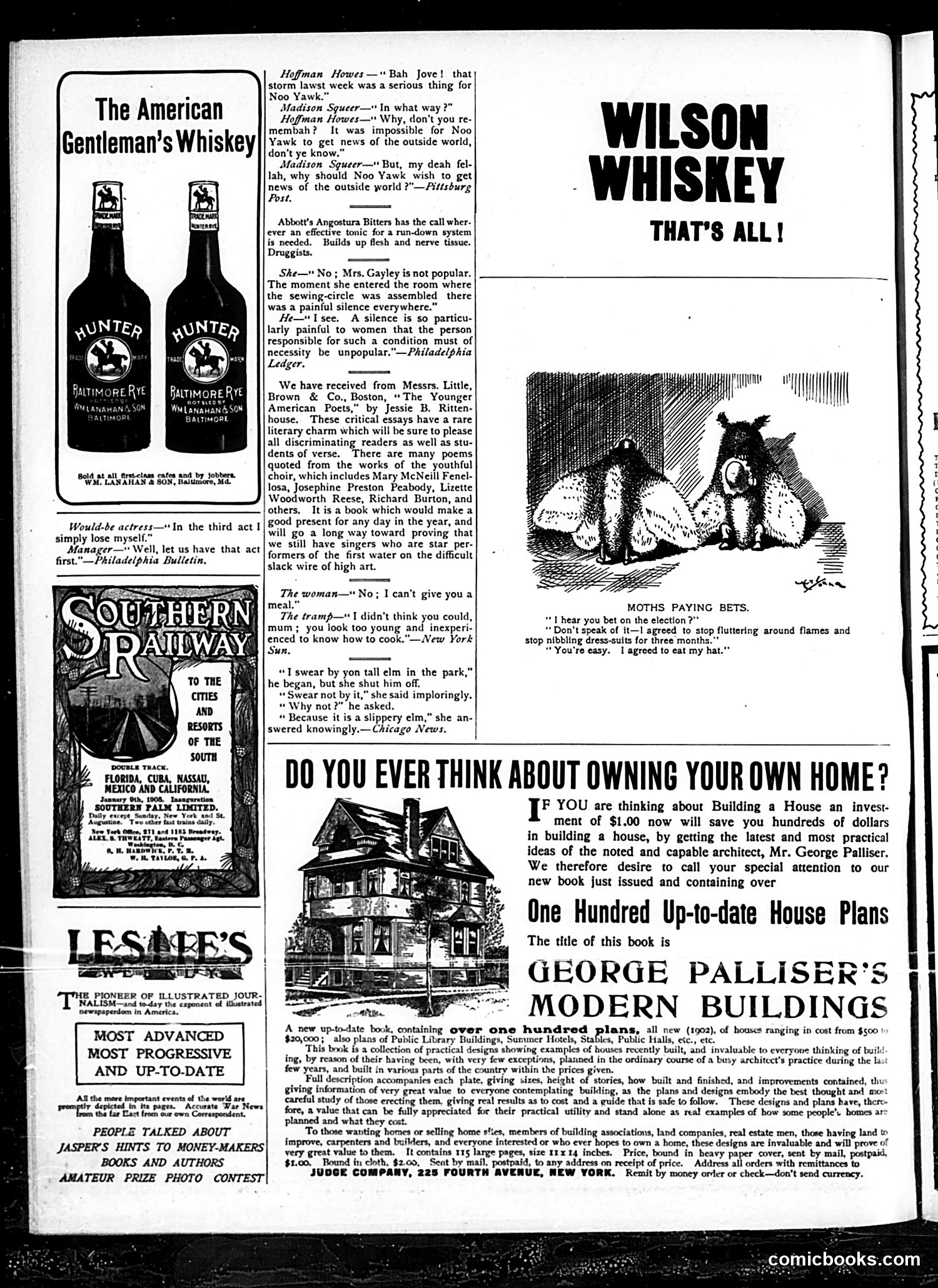
This Judge magazine page contains several short satirical jokes and advertisements typical of early 1900s humor. **The main cartoons:** 1. **"Hoffman Howes" jokes** mock New York's self-importance. The humor hinges on a wealthy socialite (Hoffman Howes, using an affected accent) complaining that a storm prevented New York from receiving outside news—implying the city is so self-centered it doesn't care about the world beyond itself. 2. **"Moths Paying Bets"** is a visual pun showing moths as gamblers. Two moths have made bets about the election: one promised to stop "fluttering around flames" (typical moth behavior), the other to "eat my hat." The joke plays on moths' actual behavior being indistinguishable from human betting habits. 3. Smaller jokes mock unpopular women, aspiring actresses, and a tramp's flattery. **The advertisements** promote whiskey, house-building plans, and railroad travel—standard period advertising with minimal satire. The humor relies on wordplay, social observation, and visual puns rather than political commentary.
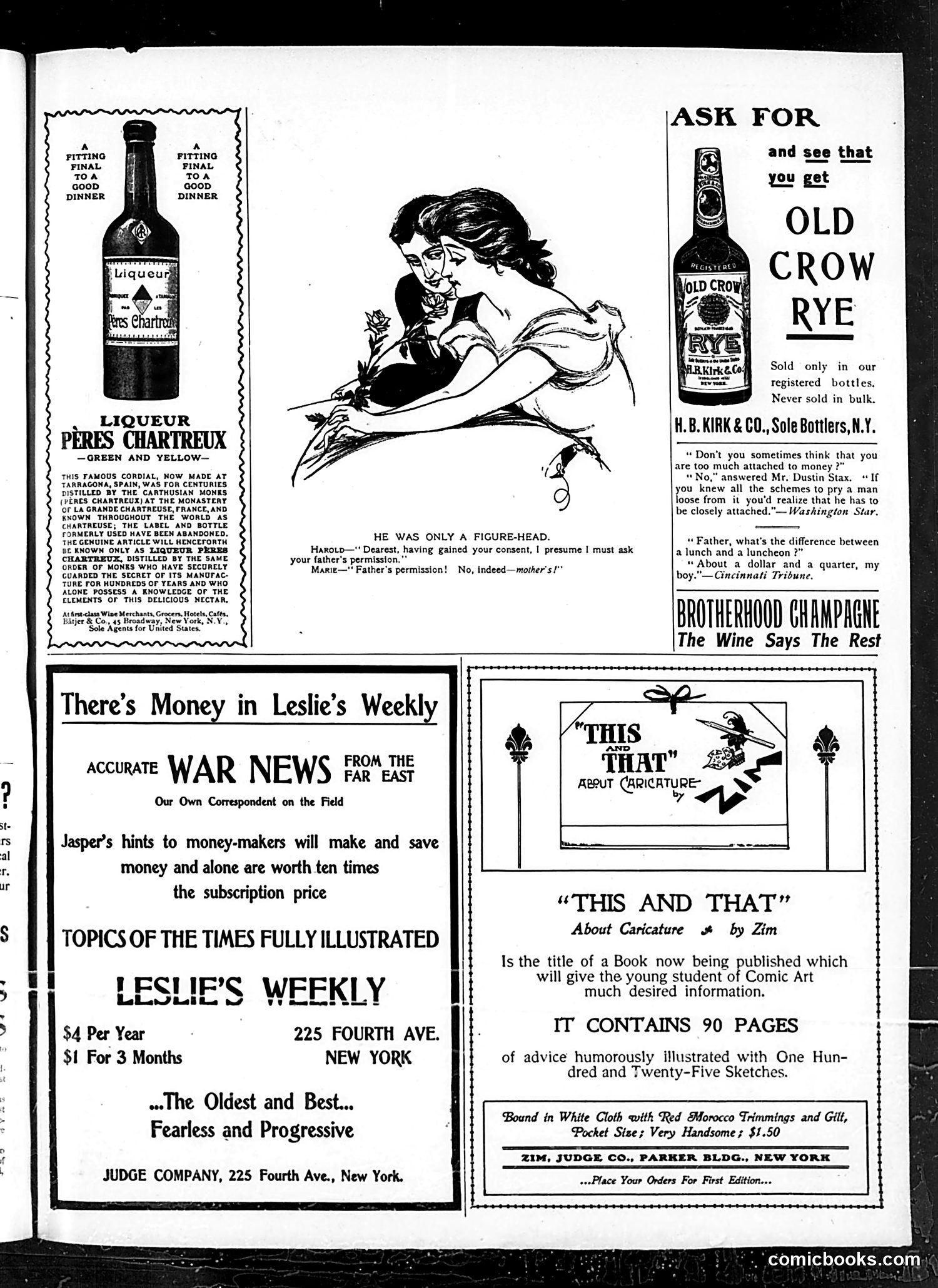
This page is primarily **advertising**, with one small cartoon. The main cartoon depicts a young man (Harold) asking his girlfriend's father for permission to marry her, only to be told he must ask the mother instead—she's the real authority. The joke satirizes **gender dynamics and family hierarchy**, suggesting that despite the formal patriarchal requirement, the mother actually wields decision-making power in the household. The page is dominated by liquor and wine advertisements (Pères Chartreux, Old Crow Rye, Brotherhood Champagne)—typical for Judge magazine of this era. Supporting advertisements promote Leslie's Weekly magazine and a caricature instruction book by "Zim." The scattered jokes about money and class ("a dollar and a quarter" difference between lunch/luncheon) reflect period humor about wealth disparities. **No specific political figures or events are referenced** on this page.
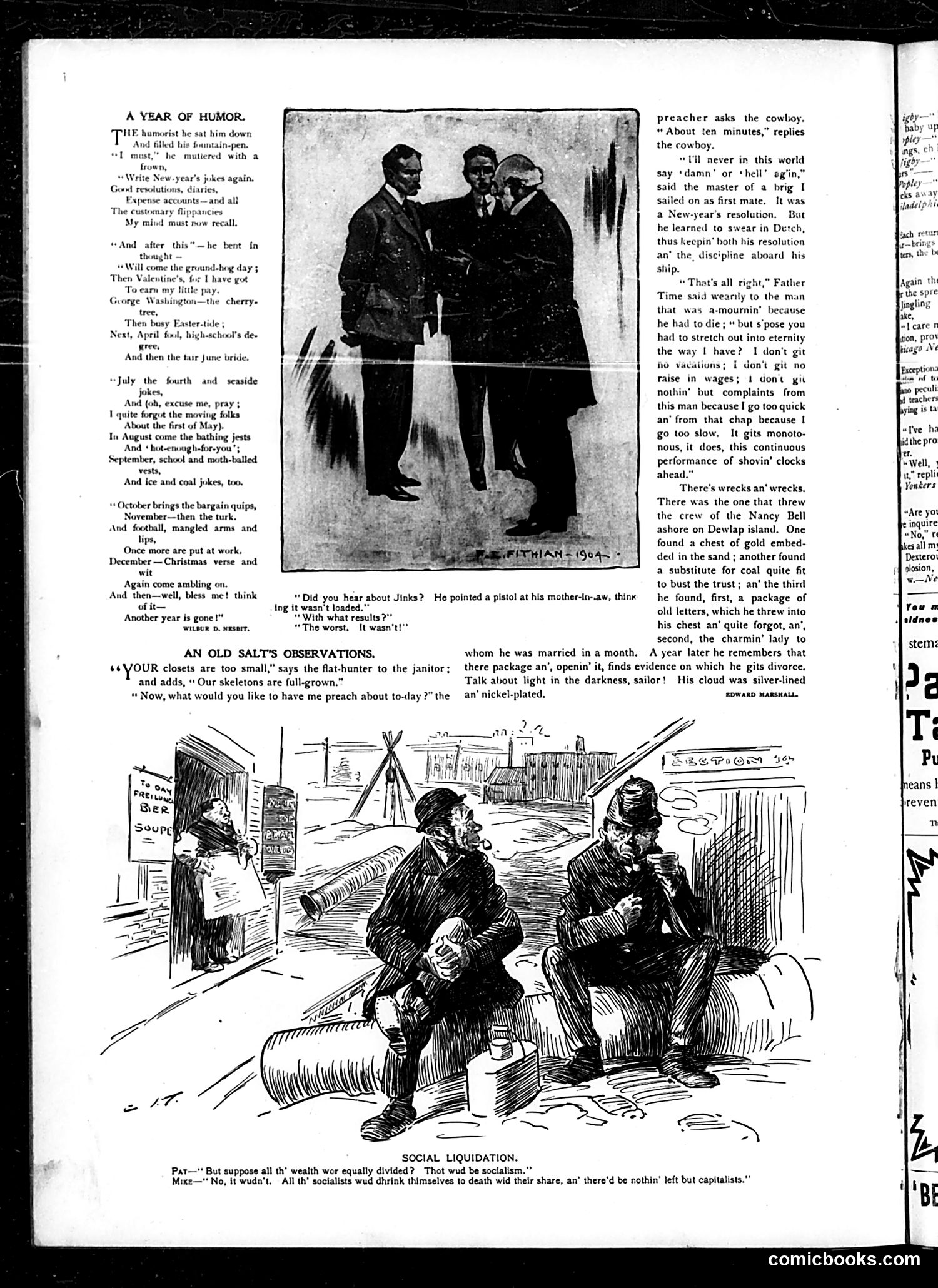
This page from *Judge* magazine contains several humor pieces satirizing American life and politics around the early 20th century. The top illustration depicts a domestic argument, with a caption joking about a man pointing an unloaded pistol at his mother-in-law—the "worst" outcome being that it actually fires, killing her. This dark humor reflects period attitudes toward in-laws. The main text "A Year of Humor" is a poet's complaint about annually recycling the same predictable jokes tied to holidays and seasons (Valentine's Day, Easter, Fourth of July, Christmas, etc.)—satirizing hack comedy writing. "An Old Salt's Observations" features working-class commentary on various topics, including a sailor's story about a man finding letters in buried treasure that lead to divorce. The bottom cartoon, "Social Liquidation," satirizes socialist ideology through a working-class Irish character arguing that equal wealth distribution would fail because workers would drink themselves to death, leaving only capitalists. This reflects anti-socialist sentiment common in American publications of this era. The humor targets predictability, class anxieties, and political ideology.
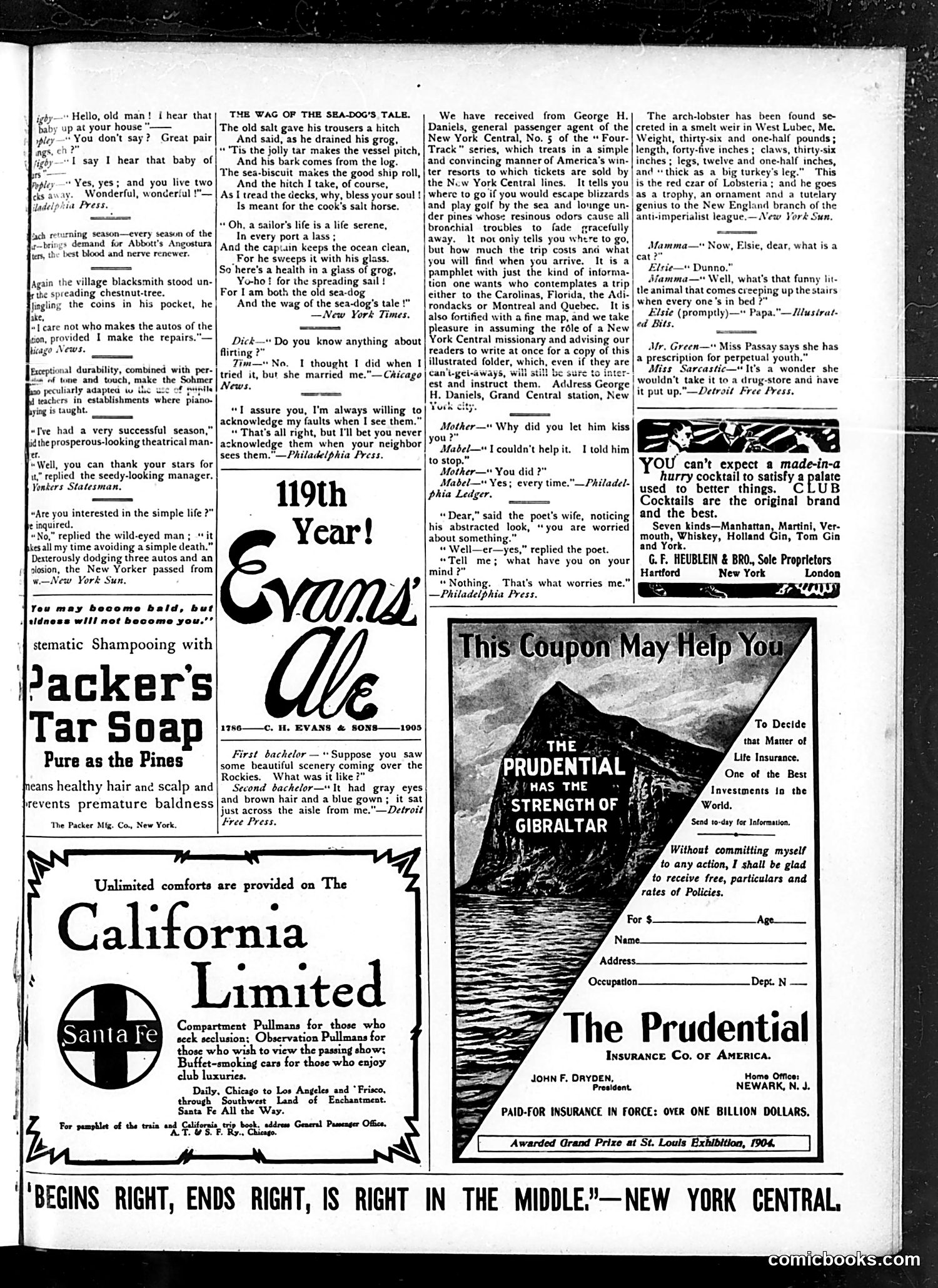
This page from *Judge* magazine (1905) is primarily **advertising and light humor**, not political satire. The content includes: **Comic snippets**: Brief jokes about village life, automobiles, theatrical performers, and modern urban dangers (autos killing pedestrians). One running gag involves a sailor's tall tale with puns ("the jolly tar makes the vessel pitch"). **Advertisements**: Packer's Tar Soap, Evans Ale (celebrating its 119th year), the California Limited train, and Prudential Insurance dominate the page visually. **Travel promotion**: A substantive piece about New York Central's "Four-Track" pamphlet promoting American winter resorts—Florida, the Carolinas, Adirondacks—marketing leisure travel to the wealthy. The humor is gentle domestic comedy typical of early 1900s magazines: misunderstandings about romance and marriage, observations about modern inconveniences, and wordplay. There's no identifiable political commentary or caricature of public figures. The page reflects leisure culture, consumerism, and the era's emerging vacation industry rather than satirizing current events.
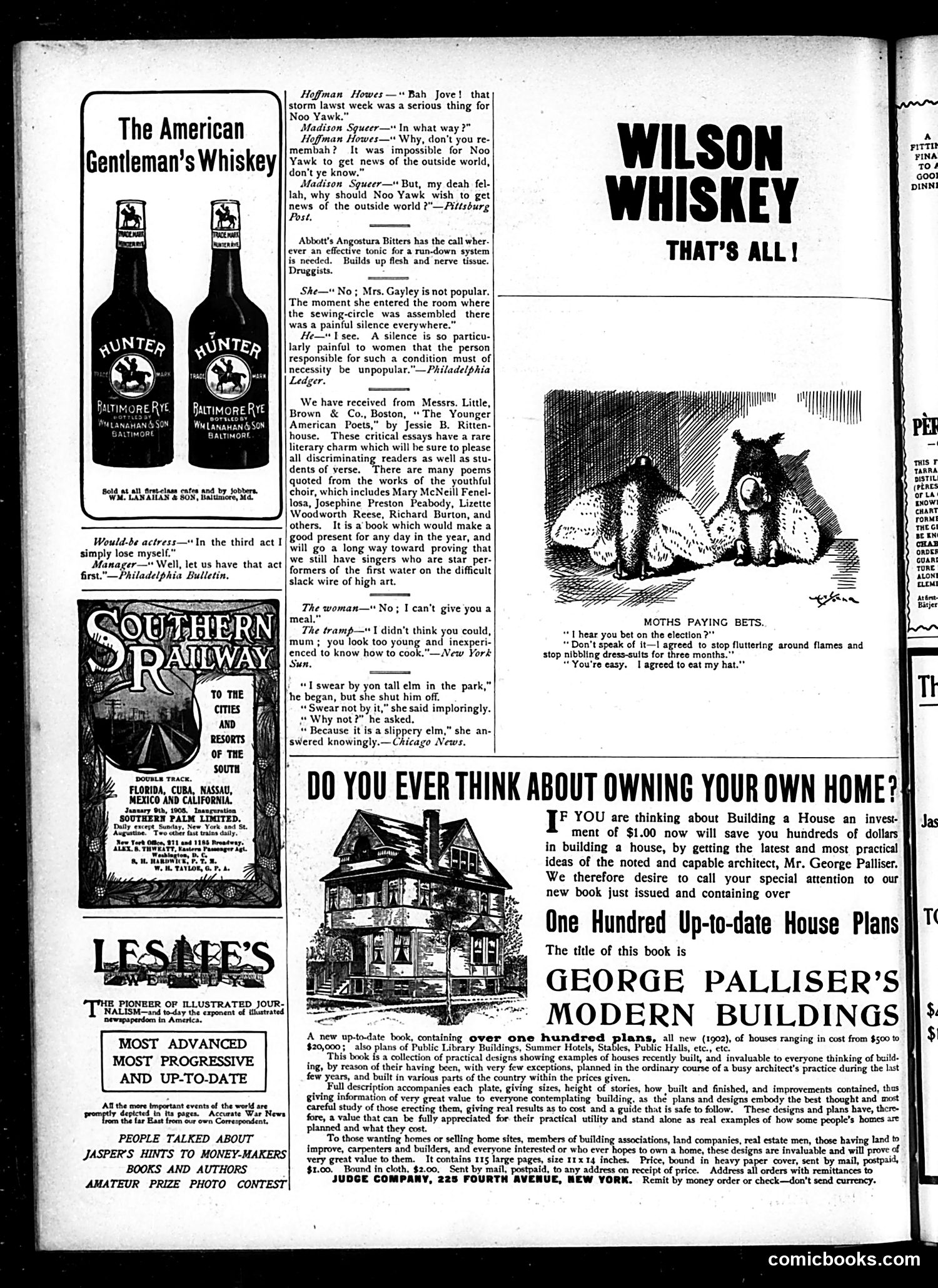
This page is primarily **advertising and humor columns**, typical of Judge's satirical format. The main cartoons are brief jokes: 1. **"Hoffman Howes" dialogue**: Satirizes New York's self-importance. A man claims a storm was "serious" because New York couldn't get outside news—to which another replies sarcastically that New York wouldn't *want* outside news anyway. This mocks NYC's provincial smugness despite its cosmopolitan pretensions. 2. **"Moths Paying Bets"**: A man and woman who bet on an election must forfeit: he stops swearing by an elm tree, she stops "fluttering around flames"—a play on moths' behavior. When he asks why not swear by the elm, she quips it's a "slippery elm," a pun on the tree's name and the proverb's danger. The remaining content comprises **full-page advertisements** for whiskey brands, railroad travel, and notably, George Palliser's house-plan book (the largest ad). These jokes rely on wordplay, social observation of wealthy characters ("Noo Yawk"), and puns—typical Judge humor circa 1902.
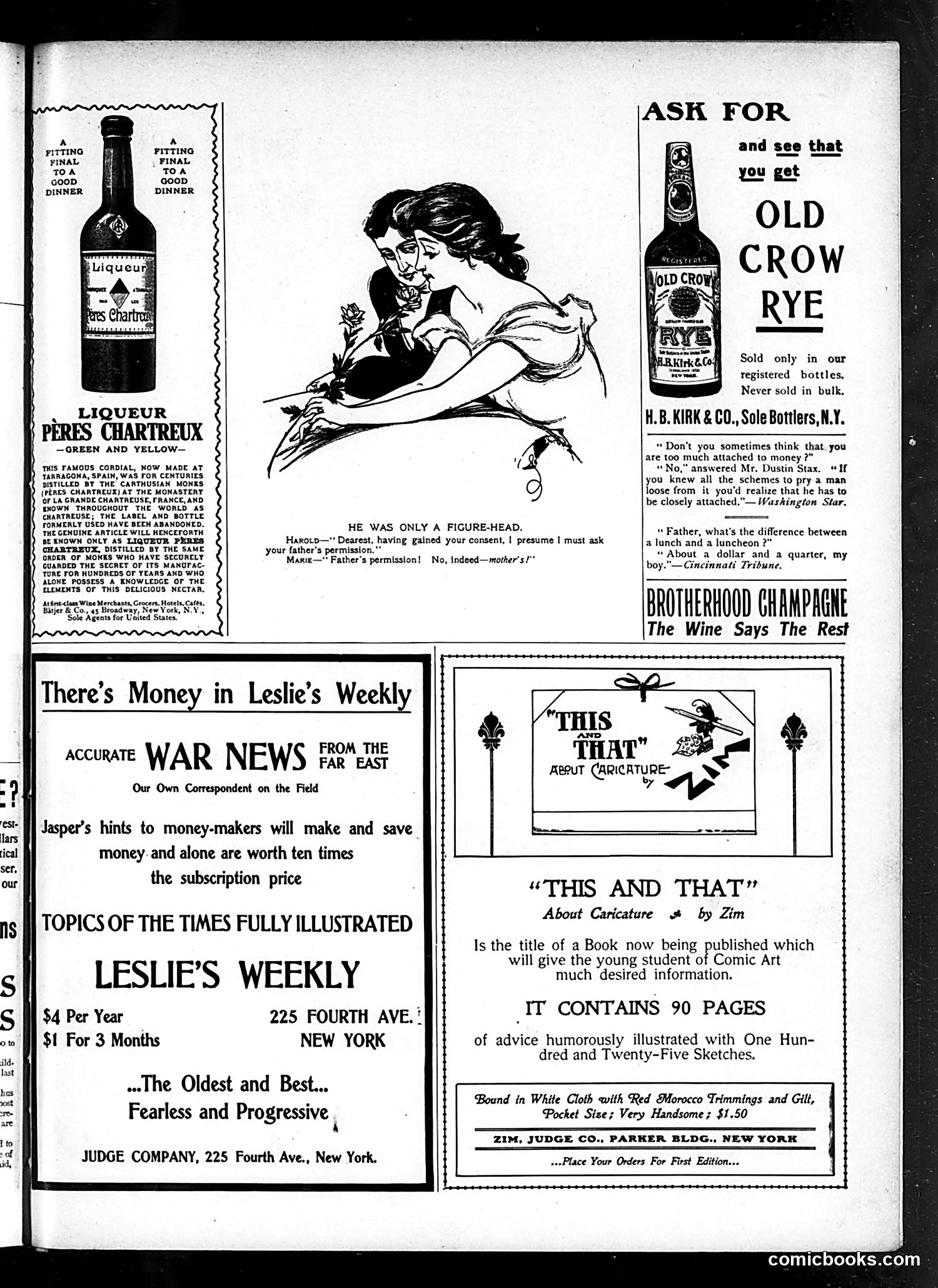
This page is primarily **advertisements and filler content** rather than political satire. The main cartoon depicts a couple, Harold and Marie, where Harold seeks permission to marry from Marie's mother rather than her father—the joke being that mothers, not fathers, control marriage decisions in this household. It's a domestic humor piece about shifting family power dynamics. The page includes ads for liqueurs (Chartreuse, Old Crow Rye, Brotherhood Champagne), Leslie's Weekly magazine (promoting war coverage from the Far East), and a cartooning instruction book titled "This and That" by artist Zim. The filler jokes at bottom are generic humor about money and class differences unrelated to current events. Without a visible date, the "Far East" war reference **likely indicates** this is from the early 1900s (possibly Russo-Japanese War era), but this cannot be confirmed from the image alone. The page reflects period advertising and light domestic humor rather than sharp political commentary.
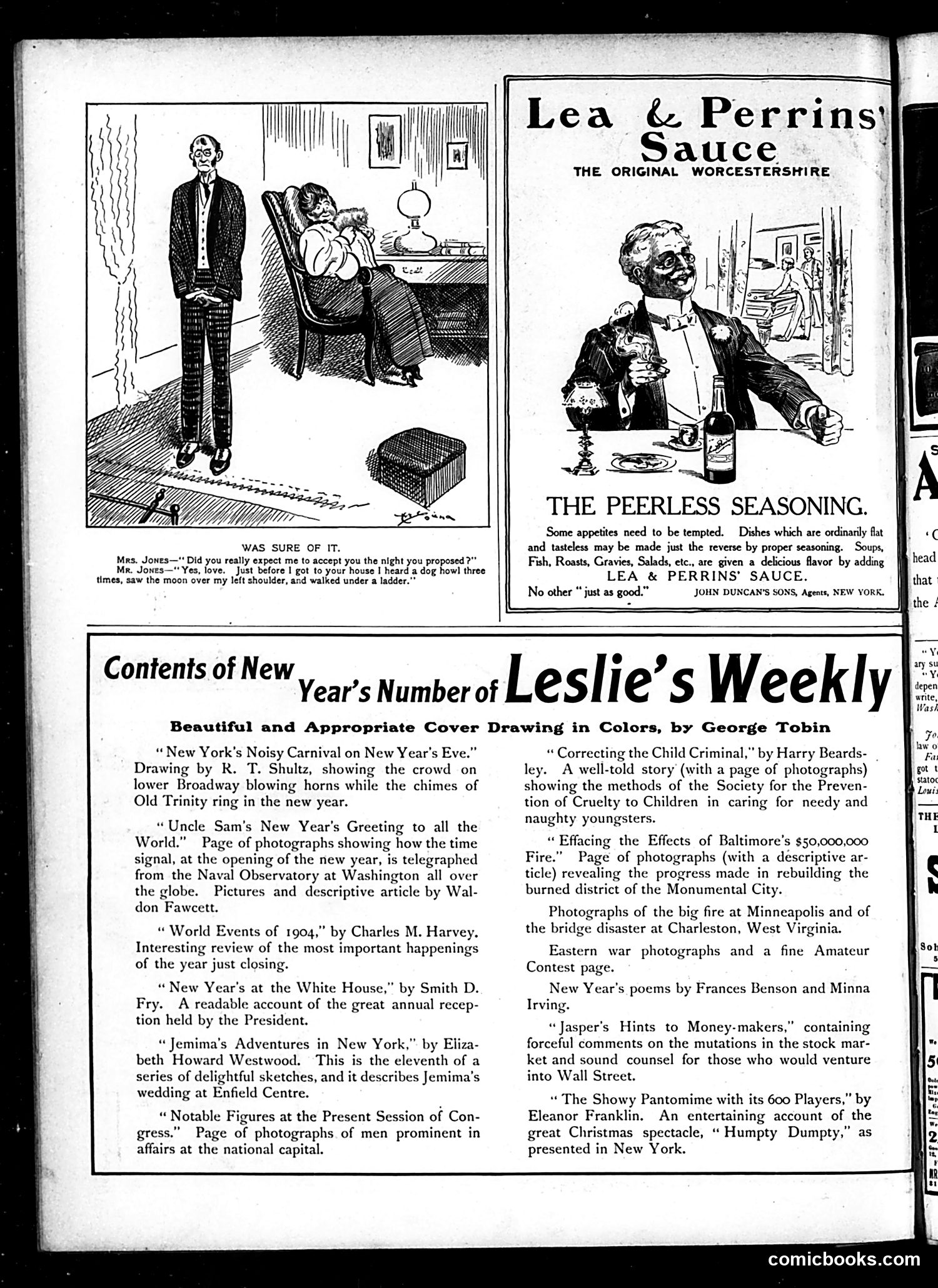
**The Cartoon:** The left panel shows a domestic comedy joke. Mr. Jones tells Mrs. Jones he expected her to accept his marriage proposal because he encountered three lucky omens beforehand: hearing a dog howl three times, seeing the moon over his left shoulder, and walking under a ladder. The humor relies on inverting superstition—walking under a ladder is typically bad luck, not good. Mrs. Jones's skeptical expression suggests the joke is on him: superstitions didn't guarantee her "yes." **The Advertisement:** The right side promotes Lea & Perrins Worcestershire Sauce, positioning it as "the peerless seasoning" that can improve ordinary dishes. This is straightforward product advertising claiming superiority. **Context:** This appears to be a contents page for Leslie's Weekly's New Year's issue (circa 1904-1905, based on references to 1904 events). The mix of satirical cartoons, advertisements, and serious editorial content was typical of Judge and similar publications of this era.
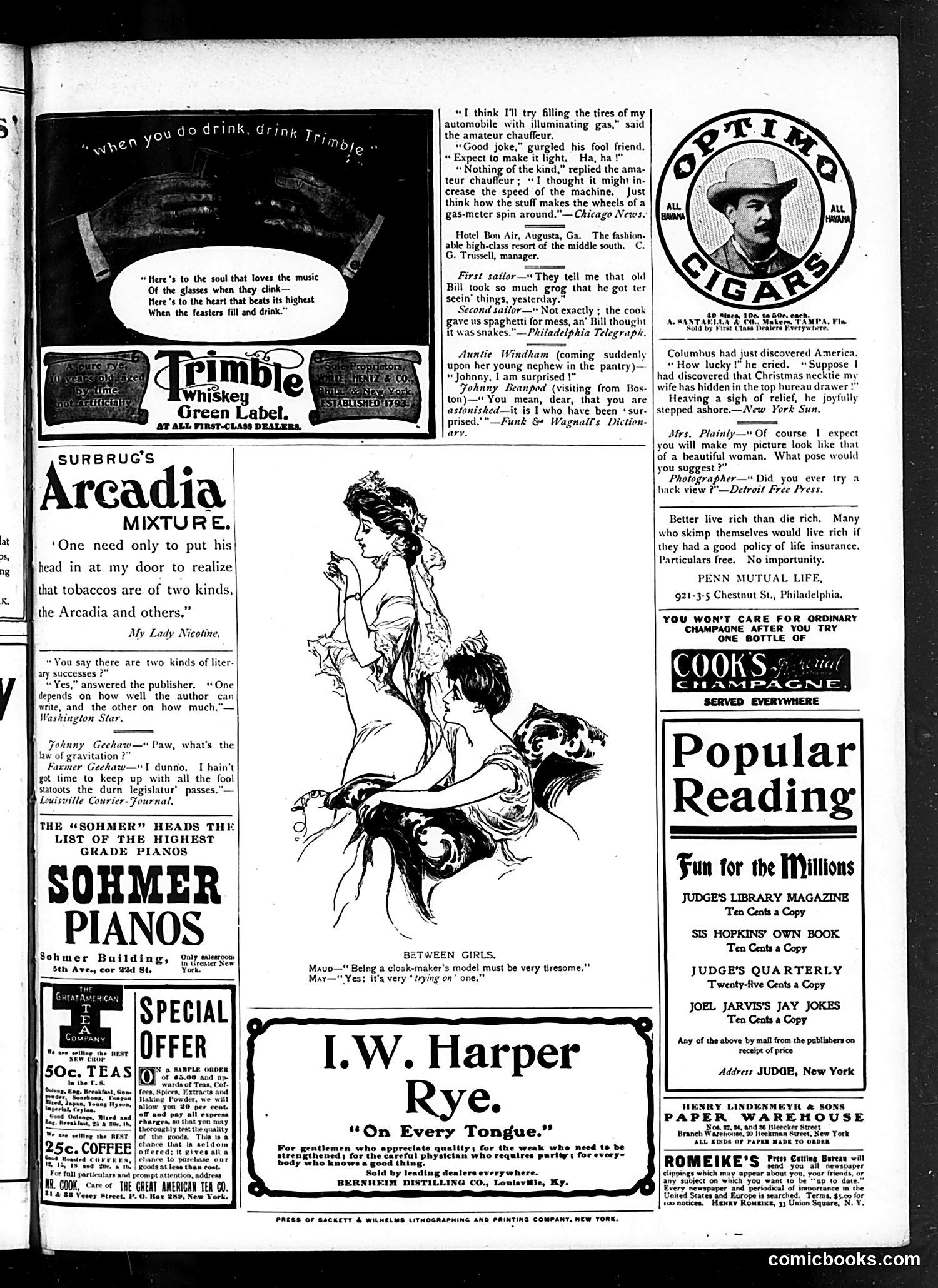
This page is primarily **advertisements and short humor pieces** rather than political cartoons. The content includes: **Main Cartoon:** "Between Girls" depicts a woman fitting a cloak-maker's model, with wordplay on "trying on" (fitting clothes vs. being tiresome). **Humor Pieces:** Brief jokes about: - An amateur chauffeur proposing to fill car tires with "illuminating gas" to increase speed - A sailor's drunkenness - A Boston boy correcting his aunt's use of "surprised" vs. "astonished" - A farmer's ignorance of legislation - A photographer suggesting an unflattering "back view" **Advertisements:** Whiskey (Trimble), tobacco (Arcadia), pianos (Sohmer), tea, coffee, champagne, life insurance, and rye whiskey dominate the page. **Social Context:** The humor reflects early 1900s American middle-class concerns: automobiles (novel technology), maritime life, proper English usage, and rural/urban cultural gaps. The overall tone is light, genteel satire typical of Judge's audience.
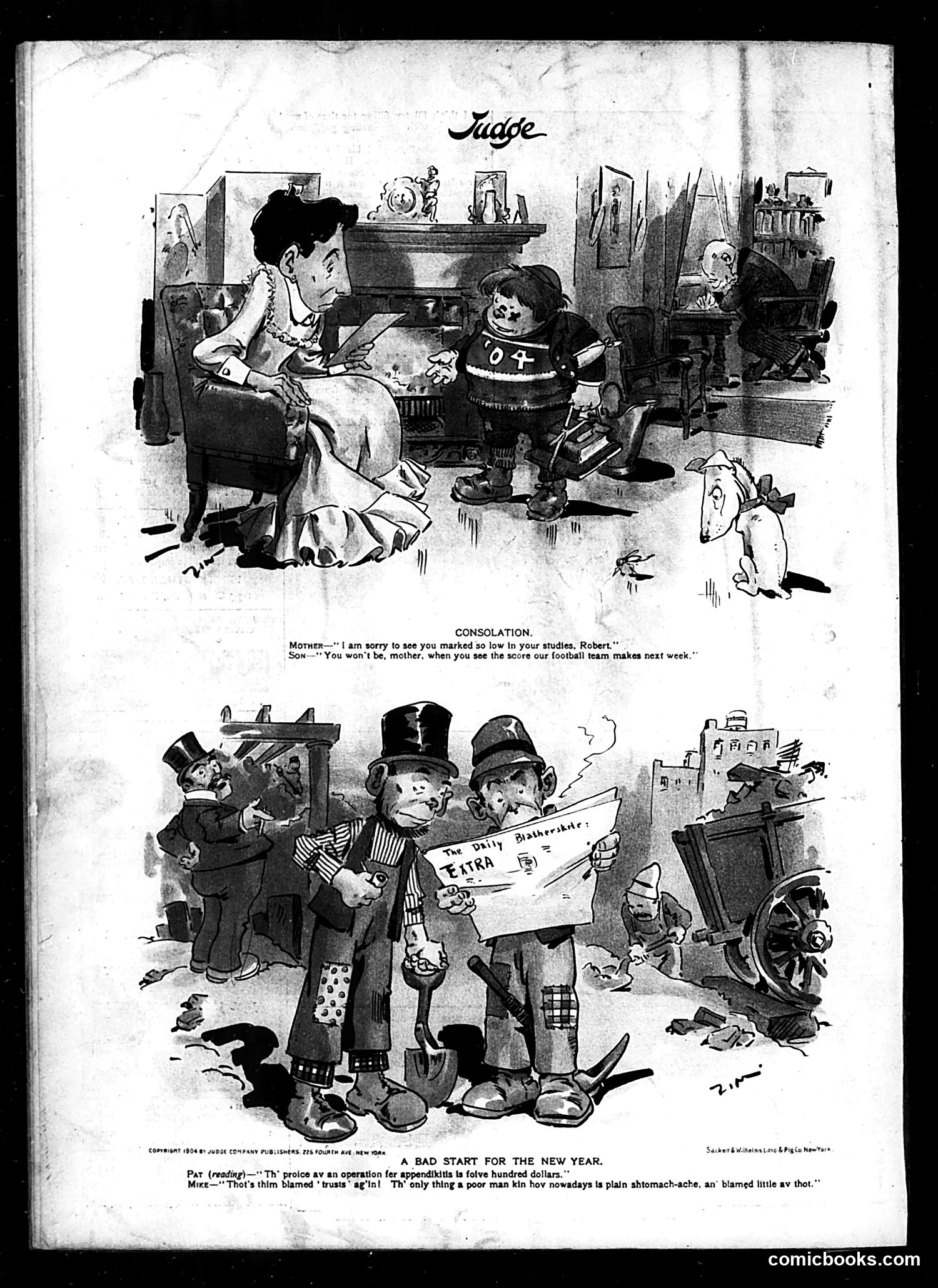
**Top cartoon ("Consolation"):** A mother scolds her son Robert for poor grades. He consoles her by noting their school's football team will score well next week—implying athletic success matters more than academics. This satirizes early 1900s American priorities, where high school and college football were becoming culturally dominant, potentially overshadowing educational achievement. **Bottom cartoon ("A Bad Start for the New Year"):** A working-class man (indicated by dialect spelling) reads that appendicitis surgery costs $500—enormous for the era. He bitterly remarks that poor people can't even afford illness anymore, blaming "trusts" (large corporations/monopolies controlling prices). This criticizes the era's trust problem and healthcare inequality, suggesting the wealthy could afford medical care while laborers faced financial ruin from illness. Both cartoons target American social anxieties circa 1906: misplaced values and economic inequality.

I can see this is a page from *Judge* magazine with a white border on the left side, but the image is almost entirely black with only faint patterns visible. The OCR text provides only a website URL ("comicbooks.com"), offering no actual magazine content to analyze. Without legible text or clear visual details in the cartoon(s), I cannot identify specific figures, political references, or the satire's intended meaning. The page appears to be either severely degraded, improperly scanned, or represents a blank/advertising section of the magazine. To properly analyze this *Judge* page, a clearer, higher-contrast image would be necessary.