
Judge, 1904-12-31 · page 14 of 21
Judge — December 31, 1904 — page 14: what you’re looking at
What you’re looking at
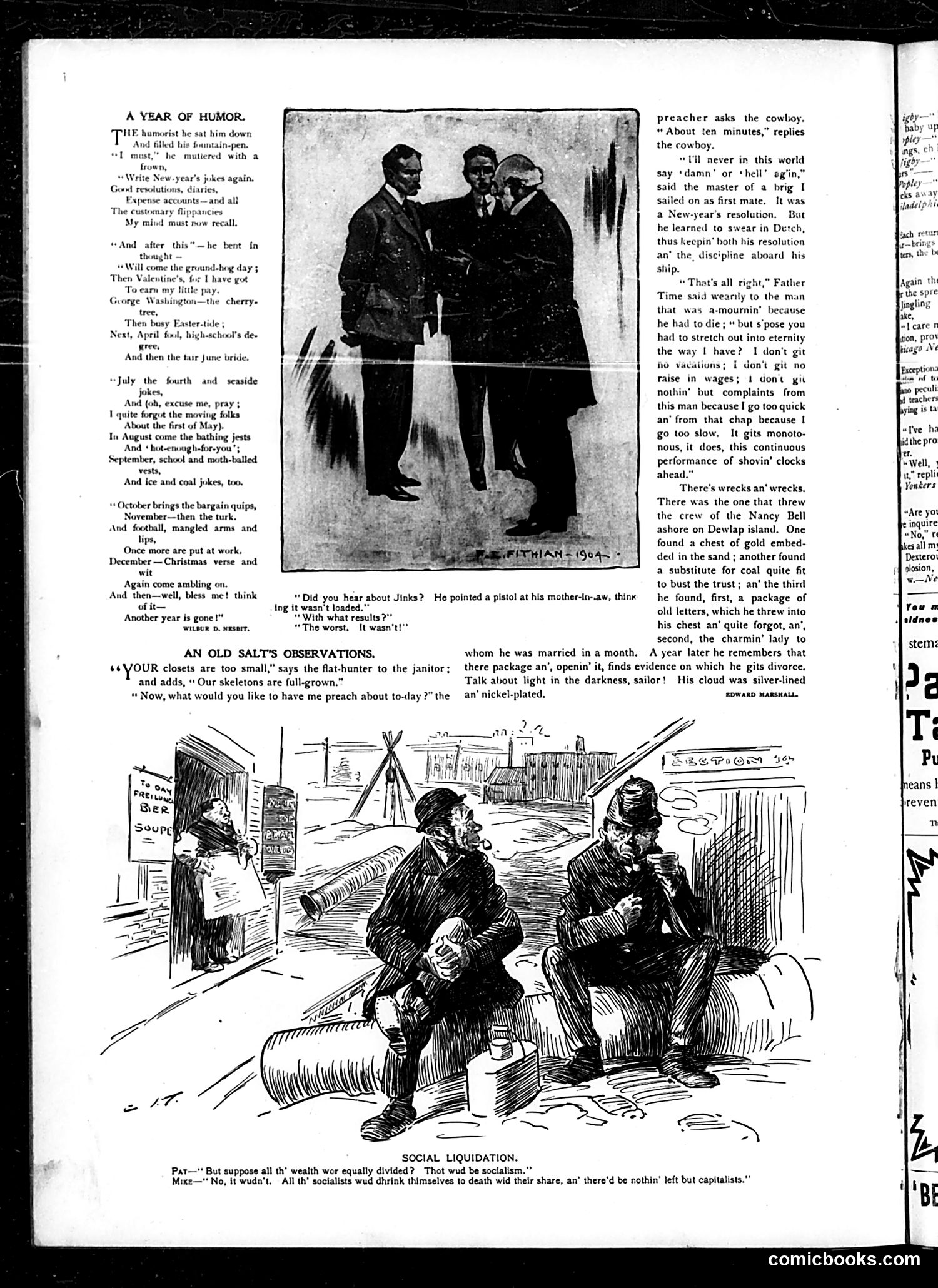
This page from *Judge* magazine contains several humor pieces satirizing American life and politics around the early 20th century. The top illustration depicts a domestic argument, with a caption joking about a man pointing an unloaded pistol at his mother-in-law—the "worst" outcome being that it actually fires, killing her. This dark humor reflects period attitudes toward in-laws. The main text "A Year of Humor" is a poet's complaint about annually recycling the same predictable jokes tied to holidays and seasons (Valentine's Day, Easter, Fourth of July, Christmas, etc.)—satirizing hack comedy writing. "An Old Salt's Observations" features working-class commentary on various topics, including a sailor's story about a man finding letters in buried treasure that lead to divorce. The bottom cartoon, "Social Liquidation," satirizes socialist ideology through a working-class Irish character arguing that equal wealth distribution would fail because workers would drink themselves to death, leaving only capitalists. This reflects anti-socialist sentiment common in American publications of this era. The humor targets predictability, class anxieties, and political ideology.
📄 Transcribed text from this page (OCR, searchable)
Machine-transcribed from the original scan — historical spelling and the odd misread are preserved.
A YEAR OF HUMOR. ILE humorist he sat him down And filled his fountain ast,” he mutiered with a frown, “Write New-year’s jokes again, Gord resolutions, diaries, Expense accuunts—and all The cusinmary flippancies My mind must now recall, ‘And after this” —he bent In thought — “Will come the ground-hog day 5 Then Valentine's, fur I have got To earn my tittle pay. George Washington—the cherry- tree, ‘Then busy Easter-tide ; Next, April f school’s de- gree, And then the tair June bride. “July the fourth and seaside jokes, And (ob, excuse me, pray ; I quite forgot the moving folks About the first of May). Tn August come the bathing jests And *hot-enoughefor-you"; September, school and moth-balled vests, And ice and coal jokes, too. “October brings the bargain quips, November—then the turk. And football, mangled arms and lips, Once more are put at work. December —Christmas verse and wit Again come ambling on. And then—well, bless me! think of it— Another year is gone!" witaur . xeserr, “Did you hear about Jinks? He pointed a pistol at his mother-in-.aw, thine Ing it wasn't loaded.” “With what results ?"* “The worst. It wasn’t!" preacher asks the cowboy. “About ten minutes,” replies the cowboy. “Ui never in this world say ‘damn’ or ‘hell’ og'in,” said the master of a brig I sailed on as first mate. It was a New-year's resolution, But he learned to swear in Detch, thus keepin’ both his resolution an’ the, discipline aboard his ship. “ That's all ” Father Time said wearily to the man that was a-mournin’ because he had to die; “ but s'pose you had to stretch out into eternity the way I have? I don't git dO vacations; 1 don't git no raise in wages; 1 dont git nothin’ but complaints from this man because I go too quick an‘ from that chap because I go too slow, It gits monoto- nous, it does, this continuous performance of shovin’ clocks ahead.” There's wrecks an’ wrecks. ‘There was the one that threw the crew of the Nancy Bell ashore on Dewlap island. One found a chest of gold embed- ded in the sand ; another found a substitute for coal quite fit to bust the trust; an’ the third he found, first, a package of old letters, which he threw into his chest an’ quite forgot, an’, AN OLD SALT’S OBSERVATIONS. seYOUR closets are too small,” says the flat-hunter to the janitor; and adds, * Our skeletons are full-grown.” “ Now, what would you like to have me preach about to-day ?” the second, the charmin’ lady to whom he was married in a month, A year later he remembers that there package an’, openin’ it, finds evidence on which he gits divorce. Talk about light in the darkness, sailor! His cloud was silver-lined an’ nickel-plated. SOCIAL LIQUIDATION. jut suppose all th’ wealth wor equally divided? Thot wud be socialism.”* . oo No, it wudn't, All th’ socialists wud dhrink thimselves to death wid their share, an’ there'd be nothin’ left but capitalists.’ ut,” repli Yonkers comicbooks.com |