
A complete issue · 16 pages · 1904
Judge — November 12, 1904
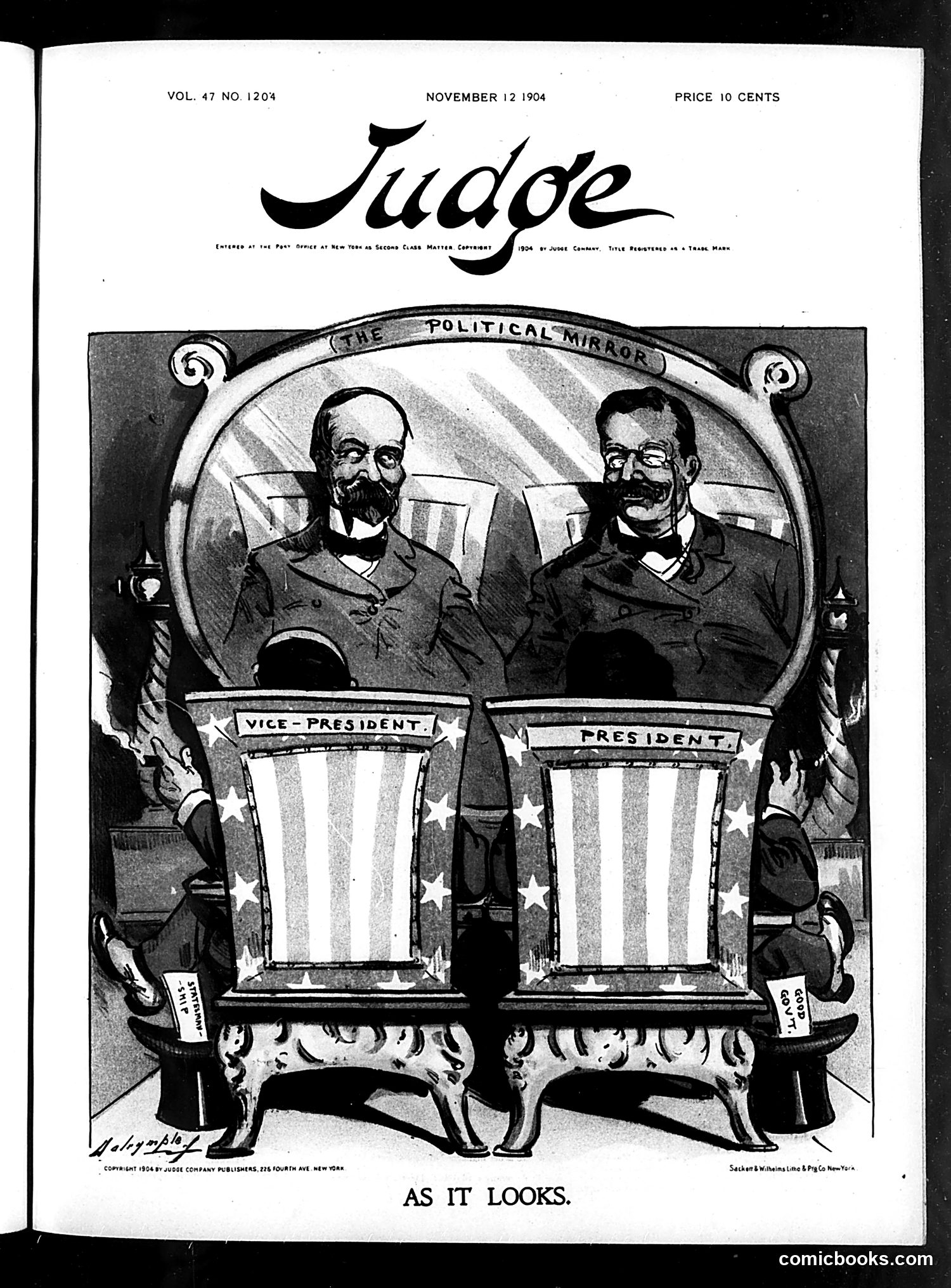
This cartoon presents "The Political Mirror"—a device showing two men reflected as both "Vice-President" and "President." The satire suggests these figures are interchangeable or that holding either office reveals similar character. The mirror's conceit implies the cartoon is commenting on the 1904 election, likely contrasting candidates or showing how political ambitions mirror one another regardless of the specific role. The bearded men appear to be caricatures of prominent 1904 politicians, though specific identities aren't labeled. The caption "AS IT LOOKS" suggests the cartoon presents a cynical view of political aspiration—that whether one seeks the presidency or vice-presidency, the underlying ambition and character remain essentially identical. This reflects Judge's satirical approach to American politics.
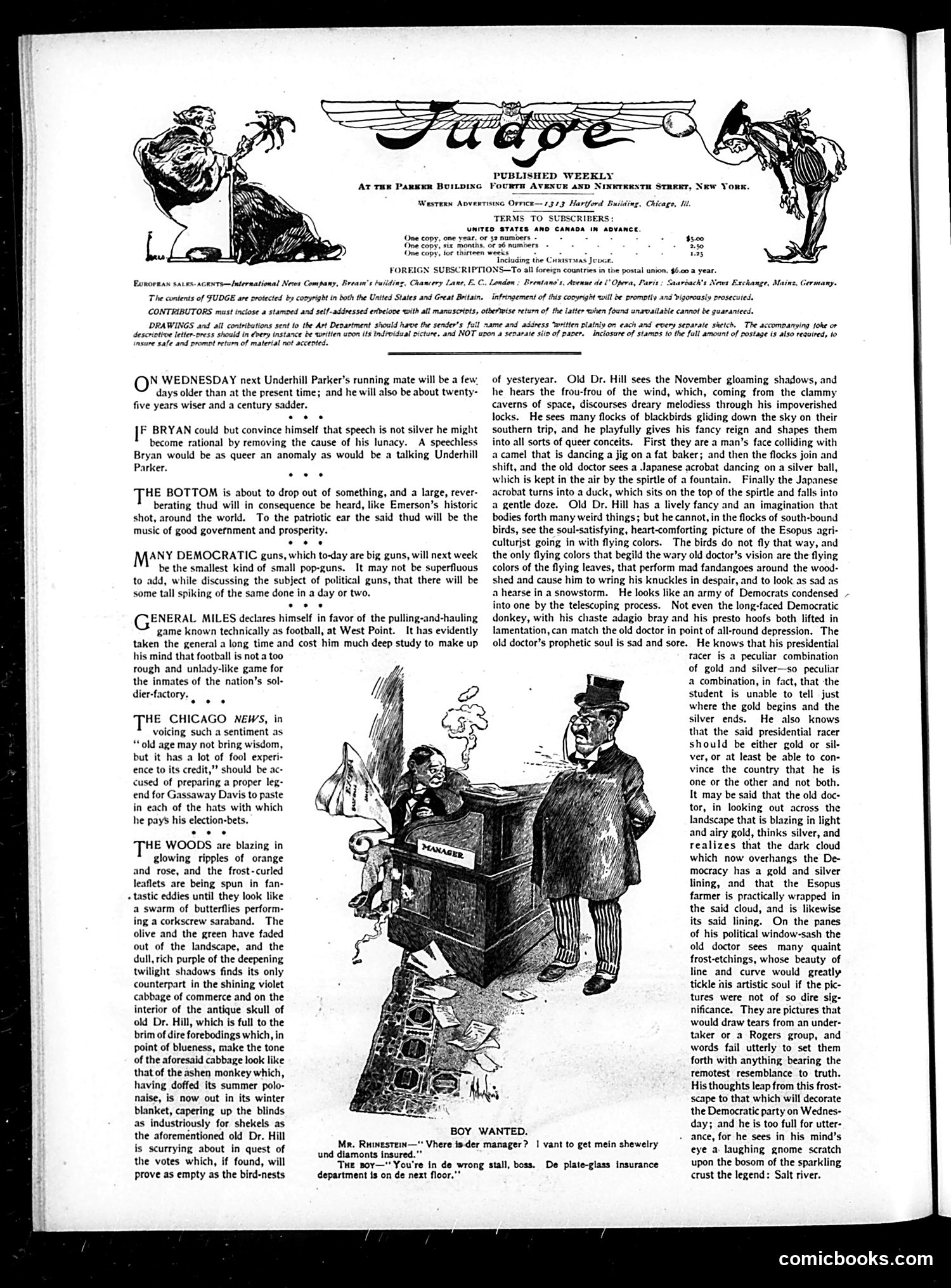
This page contains several political commentaries and a cartoon. The main illustrated cartoon depicts a figure labeled "Tammany" (New York's Democratic political machine) as a large, grotesque creature being ridden or controlled by a smaller figure in a top hat—likely representing a political boss or operator. The text sections discuss political figures: "General Miles" expresses support for a "pulling-and-hauling game" in football; commentary on "Chicago News" critiques political wisdom; and discussion of autumn landscapes and Dr. Hill's observations appear to reference contemporary political figures, though specific identities are unclear without additional context. A "Boy Wanted" joke at the bottom plays on insurance department mishaps. The overall tone satirizes Democratic machine politics and associated political figures of the era.
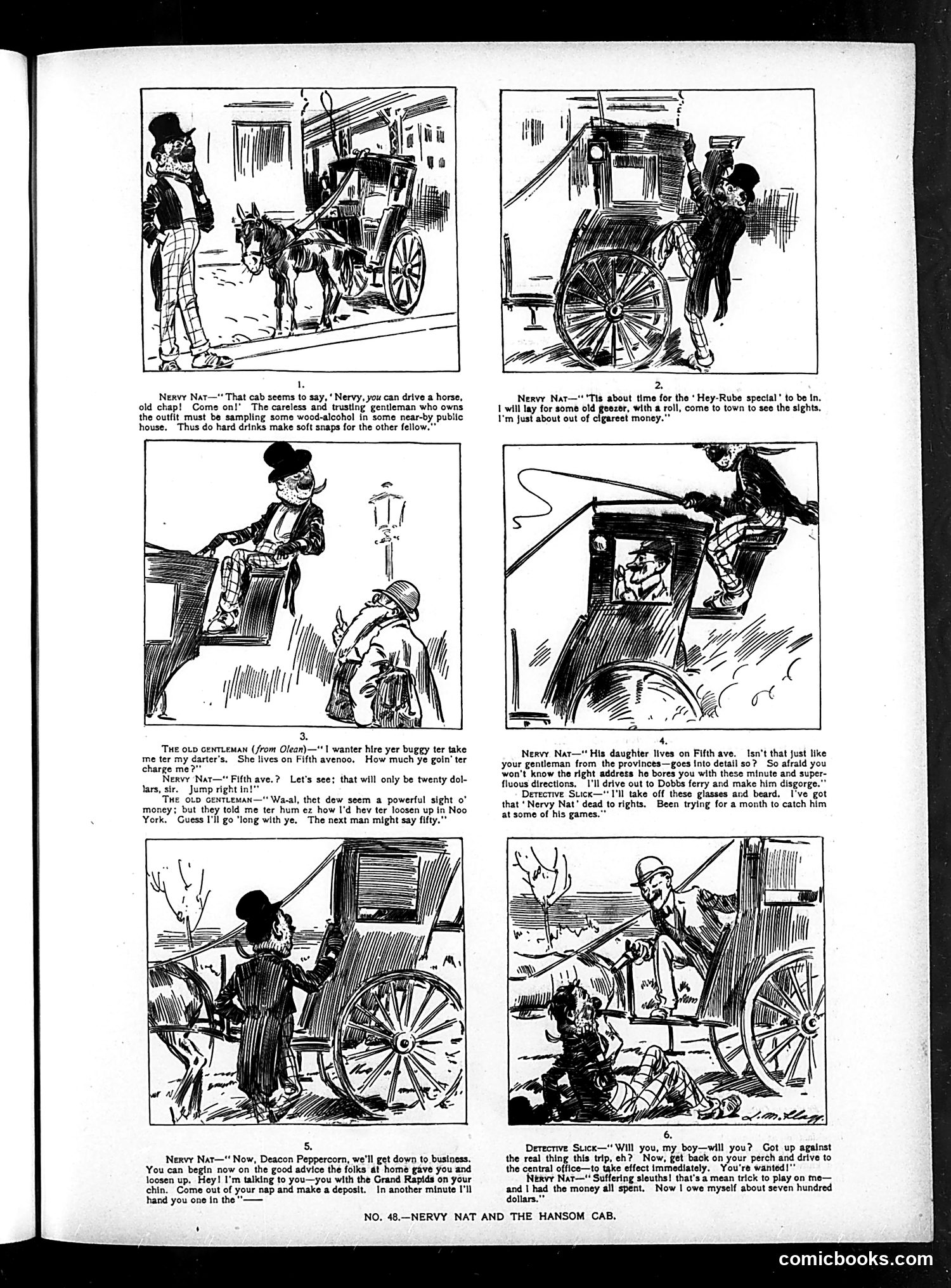
This comic strip satirizes a character called "Nervy Nat," a scheming con artist who exploits naive people through various tricks. The narrative arc shows Nat using a hansom cab (horse-drawn taxi) as cover for his schemes: 1. He tricks an old gentleman into hiring a buggy 2. He claims to need cab fare money for a supposed "Hay Rube special" 3. He deceives a deacon with flattery about his daughter 4. He orchestrates an elaborate scam where passengers encounter planted "evidence" (fake glasses/beard) 5-6. The con culminates in theft—Nat steals money while his accomplice distracts the victim by overturning the carriage The satire mocks urban con artists' manipulative tactics and the gullibility of their victims. It reflects early 20th-century concerns about street crime and dishonesty in American cities.
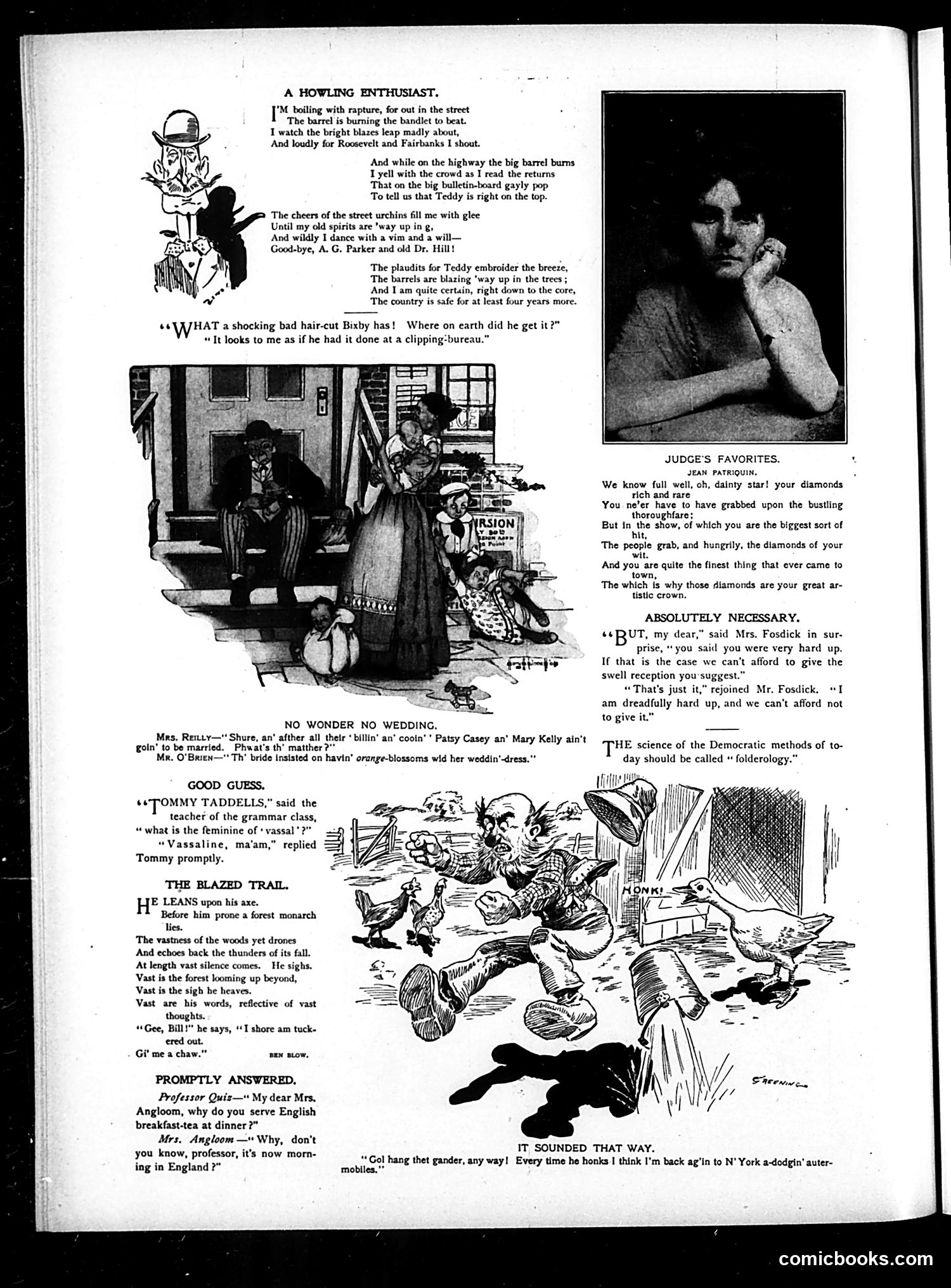
This page contains several unrelated humor pieces typical of early 20th-century Judge magazine: 1. **"A Howling Enthusiast"** depicts someone excitedly following election returns, likely referencing Theodore Roosevelt or William Howard Taft (mentioned by name). The satirical poem mocks overwrought political enthusiasm. 2. **"No Wonder No Wedding"** jokes about working-class courtship customs, with characters discussing wedding expenses and orange-blossom dress traditions. 3. **"The Blazed Trail"** is a poem about hunting/woodsmen culture. 4. Other brief humor pieces include wordplay about grammar ("vassal") and a question about serving English breakfast tea. 5. A photograph labeled **"Judge's Favorites"** features Jean Patroquin, apparently a performer or public figure of the era. The page is primarily humorous commentary on contemporary American life and politics.
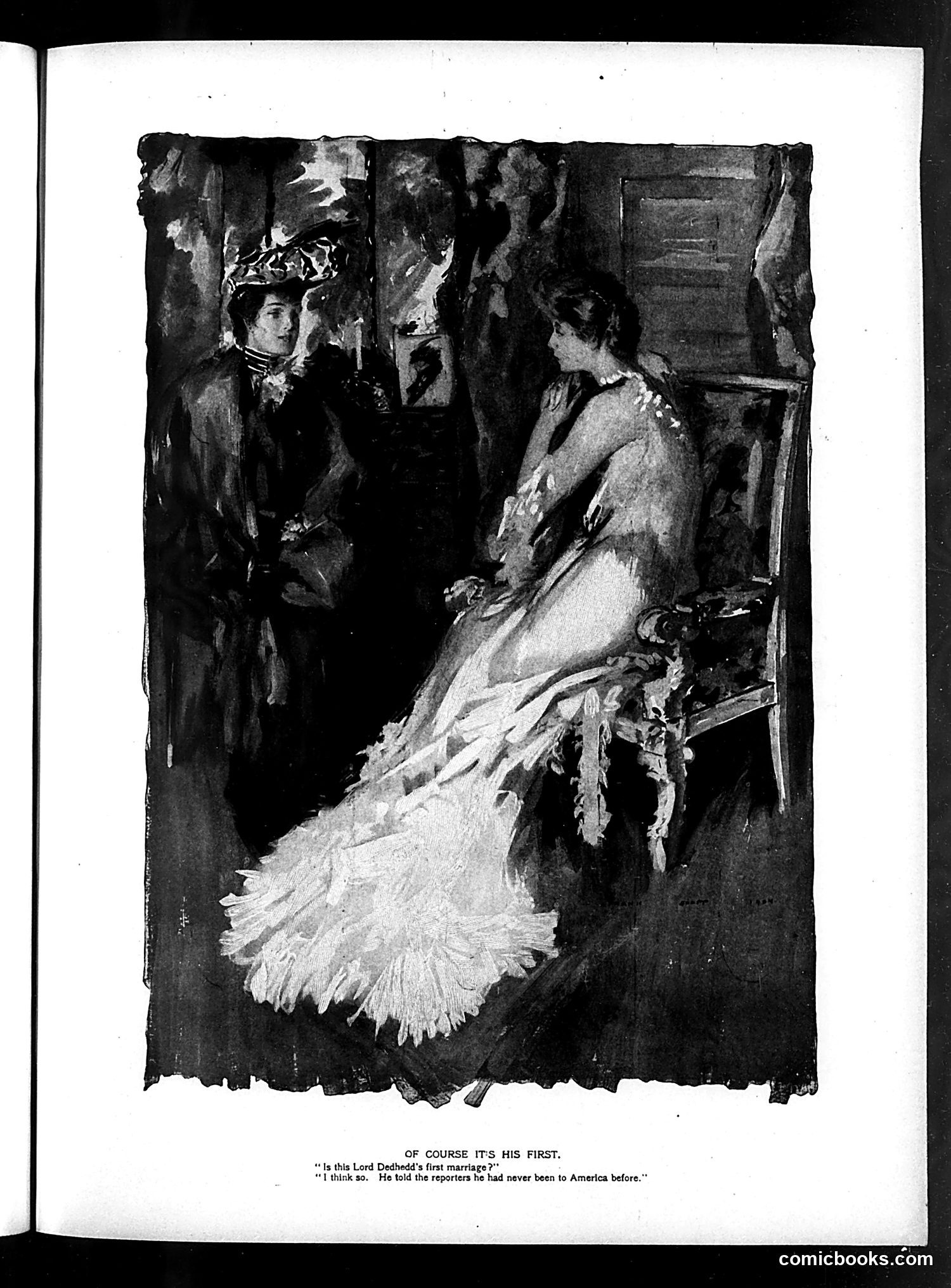
This appears to be a satirical illustration from *Judge* magazine depicting a social scene where a nobleman ("Lord Dedhedd") is meeting or being presented to an American woman in an elaborate white gown. The humor relies on a double meaning: when asked if this is his first marriage, the response conflates marriage with visiting America, suggesting the aristocrat's inexperience with America is equivalent to his marital inexperience. The satire likely mocks European nobility's unfamiliarity with American society, or possibly satirizes transatlantic marriages between American heiresses and titled European men—a common phenomenon during this era. The joke plays on the assumption that any gentleman of rank would have "visited America before," whether romantically or otherwise.
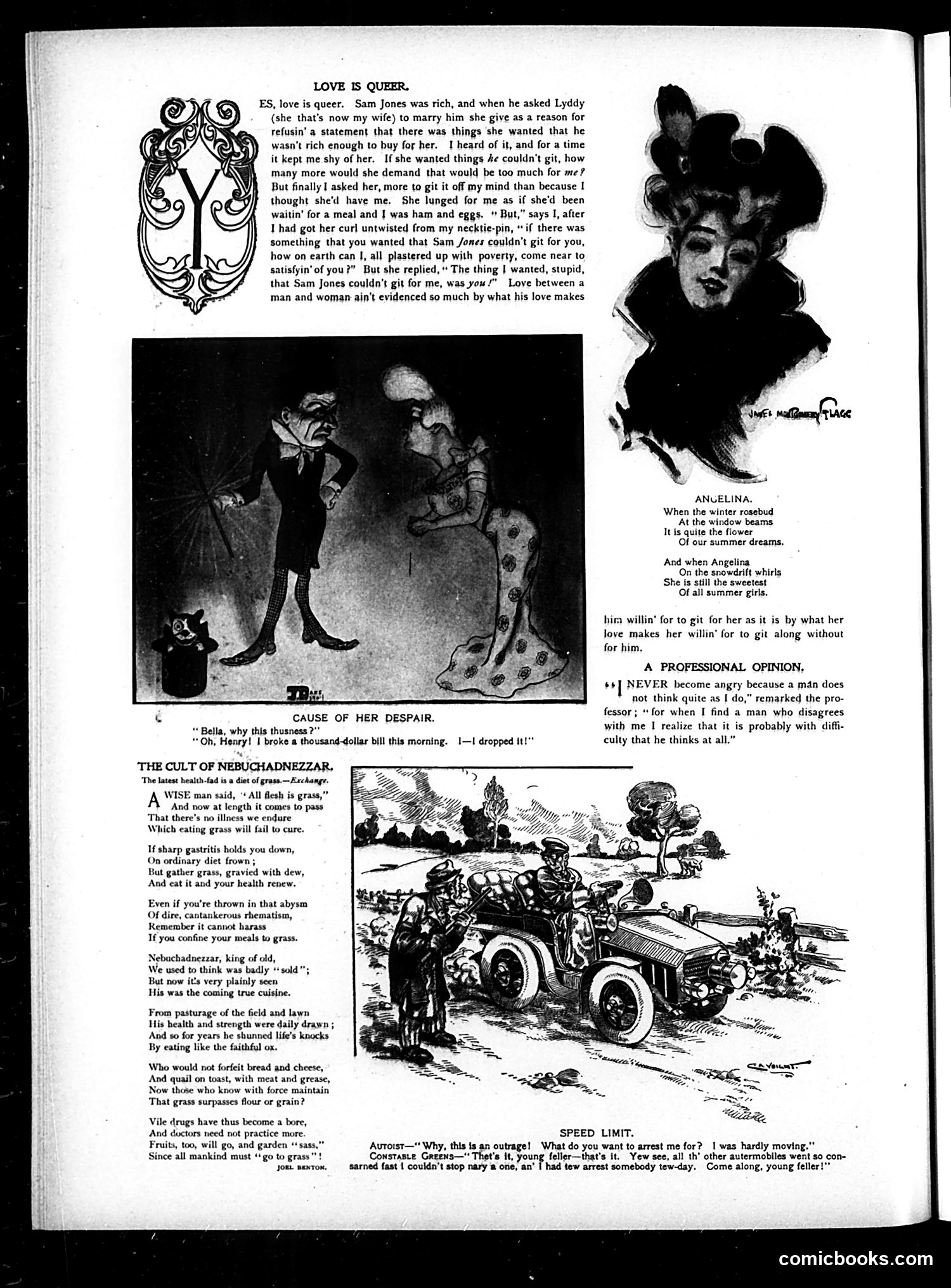
This page contains multiple satirical pieces typical of early 20th-century humor journalism: **"Love is Queer"** presents a folk anecdote about a woman who refuses a wealthy suitor but accepts a poor man, explaining she wanted *him*, not material things. The satire mocks both romantic idealization and economic pretension. **"The Cult of Nebuchadnezzar"** satirizes a contemporary health fad promoting an all-grass diet, likely inspired by the biblical king's supposed grass-eating madness. The poem mocks fad diets and alternative medicine trends by suggesting people abandon normal food for grazing like livestock. **"Speed Limit"** jokes about a traffic cop who arrests a speeding motorist simply because he couldn't catch faster cars—absurd police logic. This reflects early anxieties about automobiles and traffic enforcement. The page also includes romantic poetry about "Angelina" and a brief quip about professorial open-mindedness, representing typical magazine filler content of the era.
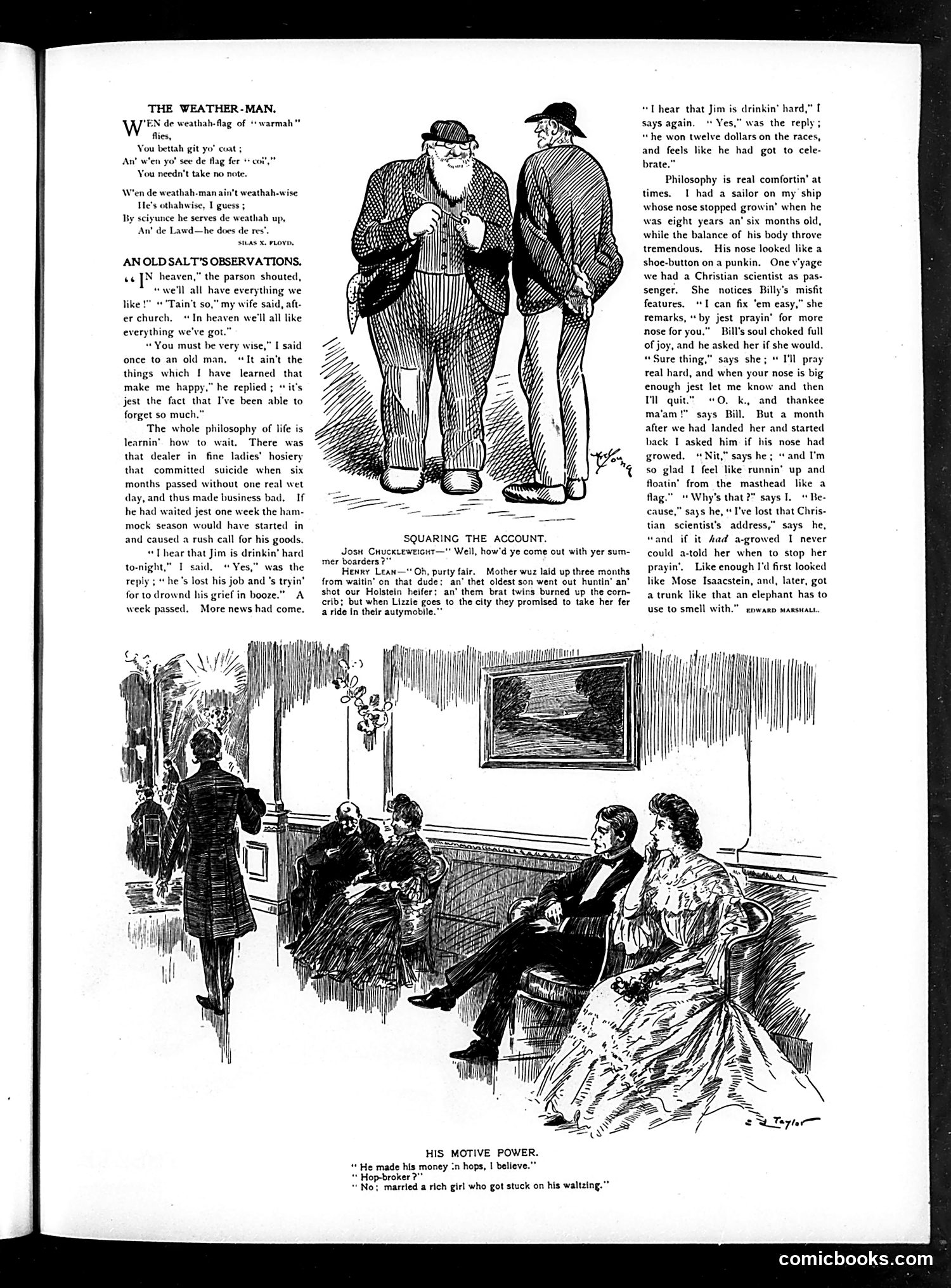
This page contains several humor pieces typical of Judge's satirical content: **"The Weather-Man"** and **"An Old Salt's Observations"** are humorous dialect pieces offering folk wisdom—the sailor narrator reflects on life's philosophy, including patience, forgetting troubles, and accepting circumstances. The humor relies on vernacular speech and homespun observations. **"Squaring the Account"** mocks rural summer boarding arrangements, where a farmer endures disruptions (his mother's illness, his son shooting livestock, twins burning the cornrib) yet his boarders only promise his daughter a joy ride. **"His Motive Power"** is a brief joke about a man who made money not through hops (beer-brewing) but by marrying a wealthy woman attracted to his waltzing. The cartoons use period stereotypes and dialect humor common to Judge. The satire targets rural life's absurdities and social pretensions rather than specific political figures or events. The overall tone is lighthearted Americana rather than hard-hitting political commentary.
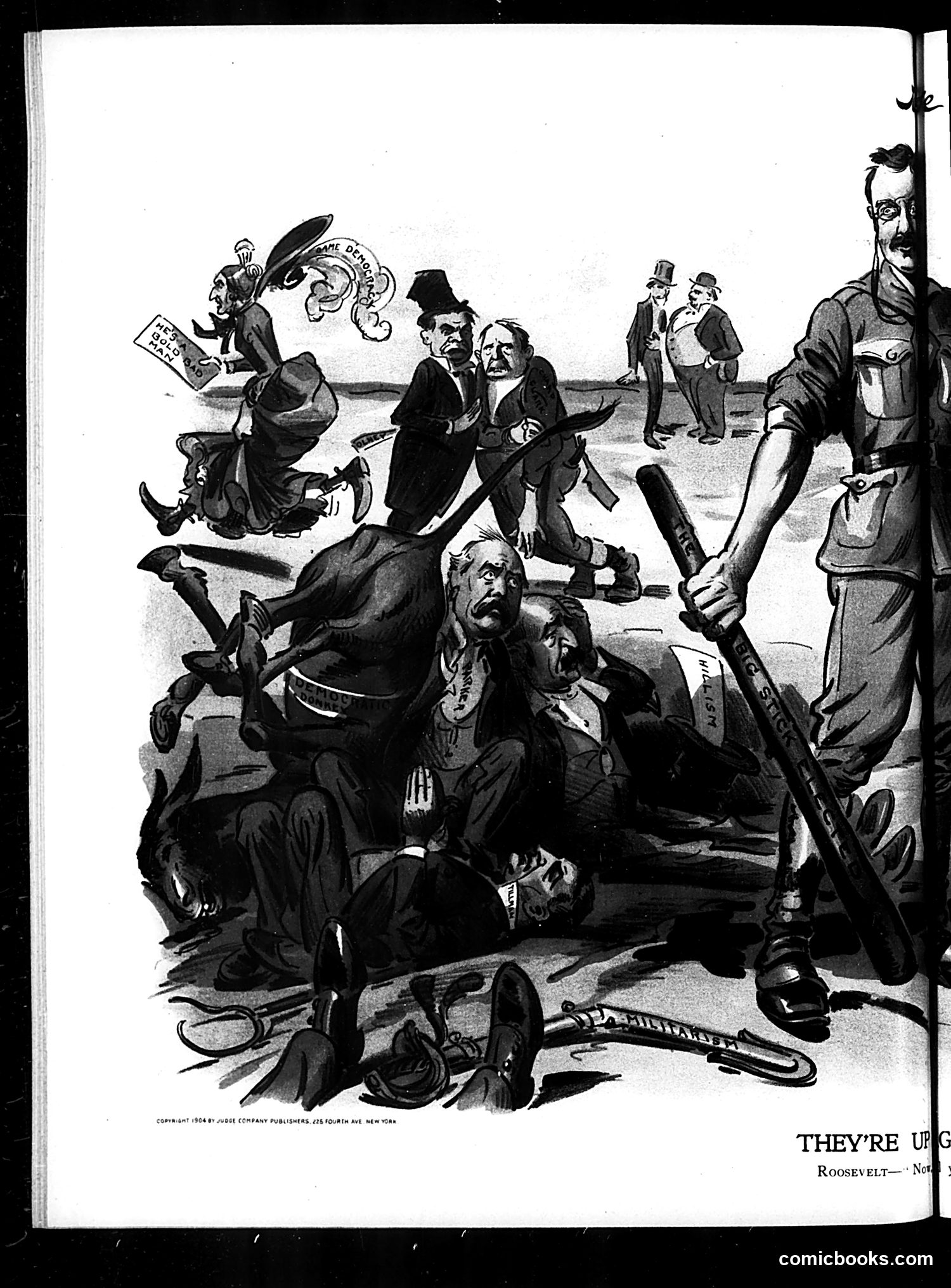
This satirical cartoon appears to depict a chaotic scene involving **Roosevelt** (likely Theodore Roosevelt, given the historical context of Judge magazine). The image shows multiple figures in conflict—men in formal dress engaged in what appears to be a physical altercation or struggle. A figure on the right holds a club or bat, while others gesture dramatically. The composition suggests political turmoil or conflict within Roosevelt's administration or policies. The partial caption "THEY'RE UP" and "Roosevelt—*Nott" is incomplete, making the specific target unclear, but the cartoon mocks political infighting or controversy surrounding Roosevelt's leadership. Without the full caption, the exact satirical point remains somewhat ambiguous, though the violent imagery suggests criticism of Roosevelt's handling of political disputes or his combative approach to governance.
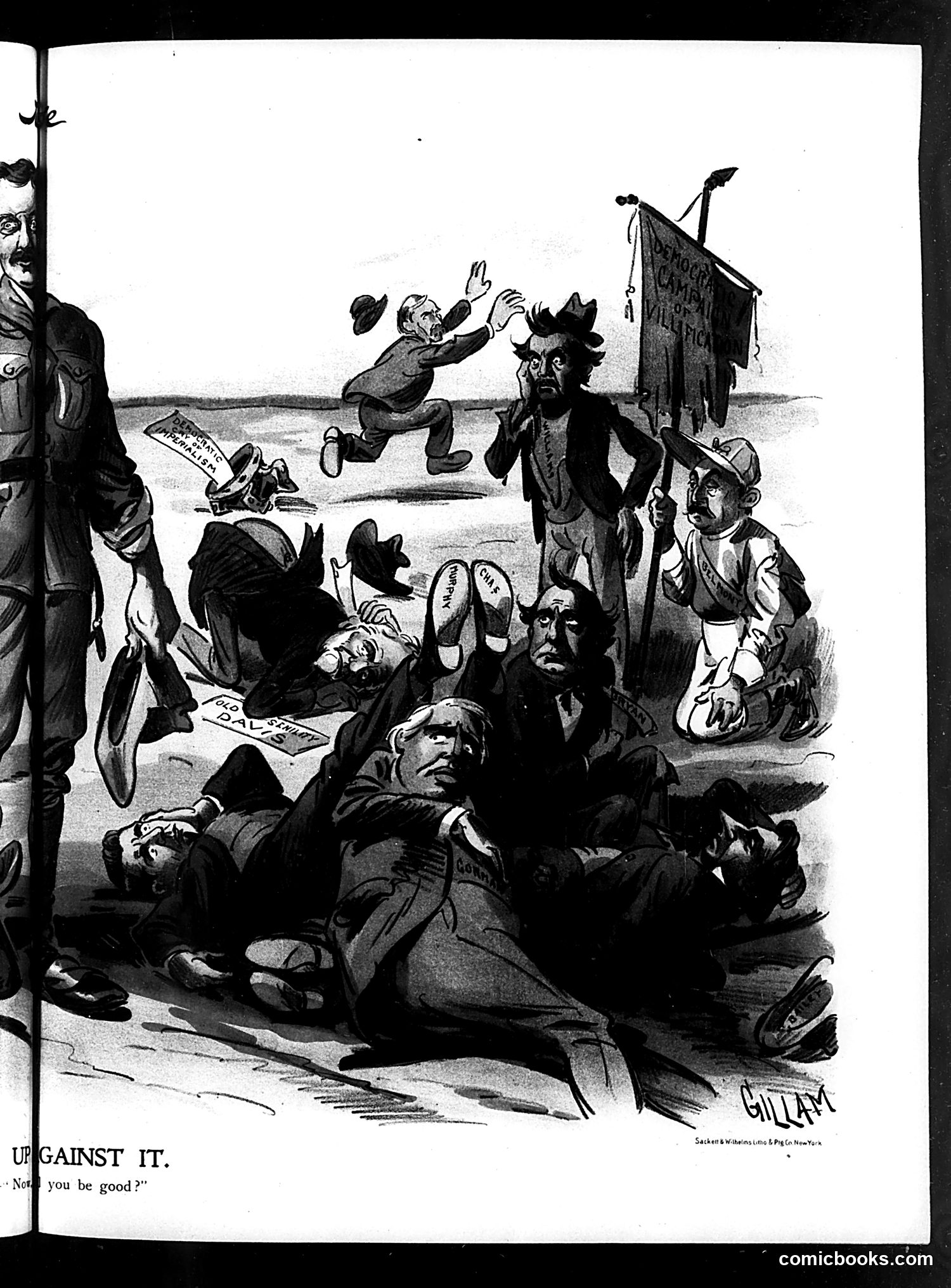
This satirical cartoon depicts what appears to be a violent confrontation or uprising. The composition shows figures lying on the ground in distress, while others stand or gesture above them in chaotic activity. A demonic or devilish figure holds a flag in the center-right, suggesting evil intent or malevolent ideology driving events. The caption "'Not you be good?'" implies moral criticism—the cartoon likely satirizes a political movement or group the magazine opposed, suggesting their actions are inherently immoral rather than justified. Without the publication date visible, the specific historical reference remains unclear. However, Judge magazine's typical targets included labor movements, anarchists, socialists, or other perceived threats to social order. The demonic imagery was common iconography used to demonize such groups in late 19th/early 20th-century American political cartooning.
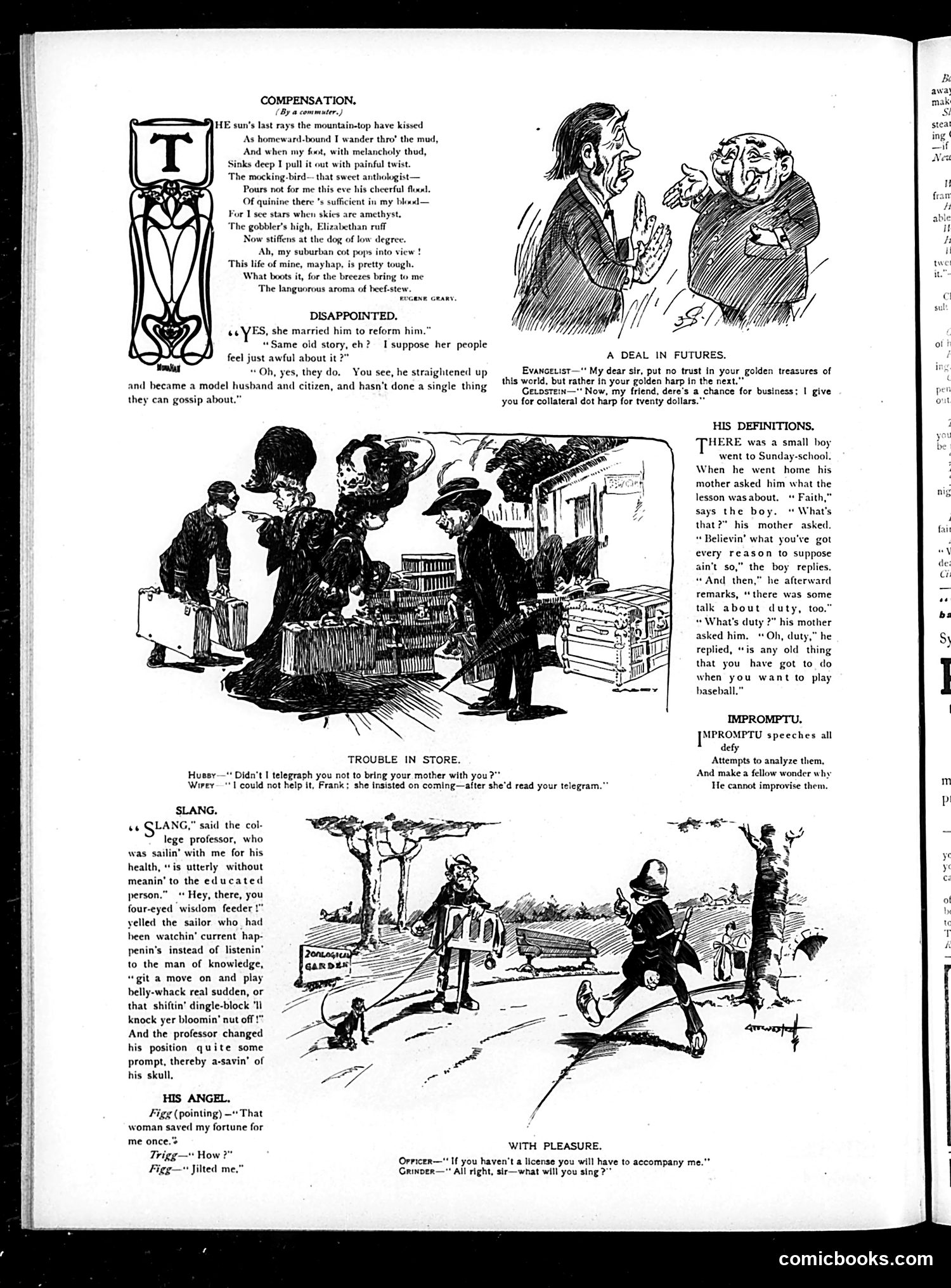
This page contains multiple humorous sketches and poems satirizing American life circa early 1900s: **"Compensation"** mocks the commuter's daily misery—trudging through mud, experiencing quinine-induced hallucinations, dealing with expensive food prices—yet finding solace only in suburban routine and beef stew aromas. The satire targets the dreary, unglamorous reality of supposedly idyllic suburban life. **"Disappointed"** jokes about a woman marrying a man to reform him; he becomes a "model husband" but loses his colorful flaws, leaving her disappointed and gossip-starved. **"His Definitions"** features a boy redefining Sunday-school concepts—faith as believing what you've "got every reason to suppose ain't so" and duty as "any old thing you have got to do when you want to play baseball." This mocks religious instruction's disconnect from childhood logic. **"Slang"** depicts an educated professor condescending about crude sailor language, only to be physically threatened into silence—the satire favoring working-class pragmatism over intellectual pretension. Additional brief sketches mock marital incompetence, impromptu speeches, and bureaucratic encounters.
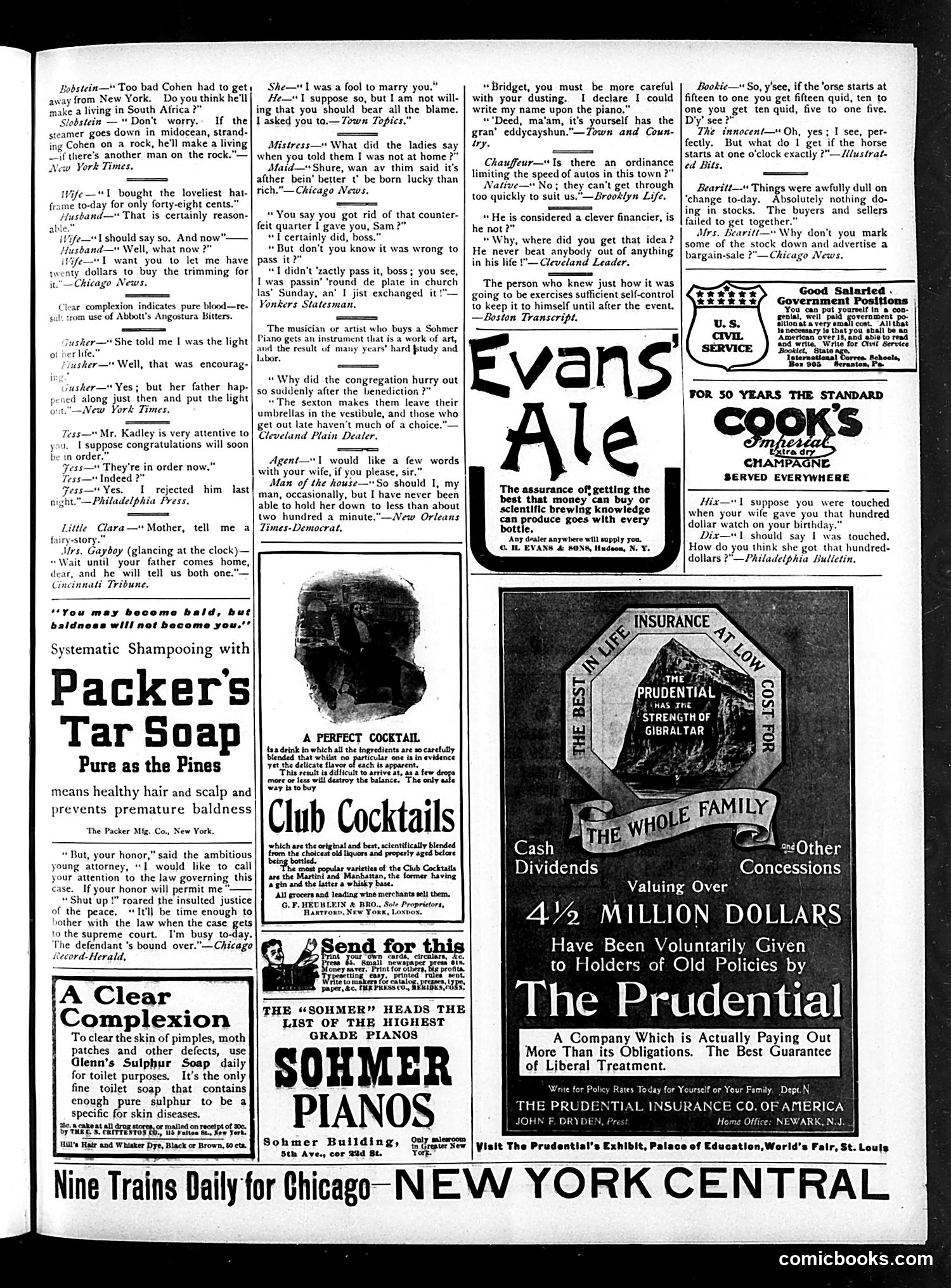
This page from *Judge* consists primarily of **short humor pieces and advertisements** rather than political cartoons. The jokes are typical early-20th-century American humor targeting domestic life, class relations, and ethnic stereotypes. Notable content includes: **Ethnic humor**: A brief joke about "Cohen" and "Jobstein" (Jewish names), making crude generalizations about Jewish survival instincts—reflective of period stereotyping. **Gender/marital satire**: Multiple jokes mocking wives' spending habits and husbands' exasperation, representing conventional domestic comedy of the era. **Social commentary**: A piece satirizing a Justice of the Peace who ignores legal procedure, suggesting judicial incompetence or corruption. **Class humor**: Jokes about servants, counterfeit currency passed during church collection, and social climbing. The advertisements (Sohmer Pianos, Parker's Tar Soap, Prudential Insurance) suggest a middle-class audience. The page lacks sophisticated political satire; instead, it relies on period stereotypes about ethnicity, gender, and class—humor that would be considered offensive today.
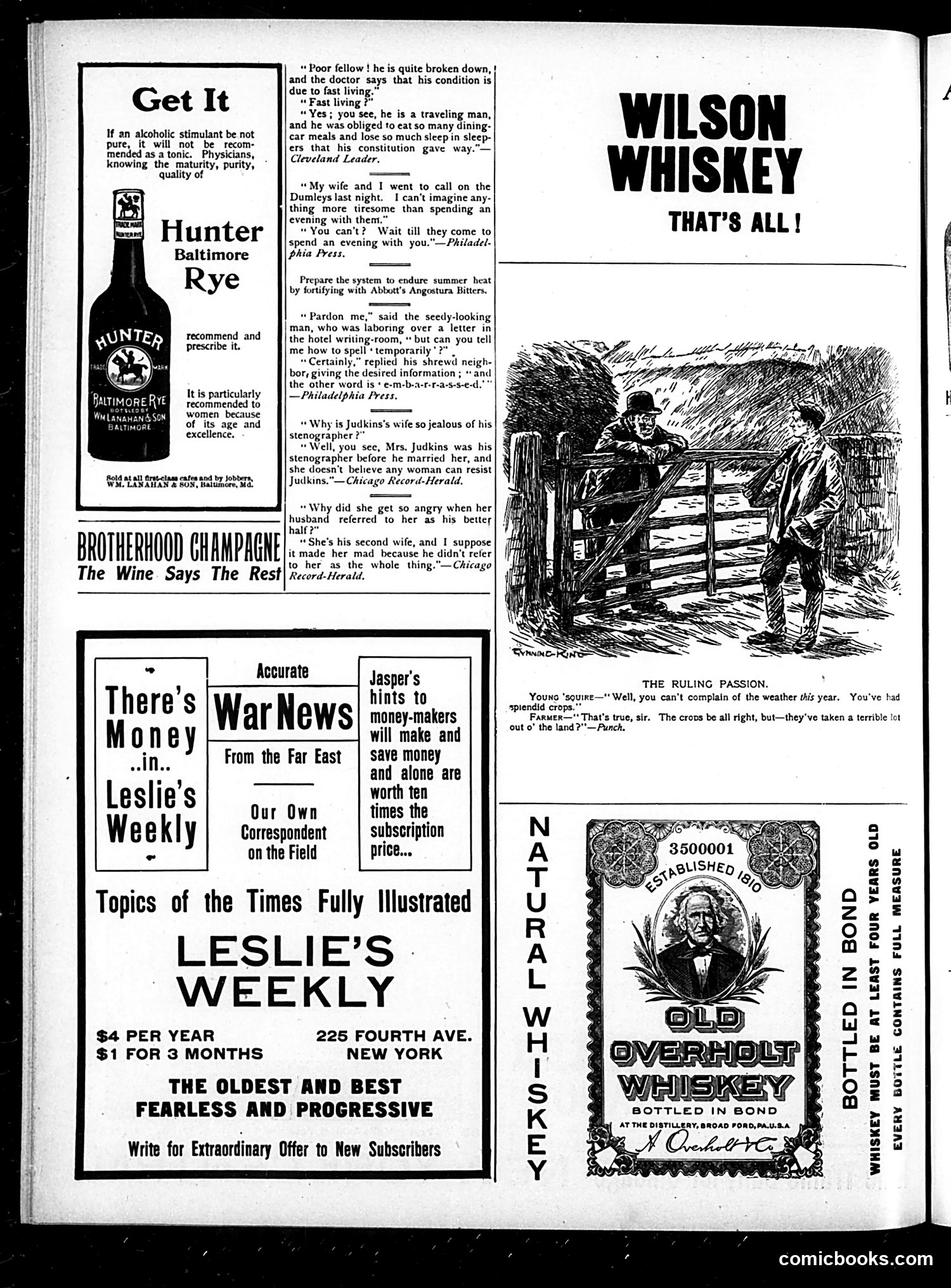
This page is primarily **advertising** interspersed with short humorous newspaper reprints. The main content includes: **Advertisements:** Hunter Baltimore Rye whiskey, Brotherhood Champagne, Wilson Whiskey, Old Overholt Whiskey, and Leslie's Weekly magazine dominate the layout. **Comic Vignettes:** Short, reprinted jokes from various newspapers (Philadelphia Press, Chicago Record-Herald, Punch) that mock domestic life and social pretension: - A traveling man's health ruined by constant dining-car meals - Mutual dread between dinner guests - A seedy man asking spelling help, receiving sarcastic answers about "temporarily" and "embarrassed" - A wife jealous of her husband's stenographer (the woman he married) - A second wife angry at being called the "better half" - A farmer lamenting crops being depleted from the land These vignettes reflect early-20th-century concerns: commercialism's toll, social anxiety, marital tension, and agricultural decline. The page emphasizes advertising revenue over editorial content.
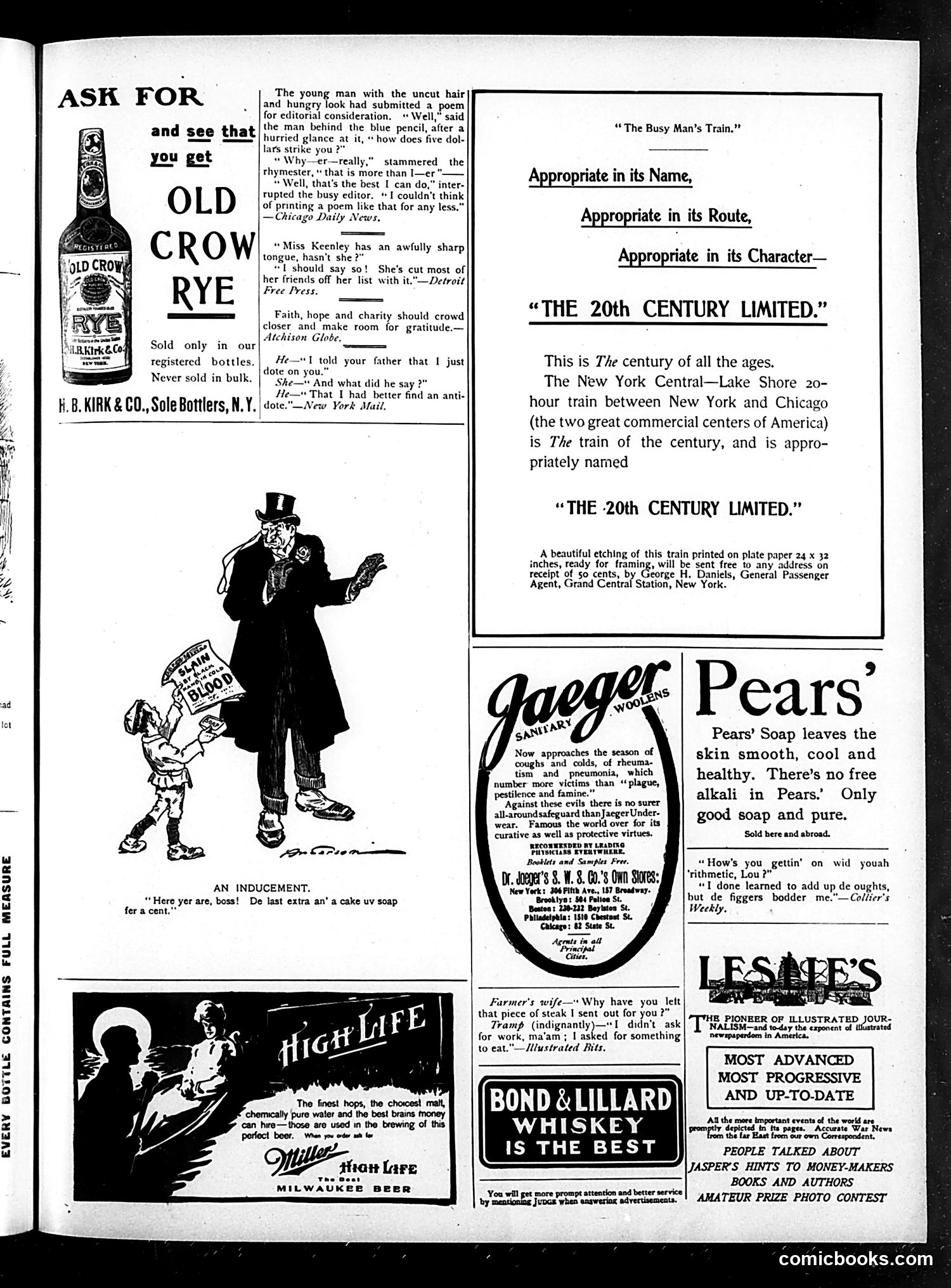
This page is primarily **advertising and promotional content** rather than editorial cartooning. The dominant features are: **"An Inducement" cartoon** (bottom left): Shows Uncle Sam offering a child cake and soap for a cent—a visual pun promoting Miller High Life beer. The joke plays on the phrase "inducement" (a promotional offer). **Small joke items** scattered throughout reference everyday absurdities: an editor underpaying a poet, a sharp-tongued woman cutting friends off, romantic miscommunication, and a tramp's refusal to work. **Train advertisement**: Promotes the "20th Century Limited," a prestigious New York Central express train, framed as appropriately named for "the century of all ages." **Product ads**: Old Crow Rye whiskey, Pears' soap, Jaeger underwear, Bond & Lillard whiskey, and Miller beer dominate the page. The page reflects **early-1900s consumer culture**, where Judge magazine monetized by mixing light humor with advertising pitched at middle-class readers. No specific political satire is evident.
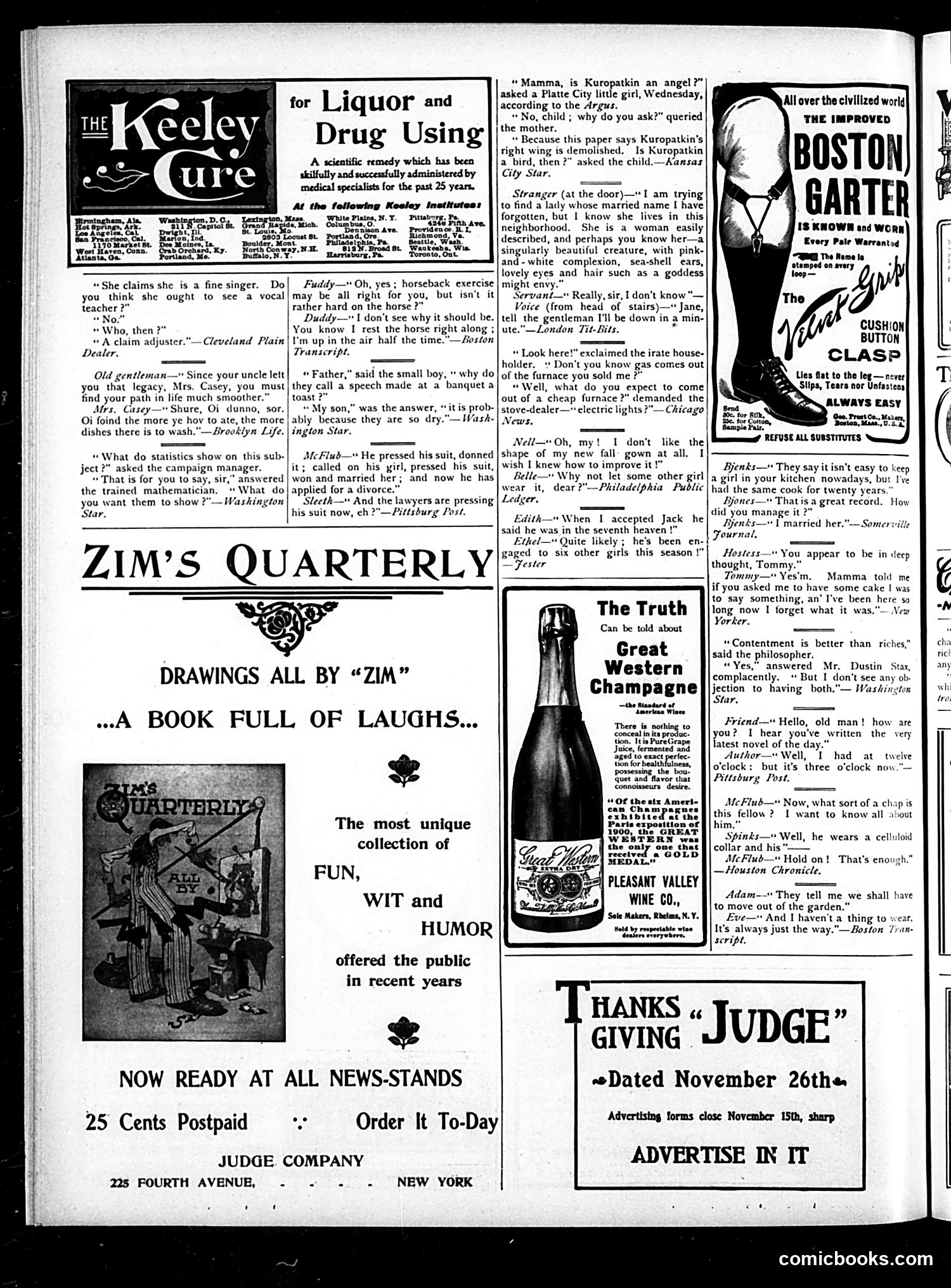
This page from *Judge* magazine contains primarily **short humor pieces and advertisements** rather than political cartoons. The **Keeley Institute advertisement** (top left) promotes a "scientific remedy" for "Liquor and Drug Using," reflecting early 20th-century attitudes toward addiction treatment—presenting it as a medical condition amenable to cure. The **humorous anecdotes** scattered throughout are genteel domestic jokes typical of the era: wordplay about singers, horseback riding, banquet toasts, and romantic misadventures. One joke references **Kuropatkin**, a Russian general from the Russo-Japanese War (1904-1905), whose military defeats made him a topical figure for humor. The **Zim's Quarterly advertisement** promotes a book of cartoons and humor drawings. The **Great Western Champagne ad** emphasizes purity and "scientific" production—marketing luxury goods to aspirational middle-class readers. The page reflects *Judge*'s format as a humor and satire magazine mixing light domestic comedy with contemporary references and upscale product advertising targeting educated, affluent readers.
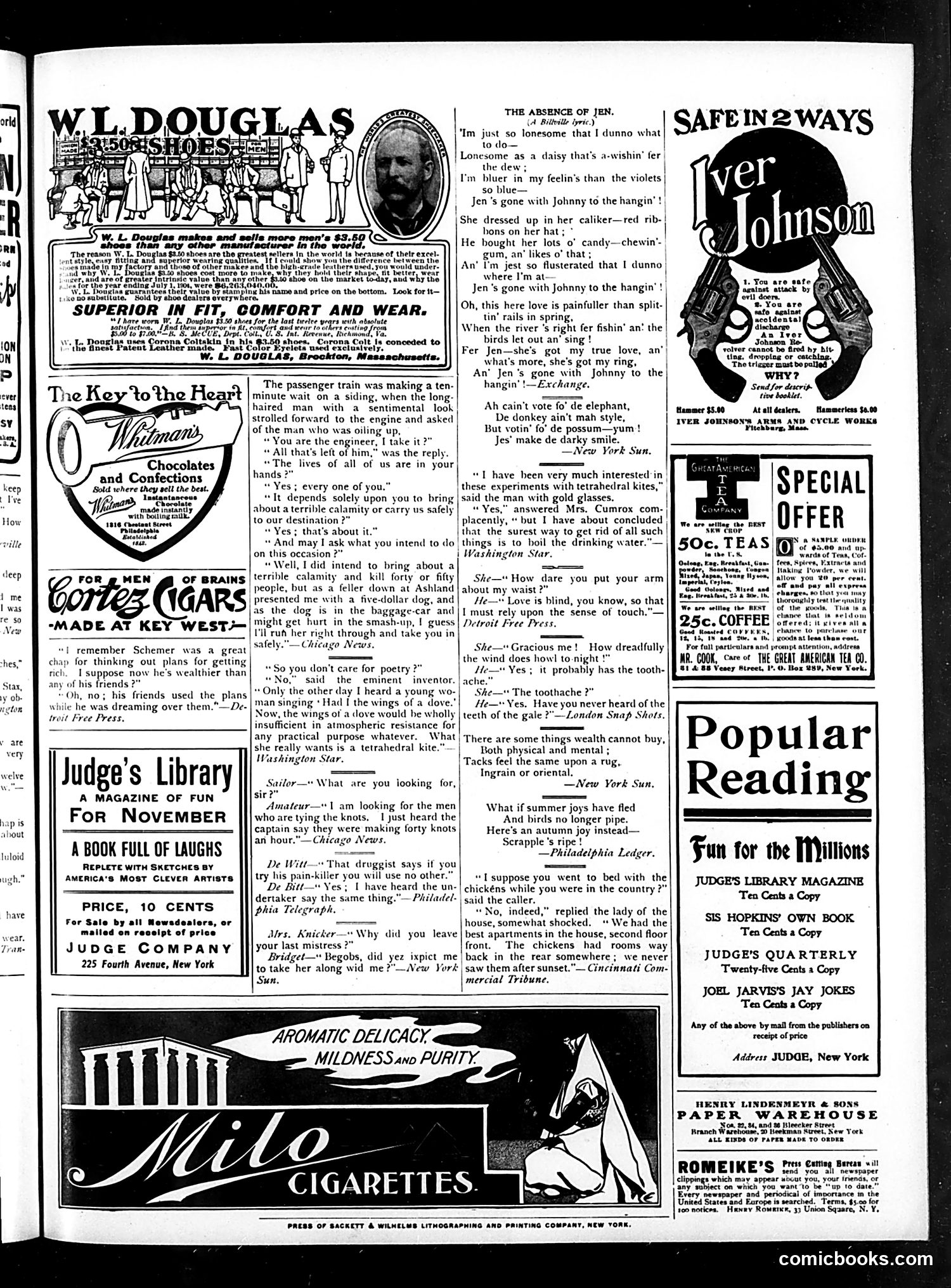
This page is primarily **advertising and humor content** rather than political satire. The main elements: **"The Absence of Jen"** is a sentimental song-poem about a lovesick man whose girlfriend has gone to a public hanging with another suitor—a darkly comic bit of Americana. The humor derives from the contrast between the lover's melodramatic pining and the casual, frontier-casual attitude toward executions as public entertainment. **The other content** consists of: - Multiple unrelated short humorous anecdotes about engineers, inventors, and romantic misunderstandings - A racist "darky" dialect joke about voting preferences - Heavy advertising (W.L. Douglas Shoes, Judge's Library, Milo Cigarettes, Cortez Cigars, Whitman's Chocolates) **For modern readers**: This reflects early 1900s magazine culture—mixing lowbrow humor, crude racial caricature as casual entertainment, and product advertising. The "Jen" poem captures period attitudes toward public executions as spectacle rather than tragedy.
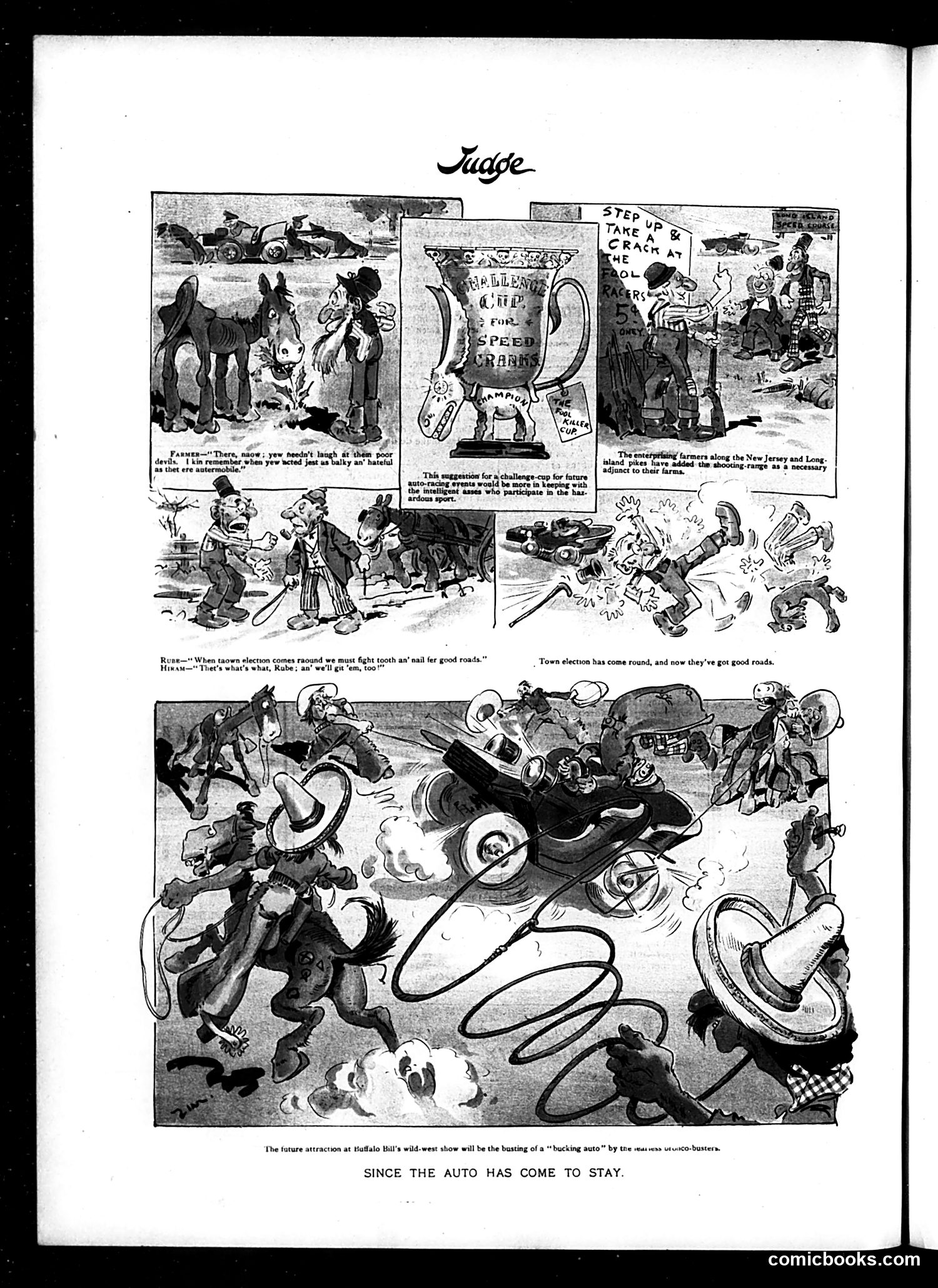
This page satirizes the early automobile's disruptive impact on rural American life. The top panels show farmers discussing automobiles with concern—one depicts a wrecked car, another shows a "speed alarm" device. The middle section shows farmers complaining about needing good roads for town elections, while simultaneously the autos are destroying those very roads. The bottom, larger cartoon depicts the climax: a chaotic scene of automobiles bucking wildly like untamed horses, with people being thrown about. The caption jokes that Buffalo Bill's Wild West show will soon feature "busting a bucking auto" like a rodeo bronco—treating automobiles as dangerous, uncontrollable beasts rather than progress. The satire's point: despite farmers' practical needs for improved roads, automobiles represent chaos and danger to rural communities accustomed to horse-drawn transport. The humor mocks both the auto's unpredictability and rural resistance to this new technology.