
A complete issue · 16 pages · 1904
Judge — October 8, 1904
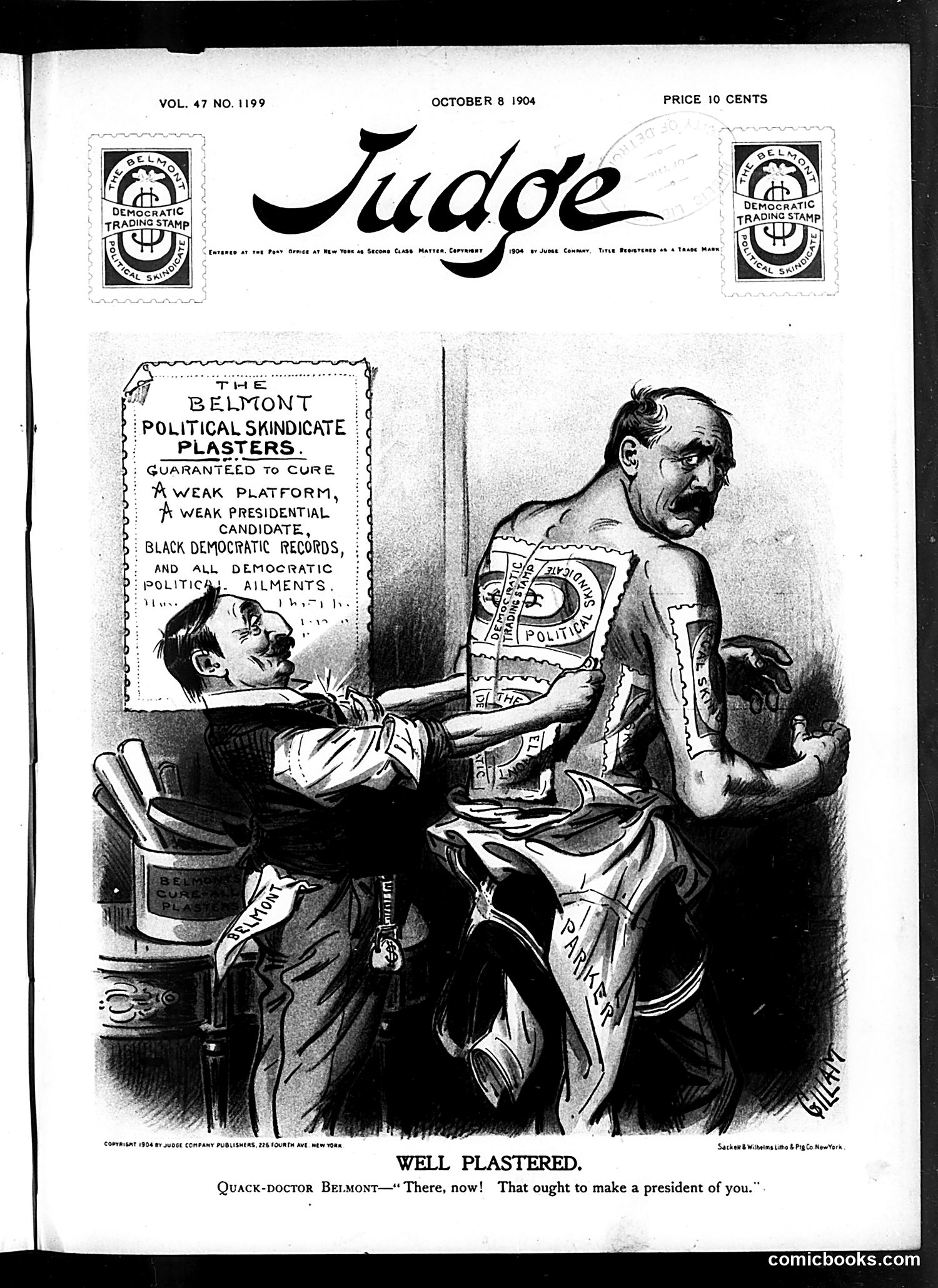
This political cartoon satirizes **Alton B. Parker**, the 1904 Democratic presidential candidate (the mustachioed figure on the right). A quack doctor labeled "Belmont" (likely August Belmont, a prominent Democratic financier) applies "Belmont Political Syndicate Plasters" to cure Parker's candidacy. The plasters claim to fix "a weak platform, a weak presidential candidate, black Democratic records, and all democratic political ailments"—mocking Parker as fundamentally unelectable despite treatment attempts. The doctor's reassurance—"That ought to make a president of you"—drips with sarcasm. The cartoon ridicules Democratic efforts to rehabilitate an unpopular candidate through financial backing and party machinery, suggesting no amount of money or political intervention could make Parker viable.
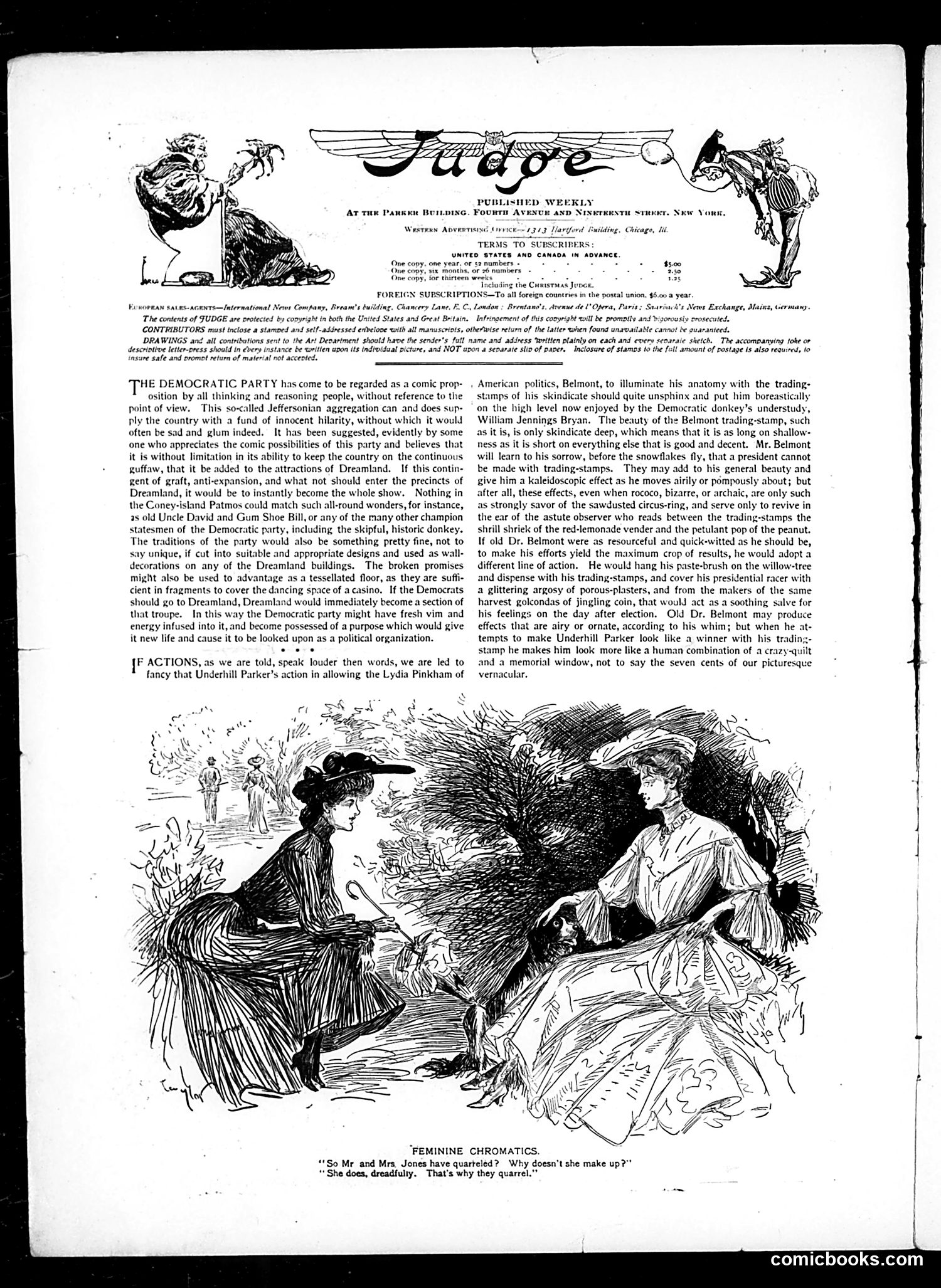
The main editorial article attacks the Democratic Party as intellectually bankrupt, arguing they rely on "comic" politics rather than serious governance. It specifically criticizes how they use "tradingstamps" (a metaphor for cheap gimmicks) to appeal to voters. The article focuses heavily on **William Jennings Bryan**, the Democratic candidate, mocking his use of theatrical rhetoric and symbolic gestures. It suggests Bryan's "beauty of the Belmont tradestamp" is merely surface-level appeal without substance. The bottom cartoon, titled "Feminine Chromatics," depicts two women quarreling, with the caption: "So Mr. and Mrs. Jones have quarreled? Why doesn't she make up?" / "She does, dreadfully. That's why they quarrel." This appears to be social commentary on marital discord unrelated to the political content above. The publication date and specific election year remain unclear from the visible text.
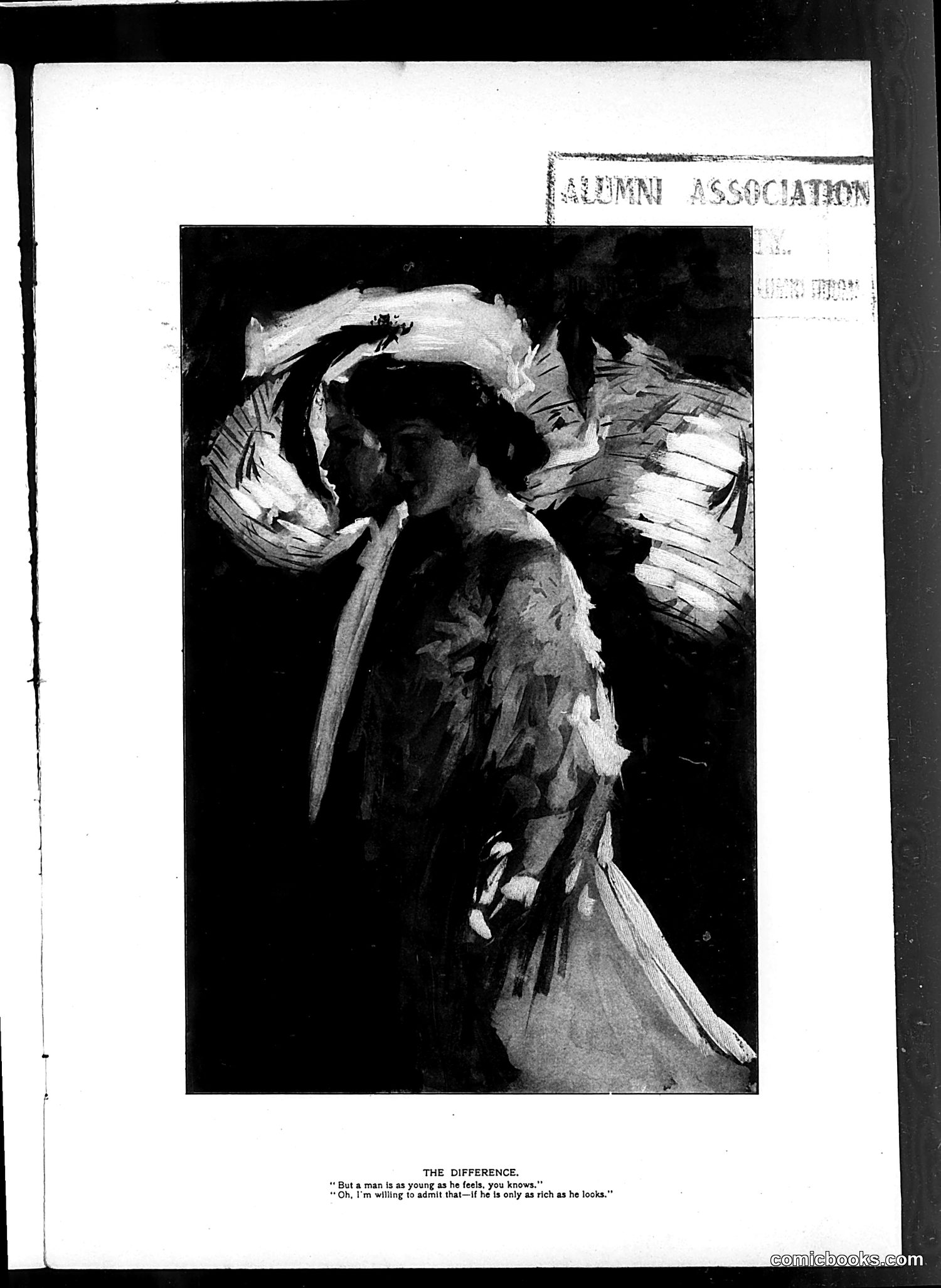
This appears to be a satirical cartoon from *Judge* magazine critiquing wealth and appearance. The image shows a figure in profile wearing elaborate, expensive clothing and accessories—suggesting ostentatious wealth. The caption reads: "But a man is as young as he feels, you know." / "Oh, I'm willing to admit that—if he is only as rich as he looks." The satire targets the relationship between wealth display and self-perception. The joke suggests that while someone might *feel* young, their actual worth should be measured by whether their riches match their expensive appearance—implying either that the figure is fraudulently dressing beyond their means, or more broadly, that wealthy people often misrepresent themselves through superficial displays of fashion.
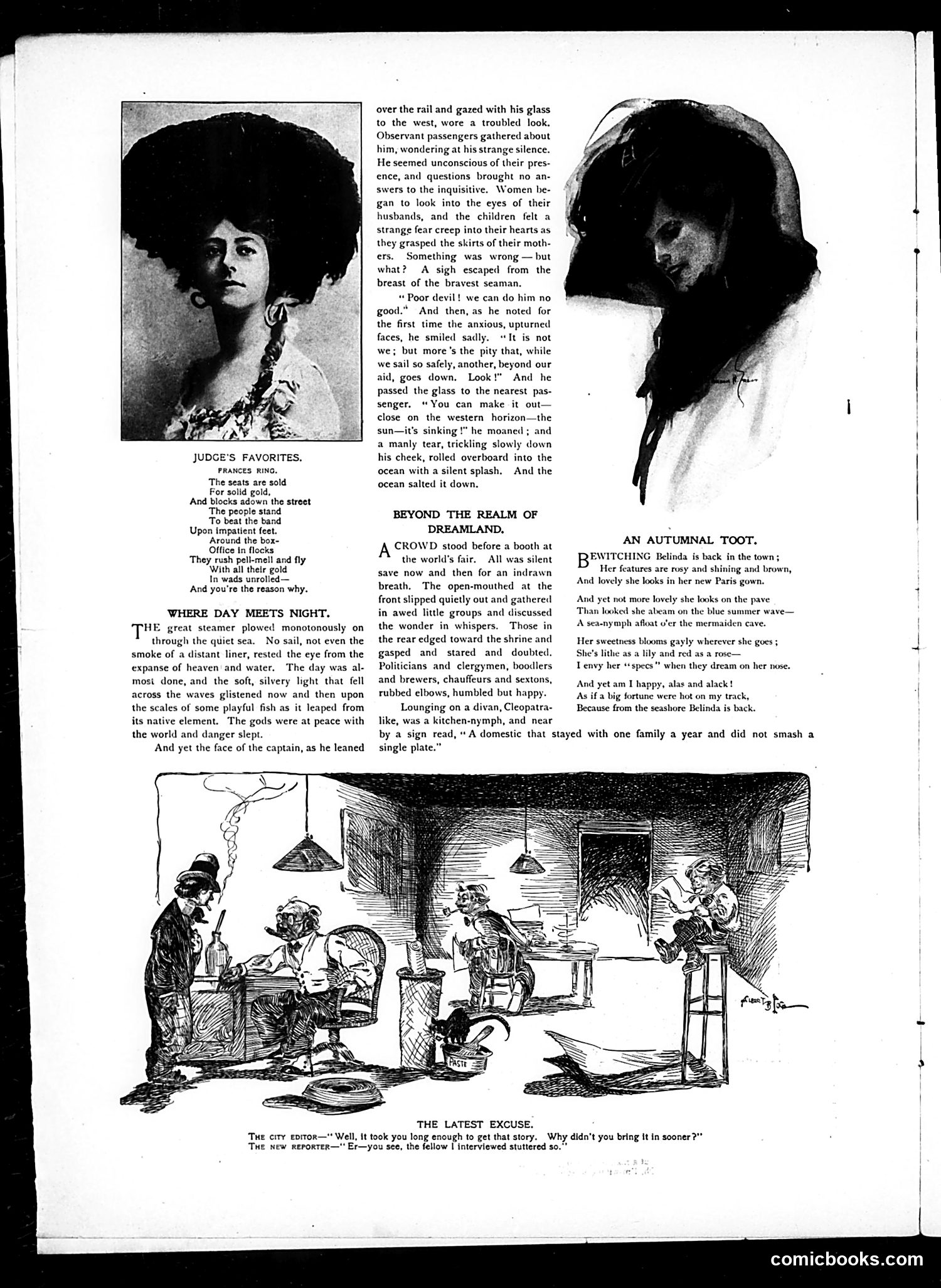
This page contains literary and illustrative content rather than political satire. The left column features "Judge's Favorites," a poem about Frances Ring with her portrait photograph. The center presents "Beyond the Realm of Dreamland," describing crowds at a world's fair observing an unusual sight—likely referencing the popular World's Columbian Exposition (1893) or similar event. The right column offers "An Autumnal Toot," a poem about a woman's seaside appearance. Below is "The Latest Excuse," a cartoon showing newspaper editors and reporters in an office, with dialogue about a delayed story. The cartoon appears to satirize newspaper office culture and journalistic excuses rather than specific political figures or events.
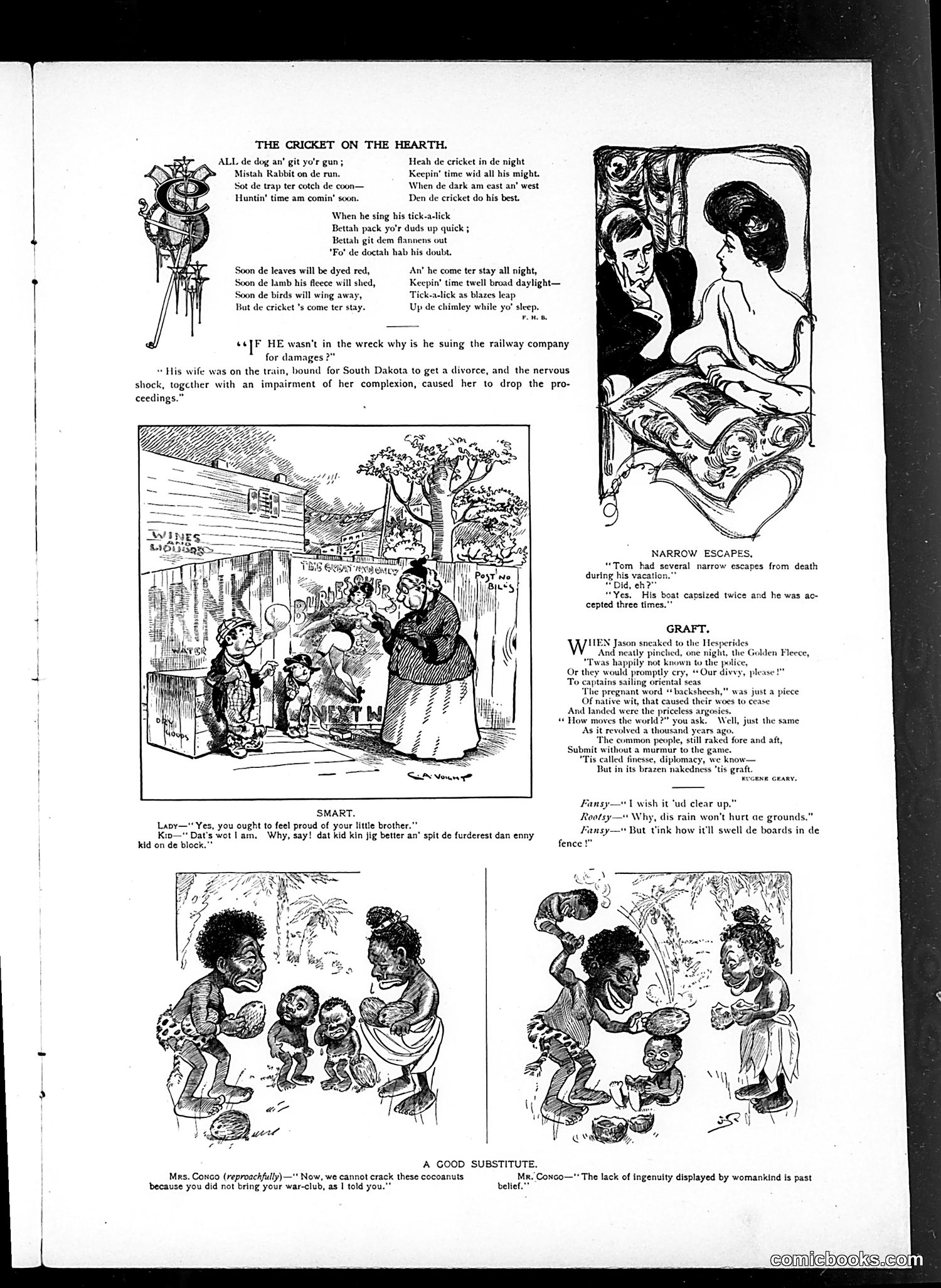
This page contains several satirical pieces using racist caricatures common to early-20th-century American humor: **"The Cricket on the Hearth"** uses African American dialect humor to present seasonal warnings, likely mocking rural Black speech patterns. **"Narrow Escapes"** is a brief joke playing on the double meaning of "accepted" (a woman rejecting marriage proposals three times). **"Graft"** is the most substantive piece—a poem criticizing widespread corruption in government and commerce. It argues that modern bribery and corruption ("graft") is merely "finesse" and "diplomacy" dressed up, while ordinary people ("common people") suffer exploitation. This reflects Progressive Era concerns about institutional corruption. **"Smart" and "A Good Substitute"** are brief domestic humor pieces featuring caricatured Black figures, using offensive stereotypes as the basis for crude jokes about comportment and intelligence. The page reflects Judge's satirical approach: legitimate social criticism (anti-corruption messaging) mixed with dehumanizing racial humor typical of the era.
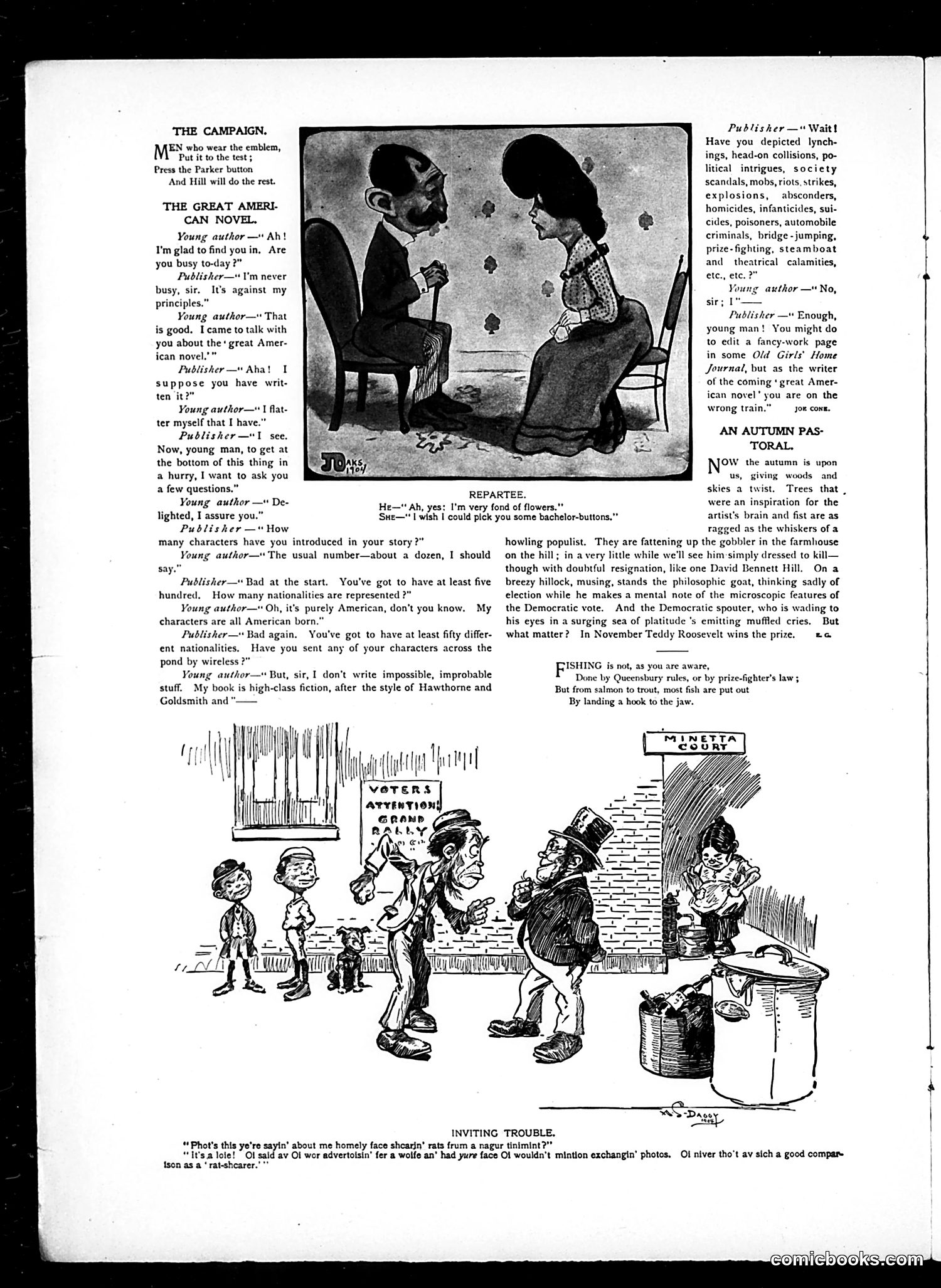
This page satirizes the 1904 presidential campaign and literary pretension. **"The Campaign"** references the Parker-Hill Democratic ticket (Alton B. Parker for president, Henry Gould for vice-president), mocking their campaign strategy as oversimplified. **"The Great American Novel"** dialogue ridicules contemporary popular fiction trends. A publisher dismisses a young author's manuscript for lacking sensationalism—demanding 500+ characters, 50 nationalities, wireless technology, and depictions of lynchings, murders, strikes, and disasters. The satire targets both publishers' crass commercialism and the era's appetite for sensational, formulaic bestsellers over literary quality. **"An Autumn Pastoral"** compares a Democratic politician to a goat contemplating election, while predicting Theodore Roosevelt's victory in November—contemporary political commentary. **Minor cartoons** include voting rallies and a dated ethnic dialect joke about an Irish immigrant. The page reflects Progressive-era anxieties about literary standards, campaign superficiality, and Republican political dominance.
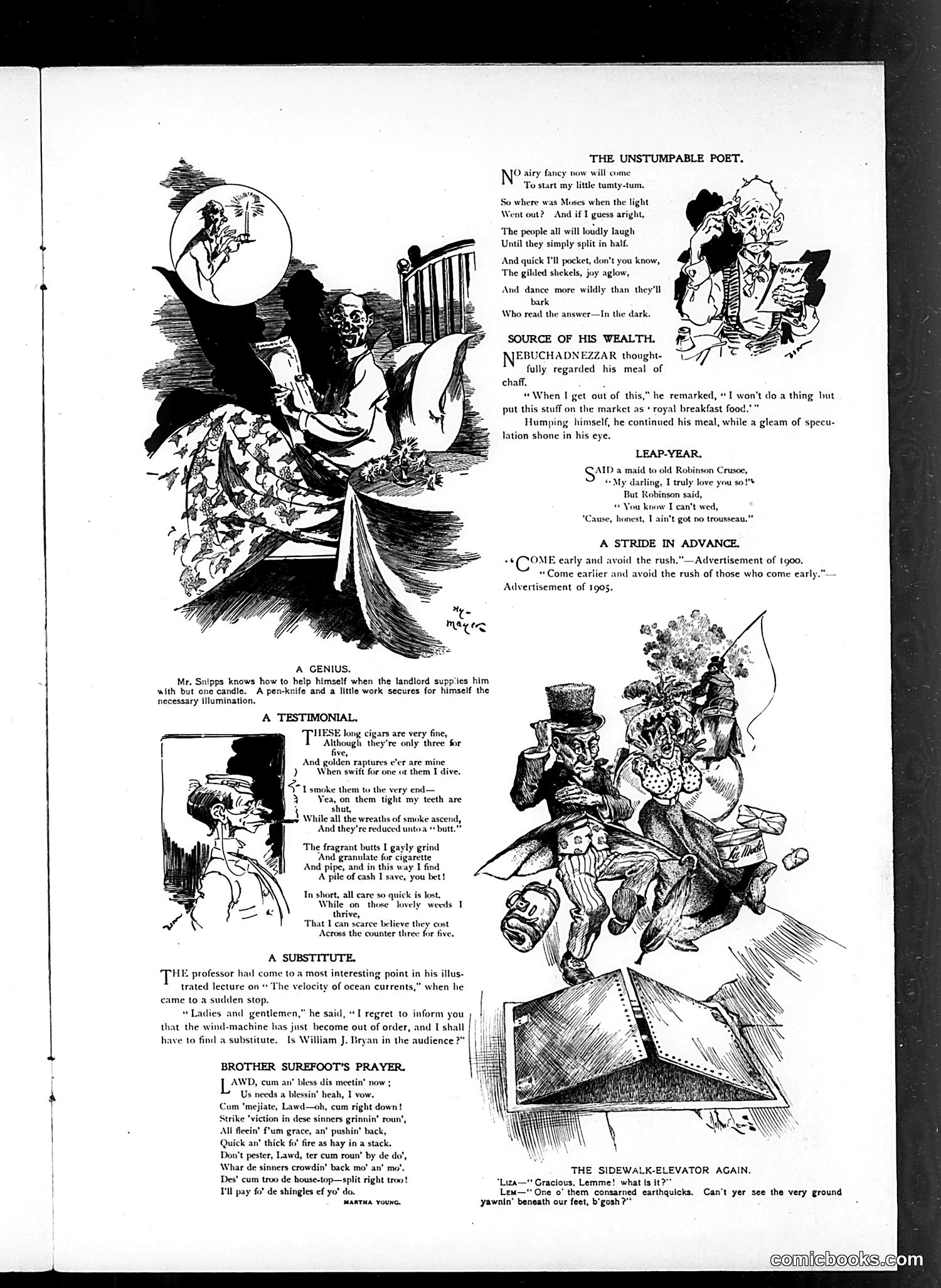
This page collects short humorous pieces typical of early 1900s satirical magazines: **"The Unstumpable Poet"** mocks poets who solve riddles with obvious answers ("in the dark") yet expect payment—satirizing both pretentious versifiers and gullible audiences. **"Source of His Wealth"** references the biblical Nebuchadnezzar, depicting him planning to sell chaff as "royal breakfast food"—a joke about fraudulent marketing and get-rich-quick schemes. **"A Stride in Advance"** satirizes escalating consumer culture: 1900's advice to "avoid the rush" becomes 1905's absurd advice to arrive even earlier, mocking how advertisements create artificial urgency. **"A Substitute"** contains a contemporary political jab: the professor asks if William Jennings Bryan (three-time presidential candidate) is in the audience, suggesting Bryan is as useless as a broken wind-machine—a dig at his failed political campaigns. Other pieces humorously depict characters exploiting landlords, smoking cheap cigars, and misinterpreting earthquakes. The cartoons are gentle social observation rather than serious political commentary.
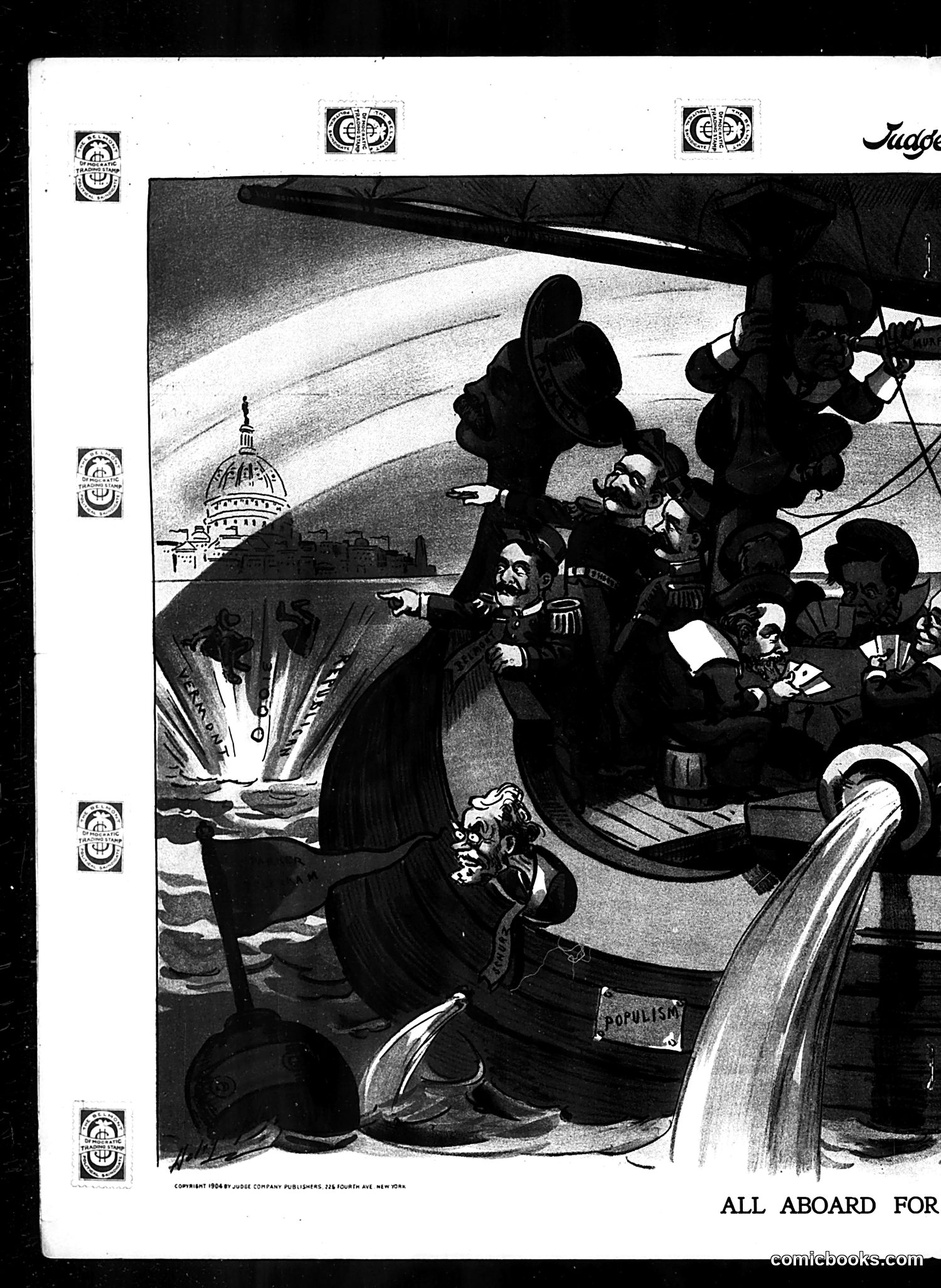
This is a Judge magazine political cartoon titled "All Aboard For..." The image depicts a boat or ship departing from the U.S. Capitol building. On deck are military and political figures in formal dress, appearing to board or prepare for departure. In the lower left, a caricatured figure labeled "POPULISM" is being left behind or ejected from the vessel. The cartoon satirizes the exclusion of populist political movements from power or influence during the era when Judge published (appears to be early 1900s based on style). The Capitol building and uniformed officials suggest this critiques how establishment political and military leadership were distancing themselves from or rejecting populist demands of that period. The specific politicians depicted are unclear from the image alone.
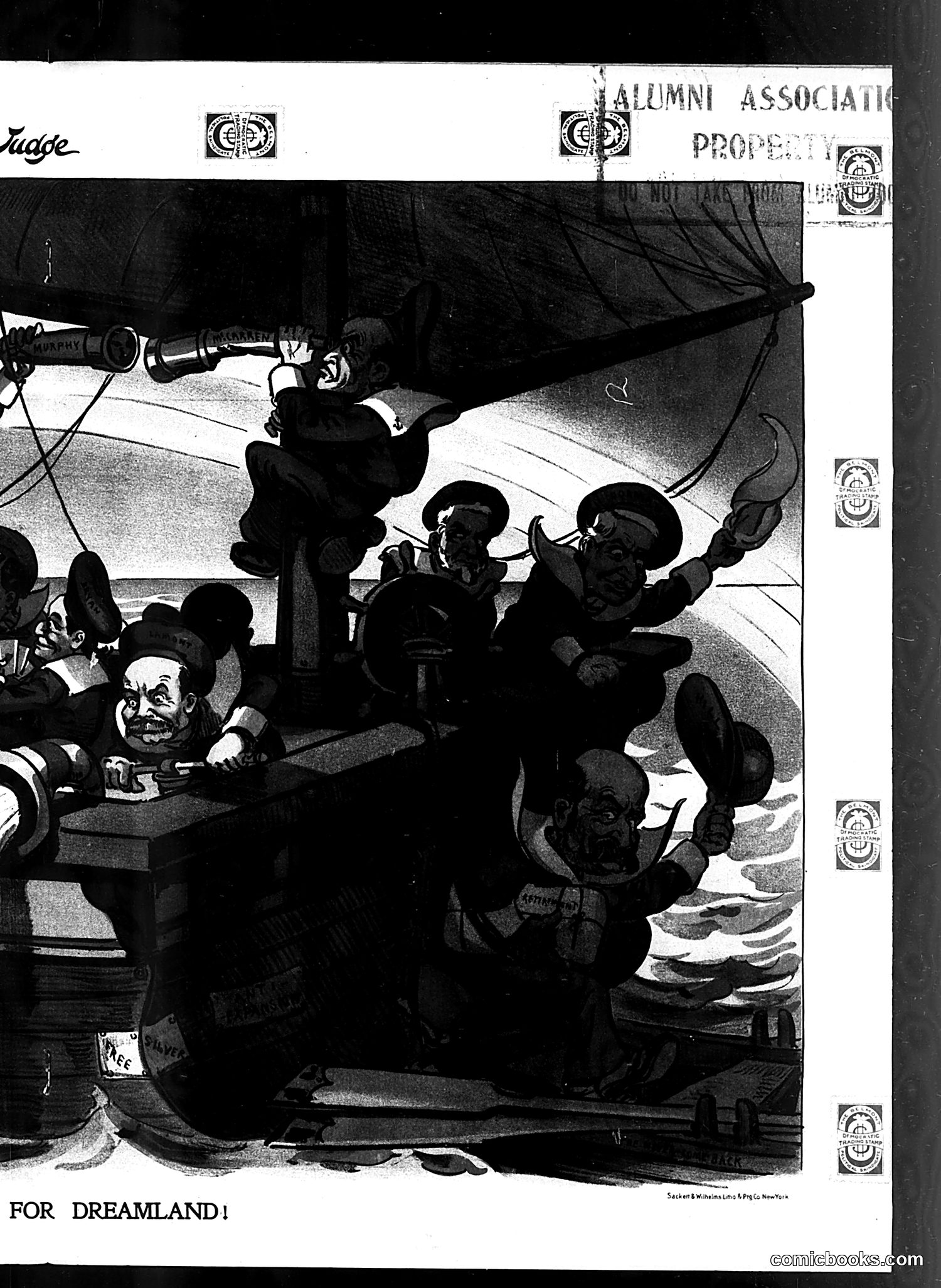
This political cartoon depicts a boat scene with exaggerated caricatures of figures wearing hats, apparently headed toward or departing from somewhere labeled "Dreamland." The style and caricature work suggest ethnic or national stereotyping typical of early Judge magazine satire. Without clearer identifying labels or accompanying article text visible in this image, I cannot definitively identify the specific figures or the exact political/social event being satirized. The "Dreamland" destination appears metaphorical—possibly referencing immigration, utopian promises, or unrealistic aspirations—but the specific target and historical context remain unclear from the image alone. The archival stamps on the right margin indicate this is preserved institutional property.
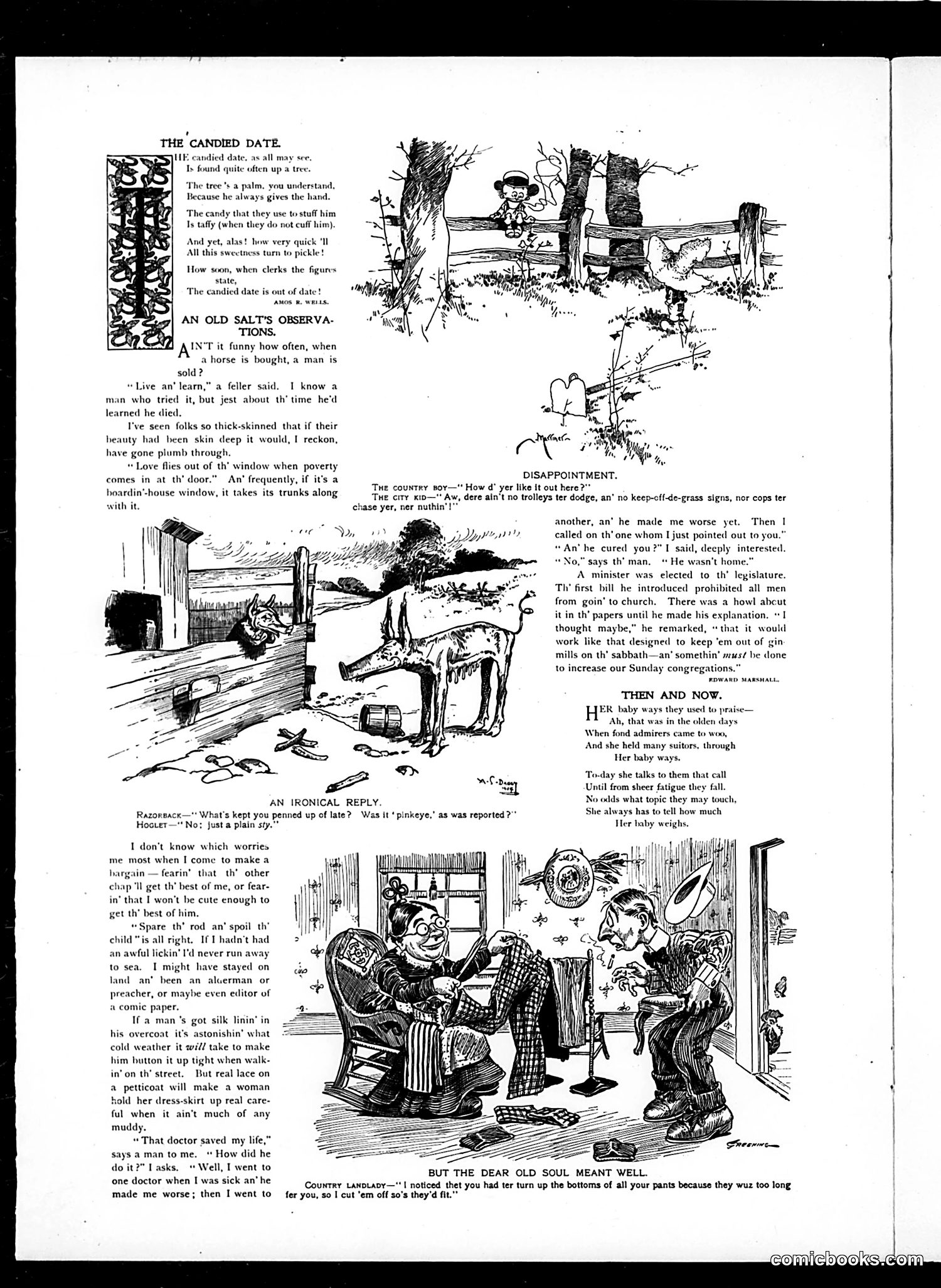
This page contains several satirical humor pieces typical of early 20th-century American comedy: **"The Candied Date"** is a pun-based poem about romantic courtship ("candied date" as a sweet treat vs. a romantic outing). The joke: sweetness turns to "pickle" (trouble) when the relationship's financial realities emerge—clerks discover the suitor is financially unsuitable. **"An Old Salt's Observations"** presents cynical, folksy wisdom from an elderly sailor character, including observations about horse trading (getting swindled), poverty destroying romance, and physical toughness. **"An Ironical Reply"** plays on medical terminology: "pinkeye" vs. "sty" (both eye conditions, but "sty" also means pig pen—an insult). **"Disappointment"** contrasts country and city life: a city kid (spelled in dialect) complains the countryside lacks urban hazards—trolleys, "keep off grass" signs, and police. **"Then and Now"** satirizes how women change after marriage: from silent, demure "baby ways" to incessantly discussing their baby's weight. **"The Dear Old Soul Meant Well"** depicts a country woman's well-intentioned but absurd "alteration" of a man's pants—cutting off the legs rather than hemming them.
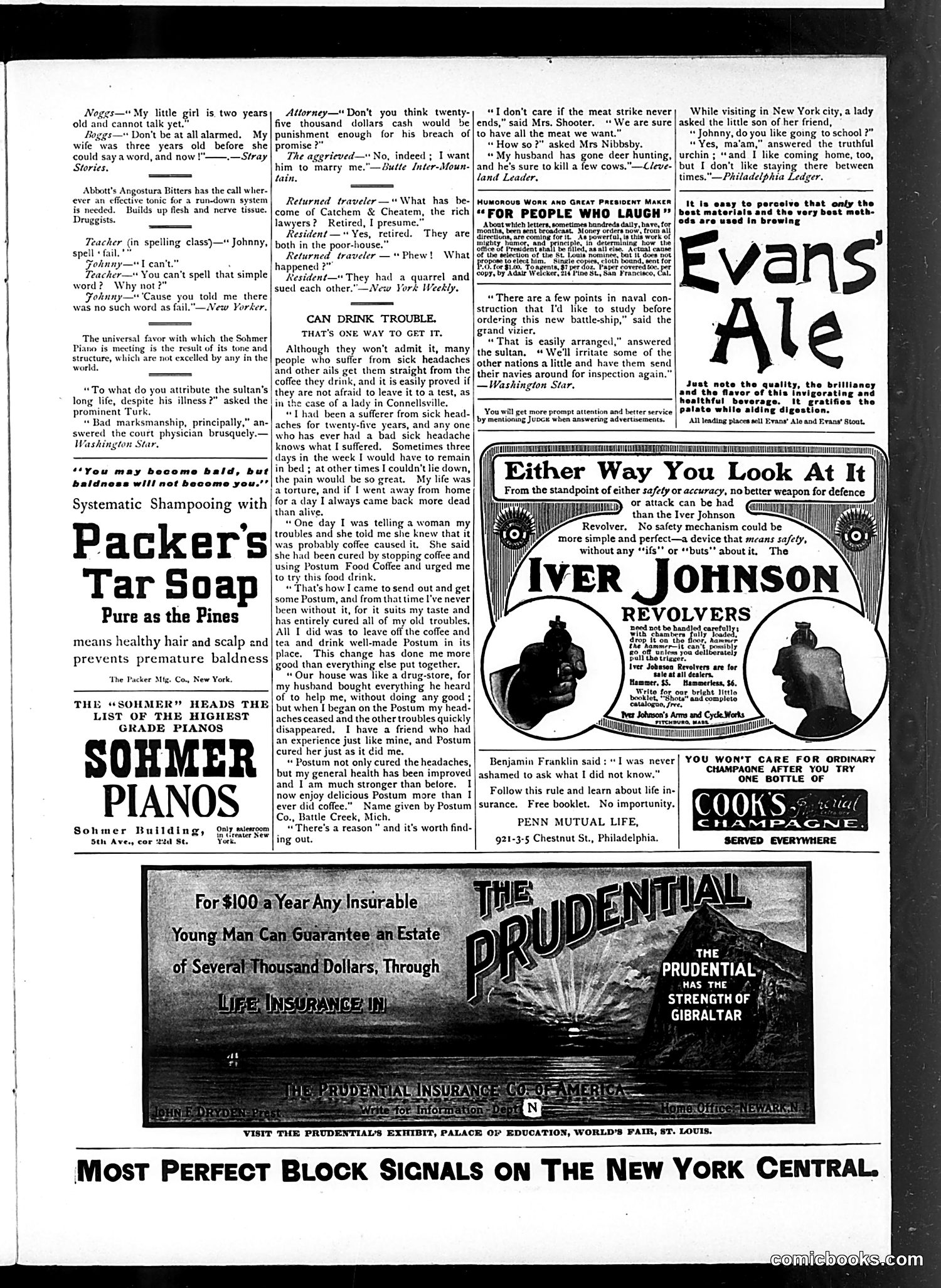
This page is primarily **advertising and humor vignettes**, not political cartoons. The content consists of: **Brief Jokes**: Short anecdotes about spelling failures, a sultan's survival attributed to "bad marksmanship," and a woman demanding marriage rather than cash compensation for breach of promise. These are generic humor pieces typical of the era. **Product Advertisements**: The page heavily features ads for Sohmer Pianos, Packer's Tar Soap, Iver Johnson Revolvers, and notably a lengthy testimonial about Postum (caffeine-free coffee substitute) curing a woman's 25-year headache affliction. **Social Context**: The Postum ad reflects early 20th-century anxieties about coffee's health effects and the marketing of "patent" remedies as cure-alls—a common advertising strategy of the period. **No Clear Satire**: Unlike typical Judge content, this page lacks identifiable political figures or sharp social commentary. It appears to be a standard magazine page mixing light humor with revenue-generating advertisements.
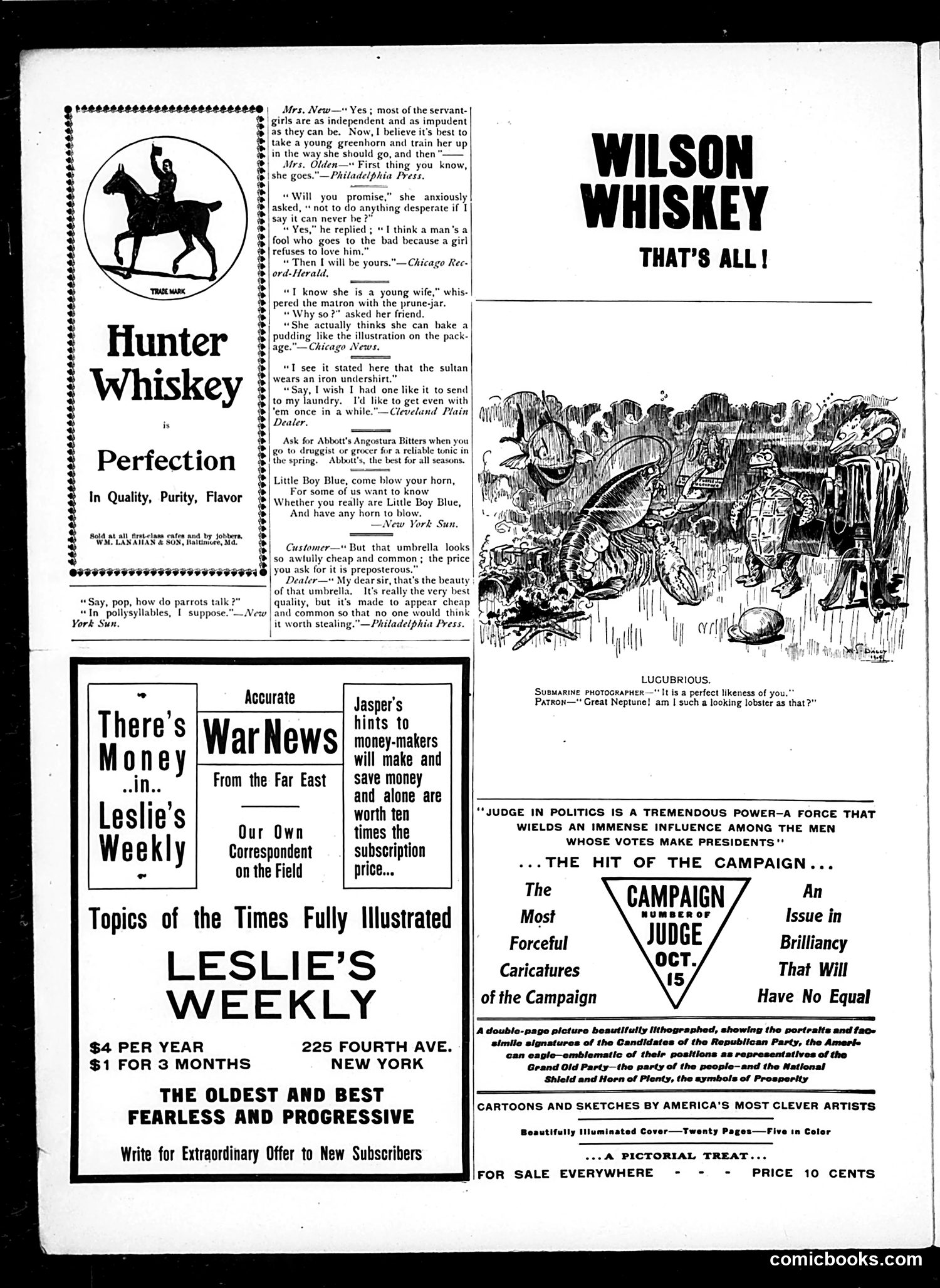
This page is primarily **advertising and promotional content** rather than editorial cartoons. The main elements include: **Advertisements:** - Hunter Whiskey and Wilson Whiskey brands - Leslie's Weekly magazine promotion - Judge's own campaign issue promotion **Humor Content:** The page contains several brief, unattributed jokes on domestic and social topics—servant girls' independence, young wives' domestic failures, umbrella quality—typical of early 20th-century magazine filler humor. These reflect period attitudes about gender roles and consumer goods. **Political Reference:** The prominent boxed promotion advertises Judge's upcoming **campaign issue** (October 15), featuring caricatures of Republican Party candidates. The quote claims Judge wields "tremendous power" in influencing voters, reflecting the magazine's self-perception as politically influential satirical journalism. **Context:** This appears to be from a 1908 or similar election year. The page demonstrates how Judge combined entertainment, advertising, and political commentary to position itself as both humorous and consequential in American politics.
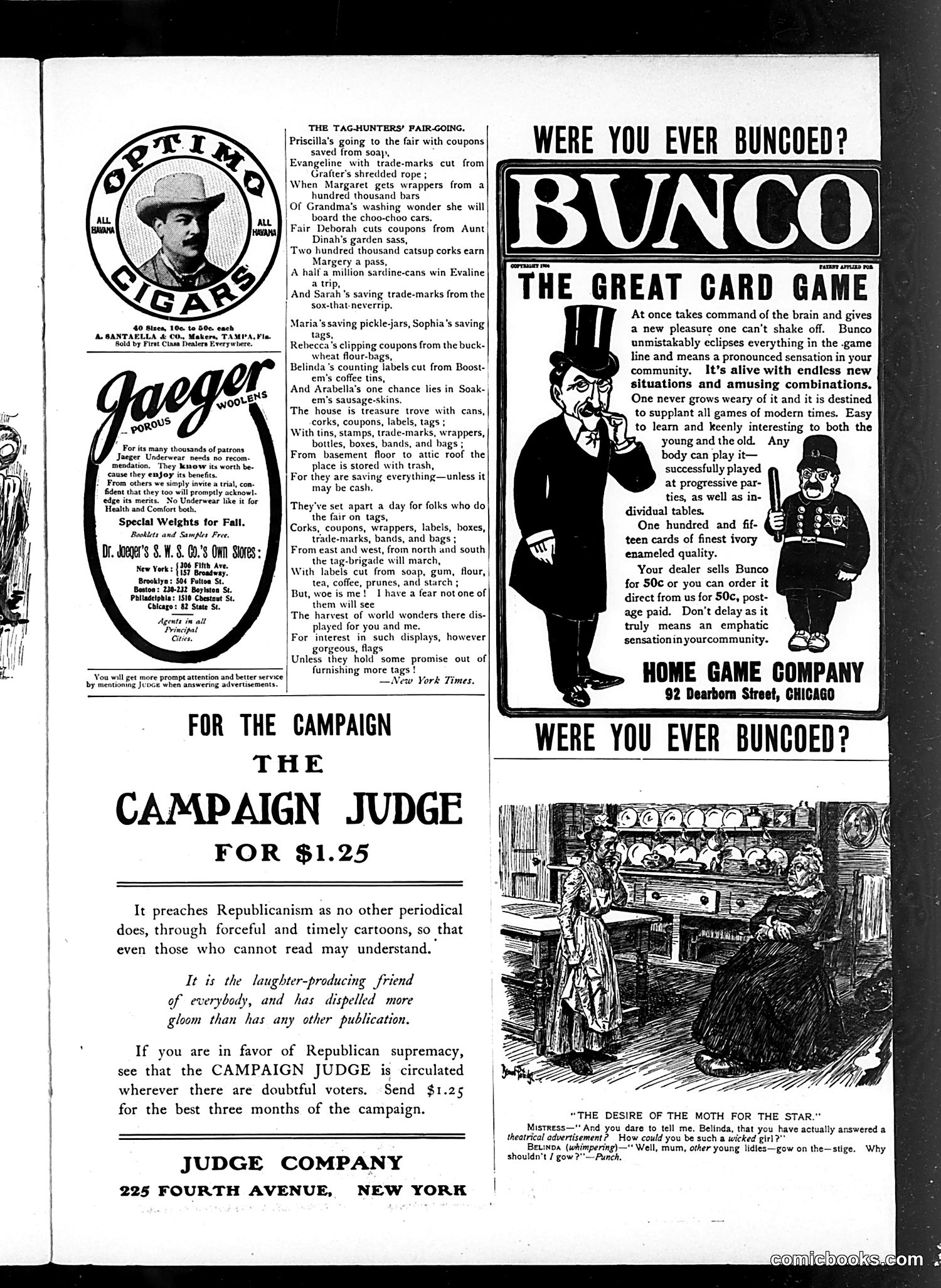
This page contains mostly **advertisements and promotional content** rather than political cartoons. The primary editorial content is a humorous poem, "The Tag-Hunters' Fair-Going," satirizing **early 20th-century consumer culture and promotional gimmicks**. The satire mocks women obsessively collecting product coupons, labels, and trade-marks from household goods (soap, coffee, sardine cans, sausage skins) to gain free fair admission. The poem ridicules how Americans accumulate worthless packaging trash in pursuit of minor rewards, and warns that despite gathering everything, tag-collectors will miss the fair's actual wonders because they're fixated on obtaining more tags. The page also advertises **The Campaign Judge** ($1.25), a Republican periodical using cartoons to promote GOP ideology to readers "who cannot read." Other ads include Jaeger Underwear, Optimo Cigars, and Bunco (a card game). The bottom illustration, "The Desire of the Moth for the Star," appears unrelated—depicting a domestic scene with unclear satirical intent in this reproduction.
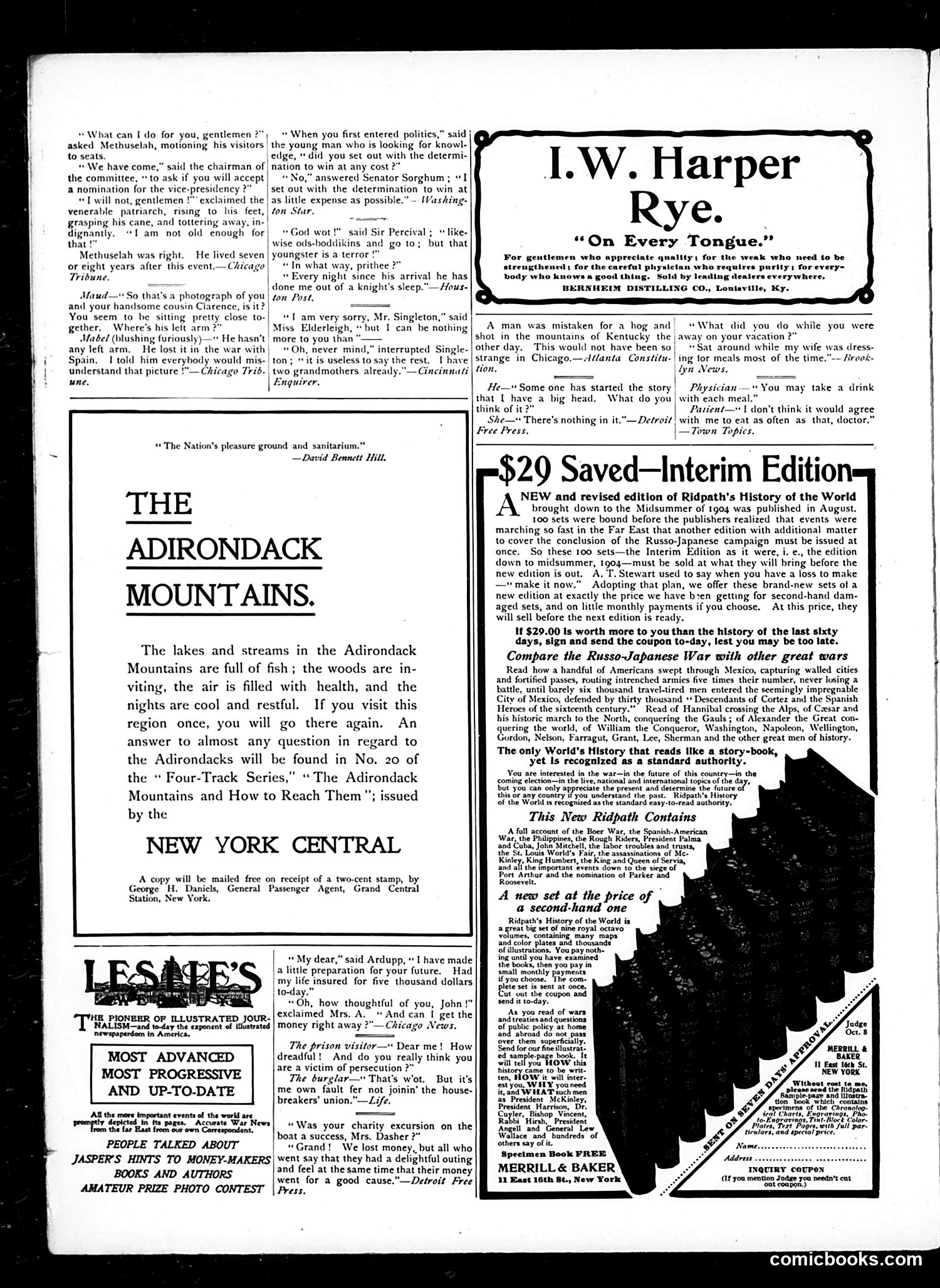
This page contains multiple short satirical pieces typical of Judge's format: **Main Cartoon**: "Methuselah and Vice-Presidency" mocks elderly political candidates. The ancient biblical figure Methuselah refuses a VP nomination, declaring he's "not old enough" — a jab at contemporary politicians considered too aged for office (likely referencing actual elderly candidates of the era, though the specific target is unclear). **Other Jokes**: Brief quips satirize: - Political corruption (Senator Sorghum's goal of "winning at little expense") - Social pretense (a woman explaining away a war amputee's missing arm to avoid scandal) - Life insurance as financial planning **Advertisements** dominate the lower half, promoting the Adirondack Mountains tourism and Ridpath's History of the World. The humor relies on wordplay, irony, and social commentary typical of early 1900s satire—none requires specific historical knowledge to understand the basic comedic structure, though some targets remain unclear without period context.
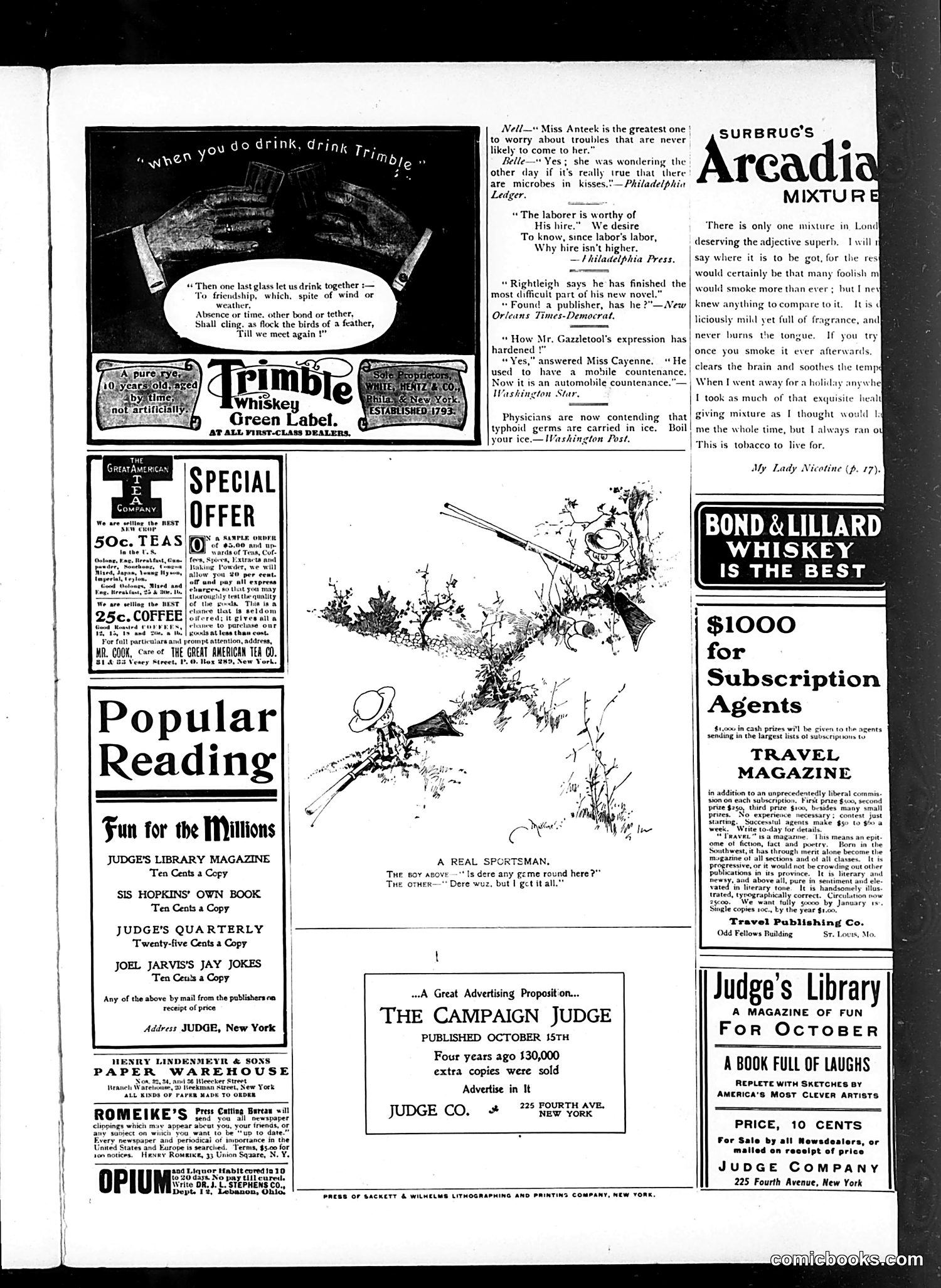
This page is primarily **advertising and house promotions** for Judge magazine and related products, with minimal editorial content. The small editorial jokes scattered throughout reflect early-1900s social commentary: - A dialogue mocks Miss Anteck's neurotic worry over non-existent problems (microbes in kisses) - A quip contrasts low wages with laborers' worthiness - A jab at a novelist suggests publishers are the hard part of writing - Miss Cayenne is teased for developing an "automobile countenance" (likely meaning rigid, mechanical expression—automobiles were new, potentially jarring technology) The **main cartoon** depicts "A Real Sportsman"—a hunter boasting he's killed all available game, leaving none for others. This satirizes selfish overexploitation, possibly commenting on environmental/conservation concerns of the era. The page is otherwise dominated by **whiskey, tea, and tobacco advertisements**—typical of Judge's era, when such products were freely advertised—plus subscription and book promotions for Judge's own publications.
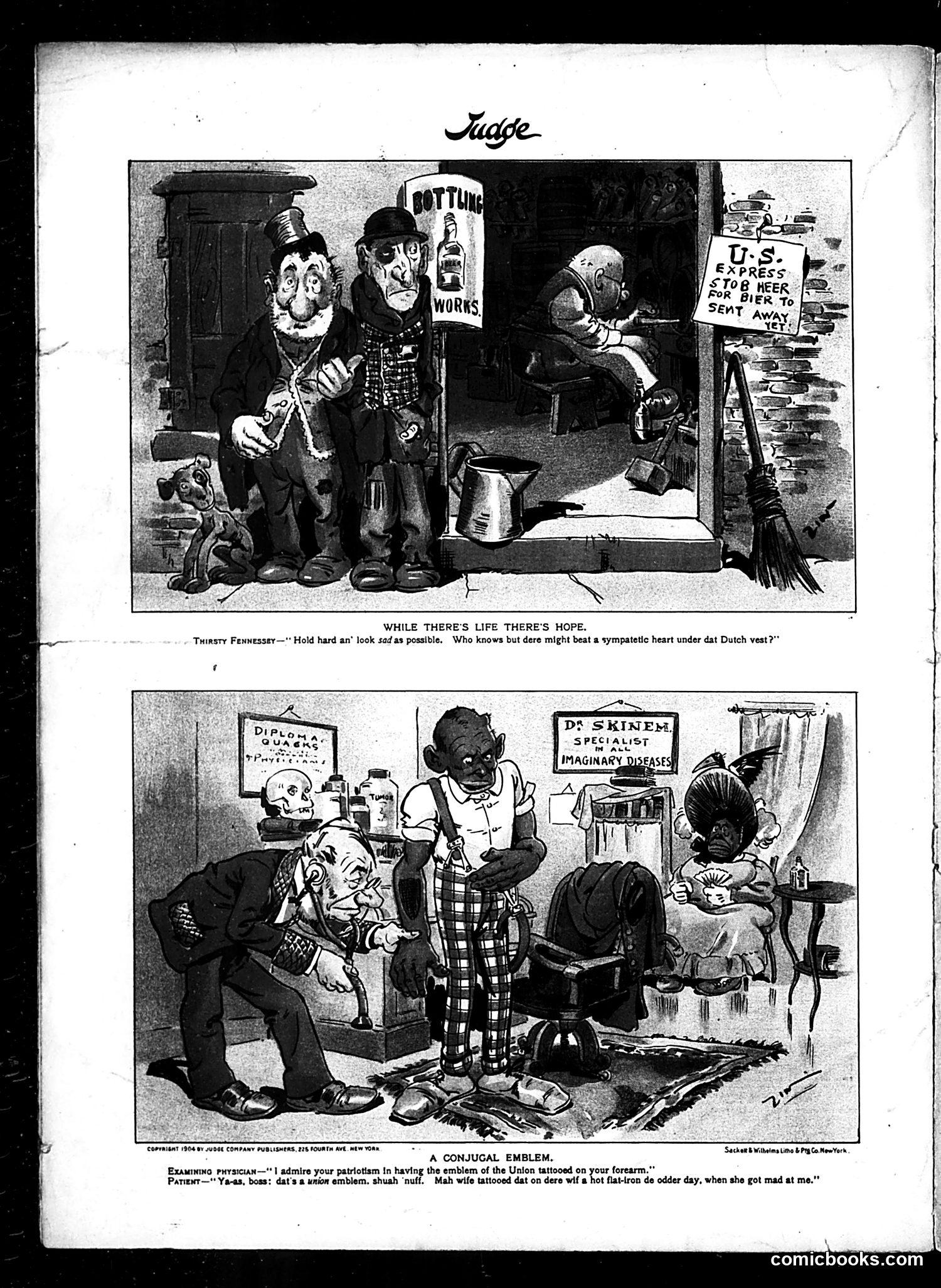
These two cartoons use ethnic caricature and dialect humor (common in early 20th-century Judge magazine) to satirize social issues: **Top cartoon**: "While There's Life There's Hope" depicts what appear to be Dutch immigrants or working-class figures outside a "Rotting Works" establishment, with a U.S. Express sign advertising beer shipment. The satire targets Prohibition-era concerns about immigrant drinking culture and federal restrictions on alcohol sales. **Bottom cartoon**: "A Conjugal Emblem" plays on a racial stereotype about a Black man's "patriotic" tattoo of the Union symbol—revealed to actually be a burn mark from his wife's hot iron. The crude humor relies on period stereotypes about domestic violence and working-class life. Both cartoons reflect Judge's satirical approach using exaggerated ethnic/racial characterization to comment on American social divisions around immigration, alcohol regulation, and class dynamics in the early 20th century.