
A complete issue · 16 pages · 1904
Judge — September 17, 1904
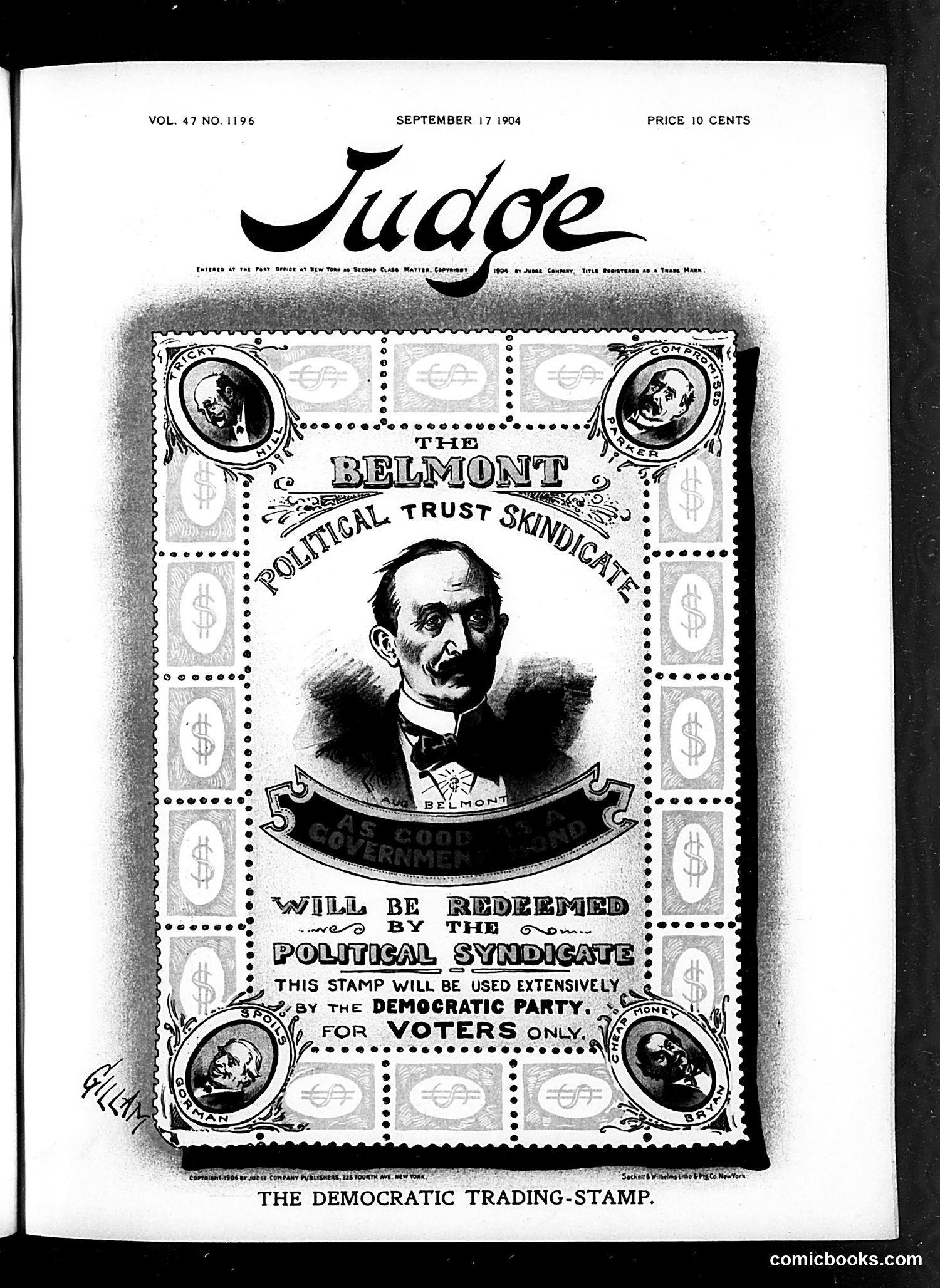
This 1904 Judge cartoon satirizes the Democratic Party by depicting a man labeled "Belmont" as the centerpiece of a mock postage stamp sheet. The design mimics trading stamps—popular commercial collectibles of the era—implying Democrats can be "redeemed by the Political Syndicate" like consumer goods. The text claims "This stamp will be used extensively by the Democratic Party for voters only," suggesting the party literally trades in political favors and allegiances rather than principles. The dollar signs framing the image reinforce the satire: Democrats are portrayed as financially motivated and transactional. The four corner medallions likely represent party figures or interests. Overall, Judge attacks Democratic politics as corrupt, mercenary commerce rather than genuine governance.
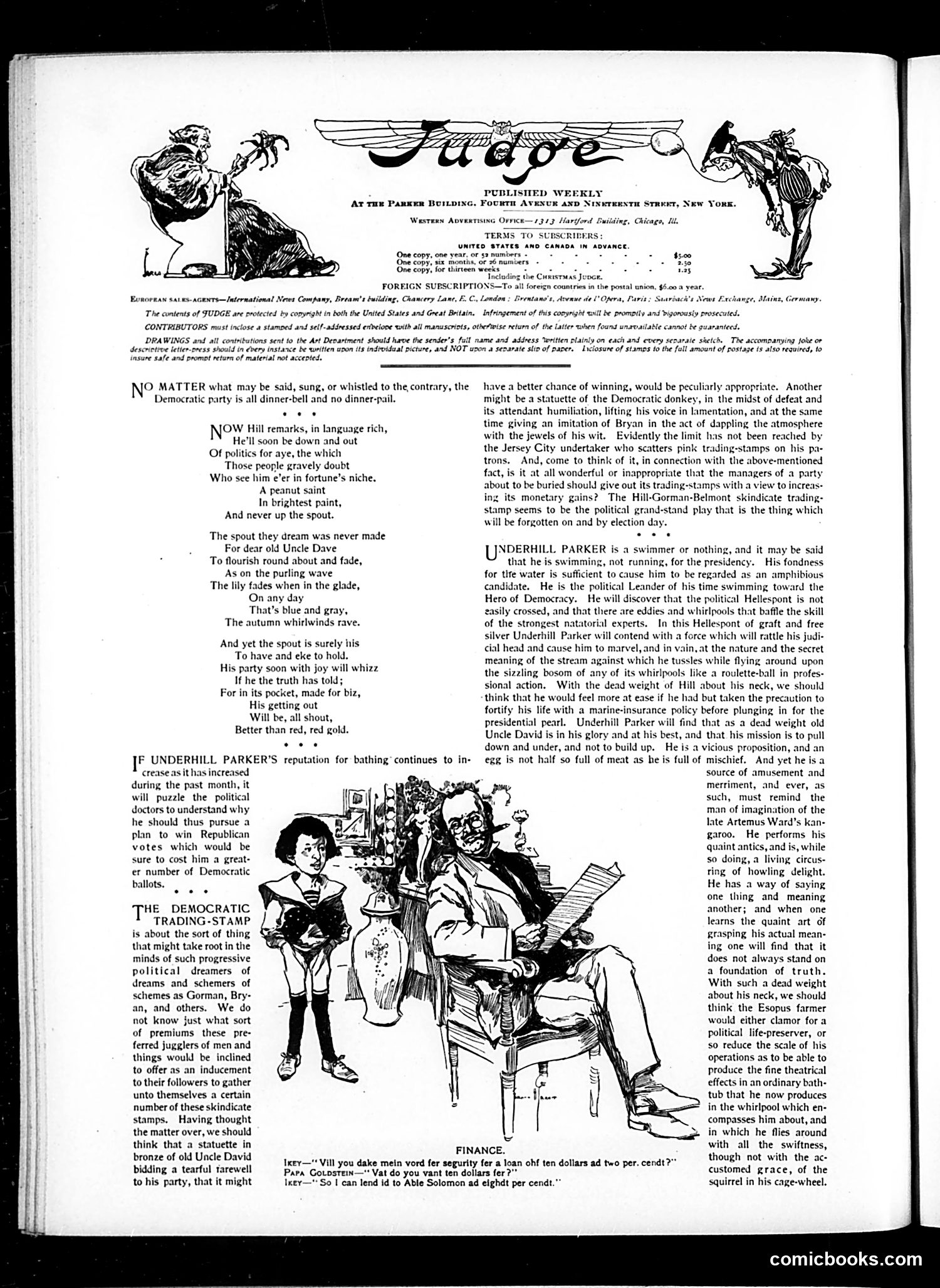
This Judge magazine page satirizes Democratic Party politics, likely from the 1900 election era. The main cartoon labeled "FINANCE" depicts what appears to be a financial negotiation or bribery scene—a man asking another for a loan "for security for a loan of ten dollars at two per cent," with the response that he'd prefer "eight per cent." The surrounding text mocks Democratic candidates and strategies, particularly references to "Hill" (likely David B. Hill), "Bryan" (William Jennings Bryan), and "Underhill Parker"—a fictional Democratic swimming candidate described as unsuitable for the presidency. The satire targets Democratic monetary policy (the "trading stamp" scheme) and portrays the party as inept, corrupt, and reliant on desperate financial schemes rather than serious governance.
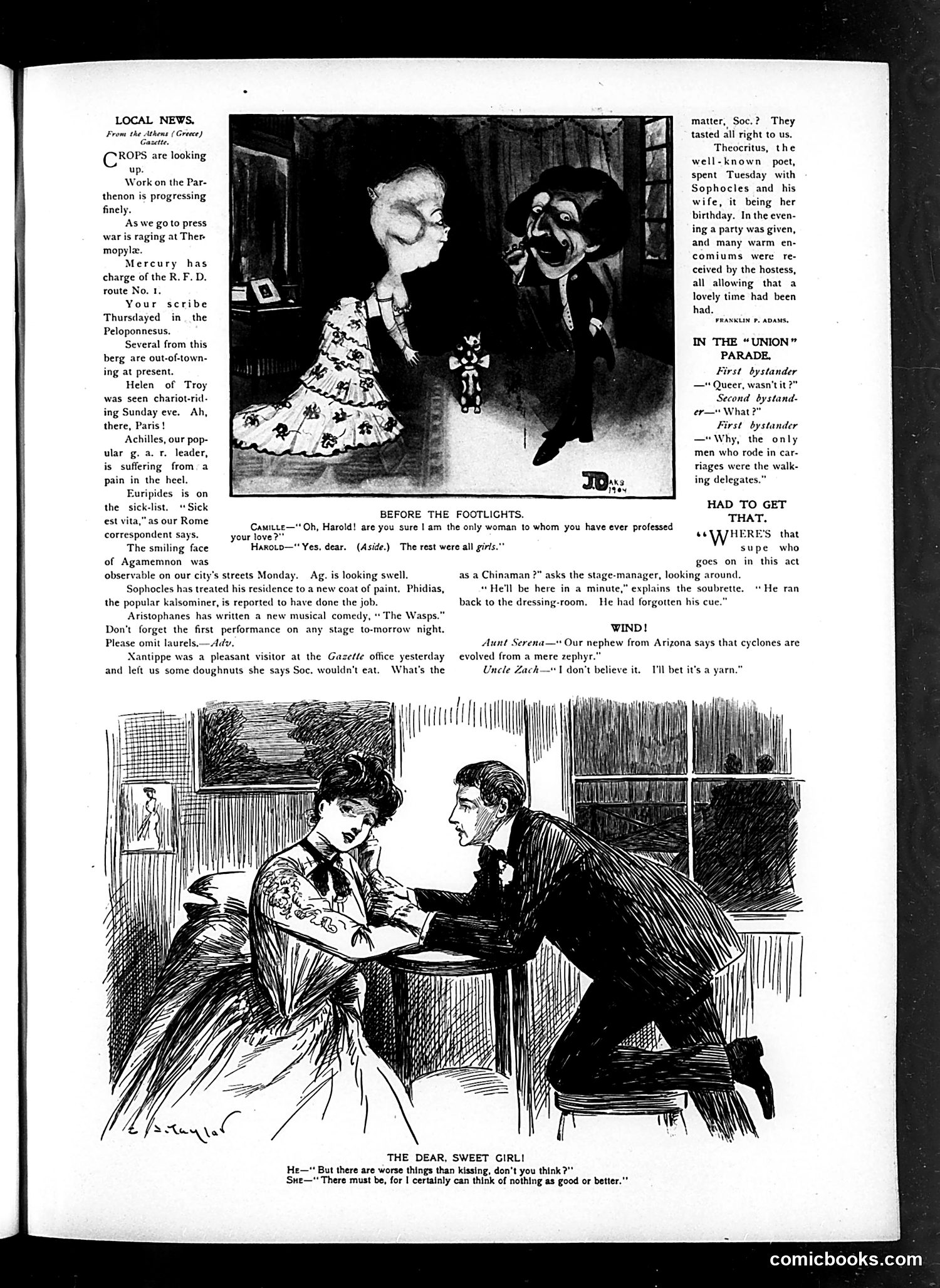
This page contains local news items, theatrical gossip, and two cartoon illustrations. The top photograph and caption "Before the Footlights" depicts a theatrical scene with a woman and man in costume, apparently showing a romantic or comedic stage moment. The dialogue suggests flirtation between characters. The bottom cartoon, titled "The Dear, Sweet Girl!" shows a man and woman in an intimate domestic setting. The dialogue—"But there are worse things than kissing, don't you think?" and "There must be, for I certainly can't think of nothing as good as better"—appears to be gentle romantic/sexual humor typical of early 20th-century magazine satire, playing on the woman's somewhat contradictory logic about romance. Both items are theater-focused entertainment content without apparent political significance.
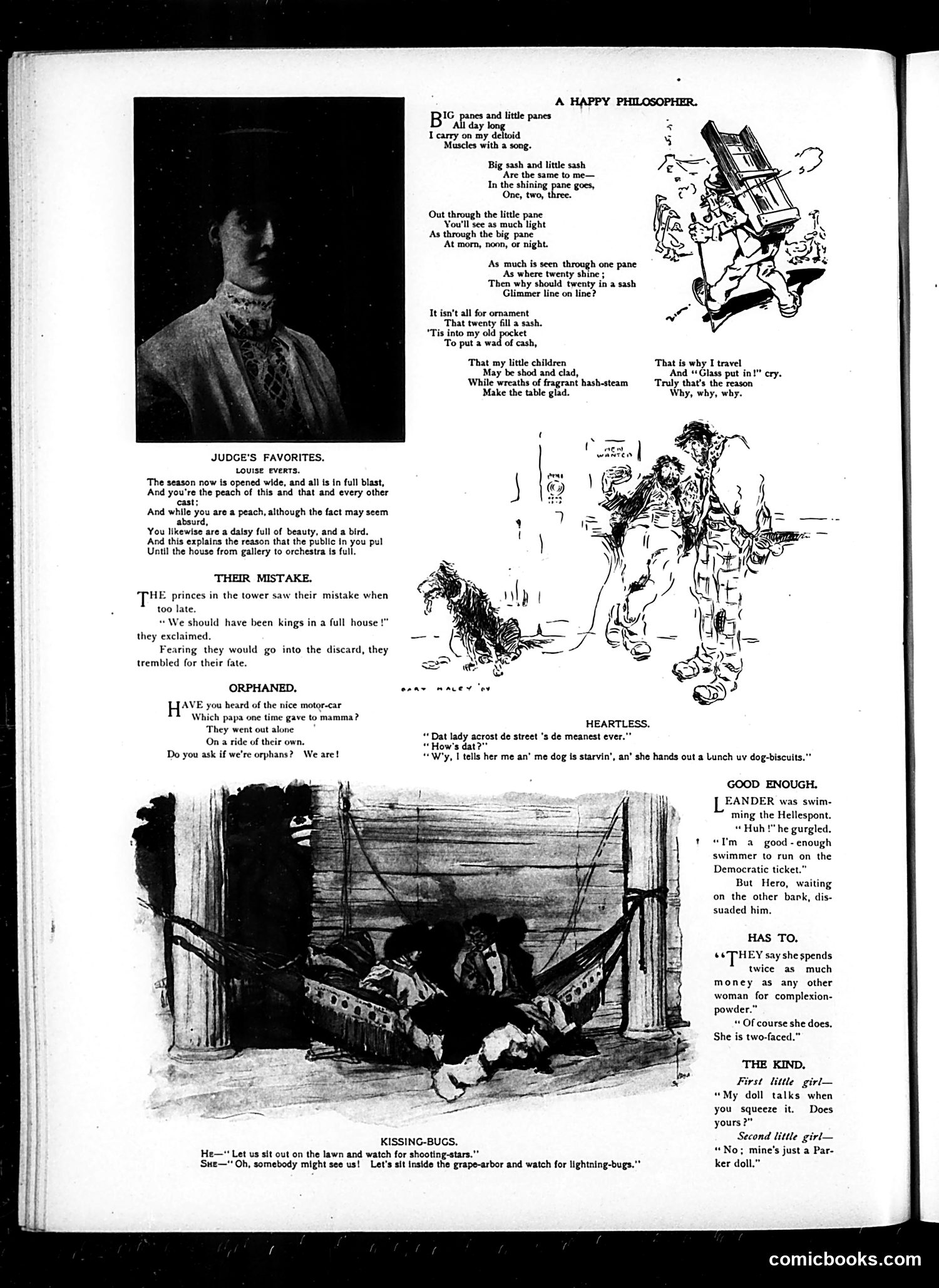
This page contains several humorous sketches and poems typical of early 20th-century American satirical journalism. The content includes: **"A Happy Philosopher"** — A poem celebrating the simple pleasures of looking through window panes, with accompanying whimsical illustrations of people engaged in everyday activities. **Other titled pieces** like "Judge's Favorites," "Their Mistake," "Orphaned," "Heartless," "Good Enough," "Has To," and "The Kind" appear to be brief satirical observations about contemporary social behavior and human nature—critiquing vanity, pretension, and hypocrisy through short anecdotes and witty commentary. **"Kissing-Bugs"** references a specific period concern (early 1900s pest panic). The page's humor targets universal human foibles rather than specific political figures or events, making it representative of Judge's general satirical approach to American society.
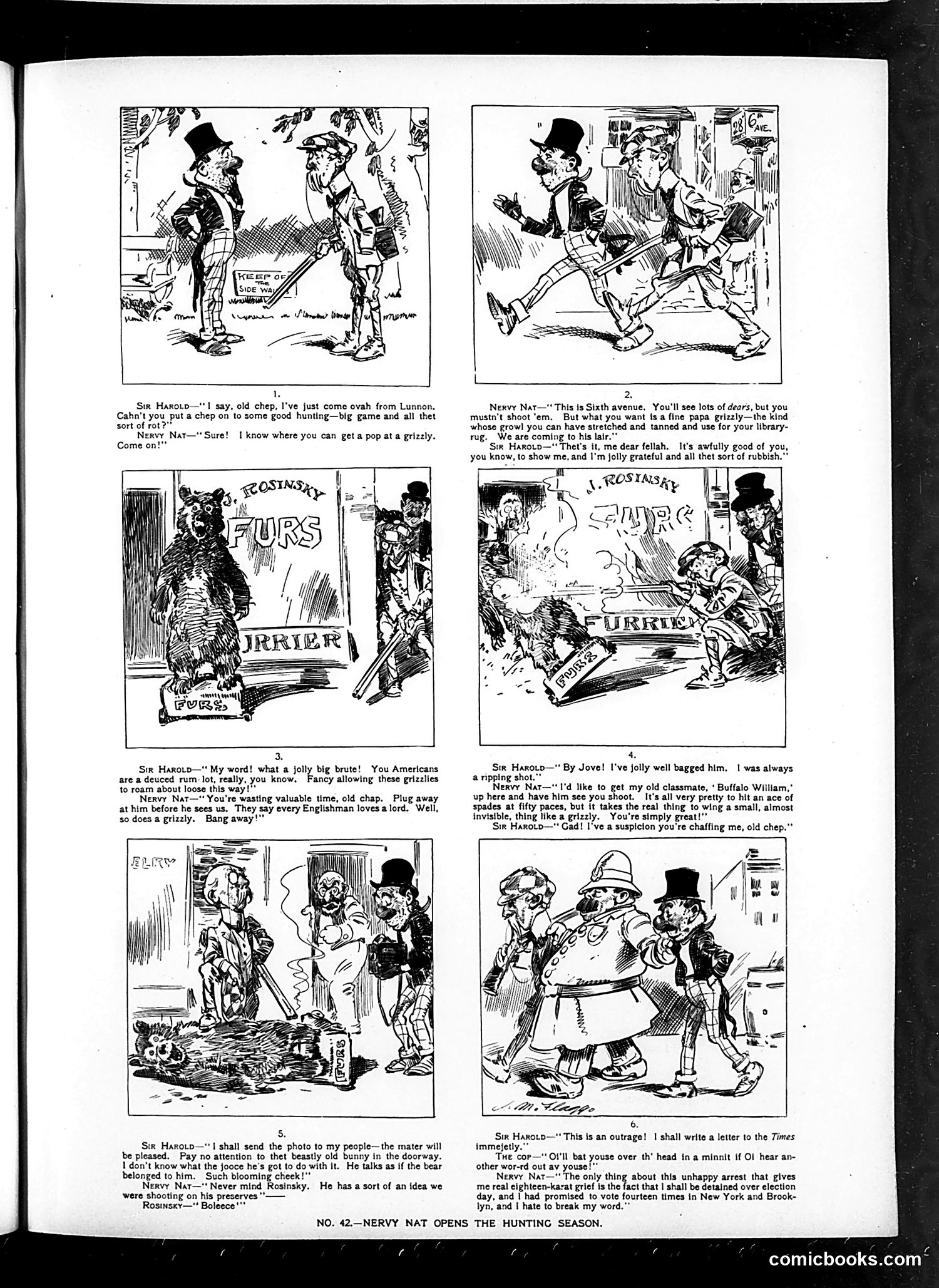
This is a satirical sequence mocking both British pretension and American electoral corruption. A wealthy British aristocrat ("Sir Harold") visits America seeking big-game hunting. "Nervy Nat," a con artist, takes him on a fraudulent hunt on New York's Sixth Avenue, where they supposedly shoot a grizzly bear that appears to be a scam—the "bear" may be fake or belong to someone else (the proprietor "Rosinsky"). The satire targets: (1) British snobbery about American wilderness and wildlife; (2) American hustlers exploiting gullible foreigners; and (3) rampant electoral fraud—Nervy Nat casually mentions voting "fourteen times in New York and Brooklyn," highlighting the era's notorious ballot-box corruption. The "hunting season" is a metaphor: Americans are hunting for British money and election votes alike. The humor relies on period-specific knowledge of American political scandal.
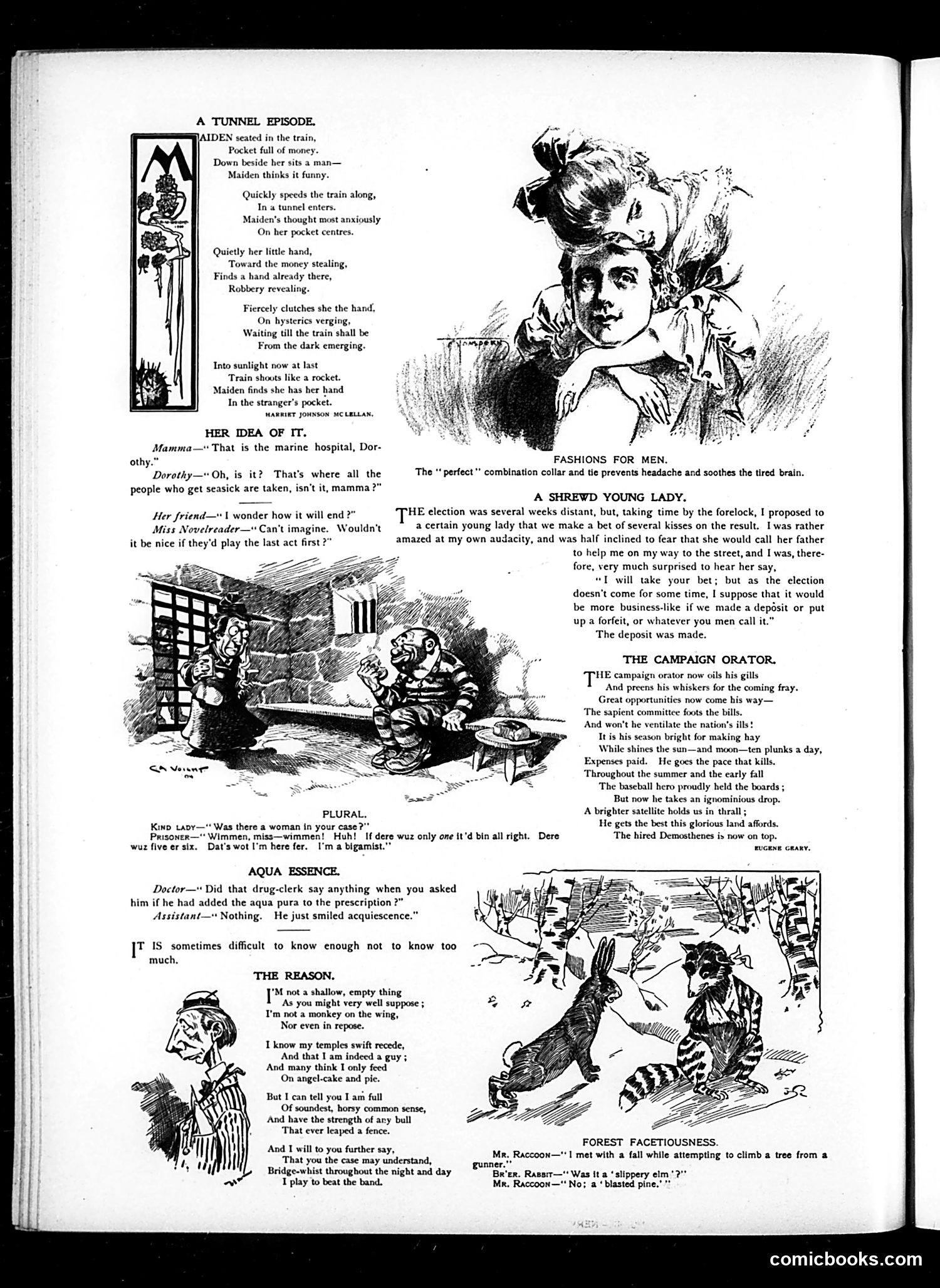
This Judge magazine page contains multiple satirical pieces typical of early 20th-century American humor: **"A Tunnel Episode"** mocks Victorian anxiety about propriety. A young woman, sitting near a man on a train, assumes he's stealing her money in a dark tunnel. She grabs his hand in alarm—only to discover upon emerging that *her* hand was in *his* pocket. The joke plays on gender stereotypes and paranoid prudishness. **"A Shrewd Young Lady"** satirizes courtship conventions. A young woman accepting a bet of kisses on an election outcome shrewdly demands a "forfeit" be deposited first—turning romantic banter into a business transaction, outwitting the man's casual proposition. **"The Campaign Orator"** ridicules political speakers as opportunistic performers who exploit election seasons for easy money, drawing comparison to more popular entertainers like baseball heroes. Scattered throughout are light gags about misheard words, fashion, and animal humor typical of period magazines. The overall tone reflects Belle Époque-era comic sensibilities—focused on courtship mishaps, class pretension, and mild social critique.
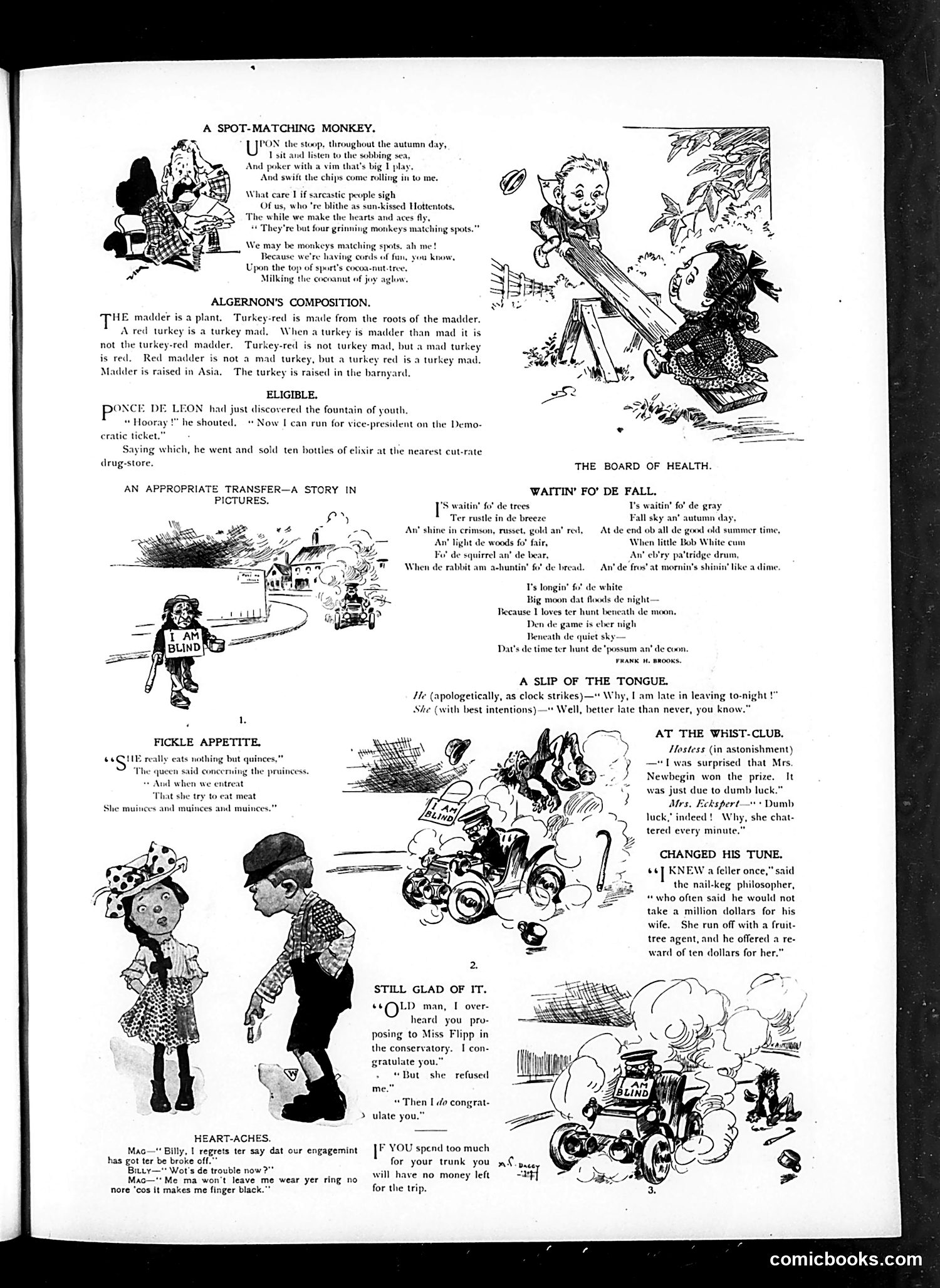
This page contains various humorous sketches and short pieces typical of early 20th-century American satirical magazines. Key items include: **"A Spot-Matching Monkey"** mocks people who obsessively gamble (playing poker), comparing them to monkeys playing a matching game—suggesting gambling is mindless behavior. **"Algernon's Composition"** is absurdist humor: a student's deliberately circular, tongue-twisting essay about madder plants and turkeys, poking fun at pretentious or meaningless academic writing. **"Ponce de Leon"** satirizes a politician (unclear which one) who, after "discovering" a youth elixir, immediately tries to capitalize on it commercially and politically—mocking opportunistic public figures. **"Appropriate Transfer"** uses dialect humor common to the era, depicting a Black character romanticizing autumn hunting season. The remaining pieces are brief domestic comedies about engagement mishaps, whist-club gossip, and marital complications—standard light comedy fare reflecting middle-class social anxieties of the period.
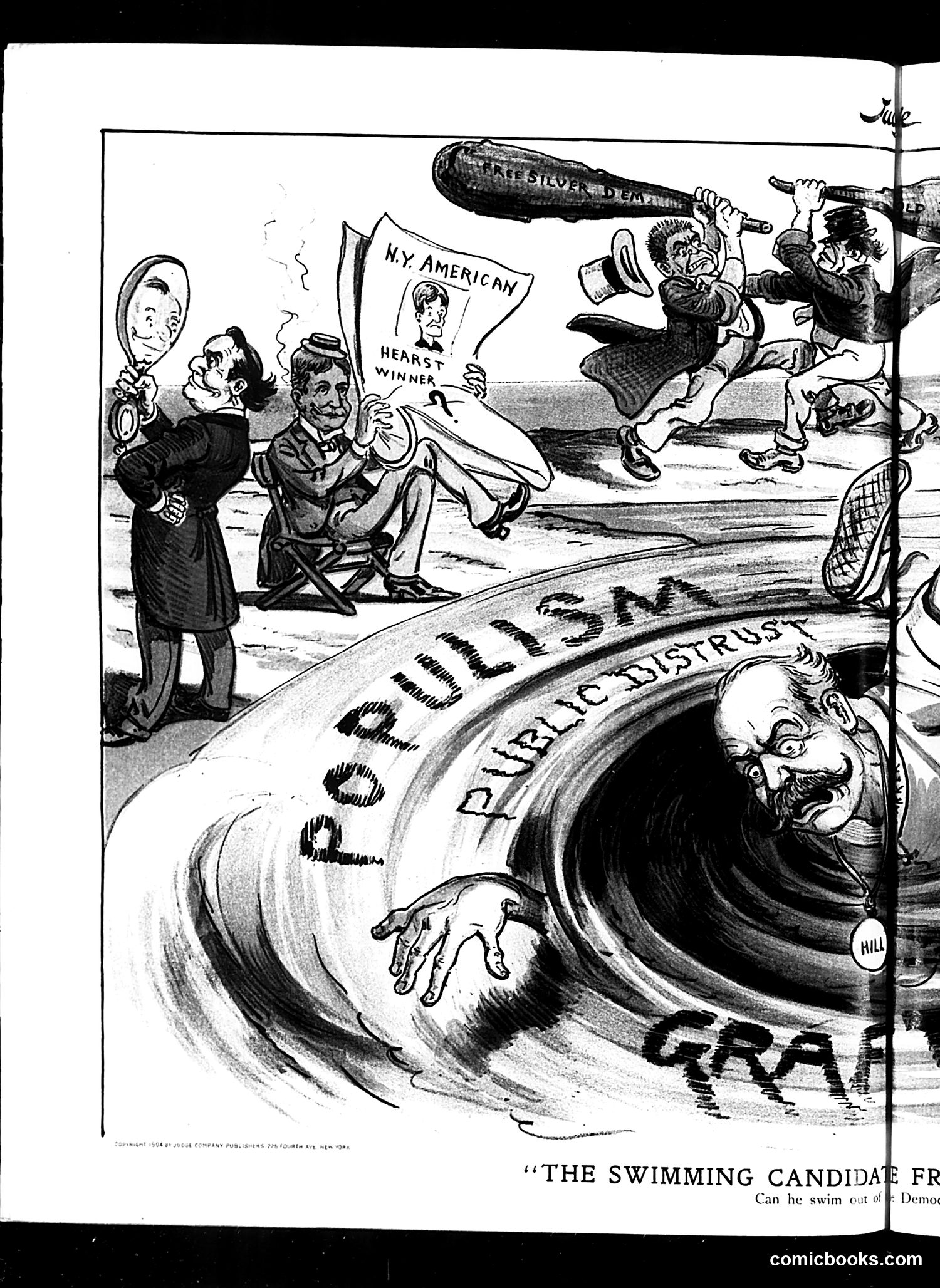
This political cartoon satirizes a Democratic candidate attempting to escape or navigate through what appears to be a barrel or container labeled "POPULISM" and marked "FOR INDUSTRY TRUST." The cartoon depicts the candidate as struggling within constraints—likely criticism that he cannot escape Democratic Party positions or populist demands, despite attempts to appeal to business interests. Figures on the left (appearing to represent party leadership or the press) observe skeptically, with one holding a mirror and another displaying a "N.Y. AMERICAN HEARST WINNER" banner, suggesting media scrutiny. The title's wordplay—"swimming candidate"—implies the politician is floundering or out of his depth navigating conflicting party pressures and public expectations during what appears to be a presidential campaign.
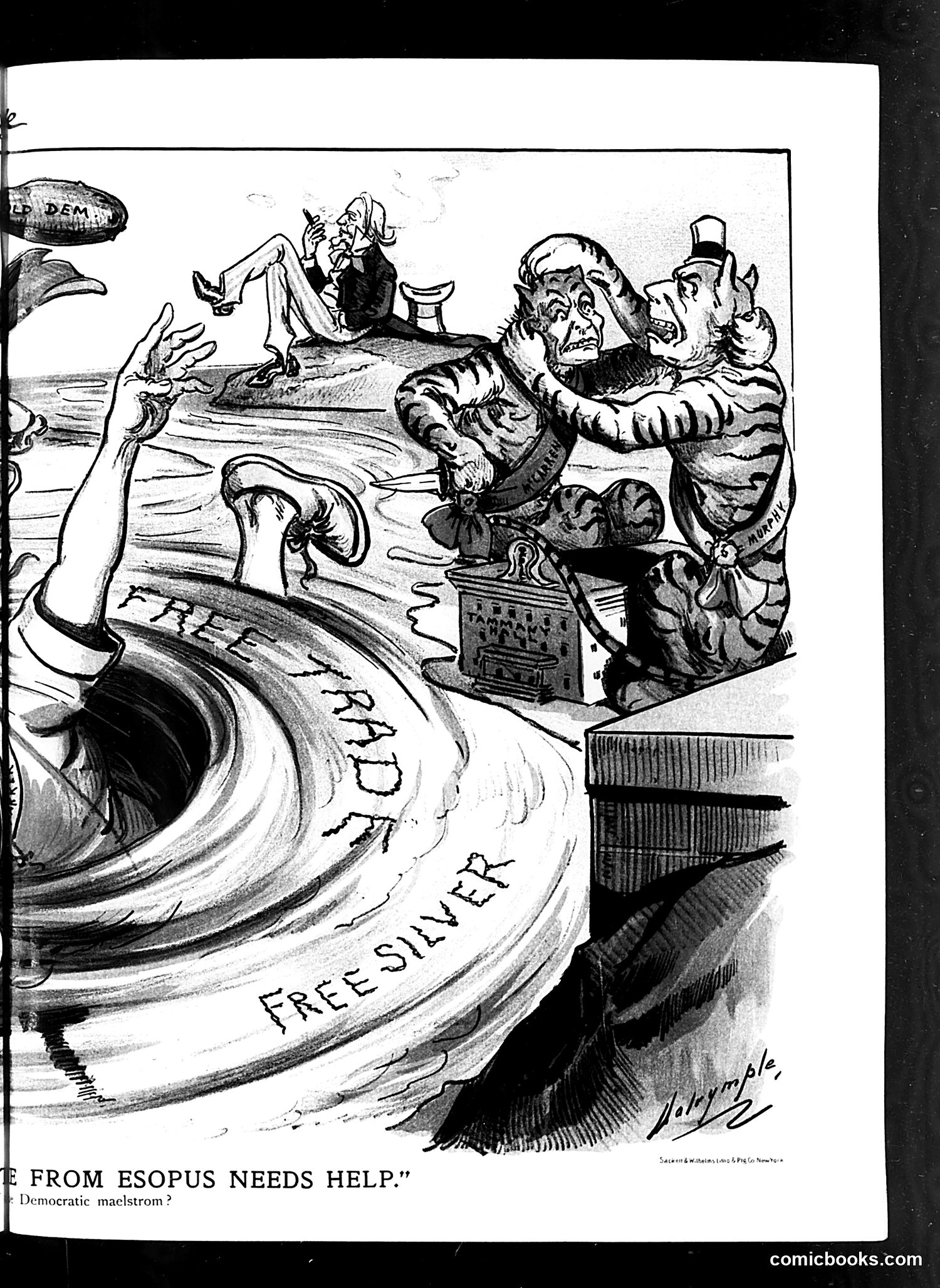
This appears to be a satirical cartoon from *Judge* magazine depicting Democratic Party turmoil. The visible text "FREE SILVER" on a whirlpool suggests the cartoon addresses the late 1890s "Free Silver" debate—a major Democratic Party controversy over whether to coin unlimited silver, which divided the party. The caricatured figures (likely Democratic leaders) are shown struggling in turbulent waters labeled "FREE SILVER" and "DEMOCRATIC," appearing distressed or drowning. The caption "FROM ESOPUS NEEDS HELP" likely references a political figure associated with Esopus, New York, though the specific identity remains unclear. The satire mocks Democratic infighting over monetary policy, portraying the party as chaotic and unable to govern effectively during this period of internal division.
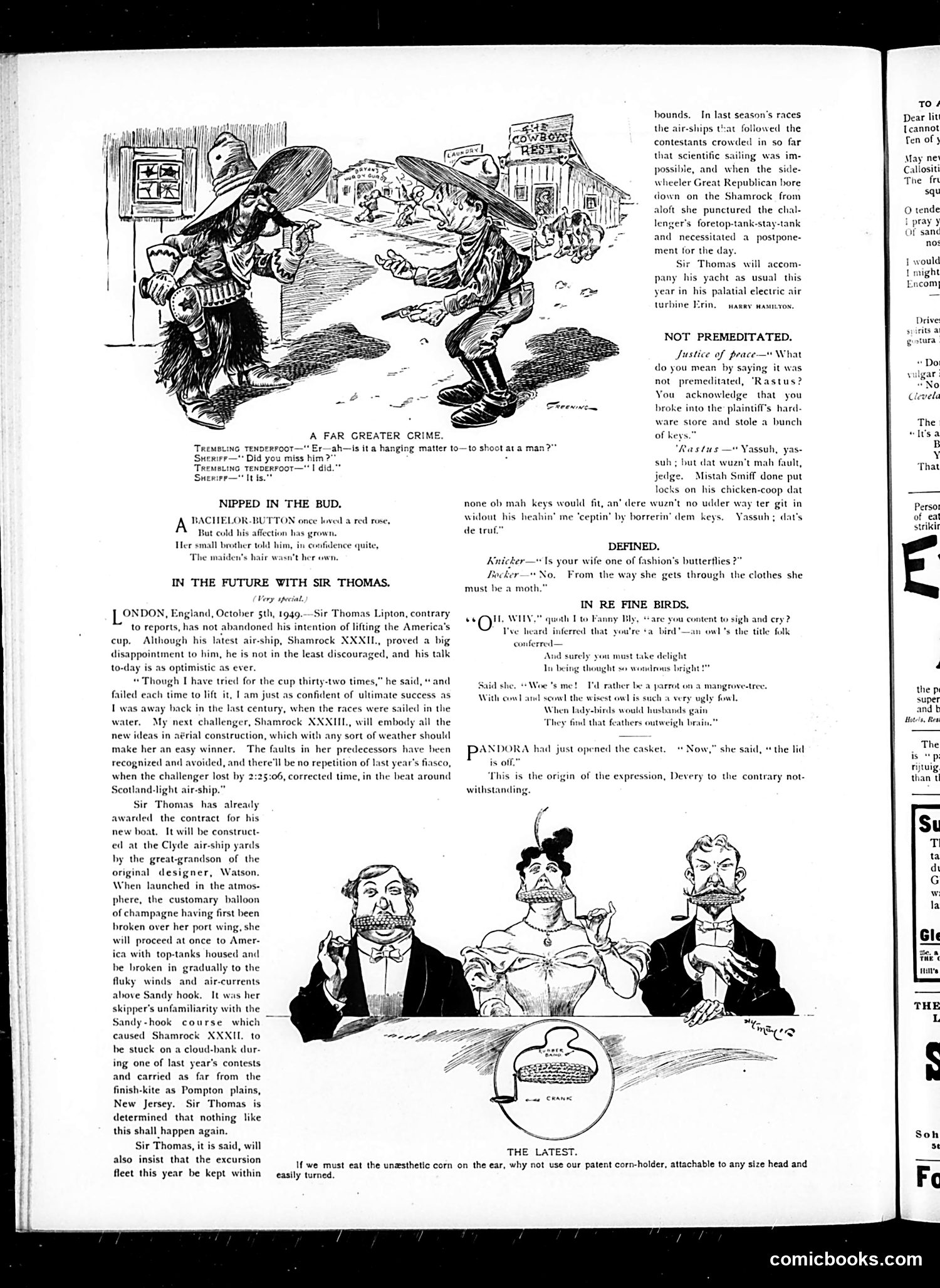
This page contains several satirical pieces typical of Judge's humor: **"A Far Greater Crime"** depicts a sheriff and Tremaine Tenderfoot discussing a missed target—likely poking fun at Wild West incompetence or law enforcement failures. **"Nipped in the Bud"** is a romantic comic about a bachelor whose affection cooled after learning his girlfriend's red hair wasn't natural—satirizing vanity and false appearances in courtship. **"In the Future with Sir Thomas"** is the main piece, mocking Sir Thomas Lipton's repeated failed attempts to win the America's Cup yacht race. The satire imagines absurdly futuristic "air-ships" replacing sailboats, with increasingly ridiculous design failures, poking fun at Lipton's persistent optimism despite decades of losses. It references his actual yacht *Shamrock*. **Minor pieces** include racial dialect humor ("'Rastus"), marriage jokes, and wordplay typical of the era's Judge content. The overall tone is lighthearted mockery of contemporary figures and social foibles rather than serious political commentary.
This page from Judge magazine contains primarily **humorous anecdotes and advertisements** rather than political cartoons requiring historical context. The notable content includes: **Literary/Joke Items**: Brief satirical pieces mocking everyday absurdities—a landlord's ridiculous logic about a damp house being "fireproof," a wife abandoning theosophy because she can't astral-project to multiple social events simultaneously, and a rhinoceros lamenting it cannot "blow its own horn." **Social Commentary**: A poem romanticizing women's feet (reflecting period attitudes toward feminine delicacy), and oblique references to contemporary concerns like automobile nomenclature and coffee's effects on complexion. **Advertising**: The page is dominated by period product ads (pianos, beer, soap, trains) typical of early 20th-century magazines. **No Major Political Cartoons**: Unlike some Judge issues, this page lacks the sharp political satire the magazine was known for. The humor is domestic and gentle rather than addressing specific political figures or events. The "Stop Kicking Miller" beer advertisement appears to be brand marketing rather than substantive commentary.
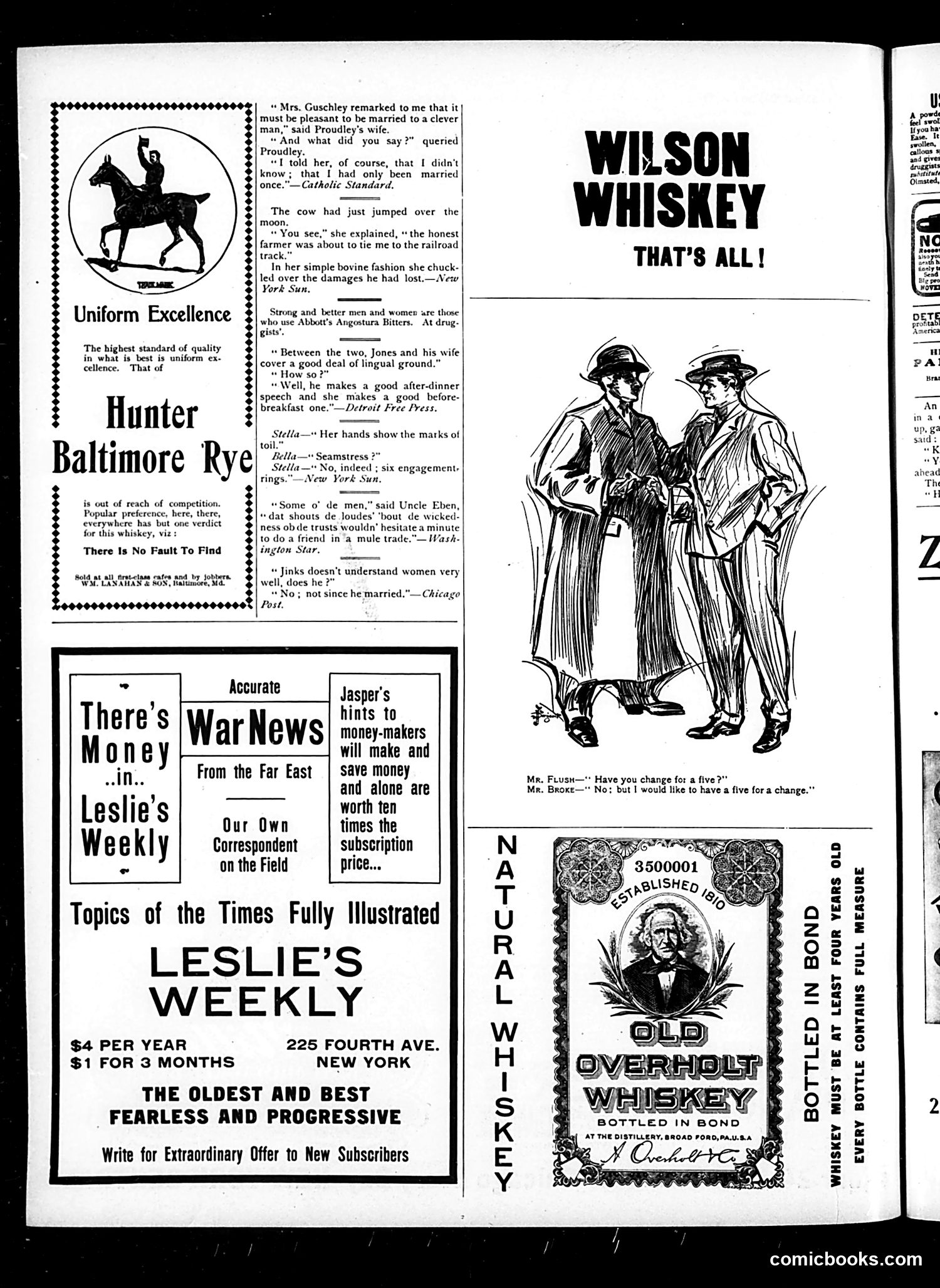
This page is primarily **advertising and filler content** rather than political satire. It contains multiple brief humorous anecdotes and advertisements typical of early 20th-century magazines. The small jokes mock domestic situations: a wife's backhanded compliment about marrying a clever man, a cow's indifference to property damage, and marital communication failures. These rely on contemporary assumptions about marriage dynamics and gender roles that modern readers might find dated. The main visual content is a **cartoon illustration** showing two men in period dress and hats, captioned with an exchange about making change—a simple joke about financial transactions. The bulk of the page comprises **whiskey and magazine advertisements**: Hunter Baltimore Rye whiskey, Old Overholt Whiskey (bottled in bond), and Leslie's Weekly magazine. These ads exploit period-specific concerns like product quality guarantees and investment tips during wartime ("War News From the Far East"). The satire is minimal and local rather than political—mostly gentle ribbing of everyday married life and business practices.
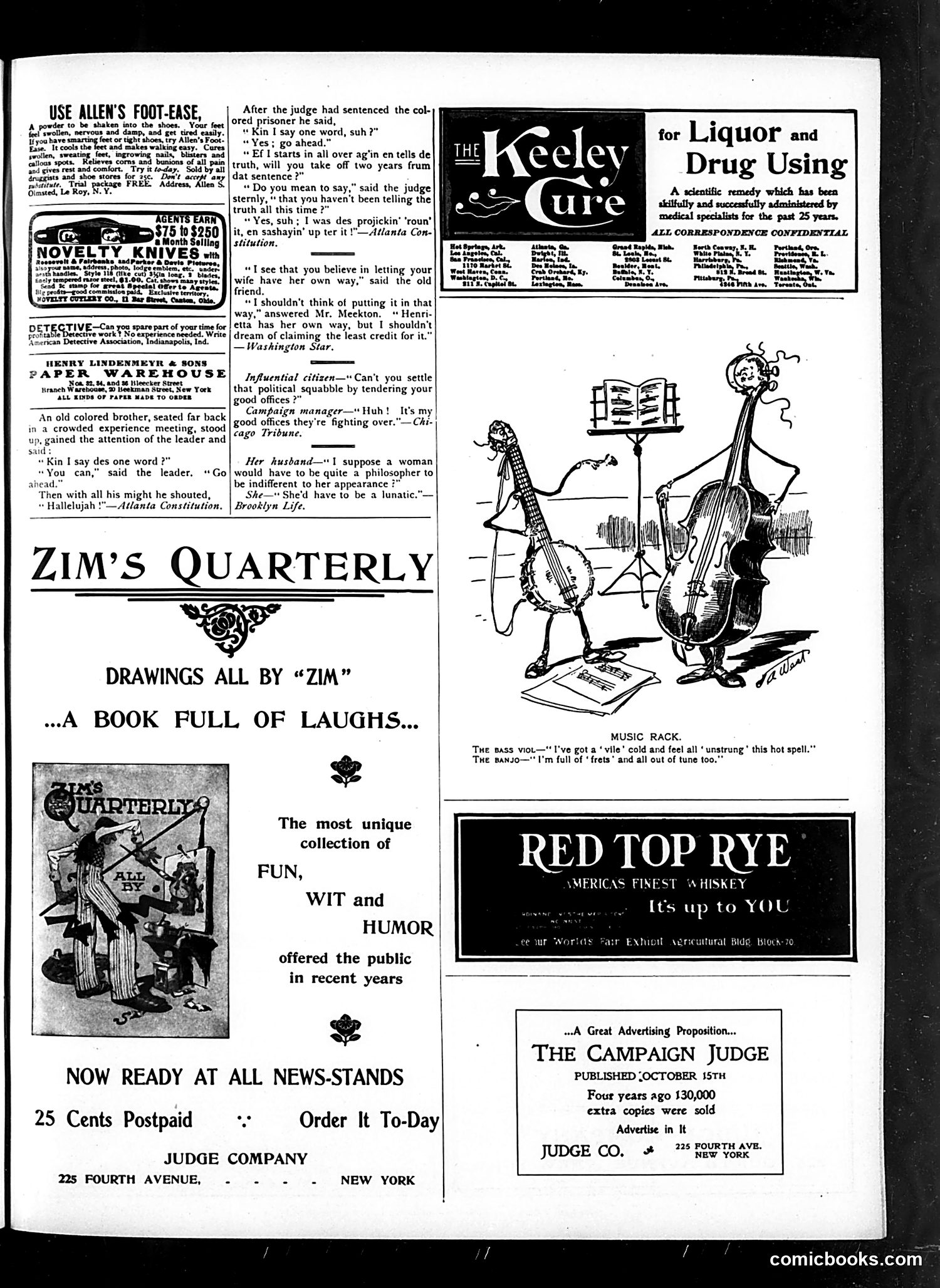
This page is primarily **advertisements and filler content** rather than political satire. The main elements: **Comic Bits:** Several short jokes appear, mostly featuring racist dialect humor common to early 20th-century publications. These include stereotypical depictions of African American speakers in religious and legal settings—standard "humor" of the era that modern readers would recognize as offensive. **The Music Rack Cartoon:** Shows anthropomorphized musical instruments (bass viol and banjo) making puns about being "unstrung" and "out of tune"—mild wordplay rather than satire. **Advertising:** The bulk of the page consists of ads for Allen's Foot-Ease, detective work, paper warehouse services, Zim's Quarterly (a humor book), liquor treatment, Red Top Rye whiskey, and Judge Company's own Campaign Judge magazine. **Historical Context:** This reflects Judge's nature as a commercial publication mixing light humor with advertising, rather than focused political cartooning. The racist dialect jokes represent period attitudes that are jarring to modern readers.
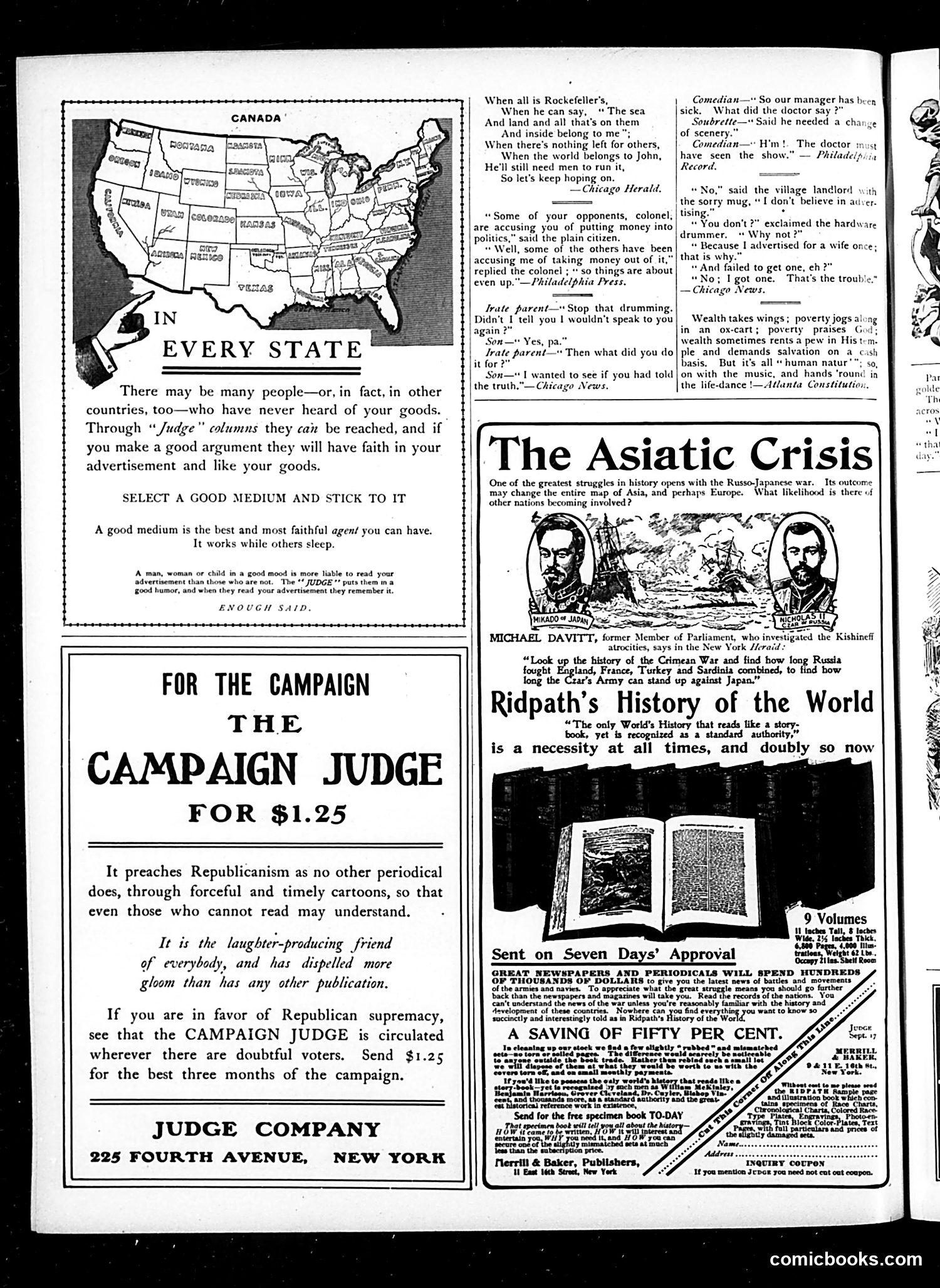
This page from Judge (a satirical Republican publication) blends political messaging with advertisements. The top section features **pro-Republican campaign material**—advertising the "Campaign Judge" publication for $1.25 to promote "Republicanism" through cartoons, targeting voters who "cannot read." **The cartoons** are brief humorous exchanges touching on common themes: a Rockefeller reference joking about monopoly wealth, political corruption accusations, domestic life, show business, small-town attitudes toward advertising, and class commentary on wealth versus poverty. **"The Asiatic Crisis"** section addresses the **Russo-Japanese War** (1904-1905), quoting politician Michael Davitt asking how long Russia can withstand Japanese military power—a timely geopolitical concern for American readers. The **Ridpath's History advertisement** promotes a 9-volume history set as essential reading given current world events. Overall, this page reflects Judge's dual purpose: satirical entertainment with Republican political advocacy, packaged among advertisements aimed at educated middle-to-upper-class readers interested in current events.
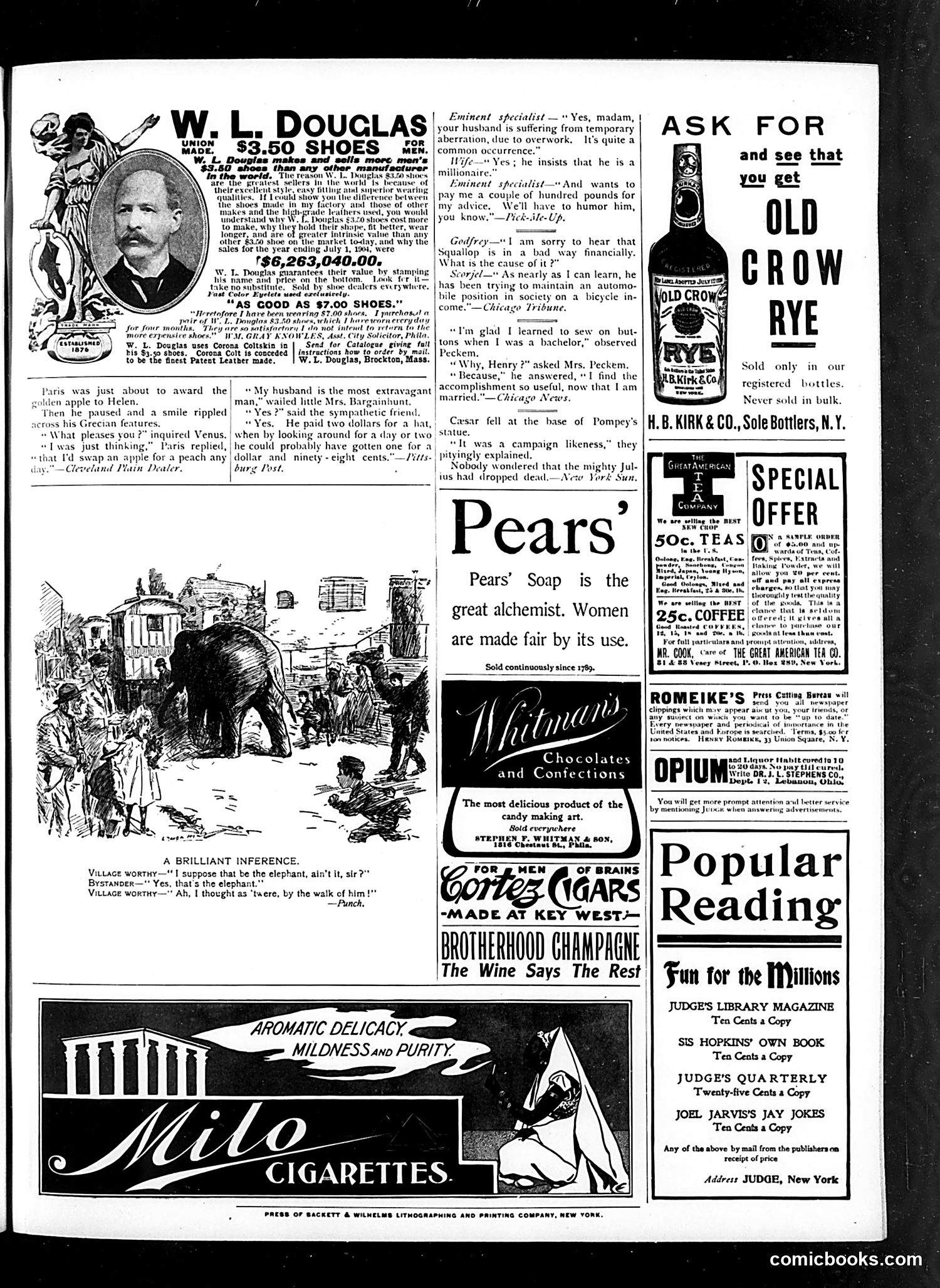
This page consists primarily of **advertisements mixed with brief satirical jokes**—typical of Judge's format. The cartoon jokes are light social satire: - **"Eminent Specialist"**: A man experiencing delusions of wealth due to work stress. The humor lies in the doctor's decision to humor his millionaire fantasy rather than cure it—suggesting either his condition is harmless or the doctor wants payment. - **"Godfrey/Scorjel"**: A pun about someone trying to maintain a wealthy lifestyle ("automobile position in society") while living on modest means ("bicycle income")—mocking pretension and financial overextension. - **Greek mythology references**: Jokes about Paris, Helen, and Caesar are brief wordplay pieces unrelated to current events. The **advertisements** include W.L. Douglas shoes ($3.50), Pears' Soap, Old Crow Rye whiskey, Whitman's Chocolates, and various publications. These reveal period consumer culture. There's **no overt political satire** on this page—it's entertainment-focused, emphasizing consumer goods and light humor typical of early 1900s American magazines.
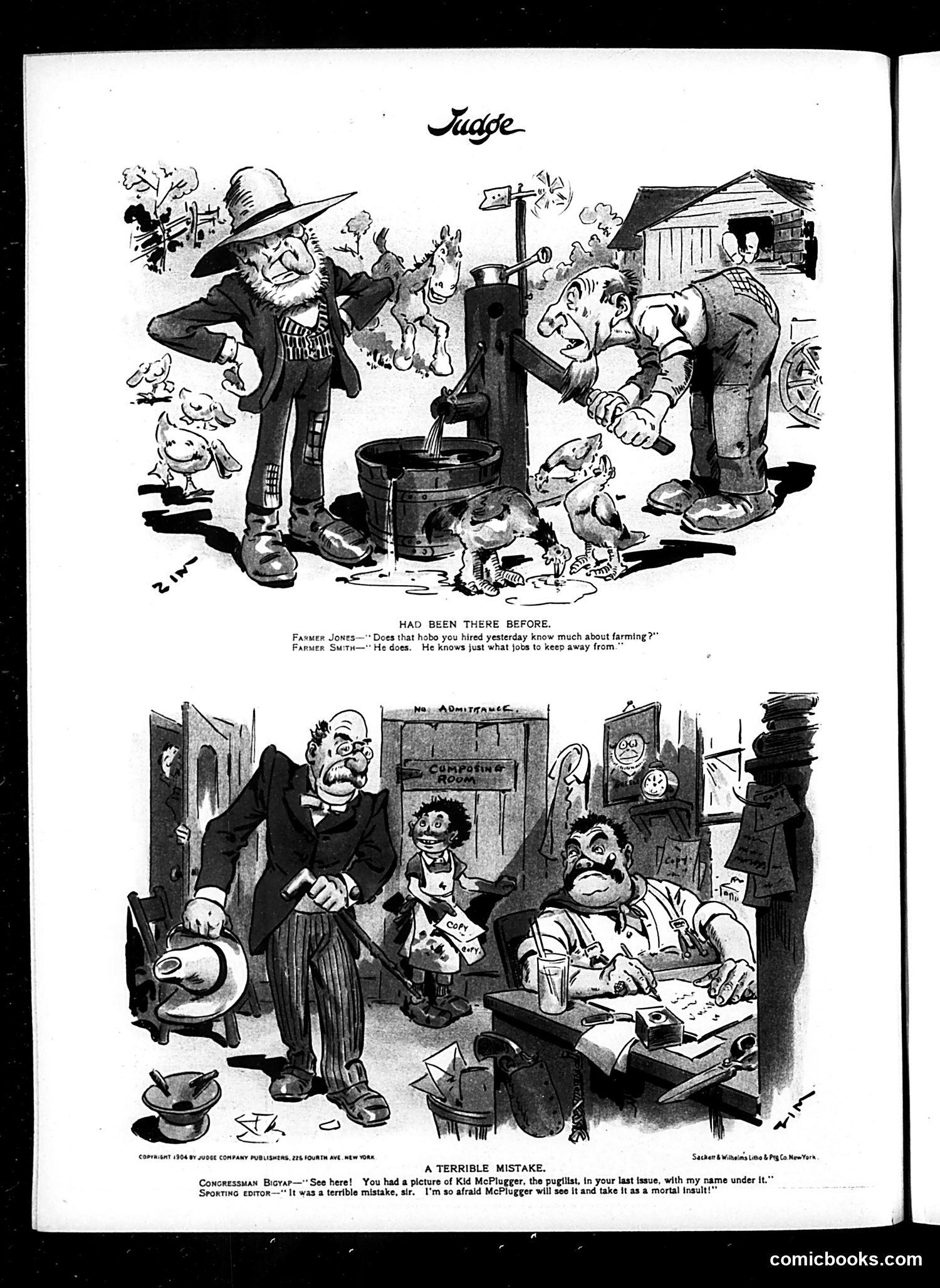
**Top cartoon ("Had Been There Before"):** Two farmers discuss hiring a vagrant/hobo. The joke: the hobo knows farming so well that he specifically avoids doing farm work—suggesting he's experienced enough to know which jobs are hardest or most undesirable. It's satirizing both lazy workers and farmers' difficulty finding reliable labor. **Bottom cartoon ("A Terrible Mistake"):** A congressman complains that his photograph was mistakenly published with pugilist Kid McPlugger's name. The sporting editor's response—he's "afraid McPlugger will see it and take it as a mortal insult"—is the joke: comparing the congressman's appearance to a boxer is so insulting that McPlugger might challenge him to a fight. The satire mocks the congressman's vanity and low public standing compared to a prizefighter. Both cartoons use exaggerated caricature and working-class/political figures as targets for social ridicule typical of Judge's satirical approach.