
A complete issue · 16 pages · 1904
Judge — August 27, 1904
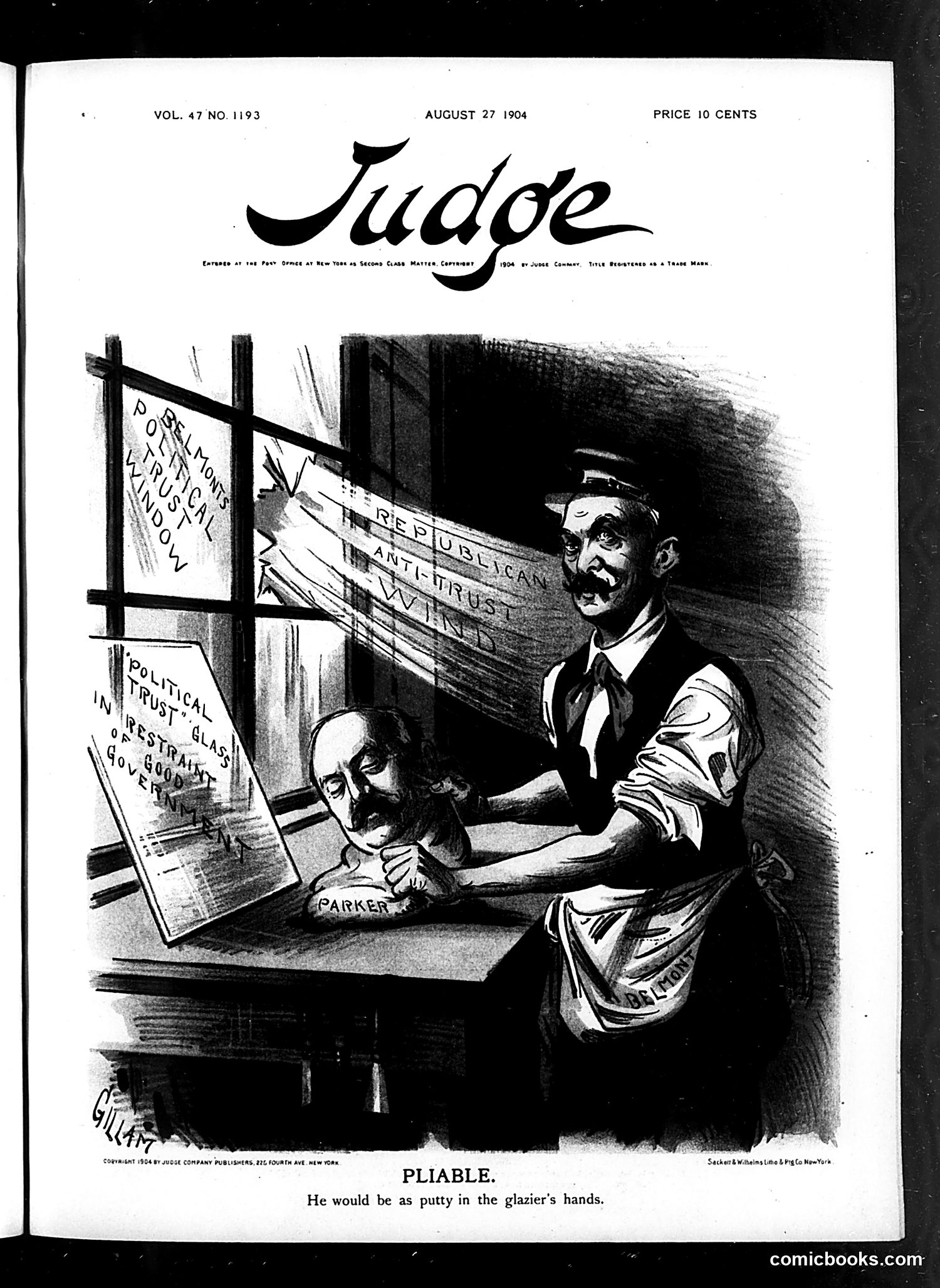
This Judge magazine cartoon from August 27, 1904 depicts a political figure labeled "Parker" being molded like clay by a glazier (glassworker). The caption reads: "He would be as putty in the glazier's hands." **Context:** This appears to reference Alton B. Parker, the 1904 Democratic presidential candidate. The "Republican Anti-Trust" banner and references to "Political Blasts" and "Trust" suggest the cartoon critiques Parker as easily manipulated by Republican interests on corporate trust issues—major political concerns of the Progressive Era. The satire implies Parker lacks backbone or firm convictions, making him malleable to opposing forces rather than an independent leader. The craftsman-like imagery emphasizes his passivity.
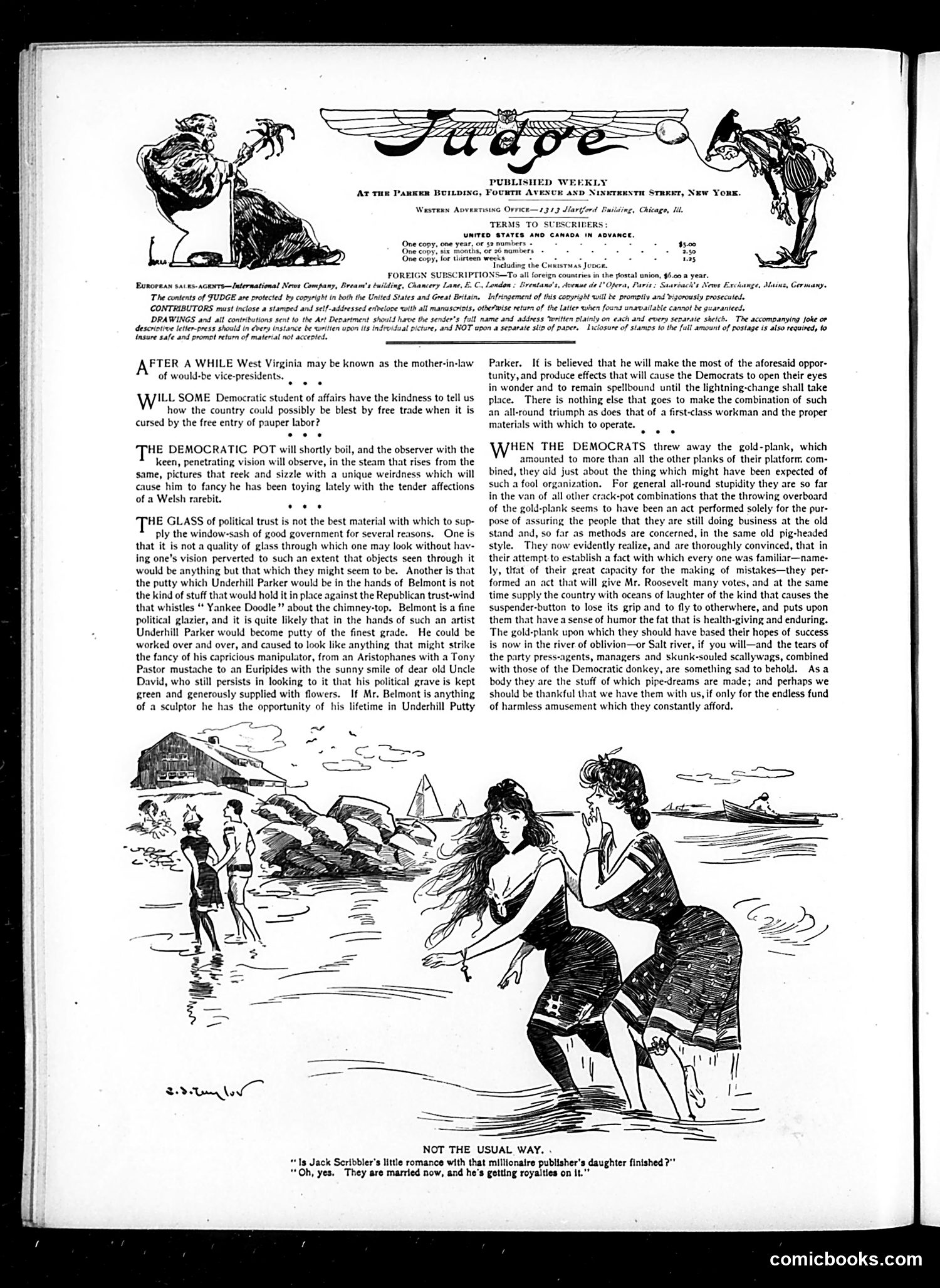
This page contains political commentary on Democratic Party dysfunction. The main articles critique Democratic leadership, comparing them to ineffective materials and questioning their competence. One section mockingly suggests Democrats are so divided they cannot function effectively as a governing party. The beach illustration captioned "NOT THE USUAL WAY" appears to reference a romance involving a millionaire publisher's daughter, suggesting this was a known society scandal of the period. The decorative mastheads feature jester/fool figures, reinforcing Judge's satirical purpose. The overall thrust attacks Democratic political strategy and party unity during what appears to be an early 20th-century election cycle, though the specific year isn't indicated on this page. The commentary suggests Republicans viewed Democratic divisions as a significant political vulnerability.
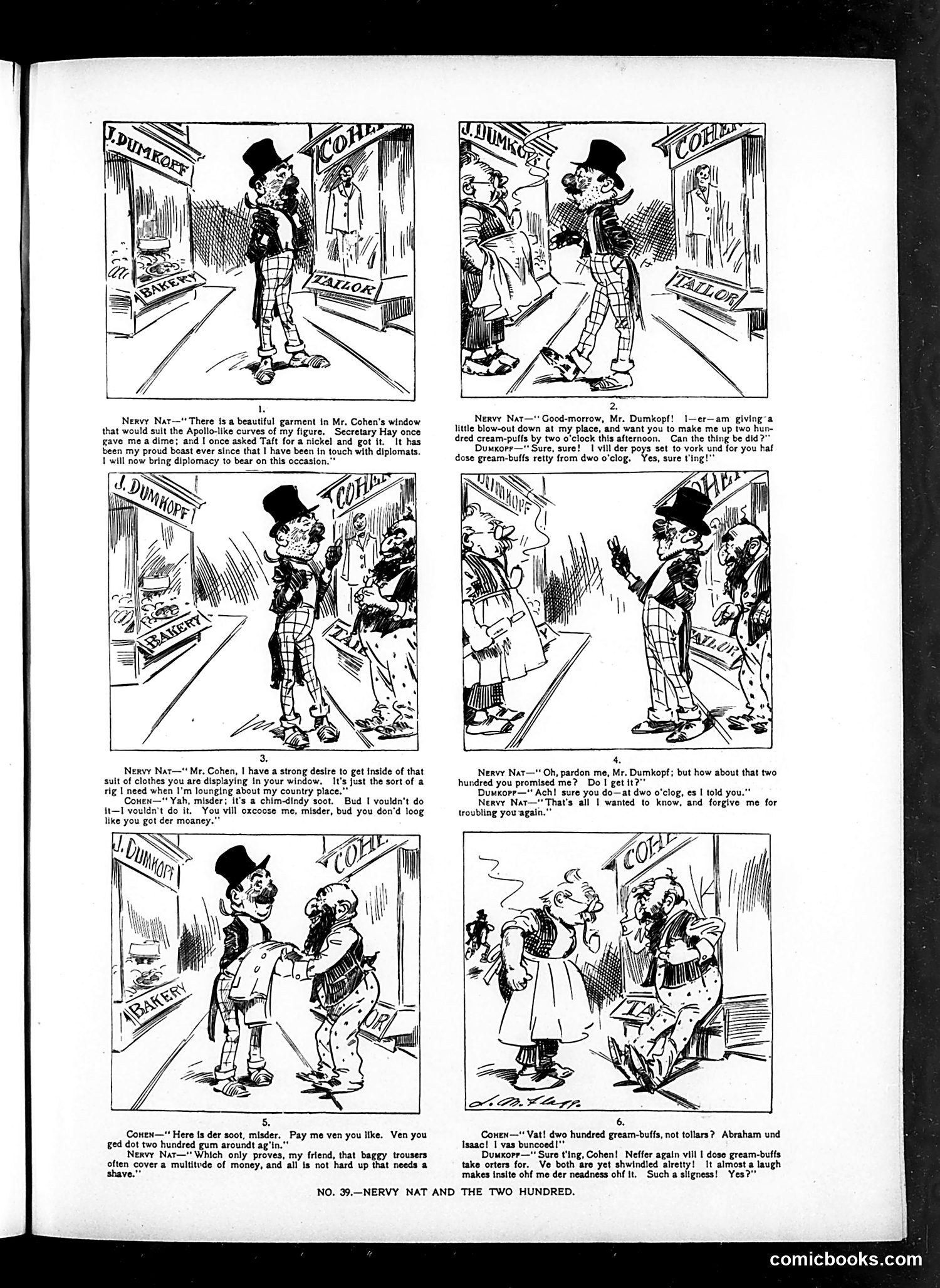
This comic strip appears to feature "Nervy Nat," a character involved in a scheming plot. The narrative involves Nat attempting to obtain Mr. Cohen's valuable garment (described as an "Apollo" tie curved from linen) through deception. Nat convinces someone to make cream-puffs as part of what appears to be a con—arranging for them to be served at two o'clock. The dialogue references a "chim-chiny soot" and baggy trousers covering "a multitude of money." The satire likely targets con-artist schemes and ethnic stereotypes common to early 20th-century humor. The repeated references to cream-puffs and monetary transactions suggest Nat is executing some form of petty theft or swindle involving food as a vehicle for the scheme.
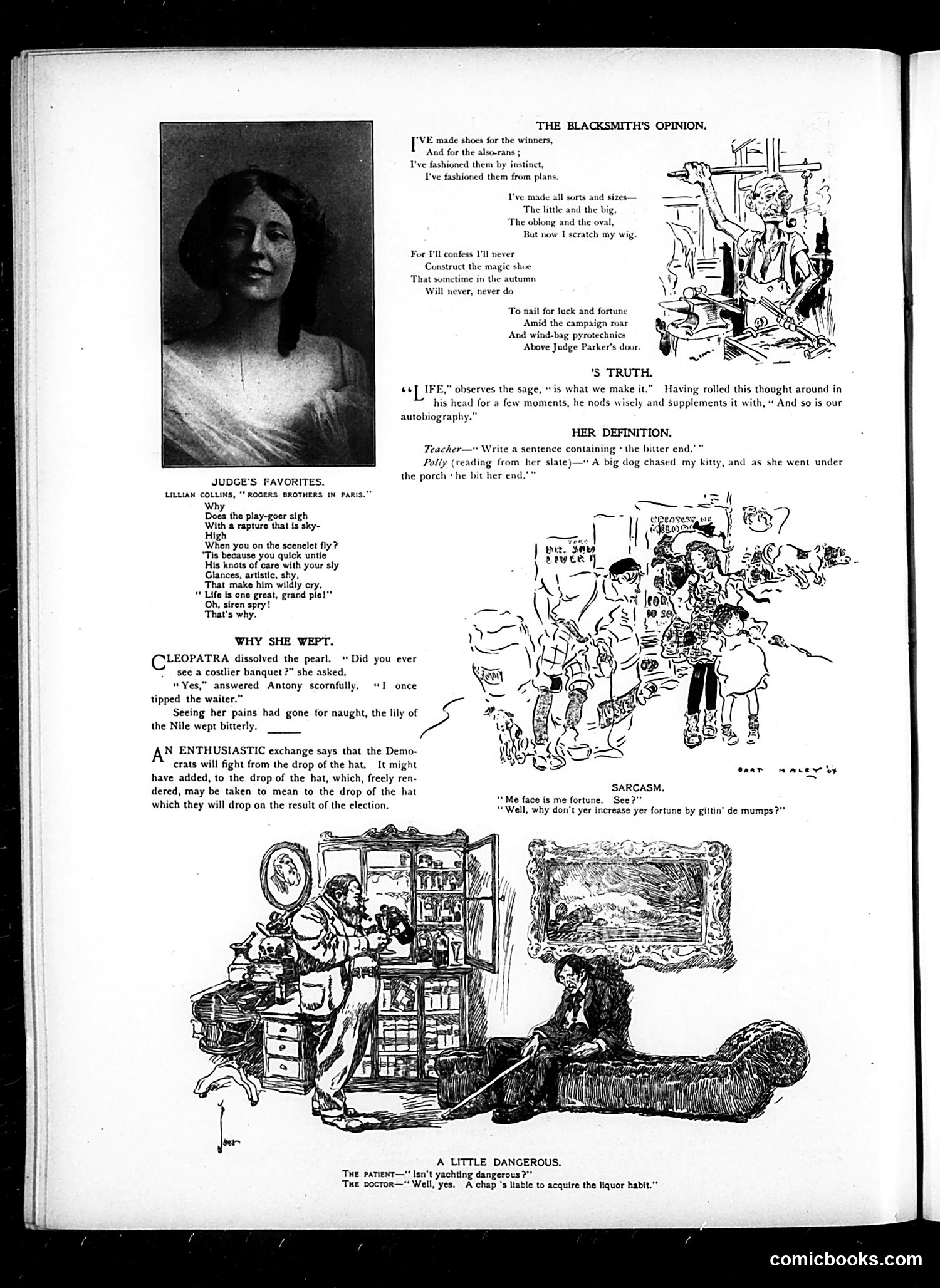
This page contains several disconnected satirical pieces rather than a unified political cartoon. **"The Blacksmith's Opinion"** appears to be light verse about a craftsman's frustrations with impossible commissions, ending with a reference to "Judge Parker's door"—likely a contemporary legal figure. **"Judge's Favorites"** features Lillian Gish (identified in caption), a famous silent film actress, with humorous poetry about her stage presence and dramatic qualities. **"Why She Wept"** presents a brief anecdote about Cleopatra, treating ancient history comedically. **"A Little Dangerous"** is a doctor-patient joke about acquiring a liquor habit through medical prescription—likely referencing Prohibition-era concerns about alcohol as medicine. The illustrations are charming period sketches. The page prioritizes humor and entertainment over sharp political commentary.
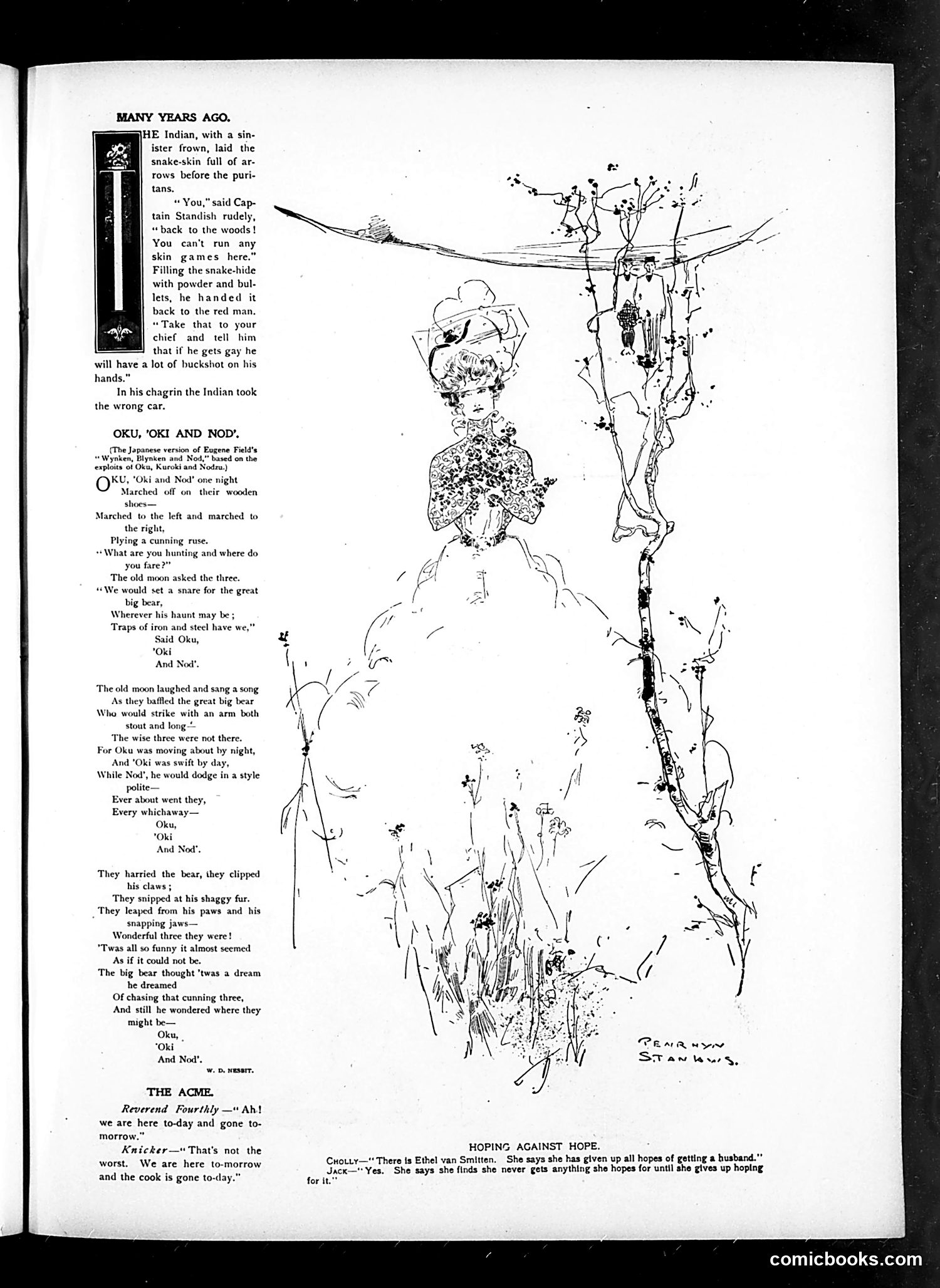
This page contains three distinct pieces of satirical content: **"Many Years Ago"**: A brief historical joke mocking Native Americans and early American colonists, portraying Captain Standish as outwitting an Indian chief through superior firepower—reinforcing period stereotypes of indigenous peoples as inferior and threatening. **"Oku, 'Oki and Nod'"**: A parody of Eugene Field's children's poem "Wynken, Blynken and Nod," adapted to celebrate Japanese military generals (Oku, Kuroki, Nodzu) during the Russo-Japanese War (1904-1905). The "great big bear" represents Russia. This satire praises Japanese military strategy and cunning, portraying them as cleverly outmaneuvering a larger, clumsier opponent. **Bottom sections**: Brief comedic snippets about everyday life—a clergyman's sermon about mortality, and a joke about a woman's romantic prospects improving when she stops hoping. The page reflects early 1900s American attitudes: racism toward Native Americans, admiration for Japan's military success, and conventional domestic humor.
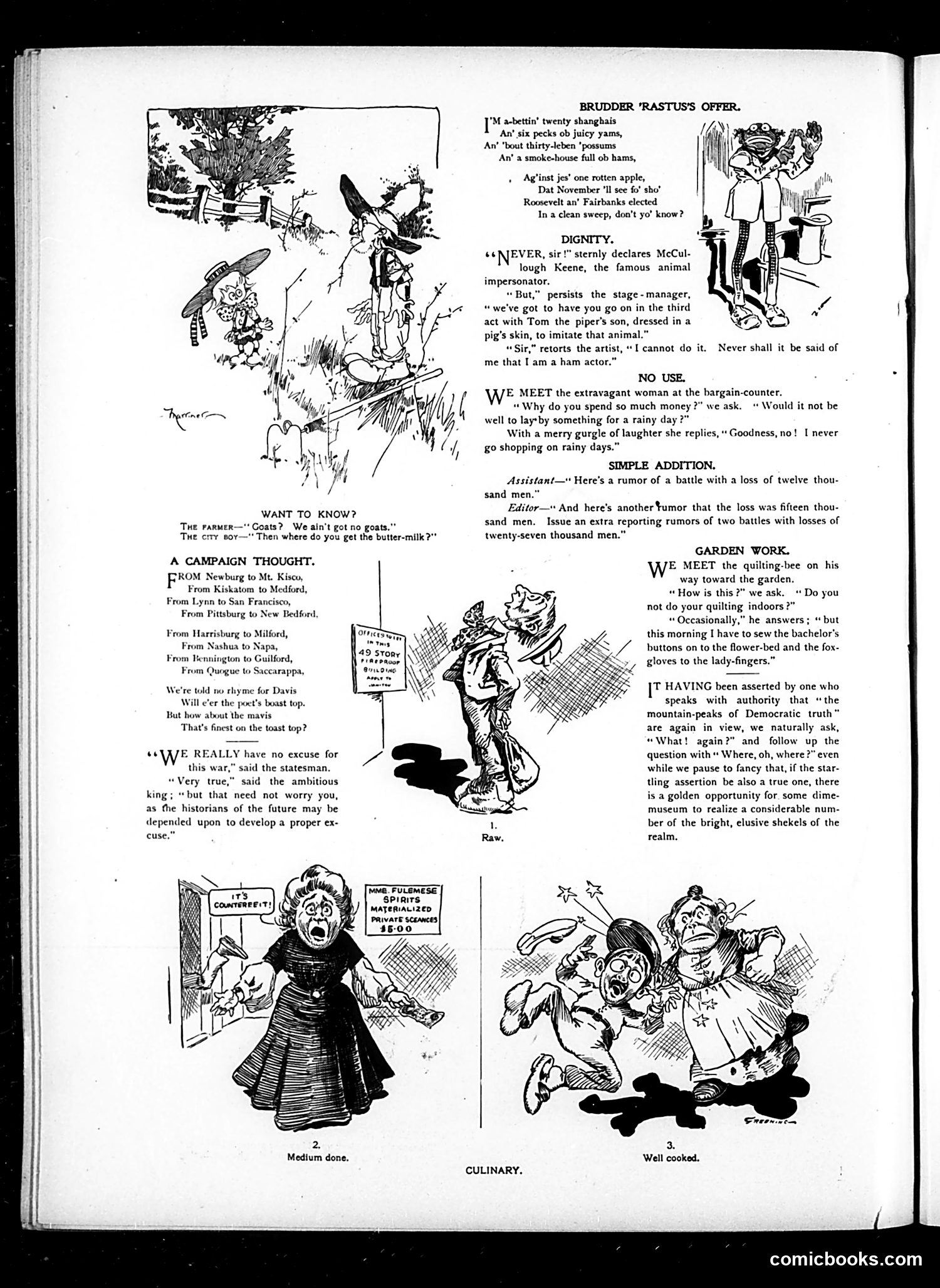
This page from Judge magazine (early 1900s) contains several satirical pieces: **"Brudder 'Rastus's Offer"** uses racist dialect and a caricatured Black figure to joke about the 1904 presidential election. The piece suggests betting against Roosevelt and Fairbanks winning decisively—apparently implying their victory was uncertain or mocking their candidacy through exaggeration. **"A Campaign Thought"** plays on the difficulty finding rhymes for "Davis" (likely referring to a political figure), then makes a pun about "mavis" (a bird) on "toast top." **"Dignity"** mocks an animal impersonator (McCullough Keene) who refuses to wear a pig costume, calling it beneath him—the joke being he'd be a "ham actor" (pun on ham/acting). Remaining pieces are lighter humor about shopping, journalism inflation of battle casualty reports, and domestic/garden wordplay. The page reflects Judge's mix of political commentary and gentle social satire typical of Gilded Age American humor.
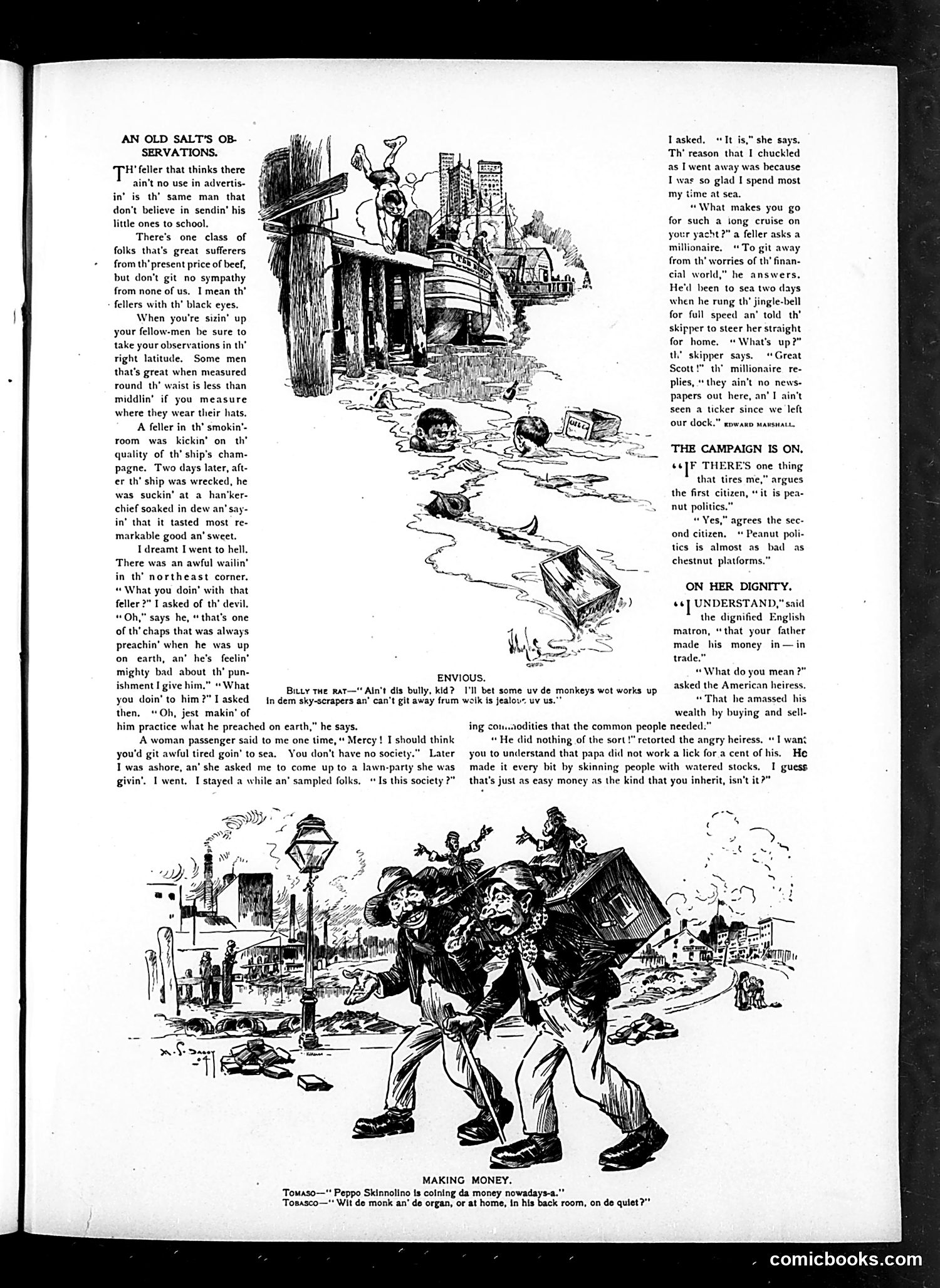
This page contains satirical commentary on wealth, class, and social pretense circa early 20th century. **"An Old Salt's Observations"** presents seafaring wisdom mocking hypocrisy—a millionaire flees financial worries by yacht but returns home after two days without newspapers/stock tickers, revealing his anxieties are inescapable. **"The Campaign Is On"** satirizes mundane political discourse, with citizens dismissing "peanut politics" and "chestnut platforms"—tired, repetitive campaign rhetoric. **"On Her Dignity"** depicts class anxiety: a snobbish English matron questions an American heiress's father's trade origins. The heiress defensively boasts he made money through stock manipulation ("watering stocks"), not honest labor—inadvertently revealing her own family's dubious practices while attempting to claim respectability. **"Making Money"** (bottom cartoon) jokes about "Peppo Skinnolin" earning money either legitimately (organ-grinder) or shadily (back-room dealings)—punning on income sources' questionable nature. Overall, the page mocks nouveau-riche pretensions, financial speculation, and the gap between claimed gentility and actual practices.
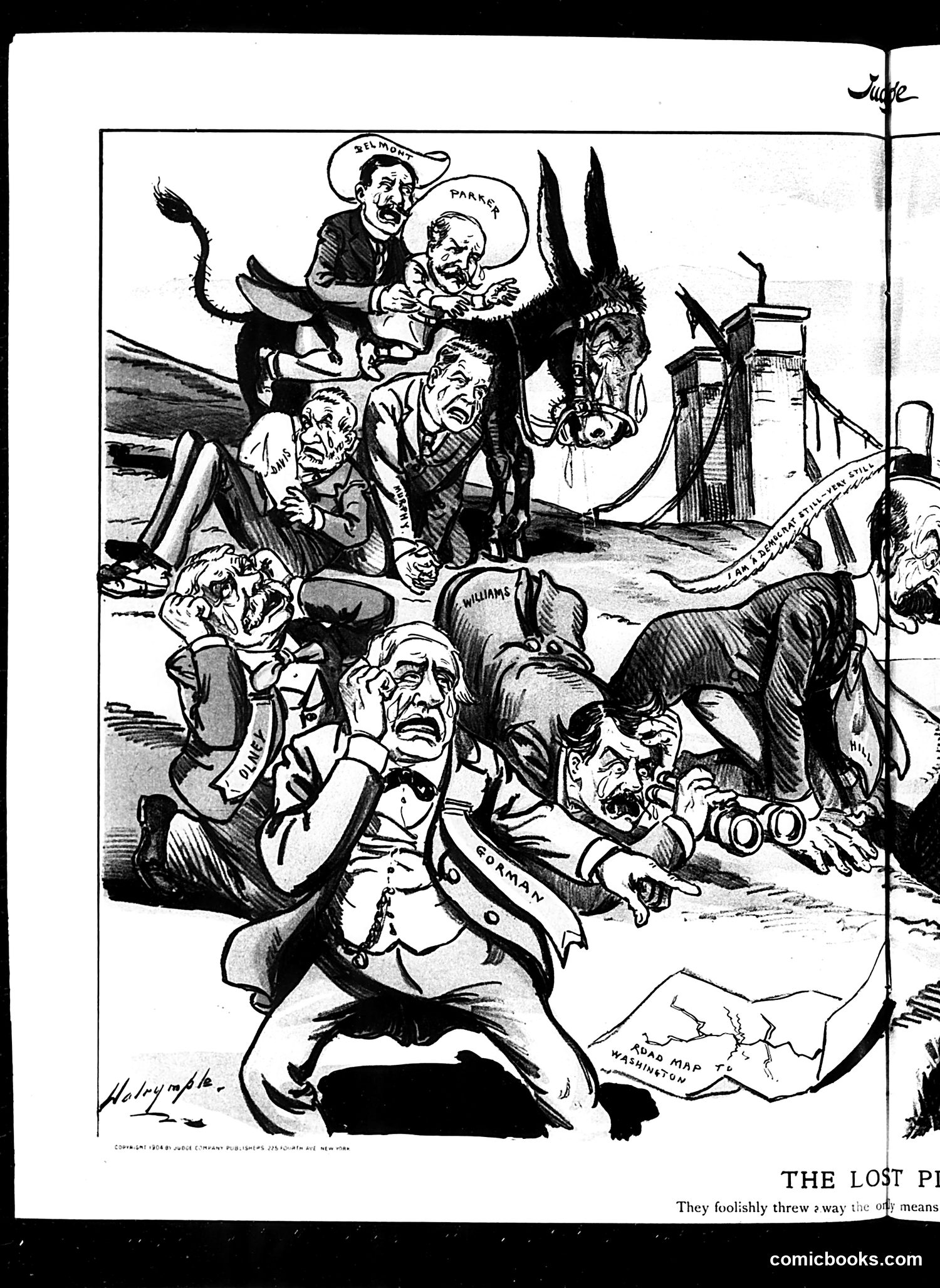
This appears to be a political cartoon titled "The Lost Pi" from *Judge* magazine. The image depicts multiple caricatured figures in a chaotic scene with demons or devils, suggesting moral or political corruption. Several figures wear hats labeled with names like "Belmont," "Parker," and "Williams," though the specific context of their involvement is unclear from the visible text. The cartoon seems to satirize political figures who "foolishly threw away" some means or opportunity (the OCR text is incomplete). The demonic imagery suggests the cartoonist views their actions as morally reprehensible. Without the full caption and publication date, the specific historical event or scandal being referenced cannot be determined with certainty.
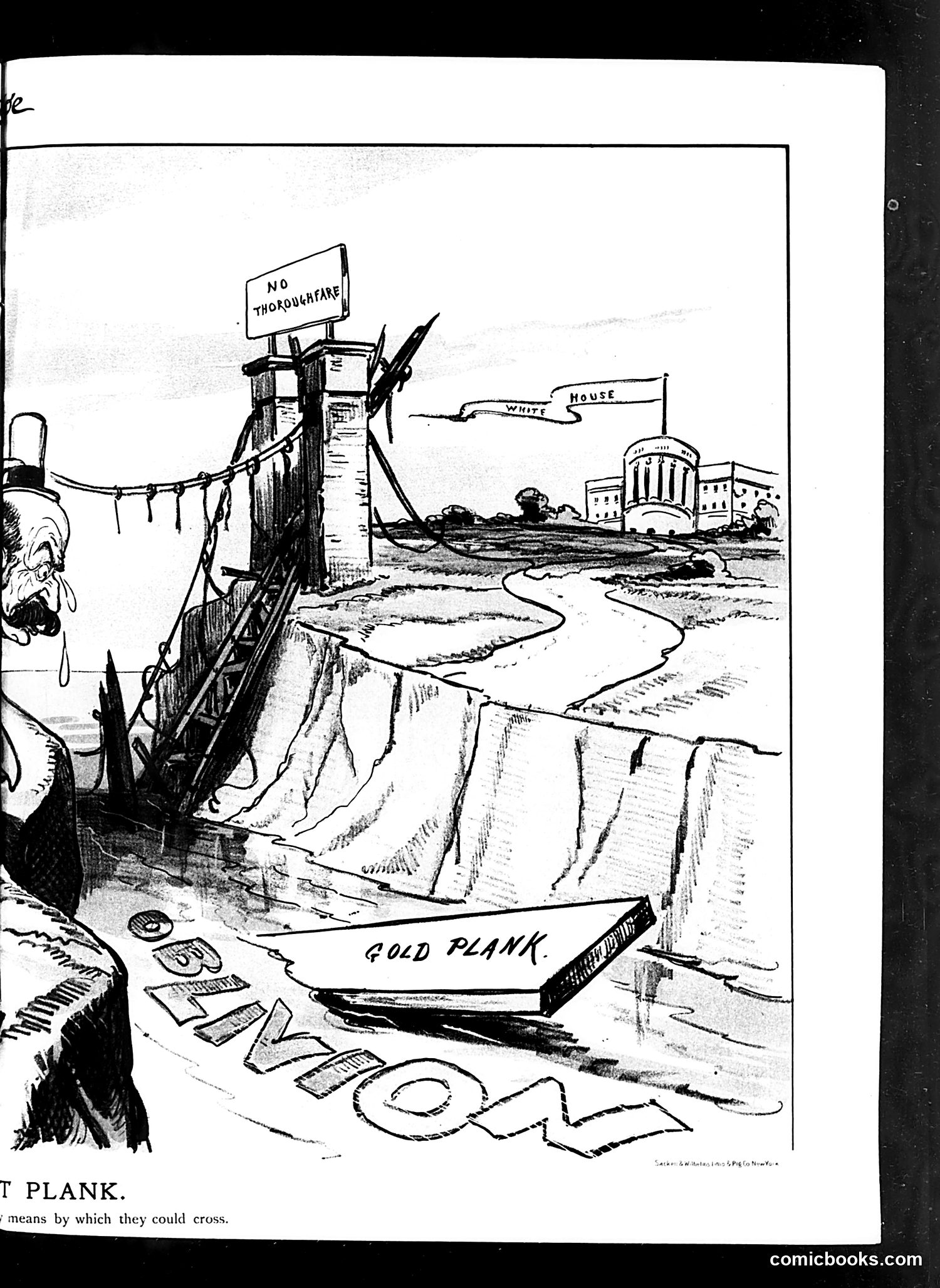
This Judge magazine cartoon depicts a political allegory. A caricatured figure on the left (appearing distressed or angry) faces a chasm separating him from the White House in the distance. A wooden plank labeled "GOLD PLANK" bridges the gap, while a sign reading "NO THOROUGHFARE" blocks direct passage. The cartoon likely satirizes debates over monetary policy—specifically the gold standard—as a divisive political issue. The "gold plank" represents using gold-based currency as a bridge to political power or policy goals, while the "no thoroughfare" sign suggests this approach faces obstruction or is problematic. Without the publication date visible, the specific political context remains unclear, though gold standard debates were prominent in American politics during the late 19th and early 20th centuries.
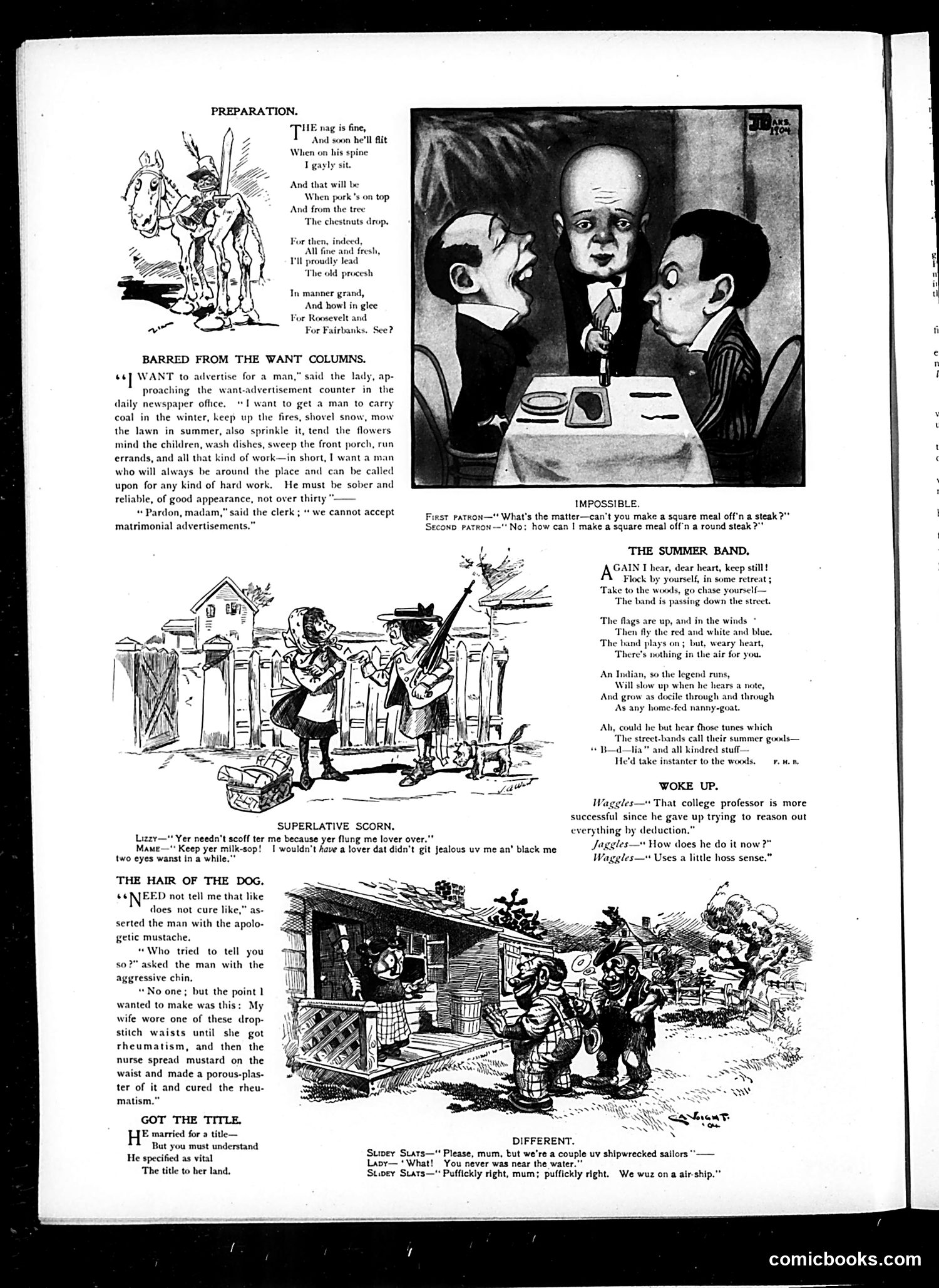
This page contains several satirical humor pieces typical of early 20th-century Judge magazine: **"PREPARATION"** references Theodore Roosevelt and James Fairbanks (likely Vice President James Sherman, though text says "Fairbanks"), suggesting political campaign preparation with coded language about chestnuts and pork. **"BARRED FROM THE WANT COLUMNS"** satirizes the impossible domestic servant—a woman seeks an omnipotent handyman for all seasonal tasks, and the clerk rejects her ad as "matrimonial" (implying she's really seeking a husband, not an employee). The joke mocks both unrealistic employer expectations and classified ad conventions. **"THE SUMMER BAND"** is a sentimental poem about street bands and their allure. **"SUPERLATIVE SCORN,"** **"THE HAIR OF THE DOG,"** **"GOT THE TITLE,"** and **"WOKE UP"** are brief comic vignettes about relationship dynamics, wordplay, and social pretension—typical Judge humor emphasizing class distinctions and marital mockery. The page is primarily entertainment-focused rather than overtly political satire.
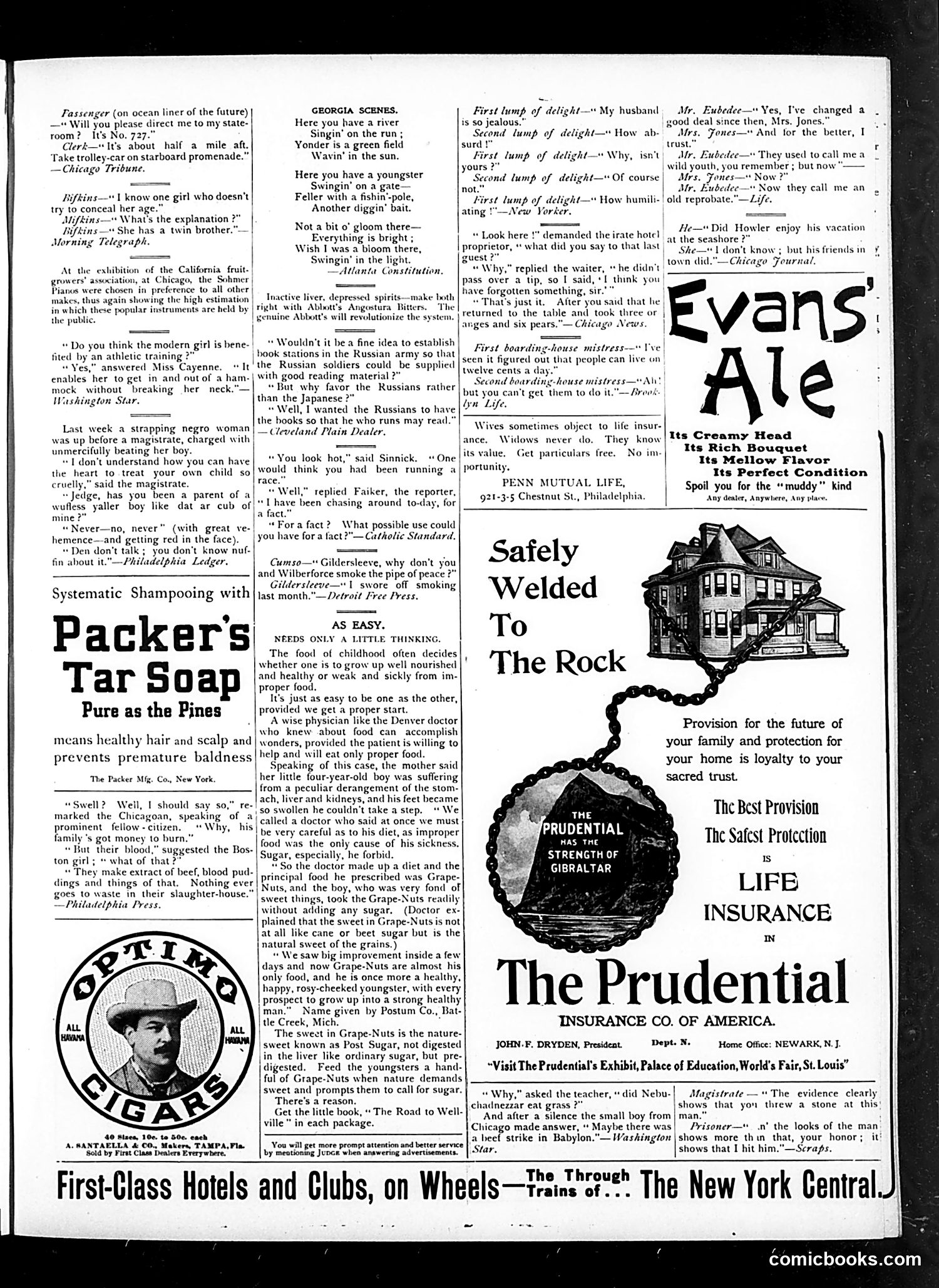
This page contains primarily **advertisements and humorous anecdotes** rather than political cartoons. The advertisements include Parker's Tar Soap (promoting healthy hair), Optimo Cigars, Sohmer Pianos, and prominent display for **The Prudential Insurance Company's "Safely Welded to the Rock"** campaign. The humorous content (labeled "GEORGIA SCENES," etc.) comprises **short jokes and stories**: - A future ocean liner with rooms so far apart you need a trolley-car - Questions about athletic girls and hammocks - A racial stereotype dialogue about a Black woman disciplining her child - Various one-liners about romance and food The **Evans** medicine advertisement emphasizes its "creamy head" and "rich bouquet." The jokes reflect **turn-of-the-century American humor**, including casual racial stereotypes common to the period. The Prudential ad showcases 1900s-era optimism about corporate "strength" protecting families. This is **primarily a commercial publication page**, not editorial satire.
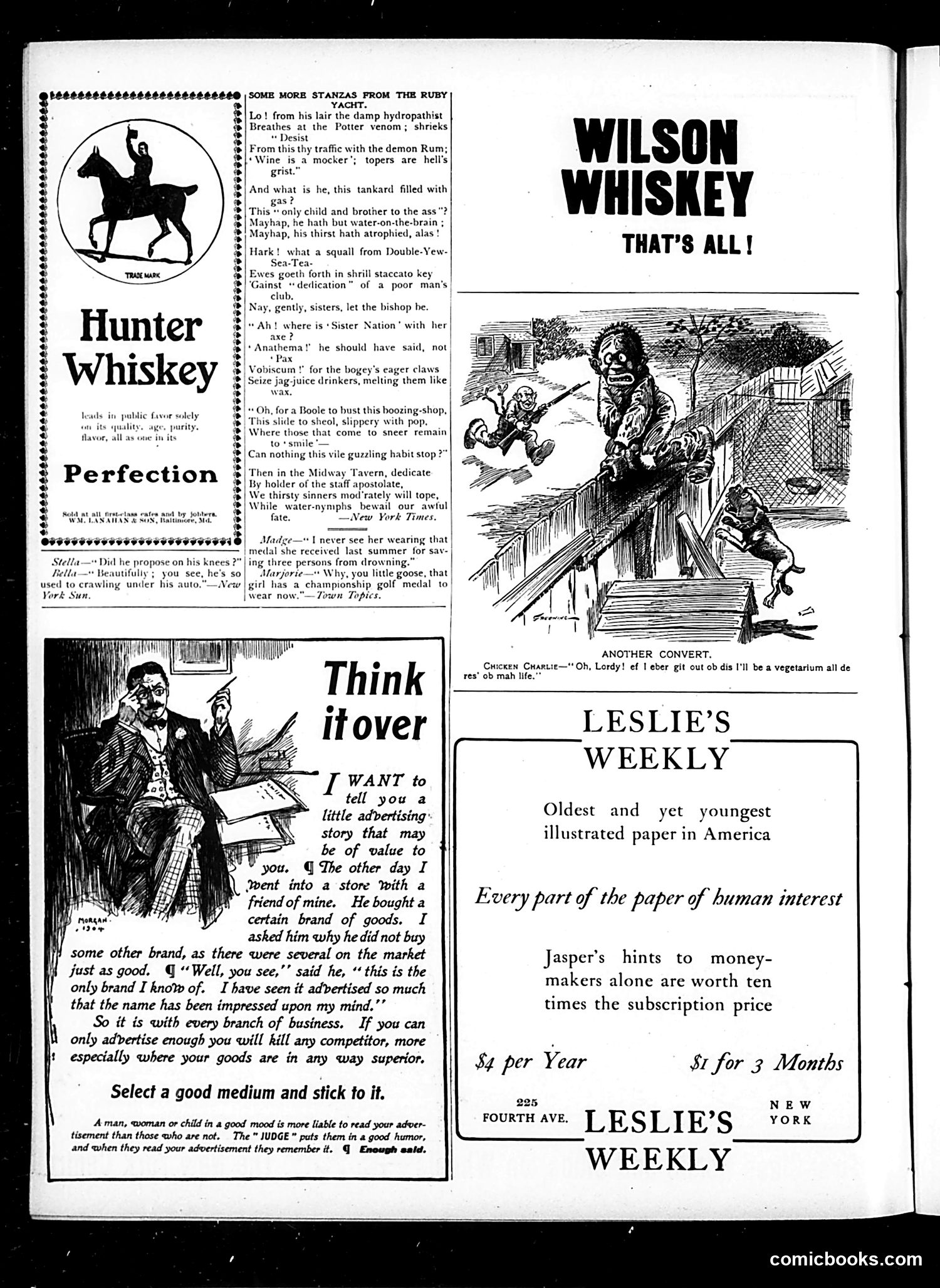
This page contains mixed content: advertisements, poetry satire, and brief comic vignettes. **Main Content:** The "Ruby Yacht" poetry satirizes temperance advocates' attacks on alcohol consumption. It mocks prohibitionist rhetoric—referencing "hydropathist" crusaders condemning drinking—while defending taverns and moderate drinking. The verse puns on whiskey brands ("Double-Yew-Sea-Tea," likely riffing on "W.C.T." for Woman's Christian Temperance Union). **Comic Vignettes:** Small humor pieces include: a proposal anecdote, a joke about a woman wearing a golf medal instead of a lifesaving medal, and "Chicken Charlie," a stereotypical African American character (in offensive dialect) joking about becoming vegetarian—playing on period racial caricature tropes. **Advertising:** The "Think it over" section promotes advertising strategy. Hunter Whiskey and Wilson Whiskey ads appear alongside Leslie's Weekly promotions. **Historical Context:** This predates Prohibition (1920), reflecting pre-Prohibition-era debates over alcohol. The content reveals period attitudes toward drinking, prohibition movements, and crude racial stereotyping common in early 20th-century American humor.
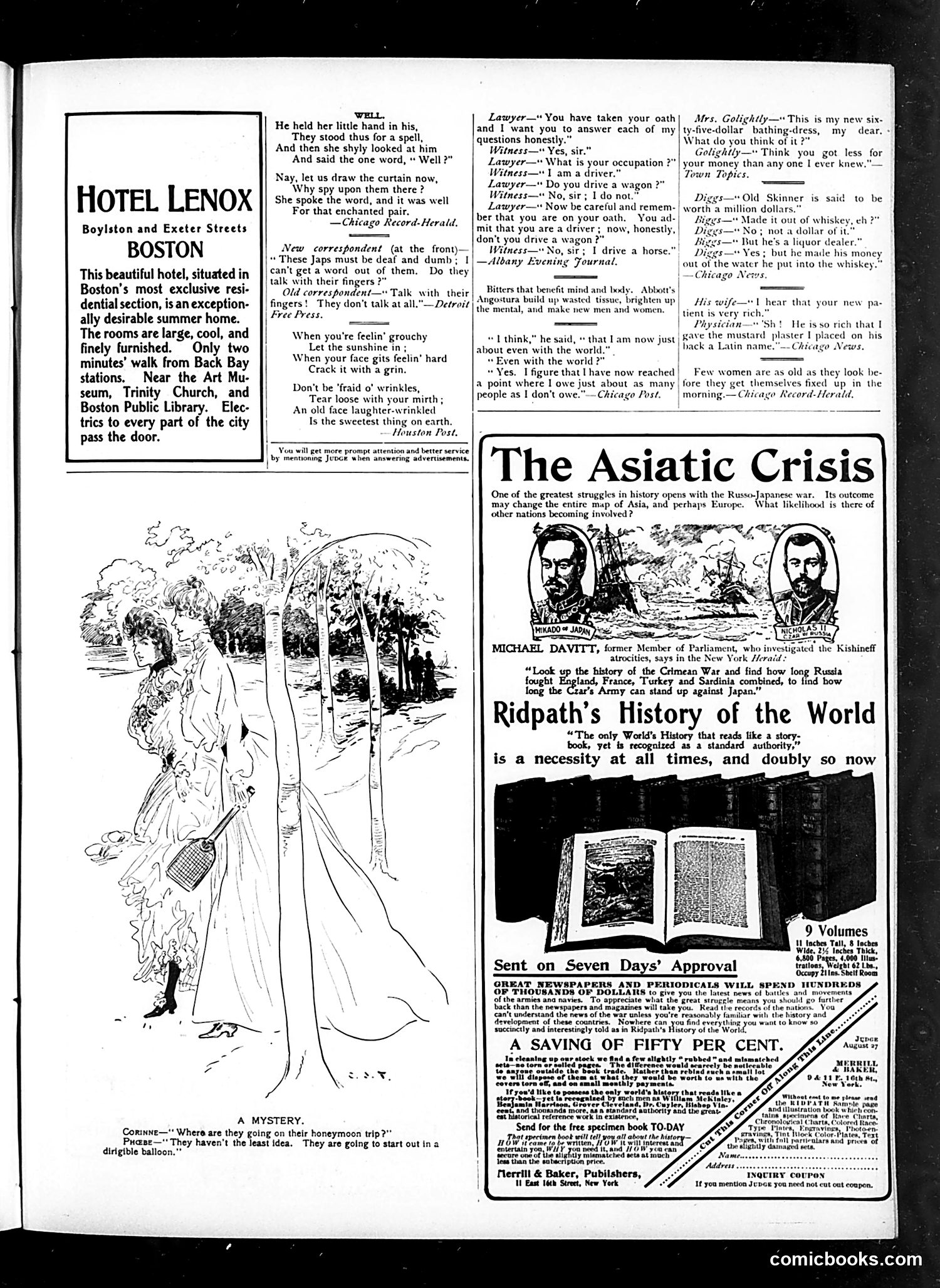
**Cartoons and Content:** The page contains several short humorous pieces typical of early 1900s satirical magazines. The main cartoon (bottom left, "Mystery") jokes about a honeymooning couple in a dirigible—the humor relies on the era's new fascination with aviation. **Notable Item—"The Asiatic Crisis" advertisement:** This is not a cartoon but an editorial-advertisement discussing the Russo-Japanese War. It features Michael Davitt (identified as a former Member of Parliament who investigated the Kishineff atrocities) arguing that studying Ridpath's History is essential for understanding the current war and Asia's geopolitical future. The piece appears designed to sell history books by emphasizing their contemporary relevance. **Historical Context:** The Russo-Japanese War (1904-1905) was major international news. The reference to Kishineff atrocities (1903 massacre of Jews in Bessarabia) suggests concern about broader Russian aggression. The page reflects period anxieties about global conflict and colonial power struggles. The smaller comic pieces are gentle, domestic humor—a style dominating Judge's lighter content from this era.
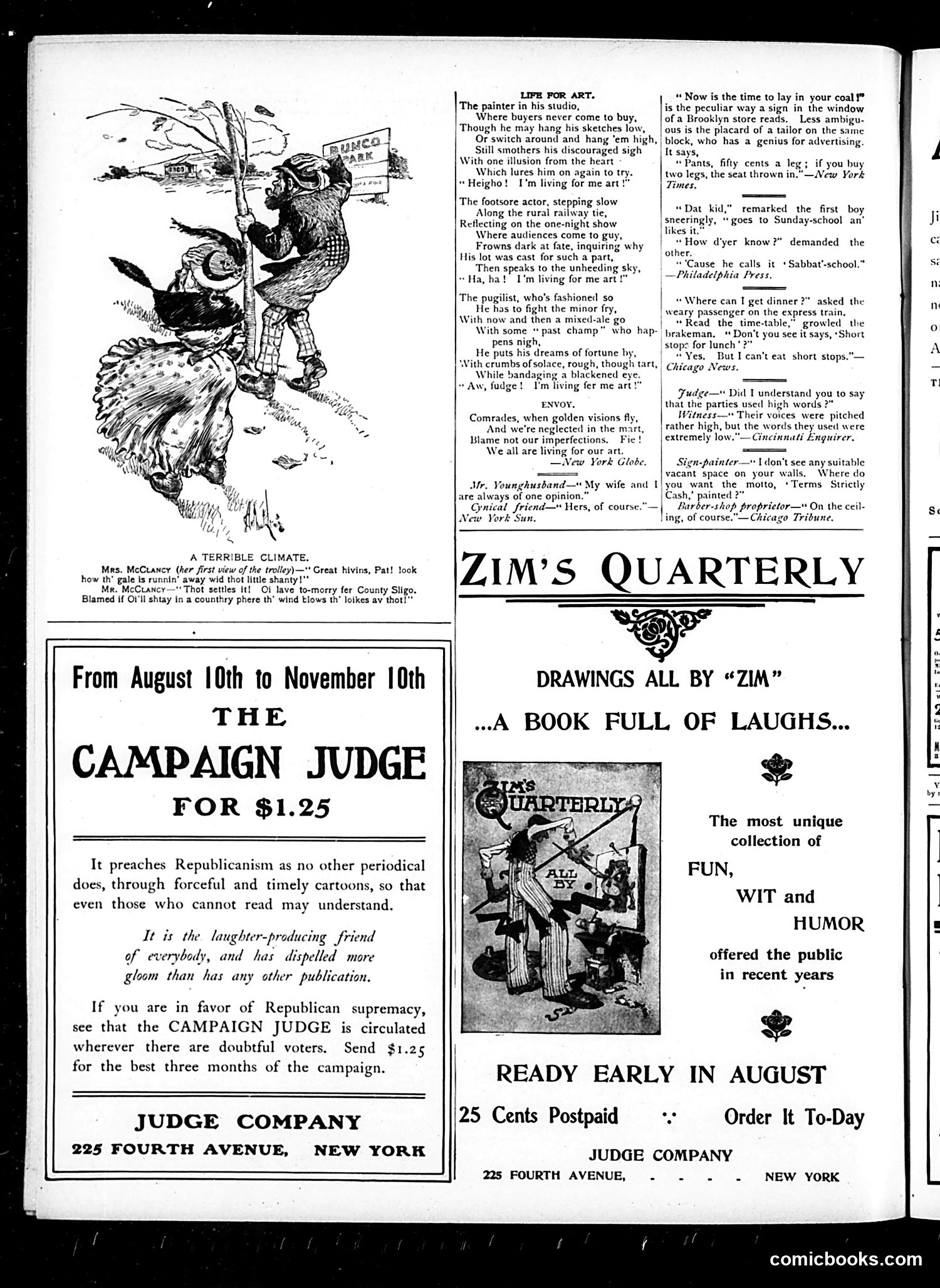
This page from *Judge* magazine (a satirical weekly) contains political advertising alongside humor content. **The Main Cartoon** ("A Terrible Climate") depicts Irish immigrants—identifiable by their dialect ("Great hivins, Pat!")—reacting to wind so strong it's blowing away their shanty. The humor relies on ethnic stereotyping common to the era, portraying working-class Irish as simple and excitable. **The Political Content** is the advertisement for *Campaign Judge* ($1.25), a Republican publication for the 1908 election. It explicitly markets itself as propaganda for "doubtful voters," using cartoons to reach the illiterate, and advocates for "Republican supremacy." **The Remaining Content** consists of humorous anecdotes and verse ("Life for Art") about struggling artists and a separate advertisement for *Zim's Quarterly*, a humor collection. The page reflects early 20th-century American humor standards: ethnic caricature, wordplay, and frank partisan political advocacy presented alongside entertainment.
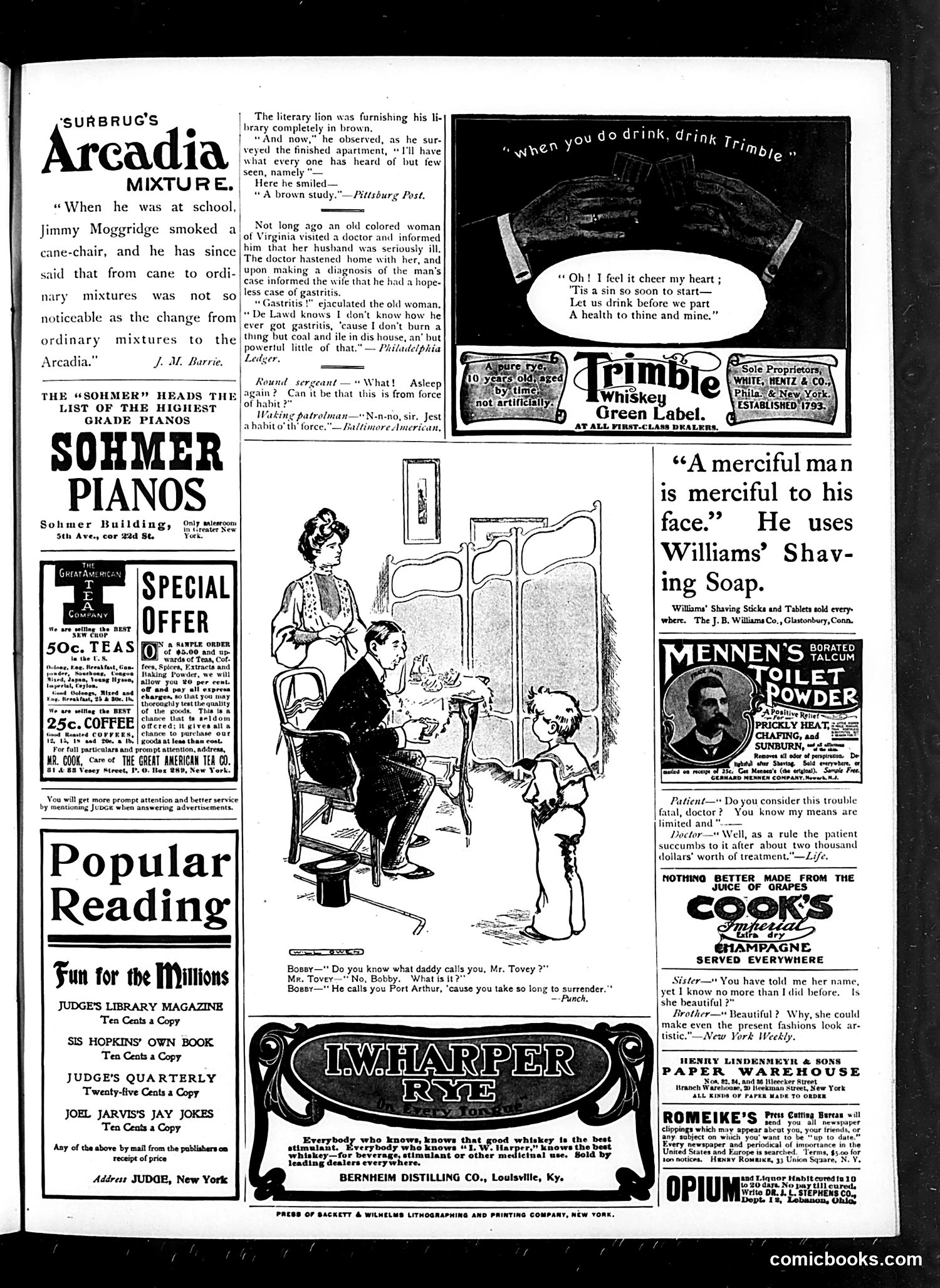
This page is primarily **advertising**, typical of early 20th-century magazines. The main content consists of product advertisements interspersed with brief humorous anecdotes. The notable cartoon depicts a **domestic scene** where a man sits while a woman and child attend to him—likely illustrating one of the adjacent jokes or advertisements about shaving products or household goods. **Key satirical content:** The small anecdotes mock social pretension and misunderstanding. One joke references "Port Arthur" (the Russo-Japanese War siege, 1904-05), calling someone slow to "surrender"—contemporary political humor. Another depicts an old Black woman misunderstanding "gastritis" as something caused by her cooking methods, playing on period stereotypes. The advertisements themselves—for whiskey, shaving soap, talcum powder, and tea—represent consumer products marketed with genteel or humorous appeals typical of the era. **Missing context for modern readers:** Judge was a satirical magazine for educated, urban audiences. The humor relies on period knowledge (Port Arthur reference), racial stereotypes common to the time, and marketing conventions now dated.
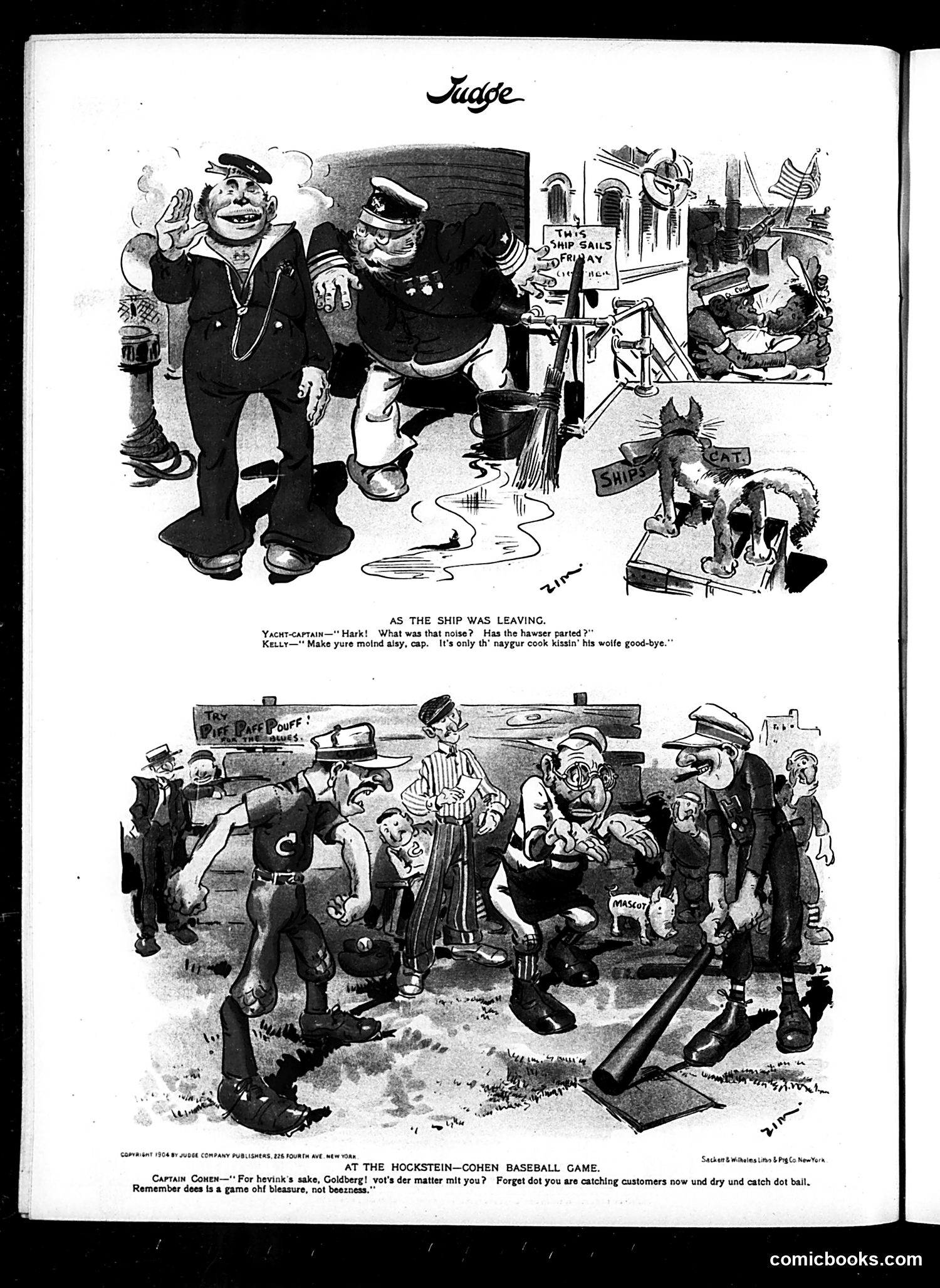
This 1904 page contains two caricatured scenes using heavy ethnic stereotyping typical of the era. The top cartoon depicts a ship's departure where a sailor (labeled "Yacht-Captain") hears a noise and asks if a rope has broken. The response uses an offensive caricature of a Black cook saying goodbye to his wife—the "joke" being that his affectionate farewell sounds like ship damage. The bottom cartoon shows a baseball game between characters with Jewish names (Hockstein and Cohen). Captain Cohen scolds his friend Goldberg for being distracted, implying he's treating the game as a business transaction ("catching customers") rather than recreation. The satire mocks Jewish immigrants as overly focused on commerce even during leisure. Both cartoons rely on ethnic caricature and dialect humor—common in early 20th-century American satire—to create comedy through demeaning portrayals of working-class immigrants and Black Americans.