
Judge, 1904-08-27 · page 5 of 16
Judge — August 27, 1904 — page 5: what you’re looking at
What you’re looking at
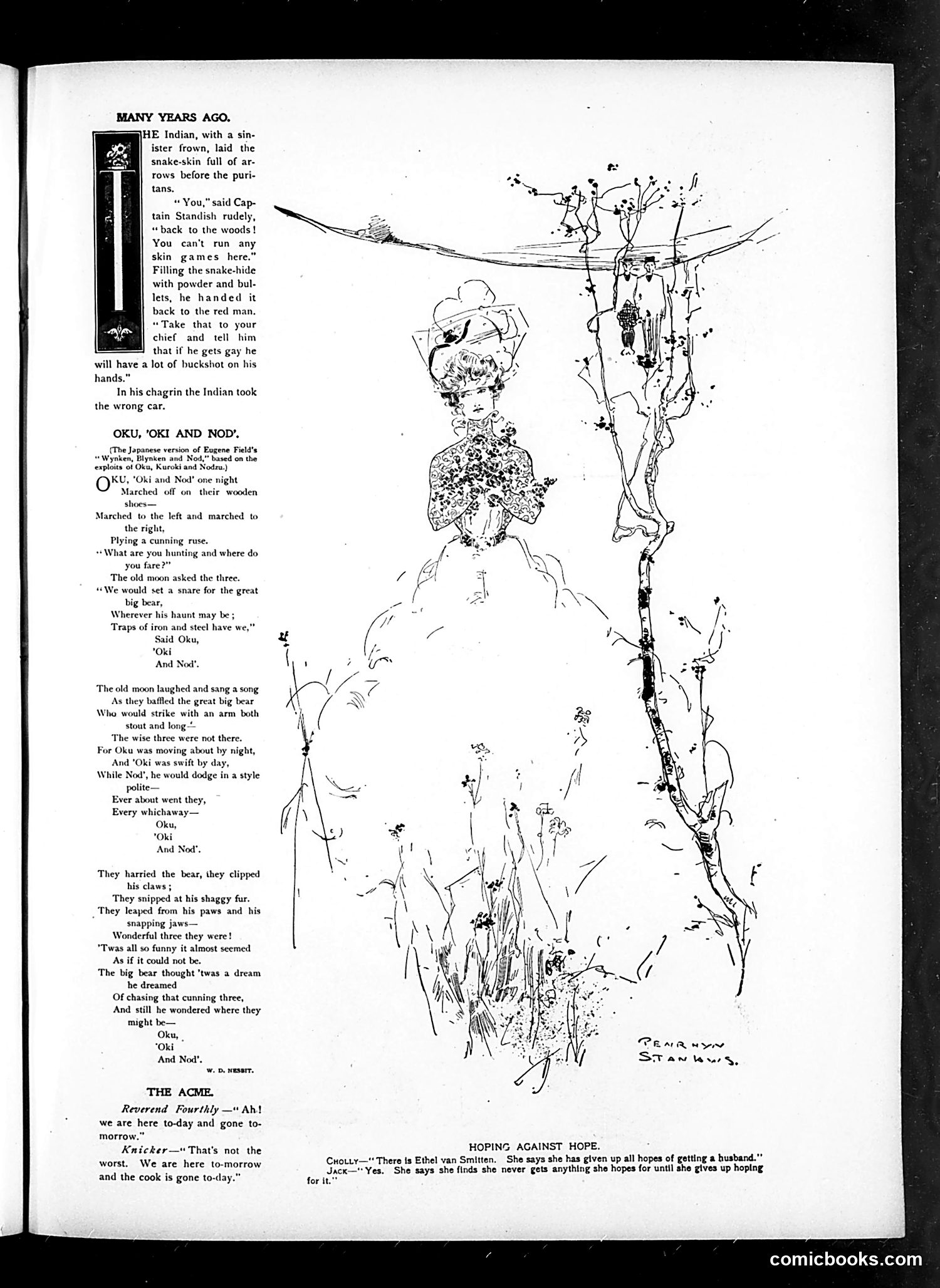
This page contains three distinct pieces of satirical content: **"Many Years Ago"**: A brief historical joke mocking Native Americans and early American colonists, portraying Captain Standish as outwitting an Indian chief through superior firepower—reinforcing period stereotypes of indigenous peoples as inferior and threatening. **"Oku, 'Oki and Nod'"**: A parody of Eugene Field's children's poem "Wynken, Blynken and Nod," adapted to celebrate Japanese military generals (Oku, Kuroki, Nodzu) during the Russo-Japanese War (1904-1905). The "great big bear" represents Russia. This satire praises Japanese military strategy and cunning, portraying them as cleverly outmaneuvering a larger, clumsier opponent. **Bottom sections**: Brief comedic snippets about everyday life—a clergyman's sermon about mortality, and a joke about a woman's romantic prospects improving when she stops hoping. The page reflects early 1900s American attitudes: racism toward Native Americans, admiration for Japan's military success, and conventional domestic humor.
📄 Transcribed text from this page (OCR, searchable)
Machine-transcribed from the original scan — historical spelling and the odd misread are preserved.
MANY YEARS AGO. fee HE Indian, with a sin- ister frown, laid the snake-skin full of ar- rows before the puri- tans, “You,” said Cap- tain Standish rudely, «back to the woods ! You can't run any skin games here.” Filling the snake-hide with powder and bul- lets, he handed it back to the red man, “Take that to your chief and tell him that if he gets gay he will have a lot of buckshot on his hands.” In his chagrin the Indian took the wrong car. OKU, ‘OKI AND NOD’, (The Japanese version of Eugene Field’s “ Wynken, Blynken and Nod," based on the exploits of Oku, Kuroki and Nodzu.) KU, ‘Oki and Nod’ one night Marched off on their wooden shoes— Marched to the left and marched to the right, Plying a cunning ruse. + What are you hunting and where do you fare?” ‘The old moon asked the three. “We would set a snare for the great big bear, Wherever his haunt may be ; ‘Traps of iron and steel have we,” Said Oku, "Oki And Nod’, The old moon laughed and sang a song As they baffled the great big bear Who would strike with an arm both stout and long ‘The wise three were not there. For Oku was moving about by night, And ‘Oki was swift by day, While Nod’, he would dodge polite— Ever about went they, Every whichaway— Oku, "Oki And Nod’, They harried the bear, they clipped his claws; They snipped at his shaggy fur. ‘They leaped from his paws and his snapping jaws— Wonderful three they were! "Twas all so funny it almost seemed As if it could not be. The big bear thought "twas a dream he dreamed Of chasing that cunning three, And still he wondered where they might be— Oku, On” : CRA R ww And Nod’. ; pel Stan leurs, Ww. D, NessrT. THE ACME. Reverend Fourthly —" Ab! we are here to-day and gone to- morrow.” Knicker—« That's not the HOPING AGAINST HOPE. y Cnouty—"There ts Ethel van Smitten. She says she has given up all hopes of getting a husband.”’ ete pene ieregbetes teatncrrow Shox "Yes. She says she finds she never gets anything she hopes for until she gives up hoping and the cook is gone to-day.” for it.” comicbooks.com