
A complete issue · 20 pages · 1904
Judge — August 6, 1904
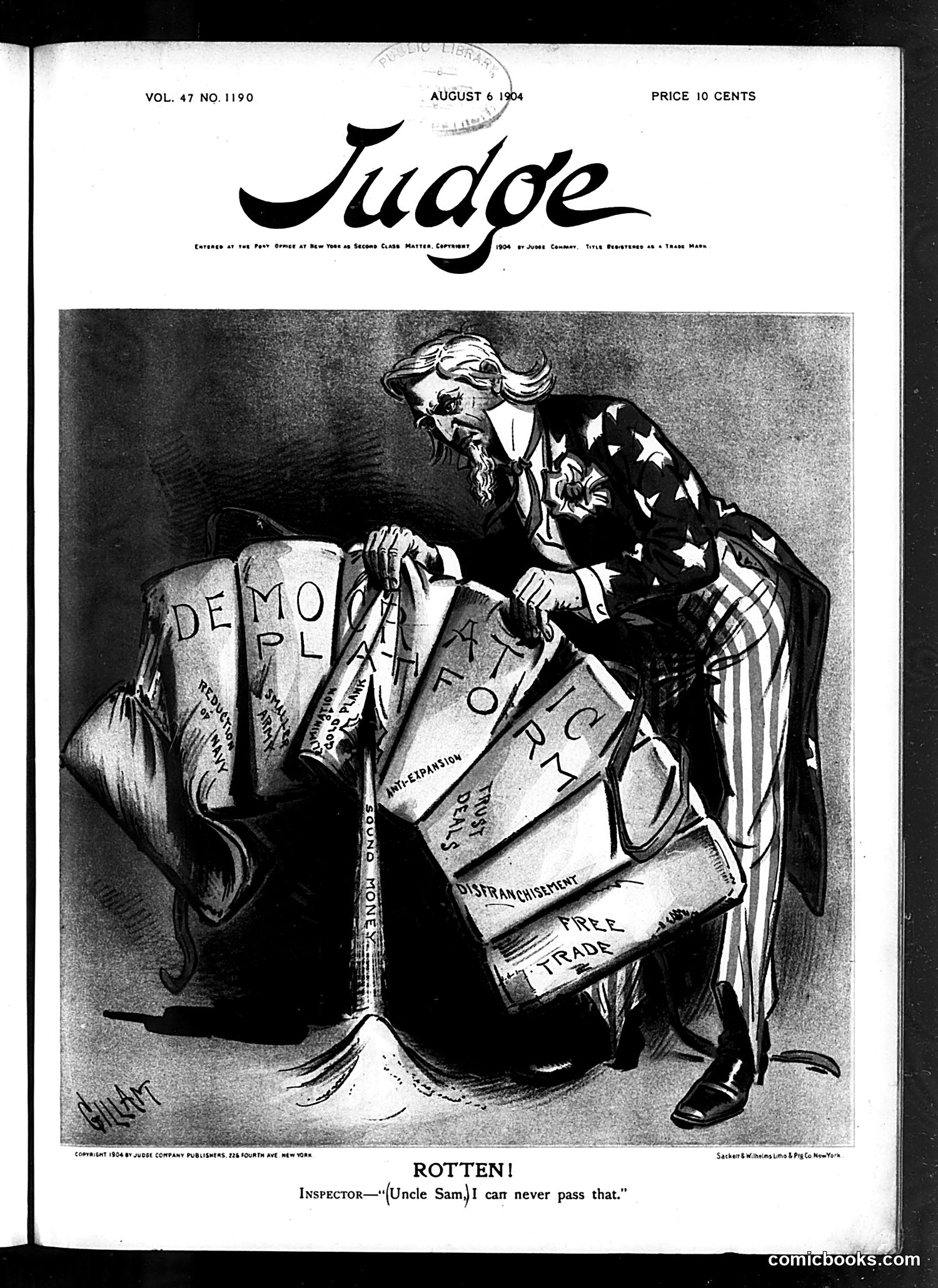
This political cartoon depicts Uncle Sam (identifiable by his star-spangled jacket and characteristic appearance) as a food inspector examining various contaminated or spoiled goods. The bundles are labeled with terms like "DEMOCRACY," "PLATFORM," and references to "FREE TRADE" and "DISENFRANCHISEMENT." Uncle Sam declares "I can never pass that," suggesting he's rejecting corrupt or morally bankrupt political platforms and policies. The satire criticizes the state of American politics in 1904—likely referencing election-year promises and political corruption. The "rotten" goods represent Democratic or opposing party platforms that the cartoonist considers unfit for the nation, using the food inspection metaphor to mock the quality of political discourse and proposals during this election season.
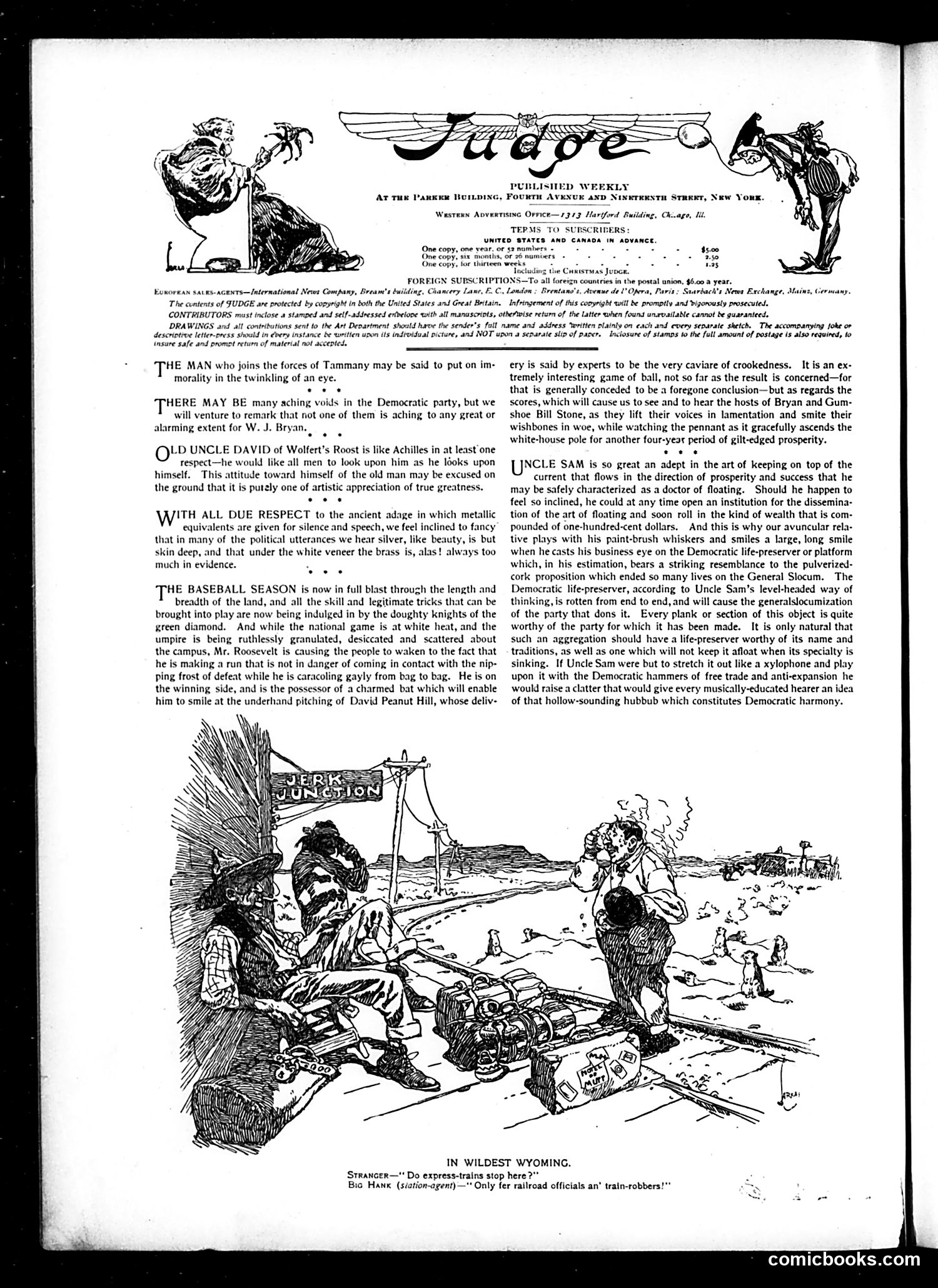
This page contains editorial commentary on early 20th-century American politics. The text discusses Democratic Party politics, mentions W.J. Bryan (likely William Jennings Bryan, a prominent Democratic figure), and references "Uncle Sam" as a symbol of American interests. The main cartoon, "In Wildest Wyoming," depicts what appears to be a railroad robbery scene. A stranger asks a "Big Hank" (a rough frontier character) whether express trains stop there, and the reply is that only railroad officials are "train-robbers." This is satirical commentary suggesting that railroad companies themselves were engaged in exploitative practices—a common Progressive-era critique of big business corruption and monopolistic behavior during the railroad expansion period.
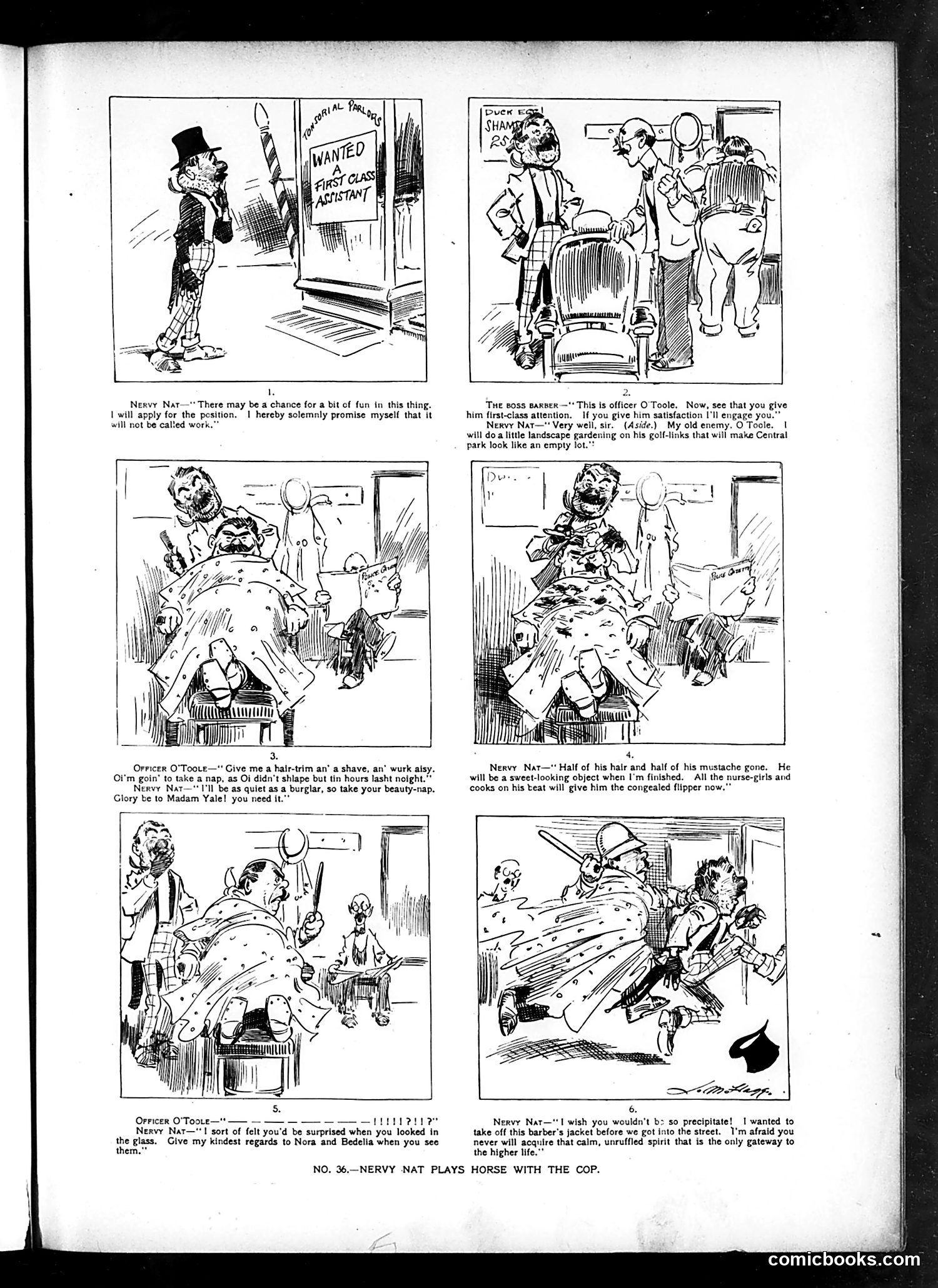
This comic strip satirizes a street character called "Nervy Nat" who attempts to con a police officer. The humor relies on class and social commentary typical of Judge magazine. In panel 1, Nat spots a "Wanted" advertisement for a first-class assistant. He proposes himself to the boss, promising good behavior. The boss hires him, assigning Officer O'Toole to oversee him. The subsequent panels show Nat's scheme: he convinces O'Toole to give him a haircut and shave by flattery, then literally uses the officer as a "horse," riding him around while causing chaos. The final panel shows them both tumbling down the street. The satire mocks both Nat's criminal cunning and the officer's gullibility, reflecting period anxieties about urban crime and police competence.
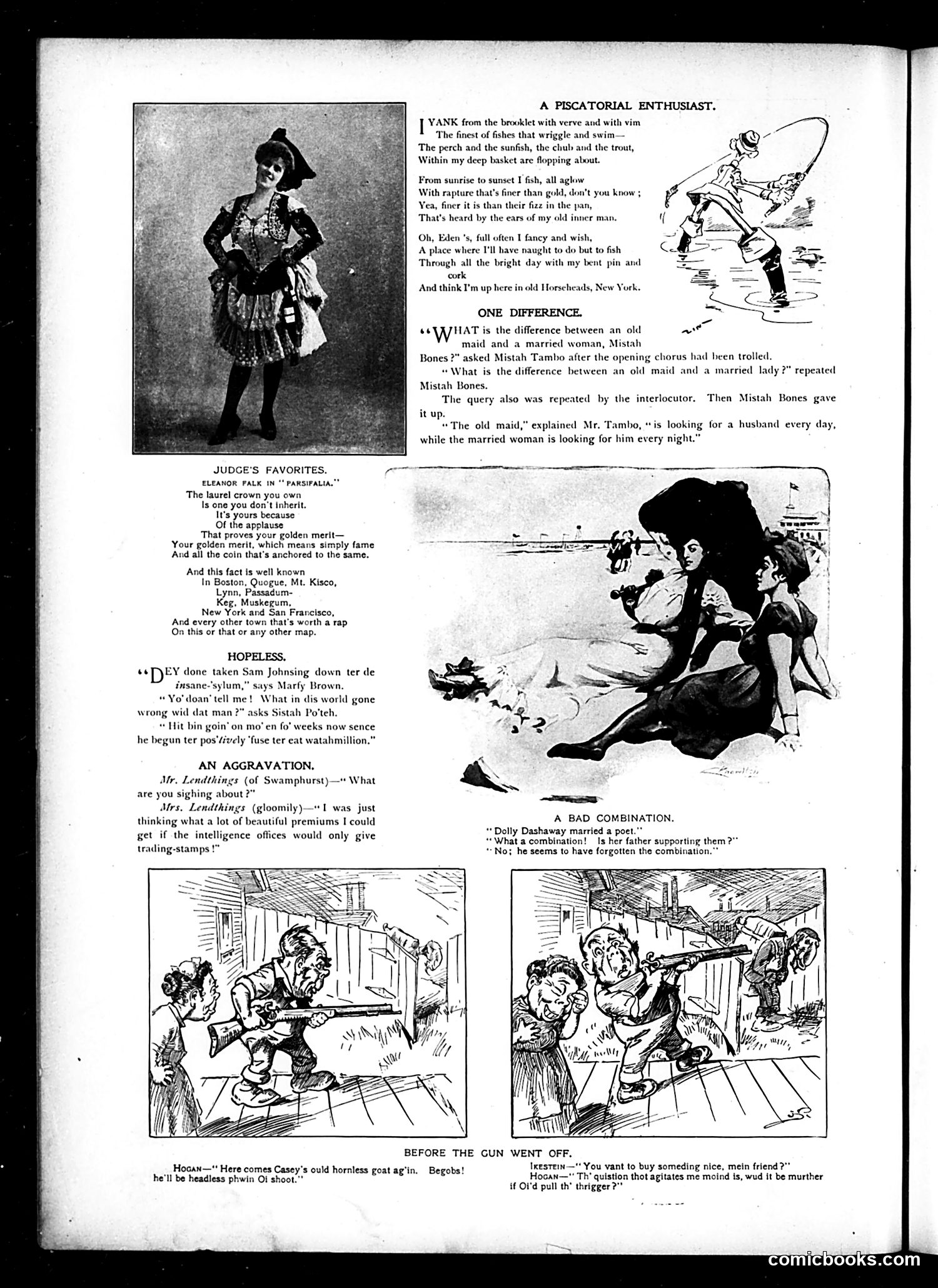
This page contains several unrelated humorous pieces typical of early 20th-century Judge magazine: **"A Piscatorial Enthusiast"** features a woman recounting her fishing passion, establishing the joke that she talks about fish constantly—even imagining doing so in Horsheads, New York. **"One Difference"** presents a joke about the distinction between unmarried and married women, delivered through characters Mistah Bones and Mistah Tambo (likely referring to minstrel show traditions). **"Judge's Favorites"** and other short joke pieces fill the remaining space. **"A Bad Combination"** shows a domestic quarrel over financial support, using caricatured figures in a comic strip format. The page reflects Judge's formula: mixing theatrical references, domestic humor, and gentle social commentary aimed at middle-class readers of that era.
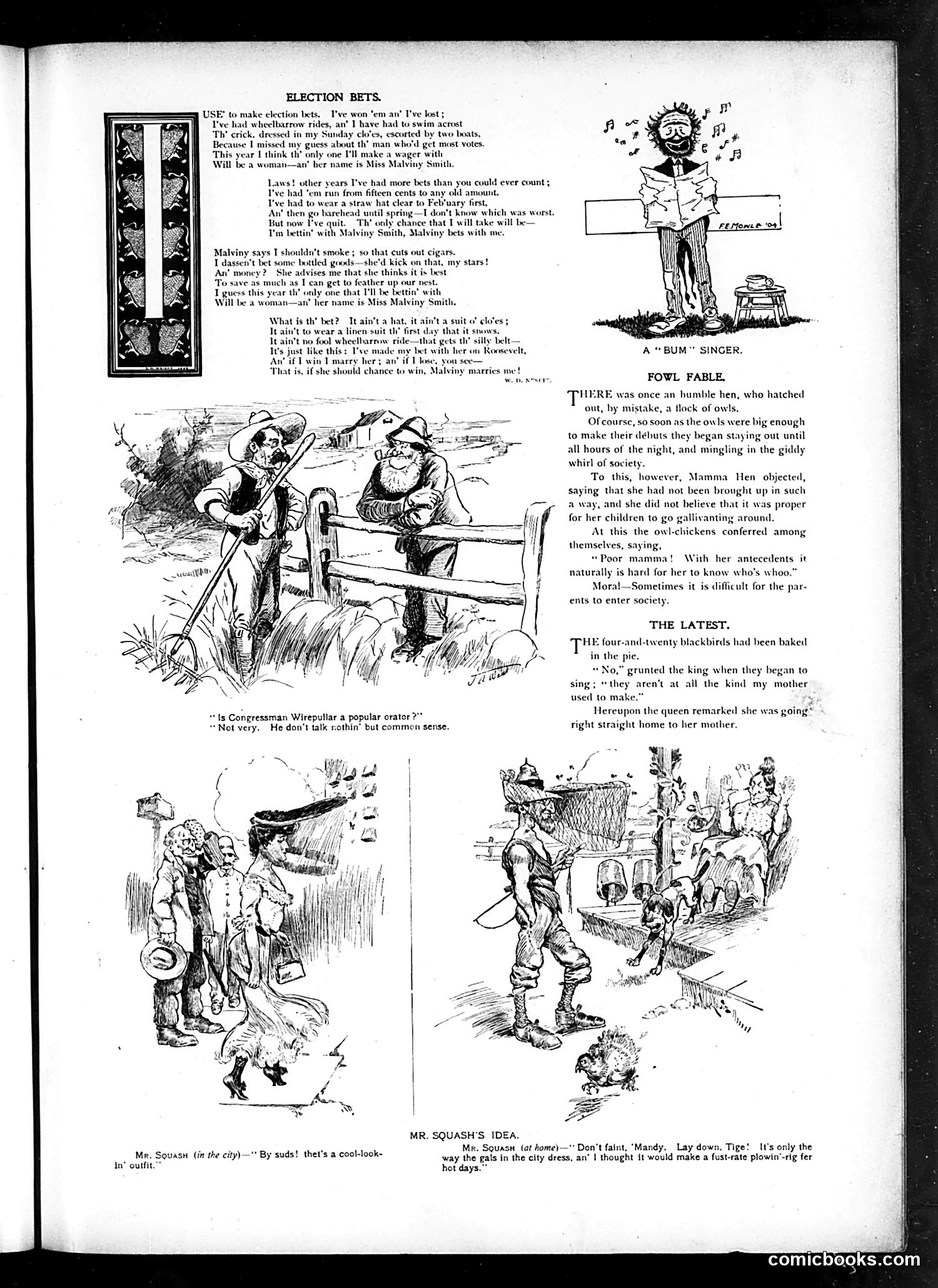
This Judge page satirizes early 20th-century American life through multiple sketches: **"Election Bets"** presents a rural speaker who habitually makes election wagers but is now constrained by his wife Malviny's domestic authority. The joke centers on marital control replacing political betting—he'll only wager that if he wins the election bet, he'll marry Malviny. It mocks both electoral overconfidence and the powerlessness of husbands under wives' management. **"Fowl Fable"** uses animal allegory: a hen's owl chicks resent her old-fashioned morality ("who's whoo" puns on their nature). The moral critiques generational clash—parents struggle to maintain propriety as children adopt modern social habits. **"Mr. Squash's Idea"** shows a rural man misunderstanding city fashion, proposing women's shortened skirts as practical farm equipment for hot-weather plowing. All three cartoons reflect period anxiety about social change: electoral reliability, generational values, and rural-urban cultural differences.
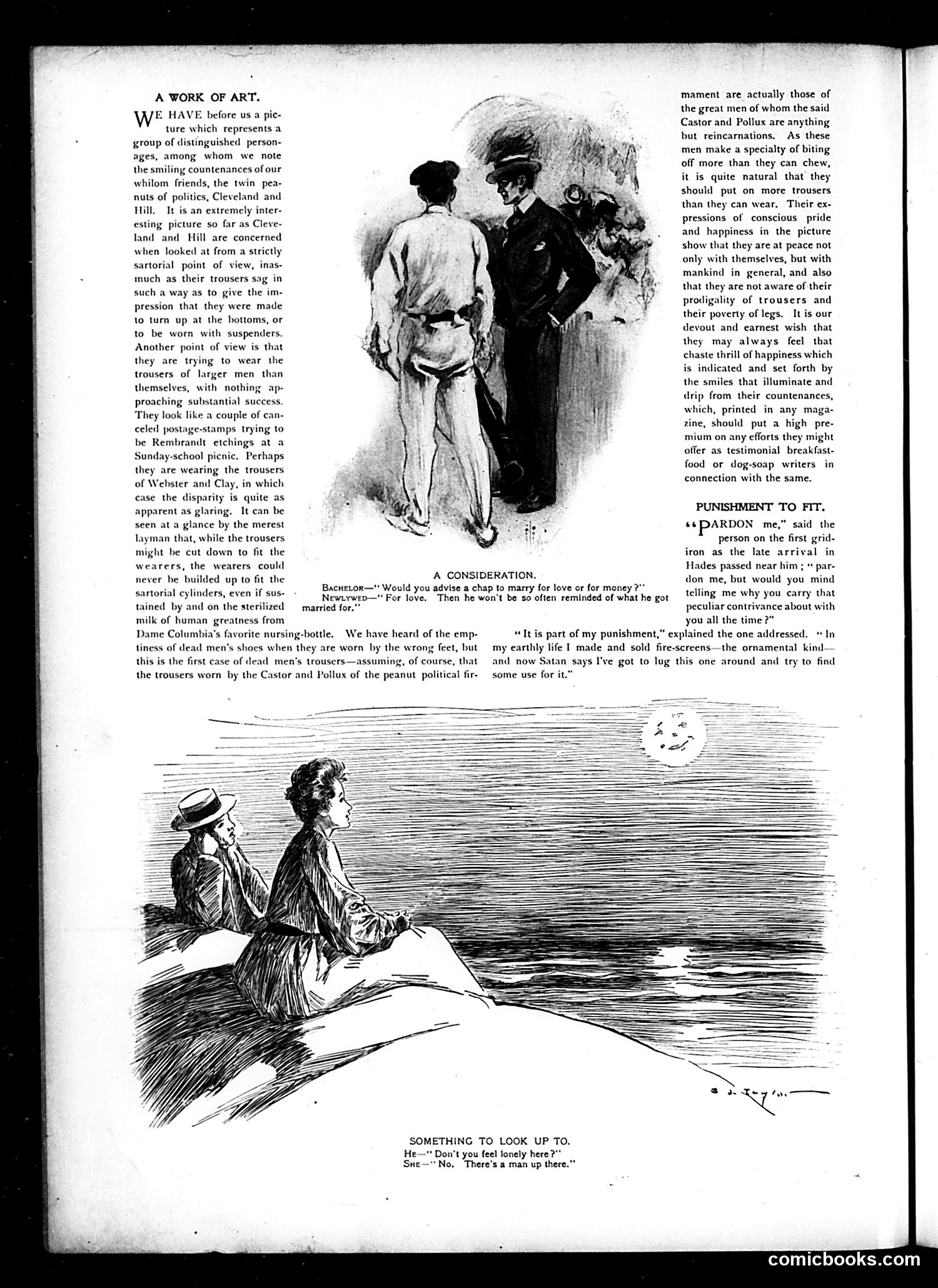
This page mocks **Cleveland and Hill** (likely Grover Cleveland and David B. Hill, prominent Democratic politicians of the 1880s-90s), depicted as undersized men literally wearing oversized trousers. The satire ridicules their political inadequacy—they're "biting off more than they can chew," attempting responsibilities beyond their capacity, like wearing trousers meant for giants (Webster and Clay, historical statesmen). The humor is sartorial: their ill-fitting clothes symbolize their incompetence. They're compared unfavorably to historical giants, yet remain blissfully unaware of their inadequacy. Secondary cartoons employ unrelated humor: one jokes about marriage for money, another depicts a damned soul condemned to eternally carry a decorative fire-screen—punishing a fire-screen salesman with his own product. The bottom sketch simply presents romantic comedic relief about attraction.
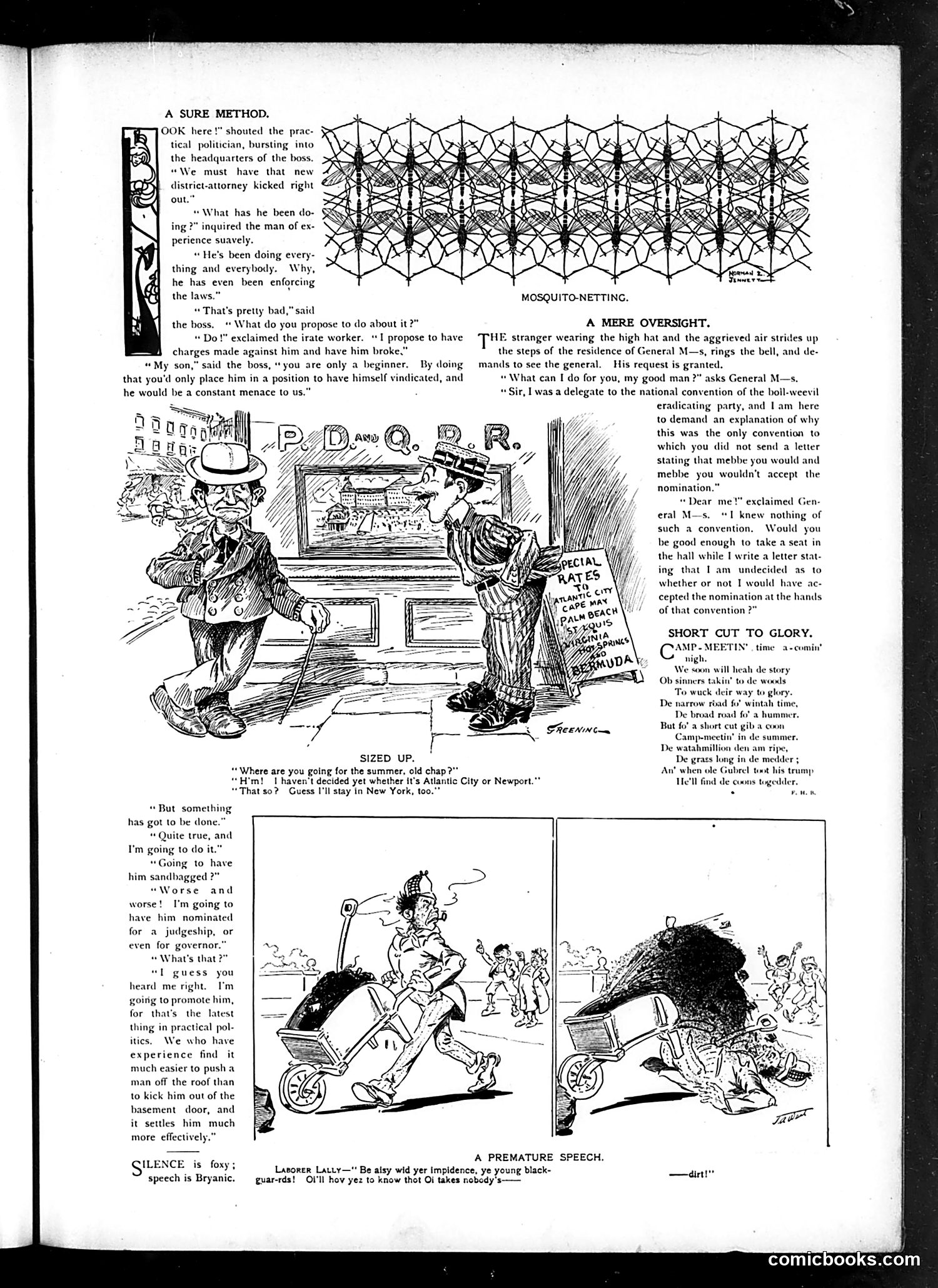
This page contains several political cartoons satirizing early 20th-century American politics: **"A Sure Method"**: A party boss advises against prosecuting a corrupt district attorney, arguing that nomination for higher office (judge or governor) neutralizes him more effectively than direct removal—the implication being that incompetent officials get "kicked upstairs" as a political strategy. **"A Mere Oversight"**: A delegate to a "boll-weevil eradicating party" convention demands a general explain why he didn't send a letter about potentially accepting their nomination. This appears to mock politicians' non-committal posturing regarding unsolicited nominations. **"Sized Up"**: Two socialites discussing summer vacation plans, suggesting New York's heat makes travel unnecessary. **"Short Cut to Glory"**: A dialectal poem about religious salvation. **"A Premature Speech"**: An Irish character warns young troublemakers about consequences. The cartoons collectively satirize political corruption, the era's custom of lobbying politicians with unsolicited nominations, and the strategic promotion of incompetent officials to neutralize them.
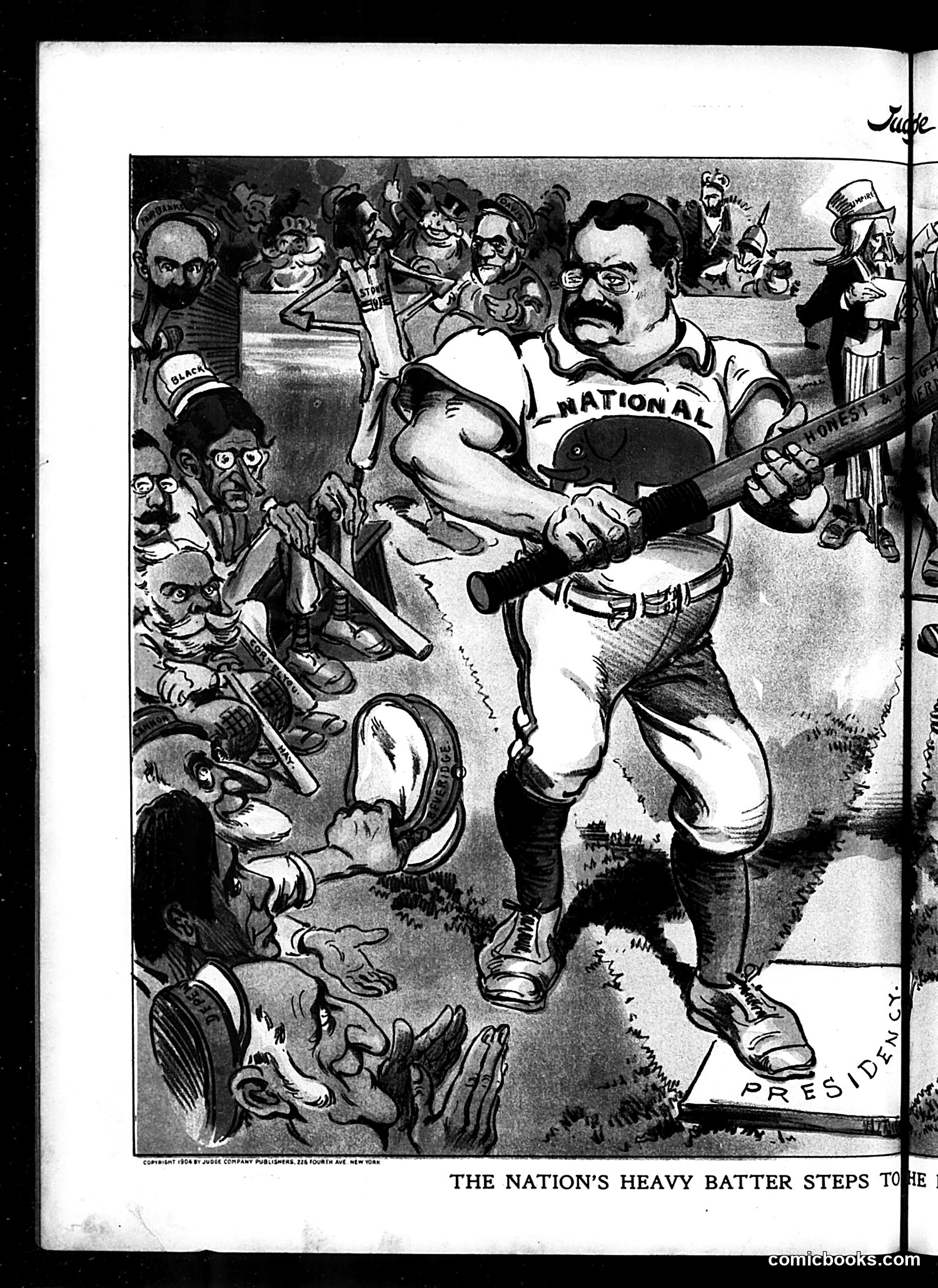
This political cartoon from Judge magazine depicts "The Nation's Heavy Batter Steps to [the Plate]" (caption cut off). The central figure is a large man in a baseball uniform labeled "NATIONAL," holding a bat and preparing to swing. He's surrounded by smaller, caricatured figures with exaggerated features—some appearing menacing or demonic—likely representing foreign threats, enemies, or political opponents of the era. The baseball metaphor suggests America (the "heavy batter") is preparing for confrontation or conflict. The grotesque surrounding figures appear to represent nations or ideologies perceived as threats. The cartoon's tone is patriotic and militant, positioning the United States as a powerful force ready for action. Without the complete caption or date visible, the specific historical moment remains unclear, though the style suggests early-to-mid 20th century.
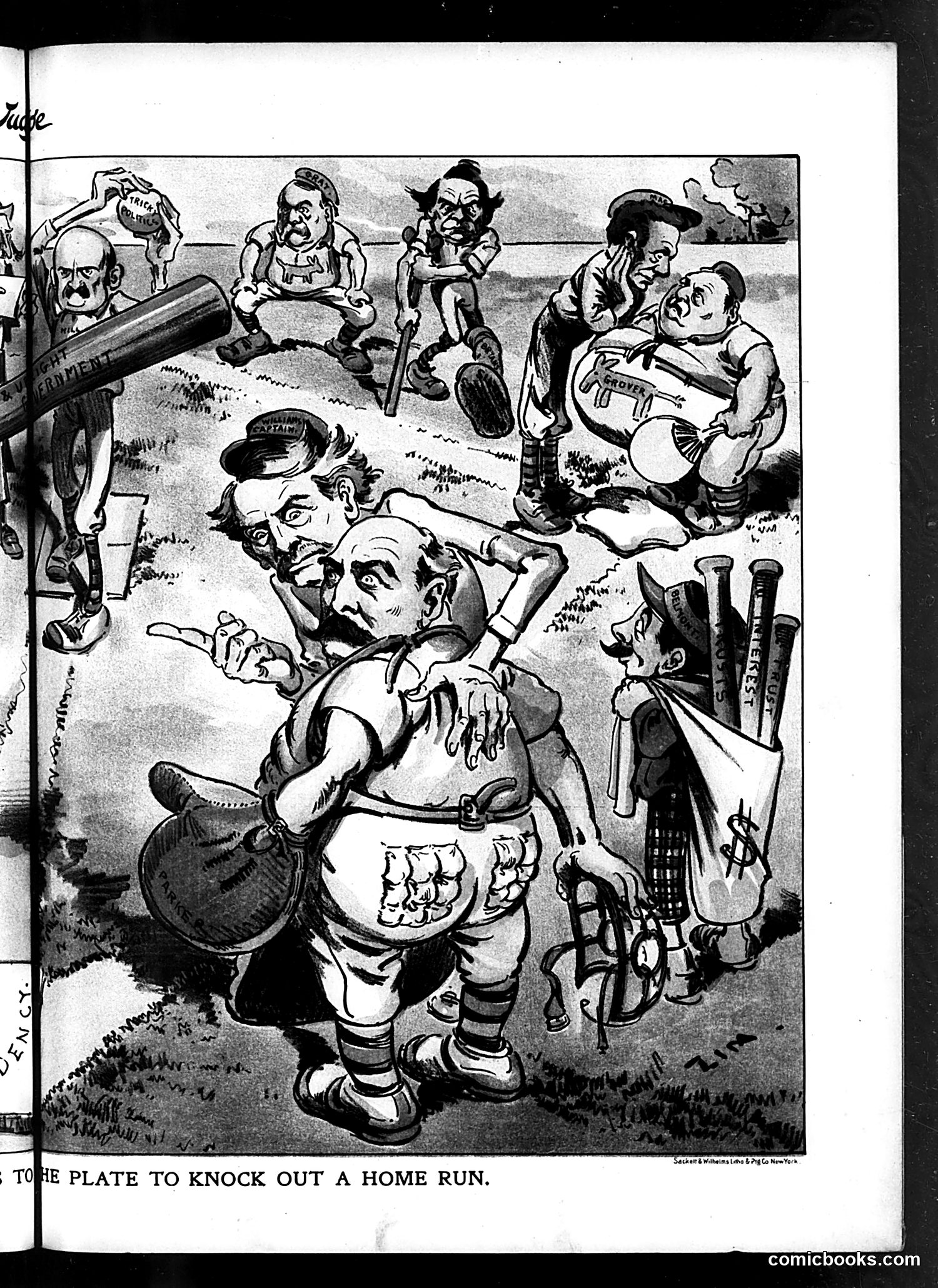
This Judge magazine cartoon uses baseball as metaphor for political conflict. The caption reads "TO THE PLATE TO KNOCK OUT A HOME RUN." The central figure appears to be a caricatured political leader at bat, with exaggerated facial features typical of early 20th-century satirical cartooning. Behind him stand other figures—some appear menacing or demonic, suggesting opposition or antagonistic forces. The baseball setting implies this is about a significant political "competition" or confrontation. The cartoon likely satirizes a political figure's attempt to achieve a major victory or policy goal against hostile opponents. Without clearer identifying labels or context about Judge's publication date, I cannot specify which political moment or figures are depicted, though the style suggests early-to-mid 20th century American political commentary.
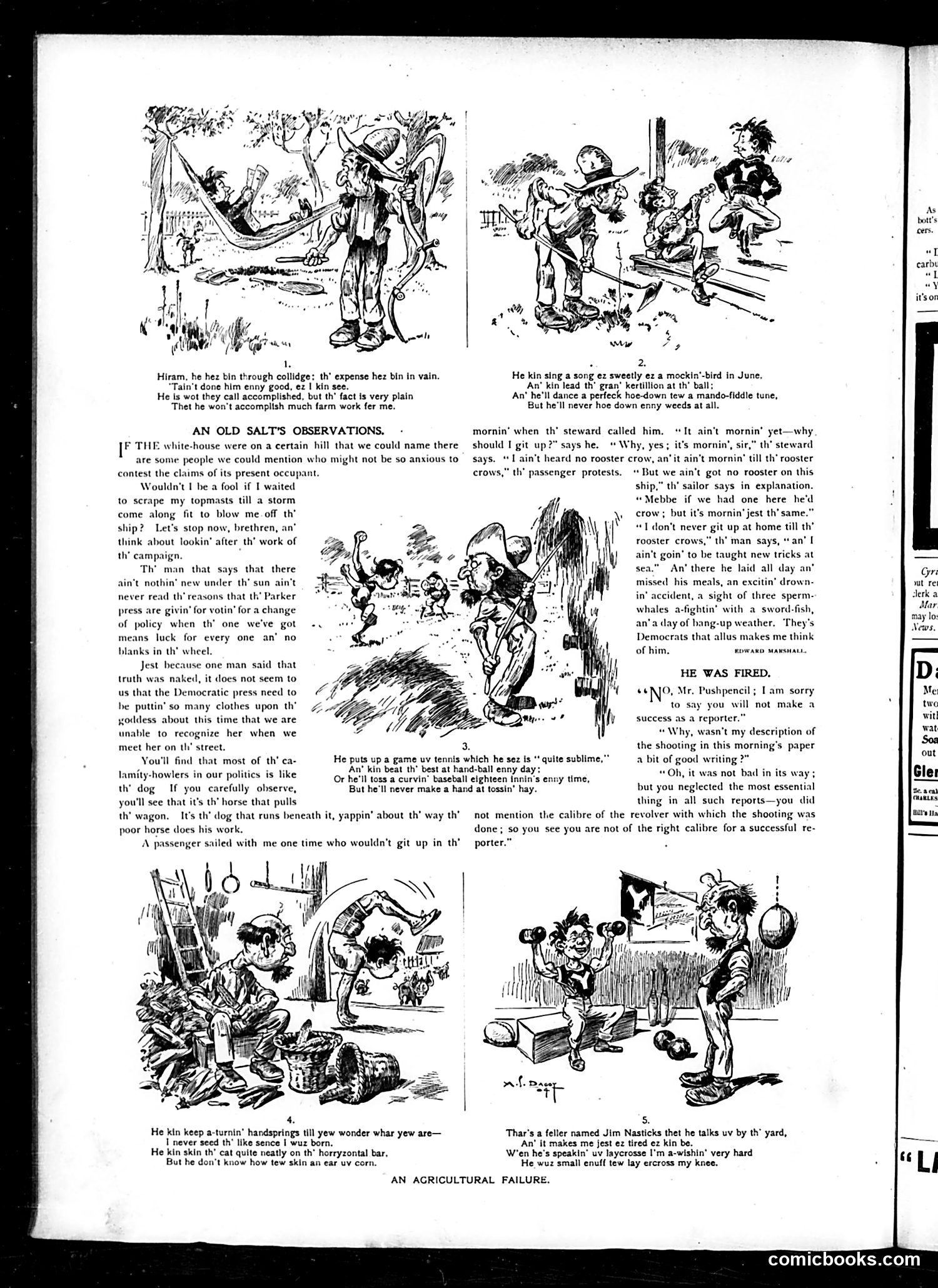
This Judge magazine page satirizes the tension between classical education and practical American life, a common theme in Gilded Age commentary. The main cartoon sequence ridicules a college-educated young man named Hiram through rural dialect. Despite his "accomplishments"—singing, dancing, athletics, academic skills—he's useless for farm work. He can't hoe weeds, skin corn, or perform basic agricultural labor. The satire targets elite education as impractical and disconnected from working reality. The sidebar section titled "An Old Salt's Observations" makes political commentary (likely about Parker, suggesting this relates to the 1904 presidential campaign) using sailor anecdotes about common sense versus pretension—reinforcing the theme that theoretical knowledge without practical utility is worthless. The final brief item mocks a reporter fired for omitting the gun's caliber from a shooting story—a pun on being "of the right calibre." Overall: education without utility deserves ridicule; practical competence matters more than refinement.
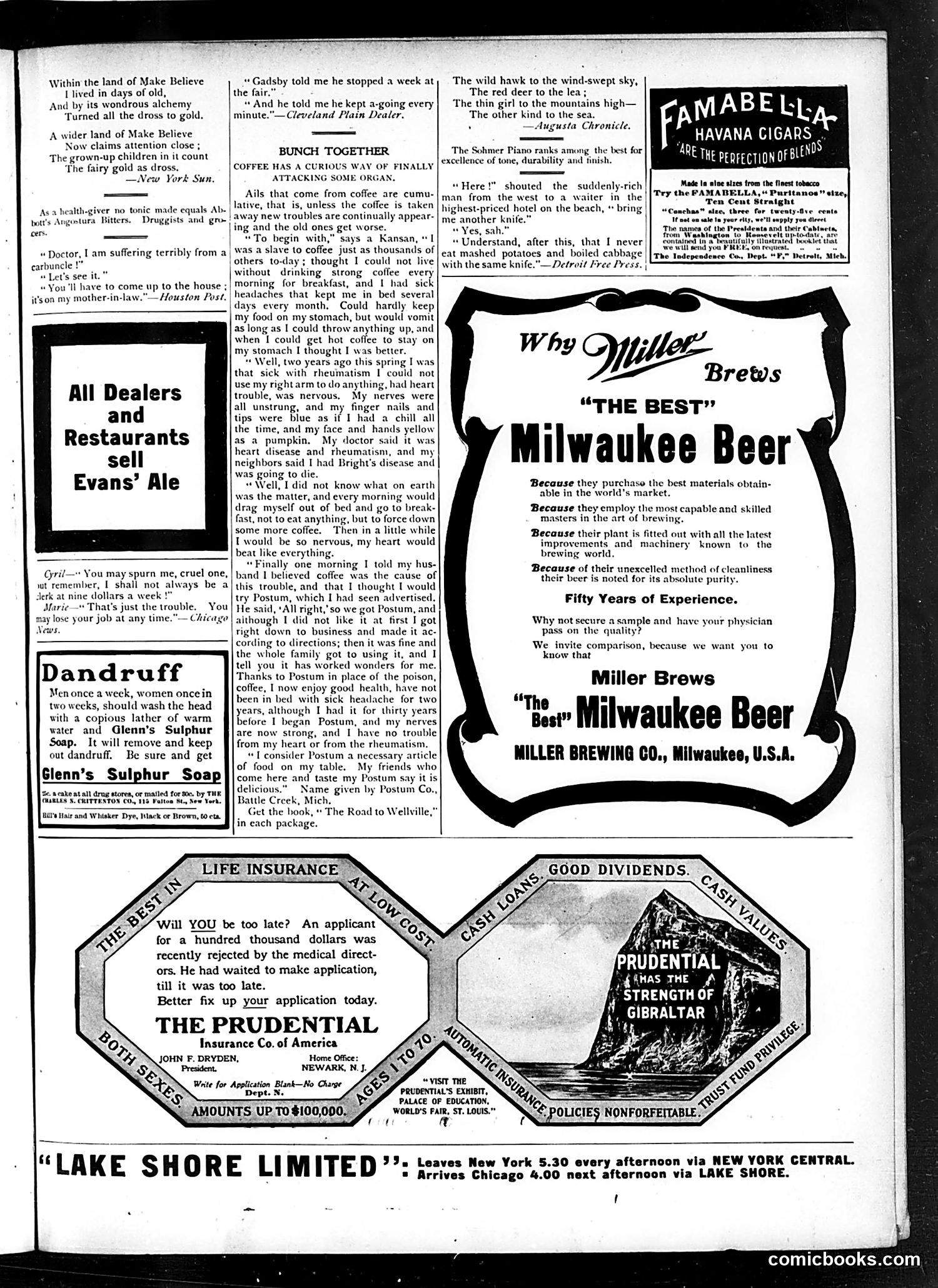
This page is primarily **advertisements**, not political satire. The main content consists of: 1. **Postum coffee substitute ad** (largest): A testimonial from a Kansas woman describing how switching from regular coffee to Postum cured her rheumatism, heart trouble, and nervousness. This reflects early 20th-century health anxieties about caffeine's supposed toxic effects. 2. **Miller Brewing Company ad**: Promoting Milwaukee Beer's quality, emphasizing "fifty years of experience" and purity. 3. **Smaller ads**: Evans' Ale, Glenn's Sulphur Soap (for dandruff), The Prudential Insurance, and a Lake Shore Limited train schedule. The page also includes brief **humorous quotations** at top (about "Make Believe" and coffee's cumulative effects) rather than full political cartoons. **For modern readers**: These ads reveal period anxieties about food/beverage safety and health, plus advertising strategies relying on personal testimonials and pseudo-medical claims—practices now heavily regulated.
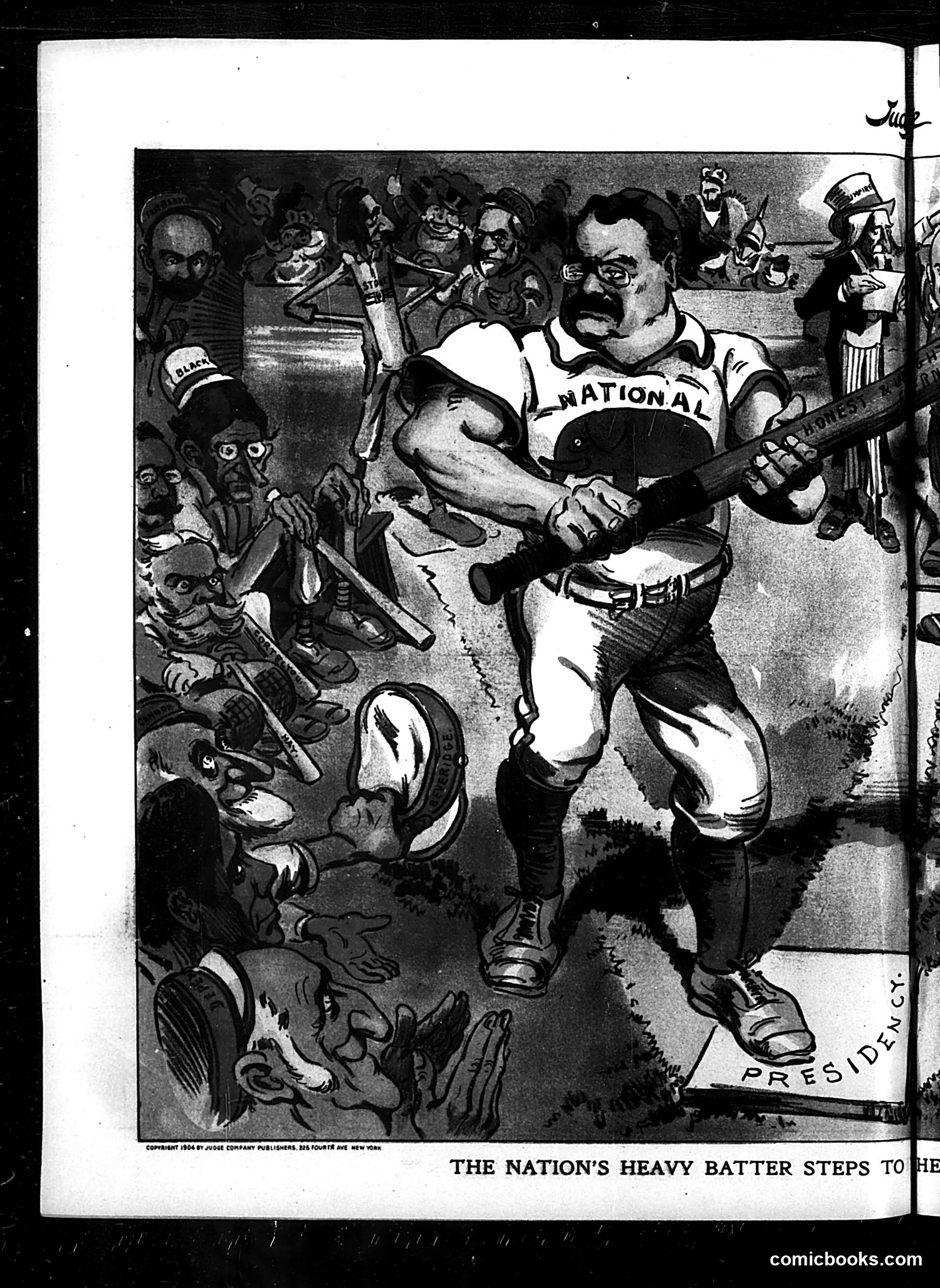
This Judge magazine cartoon depicts "The Nation's Heavy Batter Steps to He[lp]" (text cuts off). The central figure is a large man wearing a "National" baseball uniform, holding a bat while surrounded by caricatured faces—some appearing demonic or grotesque—at ground level. The satire uses baseball imagery as metaphor for political/economic action. The "heavy batter" (likely representing presidential or national authority) prepares to swing against smaller, menacing figures below, possibly representing threats like monopolies, corruption, or foreign adversaries. The specific identities and date remain unclear from visible text. The crude caricatures reflect period satirical style conventions. The overall message appears to support strong national action against perceived threats, using sports as accessible metaphorical language for contemporary readers.
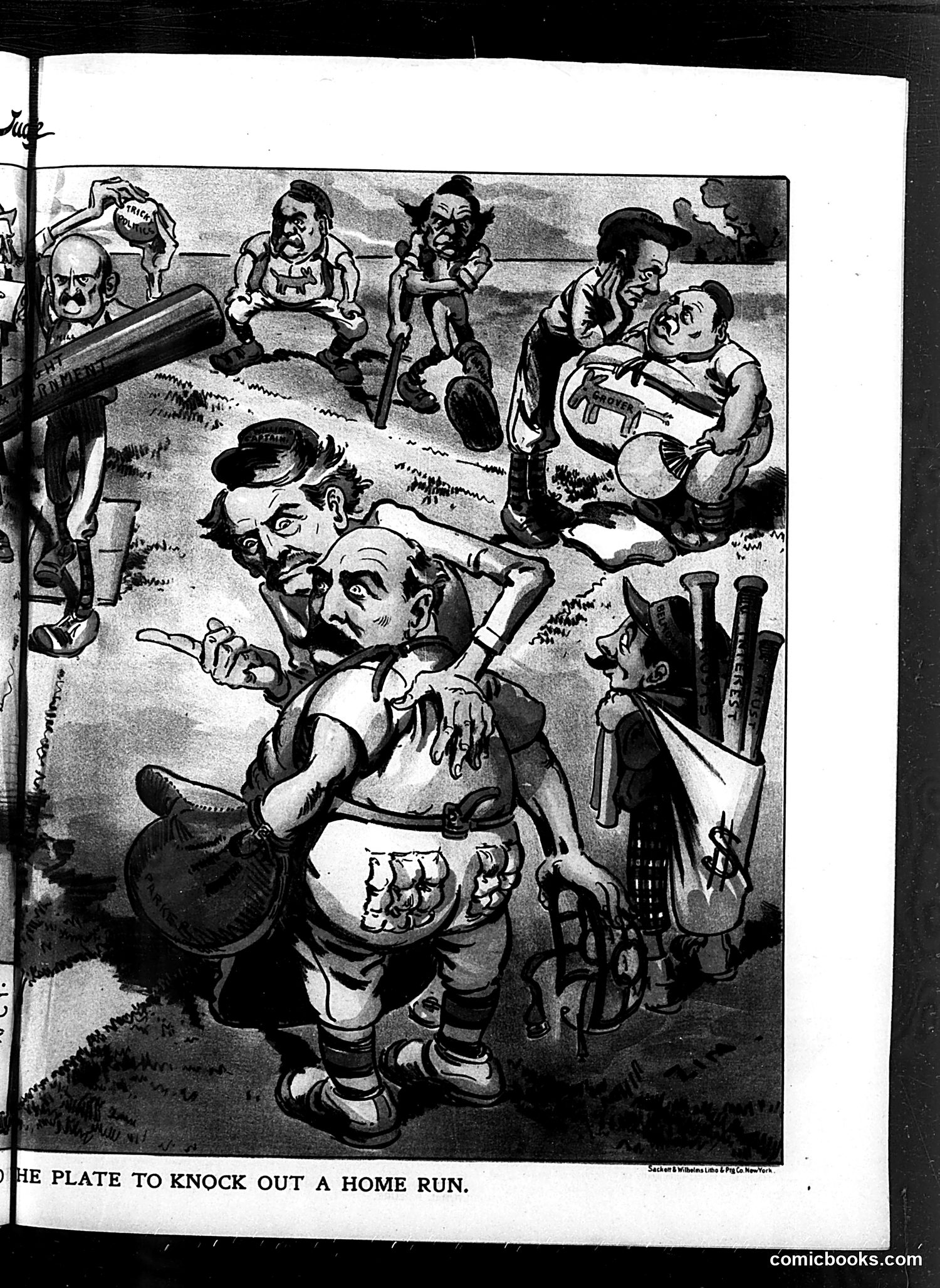
This political cartoon uses baseball as a metaphor for warfare or conflict. The central figure—a caricatured man with exaggerated features holding a baseball bat—appears ready to strike. He's surrounded by smaller caricatured figures seated as if in a dugout or stands, all rendered with the exaggerated facial features typical of early 20th-century satirical cartooning. The title's reference to "knocking out a home run" suggests the cartoon critiques aggressive action or militarism, using sports language as a euphemism. The grotesque depictions of the surrounding figures suggest commentary on political or military leadership. Without additional context identifying the specific figures or publication date, the exact political target remains unclear, though the overall tone appears critical of warmongering or authoritarian action.
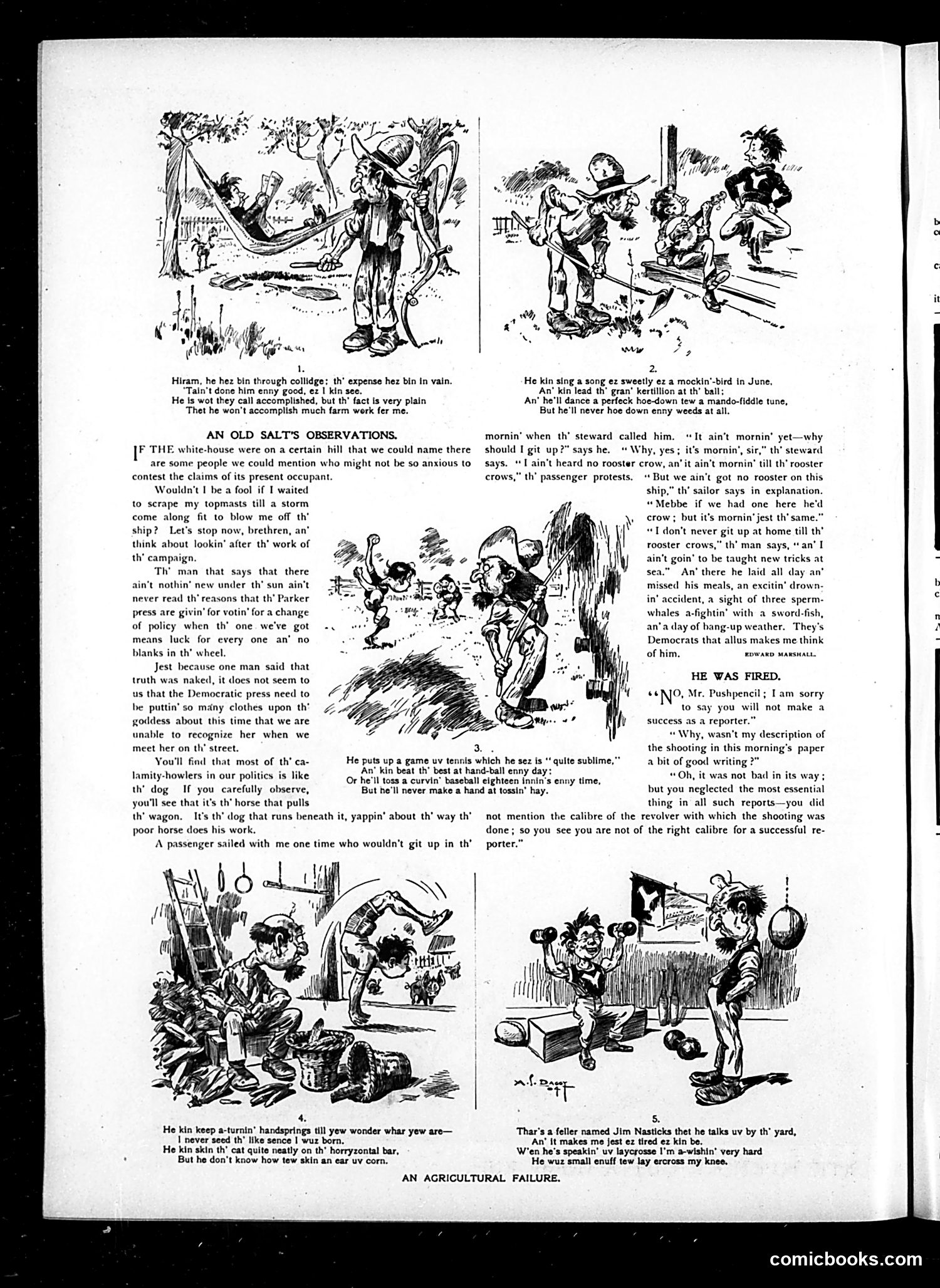
This Judge page contains political and social satire through verse and cartoons, circa early 1900s. **"An Old Salt's Observations"** presents a seasoned sailor criticizing Democratic opposition to the current administration (appears to be McKinley-era). The sailor uses nautical metaphors to argue against changing policy when things are working well, and mocks Democratic press for obscuring truth with rhetoric. **"Agricultural Failure"** cartoons satirize educated young men—college graduates and city folk—who possess refined skills (sports, music, dancing, acrobatics) but lack practical farm abilities. The repeated refrain is that despite accomplishments in genteel pursuits, they cannot perform basic agricultural work like "tossin' hay" or "hoe down enny weeds." **"He Was Fired"** is a brief pun about a journalist dismissed for omitting the gun's caliber from a shooting report—the editor jokes the reporter lacks "calibre" for the job. All pieces use rural dialect and working-class perspective to mock upper-class pretension and impracticality, a common Judge theme.
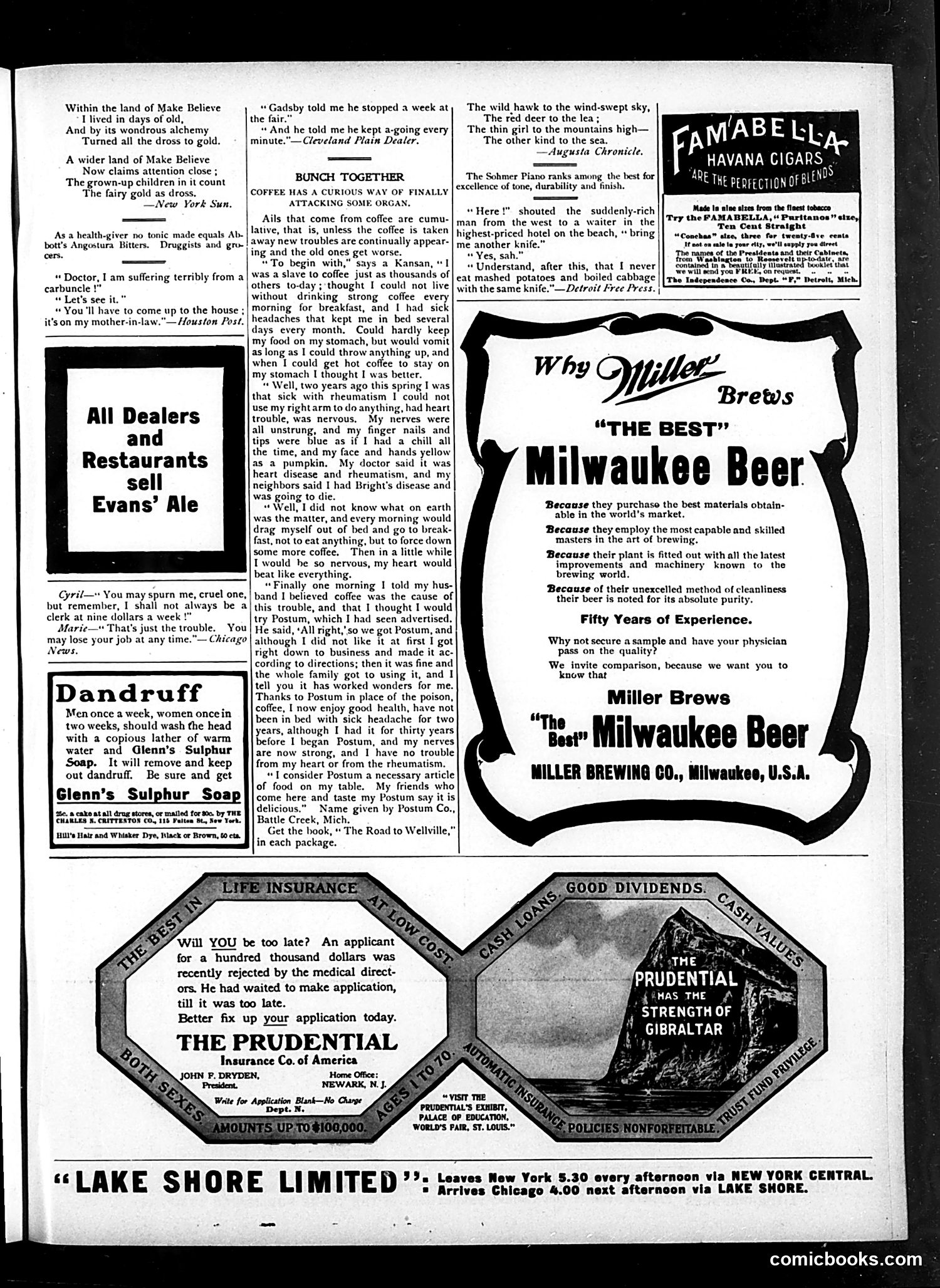
This page is primarily **advertising**, with minimal editorial content. The notable elements: **Main Content:** A testimonial article (likely advertising disguised as editorial) about **Postum**, a caffeine-free coffee substitute. A Kansas woman describes coffee-induced health crises—headaches, rheumatism, heart trouble, digestive issues—that mysteriously resolved when she switched to Postum. This reflects early 1900s health anxieties about coffee's effects and the era's credulous acceptance of patent medicine testimonials. **Other Advertisements:** - Evans' Ale, Milwaukee Beer, Glenn's Sulphur Soap, Abbott's Bitters, and life insurance from The Prudential - These target working-class readers (clerks earning $9/week appear in jokes) **Satirical Content:** Small jokes mock courtship, workplace anxiety, and marital dynamics—typical Judge humor. One poem fragment alludes to Romantic nature imagery ("wild hawk," "red deer"). The page reflects **early 1900s advertising practices**: pseudoscientific health claims, testimonials, and appeals to consumer anxieties about modernity's physical toll.
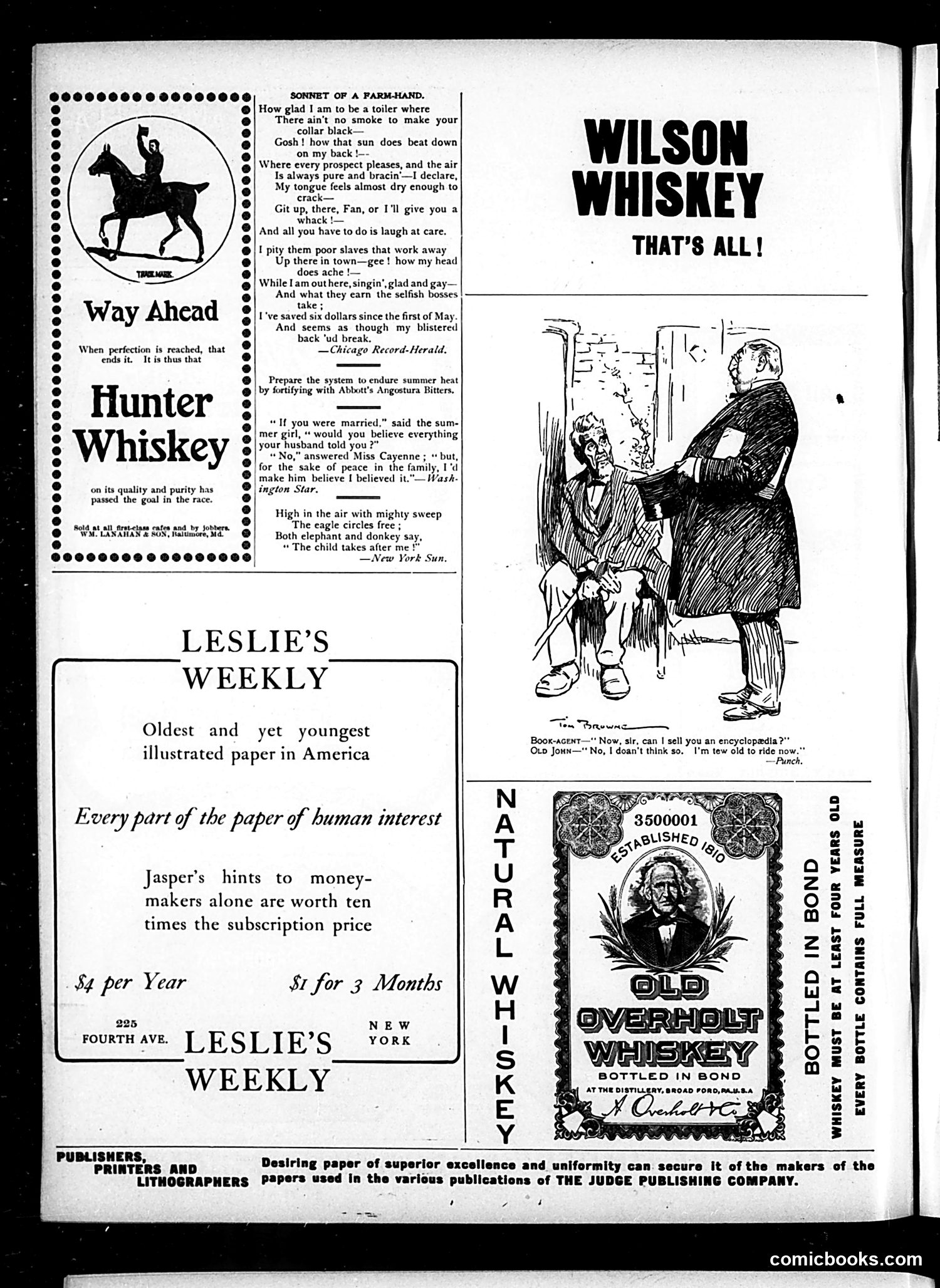
This page mixes advertisements with satirical content typical of early 20th-century Judge magazine. The main cartoon features a **book agent pitching an encyclopedia to "Old John,"** who declines with the quip "I'm too old to ride now"—a joke playing on the agent's aggressive sales pitch and the customer's age. The **"Sonnet of a Farm-Hand"** uses ironic contrast: a farmer boasts about rural life's supposed benefits (pure air, no smoke, freedom from care) while the text reveals his actual misery (brutal sun, aching head, blistered back, only six dollars saved). The satire mocks romanticized notions of farm life versus urban work—both exhausting, but farmers deceive themselves about their superiority. The page is otherwise **dominated by period advertisements** for whiskeys (Hunter, Wilson, Old Overholt) and Leslie's Weekly magazine, reflecting the publication's commercial nature. The smaller poem about an eagle and donkey satirizes parental claims of offspring resemblance.
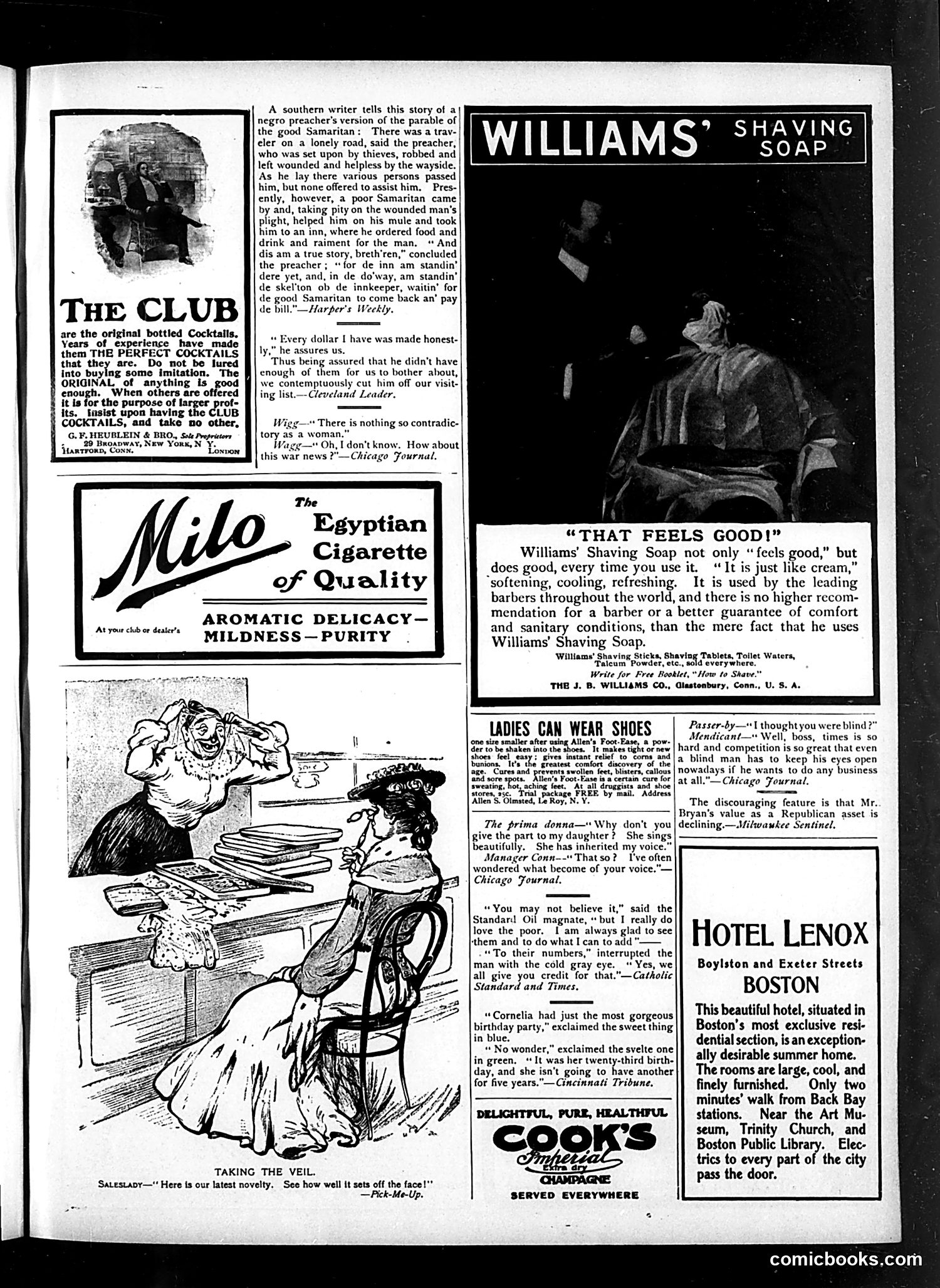
This page is primarily **advertising** interspersed with light humor and satirical commentary typical of *Judge* magazine. The main cartoon, "Taking the Veil," depicts a woman trying on a veil, with the caption joking that it "sets off the face" well—a gentle jab at women's vanity and fashion. The text snippets are brief satirical quips: one mocks a preacher's version of the Good Samaritan parable (an old "Negro dialect" joke format common to the era, reflecting period racism); another ridicules a wealthy person's claim to have earned money "honestly"; another contrasts women's contradictions with wartime news confusion. Most content consists of ads for **cocktails, cigarettes, shaving soap, shoes, hotels, and champagne**—period luxury goods. The page reflects early 20th-century magazine format: light satire serving as filler between advertisements targeting middle-to-upper-class readers.
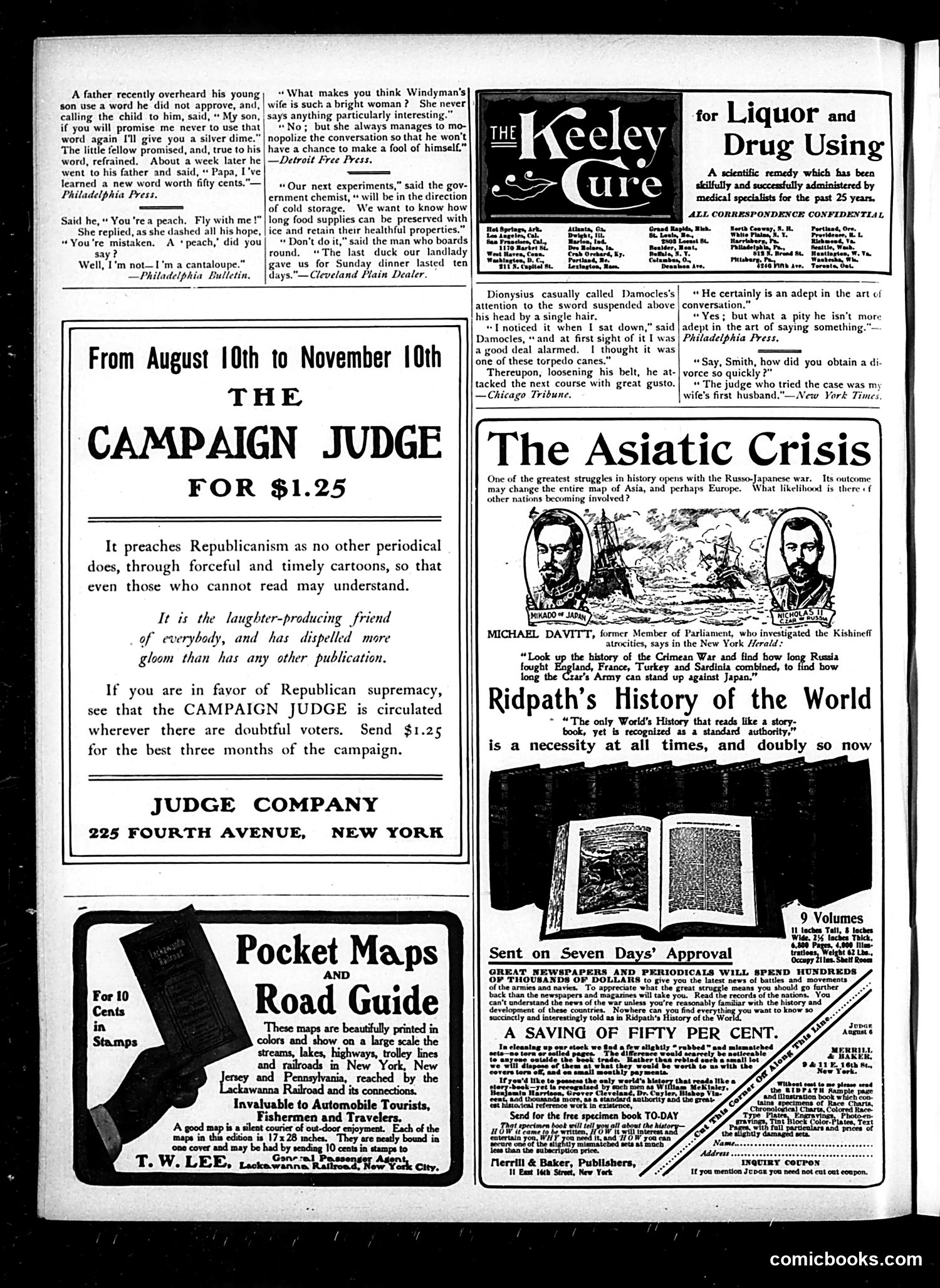
This page is primarily **advertising and filler content** rather than political cartoons requiring historical interpretation. The page contains: 1. **Brief humorous anecdotes** (top left) — simple jokes about word usage, flirtation, and domestic life with no specific political reference. 2. **Campaign advertisement** (center-left) — Judge magazine promoting Republican subscription during what appears to be an election cycle, encouraging circulation to "doubtful voters." This reflects Judge's partisan Republican stance. 3. **"Asiatic Crisis" section** (right) — discusses the Russo-Japanese War (1904-1905), featuring commentary from Michael Davitt questioning how long Russia can withstand Japan militarily. This represents contemporary geopolitical speculation. 4. **Product advertisements** — for road maps, Ridpath's History, and a "Keeley Cure" (a patent remedy for alcohol/drug addiction). The page reflects early 1900s American concerns: partisan politics, imperial conflicts in Asia, and era-specific commercial remedies. The specific cartoons or satirical illustrations that would convey Judge's typical biting political commentary are not prominently featured here.
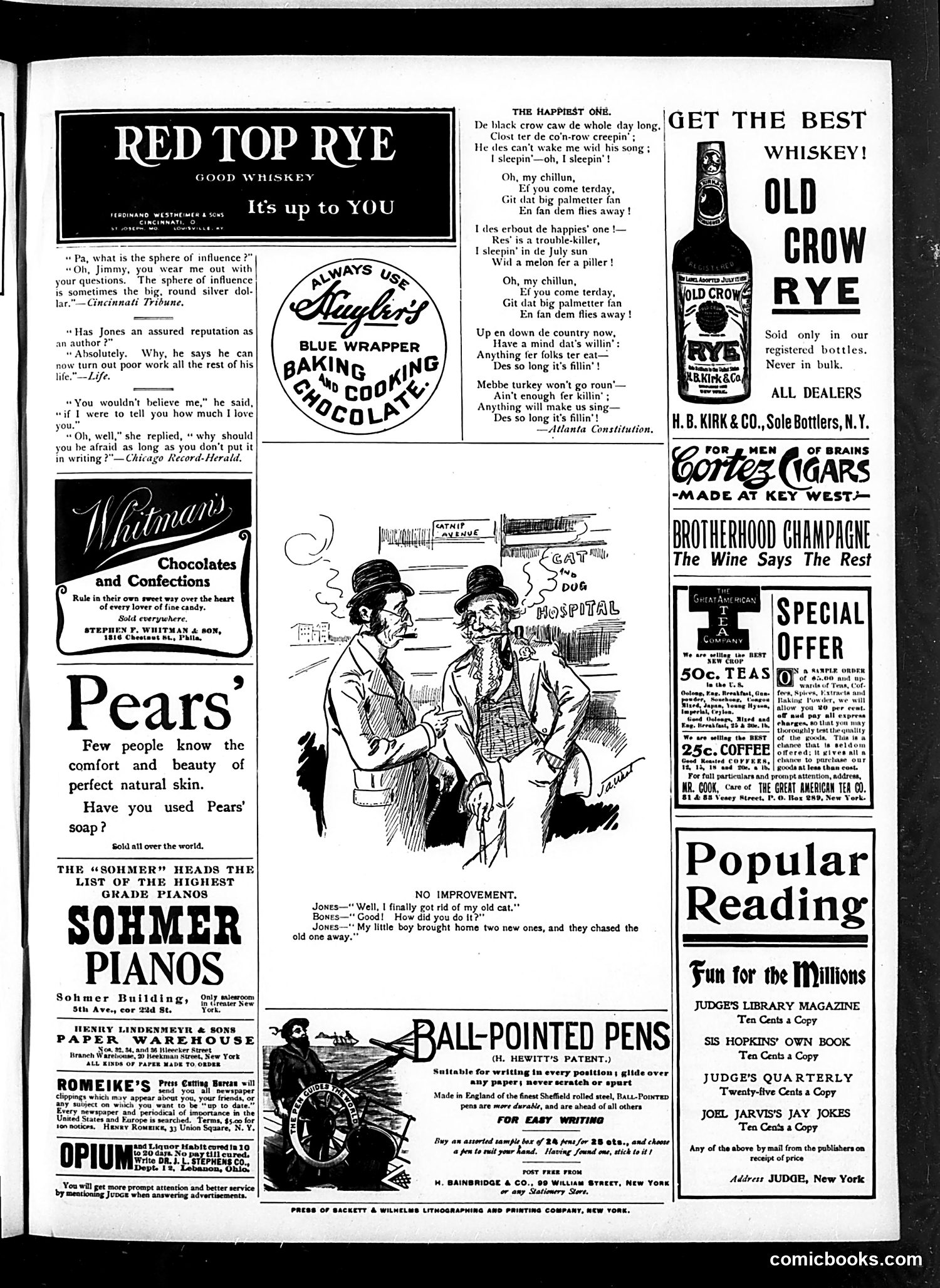
This page is primarily **advertising** with minimal editorial content. The main cartoon depicts two men on a street labeled "Catnip Avenue" and "Goat Street," discussing cat problems—a domestic humor piece with no political significance. The satirical content is limited to three brief **jokes**: 1. A dialogue about "sphere of influence" (likely referencing imperialist geopolitics of the era, though the joke's point is unclear) 2. A quip about an author's "assured reputation" for producing poor work 3. A romance joke about putting declarations of love in writing The page also includes **"The Happiest One,"** a dialect poem in the voice of an African American character celebrating rest and simple pleasures. This reflects early-20th-century popular entertainment conventions featuring racial stereotypes common to the period. The remainder comprises advertisements for whiskey, chocolates, pianos, soap, and other consumer goods typical of Judge's revenue model.
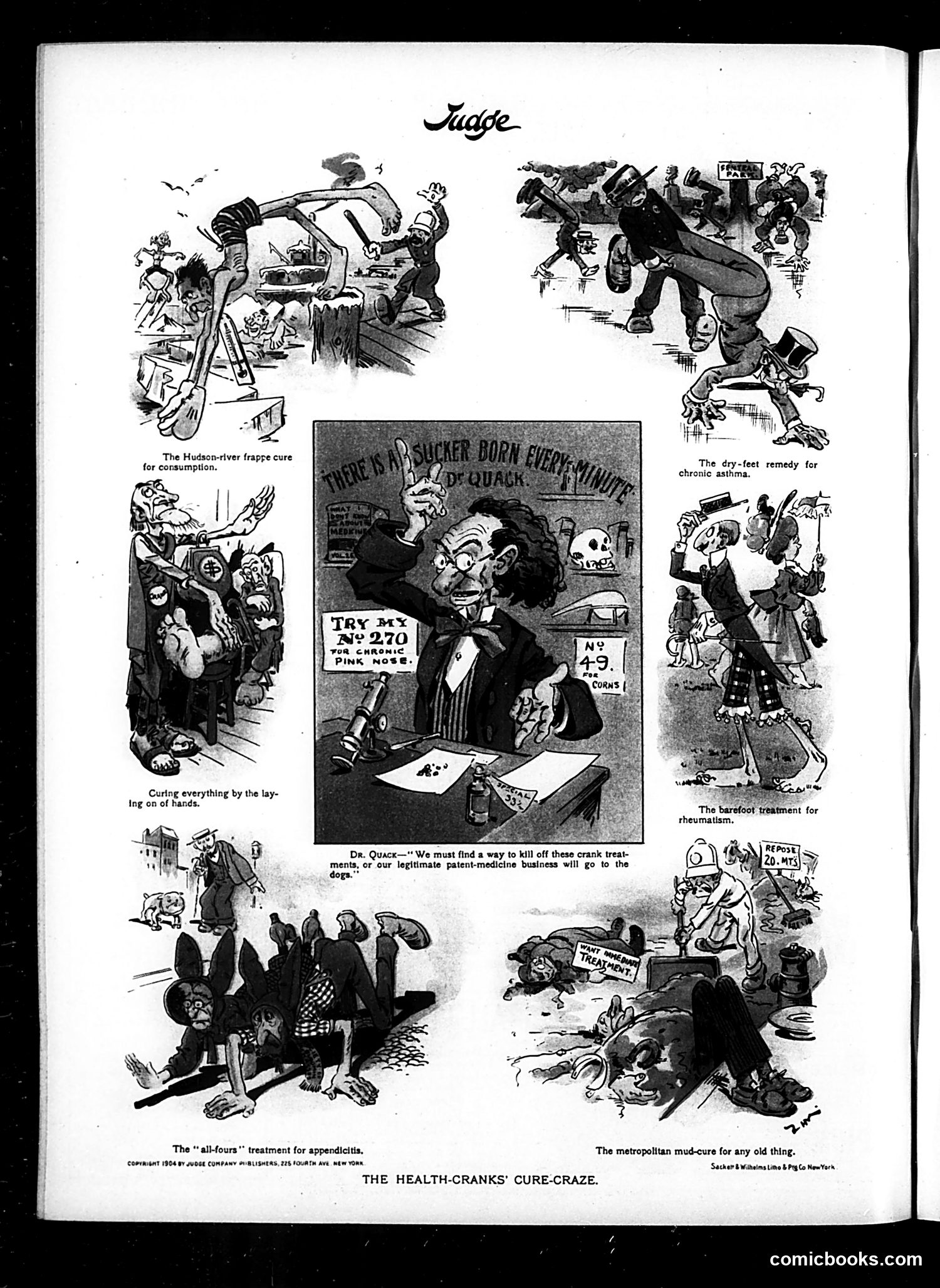
This satirical page mocks the proliferation of dubious medical treatments in early 1900s America. The central figure, "Dr. Quack," represents legitimate patent-medicine manufacturers concerned that unorthodox "crank" treatments threaten their profitable business. The surrounding vignettes lampoon absurd alternative remedies: the "Hudson-river frappe cure" for consumption, "dry-feet remedy" for asthma, faith healing ("laying on of hands"), a "mud-cure," and treatments involving unusual positions or substances. Each is presented as ridiculous pseudoscience. The satire cuts both ways: while mocking alternative practitioners, Judge also criticizes Dr. Quack's patent medicines as equally fraudulent—just more established. The cartoon suggests the era's medical marketplace was dominated by charlatans on all sides, with no clear distinction between "legitimate" and "crank" treatments. Modern readers should recognize this reflects genuine turn-of-the-century skepticism about unproven remedies peddled to desperate patients.