
Judge, 1904-08-06 · page 5 of 20
Judge — August 6, 1904 — page 5: what you’re looking at
What you’re looking at
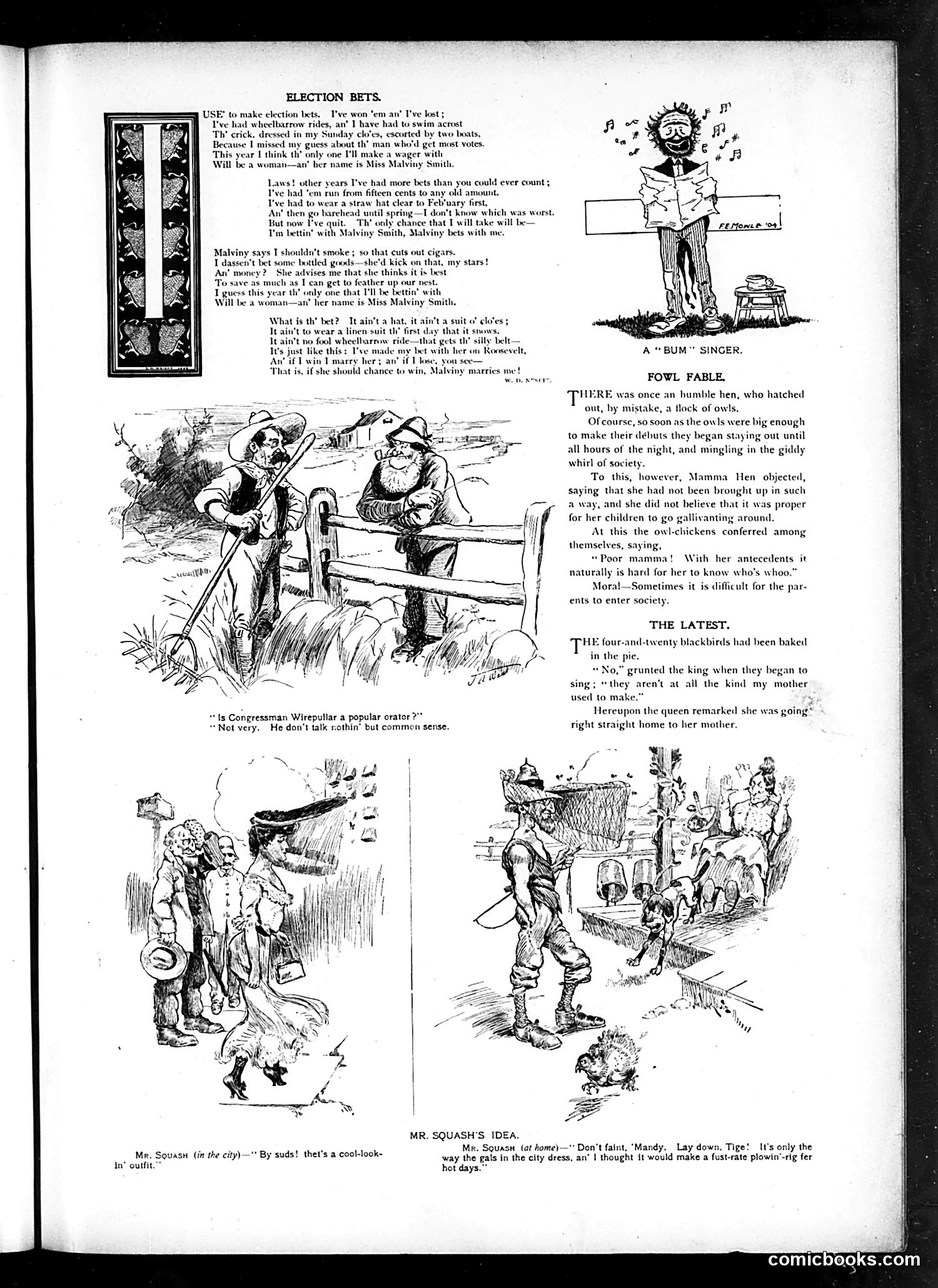
This Judge page satirizes early 20th-century American life through multiple sketches: **"Election Bets"** presents a rural speaker who habitually makes election wagers but is now constrained by his wife Malviny's domestic authority. The joke centers on marital control replacing political betting—he'll only wager that if he wins the election bet, he'll marry Malviny. It mocks both electoral overconfidence and the powerlessness of husbands under wives' management. **"Fowl Fable"** uses animal allegory: a hen's owl chicks resent her old-fashioned morality ("who's whoo" puns on their nature). The moral critiques generational clash—parents struggle to maintain propriety as children adopt modern social habits. **"Mr. Squash's Idea"** shows a rural man misunderstanding city fashion, proposing women's shortened skirts as practical farm equipment for hot-weather plowing. All three cartoons reflect period anxiety about social change: electoral reliability, generational values, and rural-urban cultural differences.
📄 Transcribed text from this page (OCR, searchable)
Machine-transcribed from the original scan — historical spelling and the odd misread are preserved.
ELECTION BETS. T've won "em an’ I've lost ; des, an’ I have had tu swim acrost Because I missed my guess about th’ n This year I think th’ only one Pll make a wa Will be a woman—an’ her name is Miss Malviny Laws! other years I've had more bets than you could ever count ; Malviny says I shouldn't smoke ; so that cuts out cig I dassen't bet some bottled goods— An’ money? She advises me that she thinks i To save as as I can get to feather up our nest. I guess this year th’ only one that I'll be bettin’ with Will be a woman—an’ her name is Miss Malviny Smith, What is th’ bet? It ain’t_a hat. ita a suit o' clo'es ; ear a linen suit th lay that it snows. ‘lly: belt — » Roosevelt, A“ BUM" SINGER. ce to win, Malviny marries me! : pane FOWL FABLE, HERE was once an humble hen, who hatched out, by mistake, a flock of owls. Of course, so soon as the owls were big enough to make their debuts they began staying out until all hours of the night, and mingling in the giddy whirl of society. To this, however, Mamma Hen objected, saying that she had not been brought up in such a way, and she did not believe that it was proper for her children to go gallivanting around. At this the owl-chickens conferred among themselves, saying, “Poor mamma! With her antecedents it naturally is hard for her to know who's whoo.” Moral—Sometimes it is difficult for the par- | ents to enter society. ‘THE LATEST. pe wa “\ THE four-and-twenty blackbirds had been baked ~ in the pi “No,” grunted the king when they began to Car 7aw F ‘i Ja sing; “they aren't at all the kind my mother used to make.” + 1s Congressman Wirepullar a popular orator ?"* Hereupon the queen remarked she was going™ “Not very. He don't talk nothin’ but common sense. right straight home to her mother. MR. SQUASH’S IDEA. . SQUASH. (at home)—"* Don't faint, ‘Mandy. Lay down, Tige! It's only th Mr. Souasn (in the city)—"' By suds! thet’s a cool-look- Mx. Squasn (at home)—" Don't faint, "Mandy. Lay down, Tige! It's only the . way the gals in the city dress, an’ | thought it would make a fust-rate plowin’-rig fer in’ outfit. hot days" i comicbooks.com