
A complete issue · 20 pages · 1904
Judge — July 16, 1904
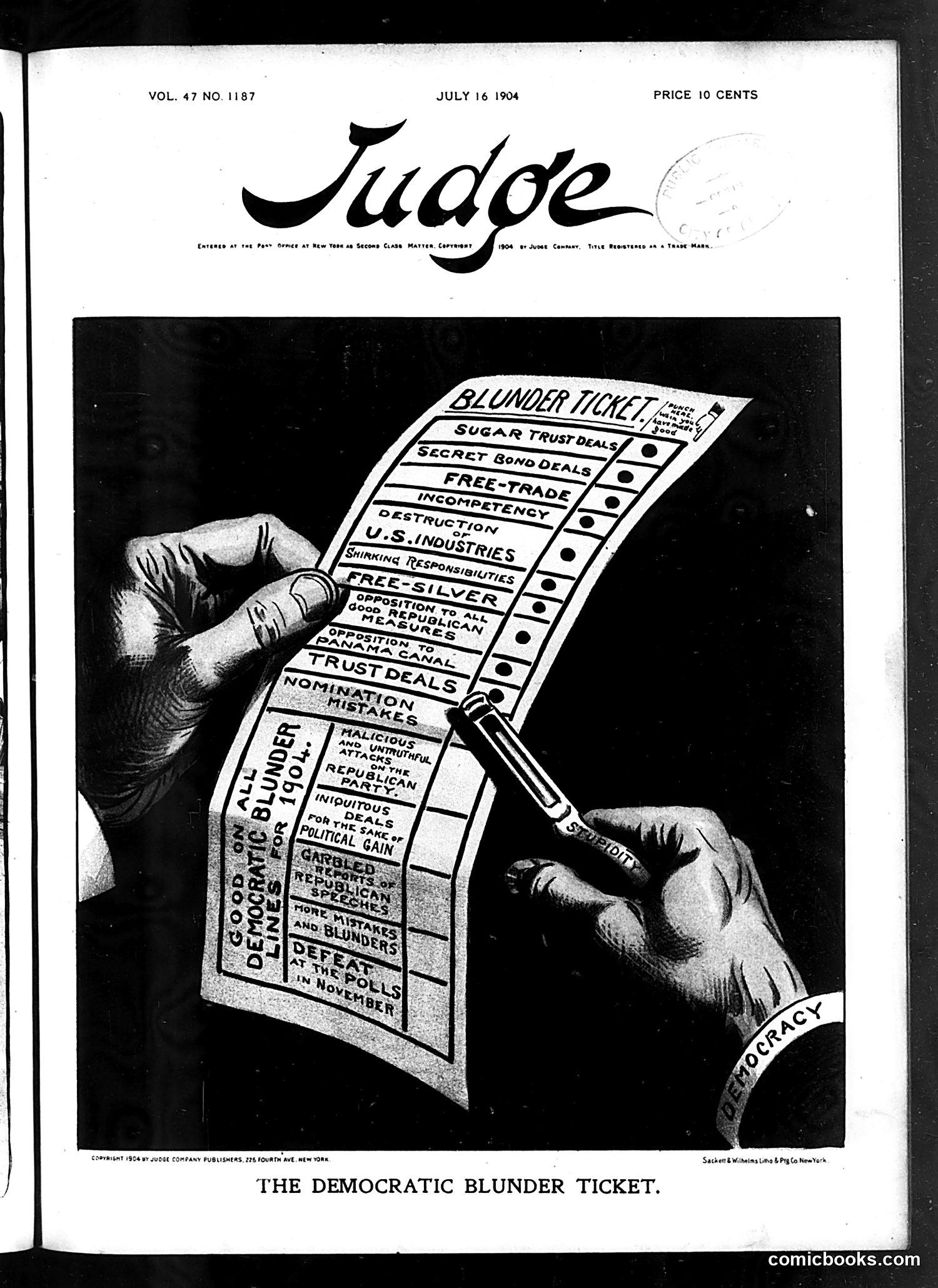
This political cartoon satirizes the Democratic Party platform through a "blunder ticket"—a mock ballot that voters are being asked to punch. The ticket lists alleged Democratic failures and scandals rather than candidates: - **Sugar Trust Deals** and **Secret Bond Deals** reference corruption charges - **Free-Trade Incompetency** and **Destruction of U.S. Industries** attack Democratic trade policy - **Shinning Responsibilities** and **Free Silver** reference past controversies - **Panama Canal** opposition and **Trust Deals** - **Nomination Mistakes** - Culminating in **"All Under One Cover": Decay of the Democratic Party, with Home Rule Blunders and Defeat at the Polls in November** The imagery of a hand preparing to punch this ballot suggests voters will inadvertently select Democratic incompetence. This was created during the 1904 election campaign, likely supporting Theodore Roosevelt's Republican candidacy against the Democratic nominee.
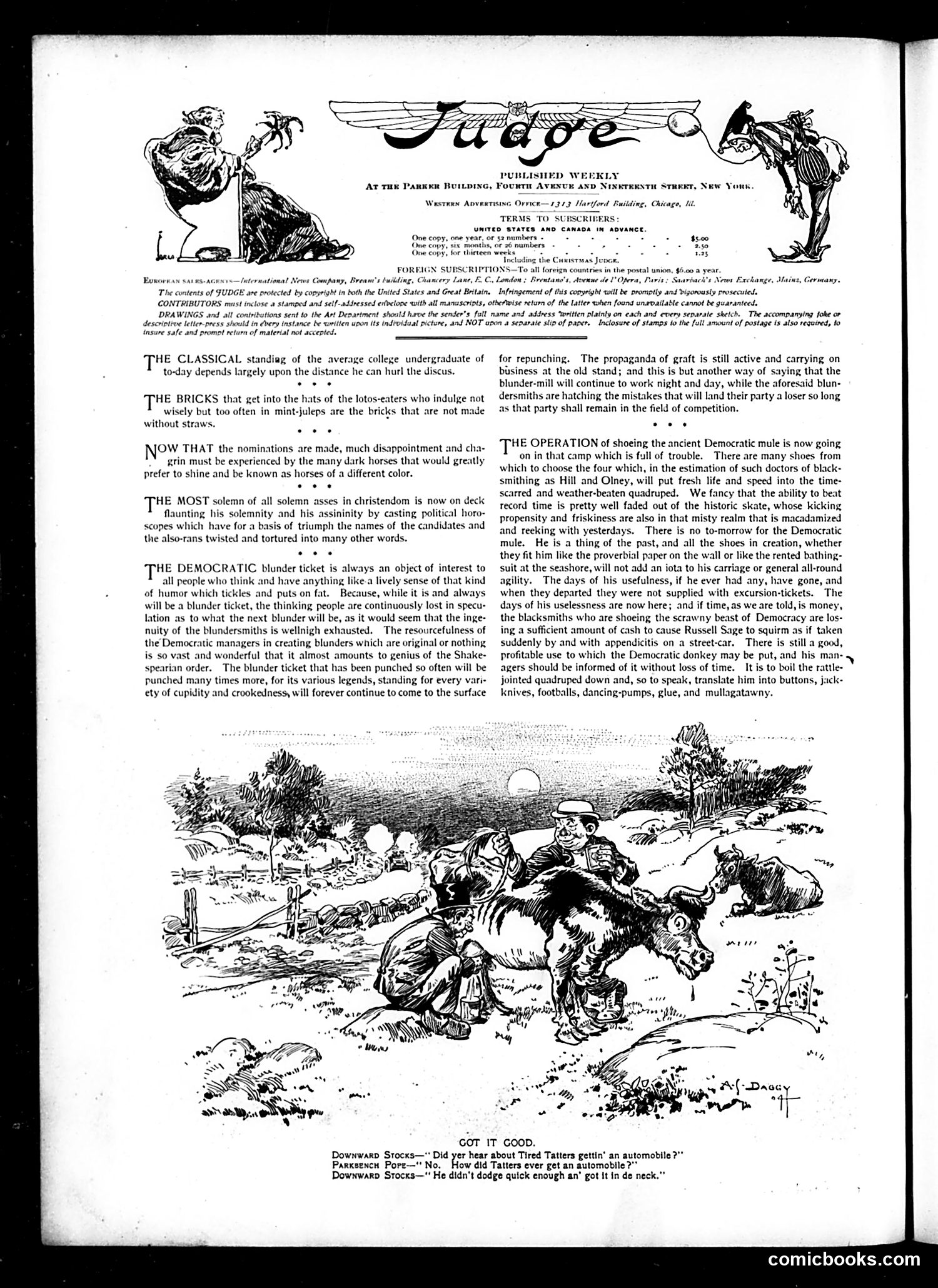
This page contains several editorial columns criticizing American politics and society, likely from the early 1900s. The main cartoon depicts rural figures with a donkey, captioned "GOT IT GOOD," illustrating a joke about "Tired Tatters" and automobiles—apparently mocking rural people's lack of access to modern technology. The columns attack: - College graduates' poor practical skills - Political corruption ("graft") - The Democratic Party's dishonesty and incompetence - Election fraud and bribery The satire suggests Democrats are fundamentally corrupt and unfit to govern. The rural cartoon appears to mock working-class Americans as backward and disconnected from progress, while the political commentary frames Democratic politics as criminal enterprise rather than legitimate disagreement.
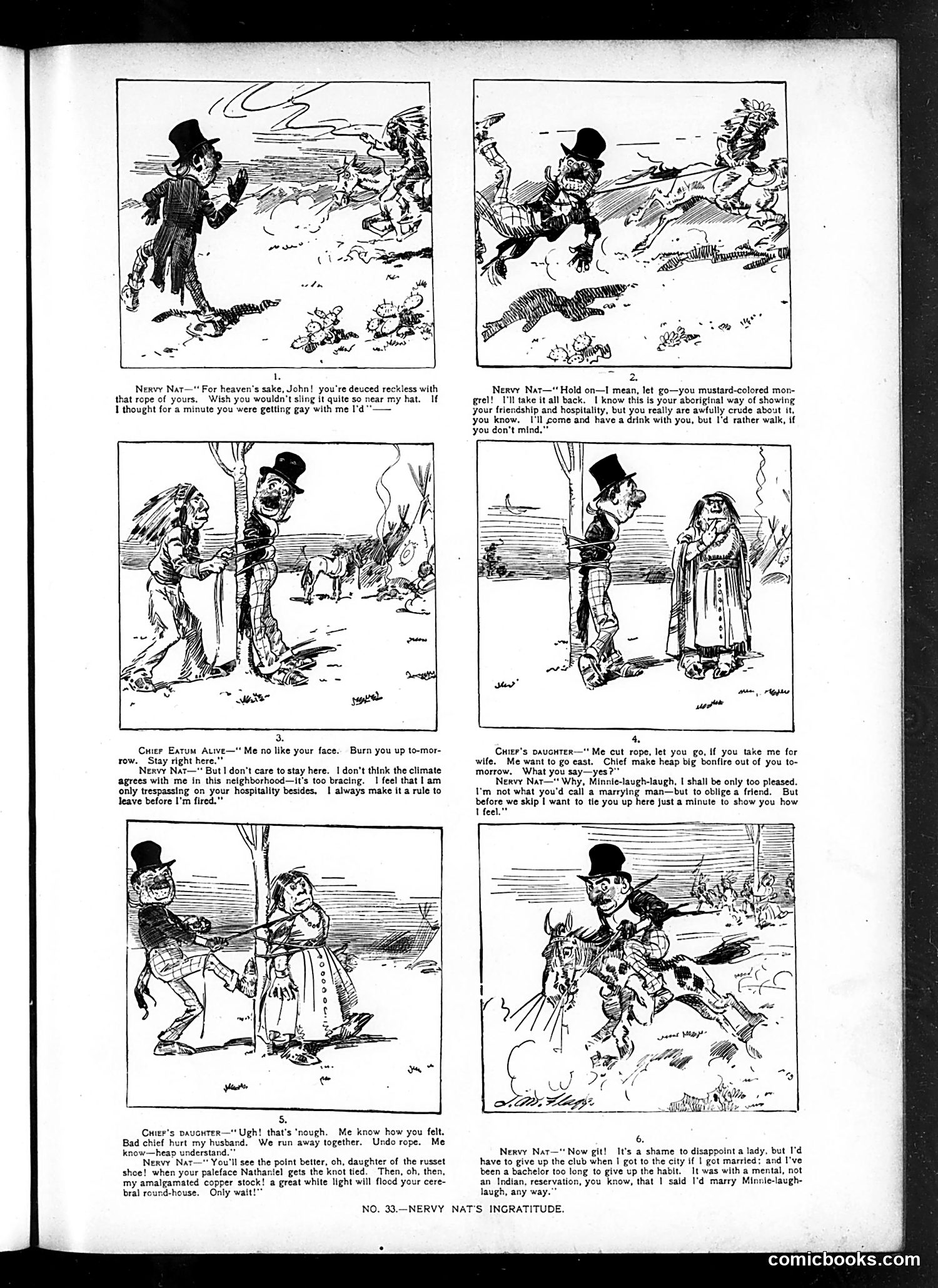
This six-panel comic satirizes a character named "Nervy Nat" (identifiable by his top hat) and his interactions with Native Americans. The humor relies on period-typical ethnic stereotypes and caricature. The narrative shows Nat encountering an Indigenous chief and his daughter. The satire centers on Nat's opportunistic behavior—he borrows money, accepts hospitality, and courts the chief's daughter while planning to abandon them all. The title "Ingratitude" mocks his shameless exploitation of their generosity. The punchline involves Nat absconding with the chief's valuables (a "copper stock") and daughter, then dismissively dismissing Indigenous culture as grounds for "marriage-laughs." The comic reflects late 19th/early 20th-century American attitudes depicting Native Americans as naive and suitable targets for ridicule.
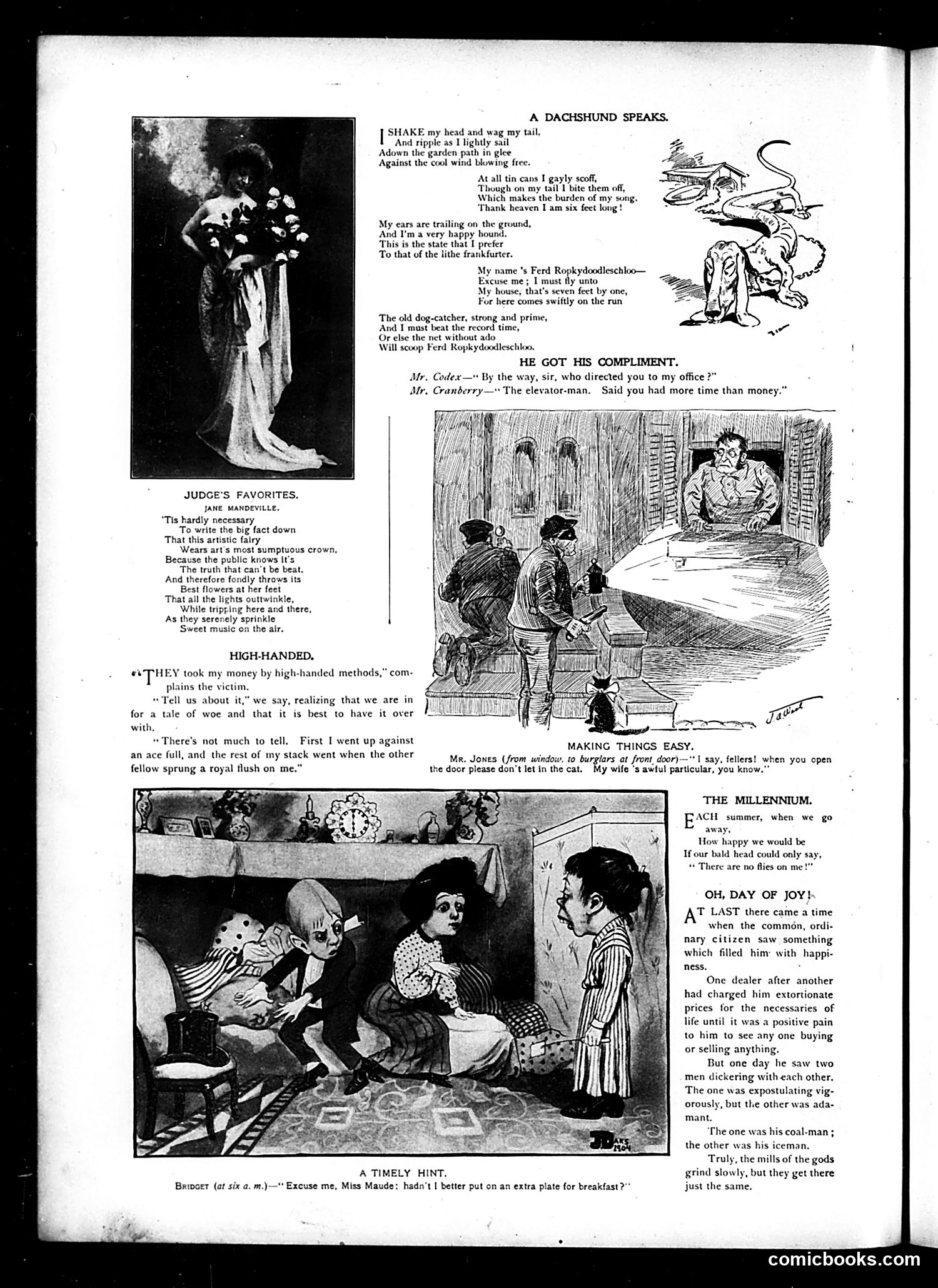
This page contains several humor pieces typical of early 20th-century Judge magazine: **"A Dachshund Speaks"** - A humorous poem from a dachshund's perspective, playing on the breed's long body and German name (Ferd Rokyboodleschko). The satire appears to mock both the dog's appearance and perhaps German immigrant naming conventions. **"He Got His Compliment"** - A brief office joke about an elevator operator receiving a backhanded compliment regarding time management. **"Making Things Easy"** - A cartoon about a landlord warning tenants not to let cats in the door. **"The Millennium"** - A satirical piece about economic frustration, depicting common citizens unable to afford basic necessities while wealthy coal merchants profit—social commentary on class disparity and commercialism of everyday life. The page emphasizes period humor relying on class observation and gentle social critique.
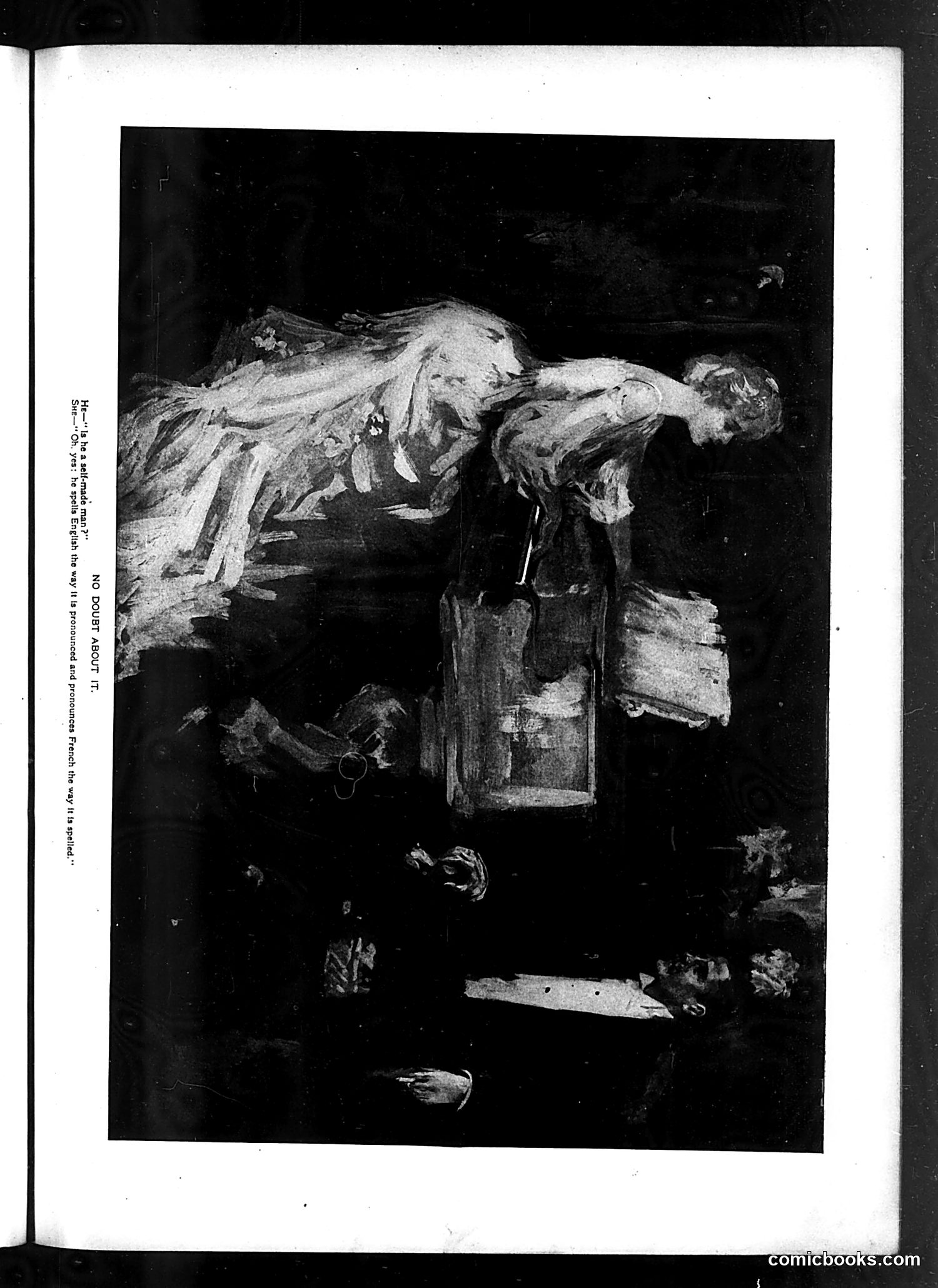
This appears to be a satirical cartoon mocking someone's language abilities—specifically their unconventional spelling of English and pronunciation of French. The caption suggests the subject phonetically spells English words (writing how they sound) rather than following standard spelling conventions, while simultaneously mispronouncing French words by reading them literally as spelled. The cartoon likely targets a public figure known for linguistic errors or affected speech patterns, a common subject for *Judge* magazine's satirical humor. Without clearer visual identification of the figures or additional context, the specific target remains unclear, but the satire ridicules pretension combined with incompetence in language—a recurring theme in American satirical publications of this era.
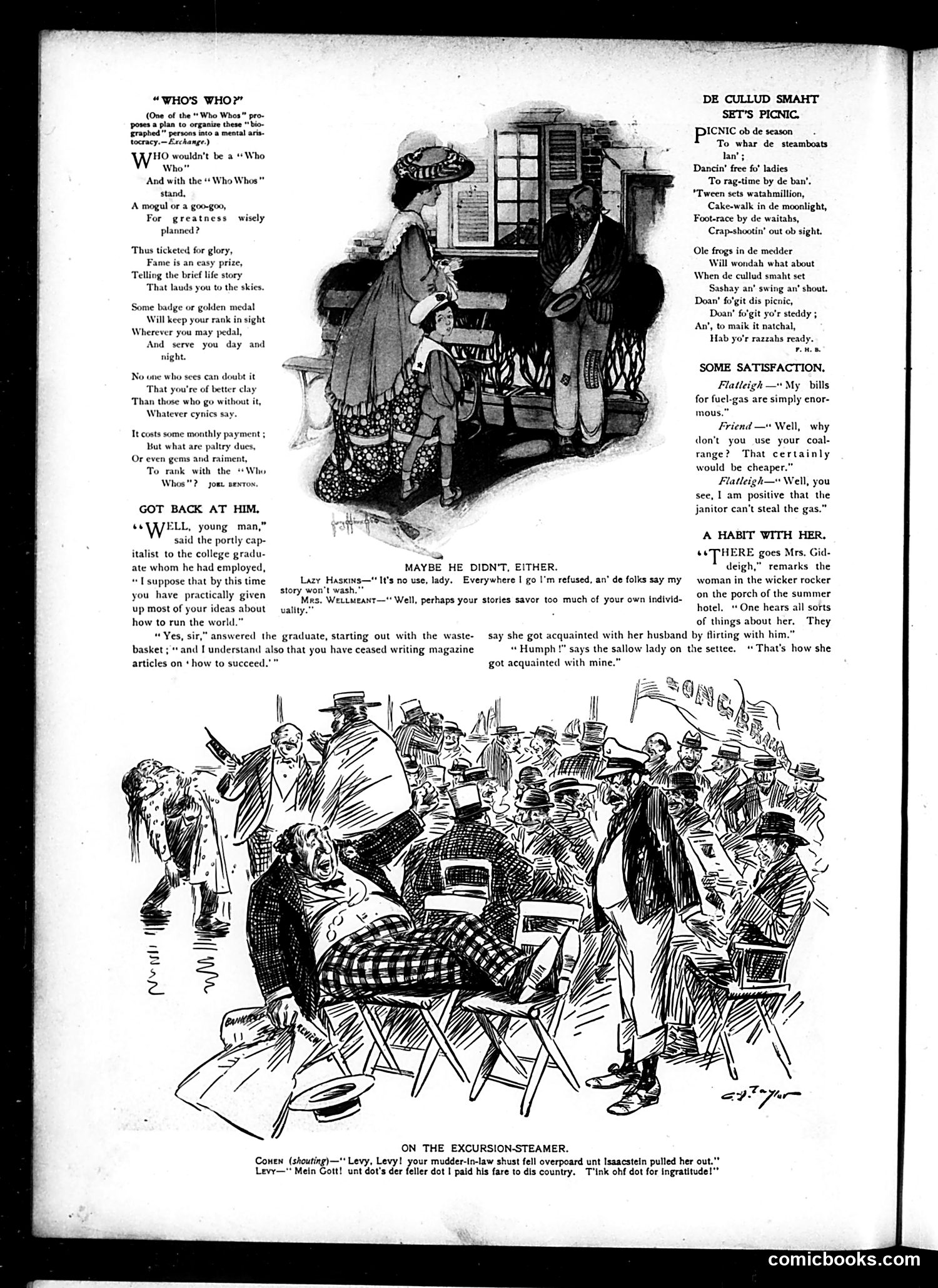
This page contains several period satirical pieces typical of early 20th-century American humor: **"Who's Who?"** mocks the emerging "Who's Who" biographical directories as creating artificial aristocracy. The satire suggests that merely being listed grants unearned prestige and that people pay fees to join this manufactured elite class. **"Got Back at Him"** presents a generational jab: an older capitalist assumes a college graduate has abandoned idealistic notions about "running the world," but the graduate retorts that the capitalist has stopped writing success articles—implying the older generation lost its reformist credibility. **"De Cullud Smaht Set's Picnic"** uses dialect humor (reflecting period prejudices) to depict African American leisure activities with exaggeration. **"Some Satisfaction"** jokes about a tenant preferring gas he believes the janitor cannot steal over cheaper coal. **"On the Excursion-Steamer"** employs ethnic stereotyping (Yiddish-inflected speech) for humor, with a character lamenting ingratitude after rescuing someone's relative. The page reflects Judge's editorial approach: class commentary, generational conflict, and ethnic caricature presented as entertainment.
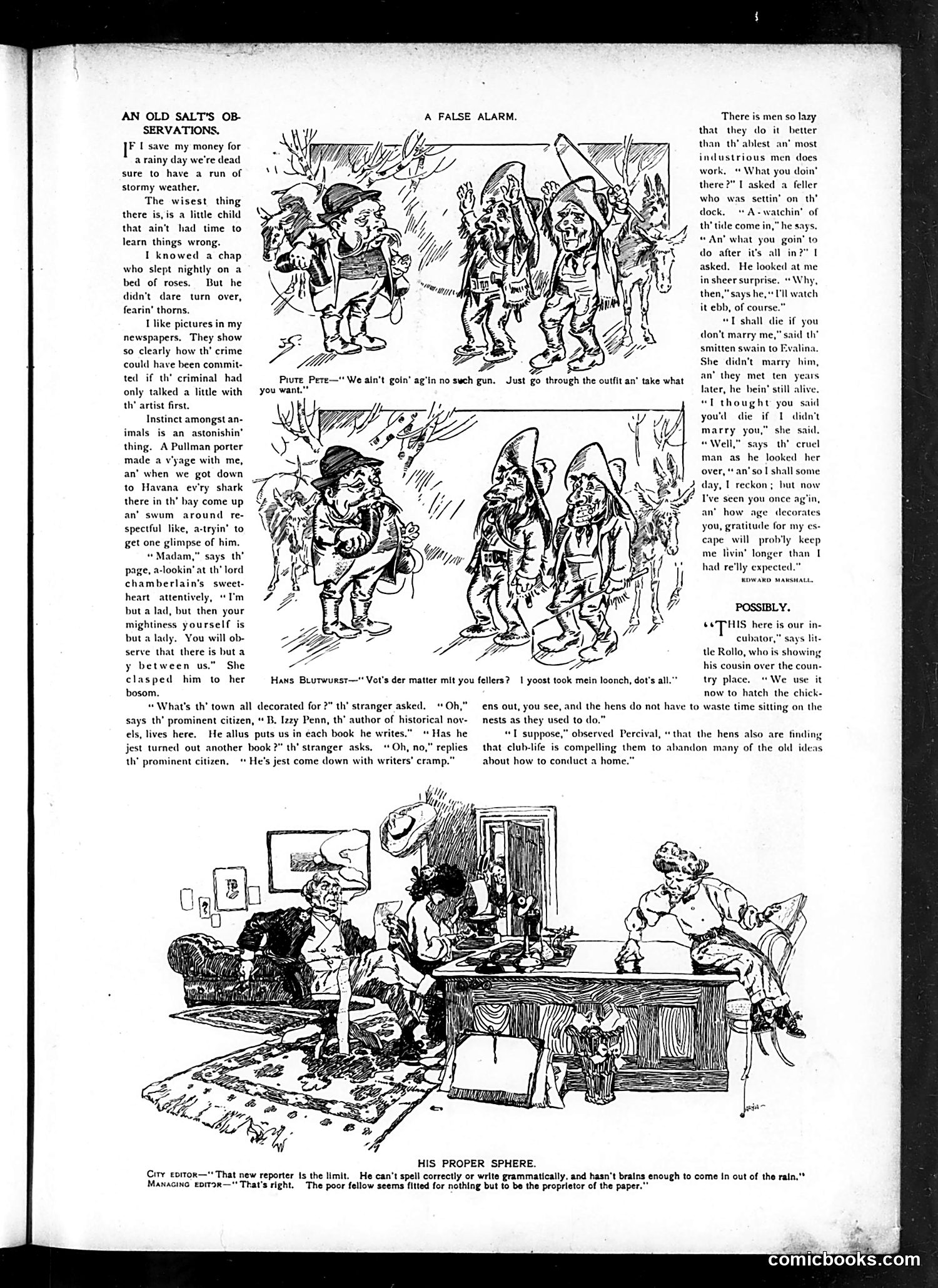
This page contains several satirical pieces typical of early 20th-century Judge magazine: **"A False Alarm"** (top): A comic dialogue where a man on a dock claims he'll "die" if a woman won't marry him. Ten years later, they reunite, and he says her aging appearance will actually keep him alive longer—a sardonic joke about how people's dramatic romantic declarations prove false over time. **"Hans Blutwurst"** (middle): Features a German-accented character complaining about his stolen lunch. The ethnic stereotype humor was common in this era's satire. **"His Proper Sphere"** (bottom): A newspaper office joke where the city editor criticizes a new reporter's incompetence in spelling, grammar, and basic sense. The managing editor replies the reporter is "fitted for nothing but to be the proprietor of the paper"—mocking incompetent newspaper owners. This reflects period criticism of newspapers' declining standards. The left column contains "An Old Salt's Observations"—aphoristic maritime wisdom presented humorously, common filler content in satirical magazines.
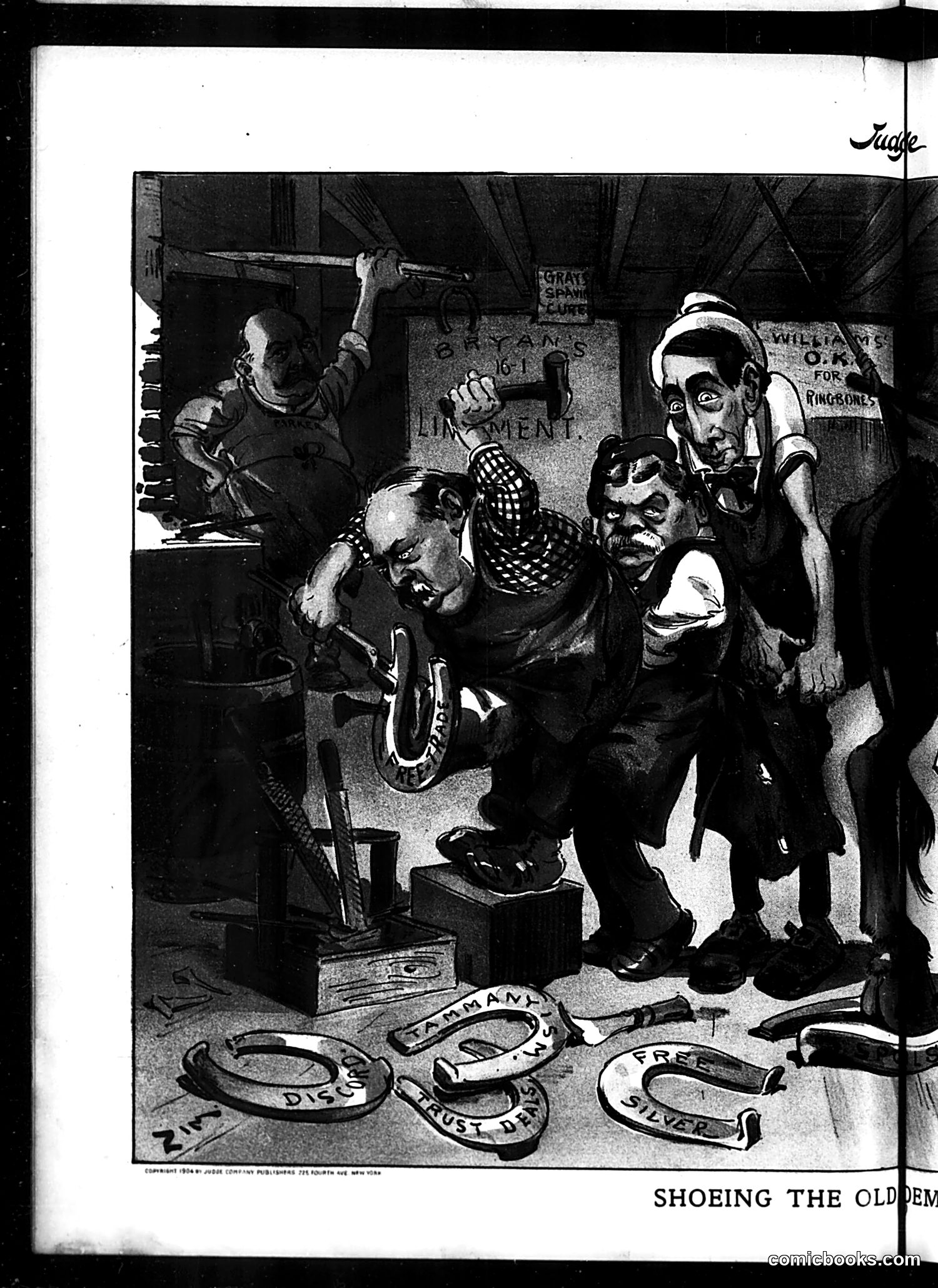
This political cartoon depicts caricatured figures—appearing to represent corrupt politicians or "old guard" power brokers—being forcibly "shoed" (fitted with horseshoes, a symbol of restraint or control). The horseshoes visible in the foreground are labeled with terms like "DISTRUST," "GRAFT," "SILVER," and "FRAUD," suggesting these are vices or corruptions being addressed. The violent, coercive nature of the scene—with figures wielding hammers and tools—suggests reform being imposed forcibly on entrenched political corruption. The exaggerated, demonic facial features of the caricatures emphasize their depiction as villainous. This appears to be early-20th-century American satirical commentary on political reform efforts against established corrupt institutions or politicians.
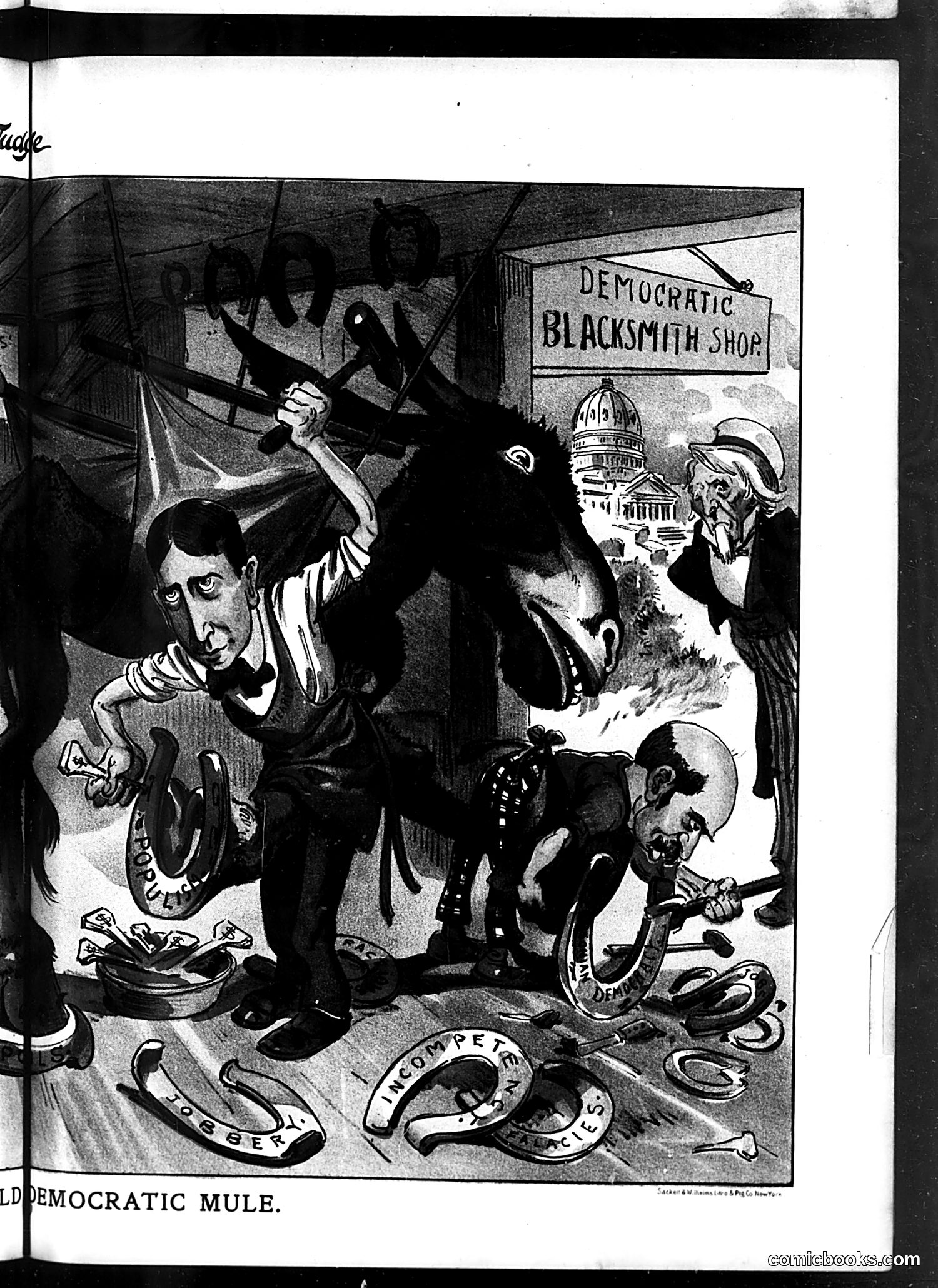
This political cartoon satirizes the Democratic Party, represented as a stubborn mule being shod at a "Democratic Blacksmith Shop." The mule, labeled with Democratic symbols, resists the blacksmith's work while figures (likely representing Democratic leadership or factions) struggle to control it. The horseshoes scattered on the ground are labeled "incompetence" and "forgeries," suggesting criticisms of Democratic governance or scandals. The Capitol building visible in the background indicates this concerns national politics. The cartoon's central joke is that the Democratic Party, like a mule, is obstinate and difficult to manage, and that its leadership cannot successfully implement necessary reforms or address these labeled failures. The satire appears designed for Republican-leaning readers of *Judge* magazine.
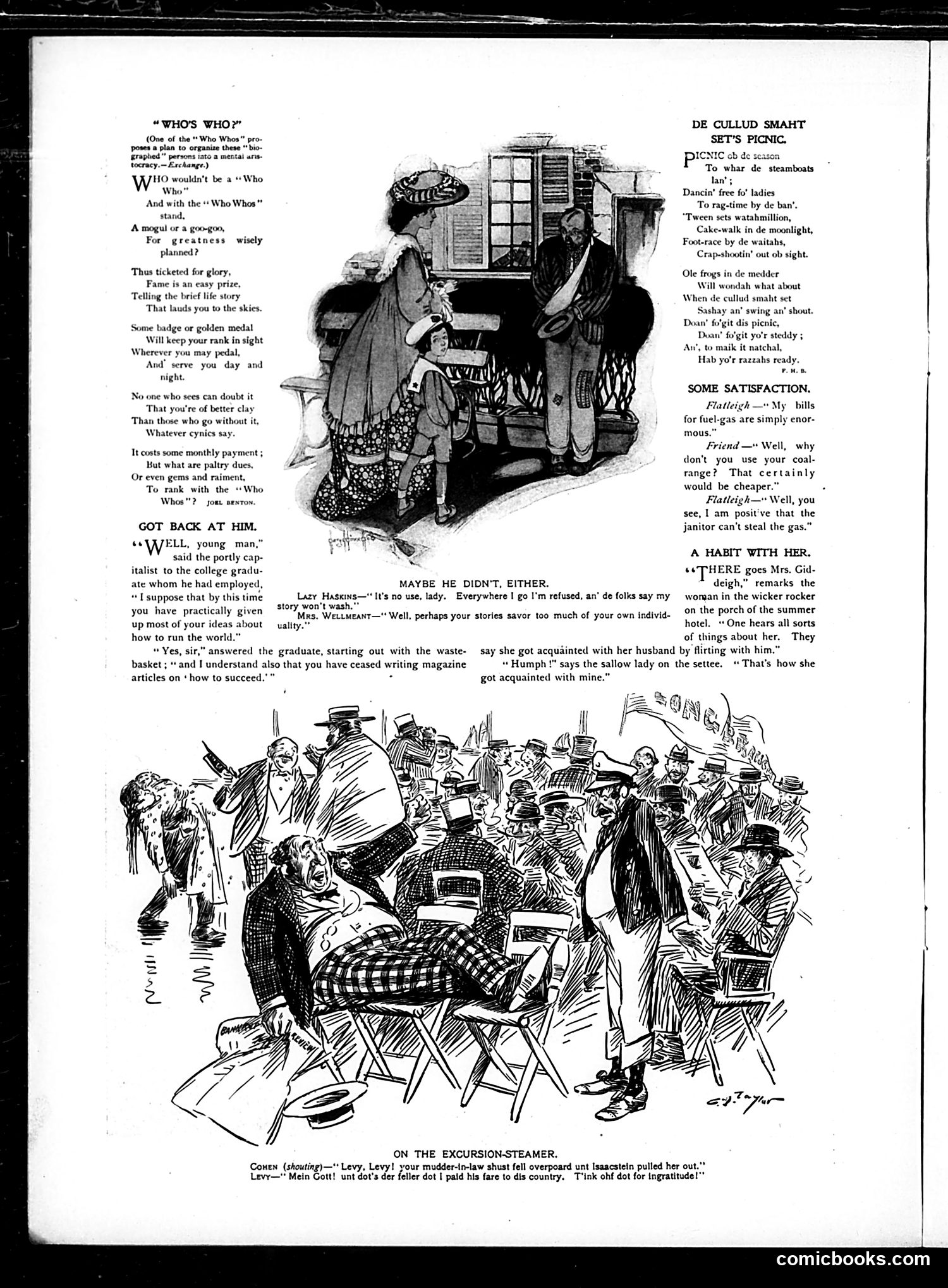
This page contains several satirical pieces mocking different social groups: **"Who's Who?"** satirizes vanity publishing schemes—organizations that charge fees to list people as notable in biographical directories. The satire suggests this creates a false "aristocracy" based on payment rather than actual achievement. **"Got Back at Him"** shows class conflict: a college graduate's idealistic talk about "running the world" is mocked by his capitalist employer, who claims the young man has abandoned such notions. The graduate's sharp reply—that the employer has also stopped writing success articles—levels the criticism back. **"De Cullud Smaht Set's Picnic"** uses racist dialect to mock African American social aspirations, depicting a steamboat picnic in stereotypical terms. **"Some Satisfaction"** is a brief joke about a man preferring gas heat because the janitor can't steal it (versus coal). **The excursion-steamer cartoon** appears to mock Jewish immigrants, with Yiddish-accented dialogue about a man who paid passage for someone who later saved his mother-in-law—framed as ingratitude. The page reflects early 20th-century Judge magazine's characteristic blend of class commentary and ethnic stereotyping.
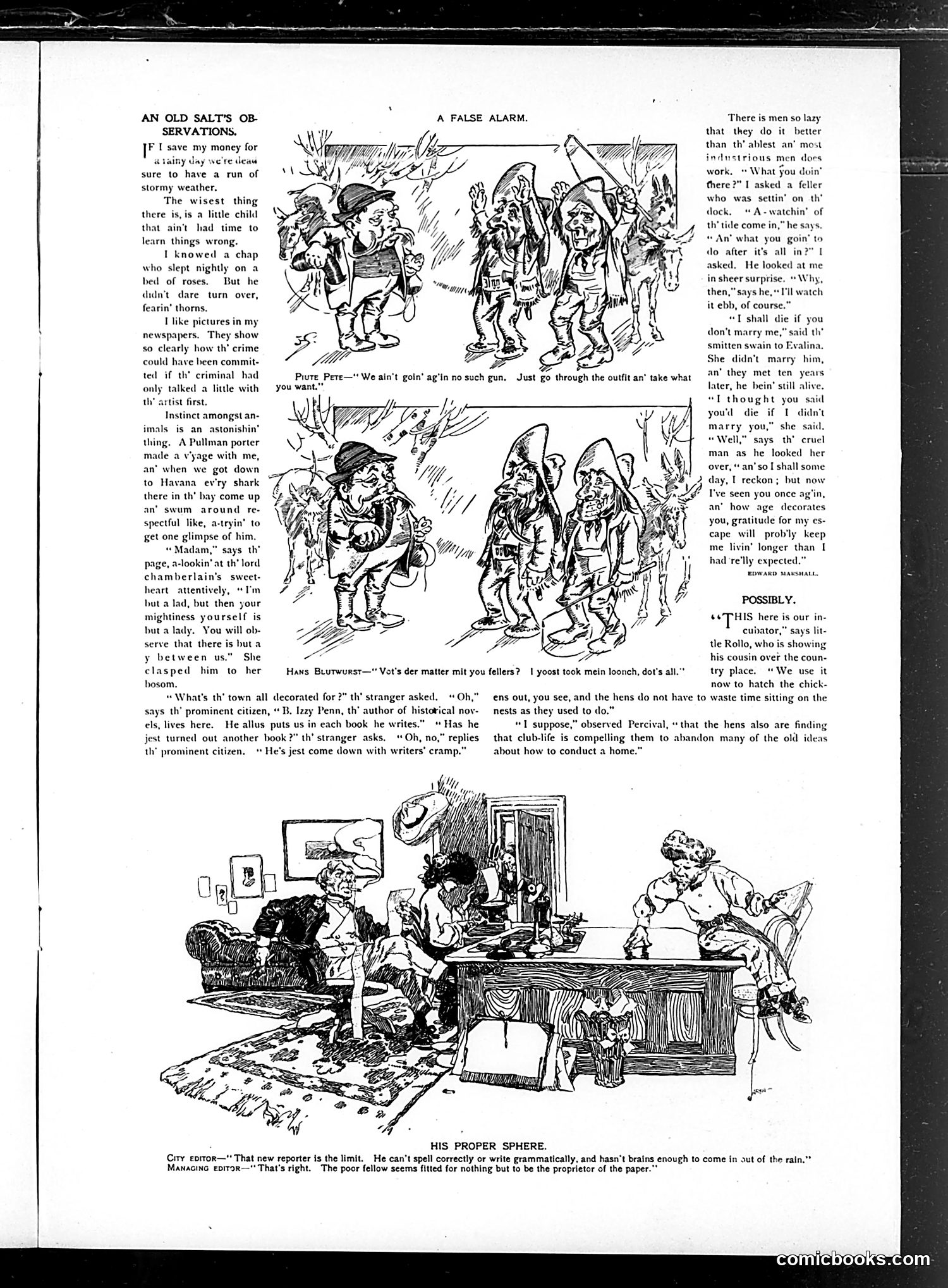
This page from *Judge* magazine contains several satirical pieces: **"A False Alarm"** (top cartoons): Shows men in a panic, believing danger is imminent. The caption reveals it's a false alarm—Hans Blutwurst merely took someone's lunch. The joke satirizes overreaction and hysteria. **"His Proper Sphere"** (bottom): Editors debate a new reporter's incompetence—he "can't spell correctly or write grammatically, and hasn't brains enough to come in out of the rain." They conclude he's only fit to be the newspaper's proprietor (owner). This is satirical commentary on newspaper management quality and the irony that the least competent person might end up in charge. The left column contains "An Old Salt's Observations"—homespun philosophies from a seasoned sailor character, typical of period humor using folksy wisdom and dialect. These pieces reflect early 20th-century *Judge* magazine's mix of social satire, workplace humor, and character-based comedy.
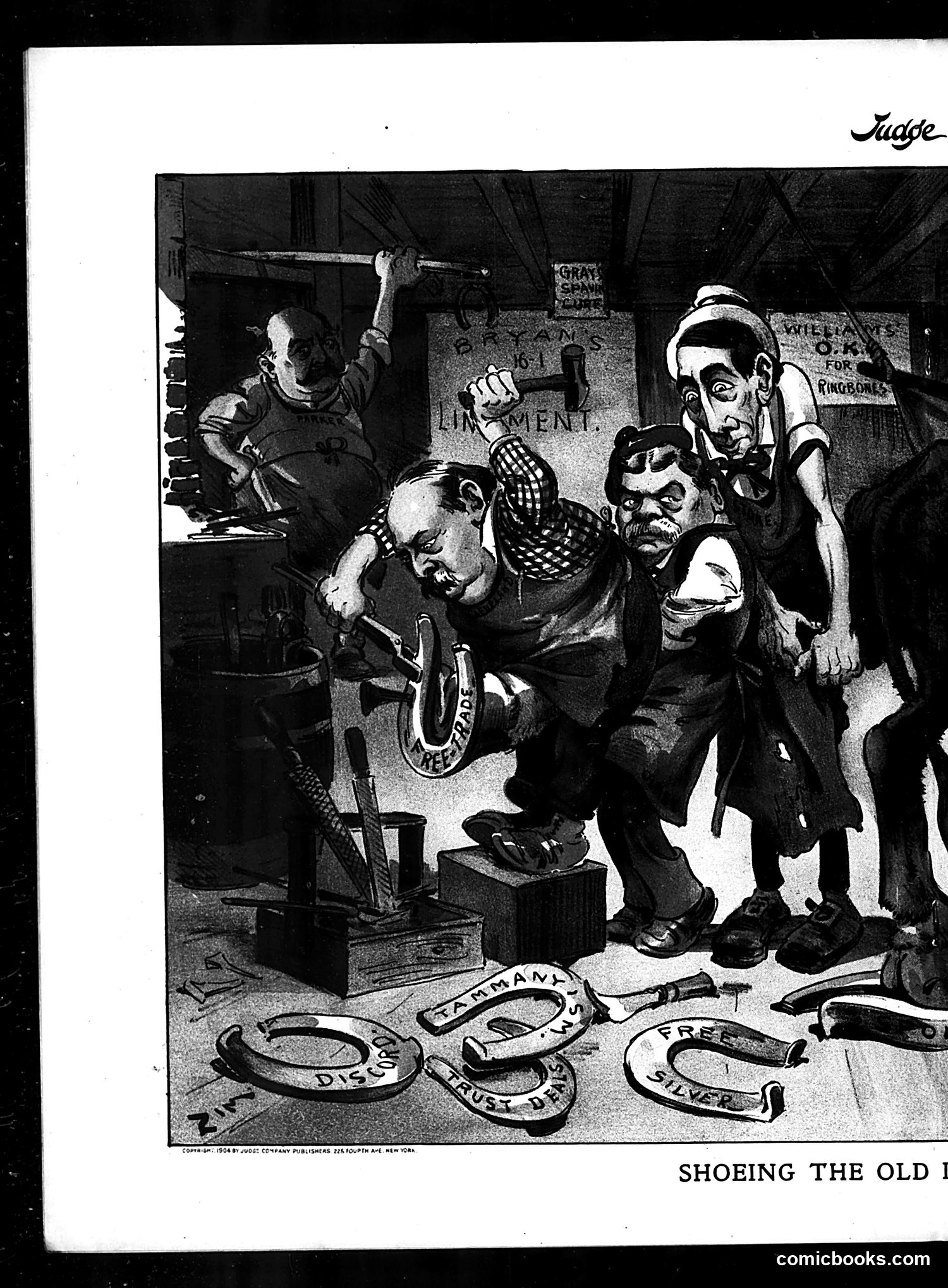
This political cartoon depicts caricatured figures engaged in shoeing a horse—a metaphorical reference to repairing or reinforcing something deteriorated. The exaggerated facial features and working-class attire suggest these are meant to represent specific political or labor figures of the era, though their identities aren't clearly labeled in the visible portion. The horseshoes visible in the foreground appear to have text or labels, though details are illegible. The setting and collaborative effort suggest commentary on either labor reform, industrial policy, or political figures attempting to "fix" a failing institution or economy. Without clearer labeling or date information, the specific satirical target remains unclear, though the Judge magazine context indicates contemporary political commentary.
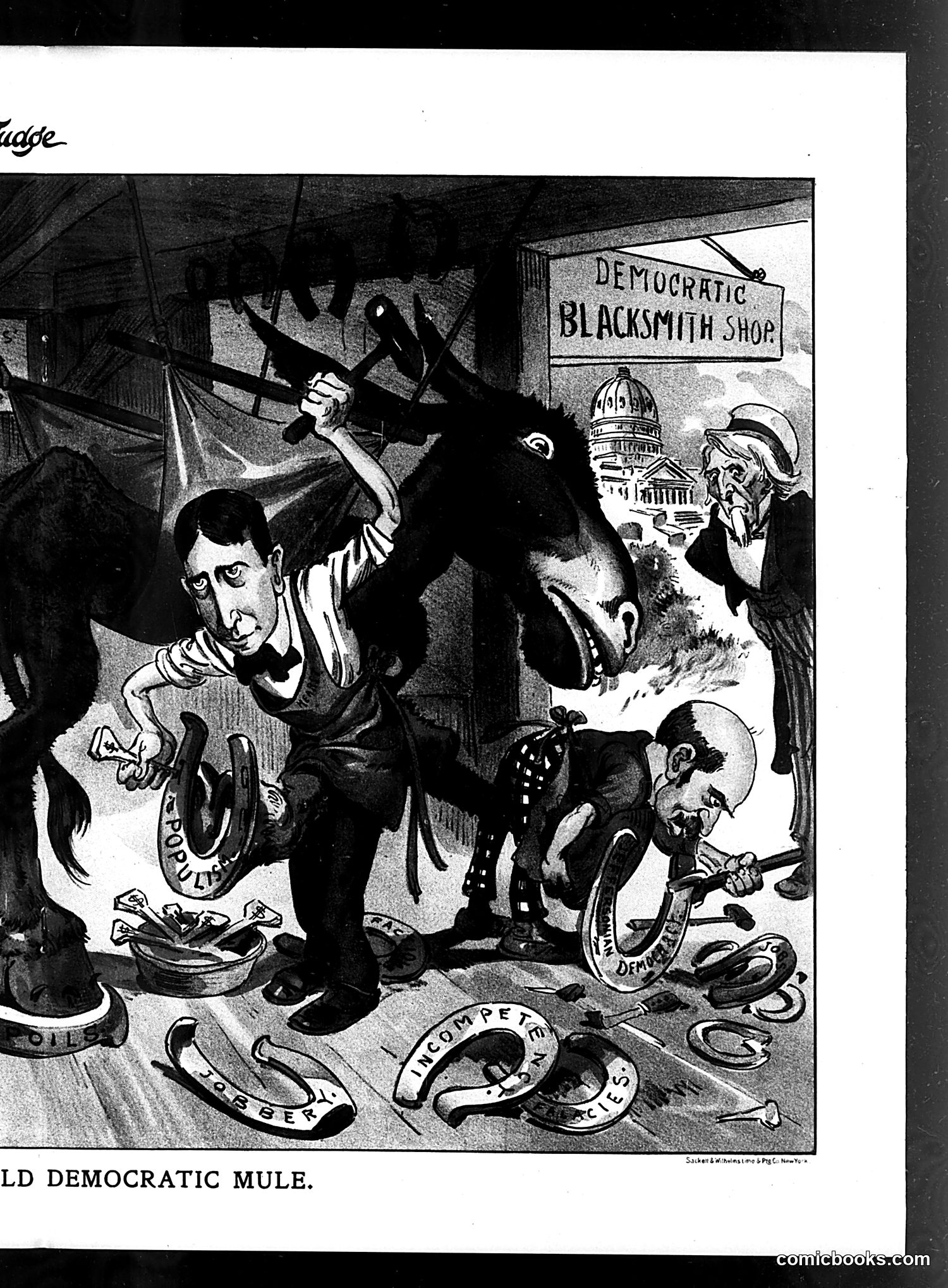
This political cartoon depicts the Democratic Party as a stubborn, uncooperative mule being "shod" (fitted with horseshoes) at a "Democratic Blacksmith Shop." The sign references the U.S. Capitol building in the background. The caricatured figures appear to be Democratic politicians or party leaders attempting to force the mule to accept new shoes labeled "INCOMPETENT" and other negative terms. The mule resists violently, kicking back against the effort. The satire suggests that the Democratic Party is fundamentally resistant to reform or modernization, stubbornly clinging to old ways despite attempts by party leadership to reshape it. The "mule" metaphor implies the party is obstinate and unmanageable—a common political insult suggesting lack of intelligence or cooperation.
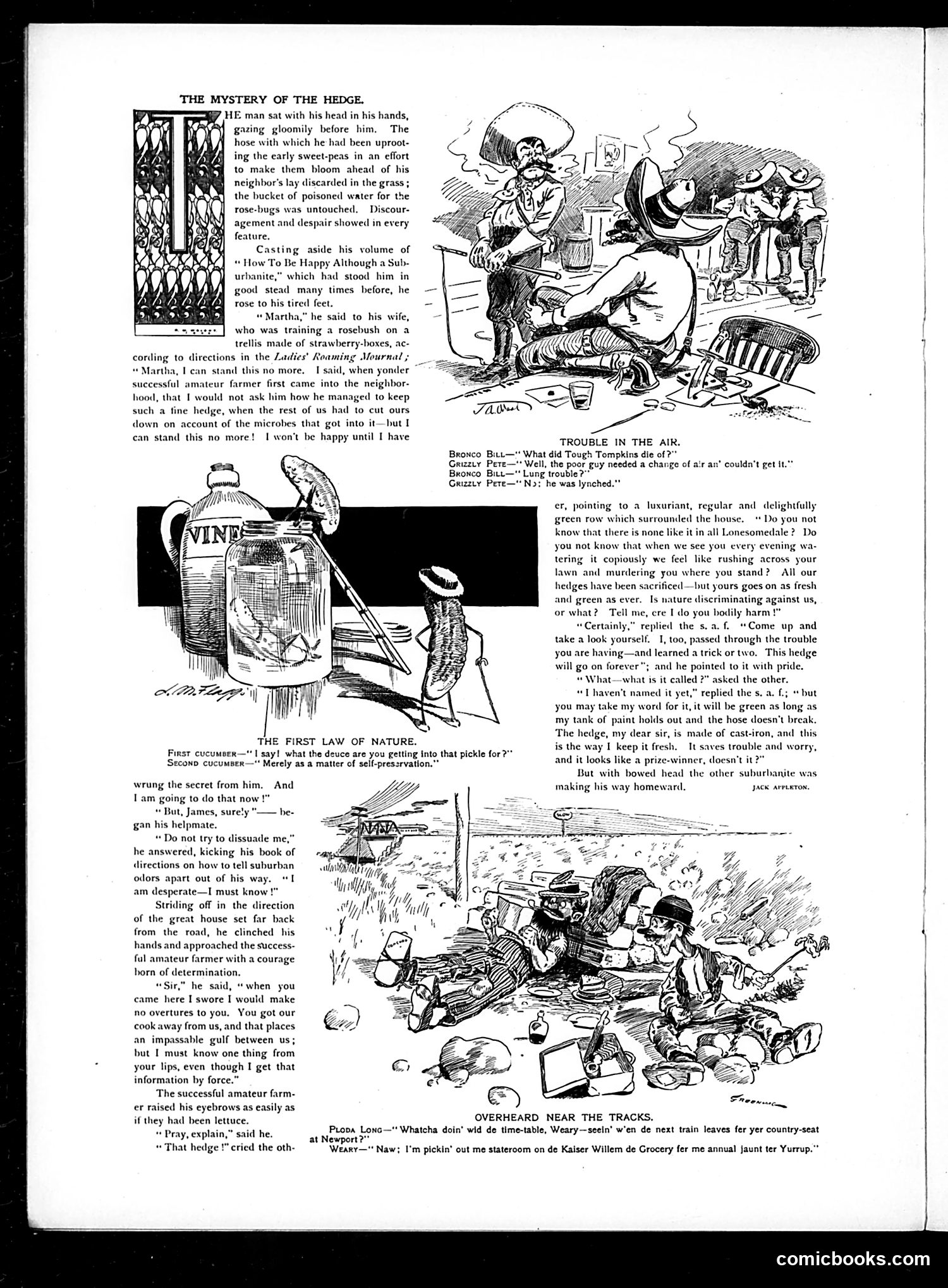
This page satirizes suburban competitive gardening and the obsession with lawn care. A frustrated neighbor confronts his successful competitor, desperate to learn the secret of his perfect hedge while all others fail. The punchline: the hedge is made of **cast-iron and painted green**—a joke mocking both suburban vanity and the absurdity of competitive home maintenance. The page includes two additional humor sketches: "Trouble in the Air" plays on lynching euphemistically as "needing a change of air," while "The First Law of Nature" shows cucumbers pickled for self-preservation. "Overheard Near the Tracks" features working-class characters (Weary and Picket Long) discussing train schedules and country retreats with mock-genteel pretension. The satire targets suburban aspirational culture and the ridiculous lengths people go to appear prosperous.
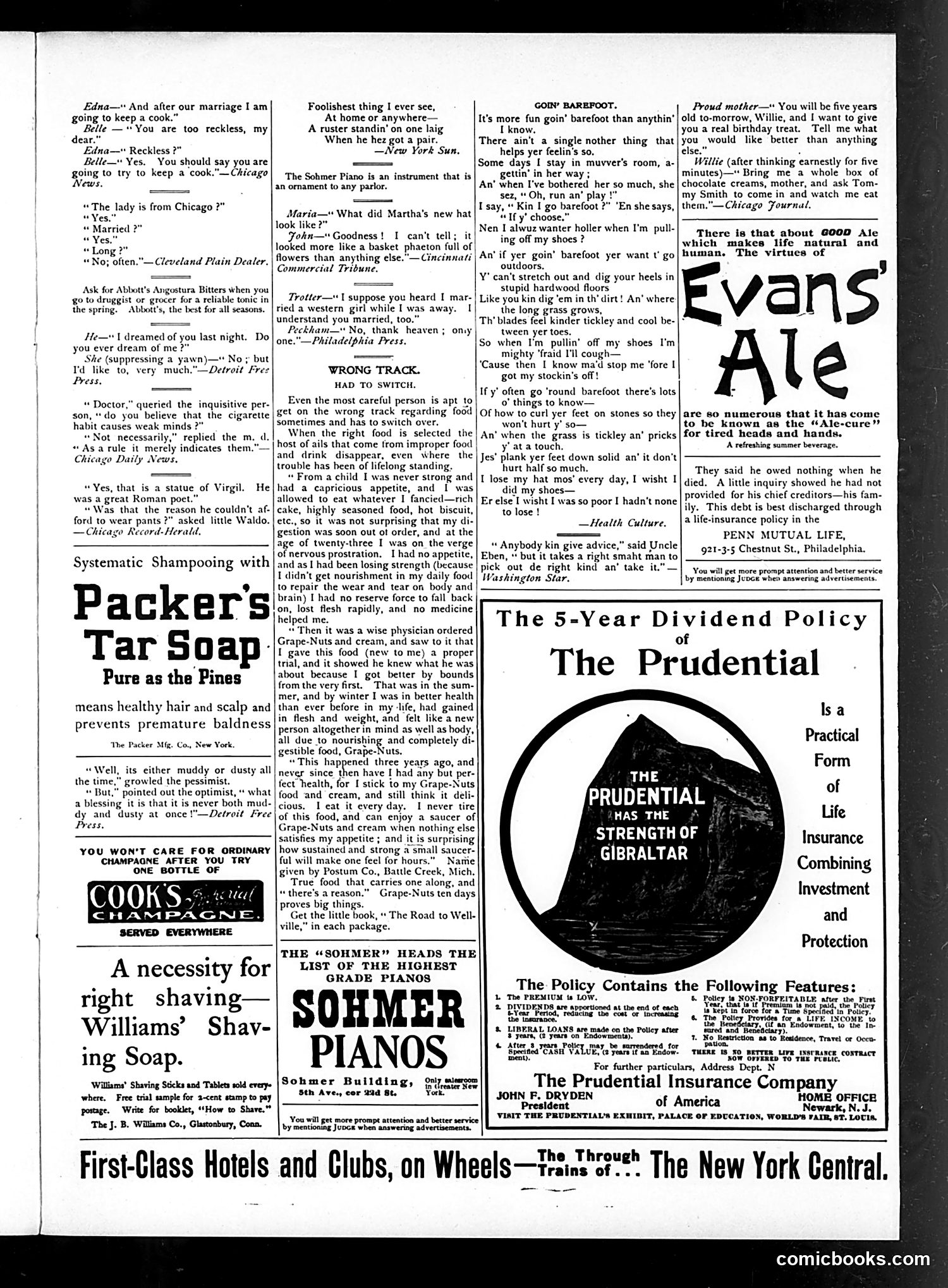
This page from *Judge* magazine consists primarily of **short humorous anecdotes and advertisements** rather than political cartoons. The jokes rely on early 20th-century domestic humor: - A woman's inability to keep household staff ("keep a cook") - Gender dynamics in marriage (men advising women against ambition) - Mild observations about weather and pessimism **Notable content**: A testimonial for Grape-Nuts cereal frames food as medical cure—reflecting the era's obsession with patent remedies and dietary solutions for vague ailments like "nervous prostration." **The humor style** assumes a middle-class, domestic audience amused by: - Marital banter - Class-conscious servants/labor complaints - Mild skepticism toward pretension **No overtly political satire is visible.** The ads (Sohmer Pianos, Prudential Insurance, Parker Tar Soap) suggest this targets prosperous urban readers concerned with refinement and respectability. The page is essentially a **period snapshot of middlebrow entertainment and consumer culture**, not commentary on major political events.
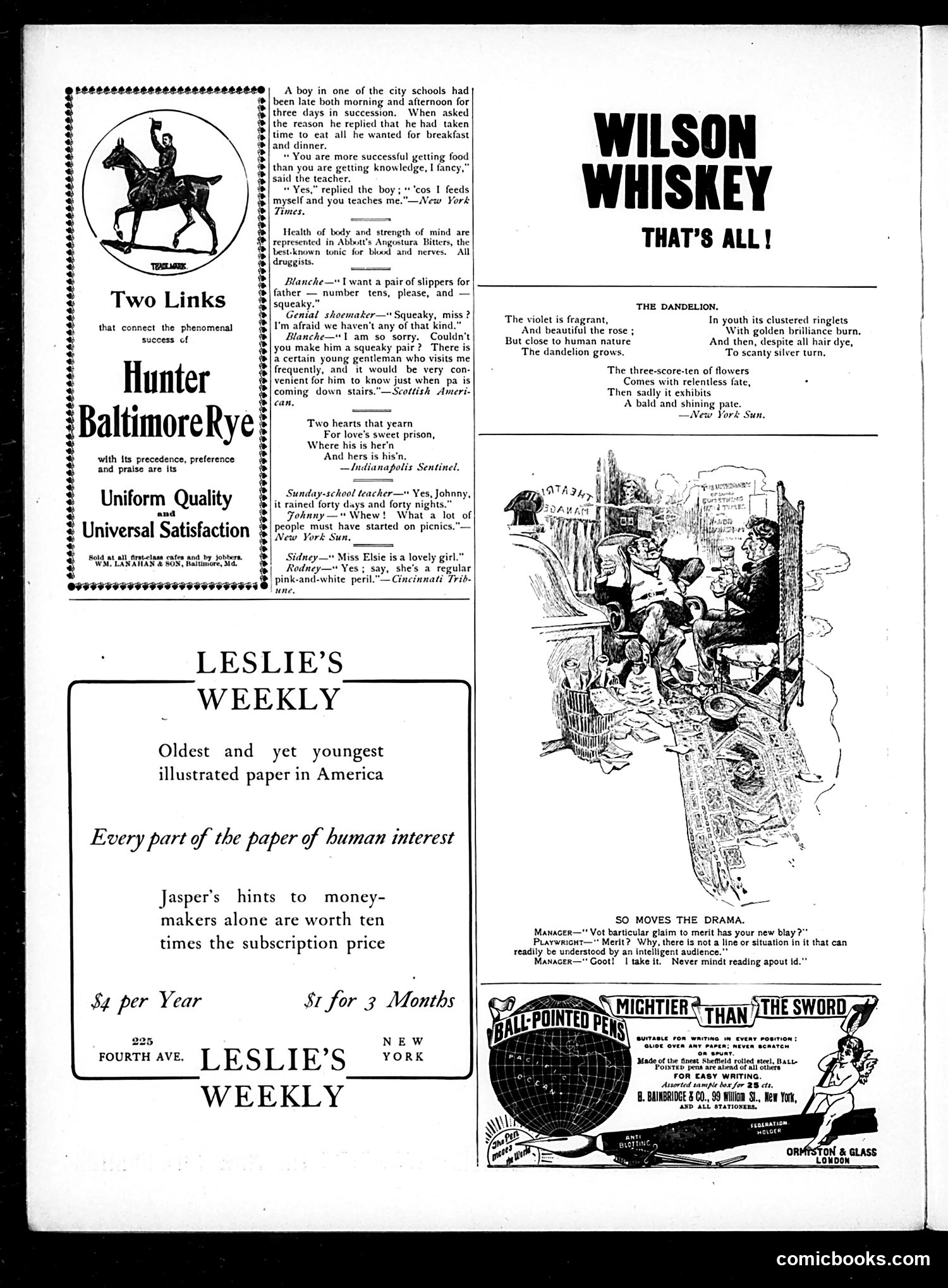
This page from the satirical magazine *Judge* contains several humor pieces typical of the era: **Short Jokes**: The anecdotes mock various social figures—a truant student prioritizing food over education, a girl seeking "squeaky" slippers to alert her father before her suitor escapes, and a Sunday school teacher whose rain story prompts Johnny to joke about ruined picnics. These reflect common turn-of-century anxieties about proper behavior and courtship. **"So Moves the Drama"**: This cartoon satirizes lowbrow theater by having a manager dismiss a play's complete lack of intelligibility as its selling point—mocking both theatrical mediocrity and audiences who attended such productions. **Advertisements**: The page includes numerous ads (Wilson Whiskey, Hunter Baltimore Rye, Leslie's Weekly, writing pens) targeting middle-class readers, reflecting the magazine's commercial function. **The Dandelion Poem**: A sentimental verse comparing aging to a flower's decline—typical of period sentiment about mortality. The overall tone reflects *Judge's* role: entertaining middle-class readers through gentle mockery of social pretension and daily life.
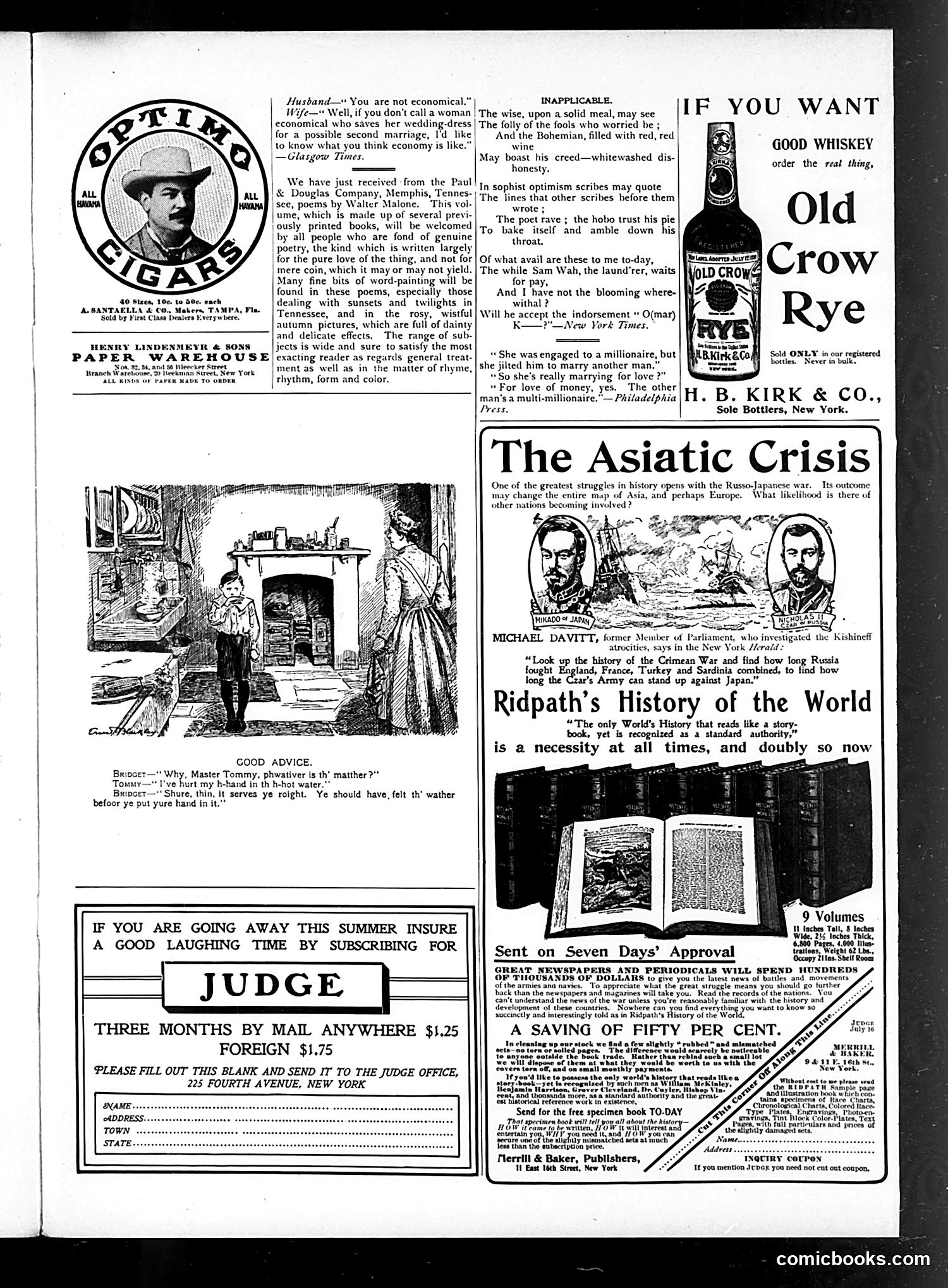
This page is primarily **advertising and filler content** with minimal political satire. The main elements are: **The "Good Advice" cartoon** depicts an Irish immigrant child (indicated by the brogue dialect) who burned his hand in hot water. An adult scolds him, saying he deserved it for putting his hand in without testing it first. This reflects period-typical ethnic stereotyping and working-class humor common in Judge magazine. **"The Asiatic Crisis" section** references the **Russo-Japanese War** (1904-1905), a major contemporary geopolitical event. It quotes a Russian official arguing Russia can withstand Japan because Russia previously fought multiple European powers in the Crimean War. The section promotes *Ridpath's History of the World* as essential reading for understanding this conflict. **Remaining content** consists of advertisements for cigars, whiskey, Judge magazine subscriptions, and book publishers—typical of the magazine's revenue model. The page contains **no significant political commentary or satire**—it's largely a commercial product designed to fund the magazine through ads.
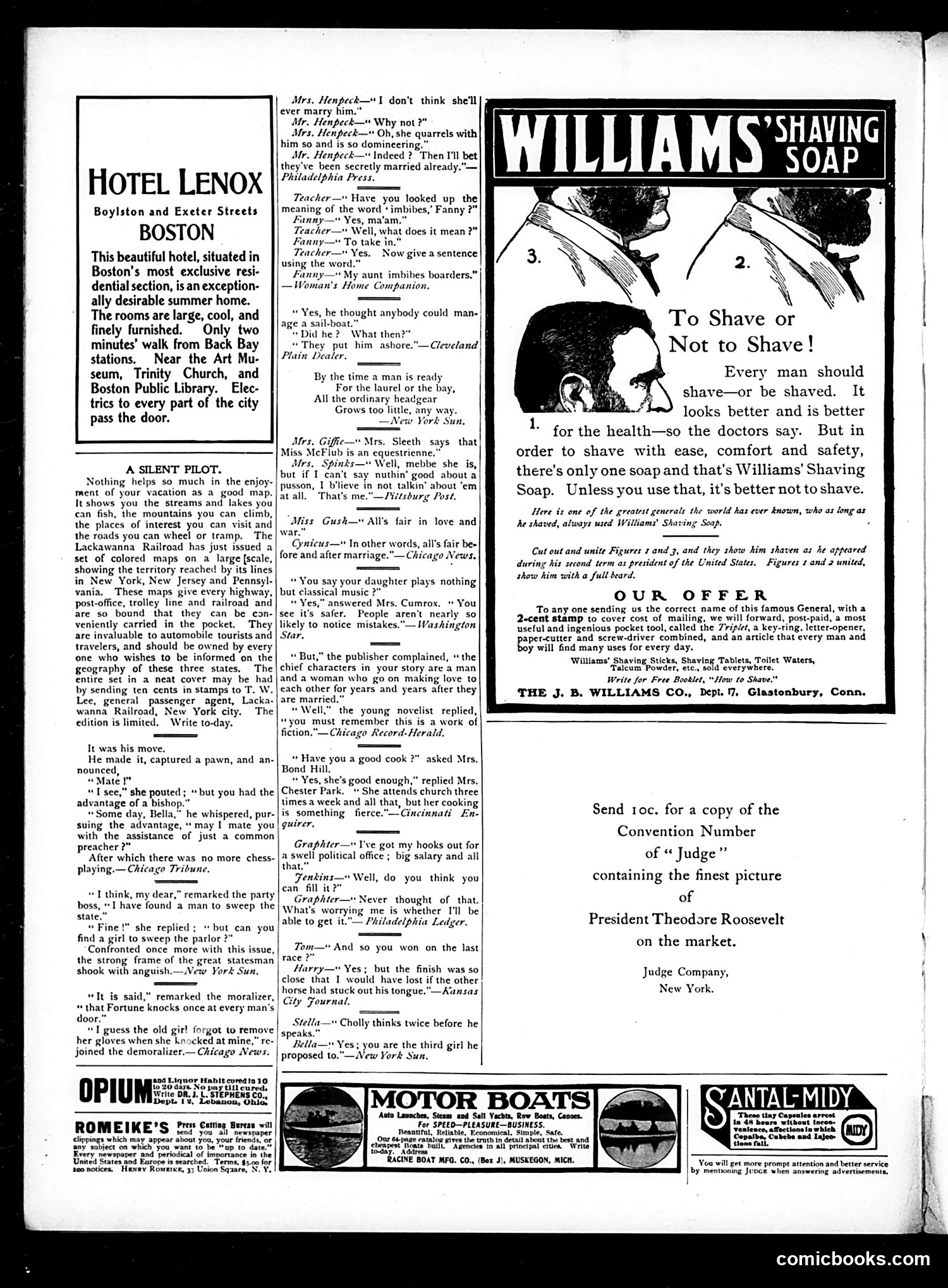
This page is primarily **advertisements and filler content** rather than satirical cartoons. The main elements include: **Hotel and business ads** dominate the layout (Hotel Lenox, Lackawanna Railroad maps, Williams' Shaving Soap). **"A Silent Pilot"** is promotional content about railroad maps, not satire. **The comic anecdotes** scattered throughout are mild domestic humor typical of early 20th-century publications: - A chess proposal joke - A politician unable to answer which woman should sweep what room (gentle political ribbing) - Various short jokes about wives, cooking, and courtship **The Williams' Shaving Soap ad** features before/after images and includes a reference to a "General" as soap's "greatest generals the world has ever known," though the specific identity is unclear from the image. Overall, this appears to be a lighter issue focused on advertising revenue rather than Judge's typical sharp satirical content. The humor is domestic and innocent by modern standards—no significant political commentary or biting social satire is evident.
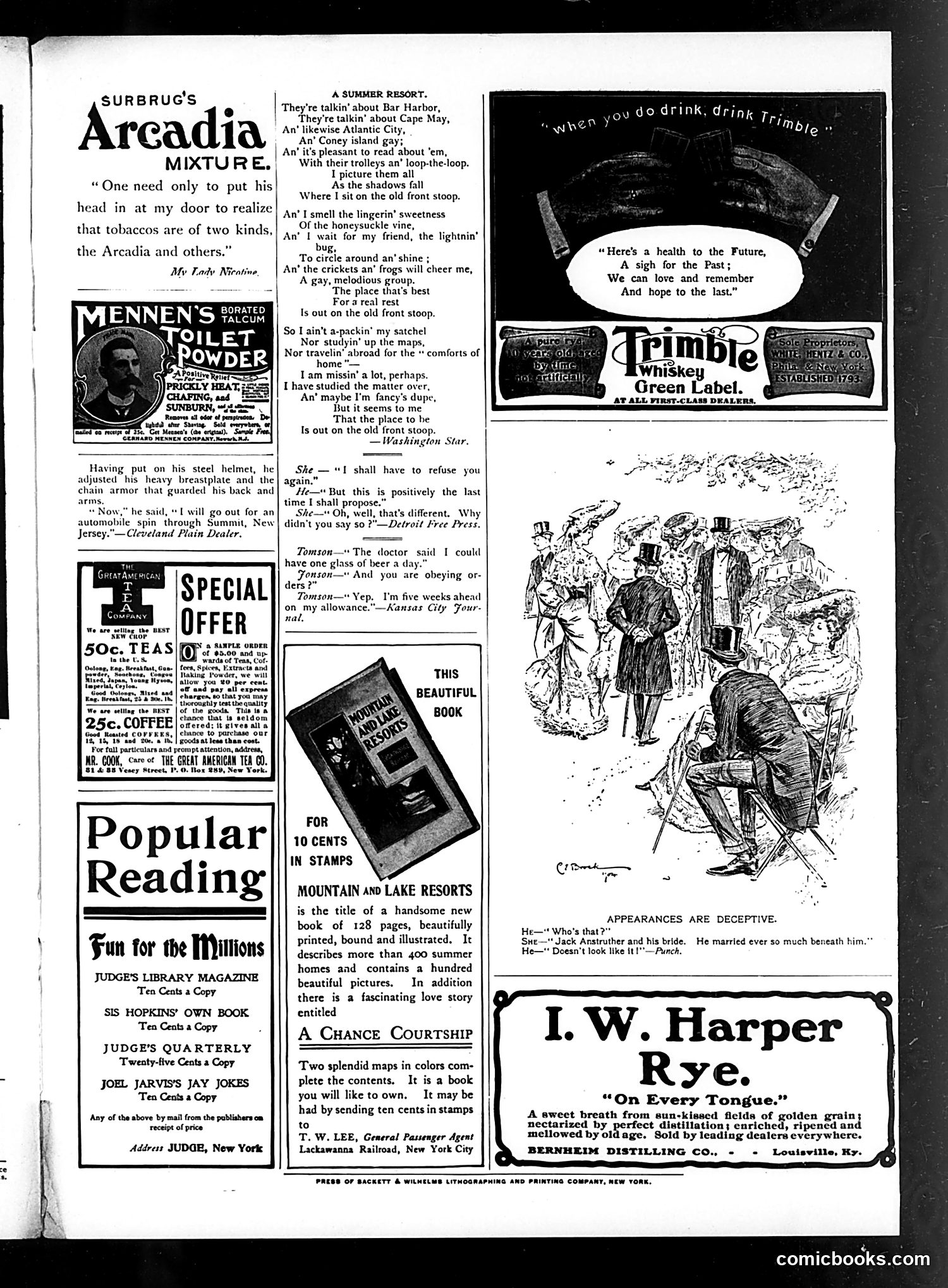
This page is primarily **advertising and light humor**, not political satire. The content includes: **Main Cartoons/Jokes:** - A brief satirical item about a man donning medieval armor to drive through Summit, New Jersey—mocking the perceived dangers of early automobiles - Two short comedic dialogues: one about a woman refusing a marriage proposal (the joke being she'll accept if it's his *last* proposal), another about a doctor's beer prescription **Poetry:** "A Summer Resort" celebrates staying home on one's front porch over fashionable vacation destinations—gentle, nostalgic Americana rather than satire. **Advertisements:** The page is dominated by ads for tobacco (Arcadia Mixture, Mennen's Talcum Powder), tea, whiskey (Trimble, I.W. Harper Rye), and books about mountain resorts. **Historical Context:** The automobile reference reflects early 1900s anxiety about new technology; the marriage joke is period-typical drawing-room humor. Overall, this is a typical Judge magazine page mixing light entertainment with commercial advertising.
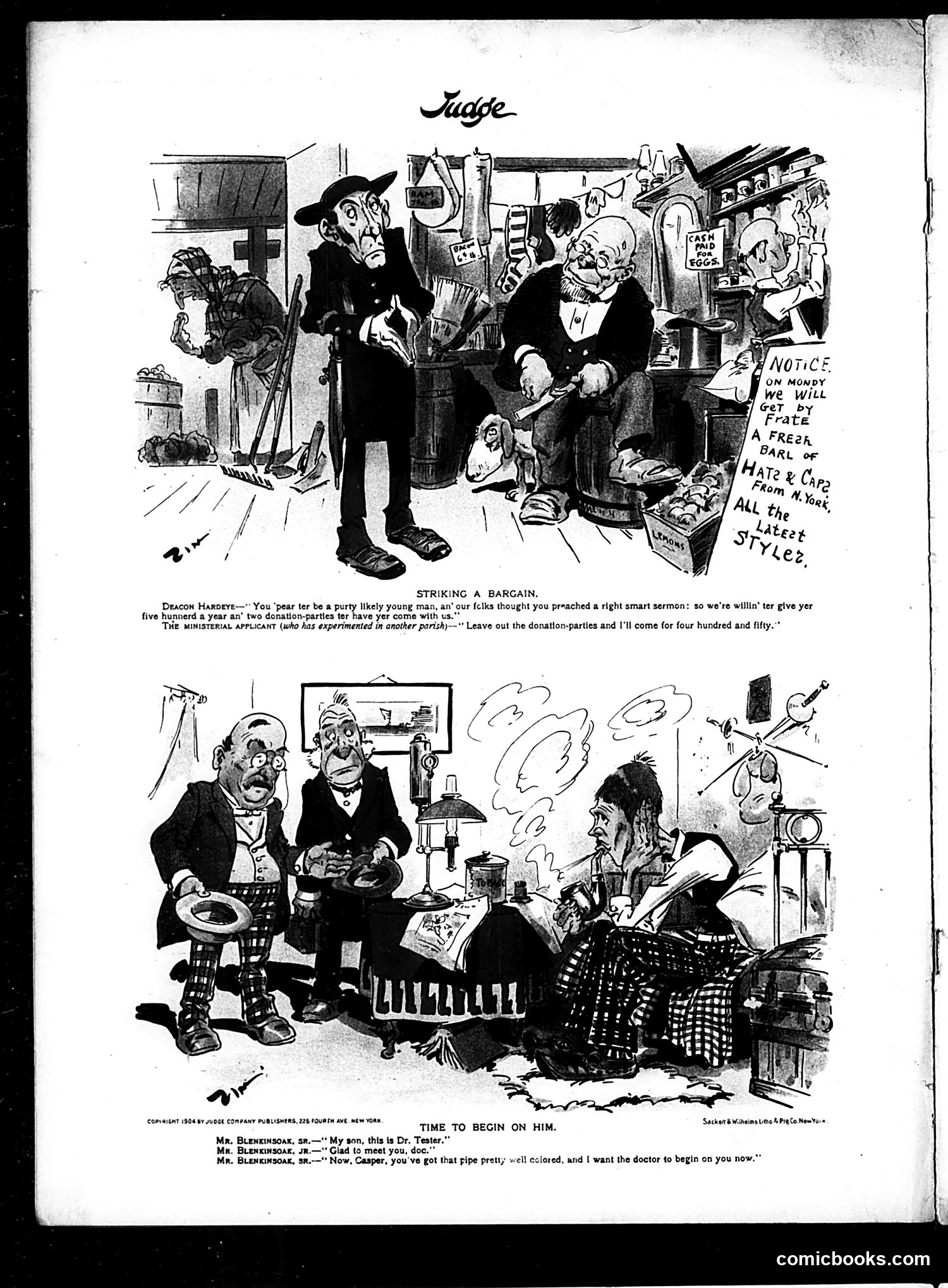
**Top Cartoon ("Striking a Bargain"):** A rural deacon negotiates salary with a ministerial candidate. The joke satirizes mercenary clergy—the applicant, who has "experimented in another parish," hagggles down the offer by refusing "donation-parties" (supplemental income from parishioners). Judge mocks both the crass commercialism of small-town ministry and the opportunistic preacher shopping himself to the highest bidder. **Bottom Cartoon ("Time to Begin on Him"):** A father presents his son "Casper" to "Dr. Tester," asking the doctor to begin treatment now that the boy's pipe is "well colored." This appears to satirize either quack medicine or dubious medical practices on children, likely referencing patent medicines or unproven treatments popular in the era. The caricatured faces suggest ethnic or class-based humor typical of period Judge cartoons. Both cartoons mock institutional hypocrisy and questionable professional practices.