
A complete issue · 19 pages · 1904
Judge — June 25, 1904
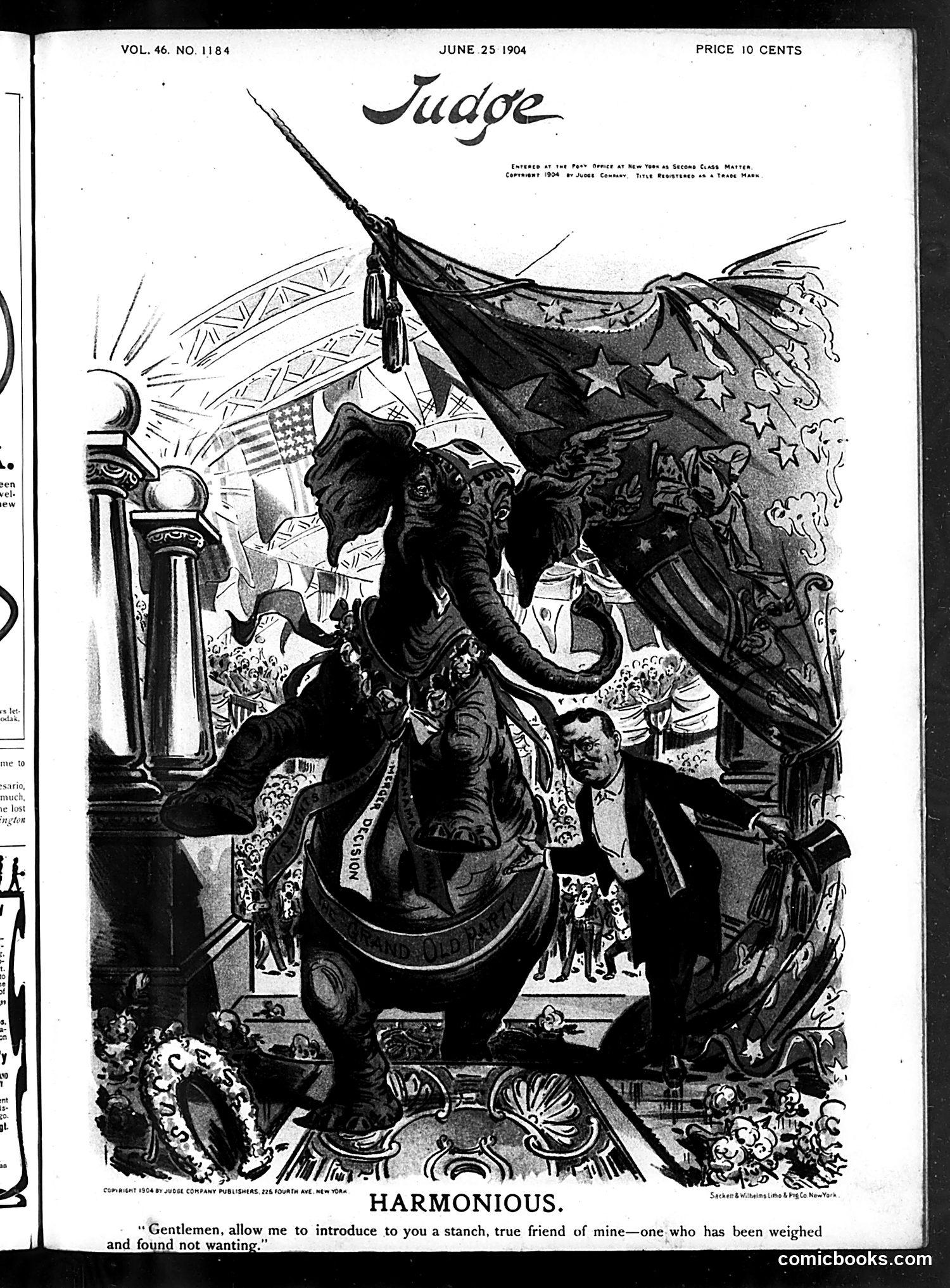
**Title:** "HARMONIOUS" **Caption:** "Gentlemen, allow me to introduce to you a stanch, true friend of mine—one who has been weighed and found not wanting." **Meaning:** This is a political cartoon featuring an elephant (the Republican Party symbol) being introduced as a "harmonious" friend. The cartoon appears to satirize Republican Party unity or solidarity during this period. The elephant is depicted as substantial and reliable—"weighed and found not wanting"—suggesting the GOP is presenting itself as dependable. The flags and decorative elements suggest a patriotic, celebratory context. Without additional context, it likely comments on Republican Party cohesion during President Theodore Roosevelt's administration (1901-1909), possibly referencing internal party dynamics or Roosevelt's leadership of the party.
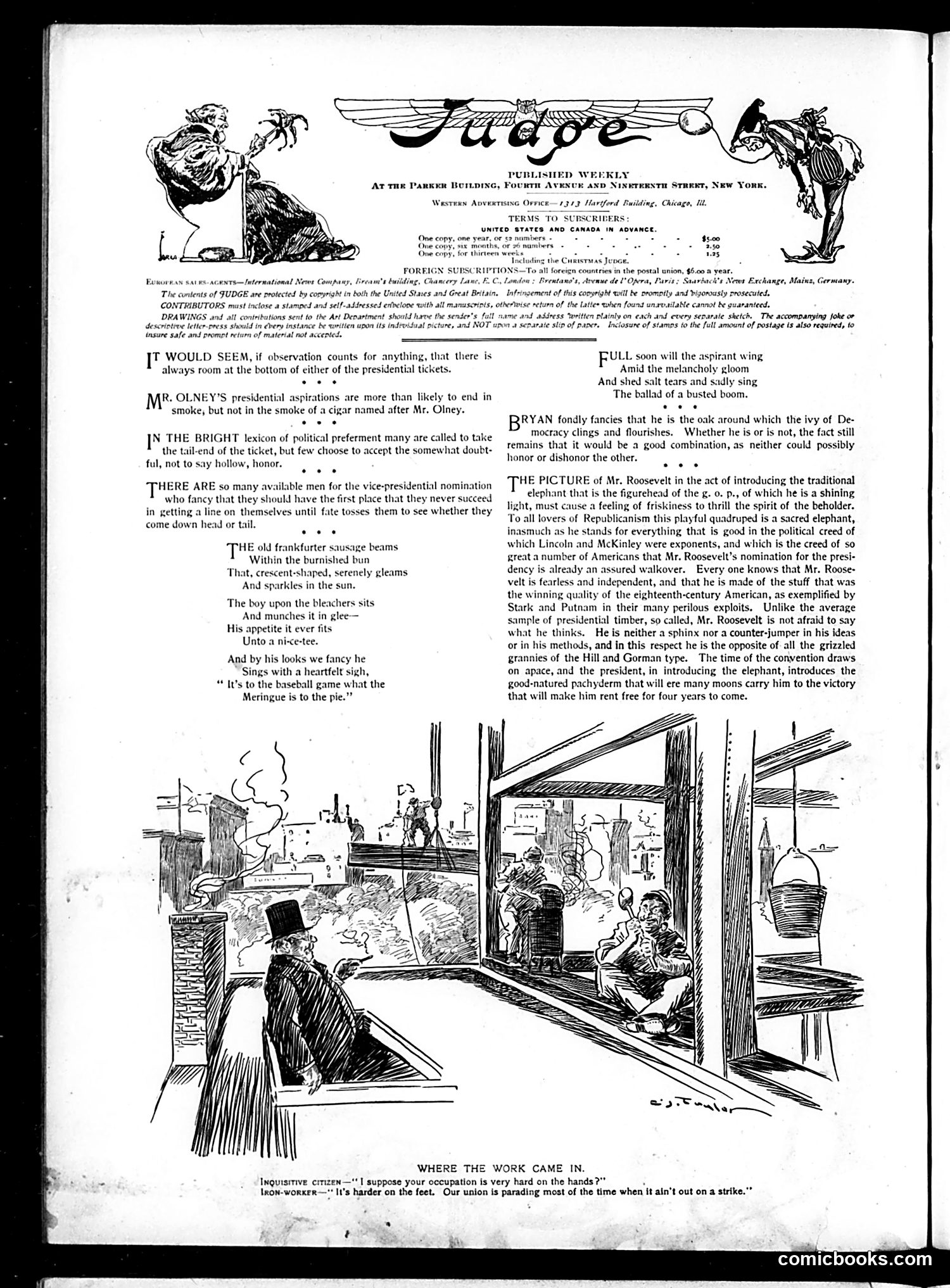
This page satirizes **presidential politics**, likely from the early 1900s based on references to Bryan and Roosevelt. The main cartoon depicts an exchange between an "inquisitive citizen" and an "iron-worker" at what appears to be a construction site. The citizen asks if the worker's occupation is "hard on the hands," to which the worker replies it's "harder on the feet" because "our union is parading most of the time when it ain't out on a strike." The satire mocks **labor unions** for excessive striking and parading rather than actual work. The accompanying text criticizes **William Jennings Bryan** and praises **Theodore Roosevelt** as the superior political choice, portraying Roosevelt as embodying American independence and strength versus Bryan's perceived weakness.
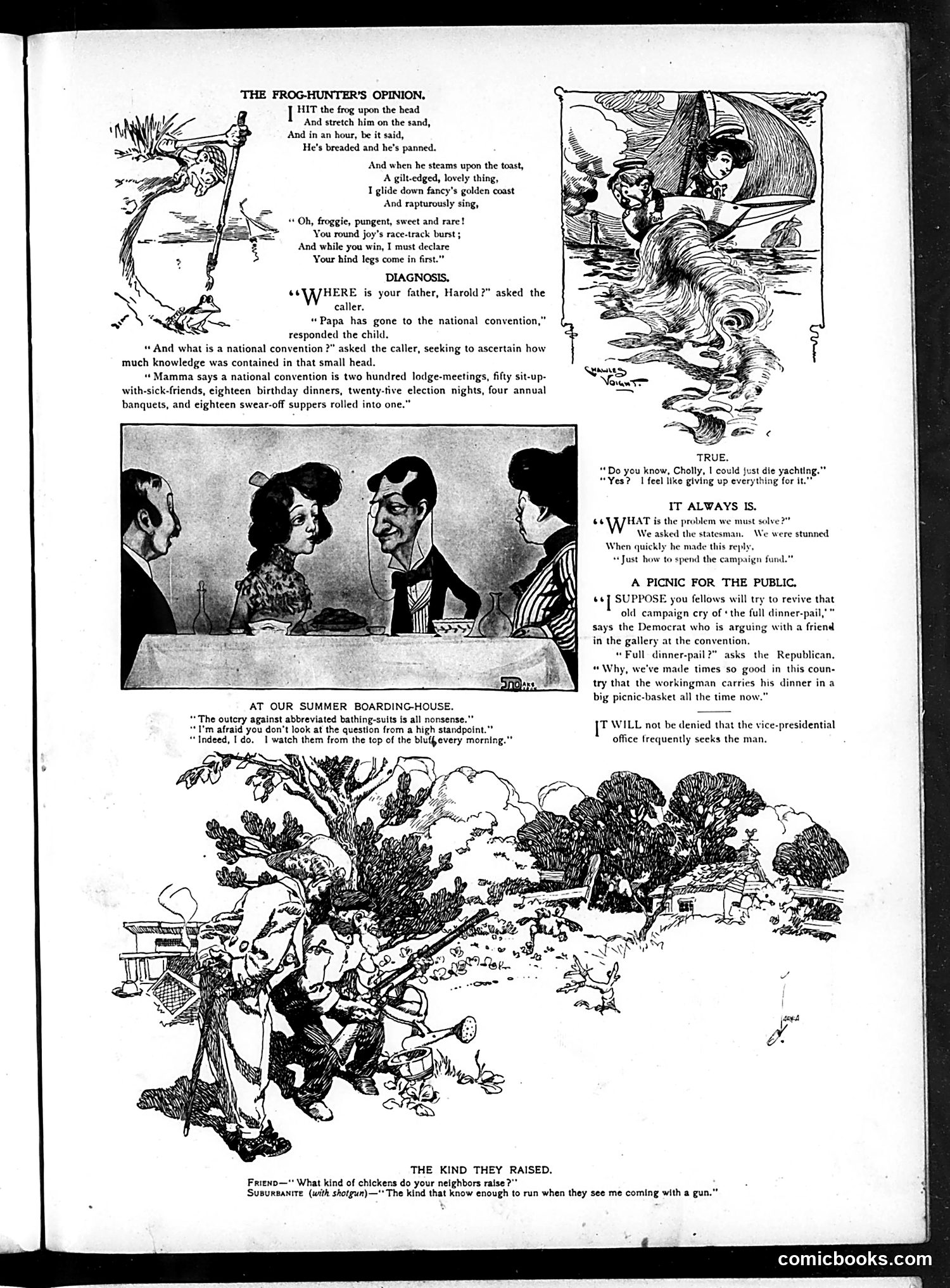
This page contains several satirical pieces mocking American political and social conventions of the era. "The Frog-Hunter's Opinion" at top appears to be light verse about hunting, with accompanying caricature. The central cartoon "At Our Summer Boarding-House" depicts four figures in conversation, likely satirizing middle-class vacation behavior and social pretension—a common Judge target. "A Picnic for the Public" mocks political campaign spending and fundraising disputes between Democrats and Republicans, suggesting working people bear the financial burden while politicians debate campaign funds. "The Kind They Raised" uses a joke about cautious chickens to satirize neighbors raising fearful children. The overall tone reflects Judge's characteristic satire of American social climbers, political hypocrisy, and class anxieties in what appears to be the late 19th or early 20th century.
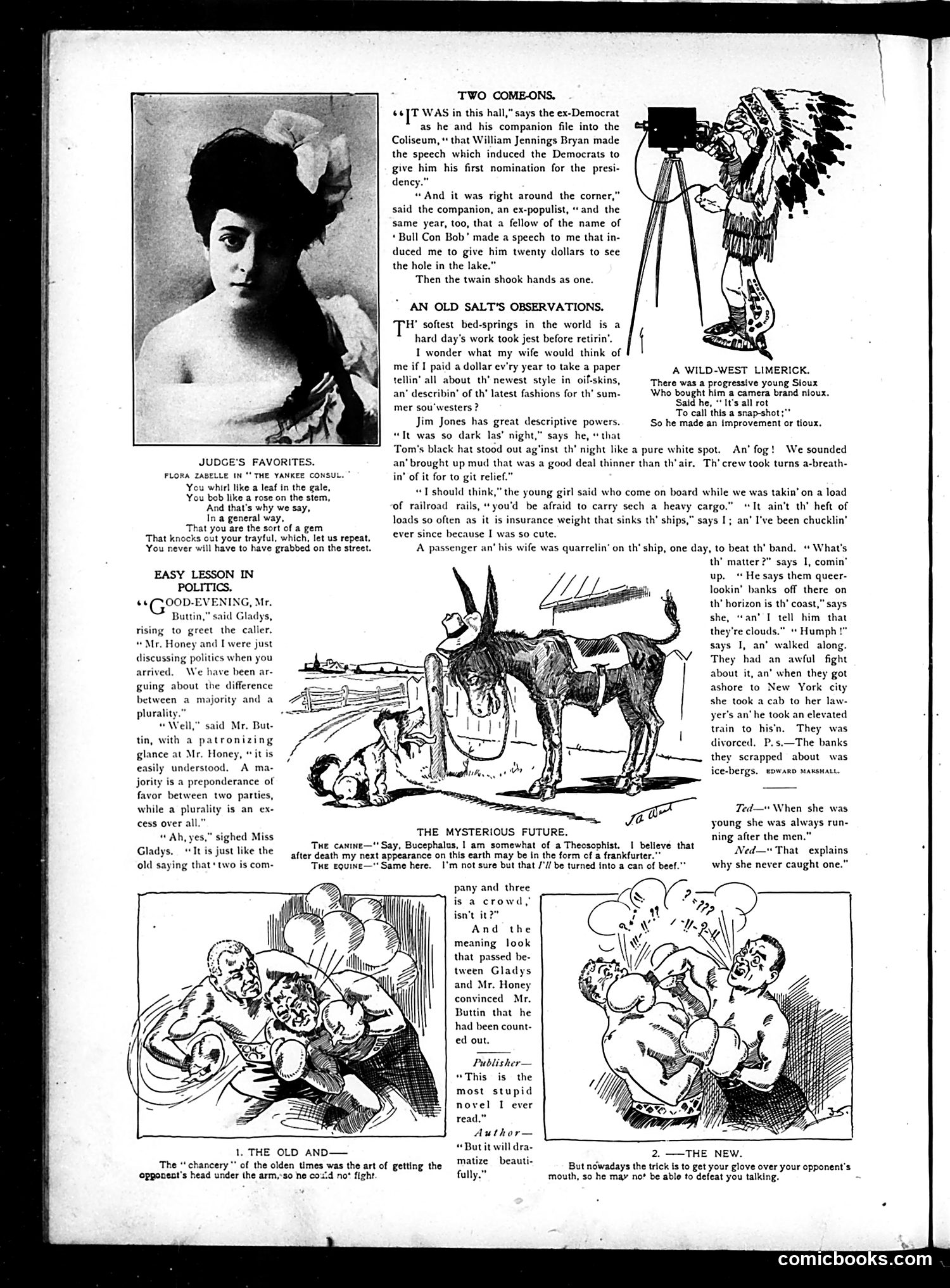
This page contains several short humorous pieces and cartoons typical of Judge's satirical format: **"Two Come-ons"** references William Jennings Bryan's nomination speech at the Democratic convention, using anecdotes about political inducements. **"Judge's Favorites"** and **"Easy Lesson in Politics"** are brief joke pieces about political patronage and the difference between majority and plurality votes. **"The Mysterious Future"** cartoon depicts a Theosophist and spiritualist discussing reincarnation as a cat, satirizing occult movements popular in the early 1900s. **"The Old and The New"** contrasts old versus modern boxing techniques—the older style involving head-butting versus newer gloved techniques. The page exemplifies Judge's mix of political commentary, social satire, and gentlemen's humor aimed at educated readers of the period.
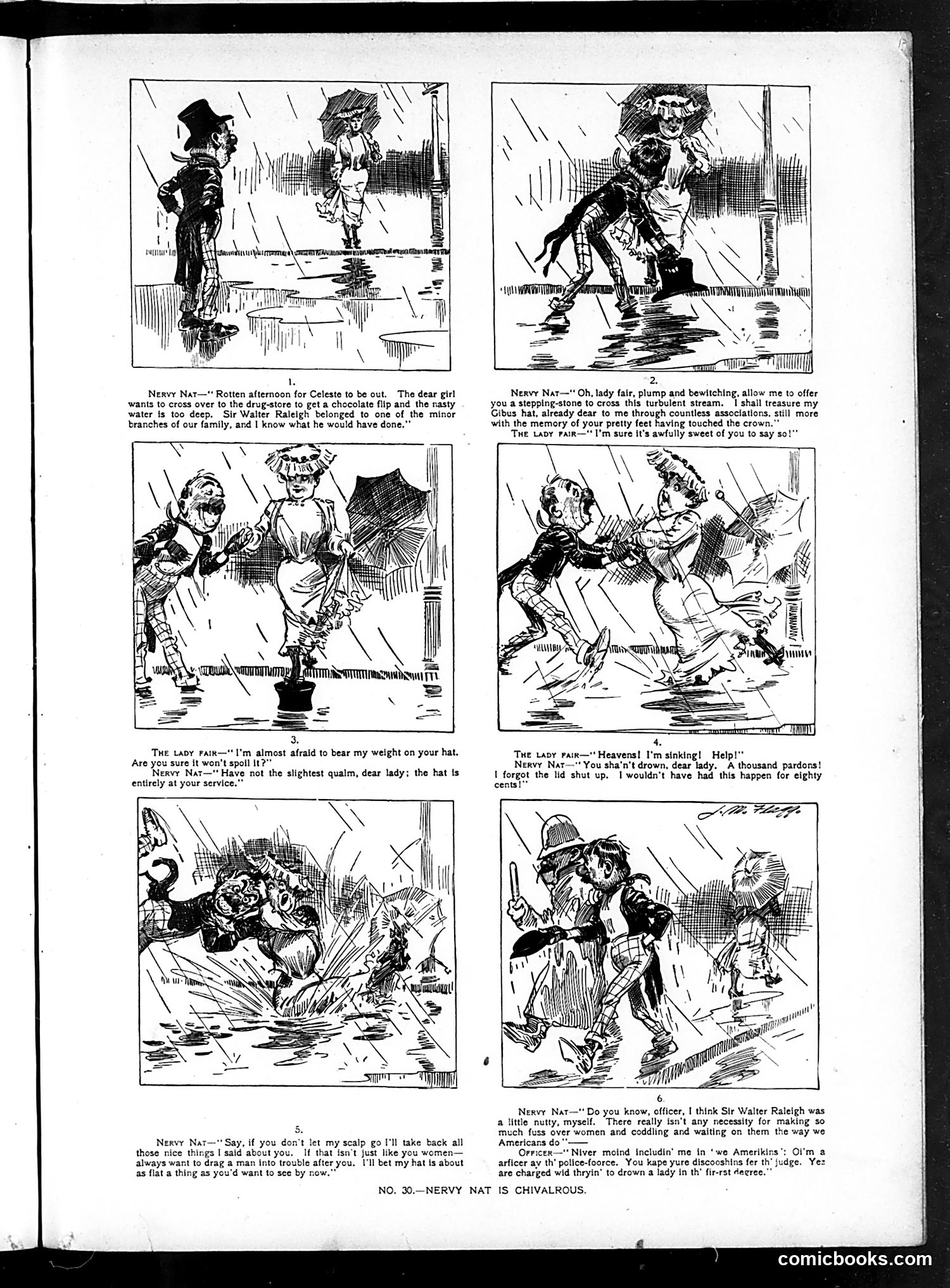
This comic satirizes the affectation of exaggerated chivalry. "Nervy Nat" repeatedly invokes Sir Walter Raleigh—the historical figure famous for laying his cloak over a puddle for Queen Elizabeth I—to justify absurd gestures toward a lady: offering his hat as a stepping-stone, then as a raft. His performative gallantry predictably backfires: the hat gets destroyed, the lady nearly drowns, and a police officer arrests them both. The satire targets two things: first, men who adopt theatrical "courtliness" as an excuse for poor judgment; second, the American obsession with imitating European aristocratic manners. Nat's self-serving romanticism—he treasures his "Gibus hat" more than her safety—undercuts any genuine chivalry. The Irish cop's dialect-heavy conclusion ("fir-rst decree") adds class commentary, suggesting working-class common sense trumps upper-class pretension.
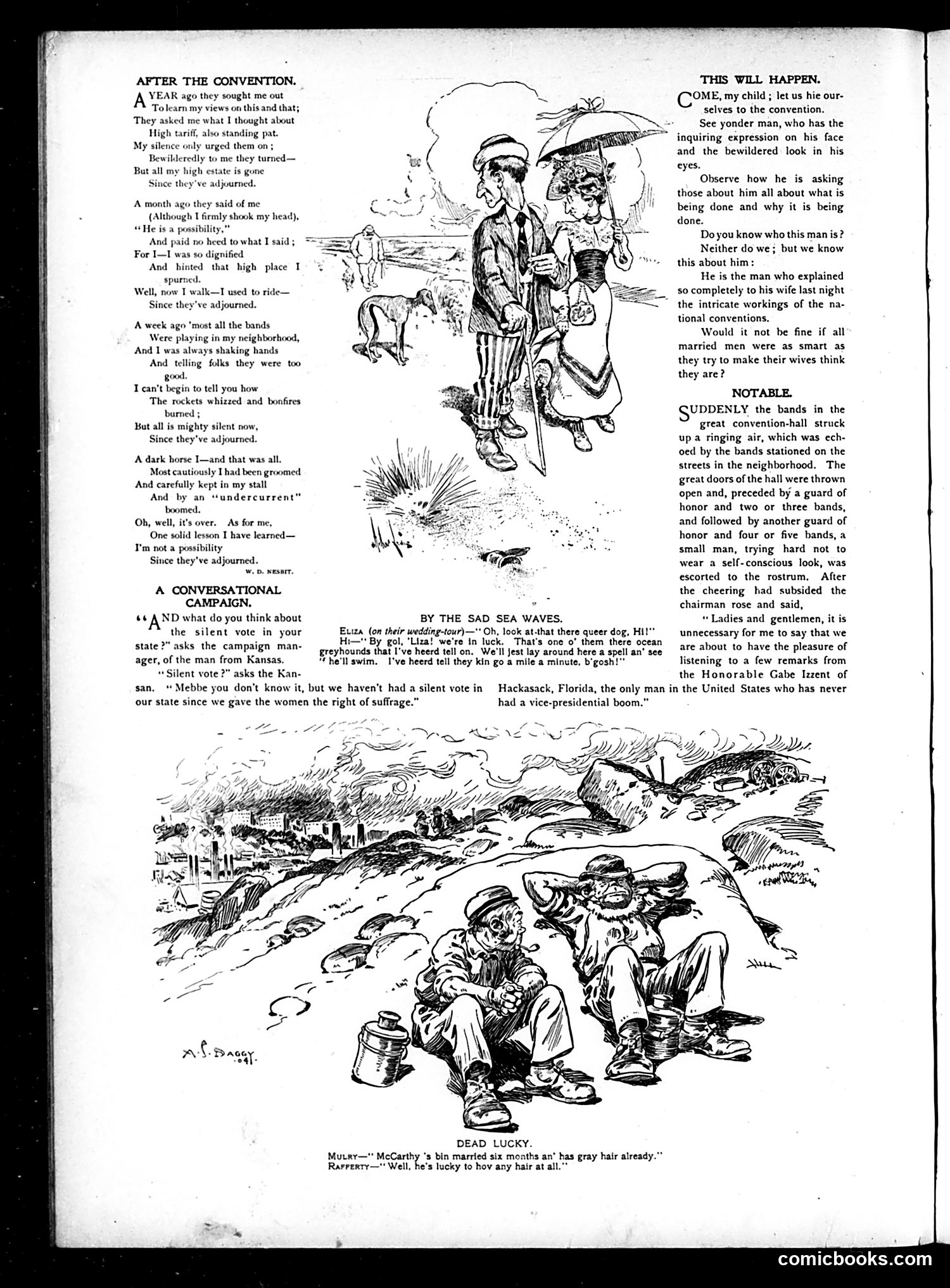
This page from *Judge* satirizes American political conventions, likely from the early 20th century when women's suffrage was a recent development. **"After the Convention"** mocks a political dark-horse candidate whose fortunes evaporate once the convention ends. When he was a possible nominee, politicians courted him intensely. After adjournment, he's forgotten—illustrating the fickleness of political attention. **"A Conversational Campaign"** jokes that Kansas—a state known for women's political activism—can no longer have a "silent vote" since women gained suffrage, implying women voters are vocal and politically engaged. **"This Will Happen"** ridicules husbands who pretend expertise about political conventions to impress their wives, despite not understanding the proceedings themselves. The cartoons collectively mock political pretension, the temporary elevation of minor figures, and the gap between male political blustering and actual knowledge—with a satirical nod to women's emerging political voice.
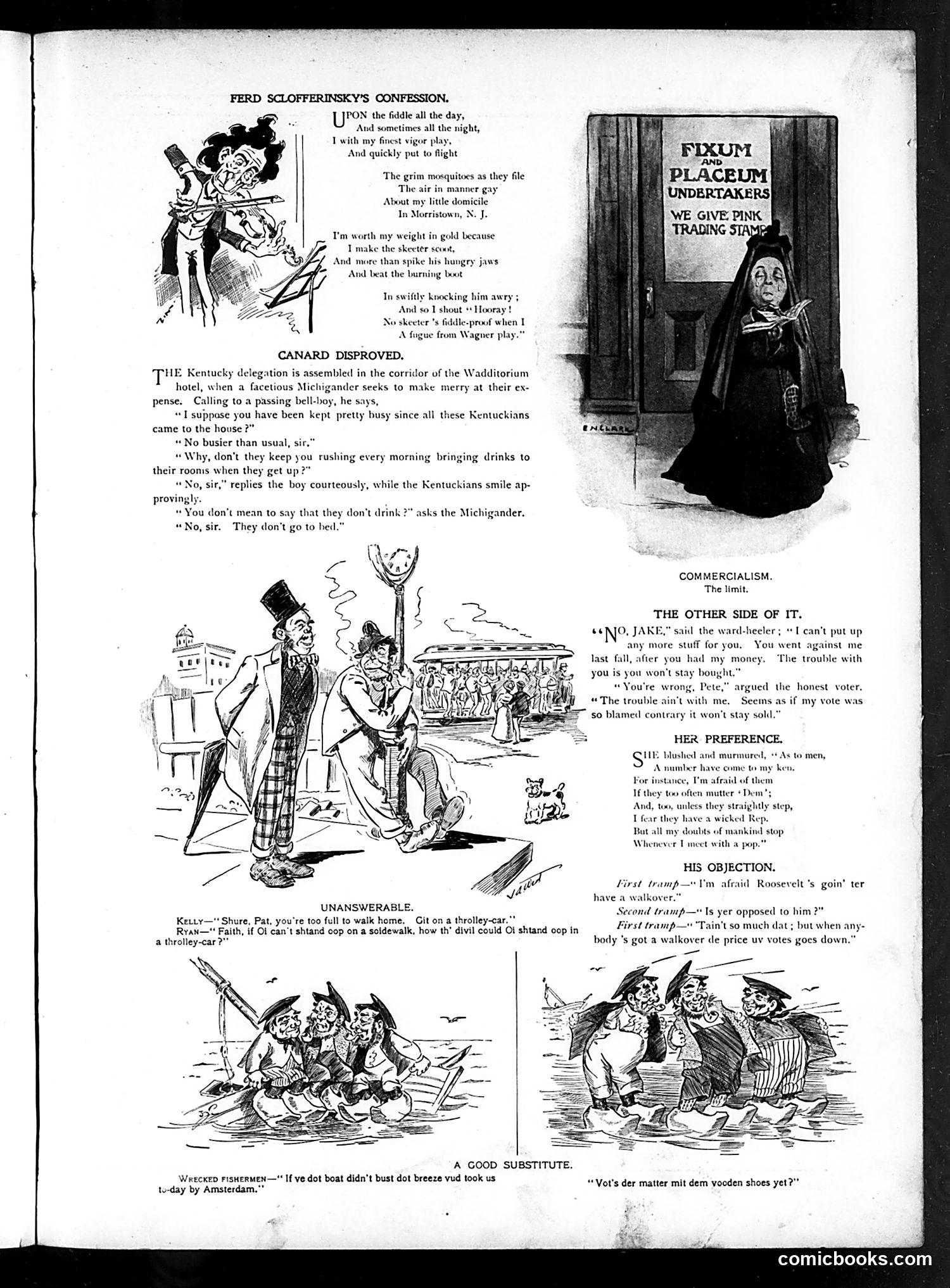
This page contains multiple brief satirical sketches mocking various American social and political figures circa early 1900s: **"Ferd Sclofferinsky's Confession"** ridicules an apparently self-important mosquito-swatter in Morristown, NJ who absurdly credits Wagner music for his pest-control success. **"Canard Disproved"** jokes that Kentucky delegates to a hotel convention *don't* drink—contradicting Michigan's stereotype of Kentuckians as heavy drinkers. **"The Other Side of It"** satirizes urban political corruption: a ward-heeler complains a voter won't stay "bought" (accept bribes), but the voter counters that his vote is simply too independently-minded to remain sold. **"Her Preference"** presents a woman dismissing various male types, preferring only champagne ("pop"). **"His Objection"** mocks a tramp opposing Roosevelt's predicted "walkover" election victory—not from principle, but because electoral certainty drives down vote-buying prices. The sketches use ethnic dialect humor and target political machine corruption as primary themes.
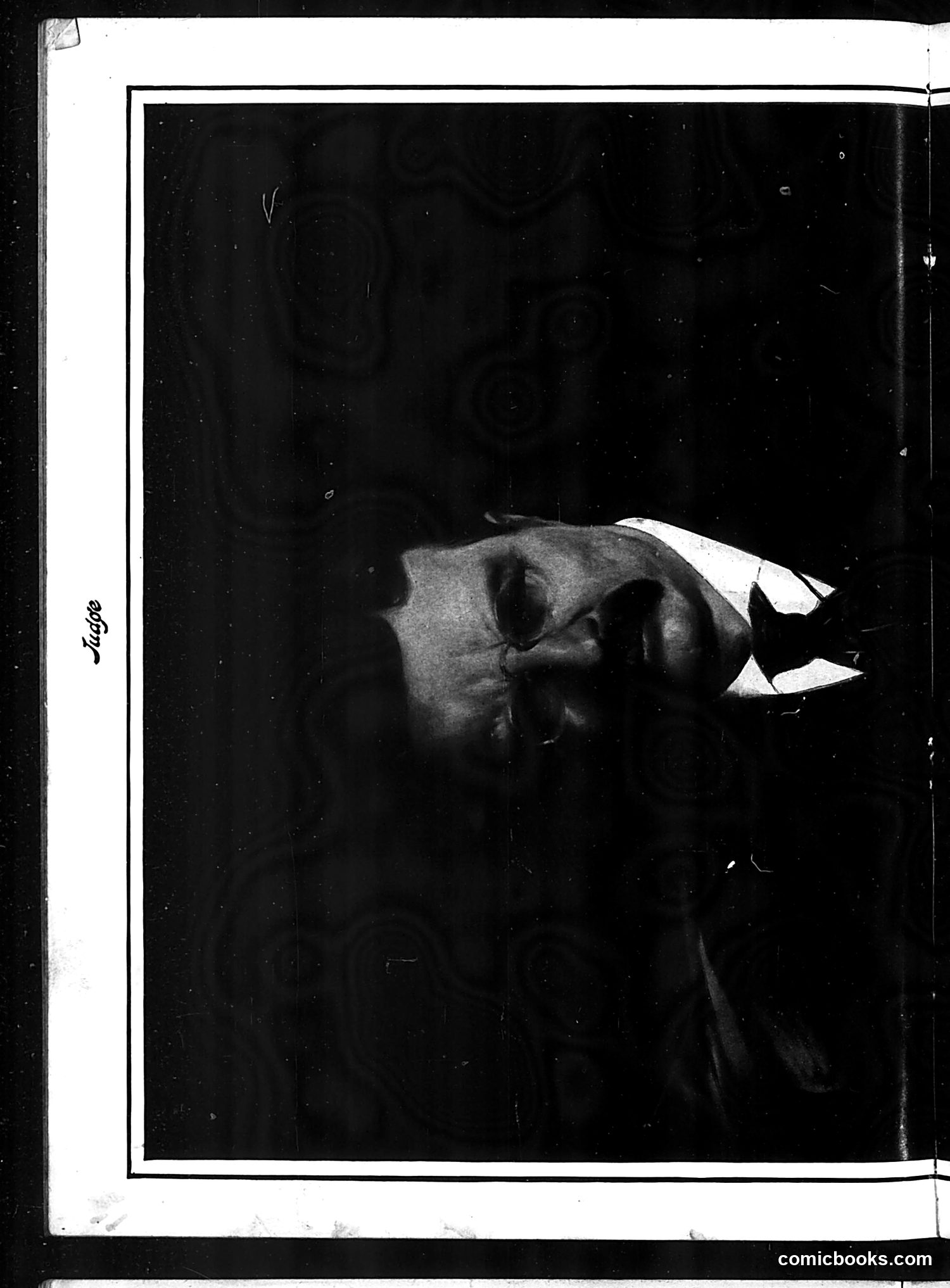
This is a black and white photograph or illustration rather than a drawn cartoon. The image shows a person in profile, head tilted back with mouth open wide, appearing to consume or drink something white (possibly a beverage or food item). The word "Judge" appears on the left margin, confirming this is from the satirical magazine *Judge*. However, without additional OCR text or captions visible on the page, I cannot definitively identify the specific political or social reference, the intended subject, or the satirical point being made. The dramatic lighting and exaggerated pose suggest this is commentary on consumption, excess, or a specific public figure or social behavior, but the context necessary to explain the satire is not clearly legible in this reproduction.
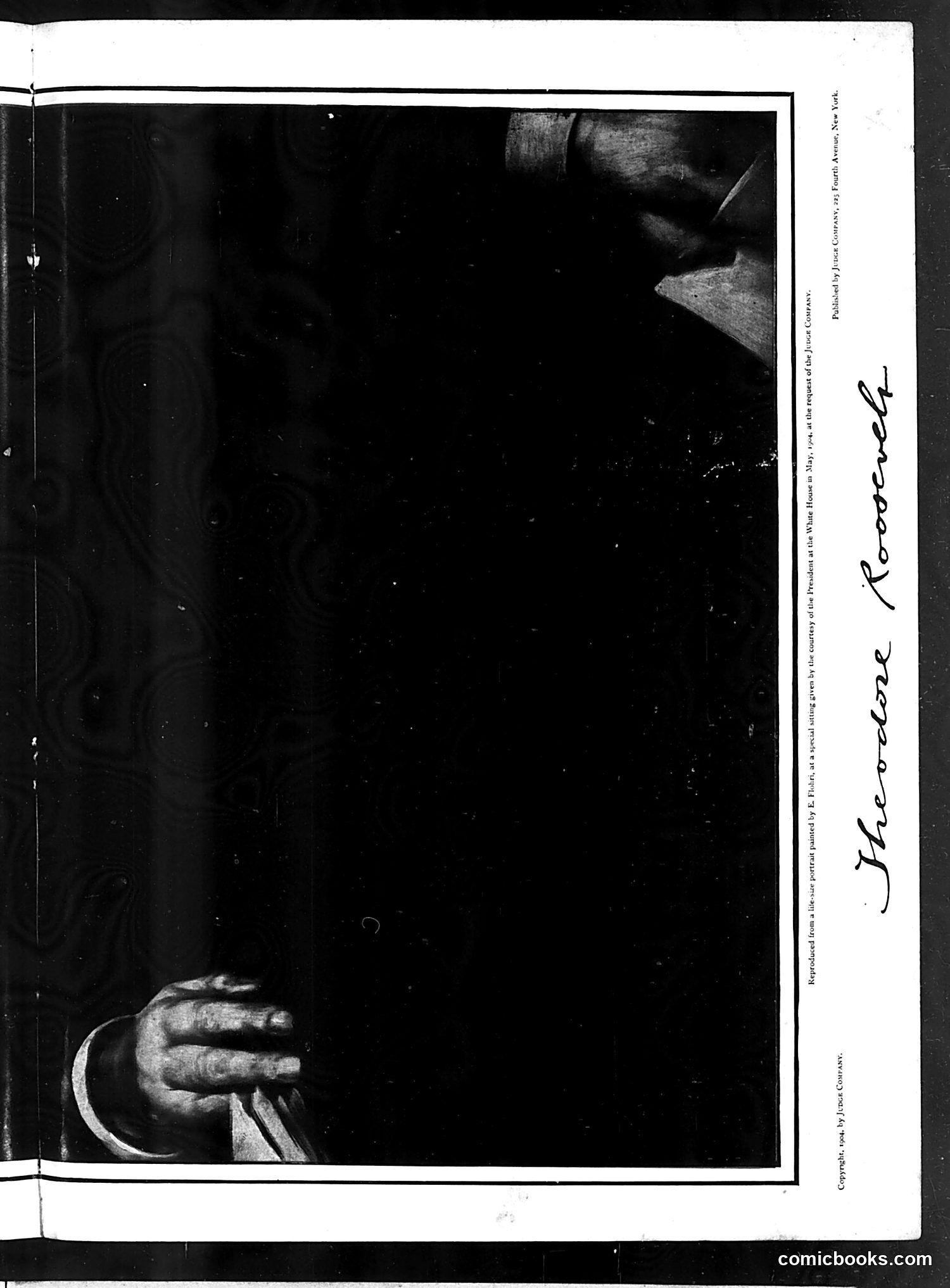
I can see this is a page from *Judge* magazine with the title "The-o-dore Roosevelt" visible on the right side. The image shows a black and white photograph or illustration of a hand gripping what appears to be a rope or similar object, positioned in the lower left portion of the page. However, the image quality is quite poor and largely dark, making it difficult to discern specific details about any cartoon, caricature, or satirical content. The text is minimal and doesn't provide sufficient context to explain the satire's meaning. Without clearer visibility of the artwork and more complete text, I cannot reliably identify the political or social references intended by this piece.
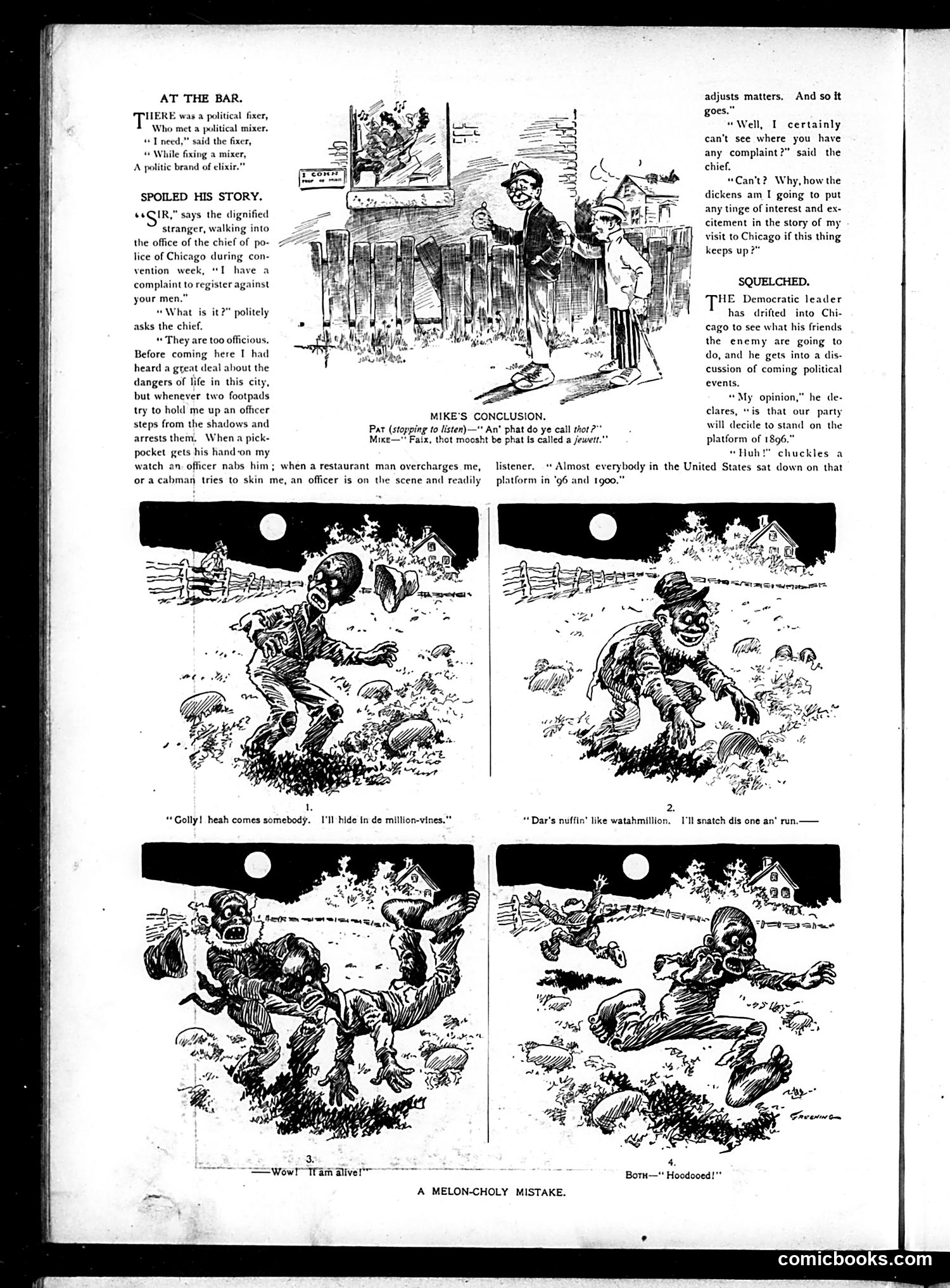
This page from *Judge* contains three distinct political humor pieces: **"At the Bar"** mocks political operatives ("fixer" and "mixer") seeking corrupt remedies—satirizing machine politics and backroom dealing. **"Spoiled His Story"** ridicules Chicago's police during convention week. A visitor complains that effective policing ruins his narrative—he came expecting exciting crime stories but officers keep preventing robberies and theft. The joke targets both the visitor's dubious priorities and implied Chicago corruption; honest policing "spoils" the expected lawlessness. **"Squelched"** shows a Democratic leader proposing his party stand on the 1896 platform. A listener responds that "almost everybody" already sat on that platform in 1896 and 1900—meaning the party has already failed those policies twice, rendering the suggestion ridiculous. **"A Melon-Choly Mistake"** (bottom comic strip) appears to depict slapstick consequences, though context is unclear from this excerpt. Overall, the page satirizes political corruption, ineffective leadership, and machine politics typical of *Judge's* era.
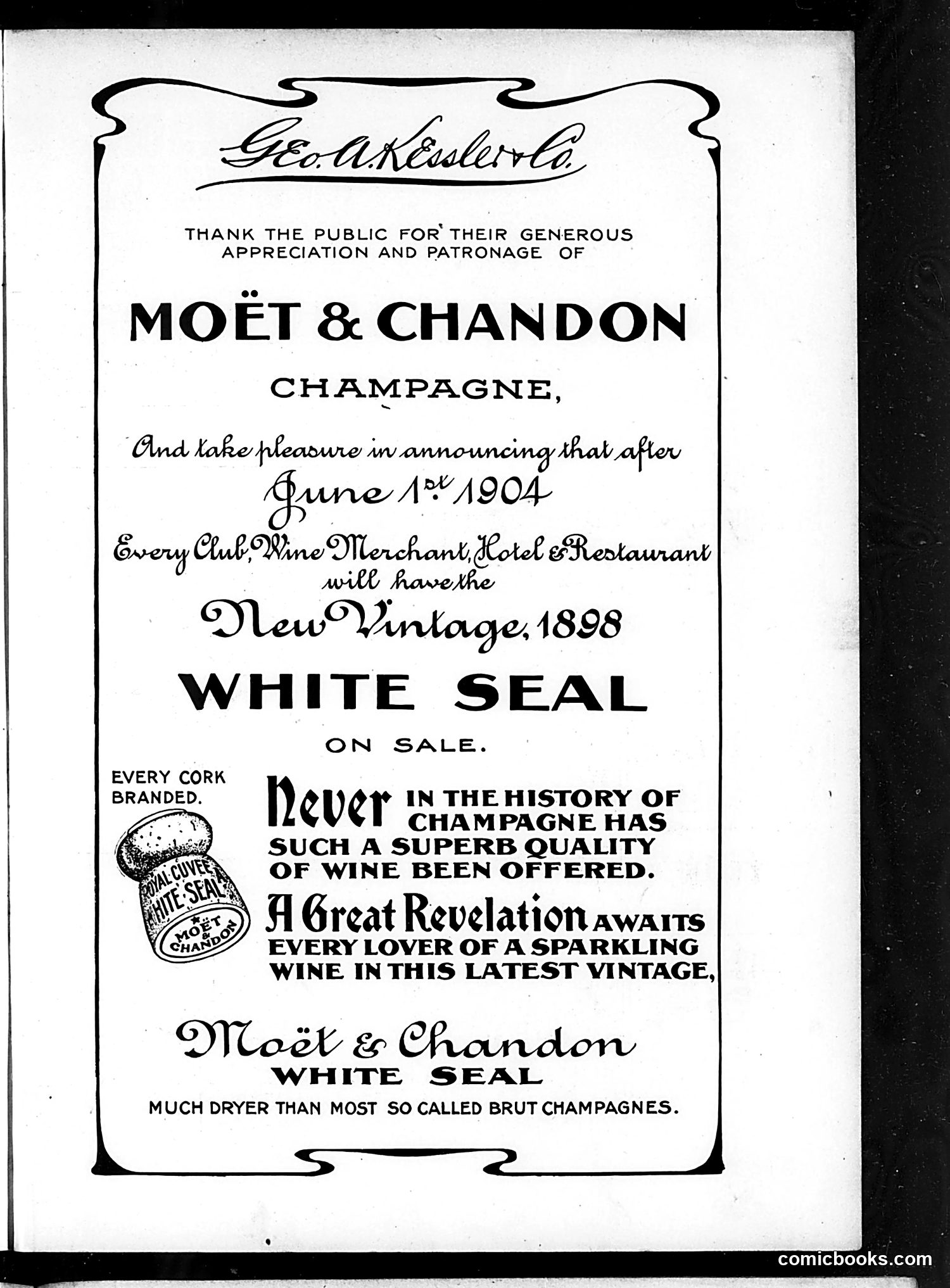
This is a **full-page advertisement** for Moët & Chandon champagne, not a political cartoon. It announces the availability of their "White Seal" vintage from 1898, effective June 1st, 1904. The ad emphasizes the wine's exceptional quality and dryness compared to competitors' "Brut" champagnes. Key selling points include branded corks and claims of unprecedented excellence. The decorative border and mix of typographic styles are typical early-1900s advertising design. There is no satire, caricature, or political commentary present—this is straightforward commercial promotion placed in *Judge* magazine to reach affluent readers who could afford premium champagne.
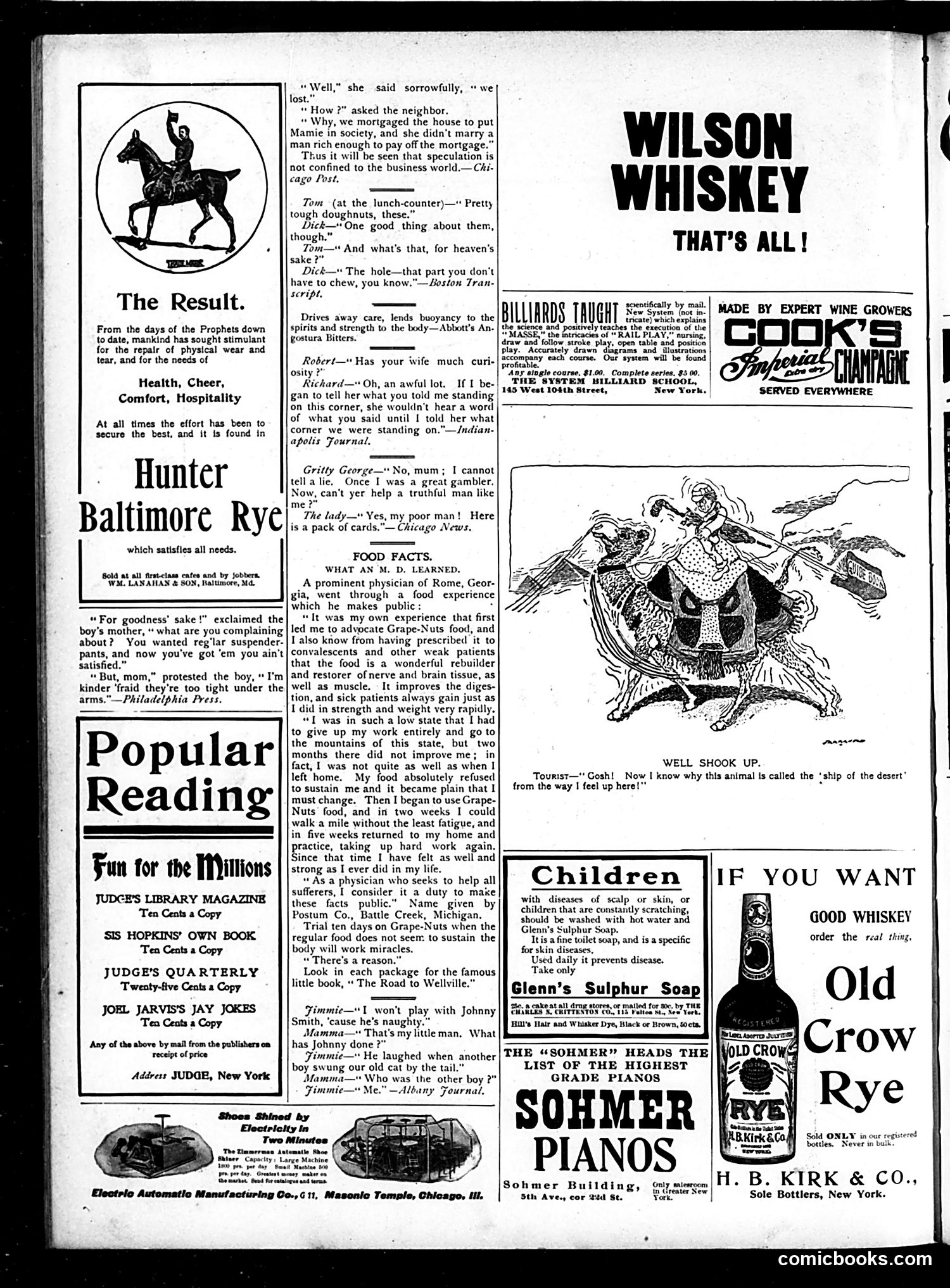
This page is primarily **advertising and light humor** rather than political satire. The main content includes: **The Cartoons/Humor:** - A small illustration titled "The Result" accompanying a Hunter Baltimore Rye whiskey ad—depicting a horse rider, likely symbolizing vitality from the product - A sketch of animals (appears to be a camel or similar creature) captioned "Well Shook Up," a visual pun about physical disruption - Multiple brief joke anecdotes about everyday life: a boy complaining about suspender-pants, neighbors discussing a failed marriage/mortgage, diner banter about tough doughnuts **The Satire:** Minimal political content. The jokes mock middle-class domestic concerns—social climbing, marital disappointment, consumer complaints. One quip references financial "speculation" beyond business. **Advertising:** Dominates the page: whiskey, soap, pianos, food supplements, and Judge's own library magazines occupy substantial space. **Historical Context:** This reflects early 20th-century American consumer culture and genteel humor for middle-class readers, with no identifiable caricatures of public figures or current events.
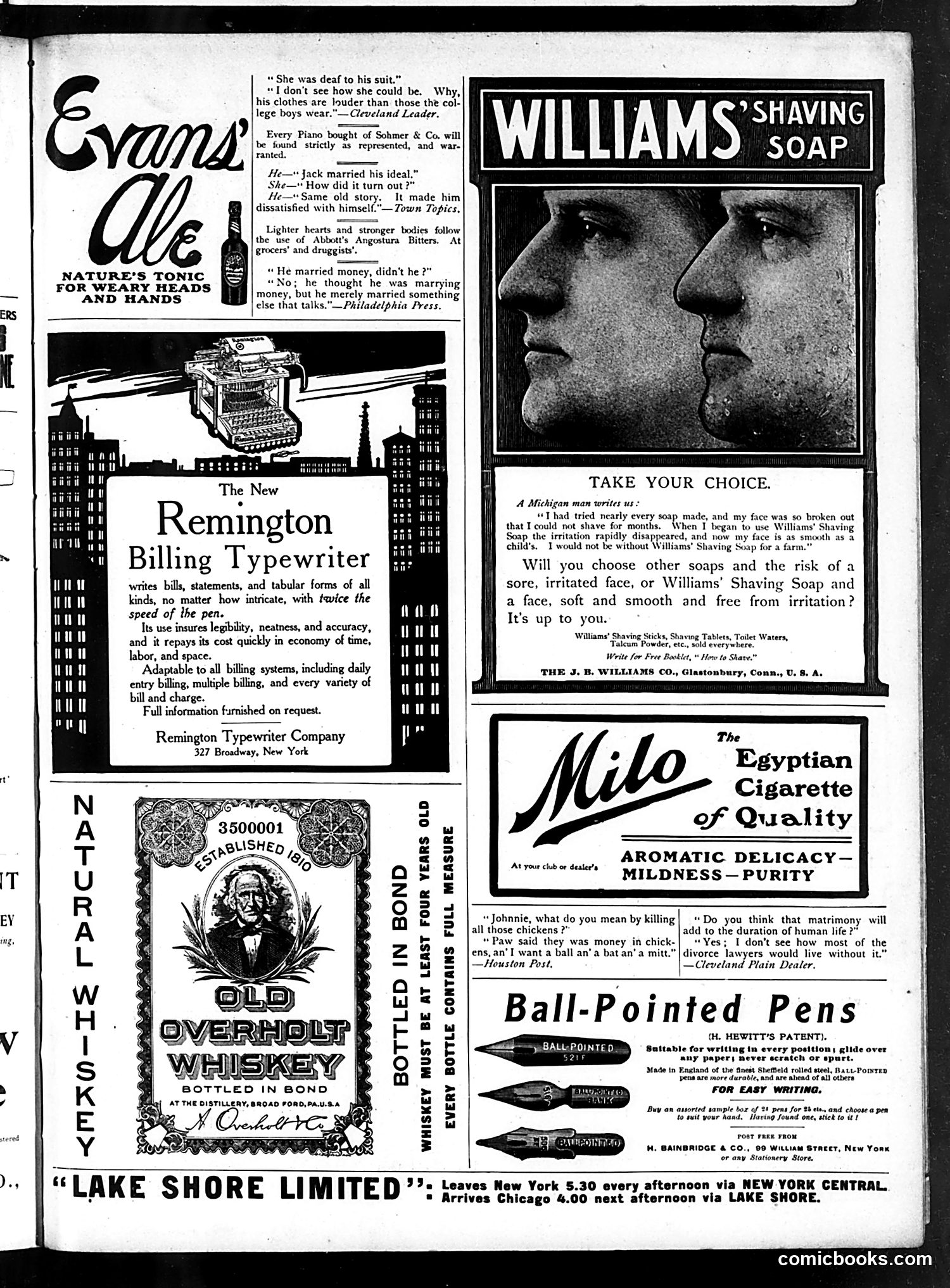
This page consists primarily of **advertisements** interspersed with brief humorous quips typical of Judge magazine's satirical style. The jokes mock marriage and courtship conventions of the era: - A woman is "deaf to his suit" despite his loud clothes - A man married his "ideal" but became dissatisfied with himself - A man thought he was marrying money but married "something else that talks"—satirizing women as talkative - A child kills chickens for profit; divorce lawyers profit from matrimony The advertisements promote period products: Evans Ale tonic, Remington typewriters, Old Overholt whiskey, Williams' Shaving Soap (with before/after facial imagery), Milo Egyptian cigarettes, and Ball-Pointed Pens. The shaving soap ad is notable for its testimonial format—a common advertising technique claiming the product cured facial irritation. The overall page reflects early-20th-century commercial culture and conventional attitudes toward gender and marriage typical of Judge's audience.
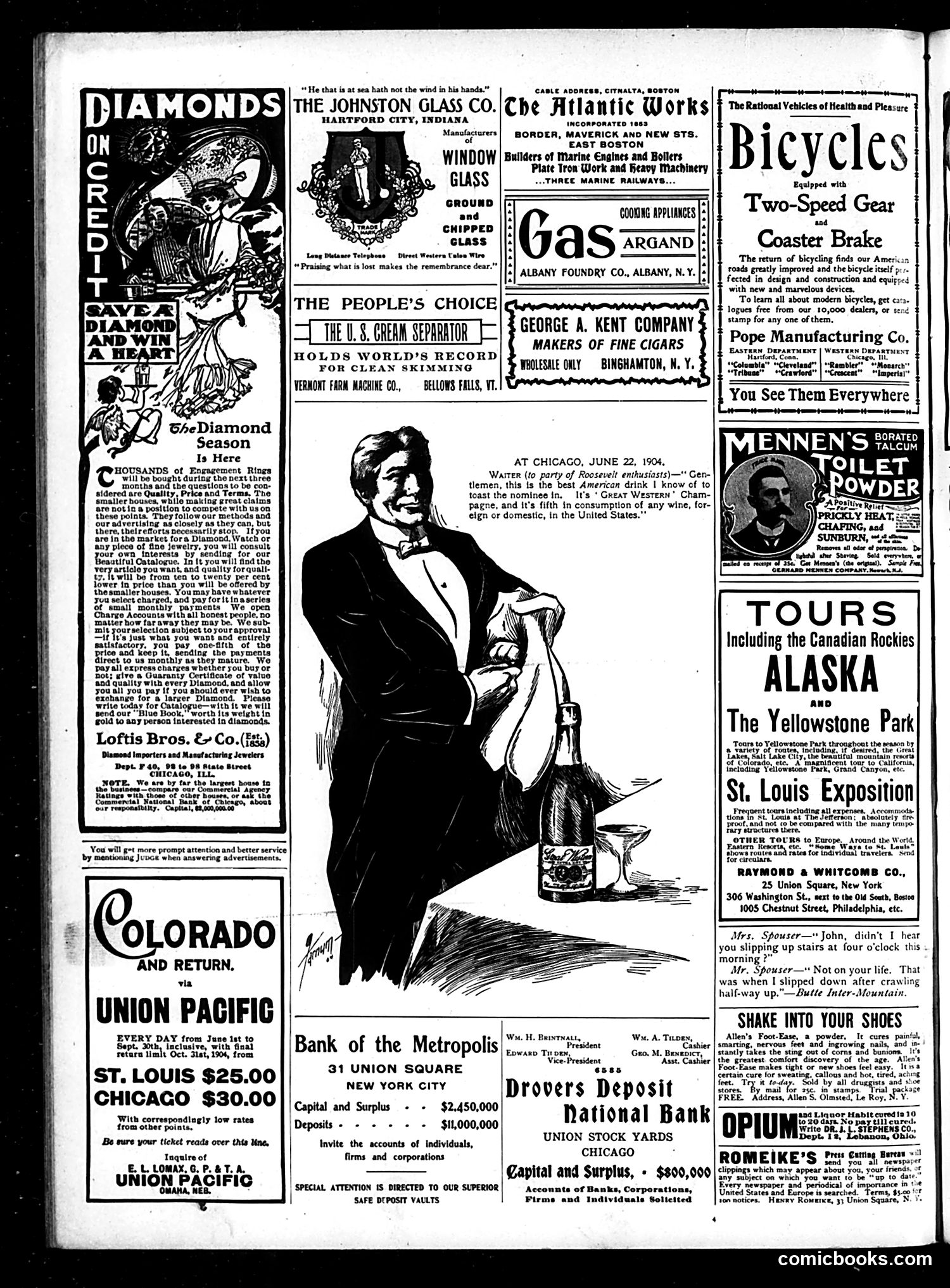
This page is primarily **advertising**, typical of Judge magazine's revenue model. The central cartoon depicts a well-dressed man toasting with champagne, captioned with a quote about "Great Western" champagne being the best American drink—a subtle advertisement disguised as editorial content. The cartoon appears to reference **1904 political circumstances**: the caption mentions "party of Roosevelt enthusiasts" toasting "the nominee," likely alluding to Theodore Roosevelt's 1904 presidential campaign. The "Warren" character seems to be endorsing a particular champagne brand while discussing political events. The satirical point is **understated**: the joke rests on conflating patriotic political celebration with product endorsement—a common advertising strategy of the era. The remainder of the page contains typical Judge advertisements: diamonds, bicycles, travel tours, and banking services—all targeting the magazine's affluent readership. The opening quote about "wind in his hands" is standard decorative typography without clear connection to content.
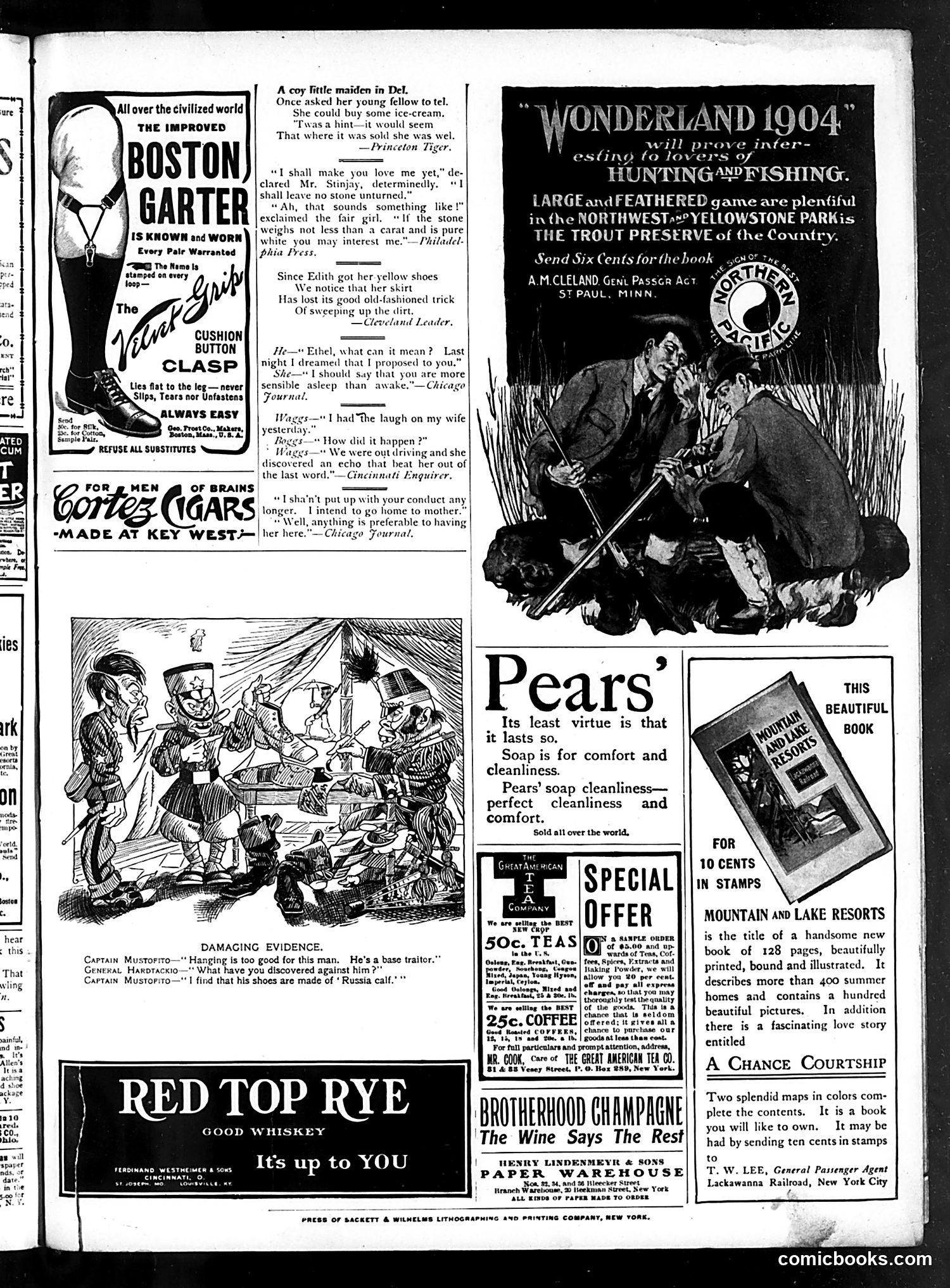
This page is primarily **advertising**, with small comic bits interspersed. The main cartoon, "Damaging Evidence," satirizes military justice: Captain Mustorto condemns a man as a "base traitor," but General Hardtackio asks what evidence exists. The punchline reveals the only "proof" is that the man's shoes are made of "Russia calf"—a play on words conflating the material (calf leather) with Russia, the foreign enemy. It mocks how flimsy or absurd the accusations against suspected traitors could be. The surrounding content is vintage early-1900s advertising: Boston garters, Cortes cigars, Pears' soap, Red Top Rye whiskey, and promotional books for Yellowstone hunting/fishing and the Lackawanna Railroad. Small humorous quotes from newspapers appear between ads—typical filler humor of the era, mostly about romance and domestic situations. The page reflects Judge's mix of political satire and commercial content.
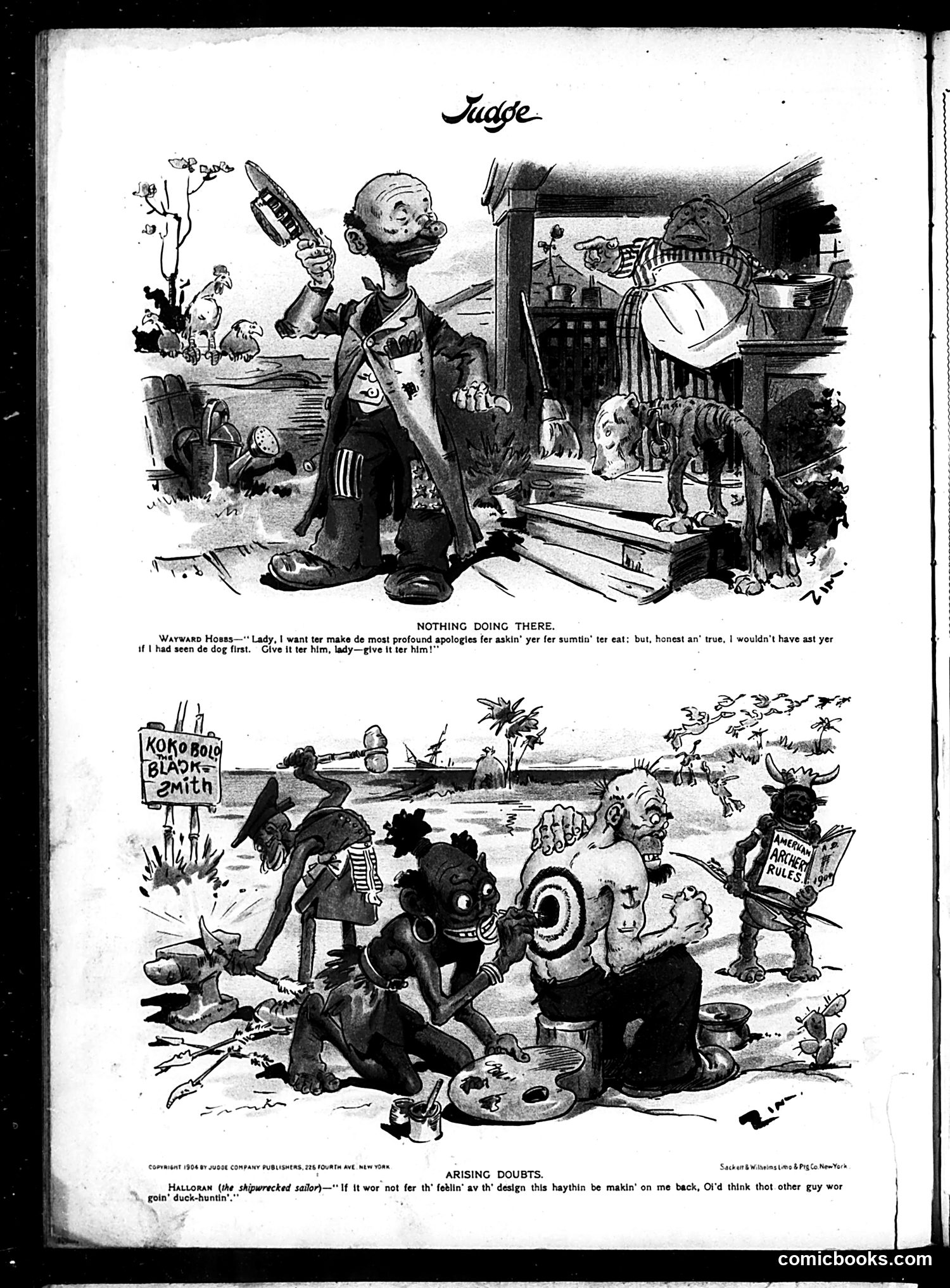
This page contains two separate satirical cartoons: **"Nothing Doing There"** depicts a judge character (Wayward Hoss) apologizing to a lady for requesting food, claiming he wouldn't have asked if he'd seen her dog first—implying the dog is more deserving or appetizing. The satire likely mocks judicial incompetence or desperation. **"Arising Doubts"** shows a shipwrecked sailor (Halloran) observing another castaway creating mysterious designs on his back. The sailor suspects the designs might be for a hunting expedition rather than rescue—suggesting dark intent or cannibalism fears among desperate castaways. Both cartoons use exaggerated ethnic dialects and caricatured figures typical of early-1900s Judge humor. The satire appears to target foolishness, desperation, and moral ambiguity in crisis situations, though the specific contemporary references remain unclear without additional historical context.
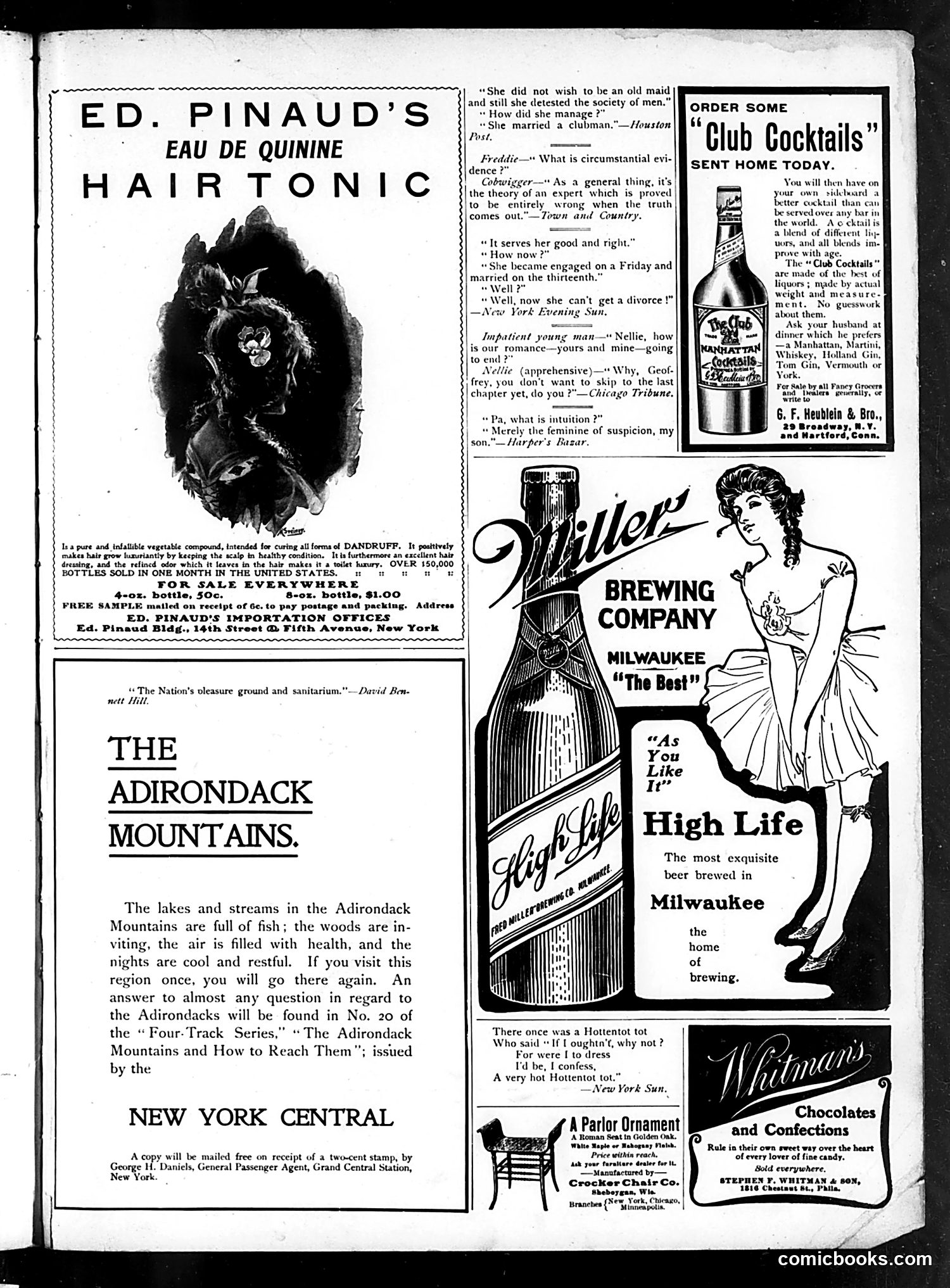
This page is primarily **advertising**, not political satire. It contains several product advertisements (hair tonic, beer, cocktails, chocolates, furniture) interspersed with short humorous anecdotes. The small jokes scattered throughout reflect early 20th-century social attitudes: one jokes about a woman avoiding spinsterhood by marrying a "clubman" (an idle, wealthy man); another mocks women's suspicion as "feminine"; a third plays on racial stereotypes with a "Hottentot tot" nonsense rhyme. The substantive non-ad content is the Adirondack Mountains promotional piece by the New York Central Railroad, advertising the region's recreational appeal. The page reflects the era's casual sexism and racial mockery normalized in mainstream humor publications, alongside commercial boosterism for luxury goods and leisure travel destinations.
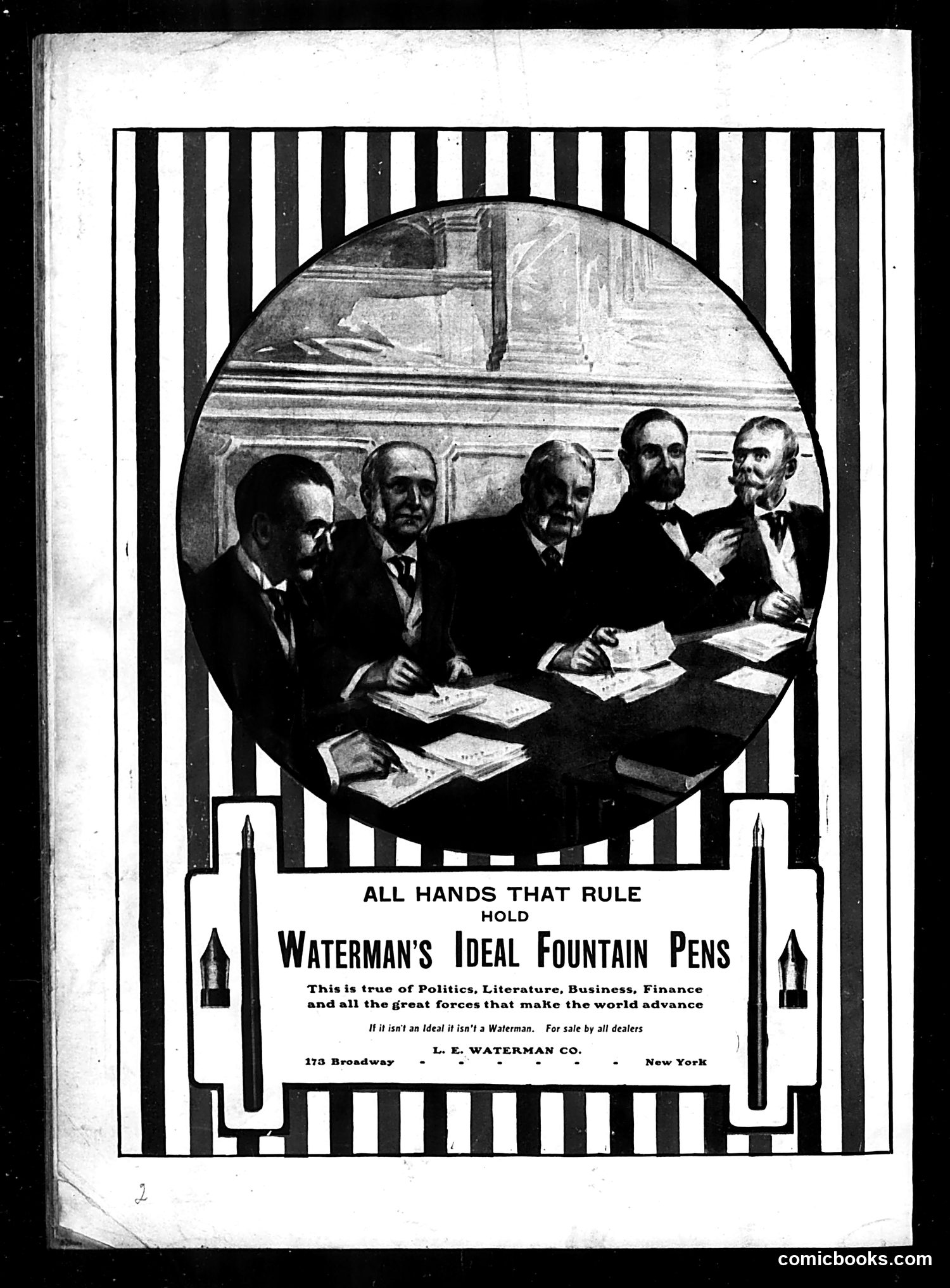
This is a **Waterman fountain pen advertisement**, not political satire. The page shows five well-dressed men in formal business attire seated at a table with documents, representing power brokers in politics, literature, business, and finance. The ad's central claim is that influential decision-makers ("all hands that rule") use Waterman's Ideal fountain pens. The slogan "If it isn't an Ideal it isn't a Waterman" is a marketing play positioning the pen as essential to those wielding power and shaping world progress. The implied message: prestigious professionals demand this specific pen brand. The formal setting and distinguished appearance of the figures reinforce the product's association with success and authority. This reflects early 20th-century advertising strategy: linking consumer goods to social status and influence.
I can see this is a very dark, heavily aged page from what appears to be a historical publication, but I cannot reliably make out the specific cartoon imagery, text content, or details clearly enough to provide an accurate historical interpretation. The image quality is too degraded—the page appears almost entirely black with only faint traces of what might be decorative patterns or illustrations visible. To properly explain the satire, political references, and figures depicted, I would need a clearer image where the cartoon(s), captions, and any text are legible. Without being able to read the specific content or identify the caricatures, I cannot responsibly assert what this particular Judge magazine page means or satirizes. If you have a clearer version of this page, I'd be happy to analyze it properly.