
A complete issue · 16 pages · 1904
Judge — May 28, 1904
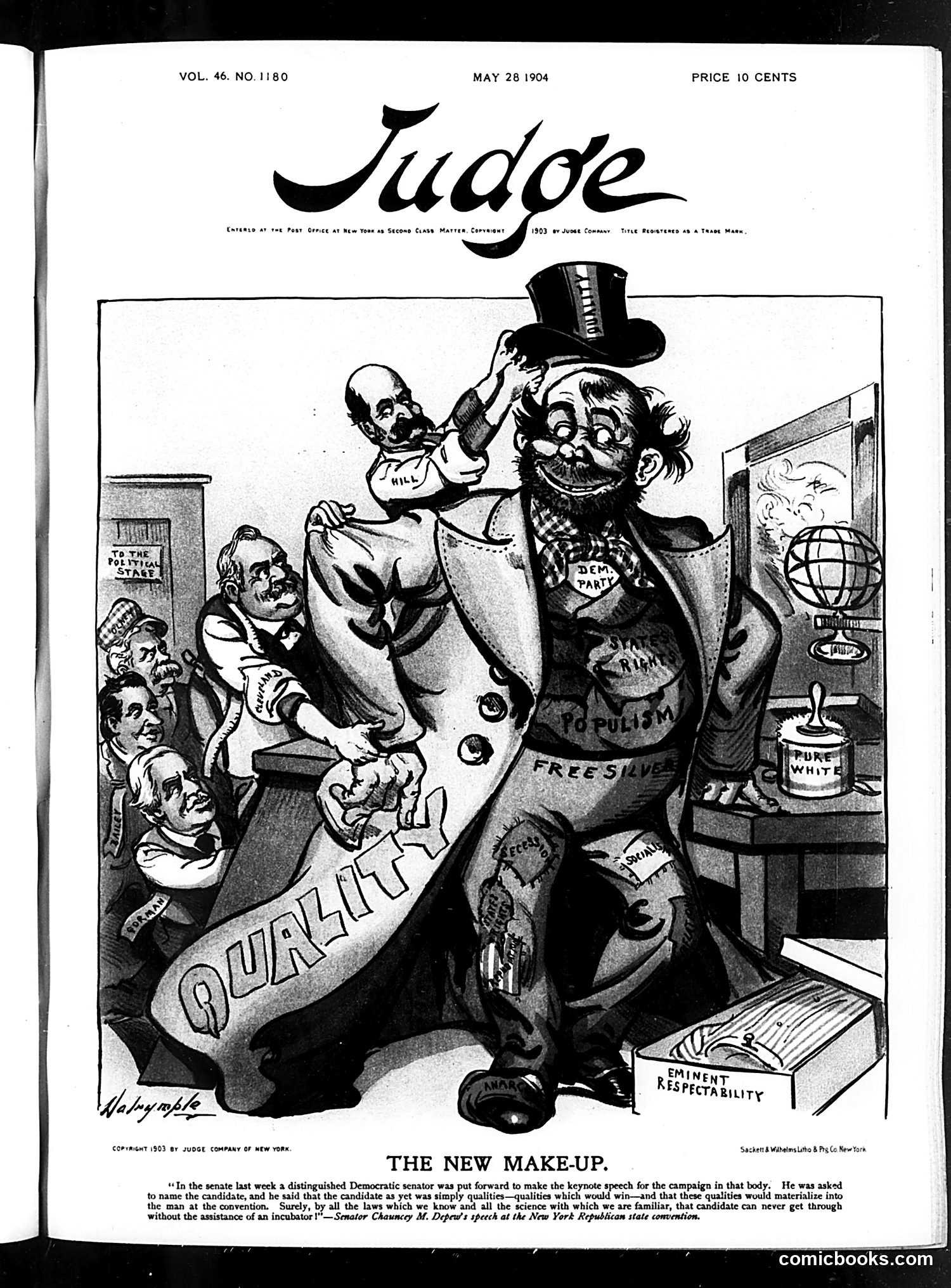
This political cartoon satirizes Democratic Party efforts to construct an appealing presidential candidate for the 1904 election. The central figure appears to be a grotesque composite—literally stitched together from various Democratic politicians and party elements, resembling Frankenstein's monster. The caricature wears labels including "FREE SILVER," "QUARANTINE," and "EMINENT RESPECTABILITY," representing conflicting party positions the Democrats were awkwardly trying to reconcile. The smaller figures on the left appear to be Democratic senators or party leaders examining their creation. The satire suggests the Democrats were cynically manufacturing an artificial candidate by combining incompatible positions rather than nominating someone with authentic credentials or consistent principles. The artist mocks this opportunistic approach to candidate-building.
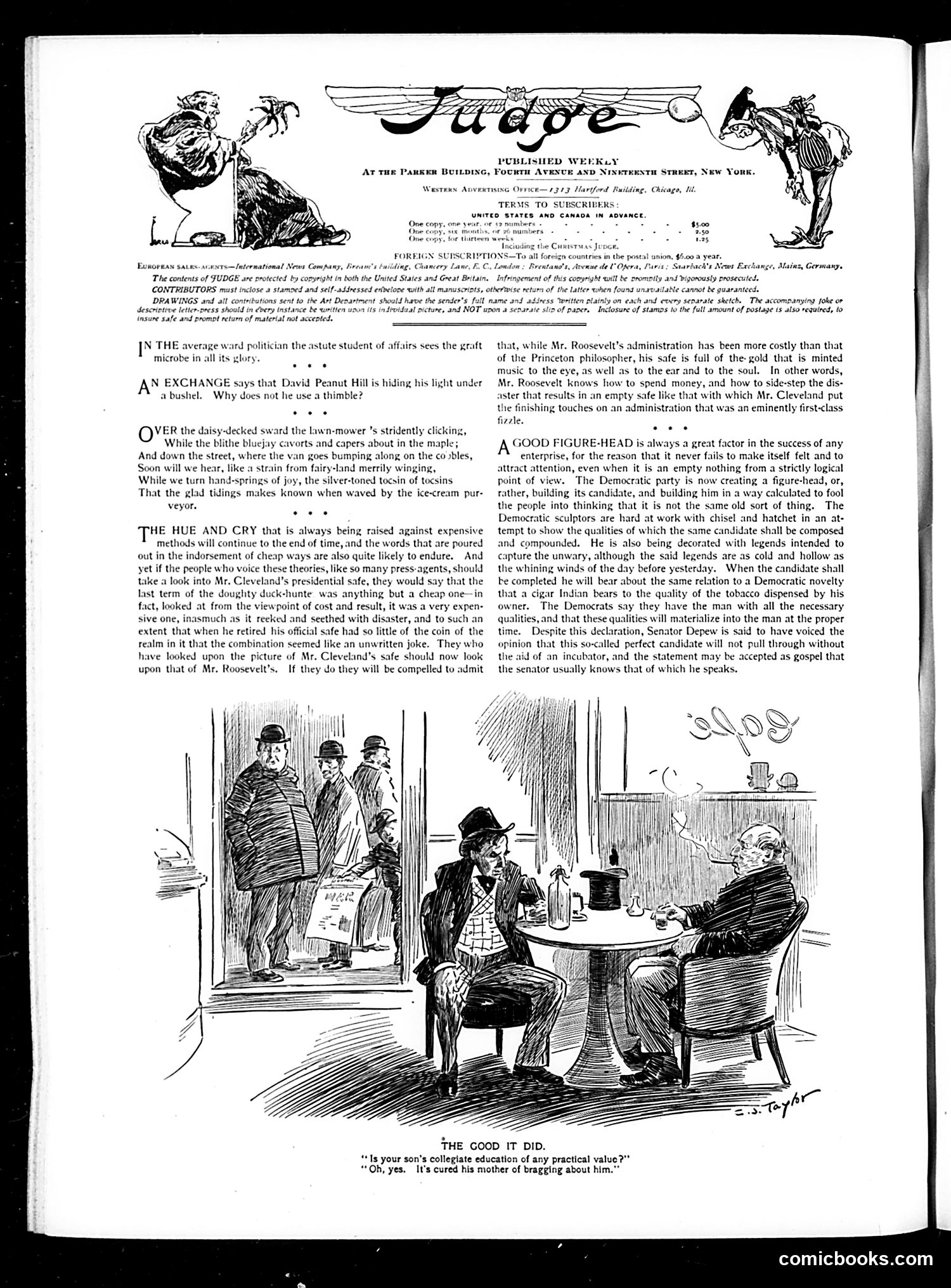
This page contains political commentary and a cartoon. The main editorial discusses Theodore Roosevelt's administration, noting it has been "costly" compared to a Princeton philosopher's views. The text critiques Democratic candidates being artificially promoted and compares them unfavorably to Roosevelt, suggesting they lack genuine qualities. The cartoon at bottom shows a father and son conversation. A man asks another: "Is your son's collegiate education of any practical value?" Response: "Oh, yes. It's cured his mother of bragging about him." This is self-contained social satire about higher education's actual utility—suggesting college produces no practical benefit, merely stopping parents from boasting about their children. The cartoon mocks the pretensions of college education circa the early 20th century.
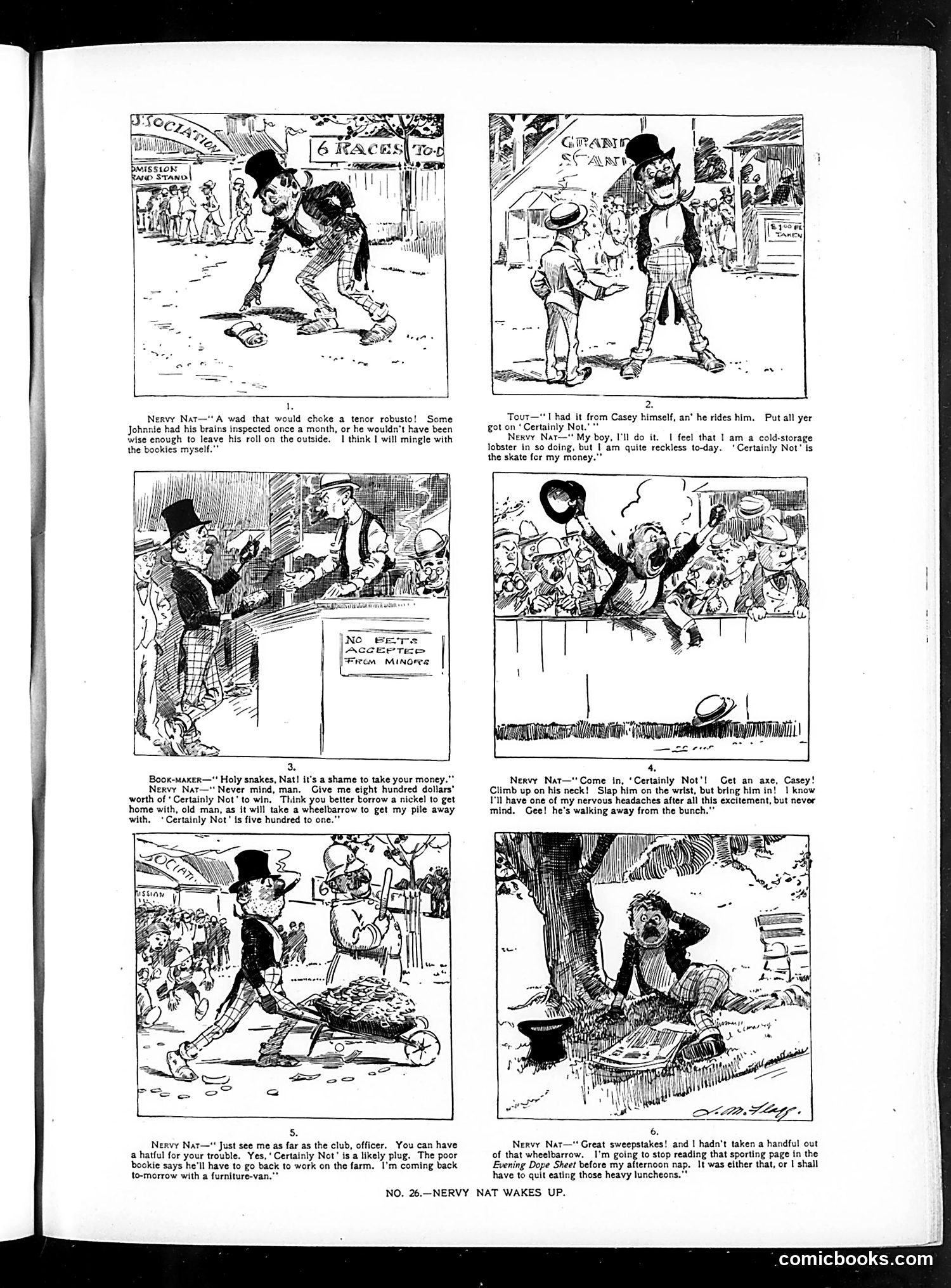
This six-panel comic strip satirizes a character named "Nervy Nat" and his relationship with money and social climbing. The narrative follows Nat attempting to borrow money from "Certainly Not" (likely a wealthy person), claiming he needs funds for unspecified purposes. When rebuffed, Nat attempts various schemes to obtain money—visiting a book-maker, attempting to manipulate a club officer, and eventually getting into physical altercations. The satire targets working-class social ambition and financial desperation during what appears to be the early 20th century. "Nervy Nat" represents a hustler type constantly pursuing quick money through dubious means. The strip's humor derives from his repeated failures and the physical comedy of his comeuppances, mocking both his scheming nature and his inability to succeed despite persistent effort.
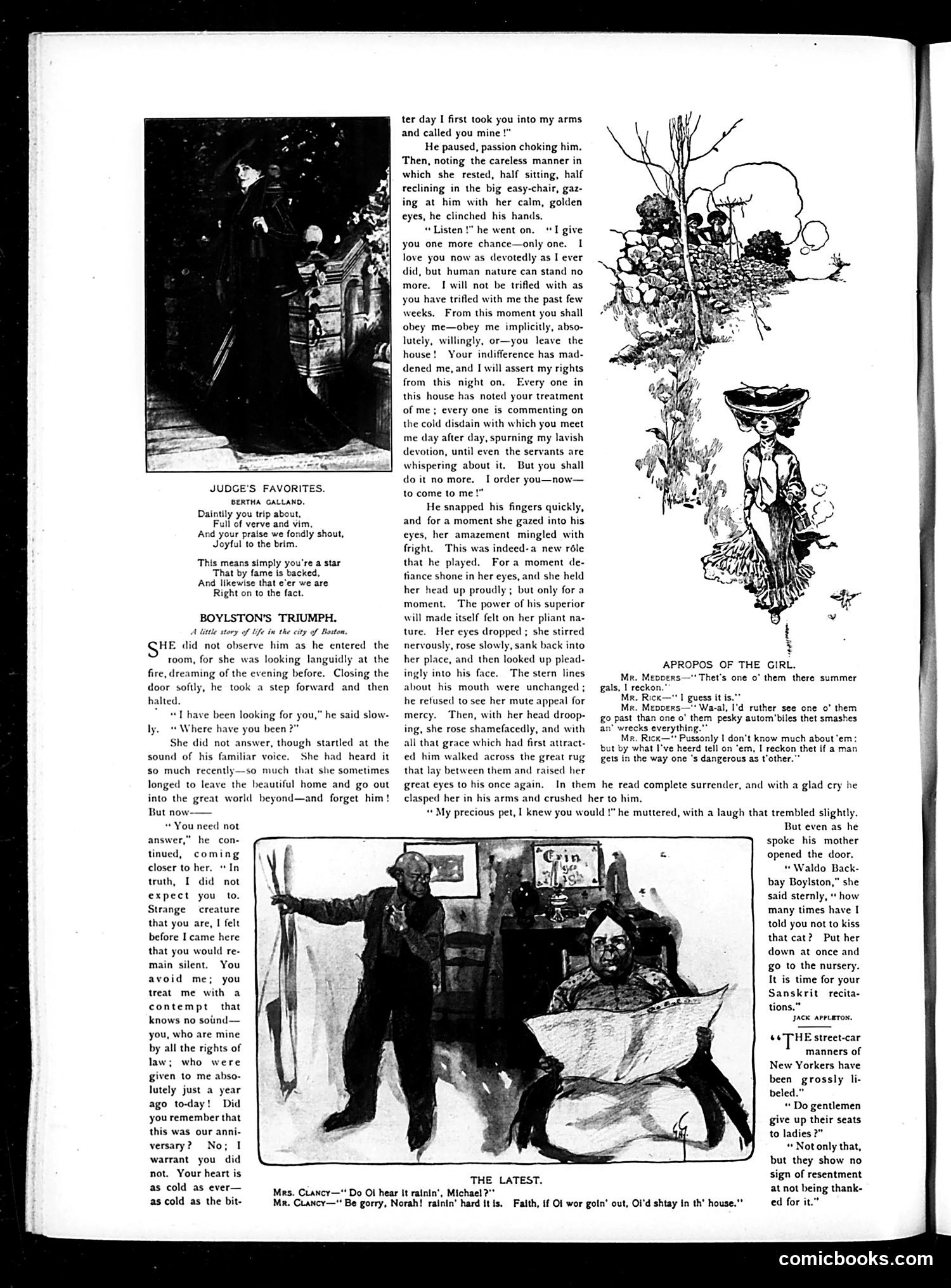
This page contains a romantic melodrama titled "Boylston's Triumph" rather than political satire. The narrative depicts a man (Boylston) confronting his beloved after her coldness toward him, demanding obedience and threatening to leave if she won't comply. She capitulates tearfully. The smaller cartoon "The Latest" shows a domestic scene with dialogue about rain, apparently mocking marital conversation. A sidebar titled "Apropos of the Girl" contains brief quips about women's behavior—one mocking men who lose their hats, another commenting on street-car etiquette and ladies' seats. This page reflects early 20th-century gender dynamics and romantic conventions rather than political commentary. The humor derives from stereotypical portrayals of courtship, female submission, and social manners—attitudes that would be considered offensive today.
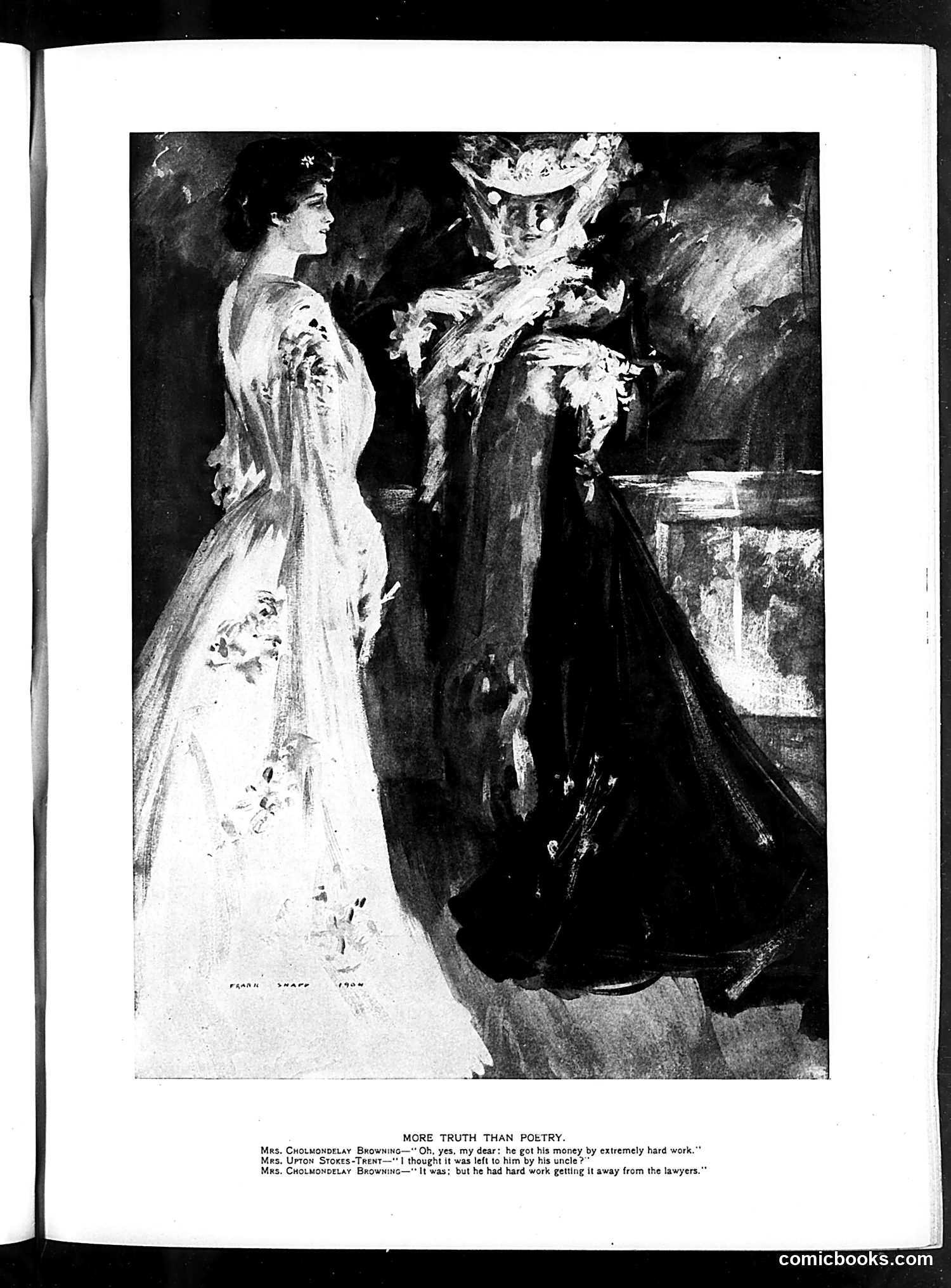
This social satire depicts two wealthy women discussing a gentleman's inheritance. Mrs. Cholmondeley Browning claims he earned his money through "extremely hard work," but when challenged—another woman reveals it was actually left to him by his uncle—she revises her story: yes, he inherited it, but he "had hard work getting it away from the lawyers." The joke satirizes both upper-class pretension and the legal profession. Wealthy society women euphemistically frame inherited privilege as earned success. The punchline mocks lawyers as inevitable obstacles to wealth transfer, suggesting they're parasitic intermediaries who extract fees from estates. The cartoon ridicules genteel dishonesty and implies legal fees consume a substantial portion of inheritances.
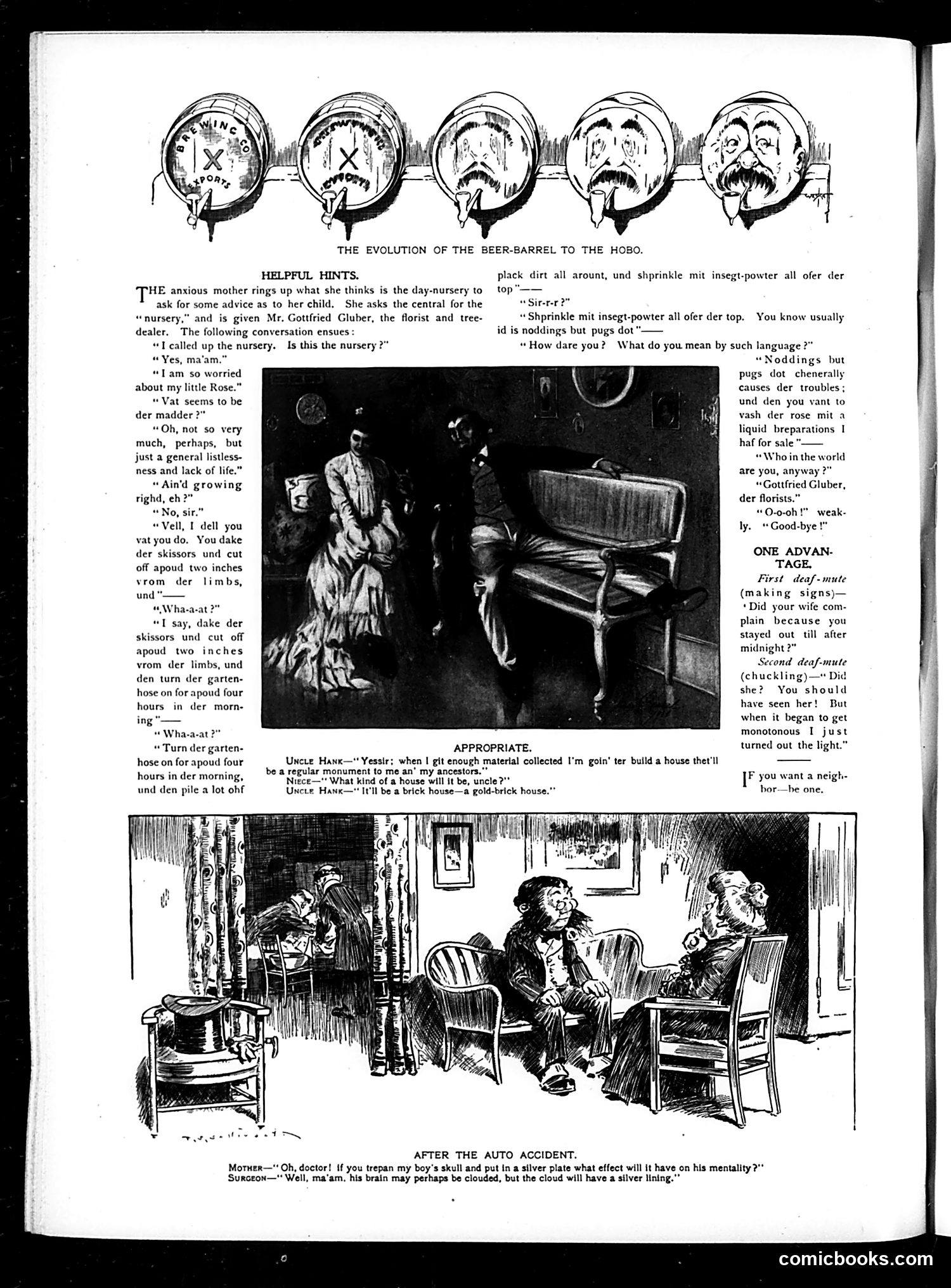
This page from *Judge* magazine contains several satirical pieces: **"The Evolution of the Beer-Barrel to the Hobo"** (top): A visual gag showing five beer barrels progressively transforming into increasingly disheveled hobo faces—suggesting alcohol consumption leads to vagrancy. **"Helpful Hints"**: A comedy sketch mocking both a flustered society mother and a thick-accented German florist (Gottfried Gluber) mistaken for a nursery worker. The humor relies on ethnic stereotype humor common to the era, with the florist's malapropisms and broken English played for laughs. **Remaining sketches**: Brief gag cartoons about deaf-mutes, family eccentricity ("gold-brick house"), and a doctor's pun about a silver lining after a boy's skull injury. The page exemplifies early 20th-century American humor: reliant on ethnic caricature, slapstick misunderstandings, and dark jokes about accidents. The satire lacks specific political targets—it's general social comedy reflecting contemporary attitudes toward immigrants and class divisions.
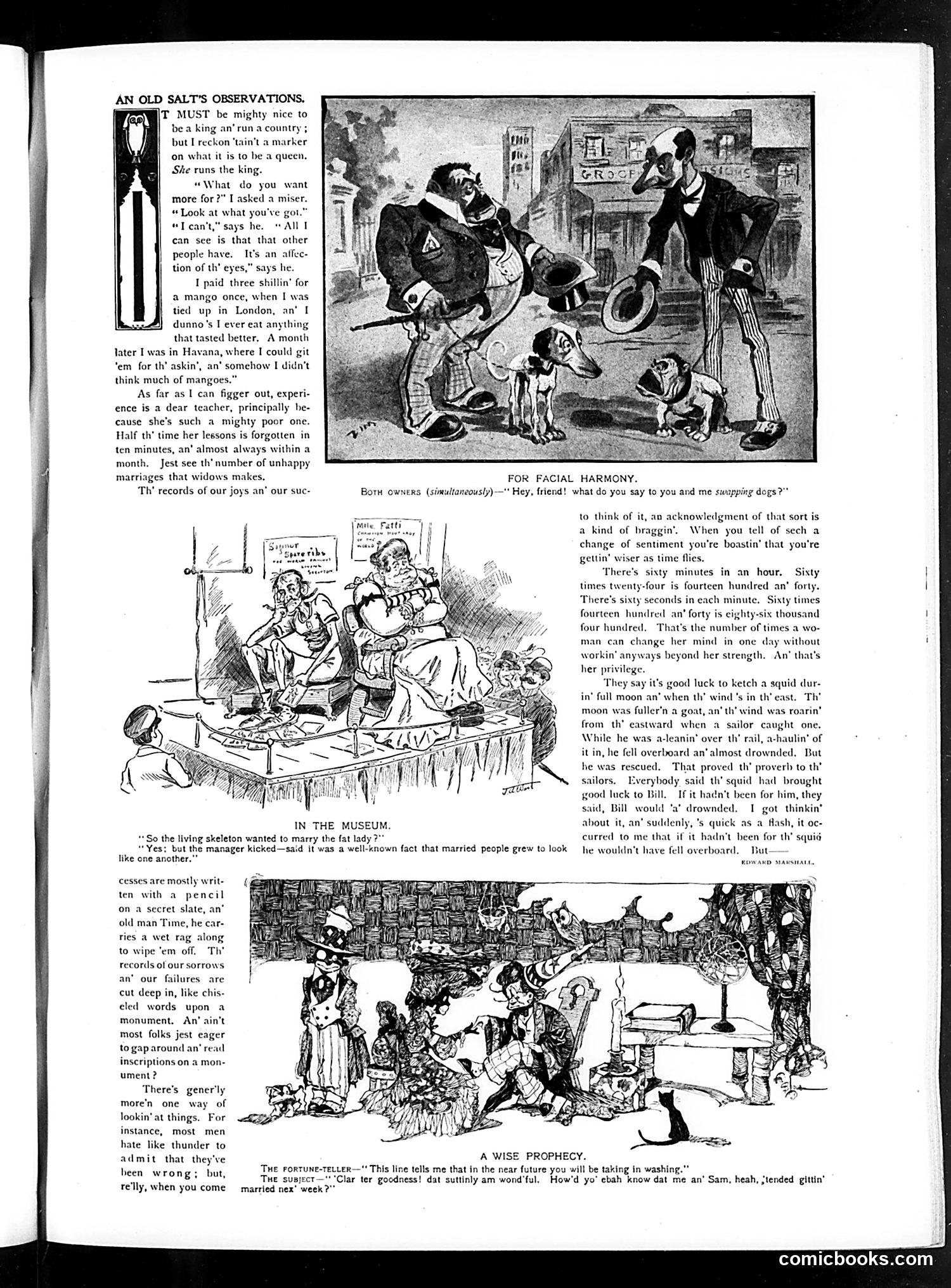
This page contains several satirical cartoons and commentary typical of early 20th-century American humor: **"An Old Salt's Observations"** (left column): A sailor's philosophical musings on life's ironies—that queens truly rule kings, that experience is a poor teacher (lessons forgotten within a month), and that people's minds constantly change. The humor lies in folk wisdom delivered in dialect. **"For Facial Harmony"** (top): Two dog owners propose swapping pets, joking that each owner resembles their own dog—a common satirical observation about humans and their companions. **"In the Museum"** (middle): A manager prevented a "living skeleton" (circus sideshow performer) from marrying a "fat lady" because married couples supposedly grow to resemble each other—absurdist humor about physical transformation. **"A Wise Prophecy"** (bottom): A fortune-teller "predicts" a Black couple will take in washing after marriage—likely mocking both fortune-telling and racial stereotypes about domestic labor, though the satire's exact target remains unclear. The page exemplifies Judge's blend of folk philosophy, physical comedy, and period stereotypes.
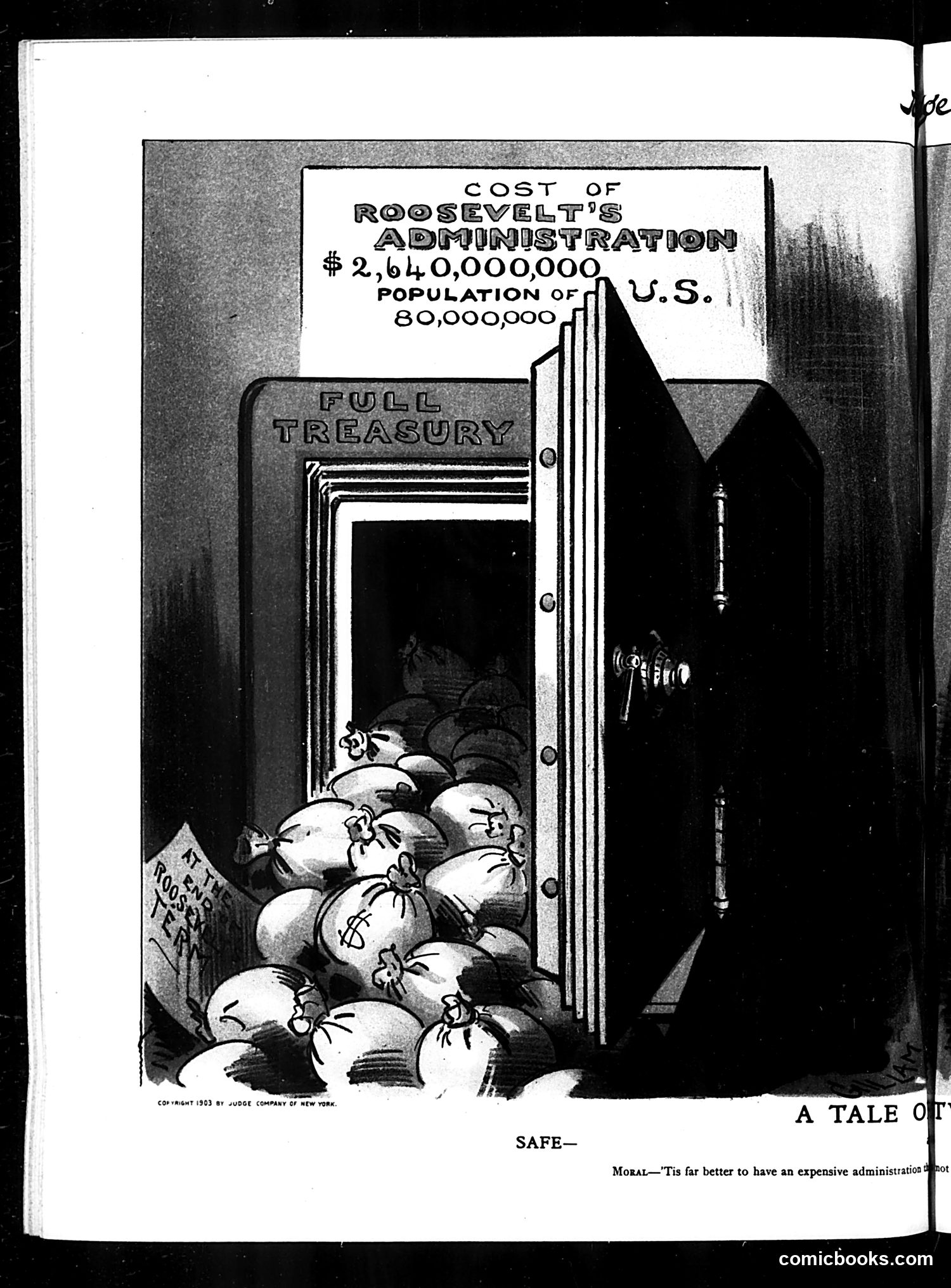
This 1903 Judge magazine cartoon satirizes President Theodore Roosevelt's administration costs. The image depicts a massive safe labeled "FULL TREASURY" bursting open, spilling oversized money bags marked with dollar signs. The caption states the administration cost $2.64 billion against a U.S. population of 80 million. The cartoon's message is a critique of government spending excess—the overstuffed safe cannot contain Roosevelt's expenditures, which literally pour out. The moral at the bottom (partially visible) appears ironic, suggesting expensive administration may have benefits, though the visual metaphor suggests wasteful overflow. This reflects early-1900s political opposition to Roosevelt's expansive executive policies and spending, portraying his administration as financially reckless despite any claimed accomplishments.
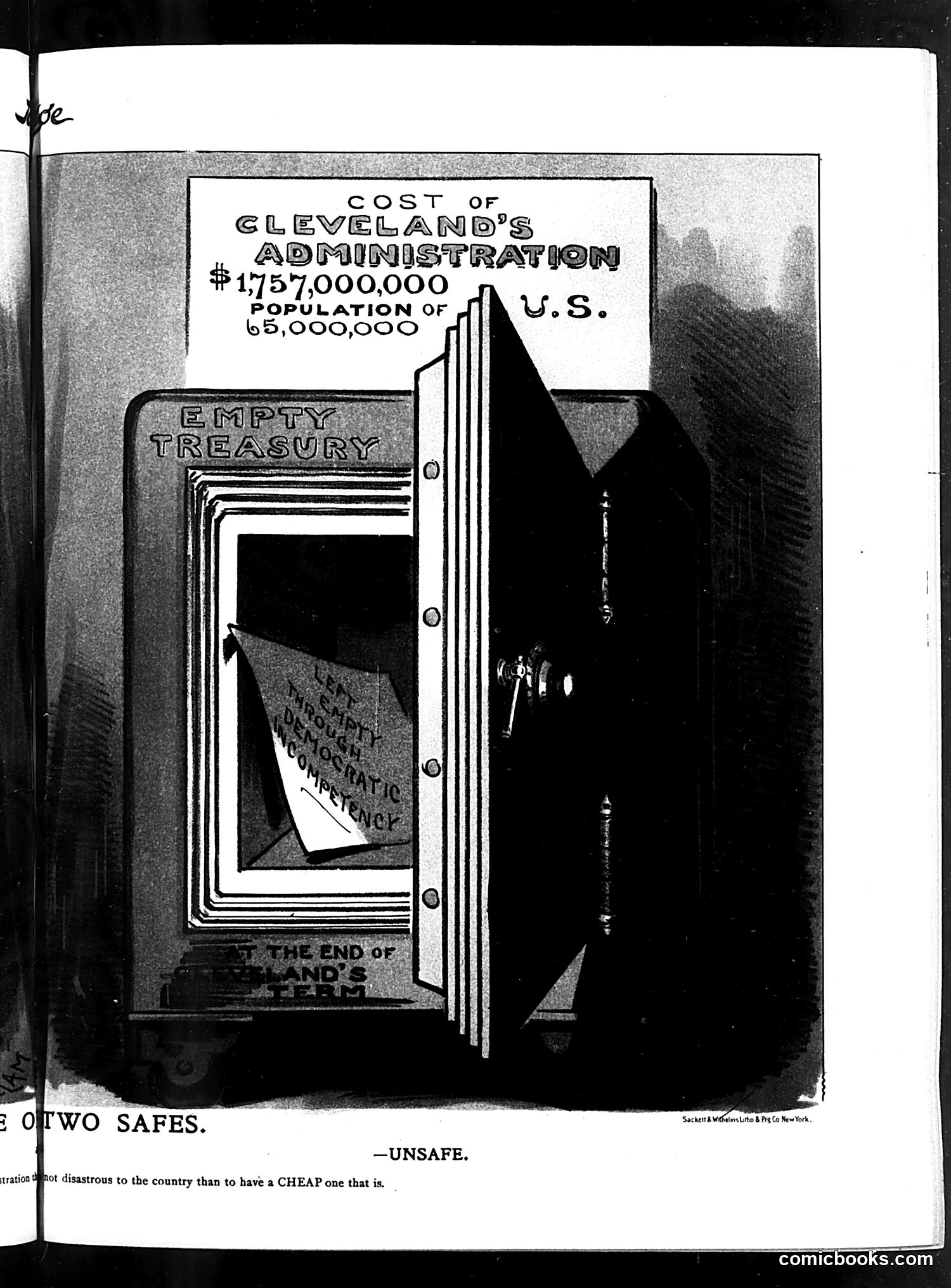
This satirical cartoon critiques President Cleveland's administration spending. It depicts an empty treasury safe labeled "EMPTY TREASURY" alongside a document listing "COST OF CLEVELAND'S ADMINISTRATION: $1,757,000,000" for a U.S. population of 65,000,000. The cartoon's message, emphasized by the caption "—UNSAFE," argues that Cleveland's massive administrative expenditures have depleted the federal treasury dangerously. The final text fragment suggests the satire's point: it's worse to have cheap, ineffective government than to waste vast sums. This reflects late 19th-century Republican criticism of Democratic President Grover Cleveland's fiscal management and spending policies. The visual metaphor of the empty safe makes the accusation of fiscal mismanagement immediately clear to contemporary readers.
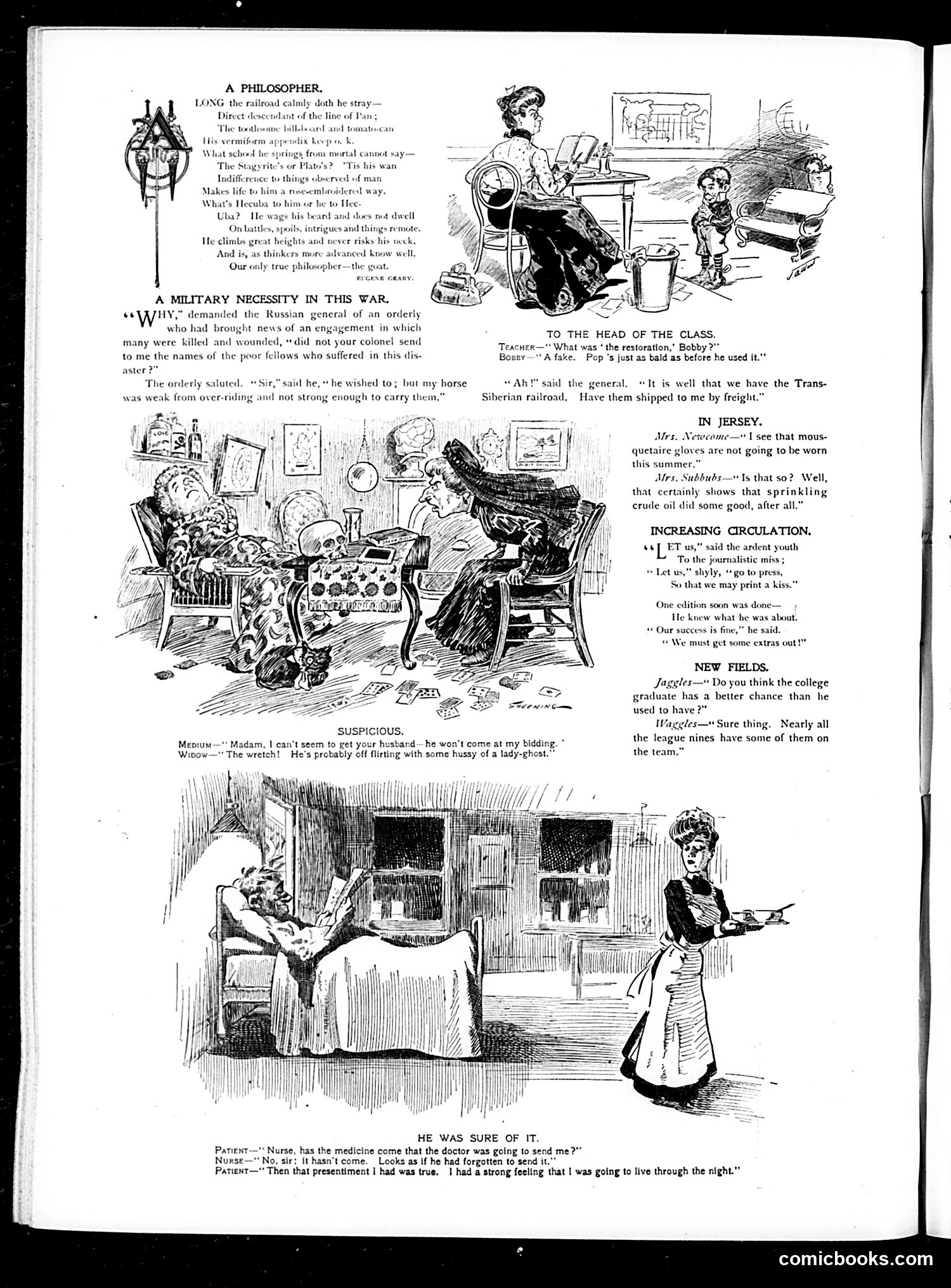
This page contains multiple satirical humor pieces typical of early 20th-century American satire: **"A Philosopher"** mocks a goat-herder's indifference to worldly affairs, playing on classical references (Pan, Plato, Stagyrite) to satirize rural ignorance. **"A Military Necessity in This War"** jokes about Russian military incompetence during what appears to be WWI—a colonel cannot deliver casualty reports because his horse is too weak, so the general suggests shipping bodies "by freight" via the Trans-Siberian Railroad. The satire ridicules both military disorganization and the absurdity of wartime logistics. **Minor pieces** include "To the Head of the Class" (hair restoration advertiser whose baldness returns), "In Jersey" (crude oil and fashion), "Increasing Circulation" (pun on printing/romance), and "New Fields" (college athletes in baseball). **"He Was Sure of It"** darkly jokes that a patient survives because his premonition of death proved wrong—ironic gallows humor about medical uncertainty. The overall tone reflects Judge's satirical approach to contemporary war, technology, social pretension, and human folly.
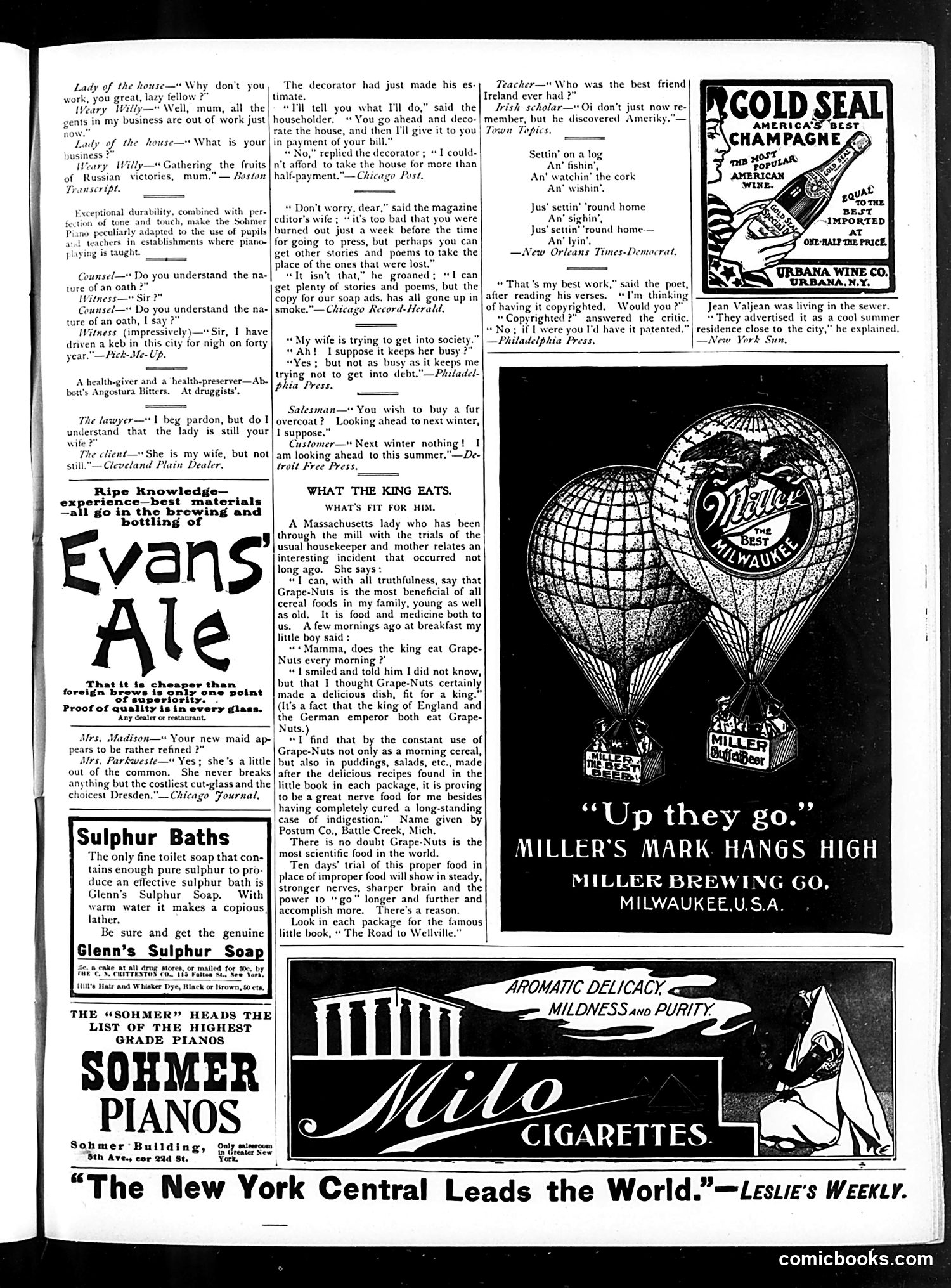
This page mixes satirical humor columns with period advertisements. The main cartoons/jokes address early 20th-century concerns: **"Weary Willy" joke**: A vagrant claims his profession is "gathering fruits of Russian victories"—satirizing the Russo-Japanese War (1904-05) by suggesting unemployment results from war disruptions. **Legal/Social humor**: Multiple short jokes mock lawyers, decorators, and nouveau-riche pretension (the maid who breaks only expensive items). **Magazine editor joke**: References a fire destroying copy, but the real tragedy is losing soap advertisement copy—satirizing how advertising revenue (not editorial content) drives magazines. **The bulk of the page** consists of vintage advertisements for Evans Ale, Sohmer Pianos, Glenn's Sulphur Soap, and Grape-Nuts cereal. The Grape-Nuts ad humorously claims both the King of England and German Emperor eat it—contemporary product-promotion hyperbole. The page is primarily **advertising-driven**, with satirical content serving as filler between paid notices.
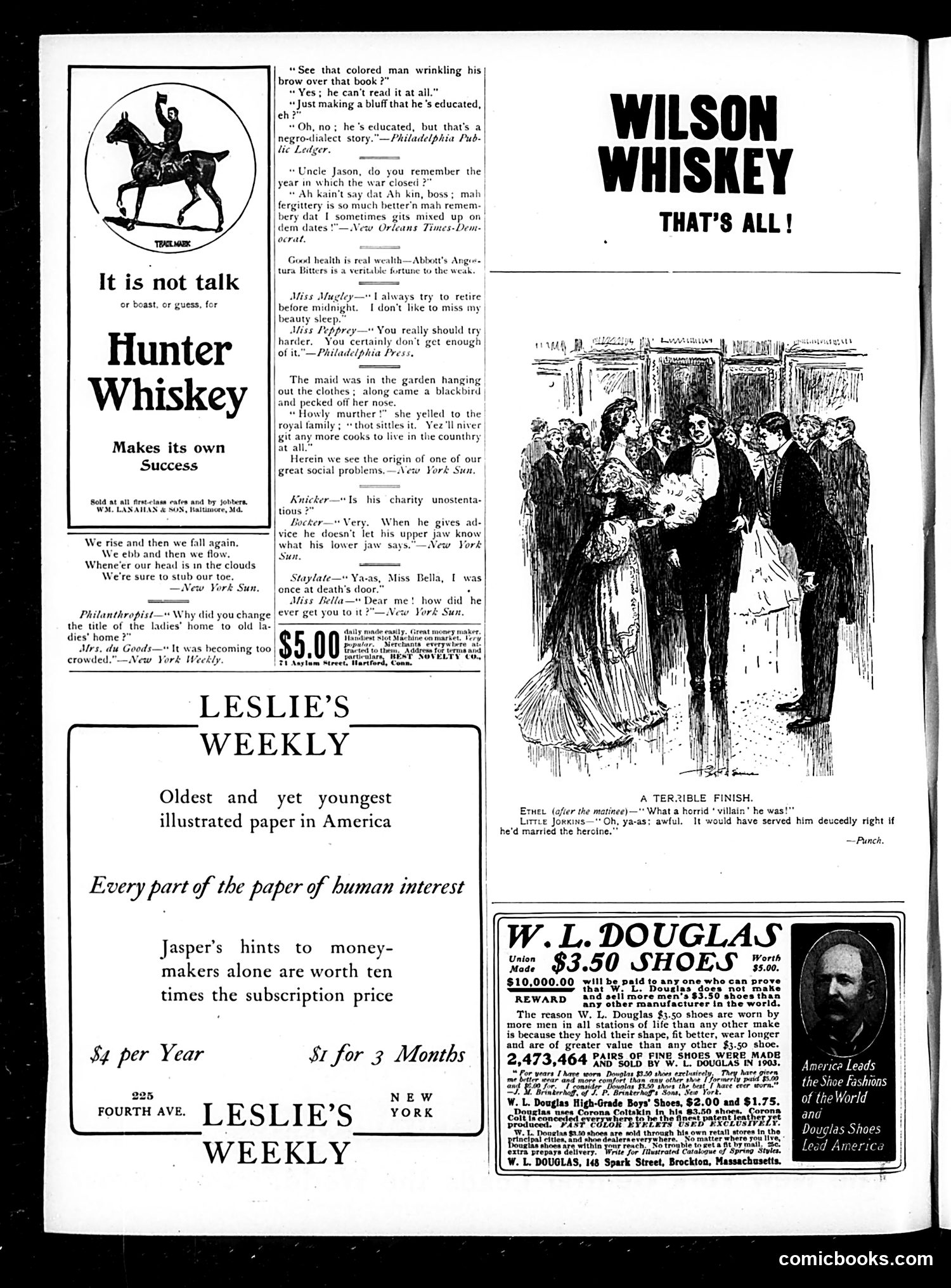
This page mixes short jokes with advertising. The humor relies heavily on **racial stereotypes** common to the era—particularly mocking African American dialect and education. One joke depicts a Black man pretending to read an educated text while actually reading a "negro-dialect story," suggesting Black people cannot genuinely be educated. Another uses exaggerated dialect ("kain't say," "mah fergittery") to mock an elderly Black man's memory. The other jokes target various social groups: servants, unmarried women obsessed with beauty sleep, Irish domestics, and wealthy men's hypocrisy about charity. The cartoons illustrate these jokes with period engravings. "A Terrible Finish" shows a theater-goer criticizing a villain—the joke being that marrying the heroine would be worse punishment than his actual fate. The page is primarily **advertising space** for Leslie's Weekly, Wilson Whiskey, W.L. Douglas Shoes, and Angostura Bitters, with the jokes serving as content filler typical of early 1900s magazines.
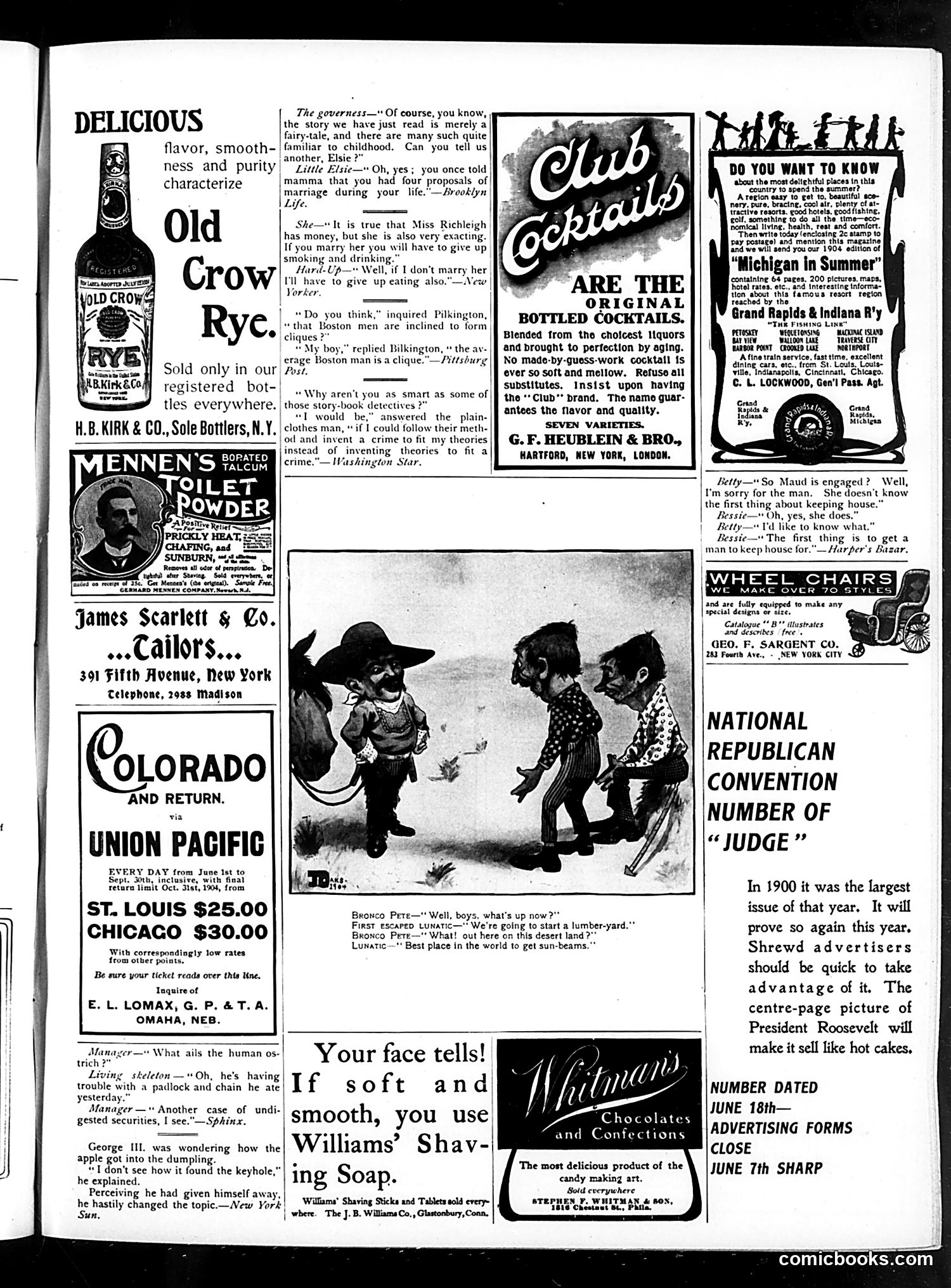
This is primarily an **advertising page** from Judge magazine with several short comic anecdotes interspersed. The main cartoon depicts **"Bronco Pete,"** a stereotypical frontier character, absurdly proposing to start a lumber-yard in a desert. The joke satirizes naive or foolish business schemes—the character plans to harvest "sun-beams" in a barren landscape, mocking both frontier optimism and impractical entrepreneurship. The page is dominated by **product advertisements** (Old Crow Rye whiskey, Williams' Shaving Soap, Whitman's Chocolates, Club cocktails) and travel promotions (Union Pacific railroad, Michigan tourism). The scattered **one-liner jokes** target stock characters: pretentious Bostonians, incompetent detectives who invent crimes to fit theories, and a woman claiming her engaged friend knows nothing about housekeeping except "how to get a man to keep house for" her—reflecting period gender stereotypes about women's domestic roles. The overall effect is typical Judge content: light satire mixed with advertising.
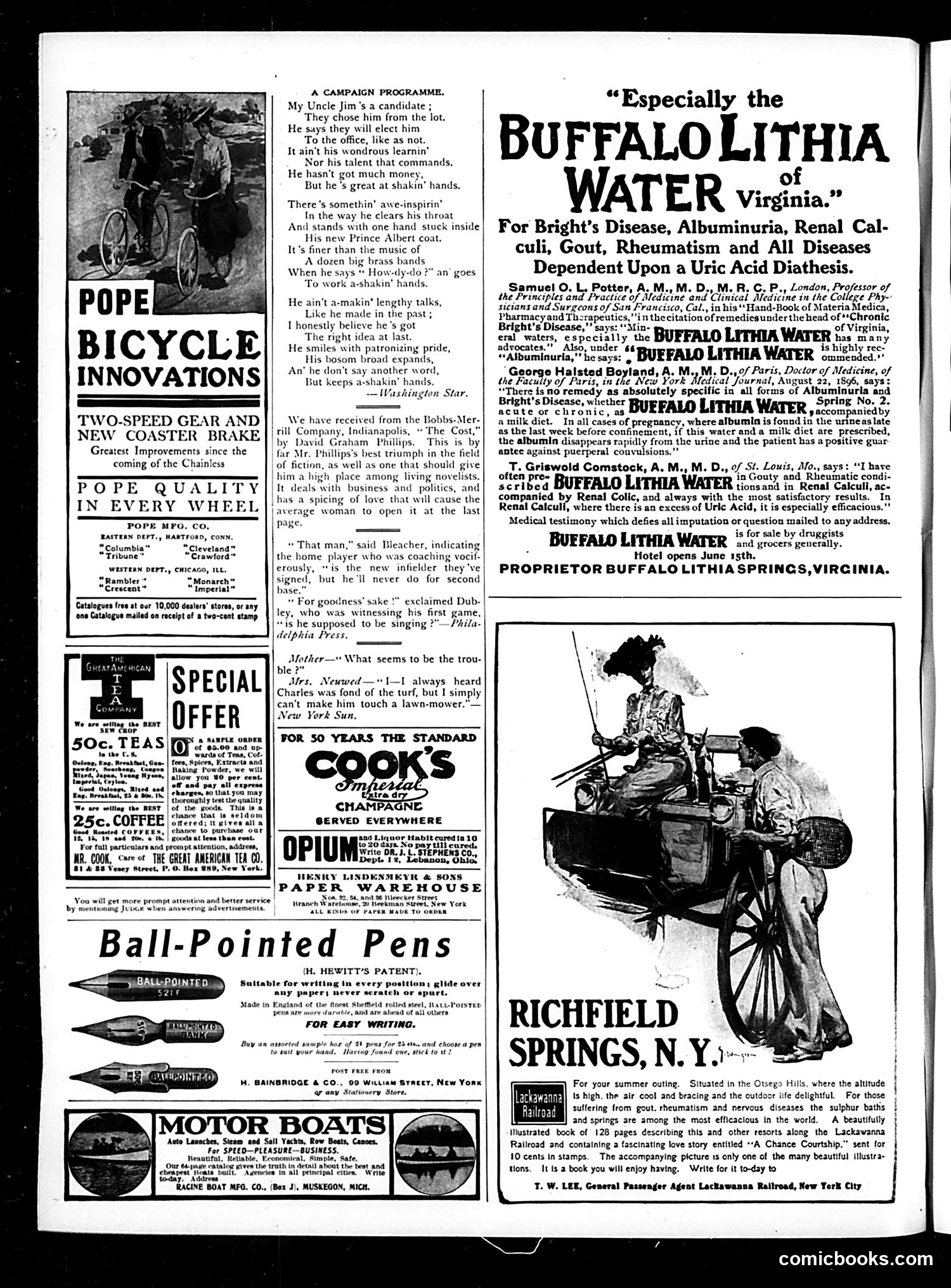
This page is primarily composed of period **advertisements** rather than political cartoons. The notable satirical content is **"A Campaign Programme,"** a poem from the *Washington Star* that mocks American electoral politics. It depicts "Uncle Jim," a mediocre political candidate chosen not for intelligence, education, or wealth, but solely for his ability to shake hands and project false charm. He avoids substantive speeches ("an' he don't say another word, / But keeps a-shakin' hands"). The satire criticizes how campaigns rely on glad-handing and empty charisma rather than merit or policy. The page also contains period **advertisements** for bicycles (Pope bicycles), office supplies, pharmaceuticals (Buffalo Lithia Water, a dubious cure-all for various ailments), champagne, and motorboats. The poem likely resonates with modern readers as a critique of **superficial politics and personality-driven candidates over substance**—a concern that remains relevant across eras.
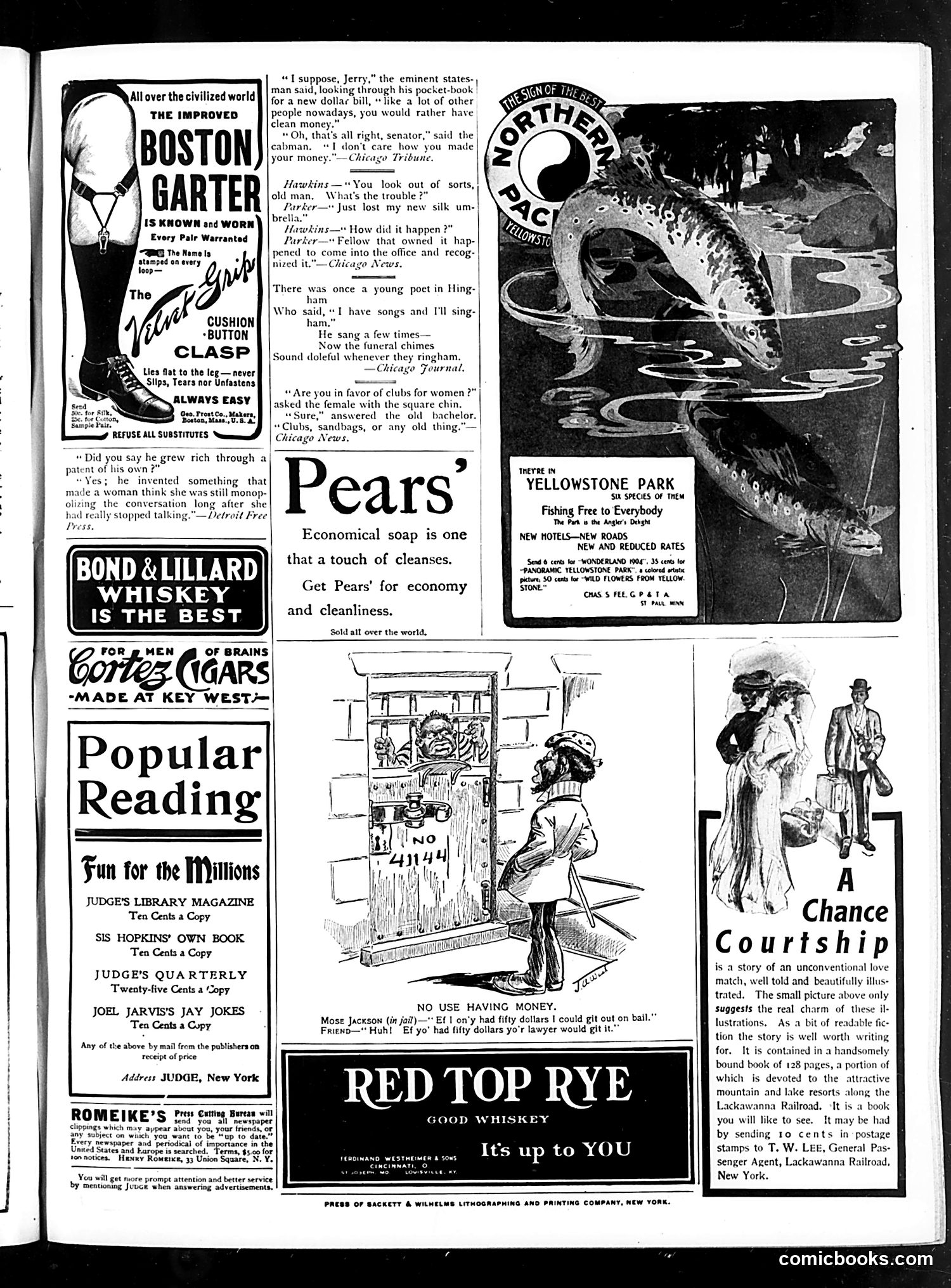
This page is primarily **advertisements and humorous short jokes** rather than political satire. The content includes: **Main Humor Pieces:** - Several brief jokes mocking social pretense: a politician seeking "clean money," a man losing an umbrella to its rightful owner, absurd answers to questions about women's clubs - A darkly comic jail scene: a prisoner notes his lawyer would steal fifty dollars if he had it—commenting on lawyer corruption **Advertisements:** Products like Boston garters, Pears' soap, Bond & Lillard whiskey, Cortez cigars, and Red Top Rye dominate the page. One ad for "A Chance Courtship" promotes a book about unconventional romance published by the Lackawanna Railroad. **Historical Context:** The jokes reflect turn-of-century anxieties: dishonest politicians, unreliable professionals (lawyers), and gender role debates. The satire is mild and domestic rather than politically pointed—typical of Judge's lighter content mixed with paid advertising.
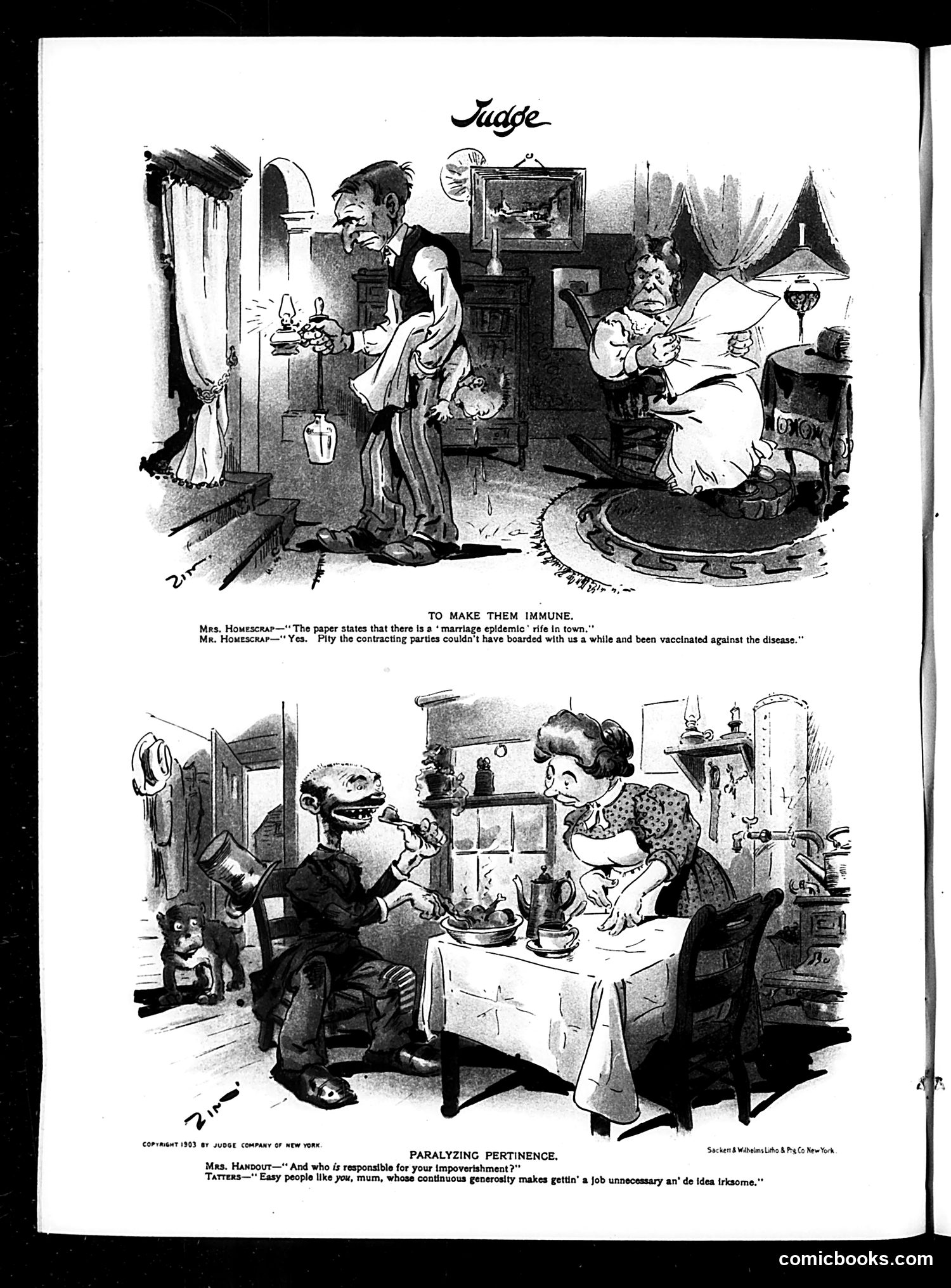
**Top cartoon, "To Make Them Immune":** A married couple observes a "marriage epidemic" in town. The husband suggests couples should stay with them as a "vaccination" against marriage itself—implying married life with the Homescrars is so unpleasant it would deter others from marrying. This is domestic satire mocking unhappy marriages. **Bottom cartoon, "Paralyzing Pertinence":** A well-dressed woman asks a vagrant why he's impoverished. He blames her class—people like her give handouts ("continuous generosity") that eliminate incentive to work and make employment seem tiresome. This reflects contemporary debates about charity enabling idleness, likely targeting wealthy philanthropists' ineffective or counterproductive generosity toward the poor. Both cartoons use ironic dialogue to critique their subjects' self-awareness (or lack thereof).