
A complete issue · 20 pages · 1904
Judge — May 7, 1904
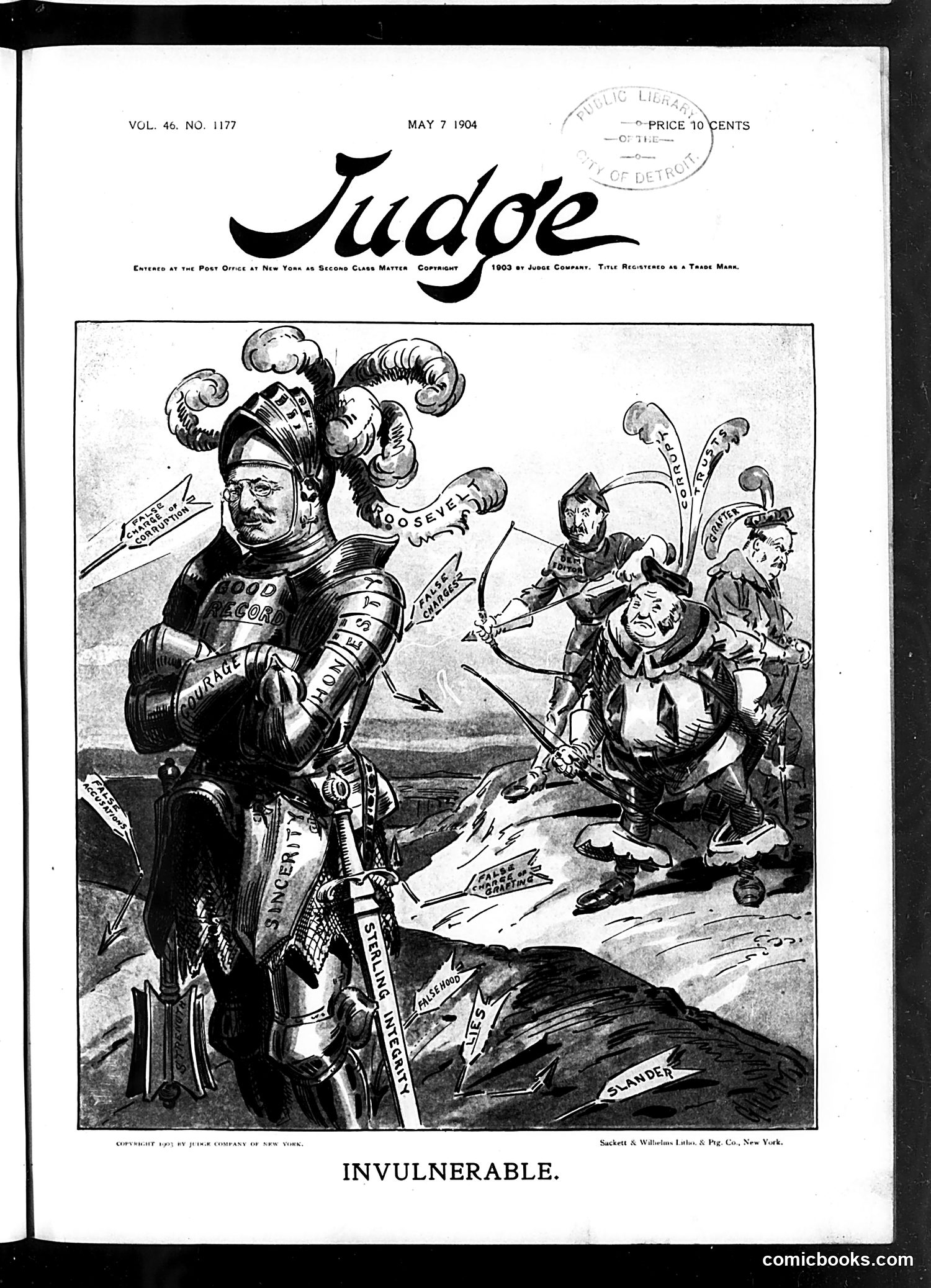
This political cartoon depicts Theodore Roosevelt as an armored knight, apparently impervious to attacks. The figure on the left, labeled with various protective items ("Tariff," "Strategy," "Congress"), represents Roosevelt's political defenses and power base. On the right, smaller antagonistic figures wield weapons against him, but cannot penetrate his armor. These appear to represent his political opponents or critics—likely including Democratic adversaries and possibly Republican dissidents challenging his presidency. The title "Invulnerable" sarcastically suggests Roosevelt's perceived political dominance in 1904, during his first elected term. The cartoon celebrates his seemingly unassailable position through legislative support, tariff policies, and congressional backing, making him immune to political attack.
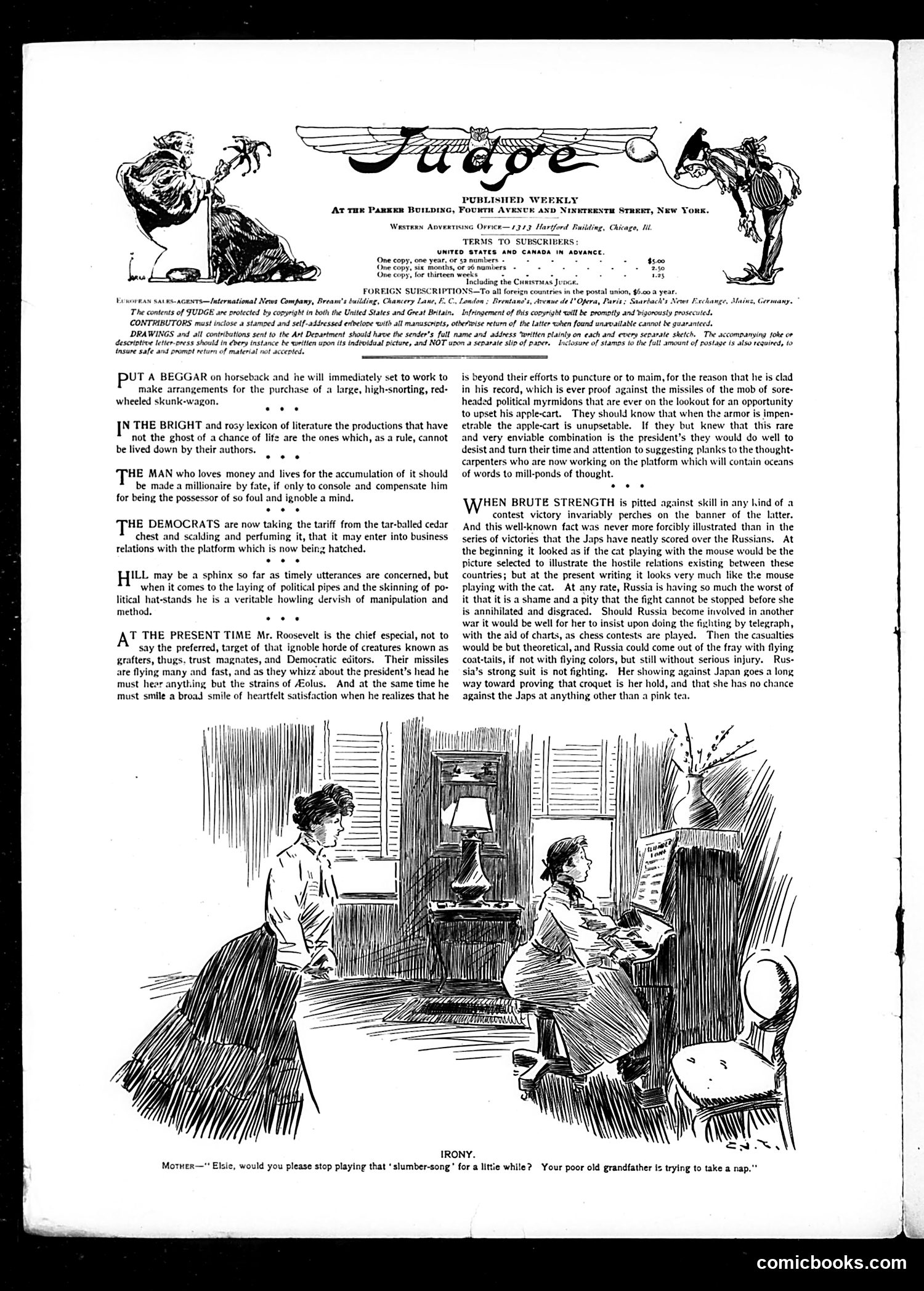
The main cartoon titled "IRONY" depicts a domestic scene where a mother scolds her daughter Elsie for playing "slumber-song," asking her to stop the noise while her elderly grandmother tries to nap nearby. The satire's point is unclear from the image alone—the humor likely relies on context about what "slumber-song" was (possibly a contemporary popular song or activity) that would have been obvious to 1904 readers but isn't to modern audiences. The page also contains several brief political editorials above, including commentary on Democrats, tariffs, and Roosevelt, though these lack accompanying illustrations and require historical knowledge to parse fully. The publication details indicate this is *Judge* magazine from New York, published weekly at the Parker Building.
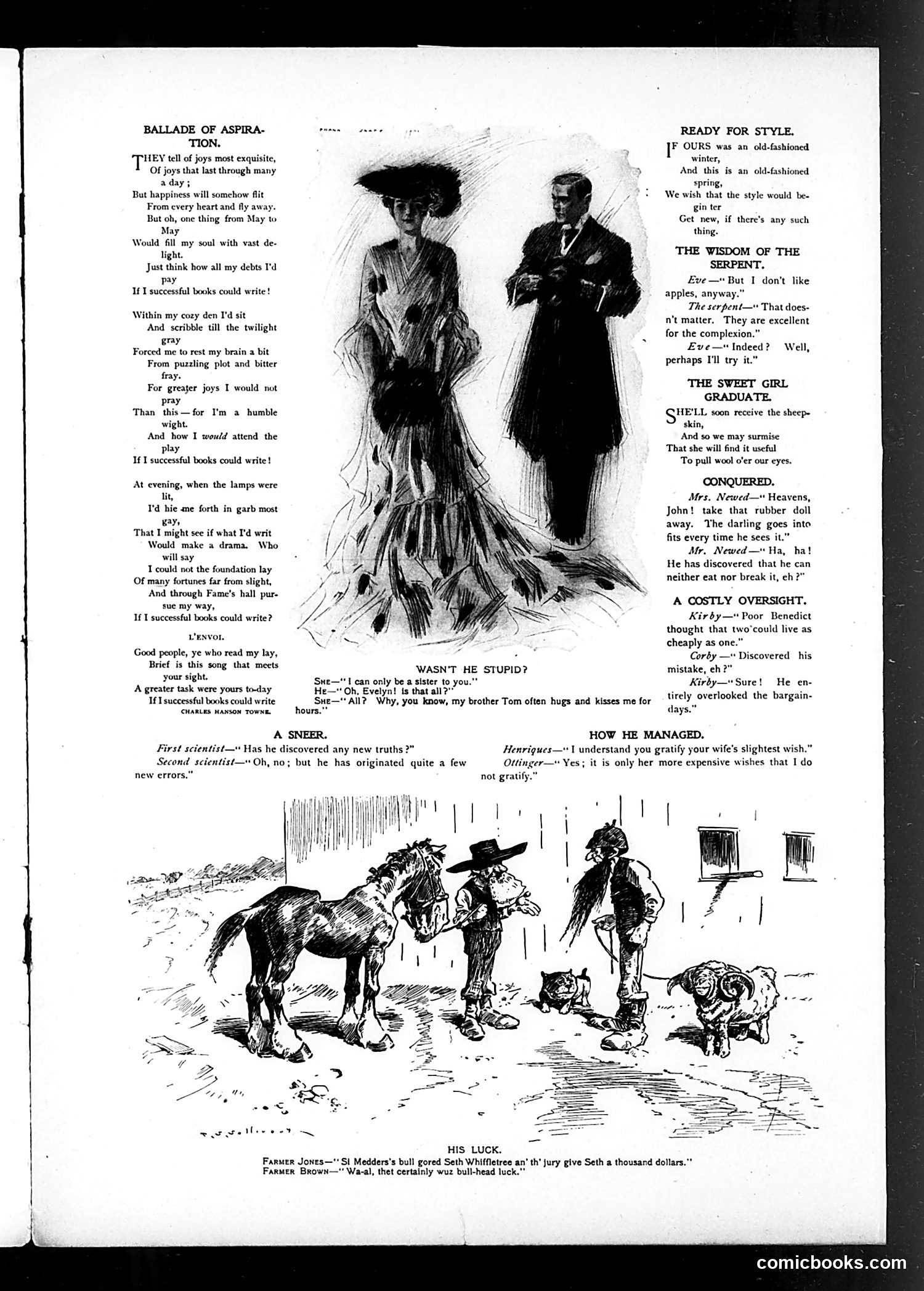
This page contains several short humorous pieces and illustrations typical of Judge's satirical format. The central sketch titled "WASN'T HE STUPID?" depicts two figures in conversation, with dialogue suggesting a domestic or romantic scenario involving a brother named Tom. Below, "HIS LUCK" shows a man in heavy rain with animals, accompanied by dialogue between "Farmer Jones" and "Parmer Brown" discussing a bull goring someone named Seth Whitfield and a subsequent lawsuit for damages. The remaining content consists of brief comic dialogues on various topics ("The Wisdom of the Serpent," "The Sweet Girl Graduate," "Conquered," etc.) typical of Judge's format—quick jabs at social situations, fashion, and human behavior rather than specific political targets. The illustrations use pen-and-ink sketching characteristic of late 19th/early 20th-century American humor magazines.
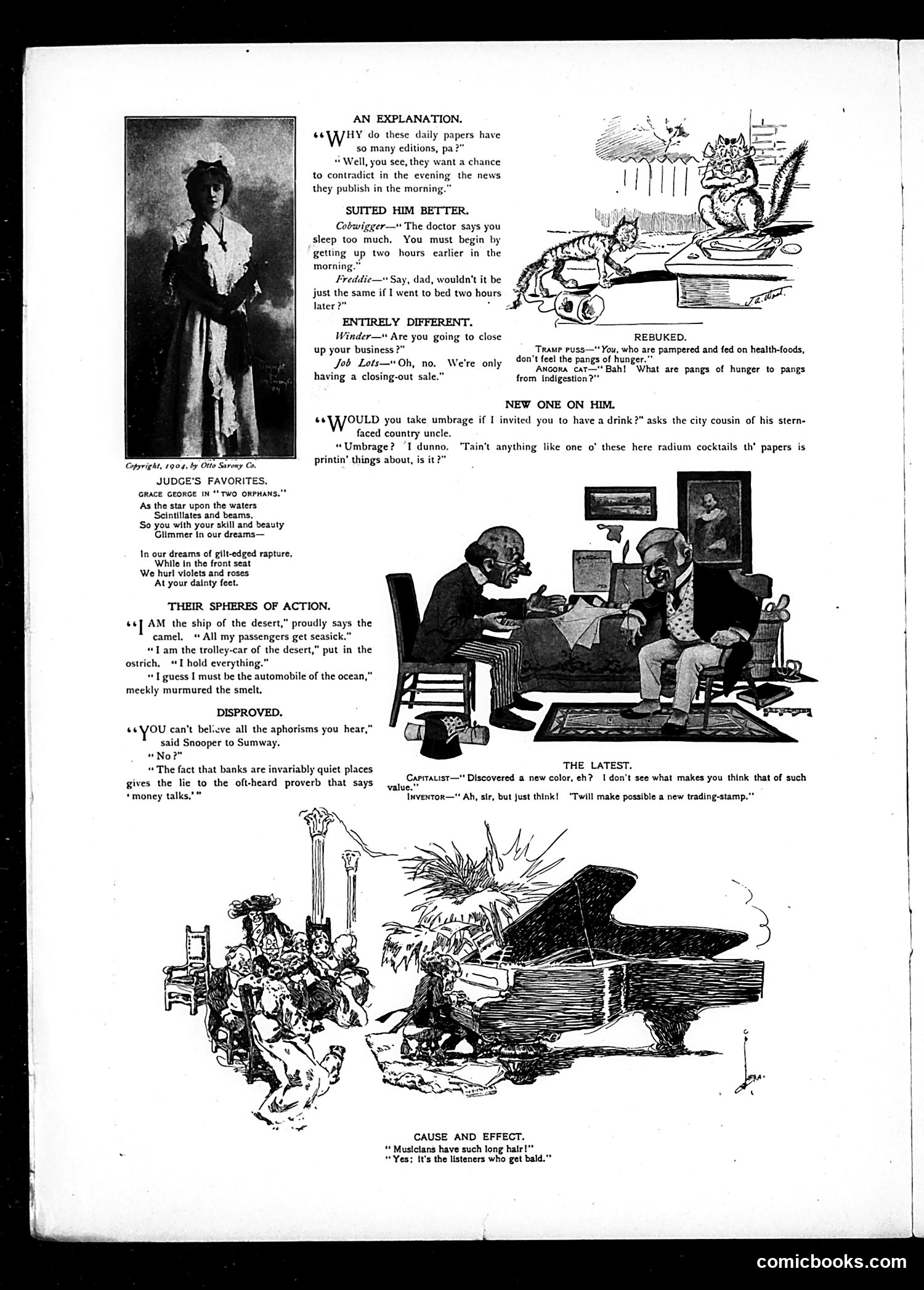
This page contains several brief humorous sketches typical of Judge's satirical format. The humor relies on wordplay and social observation rather than political commentary: **"Suited Him Better"** jokes about a doctor's health advice being inconvenient. **"Entirely Different"** uses a pun about "closing out" a business. **"Judge's Favorites"** appears to be a poem praising George M. Cohan, likely the famous entertainer/playwright of that era. **"Their Spheres of Action"** satirizes boastful desert and ocean animals claiming superiority. **"The Latest"** mocks a capitalist pitching a "new color" invention to an inventor, suggesting absurd business schemes. **"Cause and Effect"** makes a crude joke about musicians' long hair. The page primarily offers domestic humor and social satire rather than political commentary. The cartoons target everyday pretension and foolish business schemes of the period.
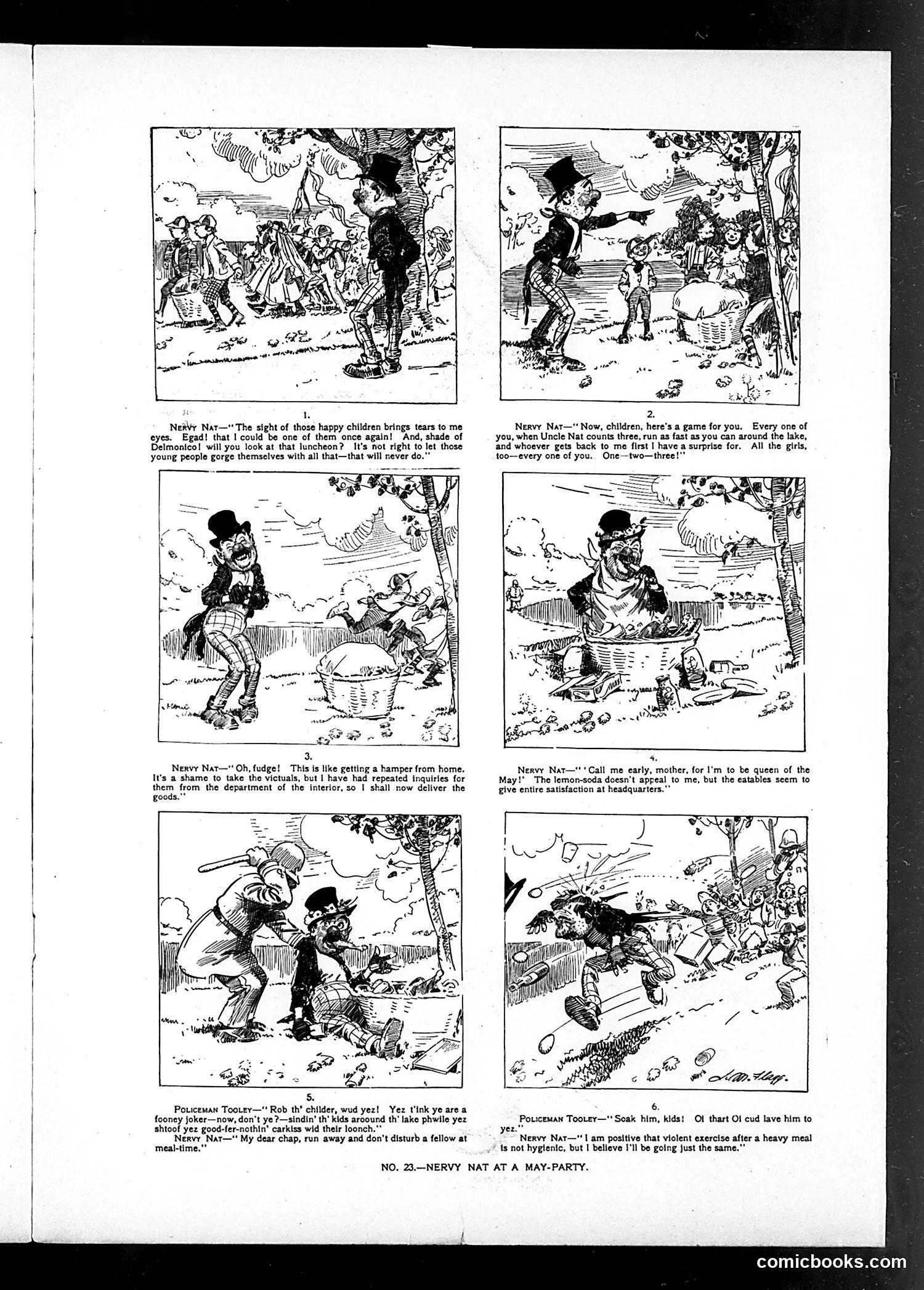
This comic strip satirizes a con artist named "Nervy Nat" who infiltrates a children's outdoor party. The humor operates on multiple levels: **The scheme:** Nat poses as a friendly uncle to gain the children's trust and access to their elaborate lunch. He then tricks them into running away by promising a "surprise," allowing him to steal their food. **The satire:** When a policeman confronts him, Nat claims the food was requested by "the department of the interior"—a bureaucratic excuse implying government corruption or petty theft rationalized through official channels. This mocks how officials might justify misappropriating public or private goods. **The payoff:** The children return and physically beat Nat in retribution, which he philosophically accepts as better than "violent exercise after a heavy meal." The strip exemplifies Judge magazine's class-conscious humor: mocking both the scheming lower-class hustler and the incompetent authorities unable to prevent theft, while celebrating working-class children's street justice.
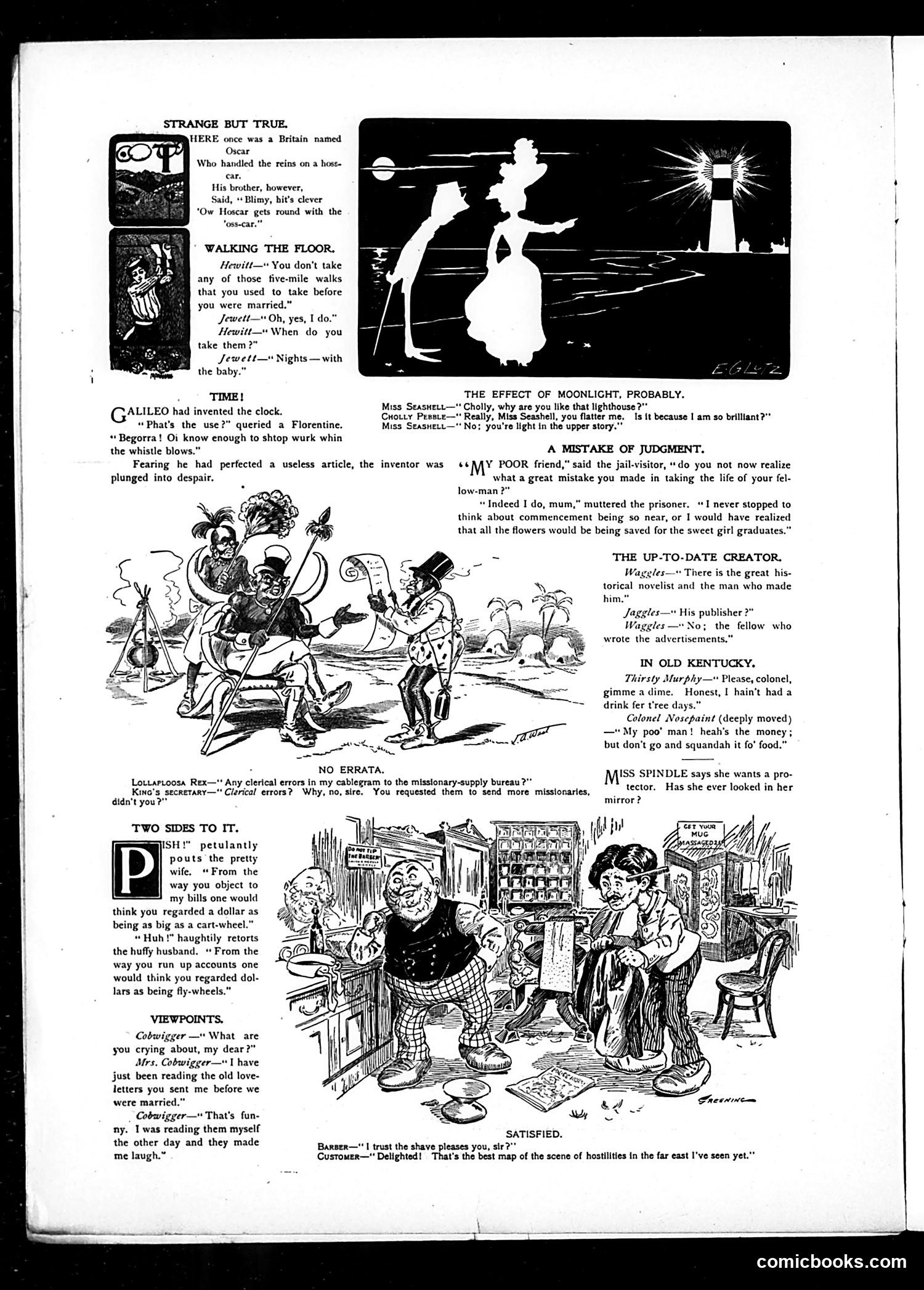
This page contains multiple short satirical pieces typical of early 20th-century American humor magazines: **"Two Sides to It"** depicts a marital argument where spouses trade accusations about financial excess—he calls her spending reckless; she calls his objections hypocritical. It's straightforward domestic comedy about money disputes. **"Viewpoints"** presents a husband finding his own old love letters amusing rather than romantic, satirizing how relationships change after marriage. **"Walking the Floor"** jokes that a man still takes five-mile walks—but now at night with a crying baby, inverting expectations about married life reducing physical activity. Other brief items mock incompetence (a barber's shaving technique leaves marks resembling a war map) and include puns on names like "Hoscar" and "Oscar." The satire throughout is gentle, domestic, and class-conscious—targeting middle-class anxieties about marriage, money, and modern life. No specific political figures or events appear identifiable.
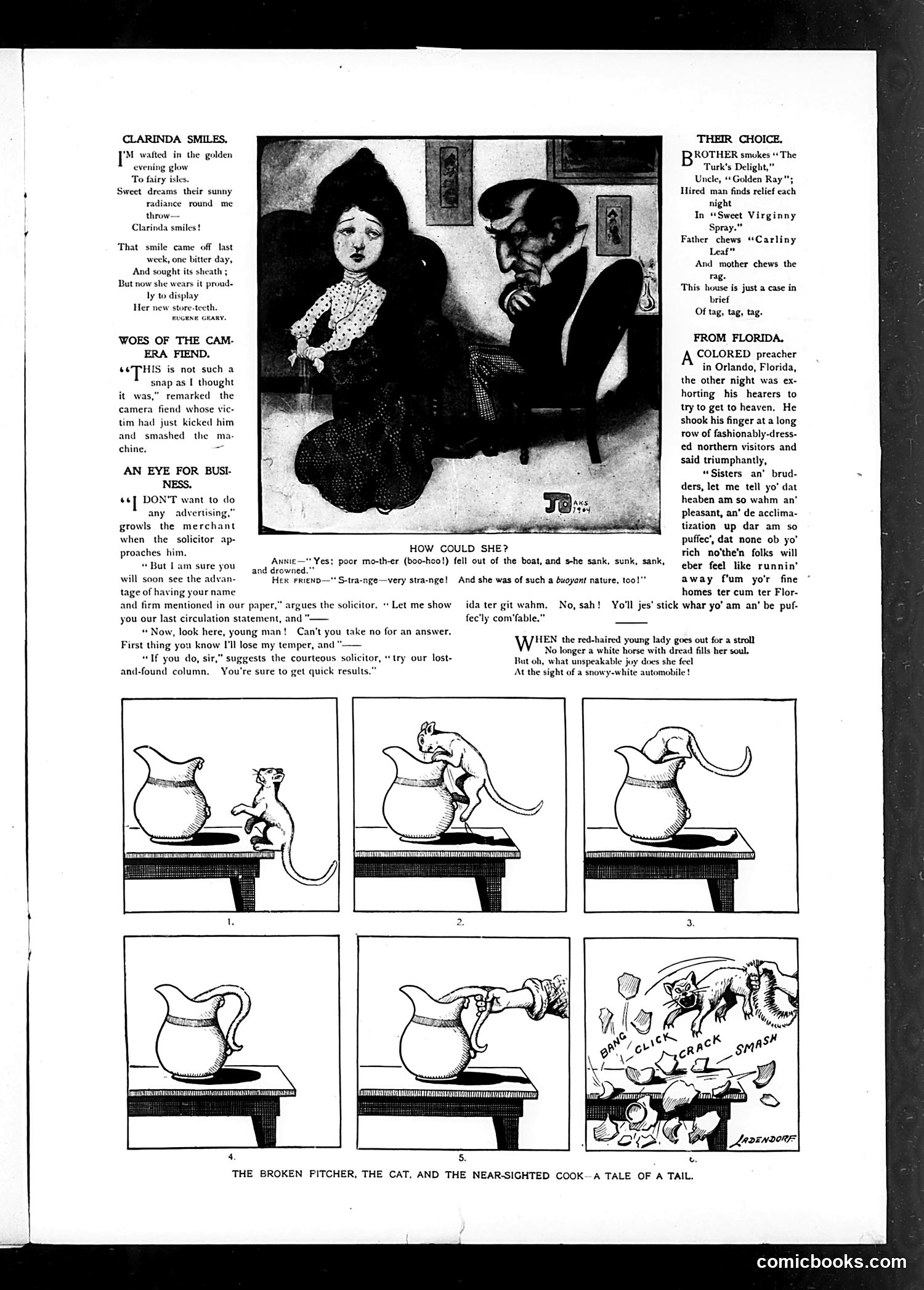
This page contains several brief humor pieces typical of early 20th-century American satirical magazines: **"Clarinda Smiles"** mocks a woman's new false teeth—suggesting vanity and artificiality. **"Woes of the Camera Fiend"** satirizes early photography enthusiasts whose intrusive picture-taking leads to physical confrontation. **"An Eye for Business"** depicts a solicitor's persistence despite rejection, illustrating aggressive sales tactics of the era. **"How Could She?"** presents a deadpan domestic scene where a woman drowns, treated as mundane gossip. **"From Florida"** features dialect humor typical of the period: a Black preacher uses exaggerated speech patterns to convince Northern visitors that Florida's warm climate makes heaven less appealing—playing on racial and regional stereotypes common in contemporary American humor. **The six-panel bottom cartoon** appears to be a visual gag about a broken pitcher, cat, and cook—likely depicting slapstick consequences. The content reflects period attitudes toward class, race, and gender through comedy.
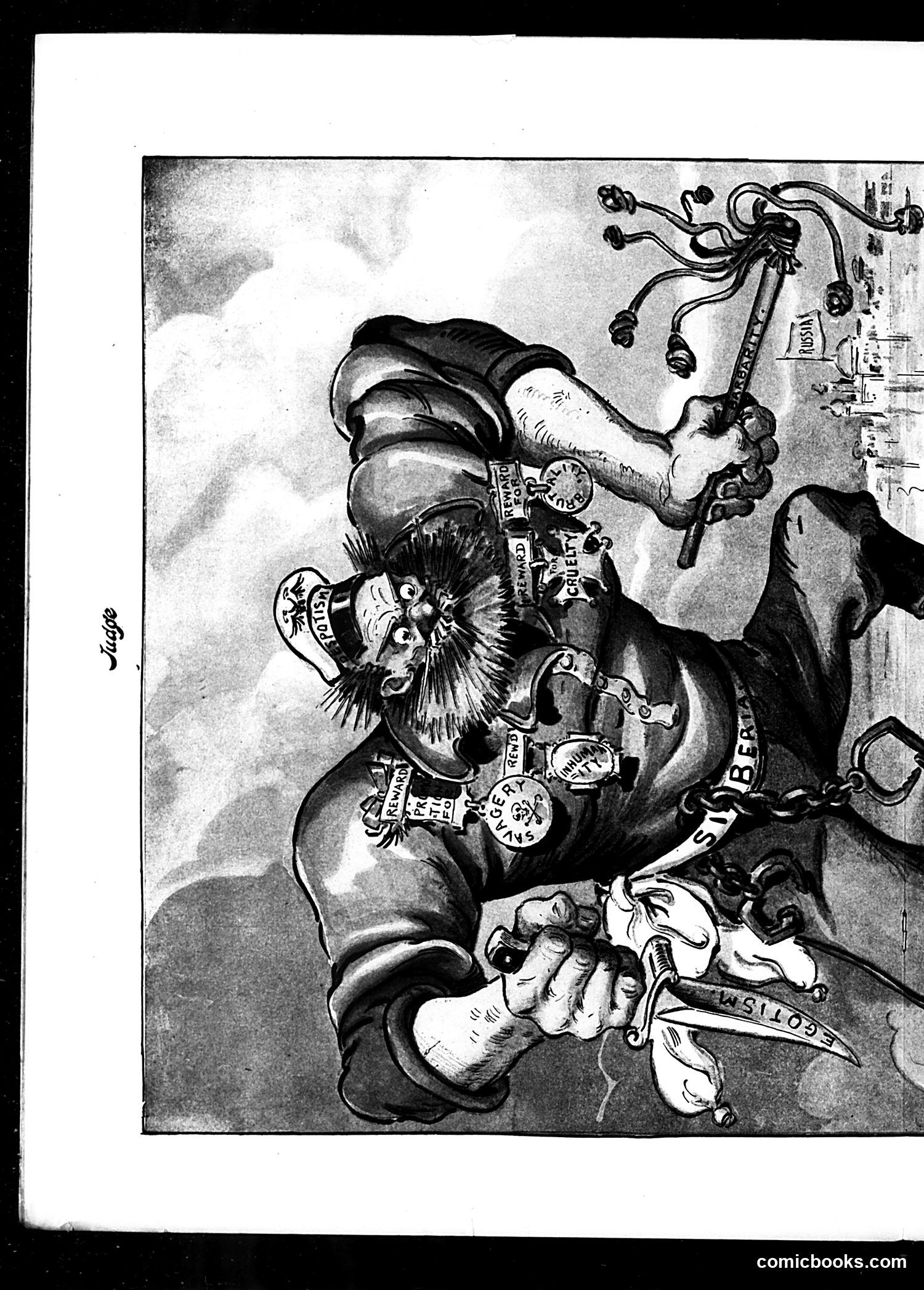
This appears to be a satirical illustration from *Judge* magazine featuring a caricatured figure depicted as a lion or beast-like creature wearing elaborate clothing and multiple ceremonial medals or decorations across its chest. The figure holds what appears to be a sword or weapon and is shown in a theatrical, aggressive pose. The caricature style—with exaggerated facial features and animal characteristics—was typical of late 19th/early 20th-century political satire. The ornate military regalia suggests the target is a military leader or autocrat being mocked for vanity or imperialism. However, without visible text identifying the specific figure or historical context, I cannot definitively say who this depicts or what particular event or policy the satire addresses.
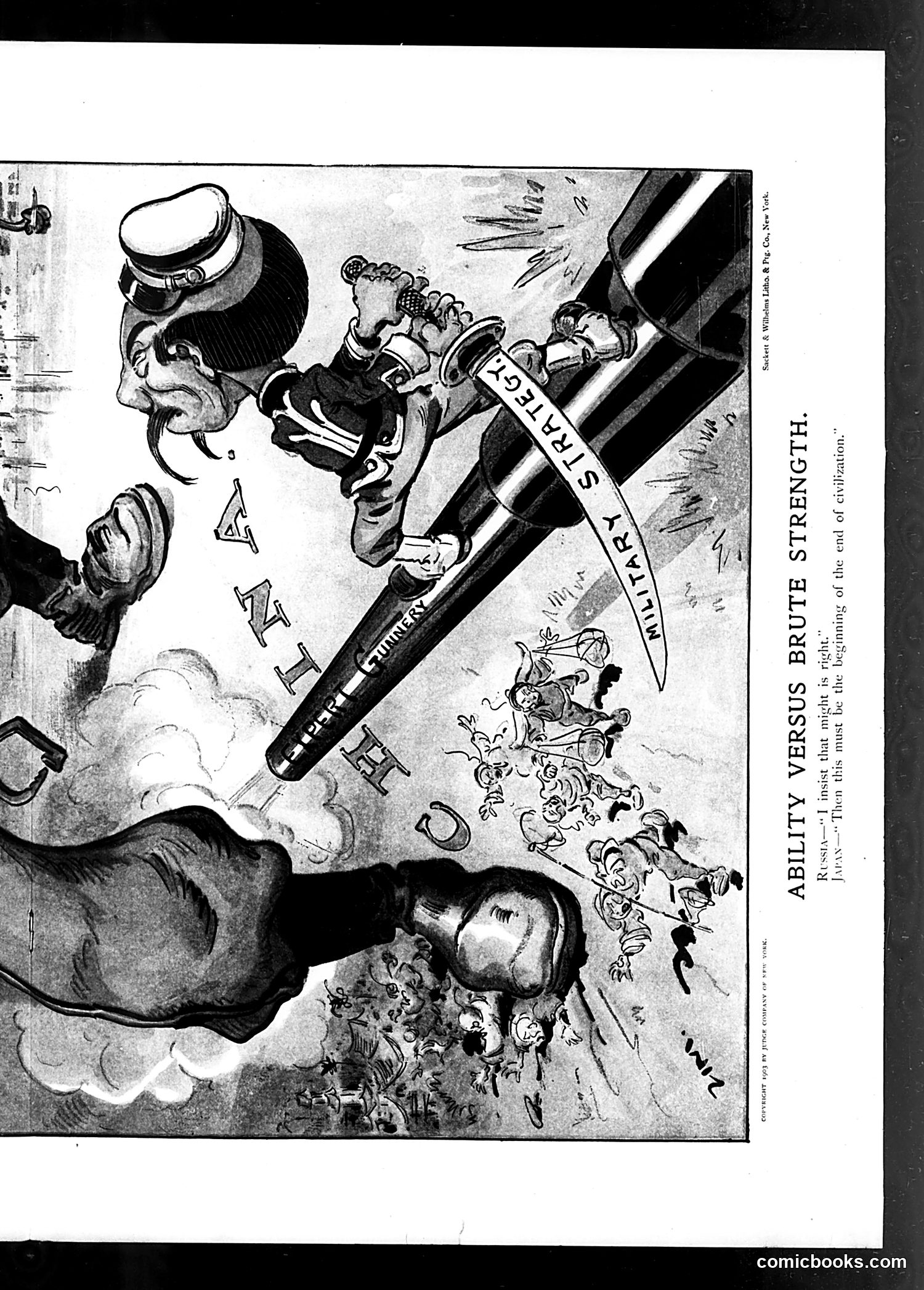
This political cartoon depicts a confrontation between two figures: a caricatured man with exaggerated features on the left (appearing menacing or brutish) and a figure wielding what appears to be a large syringe or injection device labeled "STAR LIGHT" pointing downward at a group of small figures below. The title suggests a clash between "ability" (represented by the syringe-wielder using skill/intelligence) and "brute strength" (the threatening figure on the left). The small figures at the bottom appear to be fleeing or scattering. Without the publication date visible, the specific political or social conflict referenced remains unclear, though the imagery suggests commentary on how intelligence or technological means might overcome raw force or intimidation in some contemporary dispute.
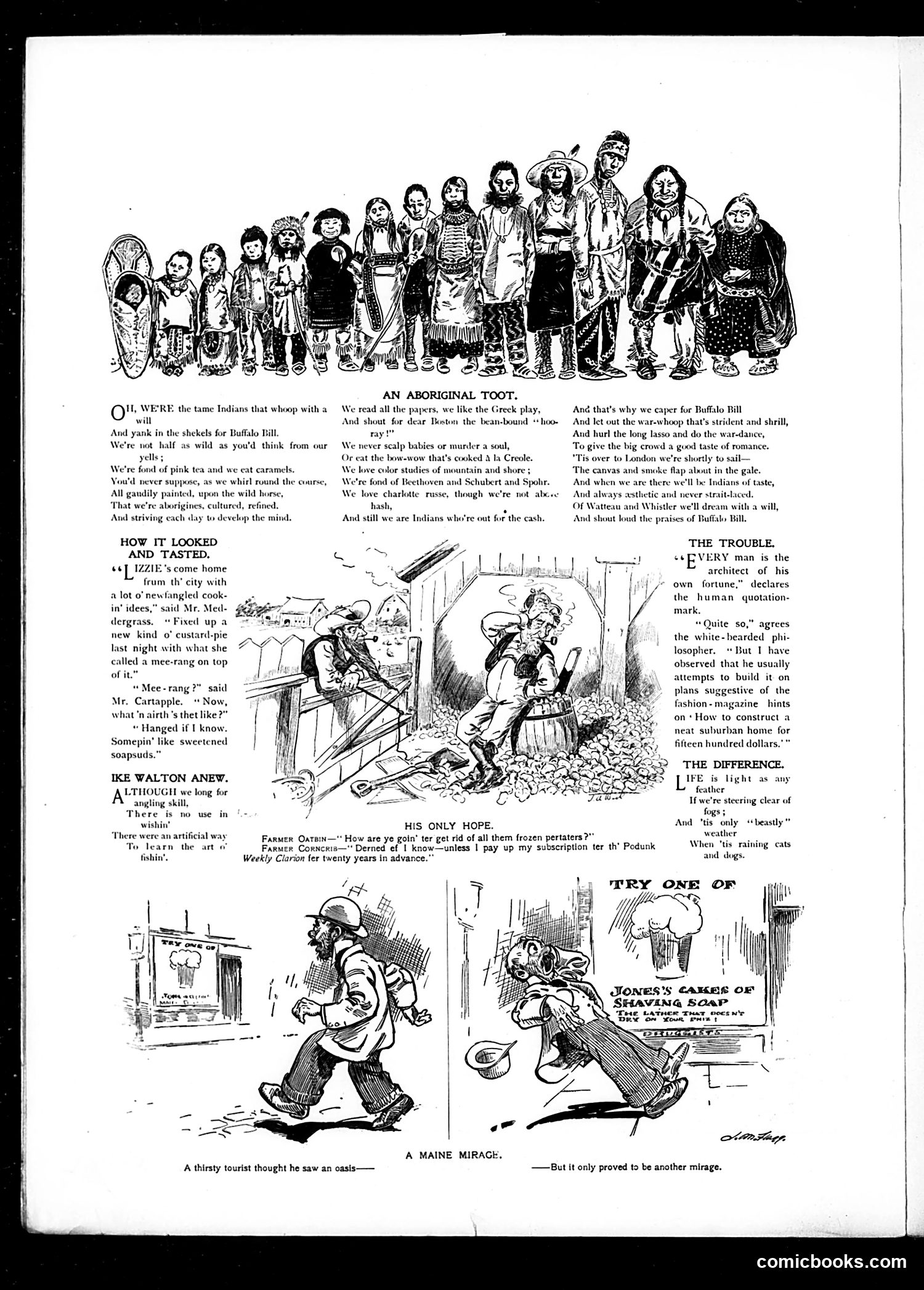
This Judge magazine page satirizes Native Americans touring with Buffalo Bill's Wild West shows. The main poem mocks the contradiction between performers' "civilized" pretensions (they read Greek plays, enjoy Beethoven, appreciate art) and their commercial purpose: entertaining audiences with stereotypical "wild Indian" performances. The satire cuts both ways—criticizing both Native performers for capitulating to commercialism and white audiences for demanding degrading spectacles. The surrounding cartoons are unrelated humor: a domestic joke about a new "meringue" pie, a fishing anecdote, and rural Maine jokes about frozen potatoes and subscription debts. The final cartoon shows a mirage joke typical of period magazine filler. The page reflects late-19th/early-20th-century attitudes toward Native Americans as performers and curiosities, treating their participation in Wild West shows as inherently absurd.
This page is primarily **advertising and humor columns**, not political cartoons. The content consists of: **Humor Pieces**: Short jokes from various newspapers about domestic life, automobiles, and social situations—typical of early 20th-century Judge magazine's format. These poke fun at marriage dynamics, class pretensions, and modern technology (automobiles). **Advertisements**: Multiple ads for consumer products—Parker's Tar Soap, Sohmer Pianos, Postum (coffee substitute), Evans Ale, Diamonds on Credit, and Prudential Insurance—representing typical commercial appeals of the era. **No Political Content**: There are no identifiable political figures or satire of current events visible. The page reflects period concerns about health (baldness, coffee's effects on digestion) and changing technology. The Postum ad notably uses testimonials claiming coffee causes medical problems, reflecting early 20th-century anxious attitudes toward caffeine and food purity.
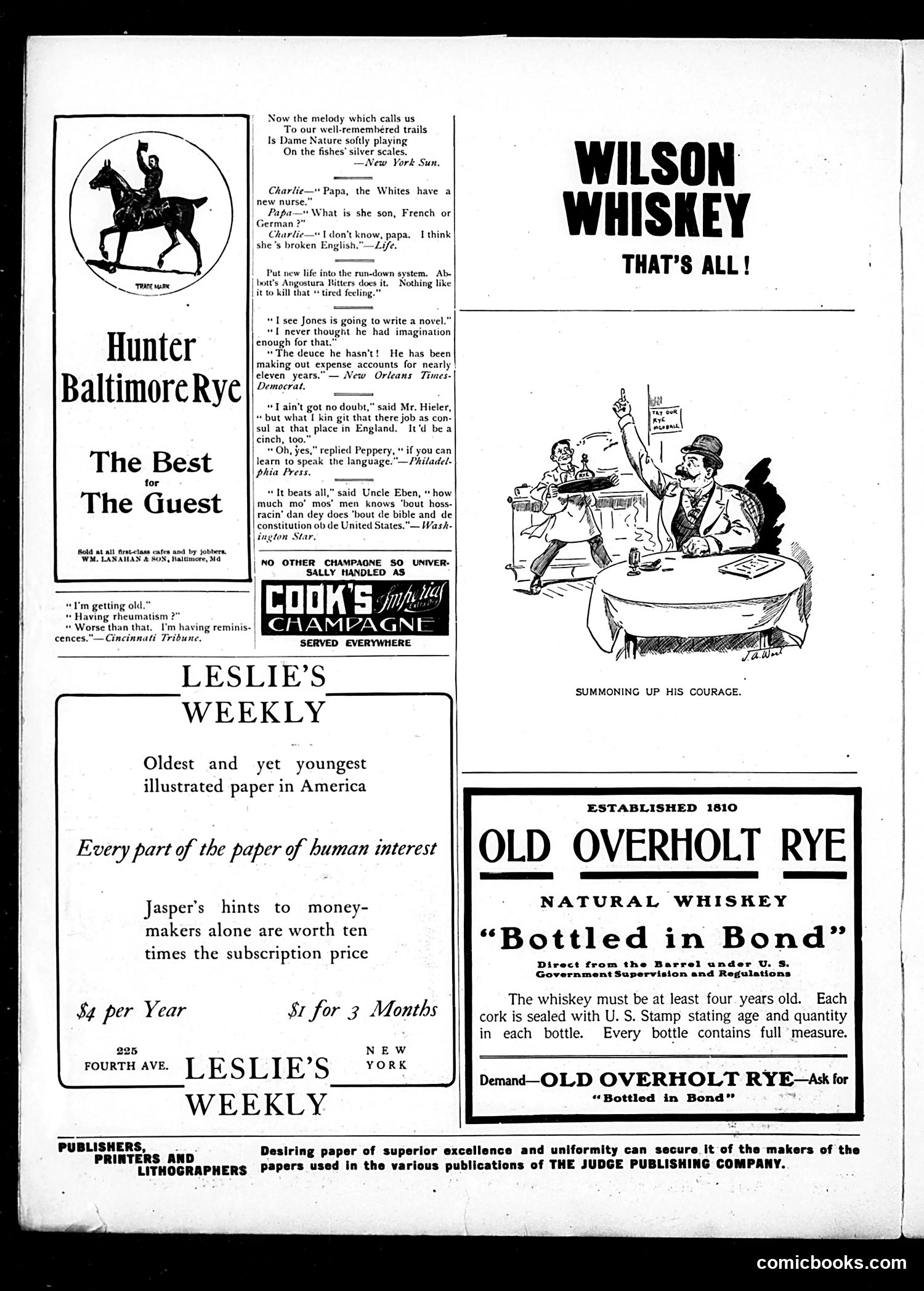
This page is primarily **advertising** with brief satirical content interspersed. The main cartoon shows a man "summoning up his courage" at a dining table, likely preparing to propose or deliver bad news—a common Judge visual joke template. The text snippets are short satirical quips on contemporary themes: - A joke about a French nurse's broken English - A comment on novelist Jones fabricating expense accounts (satirizing dishonesty in bureaucracy) - A man confident he can become a British consul despite not speaking English (mocking diplomatic incompetence) - Uncle Eben's observation that Americans know more about horse racing than the Constitution (social commentary on misplaced priorities) The page's primary purpose is advertising: **Hunter Baltimore Rye**, **Cook's Champagne**, **Old Overholt Rye** whiskey, **Wilson Whiskey**, and **Leslie's Weekly** magazine. The ads emphasize quality and government regulation (particularly for the whiskeys, which were "bottled in bond" under U.S. supervision—assuring purity to concerned consumers).
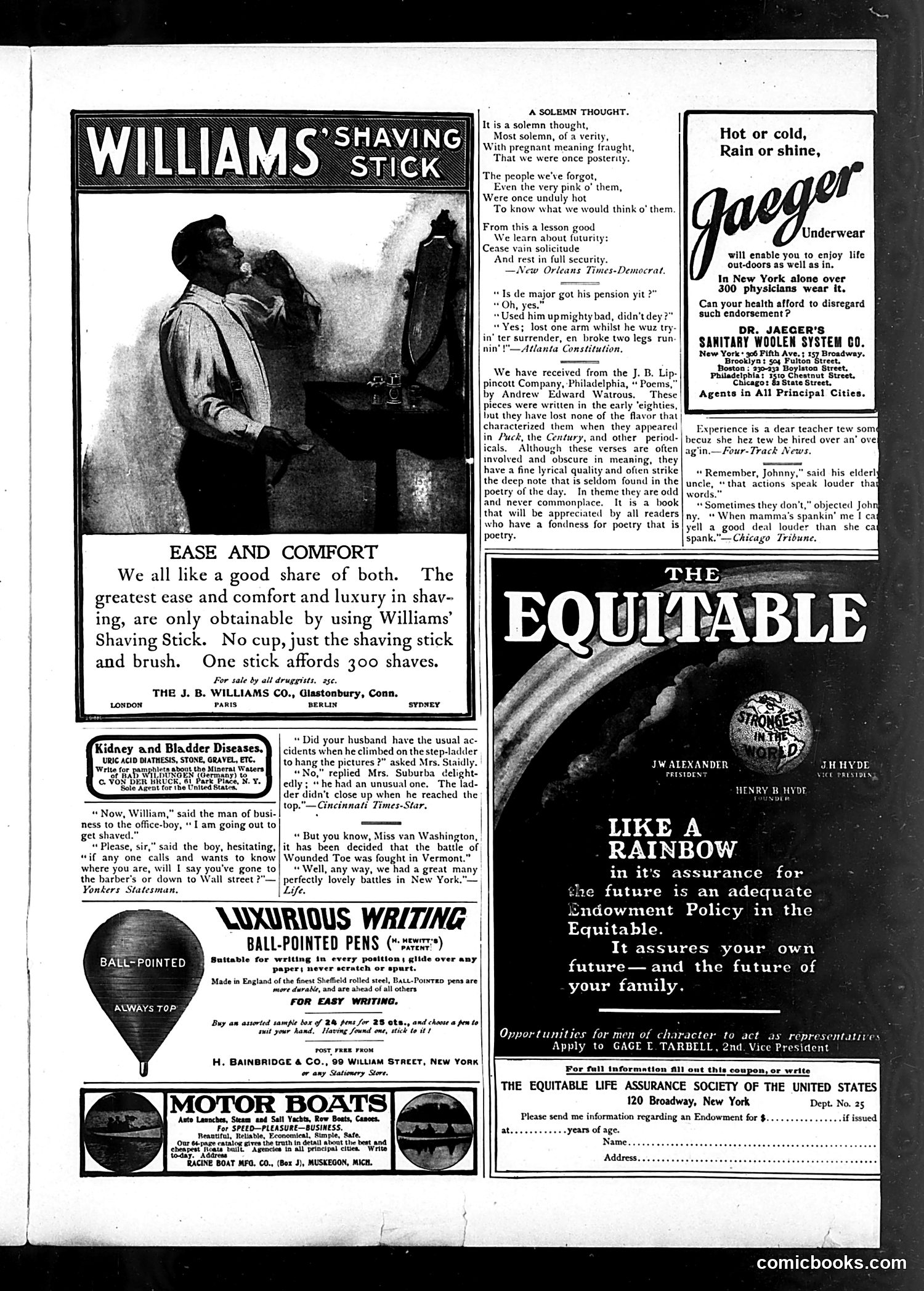
This page is primarily **advertising**, not political satire. It contains multiple product advertisements interspersed with brief humorous anecdotes typical of Judge magazine's filler content. The advertisements include Williams' Shaving Stick, Jaeger Underwear, ball-pointed pens, motor boats, and medical treatments. The small jokes scattered throughout are generic domestic humor—a husband climbing a ladder, office-boy banter, and rural dialect jokes (the "major" and "de major" jokes reference post-Civil War pensions). The only potentially satirical content is a brief exchange about "the battle of Wounded Toe" being fought in Vermont versus New York, which appears to mock historical revisionism or regional boasting, though the reference is too vague to identify specifically. Otherwise, the page reflects early 20th-century advertising and light humor with no identifiable political figures or sustained satirical commentary worth explaining to modern readers.
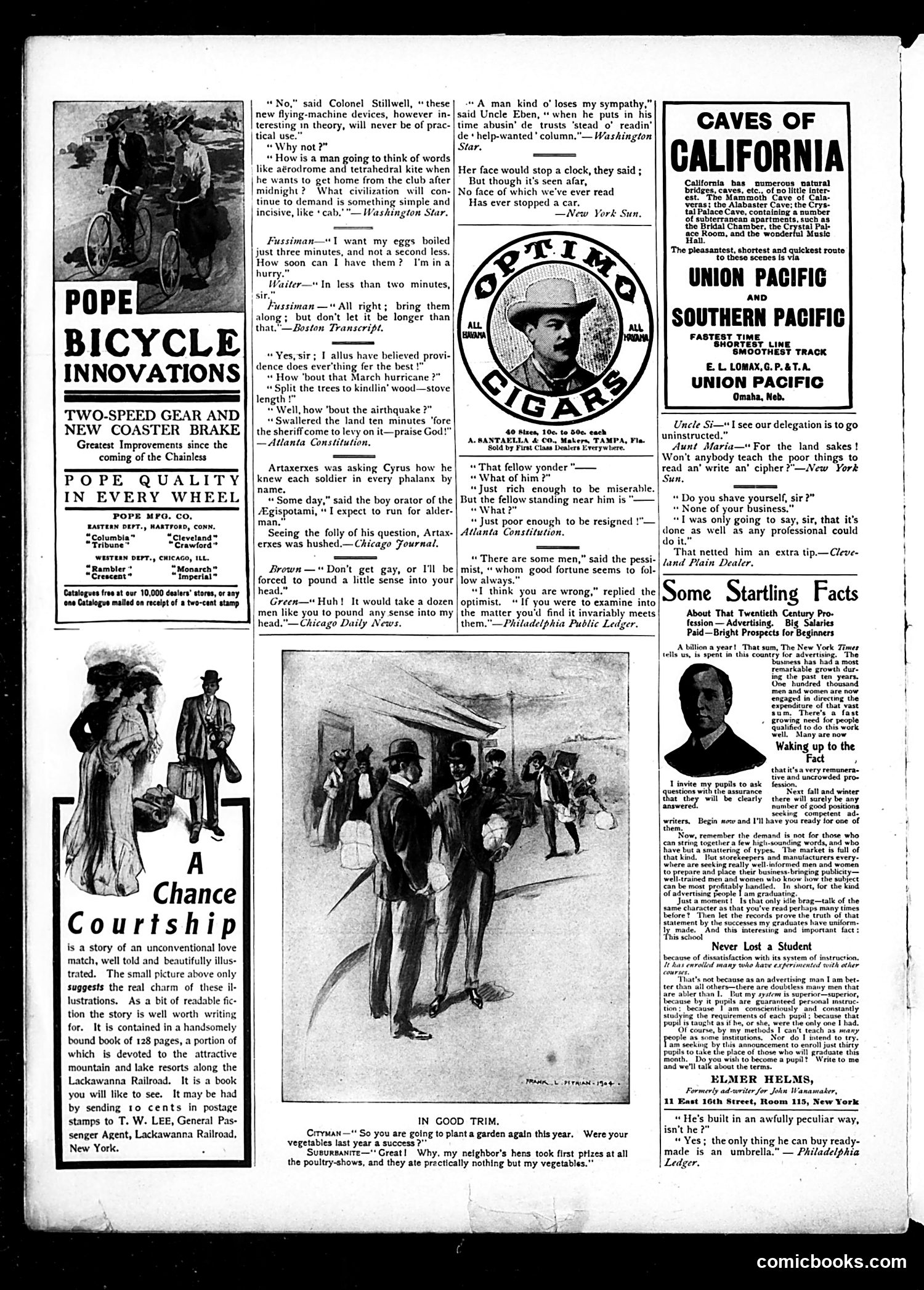
This is primarily an **advertising and humor page** from Judge magazine, circa early 1900s. **Main Content:** - Multiple **product advertisements** (Pope bicycles, Optime cigars, Lackawanna Railroad) - A collection of brief **humorous anecdotes** on various topics **Key Satirical Pieces:** 1. **Flying machines joke**: Colonel Stillwell dismisses aviation as impractical because people need simple words like "cab" to get home drunk from their clubs—mocking both early aviation skeptics and upper-class excess. 2. **Labor/pessimism jokes**: Several quips contrast rich and poor, optimists and pessimists, suggesting social commentary on class and fortune. 3. **"In Good Trim"**: A farmer boasts his neighbor's prize-winning hens ate all his vegetables—dark humor about agricultural failure. The page reflects **turn-of-century American concerns**: emerging technologies (aviation, bicycles), class distinctions, and rural-versus-urban life. The humor is genteel rather than biting—typical of Judge's middle-class audience.
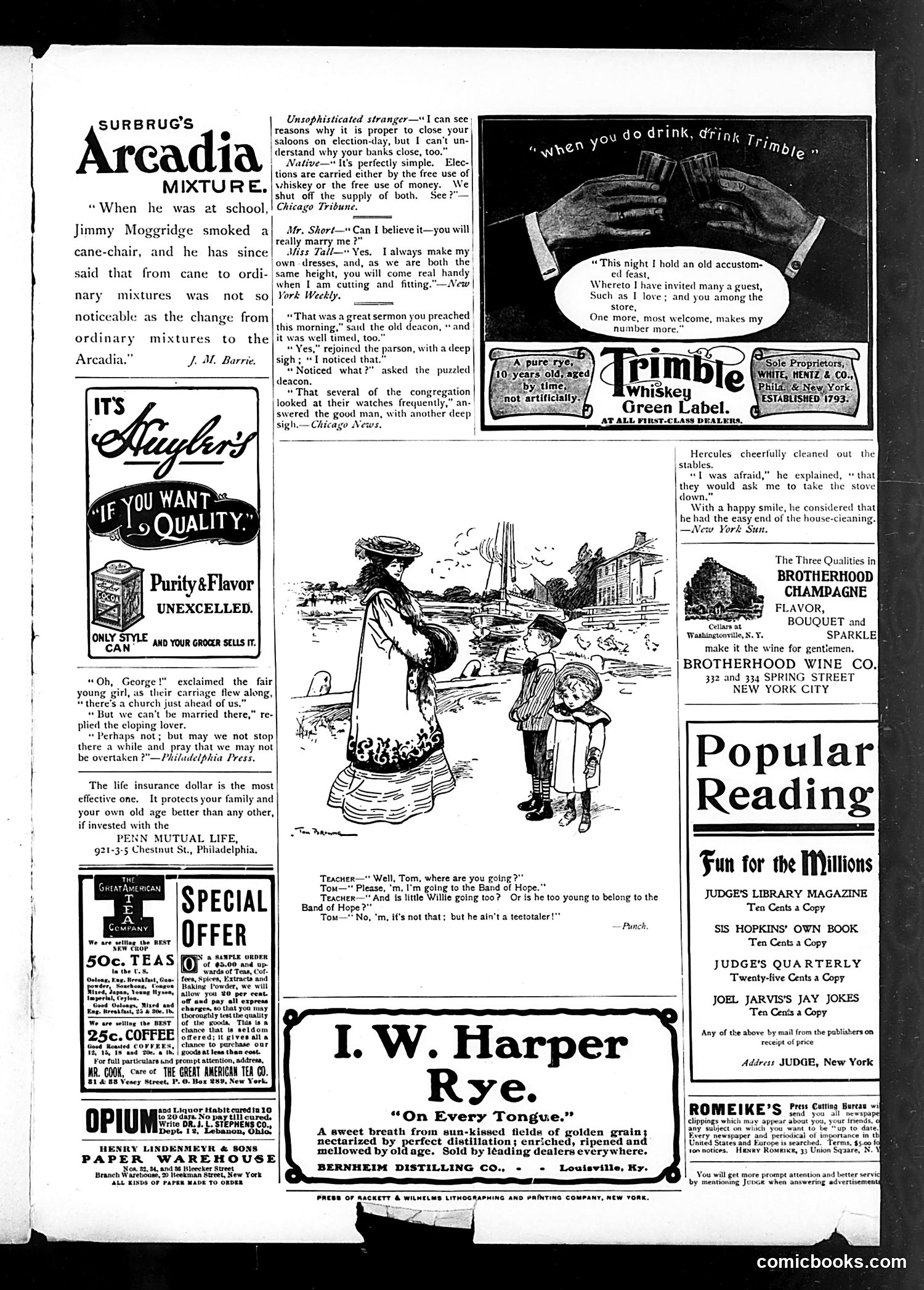
This is primarily an **advertising page** with scattered short jokes and one cartoon illustration. The main cartoon depicts a classical scene: a woman (likely representing Hercules or a mythological figure) cleaning stables, with a young boy nearby. The accompanying joke plays on the Hercules legend—the woman is relieved she only had to clean stables rather than perform harder mythological tasks, suggesting she got "the easy end of the house-cleaning." The page is dominated by period advertisements for products like **Arcadia tobacco mixture, Trimble whiskey, Stayley's mixtures, tea, coffee, life insurance, and rye whiskey**. Several short humor pieces appear, including jokes about elopement, election-day bank closures, and temperance (the "Band of Hope" reference to a teetotaler organization). The jokes reflect early 20th-century American concerns: marriage, prohibition-era attitudes, and social respectability. The overall tone is lighthearted domestic humor typical of Judge's editorial approach.
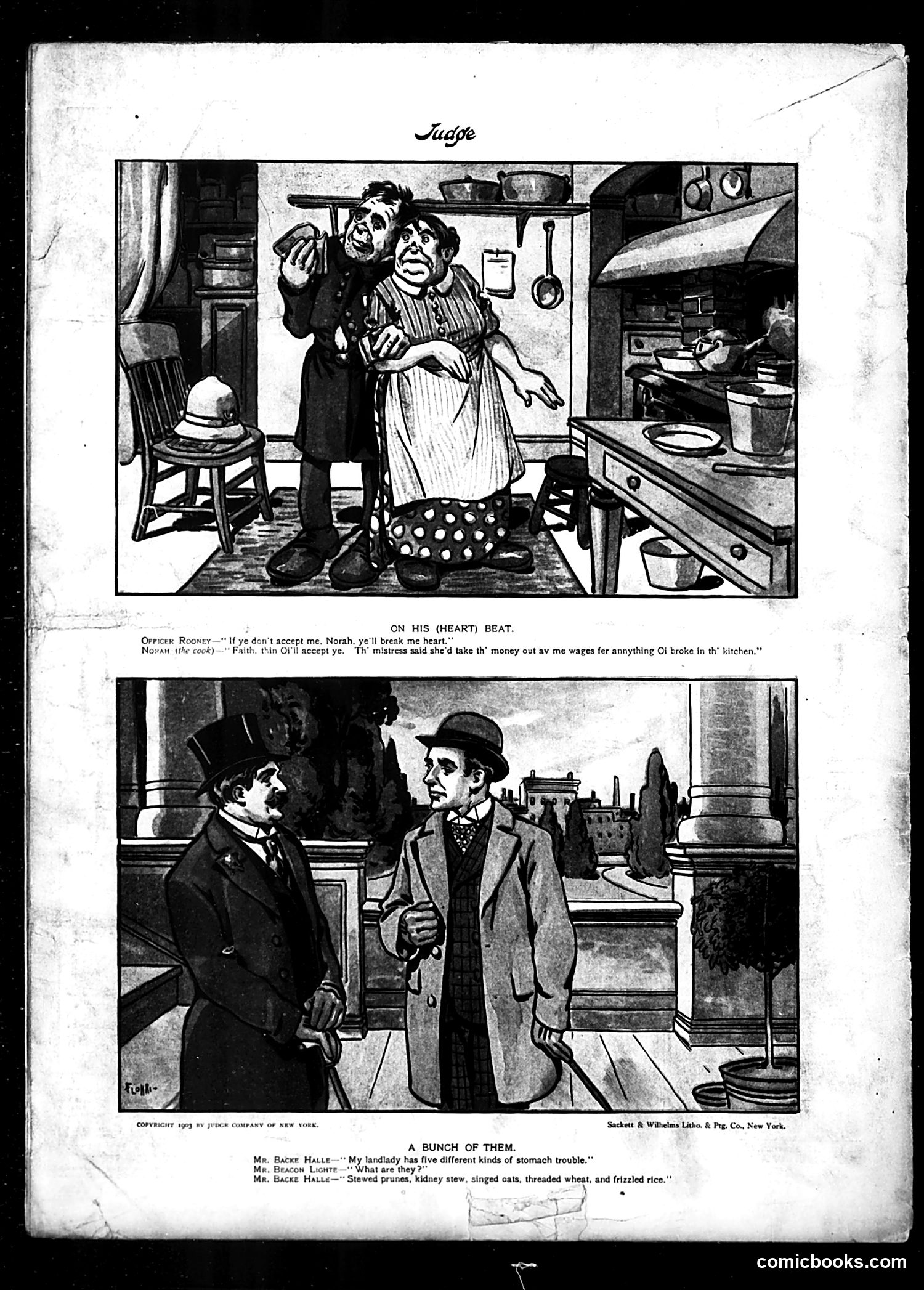
This 1909 Judge page contains two unrelated comic strips using ethnic humor typical of the era. **Top cartoon ("On His Heart Beat"):** An Irish police officer (Officer Rooney) proposes to Norah, a cook. The joke plays on her mercenary acceptance—she'll marry him only because her mistress deducts breakage costs from her wages, making marriage financially preferable. The humor relies on Irish dialect stereotypes ("Oi," "th'") and the implication that working-class domestic servants calculate romance transactionally. **Bottom cartoon ("A Bunch of Them"):** Two gentlemen discuss a landlady's "stomach trouble." The punchline reveals she doesn't have a medical condition—rather, her cooking (stewed prunes, kidney stew, singed oats, threaded wheat, frizzled rice) *causes* digestive problems. The joke mocks both the landlady's poor cooking skills and the boardinghouse experience. Both strips exemplify Judge's humor: class-based satire, ethnic caricature, and domestic/servant comedies popular in early 20th-century American comic publications.

I can see this is a page from *Judge* magazine, but the image is almost entirely black with only a white margin visible on the left side. The OCR text provides only a website URL ("comicbooks.com") with no actual article or caption text to analyze. Without legible visual content or accompanying text, I cannot identify any figures, caricatures, political references, or satirical points. The page appears to be either a blank page, a severely degraded scan, or improperly captured. To provide historical context and explanation as requested, I would need a clearer, more legible image with visible cartoon artwork and readable text.
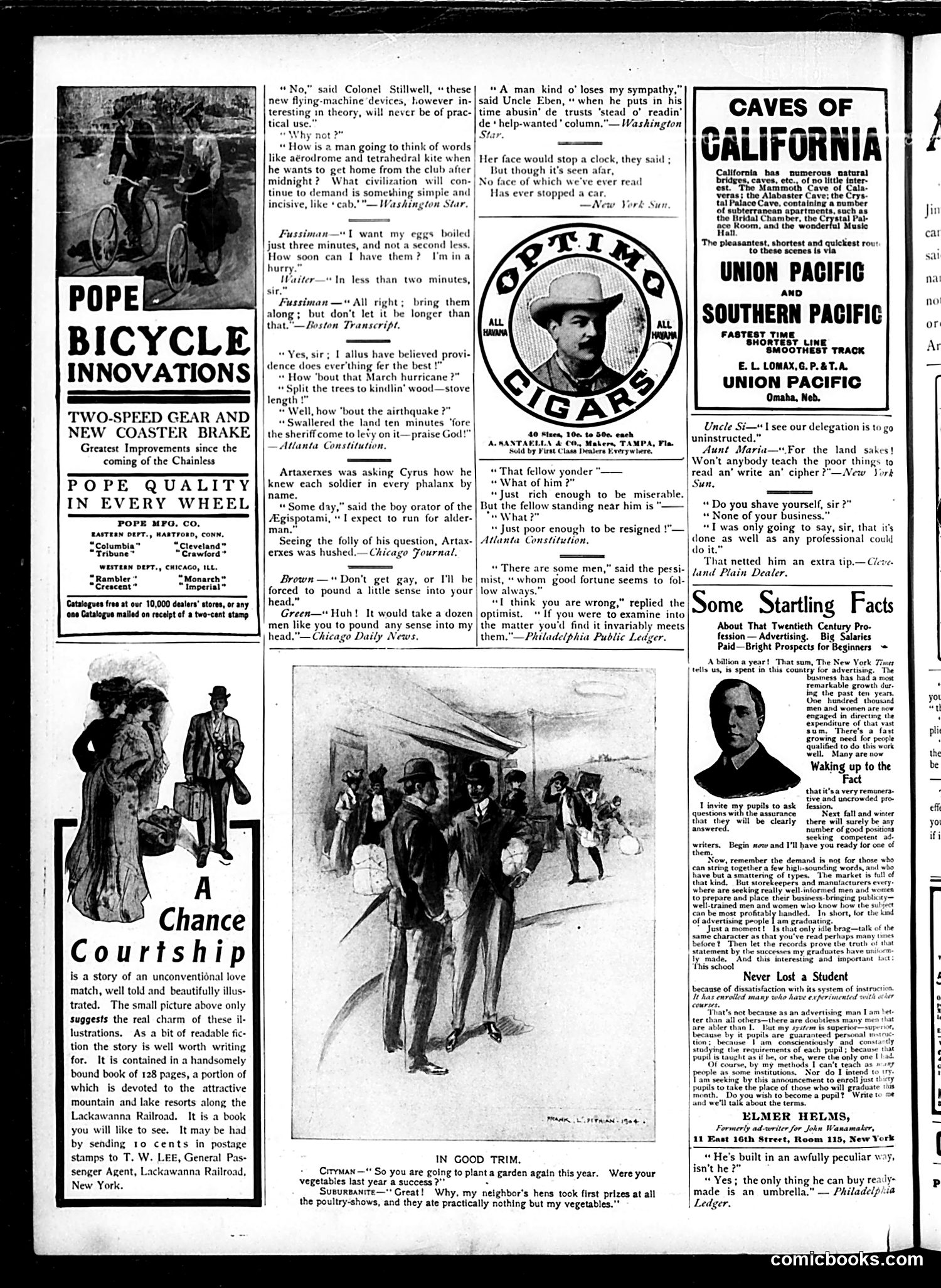
This is primarily an **advertising and humor page** from Judge magazine, a major American satirical weekly (likely early 1900s based on references to bicycles and flying machines). The page contains: **Advertisements:** Pope bicycle company dominates the left side, promoting innovations like coaster brakes. A Lackawanna Railroad ad features a romantic illustration promoting a short story booklet. **Jokes and Satirical Quips:** The cartoon content consists of brief, captioned vignettes mocking contemporary attitudes: - A colonel dismisses flying machines as impractical because pilots won't know how to say "aérodrome" - A fastidious diner demands perfectly-timed eggs - An old man's faith that Providence controls everything (even earthquakes) is portrayed as comically misguided - Various quips about wealth, marriage, and class differences **The humor is light social satire**—poking fun at affectation, technological skepticism, and human folly—rather than hard political commentary. The page reflects early 20th-century American anxieties about modernity while maintaining Judge's characteristic genteel, middle-class sensibility.
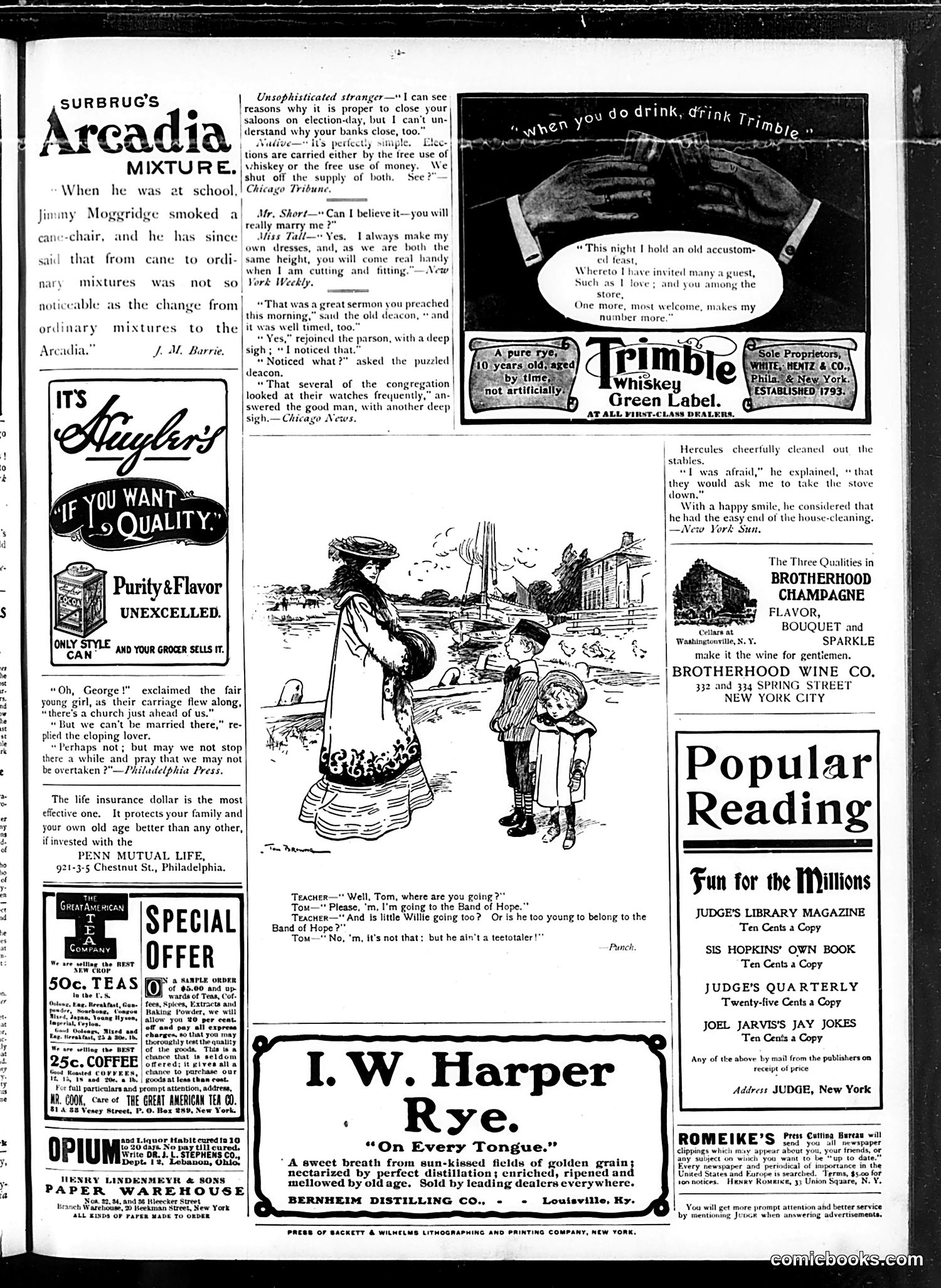
This page is primarily **advertising** with several short humorous anecdotes rather than political cartoons. The content reflects early-20th-century American social attitudes: **Key humor pieces:** 1. **Election-day banking joke**: Satirizes the practice of closing both saloons AND banks on election day, implying both enable irresponsible behavior. 2. **Elopement cartoon**: Shows a couple fleeing; the woman asks to pray they won't be "overtaken"—suggesting parental or social disapproval of their elopement. 3. **Height-difference joke**: A tall woman tells her short fiancé he'll be "handy" for dress-fitting since they're the same height—mocking both the couple's size mismatch and women's domestic duties. 4. **Temperance joke**: A boy says his younger brother can't join the "Band of Hope" (a temperance organization) because "he ain't a teetotaler"—satirizing strict abstinence movements. 5. **Hercules cleaning stables**: Jokes that avoiding a harder household task (stove-cleaning) represents "easy" work—mocking domestic labor expectations. The page otherwise consists of period product advertisements (tea, coffee, insurance, whiskey, champagne).
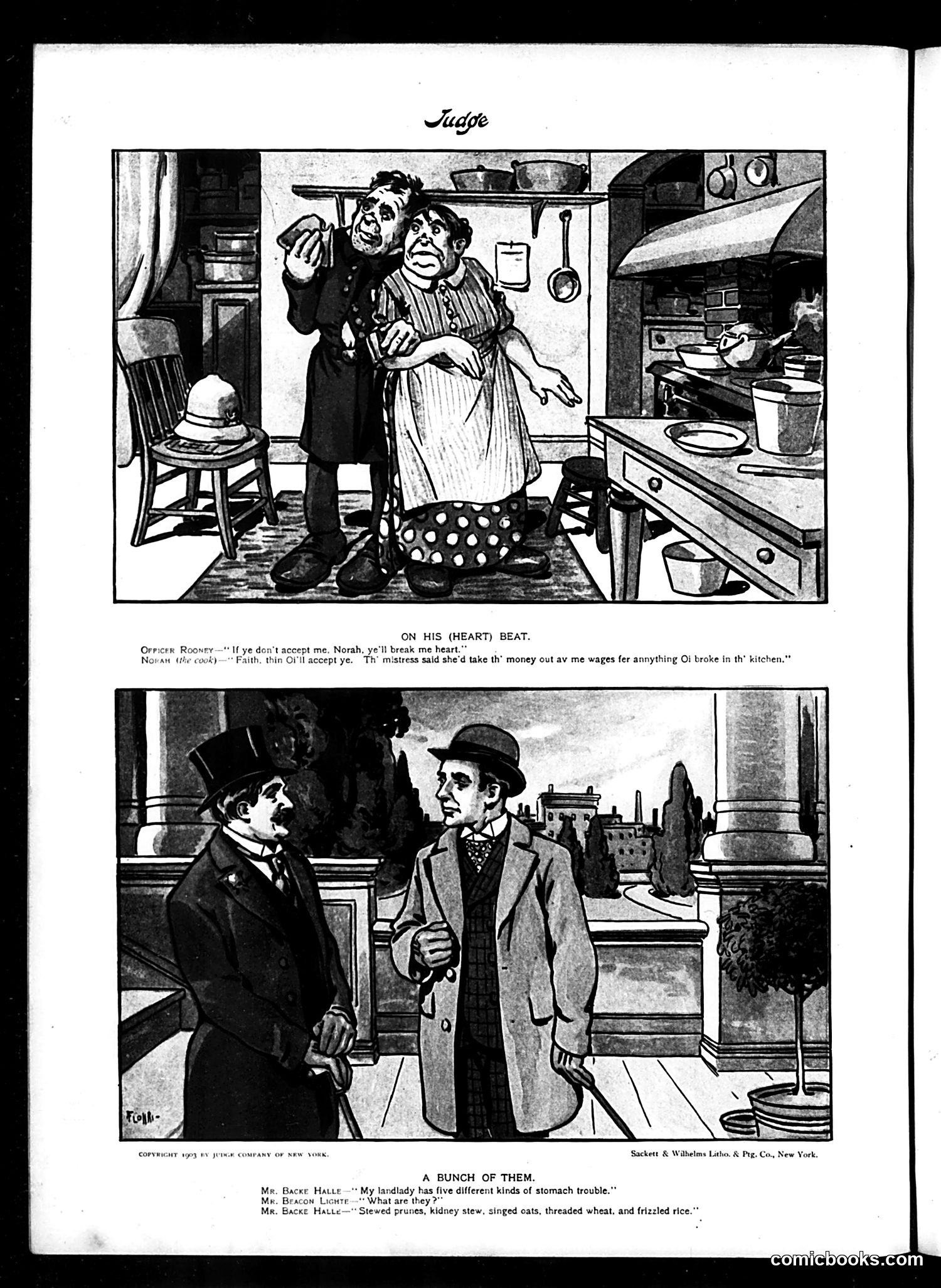
**Top cartoon ("On His Heart Beat"):** A police officer proposes to Norah, the cook, threatening heartbreak if rejected. She accepts—not from love, but because the mistress deducts broken kitchen items from her wages. The satire mocks both the officer's melodramatic proposal and the economic desperation of domestic servants, who lived under harsh conditions where even accidental breakage cost them wages. **Bottom cartoon ("A Bunch of Them"):** Two men discuss a landlady's "five different kinds of stomach trouble"—which turn out to be five poorly-prepared dishes: stewed prunes, kidney stew, singed oats, threaded wheat, and frizzled rice. The joke satirizes bad boarding-house cooking, a common complaint in early 1900s urban life, by treating inedible meals as actual ailments. Both use working-class Irish dialect and kitchen settings typical of Judge's humor targeting immigrant and servant communities.