
A complete issue · 16 pages · 1904
Judge — April 23, 1904
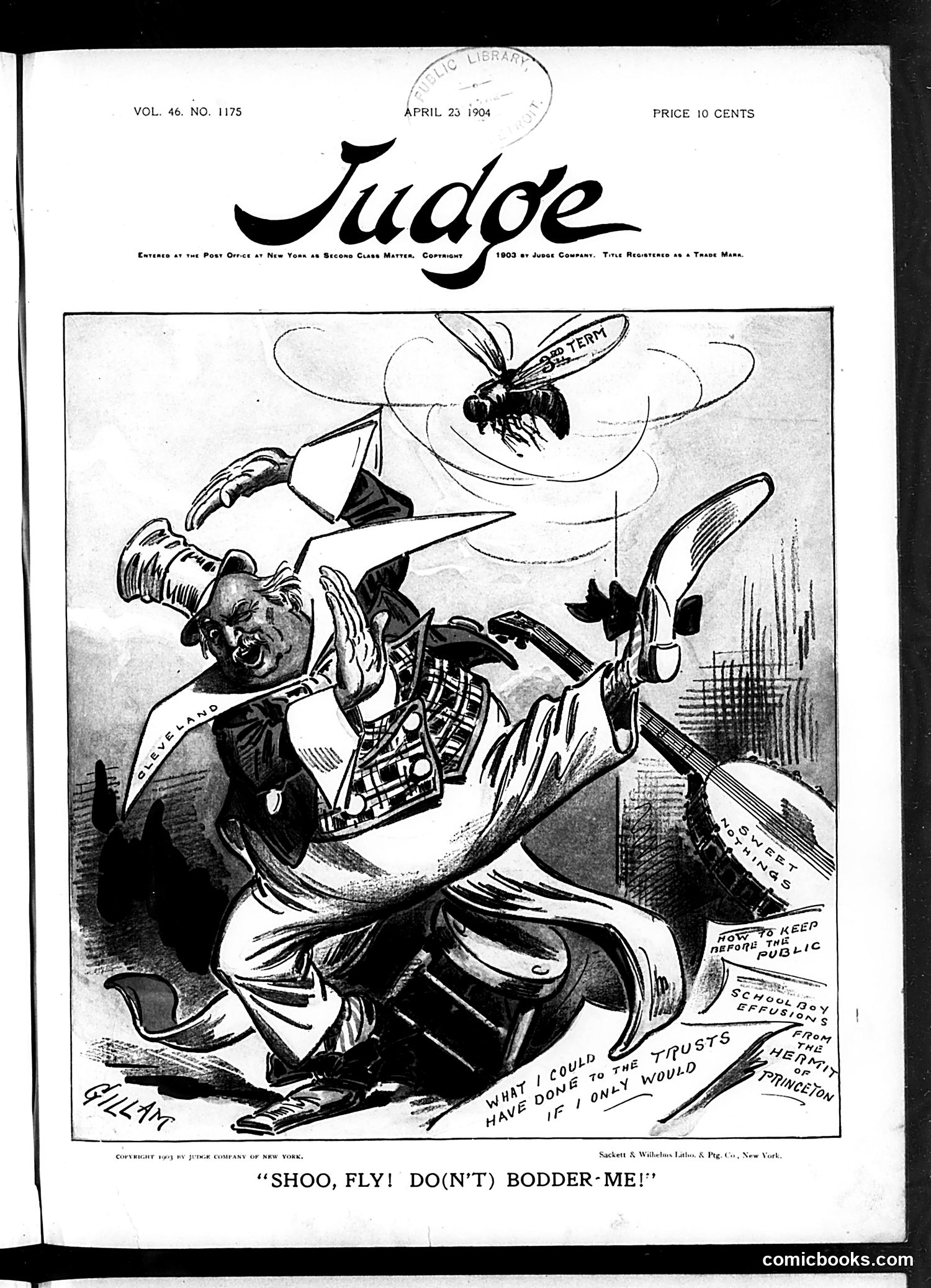
This April 1904 *Judge* cartoon depicts a caricatured figure labeled "Cleveland" being pestered by a large bee. The figure is dressed formally and appears distressed, swatting at the insect while tumbling backwards. The cartoon likely references Grover Cleveland, whose presidency had recently ended (1897). The bee may represent unwanted political pressure or persistent critics. The phrase "Shoo, Fly! Don't Bodder Me!" was a popular contemporary song, applied here mockingly to suggest Cleveland being hounded or annoyed by some political issue or group he wished to dismiss. Text references "trusts" and "school effusion," suggesting the cartoon critiques Cleveland's position on monopolies or educational policy, though exact details remain unclear without additional context.
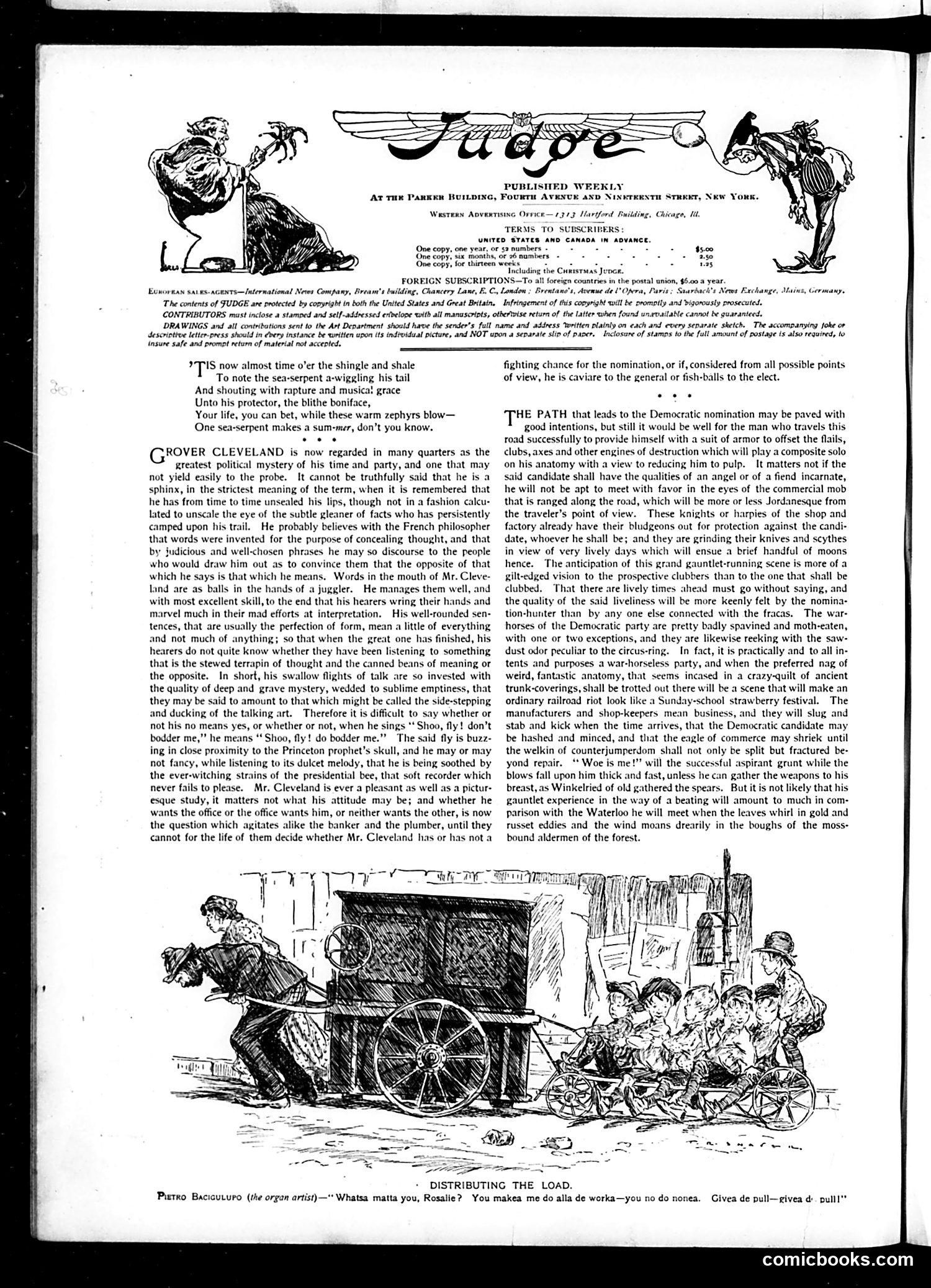
This page contains two distinct elements: **Top Section:** A lengthy political commentary on Grover Cleveland, analyzing his character and political maneuvering. The text suggests Cleveland is being criticized for obscuring facts and using rhetorical manipulation—the author compares his oratory to a juggler's misdirection. The piece questions whether Cleveland genuinely holds the office he seeks or is merely playing a political game. **Bottom Cartoon:** Titled "Distributing the Load," it depicts an organ grinder (Pietro Baccigliefo) pulling a cart while children sit inside. The Italian dialect caption ("Whata matta you, Rosalie?") suggests commentary on immigrant labor or exploitation, likely satirizing how working-class immigrants bore burdens while others benefited. The page critiques both political dishonesty and working-class exploitation.
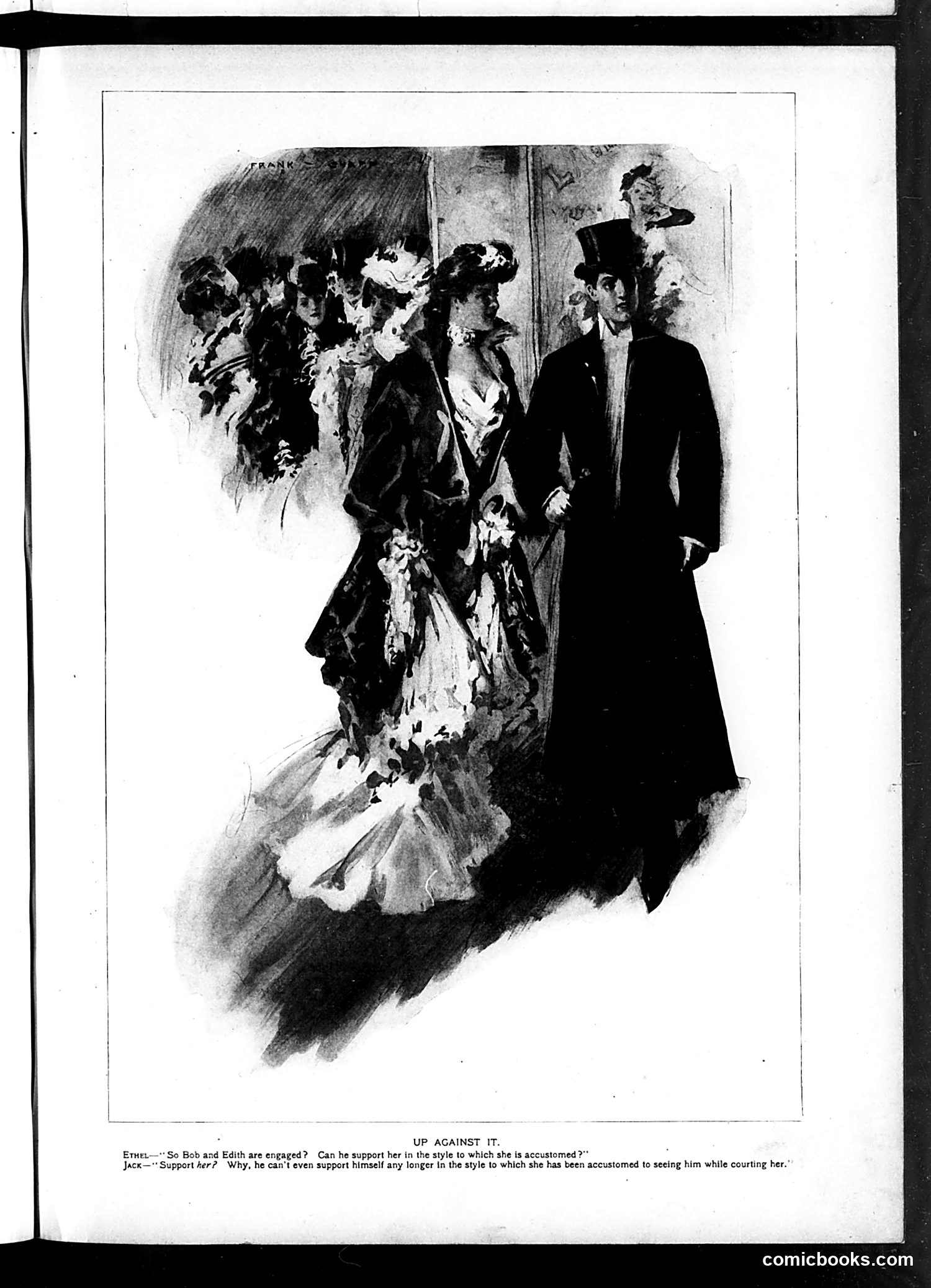
This satirical illustration depicts a social scandal involving courtship and class expectations. The caption presents a dialogue between "Ethel" and "Jack" regarding a man named "Bob" who is engaged to Edith. The satire centers on a moral double standard: Ethel questions whether Bob can support Edith "in the style to which she is accustomed," while Jack responds that Bob cannot even support *himself* in that style while courting her. The joke critiques wealthy society's expectations—particularly the assumption that a suitor must maintain an expensive lifestyle to be worthy of an affluent woman. Jack's pointed response exposes the absurdity of these pretensions, suggesting Bob is living beyond his means to appear suitable. The drawing's composition, with multiple fashionably-dressed figures, emphasizes the superficial social world being mocked.
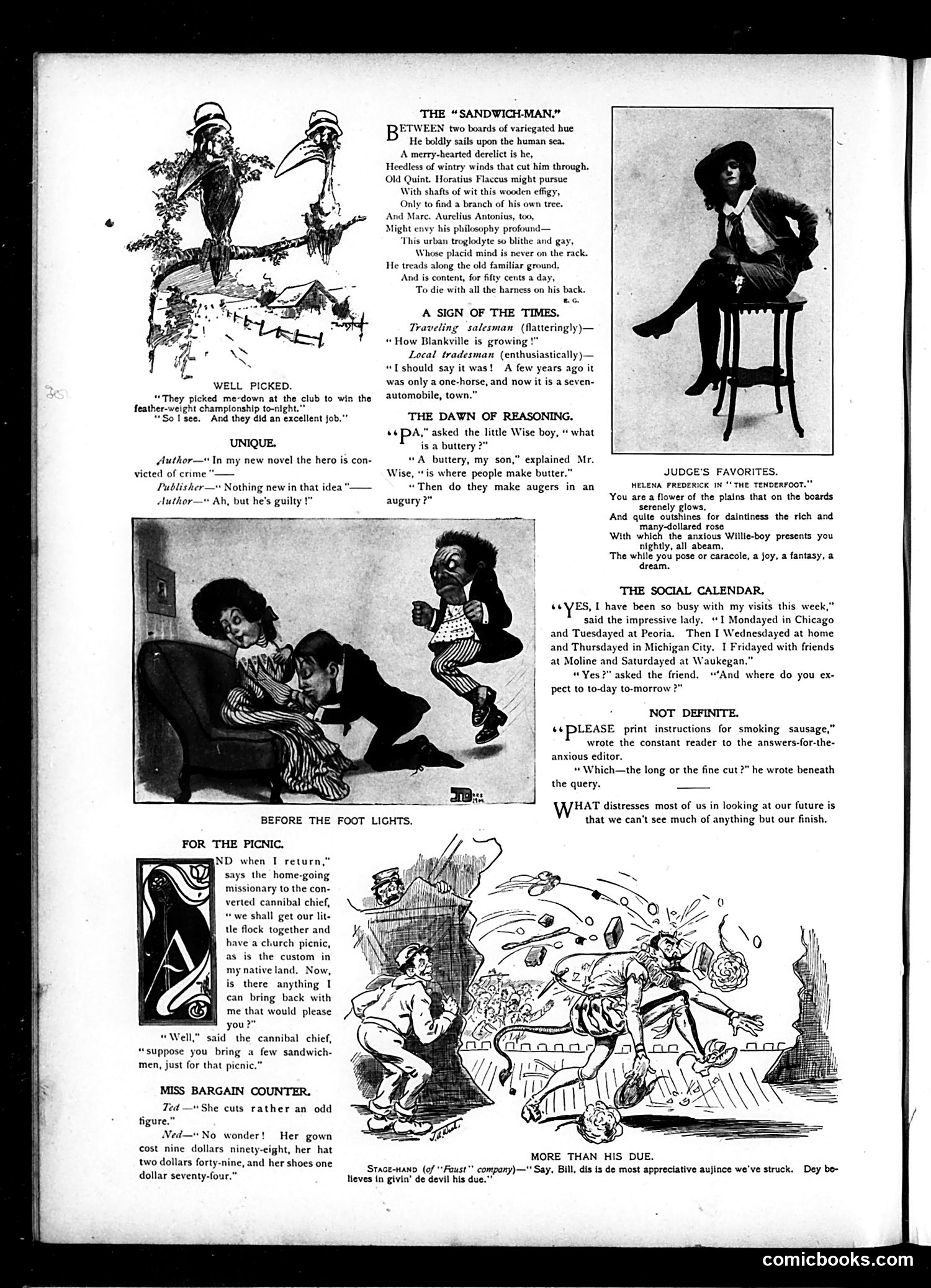
This page contains several humorous sketches and literary pieces typical of Judge's satirical style: **"The Sandwich-Man"** (top left): A poem mocking urban street advertisers who wore sandwich boards. The satire targets this dehumanizing form of labor. **"Judge's Favorites"** (right): A portrait piece praising actress Helena Fredericke in "The Tenderfoot," using flowery language about her beauty and talent. **"Before the Foot Lights"** (center): A theatrical sketch about performers, likely satirizing dramatic pretensions. **"For the Picnic"** (lower left): A humorous dialogue between a missionary and converted cannibal chief about what food to bring—satire mocking both missionary work and racial stereotypes common to the era. **"More Than His Due"** (bottom): A stage-hand comedy sketch. The page reflects Judge's mix of theatrical satire, social commentary, and period-typical ethnic humor.
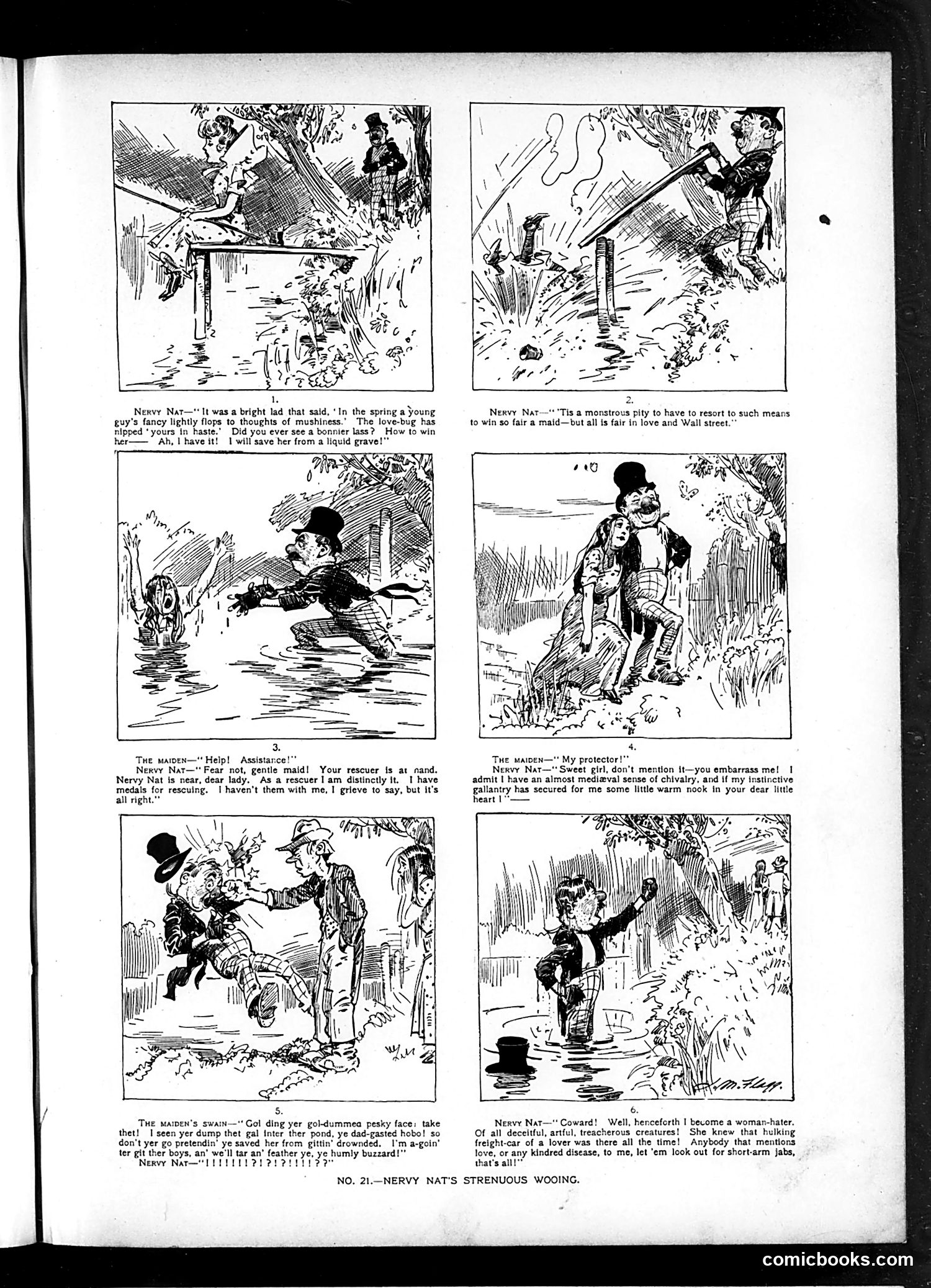
This comic strip satirizes a con-man character named "Nervy Nat" who attempts to seduce a woman by staging a fake rescue—pushing her into a pond then "saving" her to win her affection. The joke relies on period conventions of chivalry and romance. The satire targets: 1. **Fraudulent masculinity**: Nat boasts of rescue "medals" he doesn't possess, exposing false heroism 2. **Social climbing via romance**: His reference to "Wall Street" suggests fortune-hunting 3. **Class commentary**: The woman's actual boyfriend is a working-class "hulking freight-car" type who arrives and beats Nat, revealing the con The punchline shows Nat's swift rejection of romance entirely after being exposed and attacked—mocking men who claim chivalry while pursuing deception. The strip critiques both romantic pretense and the desperation of social climbers using manufactured scenarios to seduce women.
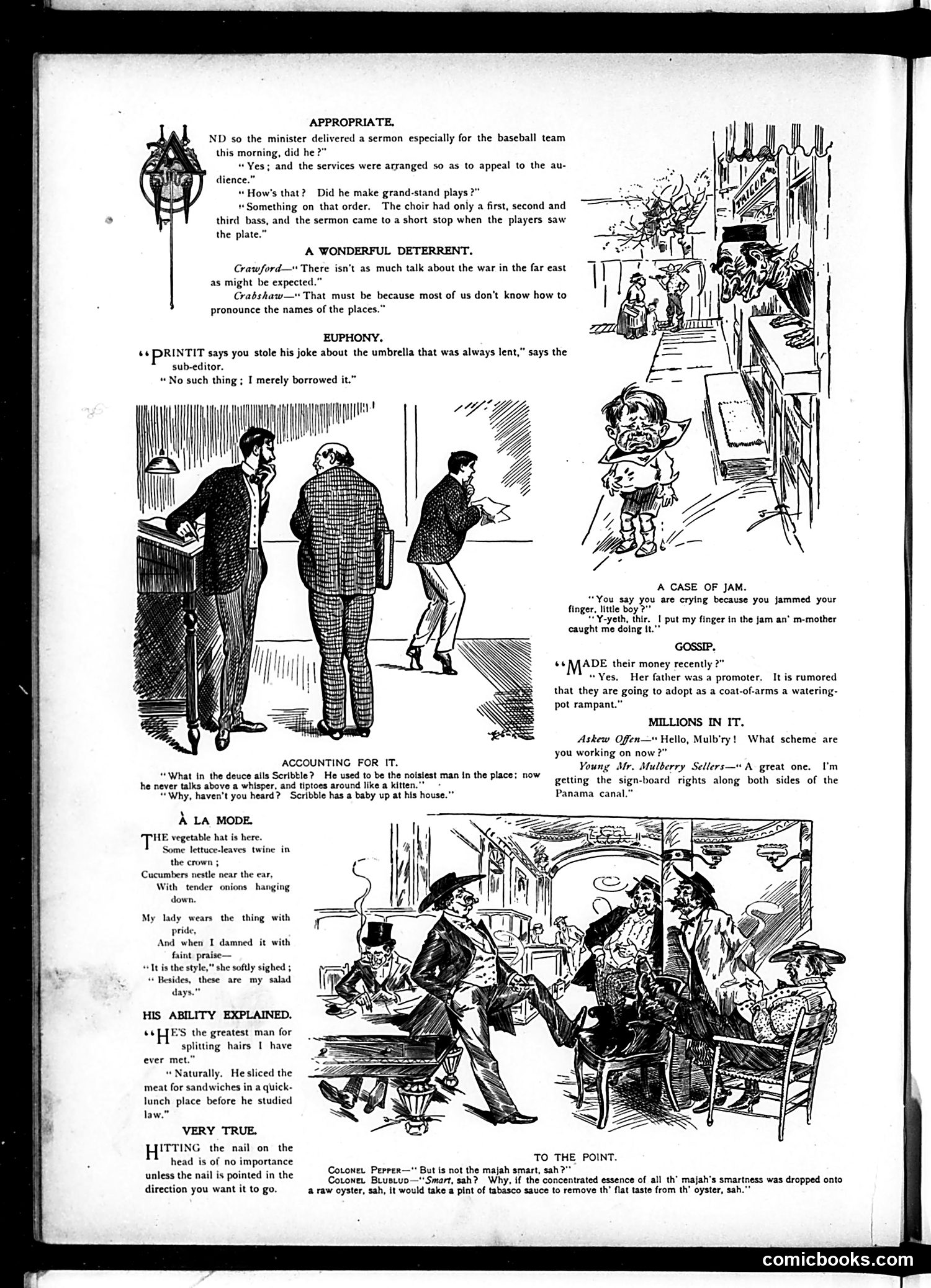
This page contains multiple brief humorous sketches typical of early 20th-century American satirical humor. Key items include: **"Appropriate"**: A joke about a minister delivering a baseball-themed sermon with baseball terminology ("grand-stand plays," "the plate"), mocking both religious services and sports enthusiasm. **"A Wonderful Deterrent"**: Characters note the Far East war receives little coverage because Americans cannot pronounce the place names—satirizing public ignorance about international affairs. **"Euphony"**: A pun about "borrowing" versus "stealing" a joke about an umbrella. **"Millions in It"**: A character promotes profiting from sign-board rights along the Panama Canal—referencing the newly-completed Canal (1914) as a contemporary business opportunity. **"A La Mode"**: Mocks fashionable women wearing vegetable-decorated hats—absurdist satire of haute couture trends. The remaining sketches are brief, wordplay-dependent jokes. The page exemplifies Judge's style: topical references, puns, and gentle mockery of social pretension and contemporary events.
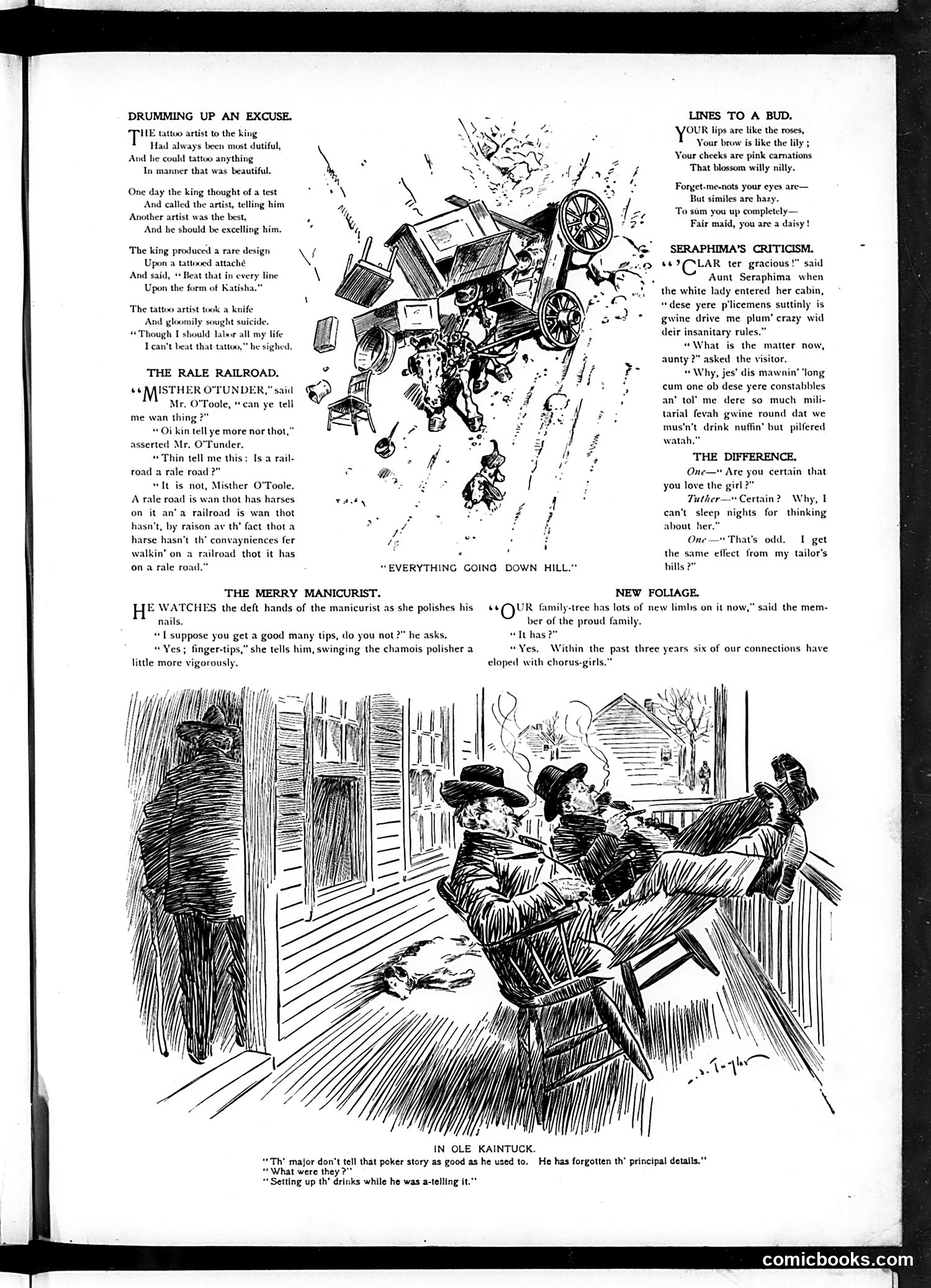
This page contains several brief humorous pieces typical of early 20th-century American satire: **"Drumming Up an Excuse"** depicts a tattoo artist who, unable to surpass a rival's work, resorts to suicide—mocking artistic pretension and competitive desperation. **"The Rale Railroad"** features two Irish-dialect characters debating whether a railroad is a "rale road." The joke hinges on wordplay: a "rale road" (real road) has horses; a railroad doesn't need them because trains exist. It's gentle ethnic humor with malapropism-based comedy. **"The Merry Manicurist"** jokes about a manicurist receiving "finger-tips" (puns on both gratuities and literal fingertips). **"Seraphima's Criticism"** presents an African American woman complaining about health regulations restricting drinking water—likely referencing early public health measures. **"The Difference"** contrasts romantic lovesickness with financial stress from tailors' bills. **"New Foliage"** uses "limbs" (family tree branches) as a double entendre for family members, joking that relatives are eloping with chorus girls. These represent typical Judge fare: light puns, ethnic dialect humor, and mild social observation.
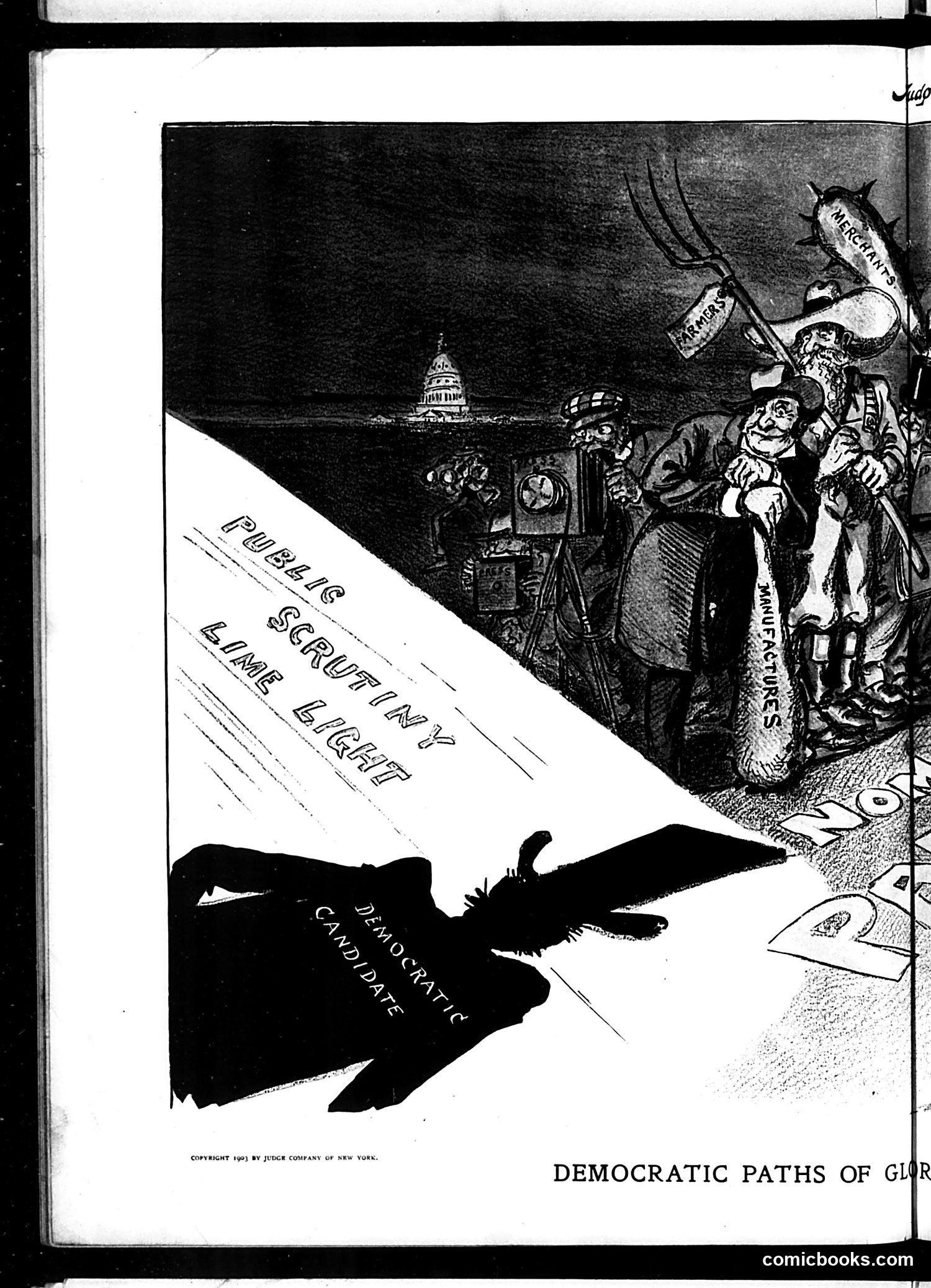
This political cartoon satirizes Democratic Party corruption or incompetence. The title references a famous phrase about war's futility. A silhouetted figure labeled "DEMOCRATIC CANDIDATE" lies prone at the bottom, appearing defeated or obstructed. Above, a searchlight beam labeled "PUBLIC SCRUTINY" and "LIME LIGHT" illuminates chaos at the Capitol building. Figures on the right—appearing to be party operatives or politicians—hold signs labeled "IRREGULARITIES" and "MACHINE POLITICS," suggesting backroom dealing and corrupt practices. The cartoon's message: Democratic candidates face exposure and failure due to party corruption and public scrutiny of underhanded political tactics. The dark, dramatic imagery emphasizes the damage these practices cause to Democratic electoral prospects. The satire targets internal party dysfunction rather than policy disagreements.
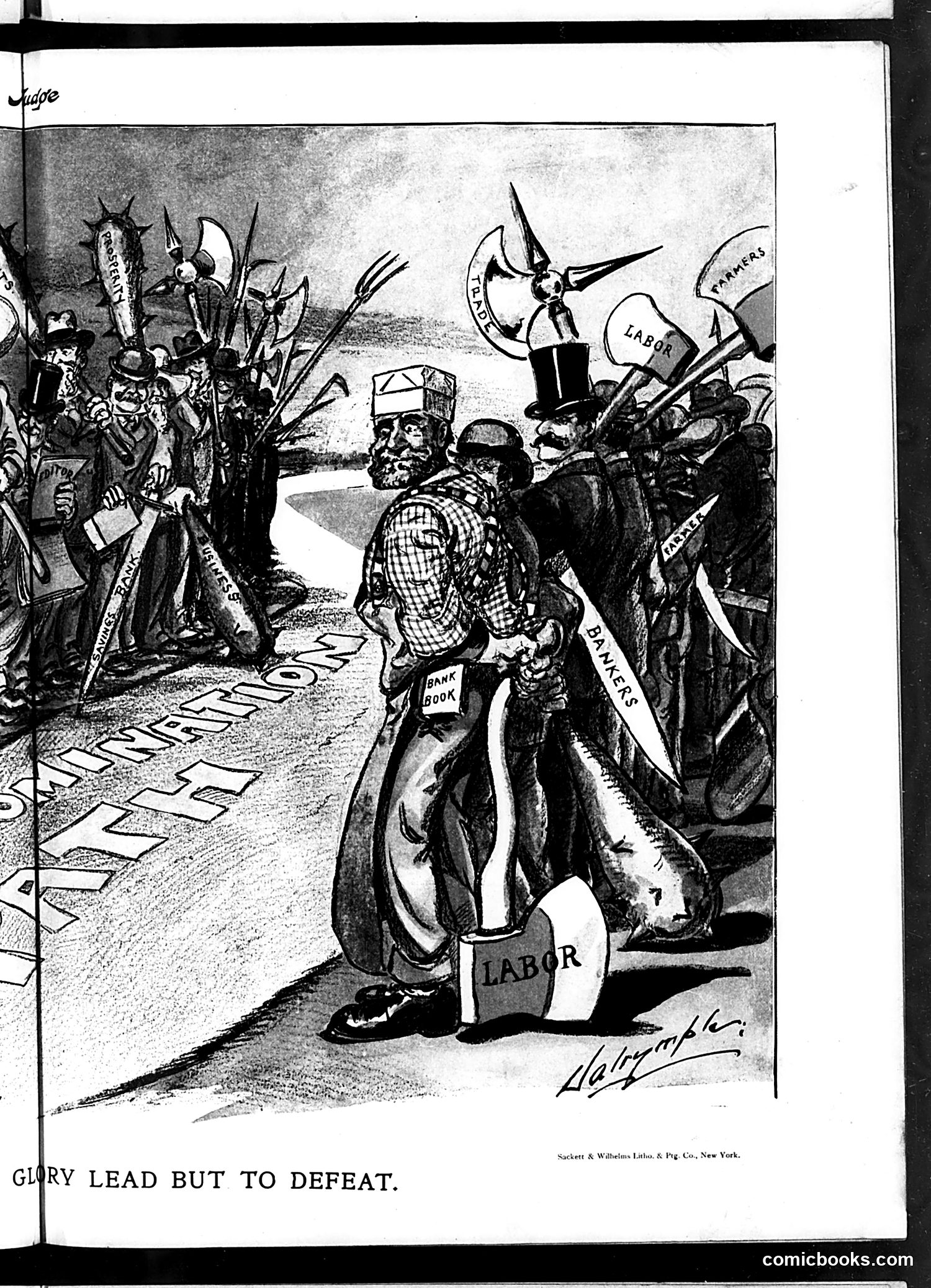
This political cartoon satirizes labor movements or labor leaders of the Gilded Age/Progressive Era. A working man labeled "LABOR" stands confronted by a threatening crowd of fierce, weapon-wielding figures representing various capitalist interests—marked with labels including "BANKERS," "TRUSTS," and "POWERS" (likely monopolies or industrial magnates). The ground is strewn with fallen banners or signs, suggesting previous failed labor struggles. The caption's title—"Glory Lead But to Defeat"—conveys the cartoon's cynical message: that despite labor's noble aspirations or leadership, it will inevitably be crushed by the organized power of capital and financial interests. The image reflects contemporary anxieties about labor's ability to achieve meaningful gains against entrenched economic power during America's industrial era.
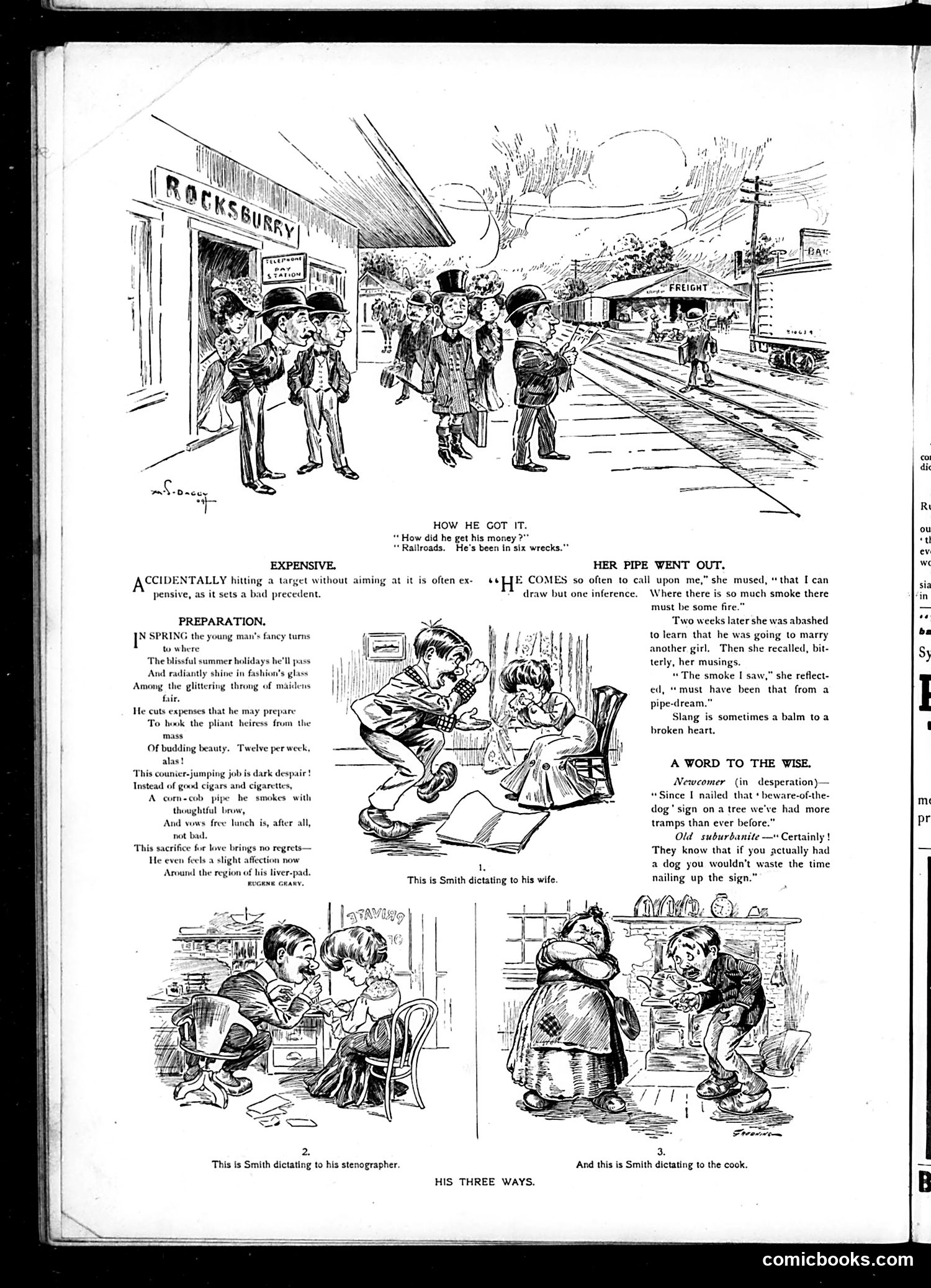
This page satirizes a character named Smith, a man of modest means pursuing an heiress. The top cartoon jokes that wealthy railroad men gained fortunes through accidents ("six wrecks")—likely referencing real railroad disasters of the Gilded Age that enriched investors through insurance and speculation. The main story follows Smith's elaborate social climbing: he economizes year-round (smoking cheap pipes instead of cigars, eating free lunches) to afford a fashionable summer where he pursues wealthy young women. The irony: his obvious financial desperation ("jumping job is dark despair") undermines his courtship. "Her Pipe Went Out" uses Victorian innuendo: a woman interprets a suitor's frequent visits as romantic interest, but his subsequent engagement to another woman reveals his visits meant nothing—the "smoke" (empty gestures) produced no "fire" (genuine affection). The bottom panels show Smith's hypocrisy: he dictates authoritatively to both stenographer and cook, performing authority he lacks elsewhere. The page satirizes social climbing, pretense, and the transparent desperation of the aspiring but unsuccessful gentleman.
This page is primarily **advertisements and light humor pieces** rather than political satire. The opening dialect poems use **racist stereotypes common to that era**, depicting African American speakers in exaggerated dialect praising hunting dogs and expressing gratitude for simple things—reflecting the prejudiced attitudes embedded in early 20th-century American humor. The remaining content consists of **short, gentle jokes**: a physician's trick to keep a busy man idle by appointing him to a health board; a barber misunderstanding "tonsorial" (haircut) work; and a woman's testimony about switching from coffee to Postum food beverage, claiming it cured her morphine addiction. The advertisements promote **Packer's Tar Soap, Sohmer Pianos, Hunter Baltimore Rye whiskey, Prudential Insurance, and the New York Central Railroad**. There is **no significant political content or sophisticated satire**—the page reflects period attitudes through crude stereotyping and mundane commercial messaging.
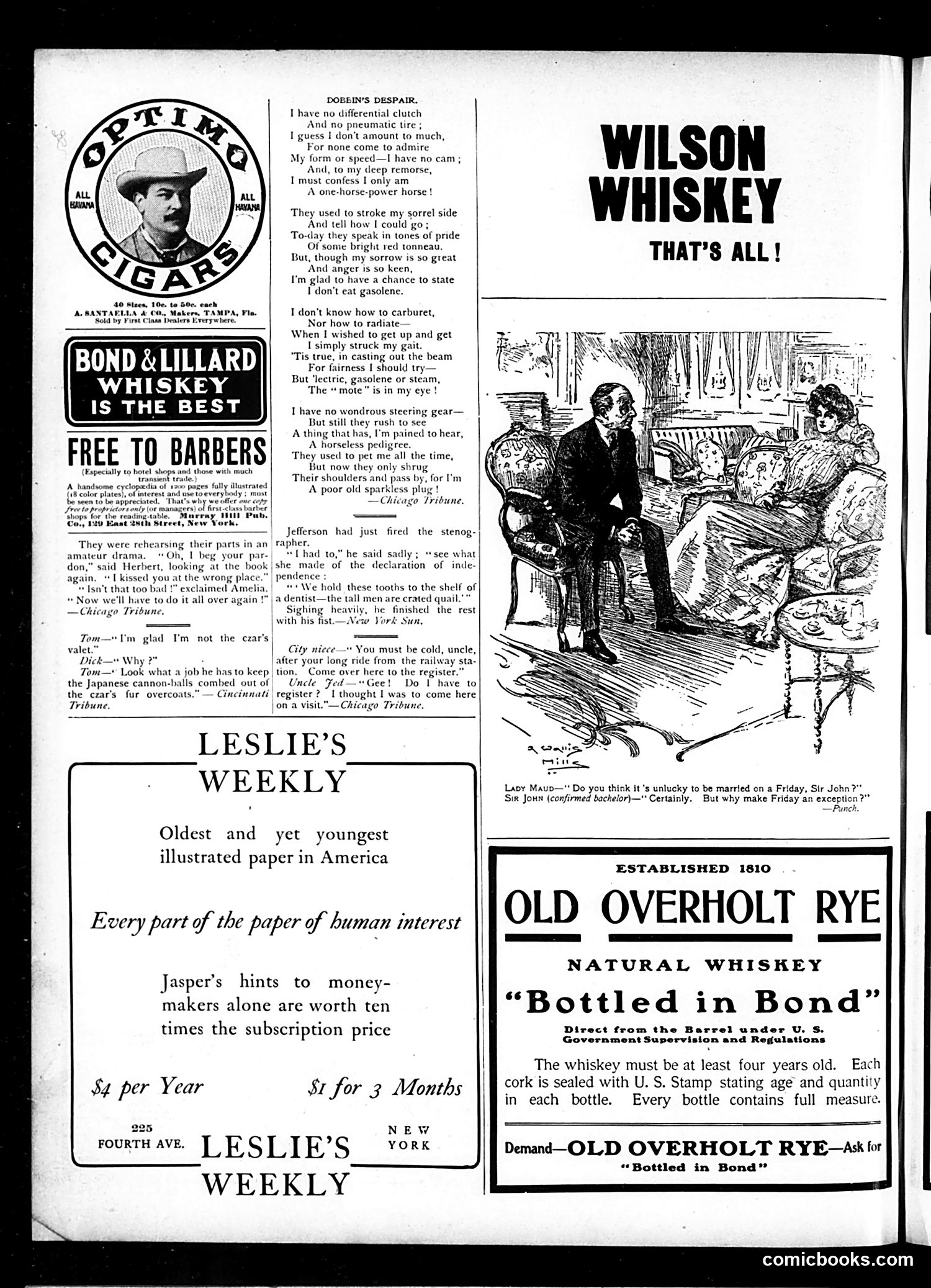
This page from Judge magazine contains mostly **advertisements and humorous short jokes** rather than political satire. The main content includes: - **"Dobbin's Despair,"** a poem from a horse's perspective lamenting obsolescence as automobiles replace horse-drawn carriages. The humor satirizes the rapid technological shift of the early 1900s. - Several brief **workplace and domestic jokes** (a couple rehearsing a play, a stenographer misreading the Declaration of Independence, a man registering at a hotel). - A **Friday wedding superstition joke** from Punch magazine. The page is dominated by **product advertisements**: Bond & Lillard whiskey, Old Overholt Rye (marketed as "Bottled in Bond" under government supervision), Wilson Whiskey, and an ad for Leslie's Weekly magazine. The cartoon illustration shows a domestic scene with two figures in conversation, accompanying the Friday wedding joke. There are no identifiable political figures or specific contemporary political references visible on this page.
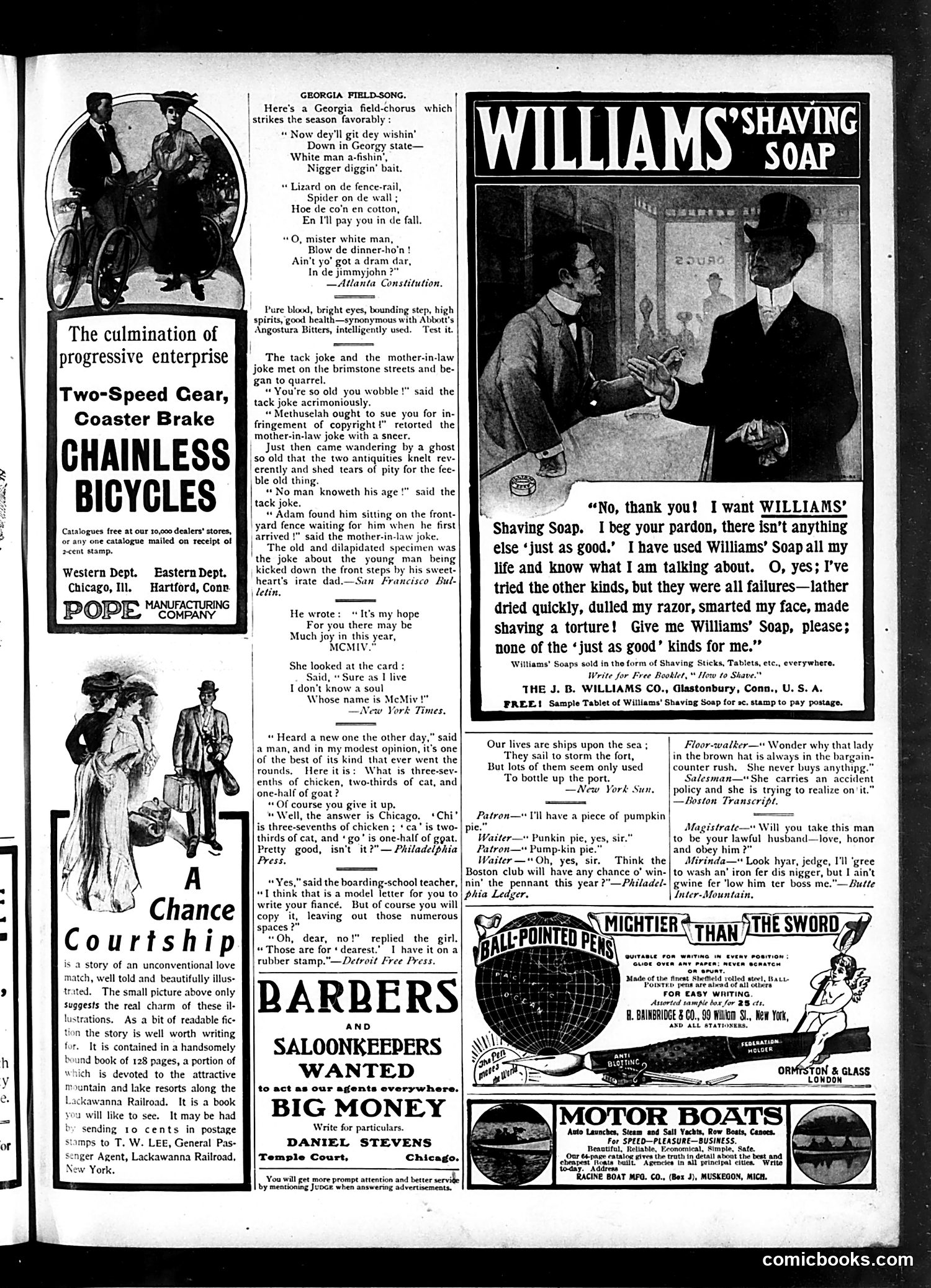
This page is primarily **advertising** with minimal editorial content. The notable pieces are: **"Georgia Field-Song"**: A racist dialect poem from the *Atlanta Constitution* depicting enslaved or sharecropping Black laborers in the post-Reconstruction South. It reflects the period's normalized racial stereotyping in mainstream publications, using offensive language ("Nigger") and portraying exploitative labor arrangements as cheerful rural life. **Joke section**: Three brief jokes about worn-out comedy tropes (the "tack joke" and "mother-in-law joke" as ancient, tired material), plus anecdotes about correspondence and logic puzzles—typical light humor for the era. **Advertisements**: Dominate the page, including bicycles, a Lackawanna Railroad story promotion, and notably a **Williams' Shaving Soap testimonial ad** featuring a customer praising the product's superiority, typical of early 20th-century advertising copy. The page reflects *Judge*'s mix of satire, light humor, and commercial content, though the racist poetry reveals the deeply problematic attitudes of the publication's era.
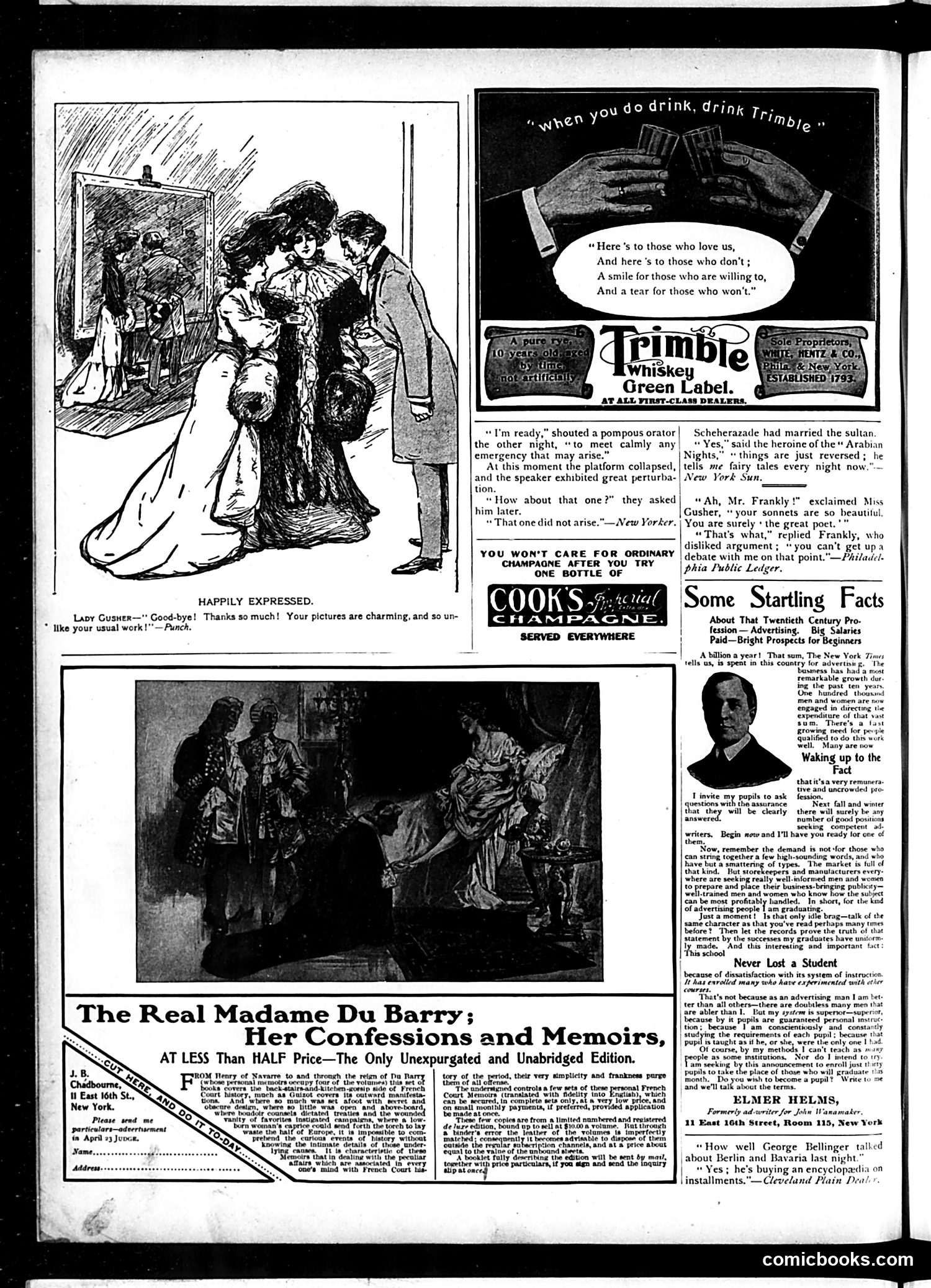
This page contains mostly **advertisements and brief humor snippets** rather than political satire. The main cartoon ("Happily Expressed," top left) shows a social scene where a lady compliments an artist's work, with the joke being her appreciation of his "usual work"—appearing to compliment his art while unknowingly insulting it. The page is dominated by **product advertisements**: Trimble Whiskey (with a sentimental drinking toast), Cook's Champagne, and notably "The Real Madame Du Barry" book offering—a sensationalized publication of court memoirs at reduced price. The right column contains brief humorous anecdotes (a platform collapse, Scheherazade references) and an article on advertising as a lucrative profession, encouraging readers to study copywriting for good wages. **Context for modern readers**: This reflects early 20th-century *Judge* magazine's mix of light satire with extensive advertising revenue. The Du Barry ad exploits period fascination with scandalous European history. The advertising industry article reflects America's emerging consumer culture and professionalization of marketing.
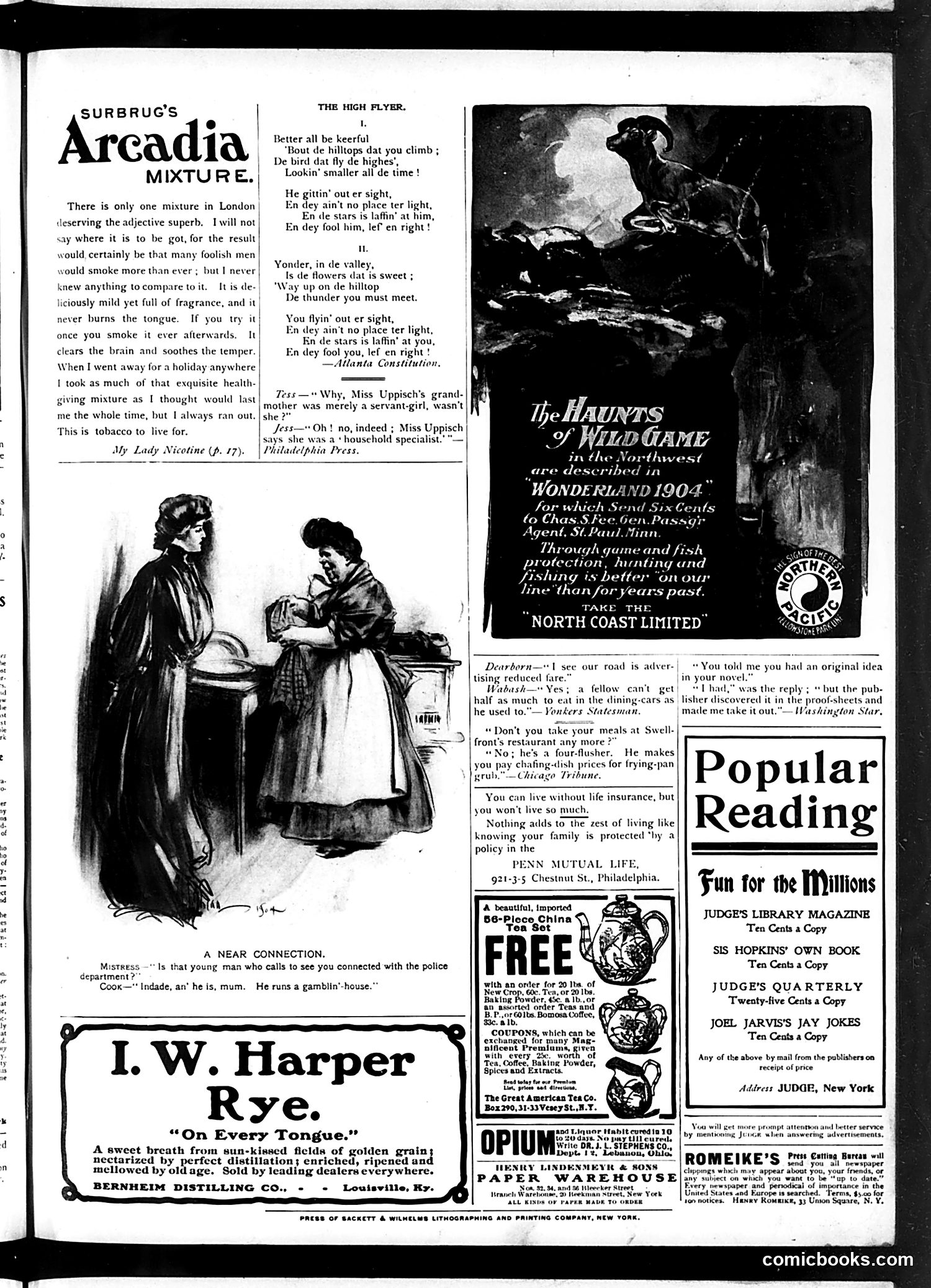
This page is primarily **advertising and fillers** with minor satirical content. The main notable item is the cartoon titled "**A Near Connection**," depicting a Mistress and Cook discussing a young man. The joke hinges on the Cook claiming her relative works in "the police department," but the punchline reveals he actually operates a gambling house—suggesting ironic "connection" between law enforcement and illegal activity, or the Cook's humorous misrepresentation of illicit work as respectable employment. The page also includes: - A poem "**The High Flyer**" (dialect verse from *Atlanta Constitution*) offering folk wisdom about ambition's dangers—those who climb highest become isolated. - A brief joke about social climbing ("Miss Uppisch's grandmother") where the servant-girl origin is euphemistically rebranded as "household specialist." The remaining content consists of period advertisements for tobacco, whiskey, tea, insurance, and magazines. No clear political satire is evident on this page.
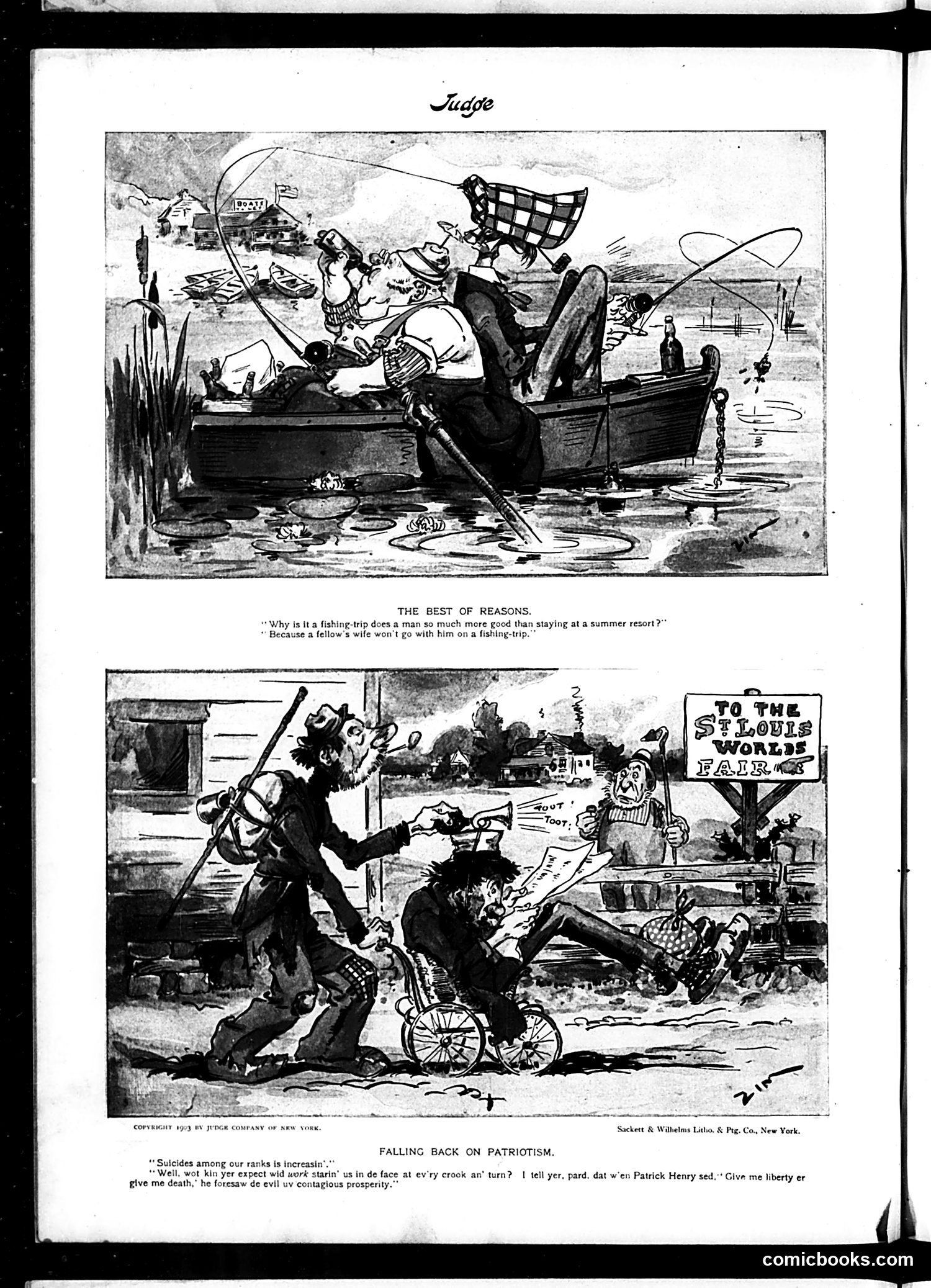
This page contains two satirical cartoons from early 20th-century Judge magazine: **Top cartoon ("The Best of Reasons"):** A husband fishing while his wife stays home. The joke reflects period gender dynamics—husbands valued fishing trips as escape from wives, implying marital tension or wives as unwelcome companions. **Bottom cartoon ("Falling Back on Patriotism"):** Two working-class men (depicted in immigrant dialect) discuss rising suicides among laborers. One sarcastically misquotes Patrick Henry's famous "Give me liberty or give me death" speech, claiming Henry actually warned against "contagious prosperity"—the irony being that *too much work* (not oppression) is killing workers. The cartoon satirizes how employers invoke patriotic rhetoric to justify harsh working conditions and low wages during a period of industrial expansion. Both cartoons mock social complacency: marital dissatisfaction and labor exploitation masked by humor or patriotic sentiment.