
Judge, 1904-04-23 · page 7 of 16
Judge — April 23, 1904 — page 7: what you’re looking at
What you’re looking at
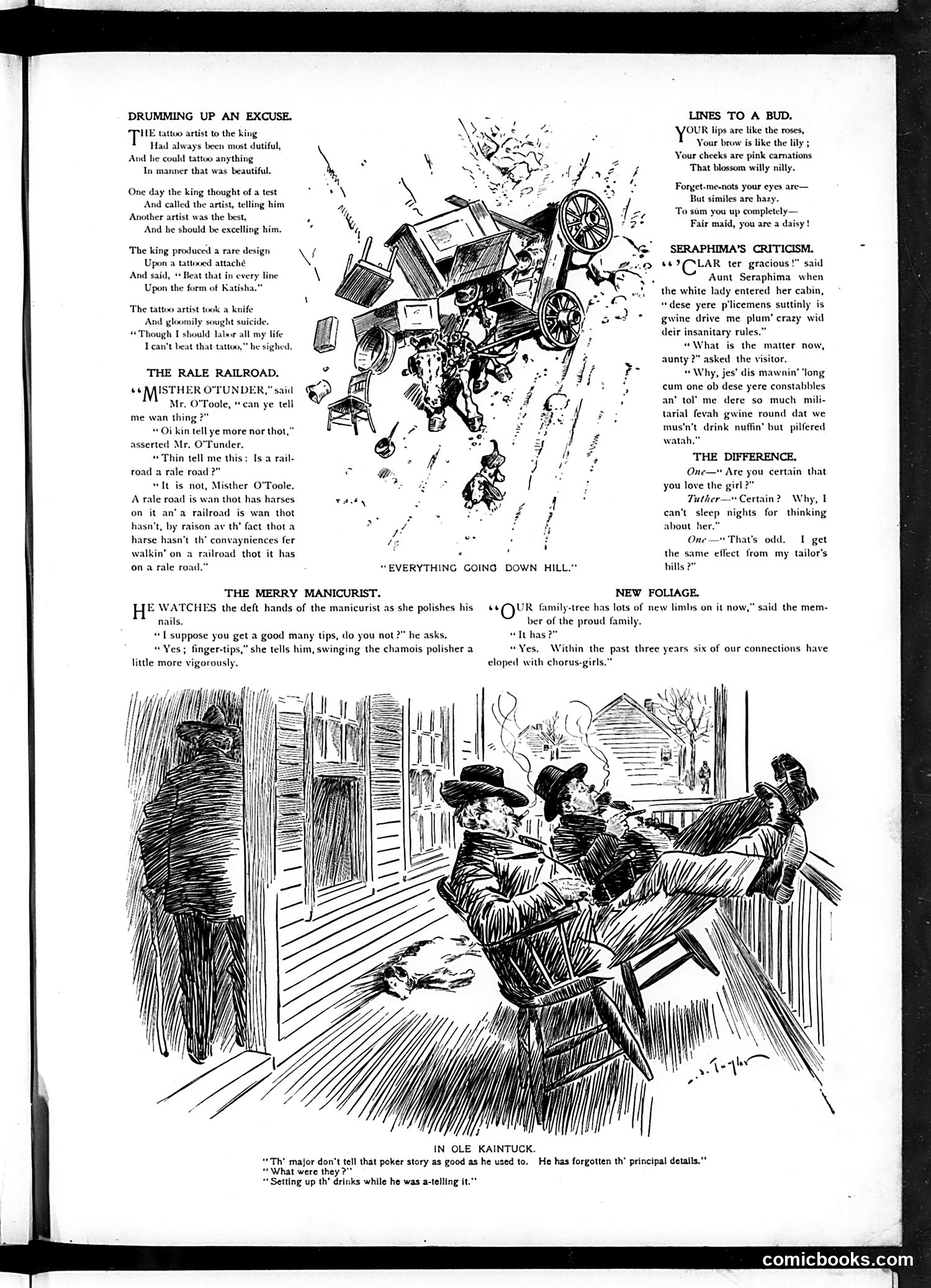
This page contains several brief humorous pieces typical of early 20th-century American satire: **"Drumming Up an Excuse"** depicts a tattoo artist who, unable to surpass a rival's work, resorts to suicide—mocking artistic pretension and competitive desperation. **"The Rale Railroad"** features two Irish-dialect characters debating whether a railroad is a "rale road." The joke hinges on wordplay: a "rale road" (real road) has horses; a railroad doesn't need them because trains exist. It's gentle ethnic humor with malapropism-based comedy. **"The Merry Manicurist"** jokes about a manicurist receiving "finger-tips" (puns on both gratuities and literal fingertips). **"Seraphima's Criticism"** presents an African American woman complaining about health regulations restricting drinking water—likely referencing early public health measures. **"The Difference"** contrasts romantic lovesickness with financial stress from tailors' bills. **"New Foliage"** uses "limbs" (family tree branches) as a double entendre for family members, joking that relatives are eloping with chorus girls. These represent typical Judge fare: light puns, ethnic dialect humor, and mild social observation.
📄 Transcribed text from this page (OCR, searchable)
Machine-transcribed from the original scan — historical spelling and the odd misread are preserved.
DRUMMING UP AN EXCUSE. IIE tattoo artist to the king Had always been most dutiful, And he could tattoo anything In manner that was beautiful. One day the king thought of a test And called the artist, telling him Another artist was the best, And he should be excelling him. ‘The king produced a rare design Upon a tattooed attaché And said, Beat that in Upon the form of Katisha, The tattoo artist took a kni And gloomily sought suicide. “Though I should labor all my life I can’t beat that tattoo,” he sighed. THE RALE RAILROAD. 66 MISTHER OTUNDER,” said Mr. O'Toole, “can ye tell me wan thing ?" “Oi kin tell ye more nor thot,” asserted Mr, O'Tunder. “Thin tell me this: Is a rail- road a rale road 2" “It is not, Misther O'Toole. A rale road is wan thot has harses on it an‘a railroad is wan thot hasn't, by raison av th’ fact thot a asn’t th’ convayniences fer in’ on a railroad thot it has ‘on a rale road.” “EVERYTHING GOING DOWN HILL.” THE MERRY MANICURIST. LINES TO A BUD. YOUR lips are like the roses, Your brow is like the lily ; Your cheeks are pink carnations That blossom willy nilly. Forget-me-nots your eyes are— But similes are hazy. To sim you up completely— Fair maid, you are a daisy ! SERAPHIMA'S CRITICISM. SCLAR ter gracious!” said Aunt Seraphima when the white lady entered her cabin, “dese yere p'licemens suttinly is gwine drive me plum’ crazy wid deir insanitary rules.” “What is the matter now, sked the visitor. “ Why, jes’ dis mawnin’ ‘long cum one ob dese yere constables an’ tol’ me dere so much mili- tarial fevah gwine round dat we mus'n’t drink nuffin’ but pilfered watah.” THE DIFFERENCE. One—* Are you certain that you love the girl?” Tuther— Certain? Why, I can't sleep nights for thinking about her.” One —" That's odd. 1 get the same effect from my tailor's bills 2" NEW FOLIAGE. HE WATCHES the deft hands of the manicurist as she polishes his seEeR family-tree has lots of new limbs on it now,” said the mem- nails. “suppose you get a good many tips, do you not 2" he asks. “Tt has 2" “Yes; finger-tips,” she tells him, swinging the chamois polisher a “Yes. little more vigorously. IN OLE KAINTUCK. ber of the proud family, Within the past three years six of our connections have eloped with chorus-girls.” “Th’ major don't tell that poker story as good as he used to. He has forgotten th’ principal details." What were they ? “Setting up th’ drinks while he was a-telling it.” comicbooks.com