
A complete issue · 16 pages · 1904
Judge — April 9, 1904
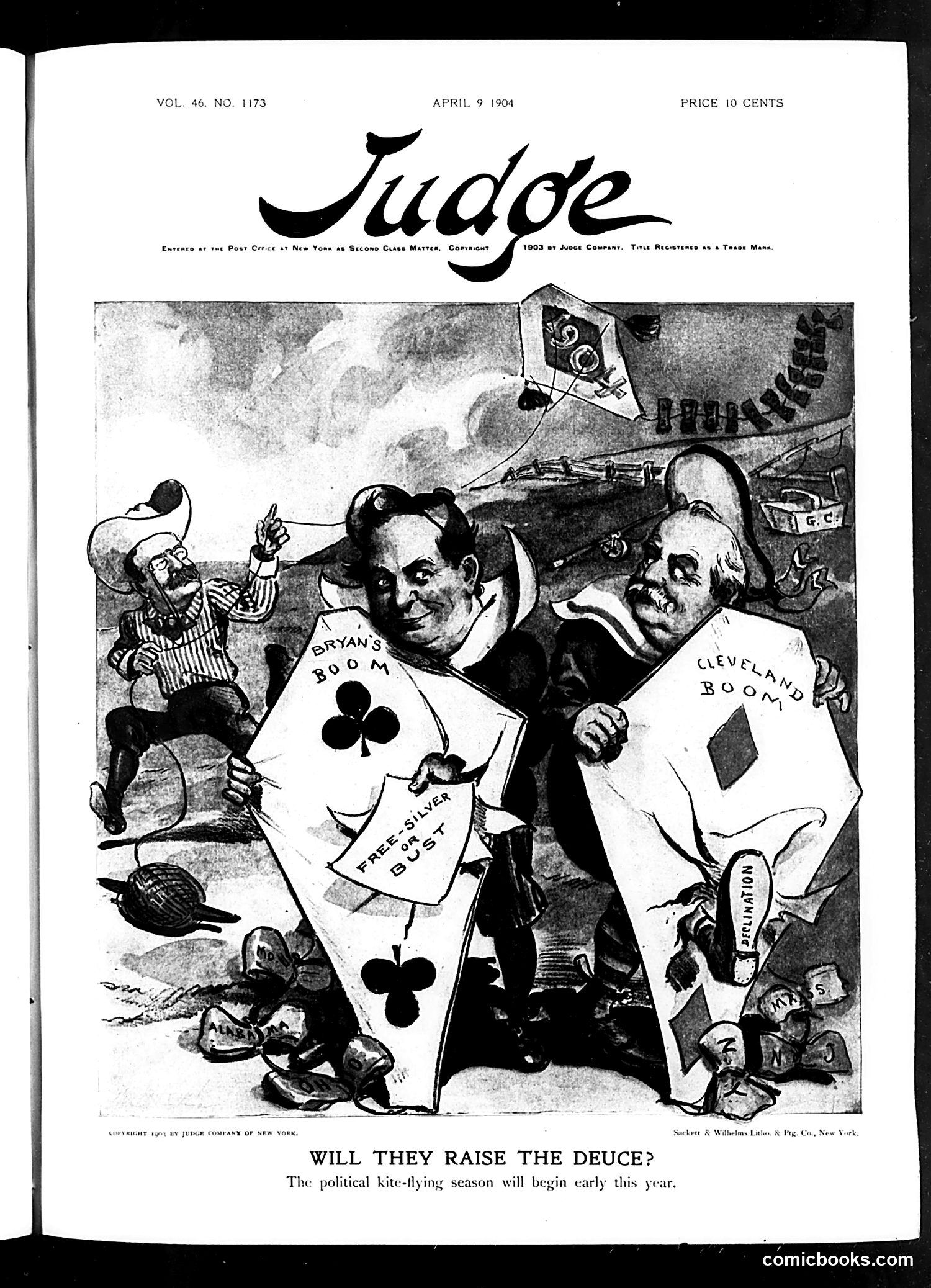
This satirical cartoon depicts the 1904 presidential election season. The central figure appears to be a playing card (the deuce of clubs) labeled "FREE SILVER BUST," flanked by two men labeled "BRYAN'S BOOM" and "CLEVELAND BOOM"—likely referencing William Jennings Bryan and Grover Cleveland, prominent Democratic figures. The title's pun—"raise the deuce" means to cause trouble—jokes whether Democrats can revive their political fortunes. A Turkish figure on the left and kite-flying imagery reference the coming campaign season. The various objects scattered about (cannons, military equipment) suggest political turmoil and competing factions within the Democratic party struggling to determine their 1904 platform and candidate.
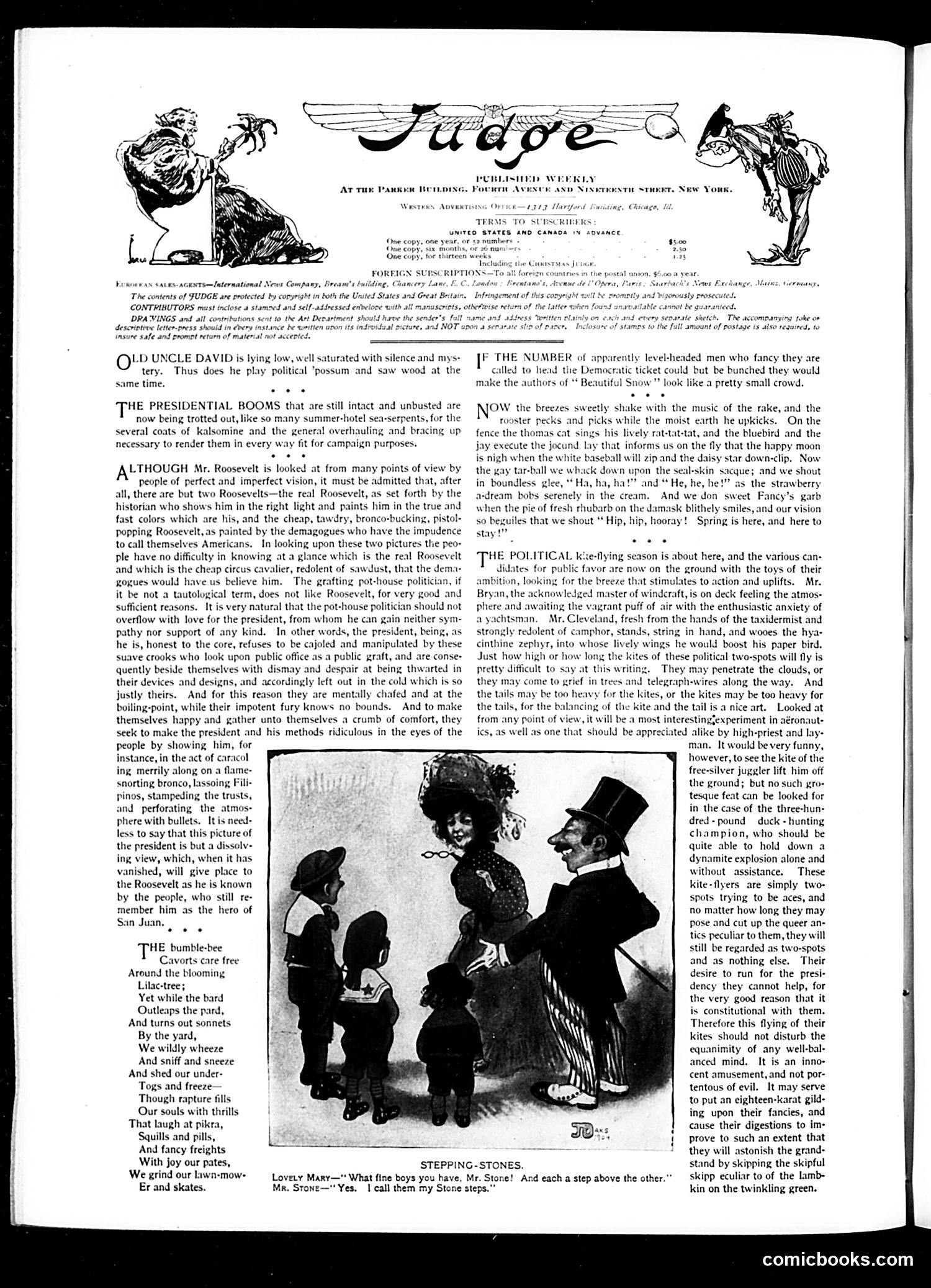
This page contains political commentary rather than a single unified cartoon. The main article criticizes President Roosevelt's inconsistent political positions and painting style, arguing his idealized portrayals don't match reality. The text suggests Roosevelt is unreliable and self-serving. The illustrated section titled "Stepping-Stones" depicts two women in conversation about boys and steps—likely a social commentary on courtship rituals of the era, with dialogue about "Mr. Store" and "my Sivic steps." The left column includes a poem about nature ("The bumble-bee / Cavorts free / Around the blooming / Lilac-tree"). The overall tone is satirical commentary on Roosevelt's political character and contemporary social customs, typical of Judge magazine's style during the Progressive Era.
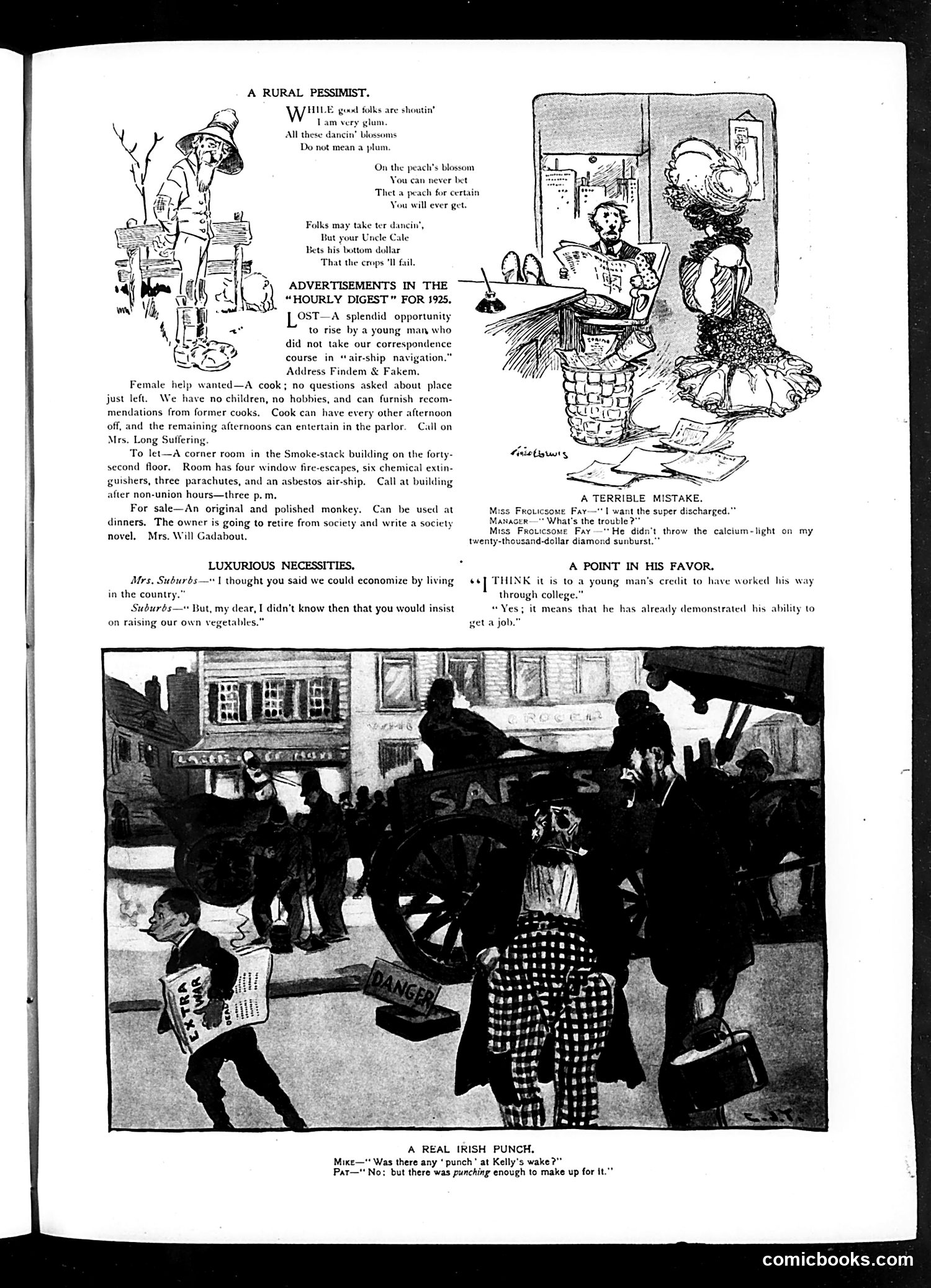
This 1925 page contains humor and advertisements reflecting post-WWI American life. **"A Rural Pessimist"** (top left) mocks rural farmers' negative outlook through verse about failed crops and financial hardship—relevant during the 1920s agricultural depression. **"A Terrible Mistake"** (top right cartoon) shows a woman accidentally discharging a calcium-light on her sunburned skin, a slapstick joke about early beauty treatments. **"A Real Irish Punch"** (large bottom photograph) appears to show a street scene with people and vehicles, with a caption joking about a "punch" at Kelly's establishment, likely playing on Irish stereotypes common to 1920s humor. The page includes classified advertisements for cooks, room rentals, and sales—typical period classifieds reflecting Depression-era economic conditions and labor scarcity.
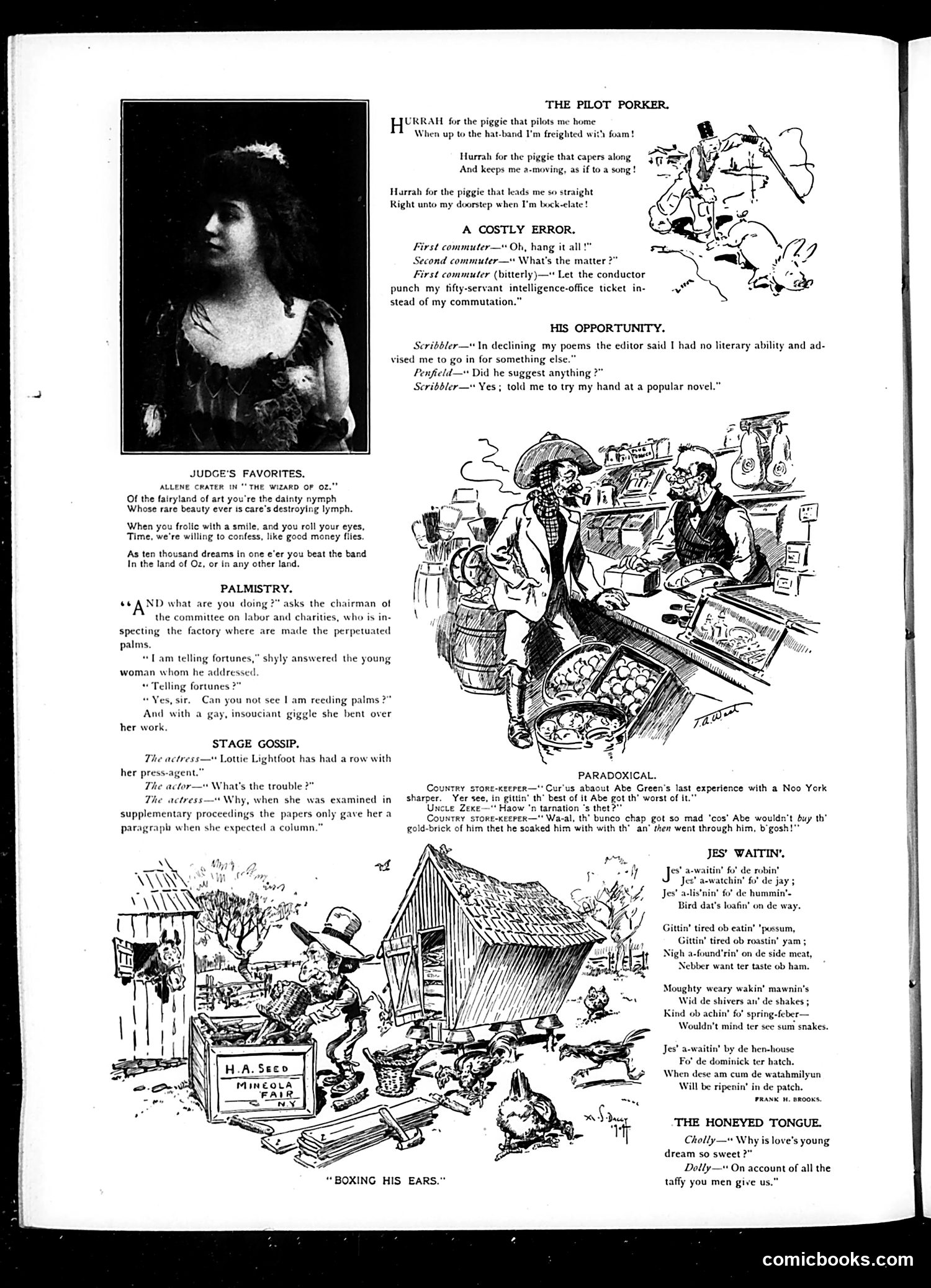
This page contains multiple humorous sketches and anecdotes rather than unified political commentary. **"The Pilot Porker"** mocks a pig that supposedly pilots a boat—satirizing incompetence or foolishness through animal metaphor. **"A Costly Error"** jokes about a commuter punching an officer over a ticket mix-up, satirizing bureaucratic absurdity. **"His Opportunity"** ridicules a struggling poet/scribbler advised by an editor to write a popular novel instead—mocking both failed writers and commercial publishing pressure. **"Palmistry"** depicts a fortune teller making money off gullible clients, satirizing both con artists and people's belief in superstitions. **"Stage Gossip"** contains theatrical rumors, typical Judge content targeting entertainment world drama. **"Boxing His Ears"** (illustration) and **"Jes' Waitin'"** (poem) appear to be dialect humor, common to the era. The page lacks coherent theme—it's typical Judge miscellany: satirizing human foibles, incompetence, and vanity across various social classes and professions.
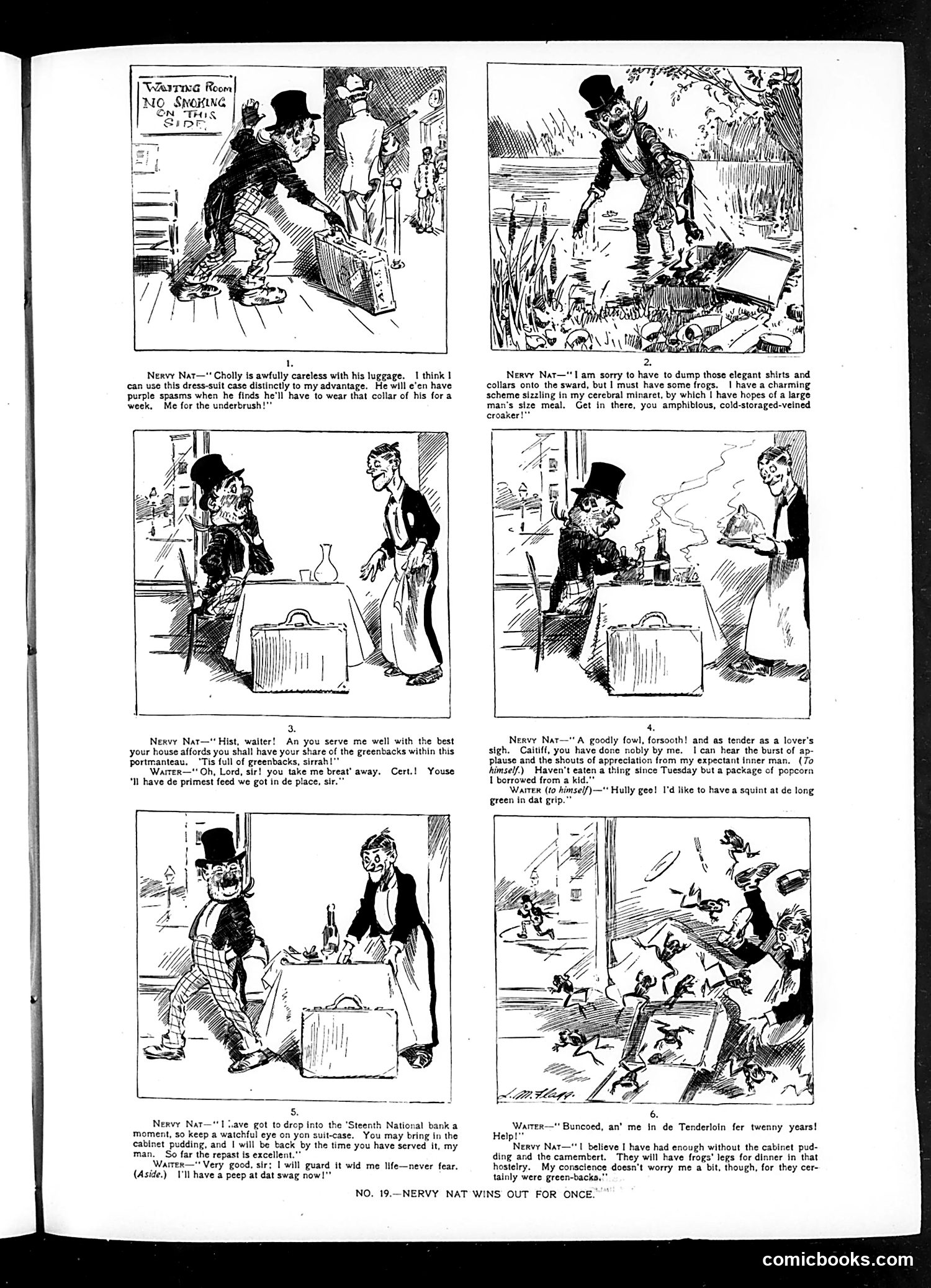
This comic strip satirizes a con artist protagonist who repeatedly outwits others through deception. "Nervy Nat" steals a waiter's attention and valuables by posing as a wealthy gentleman with a suitcase full of cash ("greenbacks"). The waiter, eager for a tip, abandons his duties and neglects to guard Nat's luggage—which Nat has deliberately filled with frogs instead of money. The humor relies on class-based trickery: Nat exploits the waiter's greed and servility, using fake promises of wealth to distract him. When the waiter later discovers the deception ("Buncoed"), Nat escapes unpunished, having obtained a free meal. The title claims this is one rare instance where Nat succeeds—implying he's typically caught. The satire mocks both the criminal's audacity and the easily-fooled servant class.
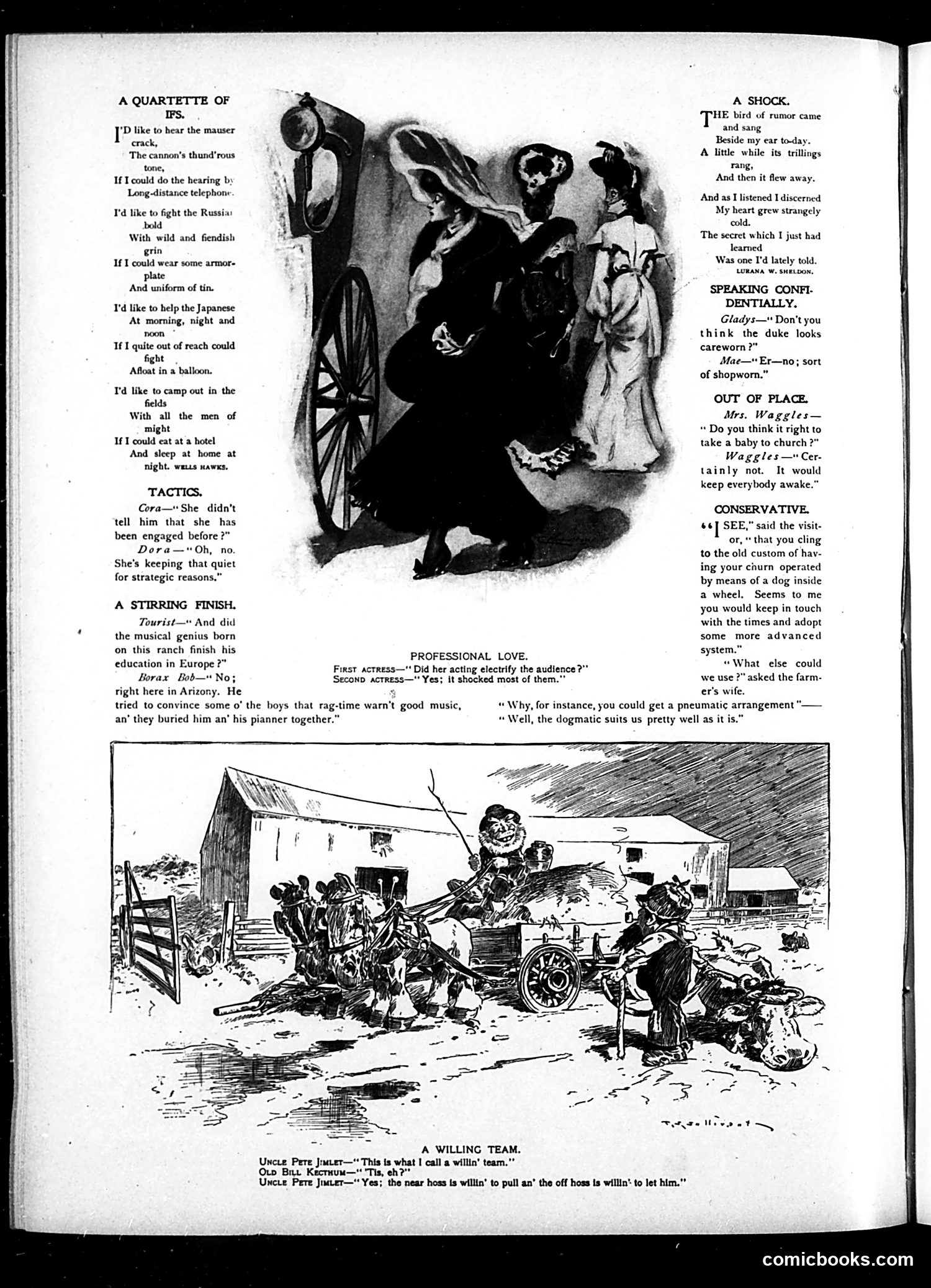
This page contains multiple short humorous sketches typical of early 20th-century American satire: **"A Quartette of Ifs"** mocks militaristic fantasies—a character wishes to hear cannons, fight Russians with "wild and fiendish" tactics, help Japan, and fight from a balloon. It satirizes armchair jingoism and impractical martial enthusiasm. **Other brief comedic dialogues** include social observations: a woman worried about appearing "shopworn," debate over taking babies to church, and mockery of agricultural conservatism (defending dog-powered churns over modern pneumatic systems). **"A Willing Team"** (bottom cartoon) uses rural dialect humor: a farmer boasts his horses form a "willing team"—one willing to pull the cart, the other willing to *let* the first do the work. It's gentle mockery of farm life and animal laziness. The sketches blend political commentary, social class humor, and domestic comedy typical of Judge's editorial approach—mildly satirizing militarism, pretension, and resistance to modernization.
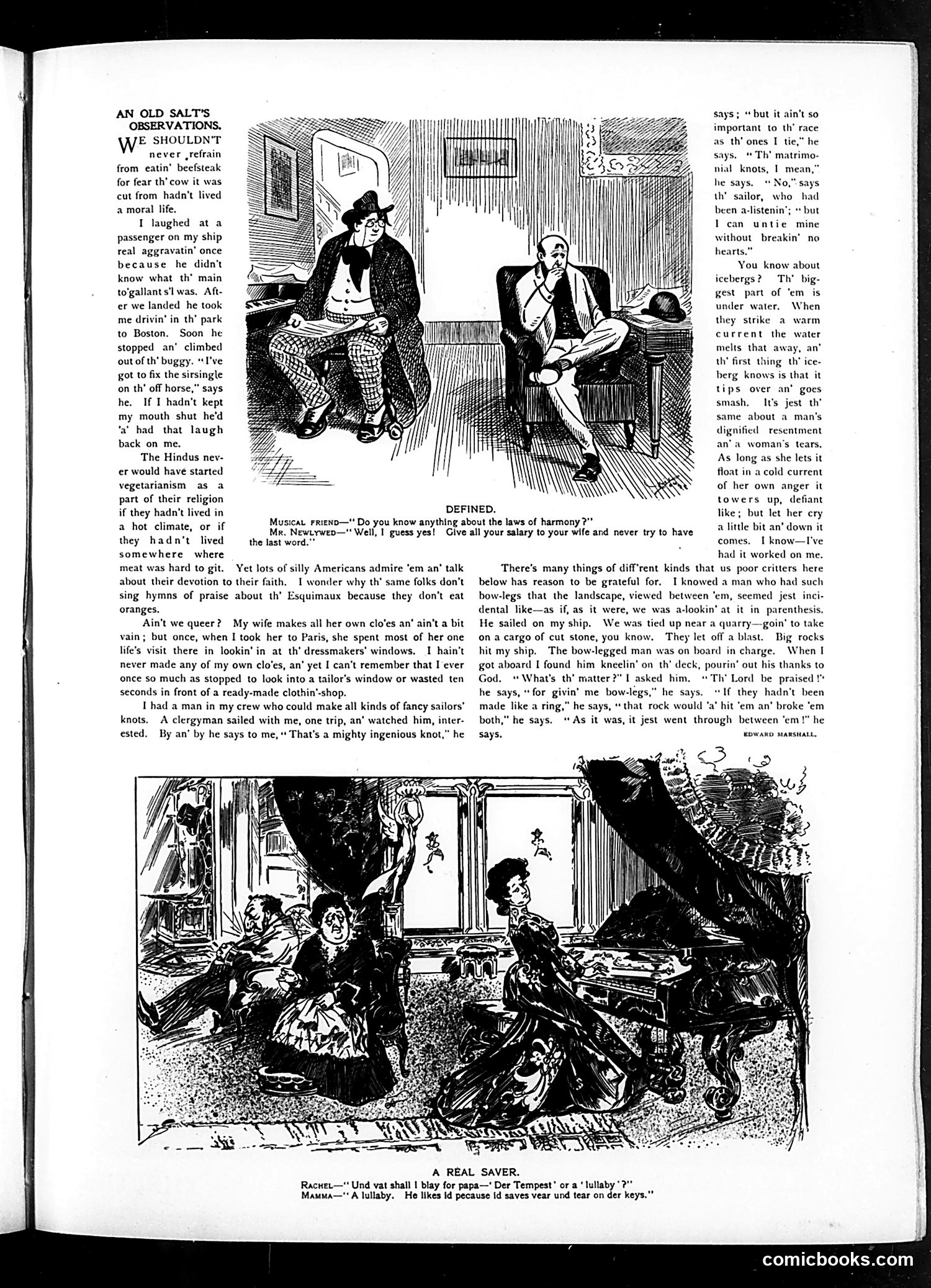
This page presents a crusty sailor's philosophical observations on human nature's contradictions. The humor relies on the narrator (an experienced seaman) deflating pretentious or illogical behavior through working-class common sense. Key satirical points: 1. **Religious hypocrisy**: Hindus are admired for vegetarianism (actually climate-driven necessity), while Eskimos aren't praised for not eating oranges—same logic, different reactions. 2. **Vanity and pretense**: His wife makes her own clothes unpretentiously, yet obsesses over Parisian dressmakers' windows; he ignores tailors entirely. The contradiction isn't about the activities but self-deception. 3. **"Matrimonial knots"**: A clergyman admires a sailor's fancy knots, missing that marriage bonds matter more than decorative ones. 4. **Unexpected blessing**: A bow-legged man survives a rockfall *because* of his deformity—providence rewarding what seems a curse. The "Real Saver" cartoon below (caption unclear in OCR) likely presents a similar ironic twist about economy. The tone is populist, mocking educated pretense and celebrating practical wisdom.
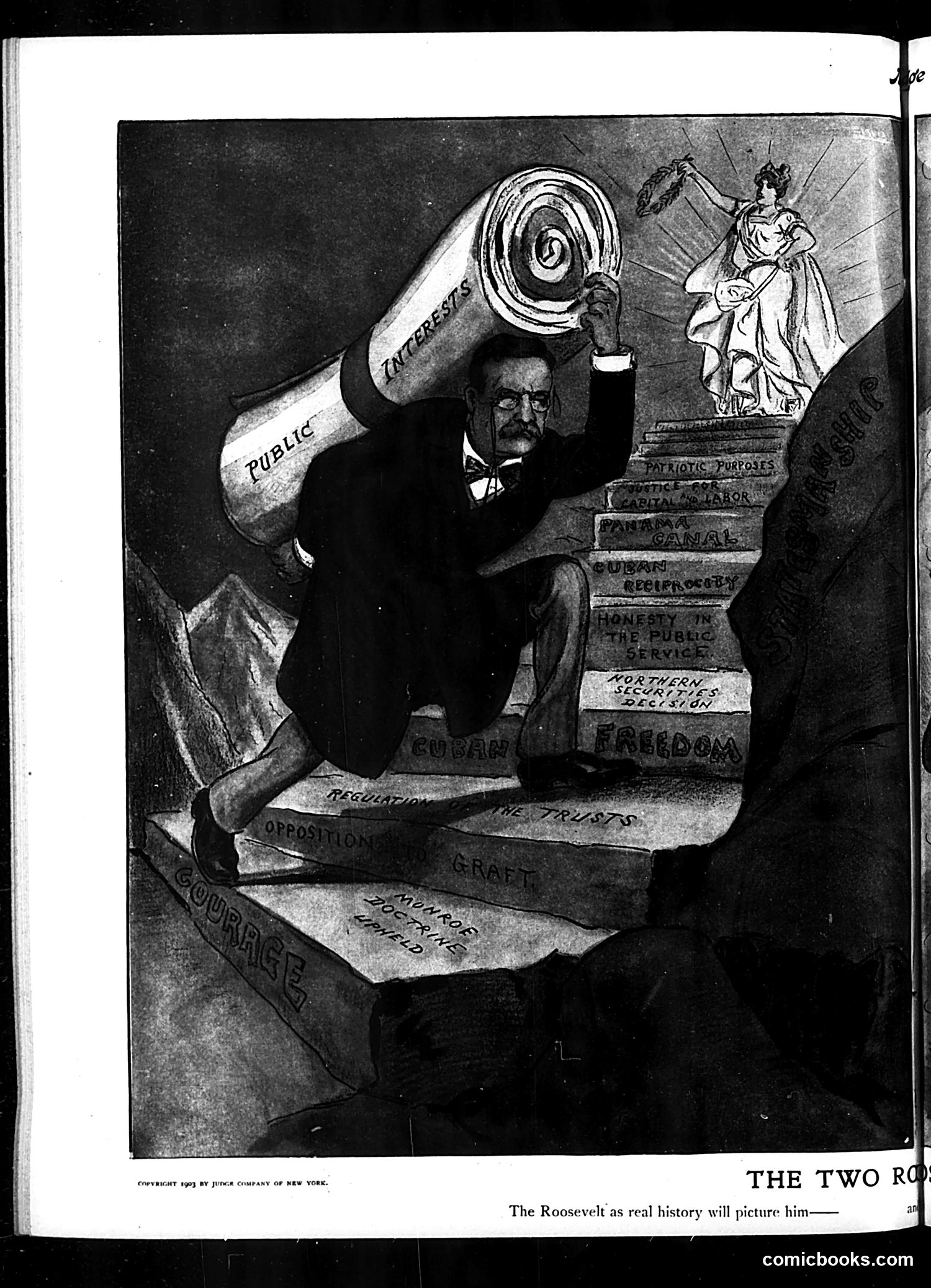
This appears to be a satirical Judge magazine cartoon depicting Theodore Roosevelt climbing a steep staircase of accomplishments and principles. The visible steps are labeled with items like "PANAMA CANAL," "HONESTY IN PUBLIC SERVICE," "NORTHERN SECURITIES DECISION," "FREEDOM," and "TRUST." Roosevelt, shown as a determined figure in formal attire, hoists a large megaphone labeled "PUBLIC INTERESTS" overhead. A classical female figure (likely representing Liberty or Justice) stands atop the stairs, endorsing his ascent. The cartoon's caption—"The Roosevelt as real history will picture him"—suggests this is praising Roosevelt's legacy and accomplishments during his presidency. It presents him climbing toward greatness through progressive reforms and moral principles, portraying his administration positively as historically significant and virtuous.
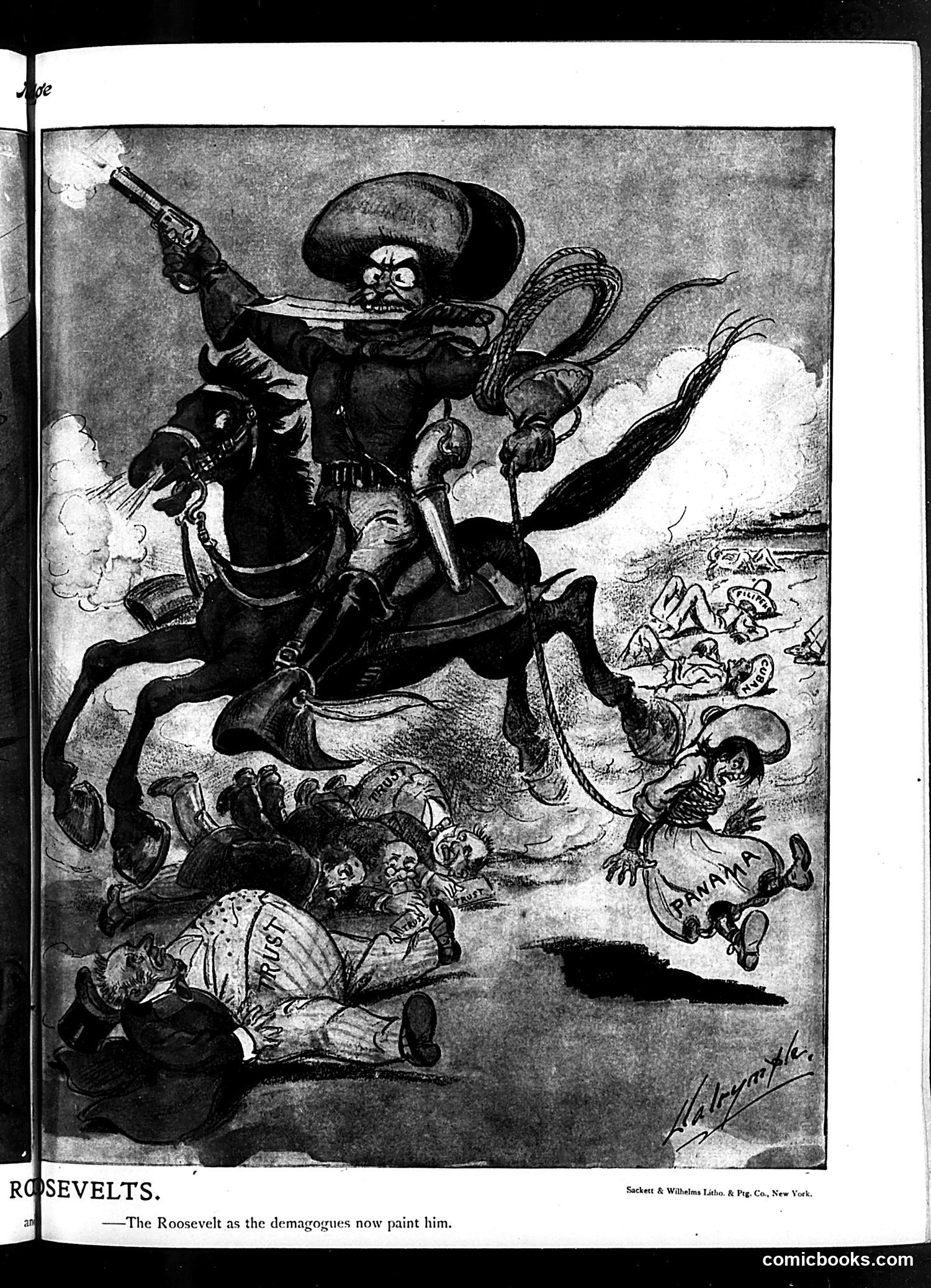
This satirical cartoon from *Judge* magazine depicts Theodore Roosevelt as a demonic, menacing figure on horseback, firing a gun while trampling smaller caricatured figures beneath him. The smaller figures appear to represent Roosevelt's political opponents or critics, labeled to identify specific groups. The cartoon is a meta-commentary: it claims to show "how demagogues paint" Roosevelt—essentially arguing that his opponents exaggerate and demonize him unfairly. By presenting this grotesque caricature with ironic framing, the cartoonist defends Roosevelt against what he considers unfair political attacks. The satire targets Roosevelt's critics rather than Roosevelt himself, suggesting their depictions of him are hyperbolic propaganda rather than accurate representation.
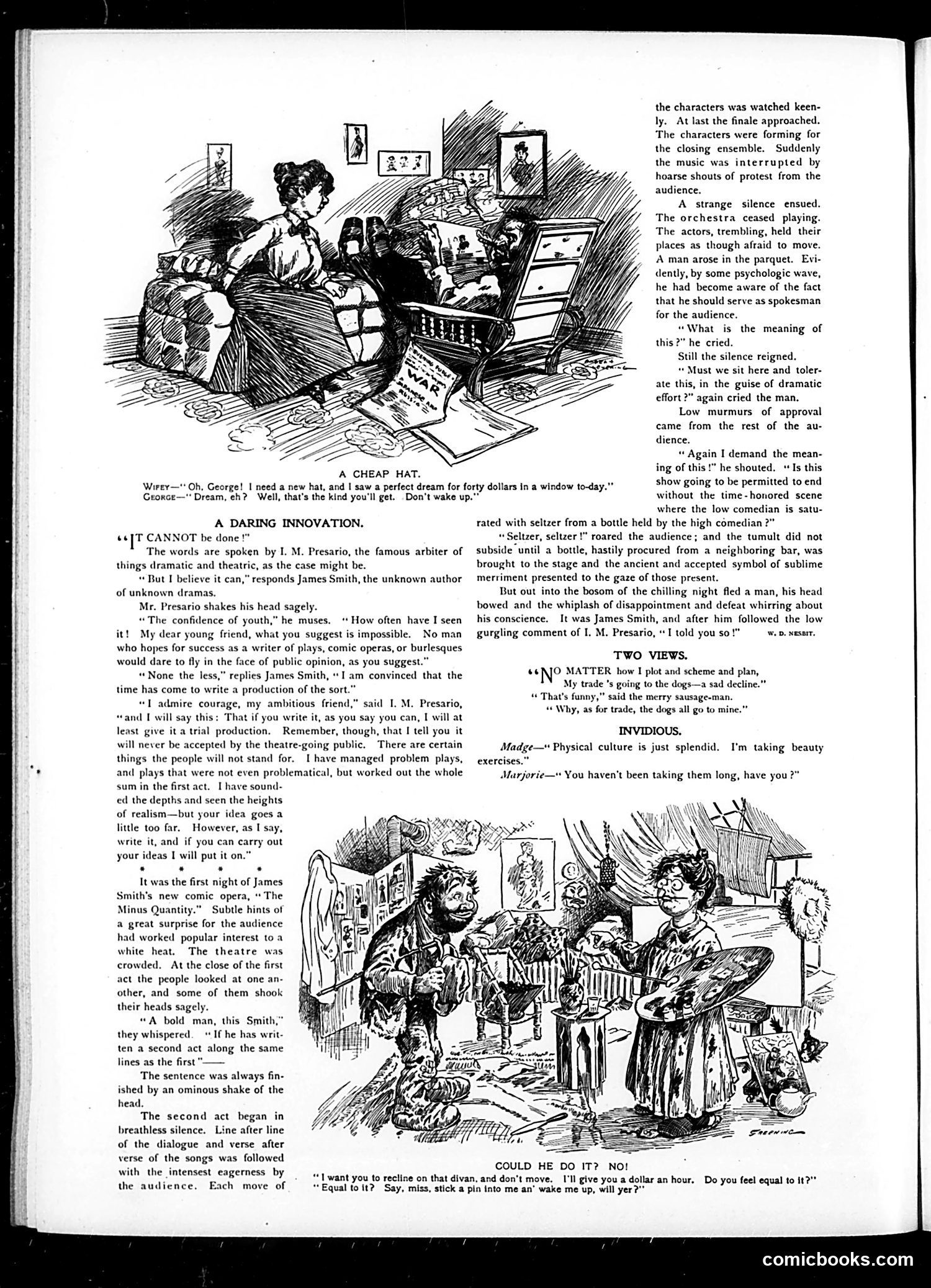
This two-part cartoon mocks theatrical conservatism and audience expectations. **Upper cartoon:** A wife dreams of an expensive hat; her husband dismisses it as mere fantasy, suggesting working-class financial struggle. **Main story/lower cartoon:** Theater producer I. M. Presario (a stock character representing theatrical establishment gatekeepers) tells unknown playwright James Smith his new comic opera is too daring and will fail. Smith proceeds anyway. Opening night proves Presario wrong—until the finale, when the audience riots, demanding the traditional seltzer-bottle gag (a stock vaudeville bit where comedians spray each other). The crowd cannot accept innovation without this familiar comedic trope. **The satire's point:** Both theaters and audiences cling to tired conventions. Smith's bold attempt fails not from artistic weakness but audience demand for predictable, lowbrow humor. The joke satirizes both theatrical establishments resisting change *and* popular taste preventing progress—a common Progressive-era critique of American culture's resistance to artistic innovation.
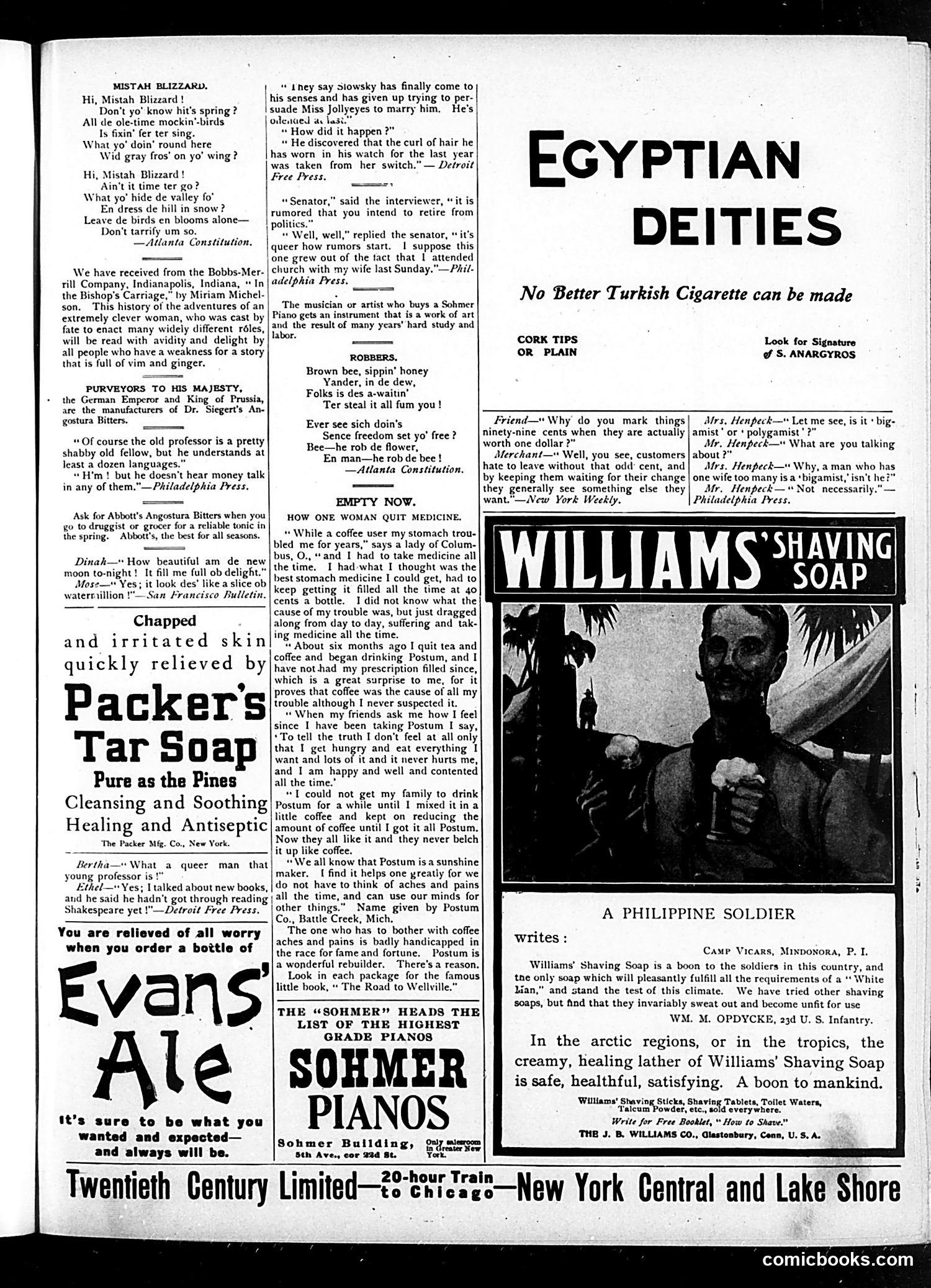
This page is primarily **advertising and light humor**, typical of early 20th-century Judge magazine. The content includes: **"Mistah Blizzard"** poem uses dialectal speech (representing African American vernacular of the era) to personify winter as an unwelcome visitor disrupting nature—a common poetic device of the period, though the dialect reflects outdated and offensive conventions. **The humor pieces** are brief anecdotes with punchlines about everyday life: a man's romantic rejection, a senator's church attendance as evidence he's not retiring, and a woman's discovery that coffee caused her stomach troubles. **The advertisements dominate the page**, hawking patent medicines (Angostura Bitters, Packer's Tar Soap), pianos, shaving soap, and Evans Ale. The Williams' Shaving Soap ad includes a testimonial from a Philippine soldier—referencing America's colonial presence there. **Overall:** This reflects early 1900s American consumer culture, racial attitudes in humor, and heavy reliance on medicinal products for ailments (often caused by those same products).
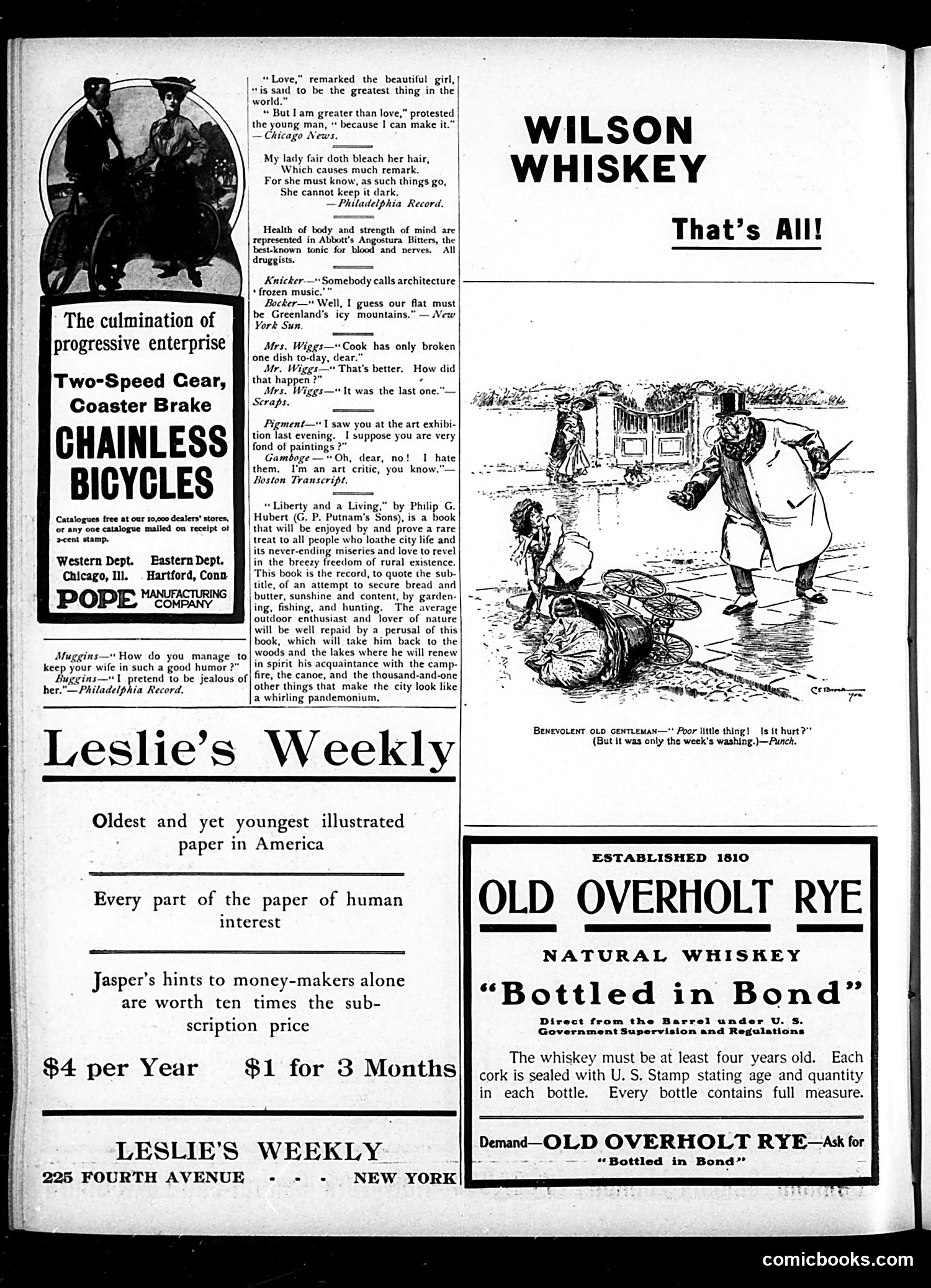
This page mixes advertisements with humor content typical of early 20th-century Judge magazine. **The Cartoons/Jokes:** The page contains several short comic dialogues and one illustrated cartoon (bottom right). The cartoon shows a well-dressed gentleman inquiring if a poor child is hurt, only to learn it's just the weekly laundry—a class-commentary joke about poverty. The verbal jokes scattered throughout play on wordplay and domestic situations (bleached hair, broken dishes, art criticism, marital jealousy). **Advertisements:** The substantial ads promote Pope bicycles ("chainless" models), Abbott's Angostura Bitters (a tonic), and whiskeys (Wilson Whiskey, Old Overholt Rye). The Old Overholt ad emphasizes government supervision and bonding—likely responding to early 20th-century concerns about whiskey adulteration and pure food safety. **Overall:** This is primarily an advertising-heavy page with light satirical humor typical of Judge's format—social observation rather than political commentary.
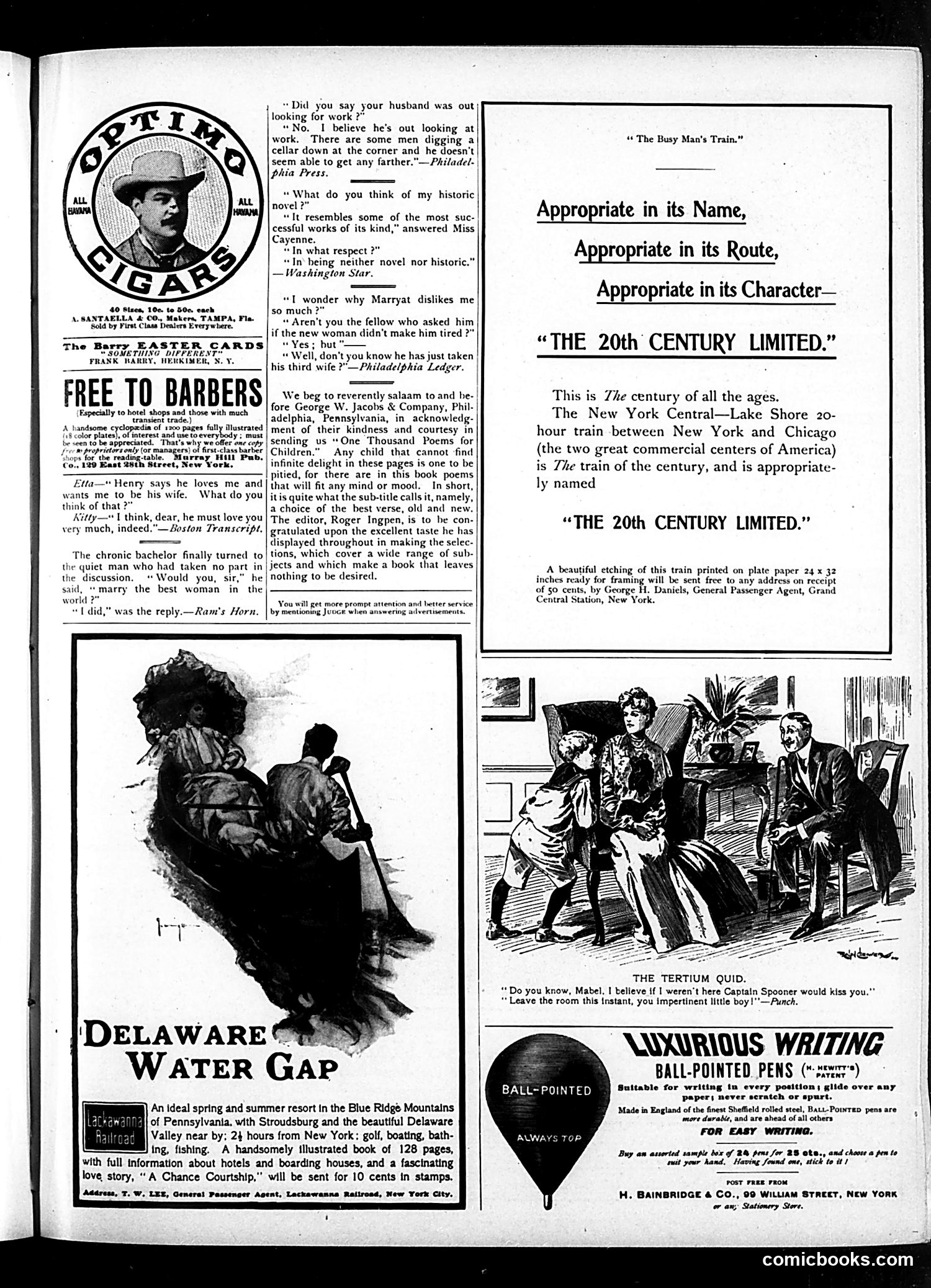
This page is primarily **advertising and light humor** rather than political satire. The content includes: **Main Elements:** - Multiple short humorous anecdotes (jokes about wives, bachelors, novels) typical of period magazines - Advertisements for cigars, barber shop encyclopedias, writing pens, and resort destinations - A railroad advertisement for the "20th Century Limited" train between New York and Chicago, emphasizing it as appropriately named for "the century of all the ages" - An illustration labeled "The Tertium Quid" (Latin: "the third thing") showing what appears to be a domestic scene with a woman, children, and a man—likely a Victorian-era joke about propriety **Context for Modern Readers:** The page reflects early 1900s American middle-class sensibilities: workplace humor, gender relations assumptions, and corporate advertising celebrating industrial progress (the railroad). The brief jokes rely on period-specific social attitudes about marriage, ambition, and propriety that would resonate with contemporary readers but require historical context today.
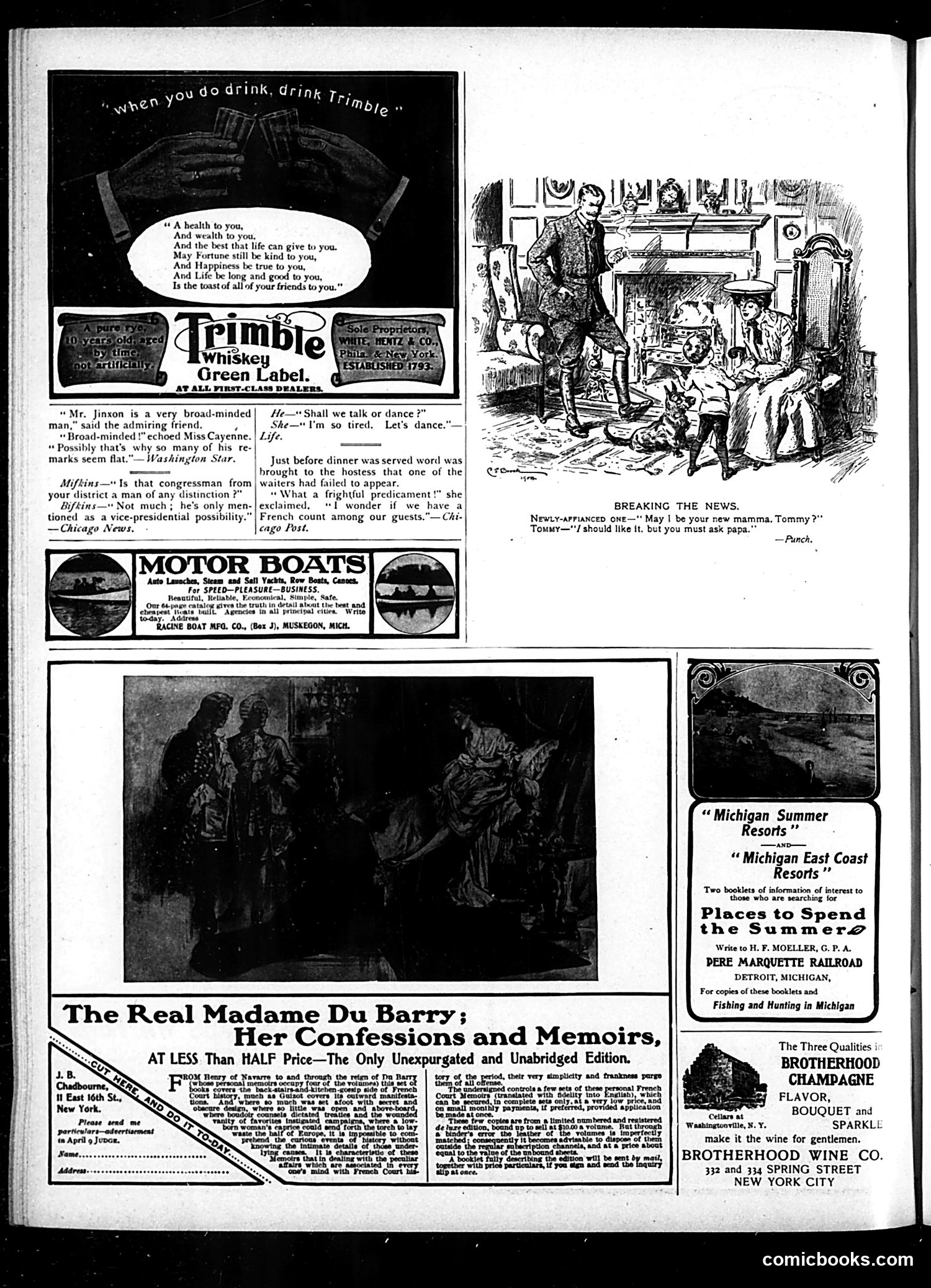
This page consists primarily of **advertisements and short humor pieces** rather than political cartoons. The humor items are brief, genteel jokes typical of early 1900s magazines: - A congressman described as only notable for "vice-presidential possibility" (mocking his obscurity) - A woman praising a man as "broad-minded" while his remarks are "flat" (wordplay on contradiction) - A woman preferring to dance rather than talk when tired (gentle domestic humor) - A hostess hoping for a "French count" among guests to substitute for a missing waiter (playing on stereotypes about French service) - A child asking a woman if she'll be his new mother, redirecting her to ask his father (innocent child humor) **Advertisements dominate**: Trimble Whiskey with a sentimental toast, motor boats, Michigan resort railroads, and the unexpurgated "Madame Du Barry" memoirs. The page reflects the magazine's mix of light social satire and commercial appeals rather than sharp political commentary. No specific political figures or events appear to be referenced.
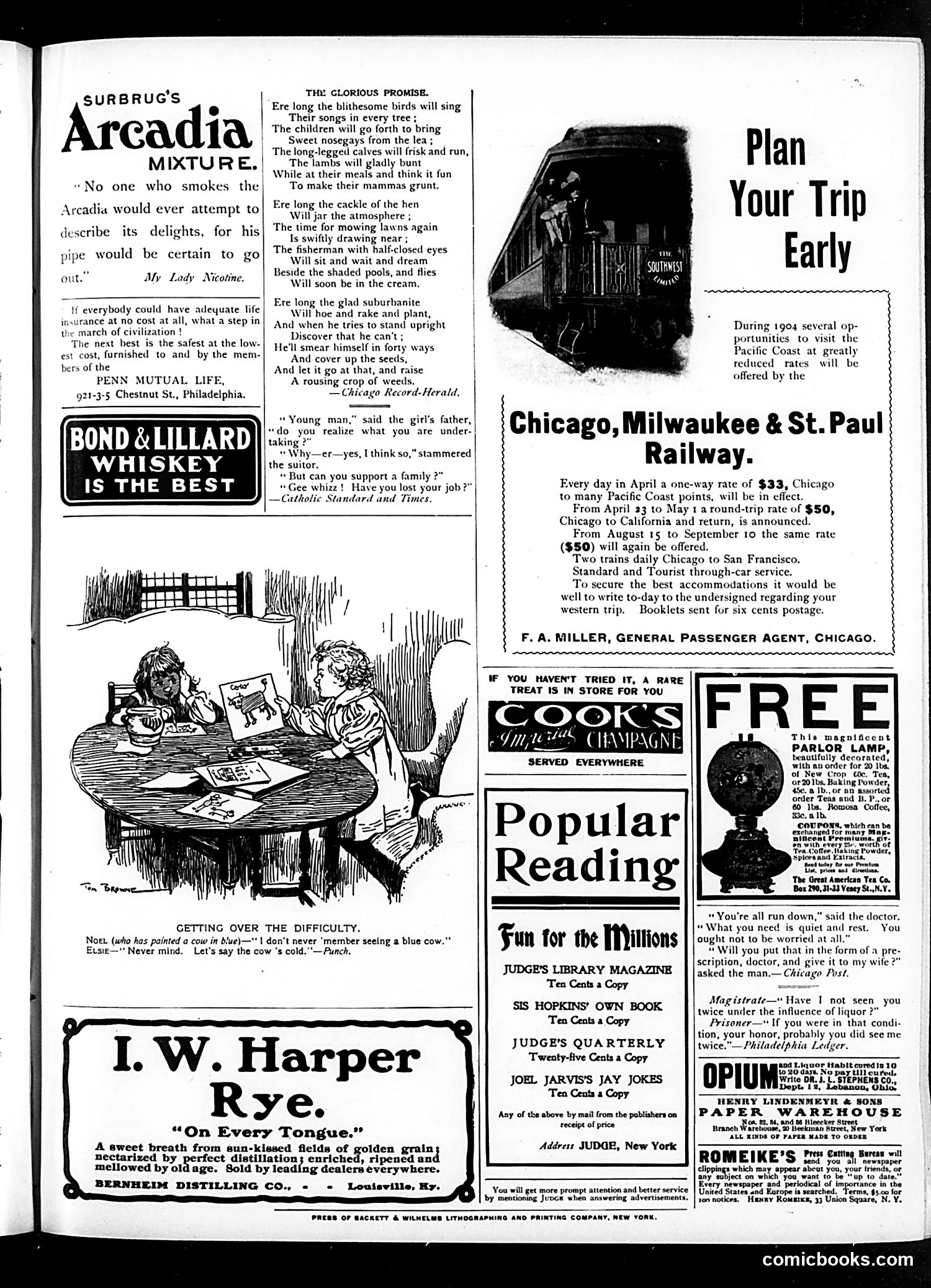
This page is primarily **advertisements and filler content** with one notable cartoon titled "Getting Over the Difficulty." The cartoon depicts an artist who has mistakenly painted a cow **blue** instead of its natural color. When questioned about this error, his companion offers the absurd explanation: "Never mind. Let's say the cow's cold." This is a **joke about rationalization and poor excuses**—the cartoon mocks how people attempt to cover up obvious mistakes with ridiculous justifications rather than admit fault. The humor lies in the complete implausibility of claiming a cow is merely "cold," which wouldn't explain its blue coloring at all. The rest of the page consists of period advertising for whiskey, tobacco, insurance, railway travel, tea, and magazines—typical of early 1900s Judge content. No specific political satire appears on this particular page.
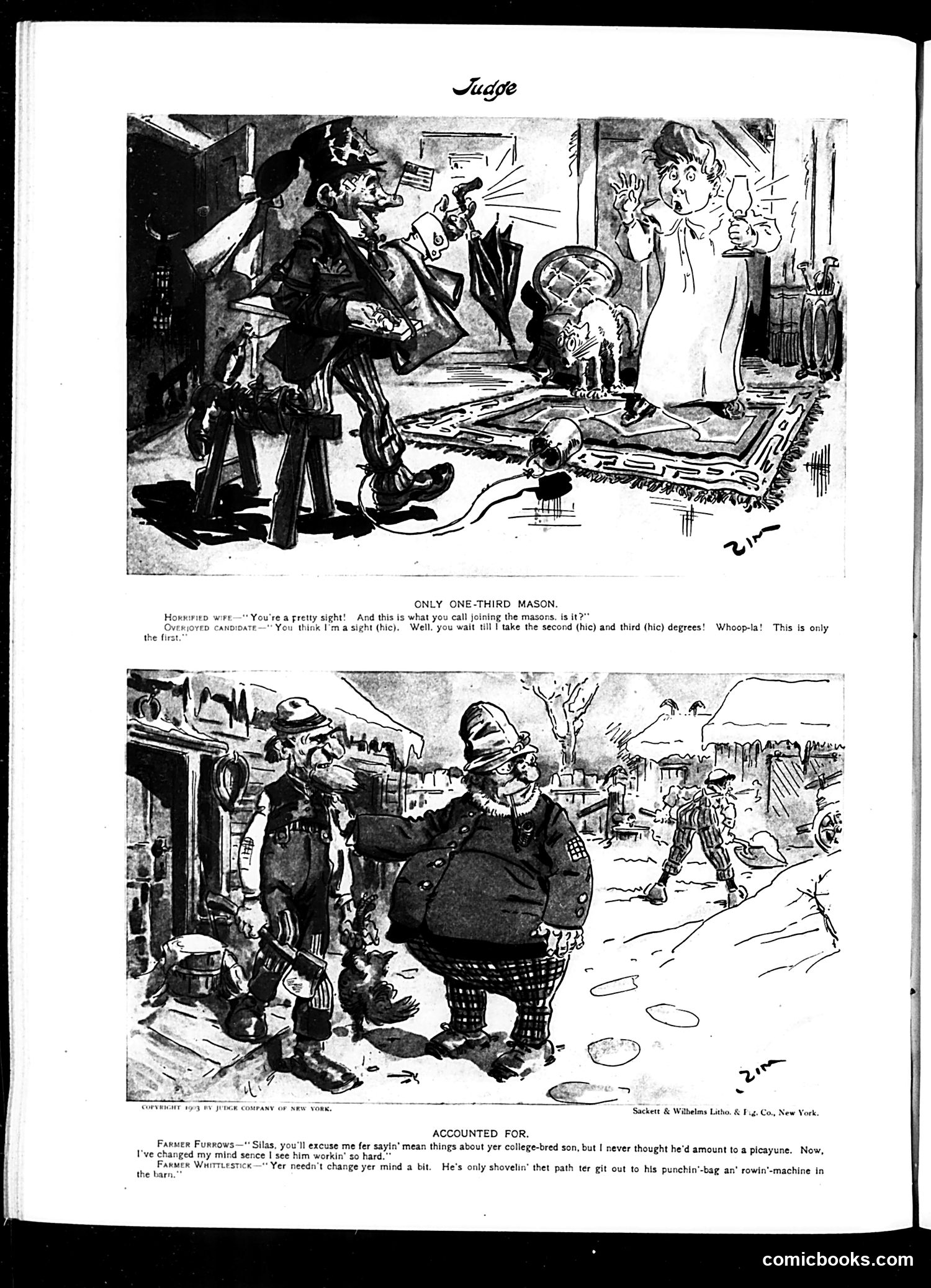
These two satirical cartoons mock social pretensions of the era: **"Only One-Third Mason"** (top): A drunk candidate for Freemasonry is shown staggering and disheveled. His wife scolds him for joining the Masons, noting he's only completed the first degree. The joke ridicules both the candidate's drunkenness and the pomposity of fraternal organizations—he's barely accomplished the "first" of three degrees, yet already acts insufferably. **"Accounted For"** (bottom): A farmer initially insulted his neighbor's college-educated son as worthless, but now praises his work ethic upon seeing him labor. The neighbor reveals the son merely uses the work path to access his exercise equipment (punching bag and rowing machine) in the barn—he's not actually industrious, just vain about physical fitness. Both cartoons satirize American social climbing and pretension: whether joining exclusive clubs or flaunting collegiate education and modern exercise equipment, the underlying subjects are revealed as shallow or fraudulent.