
Judge, 1904-04-09 · page 7 of 16
Judge — April 9, 1904 — page 7: what you’re looking at
What you’re looking at
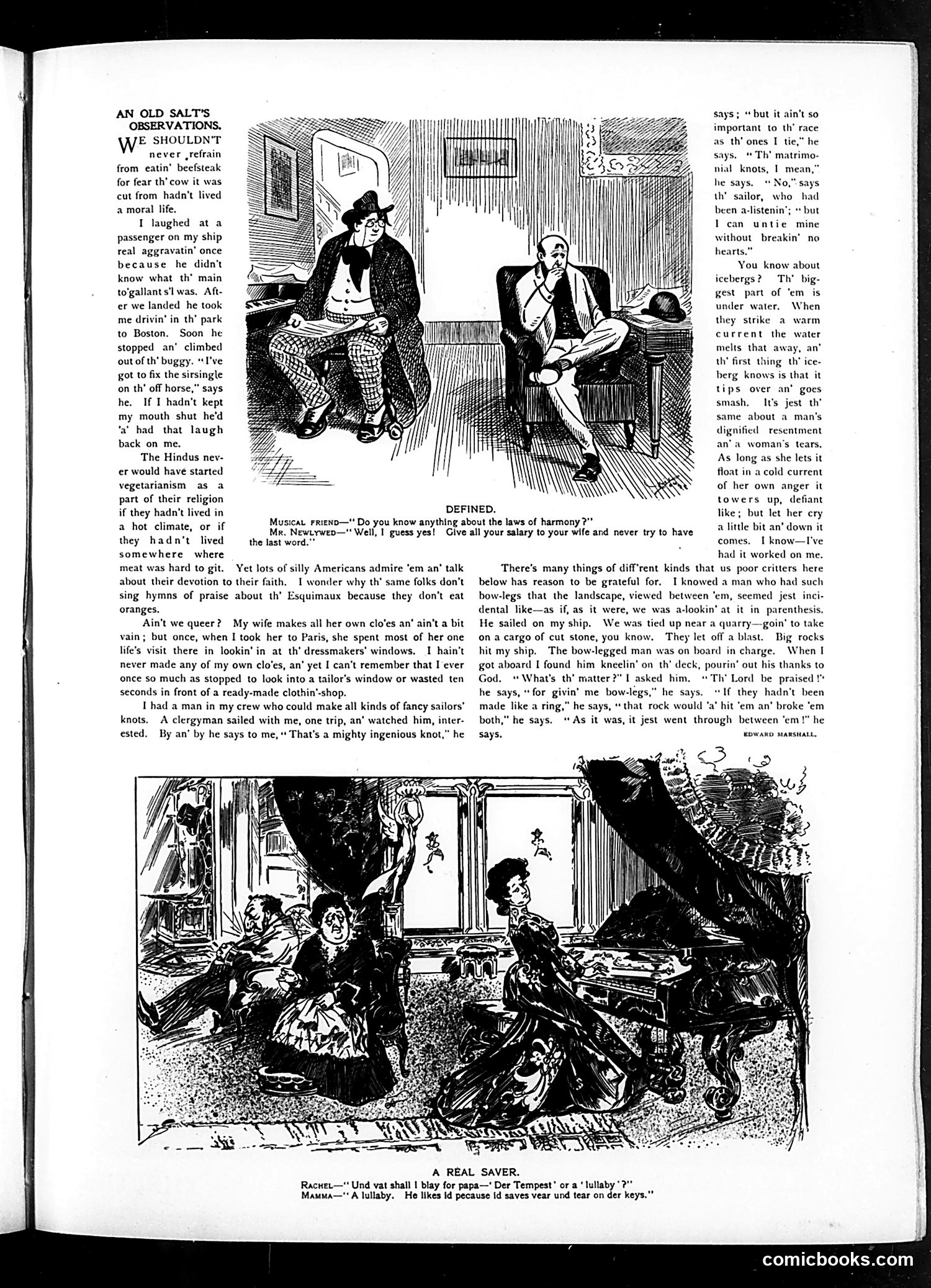
This page presents a crusty sailor's philosophical observations on human nature's contradictions. The humor relies on the narrator (an experienced seaman) deflating pretentious or illogical behavior through working-class common sense. Key satirical points: 1. **Religious hypocrisy**: Hindus are admired for vegetarianism (actually climate-driven necessity), while Eskimos aren't praised for not eating oranges—same logic, different reactions. 2. **Vanity and pretense**: His wife makes her own clothes unpretentiously, yet obsesses over Parisian dressmakers' windows; he ignores tailors entirely. The contradiction isn't about the activities but self-deception. 3. **"Matrimonial knots"**: A clergyman admires a sailor's fancy knots, missing that marriage bonds matter more than decorative ones. 4. **Unexpected blessing**: A bow-legged man survives a rockfall *because* of his deformity—providence rewarding what seems a curse. The "Real Saver" cartoon below (caption unclear in OCR) likely presents a similar ironic twist about economy. The tone is populist, mocking educated pretense and celebrating practical wisdom.
📄 Transcribed text from this page (OCR, searchable)
Machine-transcribed from the original scan — historical spelling and the odd misread are preserved.
AN OLD SALT’S OBSERVATIONS. E SHOULDN'T never ,refrain from eatin’ beefsteak for fear th’ cow it was cut from hadn't lived a moral life. I laughed at a passenger on my ship real aggravatin’ once because he didn't know what th’ main to'gallants'l was. Aft- er we landed he took me drivin’ in th’ park to Boston. Soon he stopped an’ climbed out of th’ buggy. “I've got to fix the sirsingle on th’ off horse,” says he, If I hadn't kept my mouth shut he'd ‘a’ had that laugh back on me, The Hindus nev- er would have started vegetarianism as a part of their religion if they hadn't lived in a hot climate, or if they hadn't lived somewhere where meat was hard to git. Yet lots of silly Americans admire ‘em an’ talk about their devotion to their faith. I wonder why th’ same folks don’t sing hymns of praise about th’ Esquimaux because they don't eat oranges. Ain't we queer? My wife makes all her own clo’es an’ ain't a bit vain ; but once, when I took her to Paris, she spent most of her one life's visit there in lookin’ in at th’ dressmakers’ windows. I hain’t never made any of my own clo’es, an’ yet I can't remember that I'ever once so much as stopped to look into a tailor's window or wasted ten seconds in front of a ready-made clothin'-shop. Thad a man in my crew who could make all kinds of fancy sailors’ knots. A clergyman sailed with me, one trip, an’ watched him, inter- ested. By an’ by he says to me,“ That's a mighty ingenious knot,” he Mr. Newurweo—" Well, | guess yes! the last word."* 1G DEFINED. Musicat Frieno— Do you know anything about the laws of harmony?” Give all your salary to your wife and never try to have says; “but it ain't so important to th as th’ ones I tie, says, “ Th’ matrimo- nial knots, I mean,” he says. “No,” says th’ sailor, who had been a-listenin’; « but I can untie without hearts.” You know about icebergs? Th’ big- gest. part of ‘em is under water, When they strike a warm mine breakin’ no current the water melts that away, an’ UW’ first thing th’ ice- berg knows is that it tips over an’ goes smash, It’s jest. th’ same about a man’s dignified resentment an’ a woman's tears, As long as she lets it float in a cold current of her own anger it towers up, defiant like; but let her cry a little bit an’ down it comes. I know—I've had it worked on me. There's many things of diff'rent kinds that us poor critters here below has reason to be grateful for. I knowed a man who had such bow-legs that the landscape, viewed between ‘em, seemed jest inci- dental like—as if, as it were, we was a-lookin’ at it in parenthesis. He sailed on my ship. We was tied up near a quarry—goin’ to take on a cargo of cut stone, you know. They let off a blast. Big rocks hit my ship. The bow-legged man was on board in charge. When I got aboard I found him kneelin' on th’ deck, pourin’ out his thanks to God. “What's th’ matter?" I asked him. Th’ Lord be praised !* he says, “for givin’ me bow-legs,” he says. “If they hadn't been made like a ring,” he says, “that rock would ‘a’ hit ‘em an’ broke ‘em both,” he says. “As it was, it jest went through between ‘em !" he says. EDWARD MARSHALL, A REAL SAVER. “Und vat shall | blay for papa—' Der Tempest’ or a ‘lullaby "2"" ‘Alullaby. He likes Id pecause Id saves vear und tear on der keys."" comicbooks.com