
Judge, 1904-04-09 · page 10 of 16
Judge — April 9, 1904 — page 10: what you’re looking at
What you’re looking at
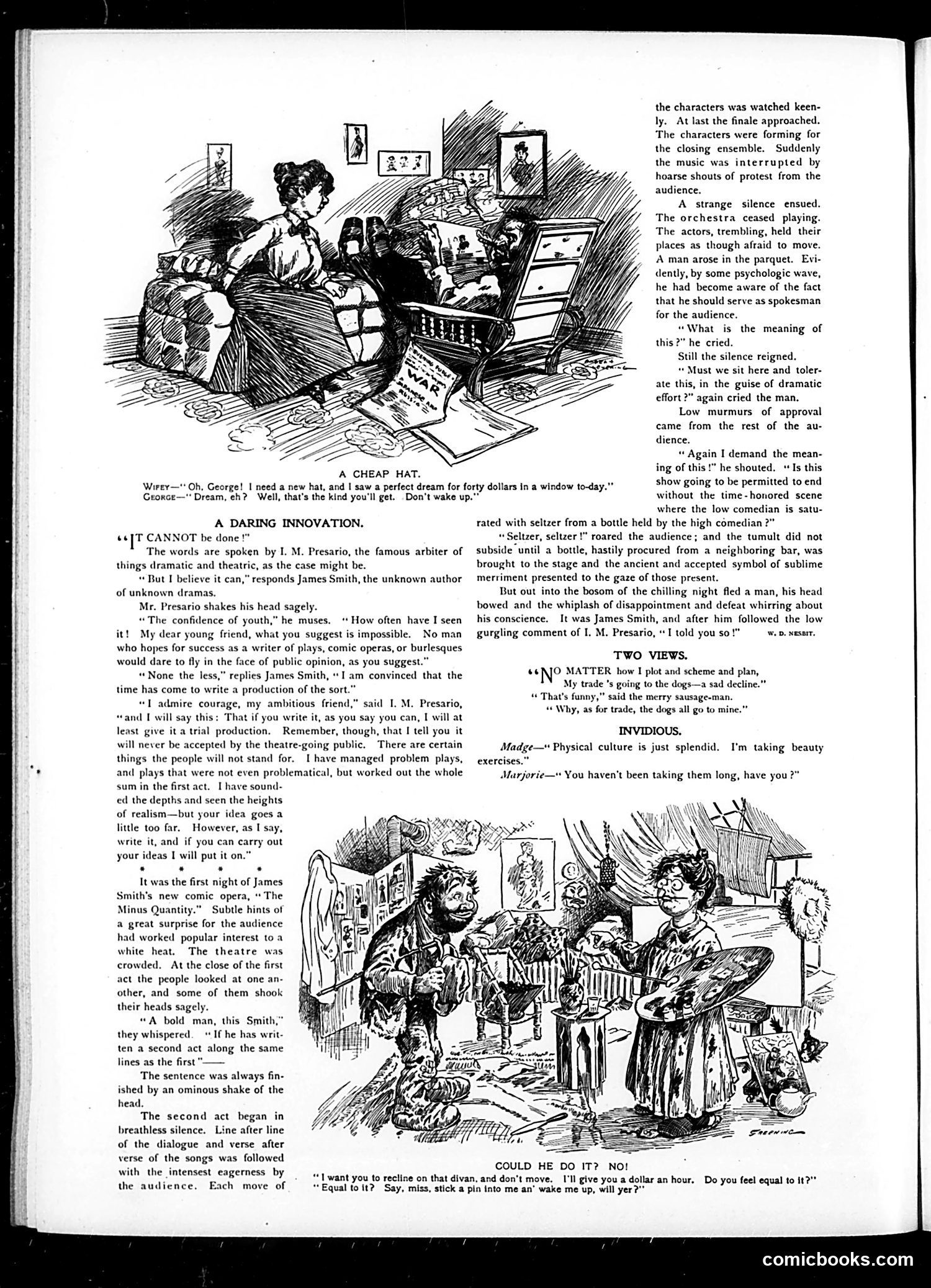
This two-part cartoon mocks theatrical conservatism and audience expectations. **Upper cartoon:** A wife dreams of an expensive hat; her husband dismisses it as mere fantasy, suggesting working-class financial struggle. **Main story/lower cartoon:** Theater producer I. M. Presario (a stock character representing theatrical establishment gatekeepers) tells unknown playwright James Smith his new comic opera is too daring and will fail. Smith proceeds anyway. Opening night proves Presario wrong—until the finale, when the audience riots, demanding the traditional seltzer-bottle gag (a stock vaudeville bit where comedians spray each other). The crowd cannot accept innovation without this familiar comedic trope. **The satire's point:** Both theaters and audiences cling to tired conventions. Smith's bold attempt fails not from artistic weakness but audience demand for predictable, lowbrow humor. The joke satirizes both theatrical establishments resisting change *and* popular taste preventing progress—a common Progressive-era critique of American culture's resistance to artistic innovation.
📄 Transcribed text from this page (OCR, searchable)
Machine-transcribed from the original scan — historical spelling and the odd misread are preserved.
A CHEAP HAT. Wirey—" Oh, George! I need a new hat, and | saw a perfect dream for forty dollars In a window to-day.” Don't wake up." Gtorce—"* Dream, eh? Well, that’s the kind you'll get. A DARING INNOVATION. oe I" CANNOT be done!" The words are spoken by I. M. Presario, the famous arbiter of things dramatic and theatric, as the case might be. “ But I believe it can,” responds James Smith, the unknown author of unknown dramas, Mr. Presario shakes his head sagely. “The confidence of youth,” he muses. ** How often have I seen it! My dear young friend, what you suggest is impossible. No man who hopes for success as a writer of plays, comic operas, or burlesques would dare to fly in the face of public opinion, as you suggest.” “None the less,” replies James Smith, I am convinced that the time has come to write a production of the sort. “1 admire courage, my ambitious friend,” said I. M. Presario, “and [ will say this: That if you write it, as you say you can, I will at least give ita trial production. Remember, though, that I tell you it will never be accepted by the theatre-going public. There are certain things the people will not stand for. I have managed problem plays, and plays that were not even problematical, but worked out the whole sum in the first act. I have sound- ed the depths and seen the heights of realism—but your idea goes a little too far, However, as I say, write it, and if you can carry out your ideas I will put it on.” . . . . It was the first night of James Smith's new comic opera, * The Minus Quantity.” Subtle hints of a great surprise for the audience had worked popular interest toa white heat. The theatre was crowded. At the close of the first act the people looked at one an- other, and some of them shook their heads sagely. “A bold man, this Smith,” they whispered.“ If he has writ- ten a second act along the same lines as the first "—— The sentence was always fin- ished by an ominous shake of the head. The second act began in breathless silence. Line after line of the dialogue and verse after verse of the songs was followed with the jintensest eagerness by the audience, Each move of “| want you to recline on that divan, and don't move. the characters was watched keen- ly. At last the finale approached. The characters were forming for the closing ensemble. Suddenly the music was interrupted by hoarse shouts of protest from the audience. A strange silence ensued. The orchestra ceased playing. The actors, trembling, held their places as though afraid to move. A man arose in the parquet. Evi. dently, by some psychologic wave, he had become aware of the fact that he should serve as spokesman for the audience. “What is the meaning of this?” he cried. Still the silence reigned. « Must we sit here and toler- ate this, in the guise of dramatic effort ?” again cried the man. Low murmurs of approval came from the rest of the au- dience. “ Again I demand the mean- ing of this!" he shouted, “Is this show going to be permitted to end without the time-honored scene where the low comedian is satu- rated with seltzer from a bottle held by the high comedian ?” Seltzer, seltzer!" roared the audience; and the tumult did not subside until a bottle, hastily procured from a neighboring bar, was brought to the stage and the ancient and accepted symbol of sublime merriment presented to the gaze of those present. But out into the bosom of the chilling night fled a man, his head bowed and the whiplash of disappointment and defeat whirring about his conscience. It was James Smith, and after him followed the low gurgling comment of I. M. Presario, “I told you so!" wp, xesarr. TWO VIEWS. MATTER how I plot and scheme and plan, My trade 's going to the dogs—a sad declin “ That's funny,” said the merry sausage-man. “Why, as for trade, the dogs all go to mine.” “N° INVIDIOUs. Madge—* Physical culture is just splendid. exercises.” Marjorie—" You haven't been taking them long, have you ?" I'm taking beauty vex y COULD HE DO IT? NO! I'll give you a dollar an hour. Do you feel equal to it?” “Equal to it? Say, miss, stick a pin into me an’ wake me up, will yer?” comicbooks.com