
A complete issue · 20 pages · 1904
Judge — February 13, 1904
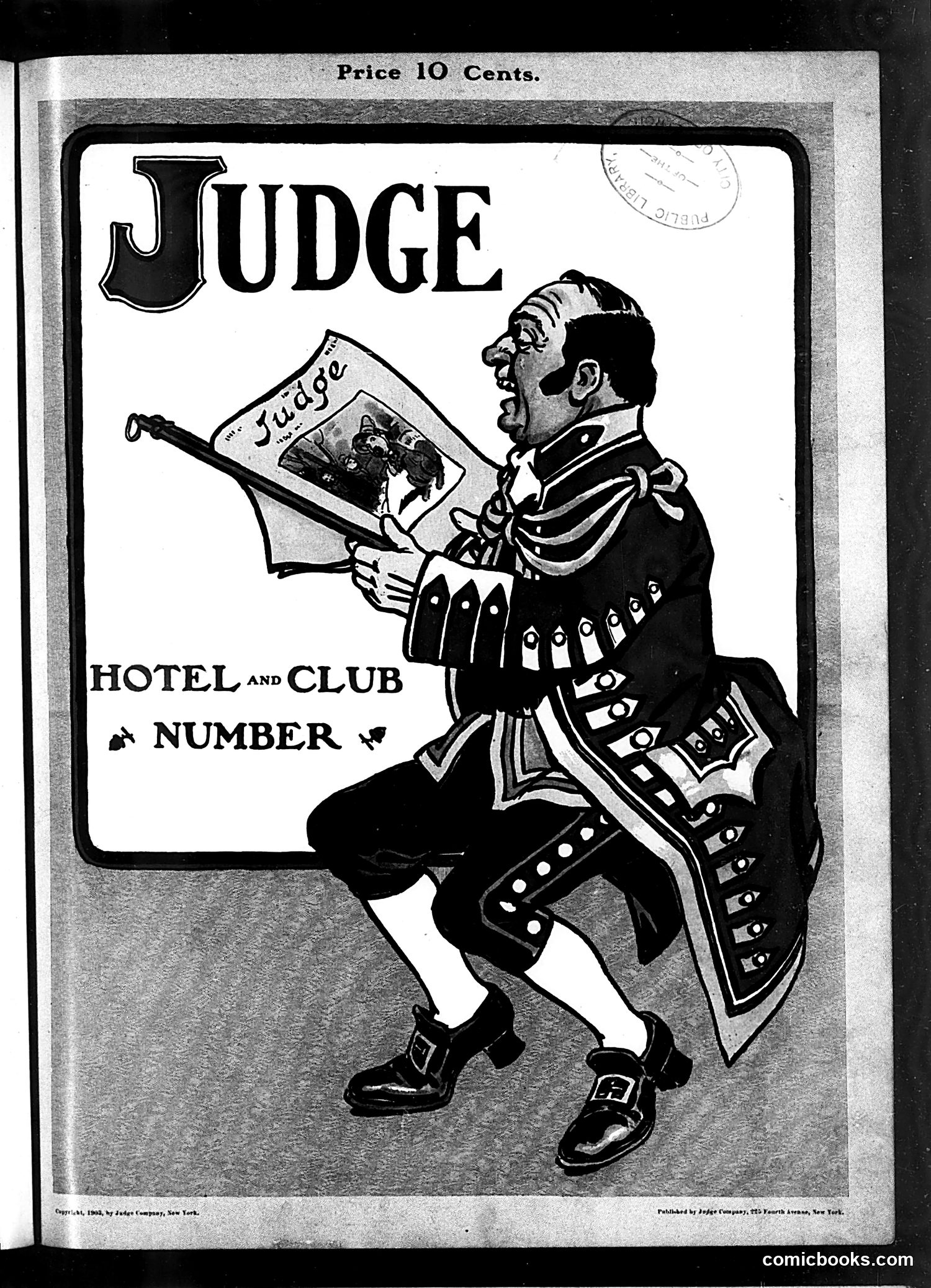
This is the cover of **Judge**, a satirical magazine priced at 10 cents, labeled as a "Hotel and Club Number." The central figure is a caricatured man in an ornate military or formal uniform, reading a copy of Judge magazine. The exaggerated facial features and elaborate decorative coat suggest this is a specific public figure meant to be recognized by contemporary readers, likely someone associated with hotels or clubs, or a political figure the magazine was mocking. The satire appears to target this individual's vanity or pretension—he's depicted as proudly reading about himself in Judge, suggesting self-importance or absurd self-regard. The uniform's ornate details (buttons, braiding, decorative elements) emphasize theatrical excess. **Without identifying the specific figure or historical event**, the core joke is satirizing someone's ego through the image of them admiring their own coverage in the magazine.
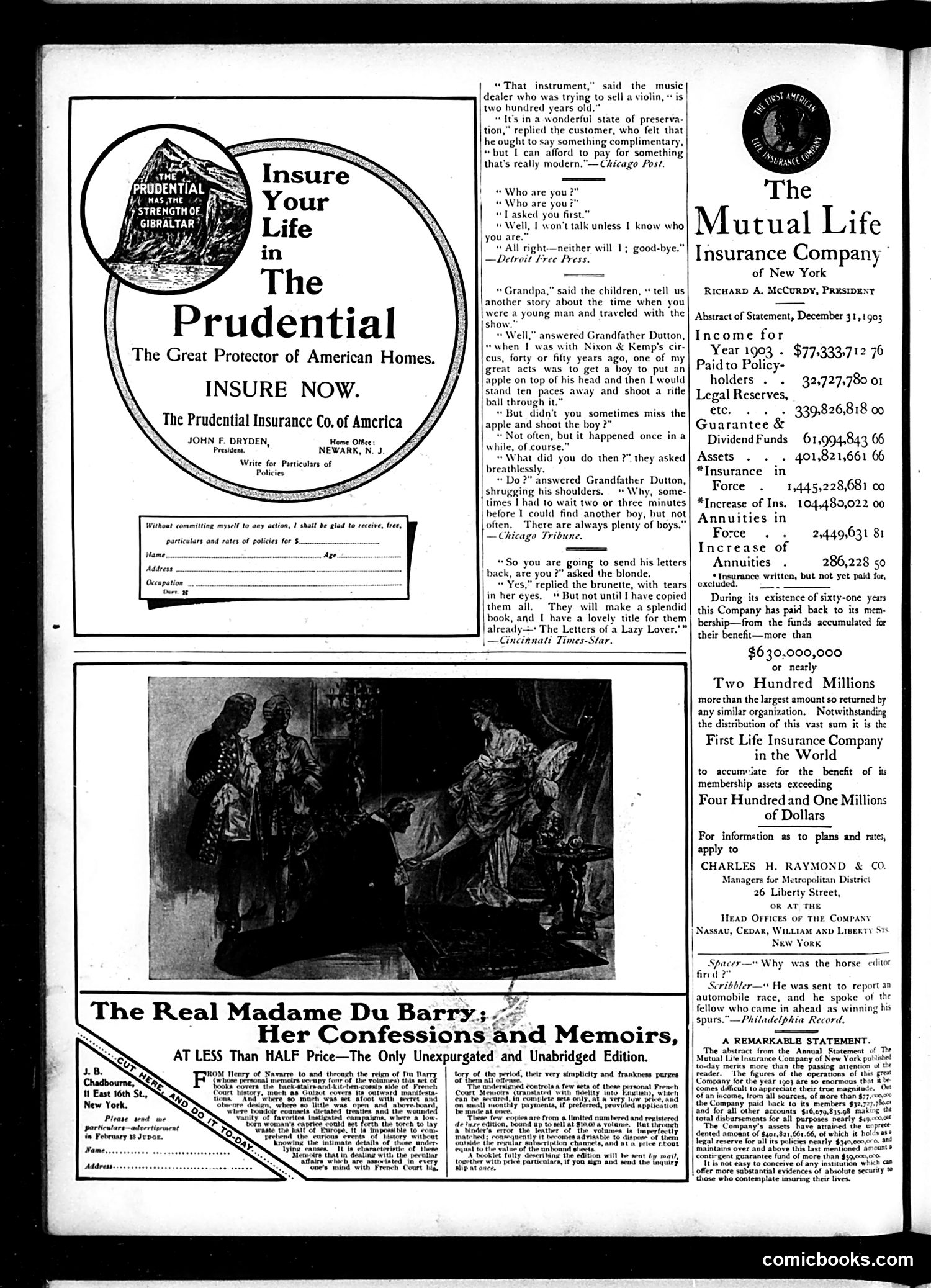
This page is primarily **advertising and commercial content** rather than political satire. The left side features a **Prudential Insurance advertisement** ("The Great Protector of American Homes"), with a circular logo showing Gibraltar's Rock—Prudential's famous symbol representing strength and stability. Below is an unrelated ad for "The Real Madame Du Barry" memoirs. The right side displays a **Mutual Life Insurance Company statement** with financial data from December 31, 1903, highlighting their assets and $630 million in paid benefits over 61 years. There are also **anecdotal stories** (about a music dealer, a grandfather's circus tale, children's inquiries) that appear designed to create emotional appeal—common advertising strategy to humanize corporate entities and build consumer trust. The page reflects early 1900s commercial magazine culture: life insurance companies using heritage, stability imagery, and sentimental narratives to market protection and financial security.
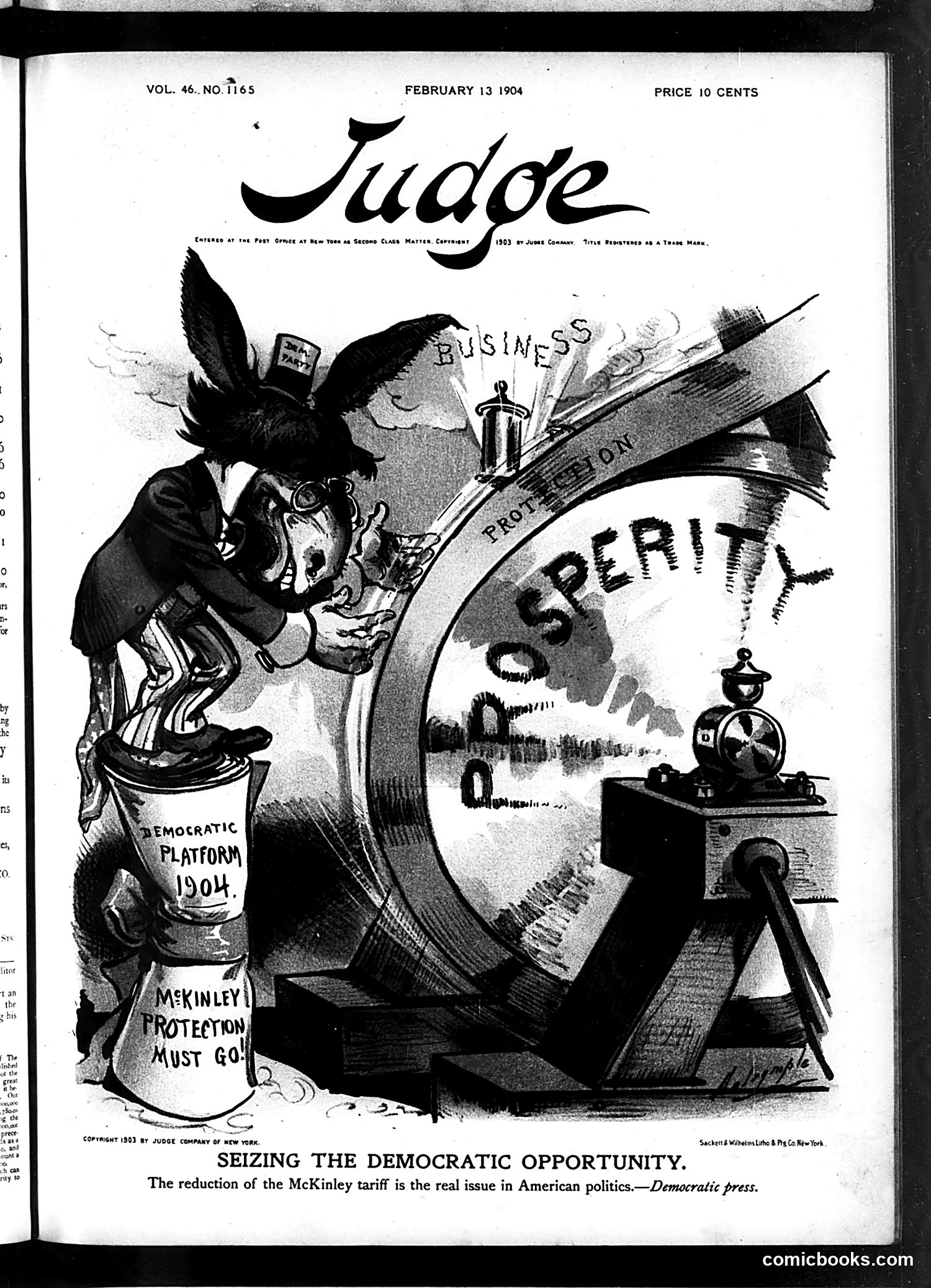
This political cartoon satirizes Democratic strategy regarding tariff policy. A donkey (representing the Democratic Party) operates a large "business" apparatus labeled "Tariff on" while holding a "Democratic Platform 1904" document. The donkey appears to be manipulating or pumping the machinery, suggesting the Democrats are mechanically exploiting the tariff issue for political gain. The caption states: "The reduction of the McKinley tariff is the real issue in American politics.—*Democratic press*." This mocks Democratic claims that tariff reduction represents their central platform. The cartoon suggests Democrats are cynically "seizing" this issue as an "opportunity"—using it opportunistically rather than from genuine principle. McKinley-era tariff policy was indeed a major partisan divide, with Republicans favoring protectionism and Democrats opposing it.
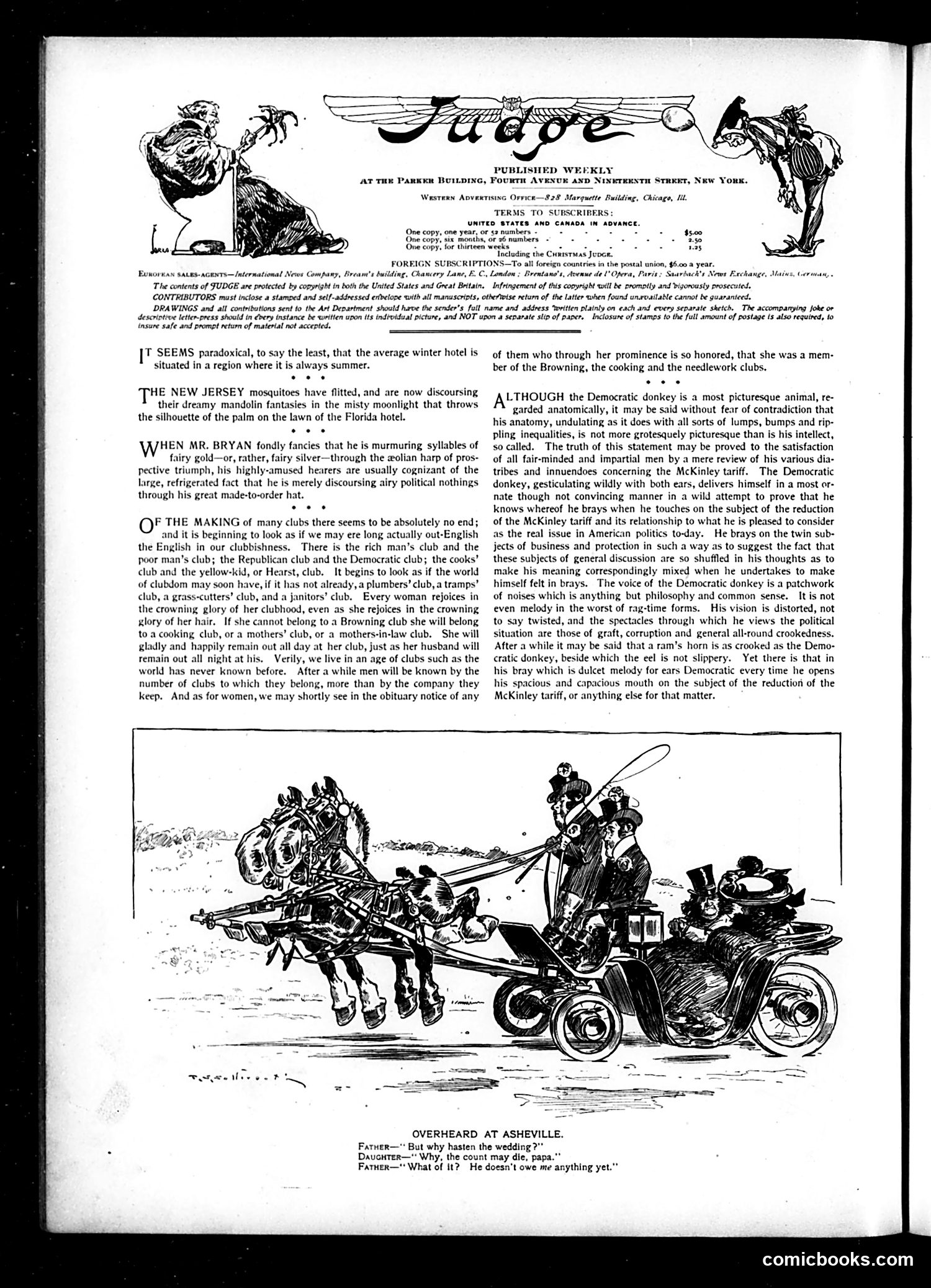
The main cartoon, titled "Overhead at Asheville," depicts a father, mother, and daughter in an early automobile, with a donkey-drawn cart ahead of them. The daughter asks why the horse hasn't moved, the mother responds "Why, the count may die, papa," and the father replies "What of it? He doesn't owe me anything yet." This satirizes wealthy Americans' obsession with European nobility, particularly the financial entanglements that could result from marrying into titled families. The donkey-cart appears to reference a count of dubious means. The joke mocks both the family's eagerness to associate with aristocracy and their crude mercenary calculations about whether debt obligations would result. The accompanying text discusses the "Democratic donkey" as a political symbol, analyzing its stubborn yet conveniently flexible nature in representing the party's contradictions.
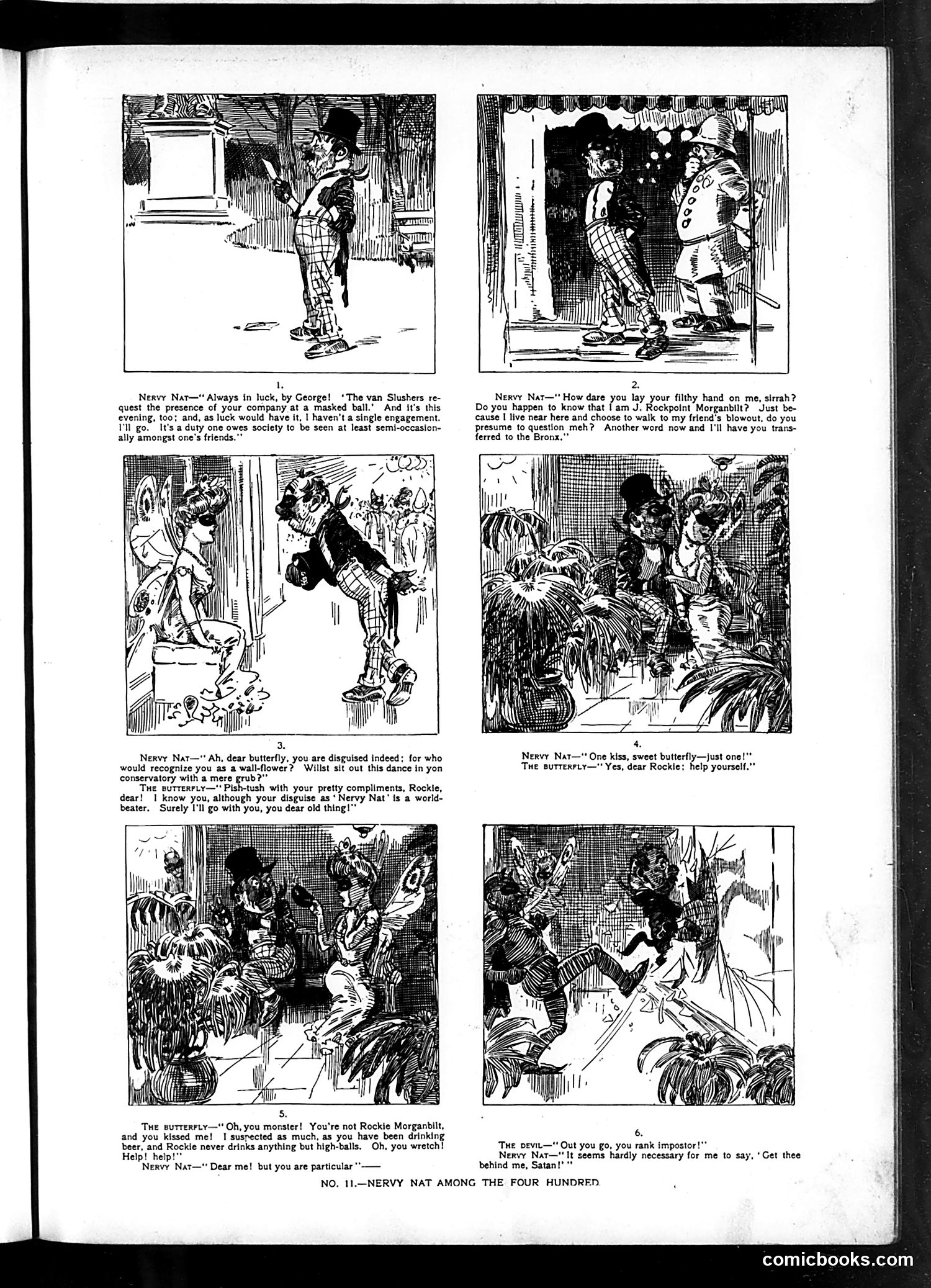
This is a satirical comic strip mocking social climbing and class pretension in Gilded Age New York. "Nervy Nat" is an ordinary man who crashes an exclusive masked ball hosted by the wealthy "van Slushers" (the "Four Hundred" refers to New York's elite social circle). At the ball, Nat impersonates "J. Rockpoint Morganbilt," a wealthy socialite, to seduce a woman disguised as a butterfly. The satire hinges on social snobbery: the woman avoids the real Morganbilt (believing him a "grub") but accepts kisses from the impostor. She discovers the deception when Nat drinks beer instead of high-balls—a detail revealing class markers even in intoxication. The final panel jokes that Nat has literally become demonic through his social fraud. The strip mocks both pretentious wealthy society and the desperation of social climbers attempting to breach its ranks.
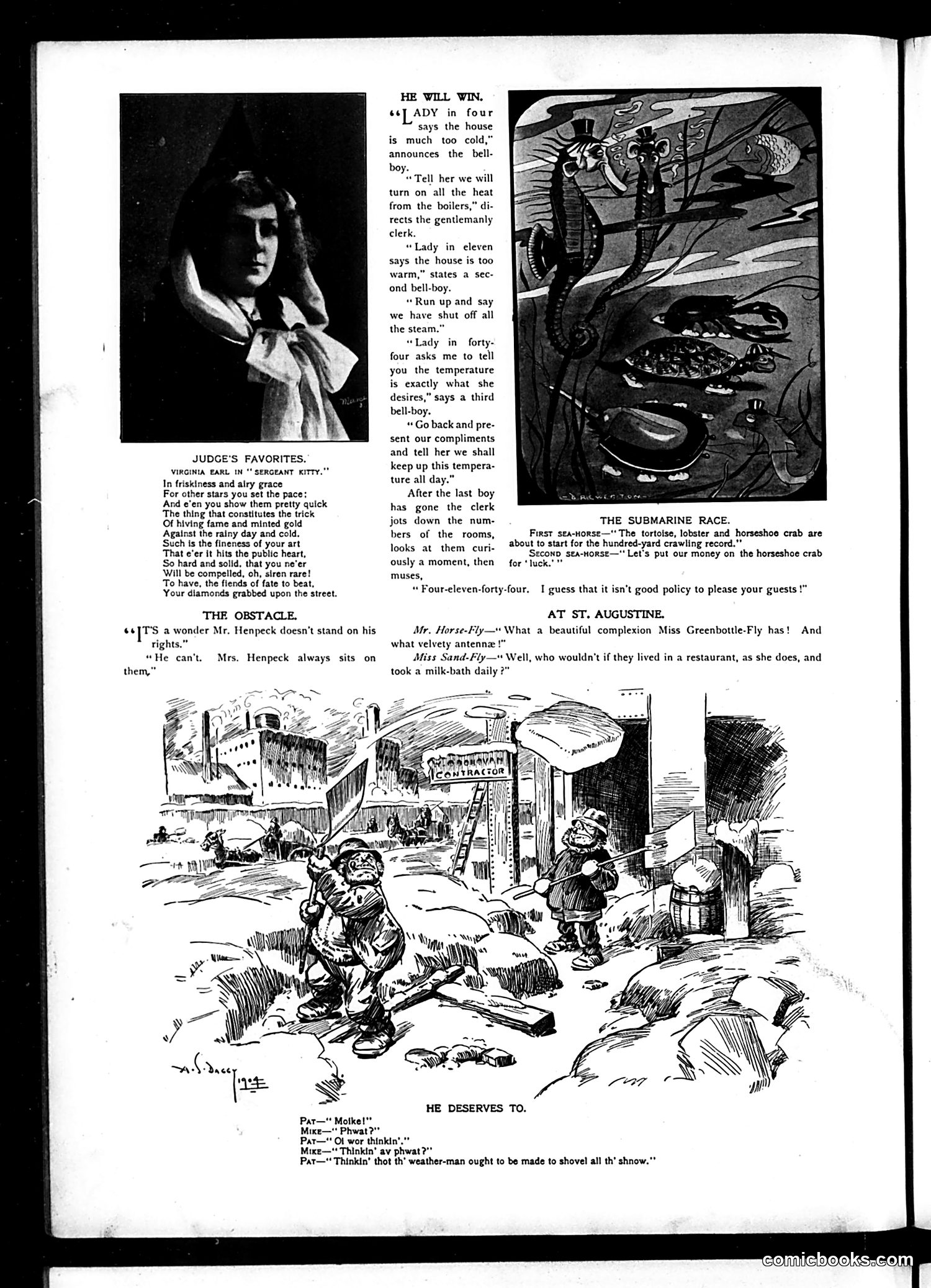
This page contains several unrelated satirical items typical of Judge magazine's humor: **"He Will Win"** mocks hotel management's impossible task pleasing guests with contradictory temperature demands—a common service-industry complaint. **"Judge's Favorites"** praises actress Virginia Earl in "Sergeant Kitty," using flowery verse typical of theatrical promotion. **"The Submarine Race"** presents whimsical sea creatures (horseshoe crab, lobster, tortoise) racing—absurdist humor with no apparent political meaning. **"The Obstacle"** is a brief marital joke about a hen-pecked husband dominated by his wife, reflecting period anxieties about gender relations. **"At St. Augustine"** employs anthropomorphized insects (flies with human vanities) discussing beauty routines and restaurant life—mild social satire. **"He Deserves To"** depicts working-class laborers complaining that weather forecasters should shovel snow themselves—populist grumbling at "experts." The page is primarily lighthearted entertainment rather than serious political commentary.
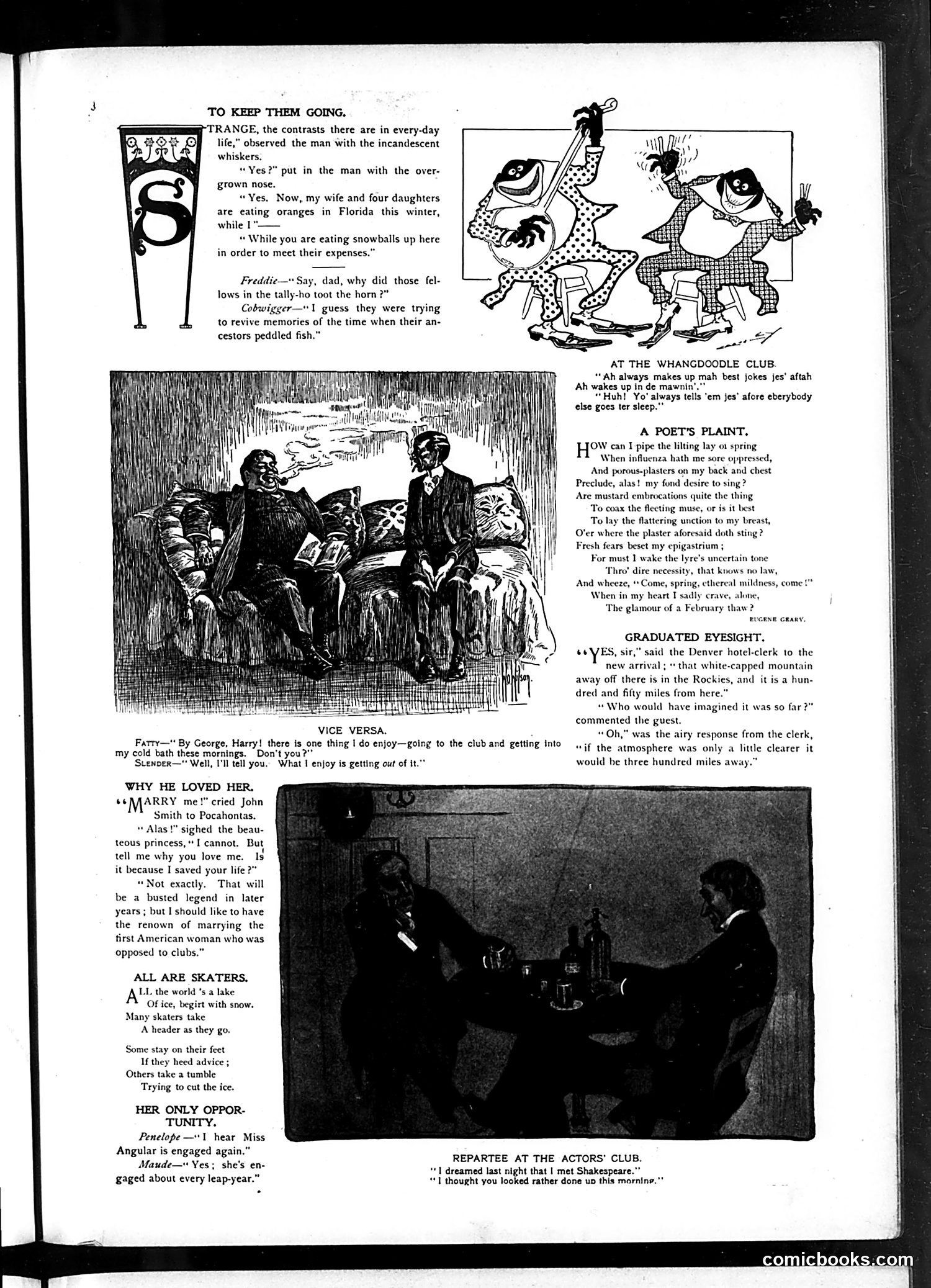
This page contains several unrelated satirical pieces typical of early 20th-century American humor: **"To Keep Them Going"** mocks upper-class leisure through contrasts: wealthy wives vacation in Florida while husbands endure cold winters to fund their expenses. **"At the Whangdoodle Club"** uses dialect humor (common but now offensive) to joke about someone who tells boring stories that put people to sleep. **"A Poet's Plaint"** satirizes overly flowery Romantic poetry by showing a poet unable to compose spring verses due to influenza and medical plasters—deflating literary pretension with physical comedy. **"Graduated Eyesight"** plays on a hotel clerk's exaggerated descriptions of mountain distances, suggesting his perspective is literally warped. **"Why He Loved Her"** makes a topical joke: a man marries Pocahontas not for saving his life (a "busted legend") but to claim fame marrying "the first American woman opposed to clubs"—satirizing both anti-club sentiment and romanticized colonial history. Minor pieces include jokes about skating and theatrical gossip. The humor relies on wordplay, class commentary, and gentle mockery of contemporary attitudes.
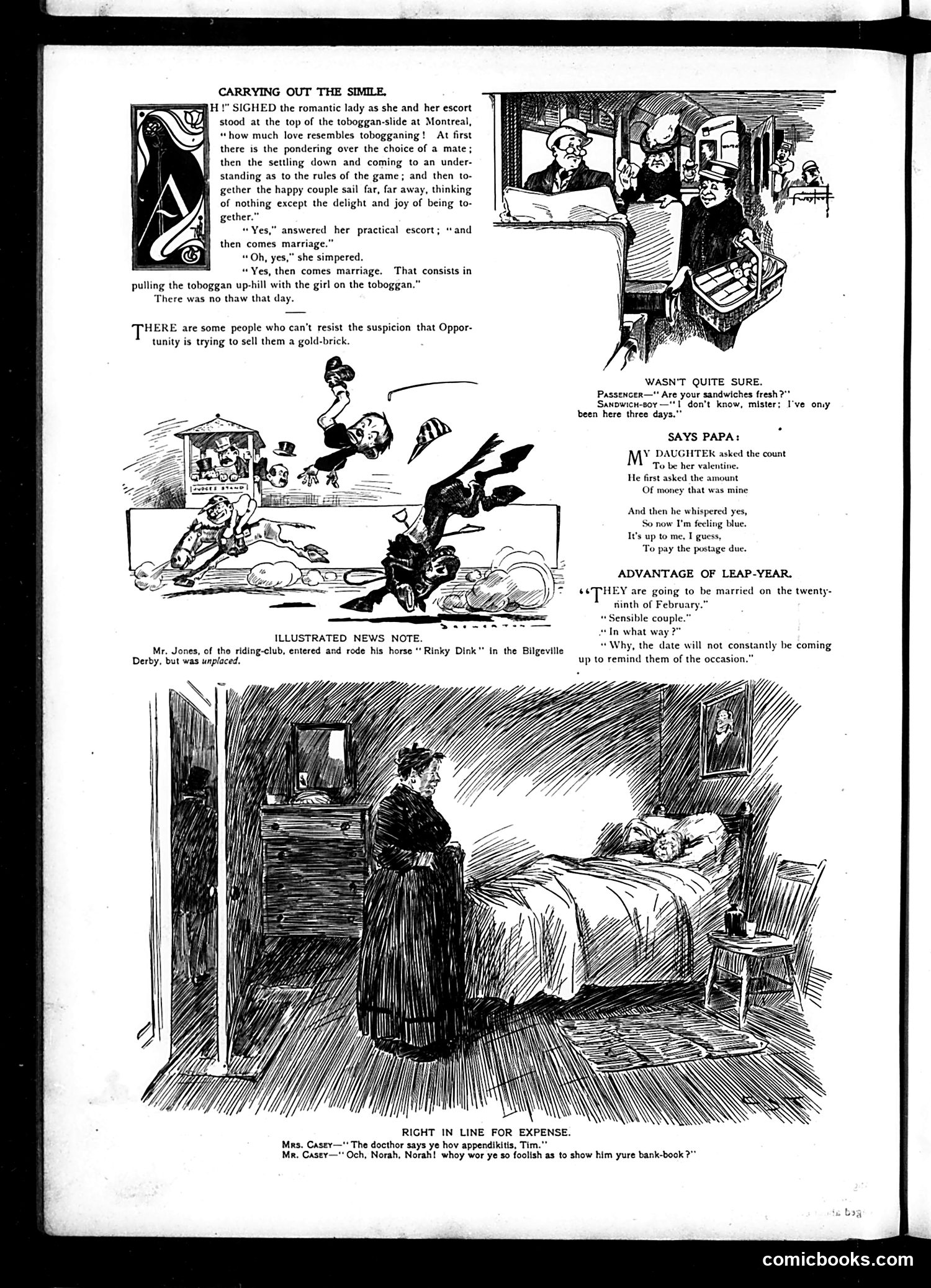
This page contains several short humorous pieces typical of early 20th-century American satirical magazines: **"Carrying Out the Simile"** mocks romantic idealism. A woman compares love to tobogganing—thrilling initially, then requiring hard work. Her escort bluntly replies that marriage means "pulling the toboggan up-hill with the girl on the toboggan," suggesting women become burdens. The joke reflects period anxieties about marriage's realities versus romantic expectations. **Other pieces** satirize everyday life: a sandwich vendor's uncertainty about freshness; a father's dismay that his daughter's suitor demanded to know his wealth before accepting her valentine; a couple choosing February 29th (Leap Year) for their wedding to avoid annual reminders; and an Irishman (indicated by dialect spelling) worried his doctor will overcharge after seeing his bank-book. These jokes assume readers share skepticism about romance, immigrants, doctors, and gold-diggers—typical Judge humor reflecting period class attitudes and gender dynamics.
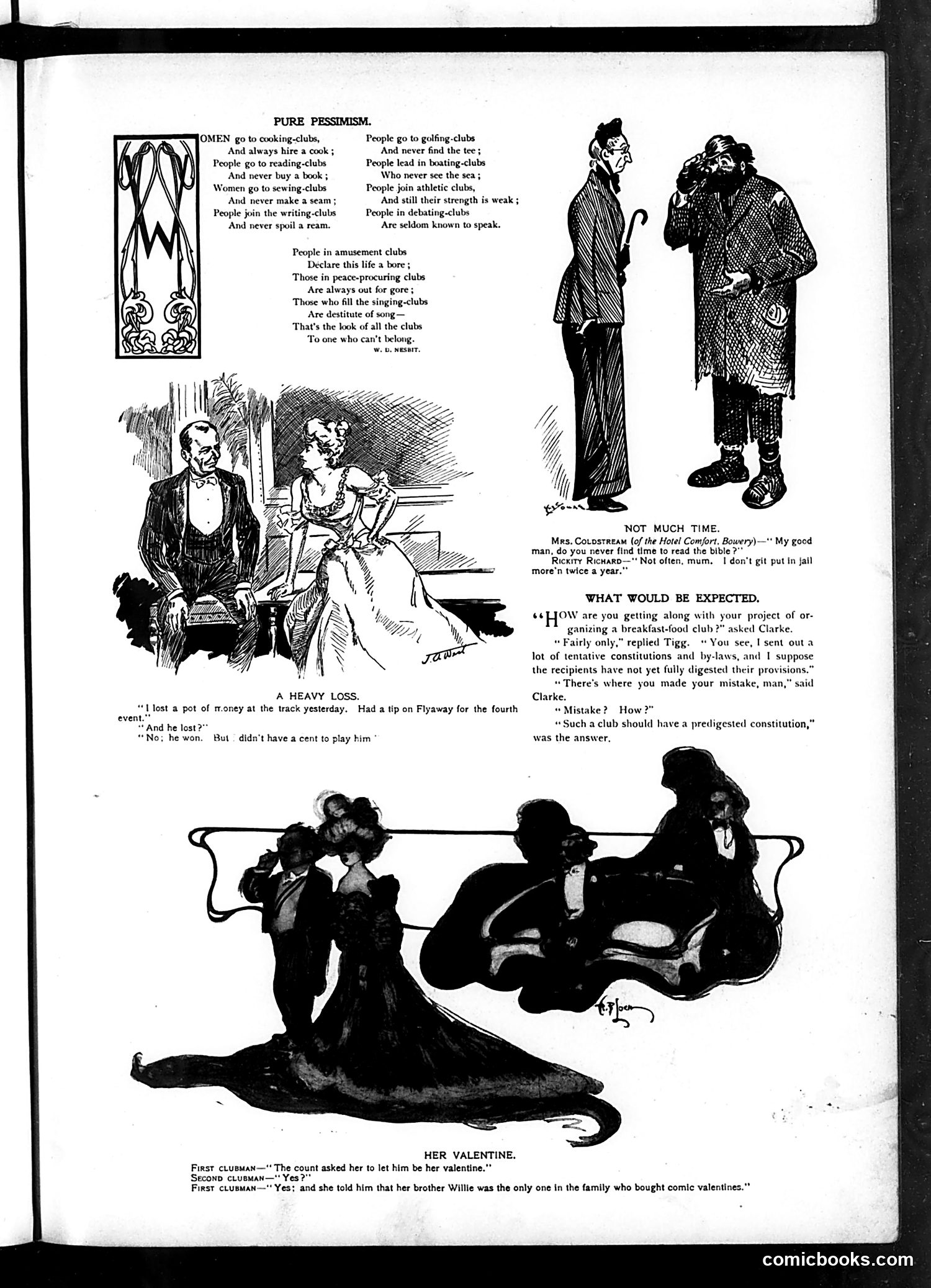
This page of satirical humor targets the proliferation of social clubs in early 20th-century America—a popular leisure trend among urban middle and upper classes. **"Pure Pessimism"** mocks the contradiction between clubs' stated purposes and members' actual behavior: cooking clubs whose members hire cooks, reading clubs where nobody buys books, athletic clubs whose members lack strength, singing clubs full of tone-deaf people. The satire suggests these organizations are pretentious fronts where members don't genuinely engage in the activities they theoretically join for. The comic vignettes below offer mild humor about class and finances: - A working-class man (Rickety Richard) admits to frequent jail time - A man loses money at the racetrack because he can't afford to place bets - A breakfast-club joke plays on "digestion" language **"Her Valentine"** satirizes cheap "comic valentines"—insulting greeting cards—by suggesting one woman's brother alone in the family buys such tacky items. Overall, the page reflects turn-of-the-century social anxieties about leisure-class pretension and consumption habits.
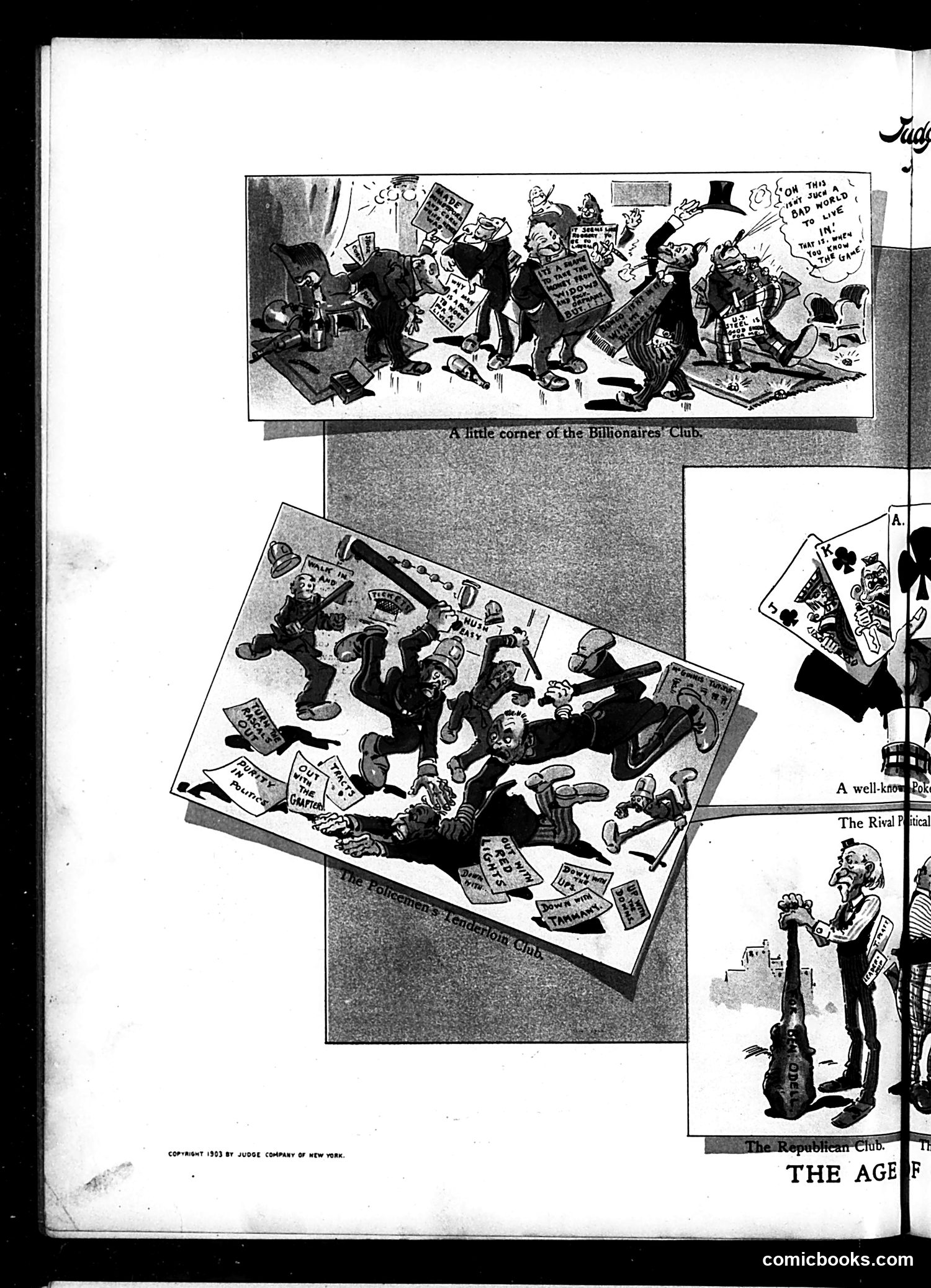
This page contains three political cartoons satirizing wealthy elites and their clubs. The top panel, titled "A Little Corner of the Billionaires' Club," depicts fat, well-dressed men in chaotic disarray with scattered money and signs, suggesting corruption or moral chaos among the ultra-wealthy. The middle panel, "The Billionaires' Pandemonium Club," shows similar figures in even more frenzied disorder, reinforcing the message that extreme wealth breeds disorder and vice. The bottom right panels reference "The Rival Political" clubs (text partially visible), appearing to contrast different social institutions. The overall message critiques American billionaires as chaotic, morally bankrupt figures—a common Progressive Era theme mocking the Gilded Age wealthy and their exclusive social organizations.
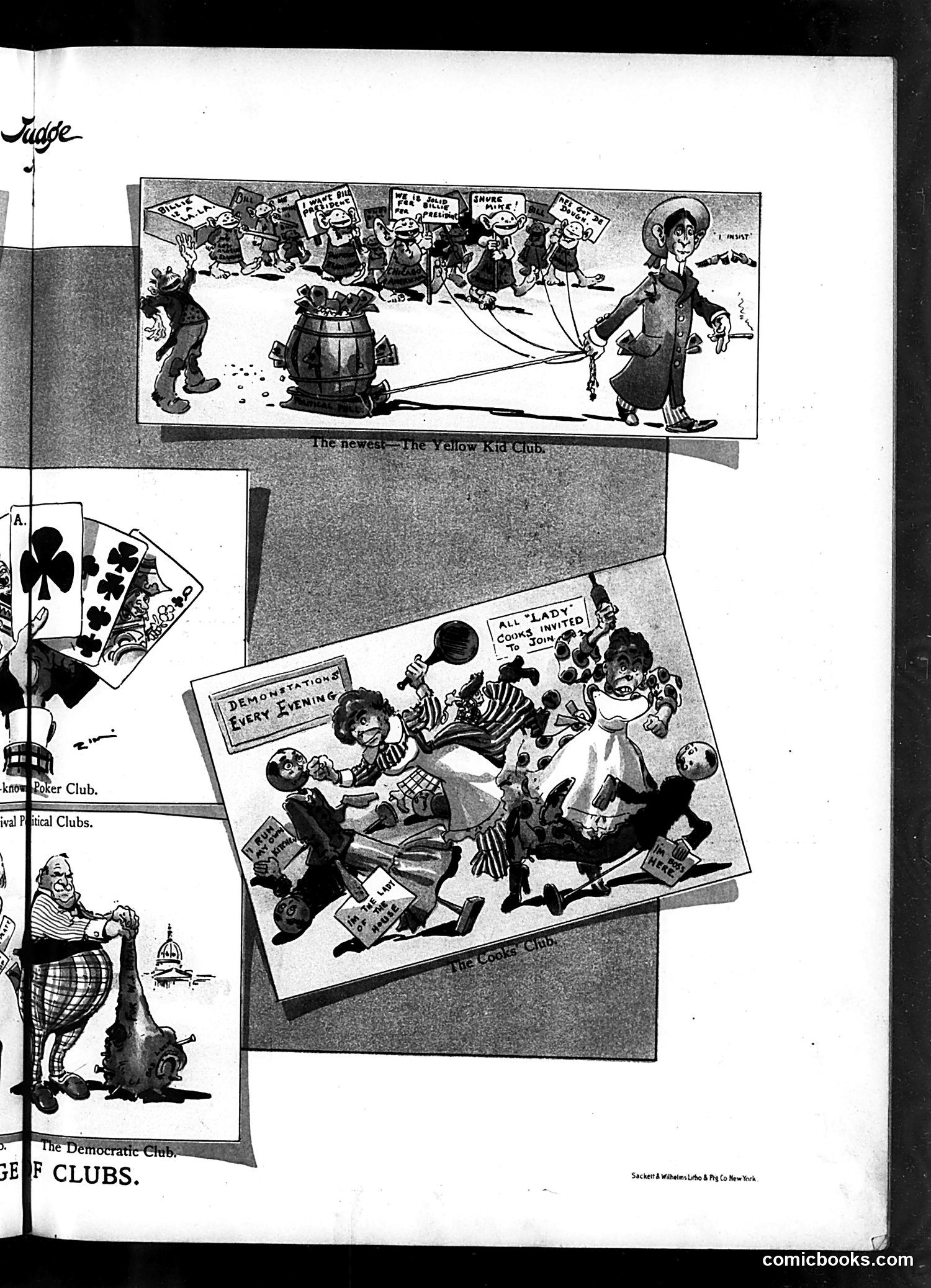
This page from *Judge* magazine satirizes various American political clubs through caricatured scenes. The cartoons depict club members engaged in partisan activities—the visible panels show "The Yellow Kid Club" (top), "The Poker Club," and "The Democratic Club" (bottom left), among others. The satire targets the exclusivity and questionable conduct of these organizations. Members are portrayed as scheming, gambling, or making backroom deals—suggesting these clubs functioned as centers of political corruption rather than legitimate civic engagement. The exaggerated facial features and chaotic scenes mock both the clubs' pretensions and their members' actual behavior. This reflects *Judge*'s role as a vehicle for social and political criticism, lampooning the clubhouse politics and patronage systems that characterized late 19th/early 20th-century American civic life.
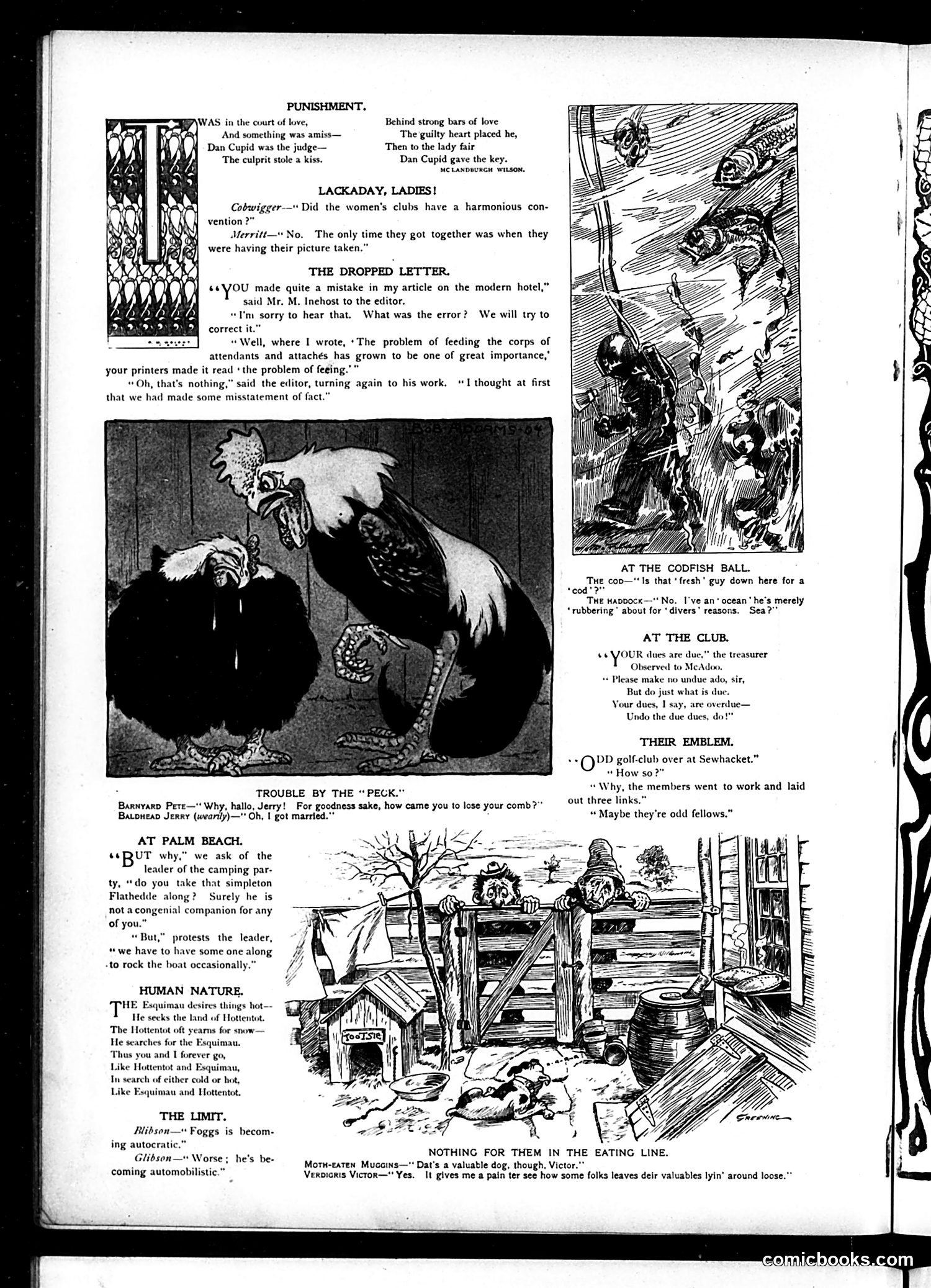
This page from the satirical magazine *Judge* contains multiple short humorous pieces targeting early 20th-century American social life: **"Punishment"** is a romantic poem playing on courtroom language—Cupid as judge, a stolen kiss as the crime, love as imprisonment. **"The Dropped Letter"** mocks a printer's error: a hotel article about feeding "the corps [body] of attendants" was printed as "the corpes [corpse] of attendants"—dark humor about workplace mishaps. **Social satire pieces** mock contemporary types: women's clubs (portrayed as fractious), wealthy Palm Beach vacationers, and nouveau-riche automobile enthusiasts ("automobilistic" as pretentious affectation). **"Human Nature"** offers philosophical humor about universal human desires for what we lack—contrasting Esquimaux (cold-seeking) and Hottentots (heat-seeking). The **illustrations** depict period scenes: dining, boating, seaside leisure. The humor relies on wordplay, social observation, and gentle mockery of American leisure classes and their pretensions.
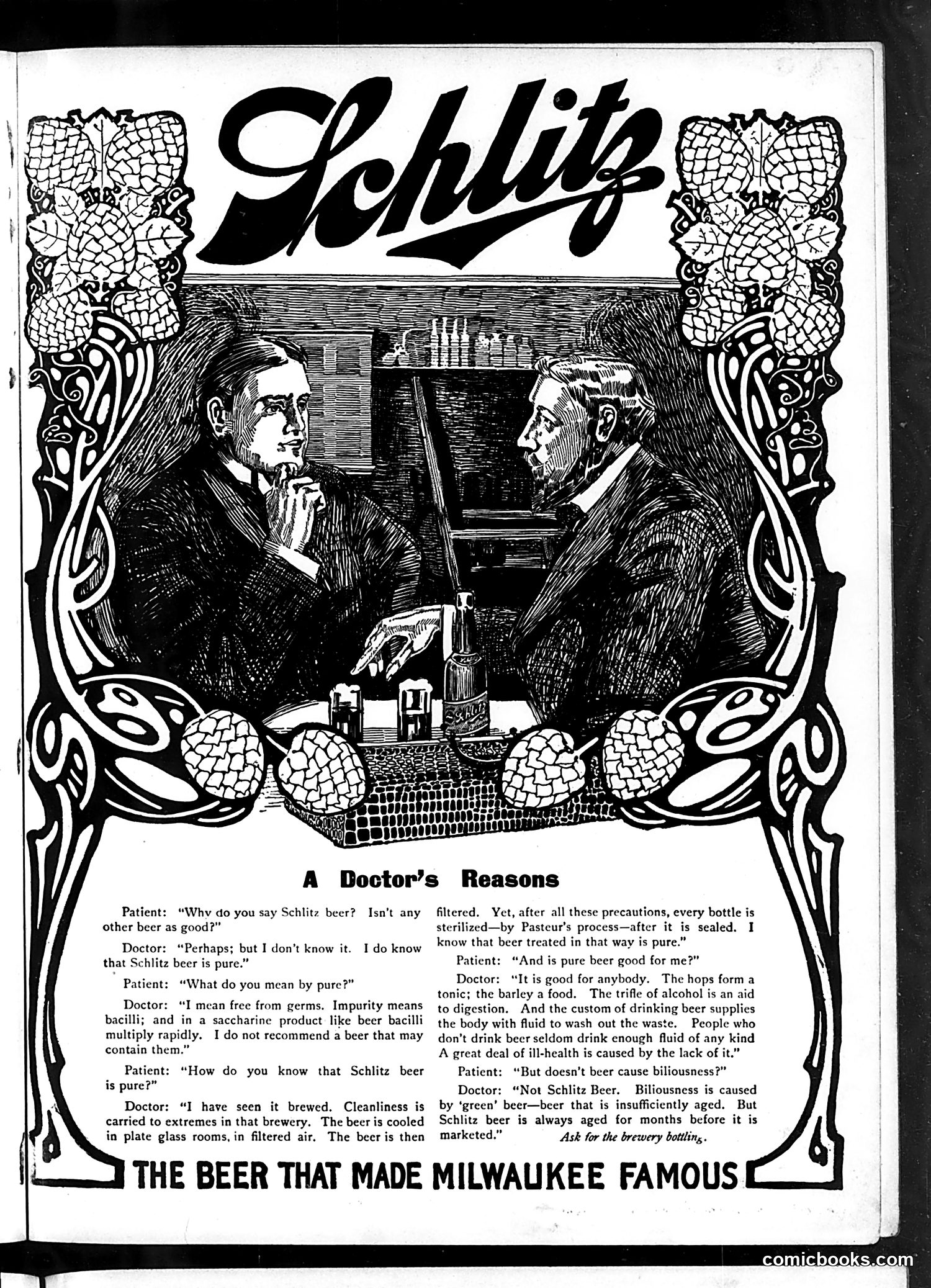
This is a **Schlitz beer advertisement** disguised as editorial content in Judge magazine. The illustration shows two men in conversation—one appearing to be a distinguished doctor, the other a patient—discussing beer's medicinal and health properties. The "satire" here is actually advertising propaganda. During this era (likely early 1900s), beer was marketed with pseudo-scientific health claims. The doctor endorses Schlitz specifically by praising its purity, sterility, and aging process, while claiming beer aids digestion and supplies necessary body fluids. He even addresses potential objections (biliousness) by blaming inferior "green" beers rather than the product itself. The ornate art nouveau border with hops imagery reinforces the beer brand. This represents an era when alcohol advertising heavily leveraged medical authority to promote consumption, before such claims became regulated. The "Doctor's Reasons" framing lends false credibility to marketing claims modern readers would recognize as exaggerated health propaganda.
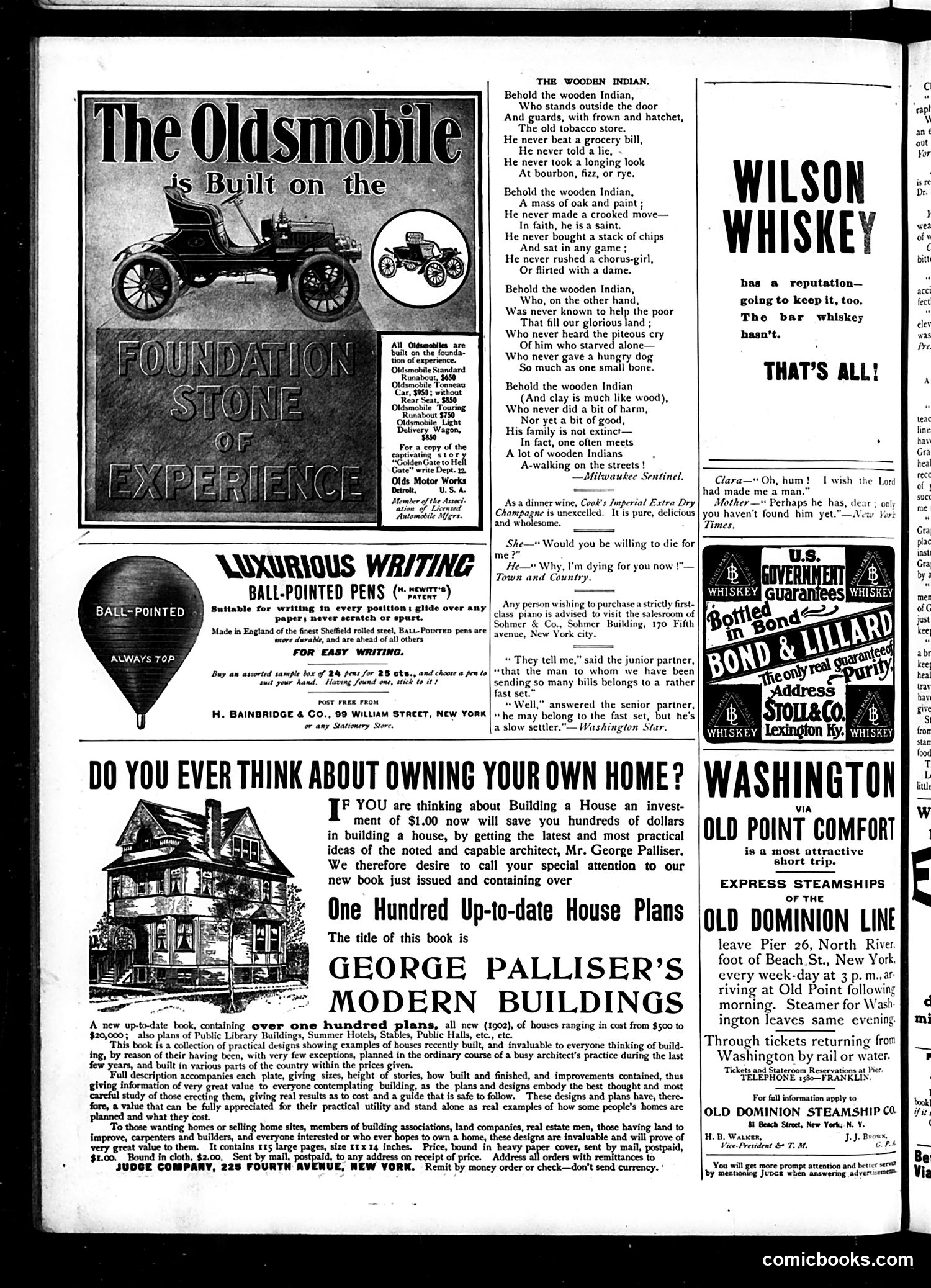
This page primarily consists of **advertisements and light satirical verse**, not political cartooning. The main satirical content is "The Wooden Indian" poem, which uses the literal wooden Indian statue (a common fixture outside tobacco shops) as a metaphor for moral criticism. The poem contrasts the wooden Indian's passive innocence—never lying, gambling, or seducing women—with its complete uselessness to society. It "never gave a hungry dog so much as one small bone" and never helped the poor. The concluding stanza extends the satire to actual people: the poet observes "wooden Indians" walking the streets—people who are morally blameless but utterly indifferent to others' suffering. This appears to critique a certain type of respectable citizen who maintains personal virtue while remaining socially callous. The rest of the page contains period advertising for automobiles, pens, whiskey, and house-building plans—typical Judge magazine commercial content.
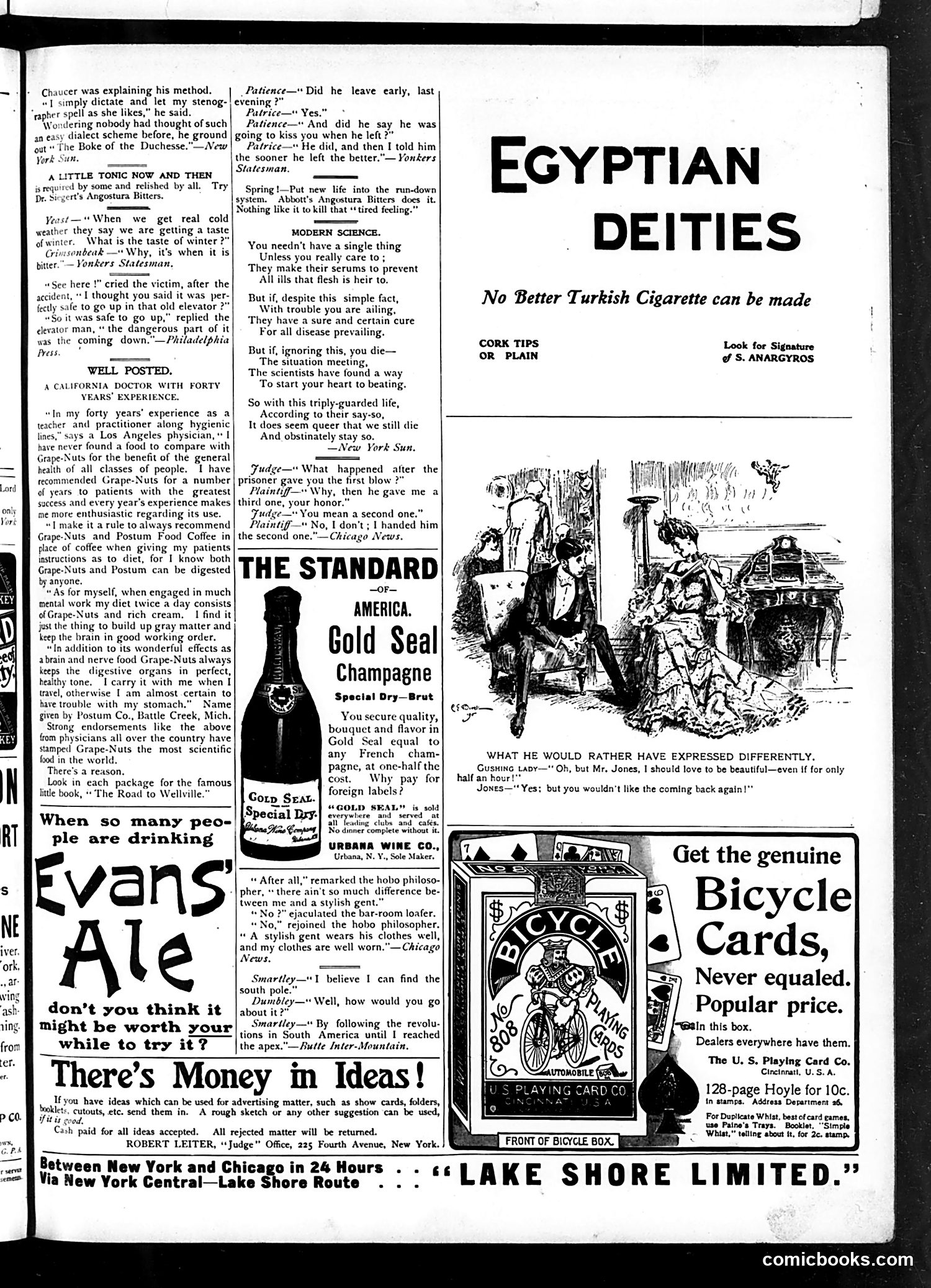
This page from *Judge* magazine contains mostly **advertisements and brief humorous anecdotes** rather than political cartoons requiring historical context. The notable content includes: **The "Modern Science" poem**: A satirical piece mocking early 20th-century medical optimism. It jokes that modern science claims to prevent every illness through serums, and if you die anyway, scientists can supposedly restart your heart. The satire targets the era's exaggerated faith in scientific progress and medical panaceas—a common theme in that period. **The brief jokes**: Mostly wordplay and domestic humor (e.g., a woman telling a suitor to leave quickly, an elevator operator's dark quip about going up being safe but coming down being dangerous). **Advertisements dominate**: Gold Seal Champagne, Evans Ale, Grape-Nuts cereal, and Bicycle Playing Cards fill most space—typical of magazine revenue models then. **No clear political figures or references** are visible. This appears to be a general-interest satirical magazine page focused on commerce and mild social humor rather than political commentary.
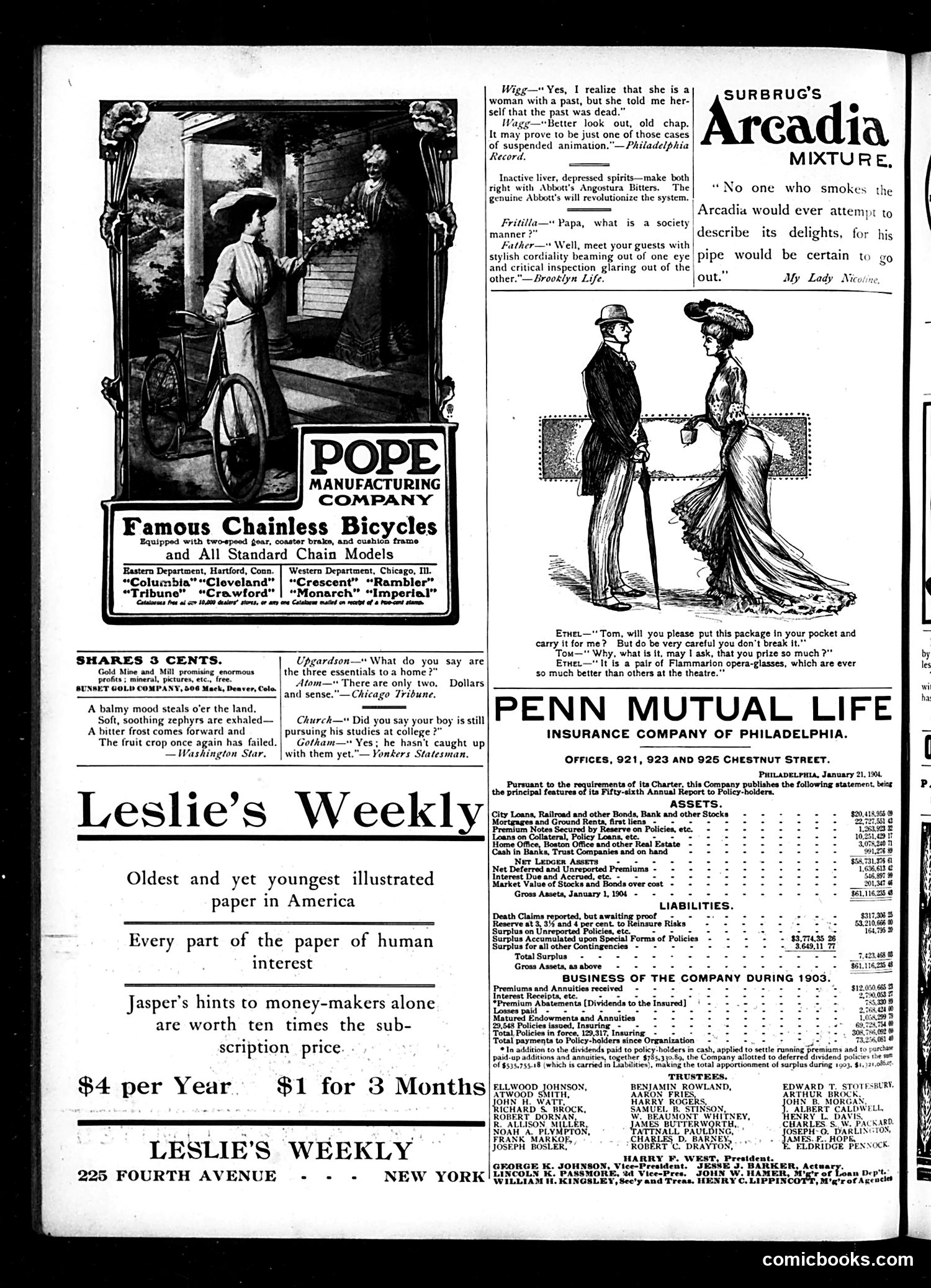
This page is primarily **advertising and corporate notices**, not satirical editorial content. The main elements are: **Advertisements:** - Pope Manufacturing Company bicycles - Surbrug's Arcadia tobacco mixture - Abbott's Angostura Bitters - Leslie's Weekly magazine subscription **Small Humor Pieces:** The page contains brief comic dialogues—likely filler content—addressing mild social observations: a woman with a "dead" but merely "suspended" past; meeting society guests with false cordiality; someone overly cautious with opera glasses. **Corporate Filing:** The Penn Mutual Life Insurance Company of Philadelphia publishes its official financial statement and list of trustees. The satirical content is minimal. The humor relies on wordplay and gentle social irony rather than political commentary. This appears to be a typical late-19th/early-20th-century magazine page mixing advertisements with light jokes and business notices.
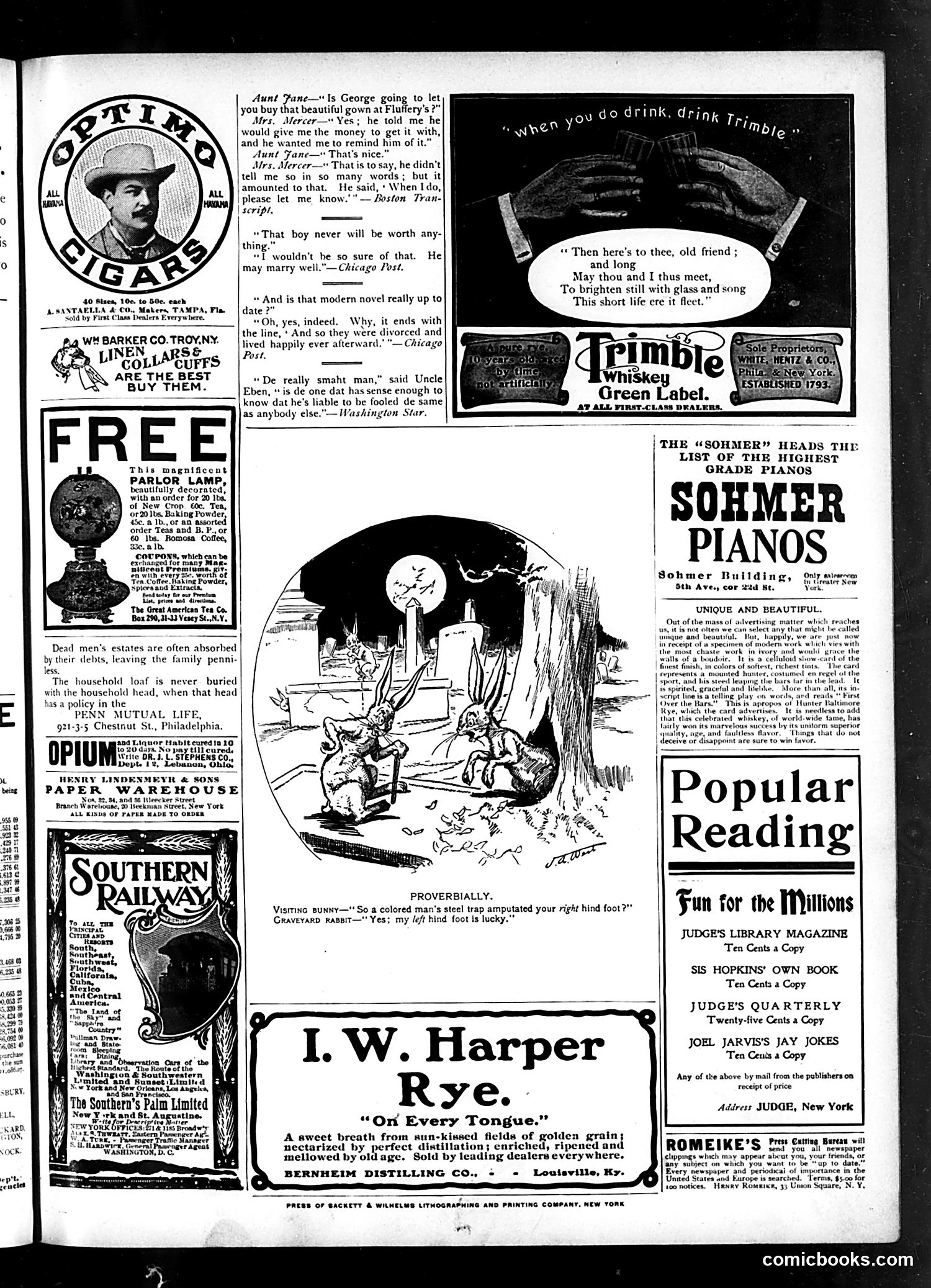
This page is primarily **advertising with one cartoon**. ## The Main Cartoon: "Proverbially" The single illustrated joke shows a visiting bunny asking a graveyard rabbit: "So a colored man's steel trap amputated your right hind foot?" The rabbit responds: "Yes; my left hind foot is lucky." **What it means:** This is a cruel joke exploiting racist stereotypes. The punchline conflates the rabbit's bad luck (losing a foot to a trap) with supposed "luck" associated with Black people—likely referencing the historical "rabbit's foot" superstition and stereotyping. The cartoon uses animal characters as thin cover for dehumanizing racial mockery typical of early-20th-century "humor." ## Advertisements The page contains numerous period ads: cigars (Optimo), a parlor lamp, whiskey (Trimble, I.W. Harper Rye), pianos (Sohmer), insurance, and other products. These represent Judge's revenue model and reflect consumer culture of the era. The page demonstrates how racist content was normalized in mainstream American magazines of this period.
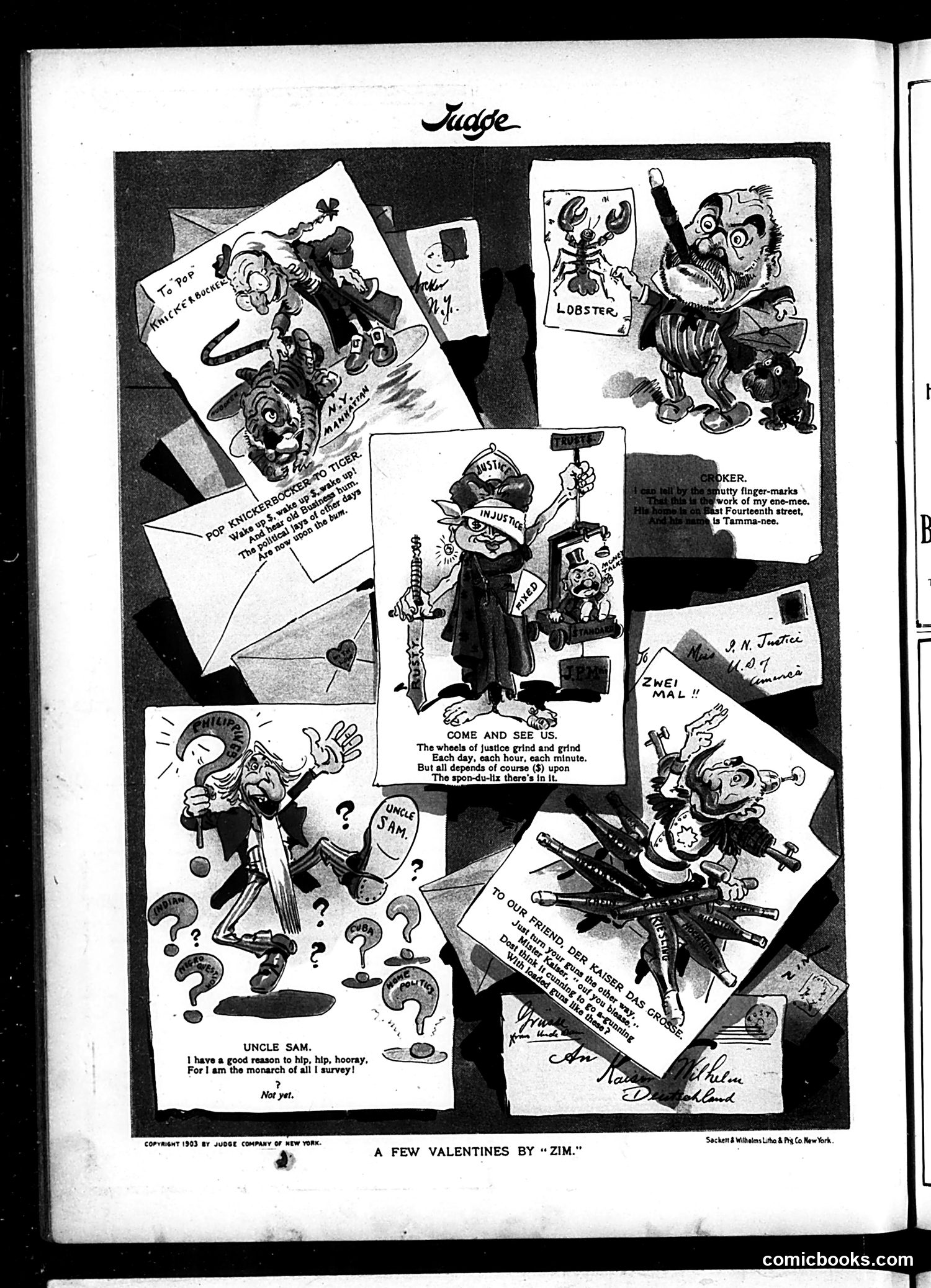
This page contains satirical "valentine" cartoons by artist Zim mocking various American institutions and figures of the early 1900s. **Key targets identified:** - **Justice figure** (center): Depicted as corrupt, with text noting the legal system's wheels grind based on money ("spon-du-lix"), satirizing bribery in courts. - **Uncle Sam** (lower left): Shown confused with question marks, contradicting his boast of being "monarch of all I survey," with the caption "Not yet"—likely critiquing American imperial ambitions or domestic authority. - **Tammany Hall reference** (text): Alludes to the notoriously corrupt New York political machine. - **Lobster and other figures**: Appear to represent political/social entities being satirized through exaggerated caricature. The overall message criticizes institutional corruption, judicial venality, and questionable American power claims circa 1903, using grotesque humor typical of Judge magazine's muckraking tradition.
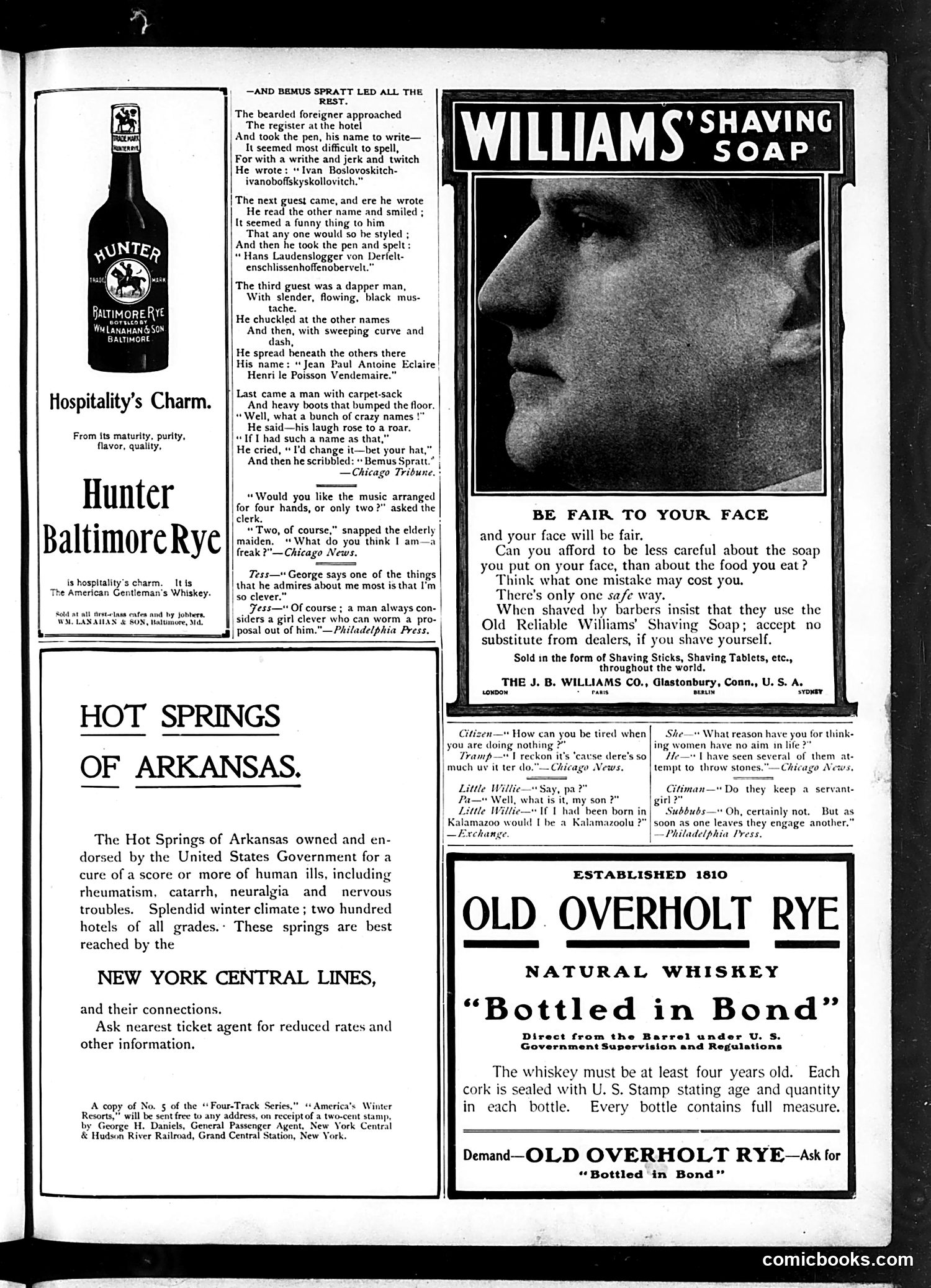
This page is primarily **advertisements** with one brief comic poem. The poem "And Bemus Spratt Led All the Rest" satirizes **ethnic prejudice**. Three foreign guests register at a hotel, each sporting deliberately unpronounceable, exaggerated names (Ivan Boslovoskitch-ivanobofiskyskollovitch; Hans Laudenslogger von Dertelt-enschlissenhoffenobervelt; Jean Paul Antoine Eclaire Henri le Poisson Vendemaire). A plain American man, "Bemus Spratt," mocks their "crazy names" as ridiculous, then writes down his own ordinary name—the joke being that *he* "led all the rest" in ignorant arrogance despite having the most unremarkable name of all. The satire critiques American xenophobia and casual dismissal of foreign names as inherently absurd, while ironically portraying the American character as unaware of his own ordinariness. The remaining page contains period advertisements for whiskey, shaving soap, and Hot Springs tourism—typical Judge magazine content.
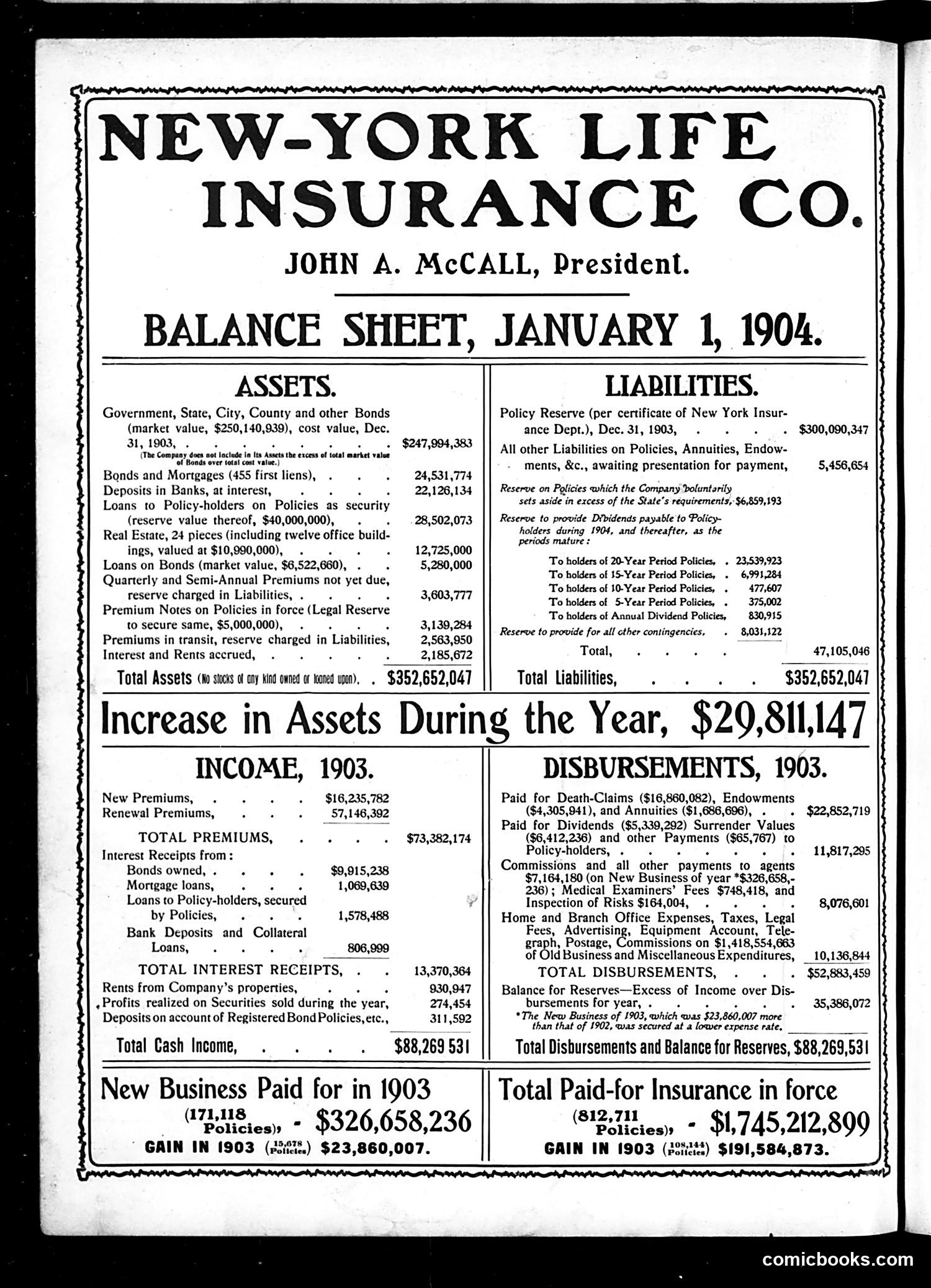
This is **not a cartoon or satire** — it's a financial document: the balance sheet for New York Life Insurance Company as of January 1, 1904, under President John A. McCall. The page presents the company's assets ($352.6 million), liabilities, income, and disbursements for 1903. It highlights significant growth: $29.8 million increase in assets, $23.8 million gain in new business written, and $191.5 million gain in total insurance in force. The document emphasizes financial stability through detailed listings of bonds, real estate holdings, policy reserves, and income sources. It was likely published in *Judge* magazine as corporate advertising—a common practice where major companies purchased space to showcase their financial health and trustworthiness to potential policyholders, particularly during the Progressive Era when insurance industry transparency and solvency were matters of public concern.