
A complete issue · 16 pages · 1903
Judge — October 31, 1903
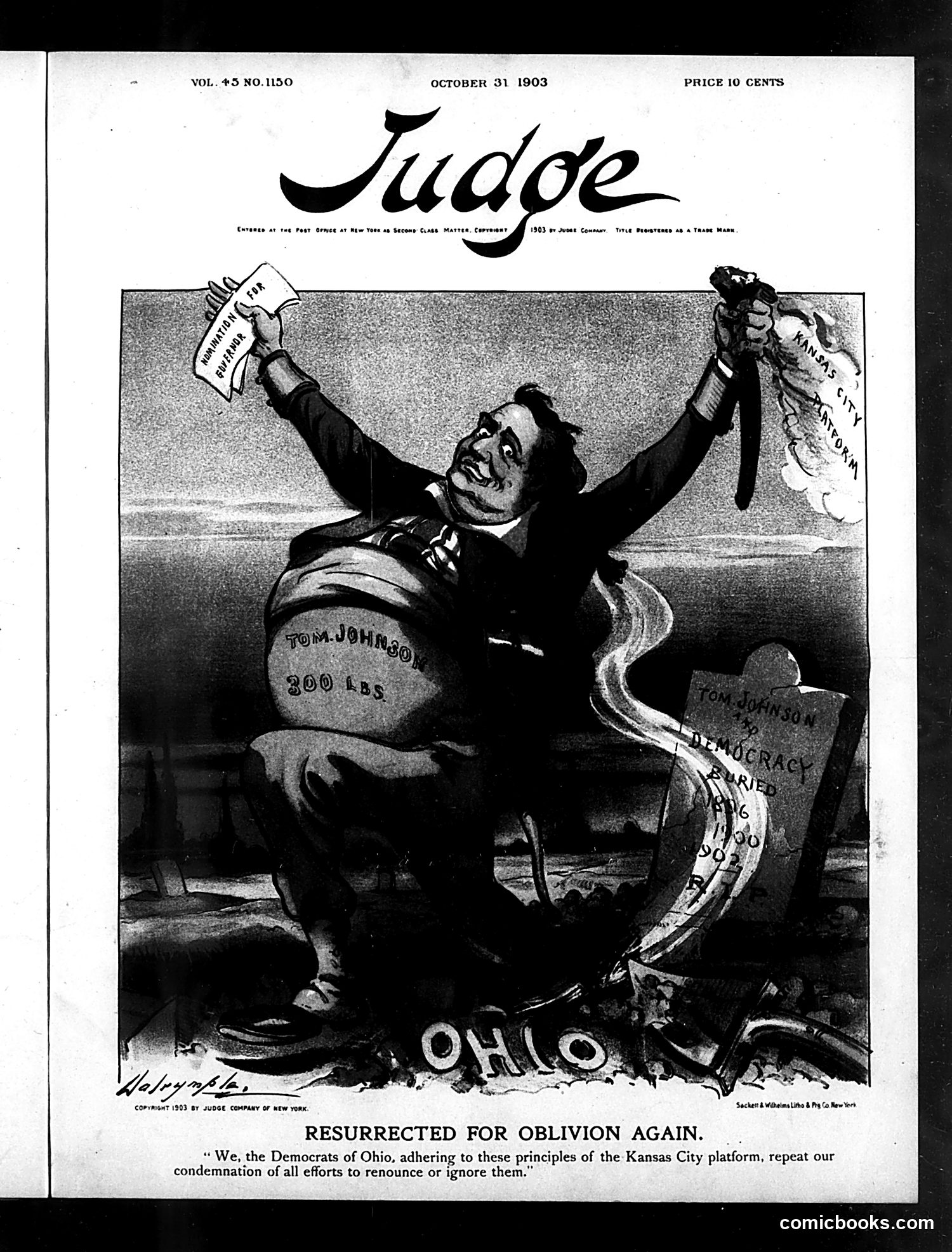
This cartoon depicts a caricatured figure emerging from barrels labeled "Tom Johnson" (300 lbs) and "Kansas City Platform," raising documents marked "Prohibition" and "Kansas City Platform." The figure stands on "Ohio," suggesting Ohio Democrats. The satire mocks Ohio Democrats for reviving—or "resurrecting"—the Kansas City Platform, a Democratic policy statement apparently associated with failed candidates or unpopular positions. The caption's quote condemns Democrats adhering to these principles despite their electoral damage. The heavy caricature and grotesque imagery suggest the cartoonist views the platform's revival as absurd and politically self-destructive. Tom Johnson likely references an Ohio political figure connected to these controversial positions. The message: Democrats are foolishly repeating past mistakes.
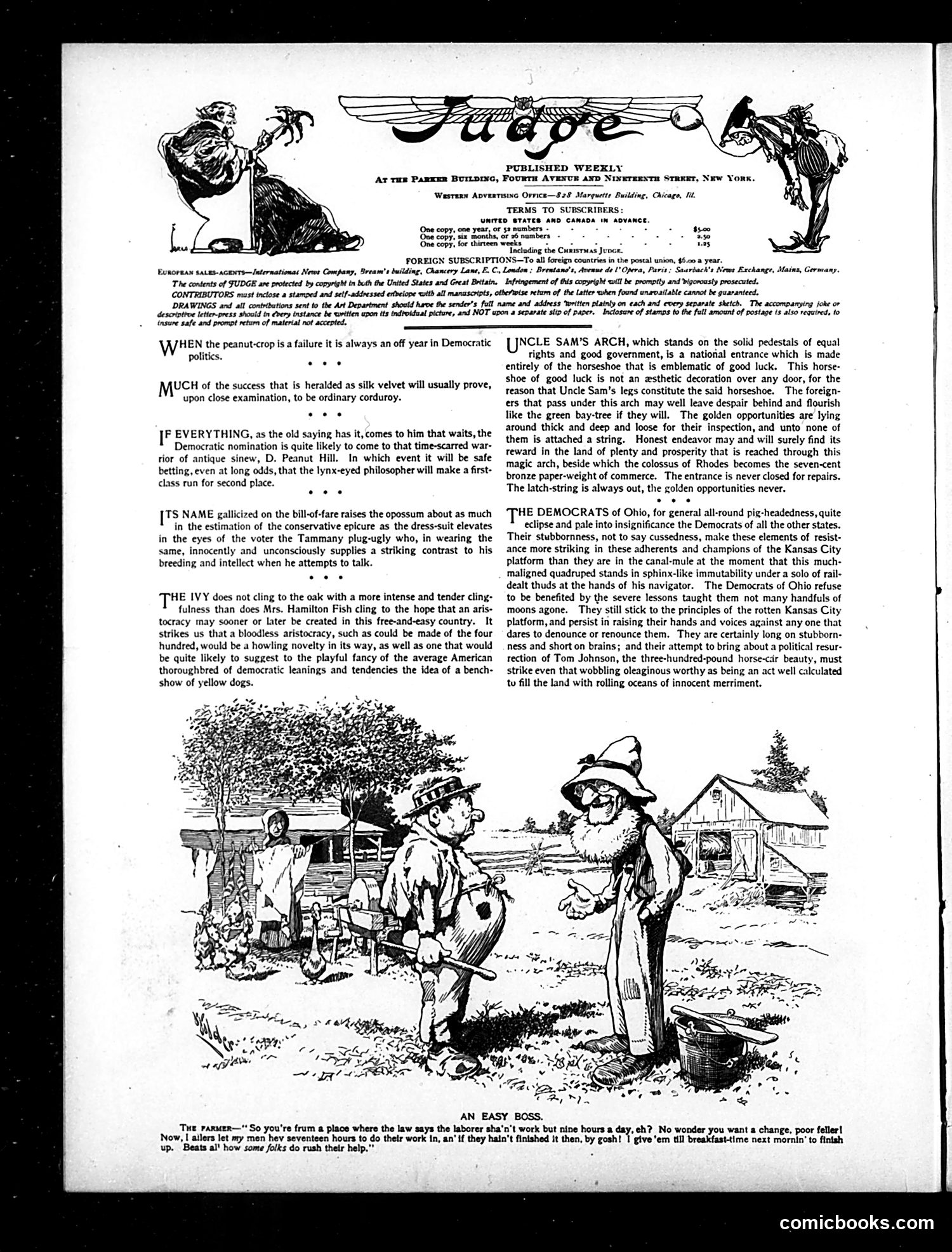
This Judge magazine page contains editorial commentary on early 20th-century American politics, particularly targeting Democratic failures and Ohio politics. The text criticizes Democratic electoral losses, describing their platform as ineffective and their leadership as stubborn. The main cartoon at bottom depicts a farmer ("AN EASY BOSS") speaking with a laborer about working conditions—nine hours daily with no day off. This appears to critique labor exploitation and broken promises of reform. The farmer represents someone offering empty assurances ("I give 'em till breakfast-time next mornin' to finish up"). The editorial sections mock Democratic claims about good governance and the party's internal contradictions. While specific politicians aren't named in the visible text, the satire targets the gap between Democratic rhetoric and actual policy outcomes affecting working Americans.
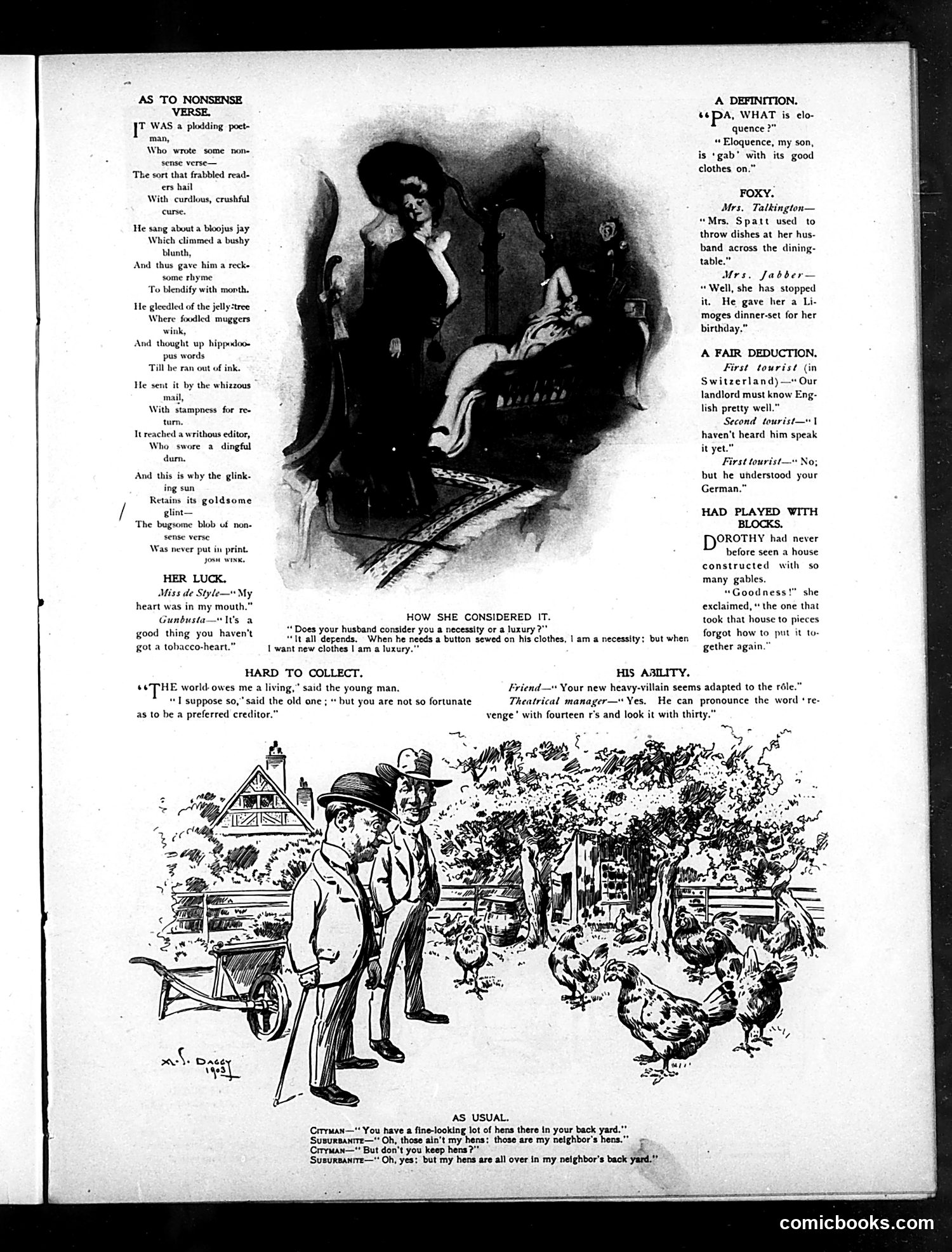
This page contains several satirical pieces typical of early 20th-century humor magazines: **"As to Nonsense Verse"** mocks pretentious poetry—likely Edward Lear or similar Victorian nonsense verse writers—by exaggerating their absurd imagery and claiming such work "was never put in print" before. **The upper illustration** (captioned dialogue about husbands and luxuries) satirizes marital disputes over spending on clothing and domestic goods, a common domestic comedy theme. **"Hard to Collect"** jokes about creditors pursuing debtors. **The lower cartoon "As Usual"** depicts neighbors arguing about property lines and chickens—a timeless suburban dispute played for humor. These pieces reflect Judge's focus on domestic life, literary pretension, and neighborly conflicts rather than specific political events. The humor targets universal human foibles accessible to any era.
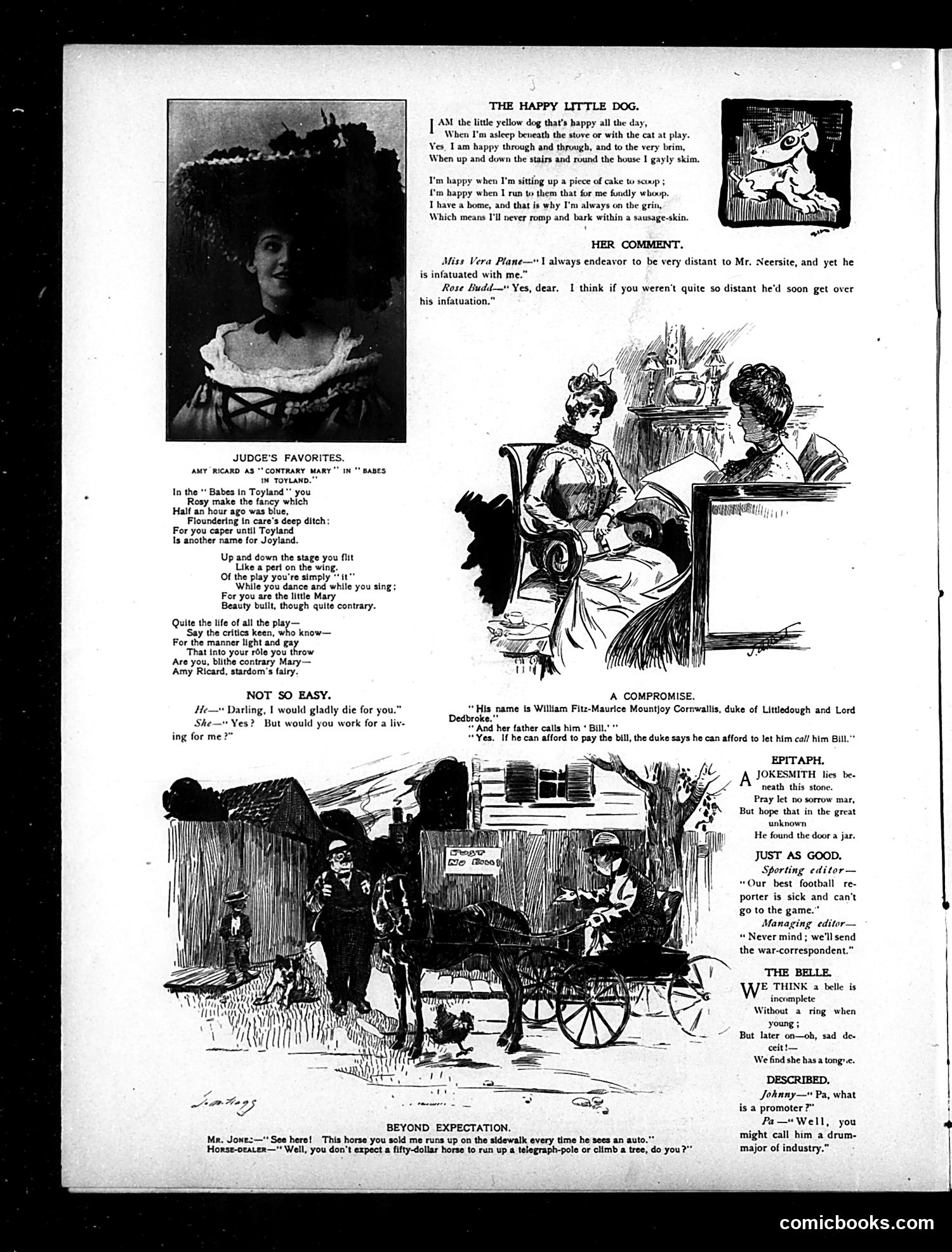
This page contains several unrelated humorous pieces typical of Judge magazine's format: **"The Happy Little Dog"** is a sentimental poem about a content dog, paired with a cartoon illustration. **"Judge's Favorites"** excerpts Amy Ricard's theatrical performances, likely celebrating a popular actress of the era. **"Her Comment"** presents a brief dialogue between Miss Vera Hane and Rose Budd about a Mr. Neersite, appearing to be society gossip humor. **"Beyond Expectation"** shows a cartoon of horse dealers and an automobile owner, joking that a horse cannot climb trees or telegraph poles—satirizing early automobiles' unreliability compared to horses. Other sections include theatrical reviews and social commentary. Without specific dates or attribution visible, the exact historical references remain unclear, though the overall tone reflects turn-of-the-century American humor focused on domestic life, theater, and emerging technology.
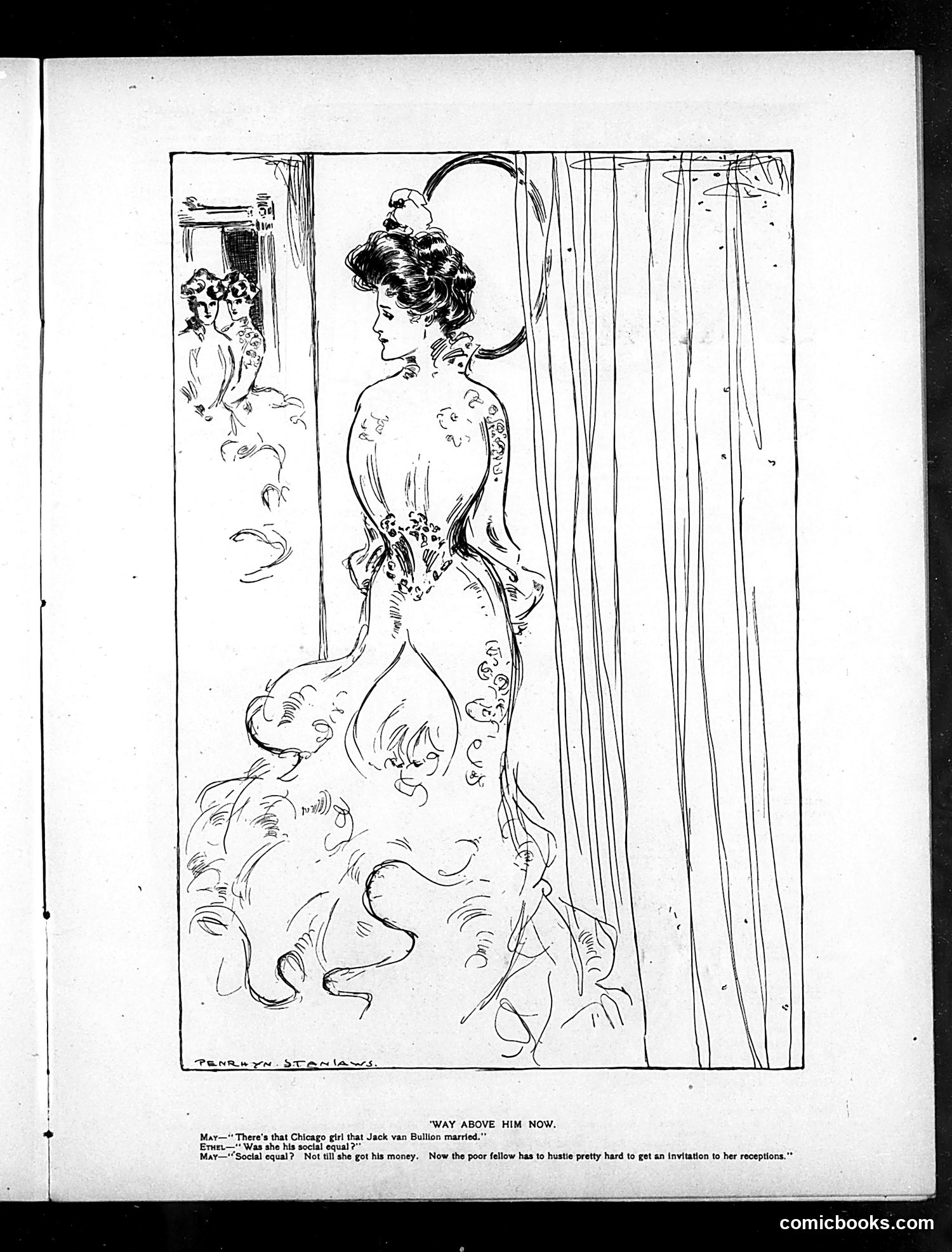
This cartoon satirizes social climbing and gold-digging marriage. A wealthy woman (the "Chicago girl") married a man named Jack van Bullion for his money. The joke is that she's now become socially superior to him—he must now work hard to *earn* invitations to *her* receptions, despite being the money source. The satire targets the absurdity of Gilded Age social hierarchies: a woman of modest background becomes "society" simply by acquiring wealth through marriage, then excludes her own husband from social events. The cartoon mocks both her social pretension and the arbitrary class system that allows money to instantly confer status, while the man who earned that wealth remains beneath her socially.
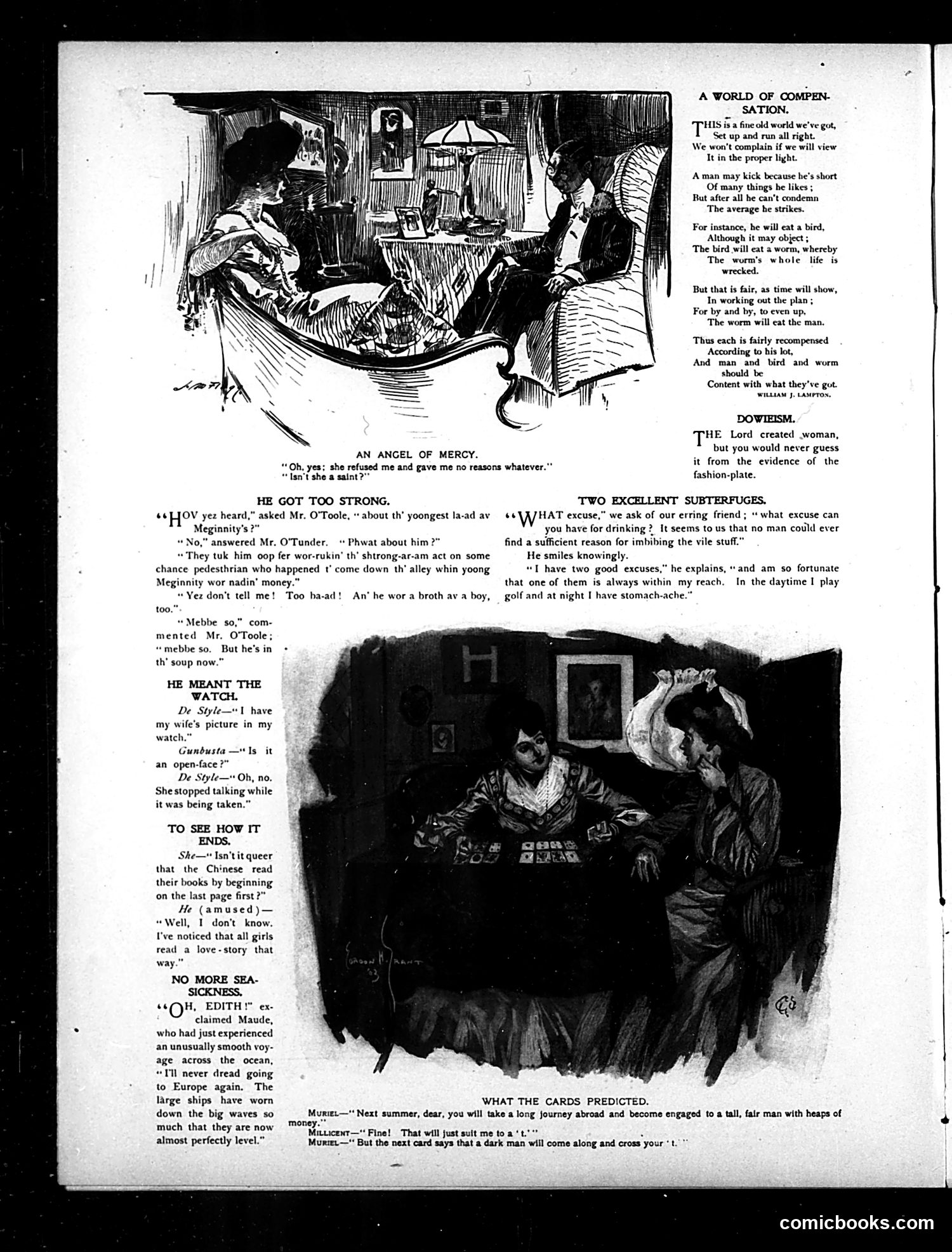
This page from *Judge* contains multiple short comic sketches satirizing turn-of-the-century social manners and gender relations: **"An Angel of Mercy"** mocks a woman who rejected a suitor without explanation—the joke being that refusing a proposal makes her saintly by comparison to her actual behavior. **"He Got Too Strong"** features Irish-dialect characters discussing a young man arrested for assault, suggesting working-class violence and legal consequences. **"He Meant the Watch"** plays on the old joke that a wife won't stop talking long enough for a photograph. **"Two Excellent Subterfuges"** ridicules a drinker's transparent excuses (golf and stomach-ache) for consuming alcohol. **"A World of Compensation"** is a moralizing poem suggesting cosmic balance—predators eat prey; eventually humans get eaten—a sardonic take on natural order. The sketches reflect *Judge*'s typical humor: domestic squabbles, immigrant dialect humor, and gentle social criticism targeting drinking, vanity, and marital discord among middle and working classes.
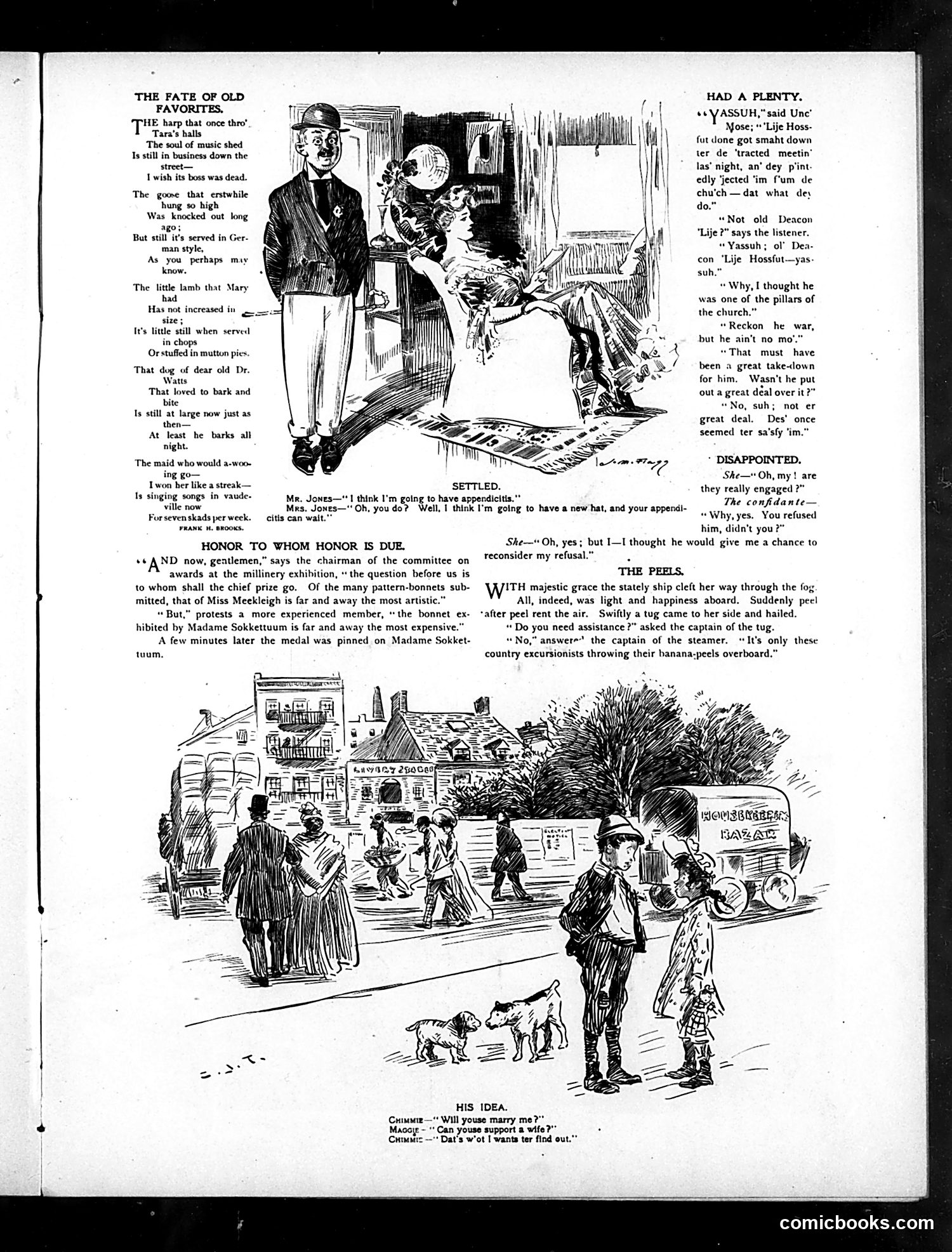
This page contains several satirical pieces typical of early 20th-century American humor: **"The Fate of Old Favorites"** is a poem mockingly tracing how classical literary references—Tara's harp, nursery rhymes, Dr. Watts' dog—have been commercialized and degraded. The satire attacks how high culture becomes cheap entertainment (the "maid" now performs in vaudeville). **"Honor to Whom Honor Is Due"** satirizes judges' corruption: a millinery competition awards the prize not to the most artistic bonnet but the most expensive one, suggesting that wealth, not merit, determines winners. **"Had a Plenty"** uses dialect humor (typical of the era) about a deacon expelled from church who isn't upset, having already received sufficient satisfaction—likely mocking both religious hypocrisy and African American stereotypes. **"The Peels"** is a visual gag: ship passengers throwing banana peels overboard create fog mistaken for the sea—a pun on "peels." The page reflects Judge's mix of social commentary, puns, and period-appropriate (if problematic) ethnic humor.
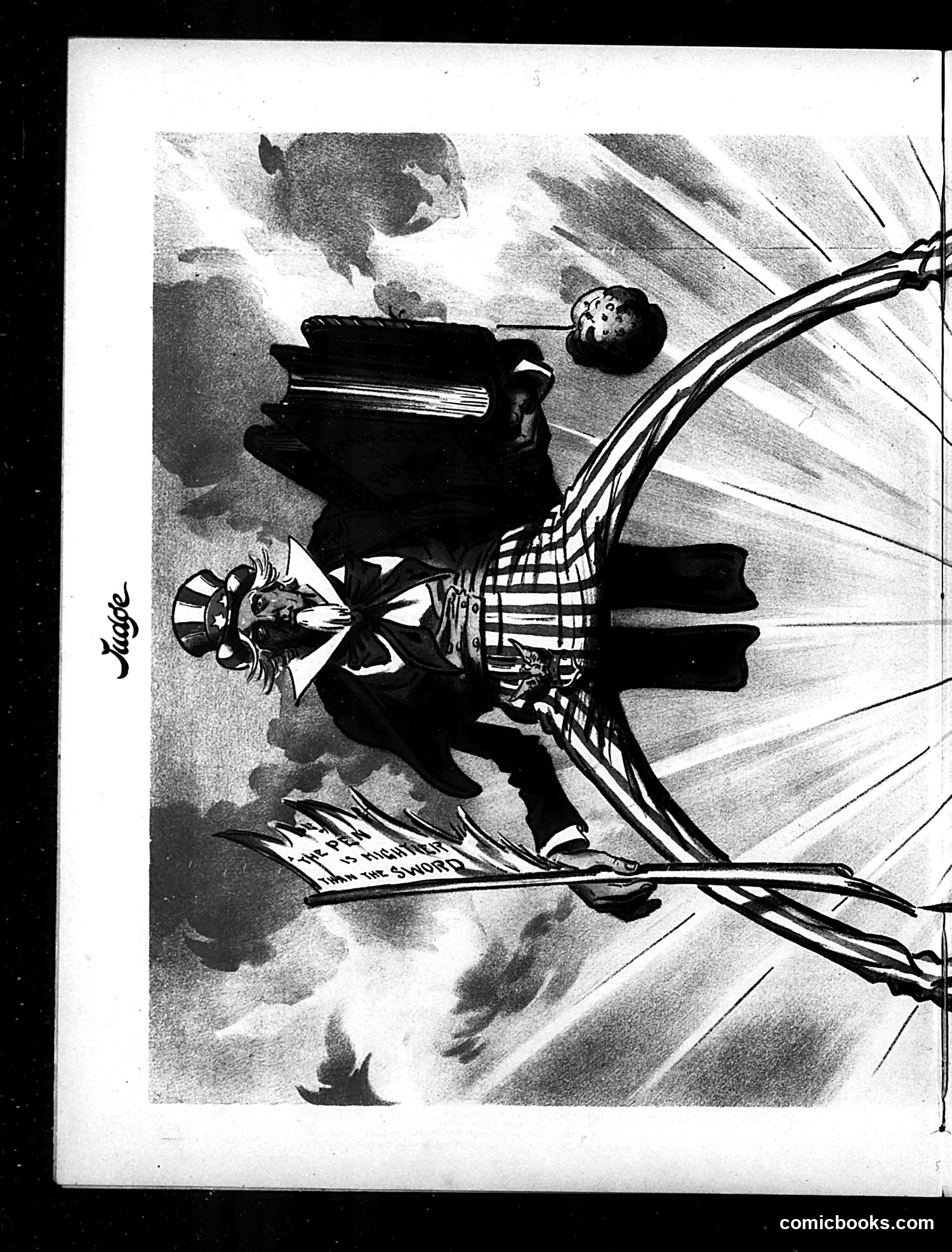
This appears to be a satirical cartoon from *Judge* magazine, though the OCR text is too corrupted to read the caption clearly. The image shows a figure in formal attire (top hat, suit) wielding what appears to be a sword or large blade, with dynamic lines suggesting action or conflict. There's a decorative bow or ribbon element and what may be a spherical object (possibly representing a bomb or globe) in the composition. The style and dramatic rendering suggest this depicts a political or social conflict, likely from the early 20th century based on the artistic technique. Without legible text, I cannot definitively identify the specific figures, political figures, or events being satirized. The overall tone appears critical or mocking of whoever the central character represents.
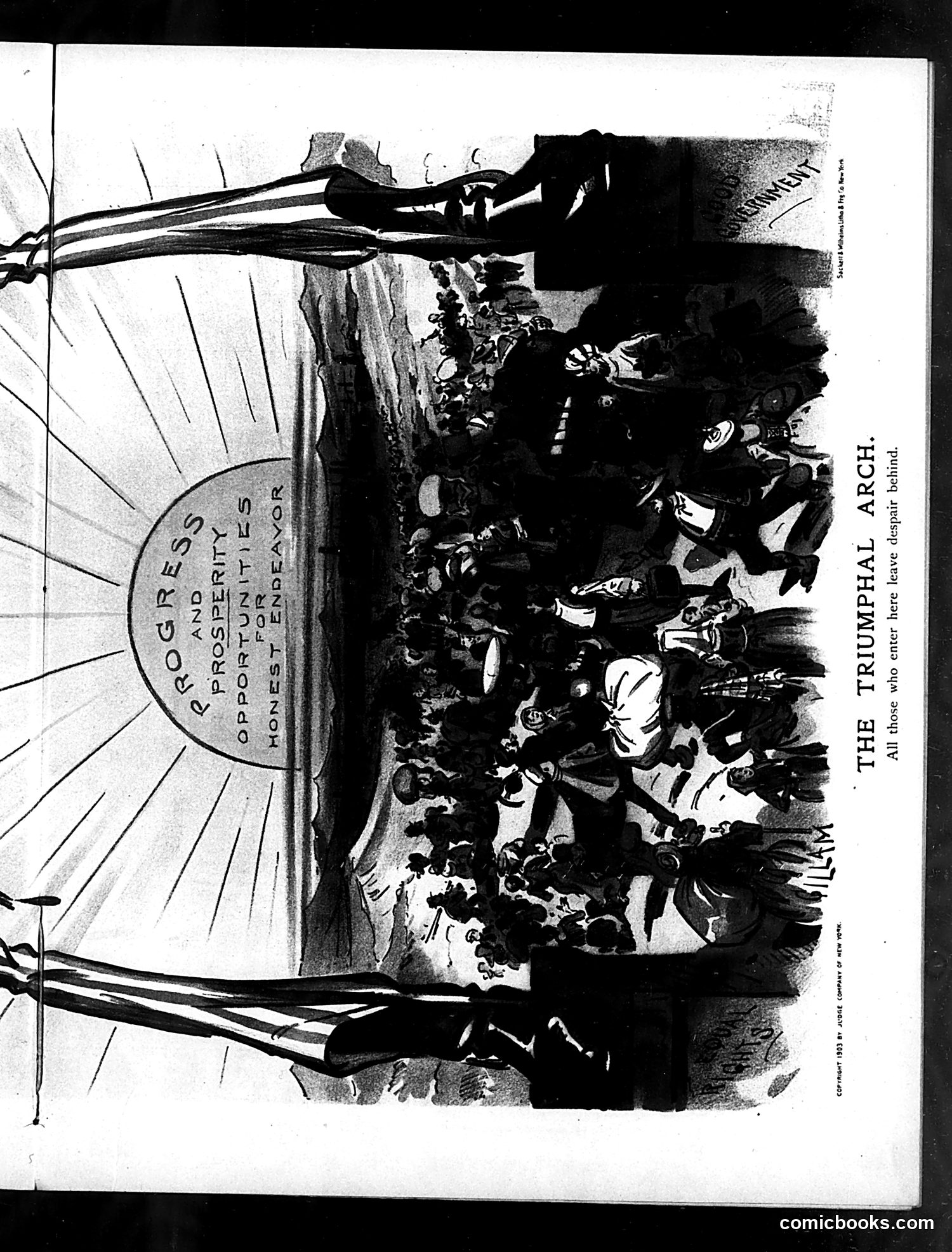
This political cartoon depicts a crowd of figures beneath an elaborate arch labeled "ROGRESS" (Progress), with text describing it as a place "where race despair behind." The image appears to satirize American progress and prosperity claims by showing them constructed upon or supported by masses of people—likely representing working classes or marginalized groups whose labor enables the nation's advancement. The arch symbolizes national achievement and triumph, but the cartoon's composition suggests this progress comes at the expense of those depicted below, critiquing the gap between America's self-congratulatory narrative of progress and the actual conditions of ordinary citizens. This reflects common early 20th-century *Judge* magazine satire about economic inequality and whose interests truly benefit from national "progress."
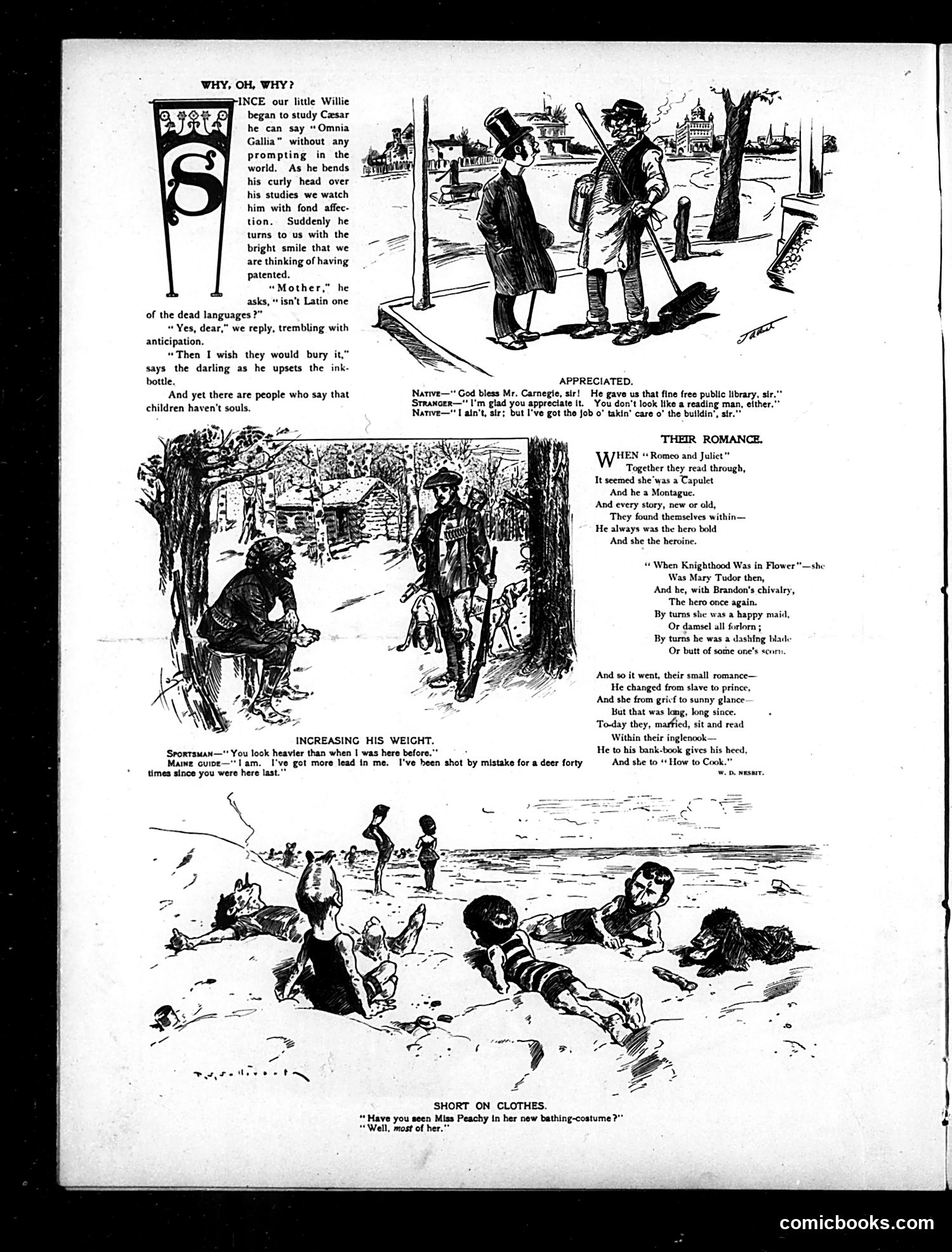
This page contains several unrelated humor pieces typical of Judge's satirical format: **"Why, Oh, Why?"** mocks parents' pretensions about classical education. A child studying Caesar's *Gallia* (Latin texts) asks why they don't "bury" the dead language—a joke about the impracticality of studying obsolete languages. **"Appreciated"** satirizes class assumptions. A working-class janitor at a free public library (likely referencing Andrew Carnegie's library donations) is patronizingly assumed illiterate by a gentleman, though he's employed there. **"Their Romance"** contrasts romantic young lovers who imagine themselves as Shakespearean and historical characters during courtship with their mundane married reality—he now studies his bank account while she reads cookbooks. **"Increasing His Weight"** features a Maine guide claiming he's gained "lead" from being shot at 40 times by hunters mistaking him for deer—a joke about hunting season dangers. **"Short on Clothes"** makes a double-entendre about a woman's revealing bathing costume. These pieces reflect early 20th-century humor: social class commentary, romantic disillusionment, and mild risqué jokes.
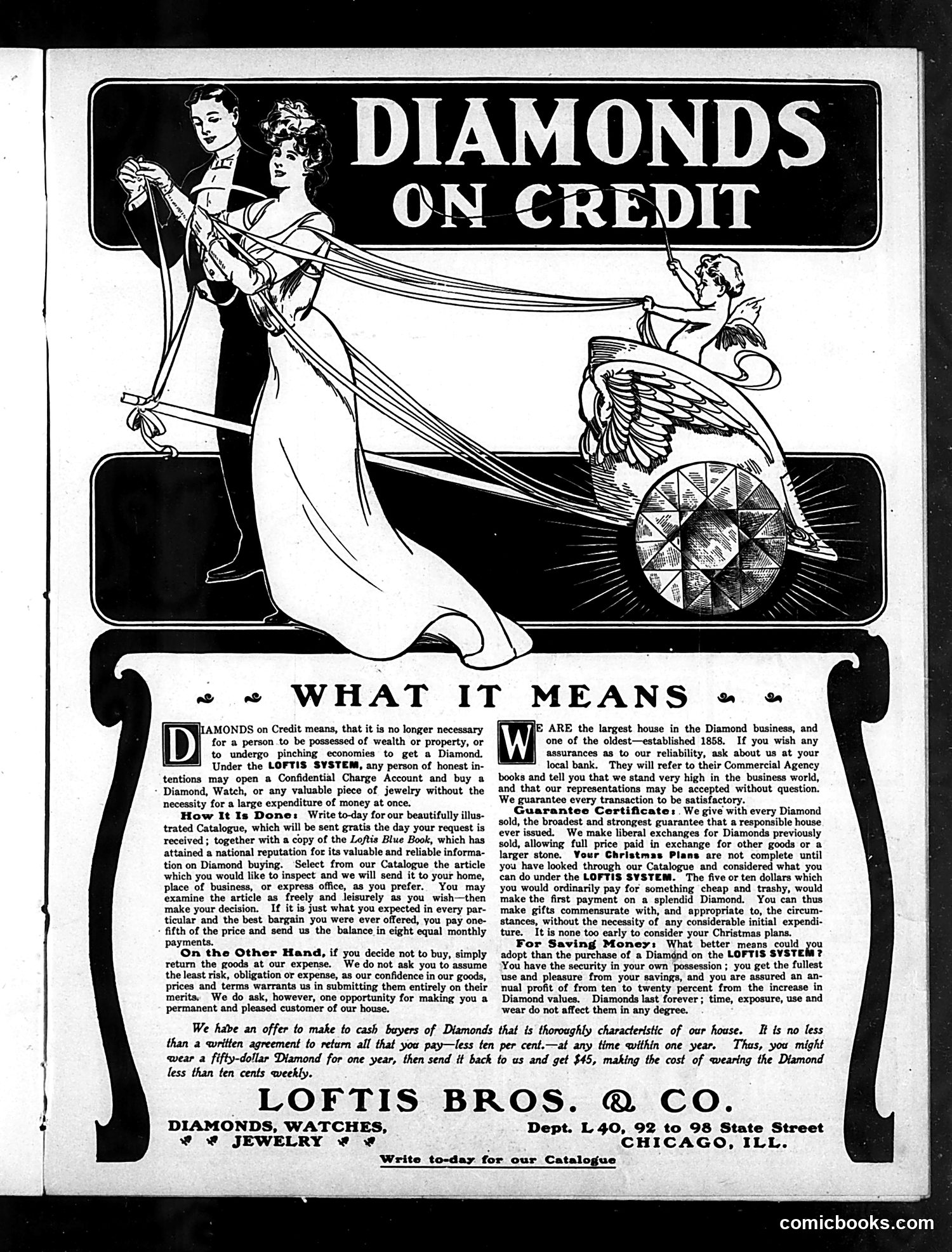
This is primarily a **jewelry advertisement**, not political satire. Loftis Bros. & Co., a Chicago diamond merchant established in 1858, promotes their innovative "Loftis System"—an early installment-payment plan for luxury goods. The illustrated header depicts elegantly dressed figures and a cherub presenting diamonds, establishing aspirational messaging. The advertisement's key appeal addresses a real concern: **democratizing luxury** for the middle class. Previously, only the wealthy could afford diamonds; this system allows "any person of honest intentions" to purchase on credit—paying one-fifth upfront, then eight monthly installments. The pitch emphasizes risk-free shopping (goods sent home for inspection, returnable at company expense) and resale value (diamonds increase 10-20% annually). This represents early 20th-century consumer capitalism and installment-buying culture emerging as social practice. There is no political cartoon or satire here—simply aggressive, persuasive marketing using period-appropriate design and aspirational imagery to sell financing accessibility.
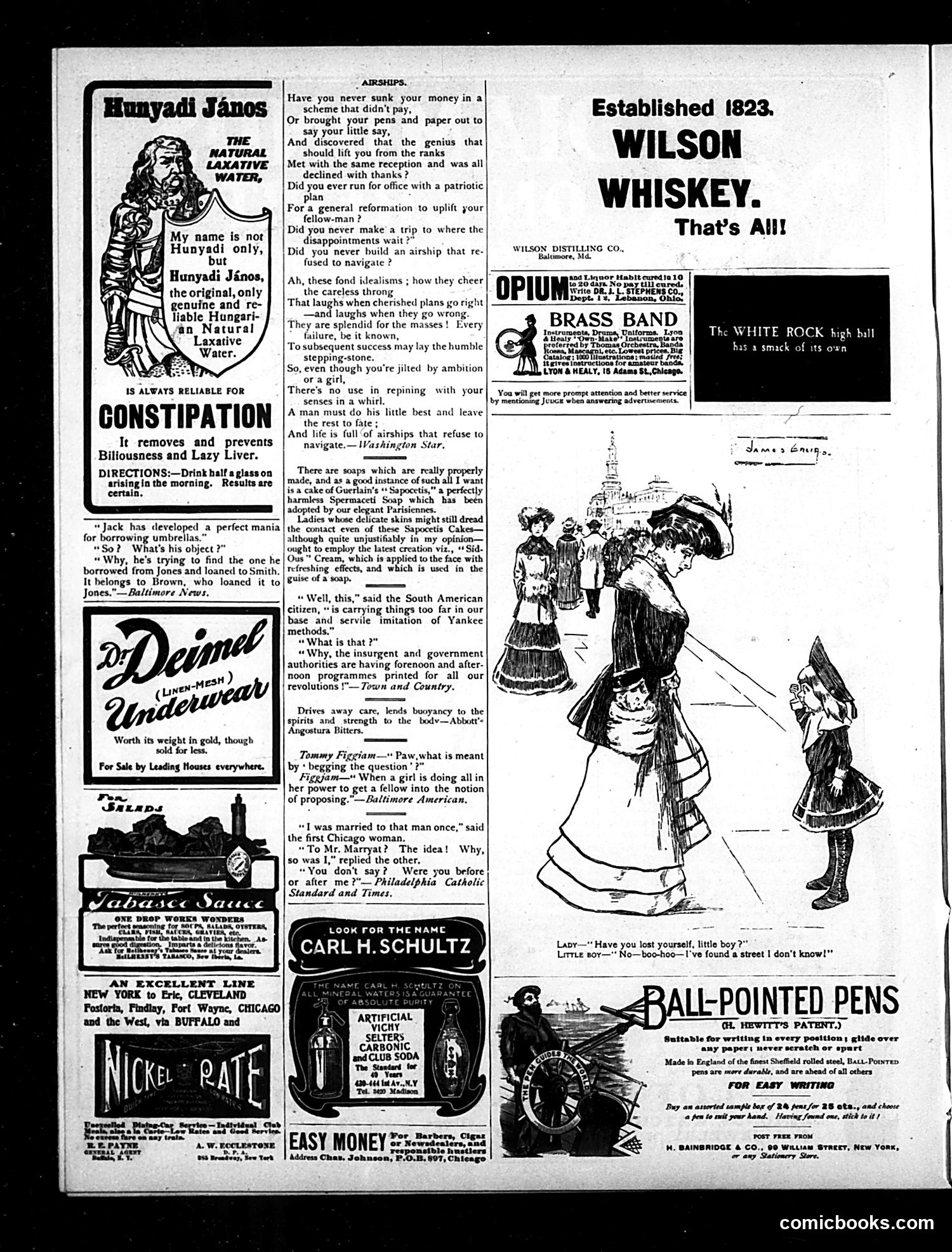
This page is primarily **advertising** with a single editorial cartoon. The main visual content shows a well-dressed lady asking a ragged street urchin "Have you lost yourself, little boy?" to which he replies "No, boo-hoo—I've found a street I don't know!" **The cartoon's point:** It's a gentle class-commentary joke. The lady's polite, concerned question assumes the boy is *lost*—implying he belongs somewhere better. His response reveals the harsh reality: he's a street child so poor and displaced that finding *any* unfamiliar street is unremarkable. The humor is bittersweet, highlighting urban poverty and vagrant children in what appears to be early-20th-century America. The remainder of the page consists of period advertisements (whiskey, laxatives, undergarments, soap, pens) interspersed with short humorous anecdotes about failed ambitions, marriage mishaps, and word-play jokes typical of Judge's satirical content.
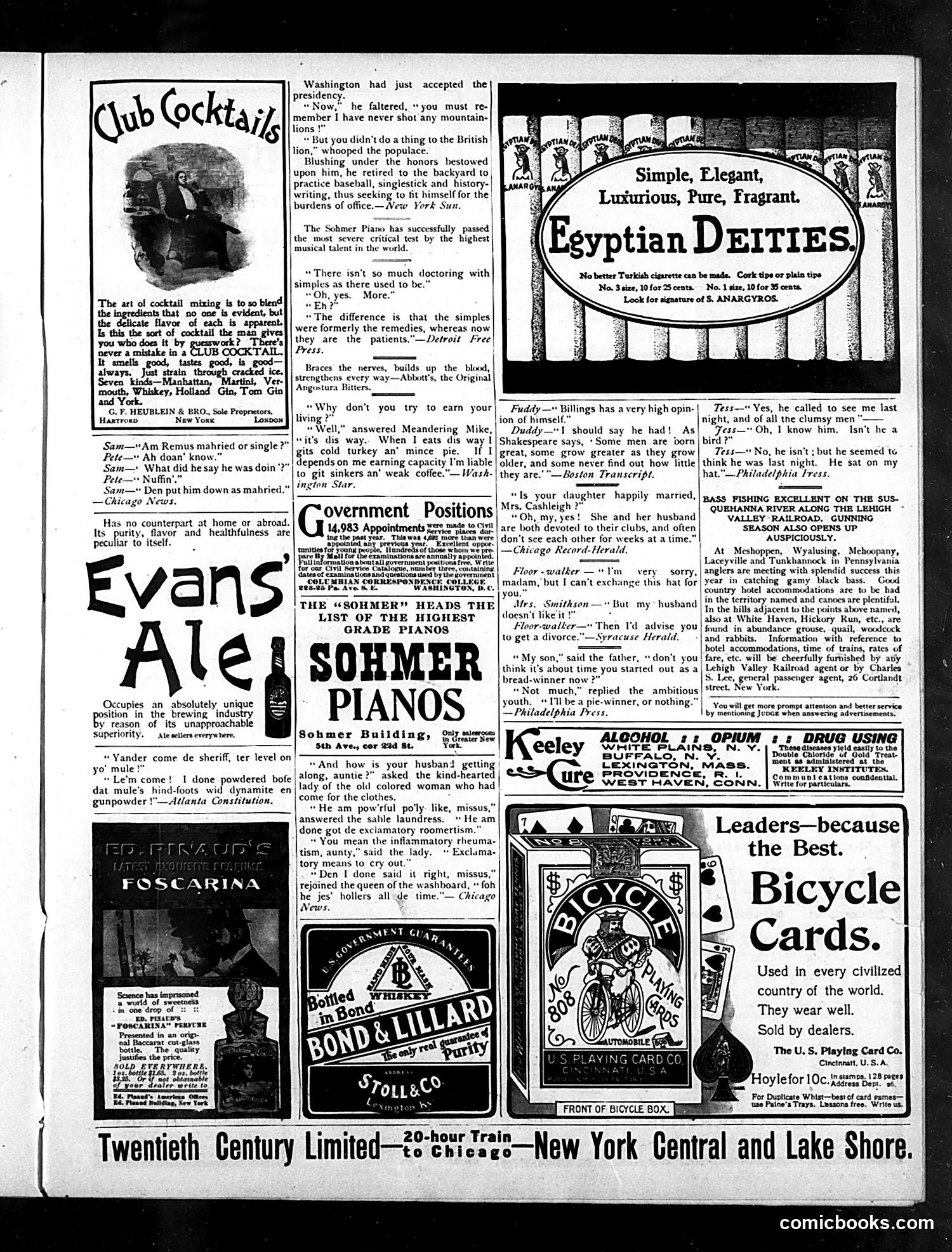
This page is primarily **advertising with some humor sketches**—typical of Judge magazine's mixed format. The main visible content includes: **Humor sections:** Brief jokes about racial stereotypes and domestic situations—common to early 20th-century American humor but reflecting period prejudices (African American dialect jokes, husband-wife banter). **Major advertisers:** Sohmer Pianos (prominently featured as "highest grade"), Evans' Ales, Keeley Cure (a substance-abuse treatment center), Bicycle Playing Cards, and Egyptian Deities cigarettes. The government positions ad lists federal job openings. **Notable detail:** A joke about Washington (likely George Washington) accepting the presidency but retiring to baseball and history-writing instead of military duties—a playful founding-father reference. **Social context:** Advertisements for alcohol, tobacco, and dubious medical "cures" (the Keeley Institute treated "alcohol, cocaine, and drug using") reflect pre-regulation, pre-FDA-approval standards. The page exemplifies how Judge mixed satirical cartoons with commercial content to fund operations.
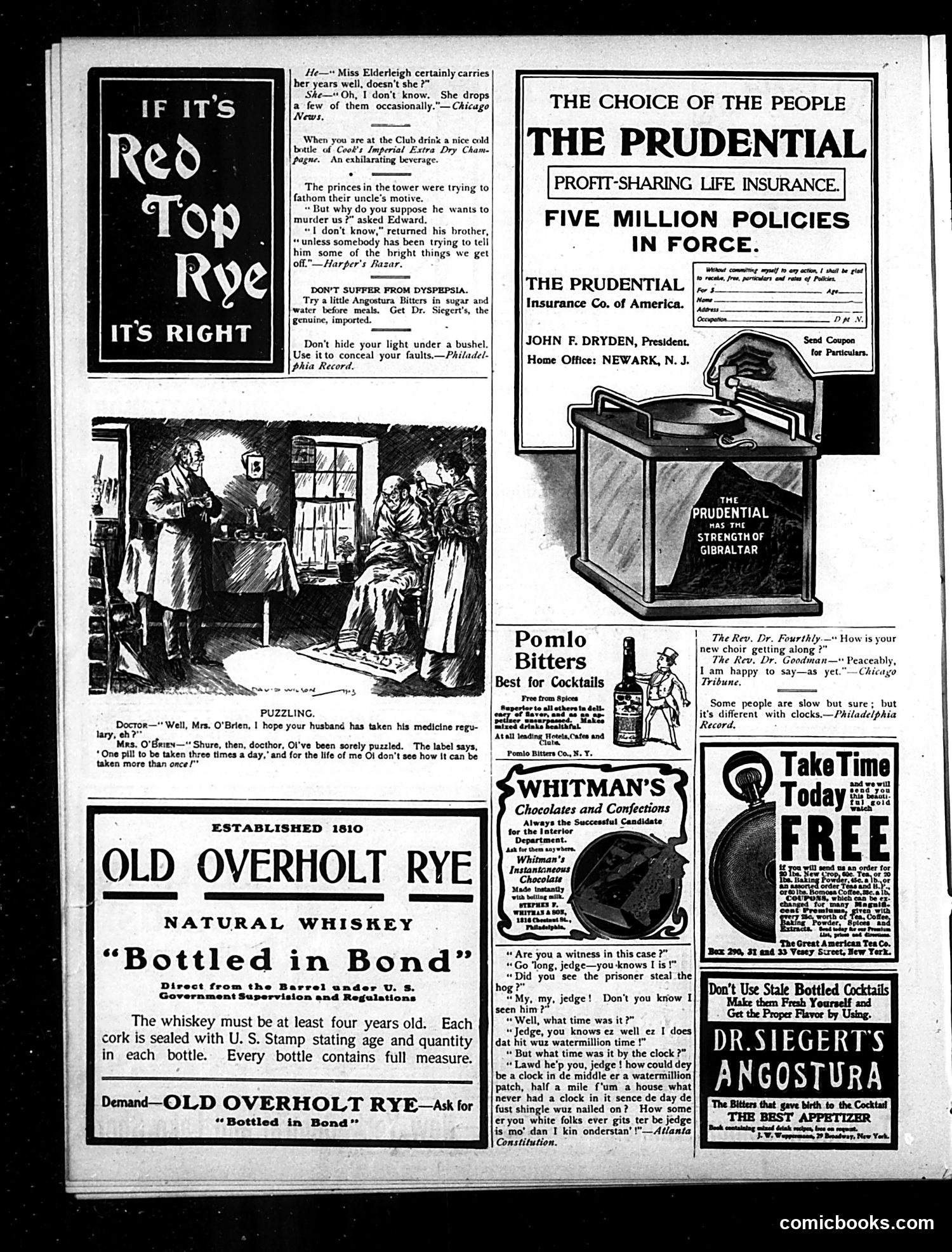
This page contains primarily **advertisements and brief humor jokes** rather than political cartoons requiring historical context. The visible content includes: **Humor snippets:** Short jokes about aging women, princes in a tower, medicine label confusion, and a courtroom exchange with a Black witness using dialect humor (typical of era's problematic racial stereotyping). **Advertisements:** Multiple liquor and patent medicine ads—Old Overholt Rye whiskey, Pomlo Bitters, Dr. Siegert's Angostura, Whitman's Chocolates, and Prudential Insurance. These reflect Prohibition-era advertising (pre-1920) or the repeal period afterward, promoting alcohol openly. **Social context:** The ads reveal consumer culture priorities and patent medicine marketing common in early 20th-century American magazines. The dialect humor reflects contemporary attitudes. **No major political satire** is evident on this page—it's primarily commercial space and light social humor typical of Judge's miscellaneous content sections.
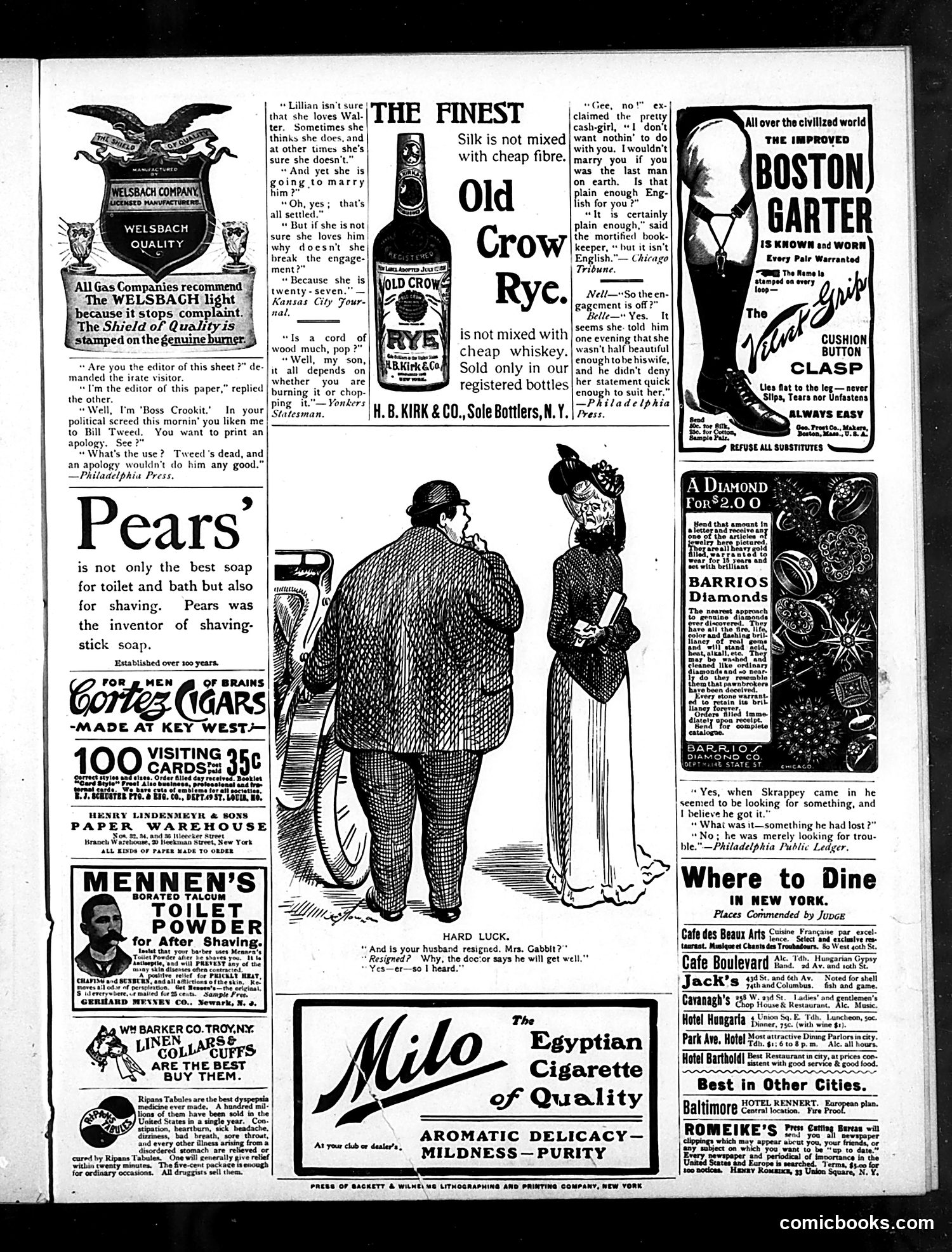
This is primarily an **advertising page** from Judge magazine, with one central cartoon and numerous product advertisements typical of early 20th-century publications. ## The Main Cartoon: "Hard Luck" The cartoon depicts a portly man showing a woman his injured leg/foot in a cast. The caption reads: *"And is your husband resigned, Mrs. Gabbit?" "Resigned? Why, the doctor says he will get well." "Yes—er—so I heard."* The joke exploits a **pun on "resigned"**: the questioner asks if the husband is "resigned" (accepting of his fate), but Mrs. Gabbit mishears it as asking about medical prognosis. The woman's misunderstanding, combined with the follow-up quip, suggests the questioner was implying the husband might *die*—a darkly humorous commentary on marriage or the man's condition. ## Advertisements The page features period products: Welsbatch gas lights, Old Crow Rye, Boston Garter shoes, Pears' soap, Cortez cigars, Milo cigarettes, and various other goods—typical of Judge's commercial content alongside editorial material.
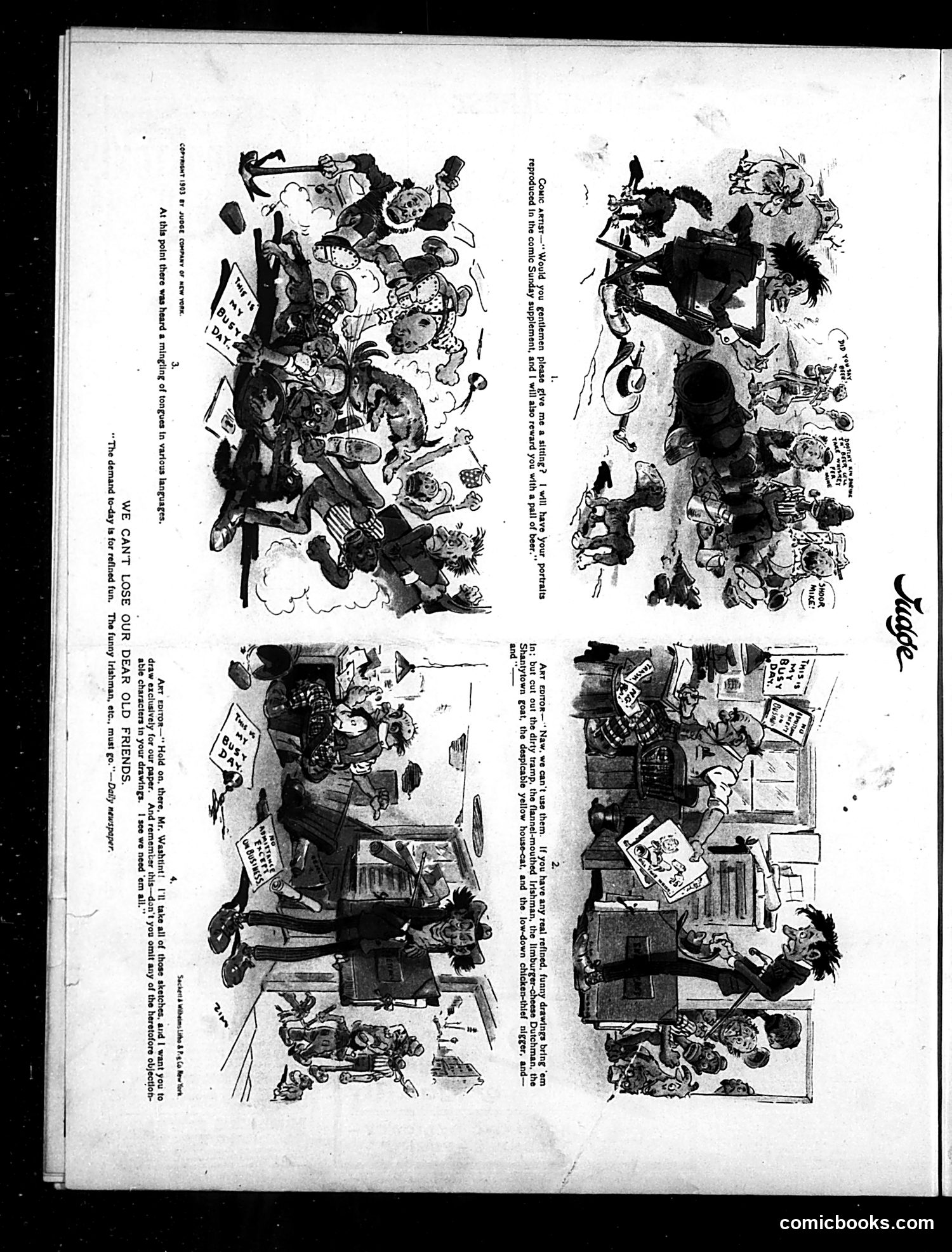
This satirical cartoon critiques competing newspapers' standards for comic illustrations. A cartoonist offers to draw portraits of various stock characters for publication. One editor rejects them, claiming readers now demand "refined fun" and want to eliminate stereotypical characters: the Irish immigrant, German immigrant ("Dutchman"), poor people, animals, and—using the era's offensive racial slur—Black Americans depicted as criminals. A second editor immediately contradicts him, saying he'll buy all the sketches and demands the artist *keep* these stereotypes, declaring "we need 'em all." The satire targets newspaper hypocrisy: editors publicly claim to elevate humor standards while actually profiting from ethnic caricatures and racist stereotypes. The cartoon suggests that despite calls for "refined" content, publications continued exploiting derogatory character types because they sold papers. The title "We Can't Lose Our Dear Old Friends" underscores this cynical contradiction.