
Judge, 1903-10-31 · page 10 of 16
Judge — October 31, 1903 — page 10: what you’re looking at
What you’re looking at
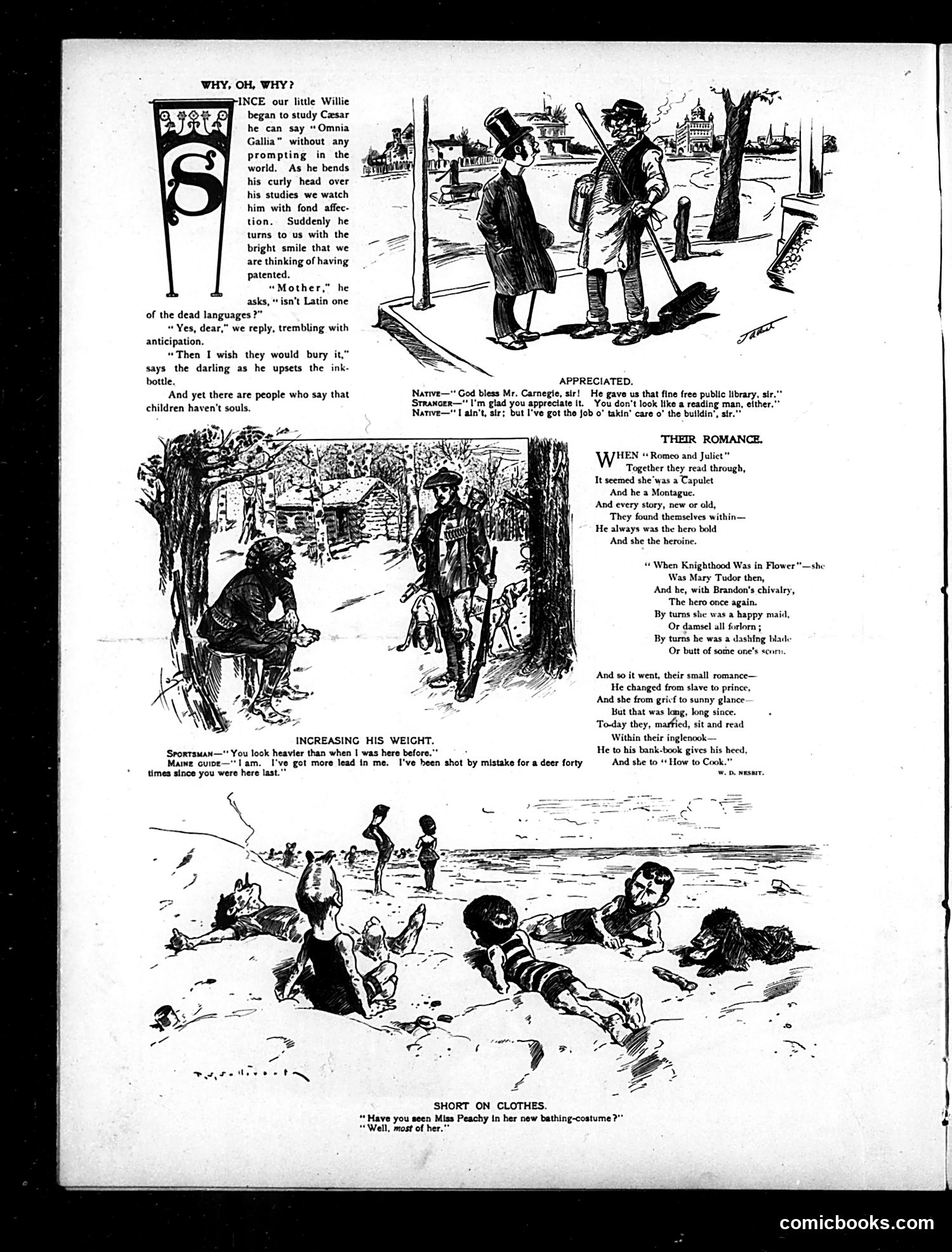
This page contains several unrelated humor pieces typical of Judge's satirical format: **"Why, Oh, Why?"** mocks parents' pretensions about classical education. A child studying Caesar's *Gallia* (Latin texts) asks why they don't "bury" the dead language—a joke about the impracticality of studying obsolete languages. **"Appreciated"** satirizes class assumptions. A working-class janitor at a free public library (likely referencing Andrew Carnegie's library donations) is patronizingly assumed illiterate by a gentleman, though he's employed there. **"Their Romance"** contrasts romantic young lovers who imagine themselves as Shakespearean and historical characters during courtship with their mundane married reality—he now studies his bank account while she reads cookbooks. **"Increasing His Weight"** features a Maine guide claiming he's gained "lead" from being shot at 40 times by hunters mistaking him for deer—a joke about hunting season dangers. **"Short on Clothes"** makes a double-entendre about a woman's revealing bathing costume. These pieces reflect early 20th-century humor: social class commentary, romantic disillusionment, and mild risqué jokes.
📄 Transcribed text from this page (OCR, searchable)
Machine-transcribed from the original scan — historical spelling and the odd misread are preserved.
WHY, OH, WHY? INCE our little Willie began to study Cesar he can say “Omnia Gallia” without any prompting in the world. As he bends his curly head over his studies we watch him with fond affec- tion, Suddenly he turns to us with the bright smile that we are thinking of having patented. “Mother,” he asks, of the dead languages 2” Yes, dear,” we reply, trembling with anticipation. “Then I wish they would bury it, says the darling as he upsets the ink- bottle, APPRECIATED. And yet there are people who say that Narive—“* God bless Mr. Carnegie, sir! He gave us that fine free public library, sir.” Dilidren baseak souks ‘Srranorr—" I'm glad you appreciate it. You don’t look like a reading man, elther.”* 3 Narive—"‘I ain't, sir; but I've got the Job 0° takin’ care o' the buildin’, sir."” ‘THEIR ROMANCE. HEN “Romeo and Juliet” Together they read through, It seemed she'was a Capulet ‘And he a Montague. And every story, new or old, They found themselves within— He always was the hero bold And she the heroine. “When Knighthood Was in Flower"—she Was Mary Tudor then, And he, with Brandon's chivalry, The hero once again. By turns she was a happy maid, Or damsel all forlorn ; By turns he was a dashing blade Or butt of somne one’s scorn. And so it went, their small romance— He changed from slave to prince, And she from gricf to sunny glance But that was lang, long since. To-day they, marfied, sit and read INCREASING HIS WEIGHT. Within their inglenook— ‘Srortsuan—' You look heavier than when | was here before."* . He to his bank-book gives his heed, Maine cuice—"'l_am. I've got more lead in me. I've been shot by mistake for a deer forty And she to ‘ How to Cook.” times since you were here last."" wD, masa, Wyse eee tN SHORT ON CLOTHES. “Have you seen Miss Peachy in her new bathing-costume?"” “Well, most of her.” comicbooks.com