
A complete issue · 16 pages · 1903
Judge — October 24, 1903
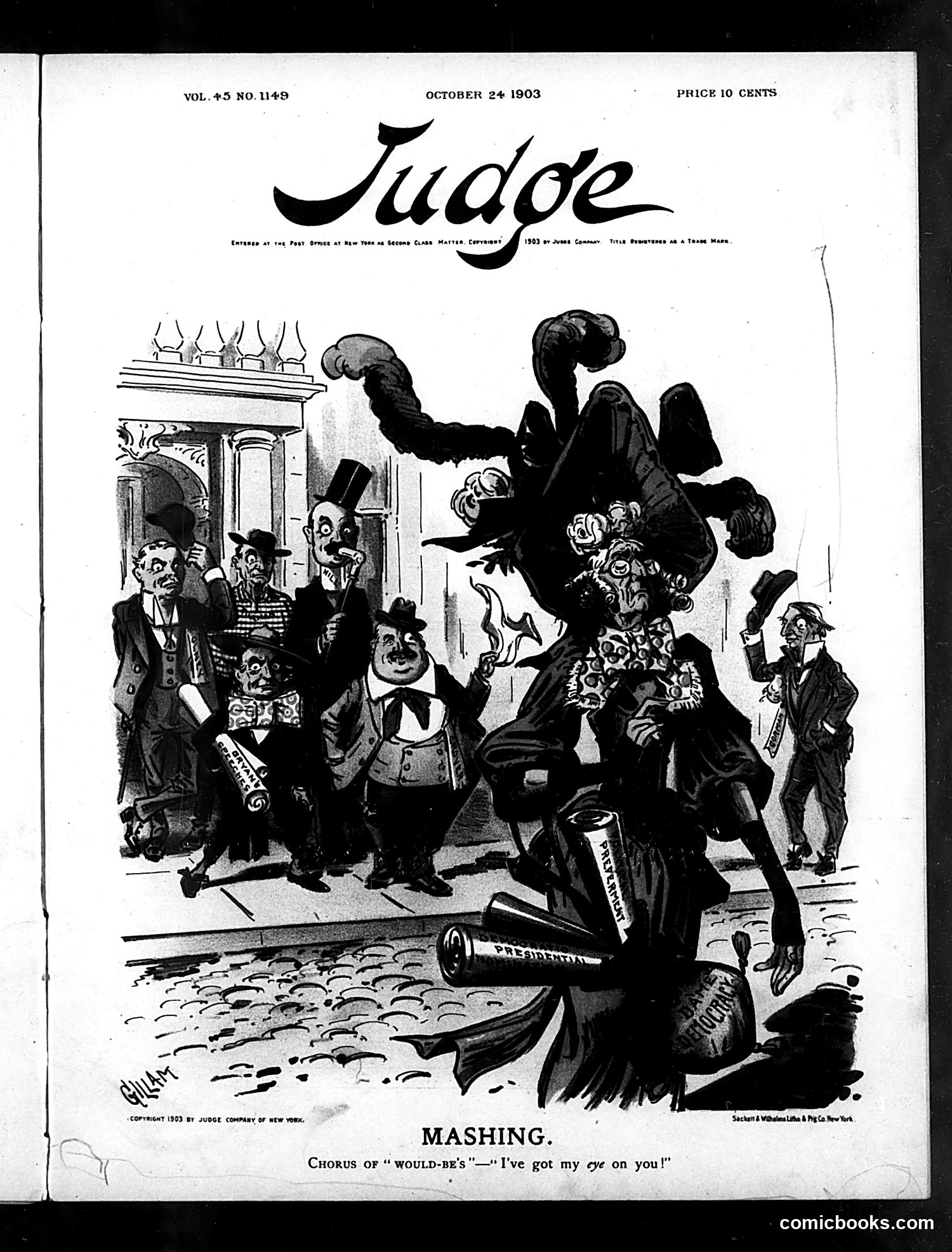
This satirical cartoon depicts a figure (appearing to be a political or social figure in formal dress) performing acrobatic "mashing"—slang for aggressive flirtation or romantic pursuit—before an audience of onlookers. The chorus line references "I've got my eye on you," emphasizing the predatory nature of the behavior being mocked. The caricatured faces and exaggerated expressions suggest this is commentary on someone's inappropriate social conduct or unwanted romantic advances. The architectural setting and formal attire indicate this occurs in a public or elite social space. Without clearer identification of the specific figure or contemporary event, the precise target remains uncertain, though the satire clearly ridicules aggressive flirtation as unseemly public conduct worthy of mockery.
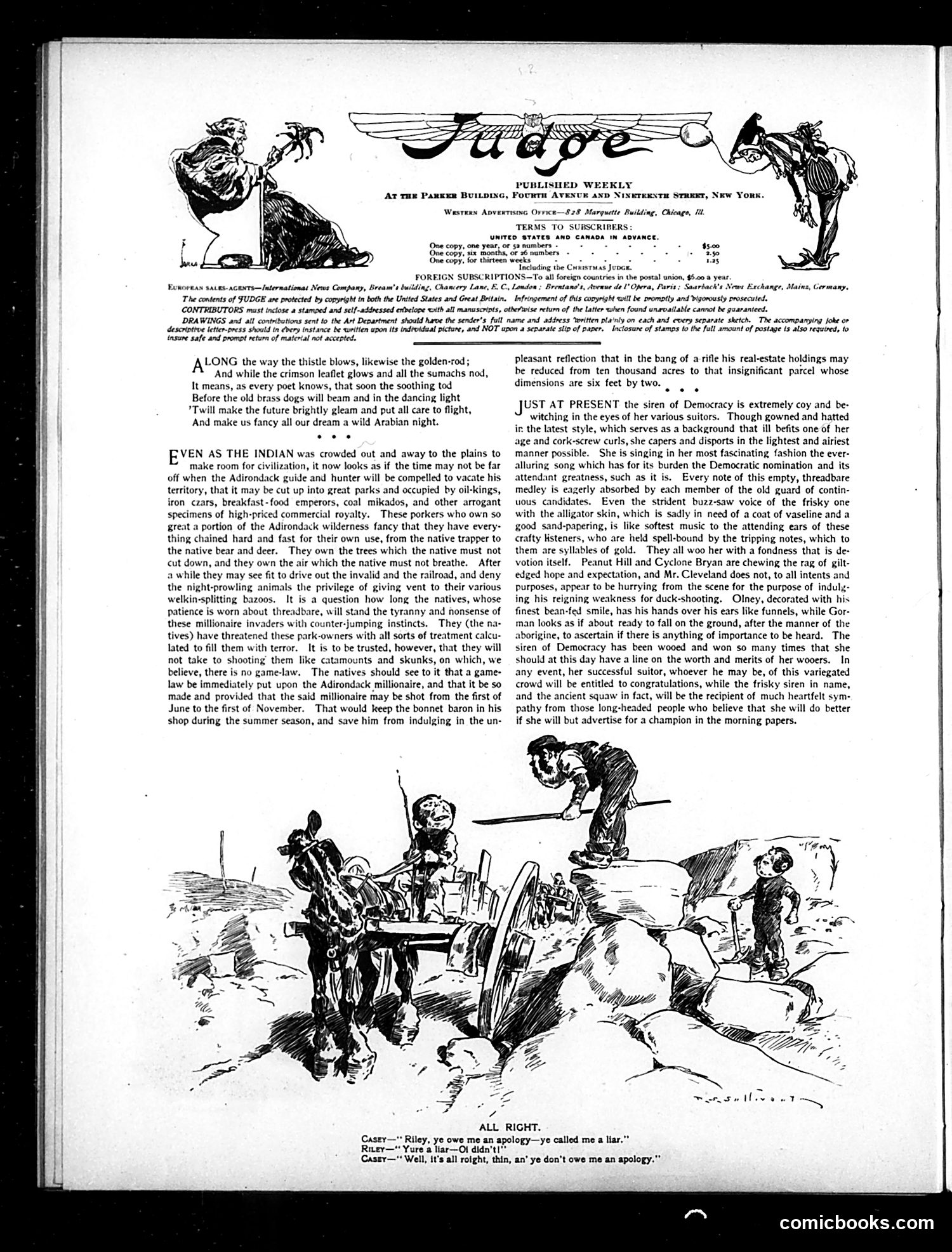
This page from *Judge* magazine contains two main elements: **Top Article**: Discusses Native Americans being displaced from Adirondack lands for wealthy estates—critiquing how ten thousand acres were reduced to insignificant parcels, lamenting the loss of indigenous hunting grounds to elite real estate development. **Bottom Cartoon ("All Right")**: Depicts two figures (Casey and Riley) in a dispute over an apology. Riley claims Casey owes him one; Casey counters that Riley owes *him* an apology instead. The final exchange—"Well, it's all right, then, an' ye don't owe me an apology"—suggests mutual stubbornness resolved through circular logic, likely satirizing Irish-American laborers or political figures of the era engaging in pointless quarrels that cancel themselves out.
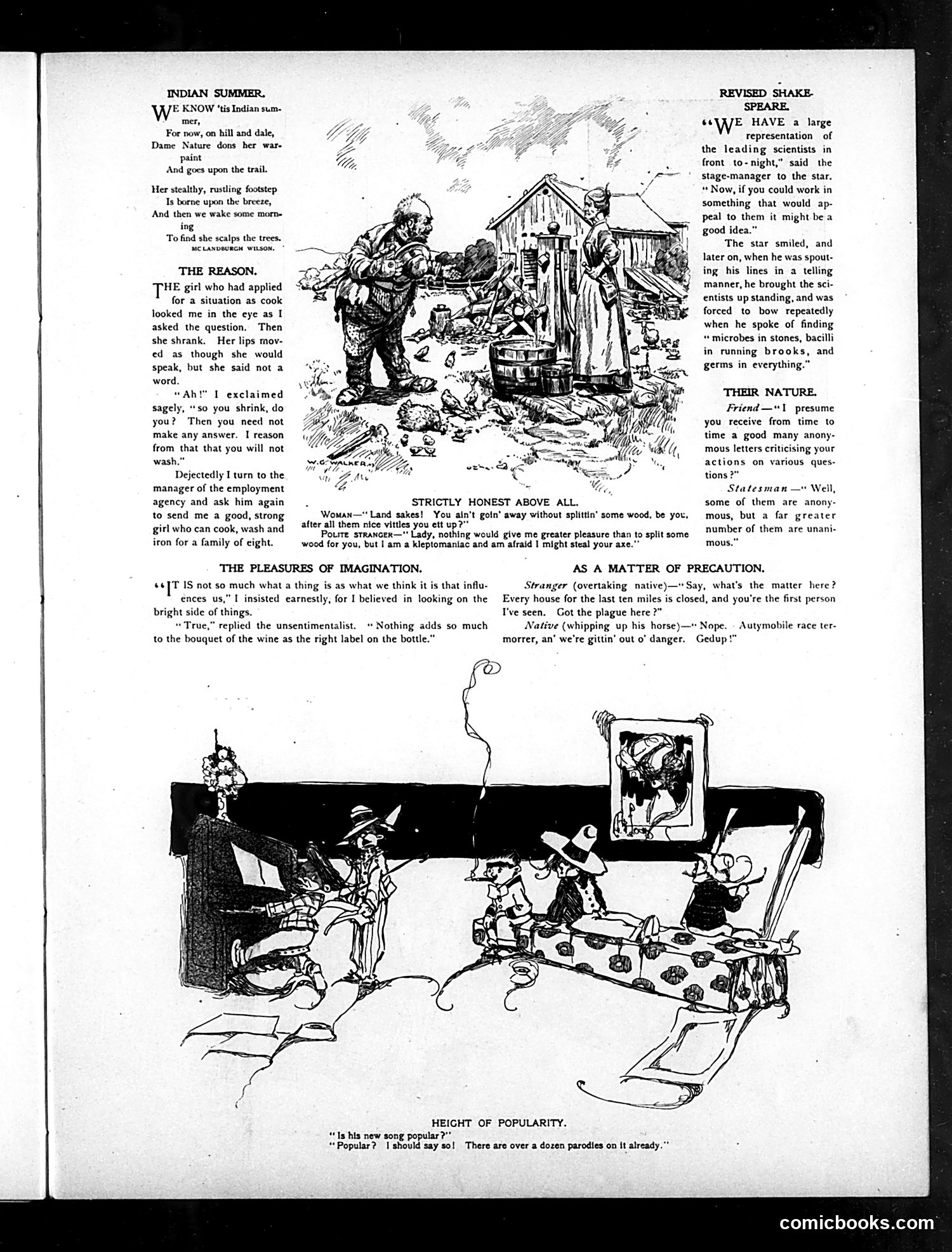
This page contains several distinct pieces rather than a unified cartoon: **"Indian Summer"** and **"The Season"** are poems with an accompanying rural illustration showing two figures outside a cottage. **"Revised Shakespeare"** mocks a stage manager who, when asked to create something scientifically appealing, forces actors to recite facts about "microbes in stones, bacilli in running brooks, and germs in everything"—satirizing the era's obsession with germ theory and scientific "improvement" of culture. The lower illustration appears to depict theatrical or entertainment figures in an indoor scene, likely satirizing popular entertainment trends. **"Height of Popularity"** at bottom jokes about parody proliferation, suggesting something has become so popular it spawns numerous imitations. The page reflects late 19th/early 20th-century concerns about science, theater, and popular culture trends.
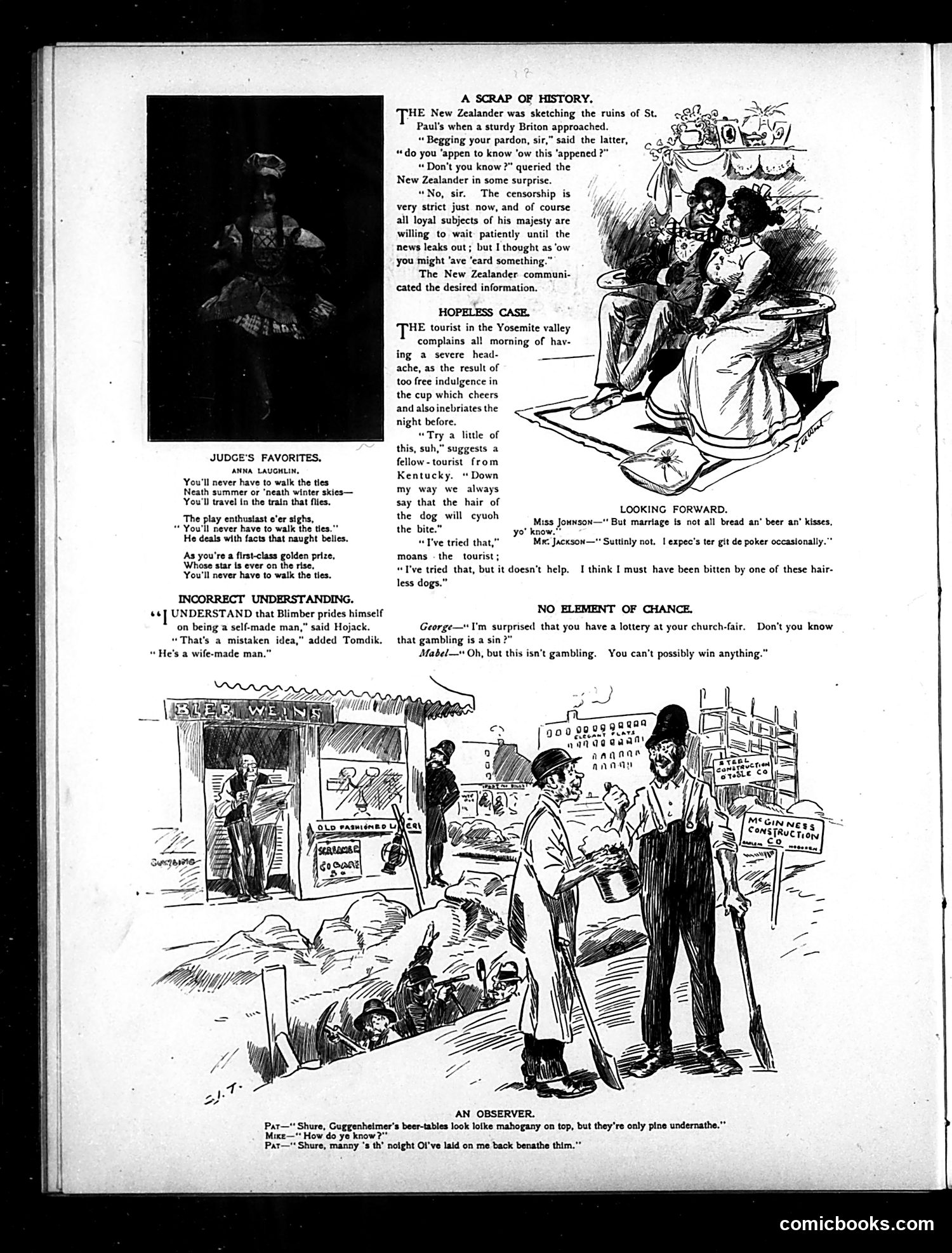
This page contains several short humorous sketches typical of Judge's satirical style: **"A Scrap of History"** mocks British colonial attitudes, depicting a Briton questioning a New Zealander about recent events, with the latter sarcastically noting strict censorship prevents him from sharing news. **"Hopeless Case"** jokes about a tourist's hangover from excessive drinking. **"Judge's Favorites"** and other brief comic sections offer light social commentary on various topics. **"An Observer"** at bottom appears to satirize construction or industrial work, with characters commenting on someone's resemblance to mahogany furniture. The cartoons reflect early 20th-century American humor: colonial politics, drinking culture, and working-class observations. The satirical tone targets both British imperialism and contemporary American social behaviors without addressing specific contemporary political events identifiable from this page alone.
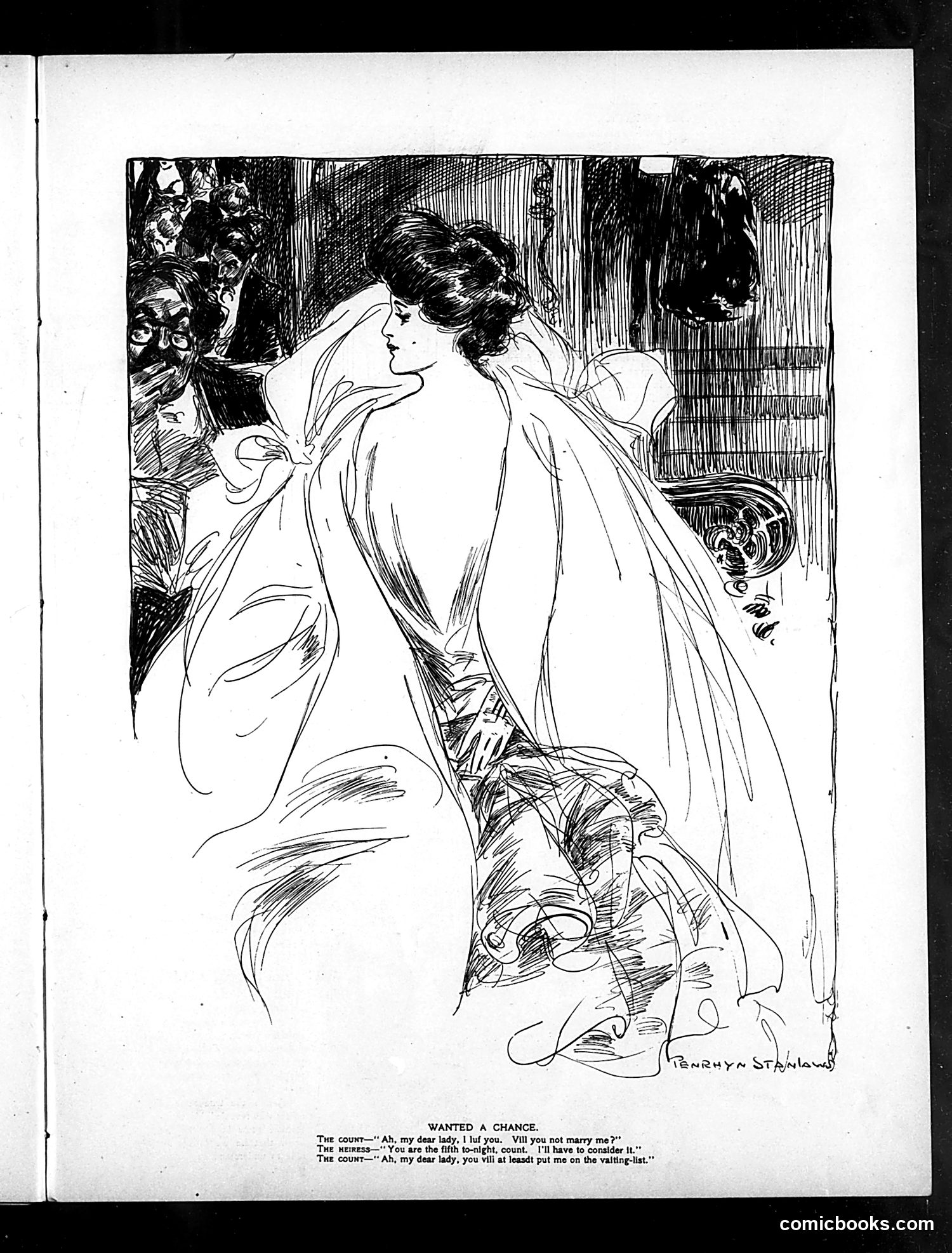
This is a romantic satire drawn by Penrhyn Stanlaws. A count proposes marriage to a woman, claiming to love her. She responds that he's the fifth suitor that evening and she needs time to consider. He then asks to at least be "put on the waiting-list." The joke mocks both the count's desperation and the woman's popularity—she's so sought-after that marriage proposals require queue management. The humor lies in treating romantic commitment like a commercial transaction with literal waiting lists. This reflects early-20th-century satirical commentary on courtship conventions among the wealthy, where marriage was often as much about social position and wealth as romance.
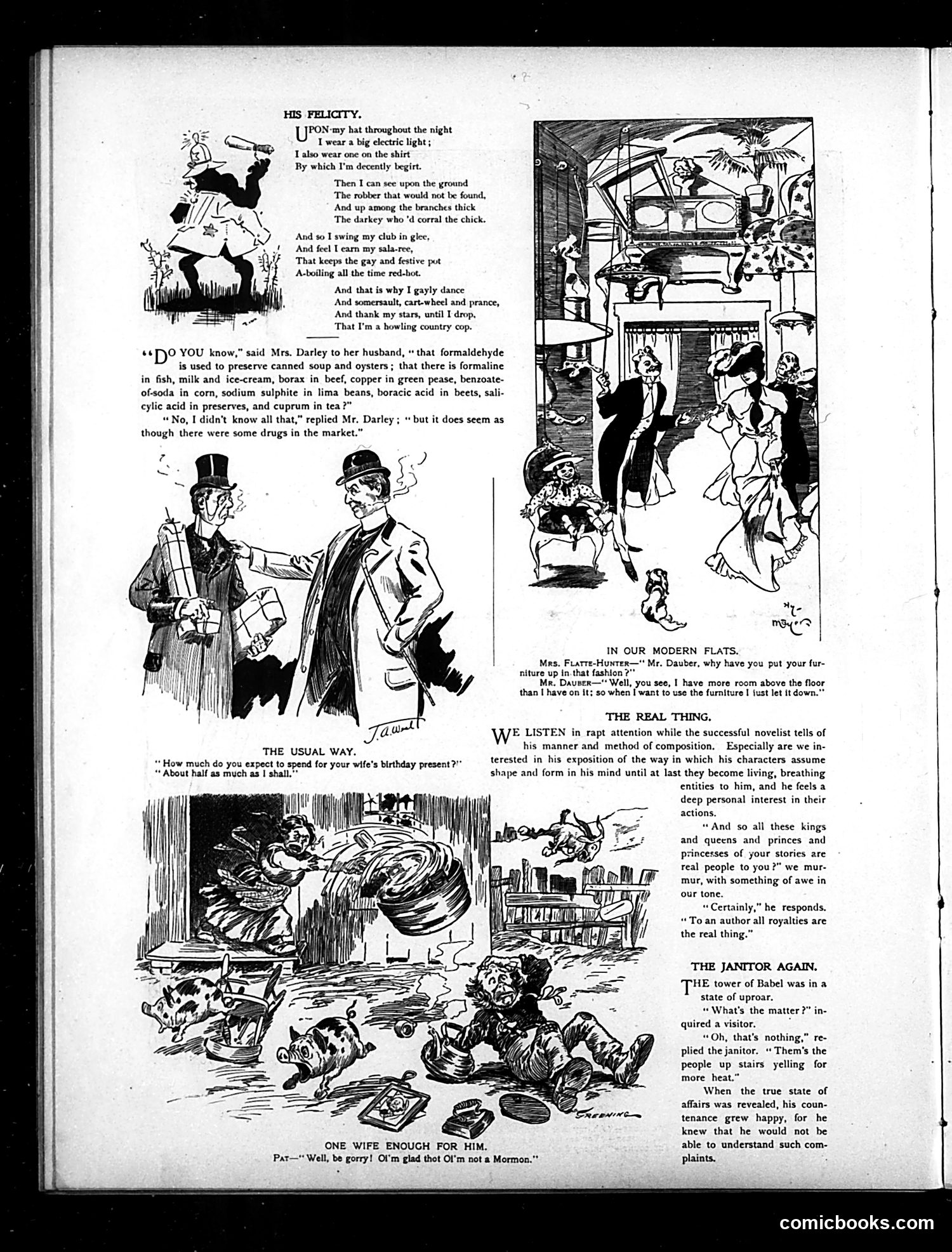
This page contains several satirical cartoons mocking American life circa early 1900s: **"His Felicity"** ridicules a rural police officer who celebrates his job's perks—wearing electric lights to catch criminals and miscreants—using exaggerated, self-congratulatory language. The casual racism ("darkey") reflects the period's prejudices. **"The Usual Way"** jokes about marital economics: a husband expects to spend twice what his wife does on her birthday gift, inverting typical gender spending expectations for satirical effect. **"One Wife Enough for Him"** features a stereotypical Irish immigrant (Pat) relieved he's not Mormon, mocking both Mormonism's polygamy and Irish-American working-class identity. **"In Our Modern Flats"** satirizes cramped urban apartment living, where residents must store furniture overhead due to space constraints. **"The Real Thing"** puns on a novelist's claim that his fictional characters are "real"—the twist is his interest is financial ("royalties"), not artistic. **"The Janitor Again"** presents a building superintendent grateful that tenants' complaints are incomprehensible to him, suggesting class-based communication barriers.
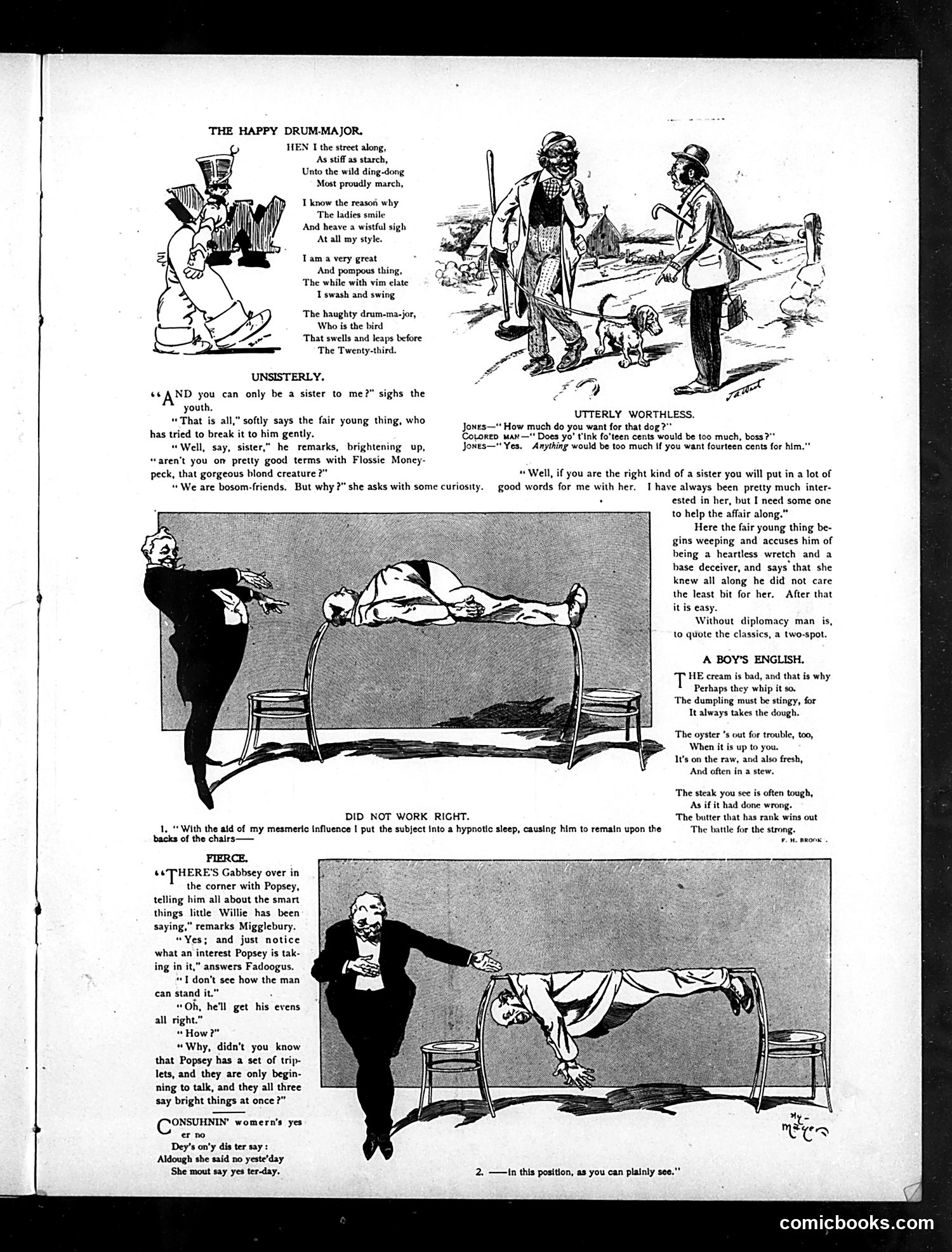
This page contains three separate satirical pieces typical of early 20th-century American humor: 1. **"The Happy Drum-Major"** — A humorous poem about a self-important drum major leading the Twenty-third Regiment, mocking his pompous vanity and the attention he receives. 2. **"Unsisterly" and "Utterly Worthless"** — Two romantic comedy sketches exploiting a common trope: a man tries to use his "sister" as an intermediary to win over a woman he's attracted to. The humor lies in the woman's justified anger at being manipulated, and a separate joke about racial dialect negotiating a low price for a dog. 3. **"A Boy's English"** — Wordplay mocking how children learn language through food-related puns (cream being "whipped," dumplings being "stingy"). 4. **"Fierce" and "Did Not Work Right"** — Mesmerism jokes and anecdotes about people tolerating annoying conversation because they face worse at home (triplets). The page relies heavily on period-specific social conventions, romantic stereotypes, and casual racial humor that would not be acceptable today.
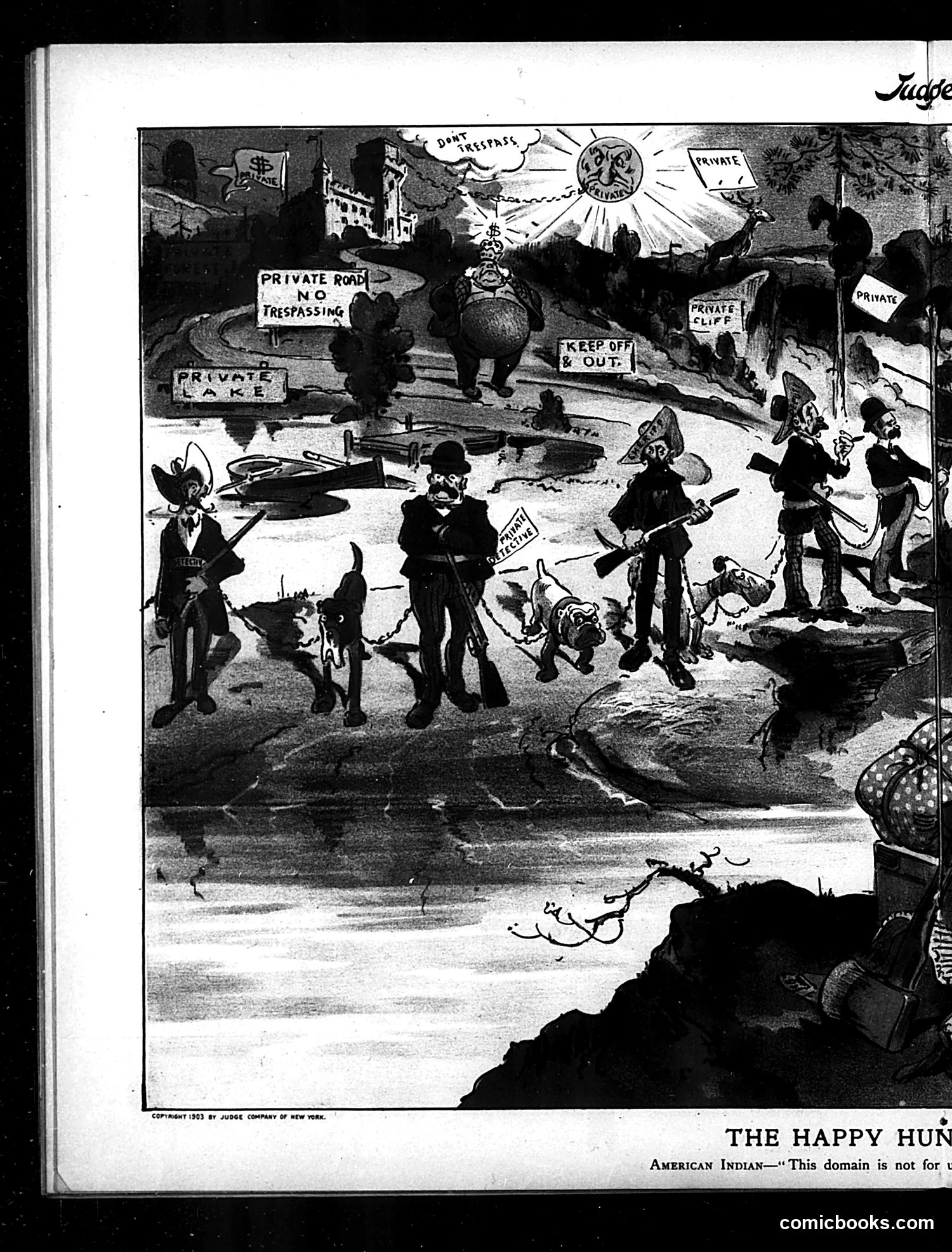
This 1903 Judge cartoon satirizes American Indian land rights. The scene depicts Native Americans being forcibly excluded from their own territory by armed settlers and officials bearing "Private" signs ("Private Road," "Private Lake," "Private Cliff," "Keep Off & Out"). The title's reference to "American Indian" combined with the "Hun" label suggests the cartoon critiques the irony and injustice of dispossession—indigenous peoples are treated as invaders on their ancestral lands. The armed figures represent the colonizing forces that seized and privatized Native territories. The sun symbol with radiating lines appears to represent divine approval or natural law, possibly mocking the settlers' justifications for taking the land. The cartoon criticizes the hypocrisy of American expansion and property claims built on displacement of Native peoples.
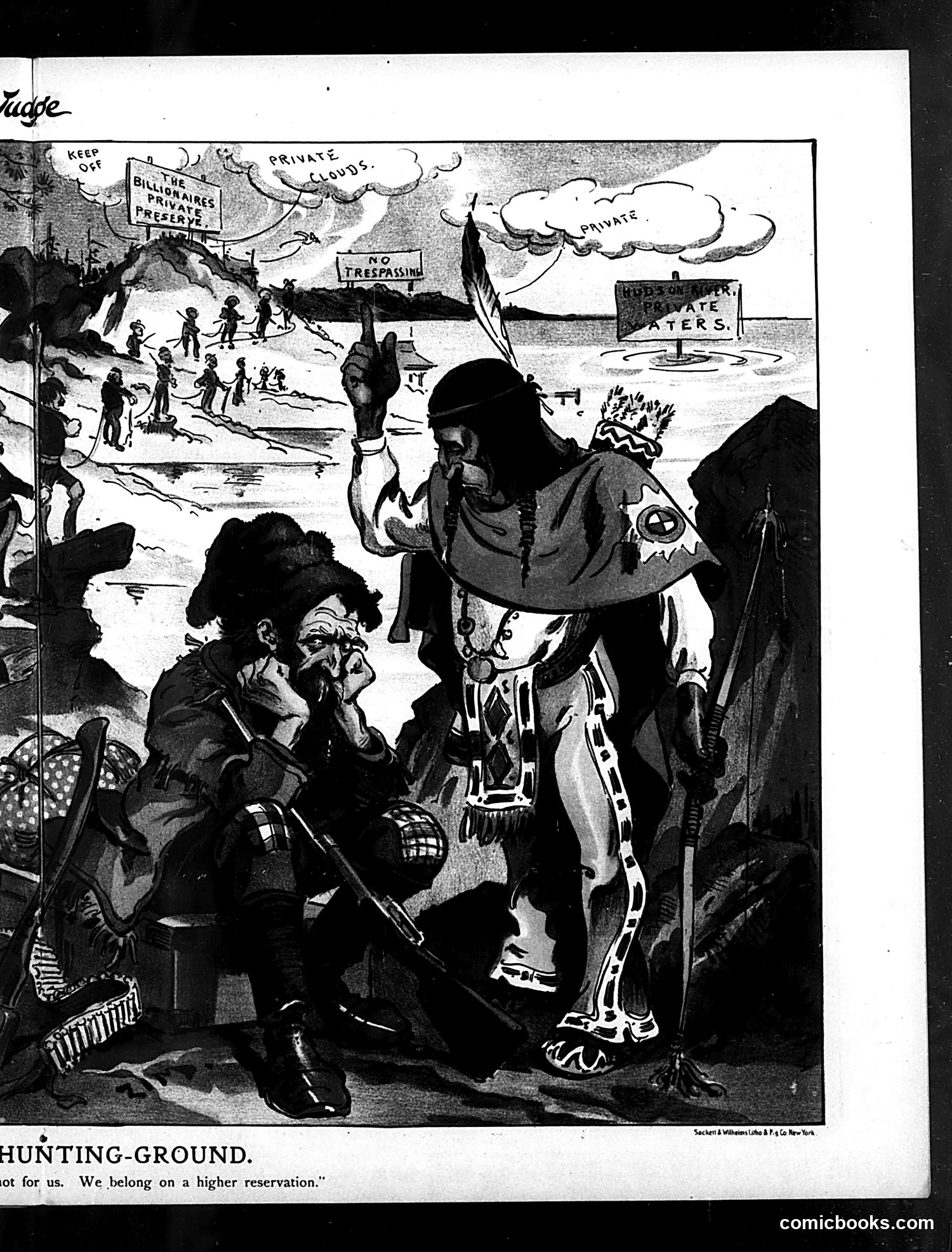
This Judge magazine cartoon satirizes wealthy elites' exclusionary practices regarding public lands. In the foreground, two aristocratic figures (rendered with exaggerated features suggesting caricature) stand before a beach or waterfront marked with "KEEP OFF," "PRIVATE CLOUDS," and "NO TRESPASSING" signs. One figure holds what appears to be a torch or torch-bearer, while the other gestures dismissively. The background shows common people enjoying the water and beach freely. The caption—"not for us. We belong on a higher reservation"—suggests ironic commentary: the wealthy claim exclusive rights to natural resources, relegating ordinary citizens to designated areas ("reservations"), echoing the historical treatment of Native Americans. The satire critiques privatization of public spaces and class-based access to nature.
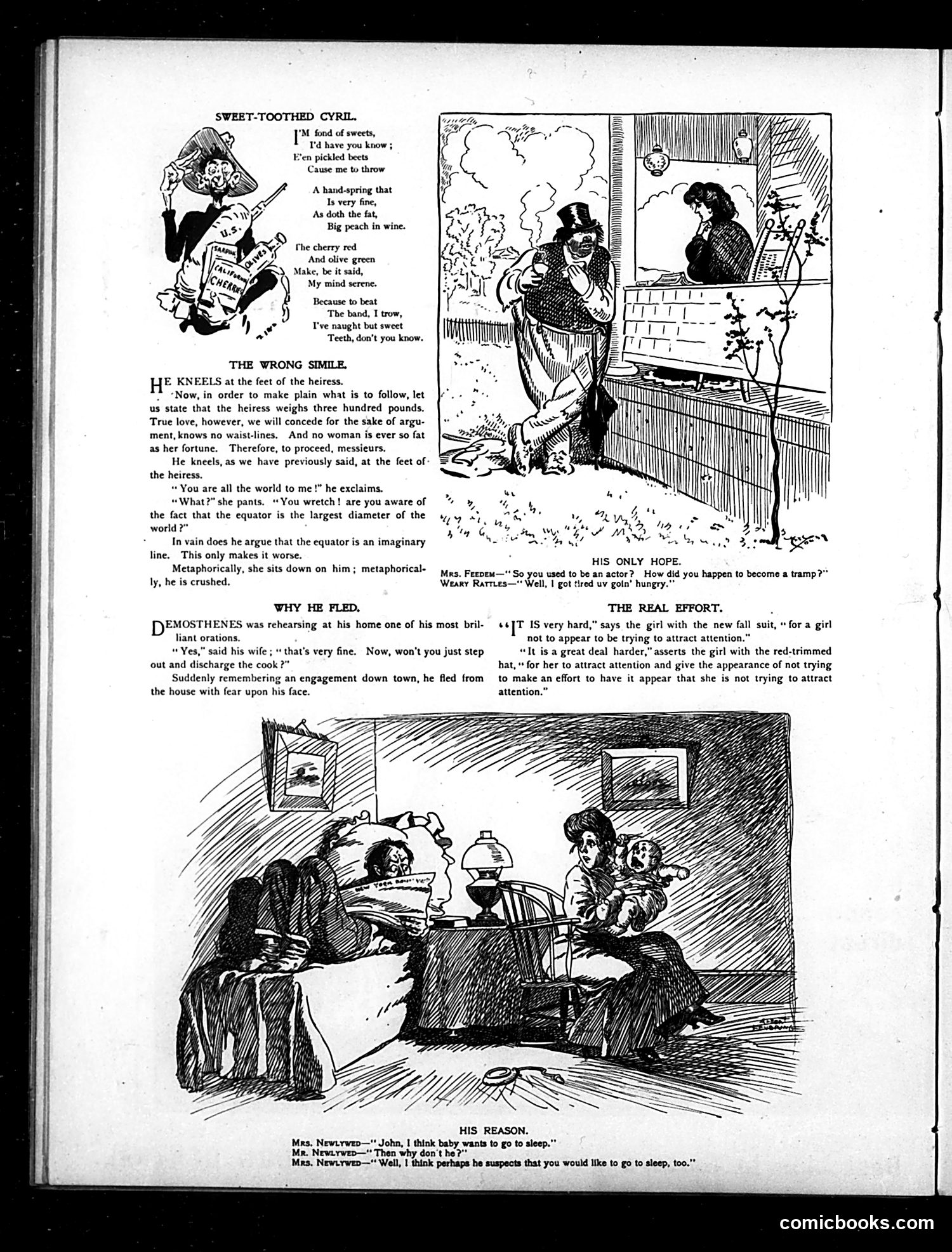
This page contains multiple short humorous sketches typical of early 20th-century satirical magazines: **"Sweet-Toothed Cyril"** mocks a man obsessively praising candy and sweets in overwrought language, a satire of affected speech and absurd enthusiasms. **"The Wrong Simile"** satirizes a fortune-hunter courting a wealthy but overweight heiress. When he romantically declares she is "all the world," she insults him by retorting that the equator (Earth's widest point) is larger—a cruel joke about her weight. The satire targets both his transparent mercenary motives and her defensive hostility. **"Why He Fled"** jokes that a man rehearsing an oration will abandon it instantly when his wife asks him to fire the cook—satirizing domestic conflict and male avoidance. **"The Real Effort"** mocks young women's contradictory social performance: they strain to appear effortlessly attractive rather than trying, creating exhausting pretense. The red-trimmed hat girl's struggle is "harder" because she must hide her effort to hide her effort. These sketches reflect period preoccupations with courtship, class anxiety, and gender performance.
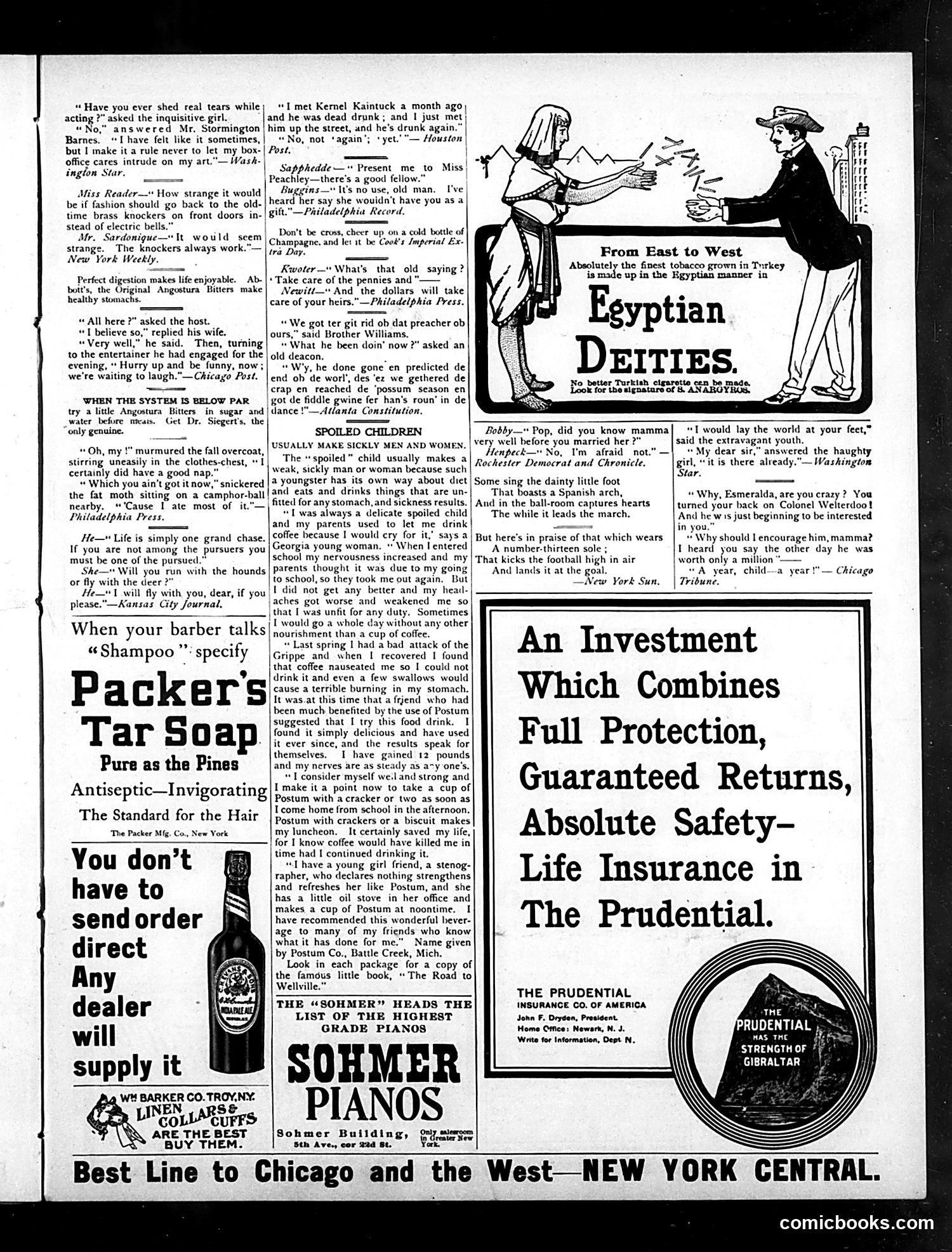
This page is primarily **advertising and humor vignettes** rather than political cartoons. The main content consists of: **Humor Pieces**: Short jokes about everyday life—an actor who won't cry on stage, a moth eating an overcoat, a preacher predicting the world's end during harvest season. These are mild social observations typical of early 20th-century humor magazines. **"Spoiled Children" Feature**: An extended testimonial about a girl made sickly by being allowed to drink coffee, who recovers after switching to Postum (a coffee substitute). This reflects period anxieties about children's health and caffeine. **Advertisements**: Parker's Tar Soap, Sohmer Pianos, The Prudential Insurance, and various patent medicines dominate the page—standard Judge revenue sources. **No Clear Political Satire**: Unlike Judge's typical sharp political commentary, this particular page contains mostly commercial content with light domestic humor. The satirical edge is minimal; it's primarily a vehicle for advertising targeted at early-1900s readers concerned with digestion, household products, and insurance.
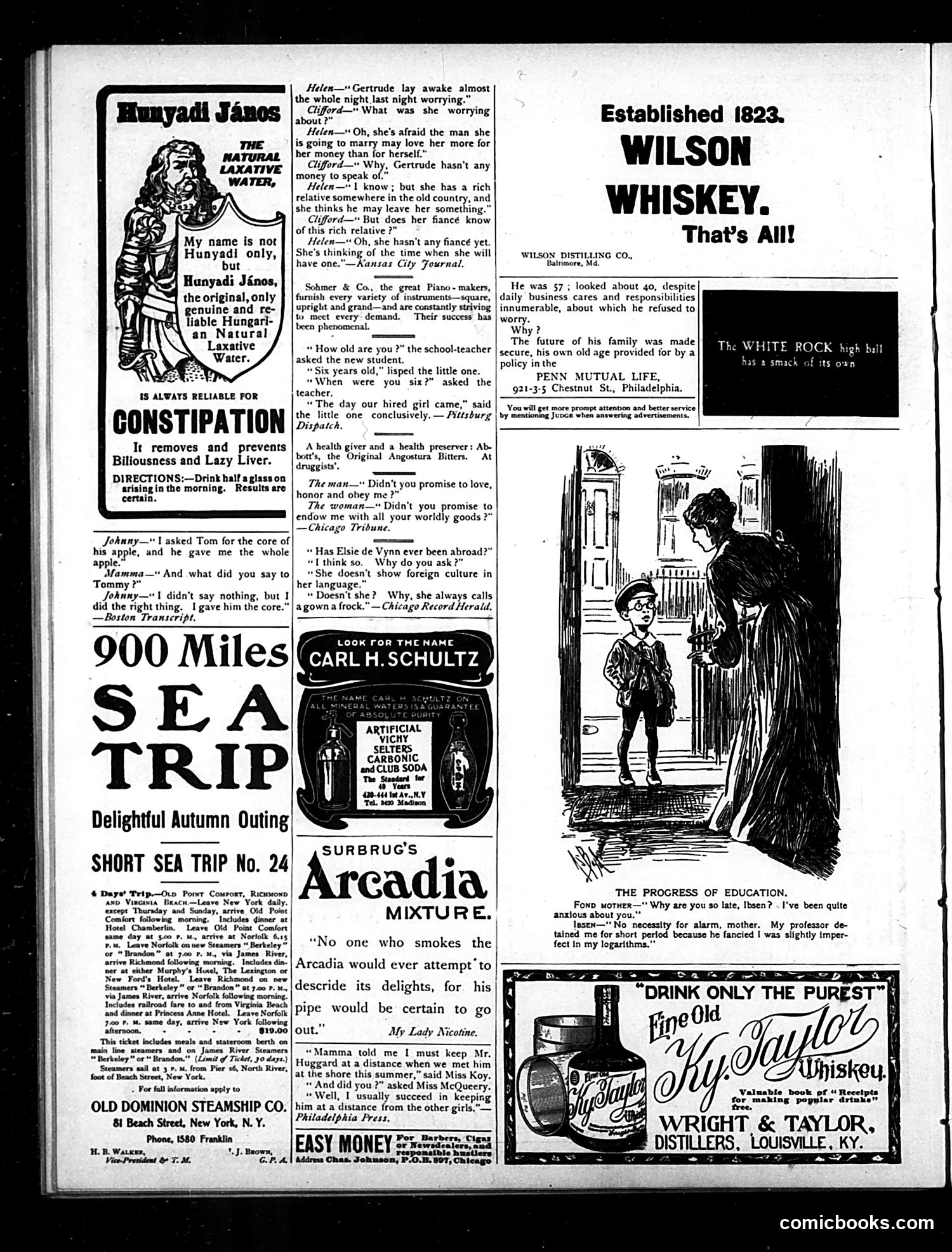
This page is primarily **advertisements and filler humor** typical of early-20th-century magazines. The main content consists of: - **Product ads**: Hunyadi Janos laxative water, piano makers Sohmer & Co., steamship excursions, mineral water, whiskey brands, and carbonated beverages - **Short jokes and anecdotes** on everyday domestic topics—children's logic, marriage anxieties, romantic misunderstandings **Notable cartoon**: "The Progress of Education" depicts a boy late for school being disciplined by his mother, illustrating a common parental concern of the era. **Social context**: The humor reflects turn-of-the-century middle-class anxieties: marriage financial arrangements, child-rearing, servants ("hired girls"), and propriety. The repeated marriage jokes suggest courtship and gender relations were popular satire topics. There is **no significant political content**—this represents Judge's lighter, commercial fare rather than its satirical editorial function. The page emphasizes leisure activities (sea trips) and patent medicines, reflecting consumer culture of the period.
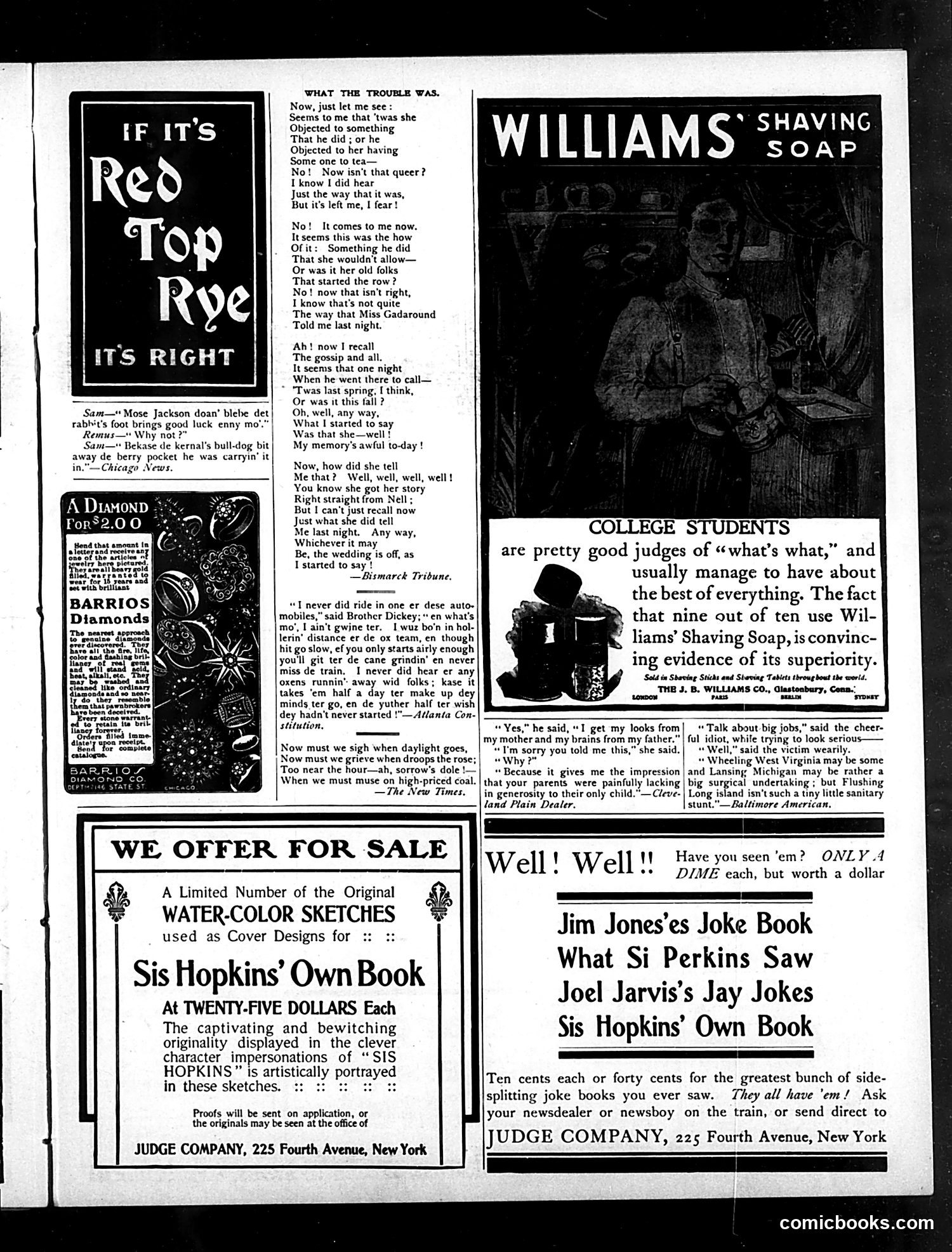
This page from *Judge* magazine consists primarily of **advertisements and humorous filler content** rather than political satire. The main content includes: **"What the Trouble Was"** — A gossipy monologue satirizing how rumors spread and mutate through word-of-mouth. The narrator tries to recall gossip about a couple's broken engagement but keeps forgetting details, illustrating how hearsay becomes unreliable. **Dialect humor pieces** featuring African American vernacular ("Sam" and "Remus," "Brother Dickey") — period-typical but now offensive stereotypical representations common to early 1900s American humor magazines. **The remainder is advertising**: Williams' Shaving Soap (marketed to college students), Barrios Diamonds, and promotional material for *Sis Hopkins' Own Book* and various joke collections. No identifiable political figures or events appear. The page reflects *Judge*'s primary function as entertainment and advertisement rather than sharp political commentary.
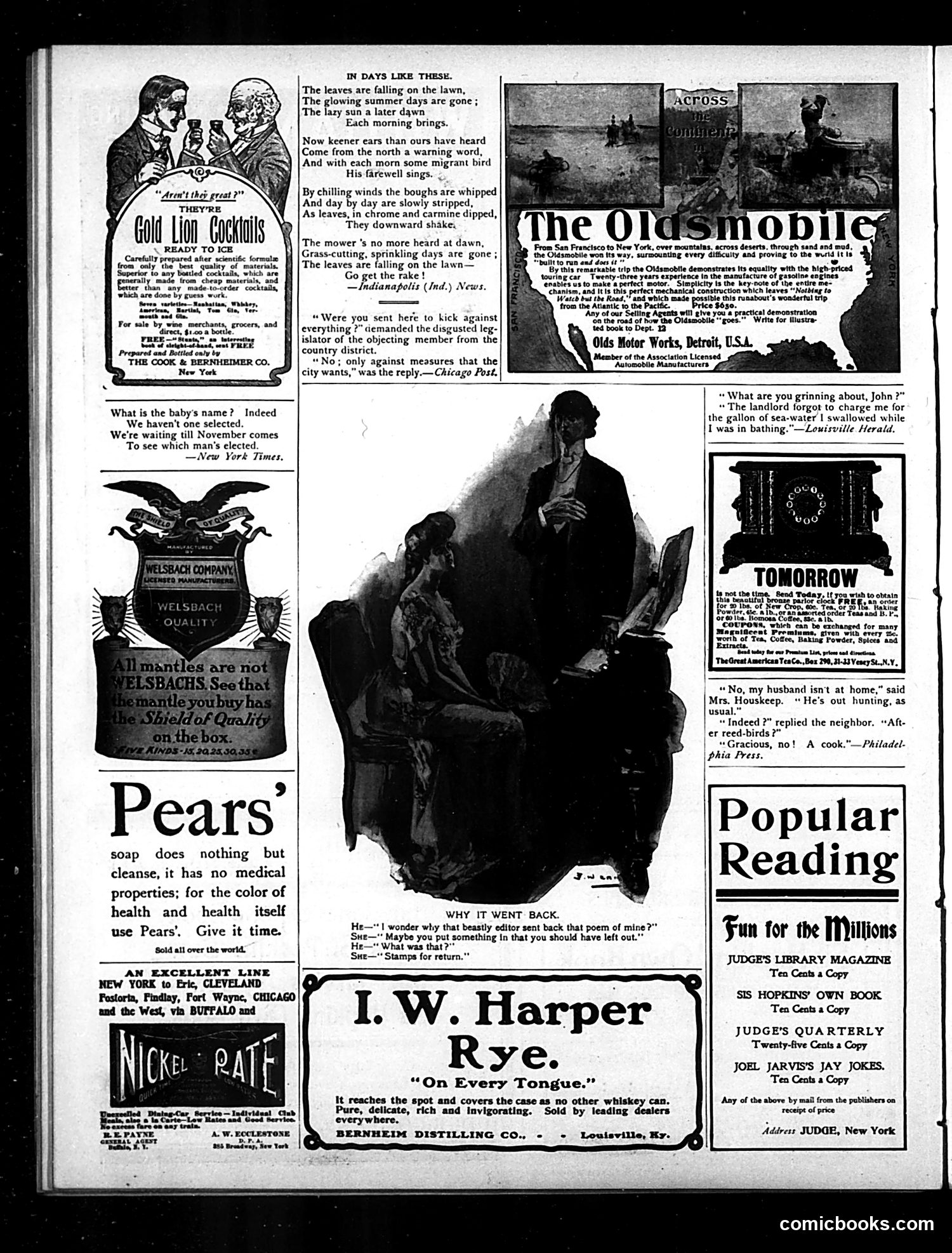
This page from *Judge* (a satirical weekly) mixes advertising with light social humor typical of early 20th-century American magazines. **The cartoons/humor:** - A two-panel dialogue joke about naming a newborn, postponed until the November election—satirizing Americans' obsession with politics - A rural legislator defending his opposition to city-proposed measures, joking that he opposes anything "the city wants"—poking fun at urban-rural political divisions - A rejected poet's submission returned with stamps, implying the poem contained something offensive or poorly chosen - A landlord's joke about accidentally charging for seawater, and a domestic humor piece about a wife whose husband hunts for a cook rather than game birds **The context:** These are gentle jabs at American political tribalism, class differences, and domestic life—nothing controversial. The page is primarily **advertising**: soap, rye whiskey, rail service, and other consumer goods dominate the layout. The ads themselves contain period-specific appeals (purity claims for soap, "medicinal" whiskey properties) now recognized as marketing exaggeration.
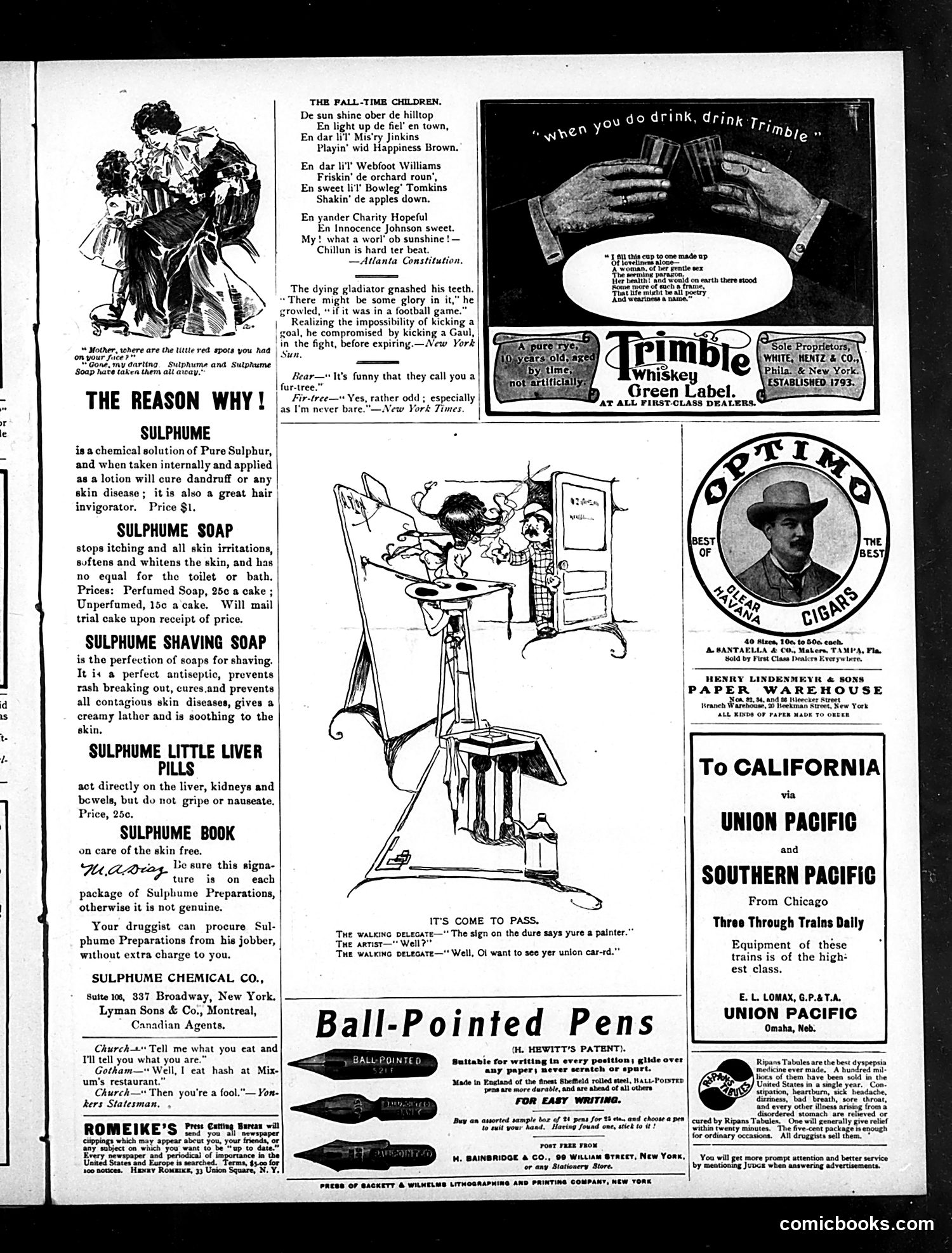
This page is primarily **advertising** with minimal editorial content. The few cartoons present are brief, disconnected jokes: **"It's Come to Pass"** depicts a "walking delegate" (labor union representative) confronting an artist, demanding to see his "union card." This satirizes labor organizing efforts of the era, suggesting unions were intrusively bureaucratic—even pursuing non-union workers like painters. **Other brief jokes** include wordplay (a fir-tree never being "bare") and references to football and gladiatorial combat, typical of Judge's light humor. **The bulk of the page** advertises patent medicines (Sulphume treatments for skin conditions), writing implements, whiskey, cigars, railroad services to California, and paper products. These ads reflect late 19th/early 20th-century commercial culture and Judge's revenue model. The "Fall-Time Children" poem is sentimental dialect verse unrelated to satire. The page represents Judge functioning as **commercial magazine** rather than political commentary.
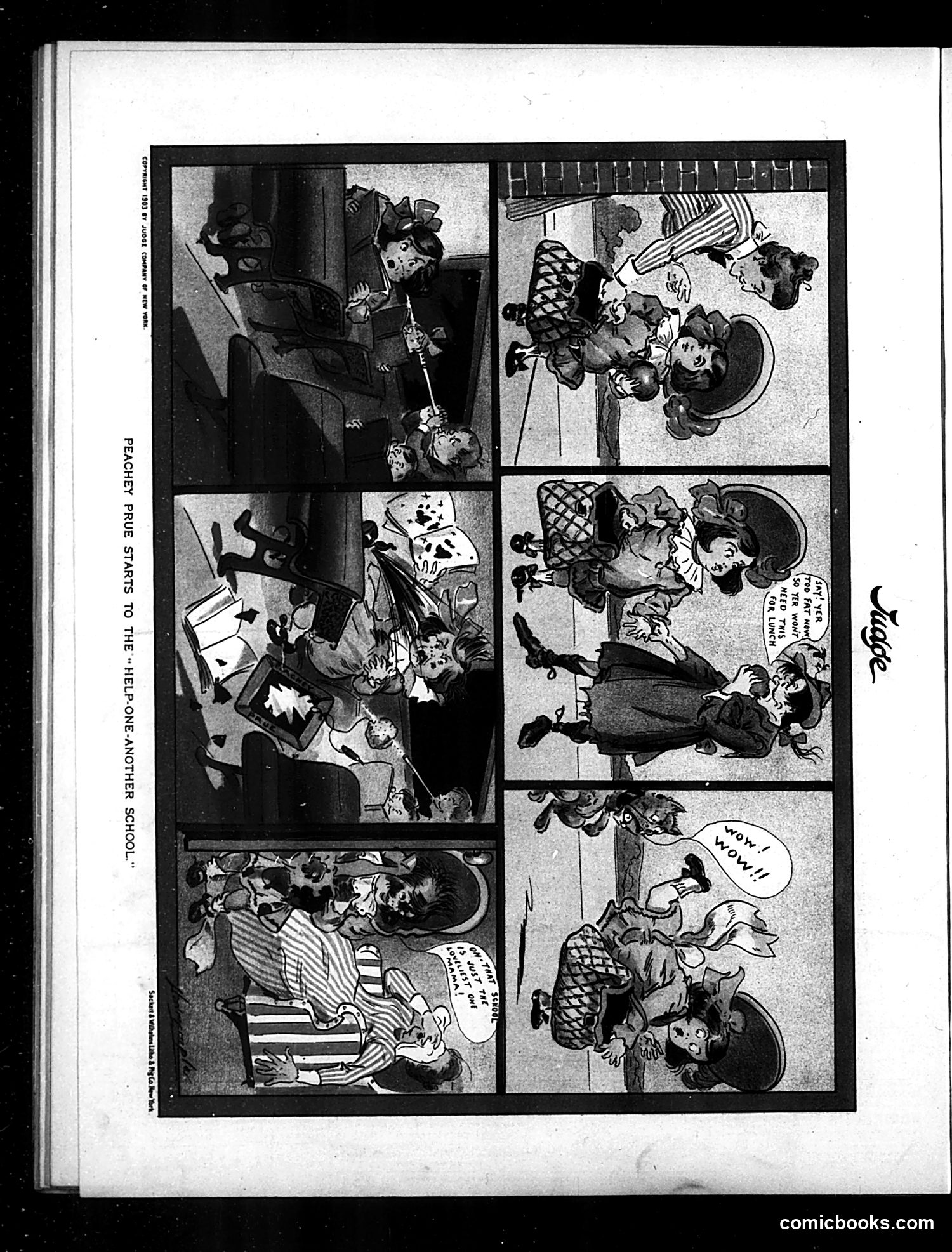
The OCR text is too corrupted to read clearly, so I'm working primarily from the image itself. This appears to be a **multi-panel comic strip** showing what looks like a domestic or school-related scenario with multiple characters. The panels are viewed from overhead angles (bird's-eye perspective), which was a stylistic choice in early-to-mid 20th century comics. The figures appear to be **adults and children in various interactions**, possibly depicting a humorous situation involving authority figures and younger people. One panel includes a speech bubble with "WOW! WOW!!" Without legible text, I cannot definitively identify the specific satirical target, named individuals, or the precise point of the humor. The style and layout suggest this is a **satirical commentary on social behavior or institutional dynamics** typical of Judge magazine's content, but the specific subject matter—whether school discipline, parenting, workplace behavior, or something else—remains unclear from the image alone.