
A complete issue · 16 pages · 1903
Judge — August 15, 1903
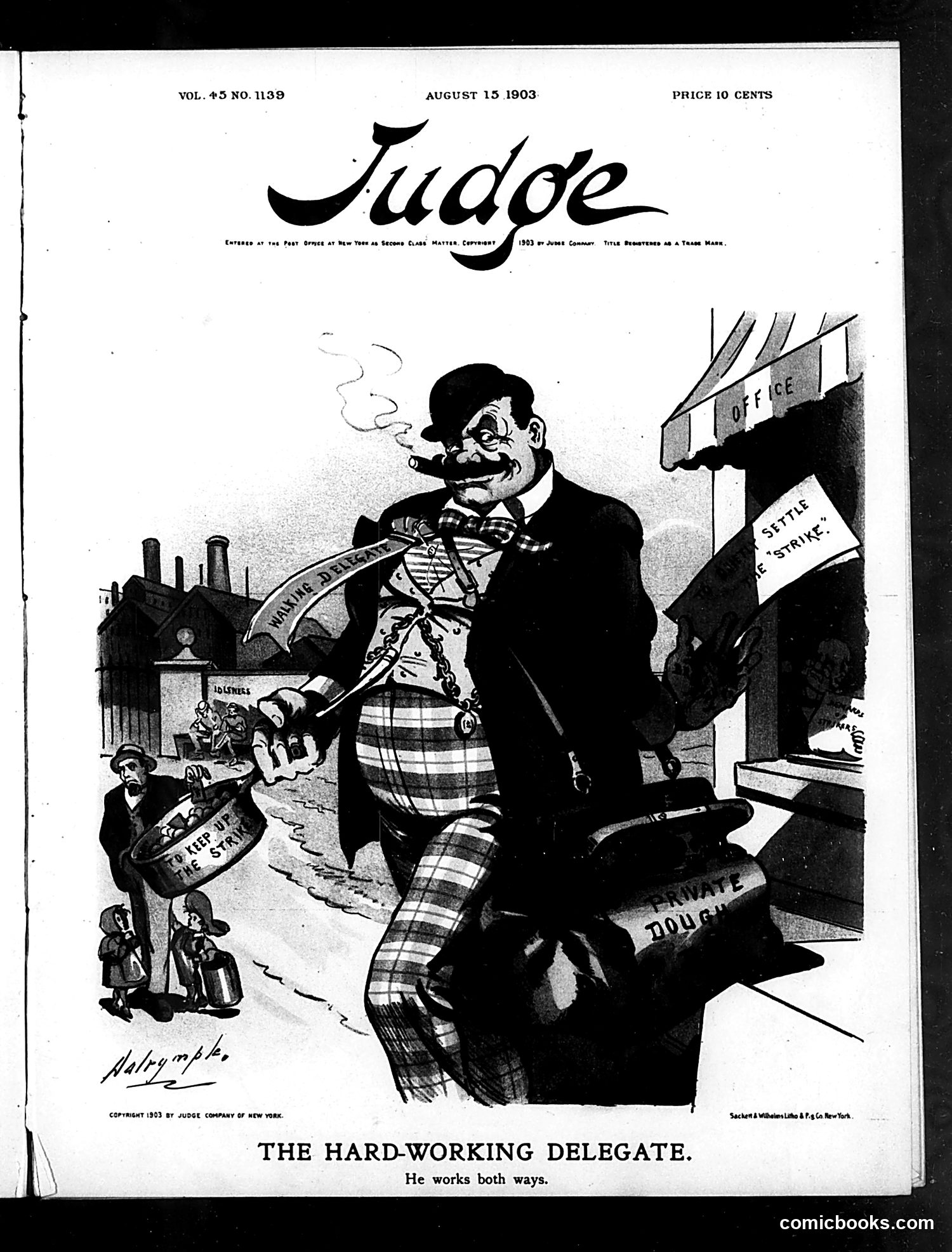
This August 1903 *Judge* cartoon satirizes a Scottish politician or labor delegate through crude ethnic caricature. The figure sports exaggerated Scottish features, kilt, and pipe while juggling multiple contradictory interests—literally "working both ways." The caption "He works both ways" suggests hypocrisy: the delegate publicly supports workers' causes (visible strike signs and industrial imagery in the background) while privately serving opposite interests. The skeleton and office setting imply corruption or duplicity behind the scenes. The small figures at left appear to represent working people or constituents being manipulated. This reflects early-1900s skepticism about labor leaders' sincerity and political compromise—a common satirical theme mocking delegates who claimed to represent workers while allegedly serving their own interests or those of management.
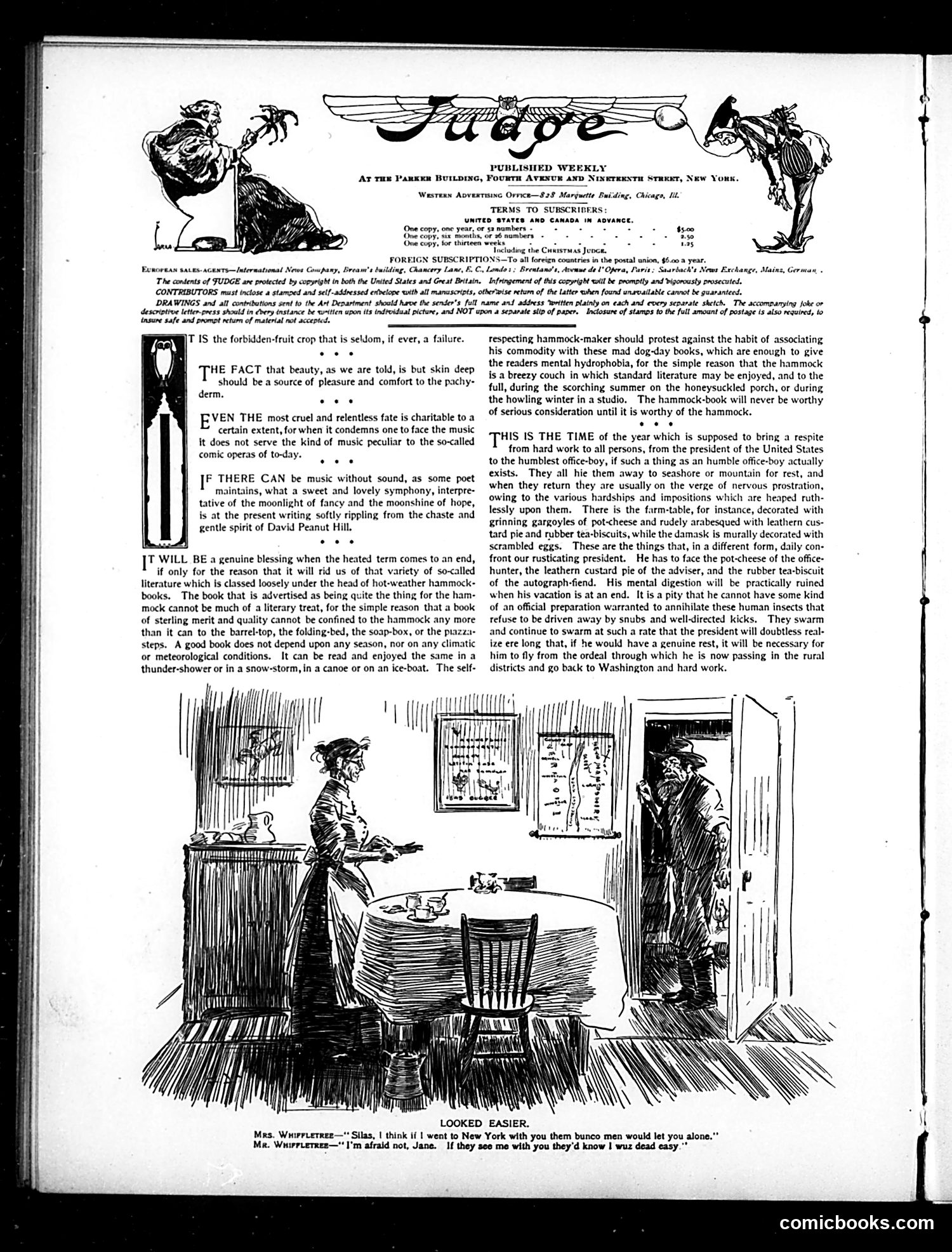
This page combines satirical essays on culture with a domestic cartoon. The text discusses hammock literature—light summer reading—and dismisses it as unworthy serious consideration. The author argues good books transcend seasons and climate, contrasting quality literature with frivolous fare. The cartoon below depicts a woman (Mrs. Whiffletree) at a desk with a visitor (a man in a coat). She states she's afraid to be alone in New York, implying danger or vulnerability. The man's response—that if seen together, people would assume they knew each other—is a social commentary on appearance versus propriety in urban society. The humor relies on contemporary anxieties about reputation, unmarried women's independence, and city life circa early 1900s.
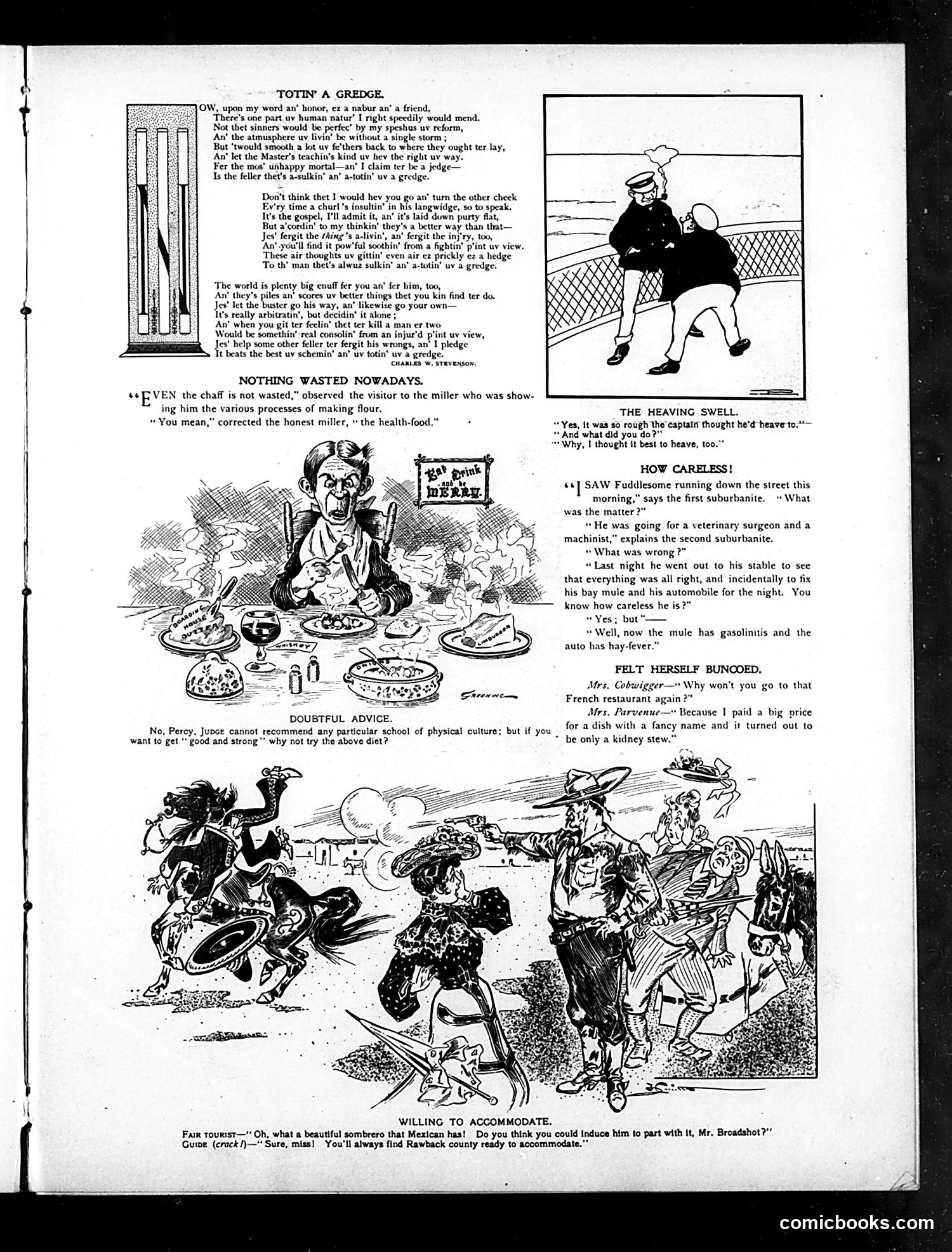
This page contains several unrelated humorous sketches typical of Judge magazine's format: 1. **"Totin' a Grudge"** (top left): A poem about holding grudges, illustrated with a prison cell window. 2. **"Nothing Wasted Nowadays"** (center): A miller asserts that even chaff isn't wasted, correcting a visitor's comment about "health-food." 3. **"The Heaving Swell," "How Careless," and "Felt Herself Buncoed"** (right): Brief joke vignettes about social situations and misadventures. 4. **"Doubtful Advice"** (center): A caricatured figure surrounded by food, discussing physical culture and diet. 5. **"Willing to Accommodate"** (bottom): A cartoon about a Mexican sombrero and tourism, depicting figures in exaggerated ethnic caricature style typical of early-20th-century humor magazines. The page exemplifies Judge's satirical approach to contemporary American social life and manners.
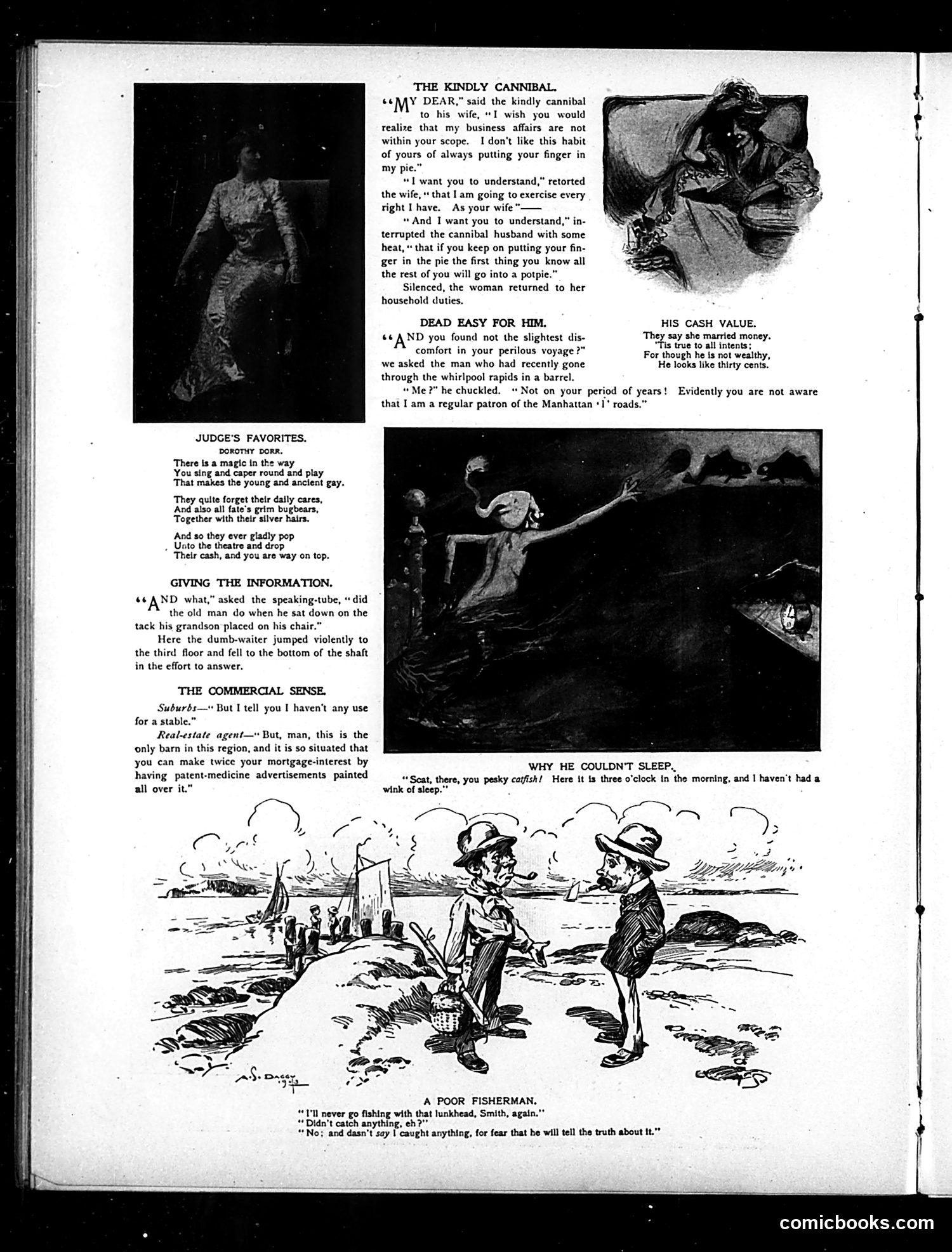
This page contains several satirical pieces: **"The Kindly Cannibal"** mocks a husband who constantly interferes in his wife's domestic affairs. The wife, exasperated, threatens him with cannibalism if he keeps "putting your finger in my pie"—a metaphorical complaint about his meddling. The satire targets overbearing husbands who won't respect household boundaries. **"Judge's Favorites"** is a poem by Dorothy Dore celebrating theatrical pleasures. **"A Poor Fisherman"** depicts two men at a beach; one warns the other never to fish with a particular lunchhead again, fearing the truth about a failed catch will be revealed—likely satirizing fishermen's notorious tall tales. The remaining sections ("Dead Easy for Him," "His Cash Value," "Giving the Information," "The Commercial Sense") appear to be brief humorous anecdotes about everyday absurdities.
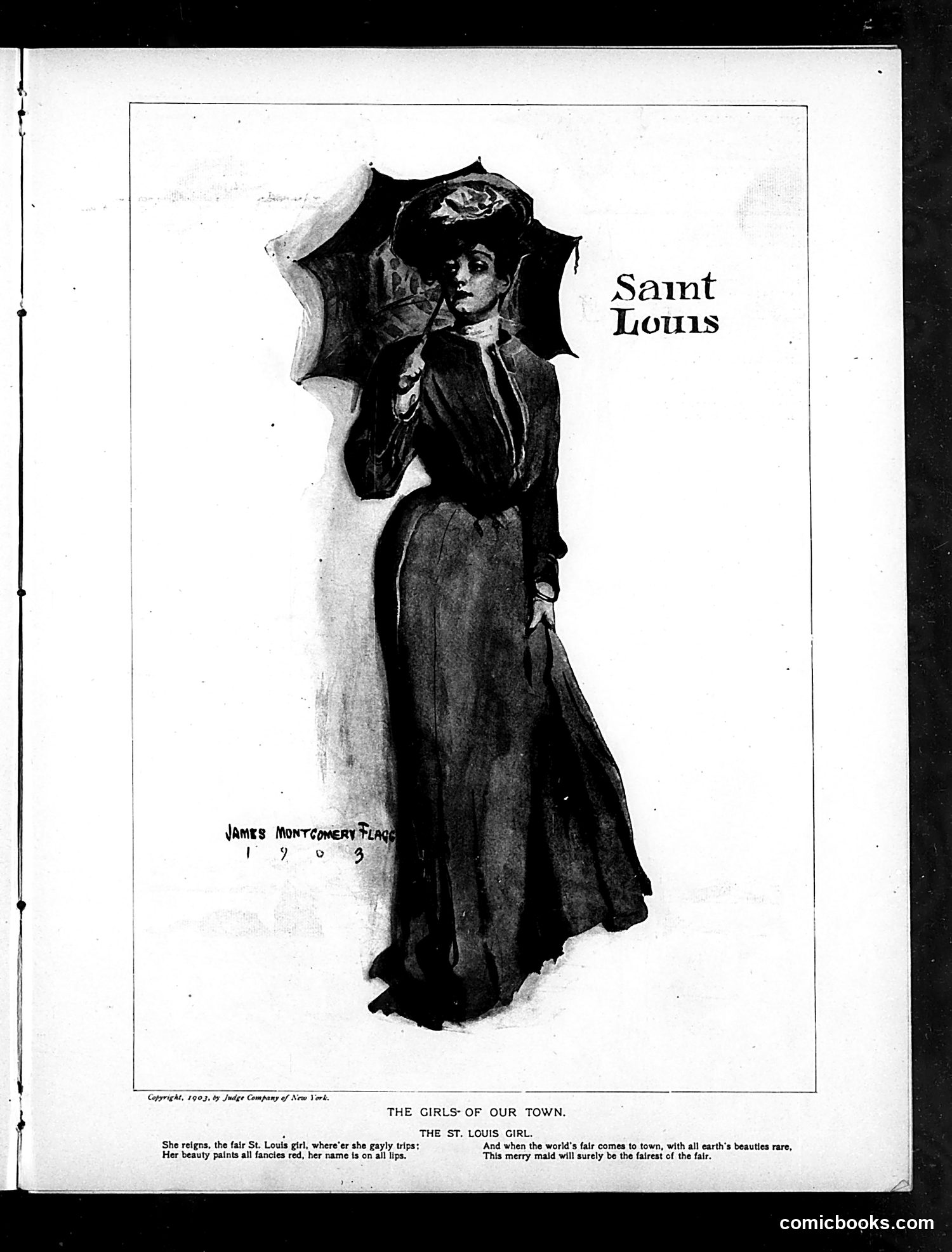
This illustration from *Judge* magazine celebrates the "St. Louis Girl" in anticipation of the 1904 World's Fair held in St. Louis. The accompanying verse praises her beauty and suggests she will be "the fairest of the fair" among the world's beauties when the exposition attracts visitors from across the globe. The artwork, credited to James Montgomery Flagg (a prominent illustrator of the era), depicts an elegantly dressed woman in early 1900s fashion—fitted jacket, long skirt, and decorative umbrella—embodying the idealized "Gibson Girl" aesthetic of the period. The satire appears gentle: *Judge* humorously elevates local civic pride by suggesting St. Louis's female population will outshine international visitors. This reflects the boosterism surrounding major world's fairs, which cities used to assert cultural prominence and attract tourism.
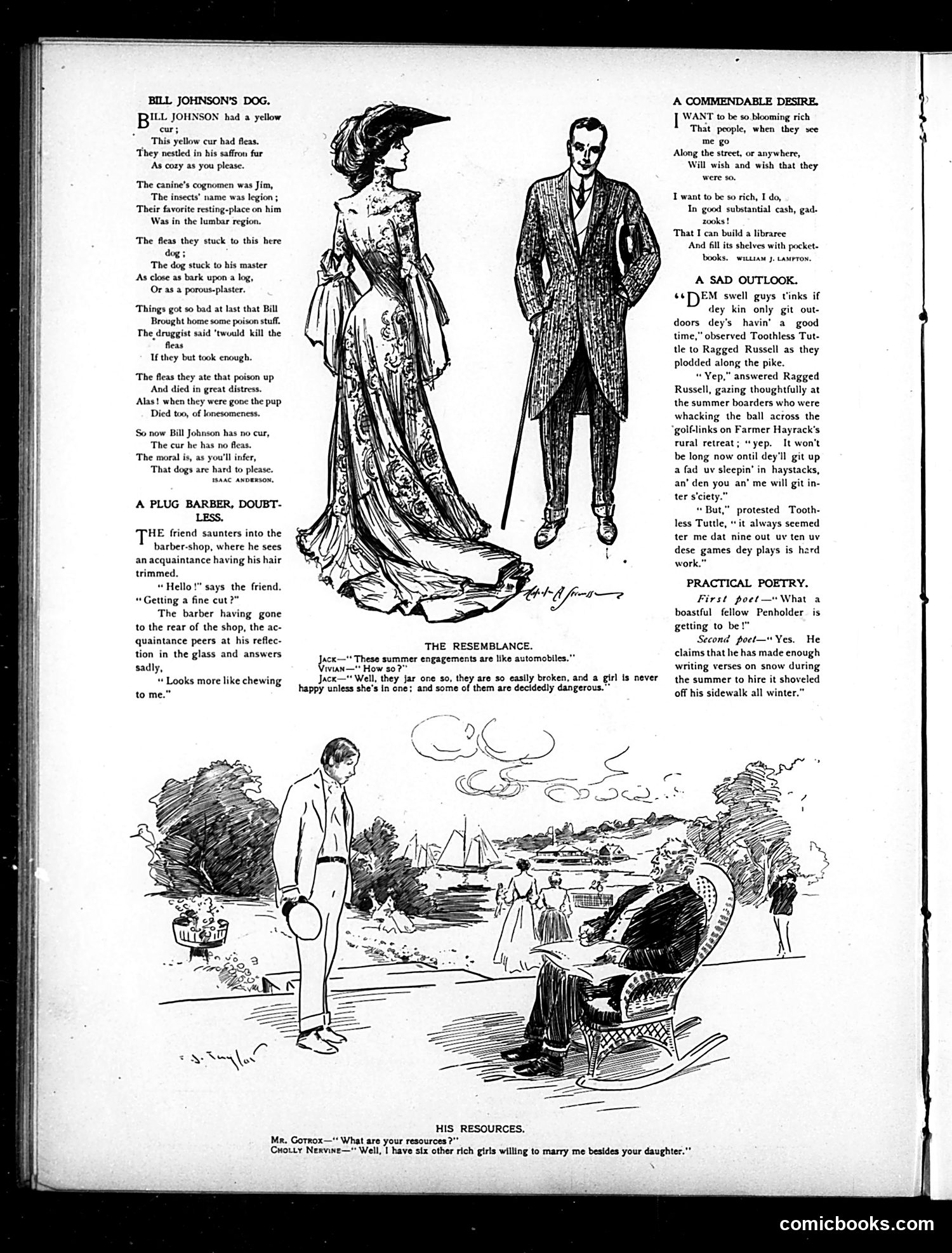
This page contains several satirical pieces typical of early 20th-century American humor: **"Bill Johnson's Dog"** is a humorous narrative poem about a dog infested with fleas that dies of loneliness after poison kills the parasites—a darkly comic morality tale suggesting life's interconnections. **"A Plug Barber, Doubtless"** jokes about a barber's poor work, with a customer saying his haircut looks more like "chewing" than styling—mocking incompetent tradesmen. **"The Resemblance"** satirizes young women's obsession with automobiles, comparing summer romantic engagements to cars: easily broken, desired constantly, and dangerous. **"His Resources"** mocks social-climbing suitors, with a character claiming his real asset is having six other wealthy women willing to marry him—satirizing gold-diggers and shallow courtship. **"A Commendable Desire"** and the working-class dialogue pieces gently mock wealth-seeking and vacation pretensions among different social classes. The overall tone reflects Judge's satirical focus on American social pretensions, consumer culture, and class dynamics of the era.
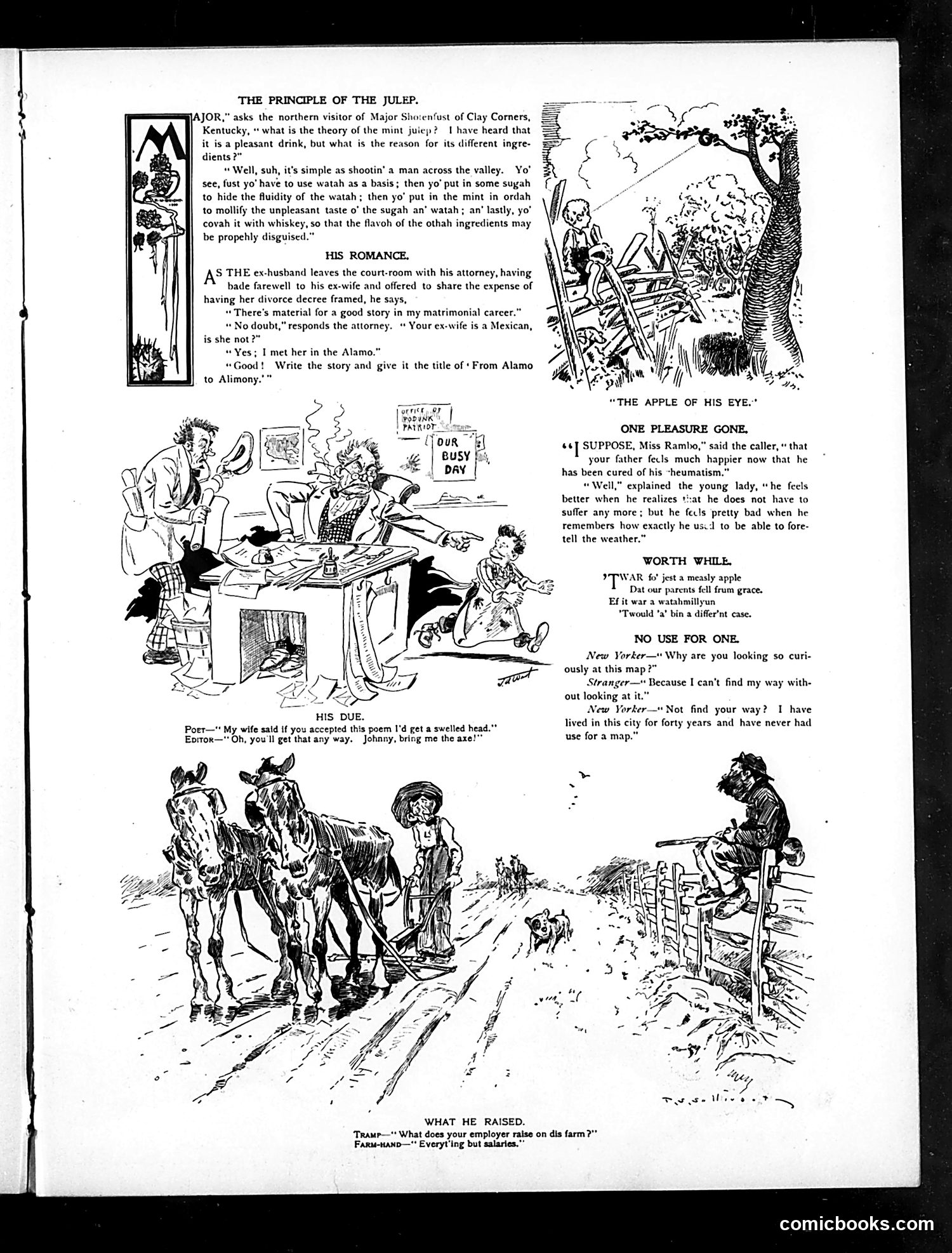
This page contains several satirical pieces typical of Judge's humor: **"The Principle of the Julep"** mocks Southern gentlemen and their elaborate mint julep recipes. A Kentucky Major explains that each ingredient (water, sugar, mint, whiskey) masks the previous one's unpleasantness—a joke about the drink's true purpose being alcohol consumption disguised by pretension. **"His Romance"** plays on the cliché of meeting a Mexican woman "in the Alamo" during the famous 1836 battle, then divorces her. The punchline "From Alamo to Alimony" is a crude rhyme mocking matrimonial misadventure. The other brief jokes mock rural dialects ("watahmillyun" for watermelon), New York City sophistication, and farm laborers' lack of wages. The cartoons use exaggerated ethnic/regional accents and stereotypes common to early-20th-century American humor, reflecting contemporary attitudes toward rural Southerners, immigrants, and working classes.
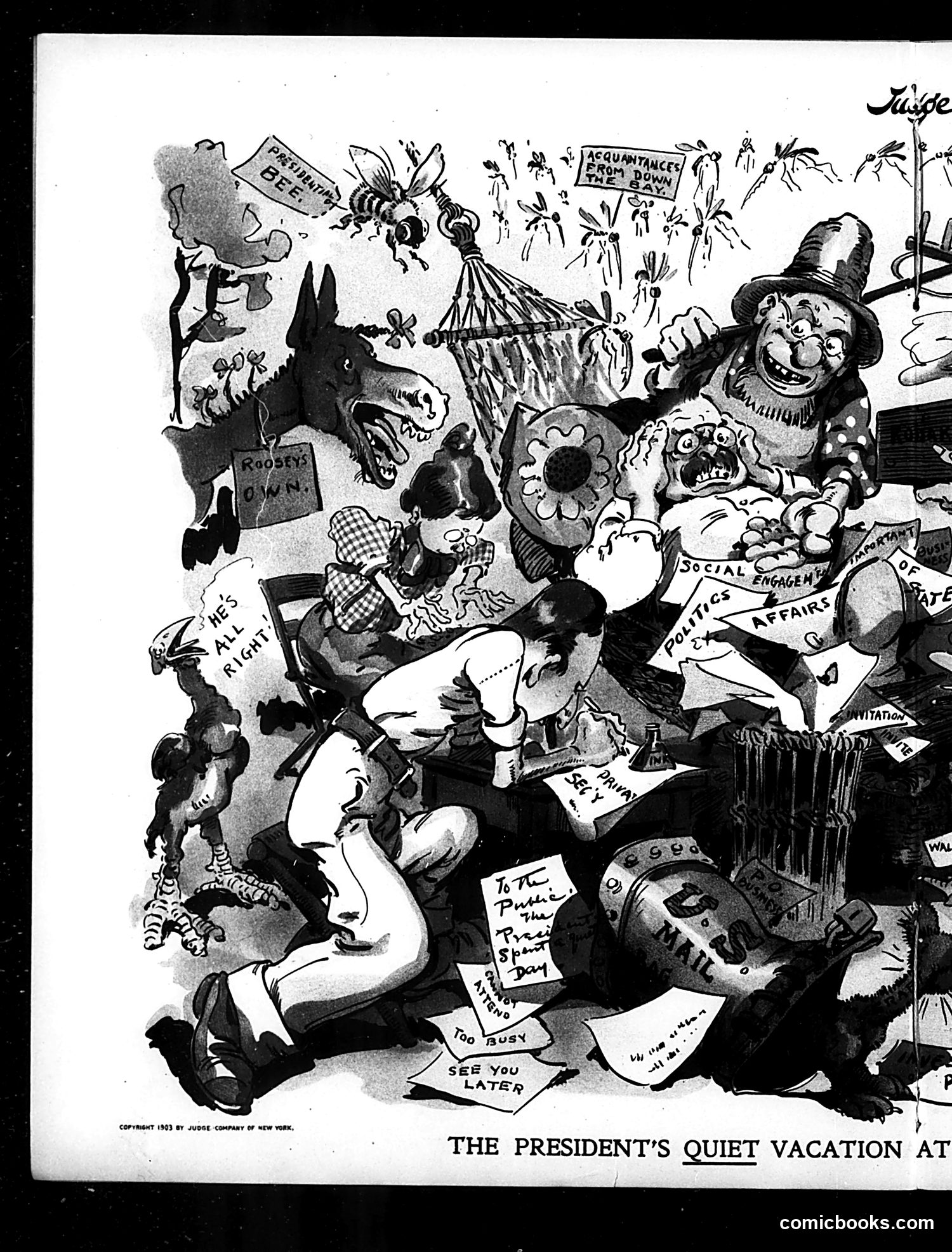
This 1903 Judge cartoon satirizes the president's difficulty achieving a peaceful vacation. Chaotic characters and absurd situations surround a figure trying to relax, including demons, leprechauns, donkeys, and disruptive elements labeled with issues like "Politics," "Social Engagements," and "Affairs." A sign reads "Acquaintances From Down South," suggesting unwelcome Southern visitors. Labels like "To Busy," "See You Later," and others imply constant interruptions. The cartoon mocks how a sitting president cannot escape official duties and social obligations even while attempting leisure. Political controversies, social demands, and various constituencies literally crash his vacation. The absurdist imagery emphasizes the impossibility of peace for a chief executive, a theme relevant to late Theodore Roosevelt's presidency when political pressures were intense.
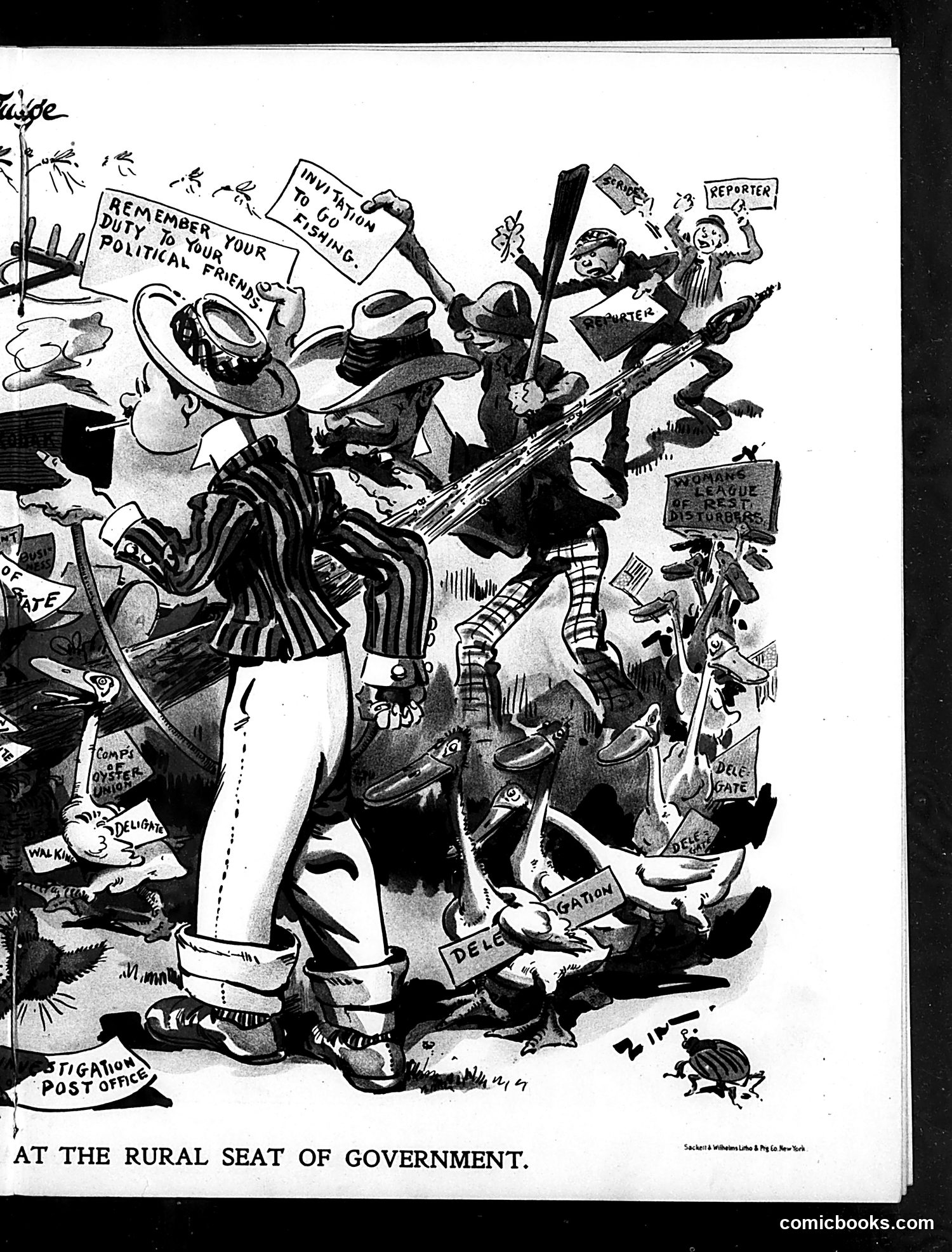
This political cartoon satirizes rural/small-town American government as chaotic and incompetent. A large figure in striped pants (likely representing Uncle Sam or government authority) is surrounded by smaller figures wielding fishing rods and holding signs reading "Invite to Canon Fishing," "Reporter," "Woman's League of Reformers," and various labels like "Stigma," "Deligation," and "Post Office." The satire suggests that rural governance is dominated by special interests, petty concerns (fishing invitations), and constant demands from reformers and the press rather than serious policy-making. The crowded, frenzied composition emphasizes the disorder. Various figures appear to be pulling the larger authority figure in different directions, implying rural politicians are pulled between competing trivial demands rather than focused on substantive governance. The cartoon criticizes small-town politics as fragmented and distracted.
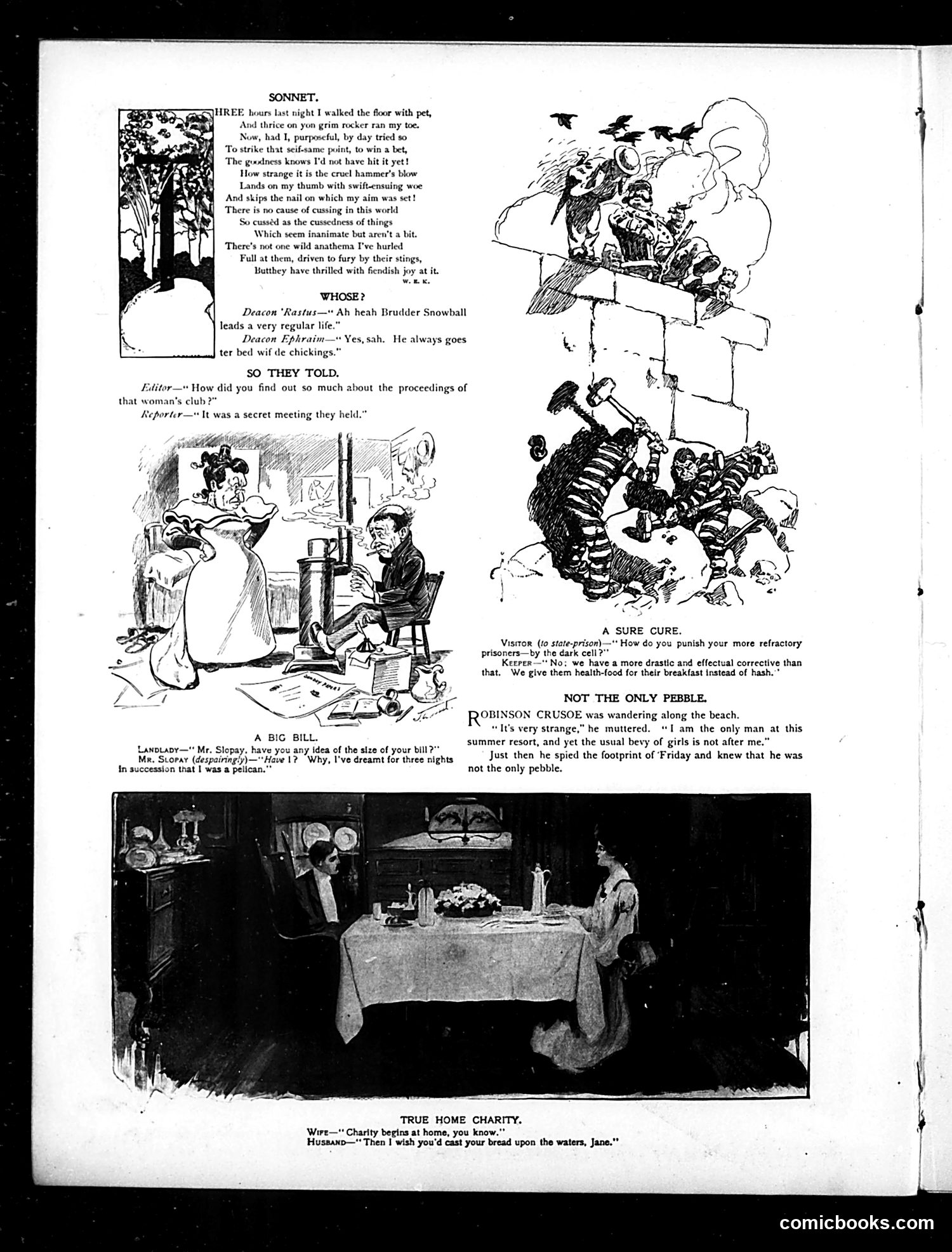
This page contains multiple satirical jokes typical of early 20th-century American humor: **The Sonnet** mocks the frustration of everyday mishaps—hammers hitting thumbs instead of nails, stubbed toes. The complaint that inanimate objects seem to deliberately cause pain is absurdist humor about life's minor annoyances. **"So They Told"** uses racist dialect humor (common to the era) about Black characters discussing a man's "regular life" going to bed with chickens—a joke about rural simplicity. **"A Sure Cure"** satirizes prison reform through a jailer claiming health-food serves as punishment worse than solitary confinement—mocking emerging ideas about prison conditions. **"Not the Only Pebble"** references Robinson Crusoe, playing on the phrase "not the only pebble on the beach" (meaning not uniquely special). The joke: Crusoe is alone at a resort yet girls ignore him until Friday arrives—suggesting male vanity or that companionship matters more than isolation. **"True Home Charity"** is a domestic joke: the wife lectures about charity beginning at home; the husband responds she should practice charity herself by "casting bread upon waters"—sarcasm about her stinginess.
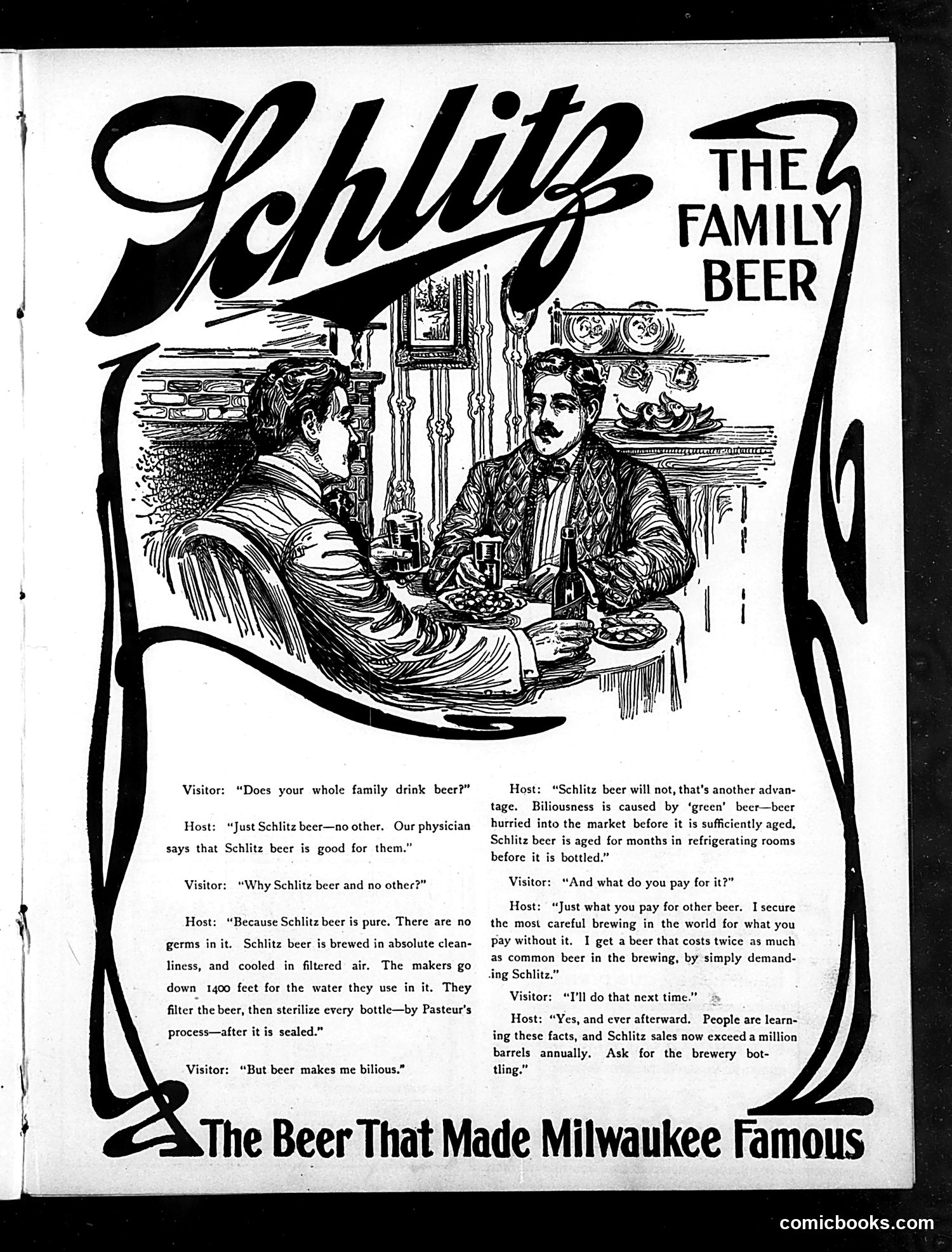
This is a **Schlitz beer advertisement**, not satire. It presents a dialogue between a visitor and host showcasing the brewery's claims about product quality. The ad emphasizes Schlitz's competitive advantages: purity through deep well-water sourcing, absolute cleanliness, filtration, and Pasteur's sterilization process. It addresses common consumer concerns—the visitor mentions beer causes biliousness (indigestion), a real worry in that era—and counters with claims that only "green" (improperly aged) beer causes such problems. Schlitz, the host insists, ages properly in refrigerated rooms. The tagline "The Beer That Made Milwaukee Famous" references Milwaukee's reputation as a major brewing center. The ad uses a genteel domestic scene to position Schlitz as suitable for respectable family consumption, not just saloon drinking. This reflects early 20th-century beer marketing that emphasized health benefits and refinement to expand the market beyond working-class drinkers.
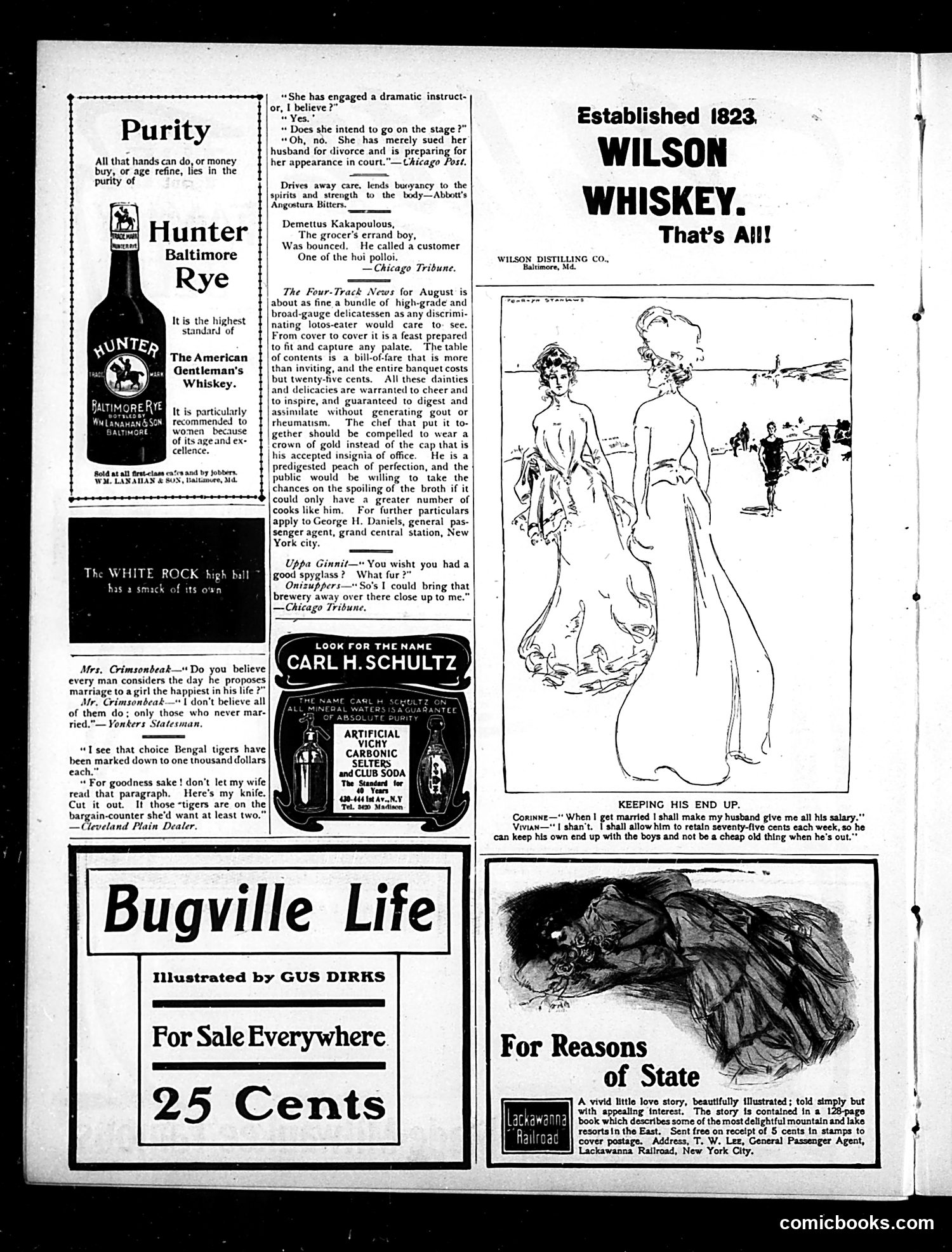
This is primarily an **advertising page** from Judge magazine, with several brief comic vignettes interspersed. The cartoons address **early 20th-century social anxieties about marriage and gender roles**: 1. **"Crimsonbeak" joke**: Satirizes men who regret marriage, implying matrimony is miserable. 2. **"Keeping His End Up"**: Two women discuss marital finances. One plans total control of her husband's salary; the other advocates letting him keep 75 cents weekly "so he can keep his own end up with the boys"—meaning maintain his social standing and independence. This reflects contemporary debates about women's financial power in marriage. 3. **Divorce/Drama Instructor joke**: A woman hired a dramatic instructor not for stage ambitions but to prepare for divorce court testimony—satirizing both divorce's prevalence and the performative aspect of legal proceedings. The remainder is **product advertising**: whiskey, patent medicines, railroad tourism, and Bugville Life (a children's comic). The ads emphasize purity, refinement, and health benefits typical of the era.
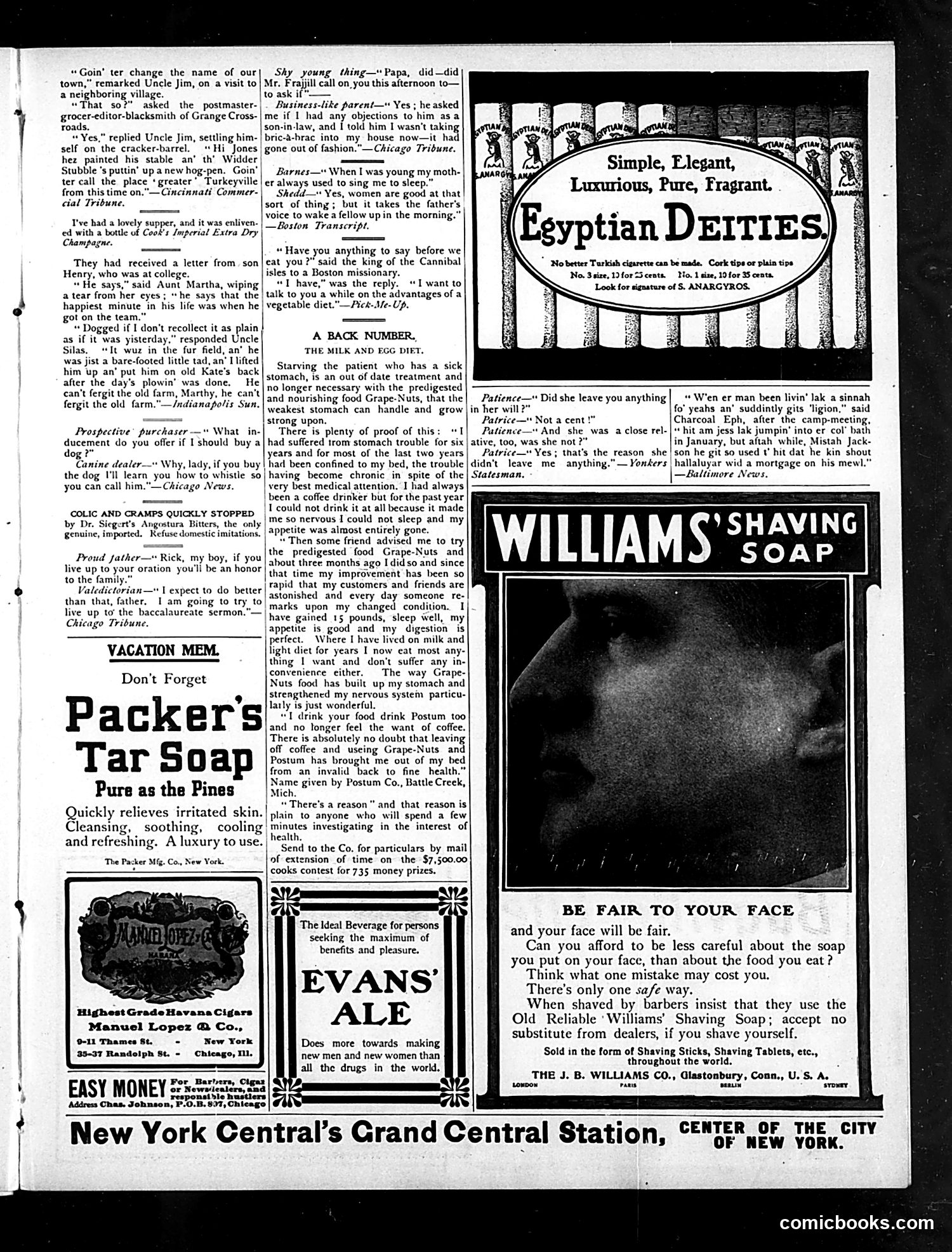
This page is primarily **advertising and humorous anecdotes** rather than political cartoons. The content consists of: 1. **Rural humor anecdotes**: Short jokes about small-town life (a village renaming itself "greater" Turkeyville, a farmer recalling his son's childhood), reflecting early 20th-century nostalgia for rural America. 2. **Domestic humor**: Jokes about courtship propriety (a father rejecting a suitor), parental expectations, and relationships—standard period comedy. 3. **Large advertisements** for consumer products: Packer's Tar Soap, Evans' Ale, Williams' Shaving Soap, cigars, and notably **Grape-Nuts cereal** (with an extensive testimonial about digestive health). The **Grape-Nuts ad** is particularly notable—it promotes a "predigested food" for stomach ailments, reflecting period medical beliefs about nutrition and digestive disease treatment. The page shows how Judge mixed satirical commentary with advertising, while the humor reflects genteel, mainstream American values rather than sharp political satire. No specific political figures or events are referenced.
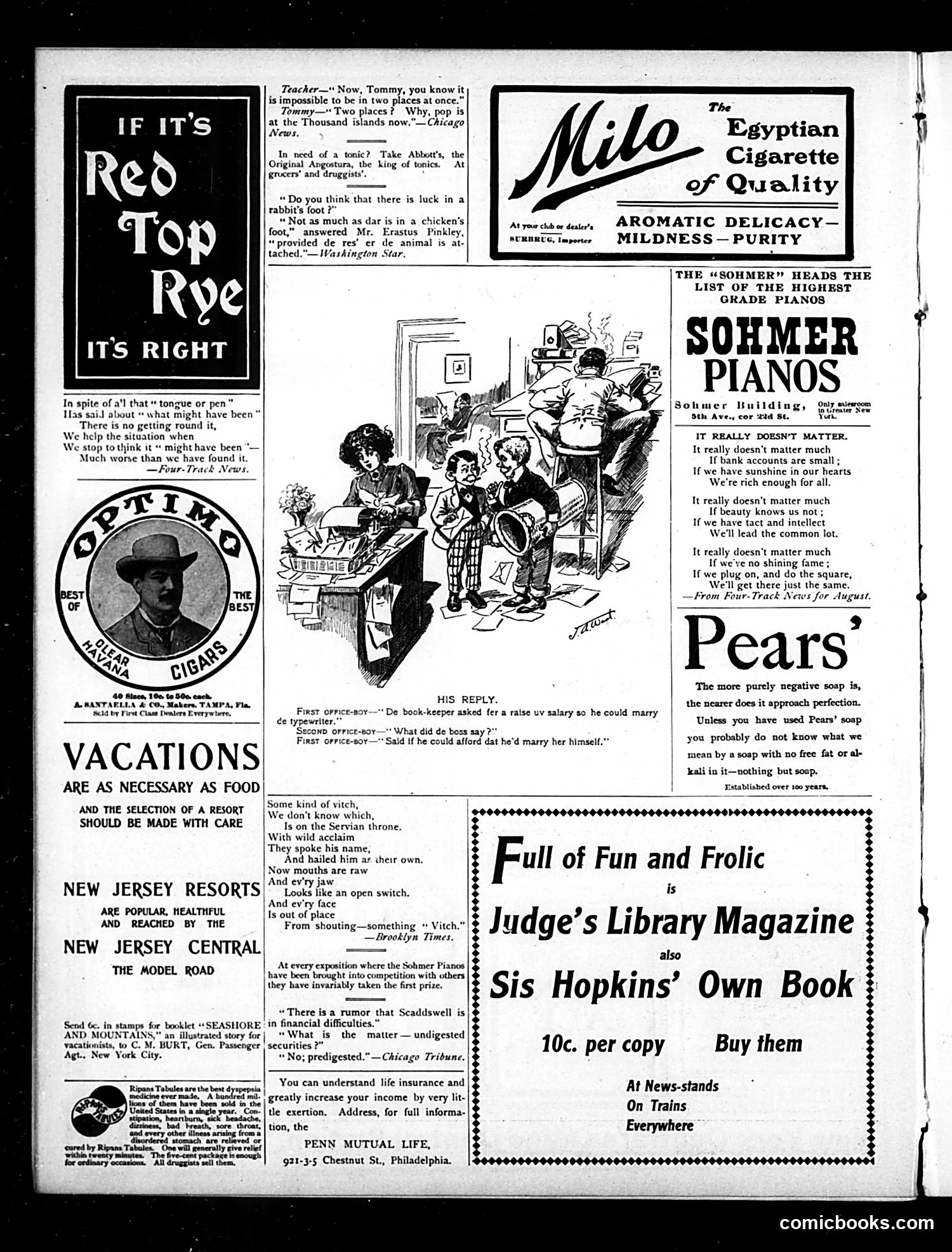
This page consists primarily of **advertisements and brief humor fillers** typical of Judge magazine's format. The main cartoon ("His Reply") depicts an office romance joke: a bookkeeper requests a salary raise to marry the typewriter operator. The boss's reply—that he'd marry her himself if he could afford it—is a crude joke about the boss's superior financial status and romantic interest, reflecting early 20th-century workplace dynamics and office hierarchy humor. Other content includes: - A poem about a mysterious "Vitch" on the Serbian throne (unclear historical reference, possibly topical to the publication date) - Teacher-student jokes about impossibilities and superstitions - Advertisements for cigars, pianos, resorts, soap, and insurance The page reflects **period advertising culture** and light workplace satire rather than serious political commentary. The humor relies on class distinctions, gender dynamics in offices, and everyday ironies now considered dated.
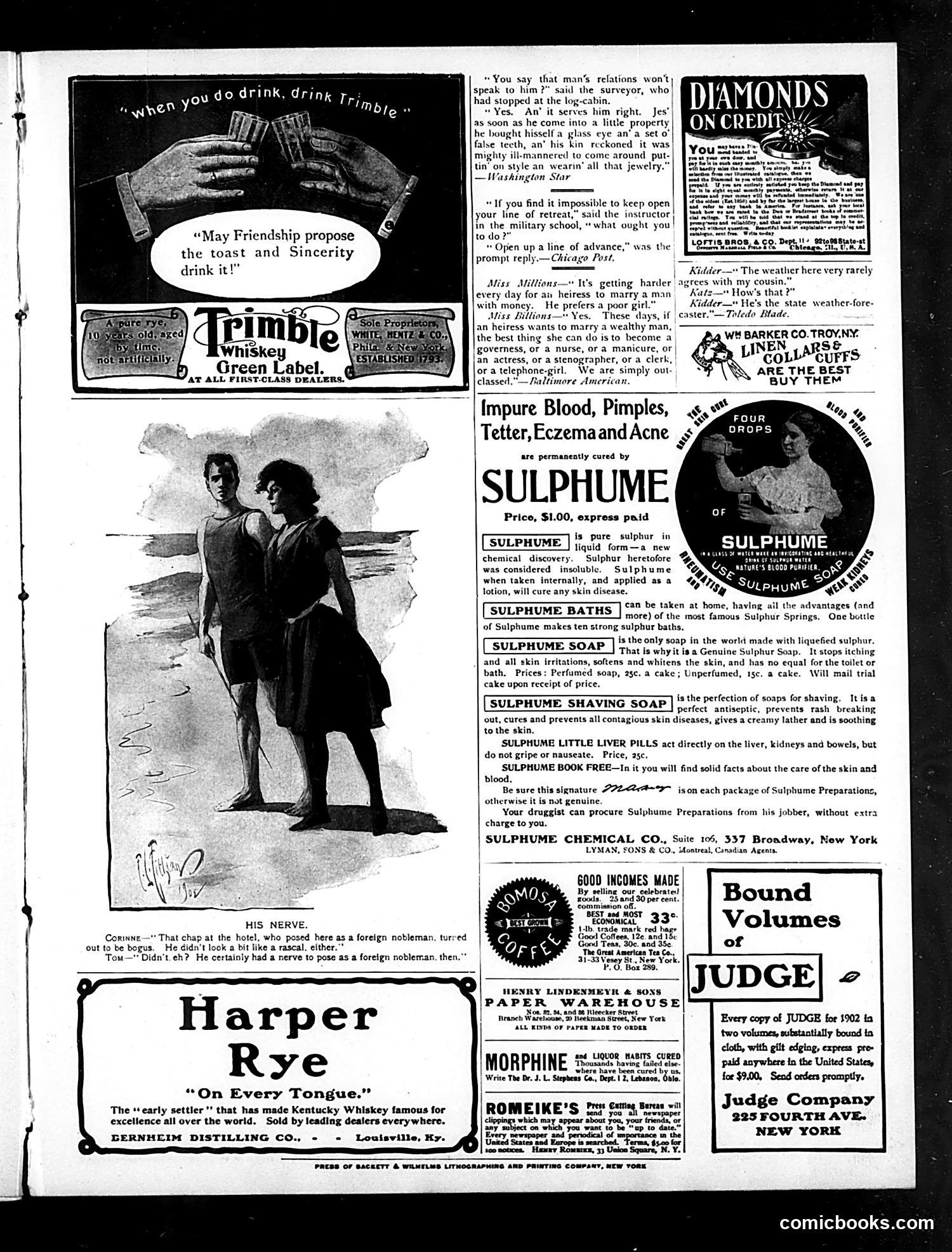
This page primarily consists of **advertisements and short humorous anecdotes** rather than political cartoons. The main cartoon shows a con artist posing as a foreign nobleman at a hotel—a satire on social pretension. The joke: a poor man is fooled, while the anecdote's humor lies in the rascal's "nerve" attempting such a transparent fraud. Other brief jokes mock: - **Rural class resentment**: A backwoods man resents his relative buying false teeth and a glass eye, seeing them as pretentious "putting on style" - **Changing gender dynamics**: Jokes about wealthy heiresses now needing to pose as poor working women (governess, nurse, stenographer) to attract men with money—inverting traditional marriage economics - **Military absurdity**: A cadet's nonsensical answer about military retreat The **bulk of the page is patent medicine advertising** (Sulphume for skin conditions, morphine, etc.)—typical of early 1900s magazines. A Harper Rye whiskey ad and Judge Company bound volumes advertisement fill remaining space. The humor reflects early 20th-century anxieties about social mobility, authenticity, and changing gender roles.
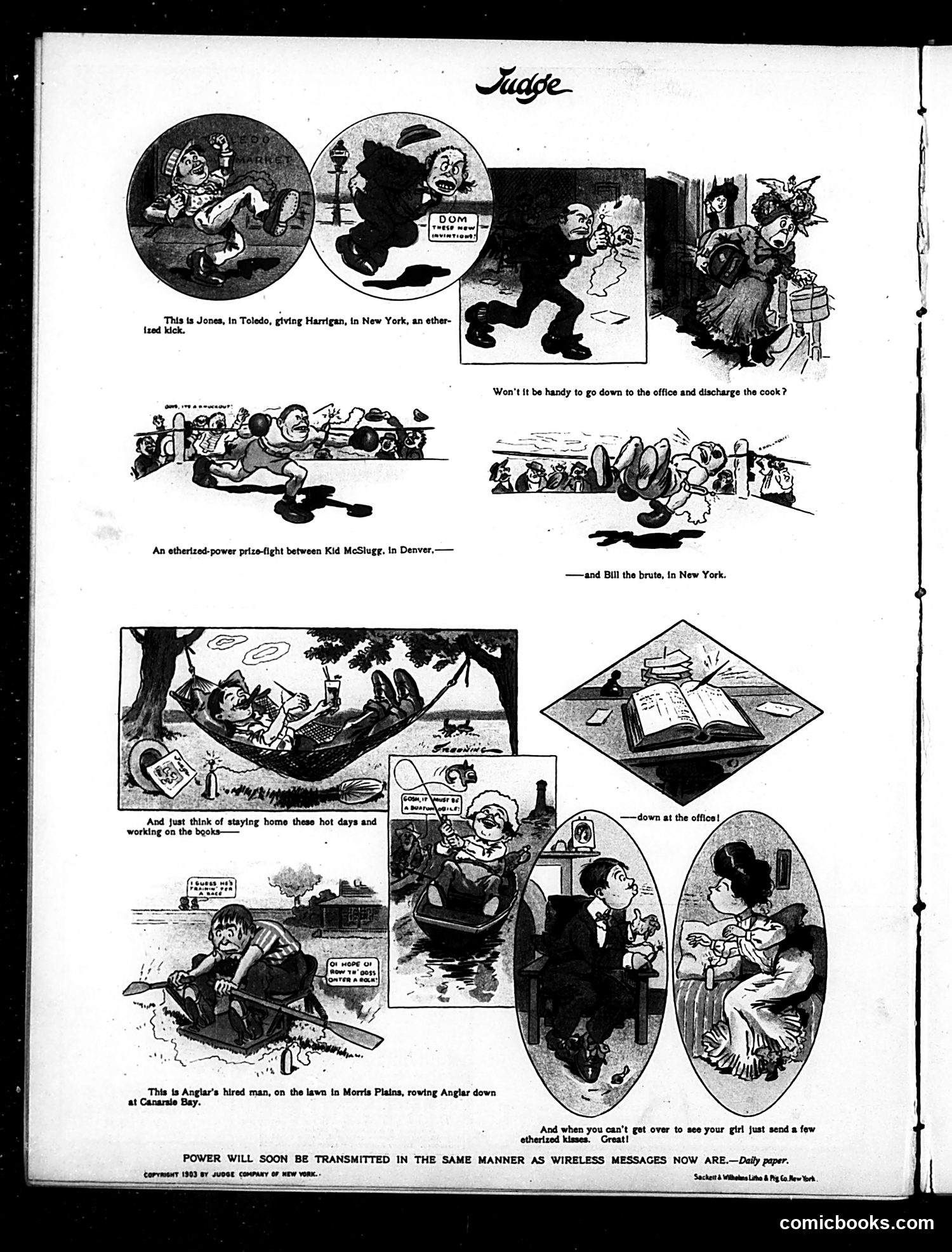
This 1903 page satirizes a newspaper prediction that power could be transmitted wirelessly like radio messages. The cartoons mock this claim through humorous scenarios showing absurd consequences. The vignettes depict characters in various situations—a man rowing a boat, office workers, couples—with the implied joke that if wireless power transmission worked as claimed, everyday activities would become comically disrupted. One caption mentions "Anglar's hired man" rowing someone at Canarsie Bay, suggesting the technology would enable lazy or impractical behaviors. The bottom caption explicitly references the source: a newspaper claim about future wireless power transmission. Judge's satire suggests such technology was either impossible or would create ridiculous social problems if realized. This reflects early-1900s skepticism toward emerging wireless technology predictions, a common theme in period humor magazines.