
Judge, 1903-08-15 · page 6 of 16
Judge — August 15, 1903 — page 6: what you’re looking at
What you’re looking at
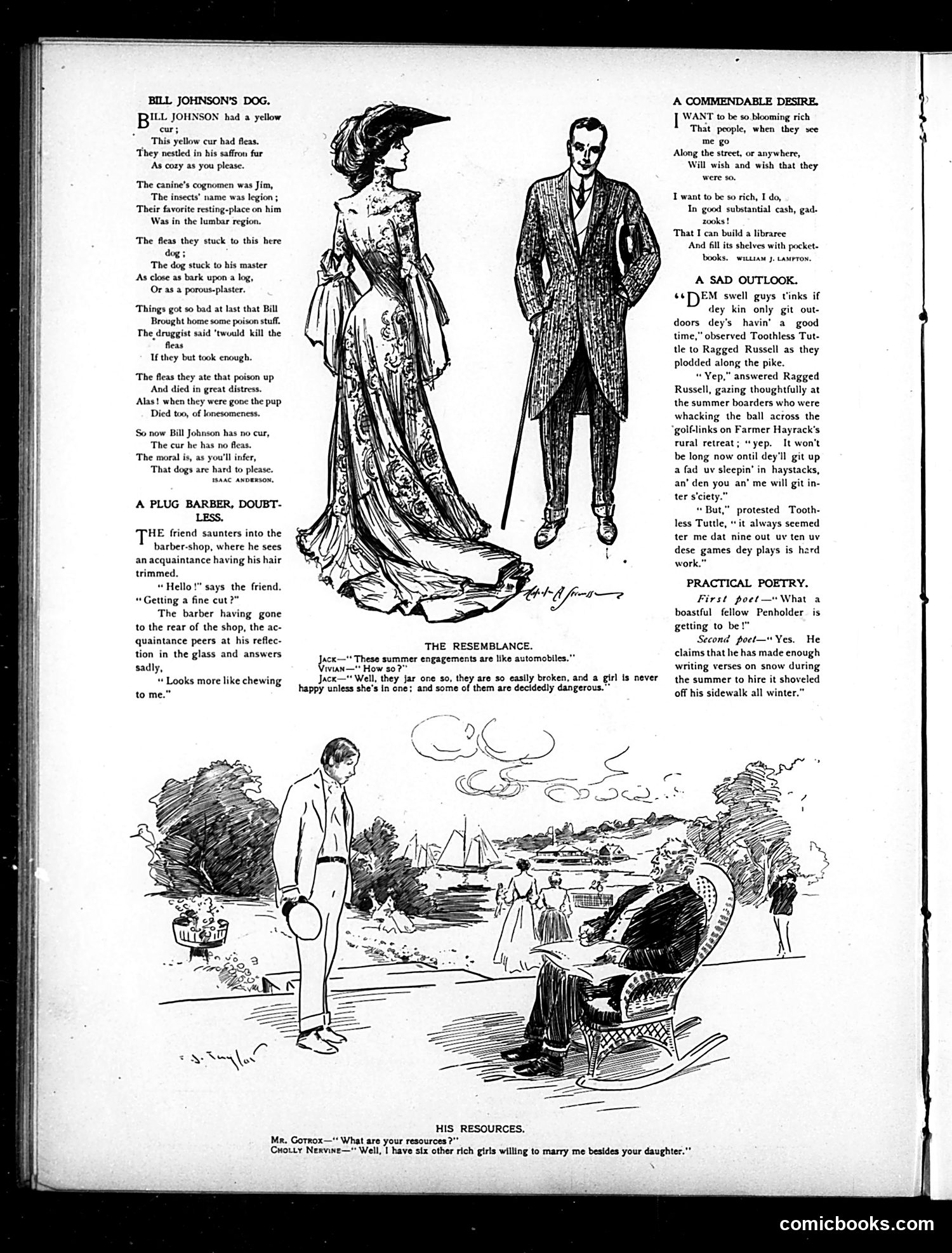
This page contains several satirical pieces typical of early 20th-century American humor: **"Bill Johnson's Dog"** is a humorous narrative poem about a dog infested with fleas that dies of loneliness after poison kills the parasites—a darkly comic morality tale suggesting life's interconnections. **"A Plug Barber, Doubtless"** jokes about a barber's poor work, with a customer saying his haircut looks more like "chewing" than styling—mocking incompetent tradesmen. **"The Resemblance"** satirizes young women's obsession with automobiles, comparing summer romantic engagements to cars: easily broken, desired constantly, and dangerous. **"His Resources"** mocks social-climbing suitors, with a character claiming his real asset is having six other wealthy women willing to marry him—satirizing gold-diggers and shallow courtship. **"A Commendable Desire"** and the working-class dialogue pieces gently mock wealth-seeking and vacation pretensions among different social classes. The overall tone reflects Judge's satirical focus on American social pretensions, consumer culture, and class dynamics of the era.
📄 Transcribed text from this page (OCR, searchable)
Machine-transcribed from the original scan — historical spelling and the odd misread are preserved.
BILL JOHNSON’S DOG. BML JOHNSON had a yellow cur; This yellow cur had fleas. They nestled in his saffron fur As cozy as you please. ‘The canine’s cognomen was Jim, The insects’ name was legion ; Their favorite resting-place on him Was in the lumbar region. ‘The fleas they stuck to this here dog ; The dog stuck to his master ‘As close as bark upon a log, Or as a porous-plaster. ‘Things got so bad at last that Bill Brought home some poison stuff. The druggist said ‘twould kill the fleas If they but took enough. ‘The fleas they ate that poison up And died in great distress. Alas! when they were gone the pup Died too, of lonesomeness. So now Bill Johnson has no cur, The cur he has no fleas. The moral is, as you'll infer, That dogs are hard to please. ISAAC ANDERSON, A PLUG BARBER, DOUBT- LESS. THRE friend saunters into the barber-shop, where he sees an acquaintance having his hair trimmed, “ Hello!" says the friend. Getting a fine cut?” The barber having gone to the rear of the shop, the ac- quaintance peers at his reflec- tion in the glass and answers sadly, + Looks more like chewing to me.” THE RESEMBLANCE. ice" These summer engagements are ike automobiles." ivian—"* How 30?" Jack—"' Well, they jar one 50, they are so easily broken, and a girl is never happy unless she's in one; and some of them are decidedly dangerous.” HIS RESOURCES. Mr. Gorrox—'' What are your resources ?”” Cwouty Nexvine—" Well, I have six other rich girls willing to marry me besides your daughter."” A COMMENDABLE DESIRE, ] WANT to be 20 blooming rich That people, when they sce me go Along the street, or anywhere, Will wish and wish that they were 50. I want to be so rich, I do, In good substantial cash, gad- zooks! ‘That I can build a libraree And fill its shelves with pocket books. witias 5. Laurron. A SAD OUTLOOK. SePJEM swell guys cinks if dey kin only git out- doors dey’s havin’ a good time,” observed Toothless Tut- tle to Ragged Russell as they plodded along the pike. “Yep,” answered Ragged Russell, gazing thoughtfully at the summer boarders who were whacking the ball across the “golf-links on Farmer Hayrack’s rural retreat; “yep. It won't be long now ontil dey'll git up a fad uv sleepin’ in haystacks, an’ den you an’ me will git in- ter s'ciety.” “But,” protested Tooth- less Tuttle, “it always seemed ter me dat nine out uv ten uv dese games dey plays is hard work.” PRACTICAL POETRY. First poet—“What a boastful fellow Penholder is getting to be!” Second poet—“ Yes. He claims that he has made enough writing verses on snow during the summer to hire it shoveled off his sidewalk all winter.” comicbooks.com